Temporal fluctuation scaling in nonstationary counting processes
The fluctuation scaling law has universally been observed in a wide variety of phenomena. For counting processes describing the number of events occurred during time intervals, it is expressed as a power function relationship between the variance and…
Authors: Shinsuke Koyama
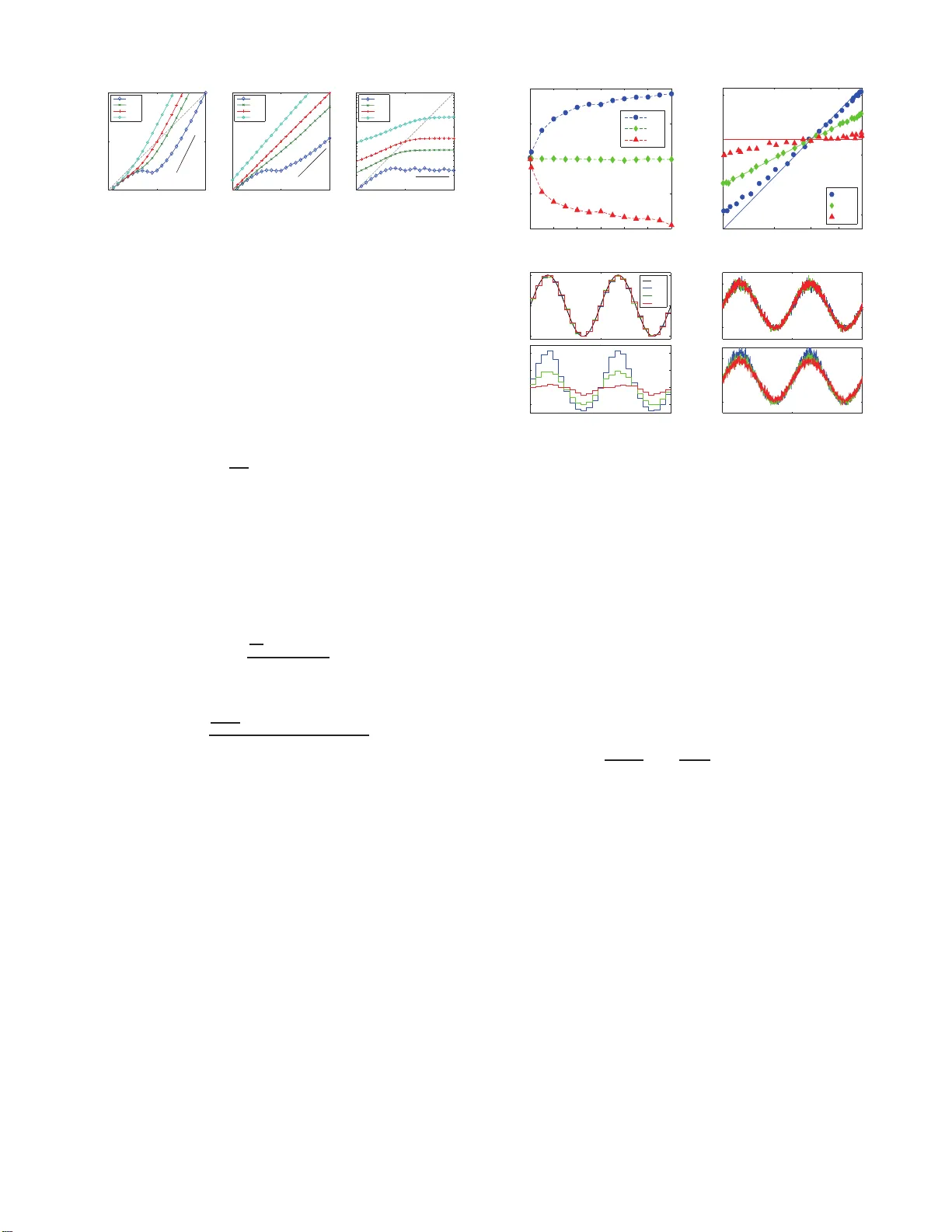
T emp oral fluctuation scaling in nonstationary coun ting pro cesses Shinsuke Koy ama ∗ Dep artment of S tatistic al Mo deling, The Institute of Statistic a l Mathematics, 10-3 Mi dori-cho, T achikawa, T okyo 190-8562, Jap an (Dated: June 4, 2021) The fluctuation scaling law has univ ersally b een observe d in a wide v ariet y of phenomena. F or counting processes describing th e number of ev ents occurred during time in terva ls, it is expressed as a p o wer function relationship b etw een the v ariance and th e mean of the even t count p er unit time, the c h aracteristic exponent of which is obtained theoretically in the limit of long duration of counting windo ws. Here I show th at the scaling law effectively app ears even in a short t imescale in which only a few even ts o ccur. Consequently , the counting statistics of nonstationary event s equ ences are sho wn t o exhibit the scaling la w as w ell as the dynamics at temp oral resolution of this timescale. I also prop ose a metho d to ex t ract in a systematic manner t he c haracteristic scaling exp onent from nonstationary data. The fluctuation scaling law has b een observed in man y natural and man-made s ystems. It was o riginally found by T aylor in ecolog ical systems as an empirical power function relationship be t ween the v ariance and the mean of the num b er o f individuals of a sp ecies pe r unit area [1]. The scaling relationship has been demo nstrated in other fields such as transmiss ion of infectious diseases, cancer metastasis, ch r omosomal s tructure and traffic in transp ortatio n netw or k s [2 – 6], showing a universality of the law. This letter focuse s pa r ticularly on the fluctuation scal- ing law in c o unt ing pro ces ses. A counting pro cess is a sto chastic pro cess { N t ; t ≥ 1 } de s cribing the n umber of even ts o ccur red in the interv al (0 , t ], which is used for mo deling a wide v ariety of phenomena such a s o c c ur- rence of ear th quake, photon counting and neur al spike trains [7 – 9]. The fluctuation sca ling law fo r the counting pro cess consider ed here states that the v ariance of N t per unit time is a p ower function o f the mean of N t per unit time, V ar ( N t ) /t ∝ [ E ( N t ) /t ] β . (1) Since a random proc e s s leads t o a Poisson pr o cess, β = 1 bec omes an indica tor of ra ndomness: every deviation from rando mnes s indicates a deviatio n fr om this r ela- tionship. T o co mpute the mean and the v aria nce of N t , it is usually taken a co un ting window o f long dura tion t ≫ 1 in whic h a larg e num b er of even ts occur. How ever, the scaling law (1) generally depends on the duratio n of the counting window, o r o n the average num b er of even ts in the window. In the limit o f t → 0, for in- stance, it can be s hown that the scaling relation with a r- bitrary exp onent v anishes but β approa ches unit y , which is essent ia lly the same a s the fact that the F ano factor F ( t ) := V ar ( N t ) /E ( N t ) fo r any regular p o int pr o cess approaches unity f o r t → 0 [10]. It is therefore of in terest how many even ts on av er age in the counting window is ∗ Electronic address: sko yama@ism.ac.jp enough to observ e the scaling law, the expone nt of which characterizes the ‘intrinsic’ v aria bilit y o f o ccurr ence of even ts. This question is imp or tant particular ly fo r nonstation- ary sequences o f even ts. In nervous systems, for example, the firing rate is typically mo dulated with timescale of tens to hundreds milliseconds, in which only a few ev ents (spikes) o ccur [11]. Since n eur ons oper a te in such a short timescale, it is imp or tant to ask if the counting statistics exhibits the sca ling law with only a few even ts. Here, I show by a ssuming r enewal pro cesses that the scaling la w in the co un ting statistics app ears even in a short c ounting window, in which only a few even ts on av erag e o ccur. I also prop os e a metho d to extract in a systema tic manner the characteristic sca ling exp onent from nonstationary sequences of even ts. The ability o f the pr op osed metho d is demonstrated with data simu- lated b y a leaky integrate-and-fire neur on mo del. I b egin with the fluctuation scaling law for stationar y renewal pro c e sses. Let X ≥ 0 be a n int er even t int er - v al, a nd m = E ( X ) and s 2 = V ar ( X ) b e its mea n and v ar ia nce, re sp e c tively . Suppo se that the v ariance has a power function rela tio n with m as s 2 = κm α . (2) The scaling exp o nen t α characterizes the ‘intrinsic’ dis - per sion of o ccurrence of e vents. F or a Poisson (random) pro cess, α = 2. On the other hand, α > 2 ( < 2) implies the tendency for the timing of even t o ccur rence to b e ov er (under) disp ersed for large means , and under (over) disp e rsed for small means. Let N t be the num b er of event s o ccur red in the co unt- ing window (0 , t ]. F or t ≫ 1, N t asymptotically follows the Gaussian distribution with mean t/m a nd v aria nce s 2 t/m 3 [12]. The n, if the int er v al statistics has the scaling prop erty (2), the v ariance o f N t per unit time is asymp- totically scaled b y the mean of N t per unit time (i.e., the rate) as V ar ( N t ) t = κ E ( N t ) t β , (3) 2 where β = 3 − α for t ≫ 1. Note that the scaling law (3) depe nds on the duration t of the counting window. In theory , the e xpo nent β = 3 − α is a chiev ed in the limit of t → ∞ , in which a sufficiently larg e num b er of even ts o ccur. On the o ther ha nd, β approaches 1 for the limit of t → 0 . One c a n construct a n intereven t interv al density of re- newal process that pos sesses the scaling law (2) by in tro - ducing a pa rametric probability densit y f ( z ; κ ) with unit mean and the v ariance κ , and resc a ling it as p ( x ; λ, κ, α ) = λf ( λx ; λ 2 − α κ ) , (4) where λ = 1 /m is the frequency of o ccurre nce of even ts. Here, the choice of f ( z ; κ ) is arbitrar y : different choices o f f ( z ; κ ) generate different families of probabilit y densities that hav e the scaling law (2 ). A nonstationar y r enewal pr o cess that exhibits the sca l- ing law in the co un ting s tatistics can b e cons tructed by generalizing the construction o f nonstatio nary Poisson pro cesses, the idea o f which is given as follows. Consider a stationary Poisson pro ces s with unit r ate defined on dimensionless time s . Then, the probability of o ccurr ing an even t in a short interv al ( s, s + ds ] is given by ds . Let λ ( t ) be a ra te of even t o ccurrence on the rea l time t and Λ( t ) = R t 0 λ ( u ) du b e the cumulativ e function of λ ( t ). By transforming the time s in to t wit h s = Λ( t ), one obta in a nonstationar y Poisson pro cess with time-dep endent rate λ ( t ), in which the pr obability of o ccurr ing an even t in a short interv al ( t, t + dt ] is λ ( t ) dt . In the same manner, any renewal pro ces s with unit r ate can be transformed by s = Λ( t ) int o a nonstationary renewal pro cess with the trial- av erag ed r ate λ ( t ) [13 – 16]. How ever, this trans- formation do es not allow the v ariance of the ev ent count per unit time to hav e the pow er function of th e rate with arbitrar y sc a ling e xpo nent [31]. Hence, I pro po se a gener alization of the transformation so that the v ariance and the mean of coun t per unit time ob ey the sca ling law (3). Consider a renew al pro cess with the in tere vent interv al densit y f ( z ; κ ). The conditional rate, or the haza rd funciton, of this pro c ess is given by g ( s ; s ∗ , κ ) = f ( s i − s ∗ ; κ ) 1 − R s s ∗ f ( u − s ∗ ; κ ) du , (5) where s ∗ ( < s ) is the last event time preceding s . Anal- ogously to Eq. (4), by r e s caling the v ariance para meter κ → λ ( t ) 2 − α κ as well as the time s = Λ( t ), the co ndi- tional rate of the nonstationary renewal pro cess is ob- tained as r ( t ; t ∗ , { λ ( t ) } , κ, α ) = λ ( t ) f (Λ ( t ) − Λ( t ∗ ); λ ( t ) 2 − α κ ) 1 − R t t ∗ λ ( v ) f (Λ( v ) − Λ( t ∗ ); λ ( v ) 2 − α κ ) dv . (6) F o r dt ≪ 1 , Eq. (6) gives the conditional probability of o ccurring an ev ent in ( t, t + dt ], given the last even t at t ∗ , P ( N t + dt − N t = 1; t ∗ , { λ ( t ) } , κ, α ) ≈ r ( t ; t ∗ , { λ ( t ) } , κ, α ) dt, (7) which can b e use d for sim ulating se q uences of even ts. With the bas is of the model (6), I pr op ose a metho d for estimating the scaling exp onent α (and the co e ffi- cient κ ) fro m data consisting of no nstationary sequences of even ts. The likelihoo d function of ( α, κ ), given a se- quence of even t times { t i } := { t 1 , . . . , t n } , is e x pressed with the conditional ra te function (6) as l ( κ, α ; { t i } , { λ ( t ) } ) = " n Y i =2 r ( t i ; t i − 1 , { λ ( t ) } , κ, α ) # × exp − Z t n t 1 r ( u ; t N u , { λ ( t ) } , κ, α ) du ! , (8) where the exp onential factor represents the pr obability of no e vent in eac h in tereven t in terv a l [17, 18]. Substituting Eq. (6) int o Eq. (8 ), it ca n b e ex pressed in mor e tractable form, l ( κ, α ; { t i } , { λ ( t ) } ) = n Y i =2 λ ( t i ) f (Λ( t i ) − Λ( t i − 1 ); λ ( t i ) 2 − α κ ) . (9 ) F o r M independent and identically distributed trials { t j i } M j =1 := { t j 1 , . . . , t j n j } M j =1 , n j denoting the num be r of even ts in the j th tr ial, the likelihoo d function is simply given b y the pro duct of the likelihoo d function of single trials (8). Using this, the par ameters can b e estimated in the following t wo s teps. 1) Compute an estimate ˆ λ ( t ) of the tr ial-av er a ged rate function from { t j i } M j =1 , which can be obtained by a kernel density estima to r with a Gaussian kernel whose band-width is determined by min- imizing the expected mean squa red er ror [19]; 2 ) Substi- tute ˆ λ ( t ) and { t j i } M j =1 int o the likelihoo d function, and maximize it with re s pe c t to ( α, κ ) to obtain the estimate ( ˆ α, ˆ κ ). T o study the be havior of the statistical mo del (6), the stationary cas e (i.e., λ ( t ) = λ is constant in time) is examined firstly . F or this pur p o s e, the gamma densit y , f ( z ; κ ) = κ − 1 /κ z 1 /κ − 1 e − z /κ / Γ(1 /κ ) , (10) is employ ed for f ( z ; κ ), a nd M = 1 0 5 sequences o f even ts are simulated using the interiven t interv al density (4), or equiv alently the co nditional rate function (7) with λ ( t ) = λ , under the equilibrium condition for each α = 1, 2 and 3. The equilibrium condition is ensur ed by start- ing the sim ulatio ns some times b efore the actual measure- men t b eg ins. The mean ˆ λ and the v ar iance ˆ v o f the num- ber o f event in the counting window of duration ∆ = 1 are calculated from the M trials, a nd are plotted on a log-log sc a le (Figure 1 ). It is seen from this figure tha t ˆ v and ˆ λ a symptotically ob ey the scaling law ˆ v ∝ ˆ λ β with β = 3 − α as ˆ λ is increased. Recall that the scaling law (3) for sta tionary renewal pro ces s es is theoretica lly derived for a long duration of the counting window in which a 3 10 −1 10 0 10 1 α =1 α =2 α =3 κ =0.1 κ =0.5 κ =1 κ =3 κ =0.1 κ =0.5 κ =1 κ =3 κ =0.1 κ =0.5 κ =1 κ =3 10 −1 10 0 10 1 β =2 β =1 β =0 10 −1 10 0 10 1 10 −1 10 0 10 1 10 −1 10 0 10 1 10 −1 10 0 10 1 λ ^ λ ^ λ ^ v ^ FIG. 1: The log-log plot of the vari ance of event count ˆ v as a function of th e mean ˆ λ for α = 1(left), 2(middle) and 3(right). The dashed lines of unit slope (indicating ˆ v = ˆ λ ) are in cluded for comparison. Even with a few events on av erage, ˆ v and ˆ λ exhibit the scaling law with the exp onent β = 3 − α . large num be r of events o ccur , s o that the central limit theorem can b e applied [12]. The simulation result, how- ever, shows that the s caling law with β = 3 − α app ears even with a few event s. T o examine the nonstationa ry case, a p erio dic function λ ( t ) = 0 . 04 + 0 . 02 sin 2 π 500 t is used fo r the time-dependent rate, and M = 1 0 4 sequences of ev ents ar e simulated us- ing Eq. (7) in the time interv al t ∈ (0 , 100 0] for each α = 1, 2 and 3. The time axis is divided into equally spaced, contiguous time windo ws, each of duration ∆, and the nu mber of even ts in the i th window o f the j th trial is counted a nd denoted by N j i . The mean and the v arianc e of the ev ent count p er unit time in the i th window ar e resp ectively co mputed as ˆ λ i = 1 M P M j =1 N j i ∆ , (11) and ˆ v i = 1 M − 1 P M j =1 ( N j i − ˆ λ i ∆) 2 ∆ . (12) The slop e β is then computed by p erforming the linear regres s ion of { lo g ˆ v i } on { log ˆ λ i } . Figur e 2a depicts β as a function of ∆, showing that β approa ches 3 − α a s ∆ is incr eased while β → 1 as ∆ → 0. F or illustration, Fig- ure 2b plots { ˆ v i } aga inst { ˆ λ i } , which ar e ca lculated with ∆ = 40 , on a log-lo g sca le, in whic h it is seen that the scaling law with the exp o nent β = 3 − α approximately holds for relatively la rge ˆ λ i (i.e., the av er age num b er of even ts in the counting windows is roughly more than 1 ), which correlates with the finding in the stationary case. With the time resolution ∆ = 4 0, ˆ v i s are dynamically mo dulated in prop ortion to ˆ λ β i s with β ≈ 3 − α (Fig- ure 2c). If the dur ation of counting windows is taken to be ∆ = 1 , the even t count exhibits nearly the Poisson v ar ia nce (i.e., ˆ v i = ˆ λ i ), so that ˆ v i s of the three ca ses are hardly distinguishable from each other (Figure 2d). The ability of the prop osed inference metho d to ex- tract the c har acteristic scaling expo nent α is tested with data simulated by a le aky integrate-and-fire (LIF) neu- ron mo del. F o r this pur po se, I fir st ex amine the scaling 0 500 1000 0.02 0.04 0.06 0.08 0.02 0.03 0.04 0.05 0.06 10 −1.9 10 −1.5 10 −1.1 time λ ^ i λ ^ i 0.02 0.04 0.06 0 500 1000 0.02 0.04 0.06 λ ^ i time (c) (b) (d) (a) 0.02 0.04 0.06 0 20 40 60 80 100 120 0 0.5 1 1.5 2 Δ α =1 α =2 α =3 v ^ i v ^ i v ^ i β β =2 β =1 β =0 α =1 α =2 α =3 α =1 α =2 α =3 λ (t) FIG. 2: The results of the nonstationary case. The simula- tions are p erformed with the parameter v alues α =1, 2 and 3, and κ = 0 . 04 α − 2 . In all the figures, results for α =1, 2 and 3 are represen ted with blue, green and red, respectively . (a) The slop e β , obtained by the linear regression of { log ˆ v i } on { log ˆ λ i } , as a function of ∆. (b) The log-log plot of ˆ v i against ˆ λ i calculated with ∆ = 40. The solid lines represent the theoretical slop e β = 3 − α . (c) The time course of ˆ λ i (top) and ˆ v i (b ottom) calculated with ∆ = 40. (d) The same as in (c) but with ∆ = 1. prop erty of spike trains gene r ated from the LIF mo del. The dynamics o f the LIF mo del are repr esented by the equation [20], dV ( t ) dt = − V ( t ) τ + I ( t ) , (13) where V ( t ) is the membrane p otential, τ = 5 is the mem- brane de c ay time constant, and I ( t ) r epresents the in- put curre nt. When the membrane p otential reaches the threshold v th = 1, an even t (spike) is g enerated and the mem bra ne po ten tial is reset to 0 immediately . F o r a stationa ry input current I ( t ) = µ + σ ξ ( t ), wher e ξ ( t ) is a Ga ussian white noise s atisfying h ξ ( t ) i = 0 and h ξ ( t ) ξ ( t ′ ) i = δ ( t − t ′ ), the following t wo cas es are exam- ined in the s im ulatio ns: (i) µ v aries from 0.15 to 0.25 while σ = 0 . 1 is fixed, and (ii) σ v a ries from 0 .2 to 0.6 while µ = 0 . 05 is fixed. F or each set of para meter v al- ues ( µ, σ ), a s equence o f 1 0 3 even ts is generated, fro m which the mean and the v aria nce of intereven t interv al are calculated. It is found that the v ariance and the mean ob ey the sca ling law, who se exp onent o btained b y the linear regres s ion on a log-log scale is α = 3 . 0 3 for (i) and α = 1 . 8 9 for (ii) (Figure 3a). F o r a nonstationary input current I ( t ) = µ ( t ) + σ ( t ) ξ ( t ), the following tw o ca ses a re consider ed ana lo- 4 gously to the stationary case: (iii) the mean current has a p erio dic profile µ ( t ) = 0 . 2 + 0 . 05 sin 2 π 500 t , while the am- plitude of the c ur rent fluctua tion is consta n t σ ( t ) = 0 . 1, and (iv) the amplitude of the current fluctuatio n is p e- rio dically mo dula ted σ ( t ) = 0 . 4 + 0 . 2 s in 2 π 500 t , while the mean cur rent is consta nt µ ( t ) = 0 . 0 5. F or each case, M = 10 4 spike trains are simulated in the time interv al t ∈ (0 , 10 00], from which { ˆ λ i } and { ˆ v i } are computed by Eqs. (11 )- (1 2) with ∆ = 40 . Figure s 3b and c depict the r esult, showing that ˆ v i and ˆ λ i approximately ob ey the s caling la w. The slo p e obtained by the linear re- gressio n of { log ˆ v i } on { log ˆ λ i } is β = 0 . 03 for (iii) and β = 1 . 10 fo r (iv), from which we see the approximate relation β ≈ 3 − α . It is, thus, empirically confirmed that the s pike trains generated fr om the LIF mo del exhibit the scaling law, which qualitatively matches that of the statistical mo del (6) (Figur es 2b and c). I finally examine if the pr op osed inference metho d ca n capture the sca ling exp onent α directly from the no nsta- tionary s e quences of even ts ge ne r ated by the LIF model. F o r ea ch nonstationar y input cur rent (iii) and (iv), the inference metho d is applied to M spike trains simulated by the LIF mo del to obtain ˆ α . Figure 3d plots ˆ α against the num b er of trials M , which s hows that the accurac y of the estimation is improved as M is increased. F or ex- ample, the e x po nent is estimated from M = 20 trials as ˆ α = 3 . 08 ± 0 . 05 for the case (iii) and ˆ α = 1 . 93 ± 0 . 0 3 for the case (iv), which ar e in go o d ag reement with the v alues obta ine d in Figure 3a. F o r summary , it was shown in this letter that as suming renewal pro cesses, only a few even ts in counting windows are eno ugh for the v aria nce and the mea n p er unit time to ex hibit the scaling law with the exp onent β = 3 − α . As a result, the counting statistics of no nstationary event sequences display the sca ling law as well as the dynamics at temp oral r esolution of this co unt ing windows (Fig- ures 2c and 3c). I a lso pro p o sed a method ba sed on the likelihoo d principle to extract the scaling expo ne nt from nonstationar y sequenc e s of even ts, the ability o f which was demo nstrated with the da ta simulated b y the LIF mo del. The res ults of renewal pro cesses can b e genera lized to nonrenewal pro cesses directly . F or nonrenewal pro- cesses, whose in terv al statistics has the scaling law (2), the asymptotic scaling relation in the count ing sta tistics (3) remains unchanged except that the co efficient is mo d- ified [32]. The generaliza tion of the prop osed inference metho d to the nonrenewal pro cess es is also s traightfor- ward since the tr a nsformation of a stationa ry p oint pro - cess (5) to a nonstationa ry p oint pr o cess (6 ) is applicable to nonrenewal pr o cesses. In nervous systems, neurons pro duce an action poten- tial by integrating presyna ptic inputs within tens mil- liseconds, in which typically only a few s pikes come from each presynaptic neuron. This sugg ests that the sca ling law in spike count effectively a pp e a rs in the integration time, and thus may ha ve an impact on infor mation pro - cessing. Ma et al. [21] suggested a hypothesis that the 0 0.05 0.1 0 500 1000 0 0.05 0.1 10 1 10 2 10 1 10 2 10 3 10 4 mean(X) var(X) α =1.89 α =3.03 10 −2 10 −1 10 −2 10 −1 β =1.10 β =0.03 (iii) (iv) M α λ ^ i v ^ i λ ^ i time v ^ i 1 20 40 60 80 100 1. 5 2 2. 5 3 3. 5 4 (ii) (i) (iii) (iv) (iii) (iv) (b) (a) (d) (c) ^ FIG. 3: The result of the LIF mo del. In all the figures, blu e indicates that the mean current µ v aries, while red ind icates that th e amplitude of current fluctuation σ v aries. (a) The log-log plot of the v ariance against the mean of intereve nt in- terv al when the stationary input currents are injected. The solid lines represent the slopes obt ained by the linear regres- sion on the log-log scale. (b) The log-log plot of ˆ v i against ˆ λ i calculated with ∆ = 40 when the nonstationary current in- puts are injected. The solid lines represent the slopes obtained by the linear regression on the log-log scale. (c) The time courses of ˆ λ i (top) and ˆ v i (b ottom) calculated with ∆ = 40. (d) The estimate ˆ α as a fun ction of the num b er of trials M . The standard d eviations are compu ted with 100 realizations. Poisson-like statistics in the res po nses of p o pulations of cortical neur ons may r epresent probability distributions ov er the stimulus a nd implemen t Bayesian inferences. An impo rtant prop erty in their hypo thes is is that the v ari- ance of spik e count is prop or tional to the mea n spike count, which corr esp onds to β = 1 (or α = 2 in the int er v al statistics) in our for m ulatio n. It is worth p oint- ing out that β ≈ 1 is obs e rved in the simulations o f the LIF neuron with the fluctuating current input (Figure 3 red), which ca n b e realized b y balanced excitato ry and inhibitory synaptic inputs observed in the cortex [22 – 26]. On the other hand, from in vivo recordings , T r oy and Robson [27] fo und that s tea dy discharges of retinal ga n- glion cells, in resp onse to stationar y visual patter ns, ex- hibit the scaling law in the in terv al statistics (2) with exp onent α ≈ 3. This exp onent is also observed in the simulations using multi-compartmen t mo dels of retinal ganglion cells [28] as w ell as the LIF mo del with the cur- rent input whose mean is modula ted (Figure 3a blue). It is therefor e sp eculated that the scaling exp o nen t α may r eflect the intrinsic mechanisms of neur onal dis- charge or the internal dynamics of netw ork s [30], and ma y 5 be r e lated to schemes for neural c omputation the ner vous systems e mploy . The prop o sed metho d offers a system- atic wa y to extract the characteristic sca ling exp onent from exp erimental data. This rese a rch w as supp orted by JSPS KAKE NHI Grant Number 2 47002 87. [1] L. R. T aylo r, Nature 189 , 732 (1961). [2] R. M. And erson and R. M. May , Nature 333 , 514 (1989). [3] W. S. Kend al and P . F rost, J. Natl. Cancer Inst. 79 , 1113 (1987). [4] W. S. Kendal, BMC Evol. Biol. 4 , 3 (2004). [5] A. F ronczak and P . F ronczak, Phys. Rev. E 81 , 066112 (2010). [6] M. A . de Menezes and A.-L. Barabasi, Phys. Rev. Lett. 92 , 028701 (2004). [7] Y. O gata, J. Amer. Statist. Asso c. 83 , 9 (1988). [8] M. O. Scully and M. S. Zubairy , Quantum Optics (Cam- bridge Un ivers ity Press, 1997). [9] D. H . Johnson, J. Comp. Neurosci. 3 , 275 (1996). [10] M. C. T eic h et al. , J. Opt. So c. Am. A 14 , 529 (1997). [11] B. J. Richmond et al. , J. N europhysiol. 57 , 132 (1987). [12] D . R. Cox, R enewal The ory (Chapman and H all, London, 1962). [13] M. Berman, Biometrik a 68 , 143 (1981). [14] R . Barbieri et al. , J. Neruosci. meth ods 105 , 25 (2001). [15] S . Koy ama and R. E. Kass, Neural Comp. 20 , 1776, (2008). [16] J. W. Pillow , in Neur al Information Pr o c essing Systems , edited by Y. Bengio it et al., V ol. 22, 1473, (2008). [17] D . J. Daley and D . V ere- Jones, An I ntr o duction to the The ory of Point Pr o c esses , V ol. 1 ( S pringer, New Y ork, 2002). [18] R . E. Kass and V . V entura, N eural Comp. 13 , 1713 (2001). [19] H . Shimazaki and S. Sh in omoto, J. Comp. Neurosci. 29 , 171 (2010). [20] C. Ko ch, Bi ophysics of Computation: Information Pr o- c essing in Single Neur ons (Oxford Universit y Press, Ox- ford, 1999). [21] W. J. Ma et al. , Nature N eurosci. 9 , 1432 (2006). [22] C. V. V reeswijk and H. Somp olinsky , Science 274 , 1724, (1996). [23] D. J. Amit and N. Brunel, Cereb. Cortex 7 , 237, (1997). [24] A. Destexhe et al. , Neurosci. 107 , 13 (2001). [25] Y. Shu, A . H asenstaub and D. A. McCormick, Nature 423 , 288 (2003). [26] B. Haider et al. , J. Neurosci. 26 , 4535 (2006). [27] J. T roy and J. Robson, V isual Neurosci. 9 , 535 (1992). [28] M. C. W. v an Rossum, B. J. O’Brien and R. G. Smith, J N europhysiol. 89 , 2406 (2003). [29] M. P . Nawrot, in A nalysis of Par al lel Spike T r ai ns , edited by S. Grun and S. Rotter, Chap. 3 (Springer, New Y ork, 2010). [30] M. A . d e Menezes and A.-L. Barabasi, Phys. Rev. Lett. 93 , 068701 (2004). [31] In fact, this transformation results in th e v ariance of t h e even t count b eing prop ortional to the mean, V ar ( N t ) = κE ( N t ) for t ≫ 1. [32] F or stationary p oint p rocesses with serially correlated in- tereven t in terva ls and the scaling relation ( 2), it holds for t ≫ 1 that V ar ( N t ) /t = κ (1 + 2 η )[ E ( N t ) /t ] 3 − α with η = P ∞ i =1 η i , where η i denotes th e i th-order linear corre- lation co efficient for pairs of in terva ls that are separated by i − 1 intermediate interv als [29].
Original Paper
Loading high-quality paper...
Comments & Academic Discussion
Loading comments...
Leave a Comment