Bayesian inference of inaccuracies in radiation transport physics from inertial confinement fusion experiments
First principles microphysics models are essential to the design and analysis of high energy density physics experiments. Using experimental data to investigate the underlying physics is also essential, particularly when simulations and experiments a…
Authors: Jim A Gaffney, Dan Clark, Vijay Sonnad
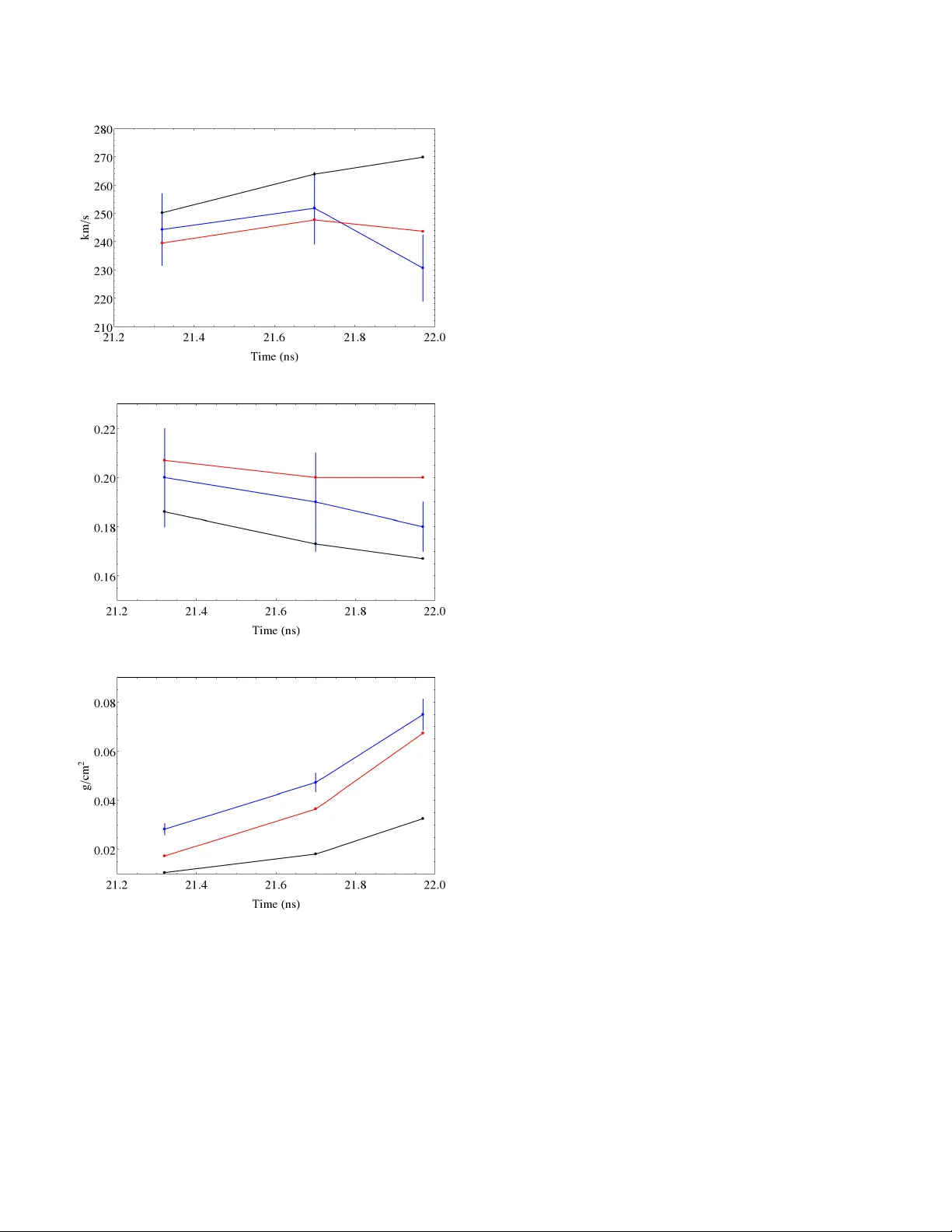
Ba y esian inference of inaccuracies in radiation transp ort ph ysics from inertial confinemen t fusion exp erimen ts J.A. Gaffney a, ∗ , D. Clark a , V. Sonnad a , S.B. Libb y a a L awr enc e Livermor e National L ab or atory, 7000 East Ave, Livermor e, CA 94550 Abstract First principles microph ysics models are essen tial to the design and analysis of high energy densit y ph ysics experiments. Using experimental data to in vestigate the underlying physics is also essen tial, particularly when simulations and exp erimen ts are not consistent with each other. This is a difficult task, due to the large n umber of physical models that play a role, and due to the complex (and as a result, noisy) nature of the exp erimen ts. This results in a large n umber of parameters that make an y inference a daunting task; it is also v ery imp ortant to consistently treat b oth exp erimen tal and prior understanding of the problem. In this pap er we present a Ba yesian metho d that includes b oth these effects, and allows the inference of a set of mo difiers which hav e been constructed to giv e information ab out microph ysics mo dels from exp erimental data. W e pay particular atten tion to radiation transport models. The inference tak es in to accoun t a large set of exp erimen tal parameters and an estimate of the prior knowledge through a mo dified χ 2 function, which is minimised using an efficien t genetic algorithm. Both factors pla y an essen tial role in our analysis. W e find that although there is evidence of inaccuracies in off-line calculations of X ra y driv e in tensity and Ge L shell absorption, mo difications to radiation transp ort are unable to reconcile differences b etw een 1D HYDRA sim ulations and the exp erimen t. Keywor ds: inertial confinemen t fusion, radiation hydrodynamic simulation, Ba y esian inference, plasma opacity, uncertain ty analysis, conv ergent ablator, national ignition facility, radiation transport 1. Introduction 1 In recen t inertial confinemen t fusion (ICF) experiments 2 p erformed at the national ignition facility (NIF) [1], sig- 3 nifican t differences betw een radiation-hydrodynamic sim- 4 ulations and experimental data hav e b een observ ed [2]. 5 It is not clear whether these simulations are inaccurate, 6 or that they neglect some important physical effect. It is 7 quite challenging to in vestigate whic h asp ects of physics 8 mo dels are causing discrepancies and should be impro ved, 9 largely due to the complex, nonlinear dep endance of ICF 10 capsule ev olution on a large n um b er of underlying models. 11 The complex nature of the exp erimen tal designs is an 12 imp ortan t source of the difficulties. There are a large 13 n umber of experimental parameters that are only kno wn 14 with limited accuracy; v ariations in these parameters rep- 15 resen t a noise source in the exp erimental data that can 16 reduce the significance of the exp erimen tal result. Since 17 the ph ysical mo dels w e aim to inv estigate are fairly well 18 constrained b y a large amount of previous work, it is im- 19 I This work performed under the auspices of the U.S. Depart- ment of Energy b y Lawrence Livermore National Lab oratory under Contract DE-AC52-07NA27344. LLNL-JRNL-617033 ∗ Corresponding author Email addr ess: gaffney3@llnl.gov (J.A. Gaffney) p ortan t to take into account the relative significance of 20 the exp eriment and of any previous w ork. The in terplay 21 b et w een experimental and previous information is an es- 22 sen tial ingredient in a reliable analysis, and is often ne- 23 glected. Its inclusion requires a consistent treatment of 24 all physical and exp erimen tal parameters; together there 25 are far to o many of these to treat directly , ho wev er they 26 are to o important to neglect completely . 27 In this pap er w e presen t an analysis of exp erimen tal 28 data taken from a single NIF shot, N110625. The aim 29 is develop a method of inv estigating microphysics mo dels 30 taking in to accoun t man y of the noise sources in the ex- 31 p erimen t, and prior w ork. W e use an inference model that 32 has b een developed sp ecifically to allo w the large num b er 33 of parameters to b e dealt with in a consistent manner [3]. 34 In this work we fo cus on inferring information ab out ra- 35 diation transp ort in the ablator of an ICF capsule from 36 time resolved data taken from radiography [4]. Radiation 37 transp ort relies on sev eral ph ysics mo dels whic h must be 38 appro ximated to mak e a full capsule sim ulation tractable, 39 and as a result are often considered to be p oten tial sources 40 of mo del inaccuracy . In this work existing microphysics 41 tables are mo dified in ph ysically motiv ated wa ys; these 42 mo difiers are interpreted as measures of the inaccuracies 43 in the physics mo dels, and their inferred v alues give in- 44 Pr eprint submitte d to Elsevier Octob er 30, 2018 formation about the source of difficulties in describing 45 exp erimen tal observ ations. 46 2. Microphysics in Inertial Confinemen t F usion 47 ablators 48 In a t ypical indirect driv e ICF design a spherical plastic 49 shell, filled with deuterium-tritium (DT) fuel, is bathed 50 in X ra ys created b y the interaction of laser ligh t with 51 a high Z hohlraum. The resulting ablation of the outer 52 plastic pro duces a rock et action that implo des the shell, 53 compressing the fuel un til it undergo es thermonuclear fu- 54 sion. The propagation and absorption of X ray energy 55 in the plastic and fuel is an essential piece of describing 56 the implosion that requires detailed mo dels of microscopic 57 ph ysics. These physics issues are describ ed by a suit of 58 computer sim ulations which provide, for example, tables 59 of radiative opacities which are tak en as input b y subse- 60 quen t radiation-hydrodynamic simulations [5]. 61 Ac hieving ignition is a challenge and so the design of 62 successful targets requires careful tuning of a large set of 63 design parameters, based on the results of sim ulations [6]. 64 This means that the fine details of microphysics mo dels 65 can be v ery significan t; nev ertheless, the imp ortant as- 66 p ects can b e understo o d with relativ ely simple one dimen- 67 sional models [7]. W e will discuss the important asp ects 68 of microph ysics mo dels in these terms. 69 A t its p eak, the X ray drive on the outer surface of the 70 capsule has a brightness temp erature of around 300eV. 71 The ma jority of the energy of this field is in photon en- 72 ergies that coincide with the K shell absorption edge in 73 carb on (whic h accounts for ∼ 50% by n umber of the plastic 74 ablator) and so the mo del of this absorption feature plays 75 an important role in determining energy deposition in the 76 ablator. Higher photon energies are able to propagate all 77 the wa y through the carb on, dep ositing their energy in 78 the DT fuel. Heating of the fuel by these hard X rays 79 has a detrimen tal effect on the implosion since, for the 80 efficien t adiabatic implosions driven by the NIF, the final 81 densit y is in part determined by the initial temp erature 82 of the DT. Preheat by X rays reduces fuel compressibility 83 and ultimately reduces the final con v ergence that can be 84 ac heived. An imp ortant play er in this preheat is emis- 85 sion from the M shell of the gold hohlraum wall, whic h 86 pro duces an enhancement ov er the thermal sp ecturm of 87 photon energies > 1 . 8KeV; in order to blo ck these from 88 reac hing the fuel a dopan t lay er is buried in the ablator. 89 In this work w e consider germanium dop ed ablators, in 90 whic h case absorption by the Ge L shell aligns with the 91 Au M shell emission and prev ents preheat of the fuel. 92 In realit y , the gro wth of 2 and 3 dimensional instabili- 93 ties also plays a very imp ortan t role in determining the 94 implosion efficiency . In sev ere cases these can b e muc h 95 more imp ortant than the 1D considerations that we hav e 96 describ ed. 97 These tw o asp ects of radiation transp ort, namely ab- 98 sorption of the driv e field and preheat of the fuel, clearly 99 dep end on models of the generation of the driv e sp ectrum 100 and of the absorption in carbon and germanium at a large 101 range of conditions (10-200 eV, 1-10 g/cc). They also hav e 102 direct consequences for the dynamics of the implosion. A 103 simple ro c ket mo del for the in w ards acceleration of the 104 ablator [7] sho ws that the v elo cit y and remaining ablator 105 mass are directly related to v elo cit y of the ablated mate- 106 rial, and therefore the absorption of driv e radiation. The 107 densit y of the fuel at a giv en time is related to the preheat. 108 Measuremen ts of these three quantities, as describ ed in 109 section 4, can therefore provide information ab out under- 110 lying radiation transport ph ysics mo dels. The complexity 111 of ICF exp erimen ts and radiation-h ydro dynamic simula- 112 tions means that extracting this information is a chal- 113 lenging data analysis problem; we describ e a metho d of 114 p erforming this analysis in the next section. 115 3. Bay esian analysis of ICF exp eriments 116 The relationship b et w een ph ysical models, which them- 117 selv es are very complex, and the data is approximated by 118 radiation-h ydro dynamic simulations which ma y not be 119 w ell b ehav ed enough to allow the use of computational 120 in version techniques [8] or fitting tec hniques [9, 10]; the 121 large num ber of ph ysical mo dels that con trol the evolution 122 of an ICF target also presen ts a problem for these meth- 123 o ds. The complex nature of the exp erimen ts also means 124 that there are a large num b er of exp erimental parameters; 125 although these are often constrained by target metrology 126 and design tolerances, their large n umber makes them 127 a significant source of noise in simulations [11]. Dealing 128 with the v ery large space of ph ysical and exp erimental pa- 129 rameters is an imp ortan t challenge to a consistent analysis 130 of ICF data. The usual metho ds of reducing the num b er 131 of parameters, for example b y Mon te-Carlo sampling (see, 132 for example, [12]), are prohibitiv ely expensive, and simply 133 neglecting parameters will lead to misleading results. 134 In [3] w e ha ve developed an inference metho d that al- 135 lo ws these problems to b e addressed. The approac h is to 136 separate out those parameters that are known to affect 137 radiation-h ydro dynamic simulations but are not of direct 138 in terest to the in vestigation of microph ysics models; these 139 are defined as ‘n uisance parameters’. T ypically these pa- 140 rameters refer to exp erimen tal v ariables which hav e a 141 kno wn probability distribution, for example a target di- 142 mension that has b een measured with some error bar. 143 The probability distributions of all nuisance parameters 144 are mapp ed onto the output of radiation-hydrodynamic 145 sim ulations; as a result the simulation output can b e con- 146 sidered as b eing probabilistic. In our mo del w e assume a 147 linear resp onse to nuisance parameters, resulting in an an- 148 alytic expression for the probability distribution of simu- 149 lation outputs (the likeliho o d ). Parameters that are ph ys- 150 ically interesting (and therefore will b e inferred from ex- 151 2 p erimen tal data), such as microph ysics mo dels, are kept 152 separate from the nuisance parameters allo wing their re- 153 lationship with exp erimental data to b e describ ed using 154 the full complexit y of the simulation code. 155 The inference mo del we hav e outlined is based on the 156 maxim um a p osteriori (MAP) estimate; that is, the most 157 probable v alues of all parameters of interest when the 158 exp erimen tal data and prior hav e b een taken in to account. 159 In our analysis these v alues are found by minimising the 160 function [3] 161 I ( θ | d exp ) = X i ( d exp,i − d m ( θ ) i ) 2 σ 2 exp,i − ( d exp − d m ( θ )) T β T β ( d exp − d m ( θ )) + 1 2 ln | Λ η || α T α | − ln P ( θ ) (1) with resp ect to the vector of interesting parameters θ . In the ab o v e expression, d m ( θ ) is the vector of sim ula- tion outputs for given interesting parameters and nomi- nal v alues of the n uisance parameters, d exp is the v ector of experimental data, P ( θ ) is the prior distribution of in- teresting parameters (discussed b elo w) and the matrices α and β satisfy the equations α T α = A T Λ − 1 exp A + Λ − 1 η β T α = Λ − 1 exp A . These matrices summarise the effect of nuisance param- 162 eters on our analysis; Λ exp and Λ η are the co v ariance 163 matrices of the exp erimental measuremen t and nuisance 164 parameters, resp ectively , and A is the linear resp onse of 165 the sim ulation to nuisance parameters η : A ij = ∂ d m ( θ ) i ∂ η j . 166 Equation (1) tak es the form of a mo dified χ 2 function. 167 The first term on the right hand side is the usual χ 2 anal- 168 ysis, and the second can b e interpreted as a loss of infor- 169 mation from the exp erimen t due to nuisance parameters. 170 The third is a normalisation factor. The final term ex- 171 presses the con tribution from prior work on the v alues of 172 the in teresting parameters. In our application we inter- 173 pret this term as an estimated error bar on the ph ysical 174 mo dels we aim to inv estigate, reflecting previous work to 175 v alidate them. The inclusion of this prior information 176 pro vides context for the exp erimen tal result, allo wing in- 177 ferences to b e obtained from a single observ ation. In [3] 178 this was shown to pla y a very imp ortan t role in the anal- 179 ysis of NIF data. 180 The summary of nuisance parameters in the matrix 181 β T β has reduced the num ber of v ariables w e m ust con- 182 sider to only the ones of direct interest. The resulting 183 smo othing of the simulation output also means that the 184 minimisation of equation (1) can b e approached using 185 standard n umerical metho ds. In this work we use a ge- 186 netic algorithm (GA) to efficien tly p erform the minimi- 187 sation. The details of the genetic algorithm hav e been 188 optimised to allo w an efficient exploration of a large pa- 189 rameter space; the sacrifice is that the algorithm is more 190 lik ely to find lo cal minima. In the case of the ICF data 191 w e will consider here, this is not expected to b e an issue 192 since the interpla y b etw een lik elihho d and prior tends to 193 pro duce a single minimum. In more complex cases this 194 can b e tested by using several random initialisations, or 195 a voided by using a more robust algorithm. 196 4. Application to NIF exp erimen tal data 197 W e aim to demonstrate the application of our Bay esian 198 inference method to the in vestigation of microph ysics 199 mo dels using NIF data. W e use 1D simulations of a cap- 200 sule implosion p erformed using the HYDRA radiation- 201 h ydro dynamics code [13]. Our inv estigation proceeds by 202 defining a set of mo difiers to the inputs of these sim ula- 203 tions, and inferring the v alues of these mo difiers. W e are 204 concen trating on physics issues in radiation transp ort and 205 so our mo difiers are to the X ray drive sp ectrum imping- 206 ing on the capsule’s outer surface (found from sep erate 207 mo dels of the hohlraum), and to relev an t opacity mo dels 208 of the ablator material (taken from the T ABOP opacit y 209 mo del). The use of mo difiers, placed on the results of 210 existing calculations, allows our inference results to b e 211 in terpreted as implied inaccuracies in microphysics mod- 212 els. W e giv e details of our modifiers in table 1. In the case 213 of the drive timing mo difier, the prior error bar reflects 214 the error bar on the DANTE instrumen t [14], which giv es 215 a time-resolved measurement of the driv e radiation tem- 216 p erature. This instrument has play ed an imp ortan t role 217 in the developmen t of the separate hohlraum sim ulations 218 whic h pro duce drive profiles for our capsule sim ulations. 219 F or all other mo difiers, prior errors are estimated in order 220 to reflect the exp ected accuracy of the underlying physi- 221 cal mo dels. All modifiers, with the exception of the drive 222 timing, are dimensionless multipliers on existing mo dels 223 and so their ‘nominal’ (and therefore prior) v alues are 1; 224 the driv e timing has a nominal shift of 0 ns. 225 Exp erimen tal data are taken from a single NIF ‘con- 226 v ergent ablator’ shot, N110625. This experiment utilised 227 a germanium dop ed capsule which was radiographed as 228 it implo ded giving a time- and space- resolved measure- 229 men t of plasma densit y [4, 15]. This then giv es time- 230 resolv ed data for the implosion v elo cit y , mass of the ab- 231 lator, and the ρR pro duct of the implo ding fuel shell. 232 W e consider these three data p oin ts, taken at three times 233 during ro c ket-lik e phase of the implosion, in our analysis. 234 The use of implosion v elo city and ablator mass, which 235 diagnose the drive, along with the ρR which is sensitive 236 to preheat of the fuel, should allo w the degeneracy of our 237 mo difier set (for example the driv e intensit y and C K 238 shell) to b e lifted. This is imp ortan t since such degen- 239 eracy results in a set of multiplier v alues that minimise 240 equation (1); the inclusion of the ρR data should select a 241 3 Mo difier Name Description Exp ected Effect Prior Error Driv e Intensit y Multiplies intensit y of 4 th rise in X ra y drive Increased driv e results in increased v e- lo cit y and decreased ablator remaining at giv en time ± 0 . 1 Driv e Timing Shifts the timing of the 4 th rise of the X ra y drive Earlier rise increases drive at giv en time ± 0 . 1 Au M Shell Multiplies the intensit y of the gold M shell component of X ra y driv e sp ectrum Increased M shell results in increased preheat and reduced ρR at given time ± 0 . 2 C K Edge Multiplies the opacit y of the K shell absorption edge in carb on Increased absorption increases effectiv e driv e ± 0 . 1 Ge L Edge Multiplies the opacity of the L shell absorption edge in germanium Increased absorption reduces preheat ± 0 . 1 T able 1: Description of the mo difiers placed on input physics models. The v alues of these modifiers are inferred from exp erimen tal data using the metho d describ ed in the text, and are intended to give information ab out the accuracy of radiation transp ort models for NIF ablators. Mo difier No Prior Including Prior Driv e intensit y 0.57 0.90 Driv e timing -0.45 ns 0.01 ns Au M shell 1.84 0.97 C K edge 0.92 1.0 Ge L shell 1.15 1.16 T able 2: Positions of the best fit to experimental data for NIF shot N110625. In b oth cases 29 nuisance parameters are included; comparison of the tw o sets of data measures the significance of the experimental data when compared to prior kno wledge. single one of these v alues since it more fully reflects the 242 ph ysics of the problem. 243 F or the multipliers and exp erimental data describ ed, 244 our genetic algorithm is randomly initialised and pro cedes 245 b y automatically calling HYDRA. The nuisance param- 246 eter mo dification β T β is calculated for the 29 physical 247 dimensions, densities and material comp osition parame- 248 ters of the capsule [6], whic h are assumed to b e known 249 with an error of 1%. W e ran the GA for 25 generations 250 with 92 members p er generation, requiring up to 2300 251 HYDRA simulations (the actual n umber is lo wer due to 252 the optimisations made to the GA), equiv alent to < 200 253 CPU hours. In table 2 we give the p osition of the results 254 for tw o cases; including and neglecting the prior, respec- 255 tiv ely . Since the p osition of the minimum of equation (1) 256 is determined b y the relativ e importance of the prior and 257 exp erimen tal results, comparison of these t wo cases pro- 258 vides information about the significance of the experiment 259 in measuring radiation transp ort ph ysics. 260 In table 2 the fit giv en in the ‘No Prior’ column corre- 261 sp onds to a maximum likelihoo d (ML) analysis, in whic h 262 the exp erimen tal data are the only source of information 263 ab out the v alues of the mo difiers. In this case, the results 264 demonstrate that in order to fit the data all mo difiers 265 should b e significantly different from their nominal v alues; 266 this implies that microph ysics models are in considerable 267 error. Giv en the extensiv e work that has b een under- 268 tak en on these models in the past, it is unlik ely that this 269 is truly the case. The previous work is tak en into accoun t 270 in the ‘Including Prior’ column, and the large difference 271 in results demonstrates the importance of including prior 272 kno wledge. In that case (corresp onding to the MAP re- 273 sult) all mo difiers are m uch closer to their nominal v alues. 274 The noise in the exp erimen t mak es the observ ed data in- 275 sensitiv e to the details of radiation transp ort; only the 276 o verall driv e and Ge absorption are significantly mo dified 277 from their prior v alues. Our results suggest that the calcu- 278 lated driv e in tensity is to o high, consistent with previous 279 w ork on ICF data, and that the calculated absorption by 280 the germanium dopan t lay er is too low. 281 Comparison of the b est fits to experiment, found using 282 the t wo inference metho ds (neglecting and including the 283 prior), allo ws us to measure the ability of inaccuracies in 284 radiation transport to explain problems with mo delling of 285 the exp eriment. The quality of the inferred fits to experi- 286 men tally inferred implosion velocity , ablator fraction, and 287 line densit y are shown in figure 1(a),(b) and (c) resp ec- 288 tiv ely . In these figures, exp erimen tal data as a function 289 of time are shown in blue, and simulation results using 290 mo difier v alues from table 2 are plotted in red (no prior) 291 and blac k (prior included). The ML analysis, neglecting 292 the prior, giv es a reasonable qualitative fit to the data, 293 but do es not match within all error bars. The MAP re- 294 sult is m uch closer to an unmo dified simulation and gives 295 a p oorer agreement with exp eriment. The inabilit y of ei- 296 ther approach to giv e a go o d matc h to the data suggests 297 that discrepancies b et ween simulations and exp eriments 298 are not solely due to issues with radiation transp ort. 299 4 (a) Implosion velo city (b) F r action of ablator r emaining (c) F uel ρR Figure 1: Best fits to exp erimen tal data, corresp onding to HYDRA sim ulations using mo difiers giv en in table 2. Exp erimen tal data are shown in blue, and inference re- sults neglecting and including prior knowledge are sho wn in red and blac k, resp ectiv ely . 5. Discussion and Conclusions 300 The work presen ted in this pap er demonstrates a 301 metho d for inferring information ab out first principles 302 ph ysics mo dels from ICF data. The inference mo del we 303 use allows the inclusion of a large num ber of nuisance 304 parameters; these play an imp ortan t role in determin- 305 ing the information in the exp erimen tal result. This is 306 essen tial when comparing exp erimen tal results with the 307 results of previous work, which is often the case in high 308 energy density physics. Although we fo cus here on ra- 309 diation transp ort in ICF ablators, the issues we discuss 310 are imp ortant in many of the exp erimen ts p erformed in 311 high energy density ph ysics, and the inference metho d we 312 describ e is easily applicable to an y of these. 313 The main result of this work is that prior knowledge 314 ab out microph ysics pla ys a very important role. Includ- 315 ing this in a consisten t manner allows meaningful informa- 316 tion to b e extracted from data, so that when data imply 317 a mo dification to physics mo dels the result truly reflects 318 the state of the art. W e hav e also sho wn that the complex 319 nature of ICF exp eriments means that the neglect of nui- 320 sance parameters and/or prior information in a simple χ 2 321 or maximum likelihoo d analysis will giv e misleading re- 322 sults. In this work 29 parameters hav e b een v aried by 1% 323 in order to produce the information loss due to n uisance 324 parameters; for the well characterised targets used at the 325 NIF certain capsule dimensions are kno wn to a m uch bet- 326 ter level than this, ho wev er prior knowledge will pla y an 327 essen tial role regardless. 328 Once these factors are accoun ted for, there is evidence 329 that b oth the ov erall X ray drive and the absorption of the 330 germanium L shell are inaccurate. This could serve to fo- 331 cus subsequent inv estigation of the underlying mo dels (for 332 example further inferences of inaccuracies in c harge state 333 balance), how ever the p o or agreement b etw een the cur- 334 ren t b est fit and the exp erimen tal data sho ws that issues 335 with radiation transp ort cannot explain discrepancies b e- 336 t ween the details of ICF implosions and sim ulations. It is 337 imp ortan t to note that inferences based on an incomplete 338 set of mo difiers, which app ears to b e the case here, may 339 nev er give a go od fit to data. Until a go od fit is found the 340 ph ysical meaning of m ultipliers is limited, and inferred 341 v alues should b e treated accordingly . 342 The metho d used here has been sp ecifically designed 343 so that an analysis with a large enough set of mo difiers is 344 feasible. Cases with 1-2 orders of magnitude more ev al- 345 uations of χ 2 are p ossible with a fairly mo dest computa- 346 tional requirement, and the num b er of n uisance parame- 347 ters can b e increased in our linear model with almost no 348 n umerical ov erhead. 349 Genetic algorithms ha ve b een previously used for 350 HEDP applications, with go o d results [16–18]. In par- 351 ticular, there is interest in using multi-ob jectiv e genetic 352 algorithms to consider sev eral data sets simultaneously 353 (t ypically 3 or 4). F or the 9 data p oints w e consider here, 354 5 and the ev en larger sets w e aim to use, suc h multiob jectiv e 355 approac hes would be difficult. Our single ob jectiv e mo d- 356 ified χ 2 approac h is in effect a linear scalarisation of the 357 m ultiob jectiv e problem and allows muc h larger datasets 358 to b e considered. The trade off is that a single solution 359 is found where m ultiob jective metho ds give several can- 360 didates; our careful treatment of the error bars on each 361 data p oin t serv es to justify our choice of scalarisation. 362 It has been previously noted that the linear mo del w e 363 emplo y is not justified for ICF targets, since they ha v e 364 b een highly tuned to op erate at p eak performance. The 365 adv antages of the analytic expression (1) are great, and 366 so the authors aim to develop an analytic mo del that is 367 more suited to ICF data. The linear mo del do es, ho wev er, 368 capture the essence of the problem; that complex exp er- 369 imen ts pro duce less significant results when compared to 370 existing kno wledge. 371 The Ba yesian nature of our metho d allo ws the consis- 372 ten t analysis of all av ailable data, either b y ev olving the 373 prior knowledge as more data b ecomes av ailable or by 374 including all data in a single analysis; the different sets 375 of data do not need to b e from the same exp erimen t, or 376 ev en ones of the same design. These extensions will form 377 a important part of our further w ork. Finally , the compu- 378 tational methods w e ha ve presented are suitable for b oth 379 exp erimen tal design and disco very purposes, and w e aim 380 to dev elop this application. 381 References 382 [1] EL Moses. The national ignition facility and the 383 national ignition campaign. IEEE T r ansactions on 384 Plasma Scienc e , 38(4):684–689, 2010. 385 [2] O L Landen, R Benedetti, D Bleuel, Et al. 386 Progress in the indirect-drive national ignition cam- 387 paign. Plasma Physics and Contr ol le d F usion , 388 54(12):124026, 2012. 389 [3] JA Gaffney , D Clark, V Sonnad, and SB Libby . De- 390 v elopment of a Bay esian metho d for the analysis of 391 ICF exp erimen ts on the NIF. Submitted to Nuclear 392 F usion. 393 [4] D. G. Hic ks, N. B. Meezan, E. L. Dewald, Et al. 394 Implosion dynamics measurements at the national 395 ignition facilit y . Physics of Plasmas , 19(12):122702, 396 2012. 397 [5] J Castor. R adiation Hydr o dynamics . Cam bridge Uni- 398 v ersity Press, 2004. 399 [6] SW Haan, JD Lindl, DA Callahan, Et al. P oint de- 400 sign targets, sp ecifications, and requiremen ts for the 401 2010 ignition campaign on the national ignition fa- 402 cilit y . Physics of Plasmas , 18:051001, 2011. 403 [7] S Atzeni and J Mey er-ter V ehn. The Physics of In- 404 ertial F usion , v olume 125 of Internation Series of 405 Mono gr aphs on Physics . Oxford Science, 2004. 406 [8] KM Hanson and GS Cunningham. Posterio sampling 407 with improv ed efficiency . Pr o c e e dings of the SPIE , 408 3338:371–382, 1998. 409 [9] J Sac ks, WJ W elc h, TJ Mitchell, and HP Wynn. 410 Design and analysis of computer exp erimen ts. Sta- 411 tistic al Scienc e , 4(4):409–435, 1989. 412 [10] Marc C. Kennedy and Anthon y O’Hagan. Bay esian 413 calibration of computer models. Journal of the R oyal 414 Statistic al So ciety: Series B (Statistic al Metho dol- 415 o gy) , 63(3):425–464, 2001. 416 [11] D. Clark. Capsule modeling of ConAbl N101220. 417 Presen ted at NIC W orkshop, April 18 2011. 418 [12] Byron P . Ro e. Statistical errors in monte carlo esti- 419 mates of systematic errors. Nucle ar Instruments and 420 Metho ds in Physics R ese ar ch Se ction A: A c c eler ators, 421 Sp e ctr ometers, Dete ctors and Asso ciate d Equipment , 422 570(1):159 – 164, 2007. 423 [13] M. M. Marinak, G. D. Kerb el, N. A. Gentile, Et 424 al. Three-dimensional HYDRA simulations of na- 425 tional ignition facility targets. Physics of Plasmas , 426 8(5):2275–2280, 2001. 427 [14] J. L. Kline, K. Widmann, A. W arric k, Et al. The 428 first measurements of soft x-ra y flux from igni- 429 tion scale hohlraums at the national ignition facil- 430 it y using dante. R eview of Scientific Instruments , 431 81(10):10E321, 2010. 432 [15] D. G. Hic ks, B. K. Spears, D. G. Braun, Et al. Con- 433 v ergent ablator p erformance measuremen ts. Physics 434 of Plasmas , 17(10):102703, 2010. 435 [16] I Golo vkin, R. Mancini, S Louis, Et al. Analysis of X- 436 ra y sp ectral data with genetic algorithms. Journal of 437 Quanititative Sp e ctr osc opy and R adiative T r ansfer , 438 75:625–636, 2002. 439 [17] T Naga yama, R. Mancini, R Florido, Et al. Pro- 440 cessing of sp ectrally resolved x-ray images of inter- 441 tial confinemen t fusion implosion cores recorded with 442 m ultimono c hromatix x-ray imagers. Journal of Ap- 443 plie d Physics , 109:093303, 2011. 444 [18] T Nagay ama, J. Bailey , G. Ro c hau, Et al. Inv esti- 445 gation of iron opacity exp erimen t plasma gradients 446 with syn thetic data analyses. R eview of Scientific 447 Instruments , 83:10E128, 2012. 448 6
Original Paper
Loading high-quality paper...
Comments & Academic Discussion
Loading comments...
Leave a Comment