Geometric $K$-homology with coefficients II
We discuss the analytic aspects of the geometric model for $K$-homology with coefficients in $\mathbb{Z}/k\mathbb{Z}$ constructed in "Geometric K-homology with coefficients I". In particular, using results of Rosenberg and Schochet, we construct a ma…
Authors: Robin J. Deeley
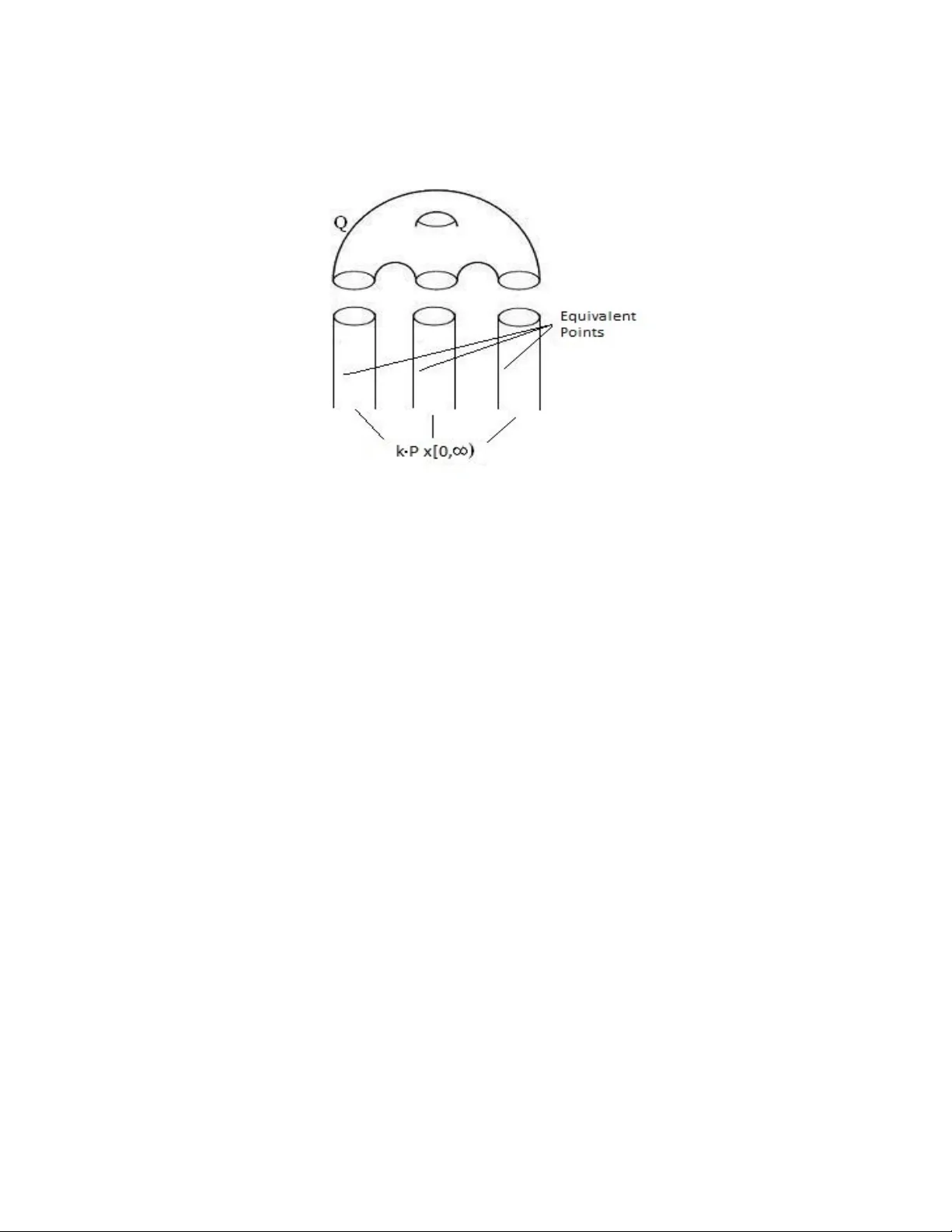
GEOMETRIC K -HOMOLOGY WITH COEFFICIENTS I I: THE ANAL YTIC THEOR Y AND ISOMORPHISM ROBIN J. DEELEY Abstract. W e discuss the analytic aspects of the geometric mo del for K - homology with co efficients in Z /k Z constructed in [11]. In particular, using results of Rosenberg and Sc hochet, we construct a map from this geometric model to its analytic counterpart. Moreov er, we show that this map is an isomorphism in the case of a finite CW-complex. The relationship b etw een this map and the F reed-Melrose index theorem is also discussed. Many of these results are analogous to those of Baum and Douglas in the case of spin c manifolds, geometric K-homology , and A tiy ah-Singer index theorem. 1. Introduction This is the second in a pair of pap ers whose topic is the construction of a geo- metric mo del for K -homology with co efficients using spin c Z /k Z -manifold theory . Despite this, we hav e tried to make our treatment as self-con tained as p ossible. In the first pap er, [11], the cycles and relations for this model w ere describ ed. In ad- dition, it w as sho wn that the mo del fits into the correct Bo ckstein sequence for the co efficien t group Z /k Z . The goal of this pap er is the construction (based on results in [21] and [22]) of an analytic mo del for K -homology with co efficien ts in Z /k Z and the construction of a map (defined at the level of cycles) from the geometric mo del in [11] to this analytic mo del. The main result is that this map is an isomorphism for finite CW-complexes (see Theorem 2.17). The reader should note the similarit y with a num b er of constructions due to Baum and Douglas (see [3, 4]). Ho w ever, a num b er of our constructions in volv e noncomm utativ e C ∗ -algebras (rather than the C ∗ -algebra of con tinuous function on a manifold in the case considered by Baum and Douglas). These algebras are constructed (based on [21]) using group oids, but we ha v e endeav oured to make them accessible to the reader unfamiliar with group oid C ∗ -algebras. W e also use some KK-theory but the amount is quite limited. Thus, prerequisites are limited to an understanding of the Baum-Douglas mo del for (geometric) K-homology and the F redholm mo dule picture of (analytic) K-homology (due to Kasparov, [17]). The first section summarizes results contained in [11]. The reader is directed to [7] for more on geometric K-homology , [14] for more on analytic K-homology and [11] (and the references therein) for more on Z /k Z -manifolds, the F reed-Melrose index theorem and the construction of geometric K-homology with co efficien ts in Z /k Z . W e note that Z /k Z -manifolds were first introduced by Sulliv an (see [18, 23, 24]). 2010 Mathematics Subje ct Classific ation. Primary: 19K33; Secondary: 19K56, 46L85, 55N20 . Key wor ds and phr ases. K -homology , Z /k Z -manifolds, the F reed-Melrose index theorem. 1 2 ROBIN J. DEELEY The second section con tains the main results of the paper. Namely , the construc- tion of the map from geometric K-homology with co efficien ts in Z /k Z to analytic K-homology with co efficients in Z /k Z and the pro of that this map is an isomor- phism in the case of a finite CW-complex. T o put these results in context, w e review the analogous results in K-homology (c.f., [7]). The reader should recall that a geometric cycle in K-homology is given b y a triple, ( M , E , f ), where M is compact spin c manifold, E is a vector bundle, and f is a contin uous map from M to X ; ( X is the space whose K-homology we are mo deling). An analytic cycle is giv en by a F redholm mo dule ov er C ( X ). The map from the first of these theories to the latter is defined in three steps: (1) T o the spin c manifold in a geometric cycle, ( M , E , f ), w e asso ciated a C ∗ - algebra, C ( M ); (2) W e use the spin c -structure and the vector bundle, E , to pro duce a F redholm mo dule (denoted [ D E ]) in the K-homology of C ( M ); (3) Finally , the contin uous map induces a map from the K-homology of C ( M ) to the K-homology of C ( X ) (denoted by f ∗ ), which w e apply to [ D E ] to get a class in the K-homology of C ( X ). The map from geometric cycles to analytic cycles is then defined to b e (1) µ : ( M , E , f ) 7→ f ∗ ([ D E ]) In [7], this map is shown to b e an isomorphism in the case when X is a finite CW-complex. The results in the case of Z /k Z -co efficients can b e summarized as follows. W e recall (see Definitions 1.1 and 1.4 b elo w) that a geometric Z /k Z -cycle is a triple, (( Q, P ) , ( E , F ) , f ), where ( Q, P ) is a compact spin c Z /k Z -manifold, ( E , F ) is a Z /k Z -v ector bundle, and f is a contin uous map from ( Q, P ) to X (the space whose K-homology with co efficien ts in Z /k Z we are modeling). On the other hand, an an- alytic Z /k Z -cycle is a F redholm mo dule ov er the C ∗ -algebra C ( X ) ⊗ C ∗ ( pt ; Z /k Z ), where C ∗ ( pt ; Z /k Z ) is the mapping cone of the inclusion of C into the k b y k ma- trices. (Based on results in [22], w e define analytic K-homology with co efficien ts in Z /k Z to b e K ∗ ( C ( X ) ⊗ C ∗ ( pt ; Z /k Z )).) The map (which is analogous to the map µ ab ov e) from geometric Z /k Z -cycles to analytic Z /k Z -cycles is defined in three steps: (1) Using Rosenberg’s construction (see [21]), we asso ciated a C ∗ -algebra to the Z /k Z -manifold, ( Q, P ) (denoted b y C ∗ ( Q, P ; Z /k Z )); (2) Again, follo wing Rosenberg, w e use the spin c -structure and the Z /k Z -vector bundle, ( E , F ), to pro duce a F redholm mo dule (denoted [ D ( E ,F ) ]) in the K-homology of C ( Q, P ; Z /k Z ); (3) Finally , the contin uous map, f , induces a ∗ -homomorphism from C ( X ) ⊗ C ∗ ( pt ; Z /k Z ) to C ∗ ( Q, P ; Z /k Z ) and hence a map from the K-homology of C ∗ ( Q, P ; Z /k Z ) to the K-homology of C ( X ) ⊗ C ∗ ( pt ; Z /k Z ). W e denote this map by ˜ f ∗ and then apply it to [ D ( E ,F ) ] to get a class in the K-homology of C ( X ) ⊗ C ∗ ( pt ; Z /k Z ). T o summarize, the map from the geometric theory to the analytic theory is defined via Φ : (( Q, P ) , ( E , F ) , f ) 7→ ˜ f ∗ ([ D ( E ,F ) ]) The pro of that this map is well-defined in not trivial. The most inv olved part is the b ordism relation (see Theorem 2.16). T o show that Φ is an isomorphism for K -HOMOLOGY WITH COEFFICIENTS I I 3 finite CW-complexes, we use the Bo ckstein sequences for b oth the geometric and analytic models, the Five Lemma, and the fact that µ is an isomorphism for finite CW-complexes (see [7, Theorem 6.2]). In the final section of the pap er, we discuss the relationship b etw een our re- sults and index theory . In particular, we discuss the fact that it follows from our construction that the F reed-Melrose index theorem for spin c Z /k Z -manifolds can b e conceptualized as a sp ecific case of the isomorphism from geometric to analytic K -homology with co efficient in Z /k Z . This is analogous to Baum and Douglas’ conceptualization of the Atiy ah-Singer index theorem as a sp ecific case of the iso- morphism b etw een geometric and analytic K -homology . W e also discuss index pairings in this section. 1.1. Geometric Z /k Z -cycles. W e now discuss the main results of [11]. Definition 1.1. Let Q b e an oriented, smo oth compact manifold with b oundary . W e assume that the b oundary of Q , ∂ Q , decomp oses in to k disjoint manifolds, ( ∂ Q ) 1 , . . . , ( ∂ Q ) k . A Z /k Z -structure on Q is an oriented manifold P , a disjoint collaring neighbourho o d, V i for each ( ∂ Q ) i , and orientation preserving diffeomor- phisms γ i : V i → (0 , 1] × P . A Z /k Z -manifold is a Q with fixed Z /k Z -structure. W e denote this by ( Q, P , γ i ). W e sometimes drop the maps from this notation and denote a Z /k Z -manifold by ( Q, P ). Man y concepts from differential geometry and top ology hav e natural generaliza- tions from the manifold setting to the Z /k Z -manifold setting. The generalization of vector bundles to Z /k Z -vector bundles is prototypical. A Z /k Z -vector bundle is a pair, ( E , F ), where E is a vector bundle ov er Q , F is a vector bundle o v er P , and E | ∂ Q decomp oses in to k copies of F . T o b e more precise, the identification of (i.e., isomorphism b et w een) E | ∂ Q and the k-copies of F is also considered part of the data. Additionally , w e ha ve natural definitions of a Z /k Z -Riemannian metric, a Z /k Z -fib er bundle, a spin c -structure on a Z /k Z -vector bundle, and a spin c -structure on a Z /k Z -manifold. The reader can see [13, Definition 3.1] for further details. Example 1.2. W e consider the manifold with b oundary , denoted by Q , given in Figure 1 and take P = S 1 . Then one can easily see that ( Q, P ) has the structure of a Z / 3-manifold. Definition 1.3. Let ¯ Q b e an n -dimensional, oriented, smo oth, compact manifold with b oundary . In addition, assume we are giv en k disjoint, oriented em b eddings of an ( n − 1)-dimensional, oriented, smooth, compact manifold with boundary , ¯ P , into ∂ ¯ Q . Using the same notation as Definition 1.1, we denote this as a triple, ( ¯ Q, ¯ P , γ i ) (or just ( ¯ Q, ¯ P )), where { γ i } k i =1 denote the k disjoint orien ted embeddings. Such a triple is called a Z /k Z -manifold with b oundary . Its b oundary is defined to b e the Z /k Z -manifold, ( ∂ ¯ Q − int( k ¯ P ) , ∂ ¯ P ), where k ¯ P denotes the k copies of ¯ P in ∂ ¯ Q . In particular, if a Z /k Z − manifold ( Q, P ) is the b oundary of the Z /k Z -manifold with b oundary , ( ¯ Q, ¯ P ), then ∂ ¯ Q = Q ∪ ∂ Q ( k ¯ P ) and ∂ ¯ P = P . Definition 1.4. Let X b e a compact space. A Z /k Z -cycle ov er X is a triple, (( Q, P ) , ( E , F ) , f ), where ( Q, P ) is a spin c Z /k Z -manifold, ( E , F ) is a Z /k Z -vector bundle and f is a con tin uous map from ( Q, P ) to X . The reader should note that the contin uous map from ( E , F ) to X must resp ect the Z /k Z -structure. If the compact space ( X in Definition 1.4) is clear from the con text, then we will refer to Z /k Z -cycles, rather than Z /k Z -cycles o v er X . 4 ROBIN J. DEELEY Figure 1. Z / 3-manifold from Example 1.2. As with the Baum-Douglas mo del, the addition op eration is defined using disjoint union and the inv erse of a cycle is given by taking its “opp osite” (see [11]). Definition 1.5. A Z /k Z -cycle, (( Q, P ) , ( E , F ) , f ), is a b oundary if there exist (1) A smooth compact spin c Z /k Z -manifold with b oundary , ( ¯ Q, ¯ P ), (2) A smooth Hermitian Z /k Z -vector bundle ( V , W ) ov er ( ¯ Q, ¯ P ), (3) A con tinuous map Φ : ( ¯ Q, ¯ P ) → X , suc h that ( Q, P ) is the Z /k Z -b oundary of ( ¯ Q, ¯ P ), ( E , F ) = ( V , W ) | ∂ ( ¯ Q, ¯ P ) , and f = Φ | ∂ ( ¯ Q, ¯ P ) . W e say that (( Q, P ) , ( E , F ) , f ) is bordant to (( ˆ Q, ˆ P ) , ( ˆ E , ˆ F ) , ˆ f ) if (( Q, P ) , ( E , F ) , f ) ˙ ∪ ( − ( ˆ Q, ˆ P ) , ( ˆ E , ˆ F ) , ˆ f ) is a b oundary . Definition 1.6. V ector bundle mo dification for Z /k Z -cycles is defined as follows. Let (( Q, P ) , ( E , F ) , f ) b e a Z /k Z -cycle and ( W, V ) b e an ev en-dimensional spin c Z /k Z -v ector bundle ov er ( Q, P ). W e note that ( Q, E , f ) is a Baum-Douglas cycle with b oundary and ( P , F , f | P ) is a Baum-Douglas cycle. As such we can define the Z /k Z -v ector bundle mo dification of (( Q, P ) , ( E , F ) , f ) b y ( W, V ) to b e the Baum- Douglas vector bundle mo dification of the cycles ( Q, E , f ) and ( P , F, f | P ) by W and V resp ectiv ely . The compatibility required b y the definition of a Z /k Z -vector bundle ensures that the result of suc h a mo dification forms a Z /k Z -cycle. Definition 1.7. W e define K ∗ ( X ; Z /k Z ) to b e the set of equiv alence classes of Z /k Z -cycles w here the equiv alence relation is generated by: (1) If 1 = (( Q, P ) , ( E 1 , F 1 ) , φ ) and 2 = (( Q, P ) , ( E 2 , F 2 ) , φ ) are Z /k Z -cycles, then 1 ˙ ∪ 2 ∼ (( Q, P ) , ( E 1 ⊕ E 2 , F 1 ⊕ F 2 ) , φ ) (2) Bordan t Z /k Z -cycles are defined to b e equiv alent; (3) A Z /k Z -cycle is defined to b e equiv alent to its vector bundle mo dification b y any even-dimensional spin c v ector bundle. The set K ∗ ( X ; Z /k Z ) is a graded ab elian group with the op eration of disjoin t union. The Bo ckstein sequence for the mo del takes the following form (see [11, Theorem 2.20]). K -HOMOLOGY WITH COEFFICIENTS I I 5 Theorem 1.8. If X is finite CW-c omplex, then the fol lowing se quenc e is exact. K 0 ( X ) k − − − − → K 0 ( X ) r − − − − → K 0 ( X ; Z /k Z ) x δ y δ K 1 ( X ; Z /k Z ) r ← − − − − K 1 ( X ) k ← − − − − K 1 ( X ) wher e the maps ar e (1) k : K ∗ ( X ) → K ∗ ( X ) is given by multiplic ation by k ; (2) r : K ∗ ( X ) → K ∗ ( X ; Z /k Z ) takes a cycle ( M , E , f ) to (( M , ∅ ) , ( E , ∅ ) , f ) ; (3) δ : K ∗ ( X ; Z /k Z ) → K ∗ +1 ( X ) maps the cycle (( Q, P ) , ( E , F ) , f ) to ( P, F , f ) . 2. Main Resul ts In this section, we deal with the isomorphism b et w een geometric and analytic K -homology with coefficients in Z /k Z . In [22], Schochet defines an analytic mo del for K -homology with co efficients. W e use results of Rosen b erg (see [21]) to link Sc ho c het’s analytic cycles to Z /k Z -manifold theory . This leads to the construction of a map from the geometric mo del developed in [11] (also see Section 1.1 ab ov e) to this analytic mo del. T o do so, w e introduce (and generalize) the construction of a group oid C ∗ -algebra from a Z /k Z -manifold dev elop ed in [21]. Then the map from geometric cycles to analytic cycles is defined and it is pro v ed (under the condition that X is a finite CW-complex) that it is an isomorphism. The construction of C ∗ -algebras from Z /k Z -manifolds in tro duced in [21] uses the theory of group oid C ∗ -algebras. The theory of group oid C ∗ -algebras is developed in great detail in [20]. W e will not need the full p ow er of this theory and the reader unfamiliar with it could p ossibly tak e Equation 6 in Example 2.7 as the definition of the C ∗ -algebra asso ciated to a Z /k Z -manifold. 2.1. Analytic K -homology with co efficients in Z /k Z . Definition 2.1. Let C ∗ ( pt ; Z /k Z ) denote the mapping cone of the inclusion of C in to the k by k matrices, M k . That is, we let (2) C ∗ ( pt ; Z /k Z ) := { f ∈ C 0 ([0 , ∞ ) , M k ) | f (0) is a multiple of I k } Basic properties of mapping cones imply that 0 → C 0 ((0 , ∞ ) , M k ) → C ∗ ( pt ; Z /k Z ) → C → 0 is exact and that K 0 ( C ∗ ( pt ; Z /k Z )) ∼ = Z /k Z and K 1 ( C ∗ ( pt ; Z /k Z )) ∼ = 0. Using [22, Section 5-6], we then hav e the follo wing definition. Definition 2.2. Let X b e a compact Hausdorff space. Then, K ana p ( X ; Z /k Z ) := K − p ( C ( X ) ⊗ C ∗ ( pt, Z /k Z )). Remark 2.3. The Bo ckstein sequence for K ana ∗ ( X ; Z /k Z ) is giv en by the six-term exact sequence asso ciated to short exact sequence of C ∗ -algebras: 0 → C ( X ) ⊗ C 0 ((0 , ∞ ) , M k ) → C ( X ) ⊗ C ∗ ( pt ; Z /k Z ) → C ( X ) → 0 6 ROBIN J. DEELEY Figure 2. The equiv alence relation on the Z / 3-manifold from Ex- ample 1.2. 2.2. Rosen b erg’s Group oid C ∗ -algebra. W e generalize Rosen b erg’s construc- tion in [21] (also see [16]). Rosen berg’s construction is discussed in Example 2.7 b elo w. Moreov er, Figure 2 should b e helpful to the reader during b oth the discus- sion of this example and the general construction. W e will work in a general framework, but Examples 2.7 and 2.9 are our main concern. The setup is the following. Let N b e a smo oth manifold. The reader should note that N may ha v e b oundary and is not necessarily compact. Moreov er, supp ose that (1) N = M Q ∪ Σ M P where M Q and M P are manifolds with b oundary and Σ is a manifold (p ossibly with boundary); (2) Σ ⊆ ∂ M Q and Σ ⊆ ∂ M P ; (3) M P = k · R for some manifold R and Σ = k · Σ R for some manifold Σ R ; An imp ortant case of this setup was considered by Rosen b erg in [21]. Let ( Q, P ) b e a Z /k Z -manifold and (using the notation ab ov e) let (3) M Q = Q, M P = ∂ Q × [0 , ∞ ) , Σ = ∂ Q, R = P × [0 , ∞ ) , Σ R = P W e will discuss this case in more detail in Example 2.7 b elo w. Returning to the general setup, w e construct a group oid via an equiv alence relation on N . Figure 2 illustrates the imp ortant sp ecial case (i.e., Equation 3). The relation is defined by (1) If n ∈ M Q , then n is equiv alent only to itself. W e note that this includes p oin ts in ∂ Q and hence p oints in Σ. (2) If n, n 0 ∈ M P − Σ, then n ∼ n 0 if and only if π ( n ) = π ( n 0 ) ∈ R where π denotes the trivial cov ering map M P → R . K -HOMOLOGY WITH COEFFICIENTS I I 7 Definition 2.4. Using the notation and constructions in the previous paragraphs, w e let G ⊂ N × N denote the group oid asso ciated to this equiv alence relation and let C ∗ ( G ) denote the asso ciated group oid C ∗ -algebra. A remark ab out notation is in order. In the setup ab ov e, no assumption on com- pactness has b een made; hence we will work with C 0 -functions. In particular, if W is a manifold with b oundary then C 0 ( W ) denotes contin uous functions which v anish at ∞ but whic h tak e (possibly) nonzero v alues on the b oundary of W . While C 0 (in t( W )) denotes the con tinuous functions that v anish at ∞ and on the b ound- ary . W e let M k denote the k b y k matrices and if M is a space, then C 0 ( M , M k ) denotes the contin uous functions from M to M k whic h v anish at ∞ . Prop osition 2.5. L et C ∗ ( G ) b e the C ∗ -algebr a fr om Definition 2.4. Then it is isomorphic to { ( f , g ) ∈ C 0 ( M Q ) ⊕ C 0 ( R, M k ) | g | Σ R is diagonal and f | Σ = g | Σ R } We note that the statement f | Σ = g | Σ R is mor e c orr e ctly written as α ( f | Σ ) = g | Σ R wher e α : C 0 (Σ) ∼ = ⊕ k i =1 C 0 (Σ R ) → M k ( C 0 (Σ R )) is the diagonal inclusion. Pr o of. W e only sk etc h the ideas of the pro of, leaving the details for the interested reader. T o b egin, we review some notation. Recall (see the paragraphs preceding Definition 2.4) that N = M Q ∪ Σ M P where M P = k · R and G denotes the equiv- alence relation (defined ab ov e) on N . W e will denote an elemen t of G , n 1 ∼ n 2 , as ( n 1 , n 2 ) ∈ N × N . In addition, if p ∈ R , then we let p 1 , . . . , p k denote the preimages of p under the (trivial) co v ering map M P → R . Let h ∈ C c ( G ) (i.e., a con tinuous function with compact supp ort on G ) and define a map: h 7→ ( f h , g h ) ∈ C 0 ( M Q ) ⊕ C 0 ( R, M k ) as follo ws. F or q ∈ M Q , f h ( q ) := h ( q , q ) and, for p ∈ R − Σ R , w e define g h ( p ) := [ h ( p i , p j )] i =1 ,...,k,j =1 ,...,k where w e hav e used the definition of { p i } k i =1 discussed in the first paragraph of the pro of. Finally , for ˜ p ∈ Σ R , we define, g h ( ˜ p ) to b e the diagonal k by k matrix with en tries along the diagonal given by h ( p 1 , p 1 ) , . . . , h ( p k , p k ) It is now left to the reader to show that this map is well-defined and extends to an isomorphism from C ∗ ( G ) to the C ∗ -algebra in the statement of the prop osition (i.e., Equation 2.5). Corollary 2.6. The C ∗ -algebr a fr om Definition 2.4 (i.e., C ∗ ( G ) ) fits into the fol- lowing exact se quenc e: (4) 0 → C 0 ( R − Σ R ) ⊗ M k → C ∗ ( G ) → C 0 ( M Q ) → 0 8 ROBIN J. DEELEY Supp ose that we hav e a Riemannian metric on N and let L 2 ( N ) denote the Hilb ert space of L 2 -sections. If the metric resp ects the decomp osition of N , then L 2 ( N ) has the structure of a Z /k Z -Hilb ert space (see [13, Definition 3.2]). That is, w e hav e isometries, e i : L 2 ( R ) → L 2 ( N ), where i = 1 , . . . , k . Using this data and Proposition 2.5, there is natural represen tation (denoted ρ G ) of C ∗ ( G ) on L 2 ( N ) defined via (5) ( ρ G ( f , g ) · ξ )( n ) := f ( n ) ξ ( n ) : n ∈ M Q ( P k i =1 P k j =1 e i M g ij e ∗ j ξ )( n ) : n ∈ M P where M g ij denotes the multiplication op erator (asso ciated to g ij ) on L 2 ( R ). The reader will note that M Q ∩ M P = Σ 6 = ∅ . How ever, the condition in the equation in Prop osition 2.5 implies that the tw o p ossible definitions for n ∈ Σ agree. W e lea v e the pro of that ρ G is a representation to the reader; who should notice the relationship b etw een matrix multiplication and the interaction of e i and e ∗ j in the form ula of ρ G . Example 2.7. The prototypical example of a group oid of the form discussed in Definition 2.4 is the one constructed in [21]. The construction is as follows. Let ( Q, P ) b e a Z /k Z -manifold with diffeomorphism φ : ∂ Q → P × Z /k Z . W e denote b y N the manifold without b oundary given b y Q ∪ ∂ Q ∂ Q × [0 , ∞ ), where w e are iden tifying ∂ Q with ∂ Q × { 0 } . The reader should note that N is usually not compact and that (in the notation of Definition 2.4) M = ∂ Q × [0 , ∞ ) and ¯ P = P × [0 , ∞ ). Let G denote the group oid constructed using the pro cess discussed ab o v e (see Definition 2.4) and C ∗ ( Q, P ; Z /k Z ) denote C ∗ ( G ). The conten t of Proposition 2.5 in this case takes the form: C ∗ ( Q, P ; Z /k Z ) ∼ = { ( f , g ) ∈ C ( Q ) ⊕ C 0 ( P × [0 , ∞ ) , M k ) | (6) g | P ×{ 0 } is diagonal and f | ∂ Q = g | P ×{ 0 } } Recall that the statement f | ∂ Q = g | P ×{ 0 } in Equation 6 is more correctly written as α ( f | ∂ Q ) = g | P ×{ 0 } where α : C ( ∂ Q ) ∼ = ⊕ k i =1 C ( P ) → M k ( C ( P )) is the diagonal inclusion. In addition, we hav e the following exact sequence (se e Equation 4 or [21]). 0 → C 0 ( R ) ⊗ C ( P ) ⊗ M k → C ∗ ( Q, P ; Z /k Z ) → C ( Q ) → 0 Remark 2.8. If we are given a Z /k Z -manifold of the form ( M , ∅ ) (where M is a compact manifold), then we let C ∗ ( M , ∅ ; Z /k Z ) := C ( M ) ⊗ C ∗ ( pt ; Z /k Z ) Example 2.9. In this example, we consider the case of a Z /k Z -manifold with b oundary . W e will form tw o C ∗ -algebra; they are analogous to C 0 (in t( W )) and C ( W ) in the case of a compact manifold with b oundary W . T o fix notation, let ( ¯ Q, ¯ P ) b e a Z /k Z -manifold with boundary , ( Q, P ). W e b egin with the C ∗ -algebra whic h is analogous to C 0 (in t( W )). In the notation of our basic setup (see the discussion preceding Definition 2.4), let M Q = ¯ Q − Q, M P = ∂ ¯ Q − Q × [0 , ∞ ) , Σ = ∂ ¯ Q − Q, R = in t( ¯ P ) × [0 , ∞ ) , Σ R = in t( ¯ P ) K -HOMOLOGY WITH COEFFICIENTS I I 9 and form the asso ciated group oid C ∗ -algebra, whic h will b e denoted by C ∗ 0 ( ¯ Q, ¯ P ; Z /k Z ). Prop osition 2.5 implies that C ∗ 0 ( ¯ Q, ¯ P , ˜ π ) = { ( f , g ) ∈ C ( ¯ Q ) ⊕ C 0 (in t( ¯ P ) × [0 , ∞ ) , M k ) | f | Q = 0 , g | ¯ P ×{ 0 } is diagonal and f | ∂ ¯ Q − Q = g | int( ¯ P ) ×{ 0 } } Again the identification discussed in Prop osition 2.5 has b een used here. Next, we discuss the C ∗ -algebra which is analogous to C ( W ) in the case of a manifold with b oundary . Again, using the setup discussed b efore Definition 2.4, let M Q = ¯ Q − in t( Q ) , M P = ∂ ¯ Q − in t( Q ) × [0 , ∞ ) , Σ = ∂ ¯ Q − in t( Q ) , R = ¯ P × [0 , ∞ ) , Σ R = ¯ P In this case, we denote the asso ciated group oid C ∗ -algebra by C ∗ ( ¯ Q, ¯ P ; Z /k Z ). Prop osition 2.5 implies that C ∗ ( ¯ Q, ¯ P , ˜ π ) = { ( f , g ) ∈ C ( ¯ Q ) ⊕ C 0 ( ¯ P × [0 , ∞ ) , M k ) | g | ¯ P ×{ 0 } is diagonal and f | ∂ ¯ Q − int( Q ) = g | ¯ P ×{ 0 } } Note that we hav e (yet again) used the iden tification discussed in Prop osition 2.5. Moreo v er, we hav e the following exact sequence: (7) 0 → C ∗ 0 ( ¯ Q, ¯ P ; Z /k Z ) → C ∗ ( ¯ Q, ¯ P ; Z /k Z ) → C ∗ ( Q, P ; Z /k Z ) → 0 This is the Z /k Z -version of the exact sequence: 0 → C 0 (in t( W )) → C ( W ) → C ( ∂ W ) → 0 in the case of a manifold with b oundary W . W e no w consider natural classes in the K -homology of these group oid C ∗ - algebras. W e ha v e follo w ed [21] for this developmen t. The setup is as follows. Let ( Q, P ) b e a spin c Z /k Z -manifold with dim( Q ) = n and D b e the Dirac op erator on it (possibly twisted by a Z /k Z -vector bundle). Let S Q denote the Dirac bundle to whic h D is asso ciated. Then S Q extends to a Dirac bundle on N (which we denote b y S N ) and D also extends to all of N . Let the extension of the op erator, D , to N b e denoted b y D N . By Theorem 10.6.5 of [14], we can form [ D N ] ∈ K − n ( C 0 ( N )). Moreo v er, this class is equiv arian t with respect to the groupoid asso ciated to ( Q, P ); hence D N defines a class in K − n ( C ∗ ( Q, P ; Z /k Z )). T o simplify notation, the class pro duced from this construction will b e denoted by [ D ] ∈ K − n ( C ∗ ( Q, P ; Z /k Z )). This class is represented by the following F redholm mo dule: ( L 2 ( N ) , ρ, χ ( D )) where (1) L 2 ( N ) denotes the completion of the compactly supported, smo oth sections of the spinor bundle (p ossibly twisted by a Z /k Z -vector bundle; see [14, Section 10.1] for details); (2) ρ ( Q,P ) : C ∗ ( Q, P ) → L 2 ( N ) is defined in Equation 5; (3) χ is a normalizing function (see [14, Definition 10.6.1]); (4) D is the Dirac op erator on N (p ossibly t wisted by a Z /k Z -vector bundle); Moreo v er, the same construction applies verbatim to pro duce a class [ D ] ∈ K − n ( C ∗ 0 ( ¯ Q, ¯ P ; Z /k Z )) where ( ¯ Q, ¯ P ) is a spin c Z /k Z -manifold with b oundary and D is again the Dirac op erator (p ossibly t wisted by a Z /k Z -vector bundle). The next proposition summarizes basic prop erties of the K -homology classes pro duced b y this construction. 10 ROBIN J. DEELEY Prop osition 2.10. L et ( Q, P ) b e a spin c Z /k Z -manifold with dim ( Q ) = n and D ( Q,P ) denote the Dir ac op er ator on ( Q, P ) (p ossibly twiste d by a Z /k Z -ve ctor bun- d le). Then the asso ciate d class [ D ( Q,P ) ] ∈ K − n ( C ∗ ( Q, P ; Z /k Z )) has the fol lowing pr op erties: (1) L et ( W , V ) b e a spin c Z /k Z -ve ctor bund le over ( Q, P ) with the dimension of the fib ers e qual to 2 k , and let ( E , F ) denote a ve ctor bund le over ( Q, P ) . Mor e over, assume that [ D ( Q,P ) ] is the Dir ac op er ator of ( Q, P ) twiste d ( E , F ) . We denote the spin c Z /k Z -manifold pr o duc e d by the ve ctor bund le mo dific ation of ( Q, P ) by ( W, V ) by ( Q W , P V ) . L et π denote the pr oje ction ( Q W , P V ) → ( Q, P ) and ˜ π denote the induc e d map fr om C ∗ ( Q, P ; Z /k Z ) to C ∗ ( Q W , P V ; Z /k Z ) . Final ly, let [ D ( Q W ,P V ) ] ∈ K − p − 2 k ( C ∗ ( Q W , P V ; Z /k Z )) denote the class asso ciate d to the Dir ac op er ator (now twiste d by ve ctor bun- d le ( H Q ⊗ π ∗ ( E ) , H P ⊗ π ∗ ( F )) ; se e Definition 1.6 and [7] ). Then ˜ π ∗ ([ D ( Q W ,P V ) ] = [ D ( Q,P ) ] ∈ K − n ( C ∗ ( Q, P ; Z /k Z ) (2) Supp ose that ( Q, P ) is the b oundary of the Z /k Z -manifold, ( ¯ Q, ¯ P ) . If ∂ is the b oundary map of the six-term exact se quenc e in K-homolo gy asso ciate d to the short exact se quenc e 0 → C ∗ 0 ( ¯ Q, ¯ P ; Z /k Z ) → C ∗ ( ¯ Q, ¯ P ; Z /k Z ) → C ∗ ( Q, P ; Z /k Z ) → 0 then ∂ [ D ¯ Q, ¯ P ] = [ D ( Q,P ) ] ∈ K ∗ ( C ∗ ( Q, P ; Z /k Z )) Pr o of. Our pro of of the first statemen t is mo delled on the pro of of Prop osition 3.6 in [7]. A partition of unity argument reduces the pro of to the case when ( W , V ) is a trivial Z /k Z -vector bundle. W e may assume that Q is connected; hence ( Q W , P V ) = ( Q × S 2 n , P × S 2 n ) where 2 n is the fib er dimension of the bundle ( W , V ). The Dirac op erator on C ∗ ( Q W , P V ) is given by D Q,P ⊗ I + I ⊗ D S 2 n . As in the commutativ e case, the Hilb ert space L 2 ( N × S 2 n ) decomposes as follows: L 2 ( N × S 2 n ) = L 2 ( N ) ⊗ L 2 ( S 2 n ) ∼ = L 2 ( N ) ⊗ k er ( D S 2 n ) ⊕ L 2 ( N ) ⊗ k er ( D S 2 n ) ⊥ The F redholm mo dule [ D Q × S 2 n ,P × S 2 n ] respects this decomp osition. Moreov er, us- ing the fact that k er ( D S 2 n ) is one dimensional and sp ecific form of the Dirac op er- ator, the restriction to the first factor is equal to the module [ D Q,P ]. T o complete the pro of, we m ust sho w that the restriction to the second factor is trivial in K-homology . Let T b e the partial isometry part of the p olar decomp osition of D S 2 n and γ be the grading operator on L 2 ( N ). It is an exercise to sho w that γ ⊗ T is an o dd-graded inv olution whic h anticomm utes with op erator in the F redholm mo dule and comm utes with the action of C ∗ ( Q, P ). Lemma 2.7 of [7] then implies that the restriction to the second factor is a trivial F redholm module o ver C ∗ ( Q, P ); this completes the pro of of the first statement. T o pro v e the second statemen t of the theorem, w e use the follo wing comm utative diagram (see [14, Section 9.6] for details; in particular for the definitions of the relev an t C ∗ -algebras). K -HOMOLOGY WITH COEFFICIENTS I I 11 0 − → S ( C ∗ ( Q, P )) − → C ( C ∗ ( Q, P )) − → C ∗ ( Q, P ) − → 0 y α y 0 − → C ( C ∗ ( ¯ Q, ¯ P ) , C ∗ ( Q, P )) − → Q ( C ∗ ( ¯ Q, ¯ P ) , C ∗ ( Q, P )) − → C ∗ ( Q, P ) − → 0 x β x 0 − → C ∗ 0 ( ¯ Q, ¯ P ) − → C ∗ ( ¯ Q, ¯ P ) − → C ∗ ( Q, P ) − → 0 Let b denote the boundary map associated to the first exact sequence and [ d ] denote the Dirac op erator on R . Standard results (see [14, Section 9.6]) imply that β ∗ is an isomorphism, ∂ = b ◦ α ∗ ◦ ( β ∗ ) − 1 and b ([ d ] × [ D Q,P ]) = [ D Q,P ]. This reduces the proof to showing α ∗ ◦ ( β ∗ ) − 1 ([ D ¯ Q, ¯ P ]) = [ d ] × [ D Q,P ]. T o this end, the reader (upon recalling the notation from Example 2.9) can verify that C ( C ∗ ( ¯ Q, ¯ P ) , C ∗ ( Q, P ))) ∼ = C ∗ 0 ( ¯ N ∪ ∂ ¯ N ∂ ¯ N × [0 , ∞ ) , ¯ P × [0 , ∞ ) × [0 , ∞ )) As such, C ( C ∗ ( ¯ Q, ¯ P ) , C ∗ ( Q, P )) has an associated Dirac class whic h we denote b y ( H , ˆ ρ, F ). The proof will b e complete upon showing that β ∗ ( H , ˆ ρ, F ) ∼ [ D ¯ Q, ¯ P ] and α ∗ ( H , ˆ ρ, F ) ∼ [ d ] × [ D Q,P ] F or the first of these statements, consider β ∗ ( H , ˆ ρ, F ) = [ H , ˆ ρ ◦ β , F )] ∼ [ p H , ˆ ρ ◦ β , pF p ] where p is the pro jection on to the image of ( ˆ ρ ◦ β ) (i.e., C ∗ 0 ( ¯ Q, ¯ P )). By construction, p H ∼ = L 2 ( ¯ N ) and ˆ ρ ◦ β = ρ ( ¯ Q, ¯ P ) on L 2 ( ¯ N ). Moreov er, for each ( f , g ) ∈ C ∗ 0 ( ¯ Q, ¯ P ), ρ ( ¯ Q, ¯ P ) ( f , g )( pF pχ ( D ¯ Q, ¯ P ) + χ ( D ¯ Q, ¯ P ) pF p ) ρ ¯ Q, ¯ P ( f , g ) ∗ ≥ 0 mo d K ( L 2 ( ¯ N )) This follows since (by [14, Section 10.8]) it holds for ( f , g ) in the image of the inclusion of C 0 (in t( N )) into C ∗ ( ¯ Q, ¯ P ) and there exists an appro ximate unit (for all of C ∗ 0 ( ¯ Q, ¯ P )) in this image. Finally , [14, Prop osition 8.3.16] implies β ∗ ( H , ˆ ρ, F ) ∼ [ D ¯ Q, ¯ P ]. The pro of that α ∗ ( H , ˆ ρ, F ) ∼ [ d ] × [ D Q,P ] is similar; one replaces the pro jection, p , ab ov e with the pro jection onto L 2 ( N × (0 , ∞ )). This completes the pro of that ∂ [ D ¯ Q, ¯ P ] = [ D Q,P ]. F ollowing [21], we replace the collapse to p oint map in classical index theory with the ∗ -homomorphism c : C ∗ ( pt ; Z /k Z ) → C ∗ ( Q, P ; Z /k Z ) (8) h 7→ h (0)1 Q ⊕ (1 P ⊗ h ) where w e hav e used Equation 6 and the fact that C ∗ ( pt ; Z /k Z ) → { f ∈ C 0 ([0 , ∞ ) , M k ) | f (0) diagonal } Definition 2.11. Using the notation of the previous paragraph, we define the analytic index of D to b e c ∗ ([ D ]). 12 ROBIN J. DEELEY 2.3. Map b etw een geometric and analytic K -homology with co efficients. Definition 2.12. Given a con tin uous map, f : ( Q, P ) → X , w e define a ∗ - homomorphism via ˜ f : C ( X ) ⊗ C ∗ ( pt ; Z /k Z ) → C ∗ ( Q, P ; Z /k Z ) g ⊗ h 7→ h (0) f ∗ Q ( g ) ⊕ ( f ∗ P ( g ) ⊗ h ) where we ha v e denoted b y f ∗ Q and f ∗ P the ∗ -homomorphism induced by f | Q and f | P . Note that we hav e also used Equation 6 and the fact that C ∗ ( pt ; Z /k Z ) → { g ∈ C 0 ([0 , ∞ ) , M k ) | g (0) diagonal } Let ˜ f ∗ denote the map induced on K -homology b y this ∗ -homomorphism. In the case when X = pt , the ∗ -homomorphism from Definition 2.12, C ⊗ C ∗ ( pt ; Z /k Z ) → C ∗ ( Q, P ; Z /k Z ), is the same as the one defined in Equation 8. (One m ust first identify C ⊗ C ∗ ( pt ; Z /k Z ) with C ∗ ( pt ; Z /k Z )). Definition 2.13. Let X b e a compact Hausdorff space. Let Φ b e the map betw een geometric Z /k Z -cycles and analytic Z /k Z -cycles defined by (( Q, P ) , ( E , F ) , f ) 7→ ˜ f ∗ ([ D ( E ,F ) ]) where [ D ( E ,F ) ] ∈ K ∗ ( C ∗ ( Q, P ; Z /k Z )) is the class of the Dirac op erator twisted by ( E , F ) and ˜ f ∗ is the map on K -homology induced from f (see Definition 2.12). Our first goal is to show that the map, Φ, is well-defined (i.e., show that the class in analytic K -homology is inv arian t under the relations on the geometric Z /k Z -cycles). The pro of for the disjoint union op eration is trivial. The case of vector bundle mo dification follo ws from Item 1 in Prop osition 2.10. Corollary 2.14. L et X b e a c omp act Hausdorff sp ac e, (( Q, P ) , ( E , F ) , f ) a Z /k Z - cycle over X , and π : ( W, V ) → ( Q, P ) a spin c Z /k Z -ve ctor bund le with even dimensional fib er. Then ˜ f ∗ ([ D ( E ,F ) ]) = ( ˜ f ◦ ˜ π ) ∗ ([ D ( E W ,F V ) ]) . Pr o of. Using Prop osition 2.10 and the fact that ˜ π ◦ ˜ f ( Q,P ) = ˜ f ( Q W ,P V ) w e obtain ˜ f ∗ ( Q W ,P V ) ([ D ( Q W ,P V ) ]) = ( ˜ π ◦ ˜ f ( Q,P ) ) ∗ ([ D ( Q W ,P V ) ]) = ˜ f ∗ ( Q,P ) ( ˜ π ∗ ([ D ( Q W ,P V ) ])) = ˜ f ∗ ( Q,P ) ([ D ( Q,P ) ]) This completes the pro of that Φ resp ects v ector bundle mo dification. The case of Z /k Z -b ordism is less clear. Our pro of is similar to the pro of in the comm utativ e case giv en in [6] (also see [14, Exercise 11.8.10]). T o b egin, note that if ( ¯ Q, ¯ P ) is a Z /k Z -manifold with b oundary and ¯ f : ( ¯ Q, ¯ P ) → X is a contin uous map then we can define a ∗ -homomorphism via e ¯ f : C ( X ) ⊗ C ∗ ( pt ; Z /k Z ) → C ∗ ( ¯ Q, ¯ P , ˜ π ) h ⊗ r 7→ ( h ◦ f ) ⊕ (( h ◦ f | ¯ P ) ⊗ r ) The reader can verify the next lemma. K -HOMOLOGY WITH COEFFICIENTS I I 13 Lemma 2.15. L et X b e a c omp act Hausdorff sp ac e and (( Q, P ) , ( E , F ) , f ) b e a Z /k Z -cycle over X , which is the b oundary of (( ¯ Q, ¯ P ) , ( ¯ E , ¯ F ) , ¯ f ) . Then the map ˜ f ∗ (se e Definition 2.12) factors thr ough the map induc e d fr om the inclusion of the b oundary. Theorem 2.16. If (( Q, P ) , ( E , F ) , f ) is a Z /k Z -cycle which is a b oundary, then ˜ f ∗ ([ D ( Q,P ) , ( E ,F ) ]) = 0 in K ∗ ana ( C ( X ); Z /k Z )(= K ∗ ( C ( X ) ⊗ C ∗ ( pt ; Z /k Z ))) . Pr o of. Denote by (( ¯ Q, ¯ P ) , ( ¯ E , ¯ F ) , ¯ f ) the cycle which has b oundary , (( Q, P ) , ( E , F ) , f ). Applying the analytic K-homology functor to the short exact sequence in Equation 7 (see the discussion following Example 2.9), w e get long exact sequence: → K ∗ ( C ∗ 0 ( ¯ Q, ¯ P )) ∂ → K ∗ +1 ( C ∗ ( Q, P )) r ∗ → K ∗ +1 ( C ∗ ( ¯ Q, ¯ P )) i ∗ → K ∗ +1 ( C ∗ 0 ( ¯ Q, ¯ P )) → Item 2) of Prop osition 2.10 and exactness imply that 0 = ( r ∗ ◦ ∂ )([ D ( ¯ Q, ¯ P ) , ( ¯ E , ¯ F ) ]) = r ∗ ([ D ( Q,P ) , ( E ,F ) ]) Moreo v er, using Lemma 2.15, w e ha ve that ˜ f ∗ ([ D ( Q,P ) , ( E ,F ) ]) = ˜ ¯ f ∗ ( r ∗ ([ D ( Q,P ) , ( E ,F ) ]) = 0 Theorem 2.17. L et X b e a finite CW-c omplex. Then the map, Φ , c onstructe d in Definition 2.13 is an isomorphism. Pr o of. T o b egin, w e pro ve that the Bockstein sequences of the analytic and geomet- ric mo dels fit into the following commutativ e diagram (we sho w only the K 0 -part of the relev ant commutativ e diagram): − − − − → K g eo 0 ( X ) − − − − → K g eo 0 ( X ) − − − − → K g eo 0 ( X ; Z /k Z ) − − − − → y µ y µ y Φ − − − − → K ana 0 ( X ) − − − − → K ana 0 ( X ) − − − − → K ana 0 ( X ; Z /k Z ) − − − − → where we recall that µ denotes the natural transformation defined from geometric K-homology to analytic K-homology (see Equation 1 in the In tro duction). Com- m utativit y follows from the following three facts: (1) µ is a group homomorphism and hence comm utes with multiplication b y k ; (2) The C ∗ -algebra asso ciated to a Z /k Z -manifold of the form ( M , ∅ ) is C ( M ) ⊗ C ∗ ( pt ; Z /k Z ) and the ∗ -homomorphism from C ( X ) ⊗ C ∗ ( pt ; Z /k Z ) to C ( M ) ⊗ C ∗ ( pt ; Z /k Z ) is f ⊗ id (see Remark 2.8 for more details). (3) The comm utative diagram: C ( X ) ⊗ C 0 (0 , ∞ ) ⊗ M k − − − − → C ( X ) ⊗ C ( pt ; Z /k Z ) y ˜ f | P ⊗ id ⊗ id y ˜ f C ( P ) ⊗ C 0 (0 , ∞ ) ⊗ M k − − − − → C ∗ ( Q, P ; Z /k Z ) and the fact that [ D ( Q,P ) ] is mapp ed to [ D P ] under the map: K ∗ ( C ∗ ( Q, P ; Z /k Z )) → K ∗ ( C ( P ) ⊗ C 0 (0 , ∞ ) ⊗ M k ) ∼ = K ∗ +1 ( C ( P )) The result then follows using the exactness of the Bo c kstein sequences, the fact that the map b etw een geometric and analytic K -homology is an isomorphism, and the Fiv e Lemma. 14 ROBIN J. DEELEY 3. Connection with the Freed-Melrose Index Theorem The isomorphism from geometric K -homology (i.e., the Baum-Douglas mo del) to analytic K -homology (i.e., Kasparo v mo del via F redholm mo dules) leads to the A tiy ah-Singer index theorem b y considering the case of a p oin t. That is, from the comm utativit y of the following diagram: K g eo 0 ( pt ) ind top µ / / K ana 0 ( pt ) ind ana Z In the case of geometric K -homology with co efficien ts in Z /k Z , we hav e an analo- gous diagram; namely , K g eo 0 ( pt ; Z /k Z ) ind F M top Φ / / K ana 0 ( pt ; Z /k Z ) ind F M ana ~ ~ Z /k Z In this case, the commutativit y of the diagram is the statement of the F reed-Melrose index theorem (c.f., [21]). W e can also consider pairings. F or example, the pairing K 0 ( X ) × K 0 ( X ; Z /k Z ) → K 0 ( pt ; Z /k Z ) is giv en (analytically) by the Kasparo v pro duct: (9) K K 0 ( C , C ( X )) × K K 0 ( C ( X ) ⊗ C ∗ ( pt ; Z /k Z ) , C ) → K K 0 ( C ∗ ( pt ; Z /k Z ) , C ) While, on the geometric side, we ha v e the following. Let V b e a vector bunlde ov er X and (( Q, P ) , ( E , F ) , f ) b e a geometric Z /k Z -cycle. Then the pairing is giv en by: ind F M top ( D ( Q,P ) ( E ⊗ f ∗ ( V ) ,F ⊗ ( f | P ) ∗ ( V )) ) This pairing naturally extends to K-theory and, moreov er, is equal to the Kasparov pairing abov e (i.e., Equation 9). This follo ws from the asso ciativit y of the Kasparov pro duct and the fact that the pairing b etw een a Z /k Z -v ector bundle and the Dirac op erator on ( Q, P ) is given b y twisting the op erator b y the bundle. Finally , using the orginal formulation of the F reed-Melrose index theorem (c.f., Corollary 5.4 in [12]), we hav e that this pairing is also equal to the F redholm index of the op erator D Q ( E ⊗ f ∗ ( V )) with the Atiy ah-Patodi-Singer b oundary conditions (see [1]). W e ha v e a similar pairing b et w een the groups K 1 ( X ) and K 1 ( X ; Z /k Z ). How- ev er, the reader may recall that the pairing b et ween K 1 ( X ) and K 1 ( X ) is given by the index of a T o eplitz op erator (see the introdcution of [10] for details). Thus one K -HOMOLOGY WITH COEFFICIENTS I I 15 is led to ask if there is an analogous index theorem for Z /k Z -manifolds. T o the au- thor’s kno wledge, this is unknown. How ever, in [10], an index theorem for T o eplitz op erators on o dd-dimensional manifolds with b oundary is developed. Thus it is natural to ask if, in the case of a Z /k Z -manifold, the mo d k reduction of this index is a top ological in v arian t and, moreov er, if it is equal to the pairing betw een K 1 ( X ) and K 1 ( X ; Z /k Z ). Both these questions represent future w ork. Ac knowledgmen ts I would lik e to thank my PhD sup ervisor, Heath Emerson, for useful discussions on the conten t and style of this do cument. In addition, I thank Nigel Higson, Jerry Kamink er, John Phillips, and Ian Putnam, for discussions. In particular, I would lik e to thank Jerry Kaminker for bringing the problem of a “T o eplitz index theo- rem” for Z /k Z -manifolds and the reference [10] to my attention. This work was supp orted by NSERC through a PGS-Do ctoral a ward. References [1] M. F. Atiy ah, V. K. Patodi, and I. M. Singer. Sp e ctr al asymmetry and Riemannian ge ometry I , Math. Pro c. Camb. Phil. So c., 77:43-69, 1975. [2] M. Atiy ah and I. Singer, The index of el liptic op er ators, I . Ann. of Math. 87:531-545, 1968. [3] P . Baum and R. Douglas. K-homolo gy and index thoery . Op erator Algebras and Applica- tions (R. Kadison editor), volume 38 of Pro ceedings of Symposia in Pure Math., 117-173, Providence RI, 1982. AMS. [4] P . Baum and R. Douglas. Index the ory, bor dism, and K-homolo gy . Contemp. Math. 10: 1-31 1982. [5] P . Baum and R. Douglas. R elative K-homology and C ∗ -algebr as , K-theory , 5:1-46, 1991. [6] P . Baum, R. Douglas, and M. T aylor. Cycles and relative cycles in analytic K-homolo gy . J. Diff. Geo., 30: 761-804 1989. [7] P . Baum, N. Higson, and T. Sc hic k. On the e quivalence of ge ometric and analytic K-homology . Pure Appl. Math. Q. 3: 1-24, 2007 [8] L. Bro wn, R. Douglas, and P . Fillmore. Unitary e quivalenc e mo dulo the c omp act oper ators and extensions of C ∗ -algebr as . Pro c. Conf. Op erator Theory (Dalhousie Univ., Halifax, N.S., 1973), Lecture Notes in Mathematics, Springer, 345: 58-128, 1973. [9] L. Bro wn, R. Douglas, and P . Fillmore. Extensions of C ∗ -algebr as and K-homolo gy . Annals of Math., 105:265-324, 1977. [10] X. Dai and W. Zhang. An index the orem for T o eplitz op er ators on o dd-dimensional manifolds with b oundary . Journal of F unc. Ana., 238: 1-26 2006. [11] R. Deeley . Ge ometric K -homology with c o efficients I: Z /k Z -cycles and Bo ckstein sequenc e . J. K-theory , 9 no. 3, 537-564, 2012. [12] D. S. F reed and R. B. Melrose. A mo d k index the or em . Inv ent. Math., 107: 283-299, 1992. [13] N. Higson. A n appr o ach to Z /k -index the ory . Internat. J. Math. 1: 283-299, 1990. [14] N. Higson and J. Ro e. Analytic K-homolo gy . Oxford Univ ersit y Press, Oxford, 2000. [15] D. Husemoller. Fibr e Bund les . Springer-V erlag, 1975. [16] N. Higson, J. Ro e, and J. Rosen b erg. Intr o duction to non-c ommutative ge ometry , Notes based on lectures from the Clay Inst. Sym. at Mt. Holyok e College 2000. [17] G. G. Kasparov. T op olo gic al invariants of el liptic op er ators I: K-homolo gy . Math. USSR Izvestija, 9:751-792, 1975. [18] J. W. Morgan and D. P . Sulliv an. The tr ansversality char actersitic class and linking cycles in sur gery the ory , Annals of Math., 99: 463-544, 1974. [19] J. Rav en. An e quivariant bivariant chern char acter , PhD Thesis, Pennsylv ania State Univer- sity , 2004. [20] J. Renault. A gr oup oid appr o ach to C ∗ -algebr as , Springer, Berlin, 1980. [21] J. Rosenberg. Gr oupoid C ∗ -algebr as and index the ory on manifolds with singularities , Geom. Dedicata, 100: 5-84, 2003. [22] C. Schochet. T op olo gical methods for C ∗ -algebr as IV: mo d p homolo gy , Pacific Journal of Math., 114: 447-468. 16 ROBIN J. DEELEY [23] D. P . Sulliv an. Ge ometric top olo gy, part I: L o c alization, perio dicity and Galois symmetry , MIT, 1970 [24] D. P . Sulliv an. T riangulating and smo othing homotopy equivalenc es and home omorphims: ge ometric top olo gy seminar notes , The Hauptv ermuting Bo ok, Kluw er Acad. Publ., Dor- drech t, 69-103, 1996. Email address: rjdeeley@uni-math.gwdg.de MA THEMA TISCHES INSTITUT, GEORG-A UGUST UNIVERSIT ¨ AT, BUNSENSTRASSE 3-5, 37073 G ¨ OTTINGEN, GERMANY
Original Paper
Loading high-quality paper...
Comments & Academic Discussion
Loading comments...
Leave a Comment