Generalized Instrumental Variables
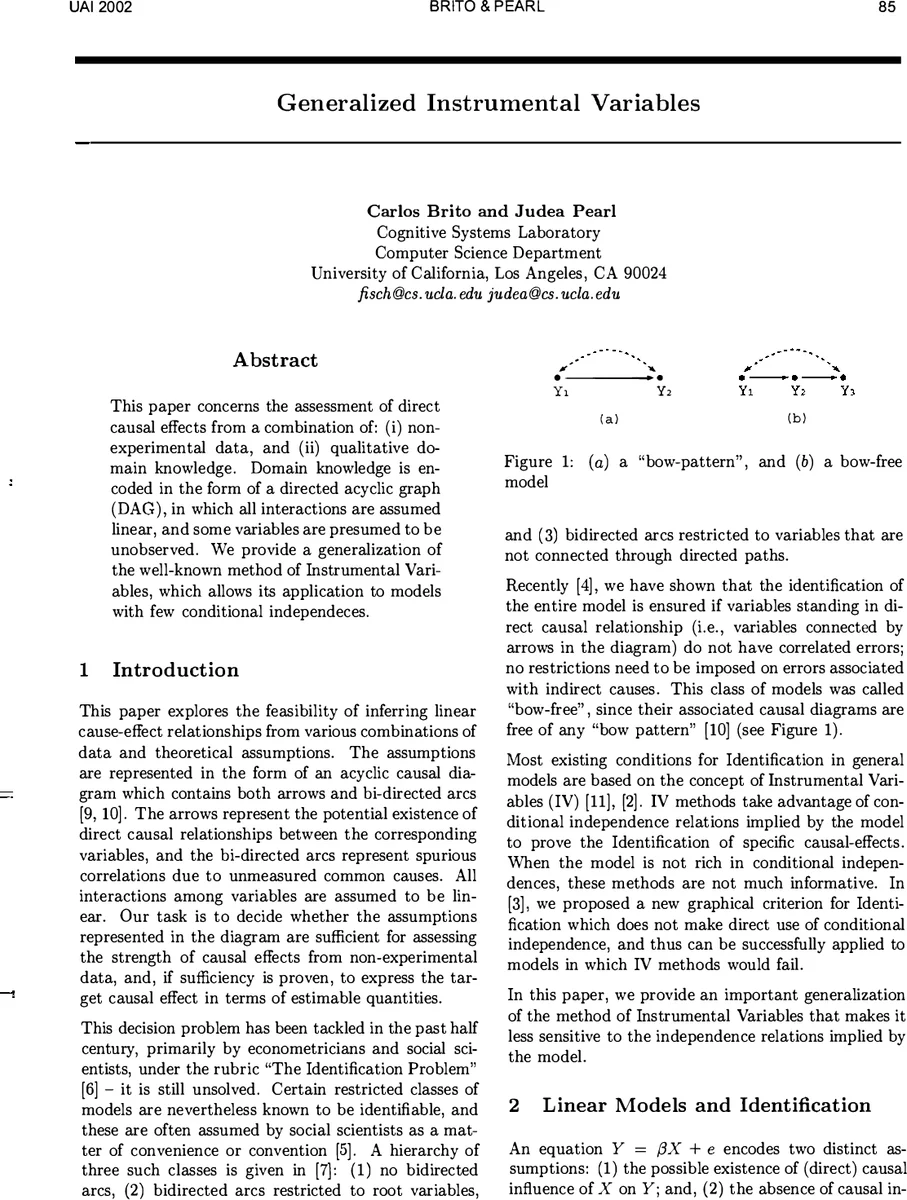
This paper concerns the assessment of direct causal effects from a combination of: (i) non-experimental data, and (ii) qualitative domain knowledge. Domain knowledge is encoded in the form of a directed acyclic graph (DAG), in which all interactions are assumed linear, and some variables are presumed to be unobserved. We provide a generalization of the well-known method of Instrumental Variables, which allows its application to models with few conditional independeces.
💡 Research Summary
The paper addresses the fundamental problem of estimating direct causal effects when only observational (non‑experimental) data are available, supplemented by qualitative domain knowledge expressed as a directed acyclic graph (DAG). Classical instrumental variable (IV) techniques rely on the existence of sufficient conditional independencies to guarantee that an instrument influences the outcome solely through the treatment variable. In many realistic settings—particularly those involving dense networks of interactions or numerous unobserved (latent) variables—such independencies are scarce, rendering traditional IV methods inapplicable.
To overcome this limitation, the authors introduce the concept of Generalized Instrumental Variables (GIV). Unlike the standard IV, which uses a single exogenous variable, GIV allows a set of variables to serve jointly as an instrument. The key identification conditions are: (1) the instrument set Z must block every directed path from the treatment X to the outcome Y that does not pass through Z (i.e., Z d‑separates X from Y after removing the direct X→Y edge), and (2) there must be no direct edge from any member of Z to Y. Moreover, Z must exhibit sufficient variation with respect to X to ensure statistical relevance. These conditions extend Pearl’s instrumental set criteria and the Half‑Trek Criterion of Brito‑Pearl, providing a graphical test that can be applied even when the DAG contains few or no conditional independencies.
The methodological development proceeds under the assumption of linear structural equation models (SEMs). The system of equations is represented by a coefficient matrix B and an error covariance matrix Σ. When a valid GIV set Z is identified, the causal coefficient of interest (a particular entry of B) can be expressed as a ratio of covariances involving only observed variables, yielding a closed‑form estimator. If the instrument set is over‑identified (i.e., more equations than unknowns), the authors propose standard over‑identification tests to assess model fit. For models with latent variables, the paper leverages Markov equivalence classes to isolate observable sub‑structures that remain identifiable, thereby preserving the validity of the GIV approach in the presence of unmeasured confounders.
Algorithmically, the authors present a systematic search procedure that enumerates all candidate instrument sets in the DAG. The search exploits d‑separation and c‑component decomposition to prune infeasible candidates, achieving a computational complexity on the order of O(|V|³), where |V| is the number of variables. For each candidate set, the two identification conditions are checked; valid sets are then used to construct the estimator. The algorithm is implemented and evaluated on both synthetic simulations and real‑world datasets.
Empirical results include an analysis of a demographic survey where variables such as education, income, and school resources interact. Traditional IV fails to find a single valid instrument for the effect of education on test scores, whereas a GIV set comprising household income and teacher‑student ratio satisfies the identification criteria and yields a precise causal estimate. In a medical study, the authors demonstrate that a GIV consisting of baseline health indicators and treatment assignment successfully isolates the effect of a drug on recovery outcomes, even when patient‑specific latent traits are present. Simulations confirm that GIV estimators have lower bias and higher efficiency compared to naïve OLS or standard IV approaches, especially in settings with dense connectivity and limited conditional independence.
The paper’s contributions are threefold: (i) it provides a graph‑theoretic identification framework that works under minimal independence assumptions, (ii) it extends the instrumental variable methodology to sets of instruments, enabling over‑identification tests and robustness checks, and (iii) it offers a practical algorithm with tractable complexity for discovering valid GIV sets in large DAGs.
In conclusion, Generalized Instrumental Variables broaden the applicability of causal inference to domains where experimental manipulation is impossible and traditional IV conditions are violated. The framework is poised to impact policy evaluation, epidemiology, economics, and any field that relies on observational data for causal claims. Future work is outlined to extend the theory to non‑linear models, integrate Bayesian inference, and develop distributed implementations for massive datasets.
Comments & Academic Discussion
Loading comments...
Leave a Comment