Exact solutions of nonlinear boundary value problems of the Stefan type
The (1+1)-dimensional nonlinear boundary value problem, modeling the process of melting and evaporation of metals, is studied by means of the classical Lie symmetry method. All possible Lie operators of the nonlinear heat equation, which allow us to reduce the problem to the boundary value problem for the system of ordinary differential equations, are found. The forms of heat conductivity coefficients are established when the given problem can be analytically solved in an explicit form.
💡 Research Summary
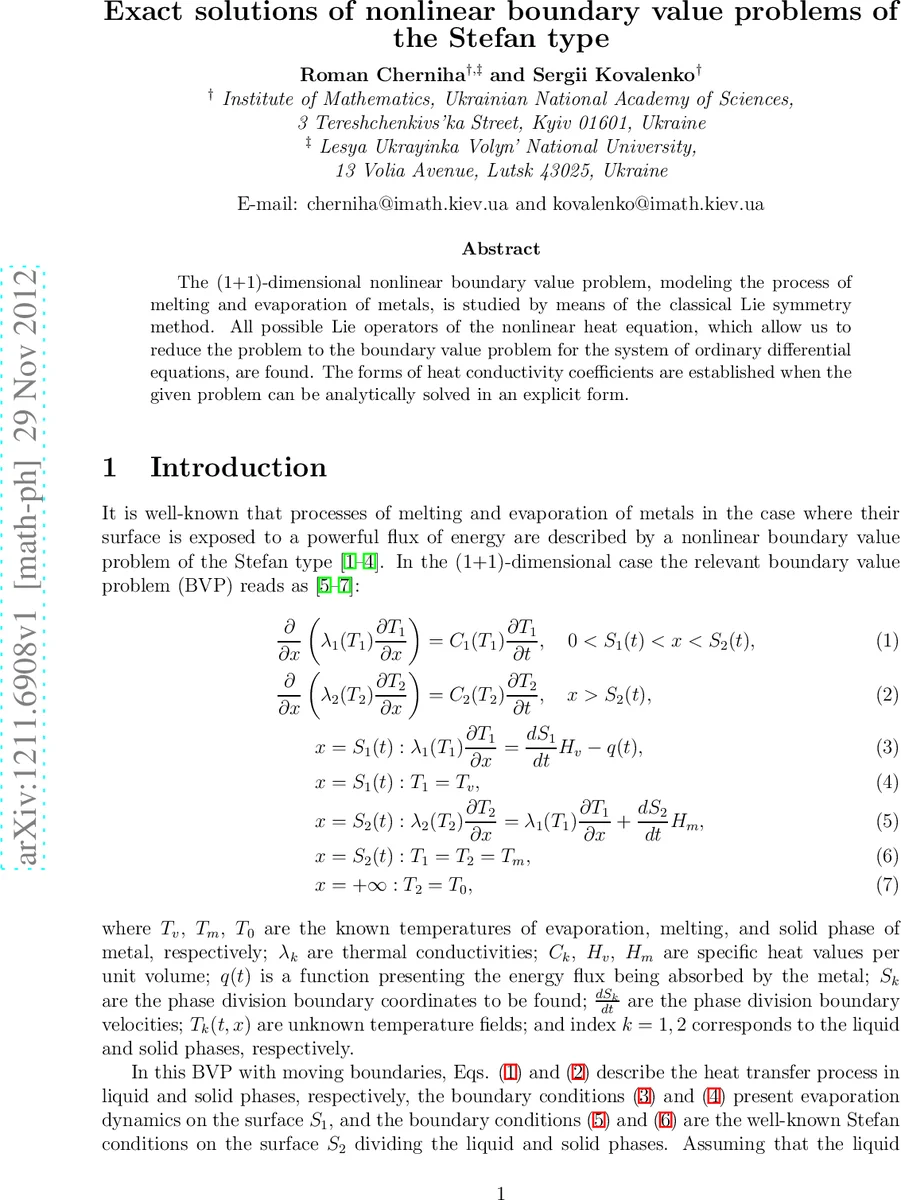
The paper addresses a one‑dimensional nonlinear Stefan‑type boundary‑value problem (BVP) that models the melting and evaporation of metals under intense energy flux. Starting from the classical formulation (equations (1)–(7)), the authors first apply the Kirchhoff transformation to introduce new dependent variables u and v, which linearize the heat capacities and lead to a pair of nonlinear heat equations (9) and (10) together with moving‑boundary conditions (11)–(15).
The core of the work is a systematic Lie‑symmetry analysis of the nonlinear heat equation ∂u/∂t = ∂ₓ(d(u)∂ₓu). By employing the well‑known group classification of this equation, the authors identify the maximal invariance algebra (MAI) for an arbitrary conductivity function d(u) as the three‑dimensional algebra generated by ∂ₜ, ∂ₓ and the scaling operator 2t∂ₜ + x∂ₓ. Special forms of d(u) (exponential, power‑law, and the critical exponent –4/3) enlarge the algebra to four or five dimensions (Table 1).
However, when the moving‑boundary conditions are taken into account, only two types of symmetry operators can reduce the whole BVP to an ordinary‑differential‑equation (ODE) system. These are (i) the translation‑plus‑boost operator X₁ = ∂ₜ + μ∂ₓ, which yields the travelling‑wave similarity variable z = x – μt and forces the phase‑boundary positions to be linear functions Sₖ(t) = μt + ωₖ, and (ii) the scaling operator X₂ = 2t∂ₜ + x∂ₓ, which introduces the similarity variable ω = x√t and leads to square‑root dependence Sₖ(t) = ωₖ√t. The associated heat‑flux function q(t) must be constant (q₀) in the first case or proportional to √t (q₀√t) in the second (Theorem 2).
Applying either symmetry reduces the original PDE‑BVP to a coupled system of nonlinear ODEs (45)–(51). To make these ODEs tractable, the authors perform another change of variables: U = ∫du/d₁(u) and V = ∫dv/d₂(v), where d₁(u)=λ₁(T₁)C₁(T₁) and d₂(v)=λ₂(T₂)C₂(T₂). The resulting equations (53) and (54) belong to a class of second‑order ODEs that have been completely solved in classical references (Kamke). Three integrable cases are listed in Table 2, the most important being the case where D₁(U)=a² and D₂(V)=b² (constants). In this situation the solutions are expressed through the error function erf.
The paper works out the first integrable case in detail. By imposing the transformed boundary conditions (56)–(58) the integration constants C₁…C₄ are determined, leading to explicit formulas (64) and (65) for U(ω) and V(ω). The similarity parameters ω₁ and ω₂ are then fixed by two transcendental equations (66) and (67), which involve the latent heats Hᵥ, Hₘ, the imposed flux q₀, and the material constants a, b. These equations can be solved numerically.
Finally, the authors illustrate the method with realistic material data for aluminium. Substituting the aluminium values for λ, C, H, etc., they compute the temperature fields in both liquid and solid regions and the velocities of the moving phase‑change fronts. The results demonstrate how the nonlinear conductivity influences the melting/evaporation dynamics compared with the classical linear‑conductivity solution.
In conclusion, the study shows that Lie‑symmetry analysis provides a powerful and systematic route to reduce nonlinear Stefan problems to ODEs, identifies the precise functional forms of the conductivity and heat‑capacity that admit exact similarity solutions, and delivers explicit analytical expressions for temperature and front positions. The work opens the way for further extensions to multi‑dimensional geometries, time‑dependent fluxes beyond the two admissible forms, and more complex constitutive laws.
Comments & Academic Discussion
Loading comments...
Leave a Comment