Trends in condensed matter physics: is research going faster and faster?
In this paper we study research trends in condensed matter physics. Trends are analyzed by means of the the number of publications in the different sub-fields as function of the years. We found that many research topics have a similar behavior with an initial fast growth and a next slower exponential decay. We derived a simple model to describe this behavior and built up some predictions for future trends.
💡 Research Summary
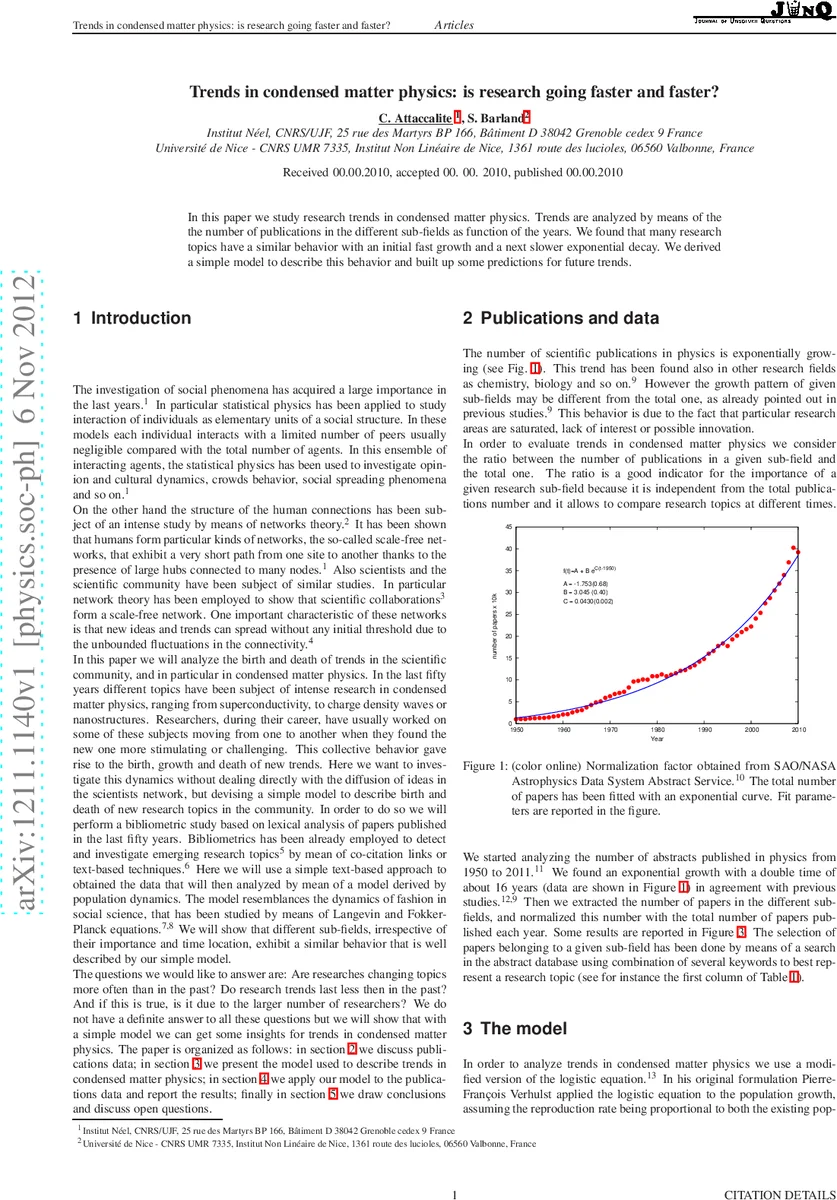
The paper investigates whether research trends in condensed‑matter physics are accelerating over time. Using the NASA/SAO Astrophysics Data System (ADS), the authors collected abstracts of physics papers published from 1950 to 2011. Because the total number of physics papers grows exponentially, they normalized the yearly count of papers in each sub‑field by the total yearly output, thereby obtaining a dimensionless “fraction of papers” that serves as a proxy for the relative importance of each topic.
To describe the temporal evolution of these fractions, the authors adapt the classic logistic growth equation. In the standard logistic model the population P(t) grows with rate r toward a fixed carrying capacity K. For scientific topics, however, the “carrying capacity” (the amount of intellectual, experimental, and funding resources available for a given field) is not constant; it declines as the field matures and as funding agencies shift toward newer areas. The authors therefore introduce a decay term for K: dK/dt = –s P(t), where s is a “research‑rate coefficient.” Combining this with the logistic growth term yields a second‑order differential equation whose solution exhibits an early exponential rise (controlled by r) followed by a long‑term exponential decay (controlled by s).
Because the full analytical solution is cumbersome, the authors propose a simplified phenomenological fitting function:
P_model(t) = P₀ /
Comments & Academic Discussion
Loading comments...
Leave a Comment