The su(n) WZNW fusion ring as integrable model: a new algorithm to compute fusion coefficients
This is a proceedings article reviewing a recent combinatorial construction of the su(n) WZNW fusion ring by C. Stroppel and the author. It contains one novel aspect: the explicit derivation of an algorithm for the computation of fusion coefficients …
Authors: Christian Korff
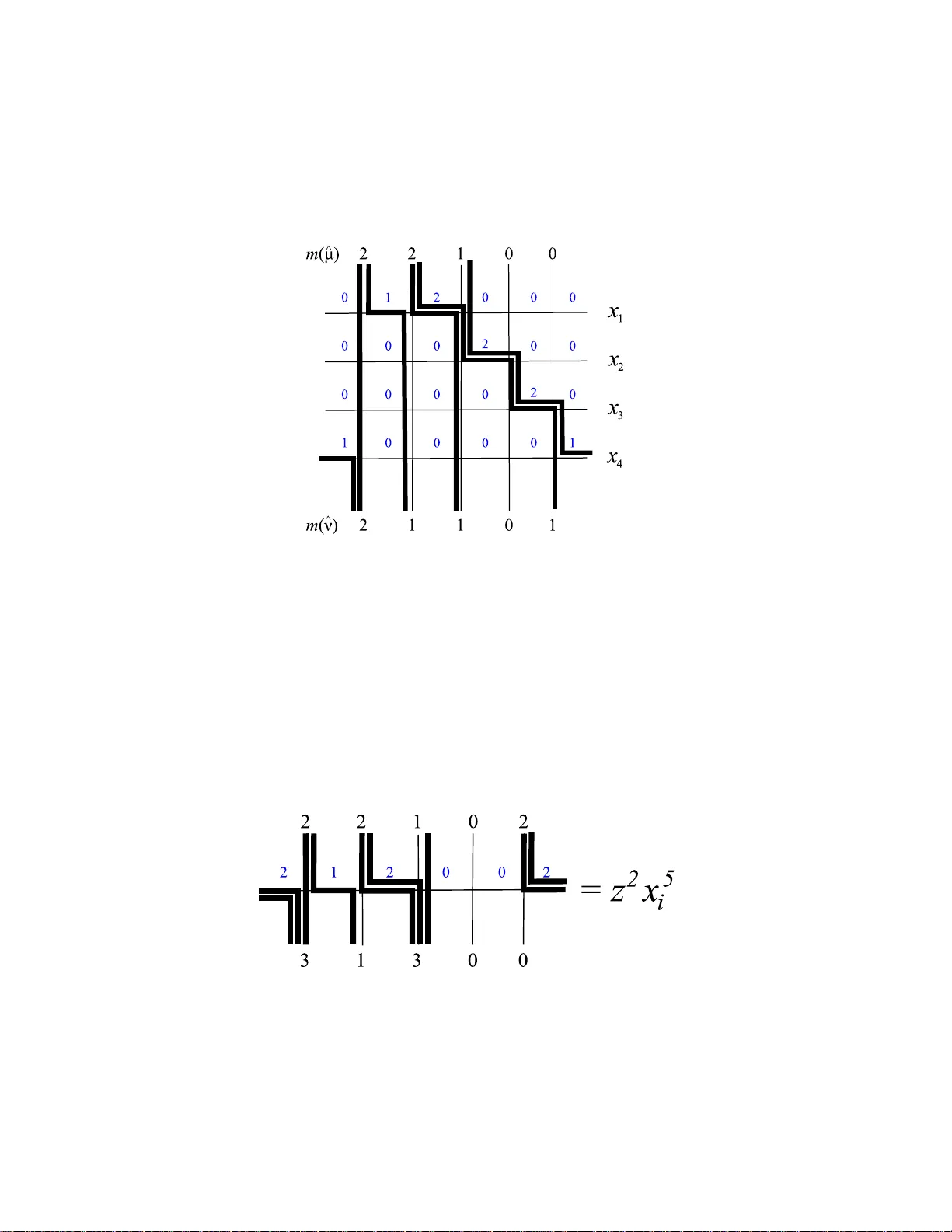
RIMS Kˆ okyˆ ur oku Bessatsu Bx (2011), 000–000 The su( n ) WZNW fusion ring a s in te grable mo de l: a new algori t hm to compute fusion co e fficien t s By Christian K orff ∗ Abstract This is a proceedi ngs articl e reviewing a recen t combinatorial construction of the b su ( n ) k WZNW fusion ring by C. Stropp el and the author. It contains one nov el asp ect: the explici t deriv ation of an algorithm for the computation of fusion co effic i en ts differen t from the Kac- W alton form ula. The discussion is presen ted from t he p oint of view of a v ertex mo del i n statistical mec hani cs whose partition function generates t he fusion coeffici en t s. The s tatistical mo del can b e sho w n to b e in tegrable b y linking its transfer matrix to a particular solution of the Y ang-Baxter equation. This transfer matri x can b e i den t i fied w ith the generating function of an (infinite) set of poly nomials in a noncommutativ e alphab et: the generators of the lo cal affine plactic algebra. The latter i s a general isation of the plactic algebra o ccurring in the con text of the Robinson-Sc hensted corresp ondence. One can define analogues of Sc h ur p olynomial s in this noncomm utativ e al phab et whic h b ecom e iden ti cal to the fusion matrices when represen ted as endomorphisms o v er the state space of the in tegrable mo del. Crucial is the construction of an eigen basis, the Bethe v ect ors, whic h are the idemp ot en t s of the f usion algebra. § 1. In tro duction W ess-Zumino-No viko v -Witten (WZNW) mo dels are an important cla ss o f confor- mal field t heori es (CFT) disti nguished by their Lie algebraic sy mmet r y . Due to this symmetry t he primary fields of WZNW theories are in one-to-one corresp ondence with the in tegrable highest weigh t represen tations of a n affine Lie algebra; see e.g. the text b o ok [4] for details a nd references. Co nsider the b su ( n ) k WZNW mo del, then the set of Received No vember 30, 2010. Revi sed March 21, 2011. 2000 M athematics Sub jec t Classification(s): 17B37; 1 4N10; 1 7B67; 05E05; 82 B23; 81T40 Key Wor d s : Quan tum integrable mo dels; Plac t i c algebra; Bethe Ansatz; F usion ring; V erl inde algebra; Sym metric functi ons The author is financially supported by a Universit y Researc h F el low ship of the Roy al So ciety ∗ School of Mathem atics & Stati sti cs, University of Glasgow, Scotland, UK. e-mail: christia n.korff @glasgow.ac.uk c 201x Research Institute for Mathematic al Science s, Kyo to University . All rights reserved. 2 Christian Korff all domi na nt inte gr al weights of leve l k ∈ Z ≥ 0 is g i v en b y (1.1) P + k = ( ˆ λ = n X i =1 m i ˆ ω i n X i =1 m i = k , m i ∈ Z ≥ 0 ) where the ˆ ω i ’s denote the fundamen t al affine weigh ts of the affine Lie algebra b su ( n ); see e.g. [13] for details. Note that we use the lab el n instead of 0 for the affine no de. In what follows it wil l b e con venien t to iden tify elemen t s in the set P + k with the partitions P ≤ n − 1 ,k whose Y oung diagram fits in to a b ounding b ox of height n − 1 and wi dth k . Namely , define a bijection P + k → P ≤ n − 1 ,k b y setting (1.2) ˆ λ 7→ λ = ( λ 1 , . . . , λ n − 1 ) with λ i − λ i +1 = m i , where m i is the so-called Dynkin l ab el, i.e. the co efficient of the i th fundamen tal w eigh t in (1.1). Vice ve rsa, gi v en a partitio n λ ∈ P ≤ n − 1 ,k w e shall denote b y ˆ λ the corresp ond- ing affine w eigh t in P + k . Since t he set of dominant in tegral w eigh t s at fixed level k has cardinality | P + k | = n + k − 1 k , WZN W mo dels are so-called r ational conformal field theories, i . e. they hav e a finite set of primary fields from whic h all o ther fields can b e generated. An imp o rtan t ingredien t in the description of rational conformal field theories is the concept of fusion: in ph ysics terminology one considers the op erat or pro duct expansion of t w o primary fields. While this can b e made mathematical ly precise i n t he con text of vertex op erator algebras a nd the fusion pro cess can b e iden tified with t he pro duct i n the Gro t hendiec k ring of an ab el i an braided monoidal catego ry in the context of tilt ing mo dules o f quan- tum g ro ups, w e will not use t his mat hemati cal framew o rk here. Consider the free ab elian gro up (with resp ect to addition) g enerated b y P + k and in tro duce the so-called fusion pro duct (1.3) ˆ λ ∗ ˆ µ = X ˆ ν ∈ P + k N ( k ) ˆ ν ˆ λ ˆ µ ˆ ν , b y defining the structure constan t s N ( k ) ˆ ν ˆ λ ˆ µ ∈ Z ≥ 0 , called fusion c o efficie nts , via the celebrated V erlinde form ula [ 19] (1.4) N ( k ) ˆ ν ˆ λ ˆ µ = X ˆ σ ∈ P + k S ˆ λ ˆ σ S ˆ µ ˆ σ S − 1 ˆ ν ˆ σ S ˆ ∅ ˆ σ . Here ˆ ∅ denotes the w eight corresponding to the empt y partition and S is the mo dular S - matrix describing the mo dular transformation τ → − τ − 1 of affine c haracters. Among other prop erti es i t enjo ys unitarity ¯ S ˆ ν ˆ σ = S − 1 ˆ ν ˆ σ and crossing symmetry ¯ S ˆ λ ˆ σ = S ˆ λ ∗ ˆ σ , where ˆ λ ∗ is the dual w eigh t o btained by ta k ing the complemen t of λ in the ( n − 1) × k The su( n ) WZNW fusion ring as integrable mo del 3 b ounding b ox and then deleti ng all n -col umns, λ ∗ = ( λ 1 , λ 1 − λ n − 1 , λ 1 − λ n − 2 , . . . , λ 1 − λ 2 ). F or WZNW mo dels the explicit expression for S i s known: the Kac-P eterson for- m ula [14] states S in terms of the W eyl group W and sp ecialises for b su ( n ) to the expression (1.5) S ˆ λ ˆ σ = e iπ n ( n − 1) / 4 p n ( k + n ) n − 1 X w ∈ W ( − 1) ℓ ( w ) e − 2 πi k + n ( σ + ρ,w ( λ + ρ )) , where ρ is the W eyl vector and λ, σ denote the finit e, non-affine w eigh ts corresp onding to ˆ λ, ˆ σ . F rom t his formu la it is b y no means ob vious that the fusion co efficien ts (1 . 4) are non-negative in tegers, how ever they hav e b een iden tified with certain dimensions or m ultiplicities in v arious different contexts as e.g. discussed i n [9] (for references see lo c. cit. ): dimensions of spaces of conformal blo c ks of 3-p oin t functions, so-called mo duli spaces o f generalised θ -functions; outer multiplicities of truncated tensor pro ducts o f tilting mo dules of quan tum groups at ro ots of unit y; Lit tlew o o d-Ric hardson co efficients of Hec k e algebras at ro ots of unit y; dimensions of lo cal states i n restricted-solid-on- solid models. In fact, (1.3) defin es a un ital, comm utative ring o v er t he in tegers Z , whic h w e shall refer to as the b su ( n ) fusio n ring at level k , denoted by F n,k , and to the corresp onding unital, commutativ e and asso ciative algebra F C n,k = F n,k ⊗ Z C a s fusion or V erlind e algebr a . This article a i ms to give a non-tec hnical accoun t of the mai n findings i n [15] and [16] regarding the b su ( n ) fusion ring. F or pro ofs t he reader is referred to t he men ti oned pap ers. Sections 2 and 3 are largely a summary of previous results rev iewing t he defi- nition of an in tegrable stat i stical mec hanics mo del which generates t he fusion ring. It is conv enien t t o describ e t he statisti cal mo del and its latti ce configurations using non- in tersecting paths, since this al lo ws for instance a non-tec hnical definition of the transfer matrix. H o w ever, it needs to b e stressed that at the mo ment the path picture is not used to give combinatorial pro ofs, instead the discussion i s alg ebrai c and employs the solution to the Y ang-Baxter equation gi v en in [16]. How ever, we presen t one result, Corollary 2. 3, which relates the coun t ing of non-in tersecting paths on the cy l inder to a sum ov er fusion co efficien t s. W e a l so mak e contact with the phase mo del of Bogo l iub o v, Izergin and Kitanine [ 2] where closely related algebraic structures hav e b een discussed. Section 4 states a detailed deriv ation of the new al gorithm to compute fusion co effi- cien t s. First a review of the Bethe ansatz equations i s given b y highl i gh ting how they are connected to a fusion p otential. The latter differs from the fami liar fusion p otential of Gepner [7] and the algori thm therefore yields ex pressions for fusion co efficien ts in terms of Littlewoo d-Ric hardson co efficien ts which differ from the ones obtained via the celebrated Kac-W alton formula [13] [20]; compare also with the work of Go o dman and W enzl [10]. Section 5 stresses that the Bethe vec tors constructed via the quan tum in- 4 Christian Korff v erse scatt ering metho d can b e i den tified with the idemp oten ts of the fusion ring. The pro of of this result has b een given b efore [15] but their role has not b een emphasized. The mo dular S-matrix is the transiti o n matrix from the basis of integrable w eigh ts to the basis of Bethe v ectors and, hence, can b e ex pressed i n terms of t he generators of a Y ang-B a xter algebra. W e also presen t a new p ersp ective on t he affine plactic Sc h ur p olynomial s w hi ch a re defined i n t erms of the transfer matrix via a determinant for- m ula: they constit ute the set o f conserve d quan tities of t he integrable mo del and hence should b e seen as the quan tum analogue of a sp ectral curv e. In t he presen t mo del this quan tum sp ectral curv e coincides with the coll ecti on o f b su ( n ) k fusion rings for k ∈ Z ≥ 0 . W e conclude wi th some practical applications, recursion formu lae for fusion co efficients at di fferent l ev el. The last section discusses ho w t he findings summari sed here mig ht generalise to a wi der class of in tegrable mo dels. § 2. F usion co efficie n ts from statistica l mec hanics W e start by defining a statistical ve rtex mo del which is o btained in the cryst a l limit of U q b su (2); see [16]. Consider a n × ( n − 1) square l a ttice with quasi-p erio dic b oundary conditions in the horizontal direction, i .e. a square la ttice on a cylinder with n − 1 rows. On the edges of the square lattice live stati stical v aria bl es m ∈ Z ≥ 0 , whic h w e will i den tify wi th the Dynki n lab els of dominant integrable w eigh ts b elow. T o eac h lattice configuration we assign a “B oltzmann w eigh t” i n C [ z ] [ x 1 , . . . , x n − 1 ] b y taki ng the pro duct o v er (lo cal) vertex configurati ons. Lab el the statisti cal v ariables a, b, c, d ∈ Z ≥ 0 sitting o n the edges of a vertex in the i th lattice ro w as sho wn in Figure 1, then we assign to it the weigh t ( compare with [16]) (2.1) R a,b c,d ( x i ) = ( x a i , d = a + b − c, b ≥ c 0 , else . It is con v enien t to describ e t he v ertex configurations in terms of non-in tersecting paths, so-called ∞ -friendly w alkers; compare with [8, 1 1, 12]. In Figure 1 b walk ers are en tering the ve rtex from abov e turning to the right, at which p oin t a con tingen t of them o f size b − c c ho oses t o defect. T he defectors then join another group of a walk ers coming from the left. The Boltzmann we igh t o f the i th lattice r ow is t hen given b y z a n Q 1 ≤ j ≤ n R a j ,b j c j ,d j ( x i ), where we ha v e introduced a parameter z whi ch k eeps track of ho w many walk ers pass the b oundary . Fi gure 3 sho ws o n a simple example t hat the weigh t o f a single row i s easily computed b y si mply coun ti ng the n um b er of horizontal edges. Giv en t w o arbitrary but fixed affine weigh ts ˆ µ, ˆ ν ∈ P + k , denote by m ( ˆ µ ) , m (ˆ ν ) their n -tuples of Dynkin lab els in (1 .1). Denote b y Γ ˆ µ ˆ ν the lat tice configurations where the outer vertical edges at the b ot tom and top of the cylinder take t he v alues m ( ˆ µ ) , m ( ˆ ν ), resp ectiv ely . Figure 2 sho ws on an example that eac h latt ice configuration corresp onds The su( n ) WZNW fusion ring as integrable mo del 5 Figure 1. Graphical depiction of a vertex configuration with Boltzmann w eigh t (2. 1). The statistical v ariables a, b, c, d ∈ Z ≥ 0 ob ey the constraints a + b = c + d and b ≥ c . to k nonin t ersecting paths some of whic h are closely bunc hed together. Th e corre- sp onding parti tion function of the vertex mo del, i.e. the w eigh ted sum ov er all l attice configurations is defined as (2.2) Z ˆ µ ˆ ν ( x 1 , . . . , x n − 1 ; z ) : = X { ( a ij ,b ij ,c ij ,d ij ) }∈ Γ ˆ ν ˆ µ Y 1 ≤ i ≤ n − 1 z a in Y 1 ≤ j ≤ n R a ij ,b ij c ij ,d ij ( x i ) with ( a ij , b ij , c ij , d ij ) denoting the vertex configuration in the i th ro w a nd j th col- umn. A s we wil l see b elo w the partition fu nction is symmetric in the v ariables x i and, therefore, can b e expanded in to a suitable basis i n the ring of symmetric func- tions C [ z ] [ x 1 , . . . , x n − 1 ] S n − 1 . W e c ho ose the basis of Sch ur functions { s λ } where λ is a partition with length ℓ ( λ ) < n . W e remind t he reader that the Sch ur function s λ ( x 1 , .. . , x n − 1 ) can b e defined a s w eigh t ed sum of Y oung tableaux. Given a partition λ , a Y o ung tableau t of shap e | t | = λ is a filli ng of the Y oung diagram with integers i n the set { 1 , . . . , n − 1 } suc h that the n umbers are weakly i ncreasing in eac h row from l eft to right and ar e stri ct l y increasing in eac h column from top to b ottom. T o eac h tableau w e assign the w eigh t v ector α = ( α 1 , . . . , α n − 1 ) where α i is the m ultiplicity of i o ccuring in t . The Sch ur function is then gi v en as s λ ( x 1 , .. . , x n − 1 ) = P | t | = λ x α 1 ( t ) 1 · · · x α n − 1 ( t ) n − 1 . W e state an ex pl i cit exa mple. Example 2.1. Let n = 3 and λ = ( 2 , 1). Then the list of p ossible tableaux t reads, t = 1 1 2 , 1 1 3 , 1 2 2 , 1 3 2 , 1 2 3 , 1 3 3 , 2 2 3 , 2 3 3 . Th us, the Sc h ur function is the foll o wing p olynomi al s (2 , 1) = x 2 1 x 2 + x 2 1 x 3 + x 1 x 2 2 + 2 x 1 x 2 x 3 + x 1 x 2 3 + x 2 2 x 3 + x 2 x 2 3 . Expanding the part ition function (2.2) wit h resp ect to Sc h ur functions we obtain a 6 Christian Korff relation b et w een the statistical mec hanics mo del defined via ( 2.1) and the fusion algebra of the b su ( n ) k -WZNW mo del [16]. Prop osition 2.2 (generating function for fusion co efficients) . The p a r ti tion func- tion (2.2) has the exp ansi on (2.3) Z ˆ µ ˆ ν ( x 1 , . . . , x n − 1 ; z ) = X ˆ λ ∈ P + k z d N ( k ) , ˆ ν ˆ λ ˆ µ s λ ( x 1 , .. . , x n − 1 ) , wher e N ( k ) , ˆ ν ˆ λ ˆ µ ar e the fusion c o efficients and the de gr e e d i s gi ven by d := | λ | + | µ |−| ν | n + ν 1 − µ 1 . Giv en a square s at p osition ( i, j ) in the Y oung diagram of a part ition λ , recall that the ho ok length is defined as h ( s ) = λ i + λ t j − i − j + 1. That is, h ( s ) is the nu m b er of squares to ri gh t i n the same row and the num b er of squares in the col umn b elo w it plus one (for the square i t self ). The con t en t of the same square is simply defined as c ( s ) = j − i . Denote by Γ ˆ µ ˆ ν ( d ) ⊂ Γ ˆ µ ˆ ν the subset of l attice path configurations which ha v e a fixed nu m b er of 2 d outer horizon tal edges. The following result on the num b er of p o ssible lattice configurations on the cyli nder a pp ears to b e new. Corollary 2.3 (lattice configurations and fusion co efficien ts) . Sp e cialisi ng to z = x 1 = · · · = x n − 1 = 1 i n (2 . 3) we ob ta i n the identity (2.4) | Γ ˆ µ ˆ ν ( d ) | = X ˆ λ ∈ P + k N ( k ) , ˆ ν ˆ λ ˆ µ Y s ∈ λ n − 1 + c ( s ) h ( s ) , wher e the sum c an b e r estricte d to those weights ˆ λ f o r which d = | λ | + | µ |−| ν | n + ν 1 − µ 1 . Pr o of. The assertion follo ws from the we ll-known formula [18, Chapter I, Section 3, Ex ample 4], s λ (1 , . . . , 1) = Q s ∈ λ ( n − 1 + c ( s )) /h ( s ) and the previous expansion (2.3) of the partition function. R emark. While i n [8, 11, 12] the Gessel-Viennot metho d has b een used t o obtai n analogous results for differen t typ e of b oundary conditions, t he pro of of Prop ositio n 2.2 rests on the Y ang-Ba xter equation, see (3.16) below, and the q uan t um in v erse scatteri ng metho d, th us it is of algebraic nature. § 3. T ransfer matri x and Y ang-Baxter algebras W e now in tro duce the row-to-ro w transfer matri x of the vertex mo del (2.1) as the partition function of a single lattice ro w and t hen iden tify it b elo w as generating function of certai n p olynomia ls in a noncomm utative alphab et. The su( n ) WZNW fusion ring as integrable mo del 7 Figure 2. An example o f a latti ce configuration in terms of non-intersecting paths for n = k = 5 a nd µ = (5 , 3 , 1), ν = ( 4 , 2 , 1). Figure 3. An example for n = 5 and k = 7 o f a ro w configuration a nd its ”statisti cal w eigh t ” , which is obtained by coun ting the horizontal edges of pat hs. Outer edges are iden t ified and for eac h a p o w er of z i s added. 8 Christian Korff Definit ion 3.1 ( transfer matrix) . Giv en an y tw o n -tuples m = ( m 1 , . . . , m n ) and m ′ = ( m ′ 1 , . . . , m ′ n ) ∈ Z n ≥ 0 , the transfer matri x Q ( x i ) of the i th ro w is defined via the elemen ts (3.1) Q ( x i ) m,m ′ := X allowed r ow conf ig ur ations z # of outer edges 2 x # of horizontal edges i , where t he factor 1/2 in the p ow er of t he v ariable z takes into accoun t that the outer horizon tal edges need to b e iden tified, since w e are on the cylinder. As i t is common in the discussion of v ertex mo dels w e wish to iden tify the transfer matrix as an endomorphism of a vector space. F or this purp ose w e now interpret the statistical v ariables at the latti ce edges as l ab els of basis vectors in t he v ector space M = L m ∈ Z ≥ 0 C v m . Then a row configuration in the la ttice, i.e. an assignmen t of statistical v a riables m = ( m 1 , . . . , m n ) along one ro w of vertical edges, fixes a ve ctor v m 1 ⊗ · · · ⊗ v m n ∈ M ⊗ n . Henceforth, we iden tify t he tensor pro duct M ⊗ n with C P + , the complex linear span of al l t he integral dominant w eigh t s of the affine Lie algebra b su ( n ), P + := n ˆ λ = P n i =1 m i ˆ ω i m i ∈ Z ≥ 0 o , v ia the map m 7→ P n i =1 m i ˆ ω i . That is, w e interpre t the sta tistical v ariables m = ( m 1 , . . . , m n ) in one ro w of our v ertex mo del as Dy nk in la b els of an affine we igh t i n P + . F or conv enience we wi ll sometimes denote this n -tuple m and the asso ciated vector in M ⊗ n b y the same symbol. By construction the ro w-to-ro w t ransfer mat rix and t he partit ion function a re then relat ed via (3.2) Z ˆ ν ˆ µ ( x 1 , . . . , x n − 1 ; z ) = h m ( ˆ ν ) , Q ( x n − 1 ) · · · Q ( x 1 ) m ( ˆ µ ) i , where we hav e introduced the i nner pro duct h m, m ′ i := Q n i =1 δ m i ,m ′ i whic h we assume to b e an tilinear i n the first factor. Thus, the transfer mat r i x (3.1) can b e in terpreted as discrete ti me evolution op erator whi ch successiv ely generates the pat hs on t he cylindric square latti ce. Note that for an y pair of configurations m , m ′ ∈ M ⊗ n only a finite n umber of the t erms maki ng up the matrix elemen t h m , Q ( x i ) m ′ i is non-zero. The op erator Q ∈ End M ⊗ n is theref ore w ell-defined. W e no w reform ulate the transfer matrix in terms of a set of more elemen tary , l o cal op erators whic h resp ectiv ely increase and decrease a single Dynkin lab el m i only . § 3.1. The lo cal affine pla ctic algebra F or i = 1 , . . . , n define maps ϕ i , ϕ ∗ i ∈ End( M ⊗ n ) b y setting (3.3) ϕ ∗ i m = ( m 1 , . . . , m i + 1 , . . . , m n ) and (3.4) ϕ i m = ( ( m 1 , . . . , m i − 1 , . . . , m n ) , m i > 0 0 , else . The su( n ) WZNW fusion ring as integrable mo del 9 In additi on let N i m = m i m for all 1 ≤ i ≤ n . These maps can b e iden tified wi th the Chev al ley generators of the U q sl (2) V erma mo dule in the cry stal limi t; see [ 16]. They ha v e first app eared in the con text of t he phase mo del; see [ 2] and references t herein. In [15] the fol l o wing stat ement has b een pro ven b y constructing an explicit basis for the phase a l gebra Φ. Prop osition 3.2 (phase algebra) . The ϕ i , ϕ ∗ i and N i gener ate a s ub algebr a ˆ Φ of End( M ⊗ n ) whi ch c an b e r e alize d as the algebr a Φ with th e f o l lowing gener ators and r elations for 1 ≤ i, j ≤ n : ϕ i ϕ j = ϕ j ϕ i , ϕ ∗ i ϕ ∗ j = ϕ ∗ j ϕ ∗ i , N i N j = N j N i (3.5) N i ϕ j − ϕ j N i = − δ ij ϕ i , N i ϕ ∗ j − ϕ ∗ j N i = δ ij ϕ ∗ i , (3.6) ϕ i ϕ ∗ i = 1 , ϕ i ϕ ∗ j = ϕ ∗ j ϕ i if i 6 = j, (3.7) N i (1 − ϕ ∗ i ϕ i ) = (1 − ϕ ∗ i ϕ i ) N i = 0 . (3.8) Note that with resp ect to the scalar pro duct in tro duced ab ov e w e ha v e h ϕ ∗ i m , m ′ i = h m , ϕ i m ′ i for any m , m ′ ∈ M ⊗ n . Definit ion 3.3 ( lo cal affine placti c algebra) . Let Pl = Pl( A ) be the free algebra generated b y the elemen ts of A = { a 1 , a 2 , . . . a n } mo dulo the relations a i a j − a j a i = 0 , if | i − j | 6 = 1 mo d n, (3.9) a i +1 a 2 i = a i a i +1 a i , a 2 i +1 a i = a i +1 a i a i +1 , (3.10) where ( 3.10) are the plactic relat i ons on the ci rcl e, i.e. all indices are defined mo dulo n . Denote b y Pl fin = Pl fin ( A ′ ) the lo c al finite plactic algebr a generated from A ′ = { a 1 , a 2 , . . . a n − 1 } . W e recal l the foll o wing result from [ 15, Prop 5.8 ]: Prop osition 3.4. Ther e is a homomorphism of algebr as P l fin → Φ such that (3.11) a j 7→ ϕ ∗ j +1 ϕ j , j = 1 , ..., n − 1 , wher e the r epr esentati on of the phase algebr a Φ give n by (3.3) and (3. 4) lifts to a r epr e- sentation of the lo c al plactic algebr a Pl fin . Mapping a 0 = a n to z ϕ ∗ 1 ϕ n it lifts in addition to a r epr esentati on of Pl on M [ z ] ⊗ n with M [ z ] = C [ z ] ⊗ C M and z an i ndeterminate. Both r epr es e n tati ons ar e fai thful. R emark. The finite placti c algebra first app eared in the context of t he Robinson- Sc hensted corresp ondence: giv en a w ord in a noncomm utative alphabet it can b e mapp ed on to a pair of Y oung tableaux, usually cal l ed ( P , Q ), b y using the bumping 10 Christian Korff algorithm. Q is the recording tableau enco ding t he sequence of bumping pro cesses; see e.g. [6] for an explanation. Lascoux and Sch¨ utzen b erger show ed that iden tifying w ords whic h only differ in their recording t a bleaux is equiv alent to a set of i den tit ies of which (3.10) are sp ecial cases. The lo c al finite placti c algebra w as first considered b y F omin and Greene in [5]. W e recov er their case when sp ecial i sing to z = 0. R emark. Note that the action of the affine plactic al gebra i s blo c k diagonal wi th resp ect to the decomp osit ion C P + = L k ≥ 0 C P + k . In fact eac h subspace can b e repre- sen ted as a directed coloured graph where the elemen ts in P + k are the v ertices a nd a directed edge of colo ur i b etw een tw o ve rtices, ˆ µ i − → ˆ λ , i s intro duced if ˆ λ = a i ˆ µ . This yields the Kiril lo v-Reshetikhin crystal graph B 1 ,k of t yp e A. Setting z = 0 all edges related t o t he affine generator a n are remov ed from the gr a ph and we obtain the su ( n ) crystal graph of highest w eigh t k ω 1 , where ω 1 is t he first fundamen tal w eigh t . § 3.2. Y ang-Baxter alge b ras F or r, s ∈ Z ≥ 0 arbitrary but fixed a nd u a formal, inv ertible v ariable define Q ( u ) : M ( u ) ⊗ M ( u ) ⊗ n → M ( u ) ⊗ M ( u ) ⊗ n b y setting Q ( u ) v r ⊗ m := P s ≥ 0 v s ⊗ Q s,r ( u ) m where (3.12) Q s,r ( u ) := X ε u | ε | + r ( ϕ ∗ 1 ) r a ε 1 1 · · · a ε n − 1 n − 1 ϕ s n with the sum running ov er all comp ositions ε = ( ε 1 , . . . , ε n − 1 ). Despite t he sums in the definition of Q ( u ) b eing infinite, only a finite n um b er of terms survive when acti ng on a vector in M ( u ) ⊗ n +1 , thus the op erato r is well-define d. In fact, w e hav e the following [16]: Lemma 3.5. L et Q b e the tr ansf e r matrix define d in (3.1). Then (3.13) Q ( x i ) = X r ≥ 0 z r Q r,r ( x i ) = X r ≥ 0 ( z x i ) r ( ϕ ∗ 1 ) r Q 0 , 0 ( x i ) ϕ r n , in other wor ds for z = 1 the tr ansfer matrix is the formal tr ac e of the matrix (3.12). Define anot her op erator R ( u/v ) : M ( u ) ⊗ M ( v ) → M ( u ) ⊗ M ( v ) vi a the relation (3.14) R ( u ) v a ⊗ v b = X c,d ≥ 0 R a,b c,d ( u ) v c ⊗ v d , setting (3.15) R a,b c,d ( u ) = u a , c = b , d = a u a (1 − u ) , d = a + b − c, b > c 0 , else . The su( n ) WZNW fusion ring as integrable model 11 Figure 4. The (Boltzmann) w eig h t s of lo cal v ertex configurati on for the auxili ary matri x T = A + z D . N o t e t hat in con t rast to the Bo l tzmann weigh ts (2.1) the walk ers can now propagate horizon tally but only one is all o w ed on a horizon tal edge at a time. Prop osition 3.6. The R -matrix (3. 14) and the mono dr omy matrix (3. 12) ob ey the Y ang- Baxter e quation, (3.16) R 12 ( u/v ) Q 1 ( u ) Q 2 ( v ) = Q 2 ( v ) Q 1 ( u ) R 12 ( u/v ) . The definition of the mono drom y matrix (3.12) can b e algebraical ly motiv ated b y tak ing a sp ecial limit of the intert winer of a U q ( sl (2)) V erma mo dule; see the di s- cussion in [16]. Replacing this V erma mo dule with the (t w o-dimensional) fundamen- tal represen tation one o bt a ins in the analogous limit n o w a 2 × 2 mono dromy ma- trix, T ∈ End( C 2 ⊗ M ( u ) ⊗ n ), where the ordering of the noncommu tative alphab et is rev ersed( r , s = 0 , 1), (3.17) T r,s ( u ) := X ε i =0 , 1 u | ε | + s ϕ s n a ε n − 1 n − 1 · · · a ε 1 1 ( ϕ ∗ 1 ) r = A ( u ) B ( u ) C ( u ) D ( u ) ! r,s . Note that the sum no w only runs ov er comp osit i ons ε whose part s are 0 or 1. This second mono drom y matrix coi ncides with the matrix i n t r o duced b y Bogoli ub ov, Izergin and Kitanine in the con text of the so-called phase mo del [2] . Prop osition 3.7 ([2]) . The 2 × 2 matrix (3.17) with entries in End( M ( u ) ⊗ n ) ob eys the Y ang-Baxter e quation R 12 ( u/v ) T 1 ( u ) T 2 ( v ) = T 2 ( v ) T 1 ( u ) R 12 ( u/v ) with (3.18) R ( u ) = u u − 1 0 0 0 0 0 u u − 1 0 0 1 u − 1 1 0 0 0 0 u u − 1 . 12 Christian Korff Figure 5. An example of a ro w configuration for the auxiliary matrix T for n = 6 and k = 7. The stat istical weigh t is again obtained by coun t ing the hori zon t a l edges of paths, where outer edges are once more iden tified eac h con tributing a p ow er of z . The matrix elements of (3.17) ob ey certain comm utation relations wi th t he matri x elemen ts (3 .12), whic h aga i n can b e enco ded in y et another solution to the Y ang-Bax ter equation [16]. Prop osition 3.8. The mono dr omy matric es (3.12) and (3. 1 7) satisfy the e qua- tion, (3.19) L ′ 12 ( u/v ) T 1 ( u ) Q 2 ( v ) = Q 2 ( v ) T 1 ( u ) L ′ 12 ( u/v ) , wher e the endomorphism L ′ ∈ End( C 2 ⊗ M ( u ) ⊗ n ) is define d in terms the matrix ele- ments (3.20) L ′ a,b c,d ( u ) = 1 + u, a, b, c, d = 0 u a , d = a + b − c, b ≥ c, a, c = 0 , 1 0 , else . The hallmark of a n exactl y solv able or in tegrable mo del i n stat istical mec hanics is that its transfer matrix comm utes wi th itself for arbi t rary v alues of the sp ectral parameter whic h here is iden tified wi t h the v aria bl es x i in eac h lat tice ro w. In a ph y sical application t he ro w v ariables { x 1 , . . . , x n } would b e ev aluated in the in terv al [0 , 1] × n suc h t hat the Bo l tzmann w eigh ts (2.1) can b e in terpreted as prop er probabilit ies. The transfer matrices for any other, p ossibly complex v alues, of the x i ’s would b e seen as a “symmetry” of the system. Generalisi ng t he notion o f Liouvill e integrabilit y in classical mec hanics, suc h a sta t istical mo del is called i n t egrable. On e i mp ortan t consequence o f the Y ang-Bax ter equat i ons stated ab o v e is that they imply integrabilit y of the vertex mo del (2.1). Corollary 3.9 (In tegrability) . Set T = A + z D then we have, among o the rs, the c ommutation r elations (3.21) [ Q ( u ) , Q ( v )] = [ T ( u ) , T ( v )] = [ T ( u ) , Q ( v )] = 0 , The su( n ) WZNW fusion ring as integrable model 13 wher e Q is the tr ans f er matri x (3.1). Mor e o v er, the f ol lowing r elation holds true Q r,r ( u ) B ( v ) = 1 + u v δ r, 0 B ( v ) Q 0 , 0 ( u ) + Q r − 1 , r ( u ) D ( v ) − Q r,r +1 ( u ) A ( v ) + Q r − 1 , r +1 ( u ) C ( v ) (3.22) Note in particular that the first rel ation in (3. 21) en tai ls via (3 .2) that the partiti on function (2.2) is symmetric in the v ariables x i as cla i med earli er. § 3.3. Affine plactic e l emen tary and comple te symmetric p olynomials T o keep this article self-con ta ined and moti v a t e the definition of the affine plactic p olynomial s b elo w, w e review some basic f acts ab out symmetric functions; see [18] for details. Let { y 1 , . . . , y ℓ } b e a set of comm uting v ariables for some finite ℓ > 0. Recall that the ri ng of symmetric functions C [ y 1 , . . . , y ℓ ] S ℓ is generated b y eit her the elemen ta ry or complete symmetric functions denoted by t he letters e r and h r with r ∈ Z ≥ 0 , resp ectively . Both sets of functions can b e in tro duced v i a the follo wing generating functions, ℓ Y i =1 (1 + y i u ) = X r ≥ 0 e r ( y 1 , . . . , y ℓ ) u r (3.23) ℓ Y i =1 (1 − y i u ) − 1 = X r ≥ 0 h r ( y 1 , . . . , y ℓ ) u r , (3.24) resp ectiv ely . Not e that t he first sum is finite, i.e. e r ( y 1 , . . . , y ℓ ) = 0 for r > ℓ , while the second one is infinite. Expli citly , the elemen tary and complet e symmetric functions are give n by t he expressions e r ( y 1 , . . . , y ℓ ) = X 1 ≤ i 1 < ··· 1 , hence λ/µ m ust b e a hori zon t a l r -strip. In o rder to describ e t he action of the remaining matrix elements in ( 3.17) note that in terms of partitions t he map ϕ ∗ 1 adds a column of height one and increases the width of the b ounding b ox, the lev el k , b y one. The map ϕ n simply decreases the width of the b ounding b ox if λ 1 < k , otherwise it sends λ to zero. Th us, the foll o wing formulae (3.37) B ( u ) = u A ( u ) ϕ ∗ 1 , C ( u ) = ϕ n A ( u ) , D ( u ) = uϕ n A ( u ) ϕ ∗ 1 , whic h can b e easily che c k ed from ( 3.17), allow one t o p erform computations wit h the Y ang-Baxter a lgebra purely i n terms of Y oung diagrams and their b ounding b o xes. Example 3.12. Let n = 5 and ch o ose µ = (2 , 2 , 1 , 0) with m = (0 , 1 , 1 , 0 , 1), that is k = 3. Then we hav e for r = 3 onl y a single t erm, e 3 ( A ′ ) = ≡ . 16 Christian Korff In con trast t he action of t he affine plactic p oly nomial yi elds the sum e 3 ( A ) = + z + z + z + z . By conv erting each partit i on in the ab ov e sum to the corresp onding comp ositi o ns one v erifies that eac h of the last four terms on t he righ t hand side is generated b y a monomial in A which contains the affine generator a n . F or instance, for the second term one finds z m =(0 , 1 , 2 , 0 , 0) = z ϕ 5 a 2 a 1 ϕ ∗ 1 m =(0 , 1 , 1 , 0 , 1) = a 2 a 1 a 5 , where we hav e used (3.7) to rewrite the resp ecti ve t erm in e 3 ( A ) a s word in the affine plactic generators. This is alwa ys p ossible for r < n . In li gh t of (3.3 5) and t he last exa mpl e the definition of the a uxiliary mat rix (3.33) can b e seen as the noncommu tative analogue of (3 . 27), since after expanding with resp ect to the v ariable u one arrives a t t he iden t it y (3.38) e r ( A ) = e r ( A ′ ) + z ϕ n e r − 1 ( A ′ ) ϕ ∗ 1 . Cylic orde ring . As already alluded to in the last example comparison w i th the com- m utativ e case ( 3.27) is made easier b y realising that for r < n the t erms in t he second summand can alw a ys b e rearranged in cyclic order. T o exp ose the general structure more clearly consider another example pro v ided b y the ro w configuration depicted in Figure 5 for n = 6 and k = 7. The latter corresp onds via (3.34) to the monomial z ϕ 6 a 5 a 4 a 2 a 1 ϕ ∗ 1 = z a 2 a 1 ϕ 6 a 5 a 4 ϕ ∗ 1 = a 2 a 1 a 6 a 5 a 4 , where we hav e used once more ( 3.7). The general case is now clear: monomials in the a i whic h do neither con tain a 1 or a n , or onl y one of these generators, are alwa ys wri tten in descending order from left to right. If b oth, a 1 and a n , o ccur in the same monomial write the max imal stri ng of form a l a l − 1 · · · a 2 a 1 to the left of the remaining lett ers whic h should also b e in descending order starting wit h a n (although the indices might no w “jump”b y more than one). It follows from the definition (3.34) t hat for r = n w e hav e e n ( A ) = z · 1. W e now sp ecialise t o t he finite plact i c complete symmetric p olynomi a ls, (3.39) z = 0 : Q ( u ) = Q 0 , 0 ( u ) = X r ≥ 0 u r h r ( A ′ ) . The su( n ) WZNW fusion ring as integrable model 17 F rom the definition (3.32) one easily computes t he noncommutativ e anal o gue of the recursion relation (3.28), (3.40) h r ( A ) = h r ( A ′ ) + z ϕ ∗ 1 h r − 1 ( A ) ϕ n . Lemma 3.13. L et r ≤ k and µ ∈ P ≤ n − 1 ,k then (3.41) h r ( A ′ ) µ = X λ ∈P ≤ n,k , λ/µ =( r ) δ λ 1 ,µ 1 λ ′ . F or r > k we have h r ( A ′ ) | C P + k = 0 . Pr o of. The assertion foll ows from a simi l ar line of argumen t as b efore, but this time one uses the Boltzmann w eigh ts depicted in Figure 1. Since z = 0 row config- urations wi th outer edges are prohibited, whence m 1 ( µ ) ≥ m 1 ( ν ). In contrast to the previous case (3.36) a friendly walk er no w cannot propagat e horizon tally , ho w ever sev- eral are allow ed at the same t i me on the horizon tal edges. Th us, w e obtai n a horizontal instead of a ve rtical strip. The last iden t it y is al so clear from the graphical depiction of allow ed row configurations: t he nu m b er of o ccupied horizontal edges cannot exceed the n umber of incoming w alke rs. Note that the affine plactic complete symmetri c p ol ynomials can only b e rewritt en in (revers e) cy cl ic order for r < n using t he same commu tation rel a tions of t he phase algebra as b efore. F or r > n the cyclic or dering ceases t o b e w ell-defined and one has to resort to (3.32). Finally , w e generalise the last iden tities from t he comm utativ e case, the Jacobi- T rudi formulae (3. 2 9) and (3. 30), whic h are sub ject o f the next prop osition [16]. Prop osition 3.14 (op erator functional equati on) . The gener ating functi o ns (3.31) and ( 3.33) satisf y the op er a tor f unctional r elation, (3.42) T ( − u ) Q ( u ) = 1 + z ( − 1) n X k ≥ 0 u k + n h k ( A ) π k , wher e π k : C P + → C P + k is the pr oj e ctor onto the subsp ac e sp anne d by the weights at level k . In p articular, f o r r < n + k th e f amiliar determinant r elati o ns fr om the c ommutative c ase also h o ld for the nonc ommutative elementary and c omplete s ymmetric p olynomials, (3.43) h r ( A ) = det( e 1 − i + j ( A )) 1 ≤ i,j ≤ r , e r ( A ) = det( h 1 − i + j ( A )) 1 ≤ i,j ≤ r , wher e the determinants ar e wel l define d due to (3.21). Setting o nce more z = 0 w e recov er the relation exp ected from the commu tative case. The additi o nal t erms hav e their origin in the quasi-p erio dic b oundary condit i ons and w e explai n their origin on an example whic h will el ucidate the general form ula. 18 Christian Korff Figure 6 . The tw o p ossible v acuum row configurations of the auxiliary matrix T . Note that the t ransfer matrix Q only allows for t he left o ne. Figure 7. Depicted is the row configuration resulting from t he successiv e action of the transfer matri x Q and the op erator D o n a state of leve l k = 1 and whic h is resp onsible for the additional term on the right hand side of the functional equation (3. 42). The su( n ) WZNW fusion ring as integrable model 19 Example 3.15. Set n > 2 and consider first the case of lev el k = 0. There is only one stat e, the “pseudo-v acuum” ˆ Ω = (0 , 0 , . . . , 0), and tri vially w e hav e Q ( u ) ˆ Ω = ˆ Ω. Acting with T ( − u ) o n ˆ Ω we obtain tw o con tributions sho wn in Figure 6 . Th us, the additional term in (3.42) wit h h 0 ( A ) = 1 is due to a “v acuum mo de”, a path which winds around the cylinder. Let us now set k = 1 and consider the state ˆ ω i = (0 , . . . , 0 , 1 i , 0 , . . . 0) wi th i < n . Then Q ( u ) ˆ ω i = ˆ ω i + u ˆ ω i +1 as can b e ded uced graphically from (3.1). In order to understand the ori g i n of the additi o nal term in (3. 42) w hi ch i ncludes the factor z , it suffices to lo ok at the contribution from the D op erato r, since T = A + z D and A, D do not contain z . The action of D can b e easil y computed using Figure 4 and remem b eri ng that only row configurati ons con tribute where the outer edges are o ccupied. One finds that al l row configuratio ns cancel except for one term whic h is depicted in Figure 7: again the additional term in (3.4 2) corresp o nds to a diagram where one path winds around the cy l inder. § 3.5. Quan tum Ha miltonian and pa rticle p icture So far w e discussed a statistical mechanics mo del whose transfer matrix can be iden- tified with the generating fun ction of the affine plactic complete symmetric p olynomials. Similarly , we can link the generating function of the a ffine plact i c elemen ta ry symmetri c p olynomial s, the auxi liary matri x T , t o a physical mo del i n q uantum mech ancis. In ter- pret the Dy nkin l a b els m i as o ccupation n um b ers of a site i of a circular l attice - t he Dynkin diag ram of b su ( n ) in Figure 8 - and the maps ( 3 .3) and (3.4) as particle creation and annihilation op erators, resp ectively . Introducing the quantum Hami l tonian (3.44) H = − e 1 ( A ) + e n − 1 ( A ) 2 = − 1 2 n X j =1 ( ϕ ∗ j +1 ϕ j + z ϕ ∗ j ϕ j +1 ) with ϕ n +1 = z − 1 ϕ 1 , ϕ ∗ n +1 = z ϕ ∗ 1 , as w ell as the conserv ed c harges H ± r = − ( e r ( A ) ± e n − r ( A )) / 2 which b ecause of (3. 2 1) are i n inv oluti on, [ H , H ± r ] = [ H ± r , H ± r ′ ] = 0, yields an alt ernative ph ysical i n t erpretation o f the com binatorial structures describ ed here. This q uan tum system is known as phase mo del , see [2] and references t herein. § 4. Bethe a nsatz equati on s an d t he fusion p otential Within the framework of exactly solv able mo dels the next step is to construct the eigen v ectors of the transfer matri x Q . Instead it is simpler t o consider the eigen v al ue problem of the auxilia r y matri x T , since it fol l o ws from t he functional rel ation (3.42) and the determinan t form ulae (3. 4 3) that the eig env ectors of Q coincide with the eigen v ectors of T . The adv an tage of this approach is that the eigen v ectors of T can b e computed via 20 Christian Korff Figure 8. The fusion ring can b e interpreted as a discrete mo del in quan tum mec hanics. Eac h Dynk in lab el m i sp ecifies a n umber of particles sitting at the i th no de of the Dynkin diagram. Applicat ion of the generator a i of t he affine plactic al g ebra, shifts one particle from site i to site i + 1, as indicated in the picture for i = 1. the algebraic Bethe ansatz or quan tum in v erse scattering metho d (see e.g. [3] for a t ext b o ok and references therein) using the comm utation relatio ns of t he A, B , C , D al g ebra in (3 .17), whi ch are drastically simpler than t he commutation relati ons of the a l gebra generated b y the matrix elements ( 3.12). Starting p oin t i s a particular assumption o n the al g ebraic form of the eig env ectors: define an (o ff-shell) Bethe v ector a t level k > 0 to b e (4.1) b ( x 1 , . . . , x k ) := B ( x − 1 1 ) · · · B ( x − 1 k ) ˆ Ω , where ˆ Ω i s agai n the unique vector corresp onding to the comp osition (0 , 0 , . . . , 0). The requiremen t that (4.1) is a n eig env ector of T leads via t he comm utation relations of t he Y ang-Baxter al gebra con tained in (3.18) and a standard computati on - which w e omit - to t he Bethe ansatz equations [2] [15] (4.2) x n + k 1 = · · · = x n + k k = z ( − 1) k − 1 k Y i =1 x i . W e no w discuss how the Bethe a nsatz equati ons lead to a com binatorial computa- tion of fusion co efficien t s. W e wish to emphasize that this i s p ossible wit hout solv ing (4.2) first. F or this reason we p ostp one the discussion of their soluti ons to the next section, ho w ev er, w e already mention that in order to sol ve them one needs to assume that z ± 1 /n exist. The Bethe ansatz equations are k p olynomial equations and, thus, desc rib e an affine v ariet y V ′ n,k ⊂ C [ z ± 1 n ] k . Rec all t hat given a field K an affine v ariety is usually defined in terms o f a set of p olynomia ls f 1 , . . . , f k ∈ K [ x 1 , . . . , x k ] b y sett i ng V ( f 1 , . . . , f k ) := v ∈ K k : f i ( v 1 , . . . , v k ) = 0 , i = 1 , . . . , k . Note t hat due to the comm utation relations The su( n ) WZNW fusion ring as integrable model 21 B ( x ) B ( y ) = B ( y ) B ( x ) , whic h follow from the Y ang-Baxter equation (3.1 8), we can iden- tify soluti ons of (4.2) under p erm utations ( x 1 , . . . , x k ) ∼ ( x w 1 , . . . , x w k ) for all w ∈ S k , since they give ri se to the same eigen v ector (4.1). Denote by V n,k the v ariety obtai ned under this iden t ification, then we can think of V n,k as b eing defined b y k elemen ts in the ring of symmetric p oly nomials C [ z ± 1 n ] k [ x 1 , . . . , x k ] S k ∼ = C [ z ± 1 n ] k [ e 1 , . . . , e k ], where the e i ’s a r e the e lementary symmetric functi o ns . Lemma 4.1. L et h r = det( e 1 − i + j ) 1 ≤ i,j ≤ r , the c omplete symm etric functions, then the affine vari e ty V n,k define d by the Bethe ansatz e quations (up to p ermutations of the solutions) is g iven by 1 (4.3) V n,k = V ( h n − z , h n +1 , . . . , h n + k − 1 ) . The pro of of this st a temen t can b e found in [15, Lemma 6.3] and simply uses the recursive relat ion (3.28) for complete symmetri c p ol ynomials. Next w e assign to the s olutions of the Bethe ansatz equations (4.2) an ideal in the ring of symmetric functions. Recall the definition of the n ullstellen or v anishing ideal of an affine v ari ety V , I ( V ) := { f ∈ C ( z )[ e 1 , . . . , e k ] : f ( v ) = 0 , v ∈ V } . Then we hav e the follo wing statemen t [15, Pro of of Theorem 6.20]: Prop osition 4.2. L et I ( V n,k ) b e the nul lstel len ide al of the Bethe ansatz v a ri ety (4.3), then (4.4) h h n − z , h n +1 , . . . , h n + k − 1 i = I ( V n,k ) . This prop o sition is pro v ed via Hilb ert’s Nullst el l ensatz which asserts that given an ideal I in a p olynomi a l ring one has I ( V ( I )) = √ I , where √ I = { f : f m ∈ I for some m ∈ Z > 0 } is the radical of I . In t he presen t case where I = h h n − 1 , h n +1 , . . . , h n + k − 1 i one sho ws t hat I = √ I and thus the assertion follows from the previous lemma. R emark. F or z = 1 the i deal (4.4) can b e enco ded into a fusion p ot en ti al V ′ k + n = p k + n / ( k + n ) + ( − 1) k e k with p k + n = P k i =1 x n + k i , the ( k + n ) th p o w er sum, noti ng that 1 k + n ∂ p k + n ∂ e r = ( − 1) r − 1 h k + n − r = 0 , r = 1 , 2 , . . . , k . This i s very simil ar to the fusion p oten tial introduced b y Gepner. The difference lies in the constrain ts imp osed on the v ariables: Gepner’s fusion p oten tial [7, Equation (2 . 31)] (4.5) V n + k = 1 k + n n X i =1 y n + k i , 1 In [ 15] an additional rel ation has b ee n stated to f acilitate the compari son with the small quantum cohomology ring of the Grassmannian, h n + k = z ( − 1) k − 1 e k . This last relation follows from h n − z = h n +1 = · · · = h n + k − 1 = 0 by e xploiting the defini tion the ho ok Sch ur p olynomial s ( n | k − 1) = e k h n = z e k ; see (4.10) b el o w. 22 Christian Korff is defin ed in terms of n v ariables { y 1 , . . . , y n } sub ject to the constrain ts e n ( y ) = y 1 · · · y n = 1 a nd (4.6) ∂ V n + k ∂ e i = ( − 1) i +1 h n + k − i = 0 , i = 1 , . . . , n − 1 . These constrai n t s can b e sho wn to b e equiv alent with the following set of equations, (4.7) y n + k 1 = · · · = y n + k n = h k + n ( y 1 , . . . , y n ) = ( − 1) n − 1 h k ( y 1 , . . . , y n ) , whic h l o ok very simi lar to the Bethe ansatz equations (4.2). How eve r, the corresponding construction of t he Bet he vector in terms of a Y ang-Bax ter algebra is curren tly missing. The imp ort ance of the i deal (4.4) derive d form the Bethe a nsatz equati o ns l ies in the fact that it yi elds a presen tati o n of the V erli nde or fusion algebra in the ri ng of symmetric functions [15, Theorem 6.2 0 ]. Theorem 4.3 (Korff-Stropp el) . Set z = 1 . Then the map P + k ∋ ˆ λ 7→ s λ t + I ( V n,k ) , wher e I ( V n,k ) i s the ide al in (4. 4) p r ovides an algebr a isomorphis m, (4.8) F n,k ⊗ Z C ∼ = C [ e 1 , . . . , e k ] / I ( V n,k ) . In con trast Gepner’s fusion p oten t ial is equiv alent to a differen t presen tati o n; c.f. [10, p24 7 , result (4 )] and [ 7 , E quation (2 .36)]. Theorem 4.4 (Gepner, Go o dman-W enzl) . The map P + k ∋ ˆ λ 7→ s λ + I n,k , wher e I n,k = h e n − 1 , h k +1 , . . . , h n + k − 1 i i s the i de al r es ulting fr om (4. 6) also pr ovides an isomorphism, (4.9) F n,k ⊗ Z C ∼ = C [ e 1 , . . . , e n ] /I n,k . Pr o of. F or the sak e of completeness we briefly outline a pro of of ( 4.9) by sho wing that the ideal (4.6) following from Gepner’s fusion p otential is iden tical with the ideal used by Go o dman a nd W enzl in [ 10] (wi th the ext ra condition e n = 1) who pro v ed that the fusion ri ng is isomorphic to a certain represen tati on of t he Hec ke algebra at a primitive ( n + k ) th ro ot of unit y . Let J n,k b e the ideal generated from e n − 1 and t he Sc h ur p o l ynomials of the form s ( λ 1 ,λ 2 ,...,λ n ) with λ 1 − λ n = k + 1; c.f. [10, p247, result (4)] . Both ideals can b e sho wn t o b e ra di cal along simi lar lines as it i s discussed for (4.4) in [15, Pro o f of Theorem 6.20, Claim 1]. Hence, emplo ying the Nullstellensatz twice, I ( V ( I n,k )) = I n,k and I ( V ( J n,k )) = J n,k , i t suffices to pro v e the t w o inclusions J n,k ⊆ I ( V ( I n,k )) and I n,k ⊆ I ( V ( J n,k )). F or this purp ose w e recall the definitio n of ho ok Sc h ur p olynomia l s [18, C hapter I, Section 3, Example 9] (4.10) s ( a | b ) := s ( a +1 , 1 b ) = h a +1 e b − h a +2 e b − 1 + · · · + ( − 1) b h a + b +1 . The su( n ) WZNW fusion ring as integrable model 23 Using the F rob enius notatio n λ = ( α 1 , . . . , α r | β 1 , . . . , β r ) for a part ition λ , where α i and β i are the lengths of the horizontal and vertical part o f a ho ok cen tered at the i th b o x in t he diagonal of λ , one has (4.11) s λ = s ( α 1 | β 1 ) s ( α 1 | β 2 ) · · · s ( α 1 | β r ) s ( α 2 | β 1 ) . . . s ( α 2 | β r ) . . . . . . . . . s ( α r | β 1 ) s ( α r | β 2 ) · · · s ( α r | β r ) W e first sho w that J ⊆ I ( V ( I n,k )) = I n,k . Ex ploiting e n = 1 and the Pieri rule e n s ( λ 1 ,λ 2 ,...,λ n ) = s ( λ 1 +1 ,λ 2 +1 ,...,λ n +1) w e can restrict ourselv es to Sc h ur p o lynomials of the form s ( k +1 ,λ 2 ,...,λ n − 1 , 0) . F rom the definition of I n,k it then follows that s ( k | b ) = h k +1 e b − h k +2 e b +1 + · · · + ( − 1) b h k + b +1 = 0 for all b = 0 , 1 , 2 , . . . , n − 2 and, thus , we can conclude with t he help of (4.11) that s ( k +1 ,λ 2 ,...,λ n − 1 , 0) = 0 for all k + 1 ≥ λ 2 ≥ · · · ≥ λ n − 1 as requi red. The con v erse inclusion I n,k ⊂ I ( V ( J n,k )) is easily deriv ed a long similar l ines: 0 = s ( k | 0 ) = s ( k +1 , 0 ,..., 0) = h k +1 , 0 = s ( k | 1 ) = h k +1 e 1 − h k +2 = − h k +2 , . . . 0 = s ( k | n − 2) = h k +1 e n − 2 − · · · + ( − 1) n − 2 h k + n − 1 = ( − 1) n − 2 h k + n − 1 . This shows that the ideal of Go o dman and W enzel coincides wit h the ideal of Gepner and using [ 10, p247, result (4)] w e arrive at (4 . 9). R emark. The tw o isomorphisms (4.8) and (4.9) lead t o different expressions for the fusion co efficien ts in terms of Littlewoo d-Ric hardson co efficien t s. W e wi ll discuss the case (4. 8) b elow. Go o dman and W enzl used their presen ta tion (4.9) to derive the Kac-W a lton form ula [13] [20] (compare with [10, p247, result (6)] ), (4.12) N ( k ) ˆ ν ˆ λ ˆ µ = X w ∈ ˆ W ε ( w ) c ( w · ˆ ν ) ′ λµ , where ˆ W denotes the affine W eyl group, ε ( w ) the signature of w , w · ˆ ν = w ( ˆ ν + ˆ ρ ) − ˆ ρ is the shifted W eyl group action with ˆ ρ = P i ˆ ω i b eing the affine W eyl vector and ( w · ˆ ν ) ′ is t he partition obtained under the bijection (1 . 2). Example 4.5. Set n = 3 and k = 4 and consider the affine we igh ts ˆ λ = ˆ ω 0 + 2 ˆ ω 1 + ˆ ω 2 , ˆ µ = ˆ ω 0 + ˆ ω 1 + 2 ˆ ω 2 in P + k . The corresp onding parti tions under (1.2) are 24 Christian Korff λ = (3 , 1 ) and µ = (3 , 2). Emplo ying the Littlewoo d-Richards on rule (see e.g. [6]) yields the partiti ons (4.13) ρ = (6 , 3 , 0) , (6 , 2 , 1) , ( 5 , 4 , 0) , ( 5 , 3 , 1) , (5 , 3 , 1) , ( 5 , 2 , 2) , ( 4 , 4 , 1) , (4 , 3 , 2) , ( 4 , 3 , 2) , (3 , 3 , 3) , (5 , 2 , 1 , 1) , ( 4 , 3 , 1 , 1) , (4 , 2 , 2 , 1) , (3 , 3 , 2 , 1) . Discarding a l l partit ions of length > n and remo ving all n -columns from the partiti ons ν w e obtain the foll o wing su ( n ) tensor pro duct decomp osit ion λ ⊗ µ = (6 , 3) ⊕ (5 , 1 ) ⊕ (5 , 4) ⊕ 2(4 , 2) ⊕ (3 , 0) ⊕ (3 , 3) ⊕ 2(2 , 1) ⊕ ( 0 , 0) . Here w e hav e iden tified highest w eigh t mo dules with the corresp onding partitions. W e wish to consider the fusion co efficien t of the affine w eigh t ˆ ν = 2 ˆ ω 1 + 2 ˆ ω 2 with partition ν = (4 , 2). F rom (4.1 2) w e find (4.14) N ( k ) ˆ ν ˆ λ ˆ µ = c (4 , 2) λµ − c (6 , 3) λµ = 2 − 1 = 1 , since s 0 · [ (6 , 3) = s 0 · ( − 2 ˆ ω 0 + 3 ˆ ω 1 + 3 ˆ ω 2 ) = ˆ ν with s 0 denoting the affine W eyl reflection. In fact, the en t i re fusion pro duct expansion i s computed to (4.15) ∗ = + + + 2 + ∅ . § 4.1. Algorithm to compute fusion co efficients Based on the presen tati on (4.8) deriv ed from the Bethe ansatz equations w e no w for- m ulate an a l ternative algorithm ho w to compute fusion co efficients in terms of Littlew o o d- Ric hardson n um b ers. 1. Compute the expansion s λ t s µ t = P ρ t c ρ λµ s ρ t via the Li t tlew o o d-Ric hardson rul e ; note that c ρ λµ = c ρ t λ t µ t [6]. Di scard all terms for whic h the part i tion ρ t has length > k . 2. F or eac h of the remaining terms w i th ρ t 1 ≥ n mak e the replacement s ρ t = s ( ρ t 2 ,...,ρ t k ,ρ t 1 − n ) . Whenev er ( ρ t 2 , . . . , ρ t k , ρ t 1 − n ) i s not a partit ion use t he straigh tening r ul es [18] s ( ...,a,b,... ) = − s ( ...,b − 1 ,a +1 , . .. ) and s ( ...,a,a +1 ,... ) = 0 for Sc h ur p oly nomi als to rewrite s ( ρ t 2 ,...,ρ t k ,ρ t 1 − n ) as s ν t with ν t a part ition. 3. Collecti ng terms for each ν one obtains the fusion co efficien t N ( k ) ˆ ν ˆ λ ˆ µ . The su( n ) WZNW fusion ring as integrable model 25 Example 4.6. As in example (4.5) set n = 3 , k = 4 a nd consider the part i - tions λ = (3 , 1 , 0) and µ = ( 3 , 2 , 0) . After tak ing t he t ransp ose partitions in (4.13) w e discard ρ t = ( 2 , 2 , 2 , 1 , 1 , 1), (3 , 2 , 1 , 1 , 1 , 1), (2 , 2 , 2 , 2 , 1), (3 , 2 , 2 , 1 , 1), (3 , 3 , 1 , 1 , 1) and (4 , 2 , 1 , 1 , 1) as they ha v e length > k = 4. W e are left with three partiti o ns ρ t for whic h ρ t 1 > n , namely (4 , 2 , 2 , 1), (4 , 3 , 1 , 1), (4 , 3 , 2 , 0). Employing the ab ov e algorithm w e calculate s (4 , 2 , 2 , 1 ) = s (2 , 2 , 1 , 1 ) , s (4 , 3 , 1 , 1 ) = s (3 , 1 , 1 , 1 ) , s (4 , 3 , 2 , 0 ) = s (3 , 2 , 0 , 1 ) = 0 . Remo v ing all ro ws of length n = 3 and collecting terms, one arrives after taking the transp ose again at the expansion (4.15), how ev er, the expression for the fusion co ef- ficien ts i n terms of Littlew o o d-Ric hardson n um b ers are differen t. F or instance, the co efficien t of ν = ( 4 , 2 , 0) is according to the Kac-W alton formula t he difference of tw o Littlewoo d-Richards on co efficien ts, see (4. 1 4). In con trast, here w e find that N ( k )(4 , 2 , 0) (3 , 1 , 0)(3 , 2 , 0) = c (4 , 3 , 1 , 1 ) (3 , 1 , 0 , 0 ) , (3 , 2 , 0 , 0 ) = 1 Th us, the B ethe ansatz equat ions ( 4 .2) pro vide an alternati v e al gorithm to compute fusion co efficien ts. Pr o of of the algorithm. Consider the ring o f symmetric fun ctions C [ x 1 , x 2 , . . . , x k ] S k , then s λ = 0 unless ℓ ( λ ) ≤ k . This justifies Step 1 of the algorithm. T o deduce Step 2, assume w e are given a part ition λ wi th ℓ ( λ ) ≤ k and λ 1 > n . Then we rewrit e the Sc hur function as [18] s λ ( x 1 , x 2 , . . . , x k ) = X w ∈ S k w · x λ 1 1 · · · x λ k k θ ( x ) , θ ( x ) := Y 1 ≤ i 1 x 1 x 1 − x j = z Y j > 1 x j x j − x 1 one deriv es the i den ti t y x λ 1 1 · · · x λ k k θ ( x ) = z w 0 · ( x λ 2 1 x λ 3 2 · · · x λ 1 − n k θ ( x )) , where w 0 = σ k − 1 · · · σ 2 σ 1 and σ i is the transp osition wh ic h p ermutes x i and x i +1 . Insertion of thi s iden tit y into the ab o v e expression for the Sch ur function prov es that s λ = s ( λ 2 ,λ 3 ,...,λ k ,λ 1 − n ) + I ( V n,k ). Step 3 then follows from (4. 8). § 5. Bethe vectors a s idemp otents W e no w sol v e the B et he ansatz equations ( 4.2) explicitl y , whic h is p ossible due to their simple form, and describ e the v ariety V n,k whic h consists of a discrete set of p oi n t s 26 Christian Korff in C [ z 1 /n ] k . F or eac h partition σ in P ≤ n − 1 ,k define the following tuple of elemen t s in C [ z ± 1 /n ] , (5.1) P ≤ n − 1 ,k ∋ σ 7→ x σ = z 1 n ζ | σ | n ( ζ I 1 ( σ t ) , . . . , ζ I k ( σ t ) ) , where ζ = exp( 2 π i k + n ) and the ex p onen t s are the half-integers, (5.2) I ( σ t ) = k +1 2 + σ t k − k , . . . , k +1 2 + σ t 1 − 1 . A straigh tforw ard computatio n shows that x σ solv es (4 . 2) for an y σ [15, Theorem 6.4] . Theorem 5.1 (completeness of t he Bethe a nsatz) . Fix k ≥ 0 . Then the set of ve ctors { b σ := b ( x σ 1 , . . . , x σ k ) } σ ∈ P ≤ n − 1 ,k define d in terms ( 4.1) and (5.1) f orms an eigen- b asis of the tr ansfer (3. 1) and auxiliary matrix (3.33) i n the subsp ac e C P + k . In p artic - ular, let S denote the mo dular b su ( n ) k S -matrix (1.5), then the Bethe ve ctor b σ has the exp ansion (for si mplicity we now lab el S -matri x elements wi th p artitions ) (5.3) b σ = z − k X ˆ λ ∈ P + k z λ 1 − | λ | n S σ ∗ λ S σ ∗ ∅ ˆ λ . Mor e over, one has the f ol lowi ng ei genvalue e quations for the affine plactic p olynomials (3.32) and (3.34), (5.4) h r ( A ) b σ = z k − r + r n S ( r ) σ S ∅ σ b σ and e r ( A ) b σ = z k − r + r n S (1 r ) σ S ∅ σ b σ , wher e ( r ) and (1 r ) denote the p arti tions whose Y oung diagr ams c onsist r e s p e ctively of a single r ow and a s i ngle c olumn of length r . Inheren t in the last result is t he statemen t that the mo dular S-matrix can b e computed in terms of scalar products of the on-sh ell B ethe vectors b σ and, hence, ultimately in terms of the Y ang-Baxter algebra generator B via (4.1). N amely , from (5.3) w e obtain for z = 1 that h b σ , λ i = S λσ /S ∅ σ and h b σ , b σ i = | S ∅ σ | − 2 . Using that S ∅ σ > 0 w e find (5.5) z = 1 : S λσ = h b σ , λ i h b σ , b σ i 1 2 , b σ = B ( ¯ x σ 1 ) · · · B ( ¯ x σ k ) ˆ Ω . Note i n particular, that for σ = ∅ w e obtain the groundstate b ∅ = P ˆ λ ∈ P + k ¯ S ∅ λ /S ∅∅ λ of the q uantum Hamiltonian (3.24), or equiv alen tly the Perron-F rob enius eigen v ector of the transf er matrix (3.1), whose componen ts are giv en b y the so-called q uantum dimensions (5.6) S λ ∅ S ∅∅ = s λ t ( x ∅ ) = Y α> 0 ζ h α,ρ + λ i 2 − ζ − h α,ρ + λ i 2 ζ h α,ρ i 2 − ζ − h α,ρ i 2 , ζ = e − 2 πi k + n . The su( n ) WZNW fusion ring as integrable model 27 Here the pro duct runs ov er all p ositive ro ot s of su ( n ) and ρ = 1 2 P α> 0 α i s the W eyl v ector. The expression in t erms of Sc h ur functions generalises t o t he excited stat es, w e hav e in general that S λσ /S ∅ σ = s λ t ( x σ ) which can b e i n t erpreted as c haracters ev a l uated at sp ecial p oints; see [15] for details. Since we ha v e skipp ed t he a lgebraic Bethe ansatz computation for T let us v erify for the simple case k = 1 that the Bethe vec tor (4.1) is indeed an eigen vector of the transfer matrix sub ject to the Bethe ansatz equations (4. 2) and compute the mo dular S-matrix. Example 5.2. T ak e n > 2 and set k = z = 1. Then it foll o ws from (3.22) that Q ( u ) B ( v ) ˆ Ω = 1 + u v B ( v ) Q 0 , 0 ( u ) ˆ Ω + X r ≥ 0 Q r,r +1 ( u )( D ( v ) − A ( v )) ˆ Ω + X r ≥ 0 Q r,r +2 ( u ) C ( v ) ˆ Ω Exploiti ng that C ( v ) ˆ Ω = 0 and Q 0 , 0 ( u ) ˆ Ω = ˆ Ω, w e need to c ho ose the v ariable v suc h that the second summand on the righ t hand side v anishes. Observing that ( D ( v ) − A ( v )) ˆ Ω = ( v n − 1) ˆ Ω, w e arrive a t the Bet he ansatz eq uat ions (4.2) with x 1 = v − 1 . The sol utions are easily found to b e x 1 ( s ) = ζ s/n ζ s = e − 2 πi n s with s = 0 , 1 , . . . , n − 1 and the B ethe v ector t hus reads b s := B ( x 1 ( s ) − 1 ) ˆ Ω = n − 1 X r =0 e 2 πi n rs (1 r ) . The mo dular S-matrix is then easil y computed to b e S (1 r )(1 s ) = e 2 πi n rs √ n . Giv en t he eigenv alue equations ( 5 .4) i t is natural t o define affine plactic Sc h ur p olynomials via the familiar Jacobi-T rudi form ul a ( w e exploit once more t he in tegrabil i t y condition (3.21) whic h guaran tees t hat t he determinan t is we ll-defined), (5.7) s λ ( A ) := det ( h λ i − i + j ( A )) 1 ≤ i,j ≤ n − 1 . It is then not difficult to sho w that the affine plactic Sc hur p o lynomials satisfy the ei gen- v alue equation s λ ( A ) b σ = ( S λσ /S ∅ σ ) b σ whic h leads to the next result [15, P ro p osition 6.11 and Theorem 6.12]. Corollary 5.3 (com binatorial pro duct) . Intr o duc e a pr o duct on the subsp ac e C P + k by setting (5.8) ˆ λ ∗ ˆ µ := s λ ( A ) ˆ µ, ∀ ˆ λ, ˆ µ ∈ P + k . 28 Christian Korff Then for z = 1 ( C P + k , ∗ ) is a unital, as so ciative and c ommutative 2 algebr a isomorphi c to the fusi on or V erlinde algebr a F C n,k . Mor e over, the r enormalise d Bethe ve ctors ˆ b λ = b λ / h b λ , b λ i 1 2 ar e idemp otents with r esp e ct to this pr o duct, i. e. (5.9) ˆ b λ ∗ ˆ b µ = δ λ,µ ˆ b λ , ∀ λ, µ ∈ P ≤ n − 1 ,k . Thus, the c ompleteness of the Be the ansatz is e quivalent to the semi-simplici ty of the fusion algebr a. Pr o of. The pro of of the result (5.8) can b e given in one line, hence we rep eat it here for the reader’s con v enience, s λ ( A ) µ = X σ h b σ , µ i h b σ , b σ i s λ ( A ) b σ = X σ ¯ S ∅ σ S µσ S λσ S ∅ σ b σ = X ν X σ S λσ S µσ ¯ S ν σ S ∅ σ ! ν . W e a l ready p oin ted out ab ov e that (5.3) implies that h b σ , λ i = S λσ /S ∅ σ and h b σ , b σ i = | S ∅ σ | − 2 , whence ˆ b σ = S ∅ σ P ˆ λ ¯ S λσ ˆ λ . It now follows that ˆ b ρ ∗ ˆ b σ = S ∅ ρ X λ ¯ S λρ s λ ( A ) ˆ b σ = S ∅ ρ S ∅ σ X λ ¯ S λρ S λσ ˆ b σ = δ σ, ρ ˆ b σ , where in t he last step w e hav e used unitari t y , S · S ∗ = 1, of the mo dular S-matri x. § 5.1. F usion mat rices as affine p lactic Sch ur p olynomials It is we ll-known t hat the fusion matrices N ( k ) ˆ λ := ( N ( k ) , ˆ ν ˆ λ ˆ µ ) ˆ µ, ˆ ν ∈ P + k form a represen ta- tion of the fusion ring. F rom the existence of the eigen basis (5.3) a nd (5.8) one deduces the next corol lary which states that t he affine placti c Sc h ur p olynomi als (5.7), when restricted to the subspace C P + k , are iden tical with the fusion matrices. Corollary 5.4. Denote by F ′ n,k ⊂ End( C P + k ) the sub algebr a gener ate d by the (r estricte d) affine plactic Schur p olynomials { s λ ( a ) k } λ ∈P ≤ n − 1 ,k . The map s λ ( a ) k 7→ [ s λ t ] pr ovides an iso morphi sm ( z = 1 ), F ′ n,k ∼ = C [ e 1 , . . . , e k ] / I ( V n,k ) . In p arti cular, one has (5.10) s λ ( a ) k s µ ( a ) k = X ν ∈P ≤ n − 1 ,k N ( k ) , ˆ ν ˆ λ ˆ µ s ν ( a ) k . R emark. It is common knowledge within the stat i stical mec hanics commun ity that a set of comm ut i ng transfer mat rices is the distinguishing prop ert y o f an in tegrable 2 F or arbitrary z the pro duct is still associ ative but ceases to b e commutative. This is differe n t from [15, Theorem 6. 12, eqn (6.33)] where t he produc t was defined i n terms of s ˆ λ ( A ) with ˆ λ b eing the partition obtained from λ by adding k − λ 1 columns of height n . This introduc e s an additional z -dep endence which renders the pro duct c ommutativ e. The su( n ) WZNW fusion ring as integrable model 29 or exactly solv able latti ce mo del [1] . Due to the developmen t of the quan tum inv erse scattering metho d b y the F addeev sc ho o l , it i s the noncomm utative structures, the Y a ng- Baxter al gebras discussed i n Section 3, whic h ha v e b een the centre of a t ten t ion. The result (5.10) shows that also the commutativ e (sub)algebra, the “ i n t egrals o f motion”, ha v e an interesting structure with applications i n represen tatio n and, here, conformal field theory . § 6. Recursion formulae for fusion co e fficie n ts The q uan t um mechanical interpretation v ia the Hamilt onian (3.24) iden t ifies the fusion ring as the k -parti cl e sup erselection sector of the state space C P + . The ph ysical picture of creati ng and destroying part icles via the maps (3.3) and ( 3 .4) suggests to in v estigate how fusion co efficien ts at differen t leve ls are rela ted. Let us start from the simple observ ation that according to (3.35) the op erato r A ( u ) do es not dep end on a n . W e t hus find from (3.7) that A ( u ) ϕ 1 = ϕ 1 A ( u ) and, hence, (6.1) ϕ 1 T ( u ) ϕ ∗ 1 = ϕ 1 A ( u ) ϕ ∗ 1 + z ϕ n ϕ 1 A ( u ) ϕ ∗ 1 = T ( u ) . Similarly , we can argue that Q 0 , 0 ( u ) ϕ ∗ n = ϕ ∗ n Q 0 , 0 ( u ) i n ( 3.39) and ex ploiting once more (3.7) w e arrive with the help o f (3. 1 3) at (6.2) ϕ n Q ( u ) ϕ ∗ n = Q ( u ) . W e stay i n t he part i cle picture and set z = 1. Then the action of h k ( A ) | C P + k is par- ticularly simple: all particles on the b su ( n ) Dynkin diag ram are shifted b y o ne p osit ion, h k ( A ) m = ( m n , m 1 , m 2 , . . . , m n − 1 ). Because of (3.21), the ab ov e comm utation rela- tions (6.1) and (6.2) generalise for z = 1 t o the maps ϕ i , ϕ ∗ i with 1 ≤ i ≤ n . If w e recall that T and Q are the generating functions of the affine plactic el emen tary and compl et e symmetric p olynomia l s w e obtain immediately the foll owing: Prop osition 6.1 (recursion form ulae) . F or any ˆ µ, ˆ ν ∈ P + k we have the i denti- ties (6.3) N ( k +1) ,ϕ ∗ i ˆ ν ( c 1 r ) ϕ ∗ i ˆ µ = N ( k ) , ˆ ν ( c 1 r ) ˆ µ and N ( k +1) ,ϕ ∗ i ˆ ν c ( r ) ϕ ∗ i ˆ µ = N ( k ) , ˆ ν c ( r ) ˆ µ , wher e 0 ≤ r ≤ k and i = 1 , 2 , . . . , n . Example 6.2. Set n = 5 and µ = (2 , 2 , 1 , 0 ) . Then for r = 3 w e find wi th help of the algorithm of Section 4.1 the following expansion at level k = 2 , ∗ = + . 30 Christian Korff T o verify the first iden tity i n (6.3) for i = 1 observe that the first tw o terms i n the follo wing expansion for ϕ ∗ 1 µ = (3 , 2 , 1) at level k = 3 , ∗ = + + + , are obta ined from t he k = 2 expansion by adding a one-column. Another set of relations follows from t he recursion relations ( 6.1) a nd (6.2). As w e discussed earlier, the b o undary paramet er z allows us to pro ject on the finite plact i c algebra A ′ b y setting z = 0. With t he help of (3.36), (3.41) and (5.8) o ne prov es the follo wing statemen t. Prop osition 6.3. L et ˆ µ, ˆ ν ∈ P + k and µ, ν the c or r esp onding p arti tions under (1.2), then we have for r = 0 , 1 , . . . , n − 1 the f ol lowing expr essi o n in te r ms of Littlewo o d - R ichar dson numb ers (6.4) N ( k ) , ˆ ν ( c 1 r ) ˆ µ = 1 , if either µ 1 = ν 1 and ν / µ = ( 1 r ) or µ 1 + 1 = ν 1 and ϕ ∗ n ν /ϕ ∗ 1 µ = (1 r − 1 ) 0 , else . In c ase of an horizonta l s trip of length r = 0 , 1 , . . . , k one has inste ad the r e cursio n r elation (6.5) N ( k ) , ˆ ν c ( r ) ˆ µ = ( 1 , if µ 1 = ν 1 and ν /µ = ( r ) N ( k − 1) ,ϕ 1 ˆ ν \ ( r − 1) ϕ n ˆ µ , else . Example 6.4. Again w e set n = 5 and µ = (2 , 2 , 1 , 0). Then at l ev el k = 4 one computes v ia the ab o v e alg orithm the ex pansion ∗ = + + . Since for all part itions ν app earing in t he expansion one has ν 1 > µ 1 , only the second case in (6.5) applies and, th us, we find the fol l o wing nonzero fusion co efficien ts at leve l k = 3, N (3) , (2 , 2 , 2 , 1) (2) (2 , 2 , 1) = N (3) , (3 , 2 , 1 , 1) (2) (2 , 2 , 1) = N (3) , (3 , 2 , 2) (2) (2 , 2 , 1) = 1 . The l atter can b e v erified b y using aga in the presen tation (4.8) in t he ring o f symmetric functions and the resulting algori t hm or the V erlinde form ula. The su( n ) WZNW fusion ring as integrable model 31 R emark. Setting z = 0 in ( 4 .4) it app ears a t first sight t hat we should exp ect to obtain the cohomology ring of the Grassmannian, H ∗ ( Gr n − 1 ,n + k − 1 ) ∼ = Z [ e 1 , . . . , e n ] / h h n , . . . , h n + k − 1 i . Ho w ev er, b ecause of the z -dep endence entering t he construction of the e igen v ectors (5.3) one cannot conclude that the pro duct (5.8) sp eciali ses to the cup pro duct i n H ∗ ( Gr n − 1 ,n + k − 1 ). Hence, the structure constants of the algebra defined via (5 . 8) b e- come in t his sp ecial case Littl ew o o d-Ric hardson co efficien ts with the additi onal con- strain t t hat µ 1 = ν 1 . § 7. Conclusions While we hav e fo cussed here o n a particularl y simple integrable mo del and a ve ry sp ecial ring, the observ ati ons ma de should generalise to a wi der class of exactly solv able lattice mo dels. Let us outline the general concept. Starting p oin t in the construction of exact l y solv able lattice mo dels are in gen- eral solutions t o the Y ang-Baxter, or more generally , the star-triangle equat ion. The o v erwhelming ma jority of these soluti ons can b e constructed wit h the help of repre- sen tat ions o f some nonc ommutative alg ebras, suc h a s q -deformed en v eloping algebras of Kac-Mo o dy al gebras (Drinfel’d-Jimbo “quantum groups”) or el l iptic generalisati ons thereof. F or the exampl e a t hand the noncomm utative algebras in question are the phase and affine plactic al gebra and i t has b een explai ned in [16] how these hav e their origin in the q -deformed env eloping algebra U q b sl (2). Once the solutions ar e known ex- plicitly one can in terpret their matrix elements as the B oltzmann w eig hts of a stat istical v ertex mo del - dep ending on a free parameter - and construct the corresp onding trans- fer matrices to compute its partition function. Because the Bol tzmann w eigh t s satisfy the Y ang-Ba x ter equatio n the t ransfer mat rices commute, th us defining a c ommutative (and asso ciati ve) alg ebra or ring despite b eing buil t from the generators of a nonc om- mutative a lgebra. W e ha v e seen how the transfer matri ces a r e generating functions for p olynomial s in the a l phab et ( a 1 , . . . , a n ) and while the letters a i of t his alphab et do not comm ute t he affine placti c Sch ur p ol ynomials ( 5.7) do. Via the Bethe ansatz one then computes the idempot en ts of this comm utati v e algebra, sho wi ng that it is semi-simple, and also its structure cons tan ts, the fusion co efficien ts and their expression in t erms o f the V erlinde form ula. While the algebraic Bethe ansatz emplo y ed here is sp ecial to the U q b sl (2) case, g enerali sations of it whic h are applicabl e to higher rank, such as t he nested, a nal ytic or co ordinate B et he ansatz migh t b e use d instead. It is true for the m a jority o f mo dels solv able by the Bethe ansatz that the Bet he ansatz equati o ns determining t he eigen v ectors of t he transfer 32 Christian Korff matrix ( or the idemp otents of the commutativ e algebra) are given i n terms of some elemen ts in a commu tative p ol ynomial ring R and hence define an affi ne v ariet y V . In the example discussed here the p olynomi a l ring R has b een the t he ri ng of symmetric functions R = C [ e 1 , . . . , e k ]. In the next step one determines the n ul lstellen i deal I ( V ) and considers the quotien t R / I ( V ) which is isomorphic t o the ring generated b y the transfer matrices, namely w e sa w in the mo del discussed here that the eigen v al ues of the affine plactic Sch ur p ol ynomials for fixed part i cle num b er or level k could b e identified with elemen t s in the quotient ring; see Coroll a ry 5.4. In general it is not true that the Bethe ansatz equations can b e solve d, i.e. the v ariet y V is not known explici t ly . Neve rtheless one mi gh t still b e able to determine the n ull stellen i deal I ( V ) and perform computations i n R / I ( V ), similar to the computations of the fusion co efficients p erformed i n Section 4, where we only used t he abstract from of the p olynomial equatio ns (4. 4) but not the explici t solutions (5.1). F rom t hese observ ations a natural classificati on question ar i ses: can the commuta- tive algebras arising from i n t egra ble ve rtex mo dels asso ciated with the q uan tum groups U q ˆ g b e iden tified and do their structure constan ts ha ve a similar represen tat ion theoretic in terpretation? W e hop e to address this question in future work. Ac kno w ledgments . The researc h of the author is carried out under a Universit y Researc h F ellows hip of the Roy al So ciet y . P art of t he results summarised where pre- sen ted during the w orkshop Infinite Analysis 10 “ Deve lopments in Quantum Inte g r able Systems ” held at the Researc h Institute for Mathematical Sciences, Ky oto, Japan during June 1 4-16, 2010 . The author wishes to t hank the orga ni sers, Professors Michio Jimbo, A tsuo Kuniba, T etsuji Miw a, T omok i N ak anishi, Masato Ok ado, Y oshihiro T ak ey ama for their kind in vitati on and hospit a l it y . Reference s [1] Baxter R. J., Exactly sol ve d mo dels in statist ic al me chanics , Academi c Press Inc, Harcourt Brace Jov anovic h Publishers, L ondon, 1989 (Reprint of the 1982 ori ginal). [2] Bogoliub o v N. M., Izergin A. G., and Kitanine N. A., C orrelation functions for a strongly correlated b oson system, Nucle ar Phys. B , 516 (1998), 501–528. [3] Bogoliub o v N. M., Izergin A. G., and Korepin V. E., Quantum inverse sc attering metho d and c orr elat ion functions , Cambridge Monographs on Mathematical Physics, Cam bridge Univ ersit y Press, C am bridge, 1993. [4] Di F rancesco P ., Mathieu P ., and S ´ en ´ ec hal D., Conformal field t he ory , Graduate T exts in Con temp orary P h y sics, Springer-V erlag, 1997. [5] F omin S. and Greene C ., Noncomm utative Sc h ur functions and their applications, Discr ete Math. , 193 (1998), 179–200. Selected papers in honor of Adri ano Garsia (T aormina, 1994). [6] F ulton W. , Y oung table aux , volume 35 of L ondon Mathematic al So ciety Student T exts , Cam bridge Univ ersit y Press, 1997. The su( n ) WZNW fusion ring as integrable model 33 [7] Gepner D., F usion rings and geom et ry . Comm. Math. Phys. , 141 (1991), 381–411. [8] Gessel I.M. and Krattenthaler C ., Cyl i ndric Partitions, T r ans. A m. Math. So c. 349 (1997), 429-479. [9] Go o dm an F. M. and Nak anishi T., F usion algebras in in tegrable systems in tw o di mensions, Phys. L ett. B , 262 (1991), 259–264. [10] Go o dm an F.M. and W enzl H., L ittlewoo d-Richard son co efficients for Heck e algebras at ro ots of uni t y , A dv. Mat h. , 82 (1990), 244–265. [11] Krattenthaler C ., Guttmann A. and Viennot X., Vicious w alkers , friendly walk ers and Y oung tableaux: I I. With a wall Journal of Physics A, 33 (2000), 8835- 66. [12] Krattenthaler C., Guttm ann A. and Viennot X., Vi c ious w alkers , friendly walk ers, and Y oung tableaux. I I I. Bet w een tw o w alls. (English summary) Sp ecial issue in honor of Mic hael E. Fisher’s 70th birthday ( P iscata w a y , NJ, 2001), J. Stat . Phys., 110 (2003), 1069–1086. [13] Kac V. G., Infi n ite-dimensional L ie algebr as . Camb ridge Univ ersit y P ress, second edition, 1985. [14] Kac V. G. and P eterson D. H. , Infin ite-dimensional Lie algebras, thet a functions and mo dular forms. A dv. in Math. , 53 (1984), 125–264. [15] Korff C. and Stropp el C., The b sl ( n ) k -WZNW fusion ri ng: A combinatorial constructi on and a reali sation as quotient of quan tum cohomology , A dv. Math., 225 (2010), 200-268. [16] Korff C. , Noncommutativ e Sch ur p olynomials and t he cry stal l imit of the U q b sl (2)-v ertex mo del, J. of Phys. A: M a t h. and The o., 43 (2010) 434021. [17] Lascoux A. and Sch¨ utzen b erger M.-P ., Le mono ¨ ıde plaxique. In Nonc ommutative structur es in algebr a and ge ometric c ombinatorics (Naples, 1978) , volume 109 of Quad. “R ic er c a Sci.” (1981), 129–156. [18] Macdonald I. G., S ymmetric functions and Hal l p olynomials . Ox ford Mathematical Mono- graphs, T he C l arendon Press Oxford Univers it y Press, second edi tion, 1995. [19] V erlinde E . , F usion rules and m o dular transformations in 2D conformal field theory . Nucle ar Phys. B , 300 (1988) 360-376. [20] W alton M. A., F usion rules in Wess-Zumino-W itten mo dels. Nucle ar Phys. B , 340 (1990), 777–790.
Original Paper
Loading high-quality paper...
Comments & Academic Discussion
Loading comments...
Leave a Comment