Packing anchored rectangles
Let $S$ be a set of $n$ points in the unit square $[0,1]^2$, one of which is the origin. We construct $n$ pairwise interior-disjoint axis-aligned empty rectangles such that the lower left corner of each rectangle is a point in $S$, and the rectangles…
Authors: Adrian Dumitrescu, Csaba D. Toth
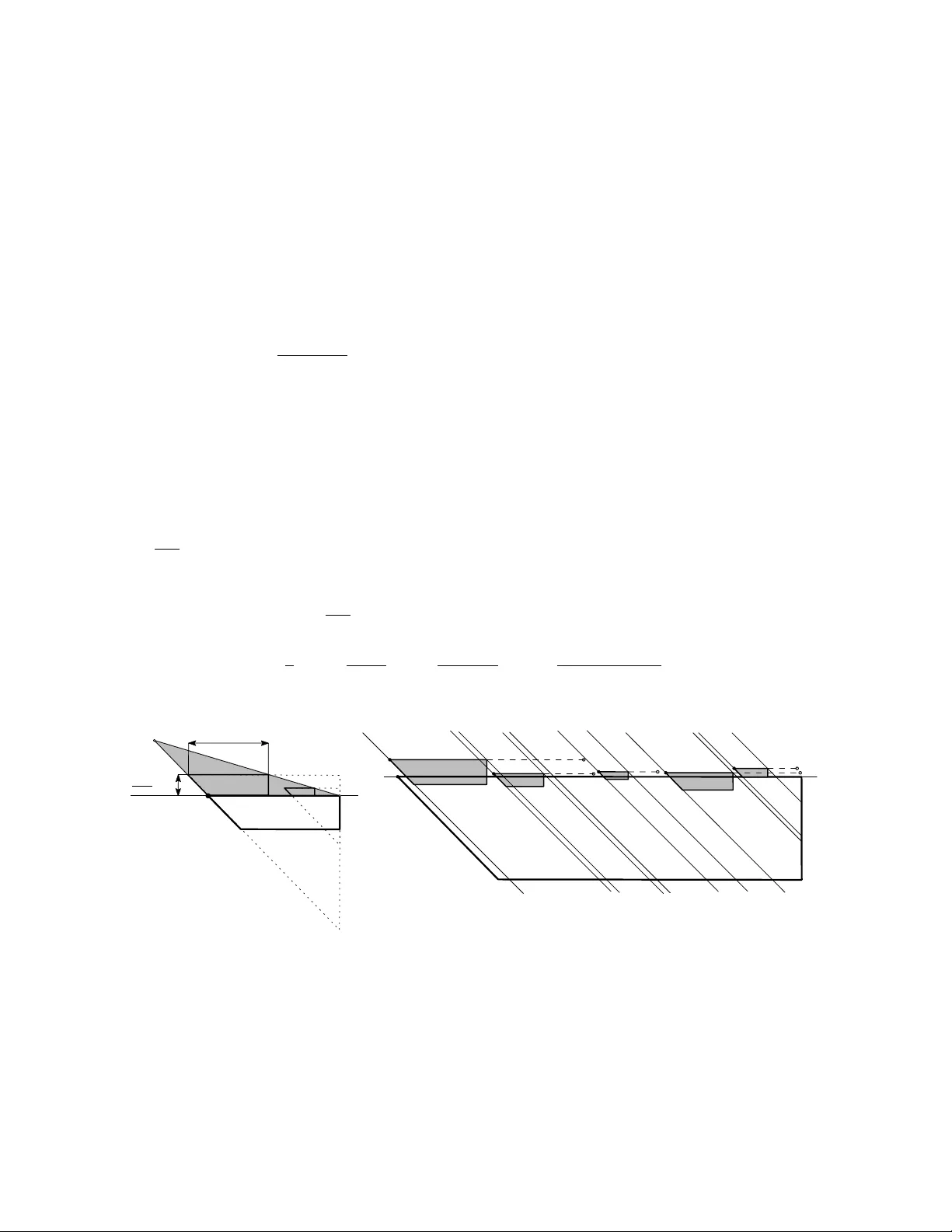
P acking ancho red rectangles ∗ Adrian Dumitrescu † Csaba D. T´ oth ‡ Abstract Let S b e a set of n p oin ts in the unit square [0 , 1] 2 , one of which is the origin. W e construct n pairwise interior-disjoin t axis-aligned empt y rectangles such that the lo wer left corner of each rectangle is a point in S , and the rectangles join tly cov er at least a positive constan t area (ab out 0 . 09). This is a first step to wards the s olution of a longstanding conjecture that the rectangles in such a packing can jointly cov er an area of at least 1/2. 1 Intro duction W e consider a rectangle packing problem prop osed by Allen F reedman [19, p. 345] in the 1960s; see also [10, p. 113]. More recently , the problem was brough t again to atten tion (including ours) b y P eter Winkler [1, 20, 21, 22]. It is a one-round game b etw een Alice and Bob. First, Alice chooses a finite p oint set S in the unit square U = [0 , 1] 2 in the plane, including the origin, that is, (0 , 0) ∈ S (Fig. 1(a)). Then Bob c ho oses an axis-parallel rectangle r ( s ) ⊆ U for eac h p oin t s ∈ S suc h that s is the low er left corner of r ( s ), and the interior of r ( s ) is disjoint from all other rectangles (Fig. 1(b)). The rectangle r ( s ) is said to b e anchor e d at s , but r ( s ) contains no p oin t from S in its interior. It is conjectured that for any finite set S ⊂ U , (0 , 0) ∈ S , Bob can choose such rectangles that join tly co ver at least half of U . Ho w ever, it has not even been known whether Bob can alw ays co v er at least a p ositive constan t area. It is clear that Bob cannot alw ays co ver 1 2 + ε area for any fixed ε > 0. If Alice chooses S to b e a set of n equally spaced p oints along the diagonal [(0 , 0) , (1 , 1)], as in Fig. 1(c), then the total area of Bob’s rectangles is at most 1 2 + 1 2 n . There has b een no progress on this problem for more than 40 y ears, even though it app eared several times in the literature. Outline. In this paper, w e presen t t w o simple strategies for Bob that cov er at least 0 . 09121 area. These are the GreedyP acking and the TileP acking algorithms describ ed b elow. Both algo- rithms pro cess the p oints in the same sp ecific order, namely the decreasing order of the sum of the t wo co ordinates, with ties broken arbitrarily (hence (0 , 0) is the last p oint pro cessed). The GreedyP acking algorithm c ho oses a rectangle of maxim um area for each point in S se- quen tially , in the ab ov e order. The TileP acking algorithm partitions U into staircase-shap ed tiles, and then c ho oses a rectan- gle of maxim um area within eac h tile indep endently . W e next describ e how the tiling is obtained. Eac h tile is a staircase-shap ed polygon, with a vertical left side, a horizontal b ottom side, and a descending staircase connecting them. The low er left corner of each tile is a p oint in S . W e sa y that the tile is anchor e d at that p oint. The algorithm maintains the inv arian t that the set of unpro cessed p oints are in the interior of a staircase shap ed p olygon (sup er-tile), and in addition ∗ A preliminary version of this paper appeared in the Pr o c e e dings of the 23r d ACM-SIAM Symp osium on Discr ete Algorithms , (SODA 2012), Ky oto, Japan, Jan uary 2012. † Departmen t of Computer Science, Universit y of Wisconsin–Milwauk ee, USA. Email: dumitres@uwm.edu . Sup- p orted in part b y the NSF gran t DMS-1001667. ‡ Departmen t of Mathematics, Universit y of Calgary , Canada and Department of Computer Science, T ufts Uni- v ersity , Medford, MA, USA. Email: cdtoth@ucalgary.ca . Supp orted in part by the NSER C grant RGPIN 35586 and the NSF gran t CCF-0830734. 1 2 1 Intr o duction (b) (a) (c) Figure 1: (a) A set S of 6 p oints in a unit square [0 , 1] 2 , including the origin (0 , 0). (b) A rectangle packing where the low er left corner of each rectangle is a p oin t in S . (c) T en equally spaced p oin ts along the diagonal [(0 , 0) , (1 , 1)], and a corresp onding rectangle packing that cov ers roughly 1/2 area. the anchor and p ossibly other p oints are on its left and low er sides. Pro cessing a p oint amounts to sho oting a horizon tal ray to the right and a vertical ray upw ards which together isolate a new tile anc hored at that p oin t, and the new staircase shap ed p olygon containing the remaining p oints is up dated. Since (0 , 0) ∈ S , TileP acking do es indeed compute a tiling of the unit square. It will b e shown shortly (Lemma 1) that the GreedyP a cking algorithm cov ers at least as m uch area as TileP acking . Hence it suffices to analyze the p erformance of the latter. The bulk of the work is in the analysis of this simple TileP acking algorithm, which inv olv es geometric considerations and a c harging scheme. Related wo rk. V ery little is kno wn ab out anchored rectangle packing. Recen tly , Christ et al. [9] pro ved that if Alice can force Bob’s share to b e less than 1 r , then n ≥ 2 2 Ω( r ) . Our result indicates that this condition do es not materialize for large r , since Bob can alwa ys cov er at least a constant fraction of the area for an y n ∈ N . Previous results on rectangle packing typically consider optimization problems, and are only lo osely related to our w ork. While our fo cus here is not on the optimization version of the anc hored rectangle pac king problem, in which the total area of the anc hored rectangles is to b e maximized for a giv en set S of anchors, our algorithms do provide a constant-factor approximation. In the classical strip p acking problem, n given axis-aligned rectangles should b e placed (without rotation or ov erlaps) in a rectangular con tainer of width 1 and minimum height. This problem is APX-hard (b y a reduction from bin packing). After a series of previous results ( e.g. , [17, 18]), Harren et al. [12] recently found a (5 / 3 + ε )-appro ximation. Jensen and Solis-Oba [14] devised an AFPT AS which packs the rectangles into a b ox of heigh t at most (1 + ε )OPT + 1 for every ε > 0. Bansal et al. [5] ga ve a 1.69-approximation algorithm for the 3-dimensional version. F urther related problems are the 2-dimensional knapsack and bin p acking problems. Given a set of axis-aligned rectangles and a b o x B , the ge ometric 2D knapsack problem asks for a subset of the rectangles of maximum total area that fit into B . In contrast, the 2D bin p acking asks for the minim um n umber of bins congruen t to B that can accommo date all rectangles. Jansen and Pr¨ adel [16] designed a PT AS for the geometric 2D knapsack problem, although it do es not admit a FPT AS. The w eighted version do es not admit an AFPT AS and an appro ximation algorithm b y Jansen and Zhang [15] guarantees a ratio of 2 + ε for every ε > 0. F or the 2D bin packing, Jansen et al. [13] ga ve a 2-appro ximation, and Bansal et al. [3] designed a randomized algorithm with an asymptotic approximation ratio of ab out 1 . 525, impro ving the previous ratio 1 . 691 b y Caprara [6, 7]. Ho w ever, 2D bin packing do es not admit an AFPT AS [4, 8]. Finally , w e mention Packing anchor e d r e ctangles 3 that Bansal et al. [4] ga ve a PT AS for the r e ctangle plac ement problem, whic h go es bac k to Erd˝ os and Graham [11]. Here a given set of axis-aligned rectangles should b e arranged (without rotation or o verlaps) so that the area of their b ounding b ox is minimized. 2 Constructing a rectangle packing In this section w e describ e the tw o strategies for Bob and then compare their p erformance. Ordering the p oints in S . Let S b e a set of n distinct points in the unit square [0 , 1] 2 suc h that (0 , 0) ∈ S . Denote by x ( s ) and y ( s ), resp ectively , the x - and y -co ordinates of each p oin t s ∈ S . Order the p oin ts in S as s 1 , s 2 , . . . , s n suc h that x ( s j ) + y ( s j ) ≤ x ( s i ) + y ( s i ) for 1 ≤ i < j ≤ n (ties are broken arbitrarily). Equiv alen tly , this order is giv en by a left-moving sw eep-line with slop e − 1. See Fig. 2. Clearly , we hav e s n = (0 , 0). In GreedyP acking , Bob c ho oses rectangles of maximum area for s 1 , . . . , s n in this order. GreedyP a cking. F or i = 1 , . . . , n , choose an axis-aligned rectangle r i ⊆ [0 , 1] 2 of maxim um area suc h that the lo wer left corner of r i is s i , and r i is interior-disjoin t from an y r j , j < i . Recall the partial order, called dominanc e or der , among p oin ts in the plane. F or tw o p oints, p = ( x p , y p ) and q = ( x q , y q ), w e say that p q (in words, q dominates p ) if x p ≤ x q and y p ≤ y q . With this definition, an axis-aligned rectangle with lo wer left corner c 1 and upp er right corner c 2 can b e written as { p ∈ R 2 : c 1 p c 2 } . In particular, any p oint in r ( s ) dominates s . (b) (a) (c) 1 2 3 4 5 6 7 8 9 10 11 1 2 3 4 5 6 7 8 10 11 2 3 4 5 6 7 8 10 11 1 9 9 Figure 2: (a) Eleven p oints in [0 , 1] 2 , sorted by decreasing order of the sum of co ordinates. (b) Rectangles c hosen greedily in this order. (c) The tiling of [0 , 1] 2 induced b y the dominance order; and the maximum-area rectangles chosen from each tile. Note that rectangle 8 is smaller than the corresp onding greedy rectangle. W e now define in terior-disjoin t tiles for the set S = { s 1 , . . . , s n } that join tly co ver the unit square U = [0 , 1] 2 . F or i = 1 , 2 , . . . , n , let tile t i b e the set of p oin ts in U that dominate s i , but hav e not b een cov ered by any previous tile t j , j < i . F ormally , let t i = { p ∈ [0 , 1] 2 : s i p and s j 6 p for all j < i } . 4 3 Analysis of TileP acking The tiles are disjoint by definition, and they cov er U since the origin is in S . Eac h tile is a stair c ase p olygon with axis-aligned sides, b ounded by one horizon tal side from b elow, one v ertical side from the left, and a monotone decreasing curv e from the top and from the righ t. Observe that the axis-aligned rectangle spanned b y the lo wer left corner s i and any p oin t p ∈ t i is contained in the tile t i . That means that ev ery maximum-area axis-aligned rectangle in the tile is incident to the lo wer left corner s i . W e can now describ e our second strategy for Bob. TileP acking. Compute the tiling U = S n i =1 t i . F or i = 1 , . . . , n , indep enden tly , choose an axis-aligned rectangle r i ⊆ t i of maxim um area. By the ab o ve observ ation, the low er left corner of r i is the lo wer left corner of the tile t i , which is s i ∈ S . W e now show that GreedyP acking alwa ys cov ers a greater or equal area than TileP a cking . Lemma 1 F or each p oint s i ∈ S , GreedyP acking chooses a rectangle of greater or equal area than TileP acking . Pro of. The rectangles chosen by the greedy tiling for s j , j < i , are all disjoin t from the tile t i , b ecause every p oint in r ( s j ) dominates s j . Hence, GreedyP acking could c ho ose an y maximum- area axis-aligned rectangle from tile t i , but it may c ho ose a larger rectangle (suc h as r ( s 8 ) in Fig. 2). 2 Rema rk. It is w orth noting that GreedyP acking cannot give a b etter worst-case constant than TileP acking . If S is in ”general p osition” (that is, no tw o p oin ts lie on the same sweep-line), we construct a set S 0 , where | S 0 | ≤ 3 n − 2 as follows. Cho ose a sufficien tly small ε > 0. Then for eac h p oint s i = ( x i , y i ) in the in terior of U , we add tw o nearby p oints ( x i − ε, y i ) and ( x i , y i − ε ) (b elo w the sweep-line incident to s i , one to the left of s i and one b elo w s i ). Observe that on input S 0 , GreedyP acking and TileP acking give the same set of rectangles. Moreov er, the total area co vered by TileP a cking with S 0 and the total area cov ered by TileP acking with S will differ from eac h other by an arbitrarily small amount, i.e., by at most 2 nε . 3 Analysis of TileP a cking F ormally , define ρ as the worst-case p erformance of TileP acking . In this section, we show that TileP acking chooses a set of rectangles of total area ρ ≥ 0 . 09121. In our analysis, w e w ill use t wo v ariables, β ≥ 5 and 0 < λ < 1. Let r i ⊆ t i b e the axis-aligned rectangle of maximum area in tile t i , whose lo wer left corner is s i , and let R = { r i : i = 1 , . . . , n } b e this set of rectangles. If area( r i ) ≥ 0 . 09121 · area( t i ) for every i , then our pro of is complete. Ho w ever, the ratio area( r i ) / area( t i ) ma y b e arbitrarily small b ecause the tiles can b e arbitrary staircase p olygons. F or β ≥ 5, w e sa y that tile t i is a β -tile if area( r i ) < 1 β area( t i ). W e will give an upp er b ound F ( β , λ ) on the total area of β -tiles for every β ≥ 5 and 0 < λ < 1. This immediately implies that, for every β ≥ 5, the complement of all β -tiles co ver at least 1 − F ( β , λ ) area, and the total area of all rectangles in R is n X i =1 area( r i ) ≥ ρ ≥ 1 − F ( β , λ ) β . (1) In Section 3.1 we study the prop erties of individual β -tiles, and in Section 3.2 we prov e an upp er b ound on the total area of β -tiles (for every β ≥ 5), which already gives a preliminary b ound Packing anchor e d r e ctangles 5 ρ ≥ 0 . 07229, using (1). By integrating o ver β , we impro ve this bound to ρ ≥ 0 . 09121 in Section 3.3. Finally , Section 3.4 shows that TileP acking runs in O ( n log n ) time. 3.1 Prop erties of a β -tile Let us introduce some notation for describing a single tile t i (Fig. 3(a)). It is b ounded from b elo w b y a horizontal side, denoted a i , and from the left by a v ertical side, denoted b i . The width (resp., height ) of t i is the length of a i (resp., b i ), denoted by | a i | (resp., | b i | ). W e sho w next that a β -tile t i has a m uch smaller area than its b ounding b ox (recall that β -tiles are defined for β ≥ 5). Lemma 2 Let β ≥ 1 and t b e a staircase p olygon of height h and width w . If the area of ev ery axis-aligned rectangle con tained in t is less than area( t ) /β , then area( t ) < β e β − 1 · hw , (2) and this b ound is the b est p ossible. Pro of. Assume, b y translating t if necessary , that the low er left corner of t is the origin. Then the b ounding b ox of t is [0 , w ] × [0 , h ]. Let area( t i ) = β u 2 , for some u > 0. Then all vertices of t lie strictly b elow the h yp erb ola arc f ( x ) = u 2 /x , for 0 < x . See Fig. 3(b). The area of the part of [0 , w ] × [0 , h ] b elow the curve f ( x ) = u 2 /x is u 2 + Z w u 2 /h u 2 x d x = u 2 + u 2 ln x w u 2 /h = u 2 (1 + ln w − ln( u 2 /h )) = u 2 (1 + ln( hw ) − ln u 2 ) . W e ha ve sho wn that area( t ) = β u 2 < u 2 (1 + ln( hw ) − ln u 2 ), or β < 1 + ln( hw ) − ln u 2 . Rearranging this inequalit y yields e β − 1 u 2 < hw , which implies (2), as required. If we approximate the shaded area in Fig. 3(b) with a staircase p olygon t of height h and width w that lies strictly b elow the hyperb ola, then the area of every axis-aligned rectangle contained in t is less than u 2 , and area( t ) can b e arbitrarily close to β e β − 1 · hw . 2 Secto rs and tips. Fix β ≥ 5 and consider a β -tile t i . Decomp ose t i in to rectangular vertic al se ctors b y vertical lines passing though its vertices; see Fig. 3(c). Each sector is part of some maximum- area axis-aligned rectangle in t i . Hence the area of each sector is less than area( t i ) /β , where near equality is p ossible for the leftmost sector. Similarly , w e can decomp ose t i in to rectangular horizontal se ctors by horizon tal lines passing through its v ertices, and the area of each sector is less than area( t i ) /β . Decomp ose each β -tile t i in to three parts, called right tip , upp er tip , and main b o dy , as follows. The right tip of t i is cut off from t i b y the right-most vertical line that passes through a vertex of t i suc h that the area of the right part is at least area( t i ) /β . Similarly , the upp er tip of t i is cut off from t i b y the upp er-most horizontal line that passes through a vertex of t i suc h that the area of the part ab ov e is at least area( t i ) /β . The remaining part, denoted by t 0 i , is the main b o dy of t i . All three parts are staircase p olygons. Both the righ t and the upp er tips are unions of some sectors of t i . Since the area of each sector is less than area( t i ) /β , the area of each tip is at least 1 β area( t i ) but less than 2 β area( t i ). In particular, since β ≥ 5, the right tip of t i is disjoint from the upp er tip of t i . Let a 0 i and b 0 i , resp ectively , b e the low er and left side of t 0 i . Note that the topmost horizontal side and the rightmost vertical side of t 0 i eac h contains some p oin t from S , b ecause each contains a reflex v ertex of the original tile t i . 6 3 Analysis of TileP acking (b) (a) (c) t i a i b i x y r i f ( x ) = u 2 /x h w u 2 h u 2 w t i main b o dy righ t tip upp er tip | a 0 i | | b 0 i | Figure 3: (a) A β -tile t i of width | a i | and height | b i | . (b) The p ortion of the rectangle [0 , w ] × [0 , h ] b elo w the hyperb ola arc f ( x ) = u 2 /x . (c) The decomp osition of t i in to vertical sectors. The tips of t i are shaded. Lemma 3 The width of the right tip of t i is at least | a 0 i | , hence 2 | a 0 i | ≤ | a i | . Similarly , the height of the upp er tip of t i is at least | b 0 i | , hence 2 | b 0 i | ≤ | b i | . Pro of. By symmetry , it is enough to pro v e the first claim. Let r 0 b e the maximum-area axis-aligned rectangle in t i whose low er side is a 0 i . Since t i is a β -tile, the area of r 0 is less than 1 β area( t i ). Recall that the area of each tip is at least 1 β area( t i ), th us area( r 0 ) is less than the area of the right tip of t i , and so area( r 0 ) is less than the area of the b ounding b ox of the righ t tip of t i . Ho wev er, the heigh t of r 0 is strictly greater than the height of the right tip (and its b ounding b ox). Therefore, the width of r 0 , whic h is | a 0 i | , is less than the width of the right tip of t i . Th us | a 0 i | ≤ | a i | − | a 0 i | , or 2 | a 0 i | ≤ | a i | , as required. 2 Recall that the areas of the right and upp er tips of t i are eac h less than 2 β area( t i ). Hence area( t i ) < β β − 4 area( t 0 i ). Since t i is a β -tile and t 0 i ⊂ t i , the area of every axis-aligned rectangle con tained in t 0 i is less than area( t i ) /β < area( t 0 i ) / ( β − 4). Applying Lemma 2 for the main b o dy t 0 i yields area( t i ) < β β − 4 · area( t 0 i ) < β β − 4 · β − 4 e β − 5 · | a 0 i | · | b 0 i | = β e β − 5 · | a 0 i | · | b 0 i | . (3) T all and wide tiles. W e distinguish tw o types of β -tiles based on the heigh t and width of their main b o dy . A β -tile t i is tal l if | a 0 i | < | b 0 i | ; and it is wide if | a 0 i | ≥ | b 0 i | . F or wide β -tiles, we ha ve max( | a 0 i | , | b 0 i | ) = | a 0 i | , and (3) implies area( t i ) < β e β − 5 | a 0 i | 2 . (4) Similarly , if a β -tile t i is tall, then area( t i ) < β e β − 5 | b 0 i | 2 . 3.2 Upp er b ound on the total a rea of β -tiles In this section we give an upp er b ound F ( β , λ ) (see equation (10) further b ellow) on the total area of all β -tiles for every β ≥ 5 and 0 < λ < 1. It is enough to b ound the total area of wide β -tiles b y 1 2 F ( β , λ ). By symmetry , the same upp er b ound holds for the total area of tall β -tiles. Let W ⊂ { 1 , . . . n } b e the set of indices of the wide β -tiles. T o b egin, for every tile t i w e define tw o adjacent triangles. Let ∆ i b e the isosceles right triangle b ounded by a i , the line of slop e − 1 through s i , and a v ertical line through the right endp oint of Packing anchor e d r e ctangles 7 a i (see Fig. 4(a)). Similarly , let Γ i b e isosceles right triangle adjacent to b i that lies left of t i . The t wo triangles ∆ i and Γ i are not part of the tiling { t i : i = 1 . . . n } , and they may in tersect several tiles. A key fact is that these tw o triangles are empty of p oin ts from S in their interior, regardless whether the tile t i is a β -tile or not. Lemma 4 F or every i = 1 , . . . , n , the in terior of ∆ i (resp., Γ i ) is disjoin t from S . Pro of. Supp ose to the contrary , that there exist p oin ts in S in the interior of ∆ i , and let s j b e the first such p oint pro cessed by the algorithm. Then s j is pro cessed b efore s i , and so the left side b j of the tile t j w ould cut through the horizon tal segment a i , which is a contradiction. Similarly , if s j lies in the in terior of Γ i , then the lo wer side a j w ould cut through the left side b i . 2 (b) (a) (c) t i a i b i t i b ody ∆ i Γ i s i A i λ | a 0 i | (1 − λ ) | a 0 i | λ | a 0 i | righ t tip ∆ i (0 , 0) (1 , 0) (0 , 1) ( λ 2 , − λ 2 ) ( 1 2 , − λ 2 ) A i a i Figure 4: (a) Tiles t 1 , . . . , t i , and the triangles ∆ i and Γ i . (b) The trap ezoid A i ⊂ ∆ i . (c) Ev ery trap ezoid A i is contained in the shaded (hexagonal) region. W e charge the area of each wide β -tile t i to the trap ezoid A i ⊂ ∆ i defined b elow. Let A i b e the set of p oin ts in ∆ i that lie vertically b elow the segment a 0 i at distance at most λ | a 0 i | from it. See Fig. 4(c). Using Inequality (4), the area of A i can b e b ounded from b elow as follows in terms of the area of t i : area( A i ) = | a 0 i | + (1 − λ ) | a 0 i | 2 · λ | a 0 i | = λ (2 − λ ) 2 · | a 0 i | 2 > λ (2 − λ ) · e β − 5 2 β · area( t i ) . (5) The trap ezoids A i , i ∈ W , are homothetic copies of each other, and their area dep ends only on | a 0 i | . Note that the triangles ∆ i (and also the trap ezoids A i ) may extend b eyond the b oundary of U = [0 , 1] 2 ( e.g. , in Fig. 4(b), ∆ i extends b elow U ). W e show that all trap ezoids A i , i ∈ W , lie in a p olygon whose area is at most 1 + λ (3 − λ ) / 8. Lemma 5 Every trap ezoid A i , i ∈ W , lies in a p olygon of area 1 + λ (3 − λ ) / 8 . Pro of. Ev ery trap ezoid A i lies v ertically b elow a segment a 0 i , which is part of the lo wer side of tile t i . Therefore, A i cannot extend b ey ond the left, right, and upp er sides of the unit square U . Moreo ver, we show that A i is con tained in the shaded p olygon in Fig. 4(c). Consider a trap ezoid A i , and the corresp onding lo wer side a i of a β -tile t i , i ∈ W . T ranslate them v ertically down until a i lies on the x -axis. Then apply a dilation cen tered at the right endp oint of a i (no w on the x -axis), such that the left endp oint of a i b ecomes (0 , 0). Finally , apply a dilation cen tered at (0 , 0) suc h that the right endp oin t of a i b ecomes (1 , 0). Observe that through all three transformations, the trap ezoid A i remains in the shaded p olygon. The shaded p olygon is the union of U and a trap ezoid of area 1 2 (1 + 1 − λ 2 ) λ 2 = λ (3 − λ ) / 8. 2 8 3 Analysis of TileP acking The case of pairwise disjoint trap ezoids. If the trap ezoids A i , for all i ∈ W , are pairwise disjoint, then w e can deduce an upp er b ound for the total area of wide β -tiles: By Lemma 5, we hav e X i ∈ W area( A i ) ≤ 1 + λ (3 − λ ) 8 = 8 + 3 λ − λ 2 8 . Using Inequalities (4) and (5), this implies X i ∈ W area( t i ) < 8 + 3 λ − λ 2 8 · 2 β λ (2 − λ ) · e β − 5 = (8 + 3 λ − λ 2 ) 4 λ (2 − λ ) · β e β − 5 . (6) The general case of overlapping trap ezoids. How ev er, it is p ossible that the trap ezoids A i , i ∈ W , are not disjoint. T o tak e care of this p ossibility , we set up a charging sc heme, in whic h we c ho ose a set of “large” pairwise disjoin t trap ezoids. F or every trap ezoid A i , i ∈ W , denote by ` i the supp orting line of a i . W e say that A i is ab ove A j (and A j is b elow A i ) if A i and A j , i 6 = j and ` i is ab ov e ` j . W e next show that if A i and A j o verlap, then the trap ezoid b elo w the other is significan tly larger. Lemma 6 Assume that A i ∩ A j 6 = ∅ , for some i, j ∈ W , i 6 = j ; and A i is ab o ve A j . Then ` j ∩ ∆ i ⊆ a 0 j and (2 − λ ) | a 0 i | ≤ | a 0 j | . Pro of. Refer to Fig. 5(a). If A i ∩ A j 6 = ∅ , and line ` i is ab ov e line ` j , then the segment a 0 j has to in tersect A i . Note that the left endp oint of a 0 j is s j ∈ S , and there is some p oin t from S on the rightmost edge of t 0 j . By Lemma 4, how ev er, there is no p oint from S in the interior of ∆ i . Therefore, a 0 j has to tra verse b oth A i and ∆ i , hence ` j ∩ ∆ i ⊆ a 0 j . The minimum horizontal cross-section of A i is (1 − λ ) | a 0 i | , and the width of the right tip of t i is at least | a 0 i | b y Lemma 3. It follo ws that | a 0 j | ≥ | ` j ∩ ∆ i | ≥ (1 − λ ) | a 0 i | + | a 0 i | = (2 − λ ) | a 0 i | . 2 t i main b o dy A i t j A j ∆ i ∆ j righ t tip of t i righ t tip of t j a 0 i a 0 j (a) t j A j ∆ j righ t tip of t j (b) a 0 j t i 2 t i 1 ∆ i 1 ∆ i 2 ` j ` j Figure 5: (a) If A i and A j o verlap, and a j lies b elow a i , then | a 0 j | ≥ (2 − λ ) | a 0 i | . (b) T rap ezoids A i 1 and A i 2 in tersect A j from ab ov e suc h that the interv als a 0 j ∩ ∆ i 1 and a 0 j ∩ ∆ i 2 are disjoint. Packing anchor e d r e ctangles 9 Cha rging scheme. W e in tro duce a charging scheme among the trap ezoids A i , i ∈ W . Initially , eac h trap ezoid A i has a charge of area( A i ). W e transfer the charges to a subset of pairwise disjoin t trap ezoids. The transfer of charges is represen ted b y a directed acyclic graph G defined as follows. The no des of G corresp ond to the trap ezoids A i , i ∈ W . If A i in tersects some other trap ezoid b elo w, we add a unique outgoing edge from A i to the trap ezoid A j , j ∈ W , whose top side a 0 j is the highest b elow a 0 i . Observe that all edges of G are orien ted down w ards, thus G is acyclic. By construction, the out-degree of G is at most one. How ev er, the in-degree of a no de in G may b e higher than one. Lemma 7 F or every trap ezoid A j , the total area of all trap ezoids A i , i 6 = j , with a directed path in G to A j is at most 1 (1 − λ )(2 − λ ) area( A j ) . Pro of. Fix a trapezoid A j , j ∈ W , and denote b y ` j b e the supporting line of a j . Refer to Fig. 6(a). F or k ≥ 1, let W k j ⊆ W b e the set of indices i of trap ezoids A i that hav e a directed path of length exactly k to A j in G . W e say that the trap ezoids A i , i ∈ W k j are on level k . In particular, the trap ezoids A i , i ∈ W 1 j , on level 1 are connected to A j with a directed edge ( A i , A j ) ∈ G . Let W j = S k ≥ 1 W k j b e the set of indices of al l trap ezoids A i , i 6 = j , with a directed path in G to A j . F or each A i , i ∈ W j , denote b y A ∗ i the unique trap ezoid with ( A i , A ∗ i ) ∈ G . By Lemma 6, ev ery trap ezoid A i , i ∈ W 1 j , has width at most | a 0 i | ≤ | a 0 j | / (2 − λ ), and height at most λ 2 − λ | a 0 j | . Equalit y is p ossible if the low er left corner of A i coincides with the upp er left corner s j of A j (see A i 1 in Fig. 6(a)). The gra y triangle in Fig. 6(a) is the minimum triangle with base a 0 j that contains the maximal p ossible trap ezoid intersecting A j from ab ov e. By triangle similarity , the heigh t of this triangle is λ 1 − λ | a 0 j | , hence its area is (using Equation (5)) 1 2 · | a 0 j | · λ 1 − λ | a 0 j | = λ 2(1 − λ ) | a 0 j | 2 = area( A j ) (1 − λ )(2 − λ ) . (7) (a) (b) A j ` j A i 1 A i 2 A i 3 A i 4 A i 5 Ξ i 1 Ξ i 2 Ξ i 3 Ξ i 4 Ξ i 5 ∆ i 1 ∆ i 2 A i 1 A i 2 A j a 0 j | a 0 j | / (2 − λ ) λ 2 − λ | a 0 j | ` j s j Figure 6: (a) A i 1 is the largest p ossible trap ezoid that can in tersect A j from ab o ve. All trap ezoids with a directed path in G to A j can be translated (without ov erlaps) into the gray triangle. (b) Disjoin t trap ezoids A i 1 . . . , A i 5 in tersect A j from ab o ve. Each of these trap ezoids induces a parallel strip Ξ i . If the strips Ξ i 1 and Ξ i 2 in tersect, and A i 1 is ab ov e A i 2 , then s i 2 lies in the interior of ∆ i 1 . Dashed lines indicate segments a i \ a 0 i . W e claim that P i ∈ W j area( A i ) is at most the area of the gray triangle in Figure 6(a). T o verify the claim, we translate ev ery trap ezoid A i , i ∈ W j , into the gra y triangle region suc h that they remain pairwise disjoint. Each trap ezoid will b e translated in the same direction, ( − 1 , 1), but at differen t distances. In order to control the p ossible lo cation of the translates, we enclose each A i , 10 3 Analysis of TileP acking i ∈ W j , in a parallel strip. F or every i ∈ W j , draw lines of slop e − 1 through the tw o endp oin ts of a 0 i , and denote b y Ξ i the strip b ounded b y the tw o lines. Refer to Fig. 6(b). First consider the trap ezoids A i , i ∈ W 1 j , whic h are connected to A j b y a directed edge in G . By the definition of G , the trap ezoids A i , i ∈ W 1 j , are pairwise disjoin t. Lab el their strips in increasing order from left to righ t. W e show that the strips Ξ i , i ∈ W 1 j , are pairwise in terior-disjoint. Supp ose to the contrary that Ξ i 1 and Ξ i 2 in tersect, where i 1 < i 2 , and suc h that A i 1 is ab ov e A i 2 (if A i 1 is b elo w A i 2 , the strips are obviously disjoint). Since the trap ezoids are disjoin t, the left endp oint of a 0 i 2 , s i 2 ∈ S , lies in the in terior of the isosceles righ t triangle b ounded b y the right side of A i 1 , line ` j , and the line of slop e − 1 b ounding the strip Ξ i 1 from the right. Since λ < 1 and | a i 1 | − | a 0 i 1 | ≥ | a 0 i 1 | b y Lemma 3, this triangle is con tained in ∆ i 1 . Ho w ever, the triangle ∆ i 1 is empt y of p oints from S , and we reached a contradiction. Applying the ab ov e argumen t for the trap ezoids on level k , k = 1 , 2 , . . . , we conclude that the trap ezoids on level k + 1 are pairwise disjoint, and they induce pairwise disjoint parallel strips. W e are now ready to describ e the translation of the trap ezoids A i , i ∈ W j . W e translate the trap ezoids in direction ( − 1 , 1) in phases k = 1 , 2 , . . . . In phase k , consider each A i , i ∈ W k j , indep enden tly . T ranslate A i together with all other trap ezoids that hav e a directed path to A i b y the same vector in direction ( − 1 , 1) until the lo wer side of A i b ecomes collinear with the upp er side of A ∗ i . Each trap ezoid A i remains in its parallel strip Ξ i , therefore the trap ezoids on the same lev el remain pairwise disjoin t. After phase k , there is no ov erlap b et ween a trap ezoid A i , i ∈ W k j of level k and trap ezoids in low er levels. When all phases are complete, all trap ezoids are pairwise in terior-disjoint. It remains to show that after the translation, all trap ezoids lie in the gray triangle in Fig. 6(a). F rom Lemma 6 and since all translations w ere done in direction ( − 1 , 1), the trap ezoids are on or to the right of the line of slop e − 1 passing through s j . Also from Lemma 6, the right endp oin t of a 0 j is to the righ t of the righ t side of ev ery triangle ∆ i , i ∈ W 1 j , hence to the righ t of the right side of ev ery triangle ∆ i , i ∈ W j . Also, if i ∈ W 1 j , by Lemma 3 we hav e 2 | a 0 i | ≤ | a i | , and so λ | a 0 i | | a i |−| a 0 i | ≤ λ | a 0 i | | a 0 i | = λ . Hence the upp er right corner of every A i , i ∈ W 1 j , is b elow the line of slop e − λ passing through the right endp oint of a 0 j , and consequen tly , the upp er right corner of every A i , i ∈ W j , is b elo w the line of slop e − λ passing through the righ t endp oint of a 0 j . Therefore, after the ab ov e translation, all trap ezoids A i , i ∈ W j , are contained in the gray triangle in Figure 5(c). This verifies the ab o ve claim and completes the pro of of the lemma. 2 T ransfer the charges from all no des to the sinks in G along directed paths. By Lemma 7, the total area c harged to a sink A j is less than area( A j ) + 1 (1 − λ )(2 − λ ) area( A j ) = 3 − 3 λ + λ 2 (1 − λ )(2 − λ ) area( A j ) (8) The area of every trap ezoid A i , i ∈ W , is charged to some sink in G , and the sinks corresp ond to pairwise disjoin t trap ezoids. W e can now adjust Inequality (6) to obtain X i ∈ W area( t i ) < 3 − 3 λ + λ 2 (1 − λ )(2 − λ ) · (8 + 3 λ − λ 2 ) 4 λ (2 − λ ) · β e β − 5 = (3 − 3 λ + λ 2 )(8 + 3 λ − λ 2 ) 4 λ (1 − λ )(2 − λ ) 2 · β e β − 5 . (9) The area of al l β -tiles is less than twice the right hand-side of (9), namely we can set F ( β , λ ) = (3 − 3 λ + λ 2 )(8 + 3 λ − λ 2 ) 2 λ (1 − λ )(2 − λ ) 2 · β e β − 5 . (10) Packing anchor e d r e ctangles 11 F rom (1), it follows that the total area of all rectangles in R is ρ ≥ 1 − F ( β , λ ) β = 1 β 1 − (3 − 3 λ + λ 2 )(8 + 3 λ − λ 2 ) 2 λ (1 − λ )(2 − λ ) 2 · β e β − 5 = 1 β − (3 − 3 λ + λ 2 )(8 + 3 λ − λ 2 ) 2 λ (1 − λ )(2 − λ ) 2 · 1 e β − 5 . Whenev er F ( β , λ ) < 1, this already giv es a low er b ound of ρ = Ω(1). W e hav e optimized the parameters β and λ with n umerical metho ds. With the c hoice of β = 12 . 75 and λ = 0 . 45, w e obtain an initial lo wer b ound of ρ ≥ 0 . 07229. 3.3 Making β a continuous variable In this section we further improv e the lo wer b ound on the cov ered area to 0 . 09121 b y making β a con tinuous v ariable and using in tegration. W e define the c ontribution of eac h p oint p ∈ t i ⊆ U , as u ( p ) = area( r i ) / area( t i ). With this definition, we hav e n X i =1 area( r i ) = Z Z p ∈ U u ( p ) d A. Let β 0 ≥ 5 b e a parameter to b e optimized later (w e will c ho ose β 0 = 9 . 955). P artition the in terv al [ β 0 , ∞ ) into subinterv als of length ε > 0: [ β 0 , ∞ ) = S ∞ j =1 [ β j − 1 , β j ), where β j = β 0 + j ε . Denote b y B j ⊂ U the union of all β j -tiles, and let B j = U \ B j . By definition, w e ha v e u ( P ) ≥ 1 /β j for ev ery p ∈ B j , and so R R p ∈ B j u ( p ) d A ≥ area( B j ) /β j . Observ e that the sets B j form a nested sequence B 0 ⊆ B 1 ⊆ B 2 ⊆ . . . ⊆ U . The total con tribution of all p oints in U can b e written as n X j =1 area( r i ) = Z Z p ∈ U u ( p ) d A = Z Z p ∈ B 0 u ( p ) d A + ∞ X j =1 Z Z p ∈ B j \ B j − 1 u ( p ) d A ≥ area( B 0 ) β 0 + ∞ X j =1 area( B j \ B j − 1 ) β j = area( B 0 ) β 0 + ∞ X j =1 area( B j ) − area( B j − 1 ) β j = ∞ X j =0 area( B j ) 1 β j − 1 β j +1 . In Section 3.2, w e sho w ed that for an y j ≥ 0, area( B j ) < F ( β j , λ ), where F ( β , λ ) is giv en b y (10). 12 3 Analysis of TileP acking It follo ws that area( B j ) > 1 − F ( β j , λ ), and therefore, ρ ≥ ∞ X j =0 (1 − F ( β j , λ )) 1 β j − 1 β j +1 = 1 − F ( β 0 , λ ) β 0 + ∞ X j =0 (1 − F ( β j +1 , λ )) − (1 − F ( β j , λ )) β j +1 = 1 − F ( β 0 , λ ) β 0 + ∞ X j =0 F ( β j , λ ) − F ( β j +1 , λ ) β j +1 = 1 − F ( β 0 , λ ) β 0 − ∞ X j =0 1 β j +1 · F ( β j +1 , λ ) − F ( β j , λ ) β j +1 − β j · ( β j +1 − β j ) . Letting ε go to 0 yields ρ ≥ 1 − F ( β 0 , λ ) β 0 − Z ∞ β 0 1 β · ∂ ∂ β F ( β , λ ) d β = 1 β 0 + (3 − 3 λ + λ 2 )(8 + 3 λ − λ 2 ) 2 λ (1 − λ )(2 − λ ) 2 e 5 − 1 e β 0 − Z ∞ β 0 1 β · d d β β e β d β = 1 β 0 + (3 − 3 λ + λ 2 )(8 + 3 λ − λ 2 ) 2 λ (1 − λ )(2 − λ ) 2 e 5 − 1 e β 0 + Z ∞ β 0 1 β · β − 1 e β d β = 1 β 0 + (3 − 3 λ + λ 2 )(8 + 3 λ − λ 2 ) 2 λ (1 − λ )(2 − λ ) 2 e 5 − 1 e β 0 + Z ∞ β 0 1 e β − 1 β e β d β = 1 β 0 − (3 − 3 λ + λ 2 )(8 + 3 λ − λ 2 ) 2 λ (1 − λ )(2 − λ ) 2 e 5 Z ∞ β 0 1 β e β d β = 1 β 0 − (3 − 3 λ + λ 2 )(8 + 3 λ − λ 2 ) 2 λ (1 − λ )(2 − λ ) 2 e 5 E 1 ( β 0 ) , where E 1 ( x ) is the exp onen tial integral E 1 ( x ) = Z ∞ x 1 te t d t. F or ev ery x > 0, this exp onen tial in tegral can be appro ximated by the initial terms of the conv ergen t series E 1 ( x ) = − γ − ln x − ∞ X k =1 ( − 1) k x k k · k ! , where γ = 0 . 57721566 . . . is Euler’s constan t; see [2]. With the choice of β 0 = 9 . 955 and λ = 0 . 452, w e obtain ρ ≥ 0 . 09121. T aking into account Lemma 1, we summarize our main result in the following theorem. Theorem 8 F or any finite p oin t set S ⊂ U , (0 , 0) ∈ S , the algorithm TileP acking c ho oses a set of rectangles of total area ρ ≥ 0 . 09121 . Consequen tly , the same guaran tee holds for the algorithm GreedyP a cking . Packing anchor e d r e ctangles 13 3.4 Runtime analysis It is not difficult to sho w that TileP acking can b e implemented in O ( n log n ) time and O ( n ) space in the RAM mo del of computation. The input is a set S of n p oints in the unit square U = [0 , 1] 2 . Clearly , S can b e sorted in O ( n log n ) time in non-increasing order of the sum of co ordinates. Assume that the p oints are lab eled s 1 , s 2 , . . . , s n in this order. W e compute the tiles sequentially in n steps. Let P i = U \ S j 0, Alice can construct a finite sequence of n p oin ts s 1 , . . . , s n , suc h that Bob can co ver at most ε area with a greedy strategy . Essentially , Alice can force Bob to c ho ose a rectangle from a ε 2 -tile (using at most ε 2 of the tile’s area) and then fence off the remainder of the tile so that it cannot b e cov ered later. Alice can make sure that the total area of these ε 2 -tiles is arbitrarily close to 1, say 1 − ε 2 . Then Bob can co ver at most ε 2 + (1 − ε 2 ) · ε 2 < ε area. W e pro ceed with the details. W e sa y that a staircase polygon P is a β -staircase, for some β ≥ 1, if the area of every axis-aligned rectangle contained in P is at most area( P ) /β . By Lemma 2, for every β ≥ 1, h > 0, and w > 0, one can construct a β -staircase of height h and width w whose area is roughly β e 1 − β hw . Alice first computes a pac king of the unit square U = [0 , 1] 2 with 2 ε -staircases, by successiv ely c ho osing in terior-disjoint 2 ε -staircases of smaller and smaller sizes until their total area is at least 1 − ε 2 (Fig. 7(a,b)). Sp ecifically , in the current step, given an axis aligned rectangle R of height h and width w , a 2 ε staircase p olygon P with the same height and width is anchored at the low er left corner of R , and the remaining space R \ P is partitioned into vertical or horizon tal sectors to b e pro cessed (see Section 3). Then she slightly shrinks these staircases, to make them pairwise disjoint, and p erturbs them to ensure that each 2 ε -staircase P i con tains a unique axis-aligned rectangle r i of maximum area, and r i has the same width as P i . The p oint set S contains, for every 2 ε -staircase in this pac king, all v ertices of P i , including the low er left corner s i . In addition, for ev ery 2 ε -staircase whose low er left Packing anchor e d r e ctangles 15 (b) (a) (c) P i s i r i p i Figure 7: (a) An initial 2 ε -staircase packing. (b) In an y empt y region (shaded gray), Alice can place an additional 2 ε -staircase. (c) The placement of an extra p oint p i near the left side of the maximal rectangle r i ⊂ P i . corner is not on the left side of U , S also contains a p oint p i v ery close to the left side of rectangle r i , as sho wn in Fig. 7(c). It remains to determine the order in which Alice reveals the p oints to Bob. The p oin ts asso ciated with each 2 ε -staircase P i are revealed in a contiguous sequence such that the last tw o p oints in each sequence are the low er left corner s i follo wed b y the extra p oin t p i . F or the low er left corner s i , Bob has to choose the unique rectangle r i of maximum area in P i , whic h is adjacen t to the lo wer side of P i . F or the extra point p i , Bob has to c ho ose a tall rectangle of negligible area, which co v ers the left side of P i . These tw o rectangles guarantee that no subsequent rectangle can cov er an y additional part of P i , while area( r i ) ≤ ε 2 · area( P i ). T o determine the order of sequences of p oin ts asso ciated with the staircases, we define a partial order ov er the staircase p olygons. Note that in the initial staircase packing, eac h tip of every P i is adjacen t to the left or lo wer side of another staircase, or the right or upp er side of U . This defines a partial order: let P i ≺ P j , if the tip of P j is adjacent to the left or low er side of P i ; or if the low er left corner of P i is a reflex vertex of P j . Order the staircases in any linear extension of this partial order. This ensures that Bob cannot c ho ose a rectangle intersecting the interior of P i b efore Alice rev eals the low er left corner s i . 2 Best versus wo rst greedy strategy . F or a finite set S ⊂ [0 , 1] 2 , and a p ermutation (ordering) π of S , w e can select anchored rectangles greedily (ties are brok en arbitrarily) in the order prescrib ed by π . One can ask which p ermutation gives the b est or the worst p erformance for a greedy strategy . Our main result, Theorem 8, sa ys that for every n -element p oint set S , (0 , 0) ∈ S , we can find in O ( n log n ) time a p ermutati on π for which the greedy strategy co vers Θ(1) area. In the w orst case, greedy cov ers only o (1) area by Theorem 9. In the b est case, how ever, we will show (Lemma 10) that greedy is alwa ys optimal for some p ermutation π . W e say that an anc hored rectangle packing is Par eto optimal if each rectangle r ( s ) has maximum area assuming that all other rectangles are fixed. It is clear that every optimal solution is Pareto optimal. In particular, eac h rectangle in an optimal solution is b ounded b y the t wo rays (going up and to the right) from its anchor p oint, and t wo other such rays (from other p oints) that limit it from the right and from the top. This immediately implies the existence of an exact algorithm for the optimization problem running in exp onen tial time, based on brute force en umeration. The next lemma also sho ws that the greedy algorithm and brute force en umeration of p ermutations yields 16 R efer enc es y et another exact algorithm for the optimization problem. Lemma 10 F or every finite p oint set S ⊂ [0 , 1] 2 and ev ery Pareto optimal anchored packing R = { r ( s ) : s ∈ S } , there is a p ermutation π for which a greedy algorithm (with some tie breaking) computes R . Pro of. Let S ⊂ [0 , 1] 2 b e a finite set, which ma y not contain the origin. Since every r ( s ) is P areto optimal, it is a greedy c hoice assuming that s is the last p oin t in the order π . Supp ose that s ∈ S is the last p oint in a p ermutation π . If the smaller problem S \ { s } with R \ { r ( s ) } is not Pareto optimal, then there is a p oint s 0 ∈ S for which we could choose a larger rectangle anchored at s 0 , whic h in tersects r ( s ) only . In this case, either s dominates s 0 or the ray shot from s 0 v ertically up (resp., horizontally right) hits the low er (resp., left) side of rectangle r ( s ). This motiv ates the definition of a binary relation o ver S , whic h is an extension of the dominance order. Let s 0 ≺ s if either s dominates s 0 or an axis-aligned ra y shot from s 0 hits the low er or left side of rectangle r ( s ). It is not difficult to see that this is a partial order ov er S . If s ∈ S is a minimal element in the p oset ( S, ≺ ), then the rectangles in R \ { r ( s ) } are still Pareto optimal for the anc hors S \ { s } . No w let π b e the rev erse order of any linear extension of this partial order. 2 W e hav e shown (our main result) that for any set of n p oints in the unit square U = [0 , 1] 2 , one can find a set of disjoint empty rectangles anchored at the given p oin ts and cov ering more than 9% of U . The same conclusion holds for p oints in any axis-aligned rectangle V instead of U , since it is straightforw ard to use an affine transformation to map the input into the unit square. Concerning the b ound obtained, a sizable gap to the conjectured 50% remains. While certainly small adjustments in our pro of can lead to improv emen ts in the b ound, obtaining substantial impro vemen ts probably requires new ideas. Ackno wledgement. The authors thank Richard Guy for tracing back the origins of this problem and Jan Kyn ˇ cl for commen ts and remarks. References [1] Ponder this c hallenge: puzzle for June 2004; http://domino.research.ibm.com/comm/ wwwr_ponder.nsf/Challenges/June2004.html . [2] M. Abramovitz and I. Stegun, Handb o ok of Mathematic al F unctions with F ormulas, Gr aphs, and Mathematic al T ables , Dov er, New Y ork, 1964. [3] N. Bansal, A. Caprara, and M. Sviridenk o, A new appro ximation metho d for set co vering problems, with applications to m ultidimensional bin packing, SIAM J. Comput. 39 (2009), 1256–1278. [4] N. Bansal, J. Correa, C. Keny on, and M. Sviridenk o, Bin packing in multiple dimensions: inappro ximability results and appro ximation schemes, Math. Op er at. R ese ar ch 31 (2006), 31– 49. [5] N. Bansal, X. Han, K. Iw ama, M. Sviridenko, and G. Zhang, Harmonic algorithm for 3- dimensional strip pac king problem, in Pr o c. 18th SODA , ACM-SIAM, 2007, pp. 1197–1206. [6] A. Caprara, Pac king 2-dimensional bins in harmony , in Pr o c. 43r d F OCS , IEEE, 2002, pp. 490– 499. Packing anchor e d r e ctangles 17 [7] A. Caprara, Pac king d -dimensional bins in d stages, Math. Op er. R es. 33 (2008), 203–215. [8] M. Chleb ´ ık and J. Chleb ´ ık o v´ a, Hardness of approximation for orthogonal rectangle packing and co vering problems, J. Discr ete Alg. 7 (3) (2009), 291–305. [9] T. Christ, A. F ranck e, H. Gebauer, J. Matou ˇ sek, and T. Uno, A doubly exp onentially crumbled cak e, manuscript, arXiv:1104.0122v1, 2011. [10] H. T. Croft, K. J. F alconer, and R. K. Guy , Unsolve d Pr oblems in Ge ometry , v olume I I of Unsolv ed Problems in Intuitiv e Mathematics, Springer, New Y ork, 1991. [11] P . Erd˝ os and R. L. Graham, Note on packing squares with equal squares, J. Combin. The ory Ser. A 19 (1975), 119–123. [12] R. Harren, K. Jansen, L. Pr¨ adel, and R. v an Stee, A (5 / 3 + ε )-approximation for strip pac king, in Pr o c. 12th W ADS , vol. 6844 of LNCS, Springer, 2011, to app ear. [13] K. Jansen , L. Pr¨ adel, and U. M. Sch warz, Two for one: tight appro ximation of 2D bin pac king, in Pr o c. 11th W ADS , vol. 5664 of LNCS, Springer, 2009, pp. 399–410. [14] K. Jansen and R. Solis-Oba, A p olynomial time appro ximation scheme for the square pac king problem, in Pr o c. 13th IPCO , vol. 5035 of LNCS, Springer, 2008, pp. 184–198. [15] K. Jansen and G. Zhang, Maximizing the total profit of rectangles pac ked into a rectangle, A lgorithmic a 47 (3) (2007), 323–342. [16] L. Pr¨ adel, Appro ximation algorithms for tw o-dimensional geometrical knapsack, Masters the- sis, Departmen t of Computer Science, Universit y of Kiel, 2008. [17] I. Schiermey er, Reverse-fit: a 2-optimal algorithm for packing rectangles, in Pr o c. 2nd ESA , v ol. 855 of LNCS, Springer, 1994, pp. 290–299. [18] A. Stein b erg, A strip-packing algorithm with absolute performance bound 2, SIAM J. Comput. 26 (2) (1997), 401–409. [19] W. T utte, R e c ent Pr o gr ess in Combinatorics: Pr o c e e dings of the 3r d Waterlo o Confer enc e on Combinatorics , Ma y 1968, Academic Press, New Y ork, 1969. [20] P . Winkler, Pac king rectangles, pp. 133-134, in Mathematic al Mind-Benders , A. K. Peters Ltd., W ellesley , MA, 2007. [21] P . Winkler, Puzzled: re ctangles galore, Communic ations of the ACM , 53 (11) (2010), 112. [22] P . Winkler, Puzzled: solutions and sources, Communic ations of the ACM , 53 (12) (2010), 128.
Original Paper
Loading high-quality paper...
Comments & Academic Discussion
Loading comments...
Leave a Comment