Linear Logic by Levels and Bounded Time Complexity
We give a new characterization of elementary and deterministic polynomial time computation in linear logic through the proofs-as-programs correspondence. Girard's seminal results, concerning elementary and light linear logic, achieve this characteriz…
Authors: Patrick Baillot, Damiano Mazza
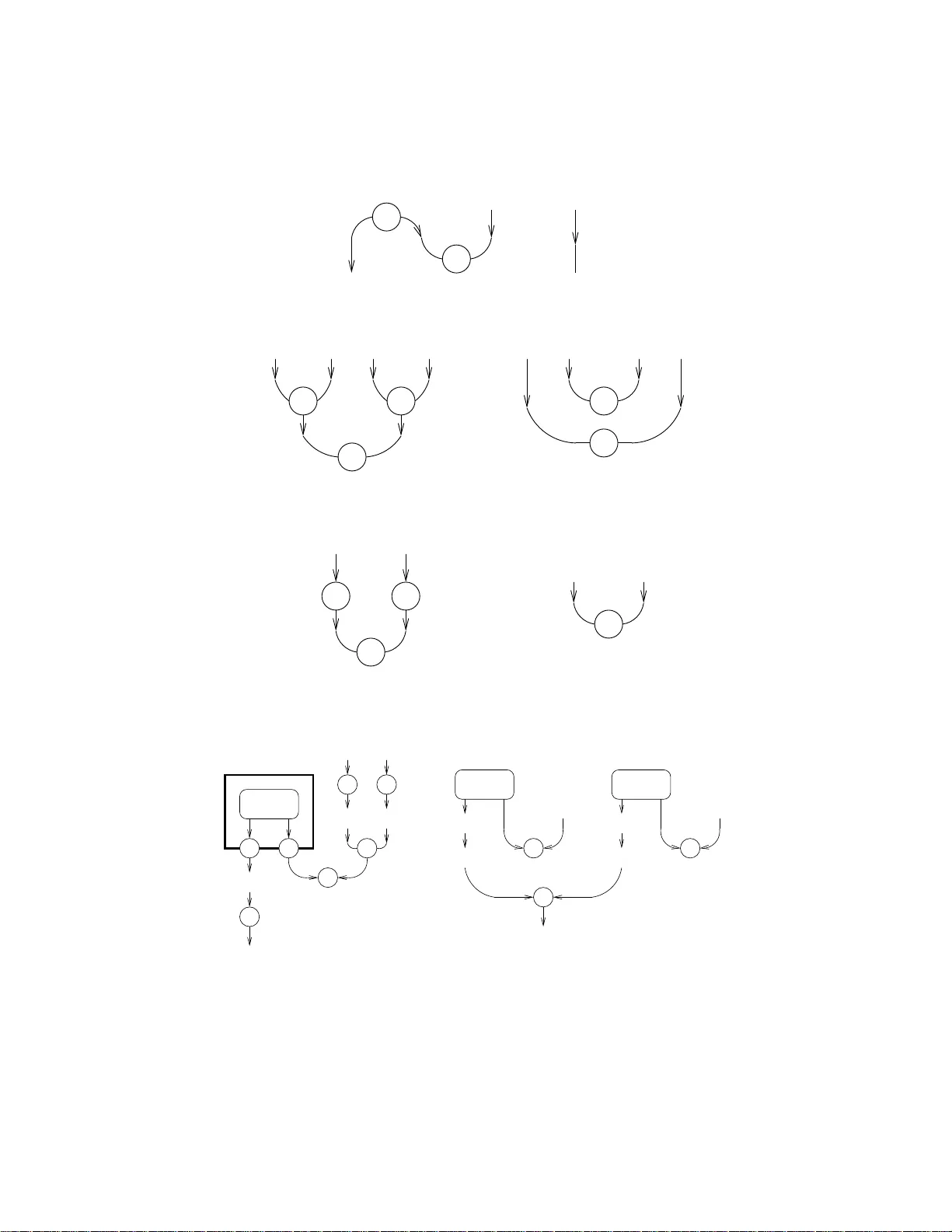
Linear Logic b y Lev els and Bounded Time Complexit y P atr ic k Baillot ∗ Damiano M azza † ENS Lyon, Universit ´ e de Lyon, LIP CNRS-Un ivers it´ e Pari s 13, LIPN (UMR 5668 CNRS-ENSL-INRIA- UCBL) (UMR 7030 CNRS-UP13) Abstract W e give a new c haracterization of elementa ry and deterministic p oly- nomial time compu tation in linear logic through the pro ofs-as-programs corresponden ce. Girard’s seminal results, concerning elementary and li ght linear logic, achiev e this c haracterization by enfo rcing a str atific ation prin- ciple on pro ofs, u sing the notion of dept h in pro of nets. Here, w e prop ose a more general form of stratification, based on indu cing levels in pro of n ets by means of indexes, which allo ws us to extend Girard’s systems while keeping th e same complexity prop erties. In p articular, it turns out that Girard’s systems can b e recov ered by forcing d epth and level to coincide. A consequ ence of the higher fl ex ibilit y of levels with resp ect to depth is the absence of b oxes for h an d ling the p aragraph mod alit y . W e use th is fact to prop ose a v ariant of our p olytime sy stem in which the paragraph mod ality is only allo wed on atoms, and whic h may th us serv e as a basis for developing lam b da-calculus type assignmen t systems with more efficient typing algorithms th an ex isting ones. In tro duction Linear logic and im plicit computational complexit y . The intersection betw een lo g ic and implicit computational complexity is at le a st tw ofold, as there are at leas t tw o alternative views on logic itself: a first p ossibility is to see it as a descriptive language , i.e., as a lang uage fo r ex pressing prop erties of mathemati- cal ob jects; a seco nd p ossibility is to see it, via the Curry-How ard isomorphism, as a pr o gr amming language , i.e., a to ol fo r co mputing functions. These t wo views closely cor resp ond to tw o fundamen tal bra nches o f mathematical logic: mo del theory , and pro of theory , re sp ectively . The firs t appro ach has bee n taken quite successfully by what is known as descriptive c omput ational c omplexity . The idea of exploring the second approach is more rec ent : the first results of this kind ∗ patrick. baillot@en s-lyon.fr † damiano. mazza@lipn .univ-paris13.fr 1 can b e found in [Leiv ant, 1994b], [Leiv a nt a nd Marion, 1 993], and in the work of [Gira rd et al., 1 992], to which the pr esent work is more clo s ely r elated. As ment ioned ab ove, the use of logic a s a progra mming language capturing certain co mplexity classes pa sses thr o ugh the Curry -How a rd is omorphism: a pro of is a progr am, whose e x ecution is given by cut-elimination; therefor e , the idea is to define a log ical system whose cut-elimination pro cedure has a bounded complexity , so that the algor ithms progr ammable in this lo gical sy stem intrin- sically have that complexity , i.e., the system is sound w.r.t. a complexity class. Due to its “ resour c e a wareness”, linear log ic [Girard, 19 8 7] is the ideal setting to attempt this. In fact, linear lo gic brings to light the logica l primitives which are res po nsible for the c omplexity of cut-elimination, un- der the form of mo dalities, called exp onentials . These ar e in control of duplication during the cut-elimination pr o cess; by restraining the r ule s for these mo dalities, one achiev es the desir e d goal. Of cours e one ha s to make sure that the resulting system is also c omplete , i.e., that al l functions o f the given complexity can be prog rammed in it. This metho do logy ha s bee n suc c essfully followed to characterize complexity classes like deter ministic po lynomial time [Girar d et al., 199 2, Gira r d, 1 998, Asp er ti and Roversi, 2002, Lafont, 2004], elementary time [Girard, 1998, Danos and Jo inet, 20 03], deter- ministic log arithmic spac e [Sch¨ opp, 2007], a nd, very recently , p oly no mial s pace [Gab oardi e t a l., 2008]. Stratification. In this work w e fo cus on elementary linear logic ( ELL ) and light linear log ic ( LLL ) systems, co rresp o nding to elementary time and deter- ministic p o lynomial time, resp ectively [Gira rd, 199 8]. The co mplexity b o und on the cut-elimination pr o cedure o f these systems relies on a principle called str atific ation , which is also at the ba s e of other a p- proaches to implicit co mputational complexity , b oth r elated to logic and not. Stratification can be in terpreted in at least three informal w ays. The first, which is wher e [Girard, 1998] originally drew inspira tion from, comes from a sharp ana lysis o f Russel’s pa radox in naive set theory [Fitch, 1952, Curry a nd F eys, 195 8], and was first considered by [Leiv ant, 1994 a]. Unre- stricted comprehension ca n b e o btained as a theor em in firs t or der classical logic plus the following tw o rules: ⊢ Γ , A [ t/x ] ⊢ Γ , t ∈ { x | A } ⊢ Γ , ¬ A [ t/x ] ⊢ Γ , t 6∈ { x | A } where { x | A } is the sta nda rd set-builder notation for the se t co nt aining all and only the e lement s satisfying the for mula A . Russ el’s antinom y is obta ined by co nsidering the term r = { x | x 6∈ x } , from whic h we build the form ula R = r ∈ r . One can s e e that R is a fixp o int of nega tio n, i.e., R is prov ably equiv alent to ¬ R . In fac t, one can obtain ⊢ Γ , R fr om ⊢ Γ , ¬ R by applying the rule a b ov e on the left, and ⊢ Γ , ¬ R from ⊢ Γ , R by applying the r ule ab ove on the r ight. The empty seq uent, i.e., a c o ntradiction, can then b e derived as follows: 2 ⊢ ¬ R, R ⊢ ¬ R, ¬ R ⊢ ¬ R ⊢ ¬ R, R ⊢ R, R ⊢ R ⊢ Remark that contraction is necessar y: in multiplicativ e linea r log ic , where co n- traction is for bidden, the empt y se q uent canno t be derived even in pr esence of the self-contradicting formula R (this was first obser ved by [Grishin, 19 82]). Another setting in whic h stratification can be applied is the λ -calculus, where Russel’s par adox corr esp onds to the diverging ter m Ω. The fundamental co n- struct be hind this term is self-application, which, from the logica l point of view, also needs contraction. A third intuition comes fro m recursio n theo r y , wher e more and more com- plex functions can be obtained by diag onalization. F or instance, if P m ( n ) is a sequence of p olynomial functions of deg ree m in n (for exa mple, P m ( n ) = n m ), the function P n ( n ) is sup er-ex po nential, i.e., elementary; if θ m ( n ) is a sequence of elementary functions in n whose co mplexity ris es with m (for example, θ m ( n ) = 2 n m , i.e ., a tow er of exp onentials of heig ht m in n ), then θ n ( n ) is hyper-exp onential, i.e., non-elementary . In all of these incarnations , stra tification can b e seen as a wa y of forbidding the ide ntification of tw o v ar iables, or the contraction of tw o formulas, b ecause they b elong to t wo mor ally different “ levels”: the o ccur rence of R coming from the axio m and that coming from the applica tion of the ∈ -rule in the der iv ation of Russel’s paradox; the o ccurrence of x in function p osition and that in argu- men t po sition in the self applicatio n λx.xx ; the index of the sequence and the argument o f the members of the sequence in the dia gonaliza tio n examples. Note that stratification is reminiscen t of the notion of r amific ation , or its v ariants like safe r e cu rsion , used for restric ting pr imitive re- cursion in implicit computationa l complexity [Bellantoni and Co ok , 19 92, Leiv ant and Marion, 1993, Leiv a nt, 1 994b]. The re lation b etw e e n safe r e- cursion a nd light linear logic was in vestigated in [Murawski a nd Ong, 2004], while a study on dia gonalizatio n and co mplexity was r ecently car ried out b y [Marion, 2 007]. Pro of nets, b o xes, and stratification. The b ound on the cut-elimination pro cedure for ELL and LLL is prov ed using pr o of nets , a gr aphical represen- tation of pro ofs [Gir ard, 1996]. These are a crucial too l for applying line a r logic to implicit computational complexity: they a llow a fine-gr ained ana lysis of cut-elimination, the definitio n of ade q uate measures and inv ariants, and the int ro duction of a dapted reduction str ategies. In par ticular, the fundament al stratification prop er ty of ELL and LLL is defined a nd enforced thro ugh b oxes , a co nstruct in the s yntax of pro of nets cor resp onding to the rules for expo nen- tial mo dalities. Bo xes hav e b een around since the introduction of pro o f nets [Girard, 1 987] a nd can be understo o d intu itively in tw o wa ys: (i) lo gic al ly : they corr esp ond to sequentialit y informa tion; 3 (ii) op er ational ly : they mar k s ubgraphs (i.e., subproo fs) that can be dupli- cated. Boxes can b e nested; as a consequenc e , a no de in a pro of net (corresp o nding to a logical rule) may b e ass igned an ex p onential depth , which is the num b er of nes ted boxes co nt aining that no de. Stratification is achiev ed precisely on the base of the exp o nential depth: in full linea r log ic, tw o o ccurrences of the same formu la in tro duced at differen t expo nential depths may eventually b e con- tracted; in E LL and LLL , they ca nnot. F rom the op erationa l p o int of view, boxes therefore assume a tw ofold role in ELL a nd LLL : they ser ve fo r the purp ose (ii) explained ab ov e , and they enforce stra tification. A new stratification. The main contribution of this w o rk is the inv estigation of an alterna tive wa y to achiev e stratifica tion, which is orthog onal to b oxes. It is a direct application of the intuitions concerning stra tification given a b ov e: o ccurrences o f fo r mulas in a pro of net are “tested” by as signing to them an index , which must satisfy cer tain cons traints; in particular, if tw o o ccur rences of the same formula are contracted, then they mu st hav e the s ame index . If the pro of net “passes the test”, i.e., if there is a wa y of assigning indexes to its formulas in a wa y which is compatible with the constra ints, then the pro of net is a c cepted. The as signment of indexe s naturally determines the stratification of a pro of net into levels , which need not match exp onential depths. W e thus define a system calle d line ar lo gic by levels ( L 3 ), prov e that it admits an elementary bo und on cut elimina tio n, and that it is complete for elementary time functions. It actually turns out that ELL corr esp onds to the subsystem o f L 3 in which levels and depths co incide, so finally Girard’s appro ach to s tr atification ca n be seen a s a sp ecia l ca se o f our own. The idea o f using indexes in linea r logic pro ofs can a lready b e fo und in the work on 2-se quent c alculi by [Masini, 1 9 92] and [Guerrini et al., 199 8]. In the latter pap er the authors define 2-sequent calculi sys tems co rresp o nding to ELL and LLL . How ever, our goa l here is different b ecause w e are not primarily inter- ested in refor mulating ELL a nd LLL but rather in generalizing these systems and pr oving pro p erties directly for such genera lizations. As said ab ove, the main nov e lt y of L 3 is that it shows how stratification and exp onential depths m ust not nec essarily b e related. This is, in our o pinion, an impo rtant c o ntribution to the understanding of the principles underlying light logics. It may also b e a sta rting p oint for finding new kinds of denotationa l semantics for b ounded time computation, extending the idea s of [Baillot, 2004] and [La urent and T ortora de F alc o, 2 006]. Removing useless b ox es. In LLL , a long the exp onential mo dalities of linear logic, an additiona l exp o ne ntial mo da lit y , the p ar agr aph § , must b e added in order to rea ch the desir ed ex pressive p ow er, i.e., pro g ramming all po lytime functions. Since stratification is linked to exp o nential depth, the paragr aph mo dality to o is ha ndled in pro of nets by means of b oxes; how ever, § -b oxes 4 cannot b e duplicated, so they lose their original function (ii), and their existence is o nly justified b y s tratification. By imp osing on our L 3 the s ame k ind of constra int s that de fine LLL from ELL , we obtain light line ar lo gic by levels ( L 4 ), which, as exp ected, characterizes deterministic p olyno mia l time. This sys tem offers an additional adv antage with resp ect to LLL : since our str atification is orthogonal to b oxes, and since § -b oxes exist o nly to enforce stratification, thes e are no longer nee ded in L 4 . Impro ving t yp e systems. In several cases , the characterization of co m- plexity cla sses w ith subsystems of linear logic has allow ed, in a second step, to define type systems for the λ -calculus sta tically ensuring complexity pr op- erties [Baillot and T erui, 2004, Gab oar di and Ro nchi Della Ro cca, 2007]: if a λ -term, exp ecting for instance a binary list argument, is well typed, then it ad- mits a complex it y bo und w.r.t. the size of the input. Such results natur a lly call for type inference pro ce dur es [Copp ola and Martini, 200 6, A tassi et a l., 2007], which ca n be s een a s tests for sufficien t conditions for a prog r am to admit a complexity b o und. F ro m this po int of view, the presence o f § -b oxes in LLL is a heavy drawback: in fact, a larg e par t of the work nee ded to p erform type inference in LLL , or subsystems like DLAL [Atassi et al., 2007], co mes from the problem of placing correctly § - b oxes, in particular in suc h a w ay that they are compatible with other rules, o r with λ bindings in the λ -calculus (remem be r that boxes also carry seque ntialization information, cf. p oint (i) ab ove). A system like L 4 clearly offers the p os sibility of overcoming these problems: the absence of § - b oxes may yield ma jor s implifications in the development of t yp e sys tems for p o lynomial time. A further co ntribution of this pap er is making a first step in that dir e c tion: exploiting the la ck of sequentialit y cons traints on the para graph mo da lit y , w e devise a v aria nt of L 4 in whic h the par agra ph mo dality is hidden in atomic formulas; as a conseq uence, the pa ragr aph mo da lity completely disa ppe a rs from this system, and there is no need for a rule handling it. This may turn out to be extremely helpful fo r des igning a type system o ut of our work. Plan o f the pap er. Sect. 1 cont ains a sor t o f mini-cr ash-cour se on linear logic and its light subs y stems ELL and LLL . Apar t fr om introducing the ma - terial neces sary to our work, this (quite lengthy) section should make the pap er as self-contained as p oss ible, and hop efully accessible to the rea der previously unfamiliar with these topics. The s ystems L 3 and L 4 are introduced in Sect. 2, and their relationship with ELL and LLL is spelled o ut. Sect. 3 is the tec hnica l core of the pa p e r : it contains the pro of of the complexity b ounds for L 3 (The- orem 16) and L 4 (Theorem 23), from which the characterization re s ult follows (Theorem 2 5). Sec t. 4 int ro duces the v ariant of L 4 without para graph mo dality; the main r esult of this section is Theor em 3 6. In Sect. 5 we conclude the pap er with a disc us sion ab out o p e n questions and future work. 5 Ac knowledgmen ts. The a uthors would like to thank Daniel de Ca r v alho for his useful comments and suggestio ns on the sub ject of this pa p e r. This work was par tially supp o rted b y pro ject NOCoST (ANR, JC05 43380 ). 1 Multiplicativ e Exp onen tial Linear Logic 1.1 F orm ulas The formulas of second o rder unit-free m ultiplica tive exp onential linear lo gic ( meLL ) a re gener ated b y the following gra mmar, where X , X ⊥ range over a denu merable set of prop ositio nal v aria bles: A, B ::= X | X ⊥ | A ⊗ B | A & B | ! A | ? A | ∃ X .A | ∀ X .A | § A. Linear neg a tion is defined through De Mor gan laws: ( X ) ⊥ = X ⊥ ( X ⊥ ) ⊥ = X ( A ⊗ B ) ⊥ = B ⊥ & A ⊥ ( A & B ) ⊥ = B ⊥ ⊗ A ⊥ (! A ) ⊥ = ? A ⊥ (? A ) ⊥ = ! A ⊥ ( ∃ X.A ) ⊥ = ∀ X .A ⊥ ( ∀ X.A ) ⊥ = ∃ X .A ⊥ ( § A ) ⊥ = § A ⊥ Two connec tives exchanged b y negation are said to b e dual . Note that the self-dual paragr aph mo da lity is not present in the sta ndard definition of meLL [Girard, 1 987]; we include it here for co nv enience. Also observe that full linear logic has a further pair o f dual binary co nnectives, called additive (denoted by & and ⊕ ), which w e sha ll briefly discuss in Sect. 5. They ar e not strictly needed for o ur purp oses, hence we r estrict to meLL in the pa p er. Linear implica tion is defined a s A ⊸ B = A ⊥ & B . Multisets o f formulas will b e ranged ov er by Γ , ∆ , . . . F or technical rea sons, it is als o useful to consider dischar ge d formulas , which will b e denoted by ♭A , where A is a for mula. 1.2 Pro ofs Sequen t calculus and cut-elim ination. The pr o of theory of meLL can be formulated using the sequent calculus o f T able 1. This ca lculus, which can b e shown to enjoy cut-elimination, differs fro m the one originally given by [Girard, 1987] b ecause of the addition o f the last three rules. All of them are added for co nv enience. The parag raph rule ac tua lly mak es this mo dality trivial, as expressed by the following: Prop ositi on 1 F or any A , § A is pr ovably isomorphic to A in meLL . Proof . It is not hard to s ee that there a re tw o der iv ations D 1 , D 2 of ⊢ § A ⊥ , A and ⊢ A ⊥ , § A , from which o ne ca n obta in t wo deriv ations of ⊢ § A ⊸ A and ⊢ A ⊸ § A , resp ectively . More ov er , the deriv ations obtained b y cutting D 1 with D 2 in the tw o p o ssible wa ys b oth reduce to the identit y (i.e., a n axiom mo dulo η -expansio n) after cut-eliminatio n. 6 ⊢ A ⊥ , A Axiom ⊢ Γ , A ⊢ ∆ , A ⊥ ⊢ Γ , ∆ Cut ⊢ Γ , A ⊢ ∆ , B ⊢ Γ , ∆ , A ⊗ B T ensor ⊢ Γ , A, B ⊢ Γ , A & B Par ⊢ Γ , A ⊢ Γ , ∀ X .A F or all ( X not free i n Γ) ⊢ Γ , A [ B / X ] ⊢ Γ , ∃ X .A Exists ⊢ ?Γ , A ⊢ ?Γ , ! A Promotion ⊢ Γ , A ⊢ Γ , ? A Derelic tion ⊢ Γ ⊢ Γ , ? A W eakening ⊢ Γ , ? A, ? A ⊢ Γ , ? A Contraction ⊢ Γ , A ⊢ Γ , § A Paragraph ⊢ Daimon ⊢ Γ ⊢ ∆ ⊢ Γ , ∆ Mix T able 1: The r ules for m eLL s equent c a lculus. Nevertheless, we sha ll consider subsystems of me LL in which the parag raph mo dality is not trivial, and this is why we find it conv enient to include it right from the sta r t. The mix rule, and its nullary version (here calle d the daimon rule), are discussed mo re thoroughly at the end o f this section. Basica lly , their presence simplifies the presentation of pro of nets. This last p oint is very imp o rtant to us. In fact, the backbo ne of o ur work is a detailed a na lysis, in terms of computationa l complexit y , of the cut-elimination pro cedure of me LL . In sequent ca lculus, this is comp osed of rules which are suitable reformulations of those origina lly given by [Gentzen, 1934] to prov e his Hauptsatz for classica l logic (the calculus LK ). As a consequence, most of them are commutations, i.e., rules p ermuting a cut with a nother inference rule; only a few of them act on de r iv ations in a non-trivia l wa y . This is why we consider pro of nets, an a lternative pr esentation of the pro o f theory of m e LL o ffering, among other things, the a dv antage of formulating cut-elimination without c om- m utations: o nly the “ int eresting” rules are left. 7 ⊗ ∃ ∀ & pax ? § ! ♭ ax tensor exists for all A B B A A & B ∃ X .A ∀ X .A A ⊗ B A [ B / X ] A [ Z/X ] par flat why not of co urse paragraph ♭A ♭A ♭A ? A A A § A ! A A ♭A ♭A . . . A ⊥ A A ⊥ A axiom cut cut pax Figure 1: Links. Pro of ne ts. The pro o f net for malism was introduced b y [Girar d, 19 87, Girard, 1 996], and subsequen tly reformulated by other authors using slightly different s y nt actical definitions. In this pa p er, we use a combination of the presentations given by [Dano s a nd Regnier, 1995] and [T ortora de F alco, 2 003], with a slight c hange in the termino logy: the term “pro o f structure”, intro duced by [Girard, 1987] and traditionally used in the literature, is here dismissed in fav or of the term net . On the contrary , the ter m pro of net, i.e., a net s atis- fying certa in structural conditions (the co rrectness criterio n), retains its usual meaning. In the following definition, and throughout the rest of the pap er, unless explicitly sta ted w e sha ll make no distinction b etw een the concepts of formula and o c curr enc e of formula . The s ame will b e done for what we call links and their o ccurrences. Definition 1 (Net) A pre-net is a p air ( G , B ) , wher e G is a fin ite gr aph-like obje ct whose no des ar e o c cu r re nc es of what we c al l links , and whose e dges ar e dir e cte d and lab el le d by formulas or dischar ge d formulas of meLL ; and B is a set of su b gr aphs of G c al le d boxes . • Links (Fig. 1) ar e lab el le d by c onne ctives of meLL , or by one of the lab els ax , cut , ♭ , pax . Two links lab el le d by du al c onne ctives ar e said to b e dual . Each link has an arity and c o-arity, which ar e r esp. the n u mb er of its inc oming and outgoing e dges. The arity and c o-arity is fixe d for al l links exc ept why not links, which have c o-arity 1 and arbitr ary arity. A nul lary why not link is also re ferr e d to as a weak en i ng link. Par and for all links ar e c al le d jumping links. 8 . . . . . . ♭B 1 A ♭B n ! pax pax ! A ♭B n ♭B 1 π Figure 2: A b ox. • The inc oming e dges of a link (and the formulas that lab el them) ar e re ferr e d to as its premises , and ar e assu me d t o b e or der e d, with the exc eption of cut and why not links; the outgoing e dges of a link (and the formulas t hat lab el them) ar e r eferr e d t o as its conclusions . • Pr emises and c onclusions of links mu s t r esp e ct a pr e cise lab eling (which dep ends on the link itself ), given in Fig. 1. In p articular: – e dges lab el le d by dischar ge d formulas c an only b e pr emises of pax and why not links; – in a for all link l , the variable Z in its pr emise A [ Z/X ] is c al le d the eigenv ariable of l . Each for all link is assume d to have a differ ent eigenvariab le. – in an exists link l , the formula B in its pr emise A [ B /X ] is said to b e asso ciated with l . • Each e dge must b e the c onclusion of ex actly one link, and the pr emise of at most one link. The e dges that ar e not pr emises of any link (and the formulas that lab el them) ar e de eme d conclus io ns of the pr e-net . (Note that the pr esenc e of these “p ending” e dges, to gether with the fact that some pr emises ar e or der e d, is why pr e-nets ar e n ot exactly gr aphs). • A b ox is depicte d as in Fig. 2, in which π is a pr e-net, said to b e contained in the b ox. The links that ar e explicitly r epr esente d in Fig. 2 (i.e., the pax links and the of course link) form the b order of the b ox. The u nique of course link in the b or der is c al le d the principal p ort of the b ox , while the p ax links ar e c al le d a ux iliary p or ts . We have the fol lowing c onditions c onc erning b oxes: a. e ach of course link is the princip al p ort of exactly one b ox ; b. e ach pax link is in t he b or der of exactly one b ox ; c. any two distinct b oxes ar e either disjoint or include d in one another. 9 A net is a pr e-net such that in its c onclusions ther e is no dischar ge d formula, nor any formula c ontaining an eigenvariable. Definition 2 (Depth, size) L et σ b e a pr e-net . • A link ( or e dge) of σ is said to have depth d if it is c ontaine d in d (ne c- essarily neste d) b oxes. The depth of a b ox of σ is the depth of the links forming its b or der. The depth of a link l , e dge e , or b ox B ar e denote d r esp. by d ( l ) , d ( e ) and d ( B ) . The depth of σ , denote d by d ( σ ) , is t he max imu m depth of its links. • The size of σ , denote d by | σ | , is the numb er of links c ontaine d in σ , ex- cluding auxiliary p orts. Definition 3 (Switc hing) Le t σ b e a pr e-n et. F or e ach jumping link l of σ , we define the set of jumps of l , denote d by J ( l ) , as fol lows: par : J ( l ) is the set c ontaining t he links whose c onclusions ar e the pr emises of l . for all : if Z is the eigenvariabl e of l , J ( l ) is the set c ontaining: • the link whose c onclusion is the pr emise of l ; • any link whose c onclusion is lab el le d by a formula c ont aining Z ; • any exists link whose asso ciate d formula c ontains Z . A switching of σ is an undir e cte d gr aph built as fol lows: • the c onclusions of σ ar e er ase d, and its e dges c onsider e d as undir e cte d; • for e ach ju m ping link l , t he pr emises of l (if any) ar e er ase d, exactly one no de m ∈ J ( l ) is chosen and a new e dge b etwe en m and l is adde d. • the b oxes at depth zer o of σ ar e c ol lapse d into single n o des, i.e., if B is a b ox at depth zer o of σ , it is er ase d t o gether with al l t he e dges c onne cting its links to the r est of the gr aph, and r eplac e d with a new no de l ; then, for any link m of depth zer o which was c onne ct e d to a link of B , a new e dge b etwe en m and l is adde d. Definition 4 (Pro of net) A pr e-net ( G , B ) is correct iff: • al l of its switchings ar e acyclic; • for al l B ∈ B , t he pr e-net c ontaine d in B is c orr e ct. A pro of net is a c orr e ct net . 10 . . . ∃ σ Γ A [ B / X ] ∃ X .A exists . . . ∀ σ Γ A [ Z/X ] ∀ X .A for a ll ( X no t free in Γ) cut . . . . . . σ 1 A A ⊥ Γ ∆ σ 2 cut & . . . Γ σ A & B A B par ⊗ . . . . . . σ 1 A ⊗ B Γ ∆ A B σ 2 tensor σ Γ . . . A ♭A ? A ? ♭ dereliction . . . § σ Γ A § A paragr aph . . . Γ σ ? ? A weak ening Figure 3: Rules for building sequentializable ne ts . Sequen t calculus and pro of nets. The rela tionship betw een s e quent cal- culus and pro o f nets is clarified b y the no tion of se qu en tializable net, who se definition mimics the rules of sequent calculus: Definition 5 (Sequent ializable net) We define t he set of sequentializable nets inductively: the empty net and the net c onsisting of a single axiom link ar e se quentializable (daimon and axiom); the jux tap osition of t wo se quentializable nets is se quentializable (mix); if σ , σ 1 , σ 2 ar e se quentializable n ets of suitable c onclusions, the n ets of Fig. 3 ar e se qu en tializable; if ♭B 1 . . . ? ♭B n . . . ? ♭B 1 ♭B n σ ? B 1 ? B n A . . . is a se quentializable net , then the net 11 ♭B 1 ? ♭B n ? ♭B 1 ♭B n ? B 1 ? B n σ . . . . . . pax pax pax pax ! ♭B 1 A ! A . . . . . . . . . ♭B 1 ♭B n ♭B n is se quentializable (pr omotion); if ? . . . ♭A ♭A ? A ? . . . . . . Γ ♭A ♭A ? A σ is a se quentializable net , then the net . . . . . . σ . . . ? ♭A ♭A ♭A ♭A ? A Γ is se quentializable (c ontr action). Prop ositi on 2 ([Gi rard, 1996]) A net is s e quentializable iff it is a pr o of n et . The ab ove result, combined with Definition 5, g ives a simple intuition for lo oking at pr o of nets: they can b e seen as a sort of “ graphica l se quent calculus”. Cut-elimi nation. As anticipated above, formulating the cut-elimination pro- cedure in pro of nets is q uite simple: there a re o nly five rules (or steps , as we shall mo re often call them), ta king the for m of the gr aph-rewriting rules given in Figures 4 thro ugh 8. When a net π is tra nsformed into π ′ by the a pplication of one cut-elimination step, we write π → π ′ , and w e say that π r e duc es to π ′ . Of course, in that case, if π is a pro of net, then π ′ is also a pr o of net, i.e., cut-elimination preserves corr ectness. The fo llowing notions, taken fro m [T ortora de F alco, 20 0 3], are needed to analyze the dynamics o f pro of nets under cut-elimination, and will prov e to be quite useful in the se quel: 12 A A A ⊥ ax cut A → Figure 4: Axiom s tep. cut cut B B ⊥ A ⊥ A ⊗ & cut A B B ⊥ A ⊥ A ⊗ B B ⊥ & A ⊥ → Figure 5: Multiplicativ e step. ∃ ∀ cut ∃ X .A A [ B / X ] ∀ X .A ⊥ cut A [ B / Z ] ⊥ A [ B / X ] A [ Z/X ] ⊥ → Figure 6: Qua ntifi er step; the subs titution is p erformed on the whole net. pax ! ? ♭ ♭ ♭A ⊥ ♭A ⊥ A ⊥ A ⊥ . . . . . . . . . . . . cut . . . A ! A ? ♭ Γ ? A ⊥ → ?Γ . . . . . . ♭ Γ ♭ Γ ? . . . . . . . . . π 0 π 0 1 n 1 n ♭ Γ ?Γ A ⊥ A cut A ⊥ A cut π 0 . . . Figure 7: Exp o nential step; ♭ Γ is a multiset of discharged formulas, so o ne pax link, why not link, or wire in the pictur e may in some case stand for several (including zero) pax link s , why no t links , or wir es. 13 § A § cut § A ⊥ § A A ⊥ → A A ⊥ cut Figure 8: Paragr aph step. Definition 6 (Lift, residue) Whenever π → π ′ , by simple insp e ction of the cut-elimination rules it is cle ar that any link l ′ of π ′ differ ent fr om a cut c omes fr om a unique (“the s ame”) link l of π ; we say t hat l is the lift of l ′ , and that l ′ is a residue of l . We define the lift and r esidues of a b ox in the same way. Un typed pro of nets. W e sha ll also us e an unt yp ed version of pr o of nets: Definition 7 (Un t yp ed pro of net) An untyp e d pr e-net is a dir e cte d gr aph with b oxes built using the links of Fig. 1 as in Definition 1, but without any lab els on e dges, or any c onstr aint induc e d by such lab els. An u ntyp e d net is an untyp e d pr e-net such that: • the c onclusion of a flat link must b e the pr emise of a pax or why n o t link; • the pr emise of a pax link must b e the c onclusion of a fl at or pax link, and the c onclusion of pax link mu s t b e the pr emise of a pax or why not link; • the pr emises of a why not link must b e c onclusions of flat or auxiliary p ort links. The notion of switching c an b e applie d to un typ e d pr e-nets with virtual ly no change ( for all links ar e no mor e jum ping links), and henc e t he notion of c or- r e ctn ess. We then define an untyp e d pr o of net as a c orr e ct u ntyp e d net. Cut-elimination ca n b e defined also for un t yp ed nets. In fact, of all cut- elimination s teps, only the quantifier step (Fig. 6) actually uses formulas; how- ever, even in this case the mo difications made to the underlying unt y p e d net do not depe nd on formulas. Hence, in the unt yp ed case, the qua nt ifier s tep and the para graph step (Fig. 8) b ehav e identically . Obviously , in the unt yp ed case there may b e “ clashes” , i.e., cut links connecting the co nclus ions of t wo non-dual links. In tha t case, the cut link is sa id to b e irr e ducible ; otherwise, we call it r e ducible . Hence, unt yp ed pro o f nets may admit normal for ms which are not cut-fre e . Remarks on m ix and daimon. W e mentioned ab ov e that admitting the mix and daimon rules makes the definition of pro of nets s impler. In fact, at pres ent, all kno wn solutions excluding them are quite cum b ersome and 14 bring up issues which are mora lly unproblematic but technically disturbing [T or tora de F alco, 20 03]. The status of the mix rule in the pro of theory o f linear logic is s omewhat contro versial [Girar d, 2007]. Its computational meaning is not clear, a nd no complexity-related subsystem of linear logic makes use of it. Its presence is harmless thoug h: as a matter fa ct, while we shall explicitly rely on the acyclicity condition of Definition 4 in one cr ucial o ccasion (Lemma 11), the soundness of our systems (Theore ms 16 and 23) holds witho ut reques ting any further condition o n switchings which would exclude daimon or mix . Nevertheless, the completeness results (Sect. 3 .4) hold for muc h s maller subsystems, using no ne of the debated rules (see Sect. 1.3 be low). F or this reaso n, the r eader who is puzzled b y daimon and mix (in pa rticular the former, which makes the empty sequent prov able in me LL , and with it a ll formulas of the form ? A ) may simply forget ab out their existence. 1.3 Computational in t erpretation The most direct co mputational interpretation of me LL can be given by consid- ering its in tuitionistic subsystem. The intuitionistic (or , more precisely , mini- mal) sequent calculus o f m eLL is o btained from that of T able 1 in the same wa y one obtains LJ from LK [Gentzen, 1 9 34]. The interest of the intuitionistic sequent calculus for meLL is that its deriv ations can be decor ated with λ -ter ms in such a wa y that cut-elimination in pr o ofs is consistent with β -reductio n in the λ -calculus. The calculus is given in T a ble 2 , directly with the decor ations. Note that, as exp ected, the constraint of having exactly one formula to the right of sequents suggests to treat linear implication as a primitive connective, and to eliminate the par connective. F or the same r eason, the daimon and mix rule s are exc luded. By transla ting A ⊸ B a s A ⊥ & B , and by co nv erting an int uitionistic sequent Γ ⊢ A into ⊢ Γ ⊥ , A , one can define intuitionistic pr o of net s as nets which ca n b e built mimicking the rules of T able 2, in the spirit o f Definition 5 . Int uitionistic pro of nets are of co urse pro of nets, but the decor ation of T a ble 2 attaches a λ -ter m to them. As anticipated ab ov e , this turns into a concrete computational semantics, tha nks to the following: Prop ositi on 3 L et π b e an intuitionistic pr o of net, and let π → π ′ . Then: 1. π ′ is int uitionistic; 2. if t, t ′ ar e the λ -terms attache d t o π , π ′ , r esp e ctively, t hen t → ∗ β t ′ . Prop os itio n 3 is a useful guideline for prog ramming with meLL pro o f nets: if o ne sticks to the int uitionistic subsystem, it is po s sible to use the λ -c a lculus as a tar get langua ge in to which pro of nets can b e “ compiled”. All complexity- related subsys tems o f meLL exploit this; as a ma tter of fact, the completeness with re s p e ct to the complexity classes they characterize is alwa ys prov ed within their intuitionistic subsystem. This will b e the cas e for our sy stems to o . 15 x : A ⊢ x : A Axiom Γ ⊢ t : A ∆ , x : A ⊢ u : B Γ ⊢ u [ t/x ] : B Cut Γ , x : A ⊢ u : B Γ ⊢ λx.u : A ⊸ B R ⊸ Γ ⊢ t : A ∆ , y : B ⊢ v : C Γ , ∆ , z : A ⊸ B ⊢ v [ z t/ y ] L ⊸ Γ , x : A [ B /X ] ⊢ u : B Γ , x : ∃ X.A ⊢ u : B L ∀ Γ ⊢ t : A Γ ⊢ t : ∀ X.A R ∀ ( X not free in Γ) Γ , x : A ⊢ u : B Γ , x : ! A ⊢ u : B D !Γ ⊢ t : A !Γ ⊢ t : ! A P Γ ⊢ u : B Γ , x : ! A ⊢ u : B W Γ , x : ! A, y : ! A ⊢ u : B Γ , z : ! A ⊢ u [ z /x, z /y ] : B C ( z fresh) Γ , x : A ⊢ u : B Γ , x : § A ⊢ u : B L § Γ ⊢ t : A Γ ⊢ t : § A R § T able 2: The rules for me LL intuitionistic se quent calculus, and their attached λ -terms. 1.4 Elemen t ary and light linear logic The log ical systems which a re the main ob jects o f this pap er a re e xtensions of the multiplicativ e fragments of elementary linea r logic ( E LL ) a nd lig ht linear logic ( LLL ), b oth introduced by [Girard, 199 8]. These t wo systems characterize, in a sense which will be made precise at the end of the section, the complexity classes FE a nd FP , resp ectively: the former is the class o f functions computable by a T uring machine whose runtime is b ounded by a tow e r of exp onentials of fixed height (also known as elementary functions ); the latter is the cla s s of functions computable in po lynomial time by a deterministic T uring mac hine. In this section, we br iefly r ecall the definition of these tw o systems. The stratification conditi on. The multiplicativ e fragment o f ELL can be defined in o ur pro of net syntax by using the notion of ex p onential br anch , as in [Danos and J o inet, 2 0 03]: Definition 8 (Exp one ntial branc h) L et σ b e a (typ e d or un typ e d) meLL net, and let b b e a flat link of σ . The exp o nent ial bra nch of b is the dir e cte d p ath st arting fr om the c onclus ion of b , cr ossing a numb er (mayb e nul l) of aux- iliary p orts and ending in the pr emise of a w hy not link (which must exist by 16 Definition 1 , or Definition 7 in the unt yp e d c ase). Definition 9 (Multi pl icativ e elem en tary linear l ogic) Multiplic ative ele- mentary line ar lo gic ( m ELL ) is the su bsystem of meLL c omp ose d of al l pr o of nets satisfying t he fol lowing c ondition: Depth-stratification: Each exp onential br anch of π cr osses ex actly one aux- iliary p ort. Note once ag ain that the para g raph mo da lit y is abse nt in original definition of mELL , but including it is harmless (Pro p o sition 1 still holds). Of co ur se the depth-stratification condition is pre served by cut-elimination: if π is in m ELL , and π → π ′ , then π ′ is also in m ELL . As sugg ested by its name, the fundamental purp ose of this condition is to assur e a str atific ation pr op erty , which can b e formally stated as follows: whenever π → π ′ , if l is a link of π different fro m a cut and l ′ is a res idue of l in π ′ , we have d ( l ′ ) = d ( l ). By contrast, in a generic meLL pr o of net a re sidue of a link l may also hav e depth smaller (by one) or g reater (by any num ber ) than l itself. In other w ords, depths can “communicate” in meLL , but are “separ ated worlds” in mELL . Round-by -round cut-elimination. The essential pro p erty of a m E LL pro of net π is that its cuts can b e eliminated so that the size of all pro of nets obtained during cut-e limination is bo unded by a tow er of exp onentials o f fixe d height, in the size o f π itself. This is a conse q uence o f the following fac ts : F1. reducing a cut at depth i do es not affect depth j < i ; F2. cut-elimination do es not incr ease the depth of pr o of ne ts ; F3. reducing a cut at depth i strictly decr e a ses the size at depth i . F1 is true for all meLL pro o f nets; F2 and F3 are consequences of the str atifi- cation prop erty . Now, the idea o f [Girar d, 1 998] is to eliminate cuts by op erating at increas - ingly higher depths: if we hav e a mELL pro o f net of depth d , we start with a first “r ound” at depth 0, which will elimina te a ll cuts a t that depth in a fi- nite amount of time b ecause o f F3; then, we pro ceed with a second round at depth 1 , which, for the sa me rea son, will e liminate all cuts at that depth, and will no t create new cuts at depth 0 b ecause of F1; and we keep go ing on like this for all depths. By F2 , this whole “ro und by round” procedur e is gua ranteed to terminate in a t most d + 1 rounds. After showing that the size of a pro of net a t the end of each round is a t most s s +1 < 2 2 s , where s is the size of the pro of net at the b eginning o f the round (this is a nalogous to L e mma 15), one easily obta ins an elementary b ound in the siz e of the initial pro of net, with the height o f the tow er of exp onentials b eing at most twice the de pth of the pro o f net itself. It is imp or tant to remark that the above ar g ument makes no us e of types: normaliz ation in elementary size is p ossible even for un typed mELL pro of nets. 17 . . . ! ! ! ! pax pax pax pax pax pax ? ? ? cut cut π Figure 9 : A chain of boxes c a using an exp onential blow-up in the size during cut-elimination. . . . ♭C 1 . . . ♭C n ♭C 1 A 1 ♭C n A m § § pax pax π § A 1 § A m Figure 10: A § - b ox. Bo x cha ins and light l inear logic. The reason for the super exp onential blow-up in the size o f mELL pro of nets after each round can b e under sto o d int uitively b y co nsidering the “chain” of b oxes of Fig . 9. If the n umber of b oxes with tw o auxilia r y p or ts in the chain is n , a simple calculation shows that there will b e 2 n copies of π when all cuts shown are reduced. In general, the why not links in volved in a chain need to b e bina ry; but their arity c an be (very r oughly) bo unded by the size of the pro of net containing the chain, and since the length of a chain can a lso b e sub jected to a similar b ound, we end up obtaining the sup e rexp onential blow-up men tioned ab ov e. If we wan t to mode r ate the incre ment o f the size of pro of nets under cut- elimination, by na ¨ ıvely lo oking at Fig . 9 we are led to think o f a simple metho d: impo se that boxes hav e at mo st one auxiliary p ort. This actually turns out to work, and is the idea under ly ing Girar d’s [Gir ard, 19 98] definition o f light linear log ic. Unfor tunately though, this restriction is quite heavy in terms of expressive p ower: in fact, while normaliz able in p olynomia l time, mELL pro o f nets using b oxes with a t most one auxiliary p ort a re not a ble to compute a ll po lytime functions. This is the origina l reason b ehind the in tro duction o f the paragr aph mo dality . How ever, us ing the pa ragr aph mo dality as we introduced it in meLL is no t 18 compatible with the stratification prop erty: the pa ragr aph to o m ust be linked to the depth, and in order to do so we must intro duce a further kind of b oxes, called § -b oxes (Fig . 10). In pr esence of these b oxes, the usual ones ar e called !-b oxes, a nd the word “b ox” r efers to a ny of the tw o kinds. Definition 10 (meLL § box ) The pr e-n ets and n et s of meLL § box ar e define d as in Defin ition 1, with the fol lowing mo dific ations on t he r e quir ements c onc erning b oxes: a ′ . e ach of course link is the princip al p ort of exactly one ! - b ox; b . e ach pax link is in the b or der of exactly one b ox; c . any two distinct b oxes ar e either disjoint or include d in one another; d . e ach paragraph link is in t he b or der of exactly one § -b ox. The size of a meLL § box pr e-net is define d just as in D efinition 2, while t he depth also takes int o ac c ount § -b oxes, i.e., the depth of a link is t he numb er of neste d ! - and § - b oxes c ontaining it. The pr o of net s of meLL § box ar e define d as in Definition 4, with § -b oxes b eing tr e ate d exactly as ! -b oxes. In terms of sequent calculus, a § -b ox corre s p o nds to the following rule: ⊢ ?Γ , ∆ ⊢ ?Γ , § ∆ After adapting Definition 5 to this rule, Prop o sition 2 extends to meLL § box . T o define cut-eliminatio n inside meLL § , one needs only to establish what the reduction o f t wo § -b oxes lo oks like: informa lly , the tw o § - boxes are “mer ged” int o one, and the cut link “e nt ers” into this new § -b ox. No detaile d descr iption is needed fo r o ur purp oses; we refer the reader to [Ma zza, 2006]. Multiplicative LLL can b e defined as a subsystem of meLL § : Definition 11 (Multi plicativ e li g h t linear l ogic) Multiplic ative light lin- e ar lo gic ( mLLL ) is c omp ose d of al l meLL § box pr o of nets π satisfying the fol lowing c onditions: Depth-stratification: Each exp onential br anch of π cr osses ex actly one aux- iliary p ort. Ligh tness: Each ! -b ox of π has at most one auxiliary p ort. Observe that, in the depth-stra tification condition, the auxiliary p or ts of § - b oxes count just a s the a uxiliary p o rts of !-b oxes. In the case of mLLL , a round sta rting with a pro of net of size s ca n b e shown to lead to a pro of net of s ize at most s 2 (this is a sp ecial ca se of Lemma 22), so that the ro und-by-round pro cedure applied to a pro of net of s iz e s and depth d terminates with a pr o of net of size at most s 2 d . 19 F rom size to time. F o r the moment, we hav e o nly s p o ken of size bounds to cut-elimination, whereas we started by claiming that m ELL and mLLL characterize time complexity cla s ses. The first step is transforming these size bo unds into time b ounds, which is done a s follows. W e consider the case of mLLL , the case of mELL b eing analog ous. Let π b e a m LLL pr o of net of size s a nd depth d . W e k now that w e c an eliminate all of its cuts in at most d + 1 rounds, each op era ting on a pro o f net of size at mo st s 2 d . By F3, each round takes a linea r num ber o f steps in the siz e of the pro of net from which the round itself starts; then, the round-by-round pro cedure for π terminates in at most ( d + 1) s 2 d steps. Observe now that a single cut-elimina tio n step can at most square the size of a pro of net; then, with a reasonable repres ent ation of pro of nets, we are able to simulate a cut-elimination step on a T uring ma chine with a p olyno mial cost, in the size of the pro of net under reduction. Ass uming that a ll pro of nets during the r eduction of π have the maximum siz e p oss ible, we hav e ( d + 1 ) s 2 d cut-elimination steps taking each s 2 d + k T uring machine s teps (where k dep ends on the p o lynomial slowdo wn g iven by implementing cut-elimination on a T uring machine), which mea ns that we can compute the result o f the round-by-round pro cedure on π in at most ( d + 1) s 2 d + k +2 d T uring mac hine steps, which is p olyno - mial in the size, and doubly-e x po nential in the depth. Similarly , computing the result of the r ound-by-round pro cedure for a mELL pr o of net takes a num b er of T uring machine steps which is elementary in the size , and hyperexp onential in the depth. Representing functions. T o sta te precisely what it means for a log ical sys- tem like mELL o r mLLL to characterize a complex ity class, we fir st need to formulate a no tio n o f r epr esentability of functions from binary strings to bina ry strings. This is do ne by resor ting to a formula (i.e., a type), which we may denote by S , such that there is a n infinite num b er of pro of nets of co nclusion S , each r epresenting a different binary s tring. It is very c o nv enient at this p o int to op era te within the intuitionistic subsystems o f mELL a nd mLLL , and to choose S so that the pro o f nets of type S corre s p o nd, via the co mputational int erpretation discussed in Sect. 1 .3, to the usual λ -terms representing binary strings. Then, we say that a function f from binary strings to binary strings is representable in mELL or mLLL just if there exists an intuitionistic pro of net ϕ of co nclusions S ⊥ , S co mputing f via cut- e limination, that is, f ( x ) = y iff, whenever ξ is the pro of net represe nting x , the pro of net ϕ ( ξ ) obtained by cutting the co nclusion (of type S ) o f ξ to the dual conclusion (of type S ⊥ ) of ϕ reduces to υ , where υ is the pro o f net r epresenting y . (Actually , it is nec essary to a llow r epresentations of functions to b e more genera lly of co nclusions S ⊥ , S ′ , where S ′ is the formula S with a num b er of suitable mo da lities pr ep ended to it; but this is not es sential at this level o f detail). 20 Characterizing complexity class es. W e s ay that a logical system charac- terizes a co mplexity class C when f ∈ C iff f is representable in the lo gical system itself. The forward implication is usually called the c ompleteness of the system, while the ba ckw a rd implication is its soundness . Proving the completeness of mELL and mLLL with respec t to FE and FP , resp ectively , is a sor t of (quite difficult) pr ogramming exercise, which is carried o n with v arying de g rees of detail in [Girard, 1 998], [Ro versi, 1 999], [Danos and J o inet, 2 0 03], and [Mairso n and T erui, 200 3]; w e shall not discuss this here. On the other hand, the soundness of these tw o s ystems is a co nsequence of the results mentioned ab ov e , plus the following cr ucial remark: al l pr o of nets of typ e S have c onstant depth 1 , and size line ar in the length of the st ring they r epr esent . Thanks to this, w e see that if ϕ is a pr o of net of mLLL of s ize s and depth d r epresenting the function f , and if ξ r epresents the string x , then computing the repres e nt ation of f ( x ) can b e done by applying the round- by- round cut-elimination pro cedure to the pr o of net ϕ ( ξ ), whose s ize is c 1 | x | + c 2 + s (where c 1 and c 2 are suitable constants), and whos e depth is max( d, 1), which do es not dep end on x , but solely on ϕ , and thus, ultimately , on f . Hence, f ( x ) ca n b e computed on a T uring machine in time O ( P ( | x | )), wher e P is a po lynomial whos e degree dep ends o n f . W e therefore have f ∈ FP . Similarly , one ca n pr ove that if f is representable in mELL , then f ∈ EF . 2 Linear Logic b y Lev els 2.1 Indexings In meLL pro o f nets there is an asymmetr y b etw een the b ehavior of the tw o kinds o f expo nential links ( of co urse a nd wh y n o t ) with resp ect to the depth. More precisely , let us say that a link l is “ ab ov e ” an of course link o if one of the conclusions of l is the premise of o , a nd, similar ly , let us say that l is “ab ove” a why not link w if one of its conclusions is the premise of a fl at link whose exp onential branch (Definition 8) ends in w . Then, w e see that if a link l is ab ov e an of course link o , we hav e d ( l ) = d ( o ) + 1; on the co ntrary , if l is a b ove a w h y not link w , all we can say is that d ( l ) ≥ d ( w ). The situation changes in mELL . In fact, the depth-stratificatio n condition guarantees that the b ehavior is pe r fectly symmetric: if a link l is ab ove a why not link w , w e hav e d ( l ) = d ( w ) + 1. This is true a ls o in mLLL , and fo r paragraph links as well, b ecaus e of § -b oxes (remember that, in mLLL , the depth takes int o a ccount these b oxes to o). The idea is then to take a meLL pro o f net and to try a ssigning to its links an index which b ehav es as the depth would b ehave in elementary and light linea r logic: Definition 12 (Indexing) L et π b e a meLL net. An indexing for π is a function I fr om the e dges of π to Z satisfying the c onstr aints give n in Fig. 11 and such that, for al l c onclusions e, e ′ of π , I ( e ) = I ( e ′ ) . An assignment s atisfying 21 ∃ ∀ & ⊗ ? § ! ax ♭ pax i i i i i i i i i i i i i i i i i + 1 i + 1 i i + 1 i + 1 i i i i . . . cut Figure 11: Co nstraints for indexing meLL pro o f nets. Nex t to each edge we represent the integer assigned b y the indexing; for m ulas are omitted, beca use irrelev ant to the indexing. the c onstr aints of Fig. 11 but not me eting the r e quir ement on c onclusions is said to b e a w eak indexing . Note that indexings do not use for mulas in an y wa y , so the notion ca n b e applied to unt yped nets without any change. Not all meLL nets admit a n indexing . An e x ample is the pro of net in Fig. 12, which is the cut-free pro of of the dereliction principle ! A ⊸ A (a key pr inciple excluded in ELL and LLL ). An ana logous example is given by the t wo pro o f nets cor resp onding to the deriv atio ns mentioned in the pro of of Prop os ition 1 , i.e., the one s asserting the isomo rphism b etw een A and § A , although these do admit a weak indexing, contrarily to the pr o of net of Fig. 12. Observe that weak indexings ar e tra ns parent to connection: if π 1 , π 2 are t wo nets admitting weak indexings I 1 , I 2 , r esp ectively , then the net obtained by juxtapo sing π 1 and π 2 admits as w eak indexing the “disjoint unio n” of I 1 and I 2 , whic h we denote by I 1 ⊎ I 2 . Likewise, if π is net whose co nnec ted compo nents are π 1 , . . . , π n , every (weak) indexing of π can be written a s U I k , where I k is a (w eak) index ing for π k , for all 1 ≤ k ≤ n . W e use this fact to state the following: Prop ositi on 4 (Rig idity ) L et π b e a meLL net whose c onn e cte d c omp onents ar e π 1 , . . . , π n , and let I = U I k b e a (we ak) indexing for π . Then, for al l p 1 , . . . , p n ∈ Z , U I k + p k is also a (we ak) indexing for π . Conversely, given another (we ak) indexing I ′ for π , ther e exist p 1 , . . . , p n ∈ Z such that I ′ = U I k + p k . Proof . The first implication is trivia l, so let us concentrate o n the second. Le t 22 ? & ? A ⊥ A ⊥ ax ♭ ? A ⊥ & A ♭A ⊥ A Figure 12: A m eLL pro of net admitting no (weak) indexing. I , I ′ be tw o (w eak) indexings for π , and set, for ea ch edge e of π , ∆( e ) = I ( e ) − I ′ ( e ). No w, observing Fig. 1 1, we s ee that differ ences in indexing propag ate across any path in π ; mor e precisely , whenever e 1 , e 2 are b o th conclusio ns, b oth premises, o r one conclusion and o ne premise of a link of π , then ∆( e 1 ) = ∆( e 2 ). Hence, for a ny tw o edges e , e ′ in the sa me connected comp onent of π , we have ∆( e ) = ∆( e ′ ), which is e no ugh to prov e the result. The following is a simple corolla ry of the first part of Pro p osition 4: Prop ositi on 5 (Comp osition) L et π , π ′ b e two pr o of nets of r esp. c onclusions Γ , A and ∆ , A ⊥ , and let π ′′ b e t he pr o of net obtaine d by adding a cu t link whose pr emises ar e the c onclusions of π and π ′ lab el le d r esp. by A and A ⊥ . Then, if π and π ′ b oth admit an indexing, so do es π ′′ . As a simple case-by-case insp ection shows, indexings also hav e the funda- men tal pr op erty of be ing preserved under cut-elimination: Prop ositi on 6 (Stabili t y) L et π b e a meLL pr o of net su ch that π → π ′ . Then, if ther e exists an indexing for π , ther e exists an indexing for π ′ as wel l. Mor e pr e cisely, if I is an indexing for π , ther e exists an indexing I ′ of π ′ such that, if e, e ′ ar e c onclusions of t wo links l , l ′ of r esp. π , π ′ such t hat l ′ is a r esidue of l , then I ′ ( e ′ ) = I ( e ) . In other wor ds, I ′ is “ the same” indexing as I , mo dulo the er asur es/duplic ations p ossibly induc e d by the cut-elimination s t ep. W e ca n therefor e g ive the fo llowing definition: Definition 13 (Multi plicativ e li ne ar logic b y l ev e ls) Multiplic ative lin- e ar lo gic by levels ( mL 3 ) is the lo gic al system define d by taking al l meLL pr o of nets admitting an indexing. The fact that an m L 3 pro of net has s everal (in fact, a n infinit y of ) indexings may s eem inconvenien t; how ever, Pr op osition 4 s e ttles this pr oblem, by giving us a wa y to choo se a c anonic al indexing : 23 Definition 14 (Canonical indexing) L et π b e an mL 3 pr o of net , and let I b e an indexing for π . We say that I is canonical if e ach c onne cte d c omp onent of π has an e dge e 0 such that I ( e 0 ) = 0 , and I ( e ) ≥ 0 for al l e dges e of π . Prop ositi on 7 Every mL 3 pr o of net admits a unique c anonic al indexing. Proof . Let π be an mL 3 pro of net, let π 1 , . . . , π n be the connected com- po nents o f π , and let k range ov er { 1 , . . . , n } . By definition, there exists an indexing U I k for π , where I k is an indexing for π k . Let m k = min e I k ( e ), wher e e r anges over the e dg es of π k . Then, by P r op osition 4, U I k − m k is still a n in- dexing for π , which is clear ly canonica l. Suppo s e now ther e exist tw o canonica l indexes I = U I k and I ′ = U I ′ k for π . By the fact that I and I ′ are canonical, we k now that for all k there exist e k , e ′ k in π k such tha t I ( e k ) = I ′ ( e ′ k ) = 0. By Prop os itio n 4, we a lso know that there exis ts p k ∈ Z such that I ′ k = I k + p k . Suppo se p k > 0; then, we would have I ( e ′ k ) < 0. On the other ha nd, if p k < 0, we would ha ve I ′ ( e k ) < 0. In b oth cases, we would b e in contradiction with the fact that I and I ′ are canonical, hence we must hav e p k = 0, a nd I = I ′ . Definition 15 (Lev el) L et π b e an mL 3 pr o of net, and let I 0 b e its c anonic al indexing. The level of π , denote d by ℓ ( π ) , is the maximum inte ger assigne d by I 0 to the e dges of π . If l is a link of π of c onclusion e (or of c onclusions e 1 , e 2 in the c ase of an axiom link), and if B is a b ox of π whose princip al p ort has c onclus ion e ′ , we say that t he level of l , denote d by ℓ ( l ) , is I 0 ( e ) (or I 0 ( e 1 ) = I 0 ( e 2 ) in t he c ase of an axiom), and that the level of B , denote d by ℓ ( B ) , is I 0 ( e ′ ) . F ro m now o n, when we sp eak of an m L 3 pro of net π , we shall a lways refer to its canonica l indexing. The reader may w o nder wh y we did no t use N instead of Z as the ra nge of our indexes in the first pla ce; we simply b elieve Z to be a more natural choice, as the set of indexes need no t b e w ell-founded. Moreov er, using N would be awkw a r d in the sequent calculus formu lation of mL 3 (cf. T able 3 b elow): it w ould force to imp ose a restr ic tion o n exp onential r ules, an unnecessary complication. Remark a lso that Pro p osition 4 shows that the set of (weak) indexing s of a pro of net w ith n connected comp onents fo rms an a ffine space ov er the mo dule Z n (in the case of indexings , all co mp o ne nts having a conclusio n must b e considere d as o ne connected co mpo nent) ; indeed, the c anonical indexing is just a wa y of fixing an “o rigin” for such affine space. This nice alge br aic structure, which we s hall not inv estigate more in this work, is a further motiv ation to the use of re la tive integers instead o f natural integers. Recall that levels are c o nceived to b ehav e like depths in mELL ; then, it is not sur pr ising that mELL is exactly the (prop er ) subsystem of mL 3 in which levels and depths c oincide: Prop ositi on 8 L et π b e a m eLL pr o of net. Then, π is in mELL iff π is in mL 3 and, for every link l of π whose c onclusion is not a dischar ge d formula, we have ℓ ( l ) = d ( l ) . 24 s 1 @ @ @ λs 0 s 0 z λz λs 1 s 1 Figure 13: Sy ntactic tree for the λ -term t 101 . Note that m E LL is not only a pro p er s ubsystem o f mL 3 at level of pro o fs, but a lso at the level of prov abilit y . F or instance, we invite the rea der to chec k that the for mula !(! A ⊗ B ) ⊸ !! A ⊗ ? B is prov able in m L 3 , but not in mELL . Now to help rela ting pro o f nets to the in tuitions coming from the λ -calculus, we give an example of a λ -term and a corr esp onding pro of net of mL 3 . The fol- lowing term is the Churc h r epresentation of the bina r y list 10 1, and its sy nt actic tree is given in Fig. 13: t 101 = λs 0 .λs 1 .λz . ( s 1 ( s 0 ( s 1 z ))) . An mL 3 pro of net corres p o nding to this term, acco r ding to Pro p osition 3, is given in Fig. 14. No te that no des λ (resp. @) o f the syntactic tree c o rresp o nd to no des & (resp. ⊗ ) o f the pro of net. 2.2 Ligh t linear logic b y lev els Chains of b oxes like that of Fig . 9 may b e built in m L 3 , so there is no hop e of finding sub-exp onential bo unds for the size of mL 3 pro of nets under cut- elimination. W e then follow the s ame idea as light linear logic: 25 z ? ♭ & ♭ ♭ ? § & & ⊗ ⊗ ax ax ax ax ⊗ 1 1 1 1 1 1 1 1 0 0 0 0 1 1 1 1 s 0 s 1 Figure 14: An m L 3 pro of-net corr e s p o nding to t 101 . Definition 16 (Multi plicativ e li g h t linear l ogic by levels) Multiplic ative light line ar lo gic by levels ( mL 4 ) is the lo gic al system c omp ose d of al l m L 3 pr o of nets π satisfying the fol lowing c onditions: (W eak) Depth- stratification: Each exp onential br anch (Defi nition 8 ) of π cr osses at most one auxiliary p ort. Ligh tness: Each b ox of π has at most one auxiliary p ort. It is not ha rd to see that mL 4 is stable under cut- e limination, i.e., that a suitable version of Pr op osition 6 ho lds. Indeed, the depth-stratificatio n condi- tion is needed precisely for that purp ose: in its absence, one can find an mL 3 pro of net satisfying the lightness condition which reduces to a pro o f net no longer s atisfying it. As exp ected, mL 4 is related to mLLL . T o see how, we consider the for get- ful e mbedding o f mLLL int o meLL which simply remov es parag raph b oxes, retaining only the cor resp onding pa r agra ph links (reca ll that our definition of meLL includes the paragr aph mo dality). Observe that this embedding is co m- patible with cut-elimination: if π 1 → π 2 , then π + 1 → π + 2 (see [Mazza , 2 0 06] for the details on cut-eliminatio n with § -b oxes). W e can then s e e mLLL as a subsystem o f mL 4 , in the following sense: Prop ositi on 9 L et π b e a mLLL pr o of net, and let π + b e its for getful image in meLL . Then, π + is in mL 4 and, for every link l + of π + whose c onclusion is not a discha r ge d formula and which c orr esp onds to a link l of π , we have ℓ ( l + ) = d ( l ) (we r emind that in m LLL pr o of nets the depth also takes into ac c ount p ar agr aph b oxes, se e Definition 10). As alr eady obs e rved ab ov e, § A is not isomorphic to A in mL 3 (or mL 4 ). How ever, it is not har d to chec k that in b oth sys tems the pa ragr aph mo dalit y 26 commutes with all connectives: for all A, B , § ( A ⊗ B ), § ! A , and §∀ X .A ar e all prov ably is omorphic (in the sa me sense as that of P rop osition 1) to § A ⊗ § B , ! § A , a nd ∀ X. § A , resp ectively (and, by dualit y , similar isomorphis ms hold for the connectives & , ?, and ∃ ). None of the ab ove is omorphisms ho lds in LLL , and this is why it do es not make muc h s ense to e stablish a converse of Pro p osition 9. W e therefore obtained a system in which the par agra ph mo dality , like LLL , is no t trivia l, but, unlike LLL , enjoys more flexible pr inciples. In Se c t. 3 we shall see that mL 3 and mL 4 hav e als o interesting prop erties with resp ect to the complexity of their cut-elimination pro cedure. 2.3 Linear logic b y lev els as a sequen t calculus It is p oss ible to formulate mL 3 and mL 4 as sequent ca lculi, whic h may b e useful for having a cleare r corr esp ondence w ith λ -terms, a s in Sect. 1.3. In doing this, one immedia tely rea lizes that 2-se qu ents , ra ther than s equents, are the natura l syntax for this purp ose. Ca lculi for 2-s equents have b een extensively studied by [Mas ini, 1992] and hav e b een found to b e quite useful for the pr o of-theory of mo dal log ics. In particula r, linear log ic a nd its elementary a nd light v ar iants can a ll b e for mulated as 2 -sequent calculi [Guerrini et al., 1998]. A meLL 2-se quent M is a function fr o m Z to meLL sequents such that M ( i ) is the empty seq uent for all but finitely many i . 2-sequents can b e suc- cinctly repre sented as standar d sequents by decora ting formulas with an integer index: ⊢ A i 1 1 , . . . , A i n n represents the 2-sequent M s uch that M ( i ) = ⊢ Γ, where Γ co ntains a ll and o nly the o ccurrences o f formulas A i j j such that i j = i . The 2- sequent calc ulus for mL 3 is g iven in T able 3, where Γ , ∆ stand for m ultisets of m eLL formulas decorated with a n integer. The daimon and mix rules are o mitted, b eca use identical to tho se in T able 1. W e say tha t a deriv ation o f ⊢ Γ in the calculus of T able 3 is pr op er if a ll the formu las in Γ ha ve the same index , i.e., the derived 2-sequent is indeed a sequent; moreov er, we say that a we ak mL 3 net is a net admitting a weak indexing. By P rop ositio n 2, it is more or less evident that a sequentializable weak mL 3 net is a weak mL 3 pro of net. Hence, we see that mL 3 pro of nets exactly corre s po nd to the prop er deriv atio ns of the calculus of T able 3. W e remark that the calculus of T able 3 is very similar to Guerr ini, Martini, and Masini’s 2ELL [Guerrini et al., 1998], without additive co nnec tives: the t wo ca lculi differ in the formulation of the promotion rule (whose context, in 2ELL , need not b e of the form ?Γ) and in a series of constra ints impose d on some rules of 2ELL (in particular on promotion). In their work, the authors show that cut-free prov ability in 2E LL coincides with pr ov abilit y in ELL , leaving o p e n the question of whether 2ELL satisfies cut-eliminatio n. All the co nstraints of the multiplicativ e fragment o f 2E LL are r emov ed in o ur ca lculus, and in fact mL 3 is a pr op er ex tension of m ELL , bo th in ter ms of pr o ofs and prov abilit y— preserving , how ever, its complexity prop er ties , as we shall see b elow. The s y stem mL 4 is obtained in seq uent c a lculus by replacing the pr omotion 27 ⊢ A ⊥ i , A i Axiom ⊢ Γ , A i ⊢ ∆ , A ⊥ i ⊢ Γ , ∆ Cut ⊢ Γ , A i ⊢ ∆ , B i ⊢ Γ , ∆ , A ⊗ B i T ensor ⊢ Γ , A i , B i ⊢ Γ , A & B i Par ⊢ Γ , A i ⊢ Γ , ∀ X .A i F or all ( X not free i n Γ) ⊢ Γ , A [ B / X ] i ⊢ Γ , ∃ X .A i Exists ⊢ ?Γ , A i +1 ⊢ ?Γ , ! A i Promotion ⊢ Γ , A i +1 ⊢ Γ , ? A i Derelic tion ⊢ Γ ⊢ Γ , ? A i W eakening ⊢ Γ , ? A i , ? A i ⊢ Γ , ? A i Contraction ⊢ Γ , A i +1 ⊢ Γ , § A i Paragraph T able 3: The rules for mL 3 2-sequent calculus. Daimon and mix a re omitted. rule with the fo llowing one: ⊢ B j +1 , A i +1 ⊢ ? B j , ! A i Light promotion where the formula B may not b e pre sent. 3 Complexit y Bounds T o establish the complexity b ounds for mL 3 and mL 4 , we shall try to ada pt the arguments originally given by [Girar d, 1 9 98] for E LL and LLL . Let us then go back to Sect. 1 .4 and co nsider again the three facts ab out cut-elimina tio n in mELL which a re at the ba se o f its elementary size b o und: F1. reducing a cut at depth i do es not affect depth j < i ; F2. cut-elimination do es not incr ease the depth of pr o of ne ts ; F3. reducing a cut at depth i strictly decr e a ses the size at depth i . 28 ⊗ ax ax ♭ ♭ ? cut ! ⊗ ⊗ ⊗ ! ? ? ? ♭ ♭ ♭ ♭ ♭ ♭ ax ax ax ax ax ax ! ! & cut cut pax pax 1 1 1 1 1 1 0 0 1 1 1 1 1 1 1 1 1 2 2 0 0 0 1 1 1 1 1 0 Figure 15: An exa mple of nested b oxes of identical level (muc h smaller exa mples exist; we gav e this one because we shall re-use it later on for differ ent pur p o ses). W e know that F1 is true in gener a l in meLL , and hence in m L 3 to o; it is no t hard to see that F2 and F3 instead fail altogether in mL 3 and mL 4 . Never- theless, in the lig ht of Pro po sitions 8 and 9 , we may exp ect those fac ts to hold in our systems provided we r e pla ce the word “depth” with “level”. Indeed, this works for F2 : Lemma 10 L et π b e an m L 3 pr o of net such that π → π ′ . Then, ℓ ( π ′ ) ≤ ℓ ( π ) . On the co ntrary , the “level-wise” versions o f F1 and F3 fail for mL 3 and mL 4 , b eca use a box of level i may contain links of any level, in particular i itself. Fig. 15 giv es an exa mple o f this: reducing a cut at lev el i ( i = 0 in this cas e) may duplica te cuts a t the same level. There fo re, a straightforward adaptation of Gir ard’s “round-by-round” pro cedure, which tr a des depths for levels, will not w ork. There is a work around tho ug h: in fact, there are cuts for which the level-wise version of F3 holds, and for which the failure o f F1 is harmless; o ur s olution will consist in showing that these can b e reduced first. 3.1 T ermination First of all, we prov e that reduction o f mL 3 pro of nets a lwa ys terminates, even in the unt yp ed version of the system. F rom this moment on, that is, for the r est of Sect. 3, by “ meLL pr o of net” we shall mean “unt yp e d meLL pro of net”, and by “ mL 3 (resp. mL 4 ) pro of net” we shall mean “ unt yp ed meLL pro of net 29 admitting an indexing (resp. admitting a n indexing and s atisfying the structural conditions of Definition 16)”. Definition 17 (Isole v el tree) L et π b e a meLL pr o of net, and let e b e an e dge of π which is the c onclusion of a link l differ ent fr om flat or pax . The isolevel tr ee of e is define d by induction as fol lows: • if l is an axiom , why not , of course , or paragraph link, then the isolevel tr e e of e c onsists of the link l alone; • otherwise, let e 1 , . . . , e k (with k ∈ { 1 , 2 } ) b e the pr emises of l ; then, the isolevel tr e e of e is the tr e e whose r o ot is l and whose imme diate subtr e es ar e the isolevel tr e es of e 1 , . . . , e k . Definition 18 (Compl exit y of reducible cuts) L et π b e a meLL pr o of net, and let c b e a r e ducible cut link of π , whose pr emises ar e e 1 , e 2 . The c o mplexity of c , denote d by ♯c , is the sum of the numb er of no des c ontaine d in the isolevel tr e es of e 1 and e 2 . (Note that the isolevel t r e es of e 1 , e 2 ar e always define d b e c ause the pr emises of a cut c an never b e c onclusions of flat or pax links). Definition 19 (W ei gh t of an m L 3 pro of ne t) L et π b e an m L 3 pr o of net of level l . If k ∈ Z , we denote by cuts k ( π ) t he set of r e ducible cut links of π at level k . The weight of π , denote d by α π , is the function fr om N to N define d as fol lows: α π ( i ) = X c ∈ cuts l − i ( π ) ♯c. Note that, if π has level l , then for all i > l , w e hav e α π ( i ) = 0. W eights are therefore almost e verywhere null, a nd the set of all weigh ts can be well-ordered so as to b e iso morphic to ω ω . W e recall that, concretely , this order is a v ariant of the lexicographical orde r , and is defined a s follows. Let α, β b e tw o almost-everywhere-null functions from N to N . W e put C α,β = { i ∈ N ; α ( i ) 6 = β ( i ) } . Obser ve that C α,β is finite, bec ause α and β ar e a lmost everywhere null. Mor eov e r, C α,β is non-empty iff α 6 = β ; in this c ase, let m = max C α,β , and we set α < β iff α ( m ) < β ( m ). So for a ll π , α π can b e seen a s an or dinal strictly smaller than ω ω . Our cut-elimination pro of will simply show that, whenever an mL 3 pro of net π is not nor mal, ther e a lwa ys exists π ′ such tha t π → π ′ and α π ′ < α π . Below, we say that a fl at link b is ab ove a wh y not link w iff the exp onential branch o f b ends in w . Definition 20 (Contra ctiv e order) L et π b e an mL 3 pr o of net, and let B , C b e two b oxes of π . We write B ≺ 1 C iff B and C ar e at the same level, B is cu t with a why n ot link w , and C c ontains a fl at link ab ove w . We denote by the r eflexive-tr ansitive closur e of ≺ 1 . Lemma 11 The r elation is a p artial or der. 30 Proof . Suppo se ther e is a cycle in ≺ 1 , i.e., there exis t n ≥ 1 different b oxes B 1 , . . . , B n such that B 1 ≺ 1 · · · ≺ 1 B n ≺ 1 B 1 . W e say that such a cycle has a lump iff there exist i 6 = j s uch that B i ≺ 1 B j and B i is contained in B j . Let k b e the num b er of lumps in the cycle; we sha ll prov e a contradiction b y induction on k . If k = 0, then all boxes are disjoint. In this case, it is easy to build, by induction on n , a cyclic s witching of π (or of the conten ts of the minimal box containing the whole chain), which is imp ossible, since π is supp osed to be a pr o of net. If k > 0, let B i , B j be a pa ir of b oxes inducing a lump. Since we have a c ycle, there c ertainly exists p such that B p ≺ 1 B i . If p = j , then there is obviously a cyclic switching a round B j , yielding aga in a c o ntradiction. Otherwise, by definition, B p ≺ 1 B i means that there is a flat link inside B i which is a b ove the why no t link to whic h B p is cut. But B i is contained in B j , so this flat link is also in B j , which means that B p ≺ 1 B j as w ell. Indep endently of whether B p is included in B j or not, the cycle obta ined b y removing B i from the original one nece ssarily has k − 1 lumps, and the induction hypothes is applies. Therefore, ≺ 1 is a c yclic, a nd its r eflexive-transitive closure is a partial order . In the following, we deem a cut link c ont r active iff its premises a re the conclusions of an of course link and a wh y not link of arity str ictly grea ter than zero. All other reducible cut links ar e ca lle d non-c ontr active . Definition 21 (Cut order) L et π b e an mL 3 pr o of net , and let cuts ( π ) b e the set of r e ducible cut links of π . We t u rn cuts ( π ) into a p artial ly or der e d set by p osing, for c, c ′ ∈ cuts ( π ) , c ≤ c ′ iff one of the fol lowing holds: • ℓ ( c ) < ℓ ( c ′ ) ; • c is non-c ontr active and c ′ is c ontr active; • c and c ′ ar e b oth c ontr active, involving re sp. the b oxes B and B ′ , and B B ′ . That the a b ove r e lation is indeed a partial order follows easily from the definition and Lemma 11. The weak normaliza tion of unt yp ed m L 3 is a trivial cor ollary of the following result, a s a nticipated ab ov e: Lemma 12 L et π b e an m L 3 pr o of net which is not normal. Then, ther e exists π ′ such that π → π ′ and α π ′ < α π . Proof . By hypothesis , cuts ( π ) 6 = ∅ ; of course c u ts ( π ) is a lso finite, so there is at least one minimal elemen t w.r.t. the cut order. T a ke a ny one of them (call it c ), and reduce it, obtaining π ′ . Let M (resp. M ′ ) be the maxim um k such that α π ( k ) > 0 (resp. α π ′ ( k ) > 0). First of all, using Lemma 1 0, we hav e that ℓ ( π ′ ) ≤ ℓ ( π ) and M ′ ≤ M . If any of the tw o ineq ualities is strict, we immediately hav e α π ′ < α π . Therefore , we may assume ℓ ( π ′ ) = ℓ ( π ) = l and M ′ = M . By the minimality hypothesis, we see that the level o f c must b e i = l − M , and that π contains no reducible cut at level j < i . This implies that, whatever happe ns in reducing c , α π ′ ( n ) = α π ( n ) = 0 for all n > M , so it is 31 enough to check that something decreases at level i , i.e., that α π ′ ( M ) < α π ( M ). The pr o of now splits into five cases, de p ending on the na tur e of c . If c is no t a n exp onential cut, or if it is a weak ening cut, we leav e it to the r eader to verify that the condition holds. So let c b e contractiv e , a nd let B b e the box involv ed. W e claim that the conten t of B contains no r educible cut links at level i . As a matter of fact, s uppo se fo r the sa ke of contradiction that B contains a reducible cut c ′ of le vel i (which is necessar ily different from c ). Beca us e of the second clause of Definition 21, c ′ m ust b e contractiv e, otherwis e we would co nt radict the minimalit y of c . But in this c ase, let B ′ and w b e resp. the b ox and the why not link inv o lved in c ′ . Since c ′ is contractive, ther e is at least one flat link ab ov e w , which en tails B ′ B ; b y the third clause of Definition 21, we w ould th us obtain a s e cond, definitive contradiction. Now that w e know tha t B is normal at level i , it is not hard to verify that the thesis holds: π ′ contains at least one copy of the co nten t of B , but none of these copies contributes to the v alue o f α π ′ ( M ). Mor eov er , the new cuts c ontained in π ′ are all at level i + 1, whereas one r educible cut at level i ( c itself ) has disapp eared. Therefore, α π ′ ( M ) < α π ( M ), a s de s ired. Prop ositi on 13 (Unt yp ed weak normalization) Unt yp e d mL 3 pr o of n ets ar e we akly normalizable. Proof . By transfinite induction up to ω ω . Let β < ω ω , and supp os e that for all α < β , α π = α implies that π is weakly nor malizable. T ake a proo f net π such tha t α π = β ; π is either nor mal, hence w eakly normaliza ble, or, by L e mma 12 and by the ab ov e induction hypothesis, it reduces to a weakly normalizable pr o of net. But any pr o of net r educing to a weakly norma lizable pro of net is a lso weakly no rmalizable. 3.2 Elemen t ary b ound for mL 3 F ro m now on, we shall only co nsider the cut-elimination pro c edure given b y the pro of o f Lemma 12, i.e., the o ne reducing only minima l cuts in the cut order. More co ncr etely , given an mL 3 pro of net π , this pr o cedure cho oses a cut to b e reduced in the fo llowing way: 1. find the low e s t level at which reducible cuts ar e pr esent in π , say i ; 2. if non-contractive cuts a re pres e nt at level i , c hoo se any of them and reduce it; 3. if only contractiv e cuts ar e left, chose one inv olving a minimal b ox in the contractiv e order . This is no thing but Girard’s “ro und by r ound” pro cedure, mo dulo tw o mo difi- cations: w e use levels instead o f de pths, and we ar e more restr ictive on which contractiv e cuts can b e re duced (in Gira r d’s pro cedure for m LLL , any contrac- tive c ut may b e reduced once all non-contractive cuts at the same depth ar e 32 reduced). This las t po int is s trictly technical: it is r equired bec a use of co nfig - urations such as the one shown in Fig. 1 5, as dis cussed a b ove. What is really fundamen tal is the shift from depth to level, which is indeed the key nov elty of our work. Let us start with a few useful definitions: Definition 22 L et π b e an mL 3 pr o of net. 1. The size of level i of π , denote d by | π | i , is t he numb er of links at level i of π differ ent fr om auxiliary p orts . 2. π is i -normal iff it c ont ains n o re ducible cut link at al l levels j ≤ i . 3. π is i -contractive iff it is ( i − 1) -normal and c ont ains only c ontra ctive cu t links at level i . Lemma 14 L et π b e an ( i − 1) -normal pr o of net. Then, the r oun d-by-r ound pr o c e dur e r e aches an i -normal pr o of n et in at most | π | i steps. Proof . Let π = π 0 → π 1 → · · · → π n be reduction sequence genera ted by o ur pro cedure, with π n i -normal. B y what we hav e seen in the pro of o f Lemma 12, if we put M = ℓ ( π ) − i , we hav e that α π j +1 ( M ) < α π j ( M ) for all 0 ≤ j ≤ n − 1. Therefore, n ≤ α π ( M ). But by definition α π ( M ) ≤ | π | i , hence the thesis. Below, we use the notation 2 n k with the following mea ning: for a ll n , 2 n 0 = n , and 2 n k +1 = 2 2 n k . Lemma 15 L et π b e an i - c ontr active pr o of net, such t hat π → ∗ π ′ under t he r ound-by-r ound pr o c e dur e, with π ′ i -normal. Then, | π ′ | ≤ 2 | π | 2 . Proof . In the pro of, we shall say that the arity of a co ntractiv e cut link c is the arity of the w hy not link whose conclusion is premise of c . Let π 0 be a n i -contractive proo f net, such that π 0 → π 1 by r e ducing a minimal cut c at le vel i . W e hav e that, for all k 6 = i , | π 0 | k = B k + C k , while | π 0 | i = B i + C i + 3, where B k is the size of level k of the con ten t of the b ox B whose principal p o rt’s co nclusion is premise o f c , and C k is a suitable no n-negative integer. It is enough to insp e ct Fig. 7 to see that, if the arity of c is A , we hav e | π 1 | k = AB k + C k , for a ll k . Now, s ince the step is contractiv e, A ≥ 1, so that | π 1 | k ≤ A ( B + C ) = A | π 0 | k . W e now make the following cla ims: 1. π 1 is i - contractiv e; 2. if c 1 is cut link of π 1 at level i , and c 0 is its lift in π 0 , then the arities of c 0 and c 1 coincide. The fir st fact can be chec ked by simply lo ok ing a t Fig . 7. F or wha t co ncerns the sec o nd, let w 0 , B 0 and w 1 , B 1 be resp. the w hy not link and b ox cut by resp. c 0 and c 1 . Note that, by hypothesis, w 0 and B 0 are the lifts of resp. w 1 and B 1 . Now supp ose, for the sake of co nt radiction, that the arity o f w 1 is different than that of w 0 . Another simple insp ection of Fig. 7 shows that this may b e 33 the case only if a n exp onential branch of π 0 ending in w 0 crosses the b or der o f B (the box inv olved in the r eduction leading fr om π 0 to π 1 ). But if it is so , then there is a flat link ab ove w 0 which is inside B , which implies that B 0 B . By Definition 21, we hav e c 0 < c , contradicting the minimalit y o f c . There fo re, the maximum arity of all cuts of π 1 at level i cannot exceed the ma ximum arity of all cuts of π 0 at level i . Let now π = π 0 → · · · → π n = π ′ be the reduction sequence gener ated by the r o und-by-round pro c e dure. If A 1 , . . . , A n are the arities of the cut link s reduced a t ea ch s tep, we have, for a ll k , | π ′ | k ≤ | π | k n Y j =1 A j . But, by the ab ov e claim, each A j cannot b e gr eater than the grea test arity of why not links prese nt in π . This is of course b ounded by | π | i +1 (a contraction of arity A a t level i needs the presence of A flat link s at level i + 1), so we c a n conclude tha t | π ′ | k ≤ | π | k | π | n i +1 ≤ | π | k | π | | π | i i +1 , where we hav e used Lemma 14, which tells us tha t n ≤ | π | i . Now, if put l = ℓ ( π ′ ) = ℓ ( π ), we hav e | π ′ | = l X k =0 | π ′ | k ≤ l X k =0 | π | k | π | | π | i i +1 = | π || π | | π | i i +1 ≤ | π | | π | +1 ≤ 2 2 | π | , as stated in o ur thes is. Theorem 16 (Elementary b ound for mL 3 ) L et π b e an m L 3 pr o of n et of size s and level l . Then, the r ound-by-r ound pr o c e dure r e aches a normal form in at most ( l + 1)2 s 2 l steps. Proof . W e can decomp ose the re ductio n from π to its normal for m π l as follows: π = π − 1 → ∗ π 0 · · · → ∗ π l , where each π i is i - normal. By Lemma 14, if we ca ll the leng th of the who le reduction sequence L , we have L ≤ l X i =0 | π i − 1 | i ≤ l X i =0 | π i − 1 | . The re ductions leading from π i to π i +1 can b e further decomp osed as π i → ∗ π ′ i → ∗ π i +1 , where π ′ i is the first i -contractive pr o of net obtained in the reduc- tion sequence. Observe now that the size of proo f nets does not g row under non-contractive steps; therefore, for all i , | π ′ i | ≤ | π i | . F ro m this, if we apply Lemma 1 5, we have that, for all i , | π i +1 | ≤ 2 | π i | 2 . It c a n now b e proved by a stra ightforw ard induction that, fo r a ll i ≥ 0, we hav e | π i − 1 | ≤ 2 s 2 i . Hence, w e o btain L ≤ l X i =0 | π i − 1 | ≤ l X i =0 2 s 2 i ≤ ( l + 1)2 s 2 l , 34 1 cut ? ♭ cut cut ax . . . ax ♭ ? cut exp exp exp N N N N ⊥ ! N N ⊥ N ⊥ N ⊥ ! N N ⊥ ? N ⊥ ? N ⊥ 0 1 0 0 0 1 1 1 1 1 2 2 2 n ! N n Figure 16 : The pro of net θ n , an itera tion o f n pr o of nets computing the exp o- nent ial function. as desired. Note that, in cas e we hav e a mELL pro of net π of s ize s and depth d , by Prop os itio n 8 depth and level coincide, so the ab ov e results tells us that π can b e reduced in at mo st ( d + 1)2 s 2 d steps, which is the bound found by [Danos and J o inet, 2 0 03]. Ho wev er , in mL 3 it is in g eneral the level tha t co n- trols the co mplexity , not the depth. Fig. 16 gives a clear exa mple of this. It uses the fact that, following again [Dano s a nd Joinet, 2003], in m ELL the ex- po nential function exp( n ) = 2 n can b e programmed as a pro of net of conclusions N ⊥ , ! N , where N is a suitable type o f natural num b ers, the cut-free pro of ne ts of co nclusion N corres p o nding to Ch urch integers, in analo g y with the example given in Fig. 14. Then, the cut-free form of the pro of net θ n of Fig . 16 is the pro of net re pr esenting the num b er 2 n , i.e., a tower o f p ow e rs of 2 of heig ht n . Hence, the size of θ n is linear in n , but the size of its cut-free for m is hyper- exp onential in n . This is in acco rdance with Theorem 1 6, b ecause the le vel o f θ n turns o ut to b e n . And yet, the depth o f each θ n is constant, indeed merely equal to 1 . 3.3 Poly nomial b ound for mL 4 In the case of mL 4 , a finer analy sis leads to a substa ntial impr ovemen t of Theorem 16. In the following, if a b ox C contains a box B , we shall wr ite B ⊆ C . The re la tion ⊆ is obviously a finite, downw ar d- arb ore s cent partial order . Definition 23 (Light con tractiv e o rde r) L et π b e an mL 3 pr o of net, and let B , C b e b oxes of π . We put B ≺ L 1 C iff B ≺ 1 C and B 6⊆ C . We denote by L the r eflexive t r ansitive closur e of ≺ L 1 , or, e quivalently, we put B L C iff B = C , or B C and B 6⊆ C . Lemma 17 In m L 4 , the r elation L is an u pwar d-arb or esc ent p artial or der. Proof . The fact that it is a par tial o rder follows trivially from its definition and from Lemma 1 1, and indeed this is true for mL 3 as w ell. F or what concerns 35 ⊗ ax ax ♭ ♭ ? cut ! ⊗ ⊗ ⊗ ! ? ? ? ♭ ♭ ♭ ♭ ♭ ax ax ax ax ax ax ! & cut cut B B 0 C w c ! ♭ D 8 2 2 2 2 2 8 2 2 2 2 2 2 2 2 2 2 2 2 4 4 1 1 1 1 1 1 1 1 2 2 2 Figure 17: The pro of net of Fig. 15 (auxiliary por ts a re not drawn b eca use irrelev ant to the discus sion of this sectio n). Levels a re omitted, since they are the same as those of Fig. 15. Instead, each link ha s its p otential size rela tive to level 0 (see Definition 2 7) a nnotated be s ide it. its arb ore s cence, simply observe that, by the lightness conditio n of Definition 16, for each box C of a n mL 4 pro of net there may b e at most one B such tha t B ≺ L 1 C . Observe that, if B , C are tw o b oxes of an mL 4 pro of net, thanks to the depth-stratification c ondition B ≺ L 1 C implies d ( B ) = d ( C ). In fact, in mL 4 the light contractiv e order is simply a “depth-wise slicing” o f the contractive order. F or example, if we take the pro of net of Fig. 17, we see tha t the contractiv e order at level 0 is linear, i.e., B C B 0 , while in the light contractive or de r we o nly have B L C , a nd B 0 is incompara ble with b oth B and C , b e cause it is not at the s ame de pth. Definition 24 (Arity of a b o x) L et π b e an m L 3 pr o of net, and let B b e a b ox of π . The arity of B , denote d by ∇ ( B ) , is define d as fol lows: • if the princip al p ort of B is pr emise of a cut link whose other pr emise is the c onclus ion of a why not link w , then ∇ ( B ) is e qual t o t he arity of w minus the n umb er of fl at links ab ove w which ar e inside a b ox C su ch that B ≺ L 1 C ; • otherwise, ∇ ( B ) = 1 . 36 Concretely , the arity of a b ox at level i a nd depth d is the nu mber of copies that will be made of its conten t and that will not b e s ub jected to further dupli- cations by reducing cuts at le vel i a nd de pth d . In the example of Fig. 17, the why not link w to which B is cut ha s arity 3 , but one of the fla t link s ab ov e it is inside a box C s uch that B ≺ L 1 C , hence ∇ ( B ) = 2 (note that we do not hav e B ≺ L 1 D b e c ause D is not at the same level as B ). On the o ther hand, the arities of the other tw o b oxes a t level 0 are equa l to the ar ities of their co r resp onding wh y not links: ∇ ( C ) = 2 and ∇ ( B 0 ) = 2. Instead, s ince D is no t inv olved in a cut, ∇ ( D ) = 1. Definition 25 (Contra ctiv e factor) L et π b e an m L 3 pr o of net, and let B b e a b ox of π . The contractive factor of B , denote d by µ ( B ) , is t hen define d as fol lows: µ ( B ) = X B L C ∇ ( C ) . Lemma 18 L et π b e an m L 4 pr o of net, and let B b e a b ox of π . Then, µ ( B ) = ∇ ( B ) + X B≺ L 1 C µ ( C ) . Proof . Simply o bserve that, by Lemma 1 7, the set {C ; B L C } can be partitioned int o {B } ∪ S B≺ L 1 C {D ; C L D} . Definition 26 (Duplication factor) L et π b e an mL 3 pr o of net, and let B b e a b ox of π . The duplication factor of B , denote d by δ ( B ) , is t he following non-ne gative inte ger: δ ( B ) = Y B⊆C µ ( C ) , wher e only b oxes at t he same level as B ar e c onsider e d in the pr o duct . Still referring to Fig. 17, we hav e µ ( B ) = ∇ ( B ) + ∇ ( C ) = 4, while the contractiv e factors of C and B 0 are e q ual to their arities, b ecause these b oxes are maximal in the lig ht contractive or der. This gives δ ( B ) = µ ( B ) µ ( B 0 ) = 8 , δ ( C ) = µ ( C ) µ ( B 0 ) = 4, while B 0 is maximal w.r.t. ⊆ and so δ ( B 0 ) = µ ( B 0 ) = 2. Int uitively , the duplica tion factor of a b ox B at level i says ho w many copies of the co nt ent of B will b e pr esent a t the end of the r ound at level i of our cut-elimination pro cedure. In fact, the co ntractiv e factor takes into account the duplications originating from “chains” o f boxes a t the same depth; to obtain the duplication factor of a b ox B , one m ust multiply the contractiv e factors o f all b oxes containing B . This is w ell shown in Fig. 17: when one reduces the cut link c , 3 copies of the conten t of B ar e made, but one of them will b e duplicated a gain when the cut concerning C is reduced, so 4 = µ ( B ) copies ar e a c tually pro duced. W e are not quite do ne though: the r eduction of the cut concer ning B 0 yields a further duplication of (the residues of ) the co nten t of B . Indeed, we invite the rea de r 37 to chec k that ex a ctly 8 = δ ( B ) residues of the conten t of B are pr esent in the normal for m of the pr o of net o f Fig. 1 7. This motiv ates the following definition: Definition 27 (P oten tial size) L et π b e an mL 3 pr o of n et, and k ∈ Z . The po tent ial size r elative t o k of a link a of π , denote d by [ a ] k , is define d as fol lows: let B b e t he minimal b ox w.r.t. ⊆ of level k c ontaining a ; if B exists, we set [ a ] k = δ ( B ) , otherwise [ a ] k = 1 . The p otential s ize r elative to k of π is simply the s u m of the p otential sizes of its links: [ π ] k = X a [ a ] k , wher e a r anges over al l links of π which ar e not auxiliary p orts. As sug g ested ab ov e , [ π ] i is intended to give an estimate of the size of the pro of net obtained by executing the round-by-round pr o cedure at level i . This int uition is formalized by the following result: Lemma 19 L et π b e an i -c ontr active mL 4 pr o of net. Then: 1. if π is i -normal, t hen [ π ] i = | π | ; 2. if π → π ′ by re ducing a minimal cut link (in t he cu t or der) at level i , then [ π ′ ] i < [ π ] i . Proof . Part 1 is e asy: simply obs erve that, if there is no r educible cut link at level i , then for all B at level i , by definition w e have ∇ ( B ) = 1. F r o m this, since every b ox is maximal in the co ntractive o rder, we deduce µ ( B ) = ∇ ( B ) = 1 for all B at level i , and similarly δ ( B ) = 1. T his implies [ a ] i = 1 for any link a of π , which prov es the result. The pr o of of part 2 is bas ed on a car eful insp ection o f Fig . 7. W e ca ll the why not link and the b ox reduced by the step r esp. w and B . W e also follow the conv en tion that all links/b oxes of π will b e denoted by “simple” letters ( a, C , . . . ), while the links/b oxes of π ′ will b e denoted by letters with a “prime” ( a ′ , C ′ , . . . ); it shall b e a s sumed that if the names o f t wo links/b oxes of resp. π , π ′ differ only b ecaus e of the absence/ presence of a “ prime”, then one is the lift/residue of the other. F o r exa mple, a is the lift of a ′ , C is the lift of C ′ , etc. The links o f π are partitioned into thr ee classes (we ig nore auxiliar y p or ts bec ause they are no t taken int o account by the p o tent ial size): C 1 : links represented in Fig. 7 having a residue in π ′ ; these are exa c tly the conten t of B (i.e., the links contained in the pre-net ca lled π 0 in the pic- ture), and, if present, the why not link of conclusion ?Γ (reca ll that, b y the lig htness condition, Γ is at mo st one for mula; if Γ is empty , this link is not pr esent); C 2 : links repre s ented in Fig. 7 having no r esidue in π ′ ; these are exactly w , the principa l po rt of B , the cut link r educed by the step, and all of the flat links shown; 38 ⊗ ax ax ♭ ♭ ? cut ! ⊗ ⊗ ? ♭ ♭ ax ax ax ! cut cut ax ⊗ ax & cut B ′ 0 ! ? ♭ ax ax & ax & D ′ C ′ cut 4 4 4 4 2 2 2 2 2 2 2 2 2 2 2 2 2 2 2 2 2 2 2 2 2 1 1 1 1 1 1 1 1 Figure 18: The res ult of re ducing the cu t link c in the pr o of net of Fig. 17. C 3 : all other links o f π , i.e., those “outside of the picture” in Fig . 7. These links hav e exactly one residue in π ′ . Similarly , the links of π ′ can b e pa rtitioned into the following three class e s : C ′ 1 : links having a lift of class 1 in π ; these are exactly the links contained in one of the co pies of π 0 , and (if pr esent) the why no t link of conclusion ?Γ; C ′ 2 : links having no lift in π ; these are exactly all o f the cut links represented in the right member o f Fig. 7; C ′ 3 : links having a lift of cla ss 3 in π . The cla s s o f a b ox o f π o r π ′ will b e the one of its principal p ort. Int uitively , in π (resp. π ′ ), a link of cla ss 1 is a link which will b e (res p. has bee n) duplicated or altered by the exe c ution o f the step; a link of class 2 is a link that disa ppe a rs during (res p. is created by) the execution of the step; a nd a link of c la ss 3 is a link to which “nothing will happ en” (re s p. “nothing ha s happ ened”) dur ing the execution of the step. Before contin uing with the pro o f, w e invite the rea der to pause a moment and lo ok ag a in at Fig. 17. The pro of net in the pictur e, which we deno te by π , is re a dily se en to b e 0-contractive. As a lr eady noted ab ove, the contractiv e order at level 0 is B C B 0 , s o the minimal cut in the cut o rder is the o ne denoted by c . After reducing it, we obtain the pro o f net π ′ given in Fig. 18. In 39 bo th figures, links filled with a da rk shade are o f class 1, thos e filled with a lig ht shade are of cla ss 2, a nd unfilled links are of cla ss 3. W e s hall now v erify part 2 o f the lemma on this concre te exa mple, by count- ing the links in each clas s and their p otential sizes. W e start with class 1 (dark-filled links). There ar e only 2 such links in π : the par and axiom link inside B . The deep est b ox of level 0 containing them is precisely B , so their po tent ial siz e is δ ( B ) = 8 . Therefore, the p otential size of class 1 links of π is 16. F or what co ncerns π ′ , we find 3 copies of thes e tw o links: one inside C ′ , one inside D ′ , and one strictly inside B ′ 0 . The fir st ones hav e p otential size δ ( C ′ ) = 4, and the last o nes δ ( B ′ 0 ) = 2. F or concerns the remaining co py , althoug h it is contained in D ′ , this box has level 1 , so the p otential size is a gain δ ( B ′ 0 ) = 2. Hence, the total p otential size is 8 + 4 + 4 = 16, i.e., identical to that o f the links o f class 1 of π . W e may now turn to the links of cla s s 2 (light-filled links). In π , ther e are 6 of these, all of po tential size 2 except the flat link inside C , which has p otential size δ ( C ) = 4. The overall contribution to the p o tent ial size of π from the links of c la ss 2 is therefore 1 4. In π ′ , all of these links have disapp ea red, and hav e bee n replaced by 3 cuts at le vel 1 . J us t as the flat links o f clas s 2 in π , t wo of these cut links have p otential weigh t 2, and one 4, giv ing a total of 8 < 14 . Hence, in going from π to π ′ we hav e lost the p otential size of the three links of class 2 of π dir ectly inv olved in the c ut, i.e., the principal p or t of B , the why n o t link w , and the cut link c itself. Finally , we consider the links of class 3 (unfilled links ). W e invite the re a der to chec k that, for each link a of class 3 in π , there is exactly one residue a ′ in π ′ , a nd [ a ] 0 = [ a ′ ] 0 . Therefore, the contribution to the potential size of the links in this cla ss is pr e served under r eduction, a nd in the end we g et [ π ′ ] 0 < [ π ] 0 , as stated in the lemma . W e may now resume the pro o f. Firs t o f all, we recall the following funda- men tal fa ct, which holds by the minimalit y of the cut under reduction: F act If B 1 is a b ox of level i such that B 1 ⊆ B , then B 1 is n ot involve d in a r e ducible cut . The a b ov e fact can be used to infer the following serie s of preliminary results (befor e even reading the pro ofs, we strongly invite the r eader to verify each one of them on the e xamples of Fig. 17 and 1 8): Claim 1 L et B ′ 1 , B ′ 2 b e two b oxes of level i . Then, B ′ 1 L B ′ 2 iff B 1 L B 2 . Proof . Start by suppo sing that B ′ 1 ≺ L 1 B ′ 2 . By definition, B ′ 1 is c ut, b y means of a cut link c ′ , with a why not link ab ov e which there is ex a ctly one (by the lightness c ondition) flat link inside B ′ 2 . Obser ve that there are no cut link s o f class 1 in π ′ , so c ′ m ust be either of class 2 or 3. In the second c a se, obviously B ′ 1 and B ′ 2 are als o of class 3 3, so B 1 L B 2 . The first case is actually imp ossible, bec ause the premise s of c ′ would b e of level i + 1, hence none of them could b e conclusion o f the pr incipal po rt of B ′ 1 . Suppo se now that B 1 ≺ L 1 B 2 . Note firstly that we a re supp osing B 1 , B 2 to b e the lifts of r esp. B ′ 1 and B ′ 2 , so neither of B 1 , B 2 can b e equal to B . If they are 40 bo th o f class 3, w e immediately ha ve B ′ 1 ≺ L 1 B ′ 2 . Supp ose now that B ≺ L 1 B 1 . W e cannot hav e B ≺ L 1 B 2 , b e cause this would contradict Lemma 17. Therefor e, B 2 is o f cla ss 3, and again obviously B ′ 1 ≺ L 1 B ′ 2 . W e ar e left with the ca se in which B 1 is of clas s 1 a nd B 6≺ L 1 B 1 . The only p ossibility would be that B 1 ⊆ B , but this is excluded by the ab ove F act, since we hav e supp osed that B 1 is inv olved in a r e ducible cut. W e have thus s hown that B ′ 1 ≺ L 1 B ′ 2 iff B 1 ≺ L 1 B 2 , which obviously implies our claim. Claim 2 L et C ′ b e a b ox of level i . Then, ∇ ( C ′ ) = ∇ ( C ) . Proof . If C ′ is not inv olved in a cut, then neither is C , so in this cas e the statement is obvious. In case C ′ is in volv e d in a cut c ′ , this ca nnot be one o f the links o f clas s 2 of π ′ , b ecause they are all at level i + 1. Therefor e, C is also inv olved in a cut, with a wh y not link that we may call u . No w no tice that, if u is of class 3 , then the arities of u and u ′ coincide, a nd everything “ab ove” u is also o f class 3, so the statement holds. But this is actually the only p ossibility: in fact, if u were o f clas s 1, it is easy to see tha t u would hav e to b e the unique (b y the lightness condition) why not link such that, among its premise s, there is (by the depth-stra tification condition) the co nclusion of the a uxiliary po rt of B . In this cas e, we would obtain C ≺ 1 B , co ntradicting the minimality o f the cut under r eduction. Claim 3 If B 1 is a b ox of level i such that B 1 ⊆ B , then µ ( B 1 ) = 1 . Proof . In fact, µ ( B 1 ) > 1 would imply , by definition, that B 1 is inv olved in a contractiv e cut, which is imp ossible by the ab ov e F act. Claims 1 a nd 2 have the following fundamental cor ollary : Claim 4 If C is a b ox of class 3 of π at level i , t hen δ ( C ′ ) = δ ( C ) . Proof . Claims 1 and 2 immediately imply that, whenever D is of cla s s 3, µ ( D ′ ) = µ ( D ). Now, any b ox containing a box o f class 3 in π is also of cla ss 3 , so if D 1 , . . . , D n are the nested b oxes of level i surrounding C in π , then in π ′ we have b oxes D ′ 1 , . . . , D ′ n of le vel i containing C ′ , with µ ( D ′ j ) = µ ( D j ) for all 1 ≤ j ≤ n , which proves the claim. Let now a 3 ∈ C 3 , and let a ′ 3 be its unique re sidue. It is not har d to see that, if a 3 is not contained in any box at level i , then neither is a ′ 3 , in which case [ a 3 ] i = [ a ′ 3 ] i = 1. Otherwise, let B 0 be the minimal b ox (w.r.t. ⊆ ) o f level i containing a 3 . Obs erve that B 0 6⊆ B , be c ause other wise a 3 would not b e of class 3. The r efore, B 0 has a unique residue B ′ 0 , a nd bo th are of class 3. By Claim 4, δ ( B 0 ) = δ ( B ′ 0 ), so a g ain [ a 3 ] = [ a ′ 3 ]. Recalling that every link of class 3 of π ha s ex actly one r esidue in π ′ , this shows that X a 3 ∈ C 3 [ a 3 ] i = X a ′ 3 ∈ C ′ 3 [ a ′ 3 ] i . Let instead a 1 ∈ C 1 . If a 1 is the why not link of co nclusion ?Γ, then it has a unique residue a ′ 1 ; in this c a se, by the same rea soning given ab ov e for links of 41 class 3, w e can easily infer that [ a 1 ] i = [ a ′ 1 ] i . Otherwise, a 1 is a link b elong ing to the pre-net called π 0 in Fig. 7 . In this cas e, a 1 is contained in a b ox B 1 ⊆ B a t level i ; mor e precisely , there are n b oxes B 1 , . . . , B n , all a t level i , such that a 1 is in B 1 and B 1 ⊆ · · · ⊆ B n ⊆ B , where each inclusion is immediate, i.e., there is no b ox at level i b etw een B j , B j +1 and B n , B . Now, let ∆ = δ ( B 0 ), where B 0 is the minimal (w.r.t. ⊆ ) b ox of level i containing B , or let ∆ = 1 if no such b ox exists. By Claim 3, we hav e [ a 1 ] i = δ ( B 1 ) = ∆ µ ( B ). Consider now a residue a ′ 2 of a 2 . Each of the B j ab ov e has a corr esp onding residue B ′ j at level i containing a ′ 2 , such that B ′ 1 ⊆ · · · ⊆ B ′ n . Since the structure of π 0 is no t changed in the duplication, each B ′ j is ma ximal in the light contrac- tive or der and is not inv olved in a r educible cut, so µ ( B ′ j ) = 1 for all j . T he r e are now tw o ca s es: 1. B ′ n is not co nt ained in a ny b ox o f level i , or the minimal (w.r .t. ⊆ ) b ox containing it is B ′ 0 . Then, [ a ′ 1 ] i = ∆. In fact, in case it ex ists, B 0 is of class 3, so by Cla im 4, δ ( B ′ 0 ) = δ ( B 0 ) = ∆; 2. There is a b ox C ′ of level i stric tly contained in B ′ 0 and co nt aining B ′ n . In this case, by insp ecting Fig. 7 under the depth-str atification condition, it is not hard to see that C ′ is the unique residue of a b ox C such tha t B ≺ L 1 C . Observe that C is of class 3, so by Claim 4 we hav e [ a ′ 1 ] i = δ ( C ′ ) = δ ( C ) = ∆ µ ( C ). If the arity of w is k ≥ 1, there a re k r esidues of a 1 . Obser ve that case 1 applies to exactly ∇ ( B ) of them, while case 2 a pplies to a ll other residues, and, b ecause of the lig ht ness c ondition, there is exactly one r esidue of this latter kind for eac h C such that B ≺ L 1 C . So , if we denote by A ′ 1 the set o f all residues of a 1 , we hav e, us ing Le mma 18, X a ′ 1 ∈ A ′ 1 [ a ′ 1 ] i = ∆ ∇ ( B ) + X B≺ L 1 C ∆ µ ( C ) = ∆ µ ( B ) = [ a 1 ] i . If we put tog ether what w e hav e said up to now, we obtain an identical result for the links of cla ss 1 a s the o ne o btained a bove for the links of clas s 3 : X a 1 ∈ C 1 [ a 1 ] i = X a ′ 1 ∈ C ′ 1 [ a ′ 1 ] i . W e now get to the links of class 2 , star ting with those of π . The principal po rt o f B , w , and c , have all p otential size ∆, wher e ∆ is the same quantit y int ro duced ab ove. F or what co ncerns the flat links shown in the pictur e, ∇ ( B ) of them hav e aga in p otential weight ∆, while the others are ea ch immediately (b y the depth-stratification condition) co ntained in a different (by the lightness condition) b ox C suc h that B ≺ L 1 C , in which case the p otential size is ∆ µ ( C ). Therefore, we have X a 2 ∈ C 2 [ a 2 ] i = 3∆ + ∆ ∇ ( B ) + X B≺ L 1 C ∆ µ ( C ) = ∆(3 + µ ( B )) . 42 On the other hand, the only links o f class 2 o f π ′ are the cut links shown in the picture . Exactly ∇ ( B ) of these hav e p otential siz e ∆, while the r est hav e each p o tent ial s ize δ ( C ′ ), where C is a b ox such that B ≺ L 1 C (of co ur se we ar e implicitly using the a b ove Claims to infer these fa c ts ). B ut, using Claim 4, we hav e that δ ( C ′ ) = δ ( C ) = ∆ µ ( C ), for all C as a b ov e. Ther e fore, remember ing that ∆ ≥ 1, we obtain X a ′ 2 ∈ C ′ 2 [ a ′ 2 ] i = ∆ ∇ ( B ) + X B≺ L 1 C ∆ µ ( C ) = ∆ µ ( B ) < X a 2 ∈ C 2 [ a 2 ] i , which co ncludes the pr o of of part 2. W e remar k that the stric t inequa lity o f part 2 of Lemma 19 is a sort of an “accident”, a nd is of no real technical v alue: what matters in the sta tement is that [ π ] i linearly b ounds [ π ′ ] i . Lemma 22 b elow, which crucia lly use s Lemma 19, would hold even if we only had [ π ′ ] i = [ π ] i , and indeed this is true at all levels except level i itself, where the three links directly inv olved in the cut “disapp ear” , and with them their p otential size. More precis ely , if we de fine the quantit y [ π ] j i as the p otential size relative to i of all links of π of level j , then po int 2 of Lemma 19 can b e replaced by [ π ′ ] j i = [ π ] j i for all i 6 = j and [ π ′ ] i i < [ π ] i i . As alr eady noted ab ov e, the duplication factor o f a b ox B is influenced not only by the b oxes C at the sa me depth as B such that B L C , but als o by the boxes at the same level as B which co nt ain it. T o quan tify this phenomenon, we define the notion of r elative depth , whic h will be useful in bounding the p otential size of a pro o f net (Lemma 20) a nd will be prov ed to hav e the sa me behavior as the level with r esp ect to reduction, i.e., it is non-increas ing (Lemma 21). Definition 28 (Rel ativ e depth) L et π b e an m L 3 pr o of net, and let B b e a b ox of π . We denote by b B the m ax imal ( w.r.t. ⊆ ) b ox of π at the same level as B such t hat B ⊆ b B . The r e lative depth of B , denote d by ρ ( B ) , is the fol lowing non-ne gative inte ger: ρ ( B ) = d ( B ) − d ( b B ) . The r elative depth of π , also denote d by ρ ( π ) , is the maximu m r elative depth of its b oxes. Observe that, b ecause ⊆ is downw ar d-arb or escent, the r elative depth of a b ox B can be equiv alently defined a s the num be r of b oxes C at the same level as B such tha t B ⊆ C , minus o ne. Lemma 20 L et π b e an m L 3 pr o of net. Then, [ π ] i ≤ | π | ρ ( π )+2 for al l i ∈ Z . Proof . Recall fro m the definition that [ π ] i = P a [ a ] i , where the sum r anges ov er all links of π other tha n auxilia ry po rts. Now let M = max { [ a ] i ; a ∈ π } . Clearly we hav e tha t [ π ] i ≤ M | π | . Now M m ust b e the duplicatio n factor of a box B of level i of π . F or any such b ox, we have µ ( B ) = P B L C ∇ ( C ). O bs erve that a flat link co nt ributing to the a rity of a b ox ca nnot contribute to the a rity of another b ox; ther e fore, even if the sum defining µ ( B ) r anged ov e r every b ox 43 of π , we would still hav e µ ( B ) ≤ | π | . F rom this, r ecalling that the rela tive depth of a b ox B of level i is the num b er of b oxes C of level i such that B ⊆ C , minus one, we have δ ( B ) = Y B⊆C ℓ ( C )= i µ ( C ) ≤ Y B⊆C ℓ ( C )= i | π | ≤ | π | ρ ( π )+1 , which co ncludes the pr o of. Lemma 21 L et π b e an mL 4 pr o of net su ch that π → π ′ . Then, ρ ( π ′ ) ≤ ρ ( π ) . Proof . The depth of a b ox C can o nly b e affected during an exp onential step, and only if it is contained in the pr e - net c a lled π 0 in Fig . 7. Then, if C ′ is a r esidue of C in π ′ , by the depth-str atification condition we either hav e d ( C ′ ) = d ( C ) or d ( C ′ ) = d ( C ) − 1, s o in g eneral d ( C ′ ) ≤ d ( C ). Now, call the b ox under reduction B ; observe that C ⊆ B , so B and b C ca nno t be disjoint. If we write B 1 ⊂ B 2 for B 1 ⊆ B 2 and B 1 6 = B 2 , then we can distinguish thre e cases : either b C ⊂ B , or B ⊂ b C , or b C = B . In all cases, we put D ′ = b C ′ . • In the firs t case, the depth o f D ′ v aries w.r.t. the depth o f b C just as the depth of C ′ v aries w.r .t. the depth of C , so ρ ( C ′ ) = ρ ( C ). • In the second case, D ′ is the unique r esidue of b C , a nd d ( D ′ ) = d ( b C ), so ρ ( C ′ ) = d ( C ′ ) − d ( D ′ ) ≤ d ( C ) − d ( b C ) = ρ ( C ) . • In the third c ase, we star t by supp osing that the lift D of D ′ is disjoint from B . Then, the depth-stratificatio n condition gives us tha t B ≺ L 1 D and d ( D ′ ) = d ( D ) = d ( B ), so that ρ ( C ′ ) = ρ ( C ). Supp ose now that D a nd B are not disjoint. Since B has no residue in π ′ , w e have either B ⊂ D or D ⊂ B . But the first case is actua lly imp os s ible, beca use it would co nt radict the fact that B = b C , since D is a t the same level as C . Therefore, we must hav e D ⊂ B , s o that d ( B ) < d ( D ). No w, as in the first case, ρ ( C ′ ) = d ( C ′ ) − d ( D ′ ) = d ( C ) − d ( D ) < d ( C ) − d ( B ) = ρ ( C ) . The technical machinery we have b een building up throug h the sectio n will now b e used to finally infer our p oly no mial b ound on the reduction of mL 4 pro of nets. Lemma 22 L et π b e an ( i − 1 ) -normal mL 4 pr o of n et , and let π ′ b e the i - normal pr o of net obtaine d fr om π by applying the r ound-by-ro und pr o c e dur e at level i . Then, | π ′ | ≤ | π | ρ ( π )+2 . 44 Proof . W e can deco mp o s e the reduction fro m π to π ′ int o π → ∗ π 0 → ∗ π ′ , where π 0 is the first i -contractive pro o f net obtained during the reductio n. Now, applying, in the or der, p oints 1 a nd 2 o f Lemma 19, L e mma 20, Lemma 21, and the well k nown fact that | π 0 | ≤ | π | , we obtain | π ′ | = [ π ′ ] i ≤ [ π 0 ] i ≤ | π 0 | ρ ( π 0 )+2 ≤ | π 0 | ρ ( π )+2 ≤ | π | ρ ( π )+2 , as desired. Theorem 23 (P o l ynomial b ound for mL 4 ) L et π b e an mL 4 pr o of net of size s , level l , and r elative depth r . Then, the ro und-by-r ound pr o c e dur e re ach es a n ormal form in at most ( l + 1) s ( r +2) l steps. Proof . W e start b y applying the same arguments us ed in the beginning of the pro of o f Theor em 16: we decomp ose the reduction from π to its nor mal for m π l int o π = π − 1 → ∗ π 0 · · · → ∗ π l , wher e each π i is i -normal; then, using Lemma 14 (whic h is v alid b ecause mL 4 is a subsystem of mL 3 ), if we call the length of the whole r eduction sequence L , we can write L ≤ l X i =0 | π i − 1 | . Now, using Lemma 22, w e hav e, for all 0 ≤ i ≤ l , | π i | ≤ | π i − 1 | ρ ( π i − 1 )+2 . But, by Le mma 21, for all 0 ≤ i ≤ l , we hav e ρ ( π i ) ≤ ρ ( π ), so we can actually write | π i | ≤ | π i − 1 | r +2 . F ro m this, it can b e pr ov ed by a stra ig htf orward induction that, for all i ≥ 0, we have | π i − 1 | ≤ s ( r +2) i . Hence, w e o btain L ≤ l X i =0 | π i − 1 | ≤ l X i =0 s ( r +2) i ≤ ( l + 1) s ( r +2) l , which is the b o und stated in the thes is. Observe that, by Pro po sition 9, if π + is the mL 4 embedding of an mLLL pro of net π of size s a nd depth d , then | π + | = s , ℓ ( π + ) = d , and ρ ( π + ) = 0 , so that no rmalizing π + takes at mo s t ( d + 1 ) s 2 d steps, which is the s ame bo und given by [Gir ard, 1998]. 3.4 Characterization of FE and FP Prop os itio ns 8 and 9 tell us that mL 3 and mL 4 are conserv a tive extensions of mELL and mLLL , so pr o gramming in the former systems ca n be done using the same type s and pro o fs as in the la tter. In particular, the t y p e of finite binary strings in mL 3 and m L 4 are resp ectively S E = ∀ X . (?( X ⊥ ⊗ X ) & ?( X ⊥ ⊗ X ) & !( X ⊥ & X )) , S P = ∀ X . (?( X ⊥ ⊗ X ) & ?( X ⊥ ⊗ X ) & § ( X ⊥ & X )) . 45 Then, one can repres ent binary s trings as in [Girard, 1998] and [Danos and J o inet, 2 0 03]. In the following, we wr ite ! k A (resp. § k A ) for the formula A preceded by k o f course (resp. par agra ph) mo da lities , and if ϕ and ξ are t wo pro of nets of resp ective conclus ions A ⊥ , B and A , we denote by ϕ ( ξ ) the pro of ne t of conclusion B obtained from ϕ and ξ by adding a cut link whose premises are the c o nclusions of t yp e A ⊥ , A o f resp. ϕ and ξ . Definition 29 (Represe n tation) A function f : { 0 , 1 } ∗ → { 0 , 1 } ∗ is rep- resentable in mL 3 (r esp. m L 4 ) iff ther e exist s k ∈ N and a pr o of net ϕ of c onclusions S ⊥ E , ! k S E (r esp. S ⊥ P , § k S P ) such that f ( x ) = y iff ϕ ( ξ ) → ∗ υ , wher e ξ is the pr o of n et of c onclusion S E (r esp. S P ) r epr esent ing x , and υ is the pr o of net of c onclusion ! k S E (r esp. § k S P ) which is the r epr esent ation of y enclose d in k b oxes (r esp. fol lowe d by k pa ragraph links). We denote by Fm L 3 (r esp. FmL 4 ) the class of functions r epr esent able in mL 3 (r esp. mL 4 ). A fundamental remark now is that the level and relative depth of the rep- resentation of a da tum do not depend on the datum itself: all cut-free pro o f nets of type S E representing binary strings in m L 3 hav e level 1, and a ll cut-free pro of nets o f type S P representing binar y strings in m L 4 hav e level 1 and rela- tive depth 0. In b oth cases, the size of the pro of net is equa l to 3 n + 6, where n is the le ngth of the s tring represented. Thanks to the ab ov e , the soundness of m L 3 and mL 4 with resp ect to FE and FP , resp ectively , is a co ns equence of Theorems 16 and 23, mo dulo the arguments given at the end o f Sect. 1.4. F or the completeness side we have: Prop ositi on 24 Any function f : { 0 , 1 } ∗ → { 0 , 1 } ∗ c omputable on a T uring machine in time O (2 n d ) c an b e r epr esente d in mL 3 by a pr o of net of level d and of c onclusions S ⊥ E , ! d S E . Any fun ction f : { 0 , 1 } ∗ → { 0 , 1 } ∗ c omputable on a T uring machine in time O ( n 2 d ) c an b e r epr esent e d in mL 4 by a pr o of net of level d and of c onclusions S ⊥ P , § d S P . Proof . Let us start with the second statemen t. First, [Mairson a nd T erui, 2003] show that a O (2 n d ) function can be represented in mLLL by a pro o f net o f depth d and of conclusions S ⊥ P , § d S P . Now we can obtain our statement by using the fact that any mLLL pro of net of depth d gives a n mL 4 pro of net of level d (Pr op osition 9). As to the first statement, w e have already r ecalled in the discussio n after Theorem 16 that [Danos a nd Jo inet, 2003] giv e an encoding of the function n 7→ 2 n d in mELL as a pr o of net of depth d o f conclusions N ⊥ , ! d N , wher e N is a t yp e for ta lly integers. Using this fact and the encoding o f T ur ing machines in mELL following the one from [Mairso n and T erui, 200 3], we obtain that a function o f O (2 n d ) c a n b e repr esented in mELL by a pro of ne t o f depth d a nd of co nc lus ions S ⊥ E , ! d S E . W e then conclude as ab ov e, rec alling that any mE LL pro of net of depth d gives a n mL 3 pro of net of level d (Pr op osition 8 ). Hence, we finally hav e: 46 Theorem 25 (Characterization of FE and FP) Fm L 3 and FmL 4 c oin- cide re sp e ctively with FE and FP . Observe that, due to the isomor phism § ( A & B ) ∼ = § A & § B , in mL 4 one may use the t ype S ′ P = ∀ X. (?( X ⊥ ⊗ X ) & ?( X ⊥ ⊗ X ) & ( § X ⊥ & § X )) with virtually no difference, i.e., Theore m 25 still holds if w e represent binary s trings with this mo dified type. 4 Restricting the Language of F orm ulas W e have alre a dy obser ved that in mL 4 there are the following isomor phisms: § ( A ⊗ B ) ∼ = § A ⊗ § B § ! A ∼ = ! § A §∀ X .A ∼ = ∀ X . § A. (Of cour se these isomorphisms hold in mL 3 to o, but we s hall only deal with the p olytime system in this section, since the parag raph mo dality is not r eally needed in mL 3 ). More generally , g iven a formula A containing § , we may find several isomo rphic formulas by commuting § connectives with other connectives. This implies that given a pro of π o f co nclusion A , there are several co mputa- tionally equiv alent pro ofs tha t are obtained b y comp osing π with isomorphisms. Hence, if we want to use mL 4 , or a fra gment of it, as a t yp e system for λ -terms, we will hav e for ea ch term the c hoice b etw een s everal types which carry essentially the s ame infor mation. A natura l idea at this p oint is to choose a r e presentativ e o f ea ch equiv a lence class of formulas, so as to obtain a “ c a nonical” syntax. Given a n mL 4 formula A , the obvious candidates to represent the equiv alence cla ss of A are the formula in which all pa ragr aphs have b een pulled as close a s p ossible to the ro o t, and the formula in which all para graphs have b een pushed to the atoms. Clea rly , only this latter choice is sta ble under comp os ition o f formulas (or prefixing with quantifiers a nd mo dalities); therefor e, we sha ll dr aw our a tten tion to the sublanguage of mL 4 in whic h § c onne ctives ar e only applie d t o atoms , a nd w e shall de fine a lo g ical sys tem, called mL 4 0 , which use s such sublang uage. T o simplify the notations we sha ll replac e § p X by the notation pX and let p range ov er N . Thus, the language of formulas o f mL 4 0 , denoted by F orm 0 , will be generated by the following g rammar: A, B ::= pX | pX ⊥ | A ⊗ B | A & B | ! A | ? A | ∃ X .A | ∀ X .A, where p ∈ N . Linear nega tio n is defined as exp ected: ( pX ) ⊥ = pX ⊥ , ( pX ⊥ ) ⊥ = pX , and ( · ) ⊥ commutes with all connectives, replacing the g iven connective with its dual. Given p ∈ N and a formula A ∈ F orm 0 , we define p · A by induction o n A as 47 follows: p · ( q X ) = ( p + q ) X p · ( q X ⊥ ) = ( p + q ) X ⊥ p · ( A • B ) = ( p · A ) • ( p · B ) , where • ∈ {⊗ , & } p · † A = † ( p · A ) , wher e † ∈ { ! , ? } p · ∇ X.A = ∇ X. ( p · A ) , where ∇ ∈ {∀ , ∃} . Lemma 26 F or any p, q ∈ N and A ∈ F orm 0 , we have p · ( q · A ) = ( p + q ) · A, 0 · A = A. Ther efor e, · is a monoid action on F orm 0 . It is a straightforw ard co nsequence o f the definition that whenever a for mula A ∈ F orm 0 is equal to p · B for some B , then all s ubformulas o f A are also of the for m p · B ′ for so me subformula B ′ of B . Also, it is easy to chec k that ( p · A ) ⊥ = p · A ⊥ . In the la nguage of formulas we co uld actua lly let p range over Z instead of N , and define a gr o up action. W e would then keep the s ame prop e rties, but here we stick to N in orde r to have a cleare r corresp o ndence w ith mL 4 (that will b e describ ed be low). W e now introduce a notion of substitution a dapted to the formulas o f F orm 0 : Definition 30 F or A, B ∈ F orm 0 we define A { B /X } by induction on A : • if A = pX : pX { B /X } = p · B , • if A = pX ⊥ : pX ⊥ { B /X } = p · B ⊥ , • and { B /X } c ommut es with al l c onne ctives; for instanc e, ( A 1 ⊗ A 2 ) { B /X } = A 1 { B /X } ⊗ A 2 { B /X } . W e may no w proce e d to intro ducing the system mL 4 0 . F or this, we first need to define a suitable class of pr o of ne ts using the for mulas o f F orm 0 . Definition 31 (meLL 0 pro of ne ts ) The nets of meLL 0 ar e define d as in Definition 1 , but for the fol lowing m o dific ations (w.r.t. Fig. 1 ): • e dges ar e lab el le d by formulas in F orm 0 ; • ther e is no paragraph link; 48 • axiom links may have c onclusions p · A ⊥ , A , for any p ∈ N ; • exists links have pr emise and c onclus ion with r esp. typ es A { B / X } and ∃ X .A . The pr o of nets of m e LL 0 ar e define d fr om these nets as in Definition 4. The intuition be hind the unusual t yping of the axiom link is that it corre- sp onds in L 4 to a pro of of § k A ⊥ , A , so an ax iom followed by a series of paragraph links. How ever in mL 4 0 paragr aphs are o nly o n ato ms , and this is why we hav e a co nclusion p · A ⊥ instead of § k A ⊥ . Cut-elimination for meLL 0 pro of nets is defined as in meLL (Figur es 4 through 8), except for the quantifier step (Fig. 6), which uses the substitution A { B /X } ins tea d of A [ B /X ], and for the axiom step (Fig. 4), which is trea ted as follows. Let π b e a meLL 0 pro of net, and let e b e an edge of π . W e say that a link l of π is ab ove e if there exis ts a directed path from the conclusion of l to e . W e define the tr e e of e , deno ted by T ( e ), as the tree (ignoring b oxes) whose r o ot is e and who se leaves ar e the conclusio ns of all the axiom a nd weakening links ab ov e e . The axiom links ab ove e are partitione d into thre e clas ses: • a n eutr al axiom is an axiom link suc h that b oth o f its conclusions a re leav es of T ( e ); • a ne gative ax iom is an axiom link whose conclusio ns a re lab e lle d by p · A ⊥ , A and such that only the conclusion lab elled by p · A ⊥ is a leaf of T ( e ); • a p ositive axiom is a n axiom link whose co nclusions are la b elled by p · A ⊥ , A and such that only the conclusion lab elled by A is a leaf of T ( e ). If, in the nega tive or p os itive case, p = 0, then the axio m may b e cons idered as either p o s itive or negative. Now, supp ose that π contains a cut link such that one premise is e a nd the other premise is the conclusion e ′ of an axiom link a . The reductio n of such a cut dep ends on whether a is po sitive o r negative with resp ec t to e ′ (it canno t be neutral, b ec a use T ( e ′ ) has o nly o ne lea f, e ′ itself ): negativ e: we may as s ume that e ′ is la b elle d by p · A ⊥ , so that e is lab elled by p · A a nd the other conclusion e ′′ of a is lab elled b y A . In this case, π reduces to the pro o f net π ′ obtained a s fo llows: • remov e a , and make e coincide with e ′′ ; • since e is lab elled by p · A , all formulas lab elling the edg es of T ( e ) m ust b e o f the for m p · B (cf. the remark after Lemma 26); then, in π ′ replace each p · B with B . It is eas y to see that s uch a tree will hav e c onclusion A ; • after this relab eling, if an a xiom is neutr al w.r.t. e , its co nclusions will change from p · B , q · p · B ⊥ to B , q · B ⊥ , so its residue is a v alid axiom o f me LL 0 ; if a n axiom is p o sitive or nega tive w.r.t. e , there is nothing to c heck b ecause o nly o ne o f its conclus ions has b een a ffected. 49 p ositi v e : w e may assume that e ′ is lab elled by A ⊥ , so that e is lab elled by A and the other conclusion e ′′ of a is lab e lle d b y p · A . In this case, π reduce s to the pro of net π ′ obtained a s fo llows: • remov e a , and make e coincide with e ′′ ; • for e a ch for mula B lab elling a n e dge of T ( e ), in π ′ lab el the cor re- sp onding edge with p · B ; it is ea sy to see that such a tree will have conclusion p · A ; • it is also ea sy to c heck that a ll ax io ms in π ′ are still correctly labelled, just a s in the neg ative ca se. Definition 32 (Indexing) An indexing I for a meLL 0 pr o of net is define d as in Defi nition 12 but for the fol lowing mo dific ation: if e , e ′ ar e the c onclusions of an axiom link with r esp e ctive typ es p · A ⊥ and A , then I s hould satisfy I ( e ′ ) = I ( e ) + p . Definition 33 (mL 4 0 ) The system mL 4 0 is c omp ose d of al l the pr o of net s of meLL 0 admitting an indexing as in Definition 32 and satisfying the (We ak) Depth-str atific ation and Lightness c onditions of Definition 16. It only takes a (tedious) ca se-by-case insp ection to check that the ab ove defini- tion is s ound, i.e., that mL 4 0 is stable under cut-elimination. Note that, b ecause of the constraint on axiom links (Definition 32), the po ssibility of assigning an indexing to a meLL 0 pro of net dep ends on the typing, in s harp con trast with the case o f m eLL pro of nets. Because o f this, defining an un typed version of mL 4 0 cannot b e do ne as easily as for mL 4 (i.e., just forgetting the formulas). A p os s ible solution is the follo wing. Consider a family of “ p -links”, with p ∈ N ∗ , to b e added to the usua l links o f unt yp ed meLL pr o of nets. The effect of a p -link is to “ change the level by p ”, i.e., a p -link has one pr emise a nd one conclusion, whose levels must b e res p. i + p and i (if typed, a p -link would hav e premise A a nd conclusion p · A ). W e a dd the r estriction that the premise o f a p -link must b e the conclusion of an a xiom link, and that ea ch ax io m has at most one p -link “b elow”. Cut-elimination handles p - links by suitably adapting the axio m steps to a n unt yp ed framework. W e shall not g ive any detail of this; the informal sketc h we just gav e is enough for our purp oses. Surprisingly , normalization fails in this s ystem: there a re un typed m L 4 pro of nets whose reduction g o es o n forever. Perhaps this is not so strange a fter all: these p -links basically add the p o ssibility of “changing the level a t will” , hence they completely break the fundament al inv ariant of mL 3 and mL 4 pro of nets (in fact, the level o f an unt ype d mL 4 0 pro of net may increase under reduction). The ab ov e discussio n implies that it is imp ossible to a dapt the arguments of Theorem 2 3 to prov e a c o mplexity b ound for m L 4 0 . Nonetheless, in the r est of the se ction we sha ll arg ue tha t this s ystem still ch aracter izes deter ministic po lytime computation. 50 In what fo llows, we denote by F orm the s e t of m eLL formulas as defined in Sect. 1.1, i.e., including the parag raph mo dality . W e shall now introduce tw o translations b e t ween our t wo systems: mL 4 ( · ) 0 − − → mL 4 0 mL 4 ( · ) 1 ← − − mL 4 0 W e first define them on formulas; this is done b y inductio n on the ar gument formula: X 0 = 0 X ( X ⊥ ) 0 = 0 X ⊥ ( § A ) 0 = 1 · A 0 and ( · ) 0 commutes with the other connectives, e.g. ( A ⊗ B ) 0 = A 0 ⊗ B 0 Similarly , ( pX ) 1 = § p X ( pX ⊥ ) 1 = § p X ⊥ and ( · ) 1 commutes with all connectives, e.g. ( A ⊗ B ) 1 = A 1 ⊗ B 1 Observe that ( · ) 0 ◦ ( · ) 1 is the iden tit y on F orm 0 , while ( · ) 1 ◦ ( · ) 0 sends A ∈ F orm to the “canonic a l” repr esentativ e of its eq uiv alence clas s, i.e., the formula w ith all § pushed to the a toms. W e shall now define how ( · ) 0 and ( · ) 1 behave on pr o ofs. Let π b e an mL 4 pro of ne t. W e say that a link l is b elow an edge e or, equiv a lently , that e is ab ove l if in π there is a directed path fr o m e to the premise o f l . W e then define π 0 as follows: • replace e a ch axiom of conclus io ns A ⊥ , A b y an axiom of conclusio ns q · A ⊥ , p · A where q (resp. p ) is the num b er of paragr aph link s b elow A ⊥ (resp. A ) in π ; • remov e par a graph links, and la b el each edg e ac c ording to the rela b e ling of the axioms. Informally s p e aking, π 0 is obtained from π by pushing par agra ph connectives up wards in the pro of net, and “ absor bing ” them in to the axio ms . W e have: Prop ositi on 27 L et π b e an mL 4 pr o of n et of c onclu s ions Γ ; then π 0 is an mL 4 0 pr o of net of c onclusions Γ 0 . 51 Proof . Since π is an mL 4 pro of net it can b e given an indexing I . T o define an indexing I 0 on π 0 it is sufficient to define it on the conclus ions of axioms . Each axio m link a ′ in π 0 has conclusions e ′ 1 , e ′ 2 with resp ective types of the form q · A ⊥ , p · A and comes from an axio m a of π of conclusions e 1 , e 2 with resp ective t yp es A ⊥ , A . W.l.o.g. we can assume q ≥ p . Let i = I ( e 1 ) = I ( e 2 ). Then set I 0 ( e ′ 1 ) = i − q , I 0 ( e ′ 2 ) = i − p . Note that we have q · A ⊥ = ( q − p ) · ( p · A ) ⊥ and I 0 ( e ′ 2 ) = I 0 ( e ′ 1 ) + ( q − p ), so I 0 satisfies the condition o n ax io ms, and is indeed an indexing. One can verify that π 0 is well-t yp ed; a fundamen tal rema r k for this is that ( · ) 0 preserves duality , i.e., ( A ⊥ ) 0 = A ⊥ 0 . T o conclude, observe that the structur e of π and π 0 are basically ident ical: the o nly differe nc e is the absence o f paragr aph links in π 0 . But these a re completely tra nsparent to b oth the connected-acyclic condition (Definition 4) and the Depth-stratification and Lightness conditions (Definition 1 6). Hence, since π satisfies these c onditions, so do es π 0 , which mea ns that this latter is an m L 4 0 pro of net. The translatio n ( · ) 1 requires a few preliminar y definitions: Definition 34 L et A ∈ F orm and p ∈ N ; the net R p A is define d as fol lows: • let S A b e the mL 4 pr o of net of c onclusions A ⊥ , A , r epr esenting the η - exp ansion of the axiom of c onclusions A ⊥ , A ; • R p A is obtaine d fr om S A by r eplacing e ach axiom link of c onclusion X ⊥ , X , wher e X ⊥ is the t yp e of the e dge ab ove the c onclusion A ⊥ , by the same link fol lowe d by p p ar agr aph links b elow X ⊥ . In the following, a we ak mL 4 pro of net is a meLL pr o of net satisfying the Depth-stratification a nd Lightness conditions (Definition 1 6) and admitting a weak indexing . Lemma 28 F or al l A ∈ F orm and p ∈ N , R p A is a we ak mL 4 pr o of net. Proof . A stra ightforw a rd induction on A . Let now π b e an m L 4 0 pro of net o f c onclusions Γ. Then, π 1 is obtained by replacing each axio m of conclusions p · A ⊥ , A in π by R p A , a nd t yping the rest of the edg e s a ccordingly . Prop ositi on 29 L et π b e an mL 4 0 pr o of n et of c onclu s ions Γ ; then π 1 is an mL 4 pr o of net of c onclusions Γ 1 . Proof . A more or less obvious cor ollary of Lemma 28. Observe that ( · ) 0 ◦ ( · ) 1 do es no t act exactly as ident ity on mL 4 0 pro of nets, but per forms an η -expansion. On the other hand, ( · ) 1 ◦ ( · ) 0 behaves just like its counterpart o n F orm : given π , it gives the isomorphic pro o f net in which a ll paragr aph links have bee n pushed to the axioms. Both mL 4 0 and mL 4 can b e embedded in meLL . F or the first system, there is c le arly a forge tful embedding U which simply er ases the integers from atoms , bo th in formulas a nd pro ofs: U ( pX ) = X , U ( pX ⊥ ) = X ⊥ , and U commutes with all connectives. The second sy stem is by definition a subsystem of m eLL , so the embedding would b e trivial (the iden tit y!); how ever, we are interested here in the following tr anslation ( . ) − : 52 → η ax ax ax ⊗ & p · ( A ⊗ B ) B ⊥ & A ⊥ A ⊥ B p · ( A ⊗ B ) B ⊥ & A ⊥ p · B p · A Figure 19: Multiplica tive η -expansion step. • given a formula A ∈ F orm , A − is A in which all § hav e b een r emov e d; • given an mL 4 pro of net π , π − is π in which all pa ragr aph links have been remov ed, and types hav e b een changed accor dingly . Clearly , bo th U and ( . ) − embed r esp. mL 4 0 and mL 4 in “ s tandard” meLL , i.e ., m ultiplicative exp onential linear logic without the p ar agr aph mo dality (actually , the embedding takes place in mELL ). These t wo embeddings preserve cut- elimination: Lemma 30 L et π b e an m L 4 0 pr o of net. Then, π → π ′ iff U ( π ) → U ( π ′ ) . Proof . Simply observe that the unt yp ed struc tur e o f π and U ( π ) is identical, and cuts ar e r educed reg ardless of types (ex cept quantifier c uts, but these are easily seen to b e r ecipro cally simulated in one step). Lemma 31 L et π b e an m L 4 pr o of net. Then, π → π ′ iff π − → ∗ ( π ′ ) − in at most one step. Proof . If π → π ′ , and the step applied is not a para g raph step, then clearly π − → ( π ′ ) − . If it is a par agra ph step, then it easy to see that ( π ′ ) − = π − . F or the conv e rse, one reduction step in π − is alwa y s simulated b y exa ctly one reduction step in π . An impor ta nt cor o llary o f Lemma 30 is the confluence and strong normalization of mL 4 0 , which fo llows from the s imilar prop erties of meLL [Girard, 19 87]. W e als o have a useful res ult relating the tw o e mbedding s: Lemma 32 L et π b e an m L 4 pr o of net. Then, U ( π 0 ) = π − . Proof . As no ted ab ov e, the translation ( · ) 0 pushes pa ragr aph links to the axioms, a nd then “absorbs” them into the form ulas; then U forgets the an- notations c o ncerning paragr aphs. But this amounts to simply removing the § mo dality from b o th π and its formulas. In the s equel, we denote by → η the application of one η -expansion step to an mL 4 0 pro of net. O ne η -expans io n step replaces a non-atomic ax iom o f conclusions p · C , C ⊥ with axio ms introducing the immediate subformulas of C . Figures 1 9 a nd 20 give the definition for the cases C = A ⊗ B and C = ? A ; the other cases a re treated similarly , as the reader may exp ect. 53 → η ax p · ? A ! A ⊥ ax p · ? A ! A ⊥ ♭ pax ? ! p · A A ⊥ Figure 20: E xp onential η -expansion step. Lemma 33 L et π b e an m L 4 0 pr o of n et such that π → η π 1 → π 2 . Then, ther e exist π ′ 1 , π ′ 2 such t hat π → π ′ 1 → ∗ η π ′′ 2 and π ′ 2 is β -e quivalent to π 2 , i.e. , they have a c ommon r e duct thr ough cut-elimination. Proof . If the cut-elimination step applied in π 1 → π 2 is “ far” from the axioms, then the r esult is o bvious. W e can th us co ncentrate on the critic al p airs , i.e., the situa tio ns in which the a xiom which is expanded in going fro m π to π 1 is inv olved in a cut, and (the residue of ) this cut is exa ctly the one r educed in going from π 1 to π 2 . W e ch eck the only int eresting ca s e, leaving the others to the reader. Supp ose that π c o ntains an axio m a of conclusio ns p · ? A, ! A ⊥ , and the conclusion of type ! A ⊥ is the premise of a cut c , whose other premise is the conclusio n of a why no t link w . W e shall assume p = 0 ; the general case is ent irely similar . The η - expansion replaces a with a b ox containing a pre - net ι consisting of an axiom of conclusio ns A, A ⊥ and a flat link just b elow A . The cut-elimination step makes n co pies of ι , and cuts them to the appro priate links. If we r educe these n cuts, we obtain a pro of net that we call π ′ 2 . Now, if we tak e π a nd reduce c right aw ay , it is immediate to see that we obtain exactly π ′ 2 , a nd η -expansio n is not even needed. If π is a meLL or mL 4 0 pro of net, we denote by NF( π ) its nor ma l form, and by NF − − → reduction to the nor mal for m. Then, we hav e: 54 Lemma 34 The fol lowing diagr ams c ommut e: mL 4 0 NF / / mL 4 0 U meLL mL 4 ( · ) 0 O O NF / / mL 4 ( · ) − O O mL 4 0 NF / / ( · ) 1 mL 4 0 η mL 4 0 U meLL mL 4 NF / / mL 4 ( · ) − O O wher e the dotte d arr ow me ans t hat one may ne e d to η -exp and some axioms to close the se c ond diagr am. Proof . F or the first diagram, it is enough to prove that the three subdiagr ams of the following dia gram c ommute: mL 4 0 NF / / U $ $ I I I I I I I I I mL 4 0 U meLL NF / / meLL mL 4 ( · ) 0 O O NF / / ( · ) − : : u u u u u u u u u mL 4 ( · ) − O O These are conseque nc e s o f Lemmas 3 0, 3 1, a nd 32. F or what co ncerns the seco nd diagram, it is enough to prov e that the three sub diagr ams of the following diagram commute: mL 4 0 NF / / ( · ) 1 NF η " " F F F F F F F F mL 4 0 η mL 4 0 NF / / mL 4 0 U meLL mL 4 ( · ) 0 D D NF / / mL 4 ( · ) − O O where NF η is the function asso ciating with a pro of net π its η -ex panded form, i.e., the pro of net obtained by η -expanding all ax ioms of π un til o nly a tomic axioms a re left. Now, the commutation of the triangle on the left is simply the 55 remark we made after Prop o s ition 29, while the b ottom s ub dia g ram is nothing but the fir s t diagra m of this le mma. Hence, all that is left to pr ov e is the commutation o f the to p s ub dia g ram. This is a conseq uence of Lemma 33. In fact, let π be an mL 4 0 pro of net, and let π ′ = NF η ( π ) and π ′′ = NF( π ′ ). By definition, w e have π → ∗ η π ′ → ∗ π ′′ . W e shall pr ov e by induction o n the length of the reduction π → ∗ η π ′ that NF( π ) → ∗ η π ′′ . If π ′ = π , then clea rly NF( π ) = π ′′ . If π → ∗ η π 1 → η π ′ , then, using Lemma 3 3, by a further induction on the length of the reduction π ′ → ∗ π ′′ we c a n prove that π 1 → ∗ π 2 → ∗ η π 3 , and π 3 is β - equiv alent to π ′′ . But π ′′ is a normal form, s o π 2 → ∗ η π ′′ . Comp o s ing the reductions, w e hav e π → ∗ η π 1 → ∗ π 2 → ∗ η π ′′ . No w the induction hypothesis applies, b eca us e the reduction π → ∗ η π 1 is strictly shorter than π → ∗ η π ′ . This gives us NF( π ) → ∗ η π 2 → ∗ η π ′′ , as desir ed. Note that from the fir st dia g ram and Lemma 3 2 we can infer tha t, for every mL 4 pro of net π , U (NF ( π 0 )) = U ((NF( π )) 0 ). How ever, U is not injective, so we ca nnot conclude that the transla tion ( · ) 0 commutes with reduction. The situation for the translation ( · ) 1 is even worse: (NF( π 1 )) − = ((NF( π )) 1 ) − holds only up to η -equiv alence. W e now pro c e ed to arg ument how mL 4 0 characterizes FP (Theorem 36). First o f all, we define the m L 4 0 t yp e o f finite binary strings as follows: S 0 = ∀ X . (?(0 X ⊥ ⊗ 0 X ) & ?(0 X ⊥ ⊗ 0 X ) & (1 X ⊥ & 1 X )) . The reader can chec k that S 0 = ( S P ) 0 = ( S ′ P ) 0 , where S P and S ′ P are the tw o isomorphic types that can be used for re presenting binary strings in m L 4 (cf. Sect. 3.4). Hence, by Prop osition 27, if x is the mL 4 pro of net of conclusio n S P (or S ′ P ) repres e nt ing the string x , the same str ing can b e repr esented in mL 4 0 by the pr o of net ( x ) 0 . Lemma 35 L et ξ , ξ ′ b e t wo cu t-fr e e pr o of nets of r esp. mL 4 and m L 4 0 , of r esp. c onclusion § p S P (or (( § p S ′ P ) 0 ) 1 ) and p · S 0 , su ch that U ( ξ ′ ) = ξ − . Then, ξ and ξ ′ r epr esent the same binary s tring. Proof . The fact that U ( ξ ′ ) = ξ − implies that ξ a nd ξ ′ hav e the same unt y pe d structure modulo the presence of paragraph links in ξ ; then the lemma is a consequence of the t yp es of the tw o pr o of nets, and o f the fact that they are cut-free. Given a no n-negative int eger p and a n m L 4 0 pro of net π not containing existential links, we denote by p · π the pro of net obtained b y replac ing a ll atoms A a pp earing in the types of π with p · A . It is easy to check that if π is of conclusions Γ, then p · π is a well-t y pe d m L 4 0 pro of net o f c onclusions p · Γ. Moreov er, if π contains only atomic axio ms , then so do es p · π . In the following, if ϕ is a pro o f net of conclusio ns A ⊥ , B and ξ a pro of net of conclusio n A , we use the notation ϕ ( ξ ) as introduced in Sect. 3.4. O bserve that bo th ( · ) 0 and ( · ) 1 are mo dular with resp ect to this notation, i.e., ( ϕ ( ξ )) 0 = ϕ 0 ( ξ 0 ) and ( ϕ ( ξ )) 1 = ϕ 1 ( ξ 1 ). Definition 35 (Represe n tation) L et f : { 0 , 1 } ∗ → { 0 , 1 } ∗ . We say that f is repr esentable in mL 4 0 if ther e ex ists p ∈ N and an mL 4 0 pr o of net ϕ of 56 c onclusions S 0 ⊥ , p · S 0 such that, whenever ξ is a pr o of net of c onclusion S 0 r epr esenting the string x , we have f ( x ) = y iff NF( ϕ ( x )) = p · υ , wher e υ r epr esents y . Theorem 36 L et f : { 0 , 1 } ∗ → { 0 , 1 } ∗ . Then, f ∈ FP iff f is re pr esentable in mL 4 0 . Proof . Let us sta r t with the completeness of mL 4 0 w.r.t. FP . Let f ∈ FP . By Theore m 25 there exist p ∈ N and a n mL 4 pro of net ϕ such that, for all x ∈ { 0 , 1 } ∗ , f ( x ) = y iff NF( ϕ ( ξ )) = υ , where υ is the r e presentation of y with p para graph links added to its co nclusion. Let υ ′ = NF(( ϕ ( ξ )) 0 ) = NF( ϕ 0 ( ξ 0 )). By the fir st diagra m of Lemma 34, υ − = U ( υ ′ ), so by Lemma 35 ϕ 0 represents f . F or wha t concerns soundness, le t ϕ be an mL 4 0 pro of net o f conclusions S 0 ⊥ , p · S 0 representing the function f . F or all x ∈ { 0 , 1 } , if ξ is the mL 4 0 representation of x , we have f ( x ) = y iff NF ( ϕ ( ξ )) = υ ′ , wher e υ ′ = p · υ and υ repres e nt s y . Now, obser ve that the r epresentations of binary string s a re a ll η -expanded, which means that υ ′ → ∗ η υ ′′ implies υ ′′ = υ ′ . Hence, in the second diagram of Lemma 34 we ca n replac e the dotted a r row with the ident ity , and obtain U ( υ ′ ) = (NF (( ϕ ( ξ )) 1 )) − = (NF( ϕ 1 ( ξ 1 ))) − . The pro of net NF( ϕ 1 ( ξ 1 )) is a normal form of type ( p · S 0 ) 1 = (( § p S ′ P ) 0 ) 1 , so Lemma 35 applies, and ϕ 1 represents f in mL 4 according to the alternative definition which uses the type S ′ P for binary strings. B ut, as we po inted out in Sect. 3.4, Theo rem 25 is still v alid in this case, so f ∈ FP . 4.1 Sequen t calculus for mL 4 0 It may b e interesting to co nsider a sequent ca lculus formulation of mL 4 0 , esp e- cially if one seek s to derive fro m it a type a ssignment system fo r the λ -ca lc ulus , to b e used to infer complexity pro p erties a b o ut λ -terms (in the style, for exa m- ple, of DLAL [Ba illot a nd T erui, 2004]). Starting fro m the 2 -sequent calc ulus for mL 4 (Sect. 2.3), we end up with the rules given in T able 4 (daimon and mix are a gain o mitted, bec ause identical to T able 1). As exp ected, weak mL 4 0 pro of nets cor r esp ond to der iv ations in this calculus, a nd mL 4 0 pro of nets to pro p e r deriv ations. Observe the co mplete abs ence o f a pa ragr a ph r ule. 5 Concluding Remarks and F urther W ork W e may p er haps summar iz e the fundamen tal contribution o f the present work in one s entence: in line ar-lo gic al char acterizations of c omplexity classes, exp o- nential b oxes and str atific ation levels ar e two differ en t things . F rom this fact, we have seen how one can define a n elementary system extending ELL , and a po lynomial system extending LLL . T he main novelt y of this la tter, which is in direct connection with the ab ove fact, is the a bs ence of § - boxes. This implies that the para graph mo dality commutes with all connectives; these commuta- tions can b e exploited to devise a p oly no mial system with a simpler class of 57 ⊢ p · A ⊥ i , A i + p Axiom ⊢ Γ , A i ⊢ ∆ , A ⊥ i ⊢ Γ , ∆ Cut ⊢ Γ , A i ⊢ ∆ , B i ⊢ Γ , ∆ , A ⊗ B i T ensor ⊢ Γ , A i , B i ⊢ Γ , A & B i Par ⊢ Γ , A i ⊢ Γ , ∀ X .A i F or all ( X not free i n Γ) ⊢ Γ , A { B /X } i ⊢ Γ , ∃ X .A i Exists ⊢ B j +1 , A i +1 ⊢ ? B j , ! A i Light promotion ⊢ Γ , A i +1 ⊢ Γ , ? A i Derelic tion ⊢ Γ ⊢ Γ , ? A i W eakening ⊢ Γ , ? A i , ? A i ⊢ Γ , ? A i Contraction T able 4: Rules for mL 4 0 2-sequent calculus. Daimon and mix a re omitted. formulas and fewer typing rules, which may b e o f in terest for type ass ignment purp oses. This is pro bably the most obvious dir ection of further res earch given by this work; in the s equel, we discuss other remark s and op en questions. Indexes and tiers. W e already mentioned in the introductio n how our form of stra tification reminds of ra mification, a tec hnique devised by [Leiv a nt and Mar ion, 19 93] to characterize complexity c la sses within the λ -calculus. Ramifica tio n is enfor ced by so-called tiers , whic h are integers a s - signed to subterms of a λ -term, in clo se analo gy with our indexes. Howev er , we hav e not b een able so far to unders tand the formal relationship b etw e e n the t wo, and we susp ect this may b e an interesting s ub ject fo r fur ther work. In tens ionality . Co ncretely , the fact that mL 3 and mL 4 extend r esp. mELL and mLLL mea ns that the first t wo s ystems have “mo r e pro ofs” that the latter t wo. Thro ugh the Curry -How a rd lo oking glas s, this means that mL 3 and mL 4 are intensionally more expr essive than Girard’s corr e sp onding systems, i.e., they admit “more prog rams”. How many and which is still no t c lear though: we do hav e examples of λ -terms which are not typable in m ELL and yet ar e typable in mL 3 (or e ven in mL 4 !), but none of thes e cor resp onds to any “interesting” algorithm. So the question of whether our systems actually improv e on the int ensionality of ELL and LLL remains op en. Naiv e set theory . Pr op osition 13 states that, if we take an unt yp e d mL 3 pro of net and start reducing its cuts, a fter a finite num ber of steps we either 58 reach a cut-free for m or a deadlo ck, i.e., a pr o of net whose all cuts are ill-formed. Now, the preserv ation of typing under reductio n guara nt ees that, if the s ta rting pro of net is t yp ed, then the la tter case never happ ens; hence, mL 3 satisfies cut-elimination. This shar ply contrasts with the situation one has in meLL : weak normal- ization blatantly fails in un typed m e LL pro o f nets (the pure λ -calculus can b e translated in the system), and the pr o of of cut-eliminatio n in the t yp ed case is highly complex, b ecause of the prese nce of second order quantification. Indeed, cut-elimination o f second-or de r m eLL pro o f nets is k nown to b e equiv alent to the consistency of P A 2 [Girard, 1987], for whic h no inductive pr o of has ever bee n given (in other words, no-one knows what or dinal should replace ω ω in a pro of like that of P rop osition 13). F ollowing [Girard, 1998] and [T erui, 2004], one can build tw o naive s e t the- ories out of mL 3 and mL 4 , which can still b e pr ov ed to be consistent, i.e., to satisfy cut-elimination. In spite of their lo w logical co mplexity (as in the pro of of Pro p o sition 1 3, the cons istency o f these theories ca n be pr ov ed by an induction up to ω ω ), these set theor ies ar e par ticularly interesting b eca us e they are conserv a tive extensions o f the set theories based on elementary a nd light linear logic: they s till use unr estricted comprehensio n, a nd thu s allow arbitra ry fixp o ints of formulas, but they hav e more flexible log ical principles, i.e ., they admit mor e pro ofs. Asking how many more is of co ur se another way of p o sing the ab ov e question ab out intensionalit y . Additiv es. The additive co nnectives of linea r logic (& a nd ⊕ ) have bee n ex- cluded from this work; this is only a conv enie nt c hoice, justified by the fact tha t some pro ofs (in par ticular those of Prop os ition 13 and Theo rems 16 and 23) bec ome s impler. There is no technical problem in adding them to our systems, th us defining what we would call L 3 and L 4 , which we still b elieve to exactly characterize resp. e lement ary and deterministic p olytime co mputation. There is ho w ever one p oint worth men tioning. The most natural definition of L 4 extends the commutation of the parag raph mo da lity to additive connectives as well; in pa r ticular, the isomor phism § ( A ⊕ B ) ∼ = § A ⊕ § B holds. [Girard, 199 8] has a nice a rgument against this being p ossible in LLL , which go es as follows. F or the sake of contradiction, supp ose we c a n prov e § ( A ⊕ B ) ⊸ § A ⊕ § B in LLL , and hence § p ( A ⊕ B ) ⊸ § p A ⊕ § p B for any p ∈ N . Bo oleans can b e eas ily enc o ded using the type V 1 ⊕ V 2 , where V 1 and V 2 are tw o for mulas a dmitting exa ctly one pro of (for example V 1 = V 2 = ∀ X . ( X ⊥ & X )). By s imilar definitions a nd arguments to those of Definition 29 a nd Theo rem 25, any languag e in P ca n b e represented b y a n LLL pro of net ϕ of conclusio ns S ⊥ P , § p ( V 1 ⊕ V 2 ) for a suitable v alue of p dep ending on the la nguage itself. Now, using the commutation of the paragr aph mo dality , we ca n transfor m ϕ into a pr o of net ϕ ′ of S ⊥ P , § p V 1 ⊕ § p V 2 . If w e w ant to know whether the string x be lo ngs to our language or not, w e may simply tak e the pr o of net ξ repr esenting x and normalize ϕ ′ ( ξ ) (we a re using the notation of Sect. 3.4), which has conclusio n § p V 1 ⊕ § p V 2 . Obser ve that the main connective of this for mula is ⊕ , hence the plus link introducing it must b e at 59 depth zero, i.e., it is no t contained in any ex p o nential b ox. O bserve also that the result o f the computation is known as so on as the nature of this link is known, i.e., whether § p V 1 ⊕ § p V 2 is introduced from § p V 1 or § p V 2 . But then, to have our answer, it is e no ugh to sto p the “round-by-round” cut-elimination pro cedure right after depth zer o. In LLL , nor malizing just o ne depth is done in a num ber of steps linear in the size o f the pro of net, which ca n b e do ne in q ua dratic time on a T uring machine, so we could solve a ny deterministic p olytime problem in quadratic time, which is o bviously false. This ar gument how ever do es not a pply to L 4 bec ause of the crucial difference betw een depth and level . A langua ge in P may as well b e repr esented in L 4 by a pro of net ϕ ′ of c o nclusions S ⊥ P , § p V 1 ⊕ § p V 2 , and it rema ins true that it is enough to normalize depth zero of ϕ ′ ( ξ ) to know whether the string repr esented by ξ is in the languag e or not; how ever, the “round-by-round” cut-elimination pro cedure for L 4 go es level by level , and depth zero may contain arbitrary many levels (in this case, p levels is a g o o d guess). Hence, normalizing just one depth may tak e a num be r of s teps far from b eing linear in the size of the pr o of net, as we a lready s how ed in the e xample of Fig. 16. Denotational sem an ti cs. Rec ent ly , [Laurent and T ortora de F a lco, 2006] prop osed a deno tational semantics for Gir a rd’s ELL and Lafont ’s SLL . T o- gether with stra tified coherence spaces [Baillot, 200 4], these ar e v ery interesting attempts at g iving a co mpletely semantic definition of complexity classes . The pr esent pa p e r offers a new and arguably nov el star ting po int in this per sp ective. With Bo udes and T ortora de F a lco, we a re curr ently working on a categoric al fr a mework for building deno tational semantics of L 3 out of generic mo dels of linear lo gic. F r om a syntactic point of view, this work is based on tw o alternative definitions of L 3 , which do not make use of indices: the first one is ge ometric , in the vein of corr e ctness c r iteria; the second one is inter active , i.e., it characterizes the nets of L 3 in terms o f their interactions with other nets. References [Asper ti and Rov er si, 200 2] Asper ti, A. and Roversi, L. (20 02). Intu itionistic light affine logic. A CM T r ansactions on Computational L o gic , 3(1):1 – 39. [A tassi et al., 2007] Atassi, V., Ba illo t, P ., and T er ui, K . (2 007). V erifica tion o f Ptime Reducibility for system F Terms : Type Inference in Dual Lig ht Affine Logic. Lo gic al Metho ds in Computer S cienc e , 3(4:10 ):1–32. [Baillot, 2004 ] Baillot, P . (2004). Stratified coherence spaces: a denotationa l semantics for Light Linear Logic. The or etic al Computer Scienc e , 3 18(1-2 ):2 9– 55. [Baillot and T erui, 200 4 ] Baillo t, P . and T erui, K. (2004). Light types for p oly - nomial time computation in lambda-ca lculus. In Pr o c e e dings of LICS’04 , pages 266– 275. IEEE Computer So ciety Pres s. 60 [Bellantoni and Co ok, 1 992] Bellantoni, S. and Co ok, S. (1992). New recursio n- theoretic character ization of the polytime functions. Computational Complex- ity , 2:97–1 10. [Copp ola and Martini, 2 006] Copp ola, P . and Martini, S. (200 6). Optimizing optimal r eduction. a type inference algo rithm for elementary affine log ic. A CM T ra nsactions on Computational L o gic , 7(2):21 9–26 0. [Curry a nd F eys, 195 8] Curry , H. a nd F eys, R. (1958 ). Combinatory L o gic . North Holland. [Danos and J o inet, 2 0 03] Danos, V. and Joinet, J.-B. (2003 ). L ine a r logic & elementary time. Informatio n and Computation , 18 3:123 –137. [Danos and Reg nier, 1 995] Danos, V. and Regnier , L. (1995). Pro of nets a nd the Hilbe rt s pace. In Girard, J.-Y., La font, Y., and Regnier , L., editor s, A dvanc es in Line ar L o gic , pages 307 – 328. Cambridge Univ ersity Pres s. [Fitc h, 1952 ] Fitch, F. B. (1952). Symb olic L o gic: An Intr o duction . The Ronald Press Company . [Gab oardi e t a l., 2008 ] Gab oa r di, M., Marion, J .- Y., a nd Ronchi Della Ro cca, S. (20 0 8). A Lo g ical Account of Pspace . In Pr o c e e dings of Symp osium on Prin- ciples of Pr o gr amming L anguages (POPL’08) , pa ges 121– 131. A CM Press . [Gab oardi a nd Ronchi Della Ro cca, 200 7] Gab oa rdi, M. a nd Ronchi Della Ro cca, S. (2 007). A soft t yp e a ssignment system for lamb da -calculus. In Pr o- c e e dings of Computer Scienc e L o gic (CSL’07) , volume 46 4 6 of LNCS , pages 253–2 67. Springer . [Gent zen, 193 4 ] Gentzen, G. (1934 ). Investigations in to logical deductions. In Szab o, M. E ., editor , The Col le cte d Pap ers of Gerhar d Gentz en , page s 68 –131 . North-Holland, Amsterdam. [Girard, 1 987] Girard, J.-Y. (19 87). Linear logic . The or etic al Computer S cienc e , 50(1):1–1 02. [Girard, 1 996] Girard, J.- Y. (1996). Pro of-nets: the para llel syntax for pro of- theory . In Aglia no, P . and Ursini, A., editors, L o gic and Algeb r a , pa ges 9 7 –124 . Marcel Dekker. [Girard, 1 998] Girard, J .-Y. (19 9 8). Light linear logic. Information and Com- putation , 14(3):17 5–204 . [Girard, 2 007] Girard, J.-Y. (200 7 ). L e Point Aveugle . Hermann. [Girard et a l., 1992 ] Girar d, J.- Y., Scedrov, A., and Scott, P . (1992). Bounded linear logic: A mo dular appro a ch to p olyno mial time computability . The o- r etic al Computer Scienc e , 9 7:1–6 6. 61 [Grishin, 1 982] Grishin, V. N. (1982 ). P redicate and set- theo retic calculi base d on a logic without contractions. Math. of US SR, Izvestiya , 18(1):41– 59. [Guerrini et al., 1998] Guerrini, S., Martini, S., and Ma sini, A. (199 8). An Analysis of (Linear) Exp onentials Bas ed on Extended Sequents. L o gic Journal of the IGPL , 6 (5):735–7 53. [Lafont, 2004] Lafont, Y. (2004). Soft linea r logic and p olynomial time. The o- r etic al Computer Scienc e , 3 18(1–2 ):163– 1 80. [Laurent and T ortora de F alco, 2006] Laure nt, O. and T or tora de F alco , L. (2006). Obsessional cliques: a semantic c haracter iz a tion of bounded time complexity . In Pr o c e e dings of LICS’06 , pages 17 9–18 8. IE EE Computer So- ciety Pres s. [Leiv ant, 1994a ] Leiv ant, D. (1994 a). A foundatio nal delineation of p oly-time. Information and Computation , 110(2):39 1–42 0. [Leiv ant, 1994b] Leiv ant, D. (1994b). Pr e dicative recurre nc e and computational complexity I: word recurrenc e and poly -time. In F e asible Mathematics II , pages 320– 343. Birkhauser . [Leiv ant and Marion, 1993] Leiv ant, D. and Marion, J.- Y. (19 93). Lambda- calculus characterisations of po lytime. F undamenta Informatic ae , 19:16 7–18 4. [Mairson a nd T erui, 2003 ] Mairso n, H. and T er ui, K. (200 3). O n the co mputa- tional c omplexity of cut-elimination in line a r log ic. In Pr o c e e dings of ICTCS 2003 , volume 2841 of LNCS , pages 23–36 . Spr inger-V erlag. [Marion, 2 007] Marion, J.-Y. (20 07). Predicative ana ly sis of feasibility and di- agonaliza tion. In Pr o c e e dings of TLCA 2007 , volume 4583 of LNCS , pa ges 290–3 04. Springer . [Masini, 1 992] Masini, A. (1992 ). 2- sequent calculus: A pro of-theor y of mo dal- ities. Annals of Pure and Applie d L o gic , 58:2 29–2 46. [Mazza, 20 06] Mazza, D. (200 6). Linear logic and p olynomial time. Mathemat- ic al Struct u r es in Computer Scienc e , 16 (6):947– 988. [Murawski and Ong , 2 0 04] Murawski, A. S. and Ong, C.- H. L. (2004). On an int erpretation of safe recursio n in light a ffine log ic. The or etic al Computer Scienc e , 318 (1 -2):197 –223. [Rov er si, 199 9] Rov ersi, L. (1999 ). A P -time completeness pr o of for light lo gics. In Pr o c e e dings of Computer Scienc e L o gic ( CSL’99) , volume 168 3 of LNCS , pages 469– 483. Springer. [Sch¨ opp, 20 07] Sch¨ opp, U. (2007). Stratified b ounded affine logic for log arithmic space. In Pr o c e e dings of Symp osium on L o gic in Computer Scienc e (LICS’07) , pages 411– 420. IEEE Computer So ciety . 62 [T er ui, 20 04] T er ui, K . (2004). Light affine set theo ry: a naive s et theory of po lynomial time. Studia L o gic a , 77:9 –40. [T or tora de F alco, 20 03] T o rtora de F alco, L . (2003). Additives of linear lo gic and normaliza tion – Pa rt I: a (re s tricted) Church-Rosser prop er ty . The or etic al Computer Scienc e , 29 4(3):489– 524. 63
Original Paper
Loading high-quality paper...
Comments & Academic Discussion
Loading comments...
Leave a Comment