The Calculation and Simulation of the Price of Anarchy for Network Formation Games
We model the formation of networks as the result of a game where by players act selfishly to get the portfolio of links they desire most. The integration of player strategies into the network formation model is appropriate for organizational networks…
Authors: Shaun Lichter, Christopher Griffin, Terry Friesz
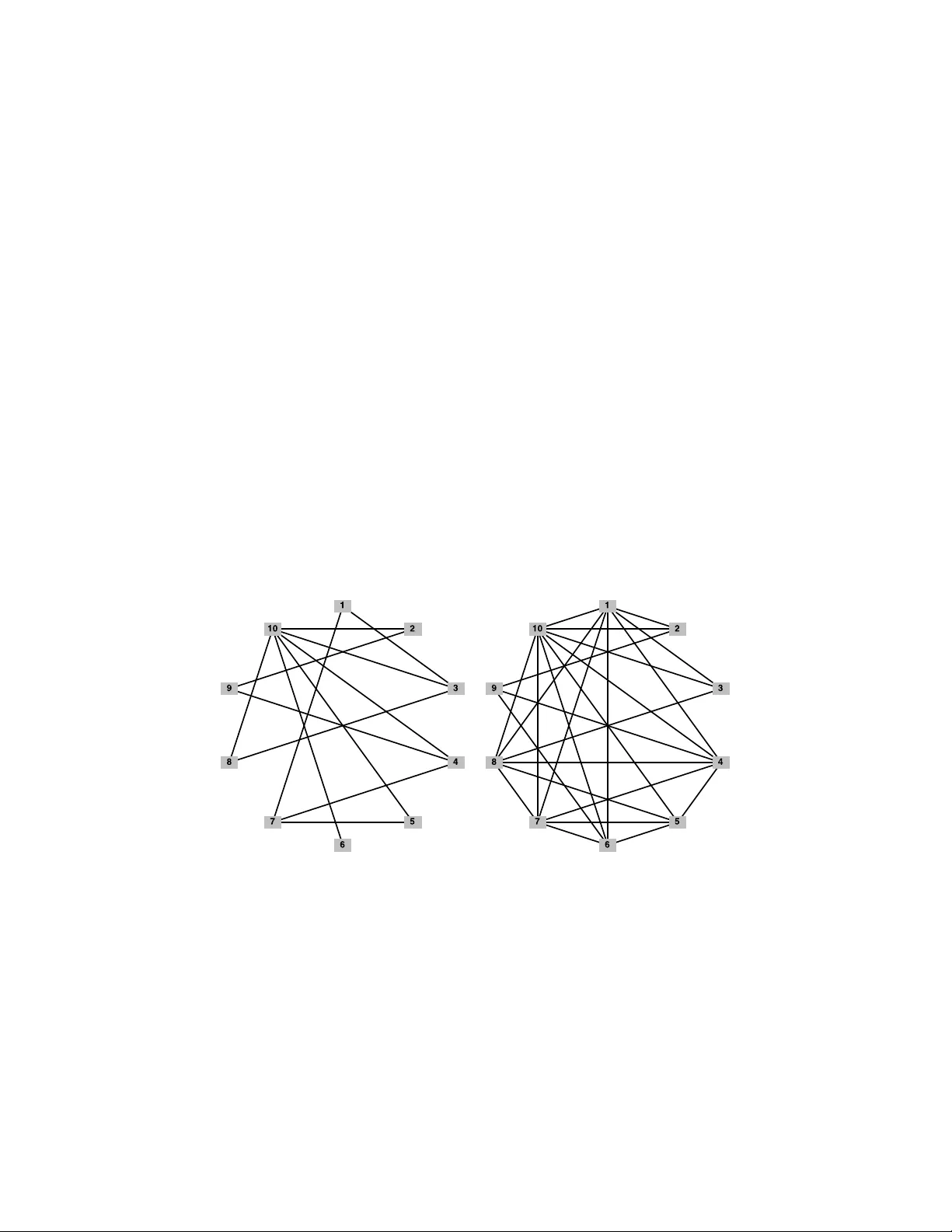
The Calculation and Sim ulation of the Price of Anarc h y for Net w ork F ormation Games Shaun Lic hter, Christopher Griffin, and T erry F riesz Octob er 15, 2018 Abstract W e mo del the formation of net w orks as the result of a game where by play ers act selfishly to get the p ortfolio of links they desire most. The in tegration of pla y er strategies into the net w ork formation mo del is appropriate for organizational net works b ecause in these smaller net works, dynamics are not random, but the result of in- ten tional actions carried through b y play ers maximizing their o wn ob jectiv es. This mo del is a b etter framework for the analysis of influences up on a netw ork b ecause it in tegrates the strategies of the play ers inv olved. W e presen t an Integer Program that calculates the price of anarc hy of this game by finding the w orst stable graph and the b est co ordinated graph for this game. W e sim ulate the formation of the netw ork and calculated the simulated price of anarch y , which w e find tends to b e rather low. 1 In tro duction In recent years, there has b een extensive efforts to collect large amoun ts of data related to underlying so cial netw orks in order to c haracterize the so cial netw ork in some useful w ay [1]. So cial netw ork analysis (and its v arious branches) is a large sub ject with several dev oted texts e.g., [2, 3]. It is imp ossible to provide a complete literature survey in a short space and most of the pap ers are not necessarily germane to the topics discussed in this pap er. Nevertheless, we provide a small sampling of the literature to illustrate the breadth of researc h in so cial net w ork analysis. [4] suggests methods for predicting future ev ents based on so cial media, while [5] is sp ecifically interested in the identification of sp ecific anonymous individuals within a giv en so cial netw ork. [6] inv estigates the problem of mathematically mo deling crowd-sourcing. This work is extended in [7]. There is substantial in terest from the statistical ph ysics communit y in this problem in the form of Net w ork Science (see the sequel). [8] inv estigate mo dels for the growth of so cial netw orks. V ery little of this work uses game theoretic principles as we do in this pap er, ho wev er, [9] in vestigates the problem of a user deciding to join a so cial netw ork from a game theoretic p ersp ectiv e. A sp ecific application of this analysis is to aid in the disco very of a maliciou s net w ork (e.g. an organized crime netw ork). In terested readers can see [10] for a more commercial appli- cation of the same techniques. These metho ds are fo cused on the discov ery of a subnet work 1 with particular characteristics, but they do not offer insigh t into the analysis of p oten tial courses of actions that ma y b e taken to influence the net w ork. F or example, supp ose that w e consider the small fiv e pla yer organization shown in Figure 1.1. In this organization, the red Figure 1.1: What will happ en if the red node is remov ed? Will the net work dissolve (left) or reform (right) no de is the center of the organization. It seems intuitiv e that the center of the organization should b e attack ed in some wa y (e.g. captured or killed). Ho wev er, it is unclear whether the organization will crumble as sho wn on the left b y a set of disconnected no des or if the graph will reform as a stronger net work, as sho wn on the right. Let us instead consider a t ypical firm rather than a crime organization. If the CEO is remo ved for some reason (e.g. retires, is arrested, or dies), the firm may encoun ter a drop in the sto c k price or market shares as an indication of some struggling, ho wev er, it is very unlikely that it will collapse. If the firm do es collapse, it will not b e quick or as a sole consequence of this ev en t. The firm will lik ely reorganize b y replacing the CEO in some manner. Sometimes this benefits the firm as the new leader or reorganized organization is b etter than b efore and yet other times, the firm ma y encounter a steady decline under the new weak er leadership. It is our p osition that the analysis of play er interaction in a crime organization should use the same metho dologies as those for analyzing the interactions of play ers in other organizational en vironmen ts. In this paper, we tak e the point of view that pla yers in suc h a net work will mak e strategic decisions on with whom to connect. These decisions may reflect instructions from a central authorit y , but it is the pla y er who acts in his own best interest to carry these instructions out. Using a game theoretic mo del of pla yers and how they connect, will allow us to mo del the reformation of a net work as a result of an influen tial act up on it. In this resp ect, this approac h seeks to shed light on the problem facing authorities after they discov er suc h a malicious netw ork. T o our kno wledge, no organization has attempted to use game theoretic tec hniques to study the net w ork formation or reformation pro cess to inform p olicy on kill or capture op erations. While a game theoretic approac h allows the analysis of influence on a net work, it requires kno wledge of the v alue functions of the pla yers in volv ed. It is not p ossible to hav e p erfect kno wledge of these v alue functions and we defer a discussion of this problem to future w ork. T o b e sure, application of this tec hnique requires that play er ob jectiv e functions b e estimated. Ho wev er, such a requirement is not inconsisten t with current op erational requiremen ts for iden tifying and targeting members of organizations. 2 2 Related Literature from the Ph ysics Comm unit y The Netw ork Science comm unity has largely dedicated its efforts to the exp osition and analysis of top ological prop erties that o ccur in several real-w orld netw orks; e.g., scale-freeness [11 – 14]. Recen tly , there has been in terest in sho wing that these top ological prop erties may arise as a result of optimization, rather than some immutable physical law [15]. As Doyle et al. [15] p oin t out, v arious netw orks such as communications netw orks and the Internet are designed by engineers with some ob jectiv es and constrain ts. While it is true that there is often not a single designer in con trol of the en tire net work, the netw ork does not natur al ly ev olve without the influence of designers . In each application, the netw ork structure m ust b e feasible with resp ect to some physical constrain ts corresp onding to the tolerances and sp ecifications of the equipment used in the netw ork. F or example, in a system such as the w orld wide w eb, a single web-page migh t hav e billions of connections, ho wev er it is not p ossible for a no de to hav e such a degree in man y other applications, suc h as collaboration or road netw orks. Certainly the structure of the netw ork has a significan t impact on its [the net work’s] ability to function, its evolution, and its robustness. How ev er net w ork structures often arise as a result (lo cally) of optimized decision making among a single agen t or m ultiple comp etitiv e or co op erativ e agents, who tak e netw ork structure and function into account as a part of a collection of constraints and ob jectiv es. Recen tly , netw ork formation has b een mo deled from a game theoretic p ersp ectiv e [16 – 19], and in [20], it was shown that there exists games that result in the formation of a stable graph with an arbitrary degree sequence. In [21], it w as sho wn that a netw ork with an arbitrary degree sequence may result as a pairwise stable graph with link bias in the play er strategies. In this pap er, we sho w that w e may formulate an optimization problem to measure the price of anarc h y of stable graphs for this netw ork formation game. 3 Preliminary Notation and Definitions Let N = { 1 , 2 , . . . n } be the set of no des (v ertices) in a graph. F ollowing the graph formation game literature [19, 22 – 24], a graph is denoted as g and represen ts a set of links (edges) (where a link is a subset of N of size t wo). This notation is consisten t with the notion of a simple graph (i.e., a graph with out multiple edges or self-lo ops) in the standard graph theory literature; see, e.g., [25]. In this pap er, it will b e more conv enien t to denote a graph as x = h x ij i where: x ij = x j i = ( 1 if no de i is linked to no de j 0 else (3.1) W e assume x ii = 0 for all i ∈ N . Note x is the symmetric adjacency matrix [26] for a graph g and w e consider only non-directed simple graphs. Denote X as the set of all graphs o v er the no de set N , that is, X = { x : x ∈ { 0 , 1 } n × n } . 3 Let η i ( x ) : X → R denote the degree of no de i in graph x , whic h is computed: η i ( x ) = X j x ij = x i · e (3.2) where e is an n-dimensional column vector filled with 1’s, that is e = (1 , 1 , . . . 1) T ∈ R n × 1 . Denote η ( x ) : X → R n as the degree sequence of the graph x ; i.e., η ( x ) = ( η 1 ( x ) , η 2 ( x ) , . . . , η n ( x )), which can b e computed: η ( x ) = xe (3.3) Note, we break slightly with the notation in the literature. In (e.g.) [27] a degree sequence is listed in descending order. W e do not hav e this requiremen t as we we will be interested in conditions where certainly play er’s in a graph formation hav e a certain desired degree. Let [ x ] η b e the equiv alence class of graphs with the same degree sequence as x . A degree sequence d = ( d 1 , . . . , d n ) on n no des is gr aphic al , if there exists a graph with n no des and degree sequence d = ( d 1 , . . . , d n ). The ` l -norm b et ween t wo degree sequences d = ( d 1 , . . . , d n ) and k = ( k 1 , . . . , k n ) is given as: k d − k k 1 = n X i | d i − k i | (3.4) W e define a graph x to b e closest in ` l norm to degree sequence d if it is a graph in X with a degree sequence that has the minimum ` l norm distance to d of all graphs in X . Naturally , this graph may not b e unique. F ormally , x is a closest graph to degree sequence d if: k η ( x ) − d k 1 = min x 0 ∈ X k η ( x 0 ) − d k 1 (3.5) 4 Net w ork Game Notational Preliminaries In the netw ork formation game, eac h pla yer selects a strategy that consists of a set of preferences for with whom they would like to form a link. The preference of eac h pla yer to ward each link is represented in a matrix s where s ij denotes the preference for no de i to link with no de j : s ij = ( 1 if Play er i desires to link with Play er j 0 else (4.1) W e define s ii = 0 to b e consistent with our assumptions from the previous section. Play er i will select strategy s i · from the set of all p ossible strategies S i = { 0 , 1 } n − 1 . In this game, eac h pla yer has the abilit y to veto a link. That is, the formation of a link requires participation b y b oth pla y ers as is consistent with many social netw orks. Hence each Pla yer i selects strategy 4 s i · and all together a strategy s = [ s i · ] i ∈ N is iden tified from S = S 1 × S 2 × · · · × S n . As a result of the strategy chosen, a simple graph x is formed: x ij = x j i = ( 1 if s ij = s j i = 1 0 else (4.2) The v alue of a graph x is the total v alue pro duced b y agen ts in the graph; w e denote the v alue of a graph as the function v : X → R and the set of of all such v alue functions as V . An allo cation rule Y : V × X → R n distributes the v alue v ( x ) among the agen ts in N . Denote the v alue allo cated to agent i as Y i ( v , x ). Since, the allo cation rule m ust distribute the v alue of the net work to all pla yers, it m ust b e b alanc e d ; i.e., P i Y i ( v , x ) = v ( x ) for all ( v , x ) ∈ V × X . The allo cation rule go verns how the v alue is distributed and thus makes a significan t con tribution to the mo del. Denote the game G = G ( v , Y , N ) as the game pla yed with v alue function v and allo cation rule Y ov er no des N . In this game, each agen t (no de) is a selfish profit maximizer who chooses strategy s i · to maximize there allo cated pay off under allo cation rule Y and v alue function v . Jac kson and W olinksy [17] suggest that Nash Equilibrium analysis for this game ma y lead to inconsistencies b et ween in tuitiv e exp ected b eha vior and equilibrium b eha vior. A Nash Equilibrium is defined as any solution such that no play er can unilaterally change strategies to b enefit himself. F or an y p oten tial link b et ween tw o no des i and j , the solution with no link (i.e., x ij = 0) is an equilibrium even if b oth play ers could b enefit from the link. This is b ecause eac h play er has link veto p ow er and therefore, no play er can unilater al ly create a link with any other play er. In order to pro vide a more intuitiv e equilibrium concept for this mo del, Jackson and W olinksy use p airwise stability to mo del stable netw orks without the use of Nash equilibria [17]. W e will first denote x + ij as the graph x with the additional link ij and x − ij as the graph x without the link ij . Definition 4.1. A netw ork x with v alue function v and allo cation rule Y is pairwise stable if (and only if ): 1. for all i, j if x ij = 1, Y i ( v , x ) ≥ Y i ( v , x − ij ) and 2. for all i, j if x ij = 0 then, if Y i ( v , x + ij ) > Y i ( v , x ), then Y j ( v , x + ij ) < Y j ( v , x ) P airwise stabilit y implies that in a stable netw ork, for each link that exists, (1) b oth pla yers m ust b enefit from it and (2) if a link can provide b enefit to b oth play ers, then it, in fact, must exist. Jackson notes that pairwise stability ma y b e to o weak b ecause it do es not allo w groups of play ers to add or delete links, only pairs of play ers [28]. Deletion of multiple links simultaneously has b een considered in Belleflamme and Blo c he [29]. Previously , in [20] w e extend work in [30] and [18], showing that stable net works may b e formed as a result of a link formation game with an arbitrary (desired) degree sequence. This work presupp oses that w e embed the degree sequence (implicitly or explicityly) into the ob jectiv e functions of the play ers. 5 Theorem 4.2. L et f : R → R b e a nonne gative c onvex function with minimum at 0 and let d = ( d 1 , . . . , d n ) b e a de gr e e se quenc e. In G ( v , Y , N ) , assume that Player i maximizes obje ctive Y i ( x ) = − f i ( η i ( x )) = − f ( η i ( x ) − d i ) = − f ( P j x ij − d i ) . Assume that v is the b alanc e d value function induc e d fr om the al lo c ation rule Y = ( Y 1 , . . . , Y n ) . If η − 1 ( d ) is non- empty (i.e., d is gr aphic al) then any gr aph x such that η ( x ) = d is p airwise stable for the the game G ( v , Y , N ) . Pr o of. See [20]. 5 Link Bias The mo del presented in Theorem 4.2 requires that each play er ha ve a similar ob jective function and, essen tially , a desired degree – or a special n umber of individuals to whom he wishes to connect. While this is a goo d first mo del for many applications, and establishes the relativ e ease with whic h Netw ork Science metrics can b e incorp orated in to a game theoretic framew ork, in real-world situations each play er usually has a bias to ward linking with a sp ecific set of pla y ers rather than others. In this section, we incorporate a pla y er’s preference to link to one pla yer ov er another. The incorp oration of link bias do es not change the fact that giv en an y degree sequence, there exists a game that will result in a pairwise stable graph with such a degree sequence [21]. Assume each pla yer minimizes a cost f i : X → R . In this framework, we assume that Y i ( x ) = − f i ( x ) and the pla y er maximizes Y i ( x ). Consistent with Theorem 4.2, w e assume the v alue function v in G ( v , Y , N ) is defined implicitly from the Y i ( x ) ( i = 1 , . . . , n ) so that v is balanced. F or the remainder of this section w e assume a linear cost function: f i ( x ) = X j c ij x ij (5.1) As in the prior model a link b et w een pla yers i and j exists if and only if the tw o play ers decide to link. That is, a pla yer may unilater al ly reject a link. 5.1 Stabilit y In this mo del, Play er i will b enefit from linking with any Play er j whenever c ij < 0 and Pla yer i will b e penalized for linking with an y Pla yer j whenev er c ij > 0. W e ma y hav e an unsp ecified b eha vior when c ij = c j i = 0. In this case it will neither help nor hinder either pla yer to establish a link. T o remov e this possibility , w e may assume link parsimony . That is, w e will assume that a link is established if and only if b oth play ers b enefit in some wa y . The stability condition b ecomes: Definition 5.1. A net work x is pairwise stable if (and only if ): 1. for all i, j : if x ij = 1, then c ij < 0 and c j i < 0 2. for all i, j : if x ij = 0, then if c ij ≥ 0 then c j i ≤ 0 6 W e show in [21], that giv en an arbitrary degree sequence d = ( d 1 , . . . , d n ) w e ma y con- struct a cost matrix c , whose comp onen ts are the ob jective function co efficients c ij , such that the resulting graph formation game has as a (pairwise) stable solution a graph with degree sequence d . The construction of c is done b y an optimization problem. Definition 5.2. As in the previous section, the preference of Pla yer i to link with Play er j is indicated via s ij where: s ij = ( 1 if play er i can b enefit from link ij 0 if play er i cannot b enefit from link ij R emark 5.3 . Sp ecifically , s ij is the b o olean mapping of c ij : s ij = ( 1 if c ij < 0 0 if c ij ≥ 0 (5.2) Lemma 5.4. A gr aph x = h x ij i is stable if and only if it satisfies the fol lowing c onstr aints: x ij = x j i ∀ ij s ij + s j i − 1 ≤ x ij ∀ ij x ij ≤ s ij ∀ ij x ij ≤ s j i ∀ ij x ij , s ij ∈ { 0 , 1 } ∀ ij (5.3) Pr o of. See [21]. R emark 5.5 . Note the linearity of the constrain ts in b oth s ij and x ij suggests we could in tro duce additional constrain ts to the constraints in Expression 5.3 and solve for b oth x and s . If there is a feasible solution ( x , s ) to the constrain ts, then this solution can b e used to generate a cost matrix c . In fact, it can b e used to generate an infinite n umber of cost matrices, the simplest one given b y: c ij = ( − 1 if s ij = 1 1 if s ij = 0 (5.4) Prop osition 5.6. L et d = ( d 1 , d 2 , . . . , d n ) b e a de gr e e se quenc e and c onsider the fol lowing c onstr aints: X j 6 = i x ij = d i ∀ i x ij = x j i ∀ ij s ij + s j i − 1 ≤ x ij ∀ ij x ij ≤ s ij ∀ ij x ij ≤ s j i ∀ ij s ij ∈ { 0 , 1 } ∀ ij (5.5) 7 If ( x , s ) is a fe asible solution to the c onstr aints in Expr ession 5.5, c is a c ost matrix c on- structe d fr om s as in Expr ession 5.4 and f 1 , . . . , f N : X → R ar e player c ost functions with Y i ( v , x ) = − f i ( x ) = − P j c ij x ij , then x = h x ij i is a p airwise stable solution for G ( Y , v , N ) and has de gr e e se quenc e d = ( d 1 , d 2 , . . . , d n ) , wher e v is the b alanc e d value function define d fr om Y i ( i = 1 , . . . , n ). 5.2 Construction of Cost Matrix via Optimization If there is no feasible s to the constrain ts in Expression 5.5, the first constrain t ma y b e priced out and the nonlinear integer program (Expression 5.6) may b e solv ed to find a solution ( x , s ) suc h that the resulting graph x is pairwise stable for G ( Y , v, N ) as defined in Prop osition 5.6 and degree sequence of x is as close p ossible to d in the ` 1 metric. min X i X j 6 = i x ij − d i s.t. x ij − x j i = 0 ∀ i < j s ij + s j i − 1 ≤ x ij ∀ ij x ij ≤ s ij ∀ ij x ij ≤ s j i ∀ ij x ij , s ij ∈ { 0 , 1 } ∀ i, j (5.6) Problem 5.6 may b e reformulated as Problem 5.7, whic h has linear ob jectiv e function and nonlinear constraints. min X i e i s.t. X j 6 = i x ij − d i ≤ e i x ij − x j i = 0 ∀ i < j s ij + s j i − 1 ≤ x ij ∀ ij x ij ≤ s ij ∀ ij x ij ≤ s j i ∀ ij x ij , s ij ∈ { 0 , 1 } ∀ i, j (5.7) 8 This problem can b e reformulated as a purely linear in teger programming problem (Problem 5.8). min X i e i s.t. X j 6 = i x ij − d i ≤ e i ∀ i − X j 6 = i x ij + d i ≤ e i ∀ i s ij + s j i − 1 ≤ x ij ∀ ij x ij ≤ s ij ∀ ij x ij ≤ s j i ∀ ij x ij − x j i = 0 ∀ i < j x ij , s ij ∈ { 0 , 1 } ∀ i, j (5.8) R emark 5.7 . The following theorem is an immediate result of the equiv alence of Problem 5.8 and Problem 5.6 and Prop osition 5.6. Theorem 5.8. Supp ose d = ( d 1 , d 2 , . . . , d n ) is a de gr e e se quenc e, ( x , s ) is an optimal solution to Pr oblem 5.8, c is a c ost matrix c onstructe d fr om s as in Expr ession 5.4 and f 1 , . . . , f N : X → R ar e player c ost functions with Y i ( v , x ) = − f i ( x ) = − P j c ij x ij , then x = h x ij i is a p airwise stable solution for G ( Y , v , N ) and has de gr e e se quenc e as close as p ossible to d in the ` 1 metric, wher e v is the b alanc e d value function define d fr om Y i ( i = 1 , . . . , n ). Pr o of. See [21]. R emark 5.9 . Theorem 5.8 shows how to construct a link biased game that encapsulates a sp ecific degree sequence d . The resulting game (or class of games) hides the degree distribu- tion in the ob jectiv e functions of the play ers in a non-obvious w ay , illustrating how arbitrary degree distributions can b e hidden within the ob jectiv e functions of individual play ers. This also suggests the need to in v estigate general v alue function inference from data, whic h w e discuss in our future work. 6 Price of Anarc h y When net w orks form as a result of selfish comp etition among no des, the resulting stable net work ma y not, in fact, b e system optimal. It is p ossible that a stable configuration is ac hieved in which each no de do es worse than if a cen tral planner had optimized the system. In this circumstance, w e would lik e to measure the collective penalization due to decen tralized con trol. This collective price has b een called the pric e of anar chy , which is measured as the ratio b etw een the worst equilibrium and the cen tralized solution. The price of anarch y [31] is a metho d to measure the inefficiency of equilibrium, but the developmen t of the analyisis of the inefficiency of equilibriums predates the price of 9 anarc hy [32]. There already exists m ultiple v ariations of the price of anarc h y (e.g. Pure Price of Anarc h y , Mixed Price of Anarc hy), for the differen t t yp es of equilibriums that exist. In this pap er, w e ha ve defined pairwise stability rather than using the t ypical Nash Equilibrium, so this foreshadows the presen tation of an analogue to the price of anarc h y in the sequel. The price of anarc h y has b een used to measure the inefficiency in congestion netw orks [33, 34]. In these games, each user of the net work has a source and destination and they m ust pa y a cost to tra vel from their source to their destination. The latency or cost of eac h link in the netw ork increases with congestion, that is as the num b er of pla yers that use it increases. Economically , we ma y think of c ap acity on the net work (sp ecifically b et ween an origin destination pair) as a commodity b eing supplied. As more users w ant that commodity , the price increases. Eac h user will selfishly minimize his o wn cost via route selection. The inefficiency of the system is calculated by measuring the total cost of the system when users act selfishly v ersus the total cost when users act in a co ordinated manner b y a centralized solution. The price of anarc hy is calculated as: ρ = max x ∈ X P i Y i ( x ) min x ∈ E P i Y i ( x ) = max x ∈ E P i f i ( x ) min x ∈ X P i f i ( x ) (6.1) where the set E ⊂ X is defined as the subset of equilibrium solutions. In this system, this ratio is a useful measurement b ecause min x ∈ X P i f i ( x ) > 0. In mo dels suc h as the traffic congestion mo del, there is an inheren t minim um cost to tra verse a link due to the fact that each link has a certain minimal trav ersal time. The congestion from other play ers and lack of capacity causes an additional cost, which is measured as a ratio of the physical cost. How ev er, this prop ert y is simply not true of all games where pla yers act selfishly . In mo dels of net work formation, there is not necessarily an inheren t cost to the system. It is p ossible that due to the desires and constraints of the play ers inv olved, there is some cost that m ust b e absorb ed by some set of pla yers, but this is due to the inconsistency of the pla yers’ desires, resources, and constraints. In the case where there is no suc h inconsistency and it is p ossible for all pla yers to satisfy their desires, there is an optimal cost of zero. In these circumstances, for these applications, it do es not mak e sense to examine the ratio as the denominator may b e zero. Hence, we calculate the pric e of anar chy as: ρ = max x ∈ X X i Y i ( x ) − min x ∈ E X i Y i ( x ) = max x ∈ E X i f i ( x ) − min x ∈ X X i f i ( x ) (6.2) In this measurement, we measure the total additional cost of the worst selfish equilibrium o ver the b est co ordinated solution and denote this as the price of anarc h y . The price of anarch y is a measure of the collective unhappiness of play ers due to selfish- ness. It is calculated as a function of the ob jective function of eac h play er. Unless otherwise stated, we will return to the assumptions made in Section 4 that Y i ( x ) = − f i ( η i ( x )) = − f ( η i ( x ) − d i ) where f is conv ex with a minimum at 0. The shap e of the function f will ha ve a considerable influence on whic h graph is the worst stable. An infinitely steep function f could ha v e an infinitely large ob jective v alue for the worst equilibrium. 10 F or computational ease and to obtain closed form theoretical results, we will consider f i ( η i ( x )) = f ( η i ( x ) − d i ) = | η i ( x ) − d i | . This function provides additional insigh t into the game b ecause, for the b est and worst graph, it measures the ` 1 distance b et ween the degree sequence of the graph generated through selfish decision making and a graph with the degree sequence closest in the ` 1 metric to the target degree sequence d . 6.1 The W orst Stable Graph 6.1.1 Link Bias Game Prop osition 6.1. Assume c is a c ost matrix in the link bias game G ( Y , v , N ) wher e Y i = − P j c ij x ij and v is the b alanc e d value function induc e d by Y i ( i = 1 , . . . , n ) . L et s ij b e define d by Expr ession 5.2. If x is a solution to the inte ger pr o gr amming pr oblem: max X i X j c ij x ij s.t. x ij = x j i ∀ ij s ij + s j i − 1 ≤ x ij ∀ ij x ij ≤ s ij ∀ ij x ij ≤ s j i ∀ ij x ij ∈ { 0 , 1 } ∀ ij (6.3) then x is a stable gr aph with the minimum net p ayoff. Pr o of. This is clear from the ob jectiv e function and Lemma 5.4. 6.1.2 Degree Sequence Game Next, w e consider the mo del where Pla yer i has an allo cation function Y i ( v , x ) = − f i ( η i ( x )) where f i : R → R is con vex with a minim um at d i . In this section, we define an integer program to find the stable graph with the worst total allo cation for the play ers inv olved in the game. The feasible region of this integer program will b e the set of stable graphs. R emark 6.2 . Define: r ij ( x ) = ( 1 if Y i ( v , x ) ≥ Y i ( v , x − ij ) 0 else (6.4) and p ij ( x ) = ( 1 if Y i ( v , x + ij ) > Y i ( v , x ) 0 else (6.5) and q ij ( x ) = ( 1 if Y j ( v , x + ij ) < Y j ( v , x ) 0 else (6.6) 11 Since stabilit y is simply a propositional statemen t with prop ositions r ij ( x ), p ij ( x ) and q ij ( x ), it can b e sho wn that the follo wing nonlinear integer programming problem will pro duce the stable graph with the minimal net pa yoff [35]: min X i Y i ( v , x ) x ij = x j i ∀ i < j (1 − x ij ) + r ij ( x ) ≥ 1 ∀ i, j x ij + (1 − p ij ( x )) + q ij ( x ) ≥ 1 ∀ i, j x ij ∈ { 0 , 1 } ∀ i, j (6.7) Ho wev er, the integer programming problem in its ra w form is highly non-linear and therefore not efficient for computing the w orst stable graph that can result from an arbitrary Y i ( v , x ). Lemma 6.3. A gr aph x = h x ij i with value function v and al lo c ation rule Y i ( v , x ) = − f i ( η i ( x )) wher e f i is c onvex and has a minimum at d i is p airwise stable if and only if: 1. for al l i , P j 6 = i x ij ≤ d i 2. for al l i, j 6 = i , if x ij = 1 , then P l 6 = i x il ≤ d i and P l 6 = j x lj ≤ d j 3. for al l i, j 6 = i , P l 6 = i x il < d i and P l 6 = j x lj < d j = ⇒ x ij = 1 Pr o of. Supp ose x is pairwise stable. If for an y Pla yer i , P j 6 = i x ij > d i , then Play er i could unilaterally drop one link and obtain a more fa vorable pay off. Thus, it is clear P j 6 = i x ij ≤ d i since we assumed Condition 1 of pairwise stability that for all i, j , if x ij = 1, then Y i ( v , x ) ≥ Y i ( v , x − ij ). Thus Constrain t 1 must b e true. Constraint 2 follo ws from this argumen t as well. If we assume for all i, j if x ij = 0 then, if Y i ( v , x + ij ) > Y i ( v , x ), then Y j ( v , x + ij ) < Y j ( v , x ) then this is equiv alen t to assuming if x ij = 0 then if P k 6 = i x ik < d i then P k 6 = j x j k = d j . If we take the contrapositive of Constraint 3, then we obtain: if x ij = 0 then P i 6 = j x ik = d i or P k 6 = j x j k = d j . Using a simple logical equiv alence, we may rewrite this expression as: if x ij = 0 then if P i 6 = j x ik 6 = d i then P k 6 = j x j k = d j . Since w e’ve pro ved Constrain t 1 m ust hold, P i 6 = j x ik 6 = d i is equiv alent to P i 6 = j x ik < d i . Thus, Constraint 3 follo ws from Condition 2 of pairwise stability . Con versely , supp ose these three conditions hold. The logical equiv alence betw een Con- strain ts 1 and Constraint 3 and Condition 2 of pairwise stabilit y has already b een established in the forgoing argument. By Constrain t 2, w e know that if x ij = 1, then each Play er i has degree at most d i , the v alue that maximizes his pay off function. Thus, setting x ij = 0 (effec- tiv ely constructing x − ij w ould yield a low er pay off for b oth Play er i and Play er j . Th us, Condition 1 of pairwise stability is established. Definition 6.4. Let u be a vector of slac k v ariables on the degrees of the nodes in the game. Then: u i = ( d i − P l 6 = i x il if P l 6 = i x il < d i 0 else ( i.e. P l 6 = i x il = d i ) 12 Similarly , let z to b e the binary mapping of the v ector u with: z i = ( 1 if u i > 0 ( i.e. P l 6 = i x il < d i ) 0 if u i = 0 ( i.e. P l 6 = i x il = d i ) R emark 6.5 . Note w e will not consider the case when P l 6 = i x il > d i b ecause each pla yer has the unilateral p o w er to v eto any connection. Lemma 6.6. L et Y i ( v , x ) b e as in the statement of L emma 6.3. L et d b e a de gr e e se quenc e and let x = h x ij i with ve ctors u , z derive d fr om Definition 6.4. Then x is stable if and only if the fol lowing c onstr aints ar e satisfie d: X j 6 = i x ij + u i = d i ∀ i (6.8) z i + z j − 1 ≤ x ij ∀ i, j 6 = i (6.9) z i ≤ u i ∀ i (6.10) u i ≤ d i z i ∀ i (6.11) x ij = x j i ∀ i, j 6 = i (6.12) u i ≥ 0 ∀ i (6.13) z i ∈ { 0 , 1 } ∀ i (6.14) x ij ∈ { 0 , 1 } ∀ i, j 6 = i (6.15) Pr o of. Supp ose that x is stable and u and z are defined appropriately . Clearly , x ij = x j i holds. By Lemma 6.3 we m ust hav e P l 6 = j x lj ≤ d j and so u i ≥ 0 and Constraint 6.8 holds by definition. F urther it is clear 0 ≤ u i ≤ d i for all i . By Definition 6.4, if u i = 0, then z i = 0 and thus z i ≤ u i and u i ≤ d i z i . The fact that u i ∈ Z + is ensured b y the in tegralit y of x so if u i > 0 then u i ≥ 1 thus u i ≥ z i = 1 and as w e observed u i ≤ d i = d i z i . Con versely , supp ose the constrain ts hold. That x is a graph is clear. T rivially , P l 6 = j x lj ≤ d j . Supp ose that u i , u j > 0. Then necessarily z i , z j = 1 since Constrain t 6.11 must hold. Th us, by Constraint 6.9 x ij = 1 and we hav e established the first and third constrain t of Lemma 6.3. Con versely , supp ose that x ij = 1. Then z i and z j ma y take any v alue to satisfy Constrain t 6.9 and the second constraint of Lemma 6.3 must hold. This completes the pro of. Theorem 6.7. L et Y i ( v , x ) b e as in the statement of L emma 6.3. L et d b e a de gr e e se quenc e. The solution to the fol lowing inte ger pr o gr amming pr oblem yields a gr aph x that is stable and 13 has the worst net p ayoff function of any stable gr aph. max X i u i s.t. X j 6 = i x ij + u i = d i ∀ i z i + z j − 1 ≤ x ij ∀ i, j 6 = i z i ≤ u i ∀ i u i ≤ d i z i ∀ i x ij = x j i ∀ i, j 6 = i u i ≥ 0 ∀ i z i ∈ { 0 , 1 } ∀ i x ij ∈ { 0 , 1 } ∀ i, j 6 = i (6.16) Pr o of. The statement follo ws at once from Lemma 6.6 and the assumptions on Y i ( v , x ) made in Lemma 6.3. Example 6.8 . Consider a simple example with 10 pla y ers who each hav e con vex cost functions with minima at 5. That is, eac h play er would prefer to link with no more and no less than 5 other pla y ers. Thus, the ideal graph solution is one in which each play er resides in a 5-regular graph. This setup yields an instan tiation of the integer programming problem in Expression 6.16: max X i u i s.t. X j 6 = i x ij + u i = 5 ∀ i z i + z j − 1 ≤ x ij ∀ i, j 6 = i z i ≤ u i ∀ i u i ≤ 5 z i ∀ i x ij = x j i ∀ i, j 6 = i u i ≥ 0 ∀ i z i ∈ { 0 , 1 } ∀ i x ij ∈ { 0 , 1 } ∀ i, j 6 = i with solution visualized in Figure 6.1: If w e assume the ob jective function of each play er is f i ( η ( x )) = | η i ( x ) − 5 | , then the worst case net pay off is 6. In this solution, w e see Play ers 1 and 2 b oth hav e degree 2, each missing 3 connections. 14 Figure 6.1: The worst solution to the problem in which 10 play ers each desired to link with 5 play ers. The ob jective function in this case is 6. 6.2 The Best Graph 6.2.1 Link Bias Game Prop osition 6.9. Assume c is a c ost matrix in the link bias game G ( Y , v , N ) wher e Y i = − P j c ij x ij and v is the b alanc e d value function induc e d by Y i ( i = 1 , . . . , n ) . L et s ij b e define d by Expr ession 5.2. If x is a solution to the inte ger pr o gr amming pr oblem: min X i X j c ij x ij s.t. x ij = x j i ∀ ij x ij ∈ { 0 , 1 } ∀ ij (6.17) then x is a (p otential ly unstable) gr aph with the maximum net p ayoff. 6.2.2 Degree Sequence Game In this section, we define an integer program to find the graph with the b est total allo cation for the pla yers inv olv ed in the game. Note that w e are not necessarily lo oking for a stable graph, so the feasible region is the set of all graphs. This will provide a baseline to ev aluate the worst price that may b e paid for selfish comp etition (e.g. the Price of Anarch y). R emark 6.10 . In the general case, the following nonlinear integer programming problem will yield the graph that provides the largest net pa y off: max X i Y i ( v , x ) x ij = x j i ∀ i < j x ij ∈ { 0 , 1 } ∀ i, j (6.18) 15 Again, the in teger programming problem in its ra w form may b e highly non-linear and therefore not efficient for computing the graph of in terest for any p ossible Y i ( v , x ). Previously , there has b een work on generating graphs with an arbitrary graphical degree sequence [36 – 39]. How ever this literature is mainly concerned with the algorithms to generate a graph for a graphical degree sequence. Here we seek to find the closest graph to any degree sequence (graphical or not) and we use an optimization form ulation to do this. That is, w e fo cus on the problem in which Y i ( v , x ) = −| η i ( x ) − d i | . F or our sp ecific function, w e form ulate a math program b y defining the feasible region as the set of all graphs and then minimizing the sum of the pla y er’s cost due to p enalization for acquiring a degree different than desired. min X i X j 6 = i x ij − d i s.t. x ij − x j i = 0 ∀ i < j x ij ∈ { 0 , 1 } ∀ i, j (6.19) This nonlinear integer programming problem is easily reform ulated to a linear in teger pro- gramming problem: min X i e i s.t. X j 6 = i x ij − d i ≤ e i ∀ i − X j 6 = i x ij + d i ≤ e i ∀ i x ij − x j i = 0 ∀ i < j x ij ∈ { 0 , 1 } ∀ i, j (6.20) This integer program minimizes the distance b et ween the arbitrary degree sequence d = { d 1 , . . . , d n } and the degree sequence of a graph in the feasible region. Theorem 6.11. The gr aph gener ate d by an optimal solution to the inte ger pr o gr am: min X i e i s.t. X j 6 = i x ij − d i ≤ e i ∀ i − X j 6 = i x ij + d i ≤ e i ∀ i x ij − x j i = 0 ∀ i < j x ij ∈ { 0 , 1 } ∀ i, j (6.21) is a closest gr aph under the ` 1 -norm to a gr aph with de gr e e se quenc e d = { d 1 , . . . , d n } . 16 Example 6.12 . No w, the price of anarch y is simply the difference of the ob jective function v alue from the worst gr aph (Problem (6.16)) to the b est gr aph (Problem (6.21)). Contin uing Example 6.8, the degree sequence in question is graphical. Th us, a globally optimal solution is one in whic h each play er is adjacen t to 5 other play ers. This is sho wn in Figure 6.2. W e Figure 6.2: A b est solution to the problem in whic h 10 play ers eac h desired to link with 5 pla yers. The ob jective function in this case is 0 and moreo ver, this graph is stable. note that this graph is not only a globally optimal solution, it is also a pairwise stable graph. As b efore, we are assuming that f i ( η ( x )) = | η i ( x ) − 5 | . Since the ob jectiv e function v alue is 0, it is easy to see that that price of anarch y as defined in Equation 6.2 is 5. 6.3 Complete Example Using a link bias game, we can illustrate a complete example of the pro cess by whic h a mo deler might make use of these techniques. Supp ose that after studying a 10 pla yer decen- tralized netw ork, a cost matrix c is constructed to iden tify link bias b et ween pla yers. This 17 cost matrix might b e: c = 0 − 85 − 29 13 − 25 − 94 − 19 − 97 10 10 75 0 9 32 78 27 − 55 − 38 − 44 − 61 − 85 19 0 48 23 18 71 − 36 26 − 26 − 19 25 35 0 − 67 18 − 50 − 69 − 3 − 20 57 17 80 51 0 63 − 17 69 − 62 − 78 83 81 20 20 − 81 0 35 − 15 − 83 − 4 − 45 89 39 − 46 − 36 − 51 0 2 9 5 68 92 − 35 35 − 88 51 − 86 0 88 − 91 58 − 2 26 − 54 91 38 50 99 0 − 44 − 43 − 46 − 74 − 17 − 62 − 38 − 94 − 59 63 0 (6.22) Using this information, the w orst net pay off stable graph can b e iden tified from Problem 6.3. The v alue to the organization under this strategy is 1077 units of rew ard. If the group w ere organized cen trally , the v alue to the group would be 1487 units of reward, computed from Problem 6.17. The resulting graphs are sho wn in Figure 6.3. Since the t wo communit y (a) W orst Graph (b) Best Graph Figure 6.3: The worst stable graph and b est centrally co ordinated graph using the cost matrix c . pa yoffs are p ositiv e, w e can analyze the price of anarc h y using the traditional ratio metho d and we s ee that decentralized play leads to a approximately ∼ 72% of the pa y off that w ould come from cen tralized co ordination. Naturally , if the pla yer’s true netw ork resembled the cen trally co ordinated graph rather than the unco ordinated (stable) graph, we migh t susp ect this netw ork w as not selfishly co ordinating and our pa yoff matrix w as incorrect. 18 Supp ose no w w e isolate a v ertex and target it for kill or capture. Without loss of gen- eralit y , we ha ve identified that it is p ossible to kill or capture either V ertex 10 or V ertex 1. In an ordinary netw ork analysis, V ertex 10 is clearly a high priorit y target since it has the highest degree. W e can explore the impact of remo ving V ertex 10 from the netw ork by deleting the 10th row and column from c and recomputing. The resulting graphs are sho wn in Figure 6.4. In this case, the unco ordinated netw ork fragmen ts into a tree and a single, (a) W orst Graph (b) Best Graph Figure 6.4: The worst stable graph and b est cen trally co ordinated graph after removing Pla yer 10. isolated vertex. F urthermore, the new pay offs are 501 reward units for the stable netw ork and 789 reward units for the new cen trally co ordinated netw ork. The new price of anarc hy (as a ratio) is ∼ 63%, suggesting we ha ve seriously impacted the ability of the net w ork to ac hieve results as go o d as a cen trally co ordinated net w ork. Ho wev er, supp ose it was easier to remo v e V ertex 1. If we execute this mission, the result- ing graphs are shown in Figure 6.5. In this case, the unco ordinated graph do es not fragment at all and more importantly the new pay offs are 899 rew ard units in the unco ordinated stable graph and 1220 rew ard units in the centrally co ordinated graph. The new price of anarc hy (as a ratio) is ∼ 74%. Remo ving V ertex 1 actually improv es the relativ e p erformance of the net work with resp ect to a cen trally co ordinated netw ork. Th us w e might conclude that giv en the opp ortunity to remov e a vertex, w e should choose to remov e V ertex 10 rather than V ertex 1, even though these vertices hav e similar netw ork characteristics. It is in teresting to note in this example there is little correlation b et w een the traditional measures of vertex imp ortance and their impact on the resulting net work’s price of anarch y . Eigen vector cen- tralit y and vertex degree for the original worst stable graph (the assumed initial condition) and the resulting change in price of anarch y are summarized in the table b elo w. Price of anarc hy difference is computed as the original price of anarch y ( ∼ 72%) min us new price of anarc hy once a v ertex is remov ed. W e also include the Comm unal Change in Utilit y . This is the difference in the comm unal ob jective function in the original graph (10 play ers) and the 19 (a) W orst Graph (b) Best Graph Figure 6.5: The worst stable graph and b est cen trally co ordinated graph after removing Pla yer 1. comm unal ob jective function in the graph that results from remo ving a v ertex (9 pla y ers). The computation is done for eac h pla yer who could be remo ved. The information in the table Remo ved V ertex Degree Eig. Centralit y PO A Diff Communal Utilit y Change 1 2 0.070066565 -0.012608178 178 2 2 0.085041762 0.026391872 153 3 3 0.120257982 0.065375238 285 4 3 0.115436794 0.009530895 190 5 2 0.093603947 0.011948301 193 6 1 0.063208915 -0.03956057 42 7 3 0.092026999 -0.072036296 213 8 2 0.102880448 -0.05390475 221 9 2 0.066087279 -0.003131446 103 10 6 0.191389311 0.089296079 576 T able 1: Summary T able for traditional net work imp ortance measures and the corresp onding impact on price of anarch y . is illustrated in Figures 6.6 and 6.7. It is interesting to note the lack of correlation in these plots. Obviously this is anecdotal evidence, but suggests interesting future work in so far as price of anarch y change ma y b e a new w a y to measure the imp ortance of a v ertex in a so cial net work of interest. W e contrast these plots to the plots in Figure 6.7, where w e illustrate the relationship b etw een traditional netw ork metrics and the change in the comm unal util- it y . There is clearly a substantial correlation b et ween the degree of a v ertex, it’s eigen v ector cen trality and the extent to whic h the remov al of this vertex impacts the communal utilit y . This is exp ected since for this game, we can compute the communal utilit y change when 20 2,#$0.012608178# 2,#0.026391872# 3,#0.065375238# 3,#0.009530895# 2,#0.011948301# 1,#$0.03956057# 3,#$0.072036296# 2,#$0.05390475# 2,#$0.003131446# 6,#0.089296079# $0.1# $0.08# $0.06# $0.04# $0.02# 0# 0.02# 0.04# 0.06# 0.08# 0.1# 0# 1# 2# 3# 4# 5# 6# 7# Price&of&Anarchy&Difference& Vertex&Degree& Difference&in&Price&of&Anarchy&vs.&Vertex&Degree& POA#Diff# (a) Degree 0.070066565& 0.085041762& 0.120257982& 0.115436794& 0.093603947& 0.063208915& 0.092026999& 0.102880448& 0.066087279& 0.191389311& -0.1& -0.08& -0.06& -0.04& -0.02& 0& 0.02& 0.04& 0.06& 0.08& 0.1& 0& 0.05& 0.1& 0.15& 0.2& 0.25& Price&of&Anarchy&Difference& Eigenvector&Centrality& Difference&in&Price&of&Anarchy&vs.&Vertex&Eigenvector&Centrality& (b) Eig. Cent. Figure 6.6: The price of anarch y change as a function of v arious vertex importance measures is illustrated. !"#$%&# !"#$'(# ("#!&'# ("#$)*# !"#$)(# $"#+!# ("#!$(# !"#!!$# !"#$*(# ,"#'%,# -#.#$*$/*%0#1#+%/()# 23#.#*/)$*!%# *# $**# !**# (**# +**# '**# ,**# %**# *# $# !# (# +# '# ,# %# Net$U&lity$Change$ Degree$ Communal$U&lity$Change$vs.$Degree$ (a) Degree !"!#!!$$%$%&'(#)' !"!)%!*(#$+&'(%,' !"(+!+%#-)+&'+)%' !"((%*,$#-*&'(-!' !"!-,$!,-*#&'(-,' !"!$,+!)-(%&'*+' !"!-+!+$---&'+(,' !"(!+))!**)&'++(' !"!$$!)#+#-&'(!,' !"(-(,)-,((&'%#$' .'/',$*+"$0'1'(*)")$' 23'/'!"-()++' !' (!!' +!!' ,!!' *!!' %!!' $!!' #!!' !' !"!%' !"(' !"(%' !"+' !"+%' Net$U&lity$Change$ Eigenvector$Centrality$ Communal$U&lity$Change$vs.$Eigenvector$Centrality$ (b) Eig. Cent. Figure 6.7: The net utilit y c hange as a function of v arious vertex imp ortance measures is illustrated . 21 v ertex i is remov ed (∆ U i ) as shown in Equation 6.23. ∆ U i = − X j s ij s j i ( c ij + c j i ) (6.23) F or eac h vertex i , when it is the remov ed v ertex, ∆ U i simply sums up the lost utilit y for eac h v ertex i and j for each link that existed in the net w ork b efore remov al. When s ij = 0 or s j i = 0, this implies the link did not exist and hence, no con tribution is made to ∆ U i . Alternativ ely , when s ij = s j i = 1, the con tribution made to ∆ U i is the sum of the utilities receiv ed by v ertex i and j , which is − ( c ij + c j i ). Since, s ij = 1 only if c ij < 0 and s j i = 1 only if c j i < 0, this means that when the link do es exist − ( c ij + c j i ) > 0. Hence, only p ositiv e con tributions can b e made to ∆ U i for each link it has and hence it must b e p ositiv ely correlated with the degree of vertex i . Ho w ev er, since utility receiv ed by a link may b e quite asymmetric when c ij << c j i , the communal utilit y change ma y differ greatly b etw een tw o no des with the same degree. This example illustrates the imp ortance of understanding what netw ork metrics mean in a giv en application. Because eac h play er (and th us the communit y of play ers) deriv es b enefit from b eing connected to sp ecific play ers in this game, it is relativ ely straightforw ard to see that net work metrics like eigenv ector cen tralit y and degree will be highly correlated to v alue functions like communal utility change; that is, how muc h removing a single play er will decrease the total pa y off to the net work. On the other hand, it is clear that there is little relationship b et ween the price of anarc hy difference and the net work centralit y measure of a vertex. Th us, if the goal is to degrade the netw ork’s ability to accum ulate utility , then using eigenv ector cen tralit y as a proxy measure in the link bias game should b e acceptable. Ho wev er, if the ob jective is to cause the netw ork to function in the least centralized wa y p ossible, then eigen v ector centralit y may not b e as go o d a pro xy measure. The is most clear in the case when we attempt to optimize b oth of these ob jectives in a kill or capture mission at once. Consider T able 1: Supp ose a decision maker’s ob jective is to simultaneously maximize the decrease in comm unal b enefits to the net w ork and increase the price of anarc hy as muc h as p ossible. Clearly , V ertex 10 is the ideal target; in fact it is the Pareto optimal solution for that m ulti-criteria optimization problem. If V ertex 10 is not accessible, then V ertex 3 is the next obvious target. It to o has an undominated pay off pair for that problem (the net b enefit decrease is 285 reward units and the price of anarch y decreases from 72% to 66%). Interestingly , these tw o v ertices hav e the highest eigen vector cen trality but not necessarily the uniquely highest degree (in the case of V ertex 3). If V ertex 3 also cannot b e killed or captured, then the problem b ecomes more complicated. Eigenv ector cen trality is no longer a go o d pro xy measure since the c hange in price of anarch y is not consisten t with the change in comm unal utility . 7 Sim ulation Net works that are pairwise stable for a game are pairwise stable b ecause no play er has an incen tive to drop a link and no t wo play ers hav e an incentiv e to add an additional link. The 22 price of anarch y measures how muc h worse the w orst p ossible stable graph is from the b est for a particular game. How ev er, this analysis do es not offer insight in to the actual formation of games. The simulation of net work formation can offer some additional insight. Moreov er, for exceptionally large games solving the Integer Programming Problems asso ciated with computing the price of anarch y may b e difficult. While it is relatively easy to solv e Problem 6.17 or Problem 6.19, it may b e difficult to solve Problem 6.16. 7.1 Metho dology In this subsection, we outline the metho dology for simulating the formation of a net work. W e again denote the current graph as x where: x ij = x j i = ( 1 if no de i is linked to no de j 0 else (7.1) W e denote the matrix P as the matrix represen ting p otential links: P ij = P j i = ( 1 if no de i c ould link to no de j 0 else (7.2) A link ij is a p oten tial link if: 1. Link ij curren tly do es not exist ( x ij = x j i = 0) 2. No de i could b enefit from linking to no de j ( i.e., P j x ij < d i ) 3. No de j could b enefit from linking to no de i ( i.e., P i x j i < d j ) No w, we in tro duce our sim ulation algorithm: 1. Initialize x ij = 0, P ij = 1 for all links ij 2. While there exists a p otential link (i.e., P ij P ij > 0): (a) Randomly select a p oten tial link ij (i.e. randomly choose a pair ( i, j ) suc h that P ij = 1) (b) Add link ij to the graph, set x ij = 1, x j i = 1 (c) Delete link ij from the p oten tial links, set P ij = 0, P j i = 0 (d) If no de i cannot b enefit from linking to any more no des ( P k x ik ≥ d i ), then remo ve all of their p oten tial links. That is, set P ik = 0 and P ki = 0 for all k (e) If no de j cannot b enefit from linking to an y more no des ( P k x j k ≥ d j ), then remo ve all of their p oten tial links. That is, set P j k = 0 and P kj = 0 for all k 23 7.2 Numerical Example Supp ose that we wan t the degree sequence of a stable graph that results from pla ying the game describ ed in Theorem 4.2 to hav e a p ow er law degree distribution. W e embed this into the ob jectiv es of the play ers, so the resulting graph has the prop er distribution. Let n = 100 pla yers attempt to minimize their cost function f i ( η i ( g )) = f ( η i ( g ) − k i ) = | η i ( g ) − k i | where the parameter k i for each pla y er and the degree distribution of k i v alues may b e found in T able 7.1. The distribution of the k i v alues form an appro ximate (with rounding to in tegers) p o w er la w distribution as illustrated in the histogram in Figure 7.2. W e note that this degree sequence is graphical. Thus the solution to Problem 6.21 yields an ob jective function that is 0. No de(s) Number of No des k i 1-75 75 1 76-89 14 2 90-94 5 3 95-96 2 4 97 1 5 98 1 6 99 1 7 100 1 8 Figure 7.1: k i v alues and degree distribution Figure 7.2: The k i v alues follow an approximate p o wer la w distribution The price of anarc h y is the difference of the ob jectiv e function v alue from the worst gr aph (Problem (6.16)) to the b est gr aph (Problem (6.21)). W e simulated this game 100 times using the metho dology from Section 7.1 to find further insigh t. In Figure 7.3 we show the simulation statistics for the degree distribution. F or 24 example, we see in Figure 7.1 that fiv e no des would optimize their ob jectiv es if they had a degree of three. In Figure 7.3, w e see that in all of the simulations, the minimum num b er of no des with a degree of three was four and the maxim um n umber of no des with a degree of three was six. Since, the t wen ty-fifth and sev ent y-fifth p ercentile was fiv e, w e kno w that in more than half of the simulation runs, five no des had a degree of three and optimized their ob jectiv e. In the other half of the runs, there was only one no de to o many or one no de to o few with a degree of three, this small v ariation indicates that most no des get close to their optim um degree resulting in a rather small price of anarch y . The sim ulation statistics are also visually presented as a b o x plot in Figure 7.2 In each simulation run, we calculated the Degree min 25 th median 75 th max 1 75 75 75 75 76 2 13 14 14 14 15 3 4 5 5 5 6 4 1 2 2 3 4 5 0 1 1 2 3 6 0 1 1 2 2 7 0 0 1 1 2 8 0 0 0 1 1 Figure 7.3: Degree Distribution Simulation Results price of anarch y and plotted the results as a histogram in Figure 7.4. Note the largest price of anarc h y is 10, suggesting that this is the true price of anarc hy for the system. That is, the worst p ossible outcome of comm unal utility in comp etitiv e pla y minus the b est outcome in cen tralized decision making (which is zero, since the degree sequence given is graphical). The price of anarc h y is rather low in most simulation runs. W e in vestigated the distribution of the contributions to the price of anarch y . As shown in Figure 7.5, the contributions to the price of anarch y w ere of higher magnitude and made more often b y no des with a greater k i 25 Figure 7.4: The empirical distribution of the price of anarc hy . v alue. This means that play ers that desired more links w ere more often more unhappy than other no des who desired a low er degree. That b eing said, Figure 7.5 and Figure 7.4 show that most play er’s attain their desired degree in most of the sim ulations. Degree min 10 th 25 th median 75 th 90 th 95 th max 1 0 0 0 0 0 0 0 0 2 0 0 0 0 0 0 0 1 3 0 0 0 0 0 0 0 1 4 0 0 0 0 0 0 0 2 5 0 0 0 0 0 0 1 3 6 0 0 0 0 1 1 2 2 7 0 0 0 0 2 3 4 6 8 0 0 0 2 3 4 4 6 Figure 7.5: Price of Anarch y Con tributions by Degree 8 Conclusion and F uture Directions In this paper w e ha ve studied game theoretic explanations for the formation of net w orks. W e ha ve sho wn that netw orks with interesting structures ma y emerge as the result of interactiv e pla y b et ween comp etitiv e individuals. W e hav e also illustrated a metho d for computing the price of anarch y for tw o types of netw ork games and illustrated the application of this calcu- lation to kill or capture op erations on violent extremist and criminal groups. W e concluded b y showing how sim ulation could b e used for ev aluating larger netw orks of interest when optimization problems b ecome infeasible. There are several future directions of w ork. W e w ould like to in vestigate more complex and more realistic games that will, ideally pro duce more lifelike b eha vior. T o do this, we m ust b e able to infer the ob jective functions 26 of the v arious pla yers. In practice, these are never kno wn and m ust b e estimated, and it may b e quite difficult to ev en estimate them. It is simply not p ossible to p erfectly observe an en tire graph at a single instance in time. Even if it w ere p ossible, relationships often cannot b e characterized by a single binary v ariable. Nonetheless, eac h time a graph is observ ed, information ab out the game can b e extracted. Inv estigating the pro cess of identifying these ob jectiv e functions is fundamental to extending these tec hniques to real world situations. In addition to this, more theoretical work can b e done. Obtaining theoretical b ounds on the price of anarc hy and on the c hange in the price of anarc h y as a result of v ertex remov al is in keeping with the literature on netw ork formation games. In addition to this, in vestigation of more complex games in whic h constraints on play ers influence strategies is of interest. The generalized Nash equilibrium games [40] may b e of interest in this case and will provide a ric her context in which to mo del play er b eha vior and therefore more requirements on our abilit y to infer play er ob jectiv es and constrain ts from observ ed graphs. References [1] K. Dozier, “Cia following twitter, faceb o ok,” Asso ciated Press: h ttp://news.yahoo.com/ap-exclusive-cia-follo wing-twitter-facebo ok-081055316.h tml, No vem b er 2011. [2] P . J. Carrington, J. Scott, and S. W asserman, Mo dels and Metho ds in So cial Network A nalysis . Cam bridge Universit y Press, 2005. [3] D. Knoke and S. Y ang, So cial Network A nalysis , ser. Quantitativ e Applications in the So cial Sciences. SAGE Publications, 2008, no. 154. [4] S. Asur and B. A. Hub erman, “Predicting the future with social media,” AxXiV: 1003.5699v1, T ech. Rep., March 2010. [5] L. Backstrom, C. Dwork, and J. Klein b erg, “Wherefore art thou r3579x? anonymized so cial netw orks, hidden patterns and structural steganograph y ,” in Pr o c. 16th World Wide Web Confer enc e , 2007. [6] A. F riggeri, G. Chelius, and E. Fleury , “F ellows: Cro wd-sourcing the ev aluation of an ov erlapping comm unity mo del based on the cohesion measure,” in Pr o c. Inter dis- ciplinary Workshop on Information and De cision in So cial Networks . Massach usetts Institute of T ec hnology: Lab oratory for Ilnformation and Decision Systems, Ma y 31 - Jun 1 2011. [7] A. Olshevsky and J. N. Tsitsiklis, “Conv ergence sp eed in distributed consensus and a veraging,” SIAM R eview , v ol. 53, no. 4, pp. 747–772, 2011. [8] E. M. Jin, M. Girv an, and M. E. J. Newman, “Structure of gro wing so cial net works,” Physic al R eview , v ol. 64, no. 046132, 2001. 27 [9] A. C. Squicciarini, S. Sundaresw aran, and C. Griffin, “A game theoretical persp ective of users’ registration in online so cial platforms,” in A c c epte d to Thir d IEEE International Confer enc e on Privacy, Se curity, Risk and T rust , Octob er 9 - 11 2011. [10] W. S. Y ang and J. B. Dia, “Discov ering cohesive subgroups from so cial netw orks for targeted advertising,” Exp ert Syst. Appl. , vol. 34, no. 3, pp. 2029–2038, 2008. [11] A. Barabasi and R. Alb ert, “Emergence of scaling in random netw orks,” Scienc e , vol. 286, no. 5439, p. 509, 1999. [12] M. Newman, “The structure and function of complex netw orks,” SIAM R eview , vol. 45, pp. 167–256, 2003. [13] S. Dorogo vtsev and J. Mendes, “Evolution of net works,” A dvanc es in Physics , v ol. 51, no. 4, pp. 1079–1187, 2002. [14] R. Albert and A. Barab´ asi, “Statistical mechanics of complex net w orks,” R eviews of mo dern physics , v ol. 74, no. 1, pp. 47–97, 2002. [15] J. Doyle, D. Alderson, L. Li, S. Lo w, M. Roughan, S. Shaluno v, R. T anak a, and W. Will- inger, “The robust y et fragile nature of the In ternet,” Pr o c e e dings of the National A c ademy of Scienc es of the Unite d States of Americ a , v ol. 102, no. 41, p. 14497, 2005. [16] R. Myerson, “Graphs and co op eration in games,” Mathematics of Op er ations R ese ar ch , v ol. 2, no. 3, pp. 225–229, 1977. [17] M. Jackson and A. W olinsky , “A strategic mo del of so cial and economic netw orks,” Journal of e c onomic the ory , vol. 71, no. 1, pp. 44–74, 1996. [18] B. Dutta and S. Mutuswami, “Stable net works,” Journal of Ec onomic The ory , vol. 76, no. 2, pp. 322–344, 1997. [19] S. Go yal and S. Joshi, “Net works of collab oration in oligop oly,” Games and Ec onomic b ehavior , vol. 43, no. 1, pp. 57–85, 2003. [20] S. Lich ter, C. Griffin, and T. F riesz, “A game theoretic p ersp ectiv e on netw ork top olo- gies,” Submitted to Computational and Mathematical Organization Theory (under re- vision) [http://arxiv.org/abs/1106.2440], F ebruary 2011. [21] ——, “Link biased strategies in net work formation games,” in In Pr o c. 3r d IEEE Con- fer enc e on So cial Computing , MIT, Boston, MA, Octob er 9-11 2011. [22] V. Bala and S. Go y al, “A nonco op erativ e mo del of net w ork formation,” Ec onometric a , v ol. 68, no. 5, pp. 1181–1229, 2000. [23] S. Go y al and S. Joshi, “Unequal connections,” International Journal of Game The ory , v ol. 34, no. 3, pp. 319–349, 2006. 28 [24] M. Jac kson and A. V an Den Nou weland, “Strongly stable net works,” Games and Ec o- nomic Behavior , vol. 51, no. 2, pp. 420–444, 2005. [25] R. Diestel, Gr aph The ory , 4th ed., ser. Graduate T exts in Mathematics. Springer, 2010. [26] C. Go dsil and G. Royle, Algebr aic Gr aph The ory . Springer, 2001. [27] J. Gross and J. Y ellen, Gr aph The ory and its Applic ations , 2nd ed. Bo ca Raton, FL, USA: CRC Press, 2005. [28] M. Jackson, “A survey of mo dels of netw ork formation: Stabilit y and efficiency,” Game The ory and Information , 2003. [29] P . Belleflamme and F. Blo c h, “Mark et sharing agreemen ts and collusiv e netw orks,” International Ec onomic R eview , vol. 45, no. 2, pp. 387–411, 2004. [30] M. Jackson, So cial and e c onomic networks . Princeton Univ ersity Press, 2008. [31] E. Koutsoupias and C. H. P apadimitriou, “W orst-case equilibria,” in In Pr o c. ST ACS 99 , 1999. [32] P . Dub ey , “Inefficiency of nash equilibria,” Mathematics of Op er ations R ese ar ch , pp. 1–8, 1986. [33] R. W. Rosen thal, “A class of games p ossessing pure-strategy nash equilibria,” International Journal of Game The ory , vol. 2, pp. 65–67, 1973, 10.1007/BF01737559. [Online]. Av ailable: h ttp://dx.doi.org/10.1007/BF01737559 [34] G. Christo doulou and E. Koutsoupias, “The price of anarc hy of finite congestion games,” in Pr o c e e dings of the thirty-seventh annual ACM symp osium on The ory of c omputing , ser. STOC ’05. New Y ork, NY, USA: A CM, 2005, pp. 67–73. [Online]. Av ailable: http://doi.acm.org/10.1145/1060590.1060600 [35] C. Griffin, K. T esta, and S. Racunas, “An algorithm for searc hing an alternativ e h y- p othesis space,” IEEE T r ans. Sys. Man and Cyb er. B , vol. 41, no. 3, pp. 772–782, 2011. [36] T. Britton, M. Deijfen, and A. Martin-L ”of, “Generating simple random graphs with prescrib ed degree distribution,” Journal of Statistic al Physics , vol. 124, no. 6, pp. 1377–1397, 2006. [37] R. Milo, N. Kash tan, S. Itzk ovitz, M. Newman, and U. Alon, “On the uniform generation of random graphs with prescribed degree sequences,” Arxiv pr eprint c ond-mat/0312028 , 2003. [38] C. Del Genio, H. Kim, Z. T oro czk ai, and K. Bassler, “Efficien t and exact sampling of simple graphs with given arbitrary degree sequence,” PloS one , vol. 5, no. 4, p. e10012, 2010. 29 [39] M. Mihail and N. Vishnoi, “On generating graphs with prescrib ed vertex degrees for complex netw ork mo deling,” ARACNE 2002 , pp. 1–11, 2002. [40] F. F acchinei, A. Fischer, and V. Piccialli, “On generalized Nash games and v ariational inequalities,” Op er ations R ese ar ch L etters , vol. 35, pp. 159–164, 2007. 30
Original Paper
Loading high-quality paper...
Comments & Academic Discussion
Loading comments...
Leave a Comment