Mathematical proof of fraud in Russian elections unsound
The Washigton Post had published allegations, that results of Russian elections "violate Gauss's groundbreaking work on statistics." I show that these allegations lack scientific basis.
Authors: M. V. Simkin
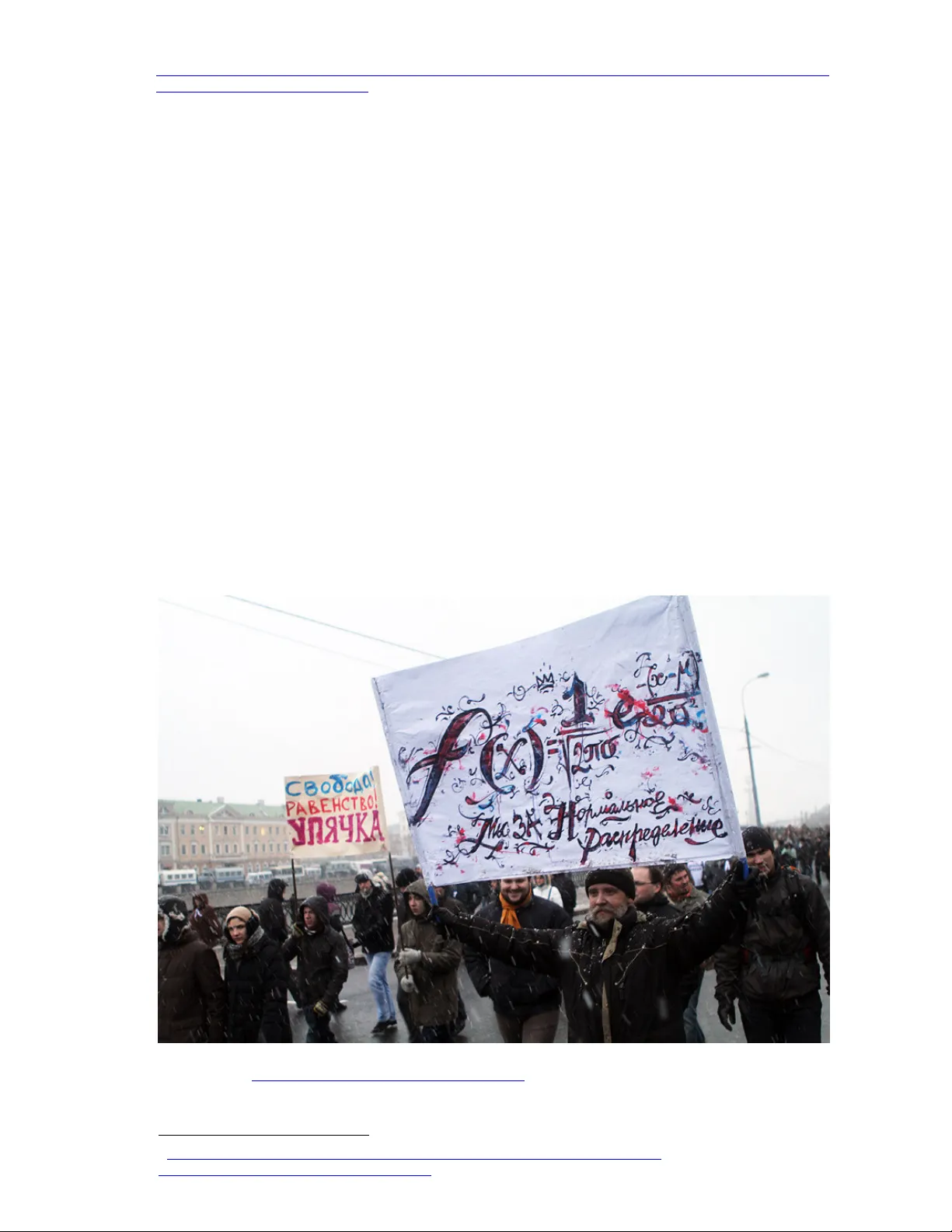
Mathematical pr oof of fraud in Russian elections u nsound Mikhail Simkin In crowds, it is stupidity and not mother wit that is accumulated. Gustave Le Bon, The Crowd: A Study of the Popular Mind On Saturday, Dece mber 10, thousands-strong crowds s warmed Russian c ities. They proteste d alleged fraud in December 4 pa rliamentary elections. Some of the allegations ha ve mathematical origin. The Washington Post article 1 states “Obviously, he [Puti n] doesn’t agree w ith Gauss,” one commenter wr ote, re ferring to pioneering mathematician Carl Friedrich Gauss, who lived 200 years ago. Disenchante d Russians argue t hat United Russia’s reported election results are s o i mprobable a s to violate Gauss’s groundbreaking work on statistics. The article does not say what e xactly the problem with the election result is a nd what work of Gauss is rel evant. It only s ays that he lived 200 years ago. However, this may be enough to trigger an a lert: the science had somehow advanced during past 200 years. I took a closer look at the allegations. The banner says “We are for Normal distribution.” (Image from http://nl.livejournal.com/1082778.html ) 1 http://www.was hingtonpost.com/world/e urope/russians-sc off-at -medvedev-election- inquiry/2011/12/11/ gIQAmBR8nO_stor y.html This article was published on December 15, 2011 in Significance http://www.significancemaga zine.org/details/webexcl usive/1424089/Mathemat ic al-proof-of-fraud-in- Russian-elections-unsound.html In the article 2 titled “M athematics against Election Committee: Gauss against Churov [t he head of the committee]” the blogger compla ined that the distribution of the percent of the vote for the United Russia party among elec tion precincts is non-Gaussian. This, he wrote, is an evidence of an election fraud because Gaussian distribution arises Always. In every case, when t here i s not one factor, but many. W hatever is measured in large quanti ties. Make a plot of how many millions of men in the c ountry have the height of 165, 170, 175 cent imeters and so on – and you wil l also get a s ymmetric bell-c urve with the top corresponding to the most typical height in the country. Yes, the heights of people are Gaussian-distributed. But what about incomes? They are distributed as if indeed most people were 170 cent imeters tall, but ofte n you would meet a three-meter guy. R arely you would encounter a five-meter man, more rarely – a ten-mete r one. Sometime, from a distance, you would see a hundred-meter person. And there would be several hundred-kilometer chaps in the count ry. This distribution is very far from Gaussian, but for some reason it doe s not attract the w reath of our ma thematicians, of our Be rezovskies 3 . There are many non-Gaussia n distributions in both nature and society [1] and there is no reason to believe that the distribution of the percent of the vote f or a pa rty among election precincts must be Gaussian. We can i llustrate this using the work of the Russian mathematician Andrei Markov [2]. The culprit is that to get a Gaussian distribution the many factors must be independent. Consider an urn with on e whit e and one b lack ball. Let us pu ll a random ball out of the urn, record its color and put the ball back. If we make a larg e numbe r of such i ndependent trials, the distribution of t he fraction of the pulled white balls will be G aussian. This is bec ause the color of the ball we pull this time does not de pend on the color of the ball we pulled out in the preceding trial : that very inde pendence of factors. In t he case of e lections independence of factors means, that people chose their political views independently of their neighbours, co- workers and friends. To account f or depend ent e vents Markov [2] modi fied the model in t he following way. T he urn initially c ontains one white and one black ball. We pull out a random ball, then put it back a nd in a ddition add to t he urn another b all of th e same c olor. After two trials, we could pull out either two black, tw o white or on e black and on e white ball. Elementary combinatorics show s that these three combinations are equally probable. That is the number of pulled out white balls can be 0, 1, or 2, and each of these numbers has the same probability – 1/3. You can prov e by induction that after N trials all numbers from 0 t o N of pulled out white balls are e quiprobable (you can also find the proof in Chapter 7 of Ref. [1]). Interestingly, this uniform distribution even somewhat resembles the mathematically impossible distribution presented on the banner of protest (next page). 2 http://www.newsland.r u/news /detail/id/838730/ 3 http://www.significanc emagazine.org/ details/webexclusive/ 1393253/Berezovsk y-number.html The banner says “We do not trust Churov [the head of Election committee]! We trust Gauss” (Image from http://nl.livejournal.com/1082778.html ) What relation can the ball problem have to the elections? Let us c onsider the following model. In a small c ity, which has only one e lection precinct, in the beginning the re are two party members. One represents the Whi te ball party and the oth er – Blac k ball pa rty. Each of them starts ag itating f or his party. When the agitator persuades someone to jo in hi s pa rty, t he new party membe r himself starts agitating. Let us suppose that the a gitator f or White ball party got lucky the first. Now there are two people agitating f or W hite party and only one for Bla ck party. If we suppose that e ach agitator has equal chances to succeed, then the probability tha t the new part y member will join the White pa rty is t wo times bigger than the probabilit y that he joins t he Black party. We have a one to one correspondence with Markov’s model. This means that t he v ote perc entage distribution among the precincts must be not Gaussia n, but uniform. Of course, the model we just considered is oversimplified. We completely neglected t he influence of people living in diff erent precincts on eac h other. This de pendence, though les ser than the influence of nei ghbours, co-workers and f riends still exists. That we ha ve only two parties in the model ma y be not that bi g of a defect. The bl oggers agitat ed t o vote for anyone, but the United Russia party. So we can present the s ituation like a choice of either f or or against United R ussia. Of course, there is no reason to believe t hat the model I jus t described is close to reality. It is thus not clear what t he di stribution of vote percentages am ong precincts must be according to Science. It is, however, clear t hat there i s no gr ounds for a demand for this distribution to be Gaussian. 1. M.V. Simkin, V.P. Roychowdhury “Re-inventing Willis”, Physics Reports 502 (2011) 1-35 http://www.sciencedirect.com/science/article/pii/S0370157310003339 . You can also download the paper here: . 2. A.A. Markov, Selected Works, (Izdatel’stvo Akademii Nauk SSSR, Moscow, 1951) (in Russian). See the chapter “Extension of the law of large numbers to dependent variables” The ball problem is discussed on pp.351-354.
Original Paper
Loading high-quality paper...
Comments & Academic Discussion
Loading comments...
Leave a Comment