Spectra of sparse regular graphs with loops
We derive exact equations that determine the spectra of undirected and directed sparsely connected regular graphs containing loops of arbitrary length. The implications of our results to the structural and dynamical properties of networks are discuss…
Authors: F. L. Metz, I. Neri, D. Bolle
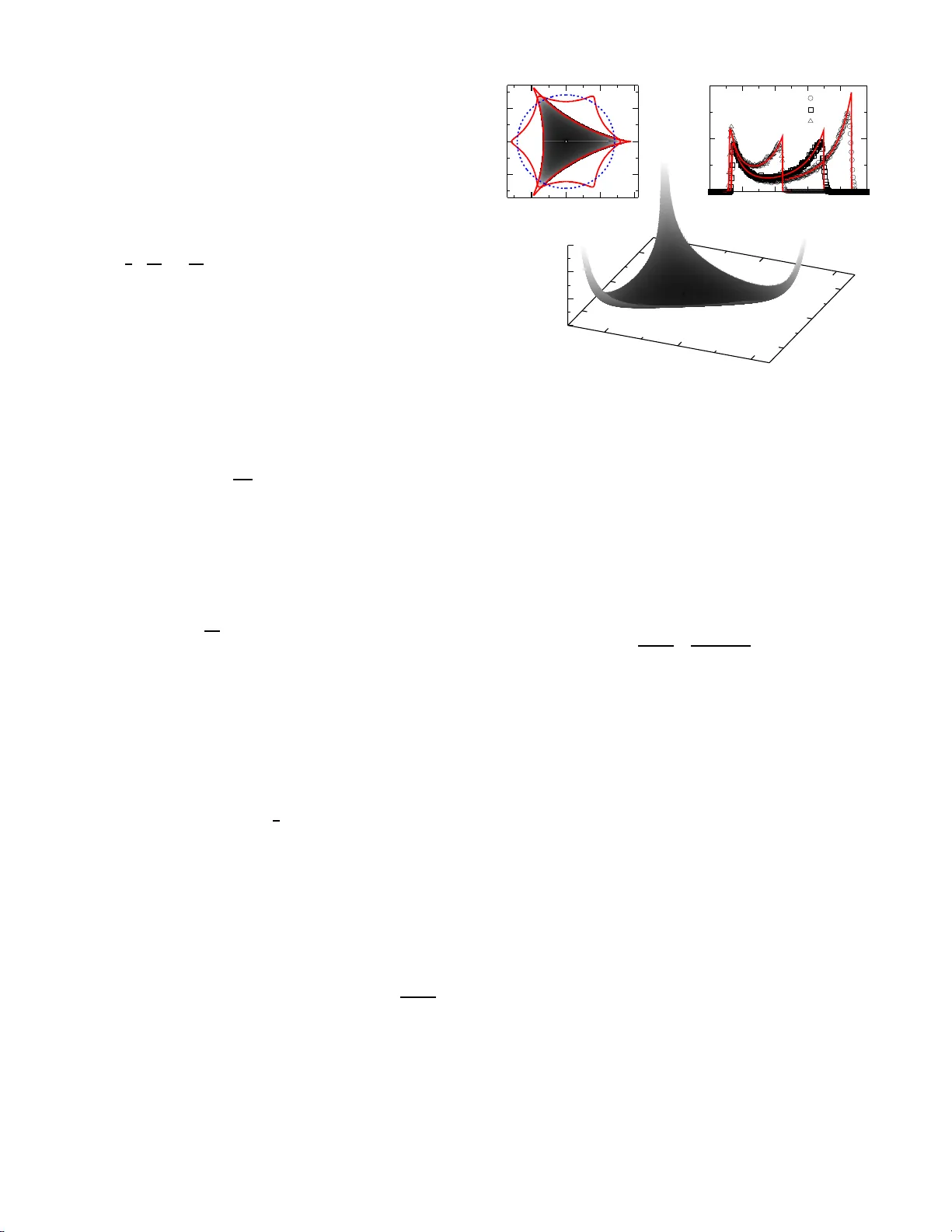
Sp ectra of sparse regula r graphs with loops F. L. Metz 1 , I. Neri 2 , 3 , and D. Boll´ e 1 1 Instituut vo o r The or etische Fysic a, Katholieke Universiteit L euven, Celestijnenlaan 200D, B-3001 L euven, Belgium 2 Universit ´ e Montp el lier 2, L ab or atoir e Charles Coulomb UMR 5221, F-34095, Montp el lier, F r anc e 3 CNRS, L ab or atoir e Charles C oul omb UM R 5221, F-34095, Montp el lier, F r anc e W e derive ex act equations that d etermine th e sp ectra of undirected and d irected sparsely con- nected regular graphs containing loops of arbitrary length. The implications of our results to t he structural and dynamical prop erties of netw orks are discussed by sho wing how lo ops influence the size of the sp ectral gap and the prop ensity for synchroniza tion. Analyt ical form ulas for the spectru m are obtained fo r specific length of the loops. P ACS num bers: 89.75.Hc, 89.75.Fb, 02.10.Yn Net works hav e emer ged as a unified framework to study complex problems in disciplines ranging from ph ysics, bio logy , info r mation theory , chemistry to tech- nological a nd socia l scienc e s [1]. Some no table exam- ples are the backbo ne of the Internet, which consists o f routers connected by physical links, and the metab olism of the cell, repr e s ent ed a s a tripar tite netw or k of metab o- lites, rea ctions and enzymes. As many seemingly un- related problems ar e mo deled by net works, it is c rucial to understa nd how the top olo gy of net works influences the pro cesses governed on them. The efficiency of er ror- correcting co des and communication net w orks [2, 3], the prop ensity for s ynchronization [4, 5] and the mixing times of search algo rithms [6], among o thers, are unv eiled fr om a sp ectral ana lysis, i.e. fro m a study of the adjacency matrix and the Laplacia n of the netw ork [7]. A widesprea d theor etical a pproach consis ts in mo d- eling real- world netw o rks by spa rsely connected random graphs [8], which hav e a lo ca l tre e -like structure a nd thus a small num b er of short lo ops. The Kesten-McKay law [9] for the spectrum of spars e regular graphs is a r are example of an analytica l solution fo r the sp ectral density and shows that reg ular gra phs hav e a large spectr al ga p, implying many optimal structural prop erties [3]. Sp ec- tral analy zes of irregula r spar s e random gra phs s uc h as Erd¨ os-R´ en yi graphs [10, 11], scale -free gra phs and small- world systems hav e r ecently b een considered [1 2]. How ever, Brav ais la ttices and real-world netw orks, such as the Internet and metab olic netw orks, exhibit a large num b er of undirected and dir ected short lo ops [13], while o ther examples like p ow er grids and neural net- works are under-shor t lo op ed, i.e. they ha v e less short lo ops than their corres po nding ra ndom graph models [14]. T o study the effect of lo ops on structur a l and dy- namical prop erties of complex netw o rks we consider the Husimi gr aph [15] (a lso called Husimi cactus), which is built out of randomly drawn shor t lo o ps. The Husimi graph a llows for a detailed sp ectral ana lysis as a function of the lo op length, due to its ex actly so lv able nature. T o our knowledge, r e s ults for the sp ectrum o f g raphs with lo ops are sca rce, apa rt fr om the ana lytical for mula for the triang ular Husimi gr aph [16]. In this letter we present a systematic study of the spe c - tra of r egular Husimi g raphs containing undirected or directed edges, going b eyond previous studies on lo cal tree-like net w orks without shor t lo ops. W e analyze the influence of lo ops on some imp ortant netw o rk prop er ties: the size o f the sp ectral gap a nd the stability o f synchro- nized states. The simplicity and ex actness of our equa- tions, co nfirmed by dir ect diagona liz a tion metho ds, leads to accurate results fo r arbitrar y lo op lengths and allows for an extension of the K esten-McKay law to tr iangu- lar and sq uare undirected Husimi gr a phs as well as to directed regula r graphs without short lo ops. FIG. 1. Local t ree- lik e structure of a (3 , 2)-directed and a (4 , 2)-undirected regular H usimi graph. The av erage path length b etw een tw o no des is of order O (ln N ). Sp arse re gu lar gr aphs with lo ops W e consider the en- semble of ( ℓ, k )-reg ular (un)directed Husimi gr a phs con- taining N vertices or no des. Each v ertex is incident to k > 1 lo ops comp ose d of ℓ no des , with k and ℓ indepen- dent of N . The indegr ee and outdegree of a n y no de are equal to each other, and given by 2 k or k in the case o f undirected or directed Husimi gra phs , res pectively . F or N → ∞ the gr a phs have a lo cal tree-like structure on the level of lo ops, illustra ted in figure 1 for tr iangular ( ℓ = 3) and squar e ( ℓ = 4 ) Husimi gra phs. The mo del allows to interp olate b et ween ℓ = 2 and ℓ → ∞ , b oth ca ses representing s ituations where s hort lo ops a re absent. W e study the sp ectral density o f the N × N a djacency matrix J for N → ∞ , which is trivially related to the 2 sp ectrum of the Laplacia n matrix in the case of r e gular graphs. The matrix element J ij assumes 1 if there is a directed edge from no de i to no de j , and zero oth- erwise. Denoting the eige nv alues o f a given ins tance of J as { λ i } i =1 ,...,N , the sp ectra l density is defined a s ρ ( λ ) ≡ lim N →∞ 1 N P N i =1 δ ( λ − λ i ). The matrix J is sym- metric o r asymmetric de p ending whether the graph is undirected o r directed, r e s pec tively . The eig en v alues ar e real in the former cas e and complex in the la tter. The lo cal tree-like structure s hown in figure 1 allows to cal- culate ρ ( λ ) exactly for N → ∞ . Sp e ctr a of undir e cte d Husimi gr aphs The resolven t G ( z ) of J is defined through G ( z ) ≡ ( z − J ) − 1 , where the complex v ariable z = λ − iǫ contains a regular iz er ǫ . The sp ectrum is extr a cted from the diagonal co mpone nts of G ( z ) accor ding to ρ ( λ ) = lim N →∞ ,ǫ → 0 + ( π N ) − 1 ImT r G ( λ − iǫ ). Due to the absence o f disorde r , a closed expressio n can be derived for the diagonal elements G ii ( z ) = G ( z ) , ∀ i . F or gra phs without sho r t lo ops, either one writes G ii ( z ) as the v aria nce of a Gaussian function and uses the c avity metho d (or the replic a method) [1 0], or one uses rep eat- edly the Schur-c omplement formula and the lo ca l conv er- gence of g raphs to a tr ee [11]. Generalizing thes e meth- o ds to Husimi g raphs [17], we have derived the following equation for ρ ( λ ) ρ ( λ ) = 1 π lim ǫ → 0 + Im[ z − k G s ] − 1 , (1) where G s solves G s = J T s h z − ( k − 1) G s I ℓ − 1 − L ℓ − 1 − L T ℓ − 1 i − 1 J s , (2) with I ℓ − 1 the ( ℓ − 1 ) × ( ℓ − 1) identit y matrix, L ℓ − 1 the ( ℓ − 1)-dimensional matrix with elements [ L ℓ − 1 ] ij = δ i,j − 1 , and J T s the ( ℓ − 1)-dimensional vector J T s = (1 0 . . . 0 1). F or ℓ = 2 , the so lution of eq. (2) yields the K esten-McKay law [9], where ρ ( λ ) takes the form ρ ( λ ) = k 2 π p 4( k − 1) − λ 2 k 2 − λ 2 (3) for | λ | < 2 √ k − 1, a nd zer o other wise. F or ℓ > 2, we hav e inv erted the ma tr ix in eq . (2) [19], leading to G s = 2 α ℓ − 2 + 2 α ℓ − 1 , (4) where the co efficients α 2 , . . . α ℓ − 1 follow from the re cur- rence re la tion α i = α 1 α i − 1 − α i − 2 , with α 0 = 1 and α 1 = z − ( k − 1 ) G s . Equation (4) leads to a p olyno- mial in the v ar iable G s and ca n b e s o lved ana ly tically for smaller v alues o f ℓ , extending the Kesten-McKay law to regular graphs containing short lo ops. F o r large r v alues of ℓ a stra ightforw ard n umerical solution can b e o btained, giving shar p res ults for ρ ( λ ). Equatio n (4) is one o f the main results of our work, a llowing to co mpute exa ctly the sp ectrum for incre a sing v alues o f ℓ . F or ℓ = 3 w e recover the analytical expr ession for ρ ( λ ) presented in [16]. F or ℓ = 4 eq . (4) b ecomes a cubic po lynomial with discriminant D ( λ ) = − 2 3 λ 4 − λ 2 3 k 2 − 2 2 k + 13 + 8 3 ( k − 2 ) 3 . (5) Defining the functions s ± ( λ ) = 9 λ ( k + 1) − λ 3 ± 9 p D ( λ ) and q ± ( λ ) = s 1 / 3 + ± s 1 / 3 − , the sp ectrum of square Husimi graphs rea ds ρ ( λ ) = 6 √ 3 k ( k − 1 ) q − ( λ ) π h 2( k − 3) λ + k q + ( λ ) i 2 + 3 π k 2 q 2 − ( λ ) (6) for D ( λ ) > 0, and ρ ( λ ) = 0 o therwise. The edges of ρ ( λ ) solve the eq uation D ( λ ) = 0. The a nalytic e x pression for some higher v alues o f ℓ is given elsewhere [17]. In figure 2 we compare dir e c t diagona lization r esults of finite matrice s with the s olution to eq. (4), for k = 2 and several v alues of ℓ . The ag reement is excellent, fol- lowing from the ex a ctness o f eq. (4) for N → ∞ . When rescaling the matrix e lemen ts J ij → J ij / √ 2 k − 1 we find analytically the c onv er gence of ρ ( λ ) to the Wigner s e mi- circle law for k → ∞ a nd arbitra ry ℓ [18]. Interestingly , FIG. 2. Sp ectrum of ( ℓ , k ) undirected Hu simi graphs with k = 2 and J ij → J ij / √ 2 k − 1, obtained by solving eqs. (1) and (4 ). The symbols are d irect diagonalization results of adjacency matrices of size N = 10 4 . The sp ectrum of the tw o- dimensional square Bra v ais lattice and the Kesten-McKay law are presented for comparison. the sp ectrum o f a squar e Husimi graph exhibits a strik- ing similarity with the s p ectr um of the t w o-dimensional square Brav ais lattice [20], with the app earance of a power-law singula rity a t λ = 0 with ρ ( λ ) ∼ | λ | − 1 / 3 . In the ca se of the s quare Brav ais lattice, the sp ectra l density contains a V an Hov e singularity a t λ = 0, with a logarith- mic divergence. Our results thus suggest that V an Hove singularities ar e related to the lo ca l neighborho o ds and 3 not to the dimensional natur e of lattices [20]. F or ℓ → ∞ , the spe c trum c onv er ges to the Kesten-McKay law with degree 2 k [9], as illustra ted in figure 2 for ℓ = 10. The r e- fore, lo o ps comp osed of ten no des ca n b e neg le c ted a nd the gr aph can b e considered lo cally tr ee-like [1 0, 11]. Sp e ctr a of dir e cte d Hus imi gr aphs In the ca se of di- rected Husimi gra phs, the density of states ρ ( λ ) at a certain p oint λ = x + iy of the complex plane can be written as ρ ( λ ) = lim N →∞ ( N π ) − 1 ∂ ∗ T r G ( λ ), where ∂ ∗ = 1 2 ∂ ∂ x + i ∂ ∂ y and G ( λ ) = ( λ − J ) − 1 . The op era- tion ( · ) ∗ denotes complex co njugation. Due to the non- analytic be havior of G ii ( λ ) in the complex plane [21], it is conv enien t to define the 2 N × 2 N blo ck matrix [2 2] H ǫ ( λ ) = ǫ I N − i ( λ − J ) − i ( λ ∗ − J T ) ǫ I N . (7) The N × N low er-left blo ck of lim ǫ → 0 + H − 1 ǫ ( λ ) is precisely the matrix G ( λ ). Thus, the pro blem r educes to cal- culating the matrix e lemen ts G j ( λ, ǫ ) = H − 1 ǫ ( λ ) j + N ,j ( j = 1 , . . . , N ), from which the s pectr um is determined according to ρ ( λ ) = − i N π lim N →∞ ,ǫ → 0 + P N j =1 ∂ ∗ G j ( λ, ǫ ). By representing H − 1 ǫ ( λ ) j + N ,j as a Ga us sian in tegral one can gener alize the cavit y metho d, as developed for sparse non-Her mitia n random matrices [22], to ca lculate the sp ectrum of directed Husimi gr aphs [17]. Due to the absence of disorder we have that G j ( λ, ǫ ) = G ( λ, ǫ ) , ∀ j , and ρ ( λ ) is given b y ρ ( λ ) = 1 iπ lim ǫ → 0 ∂ ∗ [ S ǫ ( λ ) + k G A ] − 1 21 , (8) where S ǫ ( λ ) = [ ǫ I 2 − i ( xσ x − y σ y )] and ( σ x , σ y ) are Pauli matrices. F or ℓ > 2, the tw o -dimensional matr ix G A solves the equation G A = J T A h S ǫ ( λ ) + ( k − 1) G A ⊗ I l − 1 + i J ⊗ L ℓ − 1 + i J T ⊗ L T ℓ − 1 i − 1 J A , (9) where J T A is the 2 × 2( ℓ − 1) blo ck matrix J T A = ( J 0 . . . 0 J T ), with J = 1 2 ( σ x + iσ y ). The der iv ative of eq. (9) yields an equation in ∂ ∗ G A , which ha s to b e solved together with (8) to find ρ ( λ ). E quation (9) al- lows to derive sharp numerical results for the sp ectrum of dire c ted Husimi gr a phs as a function of ℓ . In fig ure 3 we pr esent the sp ectrum ρ ( λ ) for ℓ = 3 and k = 2, co mparing the so lutio n to eqs. (8-9) with direct diagonaliza tion results. The a greement is excellent. A prominent feature of ρ ( λ ) is the ℓ - fold ro tational symme- try , due to the transforma tion prop erties o f G A under rotations of 2 π /ℓ . By r escaling J ij → J ij / √ k − 1, we find analy tically the conv ergence of ρ ( λ ) to Girko’s cir- cular law for k → ∞ a nd ar bitrary ℓ [18]. Analogously to undirec ted Husimi g r aphs, ρ ( λ ) con- verges to the sp ectrum o f a directed r e gular graph with- out short lo ops for ℓ → ∞ . In this ca se, we find a re- mark a ble extension of the Kesten- McKay law, E q. (3), 0 0.4 0.8 −1 −0.5 0 0.5 1 (a) y=0.175 y=0.350 y=0.695 −1 0 1 2 −1 0 1 (b) −0.5 0.5 1.5 −1 0 1 0 1 2 3 ρ x y ρ FIG. 3. S p ectrum of directed H usimi graphs with ℓ = 3 and k = 2, obtained from eq s. (8-9). Inset ( a) shows th ree cut s along the real direction (red curves ), together with direct di- agonalizatio n results (symb ols) obtained from an ensemble of 3 × 10 4 matrices of size N = 10 3 . Inset (b) shows th eoretical results for the b oundary of ρ ( λ ) for ℓ = 3 and ℓ = 6 (red curves). The num b er of corners in eac h b oun dary is equal to the val ue of ℓ and the blue dashed cu rve corresp on d s t o th e circle | λ | 2 = k , for ℓ → ∞ . F or comparison, direct d iagonal- ization results are also sh own in grey scale for ℓ = 3. to directed graphs, where ρ ( λ ) takes the form ρ ( λ ) = k − 1 π k k 2 − | λ | 2 2 , ( 10) for | λ | 2 < k , and zero o therwise. A co mparable equation app eared in [2 3], but with a different supp ort of ρ ( λ ). In inset (b) of figure 3 we plot the bo undary of ρ ( λ ) for k = 2 and increasing v alues of ℓ . In accordanc e with eq. (10), the b oundary conv er ges to the circle | λ | 2 = k in the limit l → ∞ . F or ℓ = 1 0 we have obtained numer- ically that ρ ( λ ) is given approximately by eq. (10) and the gr aph beco mes lo cally tree - like [22]. Structura l and dynamic al pr op erties Let us o rder the eigenv a lues o f a regula r undir ected Husimi graph a s λ 1 < λ 2 < · · · < λ N , where λ N = 2 k . The sp e ctr al gap g and the eigenr atio Q are, resp ectively , defined by g ≡ ( λ N − λ N − 1 ) / 2 k and Q ≡ ( λ N − λ 1 ) / ( λ N − λ N − 1 ). Analogo usly , for r egular directed Husimi gr a phs, the eigenv alues can be ordered according to their real pa rts Re λ 1 < Re λ 2 < · · · < Re λ N , with Re λ N = k . In this cas e, the sp ectral gap g and the e igenratio Q are given by g ≡ (Re λ N − Re λ N − 1 ) /k and Q ≡ (Re λ N − Re λ 1 ) / (Re λ N − Re λ N − 1 ). The s pectr al gap g c o nt rols the sp eed o f co n vergence to the stationary state of diffusion pro cesse s o n the gra ph [1]. Designing communication netw orks with a large g is k nown to b e imp ortant due to improv ed robustness and communication prop erties [2, 3], for undir ected net- works. The eigenratio Q measur es the pr op ensity fo r 4 synchronization in netw orks of oscillator s [4, 5]. A lin- ear stability analysis shows that synchronized states are more stable for smaller v alues of Q . Figure 4 depicts g and Q as functions of ℓ for r eg- ular Husimi gra phs , showing tha t g incr eases while Q decreases for increasing v alues of ℓ . F or undirected Husimi gr a phs, g and Q conv erge, res pectively , to ( k − √ 2 k − 1) /k a nd 2 k / ( k − √ 2 k − 1) as ℓ → ∞ , co ns is- ten t with the Alon-Boppana b ound for the s e c ond la rgest eigenv a lue [24]. F o r directed Husimi g r aphs g and Q con- verge to ( k − √ k ) / k and 2 k / ( k − √ k ), resp ectively . I n summary , sho r t lo ops hav e a negative influence on the synchronization prop er ties and on the s iz e of the sp ectra l gap, which is mor e pronounced at low co nnectivities. FIG. 4. Sp ectral gap g and eigenratio Q of Husimi graphs as functions of ℓ for different v alues of k , with the asymptotic b eha vior for ℓ → ∞ indicated by solid lines. Conclusions W e have determined the sp ectrum of sparse r egular rando m gra phs with sho rt lo o ps through a set of exa ct equations , including extensions of the K e s ten- McKay law to triangular and square undirected Husimi graphs as well as to directed regular graphs without short lo ops. W e find that shor t lo ops in directed and undi- rected netw orks have a negative influence on the s tabilit y of synchronized states , they also worsen the communica- tion prop erties due to a decr e ase of the sp ectra l gap. Our sp ectral res ults ma ke the absence of lo ops in net- work construction a pparent [5], while neural netw orks are under-short lo op ed [14]. F o r the sq ua re Husimi gra ph we recov er a singular it y at the orig in, which is als o present in a square Brav ais lattice. Overall, we find that the sp ectra of B r av a is lattices are s imila r to the sp ectra of Husimi gr aphs with suita ble neighborho o ds , indicating that Husimi graphs ser ve as g o o d toy mo dels for Bra - v ais lattices. Our res ults on sp ectra of s parse rando m matrices ar e of wide interest to diverse fields including the study of Ma rko v chains [25], dynamics of spin-gla sses [26], etc. Since o ur work is mainly based up on the cavit y metho d, it allows for an extension to e.g . irr egular gr aphs with lo ops [10] and eig env ecto r lo calization studies [27]. FLM thanks Reimer K ¨ uhn and Isaac P´ er ez Castillo for interesting discussions, a nd Tim Rog ers for a use ful corres p ondence . [1] A. Barrat, M. Barth´ elemy , A. V espignani, Dynamic al pr o- c esses on networks , Cambridge Universit y Press (2008); M. E. J. N ewman, Networks, A n Intr o duction , Ox ford Universit y Press (2010). [2] S. Ho ory , N. Linial, A. Wigderson, Bull. Amer. Math. Soc. 43 , 439 (2006). [3] M. R. Murty , J. Ramanujan Math. So c. 18 , 1 (2003). [4] M. Barahona, L. M. P ecora, Phys. Rev. Lett. 89 , 054101 (2002). [5] L. Don et t i, P . I . H urtado, M. A . Mu ˜ noz, Phys. Rev. Lett. 95 , 188701 (2005);T. Nishik a w a, A. E. Motter, Phys. Rev. E 73 , 065106 (2006). [6] L. Lov´ asz, P . Winkler, Mixing of r andom walks and other di ffusions on a gr aph , Cambridge U n ivers ity Press (1995), 119-154. [7] F. R . K. Chung, Sp e ctr al Gr aph The ory , American Mathematical S ociety (1997); B. Georgeot, O. Giraud, D. L. S hep elya nsky , Phys. Rev. E 81 , 056109 (2010); Z. W ang, A. Scaglione, R. Thomas, I EEE T ransactions on Smart Grid 1 , 1949-3053 (2010). [8] B. Bollob´ as, Ra ndom gr aphs , Cambridge U niversi ty Press (2001). [9] H. Kesten, T rans. Amer. Math. Soc. 92 , 33635 4 (1959); B. D. McKa y , Linear Algebra Appl. 40 , 203-216 (1981). [10] T. Rogers, K. T akeda, I. P . Castillo and R . K ¨ uhn, Phys. Rev. E. 78 , 031116 (2008); R. K¨ uhn, J. Phys. A : Math. Theor. 41 , 295002 (2008). [11] C. Bordenav e, M. Lelarge, Random Structures and Algo- rithms 37 , 332 (2010). [12] J. F ortin, J. Phys. A : Math. Gen. 38 , L57 (2005); A. N. Sam ukhin, S . N. Dorogovtsev, J. F. F. Mendes, Phys. Rev . E 77 , 036115 (2008); I. J. F arka s, I. Der´ enyi, A. -L. Barab´ asi and T. Vicsek, Phys. Rev. E, 64 , 026704 (2001); R . K¨ uhn, J. Mourik, J. Phys. A: Math. Theor. 44 , 165205 (2011). [13] P . M. Gleiss et al., arxiv:cond-mat/0009124 (2000 ); G. Bianconi, G. Caldarelli, A. Capo cci, Phys. Rev. E 71 , 066116 (2005). [14] G. Bianconi, N. Gulbahce, A . E. Motter, Phys. Rev. Lett. 100 , 11870 1 (2008). [15] K. Husimi, J. Chem. Phys. 18 , 682-684 (1950); F. Harary , G. Uhlenbeck, PNAS 39 , 315-322 (1953). [16] M. Eckstein, M. Kollar, K. Byczu k and D. V ollhardt, Phys. Rev. B 71 , 235119 (2005); M. Galiceanu, A. Blumen, J. Chem. Phys. 127 , 1349004 (2007). [17] F. L. Metz, I. N eri, D. Boll ´ e, in preparation. [18] Z. D. Bai, J. W. Silv erstein, Sp e ctr al A nalysis of L ar ge Di - mensional R andom Matric es , Science Press (2006). [19] Y. Huang, W. F. McColl, J. Phys A: Math. Gen. 30 , 7919 (1997). [20] P . F azek as, L e ctur e notes on Ele ctr on Corr elation and Magnetism , W orld Scientific (1999). [21] J. F einberg, A . Zee, Nucl. Phys. B 504 , 579 (1997). [22] T. Rogers and I. P . Castill o, Phys. Rev. E 79 , 012101 (2009). [23] T. Rogers, New r esults on the sp e ctr al density of r andom matric es , th esis (2010). [24] N. Alon, Combinatorica 6 , 83 (1986); J. F riedman, Mem. Amer. Math. So c. 195 , 910 (2008). [25] J. R. Norris, M arkov Chains, Statistic al and Pr ob abilistic Mathematics , Cam bridge Un ivers ity Press (1998). [26] G. Semerjian and L. F. Cugliandolo, Europhys. Lett. 61 , 247 (2003). [27] G. Biroli, G. Semerjian, M. T arzia, Prog. Theor. Phys. Suppl. 184 , 187 (2010); F. L. Metz, I. Neri, D. Boll ´ e, Phys. Rev. E 82 , 031135 (2010).
Original Paper
Loading high-quality paper...
Comments & Academic Discussion
Loading comments...
Leave a Comment