Status of the UC-Berkeley SETI Efforts
We summarize radio and optical SETI programs based at the University of California, Berkeley. The SEVENDIP optical pulse search looks for ns time scale pulses at visible wavelengths using an automated 30 inch telescope. The ongoing SERENDIP V.v sky s…
Authors: Eric J. Korpela (1), David P. Anderson (1), Robert Bankay (1)
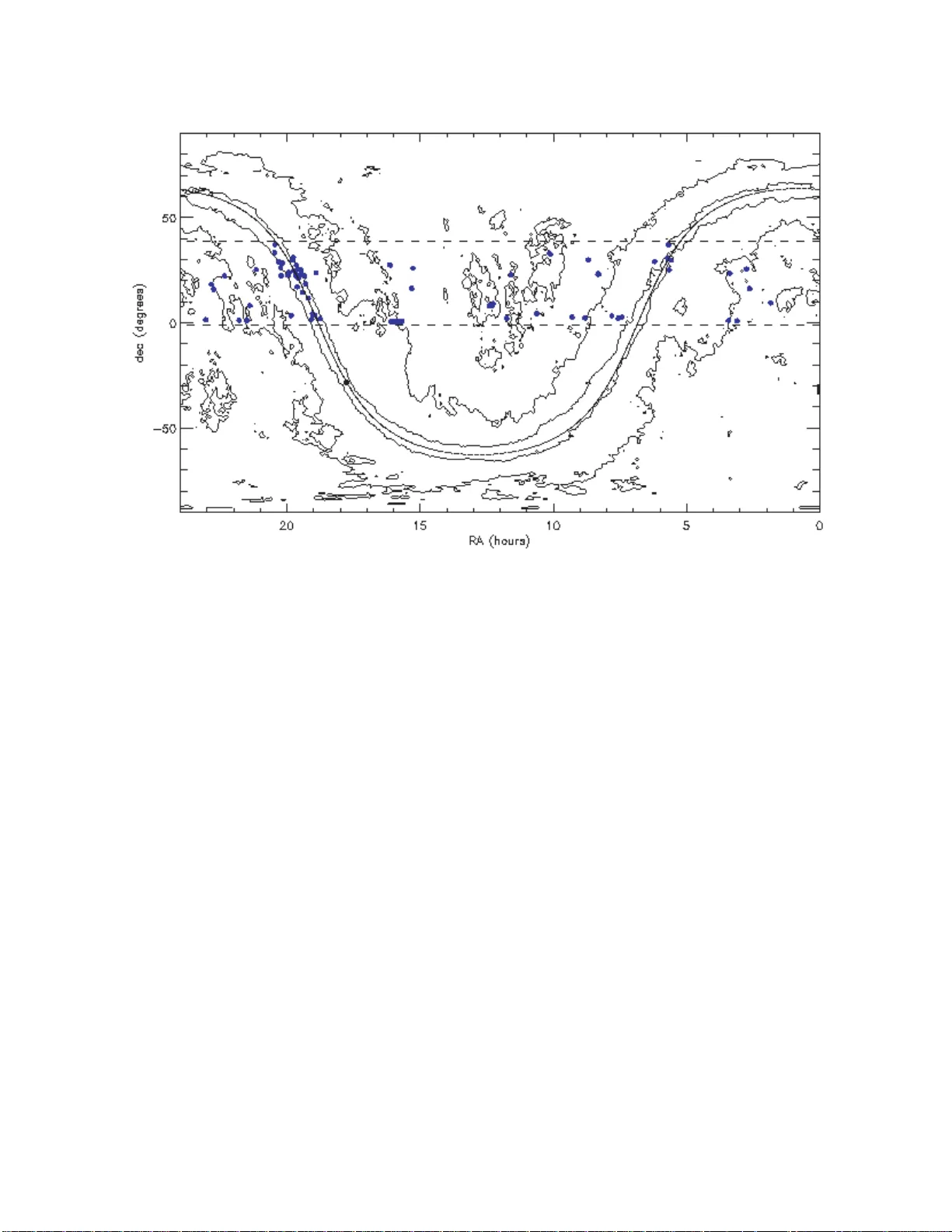
Status of the UC-Berkeley SETI Eff orts E. J. K orpela a , D. P . Anderson a , R. Bankay a , J. Cobb a , A. How ard a , M. Lebofsky a , A. P . V . Siemion a , J. v on K orff b , and D. W erthimer a a Univ ersity of California, Berkele y , CA, 94720 USA; b Kansas State Uni versity , Manhattan, KS, 66502 USA ABSTRA C T W e summ arize radio and optical SETI programs based at the Uni versity of California, B erkeley . The SEVENDIP op tical pulse search looks f or ns time scale pu lses at visible wa velen gths. It utilizes an autom ated 30 inch telescope, thre e ultra fast photo multiplier tubes and a coin cidence d etector . The target list inc ludes F , G, K and M stars, globular cluster and galaxies. The o ngoing SERENDIP V .v sky survey searche s for radio signals at the 300 meter Arecibo Observatory . The cu r- rently installed con figuration supports 128 million chann els over a 20 0 MHz band width with ∼ 1.6 Hz spectral r esolution. Frequency stepp ing allows the spectrom eter to cover the full 300MHz ban d of the Arecibo L-band receiv ers. The fin al configur ation will allo w data from all 14 receivers in the Arecibo L-band Focal Array to be mon itored simu ltaneously with over 1.8 billion chann els. SETI@home u ses the desktop computer s of volunteers to analyz e over 160 TB of data at taken at Are cibo. Over 6 million volunteer s have run SETI@home d uring its 1 0 y ear h istory . The SETI @home sky survey is 10 tim es m ore sensiti ve than SERENDIP V .v but it covers only a 2. 5 MHz band, center ed o n 1 420 MHz . SETI@home searches a much wid er p arameter spa ce, in cluding 1 4 octaves of signal band width and 15 octaves of pulse period with Dopp ler drift correction s from -100 Hz/s to +100 Hz/s. SETI@home is being expanded to analyze data collected during observations of K epler o bjects of interest in May 2011. The Astropulse projec t is the first SETI search for µ s time scale p ulses in the radio spectrum. Because short pulses are dispersed by the interstellar m edium, an d the amo unt of disp ersion is un known, Astro pulse must search through 30 ,000 possible dispersion s. Substantial com puting power is req uired to cond uct this search, so the projec t uses volunteers and their personal compute rs to carry out the compu tation (using distrib uted co mputing similar to SETI@home). Keywords: radio instrumen tation, FPGA spectr ometers, SETI , optical SETI, Search fo r Extra terrestrial Intellig ence, vol- unteer computin g, radio transients, optical transien ts INTR ODUCTION At the Uni versity of California, B erkeley , we have been conducting fi ve SETI searches that are roug hly ortho gonal to each other in search space. These fiv e searches are summarized in T able 1. The SERENDIP V .v sky survey covers a relativ ely b road range of radio f requenc ies, but not as sensitively as SETI@home. The SETI@ho me sky survey is more sensitive an d examines a much wider variety of signal types tha n SERENDIP , but only covers a narrow ba nd centere d on th e 21 cm Hyd rogen line (a “mag ic frequen cy”). Th e Astropulse pr ogram is the first search for µ s time scale radio pu lses. Th e SEVE NDIP o ptical p ulse searc h is sensitive to low du ty cycle u ltra-short pulses (eg: p ulsed lasers). W e descr ibe each of these programs below . Email: korpela @ssl.berkele y . edu T elephone: +1 510 643-6538 URL: http://setiathome.berk eley .edu/ Program Name T im escale W avelength ∆ν / ν SERENDIP V .v 1 s radio 0.21 SETI@home 1 ms – 10 s radio 0.0 018 Fly’ s Eye ms radio 0.1 5 Astropulse µ s radio 0.0 018 SEVENDIP ns optical 0.8 T able 1. SETI prog rams at the Unive rsity of California, Berkele y OPTICAL SETI There is no clear wa velength cho ice for SETI. M icrowa ve, IR and visible wav elengths all have advantages and disad- vantages, d ependin g on what factors ano ther civilization migh t choo se to optimize (power, size, b andwidth , an d/or beam size). Althoug h optical pho tons require more energy to gen erate than radio photons, optical beam sizes are typically much smaller , and directed interstellar communication links can be more ef ficien t. 1–3 SEVEND IP The SEVENDIP (Searc h for Extraterrestrial V isible Emissions from Nearby Developed Populatio ns) program at Berkele y searches for n anosecon d time scale pulses, perhaps transmitted by a powerful pulsed laser o perated by a distant civilization. The target list includes mostly n earby F , G, K and M stars, plus a few globular clusters and ga laxies. The pulse sear ch utilizes Berkele y ’ s 0.8 meter automated teles cope at Leusch ner observatory and specialized instrumentation to detect s hort pulses. A similar instrumen t has been de velop ed at Harvard Uni versity . 4 The SEVENDIP instrumen t uses bea m splitters to fe ed light fro m the telescop e onto th ree high speed photo multiplier tubes. 5 These tubes have a r ise time of 0.7 ns and ar e sensitive to 3 00 - 700 nm wavelengths. The thr ee signals are fed to high spee d amplifiers, fast discr iminators, and a co incidence detecto r . Th ree detector s are need ed to reje ct “false alar ms, ” which can b e caused by rad ioactive decay and scintillation in the PMT g lass, cosmic rays, and io n feedb ack. These false alarms can happen often in a single PMT , b ut almost never occur in thre e PMT’ s simultaneously . The Leuschner p ulse search ha s examined sev eral thousand stars so far, each star for one minute or mo re. The experi- ment’ s sensiti vity is 1.5 × 10 − 17 W/m 2 for a 1 ns pu lse, which correspon ds to 1.5 × 10 − 28 W/m 2 av erage power if the pulse duty cycle is one nanosecond e very 100 seconds. THE SEREN DIP V .v ARECIBO SKY SUR VEY The SERENDIP SETI program began 25 years ago; it has go ne throug h four gener ations of instrum entation and has observed on 14 r adio telescop es. During these twenty fiv e years, SERENDI P’ s sensitivity has impr oved by a factor of ten thousand and the number of channe ls has increased fro m one hundred to more than one hundred million. 6, 7 The latest SE RENDIP sky survey , SERENDI P V .v , began in e arnest in 20 09. Observ ations are ongo ing. Th e survey utilizes the National Astro nomy and Io nosphe ric Center’ s 305 meter rad io telescope in Arecibo , Pu erto Rico. Th e sur vey thorou ghly covers 25% of the sky (declination s fro m -2 ◦ to +38 ◦ ). Each of the 10 million beam s will b e observed an av erage of three tim es during the five y ear su rvey . Multiple observations are needed bec ause sou rces m ay scintillate 8 or have short duty cycles, and many of our robust detection algorithms require multiple detections. The sky survey utilizes real time 1 28 million chan nel FFT spe ctrum analyzer s to searc h for narrow band rad io signals in a 300 MHz band centered at the 21 c m Hyd rogen line (14 20 MHz). The currently installed system consists of one such instrument. W e ar e working towards a fin al configu ration con sisting of 14 of these in struments, whic h will allow simultaneou s an alysis of data fro m all of the 14 receivers o f th e Are cibo L-band Focal Array ( ALF A). The sy stem has a 0.6 second integration time, 1.6 Hz channel width, and a sensiti vity of 10 − 24 W/m 2 . SERENDIP V .v con ducts observations continu ously whenever the ALF A ar ray is in use f or othe r astron omical obser- vations. SERENDIP data analy sis is described by Cobb. 9 Inform ation on signals whose po we r e xceeds 16 times the mean noise power are lo gged alon g with baseline power , telescope co ordinates, time a nd freque ncy . T his data is tra nsmitted to Berkeley in real time; then , radio frequ ency interfer ence (RFI) rejection algorith ms are applied to the d ata, off-line, at UC Berkeley . After the RFI is re jected, compu ters search for candida te signals. SERENDIP’ s candida te detection algorithm s are sensitive to several types of signals, wh ich, individually or combined , may trigger an e vent to be noted for fu rther study . These algo rithms test for b eam p attern matching, linear dr ift rates, r egularly spaced pulses, multip le frequen cies (particular ly tho se periodic in frequ ency), and coincid ence with nearby stars, globular clusters, or extra- solar p lanetary systems. Every few mo nths, the entire data base is scanned for m ultiple detection s – “signals” that are detected again when the telescope re v isits the same sky coor dinates. W e test how well these multiple detections fit a barycentric ref erence frame. W e also apply anothe r test that allo ws much higher frequ ency separation, which is nec essary if transmitters are not corrected fo r their planet’ s r otation and rev olu tion. Data are simultaneou sly sent to Corn ell University for an alysis using other techniques. Potential candidates are scored and ranked by the probab ility of noise causing that particular detection. In cases where multiple dete ctions have been made, a joint pr obability is assessed. These joint p robabilities are used fo r comp aring candidates against each other and generating a prioritized candidate list for re-observation. THE SETI@HO ME SKY SUR VEY SETI@home data comes from the same piggyback receiver th at SERENDIP uses at the Arecibo radio telescope. Whereas SERENDIP analyzes this data prima rily using a special- purpo se sp ectrum an alyzer an d sup ercompu ter located at the telescope, SETI @home r ecords the data, and the n distributes the data throug h the Interne t to hund reds of thou sands of personal comp uters. This ap proach provides a tremendous amount of com puting power , but limits the amount of data that can be handled. Hence SETI@home covers a relatively narrow frequ ency range (2.5 MHz), b u t searches for a wider range of signal types, and with improved sensitivity . 10, 11 SETI@home was laun ched o n May 1 7, 19 99. In its 10 y ears o f o peration, it h as attracted over 5 million p articipants. SETI@home is one of the largest superc omputer s o n our planet, currently av e raging 3.5 PFLOP actual performance . Users are located in 226 countries, and about 50% of the users are from outside of the United States. Although SETI@home has 1/80 the freq uency coverage of SERENDIP V .v , its sensiti v ity is ro ughly ten times bet- ter . The SETI@home search also covers a m uch richer variety of signal bandwidths, drif t r ates, an d time scales than SERENDIP V .v or any other SETI program to date. Primary data analysis, don e using distributed comp uting, comp utes po wer spectra and searches for “cand idate” signals such as spikes, Gaussians, an d pulses. Secondary analysis, d one on the pr oject’ s own computers, rejects RFI and search es for repeated events with in the database of candidate signals. SETI@home covers a 2 .5 MHz bandwid th ce ntered at the 142 0 M Hz Hydr ogen lin e from each of th e 14 ALF A receivers (7 beams × 2 polarizations). T he 2.5 MH z band is recorded continuou sly onto SA T A disks with two bits per comp lex sample. Disks are mailed to UC Berkeley for analysis. SETI@home data d isks fro m the Arecibo telescop e are divided into small “work units” as fo llows: th e 2.5 M Hz bandwidth d ata is first d i vided into 256 sub-b ands; each work u nit co nsists o f 107 seco nds of data fro m a given 9,765 Hz sub-ban d. W o rk units are then sent over the In ternet to the client programs for the primary data analysis. Because an extrater restrial civilization’ s signal has unk nown bandwid th an d ti me scale, the clien t s oftware searches for signals at 15 oc tav e spaced b andwidths r anging fro m 0 .075 Hz to 1 220 Hz, an d tim e scales from 0.8 ms to 13.4 seco nds. The rest frame of th e transmitter is also un known (it m ay b e on a planet that is rotatin g an d r ev olv ing), so extraterr estrial signals are likely to be drifting in frequ ency with respect to the observatory’ s topocen tric r eference f rame. Becau se th e referenc e frame is unkn own, the client software examines ab out 1 200 different Dopp ler acceleratio n fram es (d ubbed “ chirp rates”), rangin g from -100 Hz/sec to +100 Hz/sec. At each chirp rate, peak searching is done by computing non-overlapping FFTs and their resulting power spectra. FFT lengths range fr om 8 to 1 31,07 2 in 15 octave steps. Peaks greater than 24 times the mean power are recorded and sent back to the SETI@hom e server f or further analysis. Besides searching for peaks in the multi-spectral-resolu tion d ata, SETI@home also searches for signals that match the telescope’ s Ga ussian b eam p attern. Gau ssian beam fitting is co mputed at every frequen cy and every chirp rate at spectr al resolutions rangin g from 0.6 to 1 220 Hz (tem poral r esolutions from 0 .8 ms to 1.7 seconds). Th e beam fitting alg orithm attempts to fit a Gaussian curve at each time an d frequen cy in the multi-resolution spectra l data. Gaussian fits whose power exceeds the mean no ise power b y a factor of 3.2 and whose reduc ed χ 2 of the Gaussian fit is less than 1.42 are reported to the SETI@hom e servers. SETI@hom e also searche s for pu lsed signals using a m odified Fast Folding Algo rithm 12 and an alg orithm wh ich searches for three regular ly-spaced pulses. Mor e details of the SETI@home an alysis can be f ound in K o rpela et al. (2001) 13 and K o rpela (2011) . 14 In the n ear future, we will b e adding th e ability to detect autocor related signals. Harp et al. 15 propo se that an extrater- restrial ci vilization could send a beacon that contains information (has appreciable b andwidth) , yet is easily detectable. This could be d one by send ing a signal and then, after a short d elay , startin g the bro adcast o f a co py of the signal. A signal o f this type can be detected throu gh auto correlation , which will show a peak power at the gi ven delay . Once the delay is kn own, th e infor mation within the signal can, in prin ciple, be recovered. A version of SETI @home containing an autocorr elation detector, acting o n delay s u p to 13.4 secon ds, is b eing b eta tested, and should be released in late summ er of 2011. T o determin e signals of interest the d ata fo r each sky position which has recen tly received ne w p otential signals is ex- amined by our Near - T im e Persistenc y Checker (NTPCkr). This prog ram scores candidates based upon the probability t hat the assemblage of po tential signals seen could be due to r andom fluctuations in the noise bac kgrou nd. This score inclu des the pro bability of multiple detec tions in any refe rence f rame, the pr obability of repeated d etection in the barycentric frame, the g oodne ss of fit with the an tenna beam pattern , an d conicid ence with known planets, n earby stars (fro m the Hippar cos catalog) or galaxies. W e gener ate a ranked list of our best candidates for reobservation. 16 Most of the signals found by the client prog rams turn out to be terrestrial based radio freque ncy interfer ence (RFI). W e employ a substantial n umber of alg orithms to r eject the several ty pes of RFI 9 from the best s ignals. Once RFI rejection has been perfo rmed on a candida te group, it is re-scored by the NTPCkr . 17 SETI@HOME –GREEN B A NK In May of 2011 , we utilized the 100m NRA O Gre en Bank T elescope ( GBT) to o bserve 86 of th e best planetary system candidates foun d by the Kepler m ission u p to that po int. W e selected distinct K epler In put Catalog star s having e ither a K epler Object of Inte rest (KOI) with a calculated equilibr ium temperatur e between 2 30 and 380 K, at least 4 KOIs or a KOI with inferre d radius < 3.0 Earth radii and an orbital period > 50 days. Using the GUPPI pulsar processor and modified software we were able to reco rd eight 10 0MHz bands in dual po- larization using 4 bits per complex samp le, to provide simultaneous coverage between 1 .1 an d 1. 9 GHz. Following th e observations of individual cand idates for 45 0 second s e ach, we perfo rmed a 12 hour survey o f the en tire K e pler field. In addition to b eing analy zed using loc al compu ting clusters, we will be send ing this data ou t to SETI@ho me volunteers for analysis with the SETI@home and Astropu lse applications. Following some mino r modifications to th e SETI@home and Astropulse software n ecessary to suppor t the new d ata parameter s, we expect to start sendin g this data o ut to volunteers starting in the fall of 2011. BOINC SETI@home has clearly sho wn the viability of v o lunteer based distrib uted computing for other scientific pro blems. T o this end we h av e developed an infra structure d ubbed BOINC (Berkeley Open In frastructur e for Network Computin g), which can be used for other ap plications. 18 The av ailability of this open source infrastructu re has eased the development of other d istributed applications. Ou r op en source d istributed computing inf rastructure engag es the pub lic in clim ate mo del- ing/glob al warming studies, ( climatePrediction .net), HIV , malaria and cancer dru g r esearch (W o rld Community Grid), par - ticle phy sics (LHC@home), gravity wav es (Einstein@ho me), protein structure (Rosetta@home), an d o f course SETI@ho me. More than 50 distributed computing projects use this infrastructure. The BOINC infrastruc ture has many advantages over the stand alone SETI@hom e infrastru cture. V olu nteers can sign up for many projects and di vide their compu ting resources amon g them. It is our hope that this will lead to a larger shared volunteer base. Th e BOINC infr astructure makes it possible for a project to include multiple separate applications and to distribute up dates to applications without requiring complex u ser intervention. The SETI@home BOINC “project” can in clude multiple “applications” to analyze data in d ifferent ways and to analyze data from different source s. Cur- rently we distribute th e standa rd SETI@home a pplication and the Astropulse app lication to u sers who have signed u p for SETI@home. The B OINC client performs th e communications necessary to download the SETI@home application, to do wn load the data to be an alyzed, and to u pload the r esults. It also can displa y screen saver graphics showing the status of th e ana lysis. BOINC and SE TI@home are av ailable for MacOS X, Windo ws a nd Lin ux in bo th 32 an d 64 b it versions. Participants using other oper ating systems can download the sou rce co de, and can com pile their own versions of BOINC and SET I@home. Participants can download the client software at: http://setiathom e.berkele y .ed u/ FL Y’S EYE Our now co mpleted ”Fly’ s Eye” e xperimen t search ed for bright radio transient pulses at the Allen T elescope Array (A T A). The Allen T elescope Array has se veral advantages over other telescopes worldwide for perfo rming transient searche s, particularly when the search is f or brigh t pulses. The A T A has 42 indep endently -steerable dishes, each 6m in d iameter . The beam size for ind i vidual A T A dishes is co nsiderably larger than th at for most o ther telescopes, suc h as VL A, NRA O Green Bank, Parkes, Arecibo , W esterb ork and E ffelsberg. By pointing ea ch d ish in a different dir ection the A T A can instantaneou sly observe a far larger portio n o f the sky than is p ossible with oth er telesco pes. Co n versely , when using the A T A dishes indep endently , the sensiti vity of the A T A is far lower than th at of other telescop es. The Fly’ s Ey e instrument was built to search for b right rad io p ulses of submillisecond du ration at the A T A. The instrumen t consisted of 44 inde penden t spectrometer s each pro cessing a band width of 210 MHz, and prod ucing 128-ch annel power spectrum at a rate of 16 00Hz. Therefo re each spectrum rep resents tim e domain data of leng th 0 .625 ms, and h ence pulses as shor t as 0.625 ms can b e resolved Because interstellar pulses ar e dispersed by ionized interstellar g as, a p ulse searc h inv olves cor recting f or this disp er- sion. Th e analy sis req uired fo r the Fly’ s Eye experim ent is, in princip le, fairly simple. W e wish to search over a wide range of dispersion measures to find large indi v idual pulses. Specifically ou r processing requ ires that all the data be dedis- persed with dispe rsion measures rang ing fro m 5 0 pc cm − 3 to 200 0 p c cm − 3 . At eac h d ispersion measure the data need s to be search ed for ’brig ht’ pulses. The processing chain is in pra ctice significantly mor e complicated than this de scription suggests. Processing is per formed on co mpute clusters, with input d ata form atted, divided and a ssigned to worker n odes for processing. I n the worker node flow , the data is equalized, RFI rejection is perf ormed, a nd fin ally a pulse search is perfor med through the range of dispersio n measures. Th e results are written to a database where they can be subsequ ently queried. The key f eature o f the re sults is a tab le that lists, in order of decreasing sign ificance, the pulses th at were fo und and their dispersion measures. W e have been able to observe 150 deg 2 over 450 hour s. W e have successfu lly de tected three pulsars (B0329+54 , B0355+5 4, B0950 +08) and six giant pulses fr om the Crab p ulsar . W e have not d etected any o ther convincing bursts o f astronomica l origin in our survey d ata imp lying a limiting r ate of less than 2 sky − 1 hour − 1 for 10 ms duration pu lses having average app arent flux d ensities gr eater th an 44 Jy . Mor e infor mation ab out ”Fly’ s Ey e” is available in Siemion et al. (2010, 2011) 19 , 2 0 ASTROPULSE Radio SETI search es to date have co ncentrated on narr ow-band signals as oppo sed to wide-b and signals such as pulses. The Astropulse p roject was the first SETI search fo r µ s radio pu lses. Astropu lse detects pulse widths r anging from 1 µ s to 1 ms. Such p ulses might come from extraterrestrial civilizations, evaporating black h oles, 21, 22 gamma ray bursts, cer tain supernovae, or pulsars. 23 The Astropulse prog ram m ines the SETI@home data archive for serendipitous detec tions of such ev ents. One o f the uniq ue fe atures o f this search is th at it is the first pulse search to use coher ent ded ispersion in a “blind” fashion - we have no previous knowledge of a spe cific disper sion measur e (DM) to examine. Th e r eason this search has never been attempted before is due to the enormo us comp uting po wer required. The com puting pro blem is emin ently par allel in natur e. Similar to SET I@home, Astro pulse uses volunteers a nd their personal comp uters to carr y o ut the com putation. Astropulse uses the gener al p urpose d istributed comp uting sy stem we have developed ( BOINC). Thus far , Astropu lse h as examined several years of SETI@home data, resulting in m ore than 125 million potential detections. W e are curren tly work ing on RFI rejection techniques to clean th e data set of RFI, pr imarily due to aviation radars. Mo st RFI so urces app ear to have a stable d ispersion measur e. If we detect a pulse with the same dispersion measure, Figure 1. Distribution of Astropulse candidates on the sk y . The d ots are the po tential sou rces. Contours are LAB HI su rve y 26 logarithmic contours. The dashed horizontal lines represent the limits of Arecibo’ s viewing range. but fro m a different par t of the sky m inutes to ho urs later, it is likely to be RFI. In p ractice we com pute the likeliho od of such c oincidenc e happening and if th at likelihood is b elow a thre shold we co nclude that it is RFI. W e use two m ore steps to furth er select the best pu lses. First we check to see that the pu lse is truly br oadban d. Some pulses can be du e to chan ce coinciden ce of peaks at two frequ encies with a time offset. W e elimin ate th ese by checking the d istribution of power v s frequen cy and using a χ 2 test from a fit with a flat spectrum to determine whether it is a broad band pulse. Finally , because we have two p olarization s being an alyzed indep endently we can, at the cost of some sensitivity , requ ire th at the pu lse be detected in both polarization . Using this proced ure o n the first 12 million pulses we foun d, 330 pulses from 114 sky location s passed the test. T wo o f these location s correspon d with k nown pulsars, lea ving 1 12 that do not. Th ese candidates are concentra ted near the Galactic plane, much more than our observ ing time has been. A statistical analysis 24 indicates a g reater than 4 σ probab ility that this distribution is n ot d ue to ch ance. W e reobserved most of these cand idate lo cations in Ju ly 201 1. However , g iv en the volume of data, our analysis of these reo bservations is just beginning . More details of Astropulse can be found in von K orff (20 10) 24 and von K orff et al (2011). 25 A CKNO WLEDG MENTS This w ork has been suppo rted by the Planetary Society , t he SETI Institute, the Uni versity of California, S un Microsystems and donatio ns from individuals a round the plan et. Key har dware was donated by Network Appliance , Xilinx , Fujifilm Computers, T o shiba, Quantum , Hewlett Packard, and Intel Corp. W e r eceiv e excellent sup port f rom th e staff o f the A recibo Observatory , a part of tha t Nation al Astron omy a nd Ionosph ere Cen ter , which is operated by Cornell University un der a cooper ati ve agree ment with the National Scien ce Foundation . W e would also like to thank the Allen T elescope Array , a facility of the SETI Institute. Th e National Radio Astronomy Observatory in Green Bank, WV is a f acility of the National Science Foundatio n oper ated under cooperative agreemen t by Associated Univ ersities, Inc. This work ha s been supp orted in part by NSF Grants AST -080 8175 and AST -030795 6, and N ASA Gran t NNX09AN69. REFERE NCES 1. Lampton , M., “Optica l SETI: The Next Search Frontier, ” in [ Bio astr onom y 99 : A New Era in Bioa str onomy ], G. Lemarchan d & K. Meech, ed., ASP Conf. Ser . 213 , 565– (2000) ADS: 2000AS PC..2 13..56 5L . 2. Schwartz, R. N. and T ownes, C. H., “Inter stellar and Interp lanetary C ommun ication by Optical Masers, ” Nature 190 , 205–2 08 (Apr . 196 1) DOI: 10.103 8/190 205a0 . 3. T ownes, C. H., “Op tical and in frared SETI, ” in [ Astr on omical and B iochemical Origins an d the S ear ch fo r Life in the Universe ], C. Batalli C osmovici, S. B owyer , & D. W erth imer, ed., IA U C olloq. 1 61 , 585– (Jan. 19 97) ADS: 1997ab os.co nf..58 5T . 4. How ard, A., Horowitz, P ., Coldwell, C., Lath am, D., Papaliolios, C., Stefanik , R., W olf f, J., and Zajac, J., “Op tical SETI at Harvard-Smithsonian , ” in [ Bioa str onomy 99 : A New Era in Bioastr on omy ], G. Lemarchand & K. Meech , ed., ASP Conf. Ser . 21 3 , 545– (2000) ADS: 2000AS PC..2 13..54 5H . 5. Wright, S. A., Drake, F ., Stone, R. P ., T r effers, D., and W erthimer , D., “Improved optical SETI detecto r , ” in [ The Sear ch fo r E xtraterr estrial Intelligence (S ETI) in the Optical Spe ctrum II I ], S. A. Kin gsley & R. Bhath al, ed., Pr oc. SPIE 4273 , 173–177 (Aug. 2001) DOI: 10.111 7/12. 435376 . 6. W erth imer, D., Bowyer, S., N g, D., Donne lly , C., Cobb, J., Lampto n, M., and Airieau, S., “The Berkeley SET I progr am - SERENDIP IV instrum entation, ” in [ Astr onomical a nd Biochemica l Origins an d the Se ar ch for Life in the Universe ], C. Batalli C osmovici, S. B owyer , & D. W erth imer, ed., IA U C olloq. 1 61 , 683– (Jan. 19 97) ADS: 1997ab os.co nf..68 3W . 7. Bowyer, S., W erth imer, D., D onnelly, C., Cob b, J., Ng, D., an d Lamp ton, M., “T we nty year s of SERENDIP , the Berkeley SETI effort - Past resu lts an d futu re plans, ” in [ Astr o nomical and Biochemical Origins an d the Searc h for Life in the Universe ], C. Batalli Cosmovici, S. Bowyer , & D. W erthimer, ed., I A U Colloq. 161 , 66 7– ( Jan. 1997) ADS: 1997ab os.co nf..66 7B . 8. Cordes, J., Lazio, T ., an d Sagan, C., “Scintillation -Indu ced Inter mittency in SETI, ” Astr ophys. J. 487 , 7 82– (199 7) DOI: 10.108 6/304 620 . 9. Cobb, J., Lebofsky , M., W erthimer, D., and Bowyer , S., “SERENDIP IV : Data Acquisition , Redu ction and Analysis, ” in [ Bioa str onomy 99: A New Era in Bioastr o nomy ], G. Lem archand & K. Mee ch, ed ., ASP Conf. Ser . 213 , 485– (2000 ) ADS: 2000AS PC..2 13..48 5C . 10. Anderson, D. P ., W er thimer, D., Cobb, J., Korpela, E., an d Lebofsky , M., “SETI@home : Internet Distributed Comput- ing for SETI , ” in [ Bioastr on omy 99: A New Era in Bioastr on omy ], G. Lemarchand & K. Me ech, ed., ASP Conf. Ser . 213 , 511– (2000 ) ADS: 2000AS PC..2 13..51 1A . 11. Sulli van, W . T ., W erthimer, D., Bowyer, S., Cobb, J., Gedye, D., and Anderson, D., “A new major SETI project b ased on Project SERENDIP data and 100 ,000 pe rsonal c omputer s, ” in [ Astr o nomical and Biochemical Origins and the Sear ch for Life in the Universe ], C. Batalli Cosmovici, S . Bo wyer , & D. W er thimer, ed., IA U Colloq. 161 , 729– (Jan. 1997) ADS: 1997ab os.co nf..72 9S . 12. Staelin, D., “Fast folding algorith m fo r detection of periodic pulse trains, ” Pr oc. IEE E 57 , 724 –725 (Ap r . 1969) DOI: 10.110 9/PRO C.1969 .7051 . 13. K or pela, E., W erthime r , D., Ander son, D., Cob b, J., and Leboisky , M., “SETI @home-Massively Distributed Com- puting f or SETI, ” Com puting in Science a nd En gineering 3 , 7 8–83 (Jan/Feb 2001 ) DOI: 10.110 9/599 2.8951 91 . 14. K or pela, E. J., “Distributed Processing of SETI Data, ” in [ S ear ching for E xtraterr estrial Intelligence: SETI P ast, Pr esent, an d Fu tur e (The F r on tiers Collection ) ], Shu ch, H. P ., ed. , 183–200, Springer, Heig elberg, DE (2011) DOI: 10.100 7/978 -3-642 -13196-7 . 15. Harp, G. R., Ackerm an, R. F ., B lair , S. K., Arb u nich, J., Backus, P . R., T arter, J. C., and the A T A T eam, “A New Class of SETI Beacons That Contain Information, ” in [ Communicatio n with Extraterr estrial Intelligence (CETI) ], V akoch, D. A., ed., 37–44 , SUNY Press, Albany , NY , USA (Apr . 2011). 16. K or pela, E . J., Cob b, J., Fulton, S., Lebofsky, M. , Heien, E., Person, E., Demor est, P ., Bankay , R., And erson, D., and W erth imer, D., “Thr ee Y ears of SETI@home: A Status Rep ort, ” in [ Bioastr on omy 2002: Life Among the Stars ], R. Norris & F . Stoo tman, ed., IA U Symp. 213 , 419–4 22 (June 200 4) ADS: 2004IA US..2 13..41 9K . 17. K or pela, E. J., Cobb, J., Leb ofsky , M., Siemion, A., von K orff, J., Bankay , R. C., W erth imer, D., and Anderso n, D., “Candida te Identification and In terference Removal in SETI@ho me, ” in [ Communica tion with E xtraterr estrial Intelligence (CETI) ], V akoch, D. A., ed., 37–44, SUNY Press, Albany , NY , USA (Ap r . 2011). 18. Anderson, Da vid P ., “BOINC: A System for Public-Resource Compu ting and Stor age, ” in [ Pr ocee dings of the 5th IEEE/ACM Interna tional W orkshop on Grid Computin g ], GRID ’04 , 4–10 , IE EE Compu ter Society , W ashington, DC, USA (2004) DOI: 10.110 9/GRI D.2004 .14 . 19. Siemion, A., von K o rff, J., McMahon, P ., K orp ela, E., W er thimer, D., An derson, D., Bower, G., Cobb, J., Foster, G., Lebofsky, M., van L eeuwen, J., a nd W ag ner, M., “Ne w SETI sky surveys for radio pulses, ” Acta Astr o nautica 67 , 1342– 1349 (Dec. 201 0) ADS: 2010Ac Aau.. 67.134 2S . 20. Siemion, A. P . V ., Bower , G. C., Foster , G., McMaho n, P . L., W agn er , M. I., W er thimer, D., Backer , D., Cordes, J ., and van Le euwen, J., “The Allen T elescope Array Fly’ s Eye Survey for F ast Radio Transients, ” submitted to Astr ophys. J . (2011 ). 21. Hawking, S. W ., “ Black hole explosions?, ” Natur e 248 , 30–3 1 (Mar . 197 4) DOI: 10.103 8/248 030a0 . 22. Rees, M . J., “A better way of searching for black- hole explosions, ” Natur e 266 , 333–334 (Mar . 1977) DOI: 10.103 8/266 333a0 . 23. Cognard, I., Shra uner, J. A., T aylor, J. H., and Thor sett, S. E., “Gian t Radio Pulses fro m a M illisecond Pulsar, ” Astr ophys. J. 457 , L81–L84 (Feb . 1996) DOI: 10.108 6/309 894 . 24. von K o rff, J. S., Astr opulse: A searc h for micr osecond transient radio signals using distributed co mputing , PhD thesis, Uni versity of California, B erkeley , CA, USA (May 201 0) ADS: 2010Ph DT... .....1 8V . 25. von K orff, J., Demorest, P ., Heien, E., K or pela, E., W erthimer , D., Cobb, J., Lebofsky , M., And erson, D., Bankay , B., and Siemio n, A., “Astro pulse: A Search for Micr osecond T ransient Radio Signals Using Distributed Comp uting. I. Methodo logy, ” su bmitted to Astr ophys. J. (2011). 26. Kalberla, P . M. W ., Bu rton, W . B., Hartmann, D., Arnal, E. M., Bajaja, E., Mo rras, R., and P ¨ oppel, W . G. L., “The Leiden/Argen tine/Bonn (LAB) Survey o f Galactic HI . Final d ata release of the comb ined LDS and I AR surveys with improved stray-r adiation correction s, ” Astr on. Astr oph ys. 440 , 77 5–782 (Sept. 200 5) DOI: 10.105 1/000 4-6361 :20041864 arXiv: astro- ph/05 04140 .
Original Paper
Loading high-quality paper...
Comments & Academic Discussion
Loading comments...
Leave a Comment