Confirmation of Matherons conjecture on the covariogram of a planar convex body
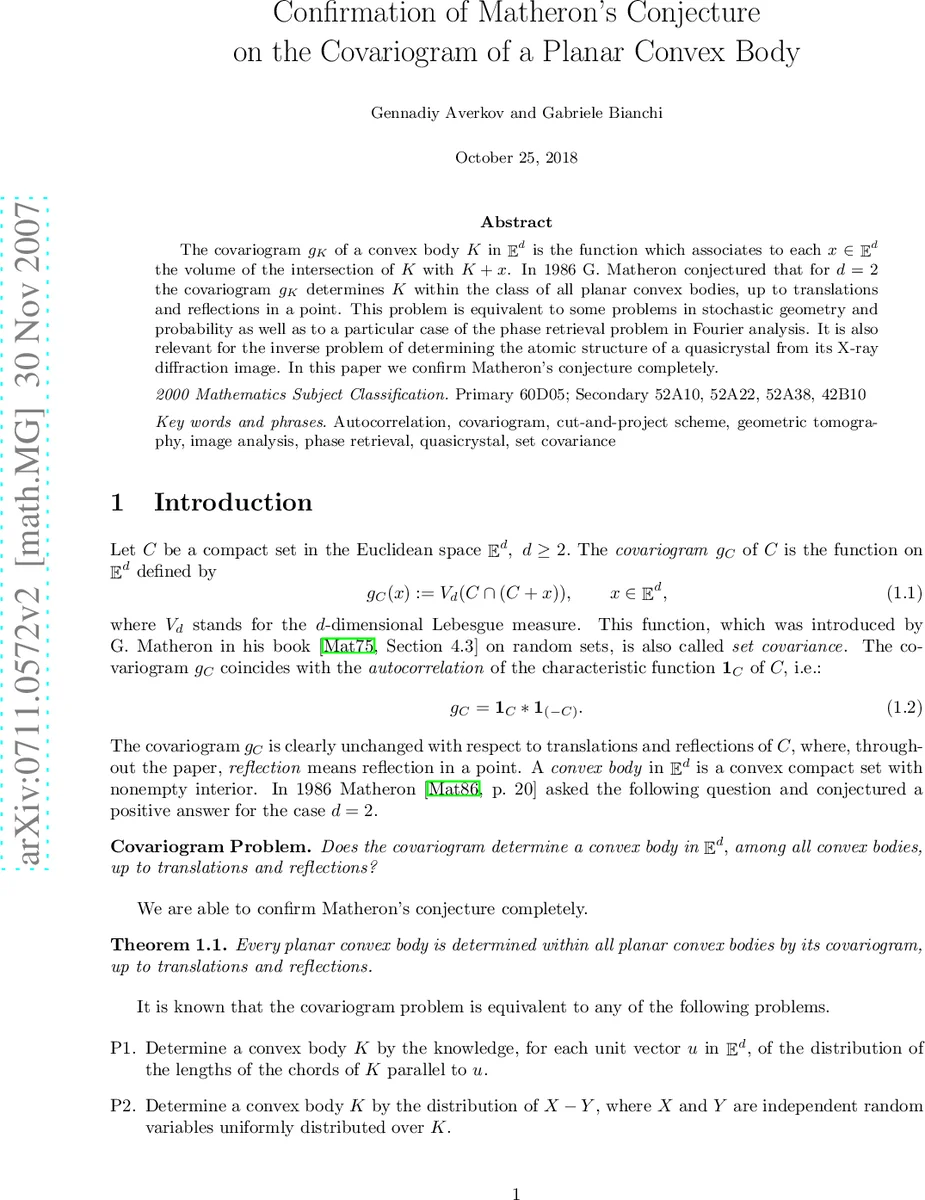
The covariogram g_K of a convex body K in E^d is the function which associates to each x in E^d the volume of the intersection of K with K+x. In 1986 G. Matheron conjectured that for d=2 the covariogram g_K determines K within the class of all planar convex bodies, up to translations and reflections in a point. This problem is equivalent to some problems in stochastic geometry and probability as well as to a particular case of the phase retrieval problem in Fourier analysis. It is also relevant for the inverse problem of determining the atomic structure of a quasicrystal from its X-ray diffraction image. In this paper we confirm Matheron’s conjecture completely.
💡 Research Summary
The paper “Confirmation of Matheron’s conjecture on the covariogram of a planar convex body” settles a long‑standing problem in convex geometry, stochastic geometry, and phase‑retrieval theory. The covariogram of a set K⊂ℝ² is defined as
g_K(x)=Vol₂(K∩(K+x)), x∈ℝ²,
i.e. the volume of the overlap of K with a translate K+x. Matheron (1986) conjectured that for planar convex bodies this function determines the body uniquely up to translation and point‑reflection (central symmetry). The conjecture is equivalent to several other problems: (P1) determining K from the distribution of chord lengths in each direction, (P2) determining K from the distribution of the random vector X−Y where X and Y are independent uniform points in K, and (P3) determining the indicator function 1_K from the modulus of its Fourier transform (a special case of the phase‑retrieval problem).
The authors prove the conjecture in full generality. Their main result (Theorem 1.1) states that if two planar convex bodies have identical covariograms, then they are translates or reflections of each other. The proof proceeds through a detailed differential analysis of g_K.
-
First‑order information. For any interior point x≠0 of the support of g_K, the covariogram is continuously differentiable and
∇g_K(x)=R D(x),
where R is the 90° rotation matrix and D(x)=p₁(x)−p₄(x) is a vector determined by four boundary points p₁,…,p₄ of K that satisfy x=p₁−p₂=p₄−p₃. The convex hull P(K,x)=conv{p₁,…,p₄} is a parallelogram inscribed in K whose edges are parallel to x and D(x). This geometric representation links the gradient of g_K directly to the shape of K. -
Second‑order information. The Hessian G(K,x) of g_K exists and can be expressed in terms of the outward unit normals u₁,…,u₄ at the points p_i. Explicit formulas (Theorem 4.1) show that
det G(x)=−det(u₂,u₃)·det(u₄,u₁)·det(u₃,u₄)·det(u₁,u₂)<0,
and that 1+det G(x) equals a product of similar determinants. These identities encode whether a diagonal of the inscribed parallelogram is an affine diameter of K (i.e., a chord whose endpoints have opposite outward normals). -
Monge–Ampère equation and central symmetry. The authors prove that the following three statements are equivalent (Theorem 4.2):
(i) K is centrally symmetric;
(ii) Every inscribed parallelogram has at least one diagonal that is an affine diameter;
(iii) g_K satisfies the Monge–Ampère differential equation det G(x)=−1 on the interior of its support.
Thus the covariogram’s second‑order structure forces central symmetry precisely when the Monge–Ampère equation holds. -
Key proposition (1.2). For strictly convex, C¹‑regular bodies K and L with g_K=g_L, the authors show that a non‑degenerate boundary arc of L coincides (up to translation or reflection) with a boundary arc of K. The crucial step is to prove that the translation carrying the inscribed parallelogram P(K,x) onto P(L,x) does not depend on x; this uses the continuity of the gradient and Hessian together with the Monge–Ampère condition.
-
Handling non‑strict or non‑C¹ cases. Theorem 1.3 (Bianchi) and Proposition 1.4 (Bianchi) treat the remaining possibilities: if one body is not strictly convex or not C¹‑regular, the same conclusion still holds. Consequently, the main theorem follows for all planar convex bodies, without any regularity assumptions beyond convexity.
The paper also discusses the broader context: the covariogram problem is equivalent to the chord‑length distribution problem (P1), to the distribution of X−Y (P2), and to a phase‑retrieval problem (P3). The result therefore guarantees uniqueness in these settings for planar convex bodies. The authors note that in dimensions d≥4 counter‑examples exist, while in three dimensions the problem remains open for bodies with strictly positive continuous curvature.
In summary, by exploiting the first and second derivatives of the covariogram, establishing a Monge–Ampère equation, and analyzing inscribed parallelograms, the authors provide a complete proof of Matheron’s conjecture for the planar case. This resolves a 30‑year‑old question and has immediate implications for stochastic geometry, image analysis, and the determination of quasicrystal structures from diffraction data.
Comments & Academic Discussion
Loading comments...
Leave a Comment