The Problem of Localization in Networks of Randomly Deployed Nodes: Asymptotic and Finite Analysis, and Thresholds
We derive the probability that a randomly chosen NL-node over $S$ gets localized as a function of a variety of parameters. Then, we derive the probability that the whole network of NL-nodes over $S$ gets localized. In connection with the asymptotic t…
Authors: ** - **Fred Daneshgaran** – Department of Electrical, Computer Engineering, California State University
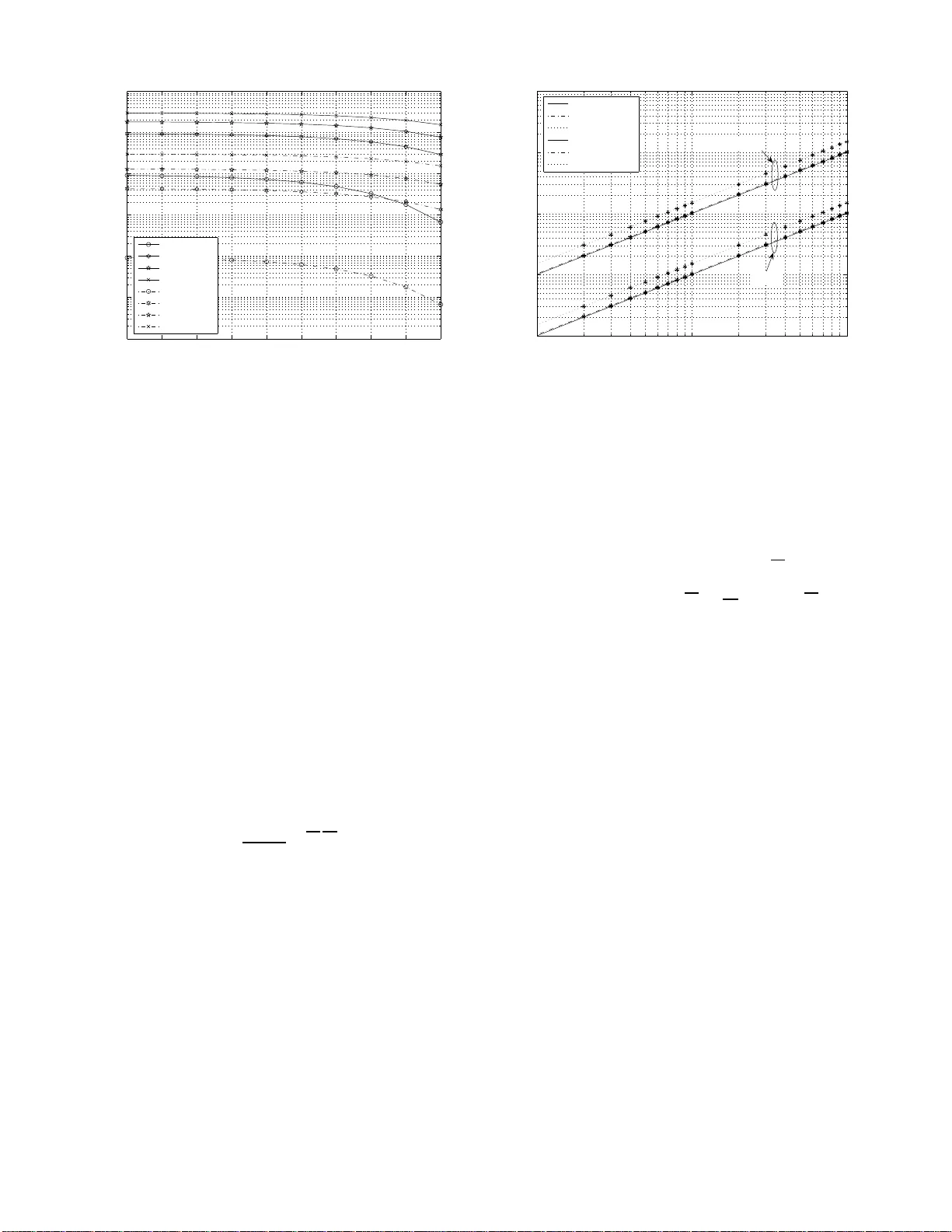
1 The Problem of Localiz ation in Netw orks of Randomly Deplo yed Nodes: Asymptotic a nd Finite Analysis, and Thresholds Fred Danesh garan, M. Laddomada , and M. Mondin Abstract — Consider a two dimensional domain S ⊆ ℜ 2 containing two sets of nodes from two statistically in dependent uniform P oisson point processes with constant densities ρ L and ρ N L . The first point process identifies t he distribution of a set of nodes having inf ormation about their positions, hereafter denoted as L-nodes (Localized-nodes), while th e other is used to model the spatial distribution of nodes wh ich need to localize themselves, her eafter denoted as NL-nodes (Not Localized-nodes). For simplicity , both kind of nodes are equ ipped with the same kind of transceive r , and communicate over a channel affected by shadow fading. As a first goal, we deriv e the probability that a randomly chosen NL-n ode ov er S gets localized as a fun ction of a variety of parameters. Then, we derive the probability th at the whole network of NL-n odes over S gets localized. As with many o ther random graph pro perties, the localization probability is a monotone graph pr operty showing thresholds. W e derive both fin ite (when th e n umber of nodes in the bound ed domain is finite and d oes not grow) and asymptotic thresholds fo r th e localization probability . In connection with the asymptotic thresholds, we show the presence of asymptotic thre sholds on the network localization probability in two different scenarios. The first refers to dense networks, which arise when th e domain S is boun ded and the densities of the two k inds of nodes tend to gro w unbounded ly . The second kind of thresholds manifest themselves when the considered domain in creases but the number of nodes gro w in such a way th at th e L-n ode d ensity remains constant throughout the inv estigated domain. In this scenar io, what matters is the minimum value of the maximum transmission range av eraged ov er the fading process, denoted as d max , above which the network of NL-nodes almost surely gets asymptotically localized. Index T erms — Ad-hoc n etwork, connectivity , GP S, LBS , local- ization, location based services, positionin g, probabilistic method, random arrays, sen sor n etworks. I . I N T RO D U C T I O N A N D L I T E R AT U R E OV E RV I E W This paper deals with a network compo sed of two sets of nodes randomly d istributed over a two d imensional domain S ⊆ ℜ 2 following two statistically in depen dent Poisson po int processes with in tensities ρ L and ρ N L . T he first process is associated with th e nodes that have a-priori k nowledge abou t their position (these a re the so called L -nodes), wh ile the other point p rocess is associated with th e n odes that are trying to localize them selves (these are the so called no n-localized or NL-nod es). I n particu lar , the paper f ocuses on the conn ection between some system level par ameters and the node local- ization probab ility in a Poisson distributed configuration of Fred Daneshgaran is with ECE Dept., CSU, L os Angeles, USA. Massimilia no Laddomada and Marina Mondin are with DELEN, Polite c- nico di T orino, Italy . nodes, which a re at the basis of topolo gical network contro l. W e do not prop ose any new or mod ified localization m ethod. As it will become clea r later, the primary assumptio ns in our analysis are: a) nodes ar e Poisson distributed ov er a bound ed circular domain contained in ℜ 2 and b) each node has an a verage typically circu lar footprint represen ting its radio coverage. Hence, while we focus o n a par ticular example in volving range m easuremen ts using Received Signal Strength (RSS), the an alysis can b e ap plied to o ther ran ge measuremen t methods as well. Notice that Poisson point processes are useful for m odelling scen arios in which th e d eployment area, the number of dep loyed nodes, or both, are no t a-priori known. The Poisson model is in fact a good ap proxim ation of a binomial rand om variable when the n umber of deployed nodes over a b ound ed d omain is high while the no de density is constant across the whole region of interest [1]. Nev ertheless, the Poisson approxima tion leads in many cases o f interest to a mathematically tractable p roblem . This general framework can be recogn ized in many practical scenarios. A possible example is a Distributed Sensor Net- work (DSN), in which one may be interested in distributed power efficient algo rithms to derive localization inform ation in a ran domly distrib uted co llection of severely en ergy and computatio n power limited nod es. A secon d example ma y be that o f a wireless network, in wh ich the various network elements may c ommun icate between themselves (in th e case of wireless networks allowing p eer-to-peer co mmunicatio n) or with a subset of nodes whose positions are kn own (this is the case of c lassic cellular networks and WLANs, whereby ev ery node must commun icate with a t least one base-station or acce ss point). With this scen ario in mind, let us provide a brief overview o f the localization metho ds th at have been propo sed in the literatu re. Giv en the great dif f erence b etween the commu nication and computation cap ability o f the nod es, as exemplified by the DSN and WLAN s, algorithms d ev eloped for lo calization should b e tailored to the p articular scen ario at han d [ 2],[3]. Practical localization algorithms can be classified in at least two ways: cen tralized o r distributed [2] an d rang e- free or b ased on r anging tech niques [ 4]. The most co mmon technique s are based o n me asured ra nge, whereby th e loca tion of nodes are estimated th roug h some stand ard method s s uch as triangulatio n. Cramer-Rao Bounds (CRBs) o n th e variance of any unbiased estimate b ased on the ab ove rang ing techniqu es are readily av ailab le and provide a bench mark for assessing the perfor mance of any given alg orithm [5], although we should 2 note that the derivation o f the CRB itself relies on a p roba- bilistic mo del (often a ssumed to be Gaussian), tha t describes the connection b etween th e parameter to be estimated and the raw observations. In range-free localization , con nectivity between nodes is a binary e ven t: either two node s are with in communication range of each other or they are not [6 ]. For simplicity , we may view this ev ent as obtained from hard quantization of, for instance, a RSS ra ndom variable. If RSS is above a certain detectio n threshold, th e n odes can communic ate, otherwise th ey cannot. Of course, the nature of path loss and the terrain characteristics influence both the coverage radius and the deviation of the coverage zon e from the idea l circular geometr y . In a typical scenario there may be mu ltipath, M ultiple Access Inter ference (MAI) and Non Line Of Sight (N LOS) p ropag ation conditions [2]. V arious ra nge free algo rithms have bee n p roposed in th e literature including the centroid algorith m [7], the DV -HOP algorithm [ 8], the Amorp hous position ing algo rithm [9], APIT [10], and ROCR SSI [4]. A review o f v arious localizatio n techn iques prop osed in the literature m ay be fo und in [11]. In [ 12], the au thors pr opose an approach b ased on conne ctivity informatio n for deriving the location s of nodes in a n etwork. In [13], the author s present some w ork in th e field o f source localizatio n in sensor networks. A topic som ewhat related to the p roblem dealt with in this paper is network conn ectivity . This topic has recei ved much attention recently [14], [15]. Given n hom ogeneo us nodes indep endently an d uniformly distributed over a region S ⊆ ℜ 2 , a network is said to b e conn ected if there exists a commun ication link between every p air of nodes in S . Early work o n th is to pic c an b e found in [1 6], [1 7], [ 18]. In [16], th e au thors in vestigated the percolatio n of bro adcast informa tion in a multiho p one-dim ensional radio network modeled by a Poisson spatial process. In [17], [18], the autho rs in vestigated the con nectivity of two and one dimensional networks respectively , as a func tion of the transmission range of the nodes inv o lved in the network. The seminal work [19] by Gupta an d Kumar demon strated that a network constituted by n i.i.d. rando mly d istributed sensors over a disk of are a S , is asym ptotically ( i.e., for n → ∞ ) a lmost surely connected if the transmission rang e between nodes is ch osen as r ( n ) = p S · (log( n ) + γ ( n )) / ( π n ) provided that γ ( n ) → ∞ as n → ∞ . A more careful loo k at the asymp totic expression f or r ( n ) ab ove would reveal a resemblance to a k nown re sult on r andom graph theory [20] which states that given a set o f n no des, the rando m grap h formed by adding an edge between any coup le of no des with probab ility p ( n ) will become co nnected almost sur ely if p ( n ) = (lo g ( n ) + γ ( n )) /n as n → ∞ , provid ed that γ ( n ) → ∞ as n → ∞ . In [21] Xu e and Kumar demonstrated that in a random network of n ho mogen eous nodes, the number o f n eighbo rs of a randomly chosen node r equired for th e network to be asymptotically connec ted is Θ(log( n )) as n → ∞ . Such 1 2 3 4 ... ... ... Localized Nodes Non-localized Nodes j-th 1 2 3 4 ... i-th ... I j,i ρ NL ρ L S S Fig. 1. Pict orial representati on of a bipartite network with an ave rage number | S | ρ L of L-nodes and | S | ρ N L of NL-nodes over a bounded domain S with size | S | = π R 2 . results have b een extend ed to 3-dim ensional networks in [22]. Other works foc using o n the connectivity of ran dom networks over bounded domain s may be f ound in [23]-[25]. Finally , paper [ 26] studies the co nnectivity of m ultihop radio n etworks in log-no rmal shadow fading en vironmen t b y lookin g at the probab ility that a rando mly chosen node is asympto tically isolated. The rest of the pa per is o rganized as follows. In Sec- tion II, we formulate the problem at hand , present the basic assumptions for th e derivations that fo llow , and briefly recall the mathem atical notatio n needed in connection with th e ev aluatio n of the asy mptotic thresho lds. Section III rec alls the m athematical m odels adopted fo r th e ch aracterization o f the transmission channel between the two kind o f nod es. The localization probabilities are d erived in Section IV for a v ariety of transmission p arameters. Section V in vestigates the p res- ence of finite thre sholds above which the derived localization probab ilities manifest large variations. T his analysis is then extended in Section VI, tak ing into accoun t the behavior of the localization p robab ilities for unbo unded ly increasing values of the nu mber of dep loyed n odes. Fin ally , Section VII is dev oted to co nclusions. I I . P RO B L E M F O R M U L A T I O N A N D A S S U M P T I O N S Consider a circular d omain S ⊆ ℜ 2 of r adius R and area | S | = π R 2 where sen sors are deployed follo wing two statistically independ ent two d imensional Poisson point pro- cesses with u niform densities ρ L and ρ N L , respectively . For simplicity , both L an d NL-nod es are assumed to emp loy the same kind of r eceiver and co mmunic ate in a scen ario wh ereby the transmission chann el is af fe cted by shadow fadin g with variance σ 2 s . T wo n odes can com municate if the recei ved power is above a prespecified thresh old P w, th , which is a network parameter with respect to which the results are derived. L-nod es have loc alization infor mation r elativ e to some co- ordinate fr ame. No tice that how this localization is established is ir relev an t to our prob lem formulatio n. On the othe r han d, NL- nodes n eed to loc alize themselves. Since we hav e two kin ds of nodes, the connection model between th em can be specified as a bipa rtite rand om n etwork, denoted by G L,N L ( ρ L , ρ N L ) . A pictorial representation of a bipartite grap h is sho wn in Fig. 1, wh ereby an ed ge b etween 3 the j -th NL-node and the i -th L-node is used to identify a commun ication link between th e under lined no des. Owin g to the con stant den sities ρ L and ρ N L , th e average number of L and NL-nodes over S is, respectively , ρ L · | S | and ρ N L · | S | . The localization problem is tw o dimensional and three distance measurem ents relativ e to nodes with known p ositions are suf ficient to solve f or th e ( X , Y ) coordin ates of the NL- node u nambig uously . A. Notations Throu ghout the paper we assume th e follo w ing n otations [27]. • x ( n ) = O ( y ( n )) if there exists a suitable co nstant c such that x ( n ) ≤ cy ( n ) for an y n ≥ n o . Notation x ( n ) = O (1) is u sed to sign ify that x ( n ) is a b ounded seq uence. • x ( n ) = o ( y ( n )) if lim n →∞ x ( n ) y ( n ) = 0 • x ( n ) ∼ y ( n ) , i.e., x and y are asym ptotically equiv alen t, if and only if lim n →∞ x ( n ) y ( n ) = 1 It is a matter of fact that the previous conditio n can also be r epresented as f ollows: x ( n ) = y ( n ) + o ( y ( n )) = y ( n )(1 + o (1)) • An event E L which d epends on the integer-valued vari- able N is said to be asympto tically almost sure (a.a.s), or to occur with hig h pro bability (w . h.p.), if lim N →∞ P ( E L ) = 1 I I I . R A N D O M G R A P H M O D E L S F O R W I R E L E S S N E T W O R K S O F R A N D O M L Y D I S T R I B U T E D N O D E S Connection s between th e two classes o f n odes d epend on the co nsidered channel model. Basically , three basic models have been extensiv ely ad opted in the literature fo r wireless networks an alysis, n amely random geo metric gr aphs [ 28], path-loss chan nel m odel [29], and path-loss geo metric model with shadowing [29], [15], [26]. A. Random Geo metric Graphs A ran dom geom etric graph suitable for th e prob lem at han d, is d efined as follows. Let x N L j, 1 , x N L j, 2 identify th e g eometric position o f the j -th NL-nod e, X N L j , with j = 1 , . . . , ρ N L | S | , and let D = k · k be some suitable norm 1 on ℜ 2 . In a random geometric grap h, X N L j is conne cted to a L -node X L i with i = 1 , . . . , ρ L | S | over the domain S by an undirected edge if D = k X N L j − X L i k ≤ r , whereby r is some positiv e p redefined parameter . This is a reason able assum ption in pr actice. In fact, usually receivers hav e strict signal-to-n oise ( SNR) requ irements such that if the SNR is ab ove a pr edefined th reshold, i.e., if the d is- tance between the nod es is below a given v a lue, then reliab le commun ication between the nod es is po ssible; o therwise, no commun ication is allowed. 1 A thoroughly employed norm is the Euclidean norm. B. P ath-loss Ge ometric Ra ndom Graph , W ithout Sha dowing A somewhat better mod el accounting for p ractical commu - nication receivers is th e so-called path-loss geometric r andom graph. Let us assume that the j -th NL- node ca n commun icate with the i -th L-n ode if the p ower received by th e i -th L-n ode is greater or equ al to a certain threshold P w, th . T he cov erage area of the j -th NL-nod e comprises the L-no des wher e the received power from NL-n ode j is greater than or eq ual to P w, th . A NL- node can only commun icate directly with L- nodes that fall inside its coverage area. With this setup, we can mod el the presence of a commun ication lin k between the j -th NL-node and the i -th L-node with a random variable I j,i as shown in Fig. 1. I j,i is a d iscrete r andom variable assum ing two p ossible values with p robab ilities P j i and 1 − P j i , i.e. I j,i = 1 , P j i 0 , 1 − P j i (1) Based on the observations above, the pro bability P j i = P ( I j,i = 1) is equal to the prob ability that the power r eceived by the i -th L-no de is greater or equal to the power thre shold P w, th . Let us consider the power P ( d j,i ) received by the i -th L- node at a distanc e d j,i from the j -th NL- node [29]: P ( d j,i ) = P t G t G r λ 2 (4 π ) 2 d n p j,i whereby , P t is the tr ansmitted po wer , G t is the tr ansmitter antenna gain, G r is th e receiver antenna gain, n p is th e path- loss exp onent, a nd λ = c/f is the wav elength. No tice that this equation is n ot valid f or d j,i = 0 . The path-loss in dB P L -[dB] can b e expr essed as: P L [dB] = 10 log 10 P t P ( d j,i ) = − 10 log 10 G t G r λ 2 (4 π ) 2 d n p j,i ! (2) Since this eq uation is not valid at d j,i = 0 , usually it is specified with resp ect to a reference distance d 0 . In oth er words, the received p ower P ( d j,i ) at a distance d j,i from the transm itter is gi ven with respect to a r eference p ower P o received at a distance d 0 , u sually assumed equal to 1 meter [ 29]. Such a value may be measure d in a reference radio environmen t by averaging the received po wer at a giv en distance close to the transmitter . Doing so , the equation specifying the r eceived power P ( d j,i ) is then expressed w ith respect to P o : P ( d j,i ) = P o · d 0 d j,i n p = P o · d j,i d 0 − n p , ∀ d j,i ≥ d 0 (3) whereby P o is the sign al power at a reference distance d o normalized to o ne for simplicity , and n p is the path loss exponent. In a similar fashion, if we consider the recei ver threshold po wer P w, th , and define d max as the distance between th e transmitter and the receiver at which the receiv ed power P ( d j,i ) equals P w, th , we can wr ite: P ( d j,i ) = P w, th · d max d j,i n p = P w, th · d j,i d max − n p (4) 4 W ith th is setup, the p robability P j i = P ( I j,i = 1) o f a link connectio n between a NL-no de and a L-n ode can be ev aluated as: P j i = 1 , 0 < d j,i ≤ d max ≤ R 0 , d max < d j,i ≤ R (5) whereby R is th e radius of the area on which the network is established. No tice that a ny distance mu st be smaller than R , and th at in th is mo del th e radio coverage of any node is a perfect circu lar area with rad ius d max . Any L-no de falling in a circle of radius d max from the NL -node is assume d to commun icate with the r eference NL-node. In th is respect, d max is the coverage radius of any no de, a nd takes on th e same meaning as r in the geometr ic rand om graph m odel described in the previous section . The difference is th at h ere d max is related to typical tr ansmission co ndition s, while r in the p revious section is only interpreted as a geometr ic parameter . The only parameter of interest in this model is the maximum distance d max . Simulation r esults can be giv en with respec t to th e n ormalized d istance d max R in o rder to highligh t the depend ence o f the results f rom the ratio between the coverage radius of any nod e and of the overall deployment area. C. W ireless Chann el Mod el: P ath -loss Geo metric Ra ndom Graph with Sha dowing Practical measur ements of the signal power level received at a certain distance from a transmitter often indicate that the path-loss in (2) f ollows a log-no rmal distribution [ 29]. From (4), one easily ev aluates: 10 log 10 P ( d j,i ) P w, th = 10 log 10 " d j,i d max − n p # Let us co nsider the n ormalized variables P ( d j,i ) and d j,i , defined as P ( d j,i ) = P ( d j,i ) P w,th d j,i = d j,i d max The log-nor mal model is fo rmalized as: 10 log 10 P ( d j,i ) = 10 log 10 ( d j,i ) − n p + X s whereby , X s is a Gaussian-distributed shad owing r andom variable, i.e, X s ∼ N ( µ s , σ 2 s ) with µ s = 0 . W ith this setup, the probab ility that a NL-node and a L -node establish a wirele ss connectio n is: P 10 log 10 P ( d j,i ) > 0 Notice th at the u nderlyin g model becom es a p ath-loss geo met- ric random g raph with out shadowing upon setting σ s = 0 . By co nsidering P ( d j,i ) dB = 10 log 10 P ( d j,i ) and µ d = 10 log 10 ( d j,i ) − n p , it e asily follows that: P P ( d j,i ) dB > 0 = P ( X s > − µ d ) The latter equation co rrespon ds to: 1 √ 2 π σ s Z + ∞ − µ d e − y 2 2 σ 2 s dy = 1 2 1 − erf − µ d √ 2 σ s Upon setting α = 10 √ 2 ln(10) and η = σ s n p , the previous eq uation can b e r ewritten as follows: P P ( d j,i ) dB > 0 = 1 2 1 − erf α η ln( d j,i ) (6) This is the prob ability of establishing a wireless link between a NL-node and a L-nod e g iv en that their relati ve d istance is d j,i . Let us fo cus on the bipartite graph of Fig. 1, and assum e that the j -th NL- node can commun icate with the i -th L-node if the po wer received by the i -th L-node is greater than or equ al to a c ertain thre shold P w, th . Th e coverage area of the j - th NL- node comp rises the L- nodes where the power received from the j - th NL-no de is g reater tha n or equal to P w, th . A NL-nod e can only commun icate directly with L-n odes that fall inside its coverage ar ea. Howe ver, with respec t to the mode l described in the pr evious section, h ere there is a non-zero proba bility of a wireless comm unication between nodes that are far apart more tha n d max due to the considered shad ow fading mo del. W ith the setup above, we have: d max = 10 β th 10 · n p (7) whereby , β th = 10 log 10 P t P w, th (8) W ith this setup , we can mode l the presen ce of a commu nica- tion lin k between the j -th NL-no de and the i -th L -node with a random variable I j,i as shown in Fig. 1. The rand om variable I j,i is a discrete r andom variable ass uming two possible values with p robabilities P j i and 1 − P j i like in ( 1), wher e P j i = P P ( d j,i ) dB > 0 (9) as in (6). This is the most ge neral model since when σ s = 0 it becomes a path -loss geometric m odel. Moreover , u pon assuming d max = r , the g eometric r andom graph described by Penrose [ 28] is obtained. I V . T H E L O C A L I Z A T I O N P RO B A B I L I T Y The aim o f this section is to derive the localization pro ba- bility of the network o f NL-nod es over the boun ded domain S . The problem is solved by first d etermining the localization probab ility of a randomly chosen NL-n ode over S , an d then upon identifying the localization p robab ility of the set of NL- nodes falling within S based o n justifiable assump tions. Owing to th e definition o f the Po isson point process de- scribing the NL-nodes distribution over S , th e pr oblem can be solved by e valuating the expected numb er λ N L , R = E { d N L v | R } of L-n odes seen by a NL-node within a circular area of radius R c entered on the NL-node. Such a r andom variable is denoted as d N L v . Resorting to ideas from p ercolation theory [3 0], th e expe cted value of neighb ors within a distance R of a generic NL -node can b e ev aluated as follows: E { d N L v | R } = · Z 2 π 0 Z R 0 ρ L P P ( r ) dB > 0 | r rdr dφ (10) whereby , ρ L is th e density of th e po int p rocess related to the L-nod es, an d P P ( r ) dB > 0 | r is as defined in (6) with r = d j,i . 5 10 20 30 40 50 60 70 80 90 100 0 1 2 3 4 5 6 7 8 9 10 R λ NL − λ NL,R d max =5.62, σ s =9dB,n p =4, β th =30dB d max =17.7, σ s =9dB,n p =4, β th =50dB d max =17.7, σ s =4dB,n p =4, β th =50dB d max =10.0, σ s =4dB,n p =3, β th =30dB Fig. 2. Beha vior of the diffe rence λ N L − λ N L,R as a funct ion of the radius R of the considere d domain S . All curves are related to ρ L = 0 . 1 nodes/m 2 . Other transmission para meters are as note d in the lege nd. The solution of (10), wh ose proof is rep orted in Appendix I, is: λ N L , R = π ρ L 2 R 2 − π ρ L R 2 2 erf α η ln R d max (11) + π ρ L 2 d 2 max e η 2 α 2 1 + erf α η ln R d max − η α The expected n umber λ N L = E { d N L v } of L-no des seen b y a NL-nod e over the en tire ℜ 2 can b e evaluated as follows: E { d N L v } = lim R →∞ Z 2 π 0 Z R 0 ρ L · P P ( r ) dB > 0 | r rdr dφ (12) The solution of ( 12), wh ose p roof is gi ven in Ap pendix I, is: λ N L = E { d N L v } = ρ L π d 2 max e η 2 α 2 (13) Before pro ceeding f urther, notice that so lon g as R ≫ d max , the average number of L-nodes estimated by (11) over S ⊆ ℜ 2 coincides with the ones estimated by (1 3) over th e whole tw o dimensiona l do main ℜ 2 . This is clearly depicted in Fig. 2 as a function of the radiu s R of the consid ered do main S , f or a variety of tr ansmission pa rameters as no ted in the legend. Actually , the less stringent con dition R ≥ 5 · d max suffices to ensure λ N L ≈ λ N L , R . Owing to this observation, when not differently specified , in what follows we will conside r th e formu la (13). The next line of pursu it consists in the definition of the localization pro bability of a random ly c hosen NL-n ode within S . Since L-no des are distributed as a Poisson po int process, the n umber of L-no des d N L v is a Poisson r andom variable with expected v alue λ N L = E { d N L v } in (1 3) if S = ℜ 2 , or λ N L , R in (11) if S is a bounded d omain of radiu s R co ntained in ℜ 2 . The event of interest, id entified b y E L , is the ev ent th at a random ly chosen NL-node is within the transmission range of at least three L-no des. Over ℜ 2 , such a probability can be ev alu ated a s the prob ability that the r andom variable d N L v 10 −4 10 −3 10 −2 10 −7 10 −6 10 −5 10 −4 10 −3 10 −2 10 −1 10 0 ρ L P(E L ) β =30dB,n p =4, σ s =1dB β =30dB,n p =4, σ s =4dB β =30dB,n p =4, σ s =9dB β =50dB,n p =4, σ s =1dB β =50dB,n p =4, σ s =4dB β =50dB,n p =4, σ s =9dB β =50dB β =30dB Fig. 3. Beh avi or of the local izati on probabi lity P ( E L ) as a function of the L-node densit y ρ L ov er ℜ 2 . Other transmission paramete rs are as noted in the legen d, while ρ N L = ρ L . Simulated points are identifie d by star-marke d points over the respecti ve theoret ical curv es. takes o n values g reater than or eq ual to 3 : P ( E L ) = P d N L v ≥ 3 = + ∞ X j =3 E { d N L v } j j ! e − E { d N L v } = 1 − 2 X j =0 E { d N L v } j j ! e − E { d N L v } (14) which can b e rewritten a s: P ( E L ) = 1 − e − E { d N L v } 1 + E { d N L v } + E { d N L v } 2 2 Using ( 13), it is straightf orward to obtain: P ( E L ) = 1 − e − ρ L π d 2 max e η 2 α 2 1 + ρ L π d 2 max e η 2 α 2 + + ρ 2 L 2 π 2 d 4 max e 2 η 2 α 2 (15) The beh avior of P ( E L ) is displayed in Fig . 3 for the p aram- eters noted in th e legend . Simulation r esults h av e been obtained as fo llows. W e d efine a square do main C with size R d × R d and centered a circular domain S of area πR 2 in th e middle o f C . In o rder to simulate the entir e domain ℜ 2 , we assume R d ≫ R . Furthermo re, we must have R ≫ d max in the in vestigated scenario, say R > 10 d max , based on the considerations stated above. Then, we generate two statistically independ ent point processes distributed un iformly over C w ith de nsities ρ L and ρ N L , r espectively . Owing to the con stant de nsity of b oth p oint processes within C , the number o f L-n odes falling in C is, on av erage, E C = ρ L · R 2 d , while the av erage number of L-nodes falling in S is E R = ρ L · πR 2 ⇒ ρ L = E R /π R 2 . Upon substituting ρ L in E C the f ollowing relation follows: E C = E R · R 2 d π R 2 For ensuring an app ropriate number of L-no des in S , say E R ∼ 50 0 , E C nodes are unif ormly distributed on the bigger 6 1 2 3 4 5 6 7 8 9 10 10 −7 10 −6 10 −5 10 −4 10 −3 10 −2 10 −1 σ s [dB] Minimum ρ L n p =2, P th =30dB n p =3, P th =30dB n p =3.5, P th =30dB n p =4, P th =30dB n p =2, P th =50dB n p =3, P th =50dB n p =3.5, P th =50dB n p =4, P th =50dB Fig. 4. Minimum L -node density ov er ℜ 2 as a functio n of σ s (in dB) for assuring that on the a ver age, eac h NL-node is able to establ ish a wireless link with at least three neighbors under the channel condition s exe mplified by the paramete rs P th and n p . domain C . The loca lization pr obability is the n evaluated by dividing the number of localization e vents in the domain S by the number of randomly g enerated network r ealizations. In order to a void b order effects, NL-nodes clo se to th e bo rder of the dom ain S ar e allowed to co mmunica te with L- nodes within an annulus of radius d max from the circular d omain S . Some observations fro m the results in Fig. 3 are in ord er . As expected, the nod e localization p robability increases fo r increasing values of the den sity ρ L of the L-nodes. For fixed values of ρ L , the node localization pr obability increases fo r increasing v alues of the p arameter β th , wh ich in turn depends on the maximum transmission range d max . Mor eover , note that fo r a given set of tr ansmission parameter s, the localizatio n probab ility increases for increasing v alues o f the variance of the shadow fading σ s . The analysis above is the starting point fo r finding theo- retical condition s assurin g that the localization probab ility is above a cer tain threshold . Up on impo sing E { d N L v } ≥ 3 , on e easily finds: ρ L ≥ 3 π d 2 max e − 1 α 2 σ 2 s n 2 p (16) which yields the minimum unifor m L- node density o ver ℜ 2 for assuring th at on the average ea ch NL-n ode is able to establish a wire less link with at least th ree neig hbor s u nder the channel condition s exemplified by the p arameters σ s and n p . The behavior of (16) as a fun ction of the shadowing parameter σ s (in dB) is displayed in Fig. 4 f or the transmission parameters n oted in the legend. Notice that, as expecte d, shadowing tends to decr ease the L-node density since farther nodes can c ommun icate over longer distances. The behavior of the expected nu mber λ N L = E { d N L v } of L-nod es seen by a NL-node over ℜ 2 (see ( 13)) is displayed in Fig. 5 as a fu nction of th e L-no de density ρ L for a variety of transmission param eters, a s summ arized in the figu re legend. Star-marked points denote simulated po ints. Next, c onsider the pr obability that th e whole n etwork o f NL- nodes falling in the boun ded domain S un der in vestigation gets 10 −4 10 −3 10 −2 10 −2 10 −1 10 0 10 1 10 2 ρ L E[d v NL ] β =30dB,n p =4, σ s =1dB β =30dB,n p =4, σ s =4dB β =30dB,n p =4, σ s =9dB β =50dB,n p =4, σ s =1dB β =50dB,n p =4, σ s =4dB β =50dB,n p =4, σ s =9dB β =50dB β =30dB Fig. 5. Expecte d number λ N L = E { d N L v } of L -nodes seen by a NL-node ov er ℜ 2 (see (13)) as a functio n of the L-node density ρ L , for the transmission paramete rs noted in the legend. Simulated points are identified by star-mark ed points over the respecti ve theoret ical curv es. localized. Such an e vent occu rs wh en all the single NL-nodes within S ge t localized . Let N N L be the numbe r of NL-no des falling within S . Consider P ( E L ) in (15), and define X ( λ N L ) as X ( λ N L ) = 1 − P ( E L ) = e − ρ L π d 2 max e η 2 α 2 [1+ + ρ L π d 2 max e η 2 α 2 + ρ 2 L 2 π 2 d 4 max e 2 η 2 α 2 (17) W ith this setup, by v irtue of the in depend ence of the NL- nodes in S , the p robab ility P N ( E L ) that a ll the network of NL-nod es deployed in S gets localized can b e expr essed as: P N ( E L ) = [1 − X ( λ N L )] N N L (18) whereby , we have to interpr et such a probability as cond itioned on the numb er of NL-nodes falling in the domain S . On av erage, N N L = ρ N L π R 2 in the observation area S . V . A NA LY S I S O F T H E L O C A L I Z A T I O N P RO B A B I L I T Y A N D T H R E S H O L D S , F I N I T E C A S E Returning to our an alysis whe re we assume the knowledge of the radio coverage area of a g iv en NL-n ode, a commo n characteristic of m any problems tackled using th e prob abilistic method is th e e xistence of transition thresholds where th e event of interest exhib its a large variation. Indeed, it is known that ev ery mo notone g raph property in rand omly gen erated g raphs has a sharp transition thr eshold [31], [32]. Such thr esholds are established in the asymptotic case, i.e., in the limit when the nu mber of nodes in the rand om grap h tends to infinity . Threshold s are very useful in pr actice for top ology control of the n etwork [ 14]. In wh at follows, we will first deriv e transition th resholds for the localization prob lem in fin ite regimes, i.e., when the num bers of both L and NL- nodes are finite within a bound ed domain S as defined in the p revious sections. In the second part, we will investigate the localization problem in the limiting cases of dense networks. Notice that our results hold even in the rando m geom etric mod el by setting σ s = 0 . 7 0 0.005 0.01 0.015 0.02 0.025 0.03 0.035 0.04 0.045 0.05 −0.4 −0.2 0 0.2 0.4 0.6 0.8 1 ρ L T( ρ L )/max(T( ρ L )) P(E L ) ρ L t =0.0061 Fig. 6. Behavior of the localizati on probabili ty P ( E L ) as a function of the L-node densi ty ρ L . Other transmissi on para meters are β th = 40 dB, σ s = 4 dB, n p = 2 , ρ N L = 0 . 1 NL-nodes /m 2 and R = 100 m. A. Thr eshold s for Sin gle Node Lo calization Pr obability , Finite Case Since the localization p robab ility P ( E L ) in (15) is a mono - tonically inc reasing fu nction of its argum ents embraced within λ N L , the transition threshold s observable in the finite regime (especially for large values of ρ L ) can be o btained by tak ing the secon d partial deriv ative of P ( E L ) in (15) with respect to the parameters of interest, such as ρ L and d max , an d setting the result to z ero. Let S be the usual bo unded circular d omain of radius R in ℜ 2 . Let us analyze th e thresholds of P ( E L ) with respect to ρ L . Let γ 1 = π d 2 max e η 2 α 2 . After so me algebra, the first partial deriv ati ve with respec t to ρ L can b e expr essed as ∂ ∂ ρ L P ( E L ) = e − γ 1 ρ L 1 2 γ 3 1 ρ 2 L (19) Giv en that ρ L > 0 , (1 9) is always greater than zero, showing a strictly increasing b ehavior of P ( E L ) w ith respect to ρ L . The second partial deriv ati ve T ( ρ L ) = ∂ 2 ∂ ρ 2 L P ( E L ) of P ( E L ) w ith respect to ρ L is: T ( ρ L ) = e − γ 1 ρ L γ 3 1 ρ L h 1 − γ 1 2 ρ L i (20) The v alues of the threshold ρ t L are the solutions of the eq uation T ( ρ L ) = 0 , that is, 1 − γ 1 2 ρ L = 0 ⇒ ρ t L = 2 π d 2 max e − η 2 α 2 (21) Fig. 6 , shows the behavior of the localization pro bability P ( E L ) as a fun ction of ρ L for the transmission setup no ted in the figure caption . Moreover , in the figure we repor t the behavior of the secon d der iv ative T ( ρ L ) (normalized with respect to its maximu m for dep icting bo th curve o n th e same ordinate range ) along with the thresh old ρ t L obtained by (21) with the setu p n oted above. Let us analy ze the thresholds of P ( E L ) with r espect to d max , and f or ease o f notation, set d max = d m and γ 2 = ρ L π e η 2 α 2 . Follo wing the same rea soning as applied for ρ t L , 0 0.01 0.02 0.03 0.04 0.05 0.06 0.07 0.08 0.09 0.1 −0.6 −0.4 −0.2 0 0.2 0.4 0.6 0.8 1 ρ L F( ρ L )/max(F( ρ L )) P N (E L ) ρ t L Fig. 7. Behavi or of the localiz ation probability P N ( E L ) as a function of the L-node densi ty ρ L . O ther transmission para meters are β th = 40 dB, σ s = 4 dB, n p = 2 , ρ N L = 0 . 1 NL-nodes /m 2 and R = 100 m. after som e algebra, one easily obtain s th e th reshold f or the localization prob ability with r espect to the node transmission range d m : d t m = r 2 π ρ L e − η 2 2 α 2 (22) B. Thr eshold s for the Loca lization Pr obability of the Whole Network o f NL-nodes, F inite Case Owing to the fact that P N ( E L ) ≤ P ( E L ) fo r a given transmission scenario, thre sholds f or the pro bability P N ( E L ) are expe cted to be higher than the ones o btained f or P ( E L ) . Let us start our a nalysis b y deri ving the thresholds of P N ( E L ) in ( 18) with resp ect to ρ L . Let γ 1 = π d 2 max e η 2 α 2 . After some algeb ra, the second partial der iv ative F ( ρ L ) = ∂ 2 ∂ ρ 2 L P N ( E L ) of P N ( E L ) with r espect to ρ L is: F ( ρ L ) = 1 2 γ 2 1 N N L 1 − e − γ 1 ρ L 1 + γ 1 ρ L + 1 2 γ 2 1 ρ 2 L N N L − 1 · e − γ 1 ρ L (2 ρ L − γ 1 ρ 2 L ) + 1 2 γ 3 1 ρ 4 L e − 2 γ 1 ρ L ( N N L − 1) 1 − e − γ 1 ρ L ( 1+ γ 1 ρ L + 1 2 γ 2 1 ρ 2 L ) (23) The v alues of the threshold ρ t L are the solutions of th e equation F ( ρ L ) = 0 . Noting that e + γ 1 ρ L > 1 + γ 1 ρ L + 1 2 γ 2 1 ρ 2 L with ρ L > 0 and γ 1 > 0 , th e only solu tions are the roots of the n on-linea r equatio n: 2 − γ 1 ρ L + 1 2 γ 3 1 ρ 3 L e − γ 1 ρ L ( N N L − 1) 1 − e − γ 1 ρ L 1 + γ 1 ρ L + 1 2 γ 2 1 ρ 2 L = 0 (24) As a reference example, consider the transmission scenario in vestigated in the p revious section, an d summarized in the caption of Fig. 7 which shows th e beh avior o f the localization probab ility P N ( E L ) as a function of ρ L . Also shown is the behavior of the second deriv ati ve F ( ρ L ) (n ormalized with respect to its maximu m for dep icting bo th curve o n the same ordinate range). N ote that th e threshold for P N ( E L ) is about 8 10 15 20 25 30 35 40 45 50 55 60 −4 −3.5 −3 −2.5 −2 −1.5 −1 −0.5 0 0.5 β th −[dB] ρ t L σ s =0dB, n p =4 σ s =4dB, n p =4 σ s =9dB, n p =4 σ s =0dB, n p =3 σ s =4dB, n p =3 σ s =9dB, n p =3 Fig. 8. Fini te case thresholds l og 10 ( ρ t L ) for P N ( E L ) as a function of β th for a v ariety of parameters noted in the legend. Othe r transmission para meters common to all plots are ρ N L = 0 . 1 NL -nodes /m 2 and R = 100 m. 2 4 6 8 10 12 14 16 18 20 −0.6 −0.4 −0.2 0 0.2 0.4 0.6 0.8 1 d m F(d m )/max(F(d m )) P N (E L ) d t m =5.837 Fig. 9. Behavior of the localizat ion probabili ty P N ( E L ) as a function of the maximum transmission range d max . Other transmission parameters are β th = 40 dB, σ s = 4 dB, n p = 2 , ρ L = ρ N L = 0 . 1 NL-nodes /m 2 and R = 100 m. one order of magn itude g reater than the thre shold ρ t L , noted in (21), relativ e to P ( E L ) . The b ehavior of the thresholds (obtain ed as the solutions of (24)) as a function of the parame ter β th for various values of the path-loss exponent n p and σ s is depicted in Fig. 8. From this figure, we observe the d ecreasing b ehavior of ρ t L for increasing values of β th , i.e. f or increasing values of the maximum transmission range d max noted in ( 7). Let u s analy ze the th resholds of P N ( E L ) with respect to d max , a nd f or ease of notation, set d max = d m . L et γ 2 = ρ L π e η 2 α 2 . Af ter some algeb ra, the second par tial d eriv ative F ( ρ L ) = ∂ 2 ∂ d 2 m P N ( E L ) of P N ( E L ) with r espect to d m is: F ( d m ) = h 1 − e − γ 2 d 2 m 1 + γ 2 d 2 m + 1 2 γ 2 2 d 4 m i N N L − 1 · γ 3 2 N N L d 4 m e − γ 2 d 2 m · 5 − 2 γ 2 d 2 m + γ 3 2 d 6 m e − γ 2 d 2 m ( N N L − 1) 1 − e − γ 2 d 2 m ( 1+ γ 2 d 2 m + 1 2 γ 2 2 d 4 m ) (25) 0.1 0.2 0.3 0.4 0.5 0.6 0.7 0.8 0.9 1 1.5 2 2.5 3 3.5 4 4.5 5 5.5 6 6.5 ρ L d t m σ s =0dB, n p =4 σ s =4dB, n p =4 σ s =9dB, n p =4 Fig. 10. Finit e case thresholds d t m of the localiz ation probability P N ( E L ) as a funct ion of the L-node density ρ L for a variet y of para meters note d in the legend. Other transmission parameters are ρ N L = 0 . 1 NL-nodes /m 2 and R = 100 m. The v alues of the threshold d t m are the solutions of the equation F ( d m ) = 0 . Up on n oting that e + γ 2 d 2 m > 1 + γ 2 d 2 m + 1 2 γ 2 2 d 4 m , ∀ d m > 0 , γ 2 > 0 the o nly solutions are the ro ots o f the n on-linea r equation: 5 − 2 γ 2 d 2 m + γ 3 2 d 6 m e − γ 2 d 2 m ( N N L − 1) 1 − e − γ 2 d 2 m 1 + γ 2 d 2 m + 1 2 γ 2 2 d 4 m = 0 (26) Fig. 9 sho ws the behavior o f the network localization pro ba- bility P N ( E L ) as a fu nction of d m for the tran smission setup noted in th e figu re ca ption. T he figure also shows th e be havior of the second deriv ati ve F ( d m ) (nor malized with respect to its m aximum for de picting b oth cur ve on the sam e ordinate range) along with th e threshold d t m obtained by solving the non-lin ear equation (26) with the setup noted in the ca ption of Fig. 9. The b ehavior of the thresholds (obtain ed as the solutions of (2 6)) as a function o f th e L- node d ensity ρ L for n p = 4 and various values of σ s is depicted in Fig. 10. From this figure, we observe the decreasing behavior of d t m for increasing values of ρ L . V I . A S Y M P T OT I C B E H A V I O R O F T H E L O C A L I Z AT I O N P R O BA B I L I T Y A N D T H R E S H O L D S In this section, we pr esent results on the be havior of the localization pro babilities of both single N L-node and the overall network of NL -node s deployed over both b ounded and unbou nded domains in a transmitting scenario affected by shadow fading. The first result conce rns dense netw orks, i.e., network of nodes wh ereby the node de nsities of both po int pr ocesses deployed over a disk S ⊂ ℜ 2 with radius R ≫ d max , a re allowed to grow unbounded ly as a f unction of the num ber of nod es over S . As a bove, edg e effects are neglected , an d the hypo thesis R ≫ d max allows u s to employ the relatio n λ N L , R ≈ λ N L . Moreover, assume that the transmission range 9 is homog eneous and equal to d max for both kinds of nodes. The next th eorem in vestigates the behavior o f the localization probab ility P N ( E L ) of the network over S in term s o f the orders of growth of th e number of L and NL-no des over S . Theorem 1 (dense networks). Let S be a boun ded disk of radius R belo nging to ℜ 2 . Assum e that two sets of node s with statistically indepen dent Poisson point processes with densities ρ L and ρ N L are d eployed over S ⊆ ℜ 2 . Let N L and N N L be the numb er of L- nodes and NL-nod es, re spectiv ely , falling in S , and assume that N L and N N L asymptotically grow as the functio ns f L ( n ) an d f N L ( n ) , where n is an asymptotic growth parameter . The network of NL-n odes gets a.a.s. localized, i.e., lim n →∞ P N ( E L ) = 1 for any f L ( n ) a nd f N L ( n ) such that lim n →∞ f N L ( n ) f 2 L ( n ) e − γ f L ( n ) = 0 whereby γ is an approp riate real constant greater th an z ero. Proof. Conside r P N ( E L ) in (18) along with the relation (17), and the fo llowing inequalities [27]: (1 + x ) n < e nx , ∀ x ∈ ℜ , x 6 = 0 (27) 1 − xy ≤ (1 − x ) y , 0 < x ≤ 1 ≤ y (28) Based on th e p revious two relations, P N ( E L ) in (18) can be bound ed as follows: 1 − X ( λ N L ) · N N L ≤ P N ( E L ) < e − X ( λ N L ) · N N L (29) where, N N L ≥ 1 and X ( λ N L ) ≤ 1 by d efinition. Equ. (29) will be used f or demon strating the three claims of the theor em. It suffices to demonstrate that as n → ∞ , X ( λ N L ) · N N L → 0 so that P N ( E L ) → 1 , i.e., the network of NL-nodes ov er S gets localized w .h.p. Let us r ewrite X ( λ N L ) in an appropr iate form f or succes- si ve developments. Upon setting γ = d max R 2 e η 2 α 2 N L = ρ L π R 2 (30) X ( λ N L ) · N N L can b e rewritten as follows: X ( λ N L ) · N N L = N N L e − γ N L 1 + γ N L + 1 2 γ 2 N 2 L = c · N N L N 2 L e − γ N L (31) whereby c = h 1 N 2 L + γ N L + γ 2 2 i . From (31), it is straightforward to demo nstrate that for any f L ( n ) and f N L ( n ) su ch that lim n →∞ N N L N 2 L e − γ N L = lim n →∞ f N L ( n ) f 2 L ( n ) e − γ f L ( n ) = 0 the network of NL-no des over S gets localized a.a.s. ✷ The previous th eorem is the starting p oint for identify ing approp riate orders of growth o f b oth L and NL-n odes guaran teeing asym ptotically almost sur e localization. In this respect, we note th e fo llowing corollary . Corollary (dense networks). Un der th e scenario described in Theorem 1, as n → ∞ the following holds: 1) Suppose N N L ∼ f N L ( n ) ∼ q · n 1 − ξ with ξ ∈ [0 , 1 ) and N L ∼ f L ( n ) ∼ p · ln( n ) , with p an d q two suitable constants strictly greater than zero . Then, the n etwork of NL-n odes over S gets loca lized w .h.p. as n → ∞ provided that p > p 0 = R d max 2 (1 − ξ ) e − η 2 α 2 2) Suppose N L ∼ f L ( n ) ∼ ln ( f N L ( n )) . Then, the n etwork of NL-n odes over S gets loca lized w .h.p. as n → ∞ provided that d max R 2 e η 2 α 2 > 1 3) Suppose N L ∼ f L ( n ) ∼ n and N N L ∼ f N L ( n ) ∼ n t with t > 0 as n → ∞ . Then, th e network of NL-nod es over S gets localized w .h.p. as n → ∞ . 4) As a consequence of the previous po int, suppose N N L = f N L ( n ) ∼ O (1) , that is, N N L is a boun ded sequence. Then, the n etwork of NL-n odes over S gets loca lized w .h.p. as n → ∞ p rovided that N L ∼ f L ( n ) ∼ ω ( n ) with ω ( n ) → ∞ no m atter h ow slowly ω ( n ) grows. Proof. As far as claim 1) of the cor ollary is concerne d, it suffices to d emonstrate that as n → ∞ , X ( λ N L ) · N N L → 0 for N N L ∼ q n 1 − ξ with ξ ∈ [0 , 1) and N L ∼ p ln( n ) with p and q two suitable constants strictly greater th an ze ro. If N L ∼ p ln( n ) + o (ln ( n )) with p a su itable constan t p > 0 , it f ollows that, X ( λ N L ) · N N L ∼ c · p 2 ln 2 ( n ) N N L · e − γ p l n( n ) = c · p 2 ln 2 ( n ) N N L · n − γ p (32) In the case N N L ∼ q n 1 − ξ with ξ ∈ [0 , 1 ) , fo r n → ∞ we have: X ( λ N L ) · N N L ∼ c · q · p 2 ln 2 ( n ) · n 1 − ξ − γ p (33) When n → ∞ , X ( λ N L ) · N N L → 0 if the following relatio n holds: 1 − ξ − γ p < 0 since we have [27], lim x →∞ [ln( x )] α x β = 0 , ∀ α, β > 0 By substituting the d efinition of γ in the p revious r elation, after some alg ebra the fo llowing threshold f ollows: p > p 0 = R d max 2 (1 − ξ ) e − η 2 α 2 (34) Claim 2) fo llows from observing that for N L ∼ f L ( n ) ∼ ln ( f N L ( n )) , (31) can b e rewritten as X ( λ N L ) · N N L ∼ ( f N L ( n )) 1 − γ ln 2 ( f N L ( n )) (35) As n → ∞ , it is lim n →∞ ( f N L ( n )) 1 − γ ln 2 ( f N L ( n )) = 0 10 0 10 20 30 40 50 60 70 0 0.1 0.2 0.3 0.4 0.5 0.6 0.7 0.8 0.9 1 p P N (E L ) n=10 10 n=10 20 n=10 30 n=10 40 p 0 =36.72 Fig. 11. Behavio r of the loc aliz ation probabili ty P N ( E L ) as a function of the constant p in N L ∼ p · log( n ) for unbounde dly incre asing v alue s of n . Tra nsmission s cenari o is compliant with the followi ng parameters; ξ = 0 . 51 ( N N L ∼ n 1 − ξ ), σ s = 9 dB, n p = 4 , β th = 3 0 dB, R = 60 m, and d max ≈ 5 . 62 m. With this setup, the threshold p 0 = 36 . 72 . provided that 1 − γ < 0 , fro m wh ich γ = d max R 2 e η 2 α 2 > 1 Claim 3) follows from observing that fo r N L ∼ n and N N L ∼ n t , the fo llowing holds; X ( λ N L ) · N N L ∼ c · n 2+ t e − γ n → 0 , n → ∞ (36) no matter wha t the ord er t of growth of the n umber of NL-nod es. So, a symptotically , the network of NL-nodes gets always localized w .h.p. under th ese co nditions. Finally , claim 4) follows from the pro of of claim 1 ) upon considerin g ξ = 1 in (31). Note that based on the proof of claim 1) , ξ = 1 signifies the fact that N N L = O (1) , i.e., N N L is a bou nded sequ ence, and that X ( λ N L ) N N L ∼ N 2 L e − γ N L → 0 f or any N L ∼ ω ( n ) → ∞ as n → ∞ . ✷ Since inequ ality (34) in Claim 1 ) is the mo st importan t result of this corollary , some con siderations are in order . Th e basic meaning of this resu lt is as follows; in a bou nded circular region S ⊂ ℜ 2 with a rea πR 2 with R ≫ d max , th e n etwork of ran domly d eployed NL-nod es g ets asymptotica lly loc alized ev en thoug h th e number o f L-nodes gro ws on ly logarithmically (i.e., with an orde r of growth smaller than that of the NL- nodes) provided that the constant p is above the thr eshold p 0 . This resu lt is fu ndamen tal from a po int o f v iew of network topo logy , since it assures us that a n umber of L -nodes which grows o nly logar ithmically suffice for assurin g network localization, provided th at p > p 0 , ev en th ough the nu mber of NL-no des grows faster than logarith mically . It is worth noting that these results also hold for rando m g eometric graphs (RGG); in a tran smission scen ario typ ical of RGGs, whereby any NL-node can co mmun icate with any other L-n ode within the distance r = d max , we have σ s = 0 ( ⇒ η = 0 ), an d the threshold becomes: p 0 ,RGG = R d max 2 (1 − ξ ) Borrowing the terminology u sed in the con text of r andom graph theory [3 3], claim 1) of th e previous corollary states that the fun ction N L ∼ p 0 ln( n ) + o (ln( n )) is a thr eshold for the localization problem at h and. Any fu nction N L ∼ o ( p 0 ln( n )) allows network loc alization asym ptotically w .h .p. As a r eference example, Fig. 11 shows th e behavior of the localization pro bability P N ( E L ) as a function of p for unbou ndedly increasing values of n in the tr ansmitting sce- nario summarized in the figure c aption. Note that, for p < p 0 = 36 . 72 , P N ( E L ) is always ze ro, while P N ( E L ) becomes instantaneou sly unitary so long as p = p 0 while n → ∞ . Finally , notice that such a thr eshold d oes n ot h old for single NL-no de localization probability . In other words, upon considerin g th e p robab ility P ( E L ) in (15) for single NL -node probab ility , it is simple to observe that any rand omly chosen NL-nod e over a boun ded do main S gets localized w .h. p. fo r N L ∼ ω ( n ) , whatev er the be havior of the fu nction ω ( n ) , provided that ω ( n ) → ∞ as n → ∞ . The results ob tained f or dense network s state conditions f or a.a.s. localization of a network of NL-nodes over a bound ed circular domain for a v ar iety of orders of growth of the number of NL-nodes d eployed. Let us n ow look at the p roblem fro m a d ifferent perspecti ve. In other w ords, we look at the problem by c onsidering constant L-nod e d ensity while we let the size of the domain S to grow in su ch a way that ρ L = N L π R 2 = O (1 ) . Such a result is typical of non-d ense network s. In this respect, it is usefu l to e valuate the minimum d max above which the network o f NL-nod es gets localized a.a. s. Theorem 2 (unbounded domains, constant densities). Let S be a d isk of r adius R b elonging to ℜ 2 . Assume tha t two sets of nodes with statistically in depend ent Poisson point processes with d ensities ρ L and ρ N L are d eployed over S ⊆ ℜ 2 . L et N L and N N L be, re spectiv ely , th e nu mber of L -nodes an d NL- nodes falling in S , an d consider any asymptotica lly inc reasing function ω ( n ) , such that ω ( n ) → ∞ as n → ∞ , and assume that N N L ∼ o ( ω − 2 ( n ) e + ω ( n ) ) . Moreover , assum e that, as R → ∞ , the L-no de density satisfies the fo llowing relation: ρ L = N L π R 2 = O (1) (37) Then, as n → ∞ in such a way th at (37) holds, the network of NL-nodes g ets a.a.s. loca lized if , d max = v u u t e − η 2 α 2 π ρ L ω ( n ) (38) Proof. The proo f follows an outline similar to the one of the previous th eorem. Consider P N ( E L ) in ( 18) along with its boun d in (29). As before , the objective is to show that asymptotically , the transmission range d max between each pair of L-NL-nodes shou ld gr ow at least a s specified in (38) in order f or P N ( E L ) → 1 as n → ∞ . 11 Giv en N N L , X ( λ N L ) N N L can b e rewritten as f ollows: X ( λ N L ) N N L = N N L e − ρ L π d 2 max e η 2 α 2 [1+ + ρ L π d 2 max e η 2 α 2 + ρ 2 L 2 π 2 d 4 max e 2 η 2 α 2 (39) W ith this setup and given (29), it suf fices to sho w that X ( λ N L ) N N L → 0 wh en d max grows as stated in (3 8). Upon substituting d max giv en in (38) in (39), the following relation follows: X ( λ N L ) N N L = N N L · e − ω ( n ) 1 + ω ( n ) + 1 2 ω 2 ( n ) ∼ 1 2 N N L · ω 2 ( n ) e − ω ( n ) which g oes to zero so long as ω ( n ) → ∞ as n → ∞ for any N N L = o ( ω − 2 ( n ) e ω ( n ) ) , guarantee ing that the network of NL-nodes g ets localized w . h.p. ✷ The result stated in this theo rem is reminiscent of percolatio n theory . In o ther words, when the deployment region S tends to b ecome the entir e p lane ℜ 2 (i.e., R → ∞ ) in such a way that ρ L is a finite and constant value, the entire network o f NL-nod es becom es a g iant localized co mpone nt so long as the transmission ra nge d max takes o n the values expr essed by (38) p rovided that N N L = o ( ω − 2 ( n ) e ω ( n ) ) . As a n example, if ω ( n ) ∼ ln( n ) , an d N N L ∼ o n ln 2 n the network with a n ever - increasing size gets asymp totically localized so far as d 2 max grows at least as d 2 max ∼ ln n . Notice that, since in practice no real device can sup port an ev er-increasing communication range d max , as th e network domain increases in size, in the limit th ere is always a non- zero probab ility that some n ode cannot g et localized. V I I . C O N C L U S I O N S The aim of this pap er has been manyfold. Considering a two dimensiona l do main S ⊆ ℜ 2 over which two sets of n odes following statistically indep endent unifo rm Poisson point pr o- cesses with con stant densities ρ L and ρ N L are deployed, we first derived the p robab ility that a randomly chosen NL-no de over S gets localized as a fu nction of a v ariety of system lev el parameters. Then, we in vestigated the probability that the who le network o f NL- nodes over S gets localized . The transmission scenario assume d is th at of shadow fadin g. Furthermo re, we presented a theoretical framew ork for deriving both finite case and asympto tic thresholds for the probab ility of lo calization in connection with both a single non-lo calized n ode r andom ly ch osen over the in vestigated do- main, and the whole network of non -localized nodes. Fin ally , we in vestigated the pre sence of th resholds on th e problem at hand for unb ound edly increasing values o f the number of deployed n odes over the do main S . R E F E R E N C E S [1] A. Pa poulis and S. U. Pillai , Probabi lity , Random V ariables and St ocha s- tic Pr ocesses, McGraw Hill , 4th edition, USA, 2002. [2] N. Patwari, J. N. Ash, S. Ky perounta s, A. O. Hero III, R. L. Moses, and N. S. Correal, “Locating the nodes: Coope rati ve localiz ation in wireless sensor networks, ” IEEE Signal Proc. Ma gazine , pp. 54–69, July 2005. [3] F . Gustafsson and F . Gunnarsson, “Mobile positioning using wireless netw orks: possibili ties and fundamental limitat ions based on av ailable wireless netw ork measurements, ” IEE E Signal Proc. Magazine , pp. 41– 53, July 2005. [4] C. L iu and K. Wu, “Performance ev aluation of range-free localiza tion schemes for wireless sen sor networks, ” Pr oc. of IEEE Intern. P erf. Computing and Commun. Conf. , pp. 59–66, 2005. [5] S. Geazic i, Z. Tian, G. B. G iannaki s, H. Kobayashi , A. F . Molisch, H. V . Poor , and Z. Sahinoglu, “Localiz ation via ultrawide band radios: A look at positioning aspec ts of future sensor networks, ” IEEE Signal Pro c. Magazi ne , pp. 70–84, July 2005. [6] N. Patwa ri and A. O. Hero III, “Using proximity and quantized RSS for sensor localizat ion in wireless networks, ” Pr oc. IEEE/A CM 2nd W orkshop on W ir eless Sensor Networks and Applications , pp. 20–29, Sept. 2003. [7] N. Bulusu, J. Heidemann, and D. E strin, “GPS-less lo w cost outdoor local izati on for very small de vices , ” IEEE P ersonal Commun. Ma gazine , V ol.7, No.5, pp. 28–34, Oct. 2000. [8] D. Nicul escu and B. Nath, “D V based positionin g in ad hoc networks, ” J . of T elecomm. Systems , V ol.1, 2003. [9] R. Nagpal, “Orga nizing a global positioning system from loca l informa- tion on an amorphou s computer , ” A.I. Memo1 666 , MIT A. I. Laborat ory , August 1999. [10] T . He, C. Hua ng, B.M. Blum, J. A. Sta nko vic, and T . Abdelzah er , “Range -free localizat ion schemes for large scale sensor networks, ” Pr oc. MobiCom 2003 , pp. 81-95, Sept. 2003. [11] N. Bulusu, J. Heidemann, and D. Estrin, “GPS-less lo w-cost outdoor local izati on for very sm all device s, ” IEEE P ersonal Communications, V ol. 7, No. 5, pp. 28 - 34, Oct. 2000. [12] Y i Shang, W . Ruml, Y ing Z hang, and M. Fromherz, “Localiza tion from connec ti vity in sensor netw orks, ” IE EE T ransact ions on P arall el and Distrib uted Systems, V ol. 15, No. 11, pp. 961 - 974, Nov . 2004. [13] J.C. Chen, Kung Y ao, and R.E. Hudson, “Source localiza tion and beamforming, ” IEEE Signal Pr ocessing Mag azine , V ol. 19, No. 2, pp. 30 - 39, March 2002. [14] P . Santi, T opology Contr ol in W ire less Ad Hoc and Sensor Networks, John W ile y and Sons, Chichester , UK, July 2005. [15] R. Hekmat, Ad-hoc Networks: Fundamental Prope rties and Network T opologie s, Sprin ger , 1st ed., Nov . 2006. [16] Y .-C. Cheng and T .G. Robertazzi, “Criti cal connec ti vity phenomena in multihop radio models, ” IEE E T rans. Comm., v ol. 36, No. 7, pp. 770- 777, July 1989. [17] T .K. Philips, S.S. Panwa r , and A.N. T antawi, “Conne cti vity properties of a packe t radio network m odel, ” IEEE T rans. Information Theory , vol. 35, No. 5, pp. 1044-1047, Sept. 1989. [18] P . Piret, “On the connecti vity of radio networks, ” IEEE T rans. Informa- tion Theory , vol. 37, No. 5, pp. 1490-1492, Sept. 1991. [19] P . Gupta and P .R. Kumar , “Critic al powe r for asymptotic connecti vity in wireless netw orks, ” Stochastic Analysis, Contr ol, Optimi zation and Applicat ions , Birk hauser , 1998. [20] B. Bollobas, Random Graphs , L ondon: Academic Press, 1985. [21] F . Xue and P .R. Kumar , “The number of neighbors needed for connec- ti vity of wireless networks, ” W irel ess Network s, vol. 10, pp.169-181, 2004. [22] P . Gupta and P .R. Kumar , “Inte rnet in the sky: T he capacity of three dimensiona l wireless networks, ” Comm. in Information and Systems, vol. 1, pp. 33-49, 2001. [23] P . Santi and D.M. Blough, “The criti cal transmitt ing range for con- necti vity in sparse wirele ss Ad Hoc networks, ” IEEE Tr ans. Mobile Computing , vol. 2, no. 1, pp. 25-39, Jan.-Mar . 2003. [24] O. D ousse, P . Thiran, and M. Hasler , “Connec ti vity in Ad Hoc and hybrid network, ” In Pr oc. of IEEE INFOCOM02, 2002. [25] C. Bett stette r , “On the minimum node degree and connecti vity of a wireless multiho p network, ” In Pr oc. of ACM Mobihoc 02, pp. 80-91 , 2002. [26] C. Bettstette r and C. Hartmann, “Connecti vity of wireless multihop netw orks in a shadow fading envi ronment, ” W irel ess Net works, V ol.11, No.5, pp.571-579, Sept. 2005. [27] D.V . W idder , Advanced Calculus , Dover Publica tions, 1989, 2nd edition. 12 [28] M.D. Penrose, Random G eometric Graphs , Oxford Studie s in Probabil- ity , 2003. [29] T . S. Rappaport, W irele ss Communicat ions, Principles and P racti ce , Pren tice-Ha ll , 2nd edition, USA, 2002. [30] R. Meester and R. Roy , Continuum P er colation, Cambrid ge Universit y Press , 1996. [31] E. Friedgut and G . Kalai, “Every monotone graph property has a sharp threshold , ” Pr oc. Am. Math. Soc., v ol. 124, pp. 2993-3002, 1996. [32] A. Goel, R. Sanatan, and B. Krishnamachari, “Sharp threshold s for monotone properties in random geometric graphs, ” In Proc . of ACM Symp. Theory of Computing, Chicago, IL, USA, pp. 580-586, 2004. [33] E.M. Pal mer , Graphica l E voluti on: A n Intr oduction to the theory of Random graphs, W ile y-Inter s cienc e , USA, 1985. [34] I. S. Gradshte yn, I. M. Ryzhik, A. Jeffre y , and D. Zwillinger , T able of Inte grals, Series, and Pro ducts , Academic Press, 2000, USA. A P P E N D I X I Upon substituting ( 9) in (10), an d considering r = d j,i : E { d N L v | R } = 2 π ρ L Z R 0 1 2 1 − erf α η ln r d max rdr = π ρ L 2 R 2 − π ρ L Z R 0 erf α η ln r d max rdr (40) By employing the substitution y = α η ln r d max ⇒ r = d max e η α y , fr om which dr = d max η α e η α y dy , the integral (40) takes o n th e fo llowing form: Z R 0 erf α η ln r d max rdr = d 2 max η α Z I s −∞ erf ( y ) e 2 η α y dy whereby , I s = α η ln R d max . Upon using the f ollowing [34]: Z e ax erf ( bx ) dx = 1 a e ax erf ( bx ) − e a 2 4 b 2 erf bx − a 2 b , a 6 = 0 after some alg ebra, (40) ca n b e rewritten as follows: E { d N L v | R } = π ρ L 2 R 2 − π ρ L R 2 2 erf α η ln R d max (41) + π ρ L 2 d 2 max e η 2 α 2 1 + erf α η ln R d max − η α Next consider ev aluating E { d N L v } over ℜ 2 . In the limit R → ∞ , (41) simp lifies to : E { d N L v } = lim R →∞ E { d N L v | R } = ρ L π d 2 max e η 2 α 2 (42) since, lim x →∞ erf ( x ) = 1
Original Paper
Loading high-quality paper...
Comments & Academic Discussion
Loading comments...
Leave a Comment