Geometric K-homology with coefficients I
We construct a Baum-Douglas type model for $K$-homology with coefficients in $\mathbb{Z}/k\mathbb{Z}$. The basic geometric object in a cycle is a $spin^c$ $\mathbb{Z}/k\mathbb{Z}$-manifold. The relationship between these cycles and the topological si…
Authors: Robin J. Deeley
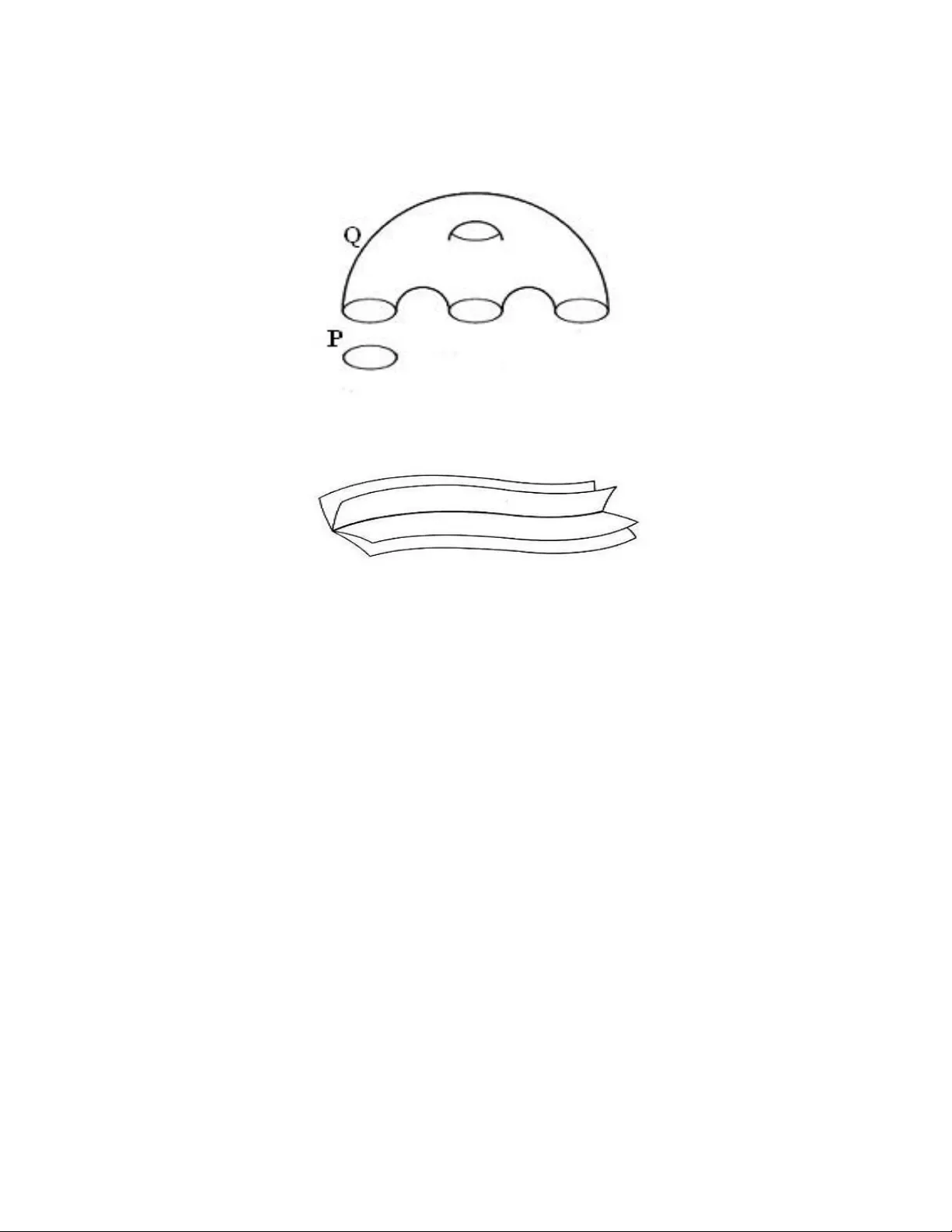
GEOMETRIC K -HOMOLOGY WITH COEFFICIENTS I: Z /k Z -CYCLES AND BOCKSTEIN SEQUENCE ROBIN J. DEELEY Abstract. W e construct a Baum-Douglas type mo del for K -homology with coefficients in Z /k Z . The basic geometric ob ject in a cycle is a spin c Z /k Z - manifold. The relationship b etw een these cycles and the top ological side of the F reed-Melrose index theorem is discussed in detail. Finally , using inductiv e limits, we construct geometric mo dels for K -homology with coefficients in an y countable ab elian group. The dev elopment of K -homology , the dual of K -theory , has inv olv ed b oth geo- metric and analytic ideas. T o briefly review the history , it w as Atiy ah who first prop osed a mo del for K -homology using F redholm operators in [1]. This w as re- alized (indep endently) by the w orks of Kasparo v [25] and BDF-theory [12] and [13]. In these cases, the cycles are analytic in nature and are based on ideas from the theory of op erator algebras. Later, Baum and Douglas [7] defined a geometric mo del for K -homology . Recall that a cycle in the Baum-Douglas mo del is a triple, ( M , E , f ), where M is a compact spin c -manifold, E is a smo oth Hermitian vector bundle o ver M , and f is a contin uous map from M to the space whose K -homology we are mo deling. F or an y homology theory , it is useful to study the corresponding theory with co efficients. The easiest wa y to define this, in the context of geometric K -homology , is to alter the map f . Thus, we define a cycle as b efore except for the map, which now maps from M to X × Y , where X is the space whose K -homology is to b e modeled while Y is a space with K 0 ( Y ) = G and K 1 ( Y ) = 0. Another approach is to alter the v ector bundle E . Since vector bundles determine classes in K -theory , the idea is to replace E with a class in K ∗ ( M ; G ) (here, K ∗ ( M ; G ) denotes K -theory with co efficients in G ). This metho d has b een dev elop ed b y Jak ob in [24] and b y Emerson and Mey er in [17] under the condition that K ∗ ( · ; G ) is a multiplicativ e cohomology theory . Both these metho ds are very general; to gain a concrete description of the cycles which define K -homology with co efficients, we required either a clear understanding of the space Y or of the group K ∗ ( M ; G ). There is another approach. Namely , one could lo ok to alter the spin c manifold in the Baum-Douglas cycles. T o do so, one would need a different geometric ob ject that is related to the sp ecific co efficien t group. Because of this requirement, the mo del w ould not be as easy to define in general. Ho wev er, the model w ould be more in trinsic (i.e., w ould not rely on an understanding of K -theory with co efficien ts or of the space Y abov e). Moreov er, the resulting mo del conceptualizes index theory for the geometric ob jects which are used to determine cycles. F or example, in the 2010 Mathematics Subje ct Classific ation. Primary: 19K33; Secondary: 19K56, 55N20 . Key wor ds and phr ases. K -homology , geometric cycles, Z /k Z -manifolds, index theory . 1 2 ROBIN J. DEELEY case of Z /k Z -co efficients and our geometric cycles, the relev ant index theorem is the F reed-Melrose index theorem (see [19]). The main goal of this pap er is the construction of a geometric mo del for the co efficien t group Z /k Z . As suc h, the main result is the construction of the Bo c kstein sequence (also called the univ ersal coefficient sequence) for this group (see Theorem 2.20). The geometric ob ject we use are spin c Z /k Z -manifolds. These singular spaces w ere introduced b y Sulliv an (e.g., [27], [33]) to study geometric topology . Later, in [18], F reed b egan the study of index theory for suc h ob jects. In [19], F reed and Melrose prov ed an index theorem for Z /k Z -manifolds, which takes v alues in Z /k Z . This result, along with Sulliv an’s work relating Z /k Z -manifolds to b ordism groups with co efficients in Z /k Z , are the main reasons Z /k Z -manifolds are the correct ob ject to determine cycles in our mo del. In fact, w e define tw o geometric mo dels for K-homology with coefficients in Z /k Z . The first is the natural “ Z /k Z -version” of the original Baum-Douglas mo del while the second is the natural “ Z /k Z -version” of the geometric mo del for K-homology defined in [28]. In the latter mo del, the v ector bundle in the original Baum-Douglas mo del is replaced by a K-theory class. This change to the cycles allows for a concise realization of trivial cycles; this is an inv aluable tool used in the pro of of the Bo ckstein exact sequence (see Theorem 2.20). These models are discussed in more detail at the start of Section 2.2. T o giv e some context to our construction, we review the history of the original motiv ation for the Baum-Douglas mo del. The starting p oint for this theory is the relationship betw een bordism and K-theory . In particular, for a finite CW-complex, X , Conner-Floyd (see [14]) constructed a natural isomorphism M U even ( X ) ⊗ M U even ( pt ) Z → K 0 ( X ) where M U denotes the b ordism group of stably almost complex manifolds and K ∗ ( X ) denotes the K-homology of X . Moreo ver, Atiy ah (see [1]) show ed that there is a natural surjection M U even / odd ( X ) → K ∗ ( X ) Th us, one w ould naturally ask if there exists a more refined equiv alence relation whic h turns this map in to an isomorphism. The Baum-Douglas mo del for K- homology answ ers this question in the affirmativ e and, moreo ver, with a relation defined in a very natural wa y . In the con text of Z /k Z -co efficients, we hav e a similarly defined surjective map M U even / odd ( X ; Z /k Z ) → K ∗ ( X ; Z /k Z ) where the domain of this map is Baas-Sulliv an b ordism theory (in the particular case of k -p oin ts) and the image is K-homology with co efficien ts in Z /k Z . Again, one is led to ask if there is a refined equiv alence relation which turns this map in to an isomorphism. This question is answered in the affirmativ e in this paper. Moreo ver, the relation defined should b e as “similar as p ossible” to the relation defined b y Baum and Douglas. This last (somewhat informal) statemen t could be in terpreted as the requiremen t that the diagram K -HOMOLOGY WITH COEFFICIENTS 3 M U even / odd ( X ) − − − − → K ∗ ( X ) y y M U even / odd ( X ; Z /k Z ) − − − − → K ∗ ( X ; Z /k Z ) is resp ected b y the refined relation in the Z /k Z -theory . The relationship b etw een our construction and b ordism is discussed in more detail on page 17. The conten t of the pap er is as follows. In Section 1, we review the basic prop- erties of Z /k Z -manifolds. This includes the generalization of a num b er of notions from manifold theory to Z /k Z -manifolds such as the F reed-Melrose index theorem men tioned abov e. Much of this material is not new, but is introduced since geo- metric prop erties of Z /k Z -manifolds are of fundamental imp ortance to our mo del. In Section 2, w e introduce the cycles which determine our mo del. These cycles are triples of the form, (( Q, P ) , ( E , F ) , f ), where ( Q, P ) is a compact spin c Z /k Z - manifold, ( E , F ) is a Z /k Z -vector bundle o v er ( Q, P ), and f is a con tinuous map from ( Q, P ) to the space whose K -homology (with co efficien ts in Z /k Z ) we are mo delling. The main result of this section is a pro of (under the condition that X is a finite CW-complex) that K ∗ ( X ; Z /k Z ) fits into the Bo ckstein exact sequence. The case of K 0 ( pt ; Z /k Z ) is discussed in detail; in particular, w e discuss its re- lationship with the top ological side of the F reed-Melrose index theorem. Finally , in Section 3, w e produce mo dels for an y coun table abelian group using inductiv e limits. A word or t wo on the exp osition ma y b e helpful to the reader. W e hav e tried to limit prerequisites to a go o d understanding of the Baum-Douglas mo del for K - homology (i.e., an understanding of the pap ers [7], [10]). A nice mo dern source for this material is [11]. W e hav e follow ed this reference and [28] for matters related to the Baum-Douglas model, and hav e follo wed [20] and [27] for the theory of Z /k Z - manifolds. Section 1 co vers the basics of Z /k Z -manifold theory whic h w e require for our developmen t. The reader is directed to [20] and [27] for more details on the generalizations of a num b er of notions from manifold theory to Z /k Z -manifold theory . Moreov er, the reader who is unfamiliar with the theory of Z /k Z -manifolds is encouraged to read Section 1 of [27] for a short, but illuminating introduction to the sub ject. In fact, the theory we develop here is b est describ ed as a formulation of the ideas presented in [27] and [32] (in particular, Chapter 6 of [32]) into the con text of cycles of the form developed by Baum and Douglas in [7]. A word of caution to the reader unfamilar with Z /k Z -manifolds is in order. There is no action of the group Z /k Z on these ob jects. The reference to the group Z /k Z can b e explained by the fact that (even dimensional, spin c ) Z /k Z -manifolds naturally imbed into a space, W , with K 0 ( W ) ∼ = Z /k Z (see ˜ H 2 n k in Definition 1.5). As we discuss in detail, this imbedding leads to a Z /k Z -v alued index. This is completely analogous to the case of (ev en dimensional, spin c ) manifolds and the top ological side of the Atiy ah-Singer index theorem. Ev en in Section 3 when we discuss inductive limit constructions, the relationship with the group is through the op eration of disjoint union and not through any “ Z /k Z group action” on the b oundary comp onents. W e hav e used the following notation. Throughout, X will denote a finite CW- complex. The K-theory (with compact supp orts) of X is denoted by K ∗ ( X ), while its K-homology is denoted by K ∗ ( X ). If M is a manifold, then we denote the 4 ROBIN J. DEELEY disjoin t union of k -copies of M by k M . If E 1 and E 2 are v ector bundles ov er M 1 and M 2 , then we use E 1 ˙ ∪ E 2 to denote the vector bundle (ov er M 1 ˙ ∪ M 2 ) with fib er at x given b y ( E 1 ) x if x ∈ M 1 and ( E 2 ) x if x ∈ M 2 . W e also use kE as notation for ˙ ∪ k times E . W e use similar notation for mappings. 1. Preliminaries 1.1. Z /k Z -manifolds. In this section, w e introduce Z /k Z -manifolds, which are the basic geometric ob jects used in our mo del. F or this mo del, w e require Z /k Z - manifolds with a spin c -structure. 1.2. Definition and basic prop erties of Z /k Z -manifolds. Definition 1.1. Let Q b e an oriented, smo oth compact manifold with b oundary . W e assume that the b oundary of Q , ∂ Q , decomp oses into k disjoin t manifolds, ( ∂ Q ) 1 , . . . , ( ∂ Q ) k . A Z /k Z -structure on Q is an oriented manifold, P , and orienta- tion preserving diffeomorphisms, γ i : ( ∂ Q ) i → P . A Z /k Z -manifold is a manifold with b oundary , Q , with a fixed Z /k Z -structure. W e denote this by ( Q, P , γ i ). W e sometimes drop the maps from this notation and denote a Z /k Z -manifold by ( Q, P ). Remark 1.2. F rom the data, ( Q, P , γ i ), we can create a singular space. T o do so, w e note that the diffeomorphisms, { γ i } k i =1 , induce a diffeomeorphism b etw een ∂ Q and P × Z /k Z . The singular space is then created b y collapsing each { x } × Z /k Z ∈ P × Z /k Z to a p oint. This singular space will (usually) b e denoted b y ˜ Q . In Definition 1.1, we hav e assumed that Q and P are both compact. W e can also consider the case when Q (or b oth Q and P ) are not compact. W e will refer to suc h ob jects as nonc omp act Z /k Z -manifolds. Man y concepts from differential geometry and top ology ha ve natural generaliza- tions from the manifold setting to the Z /k Z -manifold setting. The generalization of v ector bundles to Z /k Z -vector bundles is prototypical. A Z /k Z -vector bundle is a pair, ( E , F ), where E is a vector bundle ov er Q , F is a vector bundle ov er P , and E | ∂ Q decomp oses into k copies of F . T o b e more precise, the identification of (i.e., isomorphism b etw een) E | ∂ Q and the k-copies of F is also considered part of the data. Additionally , we hav e natural definitions of a Z /k Z -Riemannian metric, a Z /k Z -fib er bundle, a spin c -structure on a Z /k Z -v ector bundle, and a spin c -structure on a Z /k Z -manifold. The reader can see [20, Definition 3.1] for further details. W e also ha ve natural definitions of differentiable maps b et ween Z /k Z -manifolds, whic h leads to a notion of diffeomorphism b etw een Z /k Z -manifolds. W e will often require such maps to preserve certain additional structure (for example, the spin c - structure). Example 1.3. W e consider the manifold with boundary , denoted by Q , giv en in Figure 1 and take P = S 1 . Then one can easily see that ( Q, P ) has the structure of a Z / 3-manifold. Example 1.4. An y compact orien ted manifold without b oundary is a Z /k Z - manifold for any k . T o see this, we take P = ∅ and note that ( M , ∅ ) has the structure required b y Definition 1.1. Using the pro cess describ ed in Remark 1.2, we can think of a Z /k Z -manifold as a singular space. Then for any p oin t in the singular space, there is a neigh b ourho od K -HOMOLOGY WITH COEFFICIENTS 5 Figure 1. Z / 3-manifold from Example 1.3. Figure 2. Lo cal picture of a Z / 4-manifold. that is either diffeomorphic to a neighbourho o d in R n or is of the form shown in Figure 2. The n umber of “sheets of pap er” is equal to k . W e now consider em b eddings of Z /k Z -manifolds. Throughout, all embeddings of manifolds with b oundary will b e neat embeddings (see Section 1.4 of [23]). Definition 1.5. Let k and n b e fixed natural num b ers. Then, inside R n , w e let H = { ( x 1 , . . . x n ) ∈ R n | x 1 > 0 } H 0 = { ( x 1 , . . . x n ) ∈ R n | x 1 = 0 } Moreo ver, let H n k b e the space obtained by adjoining to H , k disjoint, relativ ely op en, unit radius disks in H 0 . Then ( H n k , D n − 1 ) has the structure of a noncompact Z /k Z -manifold where we note that D n − 1 denotes the op en unit disk. W e will denote the singular space constructed using the pro cess describ ed in Remark 1.2 by ˜ H n k . Example 1.6. Let ( Q, P , γ i ) be a Z /k Z manifold and ( H 2 N k , D 2 N − 1 ) b e the non- compact Z /k Z -manifold from Definition 1.5. If we take N large enough, then w e ha ve compatible embeddings f Q : Q → H 2 N k and f P : P → D 2 N − 1 . The compati- bilit y that we require is that, for eac h i , f Q | ( ∂ Q ) i = ( f P ◦ γ i ) | ( ∂ Q ) i where { ( ∂ Q ) i } k i =1 is the decomp osition of the b oundary of Q in Definition 1.1. W e ha ve the following exact sequences: 0 → T Q → T ( H 2 N k ) | Q → N Q → 0 0 → T P → T ( D 2 N − 1 ) | P → N P → 0 where N Q and N P are the normal bundles asso ciated to the embedding f Q and f P resp ectiv ely . W e then hav e that ( N Q , N P ) is a Z /k Z -vector bundle ov er ( Q, P ). 6 ROBIN J. DEELEY Definition 1.7. Let ( Q, P , γ i ) and ( ˆ Q, ˆ P , ˆ γ i ) b e tw o Z /k Z -manifolds. The disjoint union of ( Q, P, γ i ) and ( ˆ Q, ˆ P , ˆ γ i ) is giv en by ( Q ˙ ∪ ˆ Q, P ˙ ∪ ˆ P , γ i ˙ ∪ ˆ γ i ), where the disjoint union of the mappings, γ i and ˆ γ i , is given by the map defined by γ i for p oin ts in Q and b y ˆ γ i for p oin ts in ˆ Q . 1.3. Bordism of Z /k Z -manifolds. W e now discuss b ordism for Z /k Z -manifolds. This concept is due to Sulliv an [33] (also see [6]). Definition 1.8. Let ¯ Q b e an n -dimensional, oriented, smo oth, compact manifold with b oundary . In addition, assume we are giv en k disjoint, orien ted embeddings of an ( n − 1)-dimensional, oriented, smooth, compact manifold with boundary , ¯ P , into ∂ ¯ Q . Using the same notation as Definition 1.1, we denote this as a triple ( ¯ Q, ¯ P , γ i ) (or just ( ¯ Q, ¯ P )) where { γ i } k i =1 denote the k disjoin t oriented embeddings. W e refer to suc h a triple as a Z /k Z -manifold with b oundary . The boundary of such an ob ject is defined to b e ∂ ¯ Q − int( k ¯ P ) where k ¯ P denotes the k copies of ¯ P in ∂ ¯ Q . W e note that the b oundary has a natural Z /k Z -manifold structure induced by identifying the k copies of the b oundary of ¯ P (see Remark 1.9 for more on the b oundary). Remark 1.9. If a Z /k Z − manifold ( Q, P ) is the boundary of the Z /k Z -manifold with b oundary , ( ¯ Q, ¯ P ), then ∂ ¯ Q = Q ∪ ∂ Q ( k ¯ P ) (1) ∂ ¯ P = P (2) Example 1.10. Three examples of Z /k Z -manifolds with b oundary are: (1) A Z /k Z -manifold is a Z /k Z -manifold with empty b oundary . (2) Using the notation of Definition 1.8, a manifold with b oundary , ¯ Q , with ¯ P = ∅ is a Z /k Z -manifold with boundary . Moreov er, its boundary when considered as a Z /k Z -manifold is the same as its boundary when considered a manifold with b oundary . (3) F or any oriented M , ( k M × [0 , 1] , − M ) is a Z /k Z -manifold with b oundary . Moreo ver, its b oundary is k M . Definition 1.11. W e say that tw o Z /k Z -manifolds, ( Q, P ) and ( ˆ Q, ˆ P ), are b or dant if ( Q, P ) ˙ ∪ ( − ˆ Q, − ˆ P ) is a b oundary in the sense of Remark 1.9. The Z /k Z -manifold with b oundary , ( ¯ Q, ¯ P ) in Remark 1.9, will b e called a b ordism b etw een ( Q, P ) and ( ˆ Q, ˆ P ). W e will denote this by ( Q, P ) ∼ bor ( ˆ Q, ˆ P ). Prop osition 1.12. The op er ation ∼ bor is an e quivalenc e r elation. This result is due to Sulliv an, but Baas pro ves this result for more general classes of manifolds with singularities in [6]. Sulliv an also shows that the bordism rela- tion on Z /k Z -manifolds leads to bordism groups with coefficients in Z /k Z . This connection is fundamental to the construction of our mo del for K -homology with co efficien ts in Z /k Z . In our mo del, w e consider Z /k Z -b ordisms whic h preserve the additional spin c - structure w e put on our Z /k Z -manifold. The reader should assume that, for the rest of this pap er, all b ordisms and Z /k Z -b ordisms are spin c -b ordisms. K -HOMOLOGY WITH COEFFICIENTS 7 1.4. Index theory for Z /k Z − manifolds. In this section, w e discuss the F reed- Melrose index theorem for spin c Z /k Z -manifolds. A sp ecial case of this theorem w as prov ed by F reed in [18]. The general case is treated in [19] (see also [20] and [30]). W e will b e most interested in the top ological side of the F reed-Melrose index theorem. W e define the top ological index map using a noncompact space which pla ys the same role as Euclidean space in the A tiyah-Singer index theorem (see [5]). One could also (see [30] for details) use a Mo ore space to construct the top ological index. This pro cess w ould be analogous to using spheres (rather than Euclidean space) in the case of the Atiy ah-Singer index theorem. T o begin, the reader should recall that from a Z /k Z -manifold, ( Q, P ), we can form a singular space follo wing the process described in Remark 1.2. W e will denote this singular space by ˜ Q . W e note that throughout this paper w e will w ork with K-theory with compact supp orts. The reader should recall or note that the K 0 ( ˜ Q ) can b e realized as the Grothendiec k group of the semigroup of Z /k Z -vector bundles o ver ( Q, P ) and that given an embedding of one spin c Z /k Z -manifold into another w e get a wrong-wa y map b et ween the K-theories of the asso ciated singular spaces (see [18] for details). W e will b e in terested in this map in the following case. Let ( Q, P ) be a spin c Z /k Z -manifold with dim( Q ) ev en and ( H 2 N k , D 2 N − 1 ) b e the noncompact Z /k Z - manifold from Definition 1.5. Then, as discussed in Example 1.6, for N sufficiently large there is a neat embedding i : ( Q, P ) → ( H 2 N k , D 2 N − 1 ) The wrong-w ay map induced from i will b e denoted b y π ˜ Q ! . A standard computation in K-theory shows that K 0 ( ˜ H 2 N k ) ∼ = Z /k Z (3) K 1 ( ˜ H 2 N k ) ∼ = 0 (4) Since dim( Q ) is even, we hav e that the range of π ˜ Q ! is Z /k Z . Definition 1.13. Let ( Q, P ) b e a spin c Z /k Z -manifold and ( E , F ) b e a Z /k Z - v ector bundle ov er it. W e denote the Dirac operator on ( Q, P ) twisted by ( E , F ) b y D ( E ,F ) (see [30] Definition 2.4 for more on the Dirac op erator). Let ind top Z /k Z ( D ( E ,F ) ) := π ˜ Q ! ([ E , F ]) ∈ K 0 ( ˜ H 2 N k ) ∼ = Z /k Z If Q has o dd dimension, then we can produce a top ological index using similar metho ds. Ho wev er, in this case, the Z /k Z -top ological index v anishes (see [18]). The next theorem is the F reed-Melrose index theorem for Z /k Z -manifolds. It is analogous to the Atiy ah-Singer index theorem for manifolds. Theorem 1.14. L et ( Q, P ) b e a spin c Z /k Z -manifold and D a twiste d Dir ac op- er ator on it. Then ind top Z /k Z ( D ) = ind( D APS ) mo d k wher e ind( D APS ) denotes the F r e dholm index of the twiste d Dir ac op er ator with the Atiy ah-Pato di-Singer b oundary c onditions (se e [2] for mor e details). 8 ROBIN J. DEELEY Pro ofs of this result can b e found in [19], [20], [30], and [34]. W e will need tw o prop erties of this index. Pro ofs of these properties follow (more or less directly) from results in [18]. Theorem 1.15. The Z /k Z -index is a spin c Z /k Z c ob or dism invariant. T o state the other property of the F reed-Melrose index, w e will need to in tro duce some notation. Let M b e a fixed compact spin c -manifold without b oundary . The reader should recall that a fib er bundle o ver a Z /k Z -manifold ( Q, P ) with fib er M , is a Z /k Z -manifold, ( E , F ), and a pair of (compatible) fib er bundles, π M Q : E → Q and π M P : F → P (where b oth π M Q and π M P ha ve fib er M ; see [20] for details). Let ( Q, P ) b e a spin c Z /k Z -manifold and ( E , F ) b e a fib er bundle o ver it. More- o ver, assume ( E , F ) has a fixed spin c -structure which is compatible with b oth the spin c -structure on ( Q, P ) and the spin c -structure on M . Then, the direct image map in K-theory , π M ! : K ∗ ( ˜ E ) → K ∗ ( ˜ Q ) is w ell-defined and satisfies (5) π ˜ E ! = π ˜ Q ! ◦ π M ! where π ˜ E ! and π ˜ Q ! are the Z /k Z -direct image map discussed abov e. Since the Z /k Z -top ological index is defined in terms of the direct image map, it also has this prop erty (i.e., satisfies Equation 5). This prop erty is the Z /k Z -version of the m ultiplicative prop erty of the index (for closed manifolds) discussed in [5]. More details on the direct image map for Z /k Z -manifolds can b e found in [18] (see p. 246-247). 2. A model f or K ∗ ( X ; Z /k Z ) 2.1. Definition of the mo del for K ∗ ( X ; Z /k Z ) . Definition 2.1. Let X be a compact Hausdorff space. A Z /k Z -cycle (ov er X ) is a triple, (( Q, P ) , ( E , F ) , f ), where ( Q, P ) is a spin c Z /k Z -manifold, ( E , F ) is a smo oth Hermitian Z /k Z -vector bundle o ver ( Q, P ) and f is a contin uous map (in the Z /k Z -sense) from ( Q, P ) to X . Here, a contin uous map from ( Q, P ) to X in the Z /k Z -sense is a pair of contin- uous maps f Q : Q → X and f P : P → X suc h that (in the notation of Definition 1.1) f Q | ( ∂ Q ) i = f P for eac h i = 1 , . . . k . F unctions satisfying this prop erty are in one-to-one correspondence with the con tinuous functions on the singular space describ ed in Remark 1.2. Also, the manifolds Q (and P ) in a Z /k Z -cycle, (( Q, P ) , ( E , F ) , f ), may not be connected. In fact, Q (and P ) can hav e components with differing dimensions. Also, the vector bundles on differen t comp onents many hav e differing fib er dimensions. Definition 2.2. Given a Z /k Z -cycle, (( Q, P ) , ( E , F ) , f ), w e will denote its opp osite b y − (( Q, P ) , ( E , F ) , f ) = ( − ( Q, P ) , ( E , F ) , f ) where − ( Q, P ) is the spin c Z /k Z - manifold with the opp osite spin c structure (see Definition 4.8 in [11] for more on the opp osite spin c structure). K -HOMOLOGY WITH COEFFICIENTS 9 W e now define the op erations and relations on Z /k Z -cycles. The reader should note the similarity with the op erations and relations defined on the cycles from the Baum-Douglas mo del (see Section 5 of [11]). Definition 2.3. Let (( Q, P ) , ( E , F ) , f ) and (( ˆ Q, ˆ P ) , ( ˆ E , ˆ F ) , ˆ f ) be Z /k Z -cycles. Then the disjoin t union of these cycles is given by the cycle (( Q ˙ ∪ ˆ Q, P ˙ ∪ ˆ P ) , ( E ˙ ∪ ˆ E , F ˙ ∪ ˆ F ) , f ˙ ∪ ˆ f ) where the disjoint union of Z /k Z -manifolds is defined in Definition 1.7, E ˙ ∪ ˆ E is the v ector bundle with fib ers given by ( E ˙ ∪ ˆ E ) | x = E | x or ˆ E | x (dep ending on whether x ∈ E or ˆ E ), and f ˙ ∪ ˆ f is defined to b e f ( x ) if x ∈ Q and ˆ f ( x ) if x ∈ ˆ Q . Definition 2.4. W e sa y a Z /k Z -cycle, (( Q, P ) , ( E , F ) , f ), is a b oundary if there exists (1) a smo oth compact spin c Z /k Z -manifold with boundary , ( ¯ Q, ¯ P ), (2) a smo oth Hermitian Z /k Z -vector bundle ( ¯ E , ¯ F ) ov er ( ¯ Q, ¯ P ), (3) a con tinuous map Φ : ( ¯ Q, ¯ P ) → X , suc h that ( Q, P ) is the Z /k Z -b oundary of ( ¯ Q, ¯ P ), ( E , F ) = ( ¯ E , ¯ F ) | ∂ ( ¯ Q, ¯ P ) , and f = Φ | ∂ ( ¯ Q, ¯ P ) . W e say that (( Q, P ) , ( E , F ) , f ) is b ordant to (( ˆ Q, ˆ P ) , ( ˆ E , ˆ F ) , ˆ f ) if (( Q, P ) , ( E , F ) , f ) ˙ ∪ − (( ˆ Q, ˆ P ) , ( ˆ E , ˆ F ) , ˆ f ) is a boundary . W e no w define vector bundle mo dification for Z /k Z -cycles. W e consider the follo wing setup. Let ( Q, P ) b e a spin c Z /k Z -manifold and ( W, V ) b e a spin c -v ector bundle o v er ( Q, P ) with even dimensional fib ers. W e denote the trivial rank one real Z /k Z -v ector bundle by ( 1 Q , 1 P ). The Z /k Z -vector bundle, ( W ⊕ 1 Q , V ⊕ 1 P ), is a spin c Z /k Z -v ector bundle. Moreov er, its total space is a noncompact Z /k Z - manifold and its comp onents fit into the following exact sequences. 0 → ˜ π ∗ W ( W ⊕ 1 Q ) → T ( W ⊕ 1 Q ) → ˜ π ∗ W ( T Q ) → 0 0 → ˜ π ∗ V ( V ⊕ 1 P ) → T ( V ⊕ 1 P ) → ˜ π ∗ V ( T P ) → 0 where we hav e that ˜ π W : W ⊕ 1 Q → Q and ˜ π V : V ⊕ 1 P → P . By choosing compatible splittings, w e hav e T ( W ⊕ 1 Q ) ∼ = ˜ π ∗ W ( W ⊕ 1 Q ) ⊕ ˜ π ∗ W ( T Q ) T ( V ⊕ 1 P ) ∼ = ˜ π ∗ V ( V ⊕ 1 P ) ⊕ ˜ π ∗ V ( T P ) This identification puts a spin c -structure on the Z /k Z -manifold given b y the total space of ( W ⊕ 1 Q , V ⊕ 1 P ). Moreo ver, the spin c -structure is unique up to concor- dance (i.e., differen t splittings giv e concordan t spin c -structures). Finally , we denote the sphere bundles of W ⊕ 1 Q and V ⊕ 1 P b y Z Q and Z P resp ectiv ely . W e hav e a natural spin c Z /k Z -structure, induced from ( W ⊕ 1 Q , V ⊕ 1 P ), on ( Z Q , Z P ). Definition 2.5. Let (( Q, P ) , ( E , F ) , f ) be a Z /k Z -cycle and ( W, V ) an ev en dimen- sional spin c Z /k Z -v ector bundle ov er ( Q, P ). Using the notation and results of the previous paragraphs, w e hav e that ( Z Q , Z P ), the sphere bundle of ( W ⊕ 1 , V ⊕ 1 ), is a spin c Z /k Z -manifold. Moreov er, the v ertical tangen t bundle of ( Z Q , Z P ), denoted b y ( V Q , V P ), is a spin c Z /k Z -v ector bundle o v er ( Z Q , Z P ). W e then let ( S Q,V , S P,V ) b e the reduced spinor bundle associated to ( V Q , V P ) and let ( ˆ E , ˆ F ) b e the ev en part of the dual of ( S Q,V , S P,V ). The vector bundle mo dification of (( Q, P ) , ( E , F ) , f ) 10 ROBIN J. DEELEY b y ( W , V ) is the Z /k Z -cycle (( Z Q , Z P ) , ( ˆ E ⊗ π ∗ ( E ) , ˆ F ⊗ π ∗ ( F )) , f ◦ π ) where π de- notes the bundle pro jection. W e will also use the notation (( Q, P ) , ( E , F ) , f ) ( W,V ) to denote the vector bundle mo dification of (( Q, P ) , ( E , F ) , f ) by ( W, V ). Remark 2.6. It is worth noting that ( Q, E , f ) is a Baum-Douglas cycle with b oundary and ( P , F , f | P ) is a Baum-Douglas cycle. Moreo ver, the Z /k Z -vector bundle mo dification of (( Q, P ) , ( E , F ) , f ) b y ( W , V ) can b e though t of as the Baum- Douglas v ector bundle modification of the cycles ( Q, E , f ) and ( P , F , f | P ) b y W and V resp ectively . In particular, if we take a Z /k Z -cycle coming from a spin c -manifold without b oundary , M , then a v ector bundle mo dification in the Z /k Z sense corresp onds to a v ector bundle mo dification in the sense of Baum-Douglas. Definition 2.7. W e define K ∗ ( X ; Z /k Z ) to b e the set of equiv alence classes of Z /k Z -cycles where the equiv alence relation is generated by the following. (1) If (( Q, P ) , ( E 1 , F 1 ) , f ) and (( Q, P ) , ( E 2 , F 2 ) , f ) are Z /k Z -cycles (with the same spin c Z /k Z -manifold, ( Q, P ), and map f ), then (( Q ˙ ∪ Q, P ˙ ∪ Q ) , ( E 1 ˙ ∪ E 2 , F 1 ˙ ∪ F 2 ) , f ˙ ∪ f ) ∼ (( Q, P ) , ( E 1 ⊕ E 2 , F 1 ⊕ F 2 ) , f ) (2) If (( Q, P ) , ( E , F ) , f ) and (( ˆ Q, ˆ P ) , ( ˆ E , ˆ F ) , ˆ f ) are b ordant Z /k Z -cycles, then (( Q, P ) , ( E , F ) , f ) ∼ (( ˆ Q, ˆ P ) , ( ˆ E , ˆ F ) , ˆ f ) (3) If (( Q, P ) , ( E , F ) , f ) is a Z /k Z -cycle and ( W, V ) is an even-dimensional spin c -v ector bundle ov er ( Q, P ), then we define (( Q, P ) , ( E , F ) , f ) to b e equiv alen t to the v ector bundle modification (as describ ed in Definition 2.5) of this cycle by ( W, V ). W e note that the grading on K ∗ ( X ; Z /k Z ) is given as follows: K 0 ( X ; Z /k Z ) (resp. K 1 ( X ; Z /k Z )) is the set of equiv alence classes of Z /k Z -cycles for which each comp onen t of Q (recall that Q is not necessarily connected) is even (resp. o dd) dimensional. Prop osition 2.8. The set K ∗ ( X ; Z /k Z ) is a gr ade d ab elian gr oup with the op er- ation of disjoint union. In p articular, the identity element is given by the class of the trivial cycle (i.e., the cycle ( ∅ , ∅ , ∅ ) ) and the inverse of a cycle is given by its opp osite cycle (se e Definition 2.2). Pr o of. The operation of disjoin t union clearly gives the structure of an ab elian semigroup. It is also clear that the trivial cycle is an additive iden tity . T o pro duce an inv erse for a cycle, w e n ote that an y cycle which is a boundary represents the additiv e identit y of the group and the union of any cycle with its opp osite is a b oundary . In other words, the opp osite of a cycle pro vides an additive inv erse. 2.2. The Bockstein sequence. W e no w define the Bo ckstein exact sequence for the groups, K 0 ( X ; Z /k Z ) and K 1 ( X ; Z /k Z ). Our Bo ckstein exact sequence for K- homology is analogous to both the Bo ckstein exact sequence for b ordism defined in [27] and the long exact sequence in K-homology (see [11] or [28]). F or the pro of of exactness of the Bo ckstein sequence, w e follow the pro of that the Baum-Douglas mo del of relativ e K -homology has a long exact sequence. The difficult y in the proof of the latter is the determination of concise conditions, in terms of the equiv alence relations, which lead to a trivial Baum-Douglas cycle. W e face a similar problem here. T o o vercome it, we use an idea of Jak ob (see [24] and also [28]) and define the K -HOMOLOGY WITH COEFFICIENTS 11 notion of normal bordism for Z /k Z -cycles. Theorem 2.19 is a natural generalization of Corollary 4.5.16 of [28] to the Z /k Z setting. The model for K-homology defined in [28] uses K-theory classes in place of v ector bundles. As such, to apply the results of [28] directly , we need a slightly different mo del for K ∗ ( X ; Z /k Z ). F or cycles, we tak e (( Q, P ) , ε, f ) where ( Q, P ) and f are as in Definition 2.1 and ε is an elemen t in K 0 ( ˜ Q ). Recall that ˜ Q is the singular space asso ciated with ( Q, P ) (see Remark 1.2) and that elements of K 0 ( ˜ Q ) are giv en by formal difference of (isomorphism classes of ) Z /k Z -vector bundles o ver Q . The opposite of a cycle and disjoin t union of cycles are defined in essen tially the same w ay as in the previous section. The equiv alence relation on these cycles is generated by b ordism and vector bundle mo dification. The former is defined as in Definition 2.4 with the vector bundle data replaced by K-theory data. F or the latter, we use the Z /k Z -v ersion of the definition of vector bundle modification in Section 4.2 of [28]. The lac k of a disjoin t union/direct sum relation is explained by the fact that this relation is con tained in the relation generated by bordism and v ector bundle modification. F or a pro of of this fact in the Baum-Douglas setting, see Prop osition 4.2.3 in [28]; the pro of given there generalizes to the Z /k Z -setting with only minor changes. It is important to k eep trac k of whic h of the t wo mo dels for K-homology and K-homology with co efficien ts in Z /k Z are in use. T o ensure clarity , we denote K- theory classes exclusively b y ε and ν (with appropriate subscripts/sup erscripts). Also, in Section 2.2.1, the mo dels in use will b e the versions using K-theory classes rather than v ector bundles. The only other place in the pap er where the models using K-theory classes are used is in the proof of the exactness of the Bo ckstein sequence (see Theorem 2.20). 2.2.1. Normal b or dism for manifolds and Z /k Z manifolds. The follo wing notation is used in this section. W e denote the equiv alence relation of the Baum-Douglas mo del or of our Z /k Z -model (see Definition 2.7), dep ending on context, by ∼ and the b ordism relation by ∼ bor . If ( M , ε, f ) is a Baum-Douglas cycle and V is a spin c -v ector bundle ov er M with even dimensional fibers, then the vector bundle mo dification of ( M , ε, f ) by V is written as: ( M , ε, f ) V Similar notation is used for the vector bundle mo dification of Z /k Z -cycles. W e recall that throughout X denotes a finite CW-complex. Definition 2.9. Let M b e a manifold and E b e a vector bundle o ver it. Then N E is a complementary bundle for E , if E ⊕ N E is a trivial vector bundle ov er M . A normal bundle for M will refer to a complementary bundle for T M . Theorem 2.10. L et ( M , ε, f ) b e a Baum-Douglas cycle over X . Then ( M , ε, f ) r epr esents the zer o element in K ∗ ( X ) if and only if ther e exists a normal bund le, N , for M such that ( M , ε, f ) N is a b oundary. W e will need the follo wing lemma whic h is a generalization of Lemma 4.4.3 in [28]. The pro of giv en in [28] generalizes without ma jor c hange; the details are left as an exercise for the reader. 12 ROBIN J. DEELEY Lemma 2.11. L et (( Q, P ) , ε, f ) b e a Z /k Z -cycle. Then for any even dimensional spin c Z /k Z -ve ctor bund les, ( E 0 , F 0 ) and ( E 1 , F 1 ) , we have that (( Q, P ) , ε, f ) ( E 0 ⊕ E 1 ,F 0 ⊕ F 1 ) ∼ bor ((( Q, P ) , ε, f ) ( E 0 ,F 0 ) ) p ∗ ( E 1 ,F 1 ) wher e p denote the pr oje ction ( E 0 , F 0 ) → ( Q, P ) . Definition 2.12. Let ( Q, P ) be a Z /k Z -manifold and ( E , F ) a Z /k Z -vector bundle o ver it. Then ( E , F ) is Z /k Z -trivial if E is a trivial v ector bundle ov er Q . This implies that F is trivial ov er P . Of course, if ( Q, P ) is a Z /k Z -manifold, then an y trivial bundle o ver Q has a natural Z /k Z -v ector bundle structure. Definition 2.13. Let ( Q, P ) be a Z /k Z -manifold and ( E , F ) a Z /k Z -vector bundle o ver it. Then a Z /k Z -normal bundle for ( E , F ) is a Z /k Z -vector bundle, ( N E , N F ), o ver ( Q, P ) suc h that ( E , F ) ⊕ ( N E , N F ) is Z /k Z -trivial (i.e., E ⊕ N N is a trivial v ector bundle). In fact, we also require the trivialization to b e compatible with the bundle maps associated to ( E , F ) and ( N E , N F ). A Z /k Z -normal bundle for ( Q, P ) will refer to a Z /k Z -normal bundle for ( T Q, T ( P × (0 , 1]) | P ). F or notational con venience, we denote a Z /k Z -normal bundle for ( Q, P ) simply as N . The existence of a Z /k Z -normal bundle for an arbitrary spin c Z /k Z -manifold follo ws from Example 1.6. Lemma 2.14. L et ( Q, P ) b e a Z /k Z -manifold and N 1 and N 2 b e two Z /k Z -normal bund les for ( Q, P ) . Then ther e exist trivial Z /k Z -bund les ( E 1 , F 1 ) and ( E 2 , F 2 ) such that N 1 ⊕ ( E 1 , F 1 ) ∼ = N 2 ⊕ ( E 2 , F 2 ) Pr o of. Let ( E 2 , F 2 ) = N 1 ⊕ ( T Q, T ( P × (0 , 1]) | P ) and ( E 1 , F 1 ) = N 2 ⊕ ( T Q, T ( P × (0 , 1]) | P ). By the definition of Z /k Z -normal bundle (i.e., Definition 2.12), ( E 1 , F 1 ) and ( E 2 , F 2 ) are both Z /k Z -trivial. Moreo ver, N 1 ⊕ ( E 1 , F 1 ) ∼ = N 1 ⊕ N 2 ⊕ ( T Q, T ( P × (0 , 1]) | P ) ∼ = N 2 ⊕ ( E 2 , F 2 ) Definition 2.15. A Z /k Z -cycle, (( Q, P ) , ε, f ), is said to normally b ound if there exists an (ev en rank) Z /k Z -normal bundle, N , ov er ( Q, P ), such that the Z /k Z - cycle, (( Q, P ) , ε, f ) N , is a boundary . Two Z /k Z -cycles are normally bordant if their difference normally bounds. Prop osition 2.16. Normal b or dism (denote d ∼ nor ) defines an e quivalenc e r elation on Z /k Z -cycles. Pr o of. That ∼ nor is reflexiv e follows from the existence of a normal bundle for any Z /k Z -manifold. Symmetry is clear, so we need only show transitivity . T o this end, let { (( Q i , P i ) , ε i , f i ) } 2 i =0 b e Z /k Z -cycles and N 0 , N 1 , N 0 1 , and N 2 b e Z /k Z -normal bundles, suc h that (( Q 0 , P 0 ) , ε 0 , f 0 ) N 0 ∼ bor (( Q 1 , P 1 ) , ε 1 , f 1 ) N 1 (( Q 1 , P 1 ) , ε 1 , f 1 ) N 0 1 ∼ bor (( Q 2 , P 2 ) , ε 2 , f 2 ) N 2 W e now use the fact that Z /k Z -normal bundles are stably isomorphic (see Lemma 2.14 abov e). Based on this result, there exist trivial Z /k Z -bundles, 1 and 0 1 (b oth o ver ( Q 1 , P 1 )) such that N 1 ⊕ 1 ∼ = N 0 1 ⊕ 0 1 . Let 0 b e the trivial Z /k Z -bundle ov er K -HOMOLOGY WITH COEFFICIENTS 13 ( Q 0 , P 0 ) of the same rank as 1 and 2 b e the trivial Z /k Z -bundle ov er ( Q 2 , P 2 ) of the same rank as 0 1 . Since the vector bundle modification by trivial bundles extend across Z /k Z -b ordisms, we hav e that ((( Q 0 , P 0 ) , ε 0 , f 0 ) N 0 ) p ∗ 0 ( 0 ) ∼ bor ((( Q 1 , P 1 ) , ε 1 , f 1 ) N 1 ) p ∗ 1 ( 1 ) ((( Q 1 , P 1 ) , ε 1 , f 1 ) N 0 1 ) p ∗ 1 0 ( 0 1 ) ∼ bor ((( Q 2 , P 2 ) , ε 2 , f 2 ) N 2 ) p ∗ 2 ( 2 ) Moreo ver, by applying Lemma 2.11 (a num b er of times), we obtain (( Q 0 , P 0 ) , ε 0 , f 0 ) N 0 ⊕ 0 ∼ bor (( Q 1 , P 1 ) , ε 1 , f 1 ) N 1 ⊕ 1 ∼ bor (( Q 2 , P 2 ) , ε 2 , f 2 ) N 2 ⊕ 2 The result no w follo ws since N 0 ⊕ 0 and N 2 ⊕ 2 are both Z /k Z -normal bundles. W e now sho w that the normal b ordism equiv alence relation is the same as the equiv alence relation generated b y disjoin t union, b ordism, and vector bundle mo d- ification (i.e., ∼ ). It is clear that normal b ordism implies equiv alence with resp ect to the relation ∼ . The next t wo prop ositions show the conv erse. Prop osition 2.17. If (( Q, P ) , ε, f ) is a Z /k Z -b oundary, then it also Z /k Z -normal ly b ounds. Pr o of. Let (( W , Z ) , ν, g ) be a Z /k Z -b ordism with boundary , (( Q, P ) , ε, f ). W e m ust sho w that (( Q, P ) , ε, f ) normally b ounds. T o do so, fix a Z /k Z -normal bundle, N , for ( W , Z ) and then consider (( W, Z ) , ν , g ) N ⊕ 1 . The b oundary of this cycle is (( Q, P ) , ε, f ) N | Q ⊕ 1 , but w e hav e that T Q ⊕ N | Q ⊕ 1 ∼ = T W | Q ⊕ N | Q ∼ = ( T W ⊕ N ) | Q where this last bundle is Z /k Z -trivial by assumption. Hence, N | Q ⊕ 1 is a Z /k Z - normal bundle for ( Q, P ) and so (( Q, P ) , ε, f ) normally b ounds. Prop osition 2.18. If (( Q, P ) , ε, f ) is a Z /k Z -cycle and ( V , W ) is a Z /k Z -ve ctor bund le with even-dimensional fib ers, then (( Q, P ) , ε, f ) ( V ,W ) is Z /k Z -normal ly b or- dant to (( Q, P ) , ε, f ) . Pr o of. W e b egin by constructing a normal bundle for ( Q V , P W ). T o do so, w e let p : Q V → Q b e the natural pro jection and note that T ( Q V ) ⊕ 1 ∼ = p ∗ ( T Q ⊕ V ) ⊕ 1 Let N b e a Z /k Z -normal bundle for ( Q, P ) and V c b e a complemen t to V (i.e., V ⊕ V c is trivial). Note that V c can be chosen to be a Z /k Z -bundle. T o summarize, T Q ⊕ N ∼ = Q and V ⊕ V c = V where Q and V are trivial v ector bundles. Next, w e consider T ( Q V ) ⊕ p ∗ ( V c ⊕ N ⊕ 1 ) ∼ = T ( Q V ) ⊕ 1 ⊕ p ∗ ( V c ⊕ N ) ∼ = p ∗ ( T Q ⊕ V ) ⊕ 1 ⊕ p ∗ ( V c ⊕ N ) ∼ = p ∗ ( T Q ⊕ N ) ⊕ p ∗ ( V ⊕ V c ) ⊕ 1 This last bundle is trivial and hence p ∗ ( V c ⊕ N ⊕ 1 ) is a normal bundle for Q V . 14 ROBIN J. DEELEY Using Lemma 2.11, we hav e that ((( Q, P ) , ε, f ) ( V ,W ) ) p ∗ ( V c ⊕ N ⊕ 1 ) ∼ bor (( Q, P ) , ε, f ) ( V ,W ) ⊕ V c ⊕ N ⊕ 1 ∼ bor (( Q, P ) , ε, f ) V ⊕ N ⊕ 1 The last mo dification is by the bundle N ⊕ V ⊕ 1 , which is a Z /k Z normal bundle for ( Q, P ); hence these cycles are normally b ordan t. Corollary 2.19. L et X b e a finite CW-c omplex. Then a Z /k Z -cycle over X r ep- r esents the zer o element in K ∗ ( X ; Z /k Z ) if and only if it Z /k Z -normal ly b ounds. 2.2.2. Bo ckstein exact se quenc e. W e no w construct and prov e exactness of the Bo c k- stein sequence for our mo del. The reader should compare this sequence with b oth the one for b ordism groups with co efficien ts in Z /k Z found in [27] and the one for analytic K-homology with co efficients in Z /k Z found in [31]. W e briefly discuss the relationship b et ween the v arious Bo ckstein sequences after proving the theorem. Theorem 2.20. L et X b e a finite CW-c omplex. Then the fol lowing se quenc e is exact. K 0 ( X ) k − − − − → K 0 ( X ) r − − − − → K 0 ( X ; Z /k Z ) x δ y δ K 1 ( X ; Z /k Z ) r ← − − − − K 1 ( X ) k ← − − − − K 1 ( X ) wher e the maps ar e (1) k : K ∗ ( X ) → K ∗ ( X ) is given by multiplic ation by k . (2) r : K ∗ ( X ) → K ∗ ( X ; Z /k Z ) takes a cycle ( M , E , f ) to (( M , ∅ ) , ( E , ∅ ) , f ) . (3) δ : K ∗ ( X ; Z /k Z ) → K ∗ +1 ( X ) takes a cycle (( Q, P ) , ( E , F ) , f ) to ( P , F , f ) . Pr o of. W e leav e it to the reader to sho w that the stated result will follow from the corresp onding result for the model using cycles of the form (( Q, P ) , ε, f ). The maps in this case are given by: (1) k : K ∗ ( X ) → K ∗ ( X ) is given b y multiplication by k . (2) r : K ∗ ( X ) → K ∗ ( X ; Z /k Z ) takes a cycle ( M , ε, f ) to (( M , ∅ ) , ε, f ). (3) δ : K ∗ ( X ; Z /k Z ) → K ∗ +1 ( X ) takes a cycle (( Q, P ) , ε, f ) to ( P , ε P , f ). Where, if ε = [( E , F )] − [( E 0 , F 0 )], then ε P := [ F ] − [ F 0 ] ∈ K 0 ( P ); ε P (as a class in K-theory) dep ends only on the class ε . Our first goal is to show that these maps are w ell-defined. It is clear from the fact that K ∗ ( X ) is an ab elian group that multiplication by k is w ell-defined. That the map r is well-defined follows (essentially) from Item 2 of Example 1.10 (for the b ordism relation) and Remark 2.6 (for vector bundle mo dification). Finally , it follo ws from Remark 1.9 Equation 2, that the map δ : K ∗ ( X ; Z /k Z ) → K ∗ +1 ( X ) resp ects the b ordism relation. The case of v ector bundle mo dification is again co vered by Remark 2.6. W e now pro ve that the composition of an y tw o maps in the sequence is zero. This uses the same ideas as the ones used in [27] to prov e the exactness of the Bo c kstein sequence for b ordism with co efficien ts in Z /k Z . K -HOMOLOGY WITH COEFFICIENTS 15 Firstly , ( r ◦ k )( M , ε, f ) = (( k M , ∅ ) , ( k ε, ∅ ) , k f ) That this cycle is trivial in K ∗ ( X ; Z /k Z ) follo ws from Item 3 of Example 1.10. The reader should note that one m ust also keep trac k of the K-theory class and con tinuous map inv olved. It is clear that ( δ ◦ r ) = 0 since the image of cycles in K ∗ ( X ) under r hav e empty b oundary . W e are left to show that ( k ◦ δ ) = 0. Consider ( k ◦ δ )(( Q, P ) , [( E , F )] − [( E 0 , F 0 )] , f ) = ( k P , k ([ F ] − [ F 0 ]) , k f | P ) W e m ust show that this cycle is trivial in K ∗ ( X ). T o do so, note that the Baum- Douglas cycle (with b oundary), ( Q, [ E ] − [ E 0 ] , f ), has b oundary given b y ( k P, k ([ F ] − [ F 0 ]) , k f | P ). The b ordism relation in the Baum-Douglas mo del implies that the cy- cle, ( k P , k ([ F ] − [ F 0 ]) , k f | P ), is trivial and hence ( k ◦ δ ) = 0 . T o complete the pro of of exactness, we must show that k er( k ) ⊆ im( δ ) , ker( δ ) ⊆ im( r ) , k er( r ) ⊆ im( k ) It is worth noting that only here do we need the notion of normal b ordism. Again, this is analogous to the case of the long term exact sequence in relativ e K -homology (see Section 4.6 of [28]). T o b egin, supp ose that ( M , ε, f ) is a Baum-Douglas cycle which is in ker( k ). W e must construct a Z /k Z -cycle which maps to [( M , ε, f )]. Corollary 2.10 implies that there exists a normal bundle modification (w e denote the normal bundle by N ) suc h that ( k M , k ε, k f )) N is a b oundary . Moreov er, w e can c ho ose N so that N | M is w ell-defined and so that k ( M , ε, f ) N | M is a b oundary . W e now denote N | M simply as N . By definition, there exists a manifold with b oundary , Q , K-theory class in K 0 ( Q ), ν , and map, g , such that ∂ Q = k M N ν | ∂ Q = k ε N g | ∂ Q = k f Moreo ver, the class ν is in the image of the map on K-theory induced b y the inclusion of C ( ˜ Q ) → C ( Q ). Denote a preimage of ν b y ν 0 . W e hav e therefore constructed a Z /k Z -manifold, ( Q, M N ), a class in K 0 ( ˜ Q ), ν 0 and a contin uous map, g : ( Q, M N ) → X . That is, (( Q, M N ) , ν 0 , g ) is a Z /k Z -cycle. Moreov er, δ ([(( Q, M N ) , ν 0 , g )]) = [( M , ε, f ) N ] = [( M , ε, f )] Next, supp ose that ( M , ε, f ) is a Baum-Douglas cycle such that [( M , ε, f )] ∈ k er( r ). This implies that [(( M , ∅ ) , ε, f )] = 0 and, by Corollary 2.19, that there exists a normal bundle mo dification (we denote the normal bundle by N ) such that (( M , ∅ ) , ε, f ) N is the b oundary in the Z /k Z sense. That is, we ha ve a Z /k Z - manifold with b oundary , ( W , P ), a K-theory class, ν , in K 0 ( ˜ W ), and a contin uous map, g , suc h that ∂ W = M N ˙ ∪ k P ( ν ) | ∂ W − ( k P ) = ε N g | ∂ W = f ˙ ∪ k ( g | P ) 16 ROBIN J. DEELEY Let i ∗ denote the map on K-theory induced from the inclusion C ( ˜ W ) → C ( W ). Then ( W , i ∗ ( ν ) , g ) defines a bordism betw een the Baum-Douglas cycles ( M N , ε N , f ) and ( k P , i ∗ ( ν ) | kP , g | kP ). Hence [( M , ε, f )] is in the image of the map k . Finally w e must show that if (( Q, P ) , ε, f ) is a Z /k Z -cycle such that δ ([(( Q, P ) , ε, f )]) = [( P , ε P , f )] = 0 then [(( Q, P ) , ε, f )] is in the image of r . T o b egin, we reduce to the case when ( P , ε P , f | P ) is a b oundary . Theorem 2.10 implies that there exists normal bundle mo dification (we again denote the bundle b y N ) suc h that ( P, ε P , f ) N is a boundary . W e denote this b ordism by ( W, ˜ ε, ˜ f ); hence, ∂ W = P N . Extending the normal bundle, N , from the manifold, P , to all of Q is, in general, not p ossible. How ever, since all normal bundles of P are stably isomorphic (see Lemma 2.14), w e hav e a normal Z /k Z -vector bundle, ( N Q , N P ), o ver ( Q, P ) and a trivial bundle, V , such that N P = N ⊕ V . Then δ ((( Q, P ) , ε, f ) ( N Q ,N P ) ) = ( P , ε P , f ) N P = ( P , ε P , f ) N ⊕ V ∼ bor (( P , ε P , f ) N ) p ∗ ( V ) The cycle (( P , ε P , f ) N ) p ∗ ( V ) is a boundary . Hence, without loss of generality , ( P , ε P , f | P ) is a b oundary . Denote by ( ¯ P , ˜ ε, g ) the triple where ¯ P is a manifold with b oundary with, ∂ ¯ P = P , ˜ ε is a K-theory class in K 0 ( ¯ P ) with ˜ ε | ∂ ¯ P = ε , and g is a contin uous function with g | ∂ ¯ P = f | P . F orm the manifold (without b oundary) M = Q ∪ kP k ¯ P and also form the (singular space) ˜ M = ˜ Q ∪ P ¯ P . The fact that K 0 ( ˜ M ) → K 0 ( ˜ Q ) ⊕ K 0 ( ¯ P ) → K 0 ( ∂ ¯ P ) is exact in the middle implies that there exists ν ∈ K 0 ( ˜ M ) such that ν | ˜ Q = ε and ν | ¯ P = ˜ ε . Moreov er, it is clear that the con tinuous functions, f on Q , and, g on ¯ P , are compatible on ∂ Q and ∂ ( k ¯ P ). Let h denote the contin uous map f ∪ kP k g . Also let i ∗ denote the map on K-theory induced from the map i : C ( ˜ M ) → C ( M ). Then ( M , i ∗ ( ν ) , h ) forms a Baum-Douglas cycle. W e no w sho w that r ( M , i ∗ ( ν ) , h ) ∼ (( Q, P ) , ε, f ) in K ∗ ( X ; Z /k Z ) b y constructing a Z /k Z -b ordism b etw een them. T o this end, consider the Baum-Douglas b ordism b et ween ( M , i ∗ ( ν ) , h ) and its opp osite, − ( M , i ∗ ( ν ) , h ). Denoting this bordism b y ( ˆ M , ˜ ν , ˜ h ), w e hav e that ∂ ˆ M = M ˙ ∪ − M = M ˙ ∪ ( Q ∪ ∂ Q k ¯ P ) W e create a Z /k Z -manifold with b oundary from ˆ M by taking the k embeddings of ¯ P in to ∂ ˆ M . The resulting Z /k Z -manifold, ( ˆ M , ¯ P ), has Z /k Z -b oundary , M ˙ ∪ Q . Moreo ver, the K-theory class, ˜ ν , and map, ˜ h , resp ect this Z /k Z -structure so that (( ˜ M , ¯ P ) , ˜ ν , ˜ h ) forms a Z /k Z -b ordism betw een (( M , ∅ ) , ( V , ∅ ) , h ) and (( Q, P ) , ε, f ). Hence, r ( M , φ ∗ ( ν ) , h ) ∼ (( Q, P ) , ε, f ) in K ∗ ( X ; Z /k Z ), completing the pro of of the Bo c kstein exact sequence. K -HOMOLOGY WITH COEFFICIENTS 17 The observ ant reader will note that this theorem is not quite sufficient to imply that K ∗ ( X ; Z /k Z ) is a realization of K-homology with co efficient in Z /k Z . The issue is that it is not a priori clear that K ∗ ( X ; Z /k Z ) is a homology theory . A similar problem o ccurs in the developmen t of the Baum-Douglas mo del for K-homology (see for example the discussion on p. 19 of [11]). T o o vercome this difficult y , Baum and Douglas construct a natural map from their geometric cy- cles to the analytic cycles of Kasparov and prov e that it induces an isomorphism b et ween the t wo theories (see [11]). Since analytic K-homology is kno wn to be a ho- mology theory the construction of this natural isomorphism implies that geometric K-homology is as well. In our setting, a similar construction is completed in [16]. There, we construct a natural map from our geometric cycles to the analytic cycles of Schochet (see [31]). W e then pro ve that (in the case of finite CW-complexes) this map induces an isomorphism b etw een our geometric group and the analytic realization of K- homology with co efficients in Z /k Z of Schochet. Moreo v er, this isomorphism is natural with resp ect to the Bo ckstein sequences asso ciated to these mo dels. In fact, the Bo ckstein sequence constructed in Theorem 2.20 is a key part of the pro of that the natural map b et ween these theories is an isomorphism (see [16] for more details). The end result of this construction is that K ∗ ( X ; Z /k Z ) (defined via our geometric cycles) do es give a realization of K-homology with co efficients in Z /k Z . W e now discuss the relationship b etw een our construction, the Conner-Flo yd map and spin c -b ordism with coefficients. Let Ω spin c even / odd ( X ) denote the spin c -b ordism group (similar remarks hold for complex b ordism). Then, at the level of cycles, the Conner-Flo yd map (denoted by CF) is given by: ( M , f ) ∈ Ω spin c even / odd ( X ) 7→ ( M , M × C , f ) ∈ K ∗ ( X ) Sulliv an’s work on Z /k Z -manifolds implies that Ω spin c even / odd ( X ; Z /k Z ) = { (( Q, P ) , f ) } / ∼ bor where ( Q, P ) is a spin c Z /k Z -manifold, f : ( Q, P ) → X is con tinuous, and ∼ bor is the Z /k Z -b ordism relation (see Definition 1.11). Based on this realization of spin c - b ordism with co efficients in Z /k Z , there is a Z /k Z -version of the Conner-Flo yd map, CF Z / k Z , whic h is explicitly defined at the level of cycles via (( Q, P ) , f ) ∈ Ω spin c even / odd ( X ; Z /k Z ) 7→ (( Q, P ) , ( Q × C , P × C ) , f ) ∈ K ∗ ( X ; Z /k Z ) Finally , the maps C F and C F Z /k Z are natural with resp ect to the Bockstein se- quences for the homology theories spin c -b ordism and K-homology . The pro of of this fact follo ws from the explicit nature of the definitions of the maps inv olv ed. F or example, the comm utativity of the diagram Ω spin c even ( X ; Z /k Z ) CF Z / k Z − − − − → K 0 ( X ; Z /k Z ) δ bor y δ y Ω spin c odd ( X ) CF − − − − → K 1 ( X ) follo ws by direct calculation at the level of cycles (i.e., ( δ ◦ CF Z / k Z )([(Q , P) , f ]) = [(P , P × C , f | P )] = (CF ◦ δ bor )([(Q , P) , f ]) 18 ROBIN J. DEELEY Example 2.21. In this example, w e discuss K ∗ ( pt ; Z /k Z ). The Bockstein sequence implies that the groups K 0 ( pt ; Z /k Z ) and K 1 ( pt ; Z /k Z ) are equal to Z /k Z and { 0 } resp ectiv ely . Ho wev er, our goal here is to construct the natural map betw een the Z /k Z -cycles whic h generate K 0 ( pt ; Z /k Z ) and Z /k Z . The isomorphism b etw een K 0 ( pt ) and Z is given by the map that tak es even Baum-Douglas cycles to the top ological index of the Dirac operator asso ciated to suc h a cycle. The point is that the top ological index is fundamental to the definition of the isomorphism b etw een K 0 ( pt ) and Z . Analogously , we will sho w here that the top ological side of the F reed-Melrose index theorem is fundamental to the definition of the map b etw een even Z /k Z -cycles ov er a p oint and Z /k Z . Theorem 2.22. L et Φ b e the map on even dimensional Z /k Z -cycles over a p oint define d by (( Q, P ) , ( E , F ) , f ) 7→ ind top Z /k Z ( D ( E ,F ) ) , wher e ind top Z /k Z denotes the (top o- lo gic al) F r e e d-Melr ose index and D ( E ,F ) denotes the Dir ac op er ator on ( Q, P ) twiste d by the Z /k Z -ve ctor bund le ( E , F ) . Then Φ desc ends to a gr oup isomorphism b e- twe en K 0 ( pt ; Z /k Z ) and Z /k Z . Pr o of. W e b egin by proving that Φ descends to a group homomorphism. That is, we show that Φ resp ects the equiv alence relations on K 0 ( pt ; Z /k Z ). F or the disjoin t union relation, consider tw o Z /k Z -cycles of the form (( Q, P ) , ( E 1 , F 1 ) , f ) and (( Q, P ) , ( E 2 , F 2 ) , f ). Then, it is clear that ind Z /k Z ( D ( E 1 ˙ ∪ E 2 ,F 1 ˙ ∪ F 2 ) ) = ind Z /k Z ( D ( E 1 ⊕ E 2 ,F 1 ⊕ F 1 ) ) where the first index is taken on the Z /k Z -manifold ( Q ˙ ∪ Q, P ˙ ∪ P ) while the latter is o ver ( Q, P ). Next, consider the b ordism relation. Using Theorem 1.15 (i.e., the Z /k Z -index is a b ordism in v ariant of Z /k Z -manifolds), we conclude that the map passes to b ordism equiv alence classes. Finally , we prov e that the Z /k Z -index is in v ariant under Z /k Z -vector bundle mo dification. T o fix notation, let (( Q, P ) , ( E , F ) , f ) b e a Z /k Z -cycle and ( W, V ) a spin c Z /k Z -v ector bundle with even dimensional fib ers. Moreov er, we note that the Z /k Z -v ector bundle modification of (( Q, P ) , ( E , F ) , f ) b y ( W , V ) will b e denoted b y (( Q W , P V ) , ( E W , F V ) , f ◦ π ) and π : ( Q W , P V ) → ( Q, P ) is a Z /k Z -fib er bundle and that the fib ers of π are even dimensional spheres. Using the disjoint union op eration, we need only consider the case when Q is connected and hence that each fib er of π is S 2 n for some fixed natural num ber n . Finally , we denote by π S 2 n the direct image map from K 0 ( ˜ Q W ) to K 0 ( ˜ Q ) (see Equation 5 on p.g. 8). Tw o facts ab out the direct image map are required: (1) π ˜ Q W ! = π ˜ Q ! ◦ π S 2 n ! (2) π S 2 n ! ([( E W , F V )]) = [( E , F )] The first of these facts is a sp ecial case of Equation 5, while the second follo ws from the relationship betw een the direct image map and the Thom isomorphism in K-theory . In particular, [( E W , F V )] is the image of ( E , F ) under the Thom isomorphism. K -HOMOLOGY WITH COEFFICIENTS 19 Using these facts, we hav e that Φ((( Q W , P V ) , ( E W , F V ) , f ◦ π )) = π ˜ Q W ! ([( E W , F V )]) = π ˜ Q ! ( π S 2 n ! ([( E W , F V )])) = π ˜ Q ! ([( E , F )]) = Φ((( Q, P ) , ( E , F ) , f )) This pro ves the in v ariance of the Z /k Z -top ological index under Z /k Z -v ector bundle mo dification. Th us, Φ defines a map b etw een K 0 ( pt ; Z /k Z ) and Z /k Z . That it is a group homomorphism follows from the fact that it resp ects disjoint union (i.e., the group op eration) and also resp ects the op eration of taking the opp osite spin c structure (i.e., the inv erse op eration in the group). W e now sho w, using the Bo ckstein exact sequence, that Φ is a group isomor- phism. The Bo c kstein sequence, in the sp ecial case of X = pt , has the form K 1 ( pt ; Z /k Z ) − − − − → K 0 ( pt ) − − − − → K 0 ( pt ) − − − − → K 0 ( pt ; Z /k Z ) − − − − → K 1 ( pt ) y y y y y 0 − − − − → Z − − − − → Z − − − − → Z /k Z − − − − → 0 where w e hav e used the follo wing three facts: (1) K 0 ( pt ) ∼ = Z via the map whic h tak es an ev en Baum-Douglas cycle to its index; (2) K 1 ( pt ) ∼ = 0 (3) Multiplication b y k is injective in the group K 0 ( pt ) ∼ = Z . Moreo ver, the commutativit y of the connecting maps betw een these exact sequences follo ws from the following facts: (1) The top ological index resp ects the group op eration, and hence resp ects m ultiplication by k in K 0 ( pt ). (2) The top ological F reed-Melrose index of a Z /k Z -cycle which is in the image of r (i.e., is of the form ( M , ∅ ) , ( E , ∅ ) , f )) is the top ological index of the Baum-Douglas cycle ( M , E , f ) reduced mo d k . The Fiv e Lemma applied to these exact sequences leads to the fact that Φ is an isomorphism. 3. Direct Limits and K ∗ ( X ; G ) W e now use the geometric mo dels for K ∗ ( X ; Z ) and K ∗ ( X ; Z /k Z ) and inductive limits to construct geometric mo dels for K -homology with co efficien ts in any ab elian group. The general idea is similar to that of Chapter 13 of [29]; w e leav e the details to the in terested reader. T o aid suc h a reader, we note that for K ( X ; Z k ), w e use k -tuples of Baum- Douglas cycles and for each Z /n s Z ( s = 1 , . . . , r ), we use Z /n s Z -cycles. F or in- ductiv e limits of groups of the form required, we need to consider group homomor- phisms b et ween Z /n Z and Z /k Z . Therefore, we need to construct maps whic h take Z /n Z -manifolds to Z /k Z -manifolds. W e follow the construction in [27] to define the required maps. F or any Z /k Z - cycle, (( Q, P ) , ( E , F ) , f ), and l ∈ N , we define r l (( Q, P ) , ( E , F ) , f ) to b e the Z / ( l · 20 ROBIN J. DEELEY k ) Z -cycle (( l · Q, P ) , ( E , F ) , f ). Now for any Z / ( l · k ) Z -cycle, (( Q, P ) , ( E , F ) , f ), we define R l (( Q, P ) , ( E , F ) , f ) to b e the Z /k Z -cycle defined by (( Q, l · P ) , ( E , F ) , f ). (The observ ant reader will note that the second of these maps is, in fact, only defined up to Z /k Z -b ordism.) Thus, if G is an ab elian group which is an inductiv e limit of copies of Z /k Z and Z , then cycles for K ∗ ( X ; G ) can b e constructed using Z /k Z -cycles and Z -cycles with their standard relations and an additional relation coming from the maps in the inductive limit. The pro cess of constructing geometric cycles using inductiv e limits may seem a priori artificial. How ev er, for specific co efficients group, we can reform ulate suc h mo dels at the lev el of cycles. The case of Q / Z is protot ypical. In this case, the cycles w e hav e constructed for K ∗ ( X ; Q / Z ) can b e reformulated as follo ws. Definition 3.1. Let X b e a finite CW-complex. Then a Q / Z -cycle o v er X is a triple, (( Q, P , π ) , ( E , F , θ ) , ( f Q , f P )), where (1) Q and P are compact spin c -manifolds (the former with b oundary) and π is trivial co vering map ∂ Q → P . (2) E and F are vector bundles ov er Q and P resp ectively and θ is a lift of π , whic h is an isomorphism b etw een E | ∂ Q and π ∗ ( F ). (3) f Q : Q → X and f P : P → X are contin uous and f P ◦ π = f Q | ∂ Q . Ob jects of this form (i.e., manifolds whose b oundary is a finite trivial co ver) ha ve app eared in index theory before. Most notably , a Q / Z -v alued index is con- structed for such ob jects in [3]. More generally , an R / Z -inv ariant (the ρ -inv ariant) is constructed and an index theorem for flat v ector bundles is prov ed in [4]. This construction is done in K-theory with coefficients in R / Z . As such, w e can view Definition 3.1 as a starting p oin t for the construction of a mo del for K-homology with coefficients in R / Z . Suc h a mo del should ha v e applications to the both the η and ρ -inv arian t. The desire for such a construction in geometric K-homology is stated in Remark 6.12 of [22]. 4. Outlook The reader who is is familiar with K-homology will kno w that there is also an an- alytic model using F redholm mo dules as cycles (see Chapter 8 [21]). Moreo ver, there is natural map (constructed b y Baum and Douglas) from geometric K-homology to analytic K-homology (s ee [11]). F or a finite CW-complex, this map was shown to b e an isomorphism by Baum and Douglas (also see [11]). Thus, the reader may ask if there is a similar construction from our geometric mo del for K ∗ ( X ; Z /k Z ) to an analytic realization of K-homology with co efficients in Z /k Z . The answer is affir- mativ e. The second pap er in this sequence [16] will deal with the construction of a suitable analytic realization of K-homology with co efficients and the construction of a map analogous to the one constructed by Baum and Douglas. This pap er uses results in [30] and [31] in a fundamental wa y . Ac knowledgmen ts I would lik e to thank my PhD sup ervisor, Heath Emerson, for useful discussions on the con ten t and style of this do cument. In addition, I thank Nigel Higson, Jerry Kamink er, John Phillips, Ian Putnam, and Thomas Schic k for discussions. I w ould also lik e to thank the reviewer for a n umber of useful suggestions. This work was supp orted by NSERC through a PGS-Do ctoral aw ard. K -HOMOLOGY WITH COEFFICIENTS 21 References [1] M. F. A tiyah. Global the ory of el liptic op er ators . Proc. of the International Sym. on F unctional Analysis, T oky o, 1970. University of T okyo Press. [2] M. F. Atiy ah, V. K. Patodi, and I. M. Singer. Spe ctral asymmetry and Riemannian geometry I , Math. Pro c. Camb. Phil. So c., 77:43-69, 1975. [3] M. F. Atiy ah, V. K. Patodi, and I. M. Singer. Spe ctral asymmetry and Riemannian geometry II , Math. Pro c. Camb. Phil. So c., 78:405-432, 1975. [4] M. F. Atiy ah, V. K. Patodi, and I. M. Singer. Spe ctral asymmetry and Riemannian geometry III , Math. Pro c. Camb. Phil. So c., 79:71-99, 1976. [5] M. Atiy ah and I. Singer, The index of el liptic op er ators, I . Ann. of Math. 87:531-545, 1968. [6] N. A. Baas. On b or dism the ory of manifolds with singularities . Math. Scand. 33: 279-302, 1974. [7] P . Baum and R. Douglas. K-homolo gy and index tho ery . Op erator Algebras and Applica- tions (R. Kadison editor), volume 38 of Pro ceedings of Symp osia in Pure Math., 117-173, Providence RI, 1982. AMS. [8] P . Baum and R. Douglas. Index the ory, bor dism, and K-homology . Contemp. Math. 10: 1-31 1982. [9] P . Baum and R. Douglas. R elative K-homolo gy and C ∗ -algebr as , K-theory , 5:1-46, 1991. [10] P . Baum, R. Douglas, and M. T a ylor. Cycles and r elative cycles in analytic K-homology . J. Diff. Geo., 30: 761-804 1989. [11] P . Baum, N. Higson, and T. Schick. On the equivalenc e of ge ometric and analytic K-homolo gy . Pure Appl. Math. Q. 3: 1-24, 2007 [12] L. Brown, R. Douglas, and P . Fillmore. Unitary e quivalenc e mo dulo the c ompact op er ators and extensions of C ∗ -algebr as . Pro c. Conf. Op erator Theory (Dalhousie Univ., Halifax, N.S., 1973), Lecture Notes in Mathematics, Springer, 345: 58-128, 1973. [13] L. Brown, R. Douglas, and P . Fillmore. Extensions of C ∗ -algebr as and K-homology . Annals of Math., 105:265-324, 1977. [14] P . Conner and E. Floyd. The r elation of c ob or dism to K-theories . Lecture Notes in Math. 725, Springer-V e rlag, 1966. [15] A. Connes and G. Sk andalis. The longitudinal index the or em for foliations . Publ. Res. Inst. Math. Sci., 20 no. 6: 1139-1183 1984. [16] R. Deeley . Ge ometric K -homolo gy with co efficients II . arXiv: 1101.07.03v1. [17] H. Emerson and R. Meyer. Bivariant K -the ory via corr espondenc es . Adv. Math., 225 no. 5: 2883-2919, 2010. [18] D. S. F reed. Z /k -manifolds and families of Dirac op er ators . Inv ent. Math., 92: 243-254, 1988. [19] D. S. F reed and R. B. Melrose. A mo d k index the or em . Inv ent. Math., 107: 283-299, 1992. [20] N. Higson. An appr o ach to Z /k -index the ory . Internat. J. Math. 1: 283-299, 1990. [21] N. Higson and J. Ro e. Analytic K-homolo gy . Oxford Universit y Press, Oxford, 2000. [22] N. Higson and J. Roe. K-homolo gy, assembly and rigidity theor ems for r elative eta invariants . Pure Appl. Math. Q. 6, no. 2, Sp ecial Issue: In honor of Mic hael Atiyah and Isadore Singer, 555601 (2010). [23] M. Hirsch. Differ ential top olo gy . Springer-V erlag, 1976. [24] M. Jakob. A b or dism-typ e c onstruction of homolo gy . Manuser. Math. 96: 67-80 1998. [25] G. G. Kasparo v. T op ologic al invariants of el liptic op erators I: K-homolo gy . Math. USSR Izvestija, 9:751-792, 1975. [26] J. Kaminker and K. P . W o jciecho wski. Index the ory of Z /k manifolds and the Gr assmannian , Operator Algebras and T opology (Craiov a, 1989), Longman, Harlo w, 82-92, 1992. [27] J. W. Morgan and D. P . Sulliv an. The tr ansversality char actersitic class and linking cycles in sur gery the ory , Annals of Math., 99: 463-544, 1974. [28] J. Raven. A n e quivariant bivariant chern char acter , PhD Thesis, Pennsylv ania State Univer- sity , 2004. (av ailable online at the Pennsylv ania State Digital Library). [29] M. Rordam, F. Larsen, and N. Laustsen. A n Intr o duction to K-the ory for C ∗ -algebr as . London Math. So c. Student T ext, V ol. 49, Cambridge Universit y Press, 2000 [30] J. Rosenberg. Gr oup oid C ∗ -algebr as and index the ory on manifolds with singularities , Geom. Dedicata, 100: 5-84, 2003. [31] C. Schochet. T op olo gic al methods for C ∗ -algebr as IV: mo d p homolo gy , Pacific Journal of Math., 114: 447-468. 22 ROBIN J. DEELEY [32] D. P . Sulliv an. Ge ometric top olo gy, p art I: L o c alization, p erio dicity and Galois symmetry , MIT, 1970 [33] D. P . Sulliv an. T riangulating and smo othing homotopy equivalenc es and home omorphims: ge ometric top olo gy seminar notes , The Hauptv ermuting Bo ok, Kluw er Acad. Publ., Dor- drech t, 69-103, 1996. [34] W. Zhang. On the mo d k index the or em of F r e e d and Melr ose , J. Diff. Geo., 43: 198-206, 1996. Email address: rjdeeley@uni-math.gwdg.de MA THEMA TISCHES INSTITUT, GEOR G-AUGUST UNIVERSIT ¨ AT, BUNSENSTRASSE 3-5, 37073 G ¨ OTTINGEN, GERMANY
Original Paper
Loading high-quality paper...
Comments & Academic Discussion
Loading comments...
Leave a Comment