Distributed strategies for generating weight-balanced and doubly stochastic digraphs
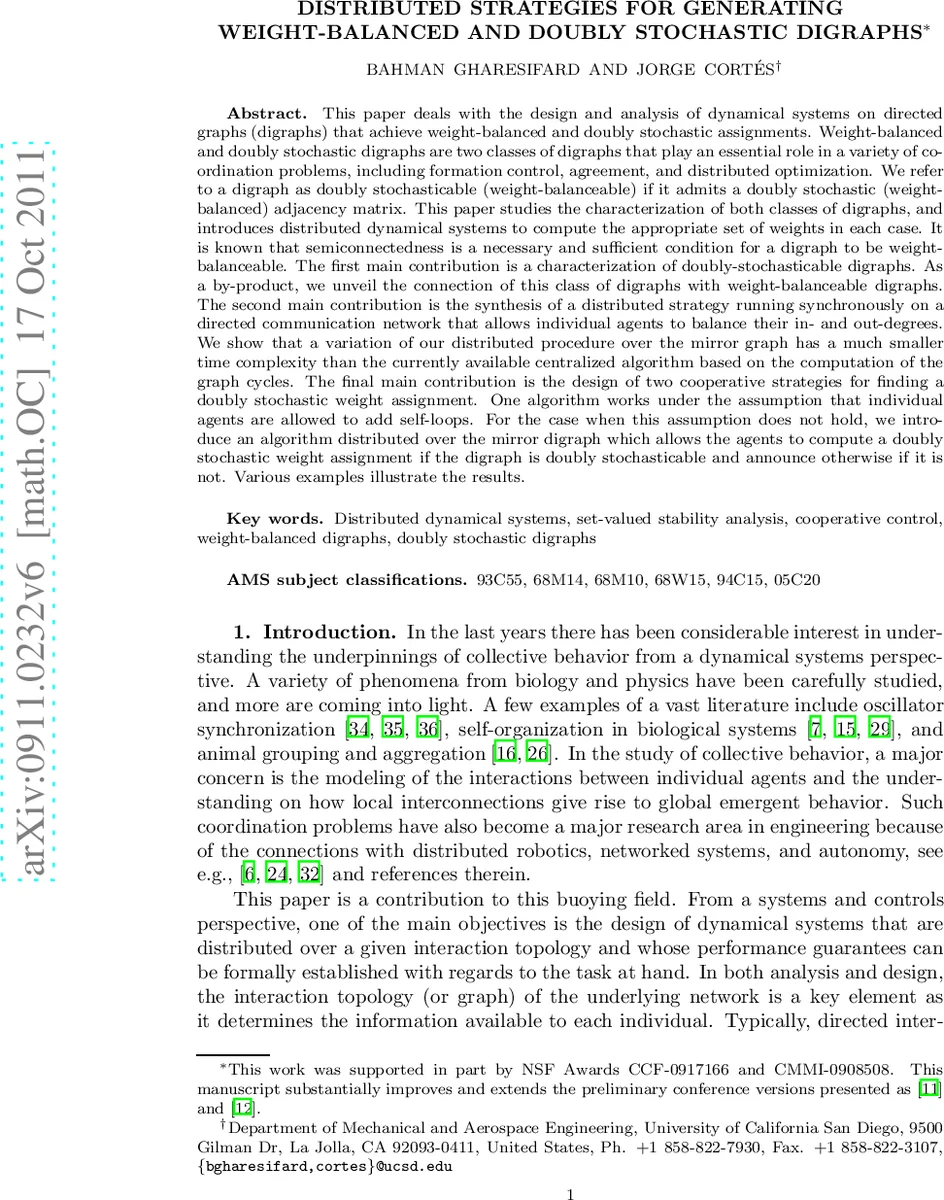
Weight-balanced and doubly stochastic digraphs are two classes of digraphs that play an essential role in a variety of cooperative control problems, including formation control, distributed averaging, and optimization. We refer to a digraph as doubly stochasticable (weight-balanceable) if it admits a doubly stochastic (weight-balanced) adjacency matrix. This paper studies the characterization of both classes of digraphs, and introduces distributed algorithms to compute the appropriate set of weights in each case.
💡 Research Summary
The paper investigates the conditions under which a directed graph (digraph) can be assigned a weight‑balanced or a doubly stochastic adjacency matrix, and it proposes fully distributed algorithms to achieve these assignments. It first revisits known results that a digraph is weight‑balanceable if and only if it is strongly semiconnected, i.e., every edge belongs to at least one directed cycle. This property guarantees that the sum of incoming and outgoing weights can be made equal at each vertex.
The authors then introduce a novel characterization of doubly stochastic‑able digraphs. While every doubly stochastic digraph is weight‑balanceable, additional constraints are required: the graph must admit a set of cycles whose weighted union yields row and column sums equal to one. To formalize the minimal such collection, they define the “principal cycle set,” the smallest family of (possibly disjoint) cycles that generates the whole graph. All principal cycle sets have the same cardinality, denoted p(G).
Three families of distributed algorithms are developed. The first, called the imbalance‑correcting algorithm, lets each node broadcast its current imbalance (difference between inbound and outbound weight sums) to its out‑neighbors and receive imbalances from its in‑neighbors. Using this local information, each node updates the weights on its incident edges. The process is synchronous and provably converges in finite time to a weight‑balanced configuration.
The second algorithm operates on the mirror digraph (the graph obtained by reversing all edge directions). By applying the same local update rule on the mirror, the authors obtain a “mirror imbalance‑correcting algorithm” whose time complexity is dramatically lower than the centralized cycle‑enumeration method of prior work, because it avoids explicit cycle detection.
For doubly stochastic assignments, two scenarios are considered. If self‑loops are allowed, a simple extension of the imbalance‑correcting procedure adds the remaining imbalance to each node’s self‑loop, thereby achieving row‑ and column‑stochasticity. When self‑loops are prohibited, the paper presents a “load‑pushing algorithm” executed on the mirror digraph. This algorithm mirrors the distributed solution of a maximum‑flow problem: each node pushes excess weight to its neighbors until all row and column sums equal one. The algorithm also serves as a distributed test for doubly stochasticability, announcing failure if the required flow cannot be established.
Complexity analysis shows that the proposed distributed methods run in O(n·d_max) time (n = number of nodes, d_max = maximum degree), a substantial improvement over the exponential cost of enumerating all cycles in the centralized approach. Numerical simulations confirm rapid convergence and exact satisfaction of the balance constraints.
Overall, the work bridges graph‑theoretic characterizations with practical distributed control, delivering scalable tools for applications such as consensus, distributed optimization, and network flow control that require weight‑balanced or doubly stochastic interaction topologies. Future directions suggested include extensions to integer‑weight settings, time‑varying topologies, and asynchronous implementations.
Comments & Academic Discussion
Loading comments...
Leave a Comment