Types are weak omega-groupoids
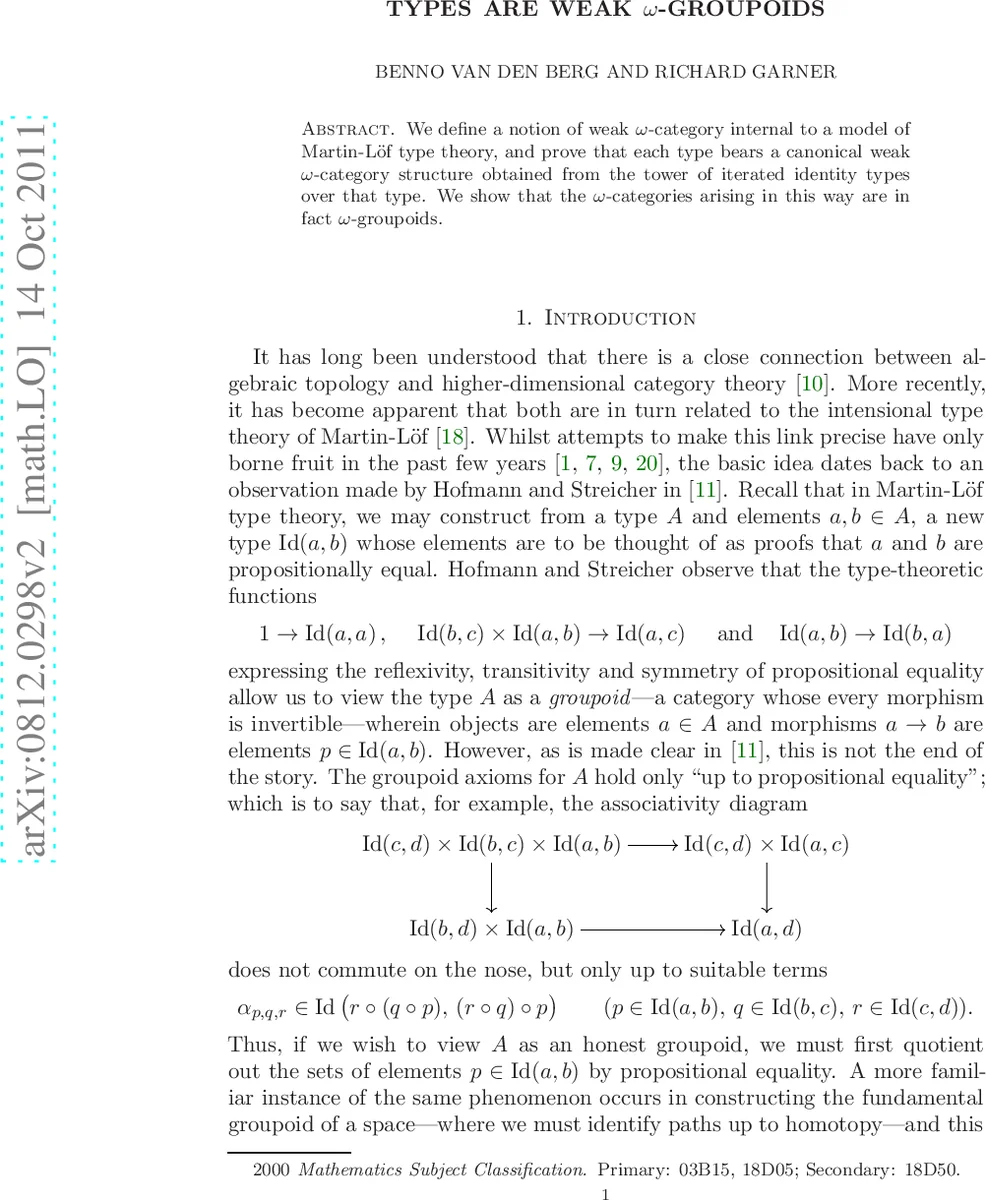
We define a notion of weak omega-category internal to a model of Martin-L"of type theory, and prove that each type bears a canonical weak omega-category structure obtained from the tower of iterated identity types over that type. We show that the omega-categories arising in this way are in fact omega-groupoids.
💡 Research Summary
The paper establishes a precise connection between intensional Martin‑Löf type theory and the theory of weak ω‑categories, showing that every type naturally carries the structure of a weak ω‑groupoid. The authors begin by recalling the long‑standing intuition that types behave like spaces and that identity types behave like paths, an idea first made explicit by Hofmann and Streicher. While the basic reflexivity, symmetry and transitivity operations on identity types give each type the structure of a groupoid at the level of 1‑cells, the higher coherence conditions only hold “up to propositional equality”, suggesting the need for a higher‑dimensional categorical structure.
To formalize this, the authors adopt Batanin’s globular‑operad approach to weak ω‑categories. A globular set supplies the underlying shape: a sequence of sets of n‑cells with source and target maps satisfying the globular equations. Strict ω‑categories are algebras for a monad T on globular sets, whose operations correspond to strict composition and identities. Weak ω‑categories are obtained by replacing T with a contractible, normalised globular operad P; normalisation guarantees that the 0‑cells are unchanged, while contractibility ensures that for any parallel cells there are enough higher‑dimensional operations to express all required compositions.
A weak ω‑groupoid is defined as a weak ω‑category in which every cell is weakly invertible. Weak invertibility is expressed via the existence of a dual (or equivalence) for each n‑cell: an (n+1)‑cell witnessing an “inverse” together with higher cells witnessing the triangle identities, all interpreted with respect to a chosen system of composition operations supplied by P.
The core of the paper then constructs, for any type A, a globular set A∞ whose n‑cells are the iterated identity types Idⁿ(A). The 0‑cells are elements of A, the 1‑cells are proofs a = b in A, the 2‑cells are proofs that two such proofs are equal, and so on. The source and target maps are the obvious projections from an identity type to its endpoints. Using the basic operations on identity types (reflexivity, symmetry, transitivity) the authors define, for each dimension n, a unit operation iₙ (the identity n‑cell) and a composition operation mₙ (the “concatenation” of parallel n‑cells). These operations satisfy the axioms required of a P‑algebra because the contractibility of P guarantees that any required higher cell can be built from the identity‑type constructors.
The main theorem is proved in two stages. First, the authors show that the iterated identity types together with the operations iₙ and mₙ give A∞ the structure of a P‑algebra for a contractible, normalised operad P; this uses the fact that the identity‑type constructors provide enough higher cells to satisfy the contractibility conditions. Second, they demonstrate that every n‑cell in A∞ has a dual. This is achieved by inductively constructing, for a given cell p : Idⁿ(a,b), a reverse cell q : Idⁿ(b,a) using symmetry, and then building the higher coherence cells η and ε from transitivity and the higher identity‑type eliminators. Because each level of identity types is itself a type, the construction can be iterated indefinitely, yielding duals at all dimensions.
Consequently, each type A becomes a weak ω‑groupoid: a weak ω‑category in which every cell is weakly invertible. This result provides a precise formulation of the homotopical intuition behind intensional type theory, confirming that the “paths‑up‑to‑paths” hierarchy of identity types exactly matches the structure of a weak ω‑groupoid. The paper also discusses the historical development of the idea, notes independent work by Lumsdaine, and points out that the proof is categorical in nature, contrasting with Lumsdaine’s more syntactic approach.
In the concluding remarks the authors emphasize the significance of the result for Homotopy Type Theory and for the broader program of interpreting higher‑dimensional categorical concepts inside type theory. By showing that every type carries a canonical weak ω‑groupoid structure, the work bridges the gap between algebraic topology, higher category theory, and constructive type theory, opening the way for further developments such as internal models of higher‑dimensional algebraic structures and formalised mathematics based on higher‑dimensional equivalences.
Comments & Academic Discussion
Loading comments...
Leave a Comment