A homotopy-theoretic universal property of Leinsters operad for weak omega-categories
We explain how any cofibrantly generated weak factorisation system on a category may be equipped with a universally and canonically determined choice of cofibrant replacement. We then apply this to the theory of weak omega-categories, showing that th…
Authors: Richard Garner
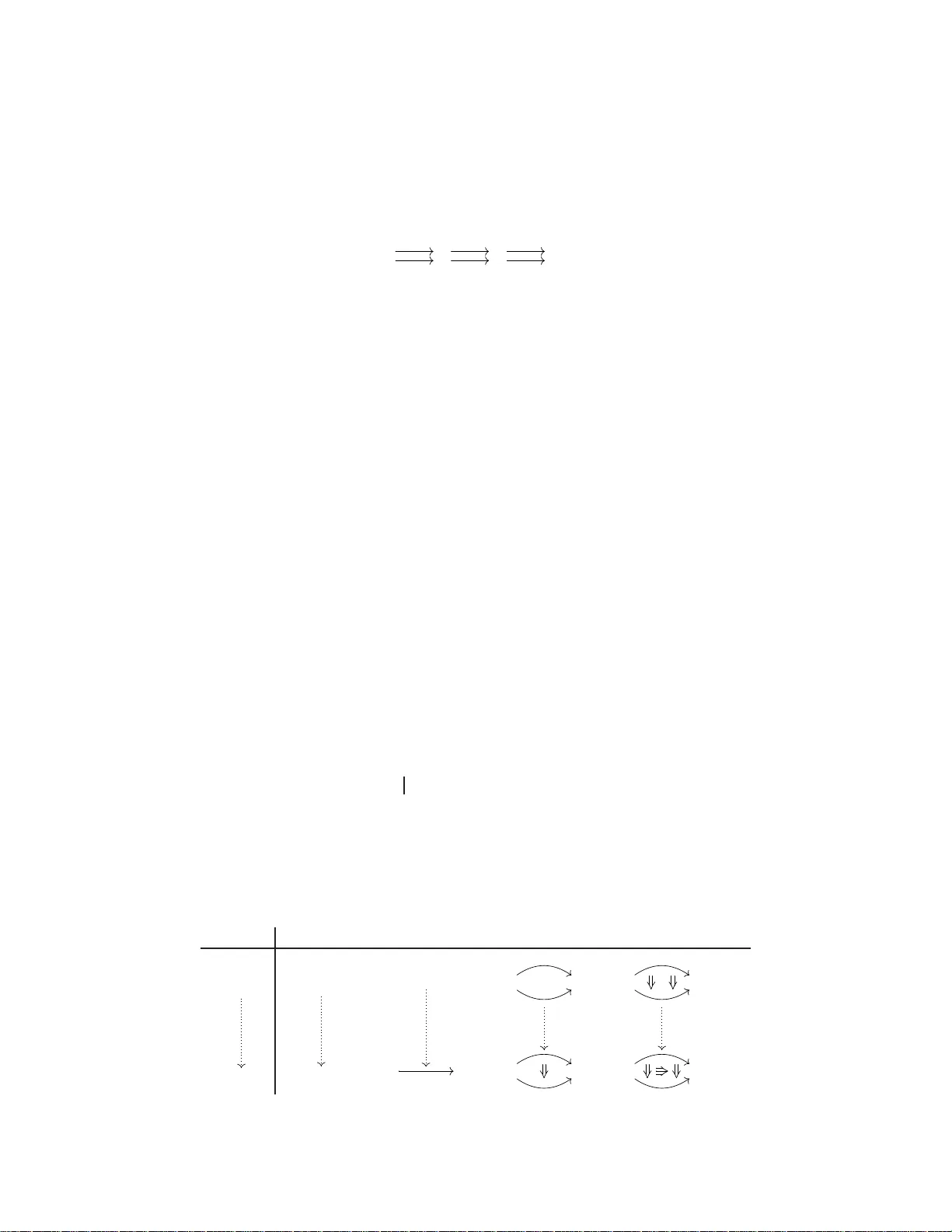
A HOMOTO PY-THEORETIC UNIVERSAL PR OPER TY OF LEINSTER’S OPERAD F OR WEAK ω -C A TEGORIES RICHARD GARNER Abstra ct. W e explain ho w an y cofibran tly generated we ak factorisation system on a category ma y be equipp ed with a univ ersally and canonical ly determined choice of cofi- brant replacemen t. W e then apply th is to the th eory of weak ω -categories, sho wing that the universal and canonical cofibrant replacement of the op erad for strict ω -categories is precisely Leinster’s op erad for wea k ω -categories. 1. Introduction One of th e most int eresting asp ects of m o dern h omotop y theory is the general mac hin- ery it p ro vides for replacing some piece of algebraic structur e with a “wea k ened” v ersion of that same s tr ucture. T he p ictur e is as f ollo ws: we b egin with a category C equipp ed with a notion of higher-dimensionalit y coming from a mo del structure in the s en se of Quillen [ 14 ]. W e n o w con template some n otion of algebraic theory on C : monads, op- erads, or La wv ere theories on C , for example. These algebraic theories themselve s form a category Th ( C ), and by making use of v arious transfer tec hniques we obtain a mo d el structure on Th ( C ) from th e one on C . No w, for a p articular algebraic theory T ∈ Th ( C ), w e obtain a w eak en ed v ersion of this theory by taking a cofibran t replacemen t for T in the categ ory Th ( C ). A cofibran t replacemen t is a generalised p ro jectiv e resolution: and so the effect this has is to transform eac h algebraic law satisfied b y the theory T into a piece of higher-dimen sional d ata witnessing the weak satisfaction of that same la w, with all this extra data fitting together in a coherent wa y . The remark able thing ab out this machinery is how little it requires to get going. All we need is a category C , a notion of algebraic structure, and a notion of higher-dimensionalit y; and for this last, w e do not ev en need a full m o del structure on C . A sin gle we ak factorisatio n s ystem [ 4 ] will d o, and f or a suffi cien tly well b eha v ed (typica lly , lo cally present able) C we ma y obtain this by using the small ob ject argum ent of Qu illen [ 14 ] and Bousfield [ 4 ]: f or wh ic h it suffices to s p ecify a set of generating higher-dimen sional cells in C , toge ther with their b oundaries and th e inclusions of the latter in to the former. Moreo ver, it is frequent ly the case that C = [ D op , Set ] for some Reedy category D [ 9 , 16 ], in whic h case we h a ve canonical notions of b oth c el l (the repr esen table preshea v es) and b oundary (arising from the Reedy structure). Y et this rather app ealing constru ction h as a problem, whic h arises when w e ask wh at “the” w eak ened v ersion of a particular algebraic theory T is. Beca use cofibr an t replace- men ts need not b e unique, ev en u p to isomorphism, we ma y only legiti mately talk of “a” w eak ened v ersion of T ; and so it b ecomes p ertinent to ask whic h one we c ho ose. The The author ackno wledges th e supp ort of a Marie Curie Intra-European F ellows hip, Pro ject No. 040802, and a Research F ellow ship of St John’s College, Cam bridge. 1 2 RICHARD GARNER usual answ er giv en is that we don’t really care, s ince all th e c h oices are essentially equiv- alen t: b ut since the p oint of b eing algebraic is in some sense to “pin do wn ev erything that can b e pinned d o w n”, it s eems p erv erse that we shou ld b e so h azy on this particular p oint . The obvio us solution is to m ake a defin ite c hoice of cofibrant replacemen ts in Th ( C ): and if – as is almost alwa ys the case – the weak factorisation system u nder consideration w as constru cted usin g the small ob ject argumen t, then it may b e equipp ed with su c h a c hoice. Y et the situation is not entirely s atisfacto ry f or t w o reasons. Firstly , the cofibrant replacemen ts we obtain are in no wa y canonical, since the ind uction which constr u cts them is go v erned b y some (sufficiently large) regular cardinal α , with different choic es of α leading to d ifferen t cofibran t replacemen ts. Secondly and more imp ortan tly , the cofibran t replace ments we obtain are neither particularly natural n or compu tationally tractable. In principle, it wo uld b e p ossible to reason ab out them by in duction; but in practic e, this w ould require some rather strange com binatorics of a natur e ent irely orthogonal to that of the mathematics one wa s tryin g to d o. Ho wev er, recen t w ork of Grandis & Tholen [ 8 ] an d the auth or [ 7 ] suggests a solution to this problem. Using th e results of [ 7 ], we ma y equip any reasonable (whic h is to sa y , cofibran tly generated) we ak factorisatio n system with a canonical and u niv ersal notion of cofibr an t replacement . The canonicit y says that we need sp ecify no additional information b ey ond the set of generating cells and b oundaries; whilst the un iv ersalit y tells us that the cofibrant r ep lacemen ts w e obtain are rather n atural, and in particular admit a straigh tforw ard calculus of in ductiv e reasoning. In this note, we fi rst exp lain the tec hnology b ehin d these universal cofibran t replace- men ts, and then illustrate their u tilit y b y means of an example dra wn from the stud y of wea k ω -catego ries . More sp ecifically , we consider Batanin’s theory of globular op er- ads [ 1 ], and b y using the mac hinery outlined ab o v e, obtain a ca nonical and univ ersal notion of cofibran t replacemen t for globular op erads. W e then sho w that applying this to th e globular op erad for strict ω -catego ries yields precisely the op erad singled out b y Leinster [ 13 ] as the op erad for wea k ω -categ ories. 2. Wea k f actorisa tion a nd cofibrant rep lacement 2.1. W eak factorisation systems. A we ak factorisat ion system [ 4 ] ( L , R ) on a cate- gory C is giv en b y tw o classes L and R of morp hisms in C whic h are eac h closed under retracts w hen viewe d as full su b categories of the arro w ca tegory C 2 , and w h ic h satisfy the t wo axioms of (i) factorisation : eac h f ∈ C ma y b e written as f = pi where i ∈ L and p ∈ R ; and (ii) we ak ortho gonality : for eac h i ∈ L and p ∈ R , we hav e i ⋔ p , where to sa y that i ⋔ p holds is to sa y that for eac h commutati v e square ( ⋆ ) U f i W p V g X w e m ay fi n d a filler j : V → W satisfying j i = f and pj = g . F or those weak factorisation systems th at w e will b e considerin g, the follo wing terminology will b e appropr iate: the maps in L we call c ofibr ations , and the maps in R , acyclic fibr ations . Supp osing C to A HOMOTOPY-THEO RETIC UNIVERSAL PR OPER TY. . . 3 ha v e an initial ob ject 0, w e sa y that U ∈ C is c ofibr ant just when the unique map 0 → U is a cofibration; and define a c ofibr ant r e plac ement for X ∈ C to b e a factorisation of the unique map 0 → X as a cofibr ation f ollo wed b y an acyclic fib ration: 0 − → X ′ p − → X . The principal to ol w e use for the construction of w eak factorisation sys tems is th e f ol- lo w ing resu lt, firs t pro v ed by Quillen in the fi nitary case [ 14 , Chapter I I, § 3] and in the follo win g transfinite form by Bousfi eld [ 4 ]. F or a mo d ern acco unt, see [ 10 ], for example. Prop osition 1 (The small ob ject argumen t) . L et C b e a lo c al ly pr esentable c ate gory, and let I b e a set of maps in C . Define classes of maps I ↓ and I ↓↑ by I ↓ := p ∈ C 2 j ⋔ p for al l j ∈ I and I ↓↑ := i ∈ C 2 i ⋔ p for al l p ∈ I ↑ . Then the p air ( I ↓↑ , I ↓ ) is a we ak factorisation system on C . W e call I the set of ge ner ating c ofibr ations f or ( I ↓↑ , I ↓ ), and giv en a m ap i : U → V in I , we call V a ge ner ating c el l and U its b oundary . T o say that a w eak f actorisati on system ( L , R ) is c ofibr antly gener ate d is to sa y that there is some set I for which ( L , R ) = ( I ↓↑ , I ↓ ). Observe that th is I will usually not b e u nique; ho w ev er, this is not a prob lem since w e t ypically b egin with the set I and generate the wea k f actorisati on system from it, rather than vice v ersa. 2.2. F unctorial w.f.s.’s. Giv en a w.f.s. ( L , R ) on a category C , it m a y b e the case that for eac h morphism f : X → Y of C , w e can p ro vide a c hoice X λ f − → K f ρ f − → Y of ( L , R ) factorisation for f . Supp ose this is so; then by w eak orthogonalit y , we kno w that for eac h square as on the left of the follo wing diagram, there exists a filler for the corresp onding square on the right : U h f W g V k X 99K U λ g .h λ f K g ρ g K f k .ρ f X . It ma y no w b e that we can c ho ose a diagonal filler K ( h, k ) : K f → K g for eac h such square: and that w e can do s o in s u c h a wa y that the assignations f 7→ K f and ( h, k ) 7→ K ( h, k ) underlie a fun ctor K : C 2 → C . If this is so, then the maps λ f and ρ f necessarily pr o vid e the comp onents of natural transf orm ations λ : cod ⇒ K and ρ : K ⇒ dom; and we call the triple ( K, λ, ρ ) so obtained a functorial r e alisation of ( L , R ). Prop osition 2. L et C b e a lo c al ly pr esentable c ate gory, and let I b e a set of maps in C . Then for e ach choic e of a sufficiently lar ge r e gular c ar dinal α , the smal l obje ct ar gument pr ovides us with a functorial r e alisation ( K ( α ) , λ ( α ) , ρ ( α ) ) of the we ak factorisation system ( I ↓↑ , I ↓ ) . 4 RICHARD GARNER The pro of falls out of the constru ction used in the sm all ob ject argumen t. The regular cardinal α that w e provide serv es to fix the length of the trans finite induction b y wh ic h factorisatio ns are co nstructed. Note that the functorial realisation w e obtain dep ends not only up on α but also up on the p articular set I of ge nerating cofibrations that w e c ho ose. Remark 3. It was sho wn in [ 17 , § 2.4] that the data ( K , λ, ρ ) for a functorial realisation completely determines the underlying w.f.s. ( L , R ). T o s ee this, we define t w o au x iliary functors L, R : C 2 → C 2 whose action on ob jects is giv en by L X f Y = X λ f K f and R X f Y = K f ρ f Y ; and tw o auxiliary natural transform ations Λ : id C 2 ⇒ R and Φ : L ⇒ id C 2 whose r esp ec- tiv e comp onen ts at f : X → Y are: Λ f = X f λ f K f ρ f Y id Y Y and Φ f = X λ f id X X f K f ρ f Y . W e m a y n ow show that a morp hism f : X → Y of C lies in R j u st when the map Λ f : f → Rf admits a retracti on in C 2 : which is to sa y that f is an algebra for the p oint ed endofunctor ( R, Λ). Dually , we ma y sho w that f lies in L just when the map Φ f : Lf → f admits a section: whic h is to sa y that f is a coalgebra for the cop ointe d endofunctor ( L, Φ). As a particular case of this last fact, if C h as an initial ob ject, then L : C 2 → C 2 restricts and corestricts to the coslice 0 / C ∼ = C to yield a c ofibr ant r eplac ement fu nctor Q : C → C together w ith a cop oin ting ǫ : Q ⇒ id C ; and n o w an an ob ject X ∈ C is cofibran t just wh en it ma y b e made int o a coalge bra f or ( Q, ǫ ); whic h is to sa y , jus t wh en ǫ X : QX → X admits a r etraction in C . 2.3. Nat ural w.f.s.’s. As we mentio ned in the Intro d uction, the fun ctorial realisations ( K ( α ) , λ ( α ) , ρ ( α ) ) that we obtain from the small ob ject argum en t are n ot ve ry intuitiv e. One w a y of rectifying this is through a f urther strengthening of the notion of wea k factorisatio n system. W e b egin from a w.f.s. ( L , R ) on a catego ry C together with a functorial r ealisati on ( K , λ, ρ ) thereof. No w , since in any w .f.s. the classes of L -map s and R -maps are closed und er comp osition, w e hav e fillers for squares of the follo wing form: X λ λ f λ f K λ f ρ f .ρ λ f K f ρ f Y and X λ f λ ρ f .λ f K f ρ f K ρ f ρ ρ f Y , and it m a y b e the case that w e can pro vide a c h oice of fillers σ f : K f → K λ f and π f : K ρ f → K f for eac h s u c h square; and that w e can do so in suc h a wa y that the A HOMOTOPY-THEO RETIC UNIVERSAL PR OPER TY. . . 5 morphisms Σ f : Lf → LLf and Π f : RR f → Rf of C 2 giv en by Σ f = X λ f id X X λ λ f K f σ f K λ f and Π f = K ρ f ρ ρ f π f K f ρ f Y id Y Y pro vide the comp onent s at f of natural trans f ormations Σ : L ⇒ LL and Π : R R ⇒ R . Under these circumstances, it may b e that R = ( R, Λ , Π) describ es a monad on C 2 , and L = ( L, Φ , Σ) a comonad; and that the natural transformation ∆ : LR ⇒ RL : C 2 → C 2 with comp onent s ∆ f = K f λ ρ f σ f X ρ λ f K ρ f π f K f describ es a d istributiv e la w [ 3 ] b etw een L and R . Under these circum stances, we will sa y that ( L , R ) is an algebr aic r e alisation of ( L , R ). The p airs ( L , R ) arisin g in this w a y are the natur al we ak f actorisatio n systems of [ 8 ]. Thou gh the requiremen ts for an algebraic realisation ma y app ear strong, they are in f act rather easily satisfied: Prop osition 4 (The refin ed small ob ject a rgument) . L et C b e a lo c al ly pr esentable c ate gory, and let I b e a set of maps in C . Then the we ak facto risation system ( I ↓↑ , I ↓ ) has an algebr aic r e alisation ( L , R ) . Pr o of. F or a full p ro of s ee [ 7 , Theorem 4.4]: we recall only the s alien t d etails here. W e b egin exactly as in th e small ob ject argument. Giv en a map f : X → Y of C w e consider the set S := ( j, h, k ) j : A → B ∈ I , ( h, k ) : j → f ∈ C 2 W e hav e a comm utativ e diagram P x ∈ S A x P x ∈ S j x h h x i x ∈ S X f P x ∈ S B x h h x i x ∈ S Y in C ; and ma y factorise this as P x ∈ S A x P x ∈ S j x h h x i x ∈ S X λ ′ f id X X f P x ∈ S B x K ′ f ρ ′ f Y where the left-hand square is a push out. The assignation f 7→ ρ ′ f ma y n o w b e extended to a fun ctor R ′ : C 2 → C 2 ; whereup on the map ( λ ′ f , id Y ) : f → R ′ f pro vid es the comp onent at f of a natur al transform ation Λ ′ : id C 2 ⇒ R ′ . W e no w obtain the m onad part R of the desired algebraic r ealisati on as the free monad on th e p oin ted endofun ctor ( R ′ , Λ ′ ). 6 RICHARD GARNER W e ma y construct this u sing the tec hn iqu es of [ 12 ]. T o obtain the comonad part L we pro ceed as follo ws. The assignation f 7→ λ ′ f underlies a fun ctor L ′ : C 2 → C 2 ; and a little manipulation shows that this functor in turn und erlies a comonad L ′ on C 2 . W e may no w adapt the free monad construction so that at the same time as it pro duces R f rom ( R ′ , Λ ′ ), it also pro du ces L fr om L ′ . The algebraic realisation of ( I ↓↑ , I ↓ ) giv en in Prop osition 4 satisfies a u niv ersal pr op ert y with resp ect to I wh ich d etermines it up to un iqu e isomorphism. Thus we refer to ( L , R ) as the universal algebr aic r e alisation of I . T o gi v e its u niv ersal prop ert y , we consider algebras for the m on ad R . F rom Remark 3 , we know that acyclic fibr ations coincide with algebras for the p oin ted endofunctor ( R, Λ): and so algebras for the monad R m ust b e acyclic fibrations equipp ed with certain extra data . The follo wing Prop osition mak es this precise. Prop osition 5. L et ( L , R ) b e the universal algebr aic r e alisation of a set of maps I as given in Pr op osition 4 . T o giv e an algebr a for the monad R on C 2 is to give a map p : W → X of C to gether with, for e ach i : U → V in I and c ommutative squar e U f i W p V g X a c hoic e of diagonal fil ler j : V → W , sub je ct to no further c onditions, whilst to giv e a morphism of R -algebr as is to give a map of C 2 which strictly c ommutes with the chosen liftings. Mor e over, this char acterisat ion of the c ate gory of R -algebr as determines the p air ( L , R ) up to unique isomorph ism. Pr o of. See [ 7 , Prop osition 5.4]. Dually , we ma y think of coalgebras for the comonad L as cofibrations equipp ed w ith extra data. Th ere is muc h less that can b e said ab out these at a general lev el: ho wev er, a go o d intuitio n is that if the cofibrations are retracts of relativ ely free things then the L -coalg ebras are the relativ ely free things of wh ic h they are r etracts. 1 Remark 6. Observe that f or an y alge braically realised w.f.s. ( L , R ) on a cat egory with initial ob ject, the chosen cofib ran t replacemen ts und er lie a c ofibr ant r eplac ement c omona d Q = ( Q, ǫ, δ ) whic h is the restriction and corestriction of L to the coslice under 0. The concept of a cofibr ant r eplacemen t comonad was fi rst considered by [ 15 ], though it shou ld b e noted that the comonads constructed there do not coincide with the ones obtained from Pr op osition 4 . Indeed, they are built u sing th e small ob j ect argum en t, and so suffer from th e same dep end ence up on a regular cardin al α that w e noted in Prop osition 2 . Example 7. Consider the category Ch ( R ) of p ositiv ely graded c hain complexes of R - mo dules, equip p ed with the set of ge nerating co fibr ations I := { ∂ y ( i ) ֒ → y ( i ) i ∈ N } . 1 The p roblem of ascertaining circumstances u nder which this intuition is va lid is closely related to the follo wing old problem: given an adjunct ion which is known to b e monadic, u nder which circumstances is it also comonadic? A HOMOTOPY-THEO RETIC UNIVERSAL PR OPER TY. . . 7 Here y ( i ) is the r epresen table c hain complex at i , with comp onen ts giv en by y ( i ) n = ( R if n = i or n = i − 1; 0 otherwise, and as differenti al, the id en tit y map R → R at stage i and the zero map elsewh er e. The c hain complex ∂ y ( i ) is its b oundary , whose comp onents are ∂ y ( i ) n = ( R if n = i − 1; 0 otherwise, and wh ose differentia l is ev erywhere zero. Since Ch ( R ) is lo cally finitely p resen table, we ma y app ly Prop osition 4 to obtain an alg ebraically realised w.f.s. ( L , R ). W e describ e the cofibran t replacemen t ǫ X : QX → X that this pr ovides for X ∈ Ch ( R ). The c hain complex QX will b e free in ev ery d im en sion; and s o it su ffices to sp ecify a set of fr ee generators for eac h ( QX ) i and to sp ecify wh ere eac h generator should b e sent by the differen tial d ′ i : ( QX ) i → ( QX ) i − 1 and the coun it ǫ i : ( QX ) i → X i . W e do this b y induction o v er i : • F or the b ase step, ( QX ) 0 is generated by the set { x x ∈ X 0 } , and ǫ 0 : ( QX ) 0 → X 0 is sp ecified by ǫ 0 ( x ) = x and d ′ 0 : ( QX ) 0 → 0 is the zero m ap ; • F or th e inductiv e step, ( QX ) i +1 (for i > 0) is generated by the set ( x, z ) x ∈ X i +1 , z ∈ ker d ′ i , ǫ i ( z ) = d i +1 ( x ) , whilst ǫ i +1 : ( QX ) i +1 → X i +1 and d ′ i +1 : ( QX ) i +1 → ( QX ) i are sp ecified by ǫ i +1 ( x, z ) = x and d ′ i +1 ( x, z ) = z . Note that, in particular, we m a y view an y R -mo d ule M as a c hain complex concentrate d in degree 0; w hereup on the ab o v e constru ction r ed uces to the usual b ar resolution of M . W e can charac terise a t ypical Q -coalgebra as b eing giv en by a chain complex X equipp ed with, for eac h i ∈ N , a sub set G i ⊂ X i for which the inclusion map G i ֒ → X i exhibits X i as the free R -mo dule on G i . 2.4. Constructions on w.f.s.’s. W e end this section by reviewing tw o s tandard tec h- niques for trans ferring w.f.s.’s b et w een categories th at w e sh all need in the s equel. In b oth cases, w e assum e the categ ory C is lo cally presen table, s o that w e may freely apply Prop osition 4 . F or th e first transf er tec hn ique, we consider passage to the slice. Prop osition 8. If ( L , R ) is a we ak factor isation system on C , and X ∈ C , then ther e is an induc e d we ak factorisatio n system ( L ′ , R ′ ) on C /X for which L ′ and R ′ ar e the pr eimages of L and R under the for getful functor U : C /X → C . If I is a set which c ofibr antly gener ates ( L , R ) , then the set I ′ of pr eimages of I under U gener ates ( L ′ , R ′ ) ; and if we let ( L , R ) and ( L ′ , R ′ ) denot e the universal algebr aic r e alisation s of I and I ′ , then ther e is a functor ˜ U : R ′ - Alg → R - Alg making the fol lowing diagr am a pul lb ack: R ′ - Alg ˜ U R - Alg ( C /X ) 2 U 2 C 2 . 8 RICHARD GARNER Pr o of. Mostly trivial; th e fin al part follo ws from the characte risation of R - Alg giv en in Prop osition 5 . Our second transfer tec hniqu e allo ws us to lift a cofibr an tly generated weak factorisa- tion system along a right adjoint f unctor. This p ro cess wa s fir st d escrib ed in the general con text of mo del categories by S jo erd Crans [ 6 ]. Prop osition 9. L et ( L , R ) b e a c ofibr antly gener ate d w.f.s. on C , and supp ose that F ⊣ G : D → C with D lo c al ly pr esentable. Then ther e is a w.f.s. ( L ′ , R ′ ) on D for which R ′ is the pr eimage of R under G . Mor e over, if I is a gener ating set f or ( L , R ) , then I ′ = { F i i ∈ I } is a ge ne r ating set for ( L ′ , R ′ ) ; and if we let ( L , R ) and ( L ′ , R ′ ) denote the universal algebr aic r e alisations of I and I ′ , then ther e is a functor ˜ G : R ′ - Alg → R - Alg making the fol lowing diagr am a pul lb ack: R ′ - Alg ˜ G R - Alg D 2 G 2 C 2 . Pr o of. The key observ ation is that there is a b ijection b et w een fillers for diagrams of the forms U i f GW Gp V g j GX and F U F i ¯ f W p F V ¯ g ¯ X , where ¯ f , ¯ g and ¯ denote the transp oses of f , g and j und er adjun ction. T h e remainin g details are straigh tforw ard. 3. Applica tion to th e theor y of we ak ω -ca te gories 3.1. The goal. By com bin ing the material of the previous section with the tec h niques outlined in the Introdu ction, we obtain a mac hinery that can w eak en algebraic structur es in a canonical wa y . In this s ection, we will use th is in the con text of Batanin’s theory of w eak ω -categories [ 1 ] to s h o w that the canonical weak ening of the theory of s tr ict ω -categories is precisely the theory of wea k ω -categ ories singled out b y Leinster in [ 13 ]. Suc h a r esult is strongly hinted at in the w ork of Batanin and Leinster (see in p articular the remarks follo w ing Lemma 8.1 of [ 1 ]), but is nev er sp elt out in detail; and so our r esu lt serv es as a clarification of th e relationship b et ween weak ω -categories and other kinds of w eak algebraic structure. 3.2. The ingredien t s. Recall that the k ey ingredien ts required for the mac hinery of the In tro duction are a base categ ory C ; a notion of higher-dimensionalit y on C arising from a w eak factorisation system; a category Th ( C ) of theories on C ; and a particular theory T ∈ Th ( C ) w e wish to wea k en. W e now describ e eac h of these four ingredien ts for our example. A HOMOTOPY-THEO RETIC UNIVERSAL PR OPER TY. . . 9 3.2.1. The b ase c ate gory. Our base category will b e the cate gory GSet of globular sets . This is the categ ory [ G op , Set ] of preshea v es o v er the glob e c ate gory G , whic h in turn ma y b e present ed as the fr ee category on th e graph 0 σ 0 τ 0 1 σ 1 τ 1 2 σ 2 τ 2 . . . sub ject to th e c o globularity e quations σ n +1 σ n = τ n +1 σ n and σ n +1 τ n = τ n +1 τ n for all n . Th us a globular set X ∈ GSet is given b y sets X n of n -c el ls together with source and target functions s n , t n : X n +1 → X n sub ject to th e globular ity e quations , wh ic h assert that the source and target n -cells of an y ( n + 1)-cell are parallel. 3.2.2. The we ak factorisation system. Our notion of higher-dimensionalit y on GSet will b e obtained by a R e e dy c ate gory tec hnique [ 16 ]. The definition of a Reedy catego ry is quite subtle—see [ 9 , Chapter 15] f or instance—but we will not need the full generalit y here. Rather, w e consider the sim p ler n otion of a dir e ct c ate g ory ; this b eing a small cat- egory A w hic h admits an identit y-reflecting functor dim : A → γ for some ord inal γ . F or suc h a category A , the presheaf category ˆ A := [ A op , Set ] comes equipp ed with canoni- cal notions of gener ating c el l and b oundary . The generating cells are the representable preshea v es y ( a ) := A (– , a ); whilst their b oun daries ∂ y ( a ) are giv en by the co end ∂ y ( a ) := b ∈A dim( b ) < dim( a ) Z A ( b, a ) · y ( b ) in ˆ A . The univ ersal prop erty of the displa y ed co end toge ther w ith the Y on ed a lemma induces a canonical map of presheav es ι ( a ) : ∂ y ( a ) → y ( a ); and s o w e obtain a set of generating cofib rations I := { ι ( a ) a ∈ A } . S ince an y presheaf category is lo cally finitely present able, w e ma y apply Prop osition 4 to obtain an algebraically realised w.f.s. on ˆ A generated b y the set I . The category G is a dir ect category , with γ = ω an d dim the uniqu e ident it y-on-ob jects functor G → ω ; and so applying the theory of the pr evious p aragraph yields the follo wing set of generating cofibrations in GSet : n 0 1 2 3 · · · ∂ y ( n ) ι ( n ) y ( n ) ∅ • • • • • • • • • • • • • 10 RICHARD GARNER W e ma y describ e the presh ea ves ∂ y ( n ) explicitly as follo w s . W e ha v e th at ∂ y (0) = 0 and ∂ y (1) = y (0) + y (0); w hilst eac h subsequent ∂ y ( n + 2) is obtained as the pu shout y ( n ) + y ( n ) [ y ( σ n ) , y ( τ n )] [ y ( σ n ) , y ( τ n )] y ( n + 1) y ( n + 1) ∂ y ( n + 2). The inclusion maps ι ( n ) : ∂ y ( n ) → y ( n ) are given by taking ι (0 ) : 0 → y (0) to b e th e unique map; taking ι (1) : y (0) + y (0) → y (1) to b e [ y ( σ 0 ) , y ( τ 0 )]; and taking eac h sub se- quen t ι ( n + 2) : ∂ y ( n + 2) → y ( n + 2) to b e the map in duced u s ing the univ ersal prop erty of pushout with resp ect to the comm utativ e s q u are y ( n ) + y ( n ) [ y ( σ n ) , y ( τ n )] [ y ( σ n ) , y ( τ n )] y ( n + 1) y ( σ n +1 ) y ( n + 1) y ( τ n +1 ) y ( n + 2). 3.2.3. The c ate gory of the ories. W e no w giv e our notion of theory on GSet . These w ill b e Batanin’s globular op er ads , which w ere introdu ced in [ 1 ]; though our presen tation of them will follo w that given in [ 13 ]. W e m ay see globular op erads as a generali- sation of Set -b ased op erads. Recall that we sp ecify a Set -based op erad b y giving a collect ion { O ( n ) n ∈ N } of basic n -ary op erations, together with data exp ressing ho w these operations comp ose together. The collection of basic n -ary op erations amoun ts to an ob j ect O of th e category C oll = [ N , Set ]: and an y such ob j ect induces a functor O ⊗ (–) : Set → Set give n b y O ⊗ X = X n O ( n ) × X n . In order for this f u nctor to und erlie a monad on Set , w e requ ire that O should b e a monoid with resp ect to the “su b stitution” tens or pro duct on Coll , wh ose unit is (0 , 1 , 0 , 0 , . . . ), and whose binary tensor is ( A ⊗ B )( n ) = X k ,n 1 ,...,n k n 1 + ··· + n k = n A ( n ) × B ( n k ) × · · · × B ( n k ). W e call su c h a monoid an op er ad ; and d efi ne an algebra for an op erad O to b e an algebra for the in duced monad O ⊗ (–) on Set . W e ma y sp ecify globular op erads and th eir algebras in a similar manner. First w e define the category GColl of collect ions of basic globular op erations. W e can p resen t this as the slice category GSet / p d, where p d is the globular set of p asting diagr ams . If we wr ite (–) ∗ for the free m onoid monad on Se t , then p d ma y b e defined inductiv ely by p d 0 = { ⋆ } an d p d n +1 = (p d n ) ∗ , with source and target maps giv en b y s 0 = t 0 = ! : p d 1 → p d 0 , s n +1 = ( s n ) ∗ and t n +1 = ( t n ) ∗ . Ho w ev er, we w ill prefer to view GC oll as [ A op , Set ], where A is the cate gory A HOMOTOPY-THEO RETIC UNIVERSAL PR OPER TY. . . 11 of elemen ts of p d. Any ob ject O ∈ [ A op , Set ] induces a functor O ⊗ (–) : GSet → GSet giv en b y ( O ⊗ X ) i = X π ∈ pd i O ( π ) × GSet ( ˆ π , X ), where ˆ π is the realisation of π as a globular set: see [ 13 , § 4.2] for more details. In order for this f unctor to u nderlie a monad on GSet , we require that O should b e a monoid with resp ect to the “sub stitution” tensor p ro duct on GC oll . A description of this tensor pro du ct ma y b e found in [ 13 , § 4.3], which we d o not rep eat since we do not need the details. W e cal l a monoid with resp ect to this tensor pro duct a globular op er ad ; and define an algebra for a globular op erad O to b e an algebra for the indu ced monad O ⊗ (–) on GSet . A globular op erad morphism is just a monoid m orphism in GColl ; and so w e obtain a categ ory GOp d of globular op erads. Ho wev er, there is a small subtlet y we m ust deal with. P art of the data for a globular op erad O is a set of 0-dimensional op er ations O ( ⋆ ), where ⋆ is the un ique elemen t of p d 0 . The op erad structure of O descends to a m on oid structur e on the set O ( ⋆ ); and an O -algebra structure on a globular set X d escends to a left action of O ( ⋆ ) on the set of 0-ce lls X 0 . But if a globular op erad O is to represent a theory of we ak ω -categories, then its monoid of 0-dimensional op erations s h ould b e tr ivial, since w e w an t the “free w eak ω -category” f unctor to b e bijectiv e on 0-cells. In order for the general mac h in ery to tak e accoun t of this fact, we tak e our category of theories to b e the category NGOp d of normalise d globular op er ads ; this is the full sub catego ry of GOp d whose ob jects are those globular op erads with O ( ⋆ ) a singlet on. The restriction to normalised globular op erads also pla y s a cen tral role in [ 2 ]. 3.2.4. The c andida te the ory. Th e fourth and fin al ingredien t w e requ ir e for our mac hinery is a theory T ∈ NGOpd whic h we wish to weak en. W e tak e this to b e the terminal globular op er ad T giv en by T ( π ) = 1 f or all π ∈ A . This emb o dies the theory of strict ω -categories, in the sense that the corresp onding m on ad T ⊗ (–) on GSet is the free strict ω -category monad. 3.3. The transfer. W e no w ha v e all the ingredien ts needed for our mac hinery . The first stage in applying it is to transfer the notion of higher-dimensionalit y from GSet to NGOp d . First we transf er fr om GSet to GColl ∼ = GSet / p d using Prop osition 8 . This yields a cofib r an tly generated w.f.s. on GSet / p d, with set of generating cofibrations I ′ := ∂ y ( n ) ι ( n ) π .ι ( n ) y ( n ) π p d n ∈ N , π ∈ p d n . If we view GColl instead as [ A op , Set ], th en this set I ′ has an alternativ e description. Indeed, A = el(p d) is another example of a direct categ ory so that the tec hnique describ ed in § 3.2.2 ma y b e applied; and it is easy to c heck that the set { ι ( π ) : ∂ y ( π ) → y ( π ) π ∈ A } so obtained coincides with I ′ . The next step is to transfer this w eak factorisation system from GC oll to NGOp d . W e ha v e adjunctions (1) NGOp d U ⊤ GOp d V F ⊤ GColl : H 12 RICHARD GARNER indeed, NGOp d , GO p d and GColl are catego ries of m o dels for essen tially-alg ebraic theories in the sens e of F reyd; and b oth U and V are induced b y forgetting essen tially- algebraic structure, and so hav e left adjoin ts. Essen tial algebraicit y also implies that NGOp d is lo cally finitely presentable, s o that w e may lift along V U us ing Prop osition 9 to ob tain an algebraically realised w .f.s. on N GOp d , with set of generating cofibrations I ′′ := { H F ( ι ( π )) π ∈ A } . 3.4. The result. W e are n o w r eady to giv e our main resu lt. W e write ( L , R ) for the unive rsal algebraic realisation of the set of generating cofib rations I ′′ in NGOp d ; and as in Remark 6 , w e write Q for the cofibrant r eplacemen t comonad asso ciated with ( L , R ). Theorem 10. App lying the c ofibr ant r eplac ement c omonad Q of NGOp d to the strict ω -c ate gory op er ad T yields the we ak ω -c ate g ory op er ad L define d by L einster in [ 13 , § 4] . In order to prov e this, we m ust first recall wh at Leinster’s op erad L is. Th e cen tral notion (cf. [ 13 , p . 139]) is that of a c ontr action on an ob j ect of C ∈ GColl . T o giv e this w e view C as a fu nctor A op → Set ; n o w for eac h π ∈ p d 1 , we define P π ( C ) to b e the set C ( s 0 ( π )) × C ( t 0 ( π )), whilst for eac h n > 2 and π ∈ p d n , w e defin e P π ( C ) to b e the pullbac k P π ( C ) C ( s n − 1 ( π )) ( s n − 2 ,t n − 2 ) C ( t n − 1 ( π )) ( s n − 2 ,t n − 2 ) C ( s n − 2 s n − 1 ( π )) × C ( t n − 2 s n − 1 ( π )). A c ontr action κ on C is no w giv en b y functions κ π : P π ( C ) → C ( π ) for eac h n > 1 and π ∈ p d n whic h render comm utativ e th e evident triangles P π ( C ) κ π C ( π ) C ( t n − 1 ( π )) × C ( s n − 1 ( π )). An y morphism f : C → D in GColl indu ces morph isms P π ( f ) : P π ( C ) → P π ( D ) for eac h n > 1 and π ∈ p d n , so that if κ and λ are con tractions on C and D r esp ectiv ely , we ma y sa y that f pr e se rve s the c ontr action ju st wh en f ( π ) .κ π = λ π .P π ( f ). W e no w d efine the catego ry O W C of op er ads with c ontr action to ha v e: • O b jects b eing pairs ( K , κ ), where K ∈ GOp d and κ is a con traction on U ( K ); • Morphisms f : ( K , κ ) → ( K ′ , κ ′ ) b eing maps f : K → K ′ of globular op erads for whic h U ( f ) p reserv es the con traction. The op erad L of Theorem 10 is no w defined to b e the un derlying op erad L of the in itial ob ject ( L, λ ) of OW C . Pr o of. First note that as w ell as a cofibr an t replacemen t comonad Q , w e also ha v e an “acyclic ally fibrant r eplacemen t monad” P on NGOp d , obtained b y r estricting and core- stricting R to the slice o v er T . T he ob ject Q ( T ) that w e are int erested in is giv en by the u niv ersally determined factorisation of the unique map I → T , wh ere I is the initial ob ject of NGOp d . But this is equally we ll a description of P ( I ). It follo ws that w e may c haracterise Q ( T ) as the un derlying n ormalised op erad of the initial P -algebra. A HOMOTOPY-THEO RETIC UNIVERSAL PR OPER TY. . . 13 Let us no w u se Prop ositions 5 , 8 and 9 to giv e an explicit description of the category of P -alge bras. Recall from § 3.2.2 the set of maps I = { ∂ y ( n ) → y ( n ) n ∈ N } in GSet . Let us write ( L GSet , R GSet ) for the corresp ond ing universally determined algebraic re- alisation, and P GSet / pd for the restriction and corestriction of R GSet to the slice o ver p d ∈ GSet . Prop ositions 8 and 9 no w tell us that we h a ve a pullbac k diagram P - Alg P GSet / p d - Alg NGOp d V U GSet / p d; whilst Prop osition 5 p ro vides us with an exp licit d escription of the category P GSet / pd - Alg . Putting these facts tog ether, we fin d that to give an ob ject of P - Alg is to giv e a nor- malised globular op erad C , together with c hosen fillers for every diagram of the form (2) ∂ y ( n ) ι ( n ) C c y ( n ) p d, where the arro w down the righ t is the u nderlying globular collection of C . Using the explicit construction of the map s ι ( n ) giv en in § 3.2.2 , we see that to giv e chosen fillers in ( 2 ) is trivial when n = 0 (b y n ormalisation of C ); and that for n > 1, it is pr ecisely to giv e the fu nctions κ π : P π ( C ) → C ( π ) d escrib ed follo wing the statemen t of Theorem 10 , and so amoun ts to giving a con traction on C . A similar argument sh ows that to giv e a morphism of P - Alg is to giv e a morphism of u n derlying normalised globular op erads C → D wh ic h p reserv es the con traction. Th us we obtain a pullbac k diagram (3) P - Alg ˜ U O W C NGOp d U GOp d . By the remarks at the start of the p ro of, we will b e done if we can s h o w that ˜ U sends the initial ob ject of P - Alg to the initial ob ject of OW C . No w, as w e noted in § 3.3, the functor U : NGOp d → GO p d has a left adjoint; an d an app lication of the ad j oin t lifting theorem [ 11 , Th eorem 2] sho ws that ˜ U also has a left adjoin t. Note th at here w e n eed the fact that P - Alg is again d escrib able in terms of essen tially-algebraic stru cture, and so co complete. F ur th ermore, ˜ U is f u lly faithful, b ecause U is and ( 3 ) is a pullbac k; and so we ma y identify P - Alg with a reflectiv e sub category of O W C . Th us w e w ill b e d one if we can sho w th at the initial ob ject ( L, λ ) of O W C lies in this reflectiv e sub catego ry; in other w ords, if w e can sho w that L is normalised. But this is kno wn to b e the case: see [ 5 ], for example. Remark 11. Note that th e restrictio n to normalised globular op erads is vital f or the ab o v e pr o of to go throu gh . Indeed, were w e to take the universal cofib ran t replacemen t for T in the categ ory GOp d r ather than NGOp d , then we w ould no longer obtain Leinster’s op erad L . By follo wing the steps of the ab o v e pr o of, we fi nd that what w e obtain in stead is the initial op erad-with-augmented-c on traction, where an augmente d 14 RICHARD GARNER c ontr action o n a collection C ∈ GColl is giv en by a co ntrac tion on C to gether with a c hosen elemen t of the set C ( ⋆ ) of 0-dimensional op erations. Th e initial op erad-with- augmen ted-con tr action is no longer normalised; and in fact, it is not h ard to sho w that its monoid of 0-dimensional op erations is the free monoid on one generato r. Referen ces [1] B a t anin , M . Monoidal globular categories as a n atu ral environmen t for th e theory of w eak n - categories. A dvanc es in Mathematics 136 , 1 (1998), 39–103. 2 , 8 , 10 [2] B a t anin , M., a nd Weber, M. A lgebras of higher op erads as enriched categories. Appli e d Cate gor- ic al Structur es 19 , 1 ( 2011), 93–135. 11 [3] B eck, J. Distributive laws . In Semi nar on T ripl es and Cate goric al Hom ol o gy The ory (ETH, Z¨ urich, 1966/67) , vol. 80 of L e ctur e Notes in Mathematics . S pringer, 1969, pp . 119–140. 5 [4] B ousfield, A. Constructions of factorization systems in categories. Journal of Pur e and Applie d Algeb r a 9 , 2-3 (1977), 207–220. 1 , 2 , 3 [5] C heng, E. Monad interlea v ing: a construct ion of the op erad for Leinster’s wea k ω -categories. Jour- nal of Pur e and Applie d Algebr a 214 (2009), 809–821. 13 [6] C rans, S. Quillen closed mo del structures for sheav es. Journal of Pur e and Applie d Algeb r a 101 (1995), 35–57. 8 [7] G arner, R. U nderstanding the small ob ject argument. Applie d Cate goric al Structur es 17 , 3 ( 2009), 247–285 . 2 , 5 , 6 [8] G randis, M., and Tholen, W. Natural weak factorization systems. Ar chivum Mathematicum 42 , 4 (2006), 397–408. 2 , 5 [9] H irschhorn, P. S. Mo del c ate gories and their lo c ali zations , vol. 99 of Mathematic al Surveys and Mono gr aphs . American Mathematical So ciet y , 2003. 1 , 9 [10] Hovey, M. Mo del c ate gories , vol. 63 of Mathematic al Surveys and Mono gr aphs . American Mathe- matical So ciety , 1999. 3 [11] Johnstone, P. T. Ad join t lifting t heorems for categories of algebras. Bul letin of the L ondon Math- ematic al So ciety 7 , 3 (1975), 294–297. 13 [12] Kell y , G. M. A u nified treatment of t ransfinite constructions for free algebras, free monoids, col- imits, associated sheav es, and so on. Bul letin of the Austr alian Mathematic al So ciety 22 , 1 ( 1980), 1–83. 6 [13] Lei nster, T. O p erads in higher-dimensional catego ry theory . The ory and Applic ations of Cate gories 12 , 3 (2004), 73–194. 2 , 8 , 10 , 11 , 12 [14] Qui llen, D. G. H om otopic al algebr a , v ol. 43 of L e ctur e Notes in Mathematics . Springer-V erlag, 1967. 1 , 3 [15] Rad ulescu-Banu, A. Cofibr anc e and C om pletion . PhD thesis, MIT, 1999. 6 [16] Re edy, C. Homotopy theory of model categories. Unp ublished note, a v ailable at http://www - math.mit.edu/ ~ psh/ , 1974. 1 , 9 [17] Rosick ´ y, J., and Tholen, W. Lax factorization algebras. Journal of Pur e and Applie d Algebr a 175 ( 2002), 355–382 . 4 Dep ar tment of Pure Ma thema tics and Ma the ma tical S t a tistics, Wilberfor ce Ro ad, Cam - bridge CB3 0WB , UK E-mail addr ess : rhgg2@cam.ac.uk
Original Paper
Loading high-quality paper...
Comments & Academic Discussion
Loading comments...
Leave a Comment