Diversity Order Vs Rate in an AWGN Channel
We study the diversity order vs rate of an additive white Gaussian noise (AWGN) channel in the whole capacity region. We show that for discrete input as well as for continuous input, Gallager's upper bounds on error probability have exponential diver…
Authors: Anusha Gorantla, Vinod Sharma
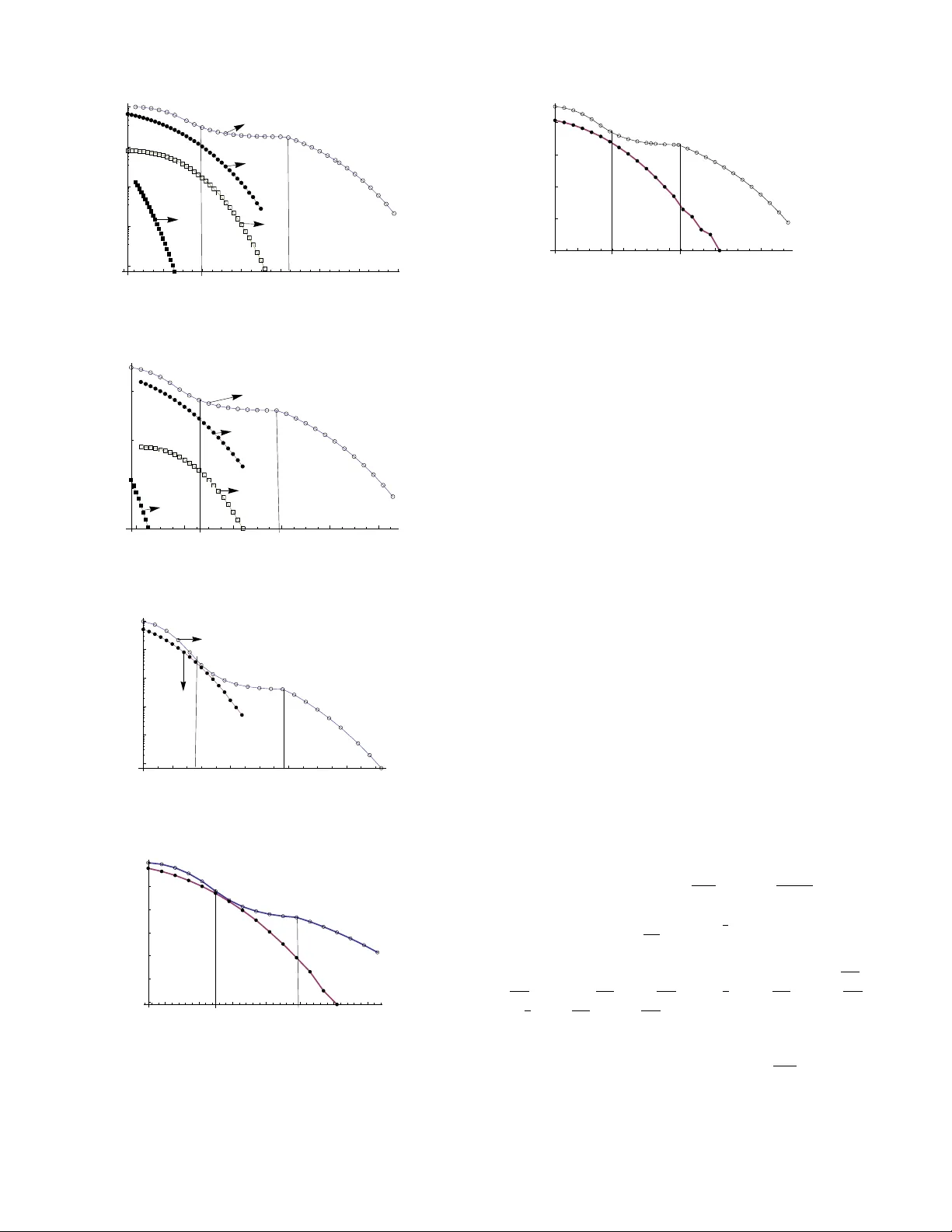
Div ersity Order Vs Rate in an A WGN Channel Anusha Gorantla and V inod Sharma Department of Electrical Communication Engineering Indian Institute of Science, Bangalore 560012, India Email: { anusha,vinod } @ece.iisc.ernet.in Abstract —W e study the diversity order vs rate of an additive white Gaussian noise (A WGN) channel in the whole capacity region. W e show that for discrete input as well as for con- tinuous input, Gallager’ s upper bounds on error probability hav e exponential diversity in low and high rate region but only subexponential in the mid-rate region. For the best available lower bounds and f or the practical codes one observes exponential diversity thr oughout the capacity r egion. Howev er we also show that performance of practical codes is close to Gallager’ s upper bounds and the mid-rate subexponential di versity has a bearing on the perf ormance of the practical codes. Finally we sho w that the upper bounds with Gaussian input pro vide good approxima- tion throughout the capacity region even for finite constellation. Index T erms — A WGN channel, error exponents, di versity order , Gallager’ s upper bounds, exponential diversity , subex- ponential div ersity . I . I N T R O D U C T I O N In an additiv e white Gaussian noise (A WGN) channel, the bit error rate (BER) decreases exponentially with signal to noise ratio (SNR) for v arious error correcting codes and modulation schemes ([6],[17]) for high signal to noise ratios. Howe ver , this div ersity order (rate of decay of BER with SNR) also depends upon the transmission rate. The fundamental tradeoff between div ersity order and the transmission rate (con verted to multiplexing gain by normalization with the rate of a standard A WGN channel) was first inv estigated in the seminal paper [18] for slow fading channel. In [7], [9] a different approach is taken. The authors consider A WGN and fast fading channels, BPSK modulation and use error exponents to obtain diversity rate tradeof f for systems with channel state information (CSI) at the transmitter and receiver . Div ersity order in [7], [9] is defined as the slope of the av erage error probability vs SNR at a particular SNR. At high SNR it can be approximated by the slope of the outage probability vs SNR as defined in [10] and [18]. It is sho wn in [7], [9] that the capacity re gion can be di vided in three regions (as in [3] and [14]). The div ersity order can be qualitativ ely dif ferent in the three regions. In particular , it was shown that in low and high rate region the block error probability decreases exponentially with SNR while for the medium rate region the decrease is polynomial. These results were observed for an A WGN channel (without fading) also. These results, not reported before, beg the following questions. Are these results specific to BPSK only? Since these results are observed for upper bounds, do they also hold for practical coding and modulation schemes? Do the lower bounds satisfy these unusual characteristics? The present study is motiv ated by these questions. Theoretically and via extensi ve computations and simulations we provide answers to some of these questions. In this paper we limit ourselv es to an A WGN channel. In future work we will report our in vestig ations on fading channels. In the literature there has been much work on the upper and lower bounds on error probability for an A WGN channel. The upper bound on av erage decoding error probability with and without input constraints is giv en by Gallager in [3], [4]. This upper bound depends on the input distribution and the constellation used for the modulation. In [5], the optimal constellation is deriv ed by maximizing the error exponent in the upper bound. These have been studied for continuous inputs also with av erage and peak power constraints on the input distribution (Chap.7, [3]), [4]. The advantage of these upper bounds is that they are independent of the constellation and the modulation used. The lower bounds are also extensi vely studied in the lit- erature. Broadly there are two types of lower bounds on the probability of decoding error . The sphere packing lo wer bounds (SPB) are lower bounds for all block codes [16], [12], [15]. Another type of lower bounds depend on the distance spectrum of codes (for specific codes, not ensembles) with BPSK input [13]. The classical sphere packing lower bound on the probability of error are Shannon’ s lower bound (SP59) for continuous input and large block lengths [11] and Shannon, Gallager , Berlekamp’ s lower bound (SP67) [12] on probability of error for a discrete input and discrete output channel. V alembois and Fossorier [15] extended the lo wer bound (SP67) to a continuous output channel. An Impro ved sphere packing lower bound (ISP) obtained is [16] for a discrete input and symmetric output channel. Thus presently for continuous input, the tightest lower bound is Shannon’ s 1959 bound [11] while for discrete input and continuous output it is ISP [16]. The error exponents for the upper and lo wer bounds ([3], [4]) are equal in the high rate region (re gion 3) but not in region 2 (mid rate region) and region 1 (low rate region). In a small fraction of re gion 2, Burnashe v [1] has shown that the error exponents for the upper and lower bounds are equal. Even though the error exponents are equal in high rate region (region 3), the corresponding bounds on probability of error are not tight for finite block lengths ev en in region 3. In this paper , we study the di versity order of an A WGN channel with M-ary PSK (BPSK, QPSK, 8 PSK, 16 PSK), optimum constellation and continuous constellation. W e show that the distance spectrum lo wer bounds and Gallagher’ s upper bounds are close to the simulated v alues for probability of error of practical codes. In fact for large block length the Gal- lagher’ s upper bounds can be quite close to the performance of the practical codes. Therefore, we study the div ersity order of these bounds closely . Although we observe exponential div ersity in most of the capacity region, there is a polynomial div ersity in a significant rate re gion of practical importance for all the constellations stated abov e. This paper is organized as follows. Section II deals with discrete input constellation. In this section, we provide the results for M-ary and optimum constellation. The results ob- tained from upper bounds are supported with lo wer bounds and simulations. In section III, results are provided for continuous constellation. Section IV concludes the paper . I I . D I S C R E T E I N P U T W e consider an A WGN channel with input X and output Y where Y = X + W and W is independent of X with Gaussian distribution with mean zero and variance σ 2 . In the follo wing we take X with v alues in a finite alphabet χ . W e study the upper and lo wer bounds on probability of error for different constellations and compare with the performance of practical codes. A. M-ary PSK 1) Upper Bound on Pr obability of Err or: Consider a block coded communication system with block length n and rate R . The upper bound on probability of error ([3], [14]) is giv en by P e < min ρ ≥ 1 exp − n E x ( ρ ) − ρ ( R + ln4 n ) , if R ∈ Region 1 exp { n [ E o (1) − R ] } , if R ∈ Region 2 min 0 ≤ ρ ≤ 1 exp {− n [ E o ( ρ ) − ρR ] } , if R ∈ Region 3 (1) where E o ( ρ ) = − ln Z y " X x q ( x ) p ( y /x ) 1 1+ ρ # 1+ ρ dy , (2) E x ( ρ ) = − ρ ln ( X x X x 0 q X ( x ) q X ( x 0 ) . Z y p p ( y | x ) p ( y | x 0 ) dy 1 /ρ ) (3) and q = { q ( a 1 ) , q ( a 2 ) , ...q ( a Q ) } is an arbitrary distribution vector over the finite input alphabet X . The three rate regions are as follows: Re gion 1 is 0 ≤ R ≤ ∂ E x ∂ ρ | ρ =1 − ln4 n , region 2 is { ∂ E x ∂ ρ | ρ =1 − ln4 n ≤ R ≤ ∂ E o ∂ ρ | ρ =1 } and region 3 is { ∂ E o ∂ ρ | ρ =1 ≤ R ≤ ∂ E o ∂ ρ | ρ =0 } . For M-ary PSK modulation (usually considered in literature [16], [2]), the signal points are equally spaced on a circle. The modulation symbols have equal ener gy (say 1). W e treat the channel input X and output Y as 2 dimensional real vectors. The input X = ( x 1 , x 2 ) takes values ( x 1 , x 2 ) = (cos θ k , sin θ k ) where θ k = 2 π k M , k = 0 , 1 , · · · , M − 1 . 2) Lower Bound on Pr obability of Err or: W e consider two lower bounds. One is the classical sphere packing lower bound (ISP). The other is a lower bound based on improvements on the de Cane’ s inequality pro vided in [2]. The second bound is complex to e valuate for large codes. If we specialize it to BPSK modulation, the resulting bound depends on the code only through its weight enumeration (distance spectrum of the code) and is easier to ev aluate. Thus we use the improved ISP bound from [16] and distance spectrum bound from [2]. These are currently the best av ailable lower bounds. 3) Numerical Results: In this section, we numerically ev al- uate the upper bound and the lower bounds described above. W e also compare these bounds with simulation results for practical codes. W e study the di versity-rate tradeof f for M-ary PSK input with uniform distribution. W e also simulate the communi- cation system with BCH encoding and decoding techniques with M-ary PSK modulated signals to ev aluate the block error probability . These are well kno wn codes and were selected for their good performance in dif ferent applications (e.g., in header-error protection of A TM cells and V ideo codec for audio visual services [8]). In Figs.1-5, we plot logarithm of probability of error vs logarithm of SNR (dB) for BPSK, 8PSK and 16 PSK modulation schemes. W e also provide simulations for BCH codes. The three rate regions are demarcated by vertical lines. W e observ e (Figs.1-5) from the upper bound that the decay of probability of error with SNR is exponential in region 3, changes to polynomial in region 2 and then again to exponential in region 1. Similar trend was also seen in [9] for BPSK. This is an interesting result because for an A WGN channel, the probability of error for practical modulation and coding schemes ([6],[17]) is upper bounded in terms of summation of K 1 Q K 2 √ S N R functions where K 1 and K 2 depend on the modulation and coding scheme. There is no closed form expression for the Q ( . ) function. From the approximate formulae [6], one observes the exponential decay of probability of error with respect to SNR. But, this approximation is v alid only for high SNR. In our Figures, we consider both high and low SNR rate re gions. For our BCH simulation results also we see only exponential decay . W e do not see similar changes of slope (as for the upper bounds) for the lower bounds Figs 1, 2. There is exponential decay throughout. For BPSK modulation, in Fig.1 and 2 for different block lengths and rates, we observe that the simulations are closer to the upper bound in region 3 and part of region 2. The ISP lo wer bound is very far of f while the distance spectrum lower bound is closer . From Figs.4 and 5, we observe that ev en for higher modulation schemes the Upper bound on Pe Simulation (31,26) BCH code Distance Spectrum Dependent Lower Bound ISP lower bound 2 4 6 8 10 12 14 16 SNR H dB L 10 - 6 10 - 4 0.01 1 Pe Pe Vs SNR N = 31 R = 0.83871 Fig. 1. Upper bound on Pe, Lower Bounds( Distance Spectrum Dependent and ISP bounds ) and Simulations of BPSK Modulation with BCH code Upper bound on Pe Simulation BCH (63,57) Distance Spectrum Dependent Lower Bound ISP lower bound 4 6 8 10 12 14 SNR H dB L 10 - 5 0.001 0.1 Pe Pe Vs SNR : N = 63 R = 0.904762 Fig. 2. Upper bound on Pe and Simulations of BPSK Modulation with BCH code Gallager's Upper Bound Simulation of BCH (255,247) code 6 8 10 12 SNR H dB L 10 - 4 0.001 0.01 0.1 1 Pe Pe Vs SNR N = 255 R = 0.9686275 Fig. 3. Upper bound on Pe, Lower Bounds (Distance Spectrum Dependent and ISP bounds ) and Simulations of BPSK Modulation with BCH code Region 3 Region 2 Region 1 Block Length=255 Rate=0.968 bps 16 17 18 19 20 21 22 SNR H dB L 10 - 5 10 - 4 0.001 0.01 0.1 1 Pe Pe Vs SNR Fig. 4. Upper bound on Pe and Simulations of 8 PSK Modulation with BCH code upper bound is quite close to the simulated values in region 3 and upper part of region 2. Fortunately , these are the regions Region 3 Region 2 Region 1 Block Length=255 Code Rate=0.968 bps 22 24 26 28 30 SNR H dB L 10 - 7 10 - 5 0.001 0.1 Pe Pe Vs SNR Fig. 5. Upper bound on Pe and Simulations of 16 PSK Modulation with BCH code of most practical interest. For BPSK, 8 PSK and 16 PSK modulation schemes, the region 2 is 2.5 dB for block length 255 and coding rate 0.968 bps. From Figs.1-5, we also observe that the simulated curve for the BCH codes decay exponentially throughout but the error exponents for them are smaller than for the upper bound in region 3. The non-exponential upper bounds in region 2 seem to hav e an effect on this. One of the applications of an A WGN channel without f ading is a wireline channel. The ITU-T recommendation G.821 for bit error rate (BER) for data circuits is 10 − 5 and for telegraph circuits is 10 − 4 . For BER P eb = 10 − 4 and R = 0 . 968 bps, we get P e = 0 . 03 . In Fig.2, we consider BPSK modulation with n = 255 and R = 0 . 968 bps. In this case, Region 3 is 5 − 7 dB where P e values are from 0 . 96 to 0 . 028 and Region 2 is 7 − 10 dB where P e values are from 0 . 028 to 0 . 0025 . Thus, the region 3 and upper part of region 2 are regions of practical interest. This is the region for which we hav e obtained interesting ne w properties for the upper bound and this is also the region where these bounds are close to the BER of practical codes. Thus in the rest of the paper we will focus on upper bounds and theoretically show the interesting div ersity-rate tradeoff observed in this section. 4) Theoretical Results for upper bounds: W e study the div ersity order for the upper bounds in all the three rate regions for M-ary PSK. These results support the numerical results provided in the last section. Consider region 1. For M − ary E x ( ρ ) = − ρ ln M − 1 X i =0 M − 1 X j =0 1 M 2 exp − η K i,j ρ > − ρ ln 1 M 1 + Z − 1 ρ 1 (4) where η is snr, K i,j = 4( b 2 1 + b 2 2 ) − ( a 2 1 + a 2 2 ) , a 1 = cos 2 π i M + cos 2 π j M a 2 = sin 2 π i M + sin 2 π j M , b 1 = 1 2 cos 2 2 π i M + cos 2 2 π j M , b 2 = 1 2 sin 2 2 π i M + sin 2 2 π j M and Z 1 = exp [ K η ] with K = min i,j K i,j where i, j = 1 , · · · , M − 1 . Therefore, P e < exp − n sup ρ ≥ 1 [ E x ( ρ ) − ρ R + ln 4 n ] (5) The optimal ρ is obtained by taking the deriv ative of the term in square brack et in Eq. (5) and equating to zero. Then the RHS of (5) becomes exp [ − nδ ( R ) η ] (6) where δ ( R ) is a root of equation, R + ln 4 n = ln M − H ( δ ) and H ( x ) = − x ln x − (1 − x ) ln(1 − x ) . These equations are valid for 0 ≤ R ≤ ln M − H ( Z 1 ) . Therefore, exponential div ersity order (i.e., upper bounds decay exponentially with snr η ) is observed in region 1. Consider region 3. For M − ary PSK, E o ( ρ ) = − ln n 2 − ρ 2 − 1 π ρ/ 2 p ρ + 1 ( ρ + 1) σ 2 ρ/ 2 o − ln Z y e − ( y − 1) 2 2( ρ +1) σ 2 √ 2 π p ( ρ + 1) σ 2 + e − ( y +1) 2 2( ρ +1) σ 2 √ 2 π p ( ρ + 1) σ 2 ρ +1 dy (7) W e hav e 0 ≤ ρ ≤ 1 and | x | 1+ ρ < | x | for | x | < 1 . Therefore, for 1 / p 2 π σ 2 (1 + ρ ) < 1 / 2 ( 1 /σ 2 < π ), E o ( ρ ) ≥ − ln π 2 ρ/ 2 p ρ + 1 ( ρ + 1) σ 2 ρ/ 2 (8) Let ˜ E o ( ρ ) = − ln π 2 ρ/ 2 p ρ + 1 ( ρ + 1) σ 2 ρ/ 2 (9) At the optimal ρ , maximizing ˜ E o ( ρ ) − ρR R = ∂ ˜ E o ( ρ ) ∂ ρ = 1 2 − ln π ( ρ + 1) σ 2 − 1 + ln 2 (10) which implies ρ = 2 e − 2 R − 1 π σ 2 − 1 (11) By multiplying Eq. (10) by ρ and comparing with Eq. (9) and also from Eq. (11), we get ˜ E o ( ρ ) − ρR = R + 1 2 − 1 2 ln 1 2 π σ 2 + ρ 2 (12) = e − 2 R − 1 π σ 2 + R + 1 2 ln(2 π σ 2 ) (13) If snr= η = 1 /σ 2 , then P e < e − n ( ˜ E o ( ρ ) − ρR ) (14) = exp − n η e − 2 R − 1 π + R + 1 2 ln 2 π η (15) = η 2 π n 2 exp − n η e − 2 R − 1 π + R (16) Therefore, we observe exponential div ersity in region 3 for η < π ≈ 11 . 45 dB. Next, consider the case η > π , E o ( ρ ) = − ln n 2 − ρ 2 − 1 π ρ/ 2 p ρ + 1 ( ρ + 1) σ 2 ρ/ 2 o − ln { I 1 + I 2 } (17) where I 1 = Z M 1 y = − M 1 e − ( y − 1) 2 2( ρ +1) σ 2 √ 2 π p ( ρ + 1) σ 2 + e − ( y +1) 2 2( ρ +1) σ 2 √ 2 π p ( ρ + 1) σ 2 ρ +1 dy , (18) I 2 = 2 Z ∞ y = M 1 e − ( y − 1) 2 2( ρ +1) σ 2 √ 2 π p ( ρ + 1) σ 2 + e − ( y +1) 2 2( ρ +1) σ 2 √ 2 π p ( ρ + 1) σ 2 ρ +1 dy = 2 √ 2 π σ 2 1 p 2 π σ 2 (1 + ρ ) ! 1+ ρ Q M 1 − 1 σ (19) and M 1 is such that e − ( M 1 − 1) 2 2( ρ +1) σ 2 √ 2 π p ( ρ + 1) σ 2 = 1 2 (20) which implies M 1 = 1 + r ( − ρ − 1) σ 2 ln π ( ρ + 1) σ 2 2 (21) = 1 + s ρ + 1 η ln 2 η π ( ρ + 1) (22) For η 1 ≤ η ≤ η 2 , M l, 1 ≤ M 1 ≤ M u, 1 (23) where M l, 1 = 1 + r 1 η 2 ln η 1 π (24) and M u, 1 = 1 + r 2 η 1 ln 2 η 2 π (25) Also, I 1 ≤ 2 M 1 2 p 2 π σ 2 (1 + ρ ) ! 1+ ρ (26) and I 2 ≤ 2 √ 2 π σ 2 1 p 2 π σ 2 (1 + ρ ) ! 1+ ρ Q M 1 − 1 σ (27) For 0 ≤ ρ ≤ 1 and Eq. (23), we get I 1 ≤ 4 √ 2 M u, 1 η /π and I 2 ≤ p η / (4 π ) exp[ − η ( M l, 1 − 1) 2 / 2] E o ( ρ ) ≥ − ln n 2 − ρ 2 − 1 π ρ/ 2 p ρ + 1 ( ρ + 1) σ 2 ρ/ 2 o − ln ( 4 √ 2 M u, 1 η π + r η 4 π exp − η ( M l, 1 − 1) 2 2 ) (28) Let ˜ E o ( ρ ) = − ln n 2 − ρ 2 − 1 π ρ/ 2 p ρ + 1 ( ρ + 1) σ 2 ρ/ 2 o − ln ( 4 √ 2 M u, 1 η π + r η 4 π exp − η ( M l, 1 − 1) 2 2 ) (29) At the optimal ρ maximizing ˜ E o ( ρ ) − ρR , R = ∂ ˜ E o ∂ ρ = 1 2 − ln π ( ρ + 1) 2 η − 1 (30) which implies ρ = 2 e − 2 R − 1 η π − 1 (31) By multiplying Eq. (30) by ρ and comparing with Eq. (29) and also from Eq. (31), we get ˜ E o ( ρ ) − ρR = 1 2 2 e − 2 R − 1 η π − ln e − 2 R − 1 η − 1 + log 2 π (32) P e < e − n ( ˜ E o ( ρ ) − ρR ) (33) = exp − n 2 2 e − 2 R − 1 η π − ln 2 π e − 2 R − 2 η (34) = 2 π e − 2 R − 2 η n 2 exp − ne − 2 R − 1 η π (35) Therefore, we observe exponential div ersity in region 3 for η > π ≈ 11 . 45 dB. Thus, exponential div ersity order is observed in region 3 for all η . In region 2, we hav e E o (1) = E x (1) and the optimal value of ρ = 1 . Therefore, P e < exp {− n [ E o (1) − R ] } = e nR M − n 1 + e − η K n (36) For M = 2 (BPSK), the expression is same as that obtained in [9]. T o study the di versity order from this bound, we use an argument similar to that in [9]. The term in the bracket decides the diversity order . For low snr , the second term e − η K dominates for di versity and we see exponential div ersity . At a higher snr , the bound becomes almost constant with respect to η and the diversity is almost zero. In between one will see the di versity order decrease from e xponential to polynomial to sub-linear to zero. B. Optimum Constellation The upper bounds obtained above depend on the constel- lation used. What constellation one should use on an A WGN channel depends on the SNR. In the follo wing we obtain the optimal constellation from the algorithm av ailable in [5]. The optimization problem is to obtain the input distribution (constellation points and the probability mass function) that satisfies max E r ( R ) = sup 0 ≤ ρ ≤ 1 − ρR + sup q { E o ( ρ ) } . (37) subject to average power constraint R x 2 q ( x ) dx ≤ σ 2 P and peak power constraint | X | ≤ M ≤ ∞ . The optimizing distribution q ρ is discrete and is obtained using the cutting plane algorithm ([5]). For lo w rates, we use the expur gated bound but still use the optimal input distribution obtained from in (37) random coding bound. Numerical Results: The optimum constellation for an A WGN channel that allows continuous constellation is Gaus- sian input distribution but practical systems are discrete input systems. W e study the diversity-rate tradeoff in all the rate regions for A WGN input the along with the optimum con- stellation with average and peak power constraints obtained abov e. Figs. 6, 7 show the average probability of error for a real Gaussian Input Optimal Input Distribution Region 3 Region 2 Region 1 - 2 0 2 4 6 8 10 SNR H dB L 10 - 21 10 - 16 10 - 11 10 - 6 0.1 Pe Pe Vs SNR N = 50 R = 0.175 Fig. 6. Upper bound on P e for optimum constellation and Gaussian input : n=50 and R=0.175 Gaussian Input Optimal Input Distribution Region 3 Region 2 Region 1 8 10 12 14 16 18 SNR H dB L 10 - 21 10 - 16 10 - 11 10 - 6 0.1 Pe Pe Vs SNR : N = 50 R = 0.8 nps Fig. 7. Upper bound on P e for optimum constellation and Gaussian input : n=50 and R=0.8 A WGN channel Y = X + N , with optimal input distrib u- tion for X = {− 10 , − 9 , ...., 9 , 10 } (also obtained from the algorithm in [5]) and real valued Gaussian input distrib ution. The optimal input distribution is obtained by maximizing the random coding bound with block length n = 50 and transmission rate R = 0 . 8 nats/sec and R = 0 . 175 nats/sec. From Figs. 6, 7, we observe that in region 3, the decay of upper bound on P e with respect to SNR is exponential whereas in region 2, it is polynomial and in region 1, it is again exponential. This holds for the Gaussian input as well as the optimal constellation. Also the two curves are quite close. If we compare the region 2 for M-ary PSK (Figs. 1-5) and optimum constellation (Figs. 6-7) the change in slope from region 3 to region 2 and then again from region 2 to region 1 is high for M-ary PSK compared to optimum and continuous constellation. Thus, the massi ve performance degradation seen in the upper bound in regions 1 and 2 in Figs. 1-5 seems to be largely due to improper input distrib ution and constellation, although the linear region 2 in Figs. 6,7 still degrades the performance. From these curves we see that upper bounds on continuous inputs provide more realistic bounds on performance of practical codes even though they ha ve discrete alphabet. The continuous alphabet code also has the advantage that same bound can be used for all the constellations. Thus we theoretically study upper bounds for continuous alphabets in the next section. I I I . C O N T I N U O U S I N P U T A. Upper Bound on A verag e Pr obability of Error Consider a time-discrete amplitude-continuous memoryless channel with X , Y ∈ C , the set of complex numbers. W e assume that maximum likelihood decoding is performed at the receiv er . For a block length n , transmission rate R and proba- bility distribution on the use of code words q X ( x ) with E q X ( x ) | x | 2 ≤ 2 ¯ P , the probability of decoding error is upper bounded as in Eq.(1) where the summations over x are replaced by integration. W ith Gaussian input distribution with mean zero and vari- ance η , we get E o ( ρ ) = − ln 1 + η 1 + ρ − ρ (38) and E x ( ρ ) = − ρ ln 1 + η 2 ρ − 1 (39) Consider region 1. The ρ that maximizes E x − ρR , is gi ven by R + ln 4 n = ∂ E x ( ρ ) ∂ ρ = ln 1 + η 2 ρ − η η + 2 ρ . (40) From [14], we hav e ρ ≥ 1 in region 1. Let δ 1 = η ρ , then Eq.(40) reduces to R + ln 4 n = ln 1 + δ 1 2 − δ 1 δ 1 + 2 . (41) Thus at optimal ρ , δ 1 is a function of R only . Hence, P e < exp − n sup ρ ≥ 1 E x ( ρ ) − ρ R + ln 4 n = exp − η n δ 1 ( R ) + 2 . (42) Therefore, in region 1 we observe exponential div ersity order . Next, consider region 2. The optimal ρ = 1 [14]. Thus, P e < exp {− n [ E o (1) − R ] } = e R 1 + η 2 − n (43) which shows polynomial div ersity in region 2. Next, consider region 3. The ρ that optimizes the E o − ρR , is giv en by R = ∂ E o ( ρ ) ∂ ρ = ln 1 + η 1 + ρ − η ρ (1 + ρ ) 2 + η (1 + ρ ) . (44) Thus, P e < exp − n sup 0 ≤ ρ ≤ 1 [ E o ( ρ ) − ρR ] = exp " − n η ρ ? 2 (1 + ρ ? ) 2 1 η 1+ ρ ? + 1 # . (45) where ρ ? is the optimal ρ . Since ρ ? is a function of η (see (44)) we donot see the explicit div ersity order from (45). Although ρ ? is a complicated function of η , it is v ery close to linear . Thus we approximate it by ρ ? ( η ) = a + bη . The exact values of a and b depend on R . For R = 1 , a = − 0 . 37 , b = 0 . 23 . Plugging this in the RHS of (45) giv es exp " − n η ( a + bη ) 2 (1 + a + bη ) 2 1 η 1+ a + bη + 1 # . (46) W e plot upper bound in (45) and (46) in Fig. 8. Let δ 3 ( R, η ) = ( a + bη ) 2 / [(1 + a + bη ) 2 ( η / (1 + a + bη ) + 1)] . W e plot δ 3 ( R, η ) in Fig. 9 and observe that it is linear , increasing function of η . This implies that from (46) we obtain exponential div ersity . Eq. 19 Eq. 18 4 5 6 7 8 SNR H dB L 10 - 9 10 - 7 10 - 5 0.001 0.1 Pe Fig. 8. Comparison of actual bound Eq. (45) and approximated bound when ρ is approximated by a + bη Eq. (46) . 3 4 5 6 Η 0.01 0.02 0.03 0.04 0.05 0.06 ∆ 3 H R, Η L ∆ 3 H R, Η L vs Η Fig. 9. For R = 1 , δ 3 ( R, η ) with respect to η . I V . C O N C L U S I O N S In this paper we study di versity-order rate tradeof f for an A WGN channel. These aspects of an A WGN channel are taken for granted and usually not studied. W e find some interesting results. For Gallagher’ s upper bounds on probability of error, the div ersity order of an A WGN channel is exponential in low and high rate region. Ho wev er in the middle, the diversity order is polynomial and some times ev en zero. The diversity order for the av ailable lower bounds is exponential throughout. Studying some practical (BCH) codes we find that although their diversity is exponential, theire BER is quite close to that of the upper bounds in high and mid-rate re gions especially for large block lengths. Thus the mid rate non-exponential div ersity of upper bounds have a bearing on the performance of practical codes. R E F E R E N C E S [1] M. V . Burnashev , Code Spectrum and Reliability Function: Gaussian Channel, Problems of Information T ransmission, 2007, V ol.43, No.2, pp.69-88. [2] A. Cohen and N. Merhav , Lower Bounds on error pr obability of block codes based on Impro vements on De Caen’s Inequality , IEEE Transac- tions on Information Theory , V ol.50, no.2, pp. 290-310, Feb.2004. [3] R. G. Gallager, Information Theory and Reliable Communication John W iley & Sons, Inc. Ne w Y ork, USA, 1968. [4] R. G. Gallager, A Simple derivation of coding theor em and some applica- tions , IEEE Transactions on Information Theory , V ol.IT -11, no.1, pp.3-18, Jan.1965. [5] J. Huang, S. Meyn, M. Medard, Error Exponents for Channel Coding W ith Application to Signal Constellation Design , IEEE Journal on selected areas in communications, V ol.24, no.8, pp.1647-1661, Aug.2006. [6] J. G. Proakis, Digital Communications , 4th ed. New Y ork : McGraw-Hill, 2001. [7] H. N. Raghava and V . Sharma, Diversity - Multiplexing T rade-of f for channels with F eedback , 43rd Annual Allerton conf. on Comm., control and computing, Monticello, Illinois, Sept. 2005. [8] I. S.Reed and X. Chen Error -Contr ol Coding F or Data Networks , Kluwer Academic, 1999. [9] V . Sharma, K. Premkumar and H. N. Swamy , Exponential Diversity Achieving Spatio T emporal P ower Allocation Scheme for F ading Chan- nels , in IEEE Tran. on Info. Th., V ol. 54, Jan. 2008. [10] E. Stauffer , O. Oyman, R. Narasimhan, A. Paulraj, F inite-SNR Diversity- Multiplexing T radeoffs in F ading Relay Channels , IEEE Journal on selected areas in comm. vol. 25, no. 2, Feb. 2007. [11] C. E. Shannon, Pr obability of error for optimal codes in a gaussian channel , The Bell System T echnical Journal, V ol.38,no.3,May 1959. [12] C. Shannon, R. Gallager, and E. Berlekamp, Lower bounds to error probability for decoding on discrete memoryless channels, Inf. Contr.,v ol. 10, pt. 1, pp. 65-103, Feb ./May 1967. [13] I. Sason and S. Shamai (Shitz), Performance analysis of linear codes under maximum-likelihood decoding: A tutorial, Foundations and Trends in Commun. and Inf. Theory , vol. 3, no. 1-2, Jun. 2006. [14] A. J. V iterbi and J. K. Omura, Principles of Digital Communication and Coding Ne w Y ork : McGraw-Hill, c1979. [15] A. V alembois and M. Fossorier , Sphere-packing bounds revisited for moderate block length, IEEE Trans. Inf. Theory , vol. 50, no. 12, pp.2998- 3014, Dec. 2004. [16] G. W iechman and I. Sason, An Improved Sphere-P ac king Bound for F inite-Length Codes Over Symmetric Memoryless Channels , IEEE T rans- actions on Information Theory , V ol.54, no.5, pp.1962-1990, May .2008. [17] S. G. Wilson, Digital Modulation and Coding , Prentice Hall, N.J., 1996. [18] L. Zheng and D. N. C. Tse, Diversity and Multiplexing : A fundamental tradeof f in multiple antenna channels , IEEE Transactions on Information Theory , V ol.49, 2003, 1073-1096.
Original Paper
Loading high-quality paper...
Comments & Academic Discussion
Loading comments...
Leave a Comment