Clique Minors in Cartesian Products of Graphs
A "clique minor" in a graph G can be thought of as a set of connected subgraphs in G that are pairwise disjoint and pairwise adjacent. The "Hadwiger number" h(G) is the maximum cardinality of a clique minor in G. This paper studies clique minors in t…
Authors: David R. Wood
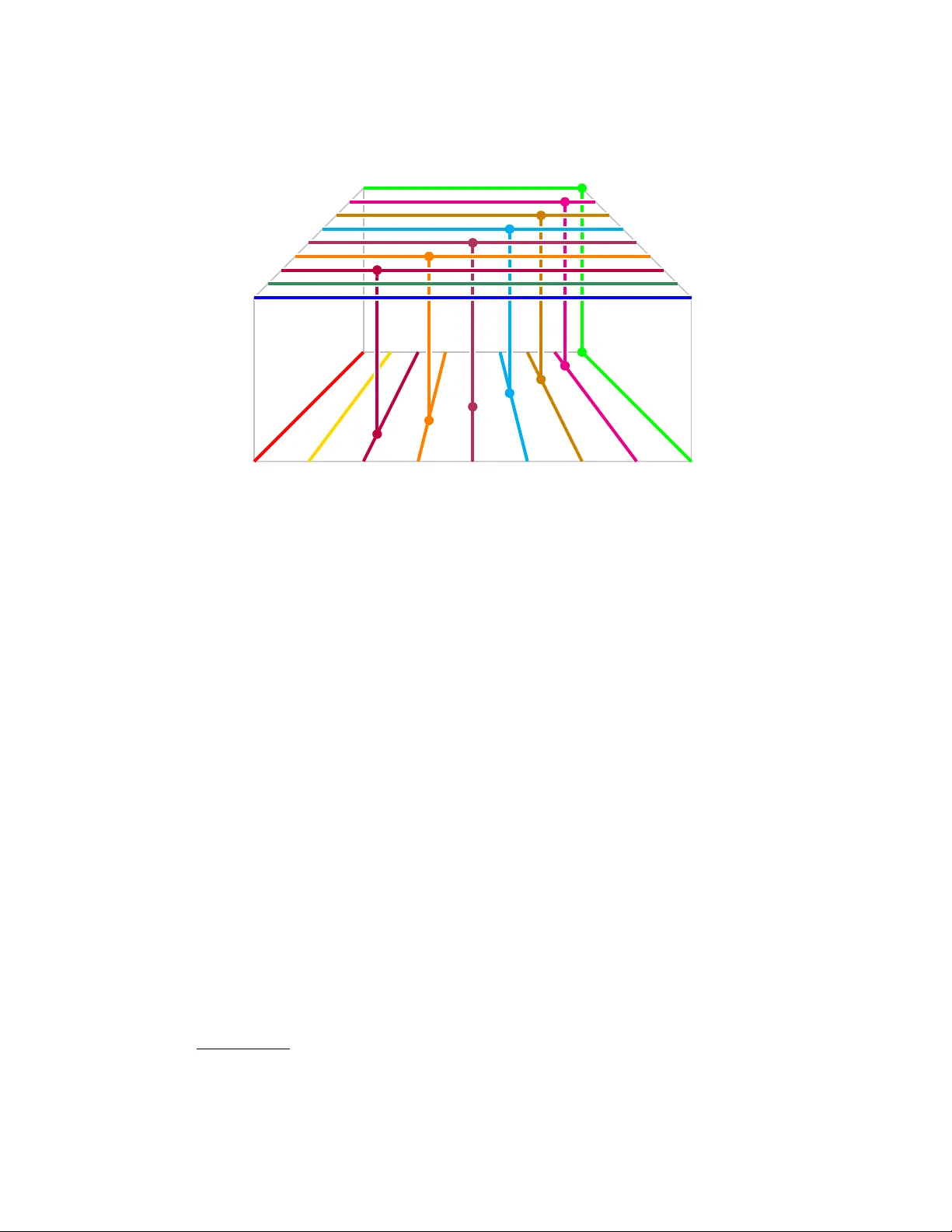
CLIQUE MINORS IN CAR TESIAN PR ODUCTS OF GRAPHS D A VID R. W OOD Abstract. A clique minor in a graph G can b e though t of as a set of connected subgraphs in G that are pairwise disjoin t and pairwise adjacen t. The Hadwiger numb er η ( G ) is the maximum cardinalit y of a clique minor in G . It is one of the principle measures of the structural complexit y of a graph. This pap er studies clique minors in the Cartesian pro duct G H . Our main result is a rough structural c haracterisation theorem for Cartesian pro ducts with bounded Hadwiger num ber. It implies that if the product of tw o sufficiently large graphs has b ounded Hadwiger n um ber then it is one of the following graphs: • a planar grid with a v ortex of b ounded width in the outerface, • a cylindrical grid with a vortex of bounded width in eac h of the t wo ‘big’ faces, or • a toroidal grid. Motiv ation for studying the Hadwiger n umber of a graph in- cludes Hadwiger’s Conjecture, which asserts that the chromatic n umber χ ( G ) ≤ η ( G ). It is open whether Hadwiger’s Conjecture holds for ev ery Cartesian pro duct. W e pro ve that G H (where χ ( G ) ≥ χ ( H )) satisfies Hadwiger’s Conjecture whenever: • H has at least χ ( G ) + 1 vertices, or • the treewidth of G is sufficien tly large compared to χ ( G ). On the other hand, w e prov e that Hadwiger’s Conjecture holds for all Cartesian pro ducts if and only if it holds for all G K 2 . W e then show that η ( G K 2 ) is tied to the treewidth of G . W e also develop connections with pseudoachromatic colourings and connected dominating sets that imply near-tigh t b ounds on the Had- wiger n umber of grid graphs (Cartesian pro ducts of paths) and Ham- ming graphs (Cartesian pro ducts of cliques). Date : Nov em b er 8, 2007; revised: August 17, 2021. 1991 Mathematics Subje ct Classification. graph minors 05C83, structural characteriza- tion of types of graphs 05C75. Key wor ds and phr ases. graph minor, cartesian pro duct, Hadwiger nu mber. Supp orted by QEI I Research F ellowship from the Australian Research Council. Re- searc h initiated at the Universitat P olit` ecnica de Catalun ya (Barcelona, Spain) where supp orted by a Marie Curie F ellowship of the Europ ean Commission under contract MEIF- CT-2006-023865, and by the pro jects MEC MTM2006-01267 and DURSI 2005SGR00692. 1 2 DA VID R. WOOD Contents 1. In tro duction 3 1.1. Hadwiger’s Conjecture 4 2. Preliminaries 4 2.1. V ortices 5 2.2. Graph Pro ducts 5 2.3. Graph Minors 5 2.4. Upp er Bounds on the Hadwiger Num b er 6 2.5. T reewidth, P athwidth and Bandwidth 7 3. Hadwiger Number of Grid Graphs 7 4. Odd-Dimensional Grids and Pseudoachromatic Colourings 11 5. Star Minors and Dominating Sets 14 6. Dominating Sets and Clique Minors in Even-Dimensional Grids 18 7. Hadwiger Number of Pro ducts of Complete Graphs 22 8. Hyp ercub es and Lexicographic Pro ducts 27 9. Rough Structural Characterisation Theorem for T rees 30 10. Pro duct of a General Graph and a Complete Graph 39 11. Rough Structural Characterisation Theorem 43 12. On Hadwiger’s Conjecture for Cartesian Pro ducts 48 Note Added in Pro of 52 References 52 CLIQUE MINORS IN CAR TESIAN PRODUCTS OF GRAPHS 3 1. Introduction A clique minor in a graph G can b e though t of as a set of connected sub- graphs in G that are pairwise disjoin t and pairwise adjacent. The Hadwiger numb er η ( G ) is the maximum cardinality of a clique minor in G . It is one of the principle measures of the structural complexit y of a graph. Rob ertson and Seymour [46] pro v ed a rough structural c haracterisation of graphs with bounded Hadwiger n umber. It sa ys that suc h a graph can b e constructed by a combination of four ingredien ts: graphs embedded in a surface of b ounded genus, vortices of b ounded width inside a face, the ad- dition of a b ounded num b er of ap ex vertices, and the clique-sum op eration. Moreo v er, each of these ingredien ts is essen tial. This result is at the heart of Rob ertson and Seymour’s pro of of W agner’s Conjecture [47]: Ev ery infinite set of finite graphs contains t wo graphs, one of which is a minor of the other. This pap er studies clique minors in the (Cartesian) pro duct G H . Our main result is a rough structural c haracterisation of pro ducts with b ounded Hadwiger num b er, whic h is less rough than the far more general result b y Rob ertson and Seymour. It sa ys that for connected graphs G and H , each with at least one edge, G H has b ounded Hadwiger num b er if and only if at least one of the follo wing conditions are satisfied: • G has b ounded treewidth and H has b ounded order, • H has b ounded treewidth and G has b ounded order, or • G has b ounded hango v er and H has b ounded hango v er, where hango ver is a parameter defined in Section 11. Basically , a graph with b ounded hango ver is either a cycle or consists of a path of degree-2 vertices joining t wo connected subgraphs of bounded order with no edge betw een the subgraphs. This implies that if the pro duct of tw o sufficiently large graphs has b ounded Hadwiger n um b er then it is one of the following graphs: • a planar grid (the pro duct of t wo paths) with a v ortex of b ounded width in the outerface, • a cylindrical grid (the pro duct of a path and a cycle) with a vortex of b ounded width in each of the t wo ‘big’ faces, or • a toroidal grid (the pro duct of tw o cycles). The k ey case for the pro of of this structure theorem is when G and H are trees. This case is handled in Section 9. The pro of for general graphs is giv en in Sections 10 and 11. Before pro ving our main results we develop connections with pseudoac hro- matic colourings (Section 4) and connected dominating sets (Sections 5 and 6) that imply near-tight b ounds on the Hadwiger num b er of grid graphs (pro ducts of paths; Sections 3, 4 and 6) and Hamming graphs (pro ducts of cliques; Section 7). As summarised in T able 1, in each case, w e improv e the b est previously kno wn lo w er b ound b y a factor of b etw een Ω( n 1 / 2 ) and Ω( n 3 / 2 ) to conclude asymptotically tight bounds for fixed d . 4 DA VID R. WOOD T able 1. Impro ved low er b ounds on the Hadwiger num b er of sp ecific graphs. graph d previous b est new result reference grid graph P d n ev en Ω( n ( d − 2) / 2 ) Θ( n d/ 2 ) Theorem 3.2 grid graph P d n o dd Ω( n ( d − 1) / 2 ) Θ( n d/ 2 ) Theorem 4.4 Hamming graph K d n ev en Ω( n ( d − 2) / 2 ) Θ( n ( d +1) / 2 ) Theorem 7.5 Hamming graph K d n o dd Ω( n ( d − 1) / 2 ) Θ( n ( d +1) / 2 ) Theorem 7.5 1.1. Hadwiger’s Conjecture. Motiv ation for studying clique minors in- cludes Hadwiger’s Conjecture, a far reaching generalisation of the 4-colour theorem, whic h states that the c hromatic num b er χ ( G ) ≤ η ( G ) for ev ery graph G . It is op en whether Hadwiger’s Conjecture holds for every pro duct. The follo wing classes of pro ducts are known to satisfy Hadwiger’s Conjecture (where G and H are connected and χ ( G ) ≥ χ ( H )): • The pro duct of sufficiently many graphs relativ e to their maximum c hromatic num b er satisfies Hadwiger’s Conjecture [9]. • If χ ( H ) is not to o small relative to χ ( G ), then G H satisfies Had- wiger’s Conjecture [7, 43]. See Section 12 for precise v ersions of this statements. W e add to this list as follo ws: • If H has at least χ ( G ) + 1 vertices, then G H satisfies Hadwiger’s Conjecture (Theorem 12.4). • If the treewidth of G is sufficiently large compared to χ ( G ), then G H satisfies Hadwiger’s Conjecture (Theorem 12.3). On the other hand, w e pro ve that Hadwiger’s Conjecture holds for all G H with χ ( G ) ≥ χ ( H ) if and only if Hadwiger’s Conjecture holds for G K 2 . W e then show that η ( G K 2 ) is tied to the treewidth of G . All these results are presented in Section 12. Clique minors in pro ducts hav e b een previously considered by a num b er of authors [1, 7, 9, 32, 38, 40, 43, 61]. In related w ork, Xu and Y ang [59] and ˇ Spacapan [53] studied the connectivity of pro ducts, Drier and Linial [16] studied minors in lifts of graphs, and Goldb erg [20] studied the Colin de V erdi` ere num b er of pro ducts. See [24, 30, 31] for more on graph pro ducts. 2. Preliminaries All graphs considered in this pap er are undirected, simple, and finite; see [4, 13]. Let G b e a graph with v ertex V ( G ) and edge set E ( G ). Let v ( G ) = | V ( G ) | and e ( G ) = | E ( G ) | resp ectively denote the or der and size of G . Let ∆( G ) denote the maxim um degree of G . The chr omatic numb er of G , denoted by χ ( G ), is the minimum integer k suc h that eac h vertex of G can b e assigned one of k colours such that adjacent vertices receiv e distinct colours. Let K n b e the complete graph with n vertices. A clique of a graph CLIQUE MINORS IN CAR TESIAN PRODUCTS OF GRAPHS 5 G is a complete subgraph of G . The clique numb er of G , denoted by ω ( G ), is the maximum order of a clique of G . Let P n b e the path with n v ertices. By default, V ( K n ) = [ n ] and P n = (1 , 2 , . . . , n ). A le af in a graph is a vertex of degree 1. Let S n b e the star graph with n leav es; that is, S n = K 1 ,n . 2.1. V ortices. Consider a graph H embedded in a surface; see [41]. Let ( v 1 , v 2 , . . . , v k ) b e a facial cycle in H . Consider a graph G obtained from H by adding sets of vertices S 1 , S 2 , . . . , S k (called b ags ), such that for each i ∈ [ k ] we hav e v i ∈ S i ∩ V ( H ) ⊆ { v 1 , . . . , v k } , and for eac h vertex v ∈ ∪ i S i , if R ( v ) := { i ∈ [ k ] , v ∈ S i } then for some i, j , either R ( v ) = [ i, j ] or R ( v ) = [ i, k ] ∪ [1 , j ], and for each edge vw ∈ E ( G ) with v , w ∈ ∪ i S i there is some i ∈ [ k ] for which v , w ∈ S i . Then G is obtained from H by adding a vortex of width max i | S i | . 2.2. Graph Pro ducts. Let G and H b e graphs. The Cartesian (or squar e ) pr o duct of G and H , denoted by G H , is the graph with vertex set V ( G H ) := V ( G ) × V ( H ) := { ( v , x ) : v ∈ V ( G ) , x ∈ V ( H ) } , where ( v , x )( w , y ) is an edge of G H if and only if v w ∈ E ( G ) and x = y , or v = w and xy ∈ E ( H ). Assuming isomorphic graphs are equal, the Cartesian pro duct is com- m utativ e and asso ciative, and G 1 G 2 · · · G d is well-defined. W e can consider a Cartesian pro duct G := G 1 G 2 · · · G d to hav e vertex set V ( G ) = { v = ( v 1 , v 2 , . . . , v d ) : v i ∈ V ( G i ) , i ∈ [ d ] } , where v w ∈ E ( G ) if and only if v i w i ∈ E ( G i ) for some i , and v j = w j for all j 6 = i ; we say that the edge v w is in dimension i . F or a graph G and in teger d ≥ 1, let G d denote the d -fold Cartesian pro duct G d := G G · · · G | {z } d . Since the Cartesian pro duct is the fo cus of this pap er, it will henceforth b e simply referred to as the pr o duct . Other graph products will b e briefly discussed. The dir e ct pr o duct G × H has v ertex set V ( G ) × V ( H ), where ( v , x ) is adjacent to ( w , y ) if and only if v w ∈ E ( G ) and xy ∈ E ( H ). The str ong pr o duct G H is the union of G H and G × H . The lexic o gr aphic pr o duct (or gr aph c omp osition ) G · H has v ertex set V ( G ) × V ( H ), where ( v, x ) is adjacen t to ( w , y ) if and only if v w ∈ E ( G ), or v = w and xy ∈ E ( H ). Think of G · H as b eing constructed from G by replacing each v ertex of G b y a copy of H , and replacing each edge of G by a complete bipartite graph. Note that the lexicographic pro duct is not commutativ e. 2.3. Graph Minors. A graph H is a minor of a graph G if H can b e obtained from a subgraph of G by contracting edges. F or each vertex v of H , the connected subgraph of G that is contracted into v is called a br anch set of H . Two subgraphs X and Y in G are adjac ent if there is an edge with one endp oint in X and the other endp oint in Y . A K n -minor of G is called 6 DA VID R. WOOD a clique minor . It can b e thought of as n connected subgraphs X 1 , . . . , X n of G , suc h that distinct X i and X j are disjoint and adjacent. The Hadwiger numb er of G , denoted by η ( G ), is the maximum n such that K n is a minor of G . The following observ ation is used rep eatedly . Lemma 2.1. If H is a minor of a c onne cte d gr aph G , then G has an H - minor such that every vertex of G is in some br anch set. Pr o of. Start with an H -minor of G . If some v ertex of G is not in a branch set, then since G is connected, some vertex v of G is not in a branch set and is adjacen t to a vertex that is in a branch set X . Adding v to X giv es an H -minor using more v ertices of G . Rep eat un til every vertex of G is in some branch set. In order to describ e the principal result of this pap er (Theorem 11.8), w e in tro duce the following formalism. Let α : X → R and β : X → R be functions, for some set X . Then α and β are tie d if there is a function f suc h that α ( x ) ≤ f ( β ( x )) and β ( x ) ≤ f ( α ( x )) for all x ∈ X . Theorem 11.8 presen ts a function that is tied to η ( G H ). 2.4. Upp er Bounds on the Hadwiger Num b er. T o pro v e the tightness of our lo w er b ound constructions, w e use the follo wing elementary upp er b ounds on the Hadwiger num b er. Lemma 2.2. F or every c onne cte d gr aph G with aver age de gr e e at most δ ≥ 2 , η ( G ) ≤ p ( δ − 2) v ( G ) + 3 . Pr o of. Let k := η ( G ). Say X 1 , . . . , X k are the branc h sets of K k -minor in G . By Lemma 2.1, we may assume that every vertex is in some branc h set. Since at least k 2 edges hav e endp oints in distinct branc h sets, e ( G ) ≥ k 2 + k X i =1 e ( X i ) ≥ k 2 + k X i =1 v ( X i ) − 1 = k 2 + v ( G ) − k . Since 2 e ( G ) = δ v ( G ), we hav e k 2 − 3 k − ( δ − 2) v ( G ) ≤ 0. The result follows from the quadratic formula. The following result, first prov ed by Iv an ˇ co [32], is another elementary upp er b ound on η ( G ). It is tight for a surprisingly large class of graphs; see Prop osition 8.3. W e include the pro of for completeness. Lemma 2.3 ([32, 54]) . F or every gr aph G , η ( G ) ≤ v ( G ) + ω ( G ) 2 . CLIQUE MINORS IN CAR TESIAN PRODUCTS OF GRAPHS 7 Pr o of. Consider a K n -minor in G , where n := η ( G ). F or j ≥ 1, let n j b e the num b e r of branc h sets that con tain exactly j v ertices. Th us v ( G ) − n 1 ≥ X j ≥ 2 j · n j ≥ 2 X j ≥ 2 n j = 2( n − n 1 ) . Hence v ( G ) + n 1 ≥ 2 n . The branc h sets that con tain exactly one v ertex form a clique. Thus n 1 ≤ ω ( G ) and v ( G ) + ω ( G ) ≥ 2 n . The result follows. 2.5. T reewidth, P ath width and Bandwidth. Another upp er b ound on the Hadwiger n umber is obtained as follows. A tr e e de c omp osition of a graph G consists of a tree T and a set { T x ⊆ V ( G ) : x ∈ V ( T ) } of ‘bags’ of vertices of G indexed by T , such that • for each edge v w ∈ E ( G ), there is some bag T x that contains b oth v and w , and • for each v ertex v ∈ V ( G ), the set { x ∈ V ( T ) : v ∈ T x } induces a non-empt y (connected) subtree of T . The width of the tree decomp osition is max {| T x | : x ∈ V ( T ) } − 1. The tr e ewidth of G , denoted b y t w ( G ), is the minimum width of a tree decom- p osition of G . F or example, G has treewidth 1 if and only if G is a forest. A tree decomp osition whose underlying tree is a path is called a p ath de c om- p osition , and the p athwidth of G , denoted by pw ( G ), is the minimum width of a path decomp osition of G . The b andwidth of G , denoted by bw ( G ), is the minim um, tak en o ver of all linear orderings ( v 1 , . . . , v n ) of V ( G ), of max {| i − j | : v i v j ∈ E ( G ) } . It is well known [3] that for every graph G , (1) η ( G ) ≤ t w ( G ) + 1 ≤ p w ( G ) + 1 ≤ b w ( G ) + 1 . 3. Hadwiger Number of Grid Graphs In this section we consider the Hadwiger n umber of the products of paths, so called grid graphs. First consider the n × m grid P n P m . It has no K 5 - minor since it is planar. In fact, η ( P n P m ) = 4 for all n ≥ m ≥ 3. Similarly , P n P 2 has no K 4 -minor since it is outerplanar, and η ( P n P 2 ) = 3 for all n ≥ 2. No w consider the double-grid P n P m P 2 , where n ≥ m ≥ 2. F or i ∈ [ n ], let C i b e the i -th column in the base copy of P n P m ; that is, C i := { ( i, y , 1) : y ∈ [ m ] } . F or j ∈ [ m ], let R j b e the j -th ro w in the top cop y of P n P m ; that is, R j := { ( x, j, 2) : x ∈ [ n ] } . Since each R i and eac h C j are adjacent, con tracting each R i and each C j giv es a K n,m -minor. Chandran and Siv adasan [9] studied the case n = m , and observed that a K m -minor is obtained b y con tracting a matching of m edges in K m,m . In fact, con tracting a matching of m − 1 edges in K n,m giv es a K m +1 -minor. (In fact, η ( K m,m ) = m + 1; see [57] for example.) Now observe that R 1 is adjacen t to R 2 and C 1 is adjacent to C 2 . Th us con tracting eac h edge of the matching R 3 C 3 , R 4 C 4 , . . . , R m C m giv es a K m +2 -minor, as illustrated in Figure 1. Hence η ( P n P m P 2 ) ≥ m + 2. 8 DA VID R. WOOD Figure 1. A K m +2 -minor in P m P m P 2 . No w we pro ve a simple upp er b ound on η ( P n P m P 2 ). Clearly , b w ( P n P m ) ≤ m . Th us, by Lemma 10.3 and (1), η ( P n P m P 2 ) ≤ bw ( P n P m P 2 ) + 1 ≤ 2 m + 1 . Summarising 1 , (2) m + 2 ≤ η ( P n P m P 2 ) ≤ 2 m + 1 . W e conjecture that the low er b ound in (2) is the answer; that is, η ( P n P m P 2 ) = m + 2 . The abov e construction of a clique minor in the double-grid generalises as follows. Prop osition 3.1. F or al l c onne cte d gr aphs G and H , e ach with at le ast one e dge, η ( G H P 2 ) ≥ ω ( G ) + ω ( H ) + min { v ( G ) − ω ( G ) , v ( H ) − ω ( H ) } ≥ min { v ( G ) , v ( H ) } + min { ω ( G ) , ω ( H ) } ≥ min { v ( G ) , v ( H ) } + 2 . Pr o of. Let P b e a maxim um clique of G . Let Q be a maxim um clique of H . Without loss of generalit y , n := v ( G ) − ω ( G ) ≤ v ( H ) − ω ( H ). Say V ( G ) − V ( P ) = { v 1 , v 2 , . . . , v n } and V ( H ) − V ( Q ) = { w 1 , w 2 , . . . , w m } , where n ≤ m . Let V ( P 2 ) = { 1 , 2 } . F or x ∈ V ( G ), let A h x i b e the subgraph of G H P 2 induced b y { ( x, y , 1) : y ∈ V ( H ) } . F or y ∈ V ( G ), let B h y i b e the subgraph of 1 In the case n = m , Chandran and Siv adasan [9] claimed an upper bound of η ( P m P m P 2 ) ≤ 2 m + 2 without pro of. CLIQUE MINORS IN CAR TESIAN PRODUCTS OF GRAPHS 9 G H P 2 induced b y { ( x, y , 2) : x ∈ V ( G ) } . Note that each subgraph A h x i is isomorphic to H , and is th us connected. Similarly , eac h subgraph B h y i is isomorphic to G , and is th us connected. Distinct subgraphs A h x i and A h x 0 i are disjoin t since the first co ordinate of every vertex in A h x i is x . Distinct subgraphs B h y i and B h y 0 i are disjoint since the second coordinate of ev ery v ertex in B h x i is y . Subgraphs A h x i and B h y i are disjoin t since the third co ordinate of ev ery v ertex in A h x i is 1, and the third co ordinate of every v ertex in B h y i is 2. Since the vertex ( x, y , 1) in A h x i is adjacent to the vertex ( x, y , 1) in B h y i , the A h x i and B h y i subgraphs are the branc h sets of a complete bipartite K v ( G ) , v ( H ) -minor in G H H . Moreo v er, for distinct vertices x and x 0 in the clique P , for any v ertex y ∈ V ( H ), the v ertex ( x, y , 1) in A h x i is adjacen t to the vertex ( x 0 , y , 1) in A h x 0 i . Similarly , for distinct vertices y and y 0 in the clique Q , for any vertex x ∈ V ( G ), the vertex ( x, y , 2) in B h y i is adjacent to the v ertex ( x, y 0 , 2) in B h y 0 i . F or eac h i ∈ [ n ], let X i b e the subgraph induced b y A h v i i ∪ B h w i i . Now X h i i is connected, since the v ertex ( v i , w i , 1) in A h i i is adjacent to the vertex ( v i , w i , 2) in B h i i . W e hav e sho wn that { A h x i : x ∈ P } ∪ { B h x i : x ∈ Q } ∪ { X i : i ∈ [ n ] } is a set of ω ( G ) + ω ( H ) + n connected subgraphs, eac h pair of which are disjoint and adjacent. Hence these subgraphs are the branch sets of a clique minor in G H P 2 . Therefore η ( G H P 2 ) ≥ ω ( G ) + ω ( H ) + n , as desired. The final claims are easily v erified. No w consider the Hadwiger num b er of the d -dimensional grid graph P d n := P n P n · · · P n | {z } d . The b est previously known b ounds are due to Chandran and Siv adasan [9] who prov ed that n b ( d − 1) / 2 c ≤ η ( P d n ) ≤ √ 2 d n d/ 2 + 1 . In the case that d is ev en w e no w improv e this lo w er bound by a Θ( n ) factor, and th us determine η ( P d n ) to within a factor of 4 √ 2 d (ignoring low er order terms). Theorem 3.2. F or every inte ger n ≥ 2 and even inte ger d ≥ 4 , 1 4 n d/ 2 − O ( n d/ 2 − 1 ) ≤ η ( P d n ) < √ 2 d − 2 n d/ 2 + 3 . Pr o of. The upp er b ound follows from Lemma 2.2 since v ( P d n ) = n d and ∆( P d n ) = 2 d . Now w e pro v e the lo w er b ound. Let V ( P d n ) = [ n ] d , where tw o v ertices are adjacent if and only if they share d − 1 co ordinates in common and differ b y 1 in the remaining co ordinate. Let p := d 2 . F or j 1 , j 2 ∈ b n 2 c and j 3 , . . . , j p ∈ [ n ], let A h j 1 , . . . , j p i b e the subgraph of P d n induced by { (2 j 1 , 2 j 2 , j 3 , j 4 , . . . , j p , x 1 , x 2 , . . . , x p ) : x i ∈ [ n ] , i ∈ [ p ] } ; 10 DA VID R. WOOD let B h j 1 , . . . , j p i b e the subgraph of P d n induced by { (2 x 1 − 1 , x 2 , x 3 , . . . , x p , j 1 , j 2 , . . . , j p ) : x 1 ∈ b n 2 c , x i ∈ [ n ] , i ∈ [2 , p ] } ∪{ ( x 1 , 2 x 2 − 1 , x 3 , x 4 . . . , x p , j 1 , j 2 , . . . , j p ) : x 1 ∈ [ n ] , x 2 ∈ b n 2 c , x i ∈ [ n ] , i ∈ [3 , p ] } ; and let X h j 1 , . . . , j p i b e the subgraph of P d n induced by A h j 1 , . . . , j p i ∪ B h j 1 , . . . , j p i . Eac h A h j 1 , . . . , j p i subgraph is disjoin t from eac h B h j 0 1 , . . . , j 0 p i subgraph since the first and second coordinates of each vertex in A h j 1 , . . . , j p i are b oth ev en, while the first or second co ordinate of each vertex in B h j 0 1 , . . . , j 0 p i is o dd. Tw o distinct subgraphs A h j 1 , . . . , j p i and A h j 0 1 , . . . , j 0 p i are disjoin t since the p -tuples determined by the first p co ordinates are distinct. Simi- larly , t w o distinct subgraphs B h j 1 , . . . , j p i and B h j 0 1 , . . . , j 0 p i are disjoint since the p -tuples determined by the last p co ordinates are distinct. Hence each pair of distinct subgraphs X h j 1 , . . . , j p i and X h j 0 1 , . . . , j 0 p i are disjoin t. Observ e that A h j 1 , . . . , j p i is isomorphic to P p n , and is thus connected. In particular, every pair of v ertices (2 j 1 , 2 j 2 , j 3 , j 4 , . . . , j p , x 1 , x 2 , . . . , x p ) and (2 j 1 , 2 j 2 , j 3 , j 4 , . . . , j p , x 0 1 , x 0 2 , . . . , x 0 p ) in A h j 1 , . . . , j p i are connected by a path of length P i | x i − x 0 i | contained in A h j 1 , . . . , j p i . T o prov e that B h j 1 , . . . , j p i is connected, consider a pair of vertices v = ( x 1 , x 2 , . . . , x p , j 1 , j 2 , . . . , j p ) and v 0 = ( x 0 1 , x 0 2 , . . . , x 0 p , j 1 , j 2 , . . . , j p ) in B h j 1 , . . . , j p i . If x 1 is even then w alk along any one of the dimension-1 edges inciden t to v . This neighbour is in B h j 1 , . . . , j p i , and its first co or- dinate is o dd. Th us we can no w assume that x 1 is o dd. Similarly , we can assume that x 2 , x 0 1 , and x 0 2 are all o dd. Then ( x 1 , x 2 , . . . , x p , j 1 , j 2 , . . . , j p ) and ( x 0 1 , x 0 2 , . . . , x 0 p , j 1 , j 2 , . . . , j p ) are connected by a path of length P i | x i − x 0 i | con tained in B h j 1 , . . . , j p i . Th us B h j 1 , . . . , j p i is connected. The v ertex (2 j 1 , 2 j 2 , j 3 , j 4 , . . . , j p , j 1 , j 2 , . . . , j p ) in A h j 1 , . . . , j p i is adjacent to the vertex (2 j 1 − 1 , 2 j 2 , j 3 , j 4 , . . . , j p , j 1 , j 2 , . . . , j p ) in B h j 1 , . . . , j p i . Th us X h j 1 , . . . , j p i is connected. Each pair of subgraphs X h j 1 , . . . , j p i and X h j 0 1 , . . . , j 0 p i are adjacen t since the v ertex (2 j 1 , 2 j 2 , j 3 , j 4 , . . . , j p , j 0 1 , j 0 2 , . . . , j 0 p ) in A h j 1 , . . . , j p i is adjacent to the vertex (2 j 1 − 1 , 2 j 2 , j 3 , j 4 , . . . , j p , j 0 1 , j 0 2 , . . . , j 0 p ) in B h j 0 1 , . . . , j 0 p i . Hence the X h j 1 , . . . , j p i form a complete graph minor in P d n of order n d/ 2 − 2 b n 2 c 2 = 1 4 n d/ 2 − O ( n d/ 2 − 1 ). CLIQUE MINORS IN CAR TESIAN PRODUCTS OF GRAPHS 11 Note that for particular v alues of n , the lo wer b ound in Theorem 3.2 is impro v ed by a c onstan t factor in Corollary 6.6 b elow. 4. Odd-Dimensional Grids and Pseudoa chroma tic Colourings The ‘dimension pairing’ tec hnique used in Section 3 to construct large clique minors in ev en-dimensional grids do es not give tight b ounds for o dd- dimensional grids. T o construct large clique minors in o dd-dimensional grids w e use the following idea. A pseudo achr omatic k -c olouring of a graph G is a function f : V ( G ) → [ k ] suc h that for all distinct i, j ∈ [ k ] there is an edge v w ∈ E ( G ) with f ( v ) = i and f ( w ) = j . The pseudo achr omatic numb er of G , denoted by ψ ( G ), is the maxim um integer k such that there is a pseudoac hromatic k -colouring of G . Pseudoac hromatic colourings were in tro duced by Gupta [22] in 1969, and ha v e since b een widely studied. F or example, many authors [19, 29, 39, 60] ha v e prov ed 2 that (3) ψ ( P n ) > √ 2 n − 2 − 2 . Note that the only difference b etw een a pseudoac hromatic colouring and a clique minor is that each colour class is not necessarily connected. W e no w sho w that the colour classes in a pseudoachromatic colouring can b e made connected in a three-dimensional pro duct. Theorem 4.1. L et G , H and I b e c onne cte d gr aphs. L et A , B and C b e c onne cte d minors of G , H and I r esp e ctively, such that e ach br anch set in e ach minor has at le ast two vertic es. If v ( B ) ≥ v ( C ) then η ( G H I ) ≥ min { ψ ( A ) , v ( B ) } · v ( C ) . Pr o of. (The reader should k eep the example of G = H = I = P n and A = B = C = P b n/ 2 c in mind.) Let V ( B ) = { y 1 , . . . , y v ( B ) } and V ( C ) = { z 1 , . . . , z v ( C ) } . By con tracting edges in H , we may assume that there are exactly tw o v ertices of H in each branc h set of B . Lab el the t wo v ertices of H in the branc h set corresp onding to each y j b y y + j and y − j . By con tracting edges in I , w e may assume that there are exactly t wo v ertices of I in each branc h set of C . Lab el the tw o v ertices of I in the branch set corresp onding to eac h z j b y z + j and z − j . Let k := min { ψ ( A ) , v ( B ) } . Let f : V ( A ) → [ k ] b e a pseudoac hromatic colouring of A . Our goal is to prov e that η ( G H I ) ≥ k · v ( C ). 2 F or completeness, we prov e that ψ ( P n ) > √ 2 n − 2 − 2. Let P n = ( x 1 , . . . , x n ). Let t b e the maximum odd integer such that t 2 ≤ n − 1. Then t > √ 2 n − 2 − 2. Denote V ( K t ) b y { v 1 , . . . , v t } . Since t is o dd, K t is Eulerian. Orient the edges of K t b y following an Eulerian cycle C = ( e 1 , e 2 , . . . , e ( t 2 ) ). F or ` ∈ t 2 , let f ( x ` ) = i , where e ` = ( v i , v j ). F or ` ∈ [ t 2 + 1 , n ], let f ( x ` ) = 1. Consider distinct colours i, j ∈ [ t ]. Th us for some edge e ` of K t , without loss of generality , e ` = ( v i , v j ). Say e ` +1 = ( v j , v k ) is the next edge in C , where e ` +1 means e 1 if ` = t 2 . Since ` ≤ t 2 ≤ n − 1, we ha ve ` + 1 ∈ [ n ]. By construction, f ( x ` ) = i and f ( x ` +1 ) = j . Thus f is a pseudoac hromatic colouring. 12 DA VID R. WOOD By con tracting edges in G , we ma y assume that there are exactly tw o v ertices of G in eac h branc h set of A . Now lab el the t wo vertices of G in the branch set corresp onding to each vertex v of A b y v + and v − as follows. Let T b e a spanning tree of A . Orient the edges of T a w a y from some ro ot v ertex r . Arbitrarily lab el the v ertices r + and r − of G . Let w b e a non-ro ot leaf of T . Lab el each v ertex of T − w b y induction. No w w has one incoming arc ( v , w ). Some v ertex in the branch set of G corresp onding to v is adjacen t to some v ertex of G in the branc h set corresp onding to w . Lab el w + and w − so that there is an edge in G betw een v + and w − , or betw e en v − and w + . F or v ∈ V ( A ) and j ∈ [ v ( C )] (and thus j ∈ [ v ( B )]), let P h v , j i be the subgraph of G H I induced by { ( v + , y + j , z ) : z ∈ V ( I ) } , and let Q h v , j i b e the subgraph of G H I induced b y { ( v − , y , z + j ) : y ∈ V ( H ) } . F or i ∈ [ k ] (and thus i ≤ v ( B )) and j ∈ [ v ( C )], let R h i, j i b e the subgraph of G H I induced b y { ( v , y − i , z − j ) : v ∈ V ( G ) } , and let X h i, j i b e the subgraph of G H I induced b y ∪{ P h v , j i ∪ Q h v , j i ∪ R h i, j i : v ∈ f − 1 ( i ) } , as illustrated in Figure 2. W e now pro ve that the X h i, j i are the branch sets of a clique minor in G H I . R h i, j i Q h u, j i P h u, j i Q h v , j i P h v , j i Q h w, j i P h w, j i G I H Figure 2. The branch set X h i, j i in Prop osition 4.2, where f − 1 ( i ) = { u, v , w } . First w e pro v e that each X h i, j i is connected. Observe that eac h P h v , j i is a copy of I and each Q h i, j i is a cop y of H , and are thus connected. Moreov er, the v ertex ( v + , y + j , z + j ) in P h v , j i is adjacen t to the vertex ( v − , y + j , z + j ) in CLIQUE MINORS IN CAR TESIAN PRODUCTS OF GRAPHS 13 Q h v , j i . Th us P h v , j i ∪ Q h v , j i is connected. No w eac h R h i, j i is a cop y of G , and is th us connected. F or each v ∈ f − 1 ( i ), the vertex ( v − , y − i , z + j ) which is in Q h v , j i , is adjacen t to ( v − , y − i , z − j ) which is in R h i, j i . Thus X h i, j i is connected. No w consider distinct subgraphs X h i, j i and X h i 0 , j 0 i . W e first prov e that X h i, j i and X h i 0 , j 0 i are disjoint. Distinct subgraphs P h v , j i and P h w , j 0 i are disjoin t since the first tw o co ordinates of ev ery v ertex in P h v , j i are ( v + , y + j ), whic h are unique to ( v , j ). Similarly , distinct subgraphs Q h v , j i and Q h w , j 0 i are disjoint since the first and third co ordinates of every v ertex in Q h v , j i are ( v − , z + j ), whic h are unique to ( v , j ). Ev ery P h v , j i is disjoin t from ev ery Q h w , j 0 i since the first co ordinate of every v ertex in P h v , j i is p ositiv e, while the first co ordinate of every vertex in Q h w , j i is negative. Observ e that R h i, j i and R h i 0 , j 0 i are disjoint since the second and third co ordinates of ev ery v ertex in R h i, j i are ( y − i , z − j ), which are unique to ( i, j ). Also R h i, j i is disjoin t from every P h v , j 0 i ∪ Q h v , j 0 i since the second and third co ordinate of every v ertex in R h i, j i are negative, while ev ery v ertex in P h v , j 0 i ∪ Q h v , j 0 i has a p ositive second or third co ordinate. Therefore distinct X h i, j i and X h i 0 , j 0 i are disjoin t. It remains to pro ve that distinct subgraphs X h i, j i and X h i 0 , j 0 i are adja- cen t. If i = i 0 then the v ertex ( v + , y + j , z + j 0 ), which is in P h i, j i , is adjacen t to the vertex ( v − , y + j , z + j 0 ), which is in Q h i 0 , j 0 i . Now assume that i 6 = i 0 . Then f ( v ) = i and f ( w ) = i 0 for some edge v w of A . By the lab elling of vertices in G , without loss of generality , there is an edge in G b etw een v + and w − . Th us the v ertex ( v + , y + j , z + j 0 ), whic h is in P h v , j i ⊂ X h i, j i , is adjacen t to the v ertex ( w − , y + j , z + j 0 ), whic h is in Q h w , j i ⊂ X h i 0 , j 0 i . In both cases, X h i, j i and X h i 0 , j 0 i are adjacen t. Hence the X h i, j i are the branch sets of a clique minor in G H I . Th us η ( G H I ) ≥ k · v ( C ). No w consider the Hadwiger num b er of the three-dimensional grid graph P n P n P n . Prior to this work the b est lo wer and upper b ounds on η ( P n P n P n ) were Ω( n ) and O ( n 3 / 2 ) resp ectiv ely [7, 9, 43]. The next result improv es this low er b ound b y a Θ( √ n ) factor, th us determining η ( P n P n P n ) to within a factor of 4 (ignoring low er order terms). Prop osition 4.2. F or al l inte gers n ≥ m ≥ 1 , 1 2 n √ m − O ( n + √ m ) < η ( P n P n P m ) ≤ 2 n √ m + 3 . Pr o of. The upp er b ound follo ws from Lemma 2.2 since P n P n P m has n 2 m vertices and maximum degree 6. No w w e prov e the low er b ound. P m has a P b m/ 2 c -minor with t w o vertices in eac h branch set. By (3), ψ ( P b m/ 2 c ) > √ m − 3 − 2. By Theorem 4.1 with G = P m , A = P b m/ 2 c , H = I = P n , and B = C = P b n/ 2 c (and since ψ ( P b m/ 2 c ) ≤ b m 2 c ≤ b n 2 c = v ( B )), η ( P n P n P m ) ≥ ( √ m − 3 − 2) b n 2 c = 1 2 n √ m − O ( n + √ m ) , 14 DA VID R. WOOD as desired. Here is another scenario when tigh t b ounds for three-dimensional grids can b e obtained. Prop osition 4.3. F or al l inte gers n ≥ m ≥ 1 such that n ≤ 1 4 m 2 , 1 2 m √ n − O ( m + √ n ) < η ( P n P m P m ) ≤ 2 m √ n + 3 . Pr o of. The upper b ound follows from Lemma 2.2 since P n P m P m has m 2 n vertices and maxim um degree 6. F or the lo w er b ound, apply Theo- rem 4.1 with G = P n , A = P b n/ 2 c , H = I = P m , and B = C = P b m/ 2 c . By (3), ψ ( P b n/ 2 c ) > √ n − 3 − 2. Thus η ( P n P n P n ) ≥ min { ( √ n − 3 − 2) , b m 2 c} · b m 2 c . Since n ≤ 1 4 m 2 , η ( P n P n P n ) ≥ ( √ n − 3 − 2) · b m 2 c = 1 2 m √ n − O ( m + √ n ) , as desired. No w consider the Hadwiger num b er of P d n for o dd d . Prior to this w ork the b est low er and upp er b ounds on η ( P d n ) w ere Ω( n ( d − 1) / 2 ) and O ( √ d n d/ 2 ) resp ectiv ely [7, 9, 43]. The next result impro ves this lo wer b ound by a Θ( √ n ) factor, th us determining η ( P d n ) to within a factor of 2 p 2( d − 1) (ignoring lo w er order terms). Theorem 4.4. F or every inte ger n ≥ 1 and o dd inte ger d ≥ 3 , 1 2 n d/ 2 − O ( n ( d − 1) / 2 ) < η ( P d n ) ≤ p 2( d − 1) n d/ 2 + 3 . Pr o of. The upp er b ound follows from Lemma 2.2 since v ( P d n ) = n d and ∆( P d n ) = 2 d . No w w e prov e the low er b ound. Let G := P n and A := P b n/ 2 c . By (3), ψ ( A ) > √ n − 3 − 2. Let H := P ( d − 1) / 2 n . Every grid graph with m v ertices has a matc hing of b m 2 c edges. ( Pr o of : induction on the num b er of dimensions.) Th us H has a minor B with b 1 2 n ( d − 1) / 2 c vertices, and t wo v ertices in each branch set. By Theorem 4.1 with I = H and C = B (and since ψ ( P b n/ 2 c ) ≤ b n 2 c ≤ b 1 2 n ( d − 1) / 2 c ), η ( P d n ) ≥ ( √ n − 3 − 2) b 1 2 n ( d − 1) / 2 c = 1 2 n d/ 2 − O ( n ( d − 1) / 2 ) , as desired. 5. St ar Minors and Domina ting Sets Recall that S t is the star graph with t leav es. Consider the Hadwiger n um b er of the pro duct of S t with a general graph. Lemma 5.1. F or every c onne cte d gr aph G and for every inte ger t ≥ 1 , η ( G S t ) ≥ min { v ( G ) , t + 1 } . CLIQUE MINORS IN CAR TESIAN PRODUCTS OF GRAPHS 15 Pr o of. Let k := min { v ( G ) , t + 1 } . Let V ( G ) := { v 1 , v 2 , . . . , v n } and V ( S t ) := { r } ∪ [ t ], where r is the ro ot. F or i ∈ [ k − 1], let X i b e the subgraph of G S t induced b y { ( v i , r ) } ∪ { ( v j , i ) : j ∈ [ n ] } , Since G is connected, and ( v i , r ) is adjacen t to ( v i , i ), eac h X i is connected. Let X k b e the subgraph consisting of the vertex ( v k , r ). F or distinct i, j ∈ [ k ] with i < j (and thus i ∈ [ k − 1] ⊆ [ t ]), the subgraphs X i and X j are disjoint, and vertex ( v j , i ), whic h is in X i , is adjacen t to ( v j , r ), whic h is in X j . Thus X 1 , . . . , X k are the branc h sets of a K k -minor in G S t , as illustrated in Figure 3 when G is a path. Figure 3. A K 5 -minor in P 5 S 4 . Note that the low er b ound in Lemma 5.1 is within a constant factor of the upp er bound in Lemma 2.2 whenev er e ( G ) = Θ( v ( G )) = Θ( t ). In particular, if G is a tree with at least t + 1 vertices, then t + 1 ≤ η ( G S t ) ≤ η ( G K t +1 ) ≤ t + 2 , where the upper bound is prov ed in Theorem 10.1 b elow. When G is another star, Iv anˇ co [32] determined the Hadwiger num b er precisely . W e include the pro of for completeness. Lemma 5.2 ([32]) . F or al l inte gers n ≥ m ≥ 2 , η ( S n S m ) = m + 2 . Pr o of. Let V ( S n ) := { r } ∪ [ n ], where r is the ro ot vertex. Observe that for all i ∈ [ n ] and j ∈ [ m ], vertex ( i, j ) has degree 2; it is adjacent to ( r, j ) and ( i, r ). In every graph except K 3 , contracting an edge incident to a degree- 2 v ertex does not change the Hadwiger n umber. Thus replacing the path ( r , j )( i, j )( i, r ) by the edge ( r , j )( i, r ) do es not c hange the Hadwiger num b er. Doing so gives K 1 ,m,n . Iv an ˇ co [32] pro v ed that η ( K 1 ,m,n ) = m + 2. Th us η ( S n S m ) = m + 2. In fact, Iv anˇ co [32] determined the Hadwiger num b er of ev ery complete multipartite graph (a result redisco v ered by the author [57]). 16 DA VID R. WOOD F or every graph G , let star ( G ) b e the maximum integer t for which S t is minor of G . Since a vertex and its neigh b ours form a star, star ( G ) ≥ ∆( G ). Th us Lemmas 5.1 and 5.2 imply: Corollary 5.3. F or al l c onne cte d gr aphs G and H , η ( G H ) ≥ min { star ( G ) + 1 , v ( H ) } ≥ min { ∆( G ) + 1 , v ( H ) } , and η ( G H ) ≥ min { star ( G ) , star ( H ) } + 2 ≥ min { ∆( G ) , ∆( H ) } + 2 . As an aside, w e now show that star minors are related to radius and bandwidth. Let G b e a connected graph. The r adius of G , denoted b y rad ( G ), is the minimum, taken ov er all vertices v of G , of the maximum distance b etw een v and some other vertex of G . Eac h v ertex v that minimises this maximum distance is a c entr e of G . Lemma 5.4. F or every c onne cte d gr aph G with at le ast one e dge, (a) v ( G ) ≤ sta r ( G ) · rad ( G ) + 1 (b) bw ( G ) ≤ 2 · star ( G ) − 1 . Pr o of. First w e pro ve (a). Le t v b e a centre of G . F or i ∈ [0 , rad ( G )], let V i b e the set of vertices at distance i from v . Th us the V i are a partition of V ( G ), and | V 0 | = 1. F or eac h i ∈ [ rad ( G )], contracting V 0 , . . . , V i − 1 in to a single vertex and deleting V i +1 , . . . , V rad ( G ) giv es a S | V i | -minor. Th us sta r ( G ) ≥ | V i | . Hence v ( G ) = P i | V i | ≤ 1 + rad ( G ) · sta r ( G ). No w we prov e (b). Let ( v 1 , . . . , v n ) b e a linear ordering of V ( G ) suc h that if v a ∈ V i and v b ∈ V j with i < j , then a < b . Consider an edge v a v b ∈ E ( G ). Sa y v a ∈ V i and v b ∈ V j . Without loss of generalit y , i ≤ j . By construction, j ≤ i + 1. Th us b − a ≤ | V i | + | V i +1 | − 1 ≤ 2 · sta r ( G ) − 1. Hence bw ( G ) ≤ 2 · star ( G ) − 1. Note that Lemma 5.4(a) is b est p ossible for G = P 2 n +1 , which has sta r ( G ) = 2 and rad ( G ) = n , or for G = K n , which has star ( G ) = n − 1 and rad ( G ) = 1. Corollary 5.7 and Lemma 5.4 imply that the pro duct of graphs with small radii or large bandwidth has large Hadwiger n umber; we omit the details. Star minors are related to connected dominating sets (first defined by Sampathkumar and W alik ar [49]). Let G b e a graph. A set of v ertices S ⊆ V ( G ) is dominating if eac h v ertex in V ( G ) − S is adjacent to a vertex in S . The domination numb er of G , denoted by γ ( G ), is the minimum cardinality of a dominating set of G . If S is dominating and G [ S ] is connected, then S and G [ S ] are c onne cte d dominating . Only connected graphs hav e connected dominating sets. The c onne cte d domination numb er of a connected graph G , denoted by γ c ( G ), is the minimum cardinalit y of a connected dominating set of G . Finally , let ` ( G ) b e the maxim um num b er of leav es in a spanning tree of G (where K 1 is considered to hav e no leav es, and K 2 is considered to ha v e one leaf ). Hedetniemi and Lask ar [28] pro ved that γ c ( G ) = v ( G ) − ` ( G ). W e extend this result as follows. CLIQUE MINORS IN CAR TESIAN PRODUCTS OF GRAPHS 17 Lemma 5.5. F or every c onne cte d gr aph G , sta r ( G ) = v ( G ) − γ c ( G ) = ` ( G ) . Pr o of. Let T b e a spanning tree of G with ` ( G ) leav es. Let S b e the set of non-leaf vertices of T . Thus S is a connected dominating set of G , implying γ c ( G ) ≤ v ( G ) − ` ( G ) and ` ( G ) ≤ v ( G ) − γ c ( G ). Sa y S is a connected dominating set in G of order γ c ( G ). Contracting G [ S ] gives a S v ( G ) − γ c ( G ) -minor in G . Thus sta r ( G ) ≥ v ( G ) − γ c ( G ). No w supp ose that X 0 , X 1 , . . . , X star ( G ) are the branc h sets of a S star ( G ) - minor in G , where X 0 is the root. By Lemma 2.1, w e ma y assume that every v ertex of G is in some X i . Let T i b e a spanning tree of each G [ X i ]. Eac h T i has at least t wo leav es, unless v ( T i ) ≤ 2. Let T b e the tree obtained from ∪ i T i b y adding one edge b etw een T 0 and T i for eac h i ∈ [ star ( G )]. Each suc h T i con tributes at least one leaf to T . Thus T has at least sta r ( G ) leav es, implying ` ( G ) ≥ sta r ( G ). Corollary 5.6. F or every tr e e T 6 = K 2 , sta r ( T ) e quals the numb er of le aves in T . Corollary 5.3 and Lemma 5.5 imply: Corollary 5.7. F or al l c onne cte d gr aphs G and H , η ( G H ) ≥ min { v ( G ) − γ c ( G ) + 1 , v ( H ) } and η ( G H ) ≥ min { v ( G ) − γ c ( G ) , v ( H ) − γ c ( H ) } + 2 . W e now show that a connected dominating set in a pro duct can b e con- structed from a dominating set in one of its factors. Lemma 5.8. F or al l c onne cte d gr aphs G and H , γ c ( G H ) ≤ ( v ( G ) − 1) · γ ( H ) + v ( H ) . Pr o of. Let S b e a minimum dominating set in H . Let v b e an arbitrary v ertex in G . Consider the set of vertices in G H , T := { ( x, y ) : x ∈ V ( G ) − { v } , y ∈ S } ∪ { ( v , y ) : y ∈ V ( H ) } . Then | T | = ( v ( G ) − 1) · γ ( H ) + v ( H ). First w e prov e that T is dominating. Consider a vertex ( x, y ) of G H . If y ∈ S then ( x, y ) ∈ T . Otherwise, y is adjacent to some v ertex z ∈ S , in which case ( x, y ) is adjacent to ( x, z ), whic h is in T . Th us T is dominating. No w we pro v e that T is connected. Since G is connected, for each v ertex x of G , there is a path P ( x, v ) b et w een x and v in G . Consider distinct vertices ( x, y ) and ( x 0 , y 0 ) in G H . Since H is connected there is a path Q ( y , y 0 ) b etw een y and y 0 in H . Thus { ( s, y ) : s ∈ P ( x, v ) } ∪ { ( v , t ) : t ∈ Q ( y , y 0 ) } ∪ { ( s, y 0 ) : s ∈ P ( x 0 , v ) } is a path b et ween ( x, y ) and ( x 0 , y 0 ) in G H , all of whose vertices are in T . Th us T is a connected dominating set. Corollary 5.7 (with G = A B and H = C ) and Lemma 5.8 (with G = A and H = B ) imply: 18 DA VID R. WOOD Corollary 5.9. F or al l c onne cte d gr aphs A, B , C , η ( A B C ) ≥ min { v ( A ) · v ( B ) − ( v ( A ) − 1) · γ ( B ) − v ( B ) + 1 , v ( C ) } . There are hundreds of theorems ab out domination in graphs that may b e used in conjunction with the ab o ve results to construct clique minors in pro ducts; see the monograph [27]. Instead, we no w apply p erhaps the most simple known b ound on the order of dominating sets to conclude tigh t b ounds on η ( G d ) whenev er d ≥ 4 is ev en and G has bounded av erage degree. Theorem 5.10. L et G 6 = K 1 b e a c onne cte d gr aph with n vertic es and aver age de gr e e δ . Then for every even inte ger d ≥ 4 , 1 2 n d/ 2 − n d/ 2 − 1 + 2 ≤ η ( G d ) ≤ √ δ d − 2 n d/ 2 + 3 . Pr o of. The upp er b ound follo ws from Lemma 2.2 since G d has av erage de- gree δ d ≥ 4. Now w e prov e the lo wer bound. Ore [42] observ ed that for ev ery connected graph H 6 = K 1 , the smaller colour class in a 2-colouring of a spanning tree of H is dominating in H . Thus γ ( H ) ≤ 1 2 v ( H ). This observ ation with H = G d/ 2 − 1 giv es γ ( G d/ 2 − 1 ) ≤ 1 2 v ( G d/ 2 − 1 ) = 1 2 n d/ 2 − 1 . By Lemma 5.8, γ c ( G d/ 2 ) ≤ ( v ( G ) − 1) · γ ( G d/ 2 − 1 ) + v ( G d/ 2 − 1 ) ≤ ( n − 1)( 1 2 n d/ 2 − 1 ) + n d/ 2 − 1 = 1 2 n d/ 2 + 1 2 n d/ 2 − 1 . By Corollary 5.7, η ( G d ) ≥ v ( G d/ 2 ) − γ c ( G d/ 2 ) + 2 ≥ n d/ 2 − 1 2 n d/ 2 + 1 2 n d/ 2 − 1 = 1 2 n d/ 2 − 1 2 n d/ 2 − 1 + 2 , as desired. 6. Domina ting Sets and Clique Minors in Even-Dimensional Grids The results in Section 5 motiv ate studying dominating sets in grid graphs. First consider the one-dimensional case of P n . It is well known and easily pro v ed that γ ( P n ) = d n 3 e . Thus, by Lemma 5.8, for every connected graph G , γ c ( G P n ) ≤ ( v ( G ) − 1) d n 3 e + n . In particular, γ c ( P m P n ) ≤ ( m − 1) d n 3 e + n ≤ ( m − 1)( n +2 3 ) + n = 1 3 ( nm + 2 m + 2 n − 2) . Hence Corollary 5.7 with G = P n P m implies the follo wing b ound on the Hadwiger num b e r of the 4-dimensional grid: η ( P n P m P n P m ) ≥ nm − 1 3 ( nm + 2 m + 2 n − 2) + 2 = 2 3 ( nm − m − n + 4) . This result impro ves up on the b ound in Theorem 3.2 b y a constant factor. CLIQUE MINORS IN CAR TESIAN PRODUCTS OF GRAPHS 19 Dominating sets in 2-dimensional grid graphs are well studied [10–12, 17, 18, 25, 26, 33, 34, 51, 56]. Using the ab ov e technique, these results imply b ounds on the Hadwiger n umber of the 6-dimensional grid. W e omit the details, and jump to the ge neral case. W e first construct a dominating set in a general grid graph. Lemma 6.1. Fix inte gers d ≥ 1 and n 1 , n 2 , . . . , n d ≥ 1 . L et S b e the set of vertic es S := { ( x 1 , x 2 , . . . , x d ) : x i ∈ [ n i ] , i ∈ [ d ] , X i ∈ [ d ] i · x i ≡ 0 (mo d 2 d + 1) } . F or j ∈ [ d ] , let B j b e the set of vertic es B j := ( x 1 , . . . , x j − 1 , 1 , x j +1 , . . . , x d ) : x i ∈ [ n i ] , i ∈ [ d ] − { j } , X i ∈ [ d ] −{ j } i · x i ≡ 0 (mo d 2 d + 1) , and let C j b e the set of vertic es C j := ( x 1 , . . . , x j − 1 , n j , x j +1 , . . . , x d ) : x i ∈ [ n i ] , i ∈ [ d ] − { j } , X i ∈ [ d ] −{ j } i · x i ≡ − j ( n j + 1) (mo d 2 d + 1) , L et T := ∪ j ( S ∪ B j ∪ C j ) . Then T is dominating in P n 1 P n 2 · · · P n d . Pr o of. Consider a vertex x = ( x 1 , x 2 , . . . , x d ) not in S . W e no w prov e that x has neighbour in S , or x is in some B j ∪ C j . Now x i ∈ [ n i ] for each i ∈ [ d ], and for some r ∈ [2 d ], d X i =1 i · x i ≡ r (mo d 2 d + 1) . First supp ose that r ∈ [ d ]. Let j := r . Thus j · ( x j − 1) + X i ∈ [ d ] −{ j } i · x i ≡ 0 (mo d 2 d + 1) . Hence, if x j 6 = 1 then ( x 1 , . . . , x j − 1 , x j − 1 , x j +1 , . . . , x d ) is a neighbour of x in S , and x is dominated. If x j = 1 then x is in B j ⊂ T . No w assume that r ∈ [ d + 1 , 2 d ]. Let j := 2 d + 1 − r ∈ [ d ]. Thus r ≡ − j (mo d 2 d + 1), and j · ( x j + 1) + X i ∈ [ d ] −{ j } i · x i ≡ 0 (mo d 2 d + 1) . Hence, if x j 6 = n j then ( x 1 , . . . , x j − 1 , x j + 1 , x j +1 , . . . , x d ) is a neighbour of x in S , and x is dominated. If x j = n j then x is in C j ⊂ T . Th us every vertex not in T has a neigh b our in S ⊂ T , and T is dominating. W e no w determine the size of the dominating set in Lemma 6.1. 20 DA VID R. WOOD Lemma 6.2. F or inte gers r ≥ 2 , d ≥ 1 , c , and n 1 , . . . , n d ≥ 1 , define Q ( n 1 , . . . , n d ; c ; r ) := { ( x 1 , x 2 , . . . , x d ) : x i ∈ [ n i ] , i ∈ [ d ] , X i ∈ [ d ] i · x i ≡ c (mo d r ) } . If e ach n i ≡ 0 (mo d r ) then for every inte ger c , | Q ( n 1 , . . . , n d ; c ; r ) | = 1 r Y i ∈ [ d ] n i . Pr o of. W e proceed b y induction on d . First supp ose that d = 1. Without loss of generalit y , c ∈ [ r ]. Then Q ( n 1 ; c ; r ) = { x ∈ [ n 1 ] : x ≡ c (mo d r ) } = { r · y + c : y ∈ [0 , n 1 r − 1] } . Th us | Q ( n 1 ; c ; r ) | = n 1 r , as desired. Now assume that d ≥ 2. Thus | Q ( n 1 , . . . , n d ; c ; r ) | = |{ ( x 1 , x 2 , . . . , x d ) : x i ∈ [ n i ] , i ∈ [ d ] , X i ∈ [ d ] i · x i ≡ c (mo d r ) }| = X x d ∈ [ n d ] |{ ( x 1 , x 2 , . . . , x d ) : x i ∈ [ n i ] , i ∈ [ d − 1] , X i ∈ [ d − 1] i · x i ≡ ( c − d · x d ) (mo d r ) }| = X x d ∈ [ n d ] | Q ( n 1 , . . . , n d − 1 ; c − d · x d ; r ) | . By induction, | Q ( n 1 , . . . , n d ; c ; r ) | = X x d ∈ [ n d ] 1 r Y i ∈ [ d − 1] n i = 1 r Y i ∈ [ d ] n i , as desired. Lemma 6.3. L et G := P n 1 P n 2 · · · P n d for some inte gers d ≥ 1 and n 1 , n 2 , . . . , n d ≥ 1 , wher e e ach n i ≡ 0 (mo d 2 d + 1) . Then γ ( G ) ≤ v ( G ) 2 d + 1 1 + X j ∈ [ d ] 2 n j . Pr o of. Using the notation in Lemma 6.1, by Lemma 6.2 applied three times, | S | = 1 2 d + 1 Y i ∈ [ d ] n i = v ( G ) 2 d + 1 , and for eac h j ∈ [ d ], | B j | , | C j | = 1 2 d + 1 Y i ∈ [ d ] −{ j } n i = v ( G ) (2 d + 1) n j . CLIQUE MINORS IN CAR TESIAN PRODUCTS OF GRAPHS 21 Th us | T | ≤ | S | + X j ∈ [ d ] | B j | + | C j | = v ( G ) 2 d + 1 1 + X j ∈ [ d ] 2 n j , as desired. If n 1 , . . . , n d are large compared to d , then Lemma 6.3 says that γ ( G ) ≤ v ( G ) 2 d +1 + o ( v ( G )). This b ound is b est p ossible since γ ( H ) ≥ v ( H ) ∆( H )+1 for every graph H (and G has maximum degree 2 d ). F rom the dominating set given in Lemma 6.3 w e construct a connected dominating set as follows. Lemma 6.4. L et G := P n 1 P n 2 · · · P n d for some inte gers d ≥ 1 and n 1 ≥ n 2 ≥ · · · ≥ n d ≥ 1 , wher e e ach n i ≡ 0 (mo d 2 d + 1) . Then γ c ( G ) < v ( G ) 2 d − 1 1 + 2 d − 2 n d + X j ∈ [ d − 1] 2 n j . Pr o of. Let G 0 := P n 1 P n 2 · · · P n d − 1 . By Lemma 6.3 applied to G 0 , γ ( G 0 ) ≤ v ( G 0 ) 2 d − 1 1 + X j ∈ [ d − 1] 2 n j . By Lemma 5.8 with H = G 0 , γ c ( G ) ≤ ( n d − 1) · γ ( G 0 ) + v ( G 0 ) . Th us, γ c ( G ) ≤ ( n d − 1) v ( G 0 ) 2 d − 1 1 + X j ∈ [ d − 1] 2 n j + v ( G 0 ) = v ( G ) 2 d − 1 1 + X j ∈ [ d − 1] 2 n j − v ( G 0 ) 2 d − 1 1 + X j ∈ [ d − 1] 2 n j + v ( G 0 ) < v ( G ) 2 d − 1 1 + X j ∈ [ d − 1] 2 n j − v ( G 0 ) 2 d − 1 + v ( G 0 ) = v ( G ) 2 d − 1 1 + X j ∈ [ d − 1] 2 n j + v ( G 0 ) (2 d − 2) 2 d − 1 = v ( G ) 2 d − 1 1 + 2 d − 2 n d + X j ∈ [ d − 1] 2 n j , as desired. Note that Gravier [21] prov ed an analogous result to Lemma 6.4 for the total domination num b er of multi-dimensional grids. Lemma 6.4 leads to the follo wing b ounds on the Hadwiger num b er of ev en-dimensional grids. These lo w er and upp er bounds are within a m ultiplicativ e factor of approximately 2 √ d , ignoring lo wer order terms. 22 DA VID R. WOOD Theorem 6.5. L et G := P 2 n 1 P 2 n 2 · · · P 2 n d for some inte gers d ≥ 1 and n 1 ≥ n 2 ≥ · · · ≥ n d ≥ 1 , wher e e ach n i ≡ 0 (mo d 2 d + 1) . Then p v ( G ) 1 − 1 2 d − 1 1 − 1 n d − 1 d − 1 X j ∈ [ d − 1] 1 n j +2 ≤ η ( G ) ≤ p (4 d − 2) v ( G )+3 . Pr o of. The upp er b ound follows from Lemma 2.2 since ∆( G ) = 4 d . F or the lo w er b ound, let G 0 := P n 1 P n 2 · · · P n d . By Lemma 6.4 applied to G 0 , γ c ( G 0 ) < v ( G 0 ) 2 d − 1 1 + 2 d − 2 n d + X j ∈ [ d − 1] 2 n j . By Corollary 5.7 applied to G 0 , η ( G ) ≥ v ( G 0 ) − γ c ( G 0 ) + 2 . Th us η ( G ) ≥ v ( G 0 ) − v ( G 0 ) 2 d − 1 1 + 2 d − 2 n d + X j ∈ [ d − 1] 2 n j + 2 = v ( G 0 ) 1 − 1 2 d − 1 − 2 d − 2 (2 d − 1) n d − 1 2 d − 1 X j ∈ [ d − 1] 2 n j + 2 = p v ( G ) 2 d − 2 2 d − 1 − 2 d − 2 (2 d − 1) n d − 2 2 d − 1 X j ∈ [ d − 1] 1 n j + 2 = p v ( G ) 1 − 1 2 d − 1 1 − 1 n d − 1 d − 1 X j ∈ [ d − 1] 1 n j + 2 , as desired. Corollary 6.6. F or al l even inte gers d ≥ 4 and n ≥ 1 such that n ≡ 0 (mo d 2 d + 1) , n d/ 2 1 − 1 d − 1 1 − 2 n + 2 ≤ η ( P d n ) ≤ p 2( d − 1) n d/ 2 + 3 . 7. Hadwiger Number of Products of Complete Graphs In this section we consider the Hadwiger n um b er of the pro duct of com- plete graphs. First consider the case of tw o complete graphs. Chandran and Ra ju [7, 43] prov ed that η ( K n K m ) = Θ( n √ m ) for n ≥ m . In particular, 1 4 ( n − √ m )( √ m − 2) ≤ η ( K n K m ) ≤ 2 n √ m . Since P b √ m c P b √ m c K n is a subgraph of K n K m , Lemma 10.7 b elow immediately improv es this low er b ound to η ( K n K m ) ≥ b n 2 cb √ m c . It is in teresting that (up to a constant factor) K n K m and P b √ m c P b √ m c K n ha v e the same Hadwiger num b er. Chandran et al. [6] CLIQUE MINORS IN CAR TESIAN PRODUCTS OF GRAPHS 23 impro v ed b oth the low er and upp er b ound on η ( K n K m ) to conclude the follo wing elegant result. Theorem 7.1 ([6]) . F or al l inte gers n ≥ m ≥ 1 , η ( K n K m ) = (1 − o (1)) n √ m . Theorem 7.1 is improv ed for small v alues of m in the following three prop ositions. Prop osition 7.2. F or every inte ger n ≥ 1 , η ( K n K 2 ) = n + 1 . Pr o of. Sa y V ( K n ) = [ n ] and V ( K 2 ) = { v , w } . First w e pro ve the low er b ound η ( K n K 2 ) ≥ n + 1. F or i ∈ [ n ], let X i b e the subgraph of K n K 2 induced by the vertex ( i, v ). Let X n +1 b e the subgraph of K n K 2 induced by the vertices (1 , w ) , . . . , ( n, w ). Then X 1 , . . . , X n +1 are branch sets of a K n +1 -minor in K n K 2 . Th us η ( K n K 2 ) ≥ n + 1. It remains to prov e the upp er bound η ( K n K 2 ) ≤ n + 1. Let X 1 , . . . , X k b e the branch sets of a complete minor in K n K 2 , where k = η ( K n K 2 ). If every X i has at least t wo vertices then k ≤ n since K n K 2 has 2 n v ertices. Otherwise some X i has only one v ertex, which has degree n in K n K 2 . Thus k ≤ n + 1, as desired. Prop osition 7.3. F or every inte ger n ≥ 1 , η ( K n K 3 ) = n + 2 . Pr o of. A K n +2 -minor in K n K 3 is obtained b y contracting the first row and contracting the second row. Thus η ( K n K 3 ) ≥ n + 2. It remains to prov e the upp er b ound η ( K n K 3 ) ≤ n + 2 . W e pro ceed by induction on n . The base case n = 1 is tri vial. Let X 1 , . . . , X k b e the branc h sets of a K k -minor, where k = η ( K n K 3 ). Without loss of generality , each X i is an induced subgraph. Supp ose that some column C in tersects at most one branc h set X i . Delet- ing C and X i giv es a K k − 1 -minor in K n − 1 K 3 . By induction, k − 1 ≥ n + 1. Th us k ≥ n + 2, as desired. No w assume that ev ery column in tersects at least tw o branch sets. If some branch set has only one vertex v , then k ≤ 1 + deg( v ) = n + 2, as desired. Now assume that ev ery branch set has at least tw o vertices. Supp ose that some branch set X i has v ertices in distinct ro ws. Since X i is connected, X i has at least tw o vertices in some column C . Now C intersects at least t wo branc h sets, X i and X j . Thus X j in tersects C in exactly one v ertex v . Consider the subgraph X j − v . It has at least one vertex. Every neigh b our of v that is in X j is in the sam e row as v . Since X j is an induced subgraph, the neighbourho o d of v in X j is a non-empt y clique. Thus v is not a cut-vertex in X j , and X j − v is a non-empty connected subgraph. Hence deleting C and X i giv es a K k − 1 -minor in K n − 1 K 3 . By induction, 24 DA VID R. WOOD k − 1 ≥ n + 1. Thus k ≥ n + 2, as desired. Now assume that eac h branc h set is con tained in some ro w. If every branch set has at least three v ertices, then k ≤ 1 3 | V ( K n K 3 ) | = n , as desired. Now assume that some branc h set X i has exactly t w o vertices v and w . No w v and w are in the same ro w. There are at most n − 2 2 other branc h sets in the same row, since ev ery branch set has at least t wo v ertices and is contained in some row. Moreo v er, N ( v ) ∪ N ( w ) con tains only four v ertices that are not in the same ro w as v and w . Th us k − 1 ≤ n − 2 2 + 4. That is, k ≤ n +8 2 , which is at most n + 2 whenev er n ≥ 4. No w assume that n ≤ 3. Since every branch set has at least tw o v ertices, k ≤ 1 2 | V ( K n K 3 ) | = 3 n 2 , whic h is at most n + 2 for n ≤ 4. Prop osition 7.4. F or every inte ger n ≥ 1 , b 3 2 n c ≤ η ( K n K 4 ) ≤ 3 2 n + 7 . Pr o of. First w e pro v e the lo w er b ound. Let p := b n 2 c . Each vertex is de- scrib ed b y a pair ( i, x ) where i ∈ [2 p ] and x ∈ { a, b, c, d } . Distinct vertices ( i, x ) and ( j, y ) are adjacent if and only if i = j or x = y . As illustrated in Figure 4, for i ∈ [ p ], let X i b e the path (2 i − 1 , a )(2 i − 1 , b )(2 i, b )(2 i, c ), let Y i b e the edge (2 i − 1 , c )(2 i − 1 , d ), and let Z i b e the edge (2 i, a )(2 i, d ). Th us each X i , Y i , and Z i is connected, and each pair of distinct subgraphs are disjoint. Moreov er, the vertex (2 i − 1 , a ) in X i is adjacent to the vertex (2 j − 1 , a ) in X j . The vertex (2 i, c ) in X i is adjacent to the vertex (2 j − 1 , c ) in Y j . The vertex (2 i − 1 , a ) in X i is adjacen t to the v ertex (2 j, a ) in Z j . The v ertex (2 i − 1 , c ) in Y i is adjacen t to the vertex (2 j − 1 , c ) in Y j . The v ertex (2 i − 1 , d ) in Y i is adjacent to the vertex (2 j, d ) in Z j . And the vertex (2 i, a ) in Z i is adjacent to the vertex (2 j , a ) in Z j . Hence { X i , Y i , Z i : i ∈ [ p ] } are the branch sets of a K 3 p -minor. Therefore η ( K 2 p K 4 ) ≥ 3 p . In the case that n is o dd, one column is unused, implying η ( K 2 p K 4 ) ≥ 3 p + 1. It follo ws that η ( K n K 4 ) ≥ b 3 2 n c for all n . X 1 Y 1 Z 1 Figure 4. A K 16 -minor in K 11 K 4 . No w we prov e the upp er b ound. (W e mak e no effort to improv e the constan t 7.) Supp ose on the con trary that η ( K n K 4 ) > 3 2 n + 7 for some minim um n . Th us η ( K n 0 K 4 ) ≤ 3 2 n 0 + 7 for all n 0 < n . Consider the branch CLIQUE MINORS IN CAR TESIAN PRODUCTS OF GRAPHS 25 sets of a K p -minor in K n K 4 , where p > 3 2 n + 7. By Lemma 2.1, we may assume that ev ery vertex is in some branc h set. Supp ose that some branch set consists of at most three vertices all in a single row. These v ertices hav e at most n + 6 neighbours in total, implying p − 1 ≤ n + 6, which is a contradiction. Now assume that no branc h set consists of at most three v ertices all in a single ro w. In particular, no branch set is a singleton. Supp ose that some column C contains exactly three vertices in a single branc h set X . Let y be the vertex in C \ X . Let Y b e the branch set that con tains y . The neighbourho o d of y in Y is contained in a single ro w R , and is thus a clique. Hence Y − y is connected and non-empty . Since y is the only v ertex in Y ∩ C , some neighbour y 0 of y in Y is in R . If, for some branc h set Z that do es not intersect C , some Y Z -edge is inciden t to y , then Z in tersects R , implying there is an edge from y 0 to Z . Therefore deleting C giv es a K p − 1 -minor (including the branch set Y − y ). Hence 3 2 ( n − 1) + 7 ≥ η ( K n − 1 K 4 ) ≥ p − 1 > 3 2 n + 6 , whic h is a contradiction. No w assume that no column con tains exactly three v ertices in a single branch set. Sa y there are q branc h sets, each with exactly tw o or three vertices. Thus 4 n ≥ 2 q + 4( p − q ) > − 2 q + 4( 3 2 n + 7) , implying q > n + 14. Eac h branch set X with exactly tw o or three vertices con tains exactly t wo v ertices in some column C (since no branch set consists of at most three vertices all in a single ro w, and no column contains exactly three vertices in a single branch set). W e sa y that C b elongs to X . Since q ≥ n + 10, there are distinct columns C 1 , . . . , C 10 that eac h b elong to at least tw o branch sets. Sa y C i is type-1 if the v ertices in the first and second rows (of C i ) are in the same branch set (whic h implies that the vertices in the third and fourth ro ws are in the same branch set). Say C i is type-2 if the vertices in the first and third rows are in the same branc h set (which implies that the vertices in the second and fourth rows are in the same branc h set). Say C i is t yp e-3 if the vertices in the first and fourth rows are in the same branc h set (which implies that the vertices in the second and third ro ws are in the same branc h set). A t least four of C 1 , . . . , C 10 ha v e the same type. Without loss of generality , C 1 , C 2 , C 3 , C 4 are all type-1. Let X b e the branc h set that con tains the v ertices in the first and second rows of C 1 . In the case that | X | = 3, let D b e the column that contains the vertex in X \ C 1 . Note that D 6 = C i for all i ∈ { 2 , 3 , 4 } (since C 1 and C i ha v e the same type and | X | ≤ 3). F or i ∈ { 2 , 3 , 4 } , let Y i b e the branch set that contains the vertices in the third and fourth rows of C i . Note that Y 2 , Y 3 and Y 4 are distinct (since exactly one column b elongs to each Y i ). Since | X | ≤ 3, each vertex in X is in the first or second row. F or eac h i ∈ { 2 , 3 , 4 } , since C i b elongs to t wo branc h 26 DA VID R. WOOD sets and | X | ≤ 3, we ha v e X ∩ C i = ∅ . Similarly , each v ertex in Y i is in the third or fourth row, and Y i ∩ C 1 = ∅ . Since there is an edge b etw een X and Y i , it must b e that | X | = 3, and each Y i con tains a v ertex in the third or fourth row of D . That is, tw o v ertices are con tained in three branc h sets. This contradiction completes the pro of. No w w e consider the Hadwiger n um b er of the pro duct of d complete graphs. Here our lo wer and upp er bounds are within a factor of 2 √ d (ig- noring low er order terms). Theorem 7.5. F or al l inte gers d ≥ 2 and n 1 ≥ n 2 ≥ · · · ≥ n d ≥ 2 , j n 1 2 k Y i ∈ [2 ,d ] b √ n i c ≤ η ( K n 1 K n 2 · · · K n d ) < √ d n 1 Y i ∈ [2 ,d ] √ n i + 3 . Pr o of. Let G := K n 1 K n 2 · · · K n d . Since v ( G ) = Q i n i and ∆( G ) = P i ( n i − 1), Lemma 2.2 implies the upp er b ound, η ( G ) < s X i ∈ [ d ] ( n i − 1) Y i ∈ [ d ] n i + 3 < p dn 1 Y i ∈ [ d ] √ n i + 3 = √ d n 1 Y i ∈ [2 ,d ] √ n i + 3 . F or the lo wer b ound, let p := b n 1 2 c and k i := b √ n i c for eac h i ∈ [2 , d ]. Let m 1 := 2 p and m i := k 2 i for each i ∈ [2 , d ]. Observ e that each n i ≥ m i . Th us it suffices to construct the desired minor in K m 1 K m 2 · · · K m d . Let V ( K m 1 ) = [2 p ], and for each i ∈ [2 , d ], let V ( K m i ) = { ( a i , b i ) : a i , b i ∈ [ k i ] } . Eac h vertex is describ ed by a vector ( r , a 2 , b 2 , . . . , a d , b d ) where r ∈ [ m 1 ] and a i , b i ∈ [ k i ]. Distinct v ertices ( r, a 2 , b 2 , . . . , a d , b d ) and ( s, x 2 , y 2 , . . . , x d , y d ) are adjacent if and only if: (1) a i = x i and b i = y i for each i ∈ [2 , d ], or (2) r = s , and for some i ∈ [2 , d ], for every j 6 = i , w e hav e a j = x j and b j = y j . In case (1) the edge is in dimension 1, and in case (2) the edge is in dimension i . F or all r ∈ [ p ], i ∈ [2 , d ], and j i ∈ [ k i ], let A h r, j 2 , . . . , j d i b e the subgraph induced by { (2 r , a 2 , j 2 , a 3 , j 3 , . . . , a d , j d ) : a i ∈ [ k i ] , i ∈ [2 , d ] } , let B h r , j 2 , . . . , j d i b e the subgraph induced b y { (2 r − 1 , j 2 , b 2 , j 3 , b 3 , . . . , j d , b d ) : b i ∈ [ k i ] , i ∈ [2 , d ] } , CLIQUE MINORS IN CAR TESIAN PRODUCTS OF GRAPHS 27 and let X h r, j 2 , . . . , j d i b e the subgraph induced by the vertex set of A h r , j 2 , . . . , j d i ∪ B h r , j 2 , . . . , j d i . Observ e that any tw o vertices in A h r, j 2 , . . . , j d i are connected by a path of at most d − 1 edges (in dimensions 2 , . . . , d ). Th us A h r, j 2 , . . . , j d i is connected. Similarly , B h r, j 2 , . . . , j d i is connected. Moreo v er, the dimension- 1 edge (2 r , j 2 , j 2 , j 3 , j 3 , . . . , j d , j d )(2 r − 1 , j 2 , j 2 , j 3 , j 3 , . . . , j d , j d ) connects A h r, j 2 , . . . , j d i and B h r , j 2 , . . . , j d i . Hence X h r , j 2 , . . . , j d i is con- nected. Consider a pair of distinct subgraphs X h r, j 2 , . . . , j d i and X h s, ` 2 , . . . , ` d i . By construction they are disjoint. Moreov er, the dimension-1 edge (2 r , ` 2 , j 2 , ` 3 , j 3 , . . . , ` d , j d )(2 s − 1 , ` 2 , j 2 , ` 3 , j 3 , . . . , ` d , j d ) connects A h r, j 2 , . . . , j d i and B h s, ` 2 , . . . , ` d i . Hence the X h r, j 2 , . . . , j d i are branc h sets of a clique minor of order p Q d i =2 k i . Therefore η ( G ) ≥ p d Y i =2 k i = j n 1 2 k d Y i =2 b √ n i c , as desired. The d -dimensional Hamming graph is the pro duct H d n := K n K n . . . K n | {z } d . Chandran and Siv adasan [9] prov ed the following b ounds on the Hadwiger n um b er of H d n : n b ( d − 1) / 2 c ≤ η ( H d n ) ≤ 1 + √ d n ( d +1) / 2 . Theorem 7.5 improv es this lo wer b ound b y a Θ( n ) factor; thus determining η ( H d n ) to within a 2 √ d factor (ignoring low er order terms): 1 2 n ( d +1) / 2 − O ( n d/ 2 ) ≤ η ( H d n ) < 1 + √ d n ( d +1) / 2 . 8. Hypercubes and Lexicographic Products The d -dimensional hyp er cub e is the graph Q d := K 2 K 2 · · · K 2 | {z } d . Hyp ercub es are b oth grid graphs and Hamming graphs. The Hadwiger n um b er of Q d w as first studied by Chandran and Siv adasan [8]. The b est b ounds on η ( Q d ) are due to Kotlov [38], who pro v ed that (4) η ( Q d ) ≥ ( 2 ( d +1) / 2 , d o dd 3 · 2 ( d − 2) / 2 , d ev en 28 DA VID R. WOOD and η ( Q d ) ≤ 5 2 + q 2 d ( d − 3) + 25 4 . Kotlo v [38] actually prov ed the follo wing more general result which readily implies (4) b y induction: Prop osition 8.1 ([38]) . F or every bip artite gr aph G , the str ong pr o duct G K 2 is a minor of G K 2 K 2 . Prop osition 8.1 is generalised by the follo wing result with H = K 2 (since G · K 2 ∼ = G K 2 ). See [58] for a different generalisation. Prop osition 8.2. F or every bip artite gr aph G and every c onne cte d gr aph H , the lexic o gr aphic pr o duct G · H is a minor of G H H . Pr o of. Prop erly colour the v ertices of G black and white . F or all vertices ( v , p ) of G · H , let X h v , p i b e the subgraph of G H H induced b y the set ( { ( v , p, q ) : q ∈ V ( H ) } , if v is blac k { ( v , q , p ) : q ∈ V ( H ) } , if v is white. W e claim that the X h v , p i form the branc h sets of a G · H -minor in G H H . First observ e that eac h X h v , p i is isomorphic to H , and is th us connected. Consider distinct v ertices ( v , p ) and ( v 0 , p 0 ) of G · H , where v is black. Supp ose on the contrary that some v ertex ( w , a, b ) of G H H is in b oth X h v , p i and X h v 0 , p 0 i . Since ( w , a, b ) is in X h v , p i , we hav e a = p . By construction, w = v = v 0 . Th us v 0 is also black, and since ( w , a, b ) is in X h v 0 , p 0 i , w e ha ve a = p 0 . Hence p = p 0 , whic h con tradicts that ( v , p ) and ( v 0 , p 0 ) are distinct. Hence X h v , p i and X h v 0 , p 0 i are disjoin t. Supp ose that ( v , p ) and ( v 0 , p 0 ) are adjacen t in G · H . It remains to pro v e that X h v , p i and X h v 0 , p 0 i are adjacent in G H H . By definition, v v 0 ∈ E ( G ), or v = v 0 and pp 0 ∈ E ( H ). If v v 0 ∈ E ( G ), then without loss of generality , v is black and v 0 is white, implying that ( v , p, p 0 ), which is in X h v , p i , is adjacent to ( v 0 , p, p 0 ), which is in X h v 0 , p 0 i . If v = v 0 and pp 0 ∈ E ( H ), then for every q ∈ V ( H ), the vertex ( v , p, q ), which is in X h v , p i , is adjacent to ( v , p 0 , q ), whic h is in X h v 0 , p 0 i . Prop osition 8.2 motiv ates studying η ( G · H ). W e now show that when G is a complete graph, η ( G · H ) can b e b e determined precisely . Prop osition 8.3. F or every gr aph H , η ( K n · H ) = j n 2 v ( H ) + ω ( H ) k . Pr o of. Let C b e a maxim um clique in H . Consider the set of v ertices X := { ( u, y ) : u ∈ V ( K n ) , y ∈ C } in K n · H . Th us | X | = n · ω ( H ) and X is a clique in K n · H . In fact, X is a maxim um clique, since ev ery set of n · ω ( H ) + 1 vertices in K n · H contains CLIQUE MINORS IN CAR TESIAN PRODUCTS OF GRAPHS 29 ω ( H ) + 1 v ertices in a single copy of H . Th us ω ( K n · H ) = n · ω ( H ). Hence the upp er b ound on η ( K n · H ) follows from Lemma 2.3. It remains to pro v e the low er bound on η ( K n · H ). Delete the edges of H that are not in C . This op eration is allow ed since it does not increase η ( K n · H ). So H no w consists of C and some isolated v ertices. Observ e that ( K n · H ) − X is isomorphic to the balanced complete n -partite graph with v ( H ) − ω ( H ) v ertices in eac h colour class. Ev ery balanced complete m ultipartite graph with r vertices has a matc hing of b r 2 c edges [52]. Thus ( K n · H ) − X has a matching M of b n 2 ( v ( H ) − ω ( H )) c edges. No edge in M is inciden t to a vertex in X . F or every edge ( v , x )( v 0 , x 0 ) in M and v ertex ( u, y ) of K n · H , since v 6 = v 0 , without loss of generality , v 6 = u . Thus v u ∈ E ( K n ) and ( v , x ) is adjacent to ( u, y ) in K n · H . Hence contracting each edge in M giv es a K | X | + | M | -minor in K n · H . Therefore η ( K n · H ) ≥ | X | + | M | = n · ω ( H )+ j n 2 v ( H ) − ω ( H ) k = j n 2 v ( H ) + ω ( H ) k . W e no w sho w that Prop ositions 8.2 and 8.3 are closely related to some previous results in the pap er. Prop osition 8.2 with G = K 2 implies that K 2 · H is a minor of H H K 2 . Prop osition 8.3 implies that η ( K 2 · H ) = v ( H ) + ω ( H ). Th us η ( H H K 2 ) ≥ v ( H ) + ω ( H ), whic h is only slightly weak er than Prop o- sition 3.1. Prop osition 8.2 with G = K n,n implies that K n,n · H is a minor of K n,n H H for every connected graph H . Since K n +1 is a minor of K n,n , w e hav e K n +1 · H is a minor of K n,n H H . Prop osition 8.3 implies that η ( K n,n H H ) ≥ n + 1 2 v ( H ) + ω ( H ) . Since K n,n ⊂ K 2 n , η ( K 2 n H H ) ≥ n + 1 2 v ( H ) + ω ( H ) . With H = K d m w e hav e η ( K 2 n K 2 d m ) ≥ n + 1 2 m d + m , whic h is equiv alen t to Theorem 7.5 with n 1 = n and n 2 = · · · = n 2 d +1 = m (ignoring lo w er order terms). In fact for small v alues of m , this b ound is stronger than Theorem 7.5. F or example, with n = 1 and m = 3 we hav e η ( K 2 K 2 d 3 ) ≥ 3 d + 3 , whereas Theorem 7.5 gives no non-trivial b ound on η ( K 2 K 2 d 3 ). 30 DA VID R. WOOD 9. R ough Structural Characterisa tion Theorem f or Trees In this section we characterise when the pro duct of tw o trees has a large clique minor. Section 5 giv es suc h an example: Corollaries 5.3 and 5.6 imply that if one tree has many leav es and the other has many vertices then their pro duct has a large clique minor. Now w e give a different example. As illustrated in Figure 5(a), let B n b e the tree obtained from the path P 2 n +1 b y adding one leaf adjacent to the v ertex in the middle of P 2 n +1 . b b b b b b r s A B (b) r s n n (a) Figure 5. (a) The tree B n . (b) A balance of order min {| A | , | B |} . No w B n only has three lea ves, but Seese and W essel [50] implicitly pro v ed that the pro duct of B n and a long path (which only has tw o lea v es) has a large clique minor 3 . In Theorem 9.1 b elow we prov e an explicit b ound of η ( P m B n ) ≥ min { n, √ m } , whic h is illustrated in Figure 6. In fact, this b ound holds for a more general class of trees than B n , whic h w e now in tro duce. As illustrated in Figure 5(b), a b alanc e of or der n is a tree T that has an edge r s , and disjoin t sets A, B ⊆ V ( T ) − { r, s } , eac h with at least n v ertices, suc h that A ∪ { r } and B ∪ { r } induce connected subtrees in T . W e sa y A and B are the br anches , r is the r o ot , and s is the supp ort of T . F or example, the star S t is a balance of order b t − 1 2 c , and B n is a balance of order n . Theorem 9.1 below implies that η ( P m T ) ≥ min { √ m, n } for ev ery balance T of order n . The critical property of a long path is that it has many large disjoint subpaths. Theorem 9.1. L et G b e a tr e e that has n disjoint subtr e es e ach of or der at le ast n . Then for every b alanc e T of or der n , η ( G T ) ≥ n . 3 Seese and W essel [50] observed that since the complete graph has a drawing in the plane with all the crossings collinear, B n P m con tains clique subdivisions of unbounded order, and th us η ( B n P m ) is unbounded. On the other hand, Seese and W essel [50] pro ved that if T is the tree obtained from the path ( v 1 , . . . , v m ) b y adding one leaf adjacen t to v 2 , then η ( P n T ) ≤ 7. This observ ation disprov ed an early conjecture by Rob ertson and Seymour ab out the structure of graphs with an excluded minor, and lead to the dev elopment of vortices in Rob ertson and Seymour’s theory; see [36, 46]. CLIQUE MINORS IN CAR TESIAN PRODUCTS OF GRAPHS 31 b 5 b 4 b 3 b 2 b 1 a 1 a 2 a 3 a 4 a 5 r s v 1 , 1 v 2 , 5 v 3 , 1 v 4 , 5 v 5 , 1 v 1 , 5 v 2 , 1 v 3 , 5 v 4 , 1 v 5 , 5 X 1 X 2 X 3 X 4 X 5 Figure 6. K n is a minor of P n 2 B n . Pr o of. Let A and B b e the branches, let r b e the root, and let s b e the supp ort of T . Contract edges in T until A and B each hav e exactly n v ertices. Orien t the edges of T aw a y from r . Lab el the vertices of A by { a 1 , a 2 , . . . , a n } such that if − − → a i a j ∈ E ( A ) then i < j . Lab el the vertices of B b y { b 1 , b 2 , . . . , b n } suc h that if − − → b i b j ∈ E ( B ) then j < i . F or each i ∈ [ n ], let T i b e the path b et ween a i and b i in T (which thus includes r ). Con tract edges in G until it is the union of n disjoint subtrees G 1 , . . . , G n , eac h with exactly n vertices. F or every pair of v ertices v , w ∈ V ( G ), let G h v , w i b e the path b etw een v and w in G . Orien t the edges of G aw a y from an arbitrary v ertex in G 1 . Let G ∗ b e the oriented tree obtained from G by contracting each G i in to a single v ertex z i . Note that for eac h i ∈ [2 , n ], eac h vertex z i has exactly one incoming arc in G ∗ . Fix a prop er 2-colouring of G ∗ with colours black and white , where z 1 is coloured white. Lab el the v ertices in eac h subtree G i b y { v i, 1 , . . . , v i,n } , suc h that for eac h arc ( v i,j , v i,` ) in G i , we ha v e ` < j if z i is black, and j < ` if z i is white. F or eac h i ∈ [ n ], let H i b e the subgraph of G T induced b y { ( v i,j , s ) : j ∈ [ n ] } . F or all i, j ∈ [ n ], let T i,j b e the subgraph of G T induced b y { ( v j,i , y ) : y ∈ V ( T i ) } . F or all i, j ∈ [ n ], let c i,j b e the vertex a i if z j is white, and b i if z j is black. F or all i ∈ [ n ] and j ∈ [2 , n ], let U i,j b e the subgraph of G T induced b y { ( x, c i,j ) : x ∈ G h v k,i , v j,i i} , where ( z k , z j ) is the incoming arc at z j in G ∗ . 32 DA VID R. WOOD F or eac h i ∈ [ n ], let X i b e the subgraph of G T induced b y [ j ∈ [ n ] ( T i,j ∪ U i,j ∪ H i ) . W e no w prov e that X 1 , . . . , X n are the branc h sets of a K n -minor. First w e prov e that eac h X i is connected. Observ e that eac h H i is iso- morphic to G i , and is thus connected. Each T i,j is isomorphic to the path T i , and is thus connected. Moreov er, the endp oin ts of T i,j are ( v j,i , a i ) and ( v j,i , b i ). Each U i,j is isomorphic to the path G h v j 0 ,i , v j,i i , and is thus con- nected. Moreov er, the endp oin ts of U i,j are ( v j 0 ,i , c i,j ) and ( v j,i , c i,j ). Thus if z j is white (and thus z j 0 is blac k), then the endp oints of U i,j are ( v j 0 ,i , a i ) and ( v j,i , a i ). And if z j is black (and thus z j 0 is white), then the endp oints of U i,j are ( v j 0 ,i , b i ) and ( v j,i , b i ). Hence the induced subgraph T i, 1 ∪ U i, 1 ∪ T i, 2 ∪ U i, 2 ∪ T i, 3 ∪ U i, 3 ∪ · · · ∪ T i,n ∪ U i,n is a path (illustrated in Figure 6 b y alternating vertical and horizontal seg- men ts). F urthermore, the v ertex ( v i,i , s ) in H i is adjacen t to the vertex ( v i,i , r ) in T i,i . Thus X i is connected. No w w e prov e that the subgraphs X i and X i 0 are disjoin t for all distinct i, i 0 ∈ [ n ]. First observ e that H i and H i 0 are disjoint since the first co ordinate of every vertex in H i is some v i,j . Similarly , for all j, j 0 ∈ [ n ], the subgraphs T i,j and T i 0 ,j 0 are disjoint since the first co ordinate of every v ertex in T i,j is v j,i . F or all j, j 0 ∈ [ n ], the subgraphs U i,j and U i 0 ,j 0 are disjoin t since the second coordinate of every vertex in U i,j is a i or b i . F or all j ∈ [ n ], H i is disjoin t from T i 0 ,j ∪ U i 0 ,j since the second co ordinate of H i is s . It remains to pro v e that T i,j and U i 0 ,j 0 are disjoin t. Suppose on the contrary that for some j, j 0 ∈ [ n ], some v ertex ( x, y ) is in T i,j ∩ U i 0 ,j 0 . Without loss of generalit y , z j 0 is blac k. Sa y ( z k , z j 0 ) is the incoming arc at z j 0 in G ∗ . So z k is white. Since ( x, y ) ∈ T i,j , w e hav e x = v j,i and y ∈ V ( T i ). Since ( x, y ) ∈ U i 0 ,j 0 , x is in the path G h v k,i 0 , v j 0 ,i 0 i . Since z j 0 is black, y = b i 0 . No w v j,i (whic h equals x ) is in the path G h v k,i 0 , v j 0 ,i 0 i . Thus b y the lab elling of v ertices in G k and G j 0 , we hav e i 0 < i ≤ n . By comparing the second co ordinates, observe that b i 0 ∈ V ( T i ). Thus i 0 > i by the lab elling of the v ertices in B . This con tradiction prov es that T i,j and U i 0 ,j 0 are disjoint for all j, j 0 ∈ [ n ]. Hence X i and X i 0 are disjoint. Finally , observe that for distinct i, i 0 ∈ [ n ], the vertex ( v i,i 0 , s ) in H i ⊂ X i is adjacent to the vertex ( v i,i 0 , r ) in T i 0 ,i ⊂ X i 0 . Therefore the X i are branch sets of a K n -minor. W e conjecture that the construction in Theorem 9.1 is within a constan t factor of optimal; that is, P m B n = Θ(min { √ m, n } ). Theorem 9.1 motiv ates studying large disjoint subtrees in a giv en tree. Observ e that a star do es not hav e tw o disjoin t subtrees, b oth with at least t w o v ertices. Th us a star cannot b e used as the tree G in Theorem 9.1 with n ≥ 2. On the other hand, a path on n 2 v ertices has n disjoint subpaths, eac h with n v ertices. Of the trees with the same n um b er of v ertices, the CLIQUE MINORS IN CAR TESIAN PRODUCTS OF GRAPHS 33 star has the most leav es and the path has the least. W e now prov e that the ev ery tree with few leav es has many large disjoint subtrees 4 . Theorem 9.2. L et T b e a tr e e with at le ast one e dge, and let n b e a p ositive inte ger, such that v ( T ) ≥ n 2 + ( star ( T ) − 2)( n − 1) + 1 . Then T has n disjoint subtr e es, e ach with at le ast n vertic es. The pro of of Theorem 9.2 is based on the following lemma. Lemma 9.3. Fix a p ositive inte ger n . L et T b e a tr e e with at le ast one e dge, wher e e ach vertex of T is assigne d a weight w ( v ) ∈ Z + , such that every le af has weight at most n and every other vertex has weight 1 . L et W ( T ) := P v ∈ V ( T ) w ( v ) b e the total weight. Then ther e is a vertex-p artition of T into at le ast f ( T ) := W ( T ) − ( sta r ( T ) − 2)( n − 1) n disjoint subtr e es, e ach with total weight at le ast n . Pr o of. W e pro ceed by induction on f ( T ). If f ( T ) ≤ 0 then there is nothing to prov e. First supp ose that f ( T ) = 1. Then W ( T ) ≥ ( star ( T ) − 2)( n − 1) + n ≥ n since star ( T ) ≥ 2. Thus T itself has total weigh t at least n , and we are done. Now assume that f ( T ) ≥ 2. Supp ose that T = K 2 with vertices x and y , b oth of whic h are leav es. Th us star ( T ) = 2 and f ( T ) = b w ( x )+ w ( y ) n c . Now f ( T ) ≥ 2 and w ( x ) , w ( y ) ≤ n . Thus f ( T ) = 2 and w ( x ) = w ( y ) = n . Hence T [ { x } ] and T [ { y } ] is a v ertex-partition of T into tw o disjoint subtrees, eac h with weigh t at least n , and we are done. Now assume that v ( T ) ≥ 3. Supp ose that w ( v ) = n for some leaf v . Let T 0 := T − v . By induction, there is a vertex-partition of T 0 in to f ( T 0 ) disjoin t subtrees, eac h with total w eigh t at least n . These subtrees plus T [ { v } ] are a vertex-partition of T in to 1 + f ( T 0 ) disjoint subtrees, eac h with total weigh t at least n . Now 4 As an aside we now describ e a p olynomial-time algorithm that for a given tree T , finds the maximum num b er of disjoin t subtrees in T , each with at least n vertices. It is con venien t to consider a generalisation of this problem, where each vertex v is assigned a p ositiv e weigh t w ( v ), and eac h subtree is required to hav e total weigh t at least n . Let v b e a leaf of T . Let T 0 := T − v . Define a new weigh t function w 0 ( z ) := w ( z ) for ev ery vertex z of T − v . First suppose that w ( v ) ≥ n . Then T has k disjoint subtrees each of total w -weigh t at least n if and only if T 0 has k − 1 disjoint subtrees each of total w 0 -w eight at least n . (In which case T [ { v } ] becomes one of the k subtrees.) Now assume that w ( v ) < n . Let x b e the neighbour of v in T . Redefine w 0 ( x ) := w ( x ) + w ( v ). Then T has k disjoint subtrees each of total w -weigh t at least n if and only if T 0 has k disjoint subtrees each of total w 0 -w eight at least n . (A subtree X of T 0 con taining x is replaced by the subtree T [ V ( X ) ∪ { v } ].) Th us in each case, from an inductiv ely computed optimal solution in T 0 (for the weigh t function w 0 ), we can compute an optimal solution in T (for the weigh t function w ). 34 DA VID R. WOOD W ( T 0 ) = W ( T ) − n , and s ( T 0 ) ≤ star ( T ) since v is not a leaf in T 0 , and the neigh b our of v is the only p otential leaf in T 0 that is not a leaf in T . Thus 1 + f ( T 0 ) = n + W ( T 0 ) − ( s ( T 0 ) − 2)( n − 1) n ≥ W ( T ) − ( sta r ( T ) − 2)( n − 1) n = f ( T ) , and we are done. Now assume that w ( v ) ≤ n − 1 for every leaf v . Let T 0 b e the tree obtained from T by deleting eac h leaf. Since T 6 = K 2 , T 0 has at least one v ertex. Supp ose that T 0 has exactly one vertex. That is, T is a star. Thus W ( T ) ≤ 1 + sta r ( T ) · ( n − 1) since every leaf has weigh t at most n − 1. Thus f ( T ) = W ( T ) − ( sta r ( T ) − 2)( n − 1) n ≤ 2 n − 1 n = 1 , whic h is a contradiction. No w assume that T 0 has at least tw o vertices. In particular, T 0 has a leaf v . Note that the neighbour of v in T 0 is not a leaf in T , as otherwise T 0 w ould only ha ve one v ertex. No w v is not a leaf in T (since it is in T 0 ). Thus v is adjacen t to at least one leaf in T . Let x 1 , x 2 , . . . , x d b e the leav es of T that are adjacen t to v . First supp ose that P i w ( x i ) ≤ n − 1. Let T 00 := T − { x 1 , . . . , x d } . Then v is a leaf in T 00 . Redefine w ( v ) := 1 + P i w ( x i ). By induction, there is a v ertex-partition of T 00 in to f ( T 00 ) disjoint subtrees, eac h of total weigh t at least n . Observ e that W ( T ) = W ( T 00 ) and s ( T 00 ) = sta r ( T ) − d + 1 ≤ star ( T ). Th us f ( T 00 ) = W ( T 00 ) − ( s ( T 00 ) − 2)( n − 1) n ≥ W ( T ) − ( sta r ( T ) − 2)( n − 1) n = f ( T ) . Adding x 1 , . . . , x d to the subtree of T 00 con taining v gives a vertex-partition of T into at least f ( T ) disjoint subtrees, each with total weigh t at least n . No w assume that P i w ( x i ) ≥ n . Let T 000 := T − { v , x 1 , . . . , x d } . Now s ( T 000 ) ≤ sta r ( T ) − d + 1, since w 1 , . . . , w d are lea v es in T that are not in T 000 , and the neighbour of v in T 00 is the only v ertex in T 000 that p ossibly is a leaf in T 000 but not in T . Observ e that W ( T 000 ) ≥ W ( T ) − 1 − d ( n − 1) since v has weigh t 1 and eac h w i has w eight at most n − 1. By induction, there is partition of V ( T 000 ) into at least f ( T 000 ) disjoint subtrees, each with total w eight at least n . These subtrees plus T [ { v , x 1 , . . . , x d } ] are a vertex- partition of T in to at least 1 + f ( T 000 ) disjoint subtrees, eac h with total weigh t CLIQUE MINORS IN CAR TESIAN PRODUCTS OF GRAPHS 35 at least n . Now 1 + f ( T 000 ) = 1 + W ( T 000 ) − ( s ( T 000 ) − 2)( n − 1) n ≥ n + W ( T ) − 1 − d ( n − 1) − ( star ( T ) − d + 1 − 2)( n − 1) n = W ( T ) − ( sta r ( T ) − 2)( n − 1) n = f ( T ) . This completes the pro of. Lemma 9.4. F or every p ositive inte ger n , every tr e e T with at le ast one e dge has v ( T ) − ( sta r ( T ) − 2)( n − 1) n disjoint subtr e es, e ach with at le ast n vertic es. Mor e over, for al l inte gers s, n ≥ 2 and N ≥ sn , ther e is a tr e e T with v ( T ) = N and star ( T ) = s , such that T has at most v ( T ) − ( sta r ( T ) − 2)( n − 1) n disjoint subtr e es, e ach with at le ast n vertic es. Pr o of. Lemma 9.3 with each leaf assigned a weigh t of 1 implies the first claim. It remains to construct the tree T . Fix a path P with N − s ( n − 1) v ertices. Let v and w b e the endp oin ts of P . As illustrated in Figure 7, let T b e the tree obtained from P by attaching d s 2 e p endant paths to v , each with n − 1 v ertices, and b y attac hing b s 2 c p endant paths to w , eac h with n − 1 vertices. Thus T has N vertices and s lea v es. b b b b b b l s 2 m j s 2 k n − 1 n − 1 v w Figure 7. The tree T in Lemma 9.4. Let A b e the subtree of T induced by the union of v and the p endant paths attached at v . Let B b e the subtree of T induced by the union of w 36 DA VID R. WOOD and the p endant paths attached at w . Let X 1 , . . . , X t b e a set of disjoin t subtrees in T , each with at least n v ertices. If some X i in tersects A then v is in X i . At most one subtree X i con tains v . Thus at most one subtree X i in tersects A . Similarly , at most one subtree X j in tersects B . The remaining t − 2 subtrees are contained in P − { v , w } . Th us t − 2 ≤ N − s ( n − 1) − 2 n . It follows that tn ≤ N − ( s − 2)( n − 1), as desired. Pr o of of The or em 9.2. The assumption in Theorem 9.2 implies that v ( T ) − ( sta r ( T ) − 2)( n − 1) n ≥ n + 1 n . Hence v ( T ) − ( sta r ( T ) − 2)( n − 1) n ≥ n . The result th us follows from Lemma 9.4. F or every tree T , let bal ( T ) b e the maximum order of a balance subtree in T . The next lemma shows how to construct a balance of large order. F or eac h v ertex r of T , let T r b e the component of T − r with the maxim um n um b er of vertices. Lemma 9.5. L et r b e a vertex in a tr e e T with de gr e e d ≥ 3 . Then every b alanc e in T r o ote d at r has or der at most v ( T ) − v ( T r ) − 2 . On the other hand, ther e is a b alanc e in T r o ote d at r of or der at le ast 1 3 ( v ( T ) − v ( T r ) − 1) . Pr o of. Consider a balance ro oted at r . The largest component of T − r is con tained in at most one branch. Thus the other branch has at most v ( T ) − v ( T r ) − 2 vertices. Hence the order of the balance is at most v ( T ) − v ( T r ) − 2. No w we pro ve the second claim. Let Y 1 , . . . , Y d b e the comp onents of T − r . Sa y v ( Y 1 ) ≥ · · · ≥ v ( Y d ). Then v ( T r ) = v ( Y 1 ). Let s b e the neighbour of r in Y d . First supp ose that d = 3. Then Y 1 and Y 2 are the branches of a balance ro oted at r with supp ort s , and order v ( Y 2 ). No w 2 v ( Y 2 ) ≥ v ( Y 2 ) + v ( Y 3 ) = v ( T ) − v ( Y 1 ) − 1. Thus the order of the balance, v ( Y 2 ), is at least 1 2 ( v ( T ) − v ( Y 1 ) − 1) > 1 3 ( v ( T ) − v ( Y 1 ) − 1). No w assume that d ≥ 4. If A and B are a partition of [ d − 1], then ∪{ Y i : i ∈ A } and ∪{ Y i : i ∈ B } are the branches of a balance ro oted at r with supp ort s . The order of the balance is min ( X i ∈ B v ( Y i ) , X i ∈ A v ( Y i ) ) . CLIQUE MINORS IN CAR TESIAN PRODUCTS OF GRAPHS 37 A greedy algorithm 5 giv es such a partition with min ( X i ∈ B v ( Y i ) , X i ∈ A v ( Y i ) ) ≥ 1 2 − v ( Y 1 ) + X i ∈ [ d − 1] v ( Y i ) = 1 2 ( v ( T ) − v ( Y 1 ) − v ( Y d ) − 1) . Since Y d is the smallest of Y 2 , . . . , Y d , the order of the balance is at least 1 2 ( v ( T ) − v ( Y 1 ) − v ( T ) − v ( Y 1 ) − 1 d − 1 − 1) = d − 2 2( d − 1) ( v ( T ) − v ( Y 1 ) − 1) ≥ 1 3 ( v ( T ) − v ( Y 1 ) − 1) , as desired. Whic h trees T hav e small bal ( T )? First note that bal ( P ) = 0 for ev ery path P . A path P in a tree T is cle an if every internal v ertex of P has degree 2 in T . Let p ( T ) b e the maxim um num b er of v ertices in a clean path in T . The hangover of T , denoted by hang ( T ), is the minim um, tak en ov er all clean paths P in T , of the maxim um num b er of vertices in a comp onen t of T − E ( P ). W e now prov e that bal ( T ) and hang ( T ) are tied. Lemma 9.6. F or every tr e e T , bal ( T ) + 1 ≤ hang ( T ) ≤ 3 bal ( T ) + 1 . Pr o of. First w e prov e the low er b ound. Let P b e a longest clean path in T . Since ev ery in ternal vertex in P has degree 2 in T , ev ery balance in T is ro oted at a v ertex r in one of the comp onents of the forest obtained b y deleting the in ternal vertices and edges of P from T . F or every such vertex r , T − r has a comp onent of at least v ( T ) − hang ( T ) − 1 vertices. That is, v ( T r ) ≥ v ( T ) − hang ( T ) − 1. By Lemma 9.5, every balance ro oted at r has order at most v ( T ) − v ( T r ) − 2 ≤ hang ( T ) − 1. Th us bal ( T ) ≤ hang ( T ) − 1. No w we prov e the upp er b ound. If T is a path then bal ( T ) = hang ( T ) = 0, and w e are done. No w assume that T has a v ertex of degree at least 3. Let r b e a v ertex of degree at least 3 in T such that v ( T r ) is minimised. Let x b e the closest vertex in T r to r such that deg( x ) 6 = 2. Let P b e the path b etw een r and x in T . Thus P is clean. If x is a leaf, then v ( T x ) = v ( T ) − 1 ≥ v ( T r ). If deg ( x ) ≥ 3 then v ( T x ) ≥ v ( T r ) by the choice of r . In b oth cases v ( T x ) ≥ v ( T r ), which implies that r is in T x . Th us deleting the internal v ertices and edges of P gives a forest with tw o comp onen ts, one with v ( T ) − v ( T r ) vertices, and the other with v ( T ) − v ( T x ) vertices. Hence hang ( T ) ≤ max { v ( T ) − v ( T r ) , v ( T ) − v ( T x ) } = v ( T ) − v ( T r ). By Lemma 9.5, 5 Giv en in tegers m 1 ≥ m 2 ≥ · · · ≥ m t ≥ 1 that sum to m , construct a partition of [ t ] in to sets A and B as follo ws. F or i ∈ [ t ], let A i := P j ∈ [ i ] ∩ A m j and B i := P j ∈ [ i ] ∩ B m j . Initialise A := { m 1 } and B := ∅ . Then for i = 2 , 3 , . . . , t , if A i − 1 ≤ B i − 1 then add i to A ; otherwise add i to B . Thus | A 1 − B 1 | = m 1 and b y induction, | A i − B i | ≤ max {| A i − 1 − B i − 1 | − m i , m i } ≤ max { m 1 − m i , m i } ≤ m 1 . Thus | A t − B t | ≤ m 1 . Hence A t and B t are b oth at least 1 2 ( m − m 1 ). 38 DA VID R. WOOD there is a balance in T ro oted at r of order at least 1 3 ( v ( T ) − v ( T r ) − 1) ≥ 1 3 ( hang ( T ) − 1). Hence bal ( T ) ≥ 1 3 ( hang ( T ) − 1). W e now prov e that if the pro duct of sufficiently large trees has b ounded Hadwiger num b e r then b oth trees hav e b ounded hango v er. Lemma 9.7. Fix an inte ger c ≥ 1 . L et T 1 and T 2 b e tr e es, such that v ( T 1 ) ≥ 2 c 2 − c + 2 , v ( T 2 ) ≥ c + 1 , and η ( T 1 T 2 ) ≤ c . Then hang ( T 2 ) ≤ 3 c + 1 . By symmetry, if in addition v ( T 2 ) ≥ 2 c 2 − c + 2 then hang ( T 1 ) ≤ 3 c + 1 . Pr o of. If sta r ( T 1 ) ≥ c , then b y Corollary 5.3, η ( T 1 T 2 ) ≥ min { v ( T 2 ) , star ( T 1 ) + 1 } ≥ c + 1, whic h con tradicts the assumption. Now assume that sta r ( T 1 ) ≤ c − 1. Let n := c + 1. Then v ( T 1 ) ≥ ( c + 1) 2 + ( c − 3) c + 1 ≥ n 2 + ( star ( T 1 ) − 2)( n − 1) + 1. Thus Theorem 9.2 is applicable to T 1 with n = c + 1. Hence T 1 has c + 1 disjoin t subtrees, each with at least c + 1 vertices. If bal ( T 2 ) ≥ c +1, then b y Theorem 9.1, η ( T 1 T 2 ) ≥ min { c +1 , bal ( T 2 ) } = c + 1, whic h con tradicts the assumption. Th us bal ( T 2 ) ≤ c , and b y Lemma 9.6, hang ( T 2 ) ≤ 3 c + 1. W e no w prov e a con verse result to Lemma 9.7. It says that the pro duct of t wo trees has small Hadwiger num b er whenev er one of the trees is small or b oth trees ha v e small hangov er. Lemma 9.8. L et T 1 and T 2 b e tr e es, such that for some inte ger c ≥ 1 , • v ( T 1 ) ≤ c or v ( T 2 ) ≤ c , or • hang ( T 1 ) ≤ c and hang ( T 2 ) ≤ c . Then η ( T 1 T 2 ) ≤ c 0 for some c 0 dep ending only on c . Pr o of. First supp ose that v ( T 1 ) ≤ c . Then η ( T 1 T 2 ) ≤ η ( K c T 2 ) = c + 1 b y Theorem 10.1 b elo w. Similarly , if v ( T 2 ) ≤ c then η ( T 1 T 2 ) ≤ c + 1. Otherwise, b y assumption, hang ( T 1 ) ≤ c and hang ( T 2 ) ≤ c . F or i ∈ [2], let P i b e a clean path with p ( T i ) vertices in T i . Now P 1 P 2 is a planar p ( T 1 ) × p ( T 2 ) grid subgraph H in T 1 T 2 . W e now show that T 1 T 2 can b e obtained from H b y adding a v ortex in the outerface of H . Let F b e the set of vertices on the outerface of H in clo ckwise order. Consider a vertex v = ( v 1 , v 2 ) ∈ F , where v 1 ∈ V ( P 1 ) and v 2 ∈ V ( P 2 ). F or i ∈ [2], let A i ( v ) b e the comp onen t of T i − E ( P i ) that con tains v i . As illustrated in Figure 8, define S ( v ) to b e the set { ( a, b ) : a ∈ A 1 ( v ) , b ∈ A 2 ( v ) } of vertices in T 1 T 2 . Ev ery vertex of G − H is in S ( v ) for some v ertex v ∈ F . In addition, each v ertex v ∈ F is in S ( v ). F or ev ery edge e of T 1 T 2 where b oth endp oints of e are in ∪{ S ( v ) : v ∈ F } , the endp oints of e are in one bag or in bags corresp onding to consecutiv e v ertices in F . F or each vertex v ∈ F , if w is clo ckwise from v in F , then define S 0 ( v ) := CLIQUE MINORS IN CAR TESIAN PRODUCTS OF GRAPHS 39 S ( v ) ∪ S ( w ). Hence for every edge xy of T 1 T 2 where b oth endp oints of e are in ∪{ S ( v ) : v ∈ F } , the endp oin ts of e are b oth in S 0 ( v ) for some v ertex v ∈ F . Now | S ( v ) | = | A 1 ( v ) | · | A 2 ( v ) | ≤ hang ( T 1 ) 2 ≤ c 2 . Thus { S 0 ( v ) : v ∈ F } is a v ortex of width at most 2 c 2 . It is well known that every graph obtained from a graph embedded in a surface of b ounded genus b y adding a vortex of b ounded width has b ounded Hadwiger num b er. Thus η ( T 1 T 2 ) is at most some constan t depending only on c . Recently , Joret and W o od [35] prov ed a tight b ound on the Hadwiger n um b er of such a graph; it implies that η ( T 1 T 2 ) ≤ O ( c 2 ). T 1 T 2 Figure 8. The sets S ( v ) in the pro of of Lemma 9.8. Lemmas 9.7 and 9.8 imply the following rough structural c haracterisation theorem for the pro ducts of trees. Theorem 9.9. F or tr e es T 1 and T 2 e ach with at le ast one e dge, the function η ( T 1 T 2 ) is tie d to min v ( T 1 ) , v ( T 2 ) , max { hang ( T 1 ) , hang ( T 2 ) } . Theorem 9.9 can b e informally stated as: η ( T 1 T 2 ) is b ounded if and only if: • v ( T 1 ) or v ( T 2 ) is b ounded, or • hang ( T 1 ) and hang ( T 2 ) are b ounded. Theorem 9.9 is generalised for pro ducts of arbitrary graphs in Theorem 11.8 b elo w. 10. Product of a General Graph and a Complete Graph This section studies the Hadwiger num b er of the pro duct of a gen- eral graph and a complete graph. Miller [40] stated without pro of that 40 DA VID R. WOOD η ( T K n ) = n + 1 for every tree T and integer n ≥ 2. W e now pro ve this claim. Theorem 10.1. F or every tr e e T with at le ast one e dge and inte ger n ≥ 1 , η ( T K n ) = n + 1 . Pr o of. Since K 2 K n is a subgraph of T K n , the low er b ound η ( T K n ) ≥ n + 1 follows from Proposition 7.2. It remains to pro v e the upp er b ound η ( T K n ) ≤ n + 1. Let X 1 , . . . , X k b e the branch sets of a complete minor in T K n , where k = η ( T K n ). F or eac h i ∈ [ k ], let T i b e the subtree of T consisting of the edges v w ∈ E ( T ) suc h that ( v , j ) or ( w , j ) is in X i for some j ∈ [ n ]. Since X i is connected, T i is connected. Since X i and X j are adjacen t, T i and T j share an edge in common. By the Helly prop erty of trees, there is an edge v w of T in every subtree T i . Let Y b e the set of v ertices { ( v , j ) , ( w , j ) : j ∈ [ n ] } . Thus, by construction, ev ery X i con tains a v ertex in Y . Since | Y | = 2 n , if ev ery X i has at least tw o vertices in Y , then k ≤ n , and we are done. No w assume that some X i has only one v ertex in Y . Say ( v , j ) is the vertex in X i ∩ Y . Let T v and T w b e the subtrees of T obtained by deleting the edge v w , where v ∈ V ( T v ) and w ∈ V ( T w ). Th us X i is contained in T v K n . Let Z b e the set of neighbours of ( v , j ) in Y . That is, Z = { ( v , ` ) : ` ∈ [ n ] − { j }} ∪ { ( w , j ) } . Supp ose on the contrary that some branc h set X p ( p 6 = i ) has no v ertex in Z . Then X p is con tained in T w K n min us the v ertex ( w , j ). Thus X i and X p are not adjacent. This con tradiction prov es that ev ery branch set X p ( p 6 = i ) has a vertex in Z . Since | Z | = n , k ≤ n + 1, as desired. Theorem 10.1 is generalised through the notion of treewidth. Theorem 10.2. F or every gr aph G and inte ger n ≥ 1 , η ( G K n ) ≤ tw ( G K n ) + 1 ≤ n ( tw ( G ) + 1) . Mor e over, for al l inte gers k ≥ 2 and n ≥ 2 ther e is a gr aph G with t w ( G ) = k and η ( G K n ) = t w ( G K n ) + 1 = n ( k + 1) . Pr o of. First we prov e the upp er b ound 6 . Let ( T , { T x ⊆ V ( G ) : x ∈ V ( T ) } ) b e a tree decomp osition of G with at most tw ( G ) + 1 v ertices in each bag. Replace eac h bag T x b y { ( v , i ) : v ∈ T x , i ∈ [ n ] } . W e obtain a tree decom- p osition of G K n with at most n ( t w ( G ) + 1) v ertices in each bag. Th us t w ( G K n ) ≤ n ( tw ( G ) + 1) − 1. Every graph H satisfies η ( H ) ≤ tw ( H ) + 1. The result follo ws. No w we pro ve the low er b ound. Let G b e the graph with vertex set V ( G ) := { v 1 , . . . , v k +1 } ∪ { x i,j,p : i, j ∈ [ k + 1] , p ∈ [ n ] } , where { v 1 , . . . , v k +1 } is a clique, and each x i,j,p is adjacent to v i and v j . A tree decomp osition T of G is constructed as follo ws. Let T r := 6 This upp er b ound ev en holds for strong products. CLIQUE MINORS IN CAR TESIAN PRODUCTS OF GRAPHS 41 { v 1 , . . . , v k +1 } , and for all i, j ∈ [ k + 1] and p ∈ [ n ], let T i,j,p := { x i,j,p , v i , v j } , where T r is adjacen t to ev ery T i,j,p and there are no other edges in T . Th us T is a star with n ( k + 1) 2 lea v es, and ( T , { T x : x ∈ V ( T ) } ) is a tree decom- p osition of G with at most k + 1 v ertices in eac h bag. Thus t w ( G ) ≤ k . Since G con tains a clique of k + 1 vertices, t w ( G ) = k . No w consider G K n . F or i, j ∈ [ k + 1] and p ∈ [ n ], let A h i, j, p i b e the subgraph of G K n induced by { ( x i,j,p , q ) : q ∈ [ n ] } . Th us A h i, j, p i is a cop y of K n . F or i ∈ [ k + 1] and p ∈ [ n ], let X h i, p i b e the subgraph induced b y ∪{ A h i, j, p i : j ∈ [ k + 1] } plus the vertex ( v i , p ). W e claim that the X h i, p i are the branch set of clique minor in G K n . First w e pro ve that eac h X h i, p i is connected. F or all j ∈ [ k + 1], v i is adjacent to x i,j,p in G . Th us ( v i , p ) is adjacen t to ( x i,j,p , p ), which is in A h i, j, p i ⊂ X h i, p i . Th us X h i, p i consists of k + 1 copies of K n plus one vertex adjacent to each copy . In particular, X h i, p i is connected. Now consider distinct subgraphs X h i, p i and X h j, q i . The first co ordinate of every v ertex in X h i, p i is either v i,p or x i,i 0 ,p for some i 0 ∈ [ k + 1]. Th us X h i, p i and X h j, q i are disjoint. Now the v ertex x i,j,p is adjacent to the vertex v j,q in G . Thus the v ertex ( x i,j,p , q ), whic h is in A h i, j, p i ⊂ X h i, p i , is adjacent to the vertex ( v j,q , q ), which is in X h j, q i . Thus X h i, p i and X h j, q i are adjacen t. Hence the X h i, p i are the branc h set of clique minor in G K n , and η ( G K n ) ≥ n ( k + 1). W e hav e equalit y b ecause of the ab ov e upp er b ound. W e ha v e the following similar upp er b ound for the bandwidth of a pro d- uct. Lemma 10.3. F or every gr aph G and inte ger n ≥ 1 , b w ( G K n ) ≤ n · bw ( G ) . Pr o of. Sa y V ( K n ) = { w 1 , . . . , w n } . Let ( v 1 , . . . , v p ) b e a vertex ordering of G , suc h that max {| i − j | : v i v j ∈ E ( G ) } = b w ( G ). Order the vertices of G K n , ( v 1 , w 1 ) , . . . , ( v 1 , w n ); ( v 2 , w 1 ) , . . . , ( v 2 , w n ); . . . ; ( v p , w 1 ) , . . . , ( v p , w n ) . In this ordering, an edge ( v i , w j )( v i , w ` ) of G K n has length at most n − 1, and an edge ( v i , w ` )( v j , w ` ) of G K n has length n · | i − j | ≤ n · b w ( G ) (since v i v j ∈ E ( G )). Thus b w ( G K n ) ≤ n · bw ( G ) (since n · b w ( G ) ≥ n − 1). W e now set out to prov e a low er b ound on η ( G K n ) in terms of the treewidth of G . W e start by considering the case n = 2, whic h is of particular imp ortance in Section 12 b elo w. Rob ertson and Seymour [45] prov ed that ev ery graph with large treewidth has a large grid minor. The follo wing explicit b ound was obtained by Diestel et al. [14]; also see [13, Theorem 12.4.4]. Lemma 10.4 ([14]) . F or al l inte gers k , m ≥ 1 every gr aph with tr e e-width at le ast k 4 m 2 ( k +2) c ontains P k P k or K m as a minor. In p articular, every gr aph with tr e e-width at le ast k 4 k 4 ( k +2) c ontains a P k P k -minor. 42 DA VID R. WOOD In what follo ws all logarithms are binary . Lemma 10.5. F or every gr aph G with at le ast one e dge, η ( G K 2 ) > ( 1 4 log t w ( G )) 1 / 4 . Pr o of. Let ` be the real-v alued solution to t w ( G ) = ` 4( ` +1) 3 . Th us ` ≥ 1, and log t w ( G ) = 4( ` + 1) 3 (log ` ) < 4( ` + 1) 4 . That is, ( 1 4 log t w ( G )) 1 / 4 < ` + 1. Let k := b ` c . Thus k ≥ 1 and tw ( G ) ≥ k 4( k +1) 3 . Hence Lemma 10.4 is applicable with m = k + 1. Thus G contains P k P k or K k +1 as a minor. If G contains a P k P k -minor, then G K 2 con tains a K k +2 -minor by (2). Otherwise G contains a K k +1 minor, and by Prop osition 7.2, G K 2 con tains a K k +2 -minor. In b oth cases η ( G K 2 ) ≥ k + 2 > ` + 1 > ( 1 4 log t w ( G )) 1 / 4 , as desired. Lemma 10.5 and Theorem 10.2 imply that η ( G K 2 ) is tied to the treewidth of G . In particular, (5) ( 1 4 log t w ( G )) 1 / 4 < η ( G K 2 ) ≤ 2 t w ( G ) + 2 . This result is similar to a theorem by Behzad and Mahmo odian [2], who pro v ed that G K 2 is planar if and only if G is outerplanar. Equation (5) sa ys that G K 2 has b ounded η if and only if G has b ounded treewidth. W e no w extend Lemma 10.5 for general complete graphs. Lemma 10.6. F or every gr aph G with at le ast one e dge and every inte ger n ≥ 1 , η ( G K n ) > b n 2 c 1 16 log t w ( G ) 1 / 6 . Pr o of. Let ` b e the real-v alued solution to tw ( G ) = ` 4 ` 4 ( ` +2) . Thus ` ≥ 1. Th us log t w ( G ) = 4 ` 4 ( ` + 2)(log ` ) ≤ 12 ` 6 . That is, ( 1 16 log t w ( G )) 1 / 6 ≤ ` . Let k := b ` c . Thus ` ≥ k ≥ 1 and tw ( G ) ≥ k 4 k 4 ( k +2) . By Lemma 10.4, G con tains a P k P k -minor. By Lemma 10.7 b elo w, η ( G K n ) ≥ b n 2 c ( k + 1) > b n 2 c ` ≥ b n 2 c 1 16 log t w ( G ) 1 / 6 , as desired. Lemma 10.6 and Theorem 10.2 imply that η ( G K n ) /n is tied to the treewidth of G . In particular, 1 16 log t w ( G ) 1 / 6 < η ( G K n ) n ≤ tw ( G ) + 1 . It remains to prov e Lemma 10.7. CLIQUE MINORS IN CAR TESIAN PRODUCTS OF GRAPHS 43 Lemma 10.7. F or al l inte gers n ≥ 1 and k ≥ 1 ( k + 1) b n 2 c ≤ η ( P k P k K n ) < k ( n + 1 2 ) + 3 . Pr o of. Since P k P k K n has k 2 n vertices and maximum degree n + 3, Lemma 2.2 implies the upp er b ound, η ( P k P k K n ) ≤ p ( n + 1) k 2 n + 3 < k ( n + 1 2 ) + 3 . No w we prov e the lo wer b ound. Let p := b n 2 c . Each vertex is describ ed b y a triple ( x, y , r ) where x, y ∈ [ k ] and r ∈ [ n ]. Distinct v ertices ( x, y , r ) and ( x 0 , y 0 , r 0 ) are adjacen t if and only if x = x 0 and y = y 0 , or x = x 0 and | y − y 0 | = 1 and r = r 0 , or y = y 0 and | x − x 0 | = 1 and r = r 0 . F or r ∈ [ p ], let T 0 ,r b e the subgraph induced by { (1 , y , 2 r − 1) : y ∈ [ k ] } , and let T 1 ,r b e the subgraph induced by { ( x, 1 , 2 r ) : x ∈ [ k ] } . F or i ∈ [2 , k ] and r ∈ [ p ], let T i,r b e the subgraph of P k P k K n induced by { ( i, y , 2 r − 1) : y ∈ [ k ] } ∪ { ( x, i, 2 r ) : x ∈ [ k ] } . F or all r ∈ [ p ], b oth T 0 ,r and T 1 ,r are paths, and for i ∈ [2 , k ], T i,r consists of tw o adjacen t paths. In particular, each T i,r is connected. Observe that eac h pair of distinct subgraphs T i,r and T j,s are disjoint. There is an edge from (1 , 1 , 2 r − 1) in T 0 ,r to (1 , 1 , 2 s ) in T 1 ,s . F or all i ∈ [2 , k ], there is an edge from (1 , i, 2 r ) in T i,r to (1 , i, 2 s − 1) in T 0 ,s , there is an edge from ( i, 1 , 2 r − 1) in T i,r to ( i, 1 , 2 s ) in T 1 ,s , and for all i, j ∈ [2 , k ], there is an edge from ( j, i, 2 r ) in T i,r to ( j, i, 2 s − 1) in T j,s . Hence the T i,j are the branc h sets of a K ( k +1) m -minor. Therefore η ( P k P k K n ) ≥ ( k + 1) p = ( k + 1) n 2 . 11. R ough Structural Characterisa tion Theorem In this section we give a rough structural c haracterisation of pairs of graphs whose pro duct has b ounded Hadwiger num b er. The pro of is based hea vily on the corresp onding result for trees in Section 9. Th us our first task is to extend a n um b er of definitions for trees to general graphs. F or a connected graph G , let bal ( G ) b e the maximum order of a balance subgraph in G . A path P in G is semi-cle an if every in ternal vertex of P has degree 2 in G . Let p 0 ( G ) be the maxim um n um b er of v ertices in a semi-clean path in G . A path P is cle an if it is semi-clean, and every edge of P is a cut in G . Let p ( G ) b e the maximum num b er of vertices in a clean path in G . Note that p ( G ) ≥ 1 since a single v ertex is a clean path. In fact, if G is 2-connected, then the only clean paths are single vertices, and p ( G ) = 1. On the other hand, since every edge in a tree T is a cut, our t w o definitions of a clean path are equiv alen t for trees, and p 0 ( T ) = p ( T ). The hangover of a connected graph G , denoted b y hang ( G ), is defined as follo ws. If G is a path or a cyc le then hang ( G ) := 0. Otherwise, hang ( G ) is the minimum, taken o v er all clean paths P in G , of the maxim um num b er 44 DA VID R. WOOD of v ertices in a comp onent of G − E ( P ). First note the following trivial relationship b etw e en hang ( G ) and p ( G ): (6) 1 2 ( v ( G ) − p ( G ) + 2) ≤ hang ( G ) ≤ v ( G ) − p ( G ) + 1 . T o prov e a relationship b etw een bal ( G ) and hang ( G ) b elow, we reduce the pro of to the case of trees using the following lemma. Lemma 11.1. Every c onne cte d gr aph G has a sp anning tr e e T such that p ( T ) ≤ p 0 ( G ) + 6 . Pr o of. Define a le af-neighb our in a tree to be a vertex of degree 2 that is adjacen t to a leaf (a v ertex of degree 1). Cho ose a spanning tree T of G that firstly maximises the n umber of leav es in T , and secondly maximises the n um b er of leaf-neighbours in T . If p ( T ) ≤ 7 then the claim is v acuous since p 0 ( G ) ≥ 1. Now assume that p ( T ) ≥ 8. Let ( v 1 , . . . , v k ) b e a clean path in T with k = p ( T ). Below w e pro v e that deg G ( v i ) = 2 for eac h i ∈ [4 , k − 3]. This shows that the path ( v 4 , . . . , v k − 3 ) is semi-clean in G , implying p 0 ( G ) ≥ p ( T ) − 6, as desired. Supp ose on the con trary that deg G ( v i ) ≥ 3 for some i ∈ [4 , k − 3]. Let w b e a neighbour of v i in G b esides v i − 1 and v i +1 . Without loss of generalit y , the path b etw een v i and w in T includes v i +1 . Case 1. deg T ( w ) ≥ 2: Let T 0 b e the spanning tree of G obtained from T b y deleting the edge v i v i +1 and adding the edge v i w . Now deg T ( v i +1 ) = 2 (since i + 1 ≤ k − 1). Thus v i +1 b ecomes a leaf in T 0 . Since deg T ( v i ) = deg T 0 ( v i ) = 2, v i is a leaf in neither T nor T 0 . Since deg T ( w ) ≥ 2 and deg T 0 ( w ) ≥ 3, w is a leaf in neither T nor T 0 . The degree of every other v ertex is unc hanged. Hence T 0 has one more leaf than T . This contradicts the choice of T . No w assume that deg T ( w ) = 1. Let x b e the neighbour of w in T . Case 2. deg T ( w ) = 1 and deg T ( x ) = 2: Let T 0 b e the spanning tree of G obtained from T b y deleting the edge w x and adding the edge v i w . Since deg T ( v i ) = 2 and deg T 0 ( v i ) = 3, v i is a leaf in neither T nor T 0 . Since deg T ( w ) = deg T 0 ( w ) = 1, w is a leaf in b oth T and T 0 . Since deg T ( x ) = 2 and deg T 0 ( x ) = 1, x b ecomes a leaf T 0 . The degree of every other vertex is unc hanged. Hence T 0 has one more leaf than T . This contradicts the choice of T . Case 3. deg T ( w ) = 1 and deg T ( x ) ≥ 3: Let T 0 b e the spanning tree of G obtained from T b y deleting the edge v i v i +1 and adding the edge v i w . Since deg T ( v i ) = deg T 0 ( v i ) = 2, v i is a leaf in neither T nor T 0 . Now deg T ( v i +1 ) = 2 (since i + 1 ≤ k − 1). Thus v i +1 is a leaf in T 0 but not in T . Since deg T ( w ) = 1 and deg T 0 ( w ) = 2, w is a leaf in T but not in T 0 . The degree of every other vertex is unchanged. Hence T 0 has the same n umber of leav es as T . Supp ose, for the sake of con tradiction, that there is a leaf-neighbour p in T that is not a leaf-neighbour in T 0 . Since v i +1 and w are the only vertices with differen t degrees in T and T 0 , p is either v i +1 or w , or p is a neighbour CLIQUE MINORS IN CAR TESIAN PRODUCTS OF GRAPHS 45 of v i +1 or w in T or T 0 . That is, p ∈ { v i +1 , w , x, v i , v i +2 } . Now deg T ( p ) = 2 since p is a leaf-neighbour in T . Thus p 6 = w and p 6 = x . Ev ery neighbour of v i and v i +1 in T has degree 2 in T (since i − 1 ≥ 2 and i + 2 ≤ k − 1). Th us p 6 = v i and p 6 = v i +1 . Finally , p 6 = v i +2 since the neighbours of v i +2 in T , namely v i +1 and v i +3 , are b oth not leav es (since there is a path in T from v i +3 to x that a v oids v i +2 ). This con tradiction prov es that ev ery leaf-neigh b our in T is also a leaf-neighbour in T 0 . No w consider the vertex v i +2 . In b oth T and T 0 , the only neighbours of v i +2 are v i +1 and v i +3 (since i + 2 ≤ k − 1). Both v i +1 and v i +3 ha v e degree 2 in T , but v i +1 is a leaf in T 0 . Thus v i +2 is a leaf-neigh b our in T 0 , but not in T . Hence T 0 has more leaf-neighbours than T . This contradicts the choice of T , and completes the pro of. Lemma 9.6 pro v es that bal ( T ) and hang ( T ) are tied for trees. W e no w pro v e an analogous result for general graphs. Lemma 11.2. F or every c onne cte d gr aph G , hang ( G ) ≤ 8 bal ( G ) + 9 . Pr o of. If G is a path or cycle, then hang ( G ) = 0 and the result is v acuous. No w assume that G is neither a path nor a cycle. By Lemma 11.1, G has a spanning tree T such that p ( T ) ≤ p 0 ( G ) + 6. By Lemma 9.6, bal ( G ) ≥ bal ( T ) ≥ 1 3 ( hang ( T ) − 1) . By the lo wer b ound in (6), bal ( G ) ≥ 1 3 ( 1 2 ( v ( T ) − p ( T ) + 2) − 1) = 1 6 ( v ( G ) − p ( T )) ≥ 1 6 ( v ( G ) − p 0 ( G ) − 6) . Th us w e are done if 1 6 ( v ( G ) − p 0 ( G ) − 6) ≥ 1 8 ( hang ( G ) − 9). No w assume that 1 6 ( v ( G ) − p 0 ( G ) − 6) ≤ 1 8 ( hang ( G ) − 9) . By the upp er b ound in (6), 1 6 ( v ( G ) − p 0 ( G ) − 6) ≤ 1 8 ( v ( G ) − p ( G ) + 1 − 9) . That is, v ( G ) + 3 p ( G ) ≤ 4 p 0 ( G ) . (7) If p ( G ) ≥ p 0 ( G ), then v ( G ) ≤ p 0 ( G ), whic h implies that G is a path. Now assume that p ( G ) ≤ p 0 ( G ) − 1. Th us there is a non-clean semi-clean path P in G of length p 0 ( G ). Since P is not clean and G is connected and not a cycle, there is a cycle C in G with at least p 0 ( G ) vertices, suc h that one v ertex r in C is adjacen t to a v ertex s not in C . It follows that G has a balance ro oted at r with supp ort s , and with order at least b 1 2 ( p 0 ( G ) − 1) c . Th us bal ( G ) ≥ 1 2 p 0 ( G ) − 1. That is, 8 bal ( G ) + 8 ≥ 4 p 0 ( G ). By (7), 8 bal ( G ) + 8 ≥ v ( G ) + 3 p ( G ) ≥ v ( G ) ≥ hang ( G ) , 46 DA VID R. WOOD as desired. W e no w prov e an analogue of Lemma 9.7 for general graphs. Lemma 11.3. Fix an inte ger c ≥ 1 . L et G and H b e gr aphs, such that v ( G ) ≥ 2 c 2 − c + 2 , v ( H ) ≥ c + 1 , and η ( G H ) ≤ c . Then hang ( H ) ≤ 8 c + 9 . By symmetry, if in addition v ( H ) ≥ 2 c 2 − c + 2 then hang ( G ) ≤ 8 c + 9 . Pr o of. If star ( G ) ≥ c , then b y Corollary 5.3, η ( G H ) ≥ min { v ( H ) , sta r ( G ) + 1 } ≥ c + 1 , whic h contradicts the assumption. No w assume that star ( G ) ≤ c − 1. Let T b e a spanning tree of G . Let n := c + 1. Then v ( T ) = v ( G ) ≥ ( c + 1) 2 + ( c − 3) c + 1 ≥ n 2 + ( star ( G ) − 2)( n − 1) + 1 ≥ n 2 + ( star ( T ) − 2)( n − 1) + 1 . Th us Theorem 9.2 is applicable to T with n = c + 1. Hence T has c + 1 disjoin t subtrees, each with at least c + 1 vertices. If bal ( H ) ≥ c + 1, then by Theorem 9.1, η ( G H ) ≥ min { c + 1 , bal ( H ) } = c + 1 , whic h con tradicts the assumption. Thus bal ( H ) ≤ c . Hence, b y Lemma 11.2, hang ( H ) ≤ 8 c + 9. W e now prov e that the pro duct of graphs with b ounded hangov er ha v e a sp ecific structure. Lemma 11.4. Fix an inte ger c ≥ 1 . F or al l gr aphs G and H , if hang ( G ) ≤ c and hang ( H ) ≤ c , then G H is one of the fol lowing gr aphs: • a planar grid (the pr o duct of two p aths) with a vortex of width at most 2 c 2 in the outerfac e, • a cylindric al grid (the pr o duct of a p ath and a cycle) with a vortex of width at most 2 c in e ach of the two ‘big’ fac es, or • a tor oidal grid (the pr o duct of two cycles). Pr o of. If G and H are cycles then G H is a toroidal grid. If neither G nor H are cycles then by the same argumen t used in the pro of of Lemma 9.8, G H is obtained from a planar p ( G ) × p ( H ) grid by adding a vortex in the outerface with width at most 2 c 2 . If G is a cycle and H is not a cycle, then b y a similar argument used in the pro of of Lemma 9.8, G H is obtained from a cylindrical v ( C n ) × p ( H ) grid by adding a v ortex in eac h of the tw o ‘big’ faces with width at mos t 2 c . Lemmas 11.3 and 11.4 imply the follo wing characterisation of large graphs with b ounded Hadwiger num b er that was describ ed in Section 1. CLIQUE MINORS IN CAR TESIAN PRODUCTS OF GRAPHS 47 Theorem 11.5. Fix an inte ger c ≥ 1 . F or al l gr aphs G and H with v ( G ) ≥ 2 c 2 − c + 2 and v ( H ) ≥ 2 c 2 − c + 2 , if η ( G H ) ≤ c then G H is one of the fol lowing gr aphs: • a planar grid (the pr o duct of two p aths) with a vortex of width at most 2(8 c + 9) 2 in the outerfac e, • a cylindric al grid (the pr o duct of a p ath and a cycle) with a vortex of width at most 16 c + 18 in e ach of the two ‘big’ fac es, or • a tor oidal grid (the pr o duct of two cycles). Theorem 11.5 is similar to a result b y Behzad and Mahmo odian [2], who pro v ed that if G and H are connected graphs with at least 3 vertices, then G H is planar if and only if b oth G and H are paths, or one is a path and the other is a cycle. W e now pro v e the first part of our rough structural c haracterisation of graph pro ducts with b ounded Hadwiger num b er. Lemma 11.6. L et G and H b e c onne cte d gr aphs, e ach with at le ast one e dge, such that η ( G H ) ≤ c for some inte ger c . Then for some inte gers c 1 , c 2 , c 3 dep ending only on c : • tw ( G ) ≤ c 1 and v ( H ) ≤ c 2 , or • tw ( H ) ≤ c 1 and v ( G ) ≤ c 2 , or • hang ( G ) ≤ c 3 and hang ( H ) ≤ c 3 . Pr o of. Let c 1 := 2 4 c 4 , c 2 := 2 c 2 − c + 1, and c 3 := 8 c + 9. First supp ose that t w ( G ) > c 1 or t w ( H ) > c 1 . Without loss of generalit y , t w ( G ) > c 1 . Then by Lemma 10.5, η ( G H ) ≥ η ( G K 2 ) > ( 1 4 log c 1 ) 1 / 4 = c, which is a contradiction. Now assume that t w ( G ) ≤ c 1 and tw ( H ) ≤ c 1 . Th us, if v ( H ) ≤ c 2 or v ( G ) ≤ c 2 , then the first or second condition is satisfied, and we are done. Now assume that v ( H ) > c 2 and v ( G ) > c 2 . By Lemma 11.3, hang ( G ) and hang ( H ) are b oth at most 8 c + 9 = c 3 , as desired. No w we pro ve the conv erse of Lemma 11.6. Lemma 11.7. L et G and H b e c onne cte d gr aphs, e ach with at le ast one e dge, such that for some inte gers c 1 , c 2 , c 3 , • tw ( G ) ≤ c 1 and v ( H ) ≤ c 2 , or • tw ( H ) ≤ c 1 and v ( G ) ≤ c 2 , or • hang ( G ) ≤ c 3 and hang ( H ) ≤ c 3 . Then η ( G H ) ≤ c wher e c dep ends only on c 1 , c 2 , c 3 . Pr o of. Supp ose that tw ( G ) ≤ c 1 and v ( H ) ≤ c 2 . Theorem 10.2 implies that η ( G H ) ≤ η ( G K c 2 ) ≤ c 2 ( t w ( G ) + 1) ≤ c 2 ( c 1 + 1) , and we are done. Similarly , if tw ( H ) ≤ c 1 and v ( G ) ≤ c 2 , then η ( G H ) ≤ c 2 ( c 1 + 1), and we are done. Otherwise, hang ( G ) ≤ c 3 and hang ( H ) ≤ c 3 . By Lemma 11.4, G H is either a toroidal grid (which has no K 8 minor), or 48 DA VID R. WOOD G H is a planar graph plus vortices of width at most 2 c 2 in one or tw o of the faces. As in the pro of of Lemma 9.8, it follo ws that η ( G H ) ≤ O ( c 2 ). Lemmas 11.6 and 11.7 imply the following rough structural characterisa- tion of graph pro ducts with b ounded Hadwiger num b er. Theorem 11.8. The function η ( G H ) is tie d to min max { t w ( G ) , v ( H ) } , max { v ( G ) , tw ( H ) } , max { hang ( G ) , hang ( H ) } . Theorem 11.8 can b e informally stated as: η ( G H ) is bounded if and only if: • tw ( G ) and v ( H ) is b ounded, or • v ( G ) and tw ( H ) is b ounded, or • hang ( G ) and hang ( H ) are b ounded. 12. On Hadwiger ’s Conjecture for Car tesian Products In 1943, Hadwiger [23] made the following conjecture: Hadwiger’s Conjecture . F or every graph G , χ ( G ) ≤ η ( G ) . This conjecture is widely considered to b e one of the most significan t op en problems in graph theory; see the surv ey b y T oft [55]. Y et it is unkno wn whether Hadwiger’s conjecture holds for all non-trivial pro ducts. (W e say G H is non-trivial if b oth G and H are b oth connected and hav e at least one edge.) The chromatic num b er of a pro duct is w ell understo od. In par- ticular, Sabidussi [48] pro v ed that χ ( G H ) = max { χ ( G ) , χ ( H ) } . Th us Hadwiger’s Conjecture for pro ducts asserts that max { χ ( G ) , χ ( H ) } ≤ η ( G H ) . Hadwiger’s Conjecture is kno wn to hold for v arious classes of pro ducts. F or example, Chandran and Siv adasan [9] pro ved that the pro duct of suffi- cien tly man y graphs (relativ e to their maximum chromatic n umber) satisfies Hadwiger’s Conjecture. The b est b ounds are by Chandran and Ra ju [7, 43], who prov ed that for some constan t c , Hadwiger’s Conjecture holds for the non-trivial pro duct G 1 G 2 · · · G d whenev er max i χ ( G i ) ≤ 2 2 ( d − c ) / 2 . In a differen t direction, Chandran and Ra ju [7, 43] pro ved that if χ ( G ) ≥ χ ( H ) and χ ( H ) is not to o small relative to χ ( G ), then G H satis- fies Hadwiger’s Conjecture. In particular, there is a constant c , suc h that if χ ( G ) ≥ χ ( H ) ≥ c log 3 / 2 χ ( G ) then G H satisfies Hadwiger’s Conjecture. Similarly , they also implicitly prov ed that min { χ ( G ) , χ ( H ) } ≤ η ( G H ) , and concluded that if χ ( G ) = χ ( H ) then Hadwiger’s Conjecture holds for G H . W e make the following small improv ement to this result. CLIQUE MINORS IN CAR TESIAN PRODUCTS OF GRAPHS 49 Lemma 12.1. F or al l c onne cte d gr aphs G and H , b oth with at le ast one e dge, min { χ ( G ) , χ ( H ) } ≤ η ( G H ) − 1 . Mor e over, if G 6 = K 2 and H 6 = K 2 then min { χ ( G ) , χ ( H ) } ≤ η ( G H ) − 2 . Pr o of. W e hav e χ ( G ) ≤ ∆( G ) + 1 and χ ( H ) ≤ ∆( H ) + 1. Thus by Corol- lary 5.3, min { χ ( G ) , χ ( H ) } ≤ min { ∆( G ) , ∆( H ) } + 1 ≤ η ( G H ) − 1 . No w assume that G 6 = K 2 and H 6 = K 2 . Case 1. G ∈ { C n , K n } and η ( H ) = 2 for some n ≥ 3: Then H is a tree and min { χ ( G ) , χ ( H ) } = 2. On the other hand, η ( G H ) ≥ η ( K 3 K 2 ) = 4 b y Prop osition 7.2. Case 2. G = K n and η ( H ) ≥ 3 for some n ≥ 3: Then min { χ ( G ) , χ ( H ) } ≤ n and η ( G H ) ≥ η ( K n K 3 ) = n + 2 b y Prop osi- tion 7.3. Case 3. G = C n and η ( H ) ≥ 3 for some n ≥ 3: Then min { χ ( G ) , χ ( H ) } ≤ 3, and η ( G H ) ≥ η ( C 3 C 3 ) = 5 by a result of Arc hdeacon et al. [1]. (In fact, Archdeacon et al. [1] determined η ( C n C m ) for all v alues of n and m , as describ ed in T able 2. Miller [40] had previously stated without pro of that η ( C n K 2 ) = 4 for all n ≥ 3.) Case 4. Both G and H are neither complete graphs nor cycles. Then by Bro oks’ Theorem [5], χ ( G ) ≤ ∆( G ) and χ ( H ) ≤ ∆( H ). Thus min { χ ( G ) , χ ( H ) } ≤ min { ∆( G ) , ∆( H ) } . By Corollary 5.3, η ( G H ) ≥ min { ∆( G ) , ∆( H ) } + 2. Thus min { χ ( G ) , χ ( H ) } ≤ η ( G H ) − 2. T able 2. The Hadwiger n umber of C n C m , where C 2 = K 2 ; see [1]. n = 2 n = 3 n = 4 n = 5 n ≥ 6 m = 2 3 4 4 4 4 m = 3 4 5 5 5 6 m = 4 4 5 6 6 7 m = 5 4 5 6 7 7 m ≥ 6 4 6 7 7 7 Theorem 12.2. Hadwiger’s Conje ctur e holds for a non-trivial pr o duct G H whenever | χ ( G ) − χ ( H ) | ≤ 2 . Mor e over, if | χ ( G ) − χ ( H ) | ≤ 1 then χ ( G H ) ≤ η ( G H ) − 1 . Pr o of. Without loss of generality , χ ( G ) − 2 ≤ χ ( H ) ≤ χ ( G ). Thus, by Sabidussi’s Theorem [48], it suffices to pro v e that χ ( G ) ≤ η ( G H ). If H = K 2 then χ ( G ) ≤ 4 b y assumption. Hadwiger [23] and Dirac [15] indep enden tly prov ed Hadwiger’s Conjecture whenev er χ ( G ) ≤ 4. Th us 50 DA VID R. WOOD η ( G H ) ≥ η ( G ) + 1 ≥ χ ( G ) + 1, as desired. This pro v es the ‘moreo ver’ claim in this case. Now assume that H 6 = K 2 . Th us b y Lemma 12.1, χ ( G ) ≤ χ ( H ) + 2 ≤ η ( G H ), as desired. And if χ ( G ) ≤ χ ( H ) + 1 then χ ( G ) ≤ η ( G H ) − 1, as desired. The following tw o theorems establish Hadwiger’s Conjecture for new classes of pro ducts. The first says that pro ducts satisfy Hadwiger’s Con- jecture whenev er one graph has large treewidth relative to its c hromatic n um b er. Theorem 12.3. Hadwiger’s Conje ctur e is satisfie d for the non-trivial pr o d- uct G H whenever χ ( G ) ≥ χ ( H ) and G has tr e ewidth tw ( G ) ≥ 2 4 χ ( G ) 4 . Pr o of. Since H has at least one edge, η ( G H ) ≥ η ( G K 2 ). By Lemma 10.5, η ( G H ) > ( 1 4 log t w ( G )) 1 / 4 , which is at least χ ( G ) b y as- sumption. Hence η ( G H ) > χ ( G ) = χ ( G H ) by Sabidussi’s Theorem [48]. That is, G H satisfies Hadwiger’s Conjecture. W e now show that pro ducts satisfy (a slightly b ette r b ound than) Had- wiger’s Conjecture whenev er the graph with smaller chromatic n umber is relativ ely large. Theorem 12.4. L et G and H b e c onne cte d gr aphs with v ( H ) − 1 ≥ χ ( G ) ≥ χ ( H ) . Then χ ( G H ) ≤ η ( G H ) − 1 . Pr o of. By Sabidussi’s Theorem [48] it suffices to prov e that η ( G H ) ≥ χ ( G ) + 1. Case 1. G = K n for some n ≥ 3: Then b y Prop osition 7.2, η ( G H ) ≥ η ( K n K 2 ) = n + 1 = χ ( G ) + 1 = χ ( G H ) + 1 . Case 2. G = C n for some n ≥ 3: Then b y Prop osition 7.2, η ( G H ) ≥ η ( K 3 K 2 ) = 4 ≥ χ ( G ) + 1 = χ ( G H ) + 1 . Case 3. G is neither a complete graph nor a cycle: Then b y Brooks’ Theorem [5] and Corollary 5.3, η ( G H ) ≥ min { v ( H ) , ∆( G ) + 1 } ≥ min { v ( H ) , χ ( G ) + 1 } = χ ( G ) + 1 = χ ( G H ) + 1 , as desired. Note that Theorem 12.4 is b est p ossible, since Theorem 10.1 implies that for G = K n and H an y tree (no matter ho w big), χ ( G H ) = n = η ( G H ) − 1. Theorems 12.2 and 12.4 both prov e (under certain assumptions) that χ ( G H ) ≤ η ( G H ) − 1, which is stronger than Hadwiger’s Conjecture for general graphs. This should not b e a great surprise, since if Hadwiger’s CLIQUE MINORS IN CAR TESIAN PRODUCTS OF GRAPHS 51 Conjecture holds for all graphs, then the same improv ed result holds for all non-trivial pro ducts G H with χ ( G ) ≥ χ ( H ): χ ( G H ) = χ ( G ) ≤ η ( G ) ≤ η ( G K 2 ) − 1 ≤ η ( G H ) − 1 . Whether Hadwiger’s Conjecture holds for all non-trivial pro ducts reduces to the follo wing particular case. Theorem 12.5. L et G b e a gr aph. Then Had wiger’s Conje ctur e holds for every non-trivial pr o duct G H with χ ( G ) ≥ χ ( H ) if and only if Hadwiger’s Conje ctur e holds for G K 2 . Pr o of. The forward direction is immediate. Supp ose that Hadwiger’s Con- jecture holds for G K 2 ; that is, χ ( G K 2 ) ≤ η ( G K 2 ). Let H b e a graph with at least one edge and χ ( G ) ≥ χ ( H ). Then χ ( G H ) = χ ( G ) = χ ( G K 2 ) by Sabidussi’s Theorem [48]. Since K 2 is a subgraph of H , η ( G H ) ≥ η ( G K 2 ). In summary , χ ( G H ) = χ ( G ) = χ ( G K 2 ) ≤ η ( G K 2 ) ≤ η ( G H ) . Hence Hadwiger’s Conjecture holds for G H . Theorem 12.5 motiv ates studying η ( G K 2 ) in more detail. By (5), η ( G K 2 ) is tied to tw ( G ), the treewidth of G . By a minimum-degree- greedy algorithm, χ ( G ) ≤ t w ( G ) + 1. Thus it is tempting to conjecture that the low er b ound on η ( G K 2 ) from Lemma 10.5 can b e strengthened to (8) η ( G K 2 ) ≥ tw ( G ) + 1 . This would imply that for all graphs G and H b oth with at least one edge and χ ( G ) ≥ χ ( H ), χ ( G H ) = χ ( G ) ≤ t w ( G ) + 1 ≤ η ( G K 2 ) ≤ η ( G H ) ; that is, Hadwiger’s Conjecture holds for every non-trivial product. How ev er, (8) is false. Kloks and Bo dlaender [37] pro ved that a random cubic graph on n v ertices has tw ( G ) ≥ Ω( n ) but η ( G K 2 ) ≤ O ( √ n ) by Lemma 2.2. W e finish with some commen ts ab out Hadwiger’s Conjecture for d - dimensional pro ducts. In what follows G 1 , . . . , G d are graphs, each with at least one edge, such that χ ( G 1 ) ≥ · · · ≥ χ ( G d ). Th us χ ( G 1 G 2 · · · G d ) = χ ( G 1 ) by Sabidussi’s Theorem [48]. Observe that Theorem 12.5 generalises as follows: Hadwiger’s Conjecture holds for all G 1 G 2 · · · G d if and only if it holds for G 1 Q d − 1 . (Recall that Q d is the d -dimensional h yp ercub e.) Finally we show that if Hadwiger’s Con- jecture holds for all graphs, then a significantly stronger result holds for 52 DA VID R. WOOD d -dimensional pro ducts. By (4) and Theorem 7.1, η ( G 1 G 2 · · · G d ) ≥ η ( K η ( G 1 ) Q d − 1 ) ≥ η ( K η ( G 1 ) K 2 d/ 2 ) ≥ (2 d/ 4 − o (1)) η ( G 1 ) ≥ (2 d/ 4 − o (1)) χ ( G 1 ) = (2 d/ 4 − o (1)) χ ( G 1 G 2 · · · G d ) . This shows that if Hadwiger’s Conjecture holds for all graphs, then the m ultiplicativ e factor of 1 in Hadwiger’s Conjecture can b e improv ed to an exp onen tial in d for d -dimensional pro ducts. Note Added in Proof Lemma 10.5 can b e restated as: if t w ( G ) ≥ 2 4 ` 4 then η ( G K 2 ) ≥ ` . This exp onen tial bound w as recen tly improv ed b y Reed and W oo d [44] to the following p olynomial b ound: for some constant c , if tw ( G ) ≥ c` 4 √ log ` then η ( G K 2 ) ≥ ` . Subsequently , the b ounds in (5), in Theorem 12.3, and in the pro of of Lemma 11.6 can b e impro v ed. References [1] Archdea con, Dan; Bonnington, C. P aul; Pearson, John; ˇ Sir ´ a ˇ n, Jozef . The Hadwiger num b er for the pro duct of tw o cy- cles. In Combinatorics, Complexity, & L o gic (1997) 113–120, Springer. MR: 1644821 (99e:05071), Zbl: 0913.05067 . [2] Behzad, M.; Mahmoodian, S. E. On top ological in v ariants of the pro duct of graphs. Canad. Math. Bul l. 12 (1969) 157–166. MR: 0244076 (39 #5393), Zbl: 0177.52402 , doi: 10.4153/CMB-1969-015-9 . [3] Bodlaender, Hans L. A partial k -arb oretum of graphs with bounded treewidth. The or et. Comput. Sci. 209 (1998) 1–45. MR: 1647486 (99k:05146), Zbl: 0912.68148 , doi: 10.1016/S0304-3975(97)00228-4 . [4] Bollob ´ as, B ´ ela . Mo dern gr aph the ory , Springer-V erlag (1998). MR: MR1633290 (99h:05001), Zbl: 0902.05016 . [5] Brooks, R. L. On colouring the no des of a netw ork. Pr o c. Cambridge Philos. So c. 37 (1941) 194–197. MR: 0012236 (6,281b), Zbl: 0027.26403 , doi: 10.1017/S030500410002168X . [6] Chandran, L. Sunil; K ostochka, Alexandr; Raju, J. Kr- ishnam . Hadwiger n um b er and the Cartesian pro duct of graphs. Gr aphs Combin. 24 (2008) 291–301. MR: 2438860 (2009d:05232), Zbl: 1215.05169 , doi: 10.1007/s00373-008-0795-7 . [7] Chandran, L. Sunil; Raju, J. Krishnam . Hadwiger n umber and the cartesian pro duct op eration on graphs. T echnical Rep ort I ISc-CSA- TR-2005-5, Department of Computer Science & Automation, Indian Institute of Science, Bangalore, India (2005). CLIQUE MINORS IN CAR TESIAN PRODUCTS OF GRAPHS 53 [8] Chandran, L. Sunil; Siv ad asan, Na veen . On the Hadwiger n um b er of hypercub es and its generalizations. In Pr o c e e dings of GRA CO2005 , Ele ctr on. Notes Discr ete Math. 19 (2005) 155–161. MR: 2173782 (1203.05146), doi: 10.1016/j.endm.2005.05.022 . [9] Chandran, L. Sunil; Siv ad asan, Na veen . On the Had- wiger’s conjecture for graph pro ducts. Discr ete Math. 307 (2007) 266–273. MR: 2285197 (2007h:05147), Zbl: 1119.05041 , doi: 10.1016/j.disc.2006.06.019 . [10] Chang, Tony Yu; Clark, W. Edwin . The domination num- b ers of the 5 × n and 6 × n grid graphs. J. Gr aph The- ory 17 (1993) 81–107. MR: 1201248 (94b:05103), Zbl: 0780.05030 , doi: 10.1002/jgt.3190170110 . [11] Chang, Tony Yu; Clark, W. Ed win; Hare, Eleanor O. Dom- ination n um b ers of complete grid graphs. I. A rs Combin. 38 (1994) 97–111. MR: 1310409 (96b:05129), Zbl: 0818.05038 [12] Ch ´ erifi, Rachid; Gra vier, Syl v ain; Zighem, Isma ¨ ıl . Bounds on domination n umber of complete grid graphs. Ars Combin. 60 (2001) 307–311. MR: 1849454 (2002e:05100), Zbl: 1073.05556 [13] Diestel, Reinhard . Gr aph the ory , Springer (2000). http:// diestel- graph- theory.com/index.html . [14] Diestel, Reinhard; Jensen, Tommy R.; Gorbunov, Kon- st antin Yu.; Thomassen, Carsten . Highly connected sets and the excluded grid theorem. J. Combin. The ory Ser. B 75 (1999) 61–73. MR: 1666948 (2000a:05066), Zbl: 0949.05075 , doi: 10.1006/jctb.1998.1862 . [15] Dirac, Gabriel A. A prop erty of 4-c hromatic graphs and some remarks on critical graphs. J. L ondon Math. So c. 27 (1952) 85–92. MR: 0045371 (13,572f ), Zbl: 0046.41001 , doi: 10.1112/jlms/s1-27.1.85 . [16] Drier, Yot am; Linial, Na than . Minors in lifts of graphs. R andom Structur es A lgorithms 29 (2006) 208–225. MR: 2245501 (2007e:05074), Zbl: pre05122830 , doi: 10.1002/rsa.20100 . [17] El-Zahar, Mohamed H.; Shaheen, Ramy S. The domination n um- b er of C 8 × C n and C 9 × C n . J. Egyptian Math. So c. 7 (1999) 151–166. MR: 1722066 (2000m:05170). [18] El-Zahar, Mohamed H.; Shaheen, Ramy S. Bounds for the dom- ination num b er of toroidal grid graphs. J. Egyptian Math. So c. 10 (2002) 103–113. MR: 1966607 (2004a:05114), Zbl: 1045.05071 . [19] Geller, Dennis; Kr onk, Hudson . F urther results on the ac hromatic n um b er. F und. Math. 85 (1974) 285–290. MR: 0357198 (50 #9666), Zbl: 0287.05119 . [20] Goldberg, Felix . On the Colin de Verdi` ere num b ers of Cartesian graph products. Line ar Algebr a Appl. 431 (2009) 2285–2290. MR: 2563021 (2010m:05176), Zbl: 1175.05083 , doi: 10.1016/j.laa.2008.11.014 . 54 DA VID R. WOOD [21] Gra vier, Syl v ain . T otal domination num b er of grid graphs. Dis- cr ete Appl. Math. 121 (2002) 119–128. MR: 1907550 (2003c:05162), Zbl: 0995.05109 , doi: 10.1016/S0166-218X(01)00297-9 . [22] Gupt a, Ram Prakash . Bounds on the c hromatic and ac hromatic n um b ers of complementary graphs. In Pr o c. 3r d Waterlo o Conf. on Combinatorics , Recen t Progress in Com binatorics (1969) 229–235, Aca- demic Press. MR: 0256930 (41 #1585), Zbl: 0209.55004 [23] Hadwiger, Hugo . ¨ Ub er eine Klassifik ation der Strec k enkomplexe. Vierteljschr. Naturforsch. Ges. Z¨ urich 88 (1943) 133–142. MR: 0012237 (6,281c), Zbl: 0061.41308 [24] Hammack, Richard; Imrich, Wilfried; Kla vzar, Sandi . Hand- b o ok of Pr o duct Gr aphs , CR C Press (2011). Zbl: pre05906416 [25] Har tnell, Ber t L.; Rall, Douglas F. Improving some b ounds for dominating Cartesian pro ducts. Discuss. Math. Gr aph The ory 23 (2003) 261–272. MR: 2070156 (2005c:05153), Zbl: 1055.05115 . [26] Har tnell, Ber t L.; Rall, Douglas F. On dominating the Carte- sian pro duct of a graph and K 2 . Discuss. Math. Gr aph The ory 24 (2004) 389–402. MR: 2120063 (2005k:05179), Zbl: 1063.05107 . [27] Ha ynes, Teresa W.; Hedetniemi, Stephen T.; Sla ter, Pe- ter J. F undamentals of domination in gr aphs , Marcel Dekker (1998). MR: MR1605684 (2001a:05112), Zbl: 0890.05002 . [28] Hedetniemi, Stephen T.; Laskar, Renu . Connected domination in graphs. In Gr aph the ory and c ombinatorics (1984) 209–217, Academic Press. MR: 0777177 (86e:05055), Zbl: 0548.05055 . [29] Hell, P a v ol; Miller, Donald J. Graph with given ac hromatic n um b er. Discr ete Math. 16 (1976) 195–207. MR: 0441778 (56 #173), Zbl: 0345.05113 , doi: 10.1016/0012-365X(76)90099-6 . [30] Imrich, Wilfried; Kla v ˇ zar, Sandi . Pr o duct gr aphs: Struc- tur e and r e c o gnition , Wiley (2000). MR: MR1788124 (2001k:05001), Zbl: 0963.05002 . [31] Imrich, Wilfried; Kla v ˇ zar, Sandi; Rall, Douglas F. T opics in gr aph the ory: Gr aphs and their Cartesian pr o duct . A K Peters (2008). MR: MR2468851 (2010g:05002), Zbl: 1156.05001 . [32] Iv an ˇ co, Jarosla v . Some results on the Hadwiger num b ers of graphs. Math. Slovac a 38 (1988) 221–226. MR: 0977899 (90g:05141) Zbl: 0658.05038 . [33] Jacobson, Michael S.; Kinch, Lael F. On the domination num b er of pro ducts of graphs. I. Ars Combin. 18 (1984) 33–44. MR: 0823829 (87a:05087), Zbl: 0566.05050 . [34] Jacobson, Michael S.; Kinch, Lael F. On the domination of the pro ducts of graphs. I I. Trees. J. Gr aph The ory 10 (1986) 97–106. Zbl: 0584.05053 , MR: 0830061 (87e:05056), doi: 10.1002/jgt.3190100112 . [35] Joret, Gwena ¨ el; W ood, Da vid R. Complete graph minors and the graph minor structure theorem (2011), arXiv: 1105.3549 . CLIQUE MINORS IN CAR TESIAN PRODUCTS OF GRAPHS 55 [36] Ka w araba y ashi, Ken-ichi; Mohar, Bojan . Some recen t progress and applications in graph minor theory . Gr aphs Combin. 23 (2007) 1– 46. MR: 2292102 (2007k:05203), Zbl: 1114.05096 , doi: 10.1007/s00373- 006-0684-x . [37] Kloks, Ton; Bodlaender, Hans . Only few graphs ha ve b ounded treewidth. T echnical Rep ort RRR-CS-92-35, Utrech t Univer- sit y , Netherlands (1992). http://www.cs.uu.nl/research/techreps/ repo/CS- 1992/1992- 35.pdf . [38] Kotlo v, Andre ˘ ı . Minors and strong pro ducts. Eur op e an J. Com- bin. 22 (2001) 511–512. MR: 1829745 (2002a:05222), Zbl: 1003.05094 , doi: 10.1006/eujc.2000.0428 . [39] MacGillivra y, Gar y; Rodriguez, A. The ac hromatic num b er of the union of paths. Discr ete Math. 231 (2001) 331–335. MR: 1821972 (2002a:05106), Zbl: 0979.05041 , doi: 10.1016/S0012-365X(00)00330-7 . [40] Miller, Zevi . Contractions of graphs: a theorem of Ore and an extremal problem. Discr ete Math. 21 (1978) 261–272. MR: 0522900 (80a:05169), Zbl: 0378.05043 , doi: 10.1016/0012-365X(78)90158-9 . [41] Mohar, Bojan; Thomassen, Carsten . Gr aphs on surfac es . Johns Hopkins Universit y Press, Baltimore, U.S.A. (2001). [42] Ore, O ystein . The ory of gr aphs . American Mathematical So ciety Col- lo quium Publications, V ol. XXXVI I I (1962). MR: 0150753 (27 #740), Zbl: 0105.35401 . [43] Raju, Krishnam . Hadwiger Numb er and the Cartesian Pr o duct Op- er ation on Gr aphs . Master’s thesis, Departmen t of Computer Science & Automation, Indian Institute of Science, Bangalore, India (2006). [44] Reed, Bruce; Wood, D a vid R. Polynomial treewidth forces a large grid-lik e-minor. Eur op e an J. Combin. (to app ear), arXiv: 0809.0724 . [45] Rober tson, Neil; Seymour, P aul D. Graph minors. V. Ex- cluding a planar graph. J. Combin. The ory Ser. B 41 (1986) 92–114. MR: 0854606 (89m:05070), Zbl: 0598.05055 , doi: 10.1016/0095- 8956(86)90030-4 . [46] Rober tson, Neil; Seymour, P aul D. Graph minors. XVI. Ex- cluding a non-planar graph. J. Combin. The ory Ser. B 89 (2003) 43–76. MR: 1999736 (2004f:05168), Zbl: 1023.05040 , doi: 10.1016/S0095- 8956(03)00042-X . [47] Rober tson, Neil; Seymour, P aul D. Graph minors. XX. Wagner’s conjecture. J. Combin. The ory Ser. B 92 (2004) 325–357. MR: 2099147 (2005m:05204), Zbl: 1061.05088 , doi: 10.1016/j.jctb.2004.08.001 . [48] Sabidussi, Ger t . Graphs with given group and given graph-theoretical prop erties. Canad. J. Math. 9 (1957) 515–525. MR: 0094810 (20 #1322), Zbl: 0079.39202 , doi: 10.4153/CJM-1957-060-7 . [49] Samp a thkumar, E.; W alikar, H. B. The connected domina- tion n um b er of a graph. J. Math. Phys. Sci. 13 (1979) 607–613. Zbl: 0449.05057 , MR: 0575817 (81g:05077). 56 DA VID R. WOOD [50] Seese, Detlef G.; Wessel, W al ter . Grids and their minors. J. Combin. The ory Ser. B 47 (1989) 349–360. MR: 1026069 (90j:05127), Zbl: 0636.05023 , doi: 10.1016/0095-8956(89)90033-6 . [51] Shaheen, Ramy S. On the domination n um b er of the m × n toroidal grid graph. Congr. Numer. 146 (2000) 187–200. MR: 1817979 (2001m:05198) Zbl: 0976.05045 . [52] Sitton, D a vid . Maxim um matc hings in complete m ultipartite graphs. F urman University Ele ctr onic J. Under gr aduate Math. 2 (1996) 6–16. [53] ˇ Sp a cap an, Simon . Connectivit y of Cartesian pro ducts of graphs. Appl. Math. L ett. 21 (2008) 682–685. MR: 2423045 (2009d:05138), Zbl: 1152.05340 , doi: 10.1016/j.aml.2007.06.010 . [54] Stiebitz, Michael . On Hadwiger’s num b er—a problem of the Nordhaus-Gaddum type. Discr ete Math. 101 (1992) 307– 317. MR: 1172386 (93j:05048), Zbl: 0774.05096 , doi: 10.1016/0012- 365X(92)90611-I . [55] Toft, Bjarne . A survey of Hadwiger’s conjecture. Congr. Numer. 115 (1996) 249–283. MR: 1411244 (97i:05048), Zbl: 0895.05025 . [56] V an Wieren, Douglas M. Critical cyclic patterns re- lated to the domination n um b er of the torus. Discr ete Math. 307 (2007) 615–632. MR: 2287500 (2007i:05144), Zbl: 1119.05084 , doi: 10.1016/j.disc.2005.09.047 . [57] Wood, Da vid R. On the maxim um num b er of cliques in a graph. Gr aphs Combin. 23 (2007) 337–352. MR: 2320588 (2008d:05084), Zbl: 1122.05048 , doi: 10.1007/s00373-007-0738-8 . [58] Wu, Zef ang; Y ang, Xu; Yu, Qinglin . A note on graph minors and strong pro ducts. Appl. Math. L ett. 23 (2010) 1179–1182. MR: 2665591 (2011h:05247), Zbl: 1193.05150 , doi: 10.1016/j.aml.2010.05.007 . [59] Xu, Jun-Ming; Y ang, Chao . Connectivity of Cartesian pro d- uct graphs. Discr ete Math. 306 (2006) 159–165. MR: 2202083 (2007a:05076), Zbl: 1085.05042 , doi: 10.1016/j.disc.2005.11.010 . [60] Yegnanara y anan, V. The pseudoachromatic n um b er of a graph. Southe ast Asian Bul l. Math. 24 (2000) 129–136. MR: 1811221 (2001k:05085), Zbl: 0959.05043 . [61] Zelinka, Bohdan . Hadwiger n um b ers of finite graphs. Math. Slovac a 26 (1976) 23–30. MR: 0427145 (55 #181), Zbl: 0324.05120 . Dep ar tment of Ma thema tics and St a tistics The University of Melbourne Melbourne, Australia E-mail addr ess : woodd@unimelb.edu.au
Original Paper
Loading high-quality paper...
Comments & Academic Discussion
Loading comments...
Leave a Comment