Unveiling the Relationship Between Structure and Dynamics in Complex Networks
Over the last years, a great deal of attention has been focused on complex networked systems, characterized by intricate structure and dynamics. The latter has been often represented in terms of overall statistics (e.g. average and standard deviation…
Authors: Cesar H. Comin, Jo~ao B. Bunoro, Matheus P. Viana
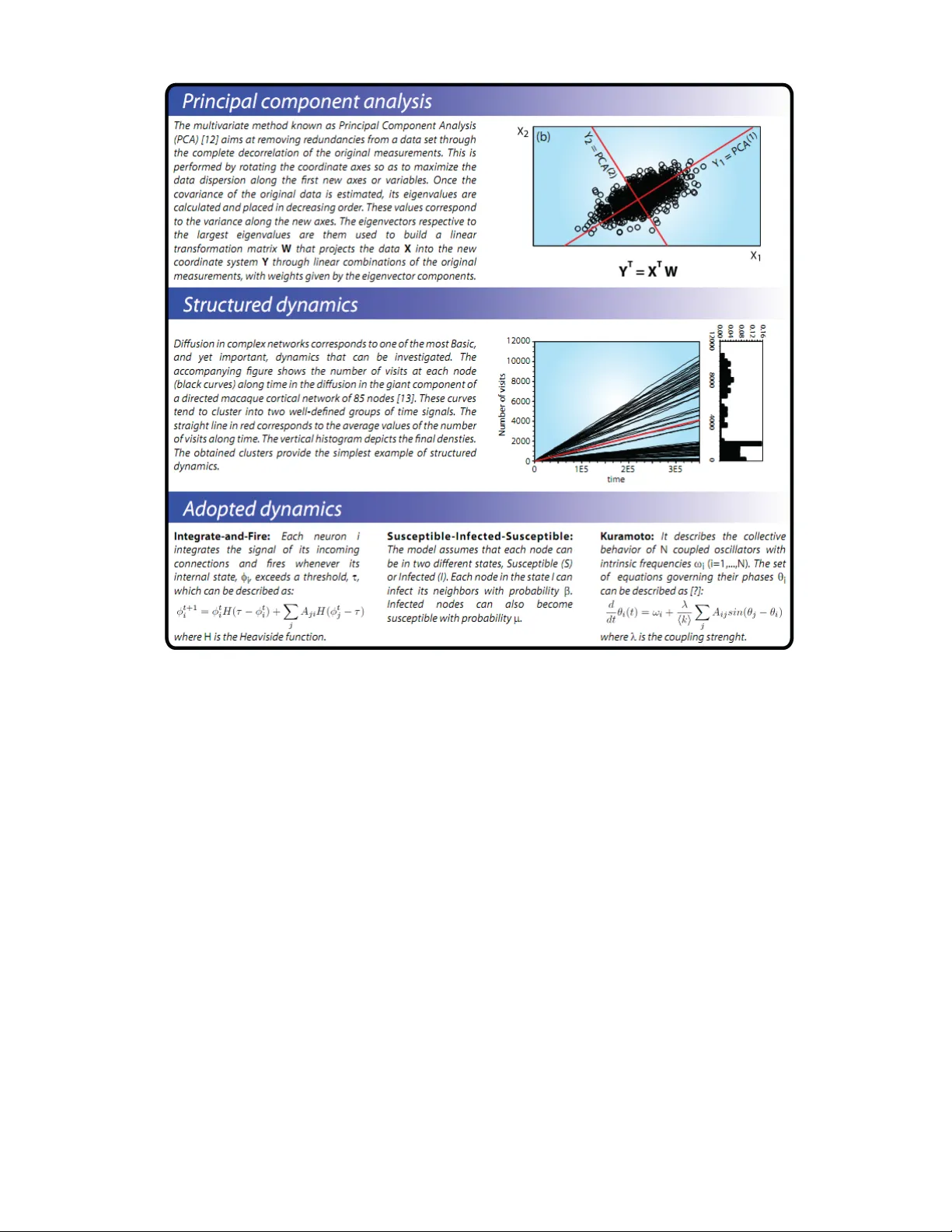
Un v eiling the Relationship Bet w een Structure and Dynamics in Complex Net w orks Cesar H. Comin, Jo˜ ao B. Bunoro, Matheus P . Viana and Luciano da F. Costa 1 1 Institute of Physics at S˜ ao Carlos, University of S˜ ao Paulo, S˜ ao Carlos, S˜ ao Paulo, 13560-970 Br azil (Dated: No vem b er 13, 2021) Ov er the last years, a great deal of atten tion has been fo cused on complex netw orked systems, c haracterized by in tricate structure and dynamics [1 – 6]. The latter has b een often represented in terms of o v erall statistics (e.g. a v erage and standard deviations) of the time signals [1]. While suc h approac hes ha v e led to many insigh ts, they ha ve failed to take in to accoun t that signals at differen t parts of the system can undergo distinct evolutions, which cannot b e prop erly represen ted in terms of av erage v alues. A no vel framew ork for identifying the principal aspects of the dynamics and ho w it is influenced b y the netw ork structure is prop osed in this work. The p oten tial of this approac h is illustrated with resp ect to three important models (Integrate-and-Fire, SIS and Kuramoto), allo wing the identification of highly structured dynamics, in the sense that different groups of no des not only presen ted sp ecific dynamics but also felt the structure of the netw ork in different wa ys. Giv en that complex systems are almost in v ariantly comp osed b y a large n umber of in teracting elemen ts, they can b e effectively represented and modeled in terms of complex netw orks [7, 8]. With this mapping, their structural and dynamical prop erties can b e extracted and inv estigated. T ypically , the structure of such net works is quantified in terms of sev eral measurements [9], reflecting different prop erties of the resp ectiv e top ology (e.g. no de degree, shortest paths, centralities) and geometry (e.g. arc length distances, angles, spatial densit y). A great deal of the in vestigations ab out structure and function in complex systems has fo cused on trying to predict the dynamics from sp ecific structural features [1, 10, 11]. Such an ability w ould provides the means for effectiv ely con trolling real-world systems. Despite the gro wing n umber of w orks devoted to this problem, the knowledge about the relationship b et ween the structural and dynamical prop erties remains incipien t b ecause of t wo main reasons: (a) dynamics is often summarized in terms of global statistics, ov erlo oking the intricacies of dynamics; and (b) the in vestigation often focuses on linear relationships such as correlations b et ween structural and dynamical features. The presen t work is aimed at addressing these limitations through a comprehensive and systematic pro cedure, in volving three steps describ ed as following. First, w e use the multiv ariate statistical approach known as Principal Comp onen t Analysis (PCA) [12] in order to identify the most important features of the dynamics unfolding at ev ery net work no de. Then, we apply a pro cedure for chec king at what an extent they are determined by any structural prop ert y of the system. Therefore, we first identify the dynamical features that are affected by the net work structure and thereafter prob e the effect of a given set of structural measurements on those features (see supplementary Figure 1). W e found that the time signals are organized in to well-defined patterns (see box for a simple example of structured dynamics), which is henceforth called structur e d dynamics . After the time signal x i ( t ) at eac h no de i is recorded along T consecutiv e discrete time instan ts ( t = 1 , 2 , · · · , T ), the PCA metho dology can be applied in order to obtain linear com binations of the signal comp onen ts (new random v ariables) that can b e understo od as new measurements P C A (1) i , P C A (2) i , . . . , P C A ( M ) i ( M ≤ T ) characterizing eac h individual signal i . These measuremen ts are completely uncorrelated and corresp ond to resp ective pro jections of the original space along axes that are optimally aligned along the directions of maximum v ariation of the dynamics. Therefore, the PCA provides a compact and effectiv e description of the original time signals. In case they are correlated, just a few principal axes are required for explaining the most relev ant asp ects of the original dynamics. The present work fo cuses atten tion on this category of dynamical systems. Ha ving iden tified the most relev ant asp ects of the time signals, it is no w imp ortan t to c heck at what an extent eac h of the dynamical v ariables P C A ( m ) is b eing influenced by any of the structural asp ects of the system under study . Th us, the metho d relies on no specific structural measurements whatsoever. First we assume that the time signal of a no de i can be expressed as in Equation . x i ( t + 1) = F ( { x j ( t ) } ) , where j indexes the neighbors of i , and the initial condition is x i (0) = ξ i . Note that the system is Marko vian, time in v ariant and that the dynamic function F is assumed to b e identical at eac h of the netw ork no des. Therefore, the dynamics at a no de i dep ends on three elements: (i) the function F , (ii) the initial condition ~ ξ , and (iii) the top ology of the net work, giv en b y the adjacency matrix A . The null h yp othesis is that the time signals cannot b e discriminated 2 one another. The given net w ork is sub jected to a large num b er of sim ulations starting with different initial conditions ~ ξ . Then, the densit y functions P ( P C A ( m ) ) for eac h principal dynamical feature P C A ( m ) are estimated and used as references. Th us, each of these density functions pro vides an estimate of the v alues obtained for the feature P C A ( m ) considering all the net work no des. Also, the individual density functions P i ( P C A ( m ) i ) of the v alues of P C A ( m ) i are estimated considering eac h no de i individually . In order to test whether the structural features produce distinct dynamical b ehavior at no de lev el, we introduce the index, α ( m ) i , b et ween P ( P C A ( m ) ) and P i ( P C A ( m ) i ), which is defined as the Euclidean distance b etw een the resp ectiv e densities. In other words, the v alue of α i expresses ho w m uch the no de i deviates from the n ull h yp othesis. In case α ( m ) i is significan tly small, the dynamical prop erty P C A ( m ) i at no de i is understoo d not to b e discriminated b y an y structural features, confirming the n ull h yp othesis. F or each dynamical feature P C A ( m ) for which the null hypothesis is not verified, we then quantify how muc h it is related to eac h of a predefined set of structural measuremen ts s (1) , s (2) , . . . , s ( S ) . T o do so, we calculate the disp ersion of α along the measurement, weigh ted by its densit y . This is conv eniently given by the conditional entrop y (or equivocation [14]) b etw een s and α . In order to illustrate the proposed approac h, w e resort to three w ell-known types of dynamics in complex systems, namely in tegrate-and-fire [15, 16], epidemics spreading (SIS) [17, 18], and synchronization (Kuramoto oscillators) [19– 21] (see the Bo x). Although the prop osed metho dology can b e applied to any regime, we consider the steady-state v alues of the signals in the Erd˝ os-R ´ en yi (ER) mo del. W e start by inv estigating the inte gr ate-and-fir e dynamics in which each no de is understo od as a neuron undergoing the McCullo c h and Pitts integrate-and-fire dynamics [22, 23]. The binary time signal (firing spik es) of each node is recorded and represented as a vector. PCA is then applied ov er this ensemble of v ectors to pro ject the data onto the eigenv ectors asso ciated with the three largest eigenv alues. Figure 8(a) shows the PCA pro jections of the time signals, with the colors corresp onding to the no de degrees (see also the supplemen tary Figure 2). Remark ably , the no des resulted organized according to a well-defined geometrical pattern. Also shown in Figure 8 are the densities (Figs. 8b,d) and a verage en tropies (Figs. 8c,e) of the original signals after being further pro jected in to tw o dimensions. Note that the 2D PCA pro jections include groups of no des organized as ‘cords’ (see supplemen tary Figure 3). The obtained 3D pro jection can be divided into three main regions: (i) a relatively sparse conic ‘head’; (ii) a densely p opulated ‘waist’; and (iii) a relatively dense and complex ‘tail’. W e observe that the density p eaks o ccur at low en tropy places. This suggests that the system dynamics tends to unfold so as to fa vor more ordered (i.e. lo wer entrop y) time signals. Another dynamical pro cess considered in this pap er is the Susc eptible-Infe cte d-Susc eptible (SIS) model [24] that is used to inv estigate epidemics spreading on netw orked systems. F or this dynamical pro cess, the time series asso ciated to each node is also binary . Figure 8(f ) sho ws the PCA pro jection of the SIS dynamics (no de degrees mapp ed into colors), as well as the resp ectiv e further tw o-dimensional pro jections into the P C A (1) × P C A (2) plane. The resulting PCA pattern is muc h simpler than that obtained for the integrate-and-fire dynamics, now containing just an ey e- shap ed volume. A cord can also b e identified in this pro jection (see supplementary Figure 3). A similar trend is observ ed betw een the time signal density and en tropy (Figure 8g,h). The third dynamics inv estigated in this work is the Kur amoto dynamics [20], whose PCA pro jection is shown in Figure 8(i), with the respective one-dimensional pro jection giv en in (j). It is clear from these results that the Kuramoto dynamics yielded the simplest PCA pro jection, in the sense that most of the signals v ariance is explained by P C A (1). W e also found that the Kuramoto dynamics tends to yield cords which are related to the natural frequencies of the no des, parametrized b y the resp ectiv e relativ e phases (see supplemen tary Figure 4). In the second step of our metho dology , w e ev aluated the α ( m ) i for each of the new measurements P C A ( m ) , as illustrated in Figures 9. The statistical significance of the α v alues was obtained by using a random null mo del (see supplementary Figure 5). First, several simulations were p erformed for v arying random initial conditions ~ ξ , from which the reference histograms P ( P C A (1) ), P ( P C A (2) ) and P ( P C A (3) )) in Figure 9(a-c) were obtained for the in tegrate-and-fire dynamics. These densities w ere also estimated for each no de separately . F or instance, in Figure 9(d-f ), (g-i), and (j-l), w e illustrate the densities of P C A (1) , P C A (2) and P C A (3) , resp ectiv ely , for three randomly c hosen no des. The small v alues of α obtained in (g) indicate that this no des is not b eing indistinctly influenced by an y structural features of the net w ork. On the other hand, larger v alues of α , such as those in (f,i,k,l) corroborate that the time signals at those resp ectiv e no des are greatly affected by the net work structure. The ov erall α densities are sho wn in Figure 9(m-o) for in tegrate-and-fire, (p,q) for SIS, and (r) for Kuramoto. Remark ably , the wide dispersion of α v alues obtained for most cases confirms that the structural influence on the dynamics can v ary strongly from one no de to another. It is also clear from these results that the P C A (3) of the in tegrate-and-fire dynamics, as w ell as the P C A (2) of the SIS dynamics are the dynamical features mostly affected b y the top ology of the netw ork. As exp ected, b ecause of the adopted strong coupling, the Kuramoto dynamics resulted to b e largely indep enden t of the netw ork structure, which was duly identified by the prop osed metho dology . This is confirmed by the rather small v alues of α sho wn in the density in Figure 9(r). A stronger influence of the top ology was verified for a w eaker coupling (see 3 supplemen tary Figure 6). W e no w pro ceed to the third step, obtaining scatterplots of the α ( m ) v ersus some top ological measuremen ts. The resp ectiv e conditional entropies are then estimated in order to quantify the degree at which the α v alues are b eing explained b y each of the measurements. The scatterplots resp ectiv ely to the smallest conditional entropies (see T able I) are depicted in Figure 10. In case of the in tegrate-and-fire dynamics (Fig. 10a-c), w e ha ve that the eigen vector cen trality was the top ological feature that most strongly affected all the three principal comp onent v ariables. As can b e b e seen in the scatterplot for α (3) v ersus E C (Fig. 10c), the influence of the top ology on the P C A (3) measuremen t is felt more strongly for the no des with low er E C v alues. As shown in Figure 10(d,e), resp ectiv e to the SIS dynamics, the degree was the measuremen t most directly related to the t wo principal v ariables. Other measuremen ts also were found to b e related to the 2D PCA pro jections (see supplementary Figure 7). Remark ably , the v alues of α (1) and α (2) presen t a lo w p eak at v alues of degree similar to the a verage netw ork degree ( h k i = 10), meaning that both P C A (1) and P C A (2) v ariables of the SIS tend to feel the top ology only for no des with degree distinct from h k i . Although the Kuramoto dynamics resulted unaffected b y the netw ork structure, the accessibility w as the top ological feature that yielded the smallest conditional en tropy . All in all, we ha ve proposed a new methodology for inv estigating the relationship b et ween structure and dynamics in complex netw orked systems. The rep orted approach relies on tw o critical concepts, namely the consideration of the structure/dynamics relationship at the individual no de lev el and also along different v alues of sp ecific structural measuremen ts. These concepts allow ed the separation of the intermixing effects that would b e otherwise obtained b y using traditional approaches where b oth structure and dynamics are summarized in terms of global statistics. The obtained results corrob orated the v alidity and imp ortance of these hypotheses. Moreov er, despite the uniformity of the ER top ology , w e identified a highly structured dynamics. In the case of the integrate-and-fire and the SIS dynamics, we found that the PCA regions with higher density of nodes tended to present lo w signal entrop y , which suggests that the dynamics is related to signal uniformit y . I. SUPPLEMENT AR Y MA TERIAL A. Diagram The framework prop osed in the present article for in vestigating the relationship b et ween structure and dynamics in complex systems is summarized by the flo w diagram in Figure 1. First, during the simulation stage, the original net work is sub jected to a total of N C random initial conditions and the time signals for eac h no de is recorded after the steady state has b een reached. The next step inv olves the extraction of PCA dynamics features from the time signals. These features are then used to obtain the resp ectiv e reference histogram. The Euclidean distances betw een this reference histogram and the no de histograms are obtained and used to estimate the α v alues for each no de with resp ect to eac h dynamical feature. Measuremen ts T i of the structure of the netw ork are also estimated and used to obtain the scatterplots α × T i . It should b e observed that the orientation of the PCA axes is undetermined, b ecause the negativ e of an eigenv ector is also an eigenv ector asso ciated to the same eigen v alue. Therefore, in order to provide a stable reference, we obtained a set of eigenv ectors for the large netw ork (10000 no des) and adopted then for all subsequen t pro jections. 4 FIG. 1: Flow diagram of the framew ork proposed in this article for inv estigating the relationship b et ween structure and dynamics of complex systems. B. In tegrate-and-Fire time signals The in tegrate-and-fire dynamics has been extensively inv estigated in complex systems because not only of its biological inspiration (i.e. as a simplified mo del of neuronal netw orks), but also as a consequence of its ric h behavior [1– 6]. Though initial in vestigations fo cused on more regular topologies suc h as la yered systems and lattices [7, 8], muc h atten tion has b een driven to the study of in tegrate-and-fire unfolding in complex net works [22, 23]. Giv en that differen t netw ork mo dels are c haracterized by sp ecific top ological features, a fundamental question arises regarding the relationship b et ween such structural properties and the resp ectiv e dynamics. Remark able related results ha ve b een obtained through the application of the methodology prop osed in this article. Figure 2 sho ws the three-dimensional PCA represen tation of the integrate-and-fire dynamics unfolding in an ER net work with 10000 nodes and av erage degree 10. The integrate-and-fire realization considered initial conditions drawn uniformly within the range [0 , τ + 1], with τ = 8. The time signals were recorded along 1000 steps after the system had reached steady state. The no des w ere colored according to their degree, which resulted stratified along the P C A (3) axis. Examples of resp ectiv e time signals are shown on the righthand side of Figure 2. In terestingly , the time signals tended to b e distributed along the P C A (3) axis in terms of their resp ective av erage frequency . The top of the PCA structure is p opulated b y signals with maximum frequency , i.e. a firing spike at each time instant. The frequency decreases as one mo ves down wards along the P C A (3) axis, such that the lo west frequency signals are found at the b ottom (tail) of the PCA structure. The largest num b er of time signals (ab out 40%) were found to ha ve a verage p eriod of 2 cycles and to b e distributed along the ‘waist’ of the PCA structure. As it b ecomes clear from Figure 3c, the time signals tended to be organized in groups with similar frequencies corresp onding to integer n umber of cycles, in a w ay that reminds harmonic frequency distribution in a linear system. This finding implies that systems undergoing in tegrate-and-fire dynamics with similar parameters will ha ve most neurons firing at 2 cycles, with the others tending to hav e multiple in teger pe riods of oscillations. This in teresting finding is related to the fact that the inv estigated dynamics in the ER structure tends to fav or the uniformit y of the time signals, as reflected in the resp ectiv e entrop y . Particularly remark able is that such structured dynamics, including marked clusters of time signals, arose despite the structural 5 FIG. 2: (a) The 3d PCA pro jections of the integrate-and-fire dynamics unfolding in an ER netw ork. (b) Examples of time signals obtained for the stratifications of the dynamics along the P C A (3) axis. Observe that the frequency of the signals tends to decrease with lo wer v alues of P C A (3) . uniformit y of the ER netw ork. 6 C. Cords In order to explain the organization of signals along the cords in the PCA pro jections, we develop now a simple form ulation for the v alues of P C A (1) and P C A (2) , whic h w e will call x and y for simplicit y . First, let us assume we ha ve the signal show ed in Figure 3(a), which can expressed as s ( t ) = N X i =1 δ t,v i , (1) where, N is the total num b er of spikes in the considered time interv al, the i − th element of the ~ v iden tifies the instan t of the i − th spike. W e can write the following rule for the elemen ts of ~ v v i = 2 i − 1 if 1 ≤ i < h 2 i if h ≤ i ≤ N . (2) On the other hand, the first and second eigenv ectors of the inte gr ate-and-fir e and SIS dynamics can b e expressed as e 1 ( t ) = ( − 1) t (3) and e 2 ( t ) = ( − 1) t cos tπ T , (4) where 1 ≤ t ≤ T , and T is the size of the time windo w. Therefore, we can estimate the v alues of x and y considering the inner-pro duct of the signal and the resp ectiv e eigenv ector: x = T X t =1 ( − 1) t s ( t ) (5) and y = T X t =1 ( − 1) t cos tπ T s ( t ) . (6) Substituting Equation 1, we find the PCA pro jections as a function of the hole position, h x ( h ) = N − 2( h + 1) (7) and y ( h ) = N X i = h cos 2 iπ T − h − 1 X i =1 cos (2 i − 1) π T . (8) In Figure 3(b) and 3(c) w e show the plot of y in terms of x (blue curves) for differen t v alues of h considering the in tegrate-and-fire and SIS dynamics, respectively . It is in teresting to observ e that if w e consider the first elemen t of the time signal as b eing zero (instead of one), the resulting curves corresp onds to the red curv es. 7 FIG. 3: (a) General form of the one-hole (tw o consecutive zeros) time signal. The 2D PCA pro jection of the (b) integrate- and-fire dynamics and (d) SIS. The same, (c) and (e) resp ectiv ely , with the analytical parametric curves appro ximating the cords D. Phases in Kuramoto A different parametric configuration of the Kuramoto dynamics was used in order to further illustrate the p oten tial of the PCA metho dology in iden tifying meaningful prop erties of the dynamics. Three groups of no des in an ER net work with 1000 no des w ere assigned sp ecific natural frequencies, with weak coupling ( λ = 0 . 5). Figure 4(a) depicts the 2D PCA pro jections obtained for the resp ectiv e dynamics. The colors in this figure iden tify each of the frequency groups. Their resp ective pro jections are also sho wn in Figures 4 (b-d). The colors in these three figures identify the relativ e phase of the time signals at each node. Figure 4(e) illustrates fiv e c haracteristic time signals obtained along the cord in Figure 4(d). 8 FIG. 4: Illustration of the distribution of phases of the time signals along the cords yielded b y the Kuramoto dynamics for an ER net work with three frequency groups. E. Statistical Significance of α In order to obtain a level of statistical significance for the v alues of α pro duced by our simulations, we also consider the distribution of α v alues that would be obtained in the case of a random null model. In this mo del the v alue of α for each no de was obtained b y sampling, through Monte Carlo, N C PCA features from the reference histogram. Figure 5 illustrates this approac h with resp ect to the P C A (2) v ariable in integrate-and-fire dynamics. The histogram for the n ull mo del, sho wn in red, is w ell-fitted b y a log-normal distribution. The histogram of α v alues obtained for the integrate-and-fire configuration is shown in gray . By comparing the latter histogram with the fitted log-normal distribution, it is possible to calculate the significance lev el assuming 0.001 confidence. In this specific case, w e obtained α ∗ = 0 . 053, which corresp onds to the probabilit y of obtaining a v alue of α larger than α ∗ b y c hance. 9 FIG. 5: Illustration of the construction used to obtain levels of statistical significance for the v alues of α . F. Effect of coupling in the Kuramoto dynamics T o illustrate the proposed metho dology , w e considered in the main article a strongly coupled version of the Kuramoto oscillator. Here we pro vide complemen tary results with resp ect to a less intensely coupled configuration. Figures 6 (a) and (c) show the histograms of α obtained for this t yp e of dynamics considering relativ ely weak ( λ = 1 . 75) and strong ( λ = 4 . 00) couplings. The histograms of α obtained for the null reference mo del are shown in Figures 6 (b) and (d), respectively . It is clear from these results that the v alues of α are substantially higher than those obtained for the null mo del in the case of the less strongly coupled Kuramoto simulations, while b eing undistinguishable in the more strongly coupled case. This means that in the less strongly coupled Kuramoto configuration the dynamics at eac h node is differentiated by the net work structure, whic h is not observ ed in the other configuration. FIG. 6: Effect of the coupling in the Kuramoto dynamics. As expected, a strong coupling mak es the dynamics at eac h node not to b e differentiated by any structural features of the netw ork. 10 G. T op ological measuremen ts ov er the 2D PCA pro jection of the SIS dynamics So as to better understand the structure versus dynamics relationship in the SIS mo del, w e mapp ed the v alues of the six considered sp ecific top ological features onto the 2D PCA pro jections obtained for this mo del, as shown in Figure 7. In eac h case, the pro jected p oin ts were separated in to tw o main subsets: one corresponding to the border of the eye-shaped pattern (a ‘chord’) and the other to the remainder region. The histograms of the measurements for these tw o groups are also sho wn in Figure7 resp ectiv ely to each 2D pro jection. It is clear from these results that the time signals in these t wo groups tend to be well-separated with resp ect to their degree, eigen v alue centralit y , and accessibilit y . More specifically , no des with high v alues of these three measurements tend to b e found along the chord. Giv en that low accessibility v alues hav e b een found to b e asso ciated to the b order of complex net works [25], it is p ossible that the in terior of the eye-shaped regions are o ccupied b y the b order no des of the ER net work adopted in our simulations. FIG. 7: 2D PCA pro jections of the time signals obtained for the SIS mo del colored in terms of the v alues of sp ecific top ological measuremen ts (a-c, g-i). Histograms of the v alues of the top ological measurements considering the time signals separation into c hord and interior regions (d-f,j-l). Ac knowledgmen ts Luciano da F. Costa is grateful to F APESP (05/00587- 5) and CNPq (301303/06-1 and 573583/2008-0) for the financial supp ort. M. P . Viana was supp orted by a F APESP grant (pro c. 07/50882-9); J. L. B. Batista thanks CNPq (131309/2009-9) for sp onsorship; and C. H. Comin is grateful to CAPES for his grant. The authors thank L. Baccal´ a for his remarks on clustered dynamics, and to G. T ravieso and O. N. Oliveira for commenting on this w ork. The 11 authors also thank L. An tiqueira for help with b o x and for reading and commen ting on the man uscript. [1] A. Barrat, M. Barthelemy , and A. V espignani. Dynamic al Pr o c ess on Complex Networks . Cam bridge Universit y Press, Cam bridge, UK, 2008. [2] L. da F. Costa, O. N. Oliv eira Jr., G. T ravieso, F. A. Rodrigues, P . R. Villas Boas, L. An tiqueira, M. P . Viana, and L. E. C. Ro c ha. Analyzing and mo deling real-w orld phenomena with complex netw orks: A survey of applications. A dvanc es in Physics , 60(3):329–412, 2011. [3] O. Sp orns, D. R. Chialvo, M. Kaiser, and C. C. Hilgetag. Organization, dev elopment and function of complex brain net works. T r ends Co gn. Sci. , 8(9):418–425, 2004. [4] A. L. Barab´ asi and Z. N. Oltv ai. Netw ork biology: Understanding the cell’s functional organization. Nat. R ev. Genet. , 5(2):101–U15, 2004. [5] R. Pastor-Satorras and A. V espignani. Evolution and structur e of the internet . Cambridge Universit y Press, 2004. [6] C. Castellano, S. F ortunato, and V. Loreto. Statistical physics of so cial dynamics. R ev. Mo d. Phys. , 81(2):591–646, 2009. [7] M. E. J. Newman. The structure and function of complex netw orks. SIAM R ev. , 45:167, 2003. [8] R. Alb ert and A. L. Barab´ asi. Statistical mechanics of complex netw ork. R ev. Mo d. Phys. , 74:47–97, 2002. [9] L. da F. Costa, F. A. Ro drigues, G. T ra vieso, and P . R. Villas Boas. Characterization of complex netw orks: A survey of measuremen ts. A dv. Phys. , 56(1):167–242, 2007. [10] S. Boccaletti, V. Latora, Y. Moreno, M. Cha vez, and D.-U. Hw ang. Complex net works: Structure and dynamics. Phys. R ep. , 424(4-5):175–308, 2006. [11] S. N. Dorogovtsev, A. V. Goltsev, and J. F. F. Mendes. Critical phenomena in complex netw orks. R ev. Mo d. Phys. , 80(4):1275–1335, 2008. [12] I. T. Jolliffe. Princip al Comp onent A nalysis . Springer, NY, 2002. [13] M. Kaiser and C. C. Hilgetag. Nonoptimal comp onen t placemen t, but short processing paths, due to long-distance pro jections in neural systems. PL oS Computational Biolo gy , 2(7):e95, 2006. [14] C. Arndt. Information Me asur es: Information and its Description in Scienc e and Enginnering . Springer, 2004. [15] X. Guardiola, A. Diaz-Guilera, M. Llas, and C. J. Perez. Sync hronization, diversit y , and top ology of netw orks of integrate and fire oscillators. Phys. R ev. E , 62(4):5565–5570, 2000. [16] A. Roxin, H. Rieck e, and S. A. Solla. Self-sustained activity in a small-w orld net work of excitable neurons. Phys. R ev. L ett. , 92(19):198101, 2004. [17] R. Pastor-Satorras and A. V espignani. Epidemic dynamics and endemic states in complex net works. Phys. R ev. E , 63(6):066117, 2001. [18] R. Pastor-Sattorras and A. V espignani. Epidemic spreading in scale-free netw orks. Phys. R ev. L ett. , 86(14):3200–3203, 2001. [19] H. Hong, M. Y. Choi, and B. J. Kim. Synchronization on small-world netw orks. Phys. R ev. E , 65(2):026139, 2002. [20] Y. Moreno and A. F. P acheco. Synchronization of kuramoto oscillators in scale-free netw orks. Eur ophys. L ett. , 68(4):603– 609, 2004. [21] A. Arenas, A. Daz-Guilera, J. Kurthsd, Y. Moreno, and C. Zhoug. Synchronization in complex netw orks. Phys. R ep. , 469(3):93–153, 2008. [22] C. Ko c h. Biophysics of c omputation: information pr oc essing in single neur ons . Oxford Universit y Press, New Y ork, 1999. [23] A. N. Burkitt. A review of the integrate-and-fire neuron mo del: I. homogeneous synaptic input. Biol. Cyb ern. , 95(1):1–19, 2006. [24] R. P astor-Satorras and A. V espignani. Epidemic dynamics and endemic states in complex netw orks. Physic al R eview E , 63:066117, 2001. [25] B. T ra venolo, M. P . Viana, and L. da F. Costa Border detection in complex net works. New Journal of Physics , 11(6):063019, 2009. 12 In tegrate-and-Fire Susceptible-Infected-Susceptible Kuramoto Measuremen t P C A (1) P C A (2) P C A (3) P C A (1) P C A (2) P C A (1) k 2.52 2.67 2.24 1.28 1.51 0.15 k nn 2.70 2.81 2.47 2.69 2.95 0.15 BC 2.50 2.62 2.22 1.62 1.95 0.15 EC 2.40 2.56 2.11 2.01 2.38 0.14 ASPL 2.43 2.60 2.14 2.00 2.37 0.13 A CC 2.43 2.60 2.15 2.12 2.48 0.13 T ABLE I: The conditional entropies obtained for α considering the three dynamics in terms of some top ological measurements: degree k , av erage neighbor degree k nn , b etw eenness centralit y B C , eigenv ector centralit y E C , av erage shortest path length AS P L and accessibility AC C . 13 14 FIG. 8: The 3d PCA pr oje ctions of the c onsider e d dynamics . (a)integrate-and-fire, (f )SIS, and (i)Kuramoto. The p ercen tage of explained v ariance provided by each principal comp onen t v ariable are shown along each axes. The densities of the pro jections are shown in (b,d) for the integrate-and-fire, (g) for the SIS, and (j) for the Kuramoto. The resp ectiv e signal entropies are depicted in (c,e) for the integrate-and-fire, (h) for the SIS. All these results w ere obtained for an ER netw ork with 10000 no des and a verage degree of 10. The integrate-and-fire realization considered initial conditions drawn uniformly within the range [0 , τ + 1], with τ = 8. The SIS dynamics assumed β = 0 . 8 and µ = 1. The initial condition was such that 50% of the no des w ere infected. The Kuramoto simulations were p erformed for κ = 4, with the natural frequencies drawn from a normal distribution with n ull mean and unit v ariance and the initial phases distributed uniformly betw een [0 , 2 π ]. As sho wn in (b) and (d), the t wo extremities of the eye-shaped waist corresp onds to approximately 40% of the nodes in the netw ork. A third peak is found at the cen ter of the ‘eye’, containing about 22% of the no des. There is a fourth density p eak, located along the central axis of the ‘tail’ part of the pro jection. Likewise, in (g) the time signals concentrate at the tw o extremities of the ‘eye’, corresp onding to ab out 55% of the no des. The num b er of PCA axes considered were either enough to account for at least 75% of the v ariance or limited to 3. 15 FIG. 9: Estimation of the distribution of α . The reference histograms of (a) P C A (1) , (b) P C A (2) and (c) P C A (3) for 1000 realizations of the integrate-and-fire dynamics ov er the ER netw ork with 1000 no des and a verage degree 10. Examples of histograms (considering the same realizations) for specific no des with resp ect to the (d-f ) P C A (1) , (g-i) P C A (2) , and (j-i) P C A (3) . The histograms of (m) α (1) , (n) α (2) and (o) α (3) for the integrate-and-fire dynamics; (p) α (1) , (q) α (2) for the SIS dynamics; and (r) α (1) for the Kuramoto dynamics. W e used the same set of parameters as in Figure 8. 16 FIG. 10: Sc atterplots b etwe en top olo gic al me asur ements and values of α : (a) α (1) × E C , (b) α (2) × E C , and (c) α (3) × E C for the in tegrate-and-fire dynamics; (d) α (1) × k , and (e) α (2) × k for the SIS dynamics; and (f ) α (1) × Acc for the Kuramoto dynamics. The red curv e corresp onds to the av erage of the α v alues, and bars indicate the standard deviation. Only the scatterplots obtained for the smallest conditional en tropies in T able I are shown.
Original Paper
Loading high-quality paper...
Comments & Academic Discussion
Loading comments...
Leave a Comment