An Efficient Paging Algorithm for Multi-Carrier CDMA System
To cope with the increasing demand of wireless communication services multi-carrier systems are being used. Radio resources are very limited and efficient usages of these resources are inevitable to get optimum performance of the system. Paging chann…
Authors: Sheikh Shanawaz Mostafa, Khondker Jahid Reza, Gazi Maniur Rashid
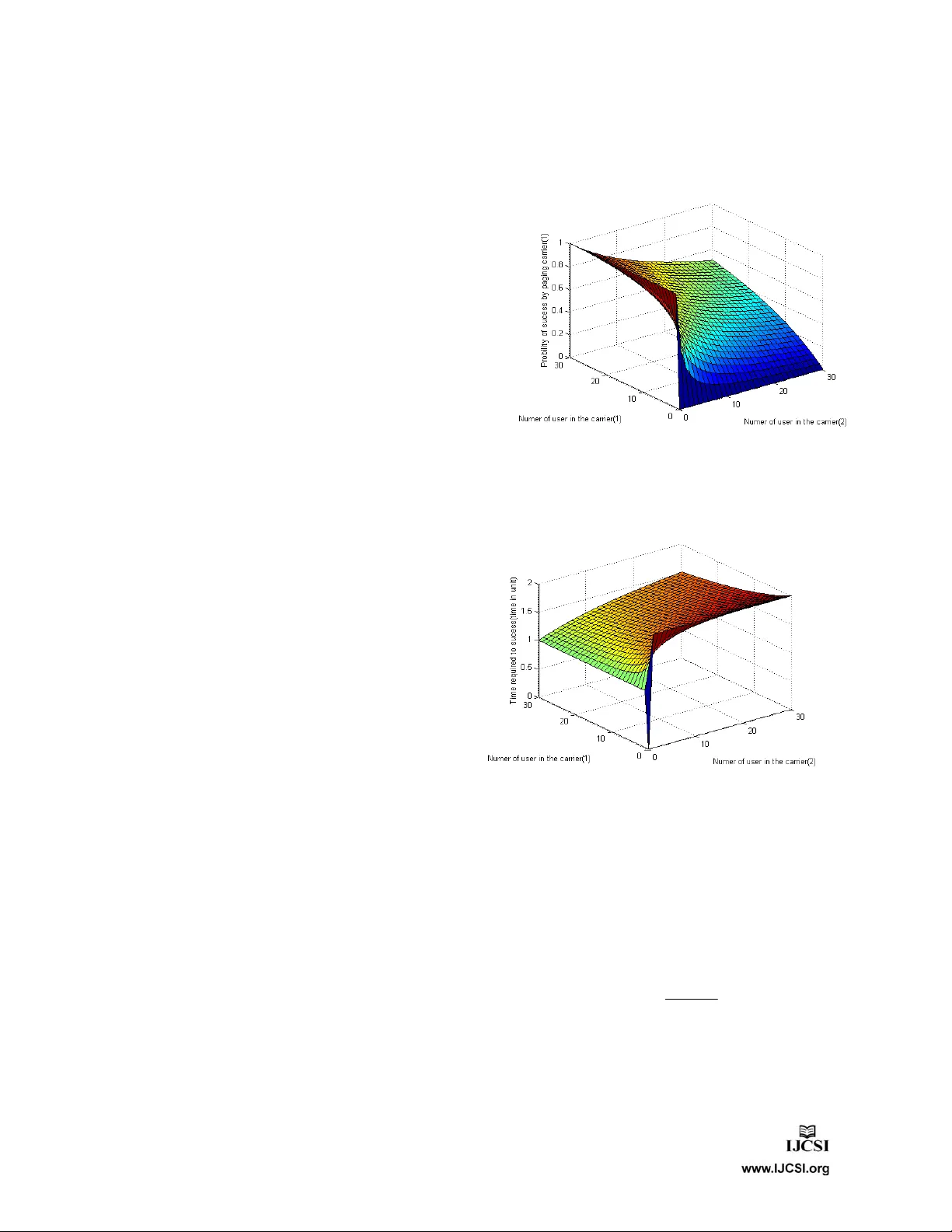
IJCSI International Journal of Com puter Science Issues, Vol. 8, Issue 3, No. 2, May 2011 ISSN (Online): 1694-0814 www.IJCSI.org 421 An Efficient Paging Algorithm for Multi-Carrier CDMA System Sheikh Shanawaz Mostafa 1 , Khondker Jahid Reza 2 , Gazi Maniur R ashid 3 , Muhammad Moinuddin 4 , Md. Ziaul A min 5 and Abdullah Al Nahid 6 1,2,3,4,5,6 Electronics and Communication Engineering Discipline, Khu lna University, Khulna-9208, Bangladesh. Abstract To cope with the increasing demand of wireless communication services multi-carrier systems are being used. Radio resources are very limited and efficient usages of these resources are inevitable to get optimum perfo rm ance of the system. Paging channel is a low-bandwidth channel and one of the most important channels on which system performance depends significantly. Therefore it is vulnerable to even moderate overloads. In this paper, an efficient paging algorithm, Concurrent Search, is proposed for efficient use of paging channel in Multi- carrier CDMA system instead of existing sequential searching algorithm. It is shown by the simulation that the paging performance in proposed algorithm is far better than the existing system. Keywords: Absorbing Markov Chain, Concurrent Search, Erlang C Formula, Multi-Carrier, Paging. 1. Introduction In order to deliver services to a Mobile Station (MS) th e cellular network must be able to track MS in the network . The forward-link communication channels are used to page and transm it system overhead messages to the MS i s called paging channel [1]. Efficient utilization of limited resources is requ ired to support the growing dem ands of personal com munication services. To utilize the paging channel efficiently, many researchers have been studying di fferent techniques. One of the concepts is dividi ng a location area int o paging zones is described in [8] a nd [9]. Anot her research has proposed to increase paging e fficiency-MS will be paged on the last registered cell and subsequently to other cells in the location area if necessary [4]. A mobility tracking scheme that com bines a movement -based location update policy with a select ive paging scheme is proposed i n [5]. In CDMA system, an MS accesses the system on a particular carrier frequency [10]. A single carri er frequency occupies 1.25MHz bandwidt h contains seven paging channels. When a carrier reaches its capacity limit, it is desirable to increase th e system capacity. One way of achieving th is is to increas e the number of carriers to greater than one. When more th an one carrier is used then, the system is referred to as multi-carrier system. In existing multi carrier system, an MS is capable of tuning to only one of the carrier frequencies at any instant of time. Because of this, the MS is only listening to one of the carrier frequency paging channels at a tim e. In order to page an MS, the paging message must be sent on the paging channels of all of the carrier frequencies to ensure that it is sent on the pagin g channel the MS is listen ing to. To do this the paging message m ust be duplicated for each of the paging channels on which the m essage is to be sent [10]. The existing system can’t search m ore than seven users simultaneously. This results in an inefficient utilization of pag ing channel recour ses. In this paper, a concurrent search algorithm i s proposed which can be used to search more than seven users simultaneously in multiple carriers. The con current search algorithm has been used for pagi ng in cells [6]. But the novelty of our paper is the adoption of concurrent search algorithm in multiple carrier CDMA system rather then cells. The system performance ha s been analyzed by using absorbing Markov chain and Erlang C formula. 2. Sequential Search Algorithm This paper focused concurrent search al gorithm based on the problem of sequentiall y locating a number of users. Suppose there is n number of carriers in t he network and k IJCSI International Journal of Com puter Science Issues, Vol. 8, Issue 3, No. 2, May 2011 ISSN (Online): 1694-0814 www.IJCSI.org 422 mobile users to be located. In existing multicarrier CDMA system a straight forward sequential paging schem e has been used to locate user i among k num ber of users. W e assume that the user must exists in the network so n 1 j 1 j) P(i, i {1,2, ...k}. When 1 ≤ c ≤ n where P(i,j) is the prob ability of existence o f user i in j th carrier. Whereas F (i,c) is the indi cator of finding user and that is F(i,c) {0,1} if the i th mobile user has located at the c th carrier then F(i,c) = 1 elsewher e F(i,c) = 0. To clarify the existing problem we use simpli fy algorithm of sequent ial search. Step 0: Initially F(i,c) = 0 where 1 ≤ i ≤ k and 1 ≤ c ≤ n Step 1: [flood the message] for all 1 ≤ c ≤ n Copy and send the paging m essage for user i Step:3 If F(i,c) = = 1 exit This technique requires k*n paging channels by usi ng concurrent paging schem e it is possible t o reduce average use of paging channels. Consider an example to dem onstrate the effectiveness of concurrent search scheme. Suppose that t here are only two carriers in the system with same num ber of users. Among them two users: X and Y are to be found. Assume that the system has no previ ous knowledge about the location of the users: each user can exis t in any of the two carriers with probability 0. 5. Using sequ ential paging, th e system would page and locate user X to the both carriers in the first attempt. Then, the system would page and locate user Y to the both carriers in the second attem pt. Thus total of (2+2) four pages would be required for finding two users. On the other hand , if the system is to page in the first attempt user X in carrier 1 and for user Y in carrier 2 simultaneously, then there is 50% pro bability that any of the two users woul d be found in the first atte mpt. If a user Y is not found at first at tempt, the sy stem would page for the user in the “other” carri er in the second attempt. Thus, (2+1) 3 paging messages are needed for the two users. On the average, 1.5 pages would be required per user, a saving of 25% over the sequential pagi ng. 3. Concurrent Search Algorithm The proposed concurrently searching al gorithm for locating i th user in n carriers is described here. To minim ize the paging cost, a m ethodology is described in [7], it is stated that the higher probability o f finding users must be paged before the lower prob ability. This is also true for proposed carri er concept. From Fig. 1 and Fi g. 2, it is visualized that if the p riority is high th en the cost (time) is low. Fig. 1 Probability of paging success Fig. 2 Cost (time) of paging It is assumed t hat the mobil e users do not move to other carriers during searching . Terms used in probability algorithm are P (i,j) be the pr obability that a mobile user i is in carrier j. When a call to mobile user i arrives, generally assume d that P(i,j) > 0 i {1,2,3.....k}, j {1,2,....n}. If the total number of users in j th carrier is U j then prob ability n 1 c c j U U ) j , i ( P , and n 1 j 1 j) P(i, i {1,2, ...k}. When 1 ≤ c ≤ n S(i,c) {0,1}, if the i th mobile user has not located at the c th carrier then S(i,c) = 0 elsewhere S(i,c) = 1,where 1 ≤ i ≤ k . And the matrix B i [c] IJCSI International Journal of Com puter Science Issues, Vol. 8, Issue 3, No. 2, May 2011 ISSN (Online): 1694-0814 www.IJCSI.org 423 stores up to date priority information about carrier for paging. Which can be found from the probabilistic informati on P(i,j) by using any sorti ng algorithm. The proposed concurrent search algorithm is presented as follows. Step 0: Initially, S(i,c) = 0, for all 1 ≤ i ≤ k Step 1: [Initializing carrier] set c = 1 Step 2: [Carrier Choice] (a) If 0 [c] B i and [c] B i is free then perform step 3 to page mobile user i in the carrier c. (b) else if c+1 ≤ n set c = c+1 and go to step 2 (c) else if c+1 > n and then go to step1 (d) else go to step 4 Step 3: [Page] (a) if S(i ,c) = = 1 go to step 4 (b) else set B i [c] = S(i,c), c = c+1 and go to step 2 Step 4: exit Here are some rem arks related to above algorithm . Step 0, the initial states, S(i,c) = 0,which represents no MS has been located yet. In step 1, the 1st carrier is chosen am ong the ‘n’ number of the carriers from priority array of B i [c]. In step 2(a), paging message will be sent (actually goes to step 3) if and only if c i s not paged yet and c is free. Here it should be not ed that, if the user is not found in that particular carrier is assigned that carrier B i [c] as 0 to obstruct multiple page on the same carrier. In step 2(b), if step 2(a) is not sati sfied then next carrier number will be checked if it is less than or eq ual total number of carrier. Again step 2 will be performed. In step 2(c), if the highest number of carri er is exceeded and all the carriers are paged then the system goes to step 2(d). Otherwise step 1 will be performed. Step 2(d) will be performed when 2(a) or 2(b) o r 2(c) steps are not satisfied. In step 3, paging procedure is m ainly processed. In step 3(a), if the desi red user is found then S(i,c) is set to 1. In step 3(b), if the desired user is not found then S(i,c) is copied to Bi[c]and carrier is increased by 1. System goes to step 2 again. In step 4, exit. 4. Performance Evaluation For analyzing the performance, consider there are two carriers in the system. So that , for CDMA system there are 14 (2*7) paging channels. Let , carrier 1 has M number of users and carrier 2 has N number of users so the total number of users in the system is M+N. Probability of finding a particular user i n carrier 1 is and in carrier 2 is . If the system first paged at carrier 1 for the desired user then th e state diagram will be like Fig. 3 Fig. 3 State Diagram In Fig. 3, if the user is succeeded in the 1 st carrier, then goes to 1 st Abs state with the probability . But if the user is not succeeded at 1 st Carrier then it goes to 2 nd Carrier with a probability . As it is assumed earlier that the desired user must be present in the system, so user must be succeeded in the 2 nd Carrier. Then the prob ability of going from 2 nd Carrier to 2 nd Absorbing state is 1. Here , 1 st Abs and 2 nd Abs are the absorbing state which m ean that the paging request no longer in the system . A user request goes to outside of the system through these states. So the canonical form of the st ate diagram is. IJCSI International Journal of Com puter Science Issues, Vol. 8, Issue 3, No. 2, May 2011 ISSN (Online): 1694-0814 www.IJCSI.org 424 Abs Abs C C nd st nd st N M M N M N Abs Abs C C P 2 1 2 1 2 1 1 0 0 0 0 1 0 0 1 0 0 0 0 0 2 1 It is assumed that the user spen ds a unit time in single carrier. The average paging (s ervice) time that the user stays in the service can be calculated by using absorbing Markov chains [2]. That is 1 or 2 from which it is realized that M should be alway s higher than N (shown in Fig 2.) for reducing the cost (tim e). There are seven paging channels of each ca rrier. So that, greater than seven users can’t access the 1 st carrier simultaneously as a result they go to 2 nd carrier. And their average time will be 1 or 2 . The average time a user spends in the service can be found by calcul ating the expected value of user time whic h is 1.5 units. The system can be imagined wit h 14 parallel servers having queue [12]. Then its probability that all serv ers are busy can be found from Erlang C form ula [3], [11] is, Pr[C channels are busy] = 1 C 0 k k c c ! k ) C 1 ( ! C A ( 1 ) Where A is total offered traffic which is , where λ is incoming traffic rate and μ is the service rate. C is the number of parallel servers com paring with proposed system it is channels. So the prob ability that all ch annels are busy in proposed system for 14 channels is P o 13 0 14 14 0 ! ) 14 1 ( ! 14 k k k ( 2) Average Wait for All users ) 14 ( 0 AWA (3) Average Wait for Delayed users ) 14 ( 1 AWD (4) Average Time in the System 1 AWA (5) 5. Simulation For two carriers service rate of sequential search is s where the service rate of concurrent search is 5 . 1 c .Here is the service rate of single carrier. The is the blocking pr obability can be compared by Eq. (2 ) (Fig 4) and other performance parame ter like average wait time for all users, average wait time for delayed users, average service time in the syst em can be analyzed by Eq. (3) (Fig 6), Eq. (4) (Fig 5) and Eq.(5) (Fig 6) sequential ly. Fig. 4 Probability Comparison of busy channels for two carriers. Fig. 5 Comparison of average wait for delayed users between proposed and existing system for two carriers. IJCSI International Journal of Com puter Science Issues, Vol. 8, Issue 3, No. 2, May 2011 ISSN (Online): 1694-0814 www.IJCSI.org 425 Fig. 6 Comparison of average waits for all customers between proposed and existing system for two carriers Fig. 7 Comparison of total average tim e between proposed and existing system for two carriers. 6. Conclusions The proposed concurrent search algorithm for paging mobile users in CDMA system based on the probab ilistic information about the carriers. The reduct ion of using paging channel due to such a concurrent search can be quite extensive; sho ws on simulation results. In the proposed system, traffic hand ling capability is higher with a little bit sacrifice in servicing time. But this drawback is also abolished for higher traffic. So the proposed system will work better in the peak hour with a large incoming traffic with same resources. References . [1] Saleh Faruque, Cellular Mobile System Engineering, Artech House Publishers, New ed., 2007-2008. [2] Charles M. Grinstead, J. Laurie Snell, Introduction to Probability, 2nd ed., American Mathematical Society, 1991. [3] Theodre S. Rappaport, “Wi reless Communications”, 2nd ed., Prentice-Hall of India, 2002. [4] G. L. Lyberpoulos, J.G. Mar koulidakis, D.V. Polymeros, D.F. Tsirkas, and E.D. Sykas, “Int elligent paging strategiesfor 3rd generation mobile telecommunication systems,” IEEE/ACM Trans. Veh. Technol., vol 44, pp. 573-553, Aug. 1995. [5] I.F. Akyildiz, J.S. M. Ho, and Y.-B. Lin, “Movement-based locationupdate and selective paging for PCS networks,” IEEE /ACM Trans. Networking, vol. 4, pp. 629-638, Aug. 1996. [6] Rung-Hung Gue and Zygmunt J. Haas “Concurrent Search of Mobile Users in Cellular Networks”, IEEE/ACM Transactions on Networking, vol. 12, no. 1, Feb 2004 [7] C. rose and R. Yates, “Minim izing the average cos t of paging under delay constraints,” ACM /Kluwer Wireless Networks, vol. 1, no.2, pp. 211-219, 1995. [8] D. Munoz-Podrguez, “Cluster paging for traveling subscribers,” in IEEE Vehicular Technology Conf. 1990, May, 6-9, pp. 748-753. [9] D. Plassmann, “L ocation management st rategies for mobile cellular networks of 3rd generation,” IEEE Vehicular Technology Conf., June 1994, pp. 649-653. [10]William E. Illidge, “CDMA Multiple Carrier Paging Channel Optimization”, Patent number: US 6,542,752; Date of Patent Apr. 1, 2003. [11]Erlang C queuing model (2010) Erlang Library for Excel. [Online]. Available:http://abstractmicro.com/erlang/helppages/mod-c.htm [12]CDMA2000 1X paging Optimization Guide, Huawei Technologies Co., Ltd., 2004. Sheikh Shanawaz Mostafa completed B.Sc. Engineering in Electronics and Communication, from Khulna University-9208, Khulna, Bangladesh. His current research interests are: Wireless communication, Modulation techniques and Biomedical signal processing. He has seven papers, published in different local and international recogni zed journal and proceedings of conference. Khondker Jahid Reza is serving as an Engineer at Advance Data Networks System Ltd. He has completed his B.Sc. in Electronics and Communication Engineering Discipline in Khulna University, Khulna, Bangladesh. His current research interest is w ireless communication, modulation and sensor networks. He has two papers, published in international recognized journal. IJCSI International Journal of Com puter Science Issues, Vol. 8, Issue 3, No. 2, May 2011 ISSN (Online): 1694-0814 www.IJCSI.org 426 Gazi Maniur Rashid is serving as an RF Engineer at Metro global Telecom Service Ltd. He has completed his B.Sc. in Electronics and Communication Engineering Discipline in Khulna University, Khulna, Bangladesh. His current research interest is wireless communication, modulation techniques, channel coding and fading. Previously his paper published in an international recognized journal. Muhammad Moinuddin is serving as an Assistant Network Engineer at Dhakacom Ltd. He has completed his B.Sc. in Electronics and Communication Engineering Discipline in Khulna University, Khulna, Bangladesh. His current research interests are: wireless communication and various modulation techniques. Md. Ziaul Am in is currently working as an Assistant Professor at the Khulna University, Khulna, Bangladesh. He obtained his B.Sc. in Electronics and Communication Engineering from same university. Previously, he worked as a System Engineer, planning, at RanksTel Bangladesh Ltd. since 10.11.07 to 08.09.08. His current research interests are: Digital Signal Processing and Radio Network Planning. He has three papers, published in international recognized journal. Abdullah Al Nahid is now working as a faculty member of Electronics and Communication Engineering (ECE) di scipline at Khulna University, Khulna, Bangladesh. He completed his B.Sc. in ECE from the same university. He is working in the field of Digital Signal Processing, Robotics and Communication. He has more than ten papers, published in different local and international recognized journal and pr oceedings of conference.
Original Paper
Loading high-quality paper...
Comments & Academic Discussion
Loading comments...
Leave a Comment