Ham Sandwich with Mayo: A Stronger Conclusion to the Classical Ham Sandwich Theorem
The conclusion of the classical ham sandwich theorem of Banach and Steinhaus may be strengthened: there always exists a common bisecting hyperplane that touches each of the sets, that is, intersects the closure of each set. Hence, if the knife is sme…
Authors: ** John H. Elton (조지아 공대 수학과) Theodore P. Hill (조지아 공대 수학과) **
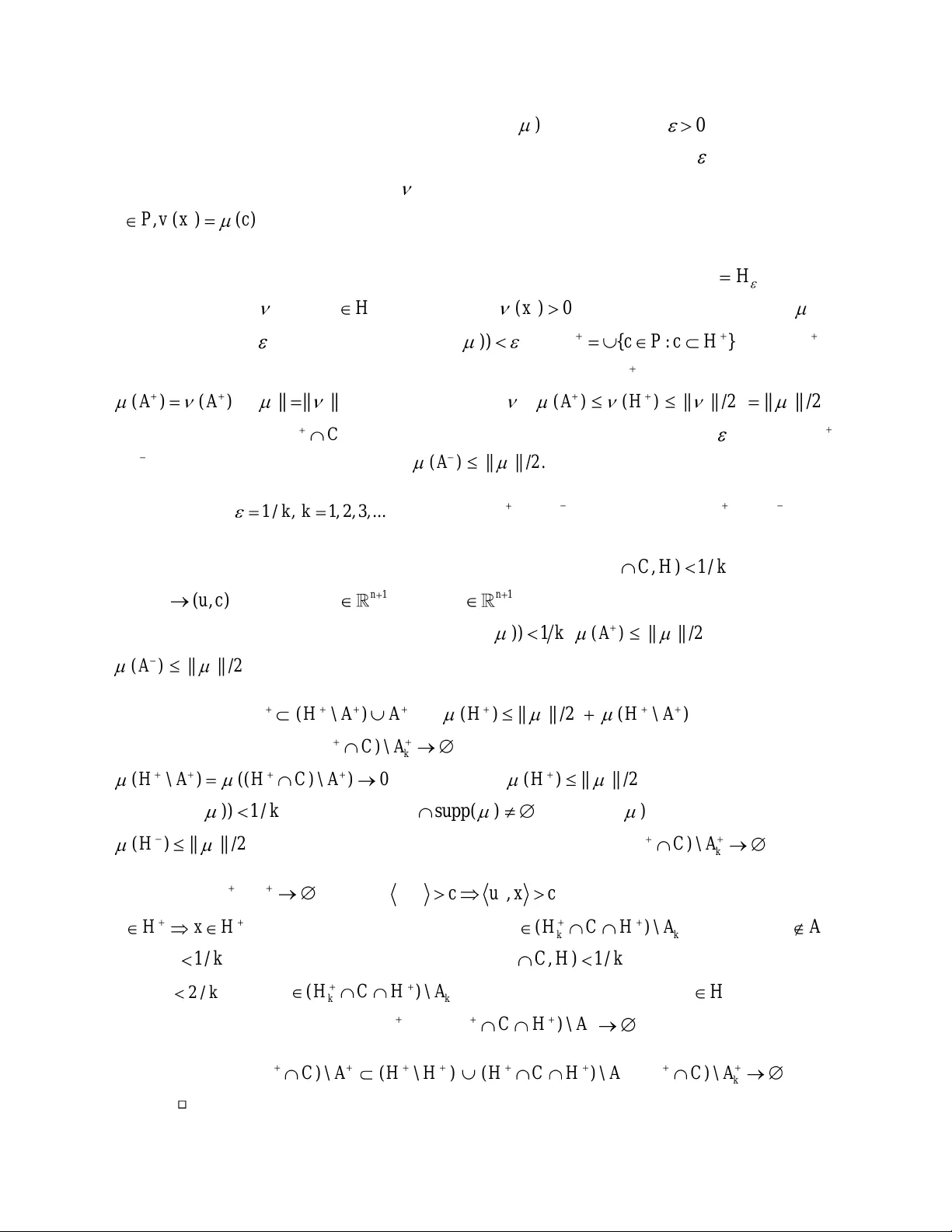
1 Ham Sandwich with May o: A Stronger Conclu sion to the Cl assical Ham Sandwich The orem By John H. Elton and Theodore P. Hill School of Mathematics, Georgia Institute of Technology Atlanta GA 30332-0160 USA elton@math.gatech.edu, hill@math.gatec h.edu Summary The conclusion of the classical ham sandwich theorem of Banach and Steinhaus may be strengthened: there alway s exists a common bisecting h ype rplane that touch es each of the sets, that is, intersects the closure of each set. Hence, if the knife is smeared with mayonnaise, a cut can always be made so that it will not only simultaneously bisect each of the ingredients, but it will also spread mayonnaise on each . A discrete analog of this theorem sa y s that n finite nonempty sets in n -dimensional Euclidean space can always be simultaneously bisected by a single hyperplane that contains at least one point in each set. More generally, for n compactly- supported positive finite Borel measure s in Euclidean n -space, there is alwa y s a h ype rplane that bisects each of the measures and intersects the support of each mea sure. 1. Introduction. The classical ham sandwich theorem [BZ, S, ST] says that every collection of n bounded Borel sets in n can be simultaneously bisected in Lebesgue measure by a single hyperplane. Many generalizations of this theorem are well known (e.g., [H], [M], [ST]), and the purpose of this note is to show that the conclusion of the classical ham sandwich theorem (a nd the conclusions of some of its well known extensions and generalizations) may be strengthened, without additional hypotheses. In the classical setting of bo unded Borel sets, for example, it is shown that there always exists a Banach-Steinhaus bisecting hyperplane that contains at least one point in the closure of each of the sets. In the discrete setting, where the sets are finite, there always exists a bisecting hyperplane that contains at least one point in each of the sets. For compactly-supported positive finite Borel measures, ther e is alwa y s a hyperplane that bisects each of the measures and intersects the support of each measure. Note that to be able to trea t these more general cases where it is possible that a hyperplane has positive measure , bisection of a measure has been defined in this paper (see below) to mean that no more than half the mass of the measure lies on 2 either side of the hyperplane (not including the hyperplane); this is equivalent to the hy perplane being a median for the measures (see [H]). Remark : The proof of Theorem 5 below for general finite measure s onl y assumes the existence of a bisecting hyperplane for the case of purely atomic measure s with finitely many atoms, so it also gives a proof of the existence of bisecting hyperplane s in the general case with the Borsuk - Ulam theorem having only been used for the purely atomic fintely-m any atom case. Notation . F i x n , and for , , n xy let x denote the Euclidean norm of x. For subsets A and B of n , let ( , ) d A B denote the Euclidean distance between A and B , i.e., ( , ) i n f { : , } . d A B x y x A y B Recall that every hyperplane H in n may be represented by 1 ( , ) n uc via the relationship , x H u x c , where u is a point in the unit n -sphere n , 0 c and , denotes the standard inner product on n . For the hyperplane H determined by ( , ) uc , let H denote the open half-space defined by , x H u x c and H denote the open half-space , x H u x c . Fo r a bounded Borel set n A , let #{ } A denote the cardinality of A , () A the Lebesgue measure ( n -dimensional volume) of A, and A the closure of A . For a finite Borel measure on n , () n denotes the total mass of , and supp ( ) the support of (the smallest closed set n C such that () C ). Definition . An ( n-1 )-dimensional hyperplane H in n bisects a finite set n A if both #{ } # { } / 2 A H A and #{ } # { } / 2 A H A ; bisects a bounded Borel set n A if ( ) ( ) ( ) / 2 A H A H A ; and bisects a positive finite Borel measure on n if ( ) || || / 2 a n d H ( ) | | | | / 2 . H 2. Bisecting Discrete Measures. Theorem 1 . Let 1 , . . . n be purely atomic finite positive measures on n , with finitely many atoms. Then there exists a hyperplane H such that for all i, H bisects i and ( ) 0 i H . Although the bisection conclusion of Theore m 1 can be proved b y first principles using the Borsuk-Ulam Theorem, the next lemma, a discrete version of the ha m sandwich theorem, will facilitate its proof. The lemma follows easily from the classical ham sandwich theore m, and is a direct corollary of [H, Theorem 1]. 3 Lemma 2. Let 1 , . . . n be purely atomic positive measures on n with finitely many atoms. Then there exists a hyperplane H that bisects i for all 1 in . Proof of Theorem 1 . Fix 0 , and let {} i A be the sets of atoms of { } i , respectively. For each i , 1 in , re duce the mass of one of the atoms of i by some positive amount less than (and less than the mass of the smallest atom of i ) such that for the new measure i , ( ) \ ( ) ( ) ii x S x A S i xx for every . i S A (This can clearly be done since each i A is finite). Now apply Lemma 2 to 1 , . . . n . The resulting hyperplane H bisects each i and must in fact contain an atom of eac h i (which has the same atoms as i , just of different mass), or it co uld not bisect it, because of ( ). Let approach zero along some sequence k such that the corresponding hyperplanes k H converge to say H . Clearly H bisects each i , and since each k H contains an element of i A for each i and the i A are finite, by passing to a subsequence it may be assumed that there is an atom of i for each i = 1,... n which belongs to all the k H , and hence to H . Thus ( ) 0 i H , for each 1 in . Corollary 3. For every collection 1 , ..., n AA of non-empty finite subsets of n , there is a hyperplane H such that for each 1 in , H bisects i A and i H A . Proof. Let { } i be the measures with atoms {} i A , respectively, and masses of each a tom equal to 1. Apply Theorem 1. Example 4. Sprinkle some salt and pepper on a table, any amounts of each. Then there is alwa ys a grain of salt and a grain of pepper and a line through both grains that has at most half of the grains of salt on each side, and a lso at most half of the grains of pepper on each side. 2. Bisecting General Measures. Theorem 5. For every collection 1 , . . . n of compactly-supported positive Borel measures on n there exists a hyperplane H such that for each 1 in , H bisects i and s u p p ( ) . i H 4 Proof : Let C be a finite closed cube containing sup p( ) i for all i, and fix 0 . Let P be a partition of C into cubes (not necessarily closed or open) of diameter less than , and let c x be the centroid of cube c . For each i, let i be the purely atomic measure such that for , ( ) ( ) i c i c P v x c , and the only atoms are the {} c x . That is, approximate the measures with purely atomic ones by concentra ting all the mass at the centroids of the cubes, for those cubes in the partition which have non-zero mass. By Theorem 1, there is a hyperplane H H such that for all i , H bisects i , and c x H for some c x with ( ) 0 ic x , so some point of support of i lies within distance of H ; that is, ( , sup p( ) ) i dH . Let { : } A c P c H , so that A is the union of the cubes of the partition that are entirely contained in H . Note that ( ) ( ) ii AA , || | | | | | | ii , and since H bisects i , ( ) ( ) || || /2 i i i AH || || /2 i . Note that any point in H C whose distance from H is greater than or equal to belongs to A . A is defined similarly; and similarly, ( ) || || /2 . ii A Now let 1 / , 1 , 2 , 3 , ... kk , and let k H , k A and k A correspond to H , A and A above. Since C is compact, by passing to a subsequence if necessary, it may be assumed that the hyperplanes k H converge a hy perplane H , in such a way that ( , ) 1 / k d H C H k , and ( , ) ( , ) kk u c u c where 1 ( , ) n kk uc and 1 ( , ) n uc represent k H and H , respectively, as in the earlier definition of hyperplanes. Also, ( , supp( ) ) 1 i d H k , ( ) | | | | / 2 i k i A and ( ) | | | | / 2 i k i A for all i . Note that ( \ ) kk H H A A , so ( ) | | | | / 2 ( \ ) i i i k H H A for all k. It will be shown below that the sets ( ) \ k H C A , so from the continuity theorem for measures, ( \ ) ( ( ) \ ) 0 i k i k H A H C A , and therefore ( ) | | | | / 2 ii H ; and from ( , sup p( ) ) 1 / ki d H k it follows that s u p p ( ) i H since sup p( ) i is closed. Similarly ( ) | | | | / 2 ii H . This will finish the proof, once it is shown that ( ) \ k H C A . Now \ k HH , because , , kk u x c u x c for sufficiently large k , so k x H x H for sufficiently large k . Suppose ( ) \ kk x H C H A . Then since k x A , ( , ) 1 / k d x H k from the definition of k A . Since ( , ) 1 / k d H C H k , it follows that ( , ) 2 / d x H k . So if ( ) \ kk x H C H A for all k , it would follow that x H , which is impossible since H is disjoint from H . So ( ) \ kk H C H A also. Thus since ( ) \ ( \ ) ( ) \ k k k k H C A H H H C H A , ( ) \ k H C A as cl aimed. 5 Example 6. At any given instant of time, there is one plane t, one moon and one asteroid in our solar system and a single plane touching all three that exactly bisects the total planetary mass, the total lunar mass, and the total asteroidal mass of the solar system. (Note that different objects may have different mass densities, and even non-uniform mass densities, so this conclusion does not follow from the next corollary.) Corollary 7. (Ham Sandwich with Mayo). For every collection 1 , ..., n AA of n bounded Borel subsets of n of positive Lebesgue measure, there exists a hyperplane H such that for each 1 in , H bisects i A and i H A . Proof. The conclusion follows immediately from Theorem 5 by letting 1 , . . . , n be the finite Borel measures on n defined by ( ) ( ) ii B B A for all Borel sets n B , and observing that supp( ) ii A . If the sets 1 , ..., n AA are all closed, of course , then there is alwa ys a bise cting hyperplane that intersects each set. Otherwise, as the following simple example shows, there may not be a bisecting hyperplane that intersects any of the sets. Example 8. Let 2 n , and suppose that A is the union of the two open disks of radius one centered at (-1,1) and at (-1,-1), and B is the union of the two open disks of radius one centered at (1,1) and at (1,-1). It is easy to see that the unique line that bisects both A and B is the line 0 y , which intersects the closure of both A and B , but does not intersect either set. Even if the sets are closed, not all of the bisecting hy perplanes guaranteed to exist by the classical ham sandwich theorem will intersec t all the bisected sets. Example 9. Let 2 n , and suppose that A is the closed disk of radius one centered at (0,0), and B is the union of the two closed disks of radius one centered at (-3,0) and at (3,0). Then the line 0 x bisects both A and B , but does not touch B . The line 0 y bisects and intersects both sets. If the hypothesis of compactly-supported is dropped in Theorem 5, the bisection conclusion still holds (cf. [H]), but there may not be a common bisecting hyperplane that intersects the supports of all the measures. Example 10. Let 2, n 22 1 {( , 1 ) : } {( , 1 ) : } A k k k k , 22 2 {( , 2) : } {( , 2) : } A k k k k , and let 1 and 2 be the purely atomic probability measures with supports 1 A and 2 A , respectively, given by ( 1 ) 1 1 2 2 ( , 1 ) ( , 1 ) ( , 2) ( , 2) 2 k k k k k for all . k It is easy to see that the only lines that bisect both measures simultaneously are horizontal lines with height in [ -1,1]. But none of these intersects 2 A , the support of 2 . 6 Correction. The proof of the General Case of Theorem 1 in [H] has a gap, namely, that although the subsequence of 1 ( , ) n jj ab converges to 1 ( , ) n ab , it could be that 0 or , a b in which case { : , } n x a x b does not define a hyperplane. To complete the argument, first note that no j a can be zero, so without loss of generality the ' j as all have norm 1 (this may violate the normalization of the vectors ( , ) jj ab , but that is not a problem); thus 1. a Since the { } i are all probability measures, there exists an * r so that 1 ( { : * } ) 1 / 2 n x x r . Replacing ( , ) jj ab by ( , ) jj ab where necessary, assume without loss of generality that all the j b are nonnegative. By construction, 1 ( { : , ) } 1 / 2 n j j x x a b for all j , so by Schwar z’s inequality, 1 ( { : ) } 1 / 2 n j x x b . Hence by the definition of r* , * j b r for all j , so . b Acknowledgment. The second author is grateful to Professor Robert Burckel for pointing out the gap noted above, and for suggesting arguments to correct it. References. [BZ] William A. Bey er and Andrew Zardecki (2004). The early history of the ham sandwich theorem, Amer. Math. Monthly 111 , 58-60. [H] Theodore P. Hill (1988) Common hyperplane medians for random vectors, Amer. Math. Monthly 95 , 437-441. [M] Jiri Matousek (2003) Using the Borsuk-Ulam Theorem , Springer-Verlag, New York. [S] Hugo Steinhaus (1938). A note on the ham sandwich theorem. Mathesis Polska 9 , 26 – 28. [ST] Arthur H. Stone, and John W. Tukey ( 1942). Generalized “sandwich” theorems, Duke Math. J. 9 , 356 – 359.
Original Paper
Loading high-quality paper...
Comments & Academic Discussion
Loading comments...
Leave a Comment