Exploiting the Passive Dynamics of a Compliant Leg to Develop Gait Transitions
In the area of bipedal locomotion, the spring loaded inverted pendulum (SLIP) model has been proposed as a unified framework to explain the dynamics of a wide variety of gaits. In this paper, we present a novel analysis of the mathematical model and …
Authors: Harold Roberto Martinez Salazar, Juan Pablo Carbajal
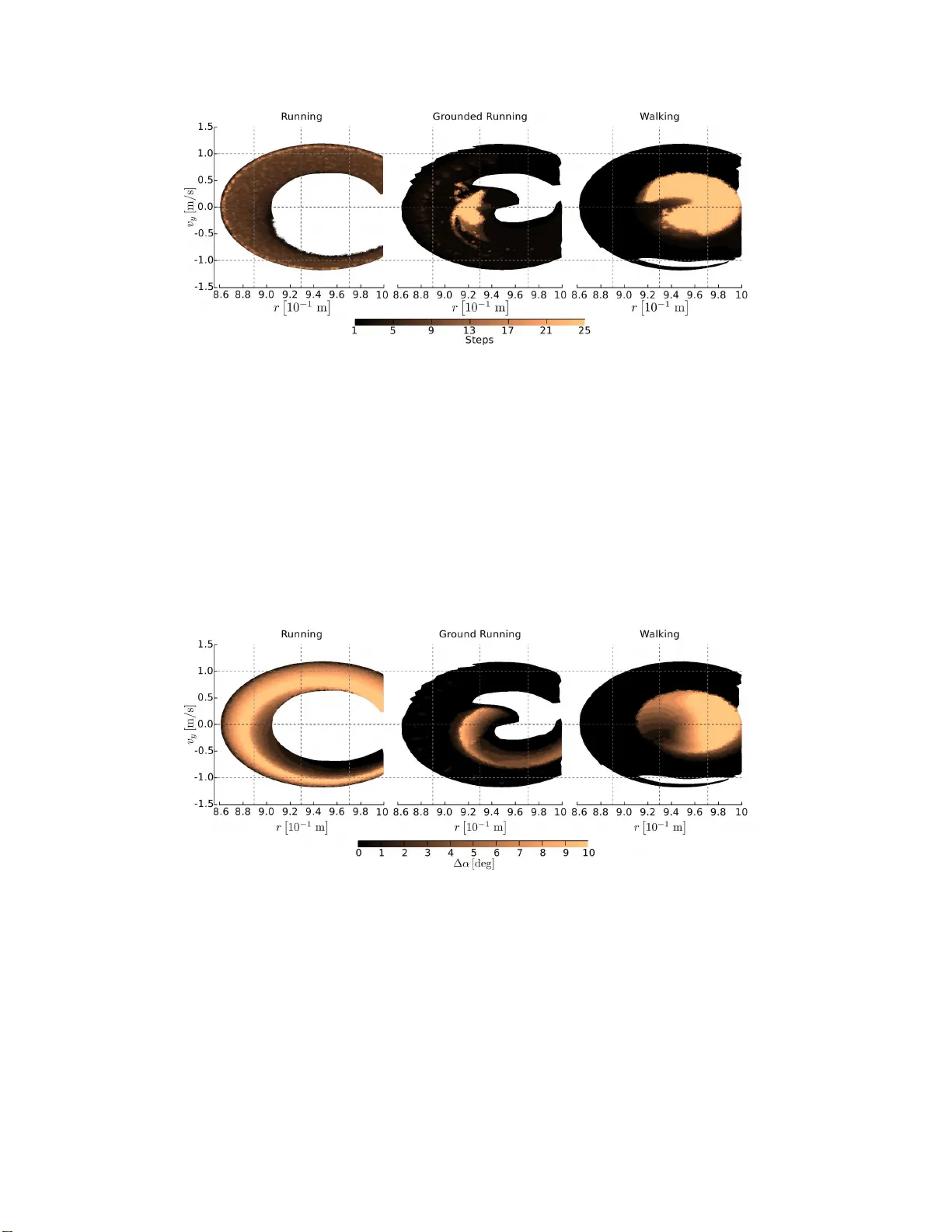
APS/123-QED Exploiting the P assiv e Dynamics of a Co mplian t Leg to Dev elop Gait T ransitions Harold Rob erto Martinez Salazar ∗ and Juan P ablo Carba jal † A rtificial Intel ligenc e L ab or atory, Dep artment of Informatics, University of Zurich A ndr e asstr asse 15 8050 Zurich Swi tzerla nd (Dated: June 4, 2018) Abstract Abstract: In the area of bip edal lo comotion, the sp ring loaded inv erted p endu lum (SLIP) mo del has b een prop osed as a unified framew ork to explain the d ynamics of a wide v ariet y of gaits. In this pap er, w e presen t a nov el analysis of the mathematical mo del and its dynamical prop erties. W e use the p ersp ec tiv e of hybrid dyn amica l systems to study the dynamics and defin e concepts su ch as partial s tabilit y and viabilit y . With this app roac h, on the one hand , w e identi fied stable an d unstable regions of lo comotion. On the other hand, w e foun d wa ys to exploit the un stable regions of lo comoti on to indu ce gait transitions at a constan t energy regime. Additionally , we sho w that simple non-constan t angle of attac k con trol p olicies can rend er the system almost alw ays stable. ∗ ht tp://ailab.ifi.uzh.ch/martinez/; ma rtinez@ifi.uzh.c h † ht tp://ailab.ifi.uzh.ch/carba jal/ ; car ba jal@ifi.uzh.ch, bo th authors can b e contacted reg arding the cont ent of the pap er 1 I. INTR ODUCTION One of the most accepted mathematical mo dels for bip edal running is the spring lo aded in verted p endulum (SLIP , for an extensiv e review s ee[1]). In a similar fashion, the rigid in verted p endulum has b een extensiv ely used to mo del bip edal walk ing[2]. In 2006, Gey er et al.[3] p rop ose the SLIP mo del as a unifying framew ork to describ e walking as w ell as running. The unified p erspectiv e prov es useful for accurately explaining da t a from hum an lo comotion[3]. Additiona lly , it allo ws describing b oth g aits (walking and running) in terms of dynamical en tities observ ed in a discrete m ap, obt a ined by in tersecting the tra jectories of the system with a predefined section of lo wer dimension. G ey er asso ciates t hese entities with limit cycles of the hybrid dynamic a l system [4, 5] and named their attracting b eha vior as self-stabilization . Though the nature of the observ ed dynamical pro p erties is not ye t clarified, those results emphasize that bip edal lo comotion may b e dictated solely by the mec hanics o f the system. As a conse quence, the con trol necessary for lo comotio n is th us reduced to the swing phase of the leg, sho w ed in Fig . 1 b et w een p oints A and B. The most p opular con trol p olicy is to pro duce touc hdowns at constant angle of at t a c k α (CAAP ( α )), i.e. the angle spanned by the landing leg and the horizon tal. In the last decade, many energy-efficien t bip edal w alking mach ines hav e b een dev elop ed. Through careful design, they exploit the passiv e dynamics of their o wn b o dy to mov e forw ard, requiring little control or none[6–10]. Ho wev er, the construction of bip edal mac hines capa ble of exploiting passiv e dynamics in differen t gaits remains an unsolv ed engineering challenge. In this contex t, Gey er et al.[3] rep ort that, in the SLIP mo del, it is not p ossible to ha v e m ultiple gaits at t he same energy . The results are based on sim ulations that do not co ver all p ossible initial conditions of the system. In addition, Rummel et al.[11 ] pro v e that walking and running is p ossible at the same energy leve l. They use a new map that allo ws comparing differen t gaits with ease. The ma p is defined at the vertical plane crossing the landing p oin t of the fo ot (F ig. 1). In this w a y , they find the self-stable regions, but their in tersection is empt y . T o concretize these ideas, let us describ e this region fo r the running map R . E R ∞ = { x | x ∈ S ∧ ( ∃ α | x = R α ( x )) } , (1) where the subscript in R α denotes running using CAAP ( α ) and S denotes the section where the map is defined. Therefore, if f o r differen t gaits these stable regions do not inters ect, e.g. 2 E R ∞ ∩ E W ∞ = ∅ , w e conclude t ha t a transition b et w een the tw o gaits cannot o ccur if the system is to remain in these regions. In other w o rds, x ∈ E R ∞ ∧ y ∈ E W ∞ ⇒ R α ( y ) / ∈ E R ∞ ∧ W β ( x ) / ∈ E W ∞ ∀ α, β . (2) In this study , w e will sho w ho w transitions b et w een gaits are found at p oints outside these stable regions. The tra nsitions require t he selection of the angle of attac k; therefore CAAP’s are not suitable for this task. W e will also sho w evidence indicating that it is p ossible to find an a ngle o f attac k θ t ha t maps a p oint in to a stable r egio n, e.g. x / ∈ E R ∞ ∧ ∃ θ , y | y 6 = x, y ∈ E R ∞ , y = R θ ( x ) . Additionally , w e in tro duce the concepts of p artial stability and via b ility that will b e useful in the construction of the tra nsitions presen ted herein. This paper is organized as follo ws. In section I I, w e describe the mo dels used for our sim ulations, t heir represen tation in state v ariables and the definition of the dis crete map. Next, in section I I I, we in tro duce the new concepts, and we sho w the regions where the transitions b et wee n ga it s exist. Later, in section IV, w e discuss ab out the requiremen ts of a FIG. 1. (Color online) Illustration of the ev olution of th e SLIP mo del for r unning and wa lking. The mass is represented with a fi lled circle. The color of the fi ll indicates touc h do wn ev en t (black) , tak eoff e v ent (wh ite) , a nd th e crossing of the s ect ion (pink (grey)). The landing leg is pictured with a thic k solid line, and the leg at tak eoff is represent ed with a blurred line. Due to th e passiv e prop erties of these mo dels, con trol is necessary only du r ing the swing of the leg, i.e. dur ing fr ee fall while runn ing and from p oint A to B while wal king. 3 con tr o ller for the system and the implications for rob ot design and bip edal lo comotion. W e conclude the pap er in section V with our conclusion. I I. METHODS As explained previously , we use the SLIP mo del to study bip edal gaits. W e adopt the framew or k in [1 2], whic h is described in t he la nguage of hybrid dynamical syste ms. There- fore, we r eintro duce some nota tion a nd definitions. T o represen t t he differen t phases of a gait, the mo del is segmen ted in to three sub-mo dels. W e will call these sub-mo dels charts [4] o r phases see Fig.1. Eac h chart represen t s the motion of a p oin t mass under the influence o f: only gravit y (ff - c hart or flight phase), gra vity and a linear sp ring (s- chart or single stance phase), gravit y and t w o linear springs (d-c hart or double s tance pha se). The p oint mass represen ts the b o dy of the agen t and the massless linear springs mo del the fo rces from the legs (Fig.1). A tra jectory switc hes from one c hart to another when some real v alued functions ev aluated on it cross zero ( ev ent functions [4, 1 3]). W e define a running ga it as a tra jectory that switc hes from the s-c ha rt to t he ff- c hart and bac k to the s-c hart. A w alking gait is defined as a tra jectory that switc hes from the s-chart to the d-chart and bac k again to the s-c hart. Switc hes from the ff-c hart to d-c hart or vice v ersa are no t included in this study . A. Equations of motion in ea c h c hart The mot io n in all t he c harts is go v erned b y a system of ordinary differen tial equations: ˙ ~ X = ~ F i ~ X , (3) where ~ X is the v ector o f state v ariables and ~ F i is a force function characteristic of each c hart . Since all forces are conserv ativ e, the energy of the system is constan t. F or the ff-c hart the state is described by the Cartesian co ordinates of the p osition of the p oint mass and its 4 v elo cit y ~ X f f = ( x, y , v x , v y ) T , ˙ ~ X f f = v x v y 0 − g , (4) where g is t he acceleration due to grav it y . The state in the s-c ha r t is represen t ed in p olar co ordinates ~ X s = r , θ , ˙ r , ˙ θ T , where r is the length of the spring and θ is the angle spanned by the leg and the horizon tal, growin g in clo c kwise direction. Th us, the equations of motion are: ˙ ~ X s = ˙ r ˙ θ k m ( r 0 − r ) + r ˙ θ 2 − g sin θ − 1 r 2 ˙ r ˙ θ + g cos θ . (5) It is imp ortant to note that θ ( t T D ) = α , i.e. the angular state a t the time of to uc hdo wn is equal to the angle of atta c k. The parameter r 0 defines the natural length of the spring. In the d- c hart the state is also represen ted in p olar co ordinates ~ X d = r , θ , ˙ r , ˙ θ T , with the origin of co ordinates in the new touc hdown p oint. The motion is described b y: ˙ ~ X d = ˙ r ˙ θ k m ( r 0 − r ) + 1 − r 0 r ♂ ( x ♂ cos θ − r ) + r ˙ θ 2 − g sin θ − 1 r k m 1 − r 0 r ♂ x ♂ sin θ + 2 ˙ r ˙ θ + g cos θ (6) r ♂ = p r 2 + x 2 ♂ − 2 r x ♂ cos θ , (7) where x ♂ is the horizontal distance b et w een the t w o contact p oin ts and r ♂ is the length o f the bac k leg. B. Ev ent functions Ev en t functions are functions on the phase space of the system. An ev en t o ccurs when the tra jectory of the system in tersects a lev el curv e of the ev en t function. A t the time of the 5 ev en t, the curren t state of the system is mapp ed to the state of another c hart. Some ev en t functions are parameterized with t he angle of attack and the natural length of the springs. Switc hes f rom the ff-c hart to the s-c hart are defined b y: F f f → s ~ X f f , α, r 0 : y − r 0 cos α = 0 v y < 0 , (8) whic h means that the ma ss is falling and the leg can b e placed at its natural le ngth with angle o f attack α . Therefore, the motion is now defined in the s-c ha rt. The switc h in the other directions is simply: F s → f f ~ X s , r 0 : r − r 0 = 0 . (9) These are the only tw o ev en t functions inv olv ed in the running gait. The map from one c hart to the other is defined by: x = − r cos θ y = r sin θ . (10) It is imp ortant to hav e in mind that the origin o f t he s-c hart is alw ay s a t the touc hdow n p oin t. F or the w alking ga it , we hav e to consider switc hes b et we en single and double stance phases. F ro m the s-chart to the d-c hart, w e ha v e: F s → d ~ X s , α, r 0 : r sin θ − r 0 cos α = 0 θ > π 2 , (11) whic h is similar to (8) with the additional condition that the mass is tilted forw a r d. Addi- tionally , if we consider the sign of the ra dial sp eed, w e differen tiate b et w een walking g ait W with ˙ r < 0 and Gro unded R unning gait G R , with ˙ r > 0. The switc h from the double stance phase to the single stance phase is defined by : F d → s ~ X d , r 0 : r ♂ − r 0 = 0 , (12) with r ♂ as defined in (7). The map from the d-c ha rt t o the s-ch art is the identit y . In the other direction w e hav e: r d = r 0 θ d = α, (13) x ♂ = r 0 cos α − r s cos θ s , (14) 6 where the subscripts indicate t he correspo nding c hart. If the system f a lls to t he ground ( y ≤ 0 ), attempts a fo rbidden transition (e.g. d-chart to ff-c hart), o r renders v x < 0 (motion to the left,“bac kw ards”), w e consider that the system fails. C. Sim ulation of t he dynamics The stat e of the mo del is observ ed when the tra jectory of the system inters ects the section defined by S : θ = π / 2 . In this w a y , the map R α : S → S transforms points t hro ugh the ev olution of the system from the s-chart to the ff-c hart and bac k again to t he s-c hart using an angle of attack α . Similarly , the map W α : S → S transforms p oin ts through the ev olution of the system f r om the s-c har t to the d-c har t and bac k again to the s-chart using an angle of attac k α . All initial conditions are g iv en in the S sec tion and in the s-c hart, i.e. only one leg touc hing the ground and oriented v ertically . Moreov er, all t he initial conditions are giv en at the same tota l energy . The results are visualized using the v alues of the length o f the spring r and the ra dial comp onen t of the v elo cit y whic h, in S , equals t he v ertical sp eed ˙ r = v y ( v x is obtained from these v alues and the equation of constan t energy). It is imp ortan t to note that all p ossible v alues of r , v y and v x , for a giv en v alue of the total energy E , lay on an ellipsoid. Beside s, the re is a transformation that maps the ellipsoid to a sphere. This can b e shown a s follows: the to tal energy in the section is, E = 1 2 k ( r 0 − r ) 2 + 1 2 m v 2 x + v 2 y + mg r (15) Defining t he parameters L = r 2 k h E − mg r 0 − mg 2 k i , (16) ω = r k m , (17) the new v ariables ˆ v x = v x ω , (18) ˆ v y = v y ω , (19) ˆ r = r − r 0 − mg k , (20) 7 T ABLE I. V alues used for the sim ulations presente d in this pap er. Description Name V alue Mass m 80 kg Elastic constan t of linear spr ings k 15 kNm Rest length of linear spr ings r 0 1 m T otal en er gy E 820 J Accelerat ion due to gra vit y g 9 . 81 m / s 2 Angle of A ttac k α from 55 ◦ to 90 ◦ transform equation (15) into, L 2 = ˆ v 2 x + ˆ v 2 y + ˆ r 2 (21) whic h defines a sphere. There fore, all initial conditions o f ˆ r and ˆ v y with constant energy , are defined inside a circle. A Delaunay triangular mesh w as created in the circle with 65896 initial conditions as v ertices (1312 45 triangles). E ac h v ertex w as tra nsformed using R α , G R α and W α with 400 v alues of α ∈ [55 ◦ , 90 ◦ ]. T o compute the ev o lution o f an a rbitrary initial condition, we used bilinear in t erp olatio n in the triang les of the mesh. The mo del implemen tation and data analysis w ere carried out in MA TLAB(2009, The MathW orks), GNU Octa v e[14 ] and Matplo t lib[1 5]. Sim ulations w ere r un for constan t energy , using the step v ariable in tegrator o de45 (relativ e tolerance: 1 × 10 − 6 and absolute tolerance: 1 × 10 − 8 ). T able I sho ws t he v alues of the parameters used. I I I. RESUL TS In this section, we presen t the results of the analysis on the data collected from the mo dels as describ ed in section I I C. Aiming t o define a con troller, w e in tro duce some im- p ortan t prop erties o f the dynamics of eac h gait, namely finite stabilit y for a giv en CAAP and viabilit y . 8 A. Finite stability and Viability Finite stability describ es t he set o f initial conditions where the system can do a maxi- m um amoun t of steps (sequen tia l applications of the ma p) b efore failing, using CAAP . F or example, w e can define for W E W n = { x | x ∈ S ∧ ( ∃ α | y = W n α ( x ) , n ≥ 1 , y ∈ S ) } . (22) That is, at a giv en state x = ( r , v y ) in S there is a CAAP ( α ) suc h that the system can do at most n steps before failing. The region E W 0 are all the p oints in the section where applying W pro duces a failure. The existence of E W n implies that a con troller of the system ma y not need to tak e a decision at eac h step. In addition, the controller ma y exploit this alleviation by planning future angles of attac k. Viabilit y describ es how easy is to ch o ose the future angle o f att a c k. The lev el of ease is measured in t erms of the size of the interv a l of angles that can b e c hosen to av oid a failure of the system. F or the running gait this region is defined as: V R (∆ α ) = { x | x ∈ S ∧ ( ∃ α ∈ I α , k I α k ≥ ∆ α | y = R α ( x ) , y ∈ S ) } , (23) where I α denotes a real in terv al and k · k measures its length. In a real system, it is required that a viable angle of attack exists for a definite in terv al, since real sensors and actuator s ha v e a finite resolution and are affected by noise. Fig. 2 sho ws the finite stabilit y regions for eac h gait. The stable regio n of R , as rep orted in [12] ( v y = 0) is not visible. Although E R ∞ ma y ha v e some area of at traction, due to the resolution w e used for the angles of attac k (describ ed in section I I C) w e do not see it in our results. Based on results not presen ted here, we estimate that the resolution in the ang le o f attac k to detect suc h basin for the curren t energy is ∼ 10 − 4 . In despite of the low resolution in the angles, the system can p erform an a v erage of 10 steps in R , and at least 25 steps (maxim um calculated) in G R and W . This means that r unning is more difficult at this energy lev el than the other tw o g aits. P articularly for G R and W , w e see that there is a plateau with the maximum num b er of steps. This is the evidence of the self-stable regio ns of these gaits, and the plateau is r elat ed to the basing of att raction of that region. 9 FIG. 2. (Color online) Finite stabilit y regions. Th e fi gures sho w initial conditions for R , G R and W that can do m ultiple steps under CAAP b efore failing. A r egio n in white corresp ond s to E i 0 for gait i . Fig. 3 sho ws the V i (∆ α ) regions f or each g ait i . Comparing with Fig. 2, w e see that in general long partial stability implies wider options fo r t he angle of at t a c k. P a r ticularly , transitions are found near thes e regions of high v iabilit y and long partia l stabilit y , as will b e describ ed in t he next section. FIG. 3. (Color online) Viabilit y regions for e ac h gait. T he fi gures sho w the r ange of a ngles of attac k that can b e selected in eac h in itia l condition that allo w s the system giv e at least one more step. Colors in dicate the s ize of the wind o w, spanning from 0 ◦ to 10 ◦ . Fig. 4 sho ws one of the strong est results presen ted here. F or eac h gait i , there is at least one angle of att a c k that maps the current state of the system in t o E i ∞ , and this angle exists for an exten se region of S . This implies that if w e conside r con trol p olicies with v aria ble angle of a t tac k, almost any p oin t in the section can b e rendered stable. F o r this region the 10 optimal control p olicy requires t w o angles: the first one maps the p oin t to E i ∞ ; the second angle, k eeps t he system in this region. FIG. 4. (Color online) Po in ts that can b e mapp ed to stable regions in one step. Th e figur es sho w the initial conditions that can b e mapp ed to a small n eighb orh oo d of the stable region E i ∞ , | v y | < 1 × 10 − 3 ( v y = 0, d ashed horizon tal lines). Color indicates the angle c h osen. Regions V i (2 ◦ ) are mark ed with solid lines. B. T ransition regions As it w as sho wn in the previous section, the only w a y of pro ducing transitions b et we en gaits is t o put the system in a region with finite stabilit y (due to the empty in tersection of the E i ∞ regions rep orted in [12], see Fig 4). In Fig. 5 w e sho w transitions starting at E i n and arriving at V j (2 ◦ ) f or i 6 = j and ( i → j ) = { ( R → GR ) , ( GR → W ) , ( W → G R ) , ( W → R ) } . W e sho w the tra nsitions tha t will b e used in the next example, ho w ev er transitions b et w een t w o any gaits are p ossible. It shall b e noticed that wherev er t w o regions of differen t gaits in tersect, the transition is trivial. Finally , Fig. 6 and Fig. 7 sho w o ne example o f three transitions for a g iven initial condi- tion. The tra j ectory has a tota l of 26 steps and the angle sequence is α = 81 . 886 5 , 88 . 500 , 62 . 400 , 7 2 . 350 , 71 . 100 3 , 71 . 000 , 74 . 400 , 7 2 . 130 , 74 . 000 4 , 78 . 000 2 , 76 . 500 , 69 . 000 , 8 1 . 728 4 (24) where the exp onen t indicates ho w man y times the angle w as used. The pa th of the cen ter of mass in the Cartesian pla ne is a lso sho wn in the figures. 11 FIG. 5. (Colo r on lin e) T ransitions regions landing in ∆ α ≥ 2 ◦ . All the initial conditions th at ha ve a fu tu re inside th e region with ∆ α ≥ 2 ◦ of the ob jectiv e gait are plotted w ith b lac k dots. The same region of the starting gait is give n as a r eference and app ears sh ad ed . Colors in the ob jectiv e region indicate the angle of atta c k us ed to p erform the transition. Wherev er t w o regions of differen t gaits in tersect, the transition is automatically give n. FIG. 6. (Color online) T rans ition sequence. Th e plot sho ws a tra jectory with th r ee transitions. The Regions V i (2 ◦ ) are sh o wn shaded with self-stable regions in dotted line. The arrows ind ica te the order of the sequ ence and the step n um b er is giv en. Th e angle of attac k sequ ence is give n in (24). All together w e hav e sho wn that the SLIP mo del can b e easily controlled to presen t transitions betw een gaits. T o find transitions w e m ust s earc h for an intersec tion b et w een the future of the starting region and t he desired ob j ective region. D epending ho w these regions are defined, it may b e the case that m ultiple steps are required to ac hiev e a successful 12 FIG. 7. T rans ition time series. Th e fi gure shows the motion of the p oint mass a in the p lane is sho wn together with the crossing of the section (filled circles 6). T ransition p oin ts are indicated with a v ertical line. a An animation of these tra ns itions c a n b e seen in ht tp://www.ifi.uzh.ch/arvo/ailab/p eople/hamarti/GaitT.avi transition. IV. DISCUSSION There are t w o imp ortant asp ects regarding the viability regions. First, it is imp ortant to notice that V i (∆ α ) enclose the E i ∞ region, a nd the p oin ts tha t can b e mapp ed to stable regions in one step (Fig. 4) . Second, as it can b e seen in Fig. 3, the big ger the range of the angle of attac k is, the smaller the viability r egio n is. W e can take a dv an tage of these prop erties to stabilize t he system more easily . The selection of an appropria te ∆ α e.g. 2 ◦ defines a set of V i (∆ α ) inside the section S , where the con tro ller has at least a range o f 2 ◦ to select an appropriate angle of a ttac k. Moreo ver, the agen t can selec t conserv ativ e angles, step by step, to bring itself to the E i ∞ region (Fig. 5). Despite the relief to the con troller induced b y the viabilit y region, the selection of the ∆ α can generate regions t ha t do no t in tersect; e .g. in F ig. 4 w e can see that V i (2 ◦ ) do es not in tersect an y other region, whic h mak es the gait transition mor e difficult to carry out. In order to cop e with this situation, w e lo ok at the future o f a ll the initia l conditions in E i n . As it is presen ted in F ig . 5, w e found t ha t there are some initial conditions, that under a set of angles of attac k, are mapp ed from E i n to E j n (e.g. E R n to E GR n ). What is also imp o rtan t is that the regio n where w e can find the se initia l conditions a re inside the viabilit y r egio n 13 (Fig. 5). In these terms, the controller has t w o purp oses. First, based on the state on the S section, it has to select t he gait, and the angle of attack to kee p the agent stable. Thus , the con tr o ller needs to ha v e the kno wledge of all the V R (∆ α ), and the desired ∆ α to iden tify whic h g ait has to b e selected; the angle of attack can b e selected based on the gait mo del. Second, the controller has to b e able to pro duce g ait transition when it is needed. Hence, the transition regions should b e kno wn by the controller and with a mo del o f the g ait, the angle o f attac k required can b e selected. W e exp ect that this a pproac h can b e used to handle unev en terrain, giv en that these irregularities can b e mo deled (under certain restrictions) as a change in energy . All these res ults are conditioned to the s election of the S section. This means that we are ana lyzing the system in only one p oint in the whole tr a jectory . F rom what w e see in these results, in some regions the tra jectories are ve ry close. It would no t b e a surprise that these tra jectories of R , W , and G R cross eac h o t her in another p oin t along t heir con tin uous ev olution, but give n that w e are lo oking just at the S section, this cannot b e an ticipated. Nev ertheless, the selection of this section establishes the angle of attack as a natural control action to stabilize the syste m and to generate t he transitions. V. CONC LUSION In the presen t study w e hav e t a k en adv antage of the p ersp ectiv e of hy brid dynamical systems to represen t lo comotion as a process generated b y s ev eral c harts. Although, this view mak es eviden t a bigger set of connections among the c harts, in this pap er w e tak e in to accoun t a small s ubset (s-chart to ff- c hart, and s-ch art to d-chart) which allow us to disco ve r new alternativ es to p erform gait transitions. The dev elopmen t of the maps W 1 α , G R 1 α , R 1 α is fundamen tal to iden tify imp ortan t regions in the S section that bring the system to stable lo comotion and to a gait transition. The prese n t results bring new ideas ab out plausible mec hanisms that bip ed creatures could use to carry o ut gait transitions and stable lo comotion. These mec hanisms exploit the passiv e dynamics of the system, whic h reduces the amount of energy needed to con tro l the system. These features are also presen t in bip ed mac hines with complian t legs, a nd as suggested in this pap er, these mech anisms can b e exploited to dev elop stable g aits and gait tra nsitions. 14 A C KNO WL EDGMENTS F unding f or this w ork has b een supplied b y SNSF pro ject no . 122279 (F rom lo comotion to cognition), and b y the Eu rop ean pro ject no. ICT-2007.2.2 (ECCER OBOT). Addition- ally , the researc h leading to these results has receiv ed funding from the Europ ean Com- m unity’s Sev en th F ramew ork Programme FP7/2007- 2013-Challenge 2-Cognitiv e Systems, In teraction, Rob otics- under grant agreemen t No 248 311-AMARSi. [1] P . Holmes, R. J . F ull, D. Ko ditsc hek, and J. Guc k enheimer, SI AM R ev. 48 , 207 (2006), ISSN 0036- 1445. [2] S. Mo c hon and T. A. McMahon, J. Biomec h . 13 , 49 (1980), ISSN 00219290 . [3] H. G ey er, A. Seyfarth, and R. Blic khan, P . Ro y . So c. B - Biol. Sci. 273 , 2 861 (No v. 20 06), ISSN 0962-84 52. [4] J. Guc kenheimer an d S. Johnson, in Hybrid Systems II (Springer-V erlag, London, UK, 1995) pp. 202–225 , ISBN 3-540-60 472-3 . [5] J. Cortes, IEEE Contr. S ys. Mag. 28 , 36 (Ju n. 2008), IS SN 0272-17 08. [6] T. McGeer, Int . J. Rob ot. Res. 9 , 62 (Apr. 1990), ISS N 0278-3 649. [7] S. H. Collins, Int. J . Rob ot. Res. 20 , 607 (Jul. 2001), ISS N 0278-3649 . [8] M. Wisse and J. V. F rank enhuyzen, in A daptive Motion of Animals and M achines (Springer- V erlag, T okyo, 2006) pp. 143–1 54, IS BN 4-431-2416 4-7. [9] S. H. Collins, A. Ruina, R. T edrak e, and M. Wisse, Science 307 , 1082 (F eb. 2005), ISSN 1095- 9203. [10] T. Geng, B. Porr, and F. W o rgotter, Neural Compu t. 18 , 1156 (Ma y 2006), ISSN 0899-7 667. [11] J. Rummel, Y. Blum, H. M. Ma us, C. Rod e, and A. Seyfarth, in IEE E Int. Co nf. R ob ot. (ICRA) (IEEE , 2010) pp. 5250–52 55, ISBN 978-1- 4244- 5038-1. [12] J. Rummel, Y. Blum, and A. S eyfarth, in Autonome Mobile Systeme (Springer, Berlin, Hei- delb erg, 2009 ) p p. 89–96, IS BN 978-3- 642-1 0283- 7. [13] P . T . Piiroinen and Y. A. Kuznetso v, A CM T. Math. Softw are 34 , 1 (Ma y 2008), I SSN 00983 500. 15 [14] J. W. Eaton, GNU Octave Manual (Net w ork Theory Limited, http://www.octa v e.org, 2002) ISBN 0-954 1617- 2-6, http://www .octave.org . [15] J. D. Hunter, Compu tin g in Science and E ngineering 9 , 90 (2007), IS SN 1521-9615. 16
Original Paper
Loading high-quality paper...
Comments & Academic Discussion
Loading comments...
Leave a Comment