Information Centric Networking based Handover Support for QoS Maintenance in Cooperative Heterogeneous Wireless Networks
Network of Information (NetInf) is a term coined for networks which unlike contemporary network are not node centric. As the name indicates, information supersedes nodes in the network. In this report, we propose an architecture of mobile node for Ne…
Authors: Muhammad Shoaib Saleem, Eric Renault, Djamal Zeghlache
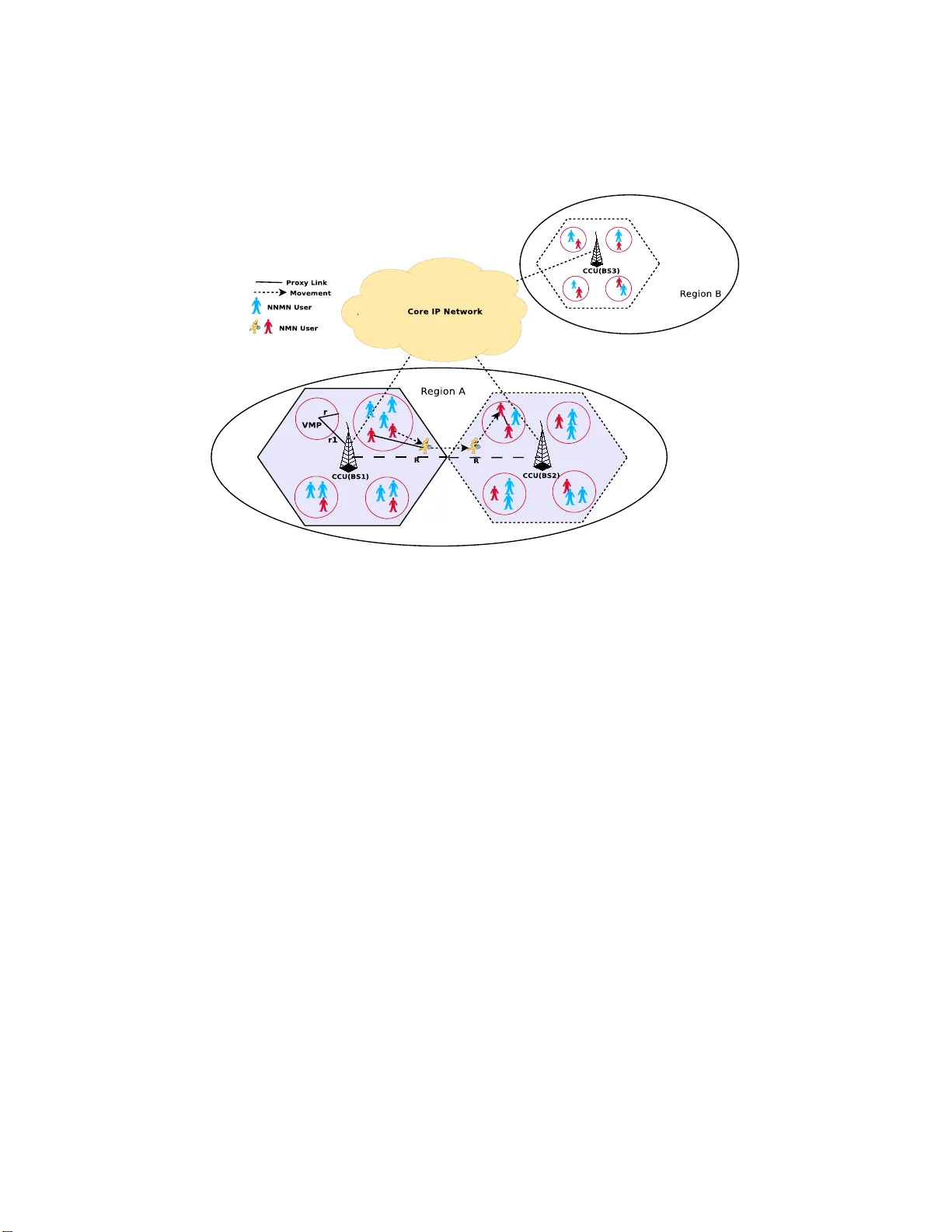
Informatio n Cen tric Net w or k ing based Hando v er Supp ort for QoS Mai n t enance in Co op era t i v e Heterogeneous Wireless Net w o rks Thesis Sup erviso r: Dr. ´ Eric Renault Thesis Advis o rs: Dr. Djamal Zeghla c he Submitted By : Muha mmad Shoaib Sal eem Wireless Netw orks and Multimedi a Services Department (RS2M) V ersion 1 August 15, 2011 1 Abstract Netw ork of Information (NetInf ) is a term coined for net works w h ich unlike contemporary n etw ork are not no de centric. As the name indicates, information sup ersedes no des in the netw ork. In this report, w e prop ose an arc hitectu re of mobile no de for Net I nf. W e call it NetI nf Mobile No de. It is an extension of the basic nod e architecture prop osed for NetInf. It is compatible to NetIn f and TCP/IP b ased netw orks. The Virtu al No de La yer mod u les in the arc h itectu re p ro v ide supp ort for managing mob ility , p o wer consumption of the no de as w ell data rela ying/storing services. Inner/Outer Lo cator Construction Routers (I/O LCTR) are tw o functions introduced in NetInf mobile no des to operate b etw een NetIn f and non- NetInf sites. The basic purp ose of NetInf mobile no de is to maintain the QoS du rin g mobility events. The h andoff/handov er are critical situations during mobilit y where chances of QoS d egradation of an ongoing session are high. This rep ort presents one such scenario in whic h QoS of an application is main tained during a handoff situations in heterogeneous wireless netw ork environmen t th rough our prop osed algorithm. 2 Con ten ts 1 In tro duction 5 2 Mobili t y Managemen t in NetInf 7 2.1 NetInf MN Architecture . . . . . . . . . . . . . . . . . . . . . . . 8 2.1.1 Virtual No de Lay er (VNL) . . . . . . . . . . . . . . . . . 10 2.2 Cross Lay er Supp ort . . . . . . . . . . . . . . . . . . . . . . . . . 11 3 Virtual No de La y er Mobilit y Manageme n t 12 3.1 VNL W or king Principle . . . . . . . . . . . . . . . . . . . . . . . 12 3.2 Handov er Scenario . . . . . . . . . . . . . . . . . . . . . . . . . . 12 4 Mobili t y Supp ort in Disconne cted Net w orks 14 5 Conclusion & F uture W ork 15 3 List of Figures 1 Net work of Information Mobile No de . . . . . . . . . . . . . . . . 9 2 Cent r al Control Unit . . . . . . . . . . . . . . . . . . . . . . . . . 11 3 Virtual No de Layer with Cr oss Layer Suppo rt . . . . . . . . . . . 12 4 Handov er Scenario . . . . . . . . . . . . . . . . . . . . . . . . . . 13 5 Flow Chart of cro ss lay e r supp orted handover of Net work of In- formation Mobile No de . . . . . . . . . . . . . . . . . . . . . . . . 14 4 1 In tro du ction The genesis of NetInf is influenced by legacy and innov ativ e netw orking tech- nologies. The featur e s which NetInf exhibits is the mela nge o f existing and innov a tive solutions. Amo ng them is the increased use of the ov erlay netw or ks in the contempor ary Internet. The P2 P netw o r ks for file sharing are very p op- ular (e.g. E-mule, Skyp e, Bit T or rent etc). Since these overla ys are distributed net works, they sha r e and tak e a wa y the load f r om the cen tral server. NetInf int ends to incor po rate these functions in its architecture. The notion of infor- mation in NetInf is bigger than what it is to day considere d in the Internet. NetInf consider s not only virtual entities as information o b jets (like web page s , text files etc) but it also recog nizes rea l world ob jects a s informatio n and part of its netw or k. [1] discusses different re s earch s cenarios for NetInf. NetInf in- tro duces terms like Informa tio n O b jects(IOs), Data ob jects(DOs) and bit level ob jects(BOs) for infor mation description in the net work. IOs repr esent seman- tics of the ob ject, DOs are the reference/lo cator to the real bit patterns i.e. BOs. The repre s ent a tion o f real world o b jects in NetInf can b e made p o s sible by presenting them as vir tual entit ies and integrating them in the NetInf. In o r der to make infor mation centric netw o rking comp etetive enoug h to re - place the leg acy T C P /IP proto col stack, it should provide s olutions for the existing pro blem in All-IP netw o rks. The new architecture must b e ba ckward compatible with the existing Internet ar chitecture so tha t the replace ment ca n be done in a n incremental way which is easy as well as economically feasible. The r ange of issues that co nt emp or ary IP- net works face are ma ny folds. As the current Internet was not designed to cater every problem, hence, most of the solutions to day are add-on. With the adv ancement in m o bile telephony , new proto cols were dev e lo p e d to handle mobility . The p er fo rmance of thes e pro to cols remained steady in early years. Howev er, in the la st decade, the ov er whelming developmen t of new applica tions a c cessable on wir e less netw or ks thr ough sma rt devices has urged to have more efficien t a lgorithms and protoco ls. T her e are t wo po ssible solutio ns . Either, as usual, provide patch up solutions o r design a clean slate architecture which provides built in solutions to all the problems and issues exhibited by TCP/IP based netw or k architecture. In couple o f years, desktop Internet users will be outnum b ered by mo- bile Internet users. One demand from user p ersp ective is to ma intain the QoS during mobility . In a heterogeneo us netw or k enviromen t this require- men t b ecomes inevitable, mostly in vertical handov er situations where ther e is a br eak b efore make situation o ccurs whenever the ser vice/applicatio n con- nectivity requir ements change. In informatio n centric netw ork ing, asp ects like, suppo rt for mobility manag ement is considered to be the pa rt of the architec- ture. There have b een ma ny resear ch pr o jects in recent years to develop infor- mation/conten t/da ta oriented netw or k s. F or example, 4W ard [2], PSIPR [3 ], SAIL [4], CCN [5] and many other s a re the pro jects which have started to for- m ula te and desig n an a rchitecture that provides s o lutions to existing pr o blems faced by the IP-netw o rks of to day . The common p oint in all these pro jects is to develop a fra mework for an informatio n centric netw ork . The appr oach can 5 be differe nt but the cor nerstone of their prop osed architecture is to have a net- work which is informatio n centric. E ach pro ject has prop ose d differnet metho ds and pro cedur e s for supp orting mobilit y , multihoming, na ming and addressing, security , data dissemination a nd stora ge, r outing and forwarding, Q oS and QoE etc. QoS is closely related to mobility managemen t in wireless netw orks. T o main- tain Qo S o f an applicatio n dur ing an o ngoing sess io n is mostly dis rupted during handov er/ handoff scenarios. T o day , hetero geneous wireless netw or k environ- men t demands seamless ha ndov er b etw een v ar ious netw ork ac cess technologies. A lot of work has been done so far in this doma in. T o day , factors that trig- ger ha ndov er are not jsut limited to the mea sured v alue of the Received Signal Strength (RSS). The list involv es da ta r ate requirement for a par ticular a ppli- cation, end use r demand for hig h/low data rate, packet loss and mo re. Ther e is a wide ra nge of proto co ls and algor ithms acro s s all the layers in a TCP/IP proto col stack for supp orting mobility . F or example, Mobile IPv4/ I P v6 and LIN6 in Netw ork layer. T he Stream Control T rans mis sion Proto col (SCTP) and the Data g ram Conges tion Control Proto co l (DCCP) provide mobility sup- po rt a t tra s po rt lay er level. Session Initiation Proto col (SIP) , Dynamic DNS (DDNS) and MO B IKE are few examples of application layer proto cols. The per formance of these proto co ls is limited due to lack of cro ss layer co op eration betw e e n the low er a nd higher lay er s. The dual nature of an IP address, acting as a lo cato r as w ell as an iden tifier degrades the efficie ncy of these proto co ls during mobility even t. The separa tion of lo cator fr om its ident ifier is to co un ter this issue. Host Identit y pro to col (HIP), Lo ca tor Identifier Sepa ration Pr oto col (LISP) a re example of such prop os als. HIP works in colla bo ration of tr ansp ort and netw ork layer. LISP is a netw ork ba sed appro ach and fo cuss e s on limiting the size of routing tables and improving sca lability and routing system. LISP extention, LISP Mobile No de has multiple design goa ls including wide r ange of communication p ossibilities in differ e n t mobility cases. The use of the devices ca pable o f accessing different ra dio in ter faces urges to have an ar chitecture that facilitates seamles s handov er of s e ssions amo ng different wireless a cces technologies. IEE E 802.21 -Media Indep endent Handov er (MIH) standar d supp orts collab or ation b etw een v ario us a ccess link lay er acc e s s techn o logies. The MIH consists of a framework for providing ser vices to its users. The framew o rk includes v arious entit ie s for transmitting and r eceving messages to s hare infor mation ab out v ario us access netw o r ks’s capacity . In other words, this framework defines a proto col stack, implemen ted on each mobile device for sea mless handoff. The cr o ss layer co op era tion has also b een studied extensively [6 ],[7],[8],[9]. The information exchange b etw een different layers of the sta ck improv es the overall ha ndov er pro ces s by av o iding false alarm signals and minimizing the latency dur ing handover to r econnect or up date. There is a histor y of extensive work o f mobilit y management. How ever, even after so muc h effort, the do main is still a live and very active. The re a sons are quite o bvious. A t each la yer of the stack, the requirements for mobility management demands different appro aches (as men tioned earlier). Moreov er, rapid adv ancement in mobile comm unicatio n enco ur ages to develop new ideas 6 and frameworks. Ubiquitous Q oS supp ort in the wireles s net work environment is a big challenge. In ur ban a reas, where problems like data traffic congestio n, channel fading, and interference result into intolerable disconnectivity , po or cov era g e a nd lack of req uired QoS. W e introduce the virtual no de concept in out s tudy . In o ur prop osed vir tual no de fra mework, we introduce : • A virtual no de layer (VNL) in the NetInf MN. This VNL is a prog ramming abstraction. The concept has b een used be fo re [10],[11],[12] b ut in the context of informa tio n centric netw orking, the idea is nov el. • W e introduce a central entit y known as Central Control Unit (CCU) which suppo rts VNL co ordinatio n b etw een v arious w ir eless net work technologies sp ecially during hando ver sc e narios. CCU also rec ords and up dates the mobility pattern of the mobile no des , pr edicting mobile no de motion and allo cation of mobility zones for virtua l no des . • Our prop osa l emphasizes collab or ation o f netw or k and the end user . The mobility even ts discussed are not entirely netw ork co nt r olled neither mo- bile controlled. The VNL with its mo dules, explained later in this r ep ort, along with cross lay e r co o p e ration, supp orts mobility by making it smo oth and seamles s. The later sections ar e org anized as follows. In s ection 2, mobility ma nage- men t in Netw o rk of Info r mation, NetInf Mo bile No de architecture is discuss ed along with VNL detailed descriptio n and cross layer s uppo rt during handover. Section 3 presents VNL working pr inciple explained throug h a scenario a nd the algor ithm pro po sed. Section 4 brie fs ov er the extended function o f NetIng Mobile No de and is followed by conclusion and future work. 2 Mobilit y Managemen t in NetInf T o handle mobility issues in NetInf, integrated name resolution and routing schemes are pro po sed. The pr op osed solutions include Multiple Distr ibuted Hash T able (MDHT) [1 3] approa ch for co re netw ork, Late Lo cator co nstruction (LLC) [14] scheme, which is an extention of MDHT, for a ccess netw o r ks and autonomous lo cal resoultion using multicast (providing access to all loca l cont ent even when the net work is n o t connec ted to c o re netw or k). In MD HT, as the name indicates, DHTs a re ar ranged in a hierar chical manner . As a n example , in an Internet Service P rovider (ISP), there ar e four levels, • Access no de level • Poin t of Presenc e • Autonomous System level • Global Internet level 7 How ever, the str ucture can b e changed dep ending up on the size of the net- work. There a re name r esolution platforms/no des at each level of MDHT. These sp ecial platfor ms/no des a re addr essed a s Dictionary No des (DN). They are ac- tually netw o rk base d implement a tion of a D HT system. They p er form name resolution and lo cation lo ok up service b oth in lo cal and global scop e of the net- work. The ob ject (information) is publshed a nd duplica ted at all levels. As far as LLC is co ncerned, it separ ates core netw o r k ro uting from edge edge netw ork routing. It uses pa th bas ed lo cator . In LLC, pack ets ar e forwarded in a connec- tionless manner . P a th based lo cator for a ob ject consists o f a co re edge router prefix app eneded with a sequence of identifiers that describ es an int er netw ork path acro ss a sequence of edge net works tow ards the ho st, hos ting des tina tion ob ject. In general, LLC employs an ob ject identifi e r /lo cator s plit mechanism. The co mmon gr o und b etw een MDHT a nd LLC schemes is that any one ca n b e switched in dep ending up on requirement. It means what kind of mobility case NetInf is dealing with. In case of mobile termina l mobility , LLC is taken into account a nd for netw ork mobility , MDHT scheme is approached. The ev aluation o f both schemes namely , MDHTs and LLC, enc o urages the need to hav e more optimization in terms of reducing the handov e r latency during the mobility even t. F urther, in c ase of int er mitten t connectivity the delays a re int o lerable. One res earch challenge also indicates to have an interaction b etw eel mobility a nd caching to reduce the ov er a ll lo ok up dela y . This latency issue is mostly co ncerened with the mobile acces s netw o rks that a re not part of the actual core ne twrok. These mobile access net works include all radio netw orks ranging from mobile telephony (3G, 4G, GSM, CDMA etc) to WiFi and WiMax. The Issues discuss ed ab ov e are very cr ucia l in multiaccess enviroment. In a large metrop olitan environment, multit e chnology interfaced mobiles device de- mand alwa ys b est connected co nnection for b etter QoS exp erience . F or re a l time streaming, smo oth shift or ha ndov er b e tw e e n different acc ess technologies is anticipated. F actors mentioned earlier like cong e stion, channel fading and un- precedented mobility o f users are the challenges hinder go o d service. In the next subsection, we present our prop osal of a mobile no de architecture for informa- tion centric netw orks which is a lso backw ar d compatible with the c o mt e mp or ary TCP/IP based no des centric netw or k. 2.1 NetInf MN Ar c hitecture Mobility manag ement in a wire less environmen t has always b een an imp orta nt issue. There are ma ny solutions prop osed to tar get the problems faced by mo- bile no des during mobility . The current Internet ar chitecture is TCP/IP ba sed and mobile no des use Mobile IP or IP mobility , which is a proto c o l develop ed for mobile devices, to r oam fro m netw ork to netw or k maintaining their p er manent IP addr esses. How ever, with the inceptio n o f the idea of a netw or k of intercon- nected things, gener ally termed a s Int er net of Things, motiv ated to have a new Int er net a rchitecture, where information sup ersedes the no de centric concept of net working. In NetInf, the no de a rchitecture defines the genera l framework for a t y pical 8 information centric netw ork no de. B ased on this architecture, we defined Net- work o f Informa tion Mo bile No de (NetInf MN) [15]. Along with new features int r o duced, NetInf Mobile No de is compatible with any environment or wir eless access tec hnolog y . Ther e are some similar characteristic b etw een NetInf MN and Lo cator Identifier Separation Proto c o l Mobile No de (LISP MN) [16]. How- ever, LISP Mobile No de has a tota lly different working framework. It includes servers that facilita te ma pping from end p oint identifiers to lo c ators. NetInf has totally different infrastructure for na me reso lution. Still there ar e some common features that NetInf MN sha res with LISP MN like bo th no des encoura ges to : Figure 1 : Net work of Informatio n Mobile No de • Keep ongo ing sessions alive dur ing mobility even if a ll no des ar e moving simult a neous. • Hav e the p ossibility of simult a neous co nnections. • Make mobile no de to act as a server. In this work, the prop os ed so lution for mobility ma nagement in netw o rk is presented in the form of a mobile no de architecture. Fig. 1 presents the NetInf MN a rchitecture. W e hav e an a pplication lay er which provides services to users. This API gets se r vices fro m the transp or t layer b elow it. Within the tranp ort lay er w e hav e T ranp or t Control Engine (TCE). Generally in NetInf, TCE is resp onsible fo r the co ordinatio n of proto c ols used for acce s sing NetInf ob jects. In our desig n, we pro po se to include Inner L o cator construction tunnel Router (ILCTR) and Outer Loca tor Cons truction T unnel Router (OLCTR) function- alities in TCE. Virtua l No de Layer (VNL), ILCTR (Inner lo cator Construction Router) a nd OLCT R (Outer Lo cator Co nstruction Router) w ithin the tr a nsp ort lay er ar e r esp onsible for the mobility management o f NetInf MN. The working of thes e routing functions is explained in later s e ction. 9 The work presented here highlights the fea tures of the NetInf MN architec- ture and VNL and is complemen ted with its working principle, adv an tages it exhibits and its s upp or ting role within the netw o rk. 2.1.1 Virtual N o de La y er ( VN L) VNL is a pr ogramming abstraction in N etInf-MN a rchitecture. Our prop osed scheme involv es cross lay er (Lay er 2 & 3) co o per ation with VNL to supp ort handoff. Link a nd netw ork layer parameters (i.e. mo bile termina l speed and handoff delay signal resp ectively) influence mo bility manag ement. It is pr o- po sed here that in a heterog enous environment , a Centralized Control Unit (CCU) Fig .2 exis ts that assists o n b ehalf of netw ork fo r ma na ging mobility . Since cellular netw orks and WiMax c ov ers la rge a r ea, we prop ose that each base station is equipped with a CCU.The VNL unit Fig.3, together with the Link and Netw or k layer, estimates the above parameter s (to initiate handoff ) and upda te the CCU. It provides following basic funtions. • VNL tog ether with the Layer (2+3), a ssists (inter/in tra ) domain han- dov ers. • In a no n active state or with minim um battery life left, power management by low er ing the paging sig nals for lo cation up date by mobile terminals. • NetInf-MN provides temp or ary stora ge or r elay s e rvice to stor e the data pack ets in c halleneg ed enviroment where the netw ork connectivity is dis- rupted frequently . It is assumed that users are equipp ed with mu lti-technology ena bled devices. The wireless netw ork environment c o nsidered is p opulated with NetInf-Mobile No des (NMN) a nd Non- NetInf-Mobile No des (NNMN). CCU co llab orates with NMN & NNMN and provides: • Probability of NMN & NNMN stay duratio n in the ce llula r netw ork • Cross la yer mobility management, predicting the threshold v alue of the Received Signa l Strength RSS to initiate the handover thro ugh VNL co- ordination • Mobility of no des through pr ediction techniques • Allo cation of mobility p oints/zones and their ma na gement VNL consists of thr ee ba sic mo dules which ar e: Hando ver (HO) mo dul e The Smoo th Handov er mo dule a cts in the sce- narios where handover even t happ ens during an ongoing communication session betw e e n no des. P ow er Management Mo dule The p ower management mo dule works in the conditions where the mo bile no de is ina ctive or idle or left woth low batter y power. In such cas es, the regular query to upda te the mobile no de lo c a tion must 10 Figure 2: Central Control Unit be susp ended. This is very useful in terms of power managemen t o f mobile no des and reducing the sig na ling overhead of the ov era ll netw ork . Data Rel a y M o dule The Delay Relay Unit in VNL provides suppor t in challenged environmen ts where there is a frequen t disruption in connectivity . It w orks on the principles of Delay T oler ant Net works (DTN) [ ? ]. The Data Relay Unit is basica lly designed for tw o purp oses : (i) for different netw or ks int er op erability and (ii) to re lay or to store the messages in case o f disr uption in the connectivity . This second featur e o f relaying and stor ing messa ges is what this mo dule do es in co ordination with ILCTR and OLCTR ro uting functions. 2.2 Cross La yer Supp ort Cross lay er suppo rt for mobility management is not a new idea. Here in this case, this supp or t is provided by link and netw ork lay ers . T he s e tw o lay er s mea sure paramerter s like mobile ter mina l sp eed, RSS s ignal a nd handoff sig nal delay . As far as handoff signa lling delay is c o ncerned, it is measured by sending inv a lid authenticated mes sages to the neigh b ouring base stations and measuring the difference on r eceiving the reply as sugges ted in [8 ]. How ever, they mentioned an ov e r all increase in the sig nal headover. In our case, it is done once for ea ch mobile ter minal when it is roaming in the Virtual Mobile Point (VMP). CCU upda tes its reco rd o f t he mobility pattern. An av erag e v alue of this delay is taken for each VMP and is used later o n. This done for each neig hbouring base station. These v alues ar e fed into VNL’s handoff mo dule. 11 Figure 3: Virtual No de Lay er with Cros s Lay e r Supp ort 3 Virtual No de La y er M obilit y Managemen t 3.1 VNL W orking Principle VNL is a prg ramming abs tr action, implemented on NetInf-MN (NMN). F o r Non-NetInf-MN (NNMN), Mobile Agen t (MA) is used which replicates NMN (NetInf Mo bile No de) sta te o n NNMN. Mo bile Agent is a computer prog ram or a softw are tha t can migrate from one computer (susp ending its exucutio n) to another (resuming aga in from wher e it was susp ended). The impo rtant features of Mobile Agents are autono m y , learning and espec ia lly mobility . This la st feature makes this technology fav ora ble fo r the case presented in this work. As they ar e autonomo us in nature, they ca n migr ate to any another co mputer in the middle o f their execution. F o r distributed application, they a re co nsidered to b e very p ow er ful to o ls . They are easily p o r table and do es not require sp ecific system requirement. 3.2 Hando v er Scenario Before explaining the handov er s c e nario in the context o f NetInf, consider the following a ssumptions: • The environment is a hetergeneous wireles s net work environmen t p opu- lated with NMN a nd NNMN no des. • CCU assig ns Virtual Mobile Point (VMP) clo s e to the cell b oundar y of a cellular netw ork . Eac h VMP has a g eographic p os ition with (x,y) c o ordi- nates and a spa n o f radius r. • Each VMP has a cent er to center distance of r1 from its CCU (Base Statio). The ra dius o f the cell is R. 12 Figure 4: Handov er Scenario • The minimum thr eshold RSS v alues within VMP is VRSS min and within cell its RSS min • All the no des in a cell, reg ister their pr e sence. CCU maintains the recor d and history of ea ch no de v isiting the cell. The mobility even t o ccur s in one of the cellular netw o rk ba s e station cov er age area of g eogra phica l Regio n A, p opula ted with NMN as well as NNMN. In an even t a NMN which is in a video conferencing with a nother user loca ted in Region B as sho wn in 4 , starts mo ving a way fr om its b a se s tation. Me an while, it also mov es clo ser to the b oundary of VMP . At base station, with the co ordinatio n of CCU, the v alues of VRSS and RSS a re mo nitored. If the monitored v alue of the VRSS v alue less than VRSS min indicates that it is out of VMP range. At this moment , CCU tr ig gers NMN to make use of the VNL and its mo dules. In Fig.4 , a NMN user while moving awa y fr om its base sta tion and out o f VMP , a ctiv ates its handover mo dule. The MA progr ammed for this task establishes a connection to its neare s t NMN to a ct as a temp ora ry s e rver or data r elay no de. W e na me it pr oxy NMN. The Data Relay Mo dule o f this pr oxy NMN is activ ated up on receiving the request to p erfor m a tas k from one of its neighbouring no de. Once the proxy no de v alidates NMN identit y with the help of CCU, the connection is established. The mobile terminals considered here are euipp ed with mu ltiple access interface technology . CCU in the mean time is monitoring RSS. O nc e the measur emnet indica tes that the v alue of RSS is less than RSS min , Base Sta tio 1 sets free NM N. Now the p r oxy NMN is relaying 13 Figure 5 : Flo w Cha r t of c r oss layer s upp or ted ha ndov er of Net work of Informa- tion Mo bile No de data fo r this no de, a cting as a tempor ary server. On the other side, NMN which is now receiving data fr om the proxy NMN, g ets near er to cell b oundary of the neig h b o ur ing Ba se Station 2 a s shown. Initially , the RSS signal strength, measured by Bas e Station 2 is very weak. NMN queries for nearby NMN no des to es ta blish an adho c link. On discov ering one as shown, it establishes a new proxy link while terminating the old one. As so on as it r e aches in the VMP range of Base Station 2, it reg isters and reconnects with the Bas e Station 2 terminating its link with the NMN. In this whole pro cess , the video co nference session is kept alive without any distortion, susta ining the QoS. 4 Mobilit y Supp ort in Disconnected Net w orks W e consider an en vir onment wher e w e hav e an edg e net work with no des hav- ing limited or intermitten t co nnec tivit y [ ? ]. One scenar io discussed in [1] is ab out intermitten t connectivity issue in distant areas. The p ossible s olution can b e offere d based on Delay T olerant Netw ork (DTN). In NetInf MN archi- tecture, ILCTR a nd OLCTR under Data Relay Mo dule of VNL, provide routing betw e e n NMN and NNMN nodes as well a s NMN no des can act as p ersistent storage devices in challenged environmen ts where connectivity with the netw ork is disr upted for long er durations . Since NetInf MN is ba ckward compatible with TCP/IP , ca s es wher e there is co mm unica tion betw een NetInf and Non-NetInf sites or no des can b e ca rried out with the help of ILCTR, OLCTR and CCU. 14 5 Conclusion & F uture W o r k W e present in this work a handov er scenar io in a heterog eneous wireless netw or k . The pro p o sed algorithm a voids deg radation of QoS during handover and this suppo rt is pr ovided by NetInf Mo bile Node mo dules and CCU. T he VNL not only leverages QoS but also optimize p ow er cons umption and increase p ersistent storage c a pacity of the netw or k . W e a re in the phas e of simulating the handov e r scenario presented in Fig.4. The idea is to per form our exp eriments in a heter ogeneous wire less net work environmen t. The p oss ible candidates are WiMax and WLAN. Thr future work also includes em ulate the whole sc enario. The step wis e implementation of all mo dules presen ted here is in the plan.The final goal is to test the full fledge implemen ta tion o f the concept. 15 References [1] Dannewitz, Pen tikousis, Rembarz, Renault, Strandb er g , and Ubillos, “Sce- narios and resear ch issues for a netw ork of information,” 4th International ICST Mobile Multime dia Communic ations Confer enc e , May 20 08. [2] h ttp:// w w w.4 ward pro ject.eu. [3] “ht tp:/ / www.psirp.or g /.” [4] “ht tp:/ / www.sail-pro ject.eu/.” [5] “ht tp:/ / www.parc.co m/ work/foc us-area /co nten t-centric-net working/.” [6] F. F o uk alas, V. Gazis, and N. Alonistioti, “Cros s-lay er design prop osals for wireless mo bile net works: a survey and taxonomy ,” Communic ations Surveys T utorials, IEEE , vol. 1 0, no. 1, pp. 7 0 –8 5, quarter 200 8. [7] M. Ab delatif, G. Kalebaila , and H. Cha n, “A cross -lay er mobilit y ma n- agement framework based on ieee8 02.21,” in Personal, Indo or a n d Mo- bile Ra dio Communic ations, 2007. PIMRC 2007. IEEE 18th International Symp osium on , sept. 2 007, pp. 1 –6. [8] S. Mohant y a nd I. Akyildiz, “A cross- lay er (lay e r 2 + 3) ha ndoff mana ge- men t proto co l for next-genera tion wireless systems,” Mobile Computing, IEEE T r ansactio ns on , vol. 5, no. 1 0, pp. 1 347 –136 0, o ct. 20 0 6. [9] L. Magagula and H. Chan, “Ieee 802.2 1-assis ted cross- lay er design and pmip v6 mobility manag ement fra mework for next generation wir e le ss net- works,” in Networking and Commun ic ations, 2008. W IMOB ’08. IEEE International Confer enc e on W ir eless and Mo bile Computing, , o ct. 2008, pp. 159 – 164. [10] M. Brown, C. Newp ort, T. Nolte, N. Lynch, and M. Spindel, “The vir tua l no de lay er : A prog ramming a bstraction for wireless sensor net works .” [11] N. Lynch, S. Mitra , and T. Nolte, “Mo tion co ordinatio n us ing virtual no des,” in De cisi on and Contr ol, 2005 and 2005 Eur op e an Contr ol Con- fer enc e. CDC-EC C ’05. 44th IEEE Confer enc e on , dec. 200 5, pp. 2823 – 2828. [12] S. Dolev, S. Gilb ert, N. A. Lynch, E . Schiller, A. A. Shv ar tsman, and J. L. W elch, “Virtual mobile no des for mobile ad ho c netw orks,” in in DISC04 , 2004, pp. 23 0–244 . [13] M. D’Ambrosio, P . F asano, M. Ma r chisio, V. V ercello ne, and M. Ullio, “Providing data dissemination serv ices in the future internet,” nov. 2 008, pp. 1 – 6. [14] A. Eriksson a nd B. Ohlman, “Dynamic in ter ne tw o rking based on late lo- cator constr uction,” may . 200 7, pp. 6 7 –72. 16 [15] M. Saleem, E. Renault, and D. Zeg hlache, “Netlnf mobile no de a rchitecture and mobility management based on lisp mobile no de,” in Consum er Com- munic ations and Networki n g Confer enc e (CCNC), 201 1 IEEE , jan. 2 011, pp. 981 – 982. [16] D. F. D. Lewis, D. Meyer and V. F uller , “, interworking lisp with ipv4 and ipv6, draft-ietf-lisp-interworking-01,,” F eb. 2010. 17
Original Paper
Loading high-quality paper...
Comments & Academic Discussion
Loading comments...
Leave a Comment