Undithering using linear filtering and non-linear diffusion techniques
Data compression is a method of improving the efficiency of transmission and storage of images. Dithering, as a method of data compression, can be used to convert an 8-bit gray level image into a 1-bit / binary image. Undithering is the process of re…
Authors: V. Asha
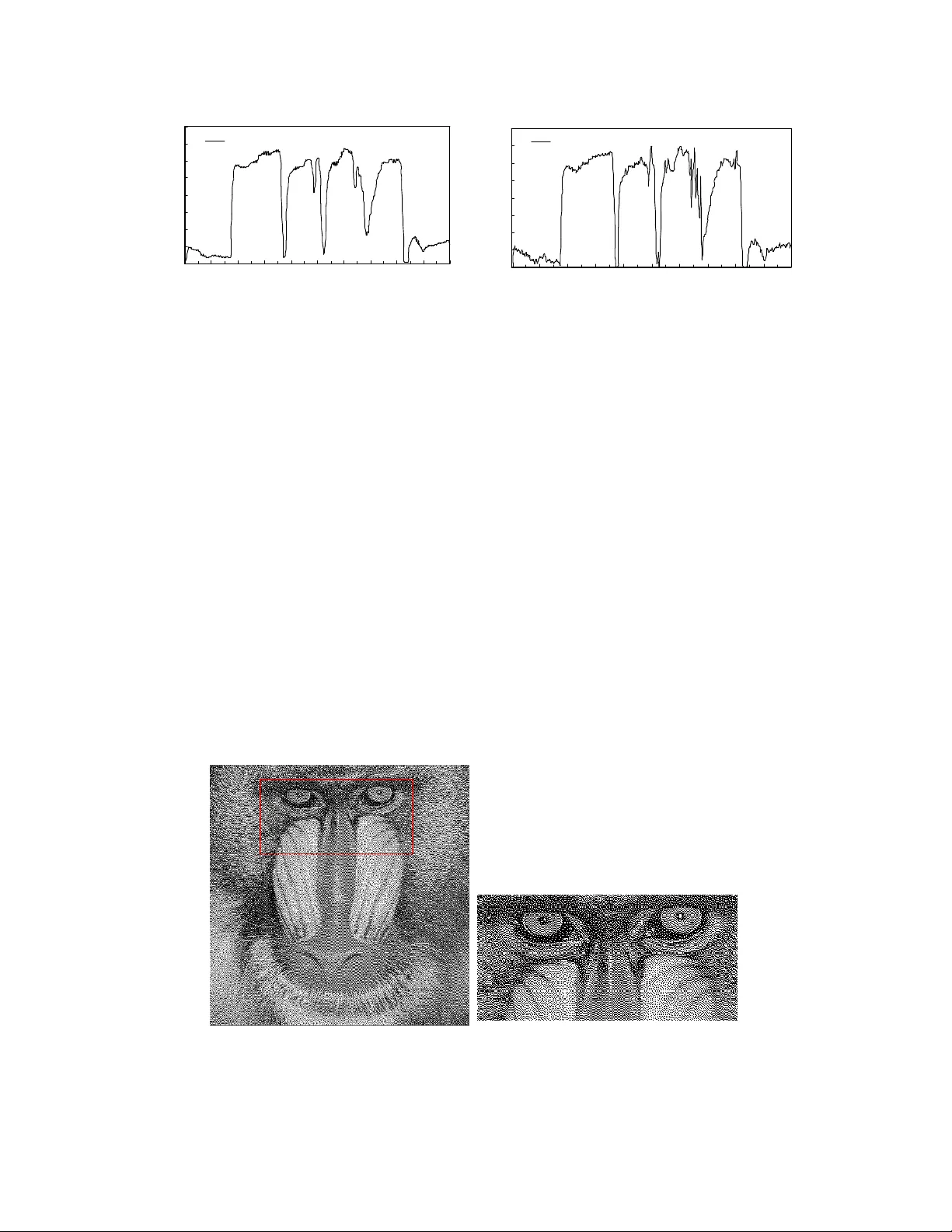
UNDITHER ING USING LINE AR FIL TERING A ND NON -LINE AR DIFFUSIO N TECH NIQUES V. Asha Department of Master of Computer Appl icat ions, New Hori zon College of Engineerin g, B an g a l o r e – 56 0 103 , I n d i a E m a il : v_ a s h a @ live . c o m ABSTR ACT Data compression is a met h od of improving the effic iency of transmission and sto rage of images. Dithering, a s a method of data c ompression, c an be used to convert a n 8 -bit gray level image into a 1-bit / bin ary image . Undith ering is the process of reconstruction of gray image from binary imag e obtained f rom dithering of gray i mage. In the present paper, I pro pose a method of undithering using linear filtering fol lowed by anis otropic diffusion which brings the ad- vantage of smoo thing and edge enhancement . First-order statistical paramete rs, second-order statistical pa rameters, mean-squared error (MSE) between reconstruct ed image and the original image b efore ditherin g, and peak sign al to noise ratio (PSNR) are evaluated at each step of d iffusion. Results of the experiments show that the reconstructed image is not as sharp as the image before dithering but a large number of gray v alues are re produced with reference to those of the o riginal image prior to dithe ring. Keywords: D ithering; Average f ilter; Anisotr opic d iffus ion; First-order s tatistics; Second- order s tatistics 1. INTRO DUCT ION Methods of c ompress ing the data pr ior to storage an d/or trans mis sion are of significant and com m ercial interest. Im age com press ion ad dresses the pr oblem of reducing the am ount of da ta require d to re present a given qu antity of informatio n and is a ke y technolog y in var ious m ultimedia services, doc ument an d medical imaging, an d m ilitar y and space applicat ion. The com pression pr ocess is applied prior to storage or transm ission of the im age. Later the com press ed image is dec ompress ed to reconstr uct an image which is th e appr oxim ation of the original image. T he rec onstruction m a y be lossy or lossless de pending on the com pres sion method used. In a lossl ess data c ompress ion s ystem , the rec overed im age is id enti- cal to the origin al image. The goal in a los sy c om press ion s ystem is to reconstruct an image whic h r e- sembles the origina l im age as close as possible at a lowest possible b it rate. Com press ion ratios ar e much higher for loss y c om pression than for lossles s com pression. Ditherin g is a tech nique to displa y mor e num ber of gray le vels on a device with black and pixels onl y [1] . Dithering has bee n widely used in areas in medical imaging [2 ] and printing industries [3 ], [4], [5] . Dithering of an e ight-bit im age to a one-b it (binar y ) image compres ses the image at a com pression ratio of 1:8 resul ting in a lossy c om pression [6]. The two m ost com mon metho ds are order ed dith er and F lo yd-Steinberg d ither . Ordered d ither uses a cleverly chosen set of black -and-white pa tterns to represent different gra y values us ing a thres holding scheme to replace each gray pixe l with a black or white pixel [7 ]. Flo yd-Steinber g dither is an error diffu- sion algorithm that proc ess es the p ixels of each line in an image from left to right and top to bottom [8]. Each pixel is exam ined and round ed off to either black or white by compensatin g the e rror to the neighborin g pixe ls such that the inform ation is not lo st. T his m ethod is considered to be bett er than or- dered dither as it su its well for repres enting f ine lines. T he reason why dither ed i m ages appear as co n- tinuous gra y shade im age s to hum an vision s ystem is that the h um an eyes au tom atically blur the dots into gr ay s hades [9]. W hile other com press ion m ethods are cons idered, there are two stages, nam ely, compres sion and decom press ion or reconstruct ion. In cas e of dithering, onl y one s tage is achiev ed. Un- dithering aim s at conversion of dithered im age back to or iginal im age as close as pos sible. Using undith- ering, it is possib le to co nvert a 1-bit im age to an 8 bit- image [9] or an 8-bit image to a 2 4-bit im age [10]. In St enger’s m ethod of undither ing for r econstruc tion of an 8-bit image f rom a 1-bi t image, th e f irst step is to blur the image b y replacing eac h pix el’s va lue with averag e of pixe ls i n a s m all windo w ar ound th e c en- tre pixel with the help of lin ear filter. Since the linear filtered image app ears mottle d due to l ess num ber of gray levels, the ne xt step i n volves non- linear sm oothing using Lee’s local statistics [11] followed by sharpening . T hus, an undithering algorithm s hould invol ve com puterized smoothing or blurr ing, s m oothing and e dge enhancem ent. In the present m ethod, I propose a m ethod of undithering using linear f iltering and a nisotropic d iff usion that com bines the adva ntage of smoothing and ed ge enhanc em ent. Li near filter- ing prior to anisotr opic diff usion, as a pre- proces sing, involves s m oothing and diff usion of inf ormation within the window of selected s ize. Anis otropic diffusion that involves adaptive s m oothing is then applied on the linear -filtered im age at c ontrolled r ate and s everal f eatures ar e evaluated at eac h iteratio n step. 2. BRIEF RE VIEW ON D IFFU SION The basic idea of diff usion in im age process ing ar ose f rom the heat d iffus ion equ ation. The rate at which temper ature at an y point (x,y) in a two-dim ensional f ield chan ges with tim e t can be give n as, ( ) y ) T(x, α t t) y , T(x, ∇ ⋅ ∇ = ∂ ∂ (1) where α is t he t herm al diffusivit y, ∇ is the gradient oper ator and ⋅ ∇ is the divergence opera tor. Anisot- ropic d iffus ion in im age pro cess ing is a discretiza tion of the f amily of contin uous partial diff erential eq ua- tions that include both the physical proc esses of diffusion and the L aplacian [1 2]. The s ame equation is applicable to im age function f (x, y) as, ( ) y ) f(x, c t y ) f(x, ∇ ⋅ ∇ = ∂ ∂ (2) where c is the im age diffus ivity. If c is cons tant, ind ependent of space, i t leads to a lin ear dif fusion equat ion w ith hom ogeneous diff usivity, in which c ase, all p ixels in t he im age, includ ing s harp edges and cor ners, will be blurred at a un iform rate. A sim ple modif ication here would b e choosi ng im age diffusivity as a functio n of im age gradie nt itself . In such case, the diffusion becomes non-linear diff usion and the gradient function becom es an “edge- stopping” function. T he diff usion near th e edges an d other areas with rapidl y var ying gr a y levels has to be minim al and that a way from thos e areas has to be maximal. A qualitative d escription of this is shown i n Fig. 1 [12]. G r ad i en t Im a g e d iffusi v it y Fig. 1. Qua litative repres en tation of no n-linearit y of image diffus ivity Various applicat ions of diffusion incl ude de-nois ing [13], [14], [15], [16], segm entation [17], [18], in painting [19] and enha ncing im age res olution ( zooming) [20 ]. A critical issue in the diff usion process is t he good choice of dif fusivit y func tion. Se veral aut hors have pr oposed diffus ivity function in v arious f orms. In the present wor k, I intend to ch oose diff usion func tion which is of the f orm as below [21]: p y ) f ( x, 1 y ) c(x, ∇ = (3) Diffus ivity functions of such type will lead to num erical problem s when the gr adient gets close to zero. This problem can be avoided b y add ing a sm all positive c onstant ε to th e de nominator. For p = 1, the d if- fusivit y f unction becom es total variat ion (T V) flow [22] , [23], a d iffus ion filter t hat is equivalent to TV regu- larization [24] , [25 ]. This f unction s eem s to suit very well, since i t r em oves os cillations, res ulting in p iece- wise consta nt results. 3. EVALU ATION OF FE ATUR ES First order statistics, second order statistics, MSE and PSNR are considere d to be the features for evaluation at eac h dif fusion s tep. T he f irst order s tatistics is based on probab ility of occur rence of a gray level r k in an im age given b y n n ) p(r k k = , k = 0, 1, 2, … , L-1 (4) where, n is the total num ber of pixels , n k is the n um ber of pixels that have gra y le vel r k , and L is the to tal number of gra y levels in t he im age. T he properties c alculated are mean ( r ), va riance ( 2 µ ), sk ewness ( 3 µ ), kurtosis ( 4 µ ), energ y (E 1 ), and entrop y (S 1 ) and are given as be low: ∑ − = = 1 L 0 k k k ) p(r r r (5) ∑ − = − = 1 L 0 k k 2 k 2 ) p(r ) r r ( µ (6) ∑ − = − = 1 L 0 k k 3 k 3 ) p(r ) r r ( µ (7) ∑ − = − = 1 L 0 k k 4 k 4 ) p(r ) r r ( µ (8) ∑ − = = 1 L 0 k 2 k 1 )] [p(r E (9) ∑ − = − = 1 L 0 k k 2 k 1 )] [p(r log ) p(r S (10) In ord er t o ana lyze the recons tructed im age base d on second order statistic s, c o-occ urrence m atrices are constructed based o n second order prob ability p θ ,d (a,b) def ined as the proba bility of oc currenc e of a gra y level ‘a’ with another gr ay level ‘b’ separated by a dist ance ‘d’ in the direct ion ‘ θ ’ in an image. T he proper - ties calcul ated are energy (E 2 ), entrop y (S 2 ), contras t (C t ), hom ogeneit y (H), a nd c orrelation (C n ) and are given belo w: ∑ ∑ = a b 2 2 b)] (a, [p E d θ , (11) ∑ ∑ − = a b 2 2 b) (a, p b)log (a, p S d θ , d θ , ( 12) ∑ ∑ − = a b 2 t b) (a, p b) (a C d θ , (13) ∑ ∑ − + = a b b a 1 b) (a, p H d θ , (14) y x a b y x n σ σ b) (a, p ) µ )(b µ (a C d θ , ∑ ∑ − − = (15) where, ∑ = a b) (a, p µ d θ , x (16) ∑ = b y b) (a, p µ d θ , ( 17) ∑ ∑ − = b a 2 x x b) (a, p ) µ (a σ d θ , (18) ∑ ∑ − = a b 2 y y b) (a, p ) µ (b σ d θ , (19) MSE and PSNR are the m ost c omm on m easures of picture q ualit y in im age com pression system s, though th ese are not adequate as perce ptuall y m eaningf ul m easures [26], [27]. At every iterat ion step of diffusion proc ess, n, t he MSE and PSNR are als o calculated as be low: ∑ ∑ = = − = M 1 i N 1 j 2 n o j)] (i, f j) (i, [f MN 1 MSE (20) ) MSE (255/ log 20 PSNR 10 × = ( 21) where f o indicates the or iginal im age before di thering and f n is the recons tructed image at an y i teration step n. In g eneral, lower the value of MSE, bet ter is the eff ectiveness of rec onstruction. Ho wever, th is meas ure does not nec essa rily impl y that an im age with a lower MSE is alwa ys visuall y pleasing. 4. EXPERIM ENT S AND RES ULTS In order to s tud y the r econstr uction process, Flo yd-Steinberg dither was ap plied on two gr ay im ages (Pepper and Baboon). The dithered images were t wice filtered using average f ilter of size 3 × 3 . T he lin- ear filtered images were subj ected to an isotropic d iffusion wit h p = 1, ε = 0.001 an d ∆ t = 0.1 f or 200 iter a- tions. At each step of dif fusion proces s, all m easur es described in the previous s ection were c alculate d. As far as the co-oc currence m atrix pr operties are conc erned, th ere is hardl y an y diff erence among direc- tions 45° , 90° , 135° and 1 80° at u nit pixel displac ement. Here seco nd or der statis tical propert ies were calculated for θ = 0° and d = 1. F ig. 2 (a) shows the pepper tes t i m age. A sm all portion of th is test im age is enlarge d an d th e detai l is sho wn in F ig. 2 (b) . First or der an d sec ond or der pr operties and MS E / P SNR for the rec onstructed image at ever y iteratio n are shown in F ig. 3 and Fig. 4 along with th e proper ties of the origina l image b efore dither ing. First or der pro perties l ike m ean, varianc e, sk ewness and k urtosis slowly vary with the itera tion. Be yond cer tain ste p, f irst order energ y and entropy and secon d order en- ergy, co ntrast a nd cor relation do not var y m uch, but hom ogeneit y k eeps increas ing at a faster rate. Fr om the p lot of MSE / PSNR, MSE is found to b e minim um at a step of 46. Howe ver, from aesthetic po int of view, an iteration step of 120 yields better visual appeara nce of the r econstru cted image. The recon- structed im age is shown against the original im age in Fig. 5. The recons tructed im age is slight ly b lurred with refer ence t o origi nal im age and it is clear from the detai ls of the windo ws sho wn in F ig. 6 . From the plot of histogr ams as in F ig. 7, it is s een that th e distr ibution of gra y leve ls of the rec onstructed image is sim ilar to th at of the origina l im age bef ore di thering. T ypical gra y profi les (F ig. 8) sho w that the gra y level variation is also sim ilar for both rec onstr ucted im age and ori ginal im age. (a) (b) Fig. 2. Pepp er im age in dither ed form (a) F ull view (b) Deta il of the w indow 11 3.50 11 3.60 11 3.70 11 3.80 11 3.90 11 4.00 11 4.10 11 4.20 11 4.30 11 4.40 11 4.50 0 20 40 60 80 10 0 12 0 140 16 0 180 200 Iteration Mea n Recon s tru cte d im ag e Im ag e be fore dith ering 51 50 52 50 53 50 54 50 55 50 56 50 57 50 0 20 40 60 80 10 0 1 20 14 0 1 60 18 0 2 00 Iteration Varianc e Recon s tru cte d im ag e Im ag e be fore dith ering -52 000 -51 000 -50 000 -49 000 -48 000 -47 000 -46 000 -45 000 -44 000 -43 000 -42 000 -41 000 -40 000 0 20 40 60 80 10 0 1 20 140 16 0 1 80 20 0 Iteration Histog ram skewn ess Recon s tru cte d im ag e Im ag e be fore dith ering 3.8 0E +07 3.9 0E +07 4.0 0E +07 4.1 0E +07 4.2 0E +07 4.3 0E +07 4.4 0E +07 4.5 0E +07 4.6 0E +07 4.7 0E +07 4.8 0E +07 0 2 0 40 60 80 100 12 0 1 40 160 180 20 0 Iteration Histog ram ku rto sis Recon s truct ed im ag e Im ag e be fore dithe ring 0.0 05 0.0 06 0.0 07 0.0 08 0.0 09 0.0 1 0.0 11 0.0 12 0.0 13 0 2 0 40 60 8 0 100 120 140 160 180 200 Iteration First ord er energy Recon s truct ed im ag e Im ag e be fore dithe ring 6.9 0 7.0 0 7.1 0 7.2 0 7.3 0 7.4 0 7.5 0 7.6 0 7.7 0 7.8 0 7.9 0 0 20 40 60 8 0 100 120 140 160 180 200 Iteration First ord er ent ropy Recon s truct ed im ag e Im ag e be fore dithe ring Fig. 3. First- order proper ties of the recons tructed im age at eac h iteratio n agains t those of original pepper image 8 .00 E-0 4 1 .20 E-0 3 1 .60 E-0 3 2 .00 E-0 3 2 .40 E-0 3 2 .80 E-0 3 3 .20 E-0 3 3 .60 E-0 3 4 .00 E-0 3 0 20 40 60 80 1 00 12 0 140 16 0 180 200 Iteration Secon d o rder ene rgy R e co ns t ruct ed i mage Im age before d ithering 10 .8 11 .0 11 .2 11 .4 11 .6 11 .8 12 .0 12 .2 12 .4 0 20 40 60 8 0 100 12 0 1 40 1 60 1 80 2 00 Iteration Seco nd order en trop y Recons t ruct ed im age Im age before d ithering 0. 28 0. 30 0. 32 0. 34 0. 36 0. 38 0. 40 0. 42 0. 44 0. 46 0 20 40 60 80 10 0 120 1 40 16 0 180 200 Iteration Homoge ni ty Recon s truc ted im ag e Im ag e b efore dith ering 60 80 10 0 12 0 14 0 16 0 18 0 20 0 0 20 40 60 8 0 100 120 14 0 16 0 180 200 Iteration Co ntras t Recon s truc ted im ag e Im ag e b efore dith ering 5. 00E+ 08 7. 00E+ 08 9. 00E+ 08 1. 10E+ 09 1. 30E+ 09 1. 50E+ 09 1. 70E+ 09 1. 90E+ 09 2. 10E+ 09 2. 30E+ 09 2. 50E+ 09 2. 70E+ 09 0 20 40 60 80 10 0 12 0 140 160 180 200 Iteration Co rrelatio n Recon s truc ted im ag e Im ag e b efore dithering 27 .20 27 .40 27 .60 27 .80 28 .00 28 .20 28 .40 28 .60 28 .80 0 20 40 60 80 10 0 12 0 140 1 60 18 0 200 Iteration PSN R , dB 92 94 96 98 10 0 10 2 10 4 10 6 10 8 11 0 11 2 11 4 11 6 Mean squ are error PSN R Mean s qu are error Fig. 4. Second- order pr oper ties of the reco nstructed im age at each iteration a gainst those of origina l pep- per image an d MSE / PSNR (a) (b) Fig. 5. (a) Rec onstruc ted p epper im age (b) Or iginal pepper im age bef ore dither ing (a) (b) Fig. 6. Detai l of the window (a) Reconstr ucted im age ( b) Original pepper im age b efore dither ing 0 12 50 25 00 37 50 50 00 62 50 75 00 87 50 1 00 00 1 12 50 1 25 00 0 32 64 96 1 28 1 60 1 92 22 4 25 6 G r a y v a l u e Fr e q u e nc y o f occ u ran ce Image bef ore di ther i ng (b) 0 1 25 0 2 50 0 3 75 0 5 00 0 6 25 0 7 50 0 8 75 0 10 00 0 11 25 0 12 50 0 0 32 64 96 12 8 16 0 19 2 22 4 25 6 G r a y va l u e Fr e q u e nc y of oc cu ran ce R e co n s t ruc te d im age (a ) Fig. 7. Hist ogram s (a) Rec onstructed p epper im age (b) Original pe pper im age before di thering 0 32 64 96 12 8 16 0 19 2 22 4 25 6 0 4 8 9 6 1 44 19 2 2 40 28 8 33 6 38 4 4 32 48 0 R o w dim ens ion Gr a y v al u e R e co n s t ruc te d i m a ge 0 32 64 96 12 8 16 0 19 2 22 4 25 6 0 48 96 14 4 19 2 2 40 288 33 6 38 4 4 32 48 0 Row d im en s ion Gr ay va lu e Im age be fore dithe ri n g (b) (a ) Fig. 8. T ypical gra y profiles ( a) Reconstr ucted pe pper im age (b) Original pepp er im age befor e dithering For the baboon im age in dithere d form as shown in Fig. 9, the feat ures calcul ated are show n in F ig. 10 and Fig. 1 1. There is no m inimum MSE at all. T he MS E for this image k eeps incr easing with iteration . Moreover, a t no iteration step, properti es of the recons tructed im age ar e close to those of the ori ginal im- age b efore dit hering. Be yond an itera tion step of 50, ther e is no m uch change in visu al a ppearance a nd it is ver y dif ficult to def ine the qualit y of recons truction. However, blurring ef fect slowly increases. Rec on- structed im age at a diffusion step of 100 appears som e what better and is sho wn against the original im- age in F ig. 12. Deta il of the sm all windo w of reconstru cted image with refer ence t o that of the origina l im - age sho ws the ef fect of smoothing as sh own in F ig. 13 . Com parison of histogram s of r econstruc ted im age and original image sh ows t hat a large n um ber of gra y values are reproduced with r eference to those of original im age as in F ig. 14. T ypical gra y prof iles (F ig. 15) show that the gra y lev el variation is also sim ilar for both recons tructe d image an d original im age. (a) (b) Fig. 9. Babo on im age in dithered f orm (a) Full view ( b) Detail of the wind ow 12 8.4 0 12 8.5 0 12 8.6 0 12 8.7 0 12 8.8 0 12 8.9 0 12 9.0 0 12 9.1 0 12 9.2 0 12 9.3 0 12 9.4 0 0 20 40 60 80 100 12 0 140 160 18 0 200 Iteration Me an Recon s tru cte d im ag e Im age befo re dithe ri n g 11 00 12 00 13 00 14 00 15 00 16 00 17 00 18 00 19 00 20 00 0 2 0 40 60 80 10 0 120 14 0 16 0 180 20 0 Iteration Variance Recon s tru cte d im ag e Im age befo re dithe ri n g -2 600 0 -2 400 0 -2 200 0 -2 000 0 -1 800 0 -1 600 0 -1 400 0 -1 200 0 -1 000 0 -8 000 -6 000 -4 000 0 20 40 60 80 10 0 12 0 1 40 16 0 180 200 Iteration Histog ram skewne ss Recon s tru cte d im ag e Im age b efore dithe ri n g 3.0 0E +06 4.0 0E +06 5.0 0E +06 6.0 0E +06 7.0 0E +06 8.0 0E +06 9.0 0E +06 1.0 0E +07 0 20 4 0 6 0 80 10 0 120 140 16 0 1 80 20 0 Iteration Histo g ram ku rto sis Recon s tru cte d im ag e Im age befo re dithe ri n g 0. 005 0. 006 0. 007 0. 008 0. 009 0. 01 0. 011 0. 012 0. 013 0 2 0 40 60 80 1 00 1 20 1 40 16 0 18 0 20 0 Iteration First order ene rgy R e co n s tru cte d im ag e Im age befo re dithe ri n g 6 .40 6 .60 6 .80 7 .00 7 .20 7 .40 7 .60 7 .80 8 .00 0 20 40 60 80 100 12 0 14 0 160 180 200 Iteration First order ent rop y R e co n s tru cte d im ag e Im age befo re dithe ri n g Fig. 10. F irst-order prop erties of the recons tructed im age at eac h iterati on aga inst those of origina l ba- boon im age 8. 00E -05 1. 80E -04 2. 80E -04 3. 80E -04 4. 80E -04 5. 80E -04 6. 80E -04 7. 80E -04 8. 80E -04 9. 80E -04 1. 08E -03 1. 18E -03 0 20 40 60 80 100 12 0 140 160 180 20 0 Iteration Seco nd orde r energy Recon s tru ct ed im ag e Im ag e b efore dithe ri n g 10 .5 11 .0 11 .5 12 .0 12 .5 13 .0 13 .5 14 .0 14 .5 0 20 40 60 80 10 0 120 14 0 160 18 0 200 Iterat ion Seco nd orde r entro py R e co n s tru ct ed im ag e Im ag e befo re dithe ri n g 0. 10 0. 15 0. 20 0. 25 0. 30 0. 35 0. 40 0. 45 0. 50 0. 55 0 20 40 6 0 80 10 0 120 14 0 1 60 18 0 20 0 Iterat ion Homoge n it y R e co n st ruc ted im ag e Im age before d ithering 0 50 10 0 15 0 20 0 25 0 30 0 35 0 40 0 45 0 50 0 55 0 60 0 0 20 40 60 80 10 0 120 140 16 0 18 0 20 0 Iteration Co nt rast Recon s tru ct ed im ag e Im ag e befo re dithe ri n g 4. 00E +08 6. 00E +08 8. 00E +08 1. 00E +09 1. 20E +09 1. 40E +09 1. 60E +09 1. 80E +09 2. 00E +09 2. 20E +09 0 20 40 6 0 80 10 0 120 14 0 160 1 80 20 0 Iteration Co rrelati o n Recon s tru ct ed im ag e Im ag e b efore dithe ri n g 21 .00 21 .20 21 .40 21 .60 21 .80 22 .00 22 .20 22 .40 22 .60 22 .80 23 .00 0 20 40 60 80 100 120 140 16 0 180 200 Iteration PSNR, dB 35 0 37 5 40 0 42 5 45 0 47 5 50 0 52 5 55 0 Mea n squa re err o r PSNR Me an sq u are error Fig. 11. Secon d-order proper ties of the r econstructe d im age at each iteration a gainst those of origina l baboon im age and M SE / PSNR (a) (b) Fig. 12. (a) R econstruc ted baboon im age (b) O riginal babo on im age before d ithering (a) (b) Fig. 13. Deta il of the window (a) Reconstr ucted b aboo n image (b) Original b aboo n image bef ore dither ing 0 50 0 1 00 0 1 50 0 2 00 0 2 50 0 3 00 0 3 50 0 4 00 0 4 50 0 5 00 0 0 3 2 6 4 9 6 1 2 8 16 0 1 9 2 22 4 2 5 6 G ra y v a lu e Freq u en c y o f o ccu ran ce Reco n st r u c t ed ima g e 0 5 00 1 0 0 0 1 5 0 0 2 0 0 0 2 5 0 0 3 0 0 0 3 5 0 0 4 0 0 0 4 5 0 0 5 0 0 0 0 3 2 6 4 9 6 1 2 8 1 6 0 1 9 2 2 2 4 2 5 6 G ray v alue Freq u en c y o f o ccu ran ce Im age befo r e dit h e rin g (b) (a) Fig. 14. Histogr am s (a) Recons tructed baboon im age (b) O riginal baboo n im age before dith ering 0 3 2 6 4 9 6 12 8 16 0 19 2 22 4 25 6 0 64 1 2 8 1 9 2 2 5 6 3 2 0 3 8 4 4 4 8 51 2 Row di m en sion Gr ay v alu e Im age befo r e dit h er in g (b ) 0 3 2 6 4 9 6 1 2 8 1 6 0 1 9 2 2 2 4 2 5 6 0 6 4 1 2 8 19 2 2 5 6 32 0 3 8 4 4 48 5 1 2 Row d im en sion Gra y v alu e Recon st ruct ed im age (a ) Fig. 15. T ypical gra y profile (a) Reconstructe d baboo n im age (b) Or iginal baboo n im age before dither ing 5. SUMM A RY AND CONCL USIONS It is s hown in t he prese nt work that recons truction of gr ay im age fr om binar y dithered image can be done using a com bination of linear f iltering a nd non-lin ear diffus ion that brings the adv antage of adaptive smoothing and edge enha ncem ent. Histogram of the rec onstructed im age shows that a larg e num ber of gray values are re produce d in com parison with those o f the original im age befor e dith ering. From an aes- thetic point of view, the undith ered images hav e sim ilar appeara nce with ref erence to the or iginal im ages but a little b lurred. REFERENC ES [1] D. F. Ro gers, 1985, Proced ural Eleme nts for C omputer Graphics , McG raw H ill. [2] E. A. Sandl ery, D. A. Gus evz, and G. Y. M ilman, 1997, Hybrid A lgorithm s f or Digital Halftoni ng and Their Applica tion to Me dical Im aging, Com puters and Graphics 21 (1), 69- 78. [3] J. P. Allebac h, and T. Pappas, 2003D igital ha lftoning: Advances in algorithm s and in pr inting, IEEE Signal Proc essing Mag azine (Sp ecial Iss ue) 20 (4) . [4] F. A. Baqai, and J. P. Alle bach, Ha lftoning v ia direct binary searc h using analytical and stochastic printer m odels , IEEE Tra ns. Ima ge Proces sing 12 (1), 2003 , 1-15. [5] A. Vongk unghae, J . Yi, and R. B. W ells, 2003, A printe r model using s ignal proc ess ing techni ques, IEEE Trans. Image Pr oces sing 12 (7), 7 76-783. [6] M. Y. Ting, and E. A. Ris k in, 1994, Error-Dif fused Im age Com pression Us ing a Binar y-to-Gra y- Scale Decod er and Predicti ve Pruned T ree-Structur ed Vector Qua ntization, I EEE Trans actions on Im age Processing 3 (6). [7] R. Ulichne y, 1987, D igita l Halftoning , Cam bridge, Mass : The MIT Press. [8] R. F loyd, and L. Stei nberg, 1976, An adaptive algorith m f or s patial gre y sca le, Pr oc. Society of In- formation Disp lay 17 ( 2), 75 -77. [9] A. Stenger, 19 92, Conver ting Dithered Im ages Back to Gra y Sc ale, Dr Dobb's Journa l 1 7 (11), 64- 68. [10] J. Sun darasara dula, a nd J. Millar, Us ing Neura l Ne twork s for Undither ing, Proc eedin gs of the IEEE Internationa l Confere nce on Neura l Network s 4 , 199 5, 189 2–1897. [11] Jong-Sen Lee, 1980, Digital Im age Enhancem ent and Noise Filtering b y Use of Local Statistic s, IEEE Transact ions on Pattern A nalysis and Machine Intelligenc e 2 (2), 1 65-168. [12] P. Perona, an d J. Malik , 1990, Scale- Space a nd E dge D etection U sing Anisotro pic Diff usion, IEE E Transactions on Patt ern Analy sis and Machine In telligenc e 12 (7), 629 –639. [13] M. J . B lack , G . Sap iro, D. H. Mar im ont, and D. Heeg er, 1998, R obust Anisotr opic Diffus ion, I EEE Transactions on Imag e Pro cessing 7 (3), 421-432. [14] S. K. W eer atunga, a nd C. Kam ath, 2003, A Com parison of PDE-bas ed Non- Linear Anisotr opic Dif - fusion Techniq ues for Image D enoising, Proc eeding s, Image Process ing: Algo rithms and Syste ms II , SPIE Electr onic Imag ing , S an Jose. [15] J. Li ng, and A. C. Bovik , 2002 , Sm oothing Lo w-SNR Molecu lar Im ages Via A nisotropic Med ian- Diffus ion, IEEE Transac tions on Medica l Imaging 21 ( 4), 377-3 84. [16] B. C hen, a nd E. W . Hsu, 2005, No ise Rem oval in M agnetic Res onance D iffus ion T ensor Im aging, Magnetic Res onance in Medic ine 54 , 3 93–407. [17] R. A. A. Nobrega, a nd C. G. O’Hara, 2006, Segm entation and obj ect extrac tion fr om anisotropic diffusion filter ed LIDAR int ensit y data, Proce edings o f the 1 st Int ernation al Confer ence on Object-b ased Image Ana lysis (O BIA-2006) , Salzburg U nivers ity, Aus tria. [18] M. Rous son, T . Brox, and R. Derich e, 2003, Ac tive Uns upervised T exture Se gmentatio n on a Dif- fusion Based F eature Space, Proc eedings of the IEEE Co mputer Society Co nferenc e on Comp uter Vi- sion and Patt ern Rec ogniti on 2 , 699-704 . [19] M. Bert alm io, Bert ozzi, an d G . Sapiro, 2001, Na vier-Stok es, Fluid D ynamics , and Im age and Vi deo Inpainting, Proce edings of the IEEE C omputer Soc iety Conference on Computer Vision and Pattern Rec- ognition 1 , 35 5–362. [20] S. Battiato, G. Ga llo, and F. Stanco, 2003, Smart Interpol ation b y Anisotropic D iffus ion, Proceed- ings of the 12 th Internatio nal Confer ence on Image Analys is and Proces sing (ICI AP-200 3) , 572– 577. [21] V. I. T surk ov, 20 00, An an alytical m odel of edge prot ection und er noise suppr ess ion b y an isotropic diffusion, Int ernational Jour nal of Comp uter and Systems Sciences 3 (3), 437– 440 . [22] F. Andreu, C. Ballester , V. Caselles, and J . M. Ma zón, 2001, M inim izing t otal vari ation f low, Differ- ential and Int egral E quation s, 14 (3), 3 21–360. [23] F. Dibos, and G. Koe pfler , 2000, Glo bal total variation m inim ization, SIAM Journal o n Numeric al Analysis 37 (2) , 646–66 4. [24] T. Brox, M. W elk , G. Steidl, and J. W eickert, 2003, Equivalenc e res ults for TV dif fusion and T V Regulariza tion, In L. D. G riff in, M. Lillholm (Eds.) , Sc ale-Space T heories in C omputer Vision , L ecture Notes in Com puter Science, 269 5 (Sprin ger-Verlag Berlin He idelberg 20 03). [25] L. I. R udin, S . Osher, an d E. Fatem i, 1992, Non linear total variatio n based no ise rem oval a lgo- rithms , Physica D 60, 259–268. [26] S. G rgic, M . Grg ic, and M. Mr ak , 1999, Pictur e Qu ality Meas urem ents in W avelet C ompr ession System, Proc . of the Int ernatio nal Broadc asting Conv ention, IBC'99 , Ams terdam, The Netherlands , 554- 559. [27] S. Grg ic, M. Grg ic, a nd M. Mr ak, 2004, Reliabilit y of Obj ective P icture Q ualit y Me asures, Journa l of Electrical En gineering 55, 3 -10.
Original Paper
Loading high-quality paper...
Comments & Academic Discussion
Loading comments...
Leave a Comment