Combinatorial Game Theory, Well-Tempered Scoring Games, and a Knot Game
We begin by reviewing and proving the basic facts of combinatorial game theory. We then consider scoring games (also known as Milnor games or positional games), focusing on the "fixed-length" games for which all sequences of play terminate after the …
Authors: Will Johnson
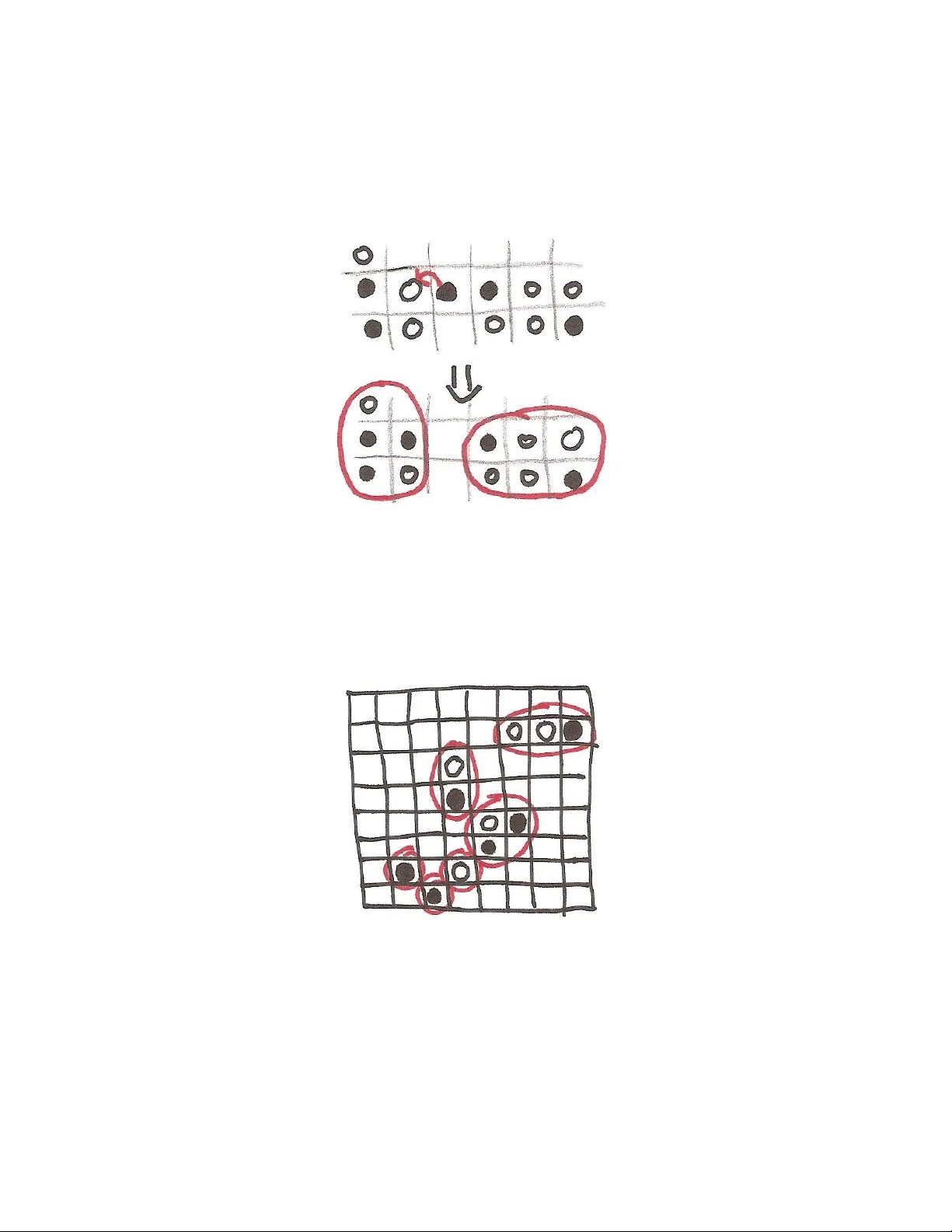
Com binatorial Game Theory , W ell-T emp ered Scoring Games, and a Knot Game Will Johnson No vem b er 2, 2018 Con ten ts 1 T o Knot or Not to Knot 4 1.1 Some facts from Knot Theory . . . . . . . . . . . . . . . . . . 7 1.2 Sums of Knots . . . . . . . . . . . . . . . . . . . . . . . . . . . 18 I Com binatorial Game Theory 23 2 In tro duction 24 2.1 Com binatorial Game Theory in general . . . . . . . . . . . . . 24 2.1.1 Bibliograph y . . . . . . . . . . . . . . . . . . . . . . . . 27 2.2 Additiv e CGT sp ecifically . . . . . . . . . . . . . . . . . . . . 28 2.3 Coun ting mov es in Hack en bush . . . . . . . . . . . . . . . . . 34 3 Games 40 3.1 Nonstandard Definitions . . . . . . . . . . . . . . . . . . . . . 40 3.2 The con ven tional formalism . . . . . . . . . . . . . . . . . . . 45 3.3 Relations on Games . . . . . . . . . . . . . . . . . . . . . . . . 54 3.4 Simplifying Games . . . . . . . . . . . . . . . . . . . . . . . . 62 3.5 Some Examples . . . . . . . . . . . . . . . . . . . . . . . . . . 66 4 Surreal Num b ers 68 4.1 Surreal Num b ers . . . . . . . . . . . . . . . . . . . . . . . . . 68 4.2 Short Surreal Num b ers . . . . . . . . . . . . . . . . . . . . . . 70 4.3 Num b ers and Hack enbush . . . . . . . . . . . . . . . . . . . . 77 4.4 The in terplay of n umbers and non-num b ers . . . . . . . . . . . 79 4.5 Mean V alue . . . . . . . . . . . . . . . . . . . . . . . . . . . . 83 1 5 Games near 0 85 5.1 Infinitesimal and all-small games . . . . . . . . . . . . . . . . 85 5.2 Nim b ers and Sprague-Grundy Theory . . . . . . . . . . . . . . 90 6 Norton Multiplication and Ov erheating 97 6.1 Ev en, Odd, and W ell-T empered Games . . . . . . . . . . . . . 97 6.2 Norton Multiplication . . . . . . . . . . . . . . . . . . . . . . 105 6.3 Ev en and Odd revisited . . . . . . . . . . . . . . . . . . . . . . 114 7 Bending the Rules 119 7.1 Adapting the theory . . . . . . . . . . . . . . . . . . . . . . . 119 7.2 Dots-and-Bo xes . . . . . . . . . . . . . . . . . . . . . . . . . . 121 7.3 Go . . . . . . . . . . . . . . . . . . . . . . . . . . . . . . . . . 132 7.4 Changing the theory . . . . . . . . . . . . . . . . . . . . . . . 139 7.5 Highligh ts from Winning Ways Part 2 . . . . . . . . . . . . . 144 7.5.1 Unions of partizan games . . . . . . . . . . . . . . . . . 144 7.5.2 Lo op y games . . . . . . . . . . . . . . . . . . . . . . . 145 7.5.3 Mis ` ere games . . . . . . . . . . . . . . . . . . . . . . . 146 7.6 Mis ` ere Indistinguishabilit y Quotients . . . . . . . . . . . . . . 147 7.7 Indistinguishabilit y in General . . . . . . . . . . . . . . . . . . 148 I I W ell-temp ered Scoring Games 155 8 In tro duction 156 8.1 Bo olean games . . . . . . . . . . . . . . . . . . . . . . . . . . 156 8.2 Games with scores . . . . . . . . . . . . . . . . . . . . . . . . 158 8.3 Fixed-length Scoring Games . . . . . . . . . . . . . . . . . . . 160 9 W ell-temp ered Scoring Games 168 9.1 Definitions . . . . . . . . . . . . . . . . . . . . . . . . . . . . . 168 9.2 Outcomes and Addition . . . . . . . . . . . . . . . . . . . . . 171 9.3 P artial orders on integer-v alued games . . . . . . . . . . . . . 176 9.4 Who go es last? . . . . . . . . . . . . . . . . . . . . . . . . . . 180 9.5 Sides . . . . . . . . . . . . . . . . . . . . . . . . . . . . . . . . 183 9.6 A summary of results so far . . . . . . . . . . . . . . . . . . . 186 2 10 Distortions 188 10.1 Order-preserving op erations on Games . . . . . . . . . . . . . 188 10.2 Compatibility with Equiv alence . . . . . . . . . . . . . . . . . 191 10.3 Preserv ation of i-games . . . . . . . . . . . . . . . . . . . . . . 196 11 Reduction to Partizan theory 203 11.1 Co oling and Heating . . . . . . . . . . . . . . . . . . . . . . . 203 11.2 The faithful representation . . . . . . . . . . . . . . . . . . . . 208 11.3 Describing everything in terms of G . . . . . . . . . . . . . . . 212 12 Bo olean and n-v alued games 216 12.1 Games taking only a few v alues . . . . . . . . . . . . . . . . . 216 12.2 The faithful representation revisited: n = 2 or 3 . . . . . . . . 217 12.3 Two-v alued games . . . . . . . . . . . . . . . . . . . . . . . . 220 12.4 Three-v alued games . . . . . . . . . . . . . . . . . . . . . . . . 227 12.5 Indistinguishability for rounded sums . . . . . . . . . . . . . . 230 12.6 Indistinguishability for min and max . . . . . . . . . . . . . . 243 I I I Knots 252 13 T o Knot or Not to Knot 253 13.1 Phony Reidemeister Mov es . . . . . . . . . . . . . . . . . . . . 255 13.2 Rational Pseudo diagrams and Shadows . . . . . . . . . . . . . 259 13.3 Odd-Even Shadows . . . . . . . . . . . . . . . . . . . . . . . . 265 13.4 The other games . . . . . . . . . . . . . . . . . . . . . . . . . 268 13.5 Sums of Rational Knot Shadows . . . . . . . . . . . . . . . . . 271 13.6 Computer Exp eriments and Additional Thoughts . . . . . . . 273 A Bibliography 278 3 Chapter 1 T o Knot or Not to Knot Here is a picture of a knot: Figure 1.1: A Knot Shado w Unfortunately , the picture do esn’t sho w whic h strand is on top and whic h strand is b elo w, at eac h intersection. So the knot in question could b e an y one of the follo wing eight p ossibilities. Figure 1.2: Resolutions of Figure 1.1 4 Ursula and King Lear decide to play a game with Figure 1.1. They take turns alternately r esolving a crossing, by c ho osing which strand is on top. If Ursula go es first, she could mo v e as follows: King Lear migh t then resp ond with F or the third and final mo v e, Ursula might then choose to mov e to Figure 1.3: The final mo v e No w the knot is completely iden tified. In fact, this knot can b e un tied as follo ws, so mathematically it is the unknot : 5 Because the final knot w as the u nknot, U rsula is the winner - had it b een truly k notted, K ing Lear would b e the winner. A picture of a knot lik e the ones in Figures 1.2 and 1.3 is called a knot diagr am or knot pr oje ction in the field of mathematics kno wn as Knot The- ory . The generalization in which some crossings are unr esolve d is called a pseudo diagr am - ev ery diagram w e hav e just seen is an example. A pseudo- diagram in which al l crossing are unresolved is called a knot shadow . While knot diagrams are standard tools of knot theory , pseudo diagrams are a recen t inno v ation b y Ry o Hanaki for the sak e of mathematically mo delling electron microscop e images of DNA in whic h the elev ation of the strands is unclear, lik e the following 1 : Figure 1.4: Electron Microscope image of DNA Once up on a time, a group of studen ts in a Researc h Experience for 1 Image taken from http://www.tiem.utk.edu/bioed/webmodules/dnaknotfig4.jpg on July 6, 2011. 6 Undergraduates (REU) at Williams College in 2009 w ere studying prop erties of knot pseudo diagrams, sp ecifically the knotting numb er and trivializing numb er , which are the smallest num b er of crossings which one can resolve to ensure that the resulting pseudo diagram corresp onds to a knotted knot, or an unknot, resp ectively . One of the undergraduates 2 had the idea of turning this pro cess into a game b et ween t wo pla y ers, one trying to create an unknot and one trying to create a knot, and thus was b orn T o Knot or Not to Knot (TK ONTK), the game describ ed ab o ve. In addition to their paper on knotting and trivialization n um b ers, the studen ts in the REU wrote an additional Shak esp earean-themed pap er A Midsummer Knot’s Dr e am on To Knot or Not to Knot and a couple of other knot games, with names like “Muc h Ado ab out Knotting.” In their analysis of TK ONTK sp ecifically , they considered starting p ositions of the follo wing sort: F or these p ositions, they determined whic h pla yer wins under p erfect pla y: • If the num b er of crossings is o dd, then Ursula wins, no matter who go es first. • If the num b er of crossings is even, then who ev er go es second wins. They also sho wed that on a certain large class of shadows, the second pla yer wins. 1.1 Some facts from Knot Theory In order to analyze TK ONTK, or even to play it, w e need a wa y to tell whether a giv en knot diagram corresp onds to the unknot or not. Unfortu- 2 Oliv er Pec henik, according to http://www.math.washington.edu/ ~ reu/papers/ current/allison/UWMathClub.pdf 7 nately this problem is very non-trivial, and while algorithms exist to answer this question, they are v ery complicated. One fundamen tal fact in knot theory is that t w o knot diagrams corre- sp ond to the same knot if and only if they can b e obtained one from the other via a sequence of R eidemeister moves , in addition to mere distortions (isotopies) of the plane in which the knot diagram is dra wn. The three t yp es of Reidemeister mo ves are 1. Adding or remov oing a t wist in the middle of a straigh t strand. 2. Mo ving one strand ov er another. 3. Mo ving a strand ov er a crossing. These are b est explained b y a diagram: Figure 1.5: The three Reidemeister Mo v es Giv en this fact, one wa y to classify knots is b y finding prop erties of knot diagrams whic h are inv ariant under the Reidemeister mo v es. A num b er of 8 surprising knot invariants hav e b een found, but none are known to b e c om- plete invariants , which exactly determine whether t w o knots are equiv alent. Although this situation ma y seem bleak, there are certain families of knots in which we can test for unknottedness easily . One such family is the family of alternating knots . These are knots with the property that if y ou w alk along them, you alternately are on the top or the b ottom strand at eac h successiv e crossing. Th us the knot wea ves under and o v er itself p erfectly . Here are some examples: The rule for telling whether an alternating knot is the unknot is simple: color the regions b et ween the strands black and white in alternation, and connect the blac k regions into a graph. Then the knot is the unknot if and only if the graph can b e reduced to a tree by remo ving self-lo ops. F or instance, is not the unknot, while 9 is. No w it turns out that an y knot shado w can b e turned in to an alternating knot - but in only tw o wa ys. The play ers are unlikely to produce one of these t wo resolutions, so this test for unknottedness is not useful for the game. Another family of knots, how ever, works out p erfectly for TKONTK. These are the r ational knots , defined in terms of the r ational tangles . A tangle is like a knot with four lo ose ends, and tw o strands. Here are some examples: The four lo ose ends should b e though of as going off to infinit y , since they can’t b e pulled in to unknot the tangle. W e consider tw o tangles to b e equiv alen t if you can get from one to the other via Reidemeister mov es. A r ational tangle is one built up from the following tw o 10 via the follo wing op erations: No w it can easily b e seen b y induction that if T is a rational tangle, then T is in v arian t under 180 o rotations ab out the x , y , or z axes: 11 Because of this, w e hav e the following equiv alences, In other w ords, adding a t wist to the bottom or top of a rational tangle has the same effect, and so do es adding a twist on the righ t or the left. So w e can actually build up all rational tangles via the follo wing smaller set of op erations: 12 John Con w ay found a w a y to assign a rational num b er (or ∞ ) to eac h rational tangle, so that the tangle is determined up to equiv alence by its n umber. Sp ecifically , the initial tangles ha ve v alues 0 and ∞ = 1 / 0. If a tangle t has v alue p q , then adding a t wist on the left or right c hanges the v alue to p + q q if the twist is left-handed, or p − q q if the t wist is right handed. Adding a twist on the top or bottom changes the v alue to p q − p if the t wist is left-handed, or p q + p if the t wist is right-handed. 13 Figure 1.6: Sample rational tangles Reflecting a tangle o ver the 45 ◦ diagonal plane corresp onds to taking the recipro cal: 14 Figure 1.7: Reflection ov er the diagonal plane corresp onds to taking the recipro cal. Note whic h strands are on top in each diagram. Using these rules, it’s easy to see that a general rational tangle, built up b y adding twists on the b ottom or righ t side, has its v alue determined b y a c ontinue d fr action . F or instance, the following rational tangle has v alue 4 + 1 2 + 1 3+ 1 2 = 71 64 . No w a basic fact ab out con tinued fractions is that if n 1 , . . . , n k are positive in tegers, then the contin ued fraction n 1 + 1 n 2 + 1 . . . + 1 n k 15 almost enco des the sequence ( n 1 , . . . , n k ). So this discussion of con tinued fractions might sound like an elab orate w ay of saying that rational tangles are determined b y the sequence of mov es used to construct them. But our con tinued fractions can include negative num b ers. F or instance, the follo wing tangle has con tinued fraction 3 + 1 − 5 + 1 − 2+ 1 3 = 79 / 28 = 2 + 1 1 + 1 4+ 1 1+ 1 1+ 1 2 , so that w e hav e the following non trivial equiv alence of tangles: 16 Giv en a rational tangle, its numer ator closur e is obtained by connecting the t wo strands on top and connecting the tw o strands on b ottom, while the denominator closur e is obtained b y joining the t wo strands on the left, and joining the t wo strands on the right: Figure 1.8: the n umerator closure (left) and denominator closure (right) of a tangle. In some cases, the result ends up consisting of t wo disconnected strands, making it a link rather than a knot : As a general rule, one can show that the n umerator closure is a knot as long as the n umerator of p/q is o dd, while the denominator closure is a knot as long as the denominator of p/q is o dd. Ev en b etter, it turns out that the numer ator closur e is an unknot exactly if the v alue p/q is the recipro cal of an integer, and the denominator closur e is an unknot exactly if the v alue p/q is an integer. The upshot of all this is that if w e pla y TK ONTK on a “rational shado w,” lik e the following: 17 then at the game’s end the final knot will b e rational, and w e can c hec k who wins b y means of contin ued fractions. The twist knots considered in A Midsummer Knot’s Dr e am are instances of this, since they are the denominator closures of the following rational tangle-shado ws: 1.2 Sums of Knots No w that w e hav e a basic set of analyzable p ositions to work with, w e can quic kly extend them by the op eration of the c onne cte d sum of tw o knots. Here are t wo knots K 1 and K 2 : 18 and here is their connected sum K 1 # K 2 This sum may lo ok arbitrary , b ecause it app ears to dep end on the places where we chose to attach the tw o knots. Ho wev er, we can mov e one knot along the other to c hange this, as shown in the following picture: 19 So the place where w e choose to join the t w o knots do esn’t matter. 3 Our main in terest is in the following fact: F act 1.2.1. If K 1 and K 2 ar e knots, then K 1 # K 2 is an unknot if and only if b oth K 1 and K 2 ar e unknots. In other w ords, tw o non-unknots can nev er b e added and someho w cancel eac h other. There is actually an interesting theory here, with knots decom- p osing uniquely as sums of “prime knots.” F or more information, and pro ofs of 1.2.1, I refer the reader to Colin Adams’ The Knot Bo ok . Because of this fact, we can play To Knot or Not to Knot on sums of r ational shadows , lik e the follo wing and actually tell which pla yer wins at the end. In fact, the winner will b e King Lear as long as he wins in an y of the summands, while Ursula needs to win in ev ery summand. 3 T echnically , the definition is still ambiguous, unless w e sp ecify an orien tation to eac h knot. When adding tw o “noninv ertible” knots, where the choice of orientation matters, there are t w o non-equiv alent wa ys of forming the connected sum. W e ignore these tec hni- calities, since our main in terest is in F act 1.2.1. 20 Figure 1.9: On the left, Ursula has w on every subgame, so she wins the connected sum. On the righ t, King Lear has w on only one subgame, but this is still enough to mak e the o verall figure knotted, so he wins the connected sum. Indeed, this holds ev en when the summands are not rational, though it is harder to tell who wins in that case. When TKONTK is pla y ed on a connected sum of knot shadows, each summand acts as a fully indep endent game. There is no interaction b etw een the comp onents, except that at the end we p o ol together the results from eac h comp onent to see who wins (in an asymmetric w a y which fav ors King Lear). W e can visualize eac h component as a black b ox, whose output gets fed in to a logical OR gate to decide the final winner: 21 The wa y in whic h we can add p ositions of To Knot or Not to Knot together, or decomp ose p ositions as sums of multiple non-in teracting smaller p ositions, is highly reminiscent of the branch of recreational mathematics kno wn as c ombinatorial game the ory. P erhaps it can be applied to To Knot or Not to Knot ? The rest of this w ork is an attempt to do so. W e b egin with an ov erview of combinatorial game theory , and then mov e on to the mo difications to the theory that we need to analyze TK ONTK. W e pro ceed b y an extremely roundab out route, which may p erhaps give b etter insight into the origins of the final theory . F or completeness we include all the basic pro ofs of com binatorial game theory , though many of them can b e found in John Con wa y’s b o ok On Num- b ers and Games , and Guy , Berlek amp, and Con w ay’s bo ok Winning Ways. Ho wev er ONA G is somewhat sp ott y in terms of con tent, not co v ering Nor- ton multiplication or many of the other interesting results of Winning Ways , while Winning Ways in turn is generally lacking in pro ofs. Moreo v er, the pro ofs of basic com binatorial game theory are the basis for our later pro ofs of new results, so they are w orth understanding. 22 P art I Com binatorial Game Theory 23 Chapter 2 In tro duction 2.1 Com binatorial Game Theory in general Com binatorial Game Theory (CGT) is the study of c ombinatorial games . In the losse sense, these are two-player discr ete deterministic games of p erfe ct information : • There m ust b e only t wo pla y ers. This rules out games lik e Bridge or Risk. • The game m ust b e discrete, like Chec k ers or Bridge, rather than con- tin uous, like So ccer or F encing. • There m ust b e no c hance inv olv ed, ruling out P oker, Risk, and Candy- land. Instead, the game m ust b e deterministic. • At ev ery stage of the game, both pla yers ha ve p erfect information on the state of the game. This rules out Stratego and Battleship. Also, there can b e no sim ultaneous decisions, as in Ro ck-P ap er-Scissors. Play ers m ust take turns. • The game must be zero-sum, in the sense of classical game theory . One pla yer wins and the other loses, or the play ers receiv e scores that add to zero. This rules out games lik e Chic ken and Prisoner’s Dilemma. While these criteria rule out most popular games, they include Chess, Chec k- ers, Go, Tic-T ac-T o e, Connect F our, and other abstract strategy games. 24 By restricting to com binatorial games, CGT distances itself from the clas- sical game theory dev elop ed b y v on Neuman, Morgenstern, Nash, and others. Games studied in classical game theory often mo del real-w orld problems like geop olitics, mark et economics, auctions, criminal justice, and warfare. This mak es classical game theory a m uc h more practical and empirical sub ject that fo cuses on imperfect information, p olitical coalitions, and v arious sorts of strategic equilibria. Classical game theory starts b egins its analyses b y en umerating strategies for all pla y ers. In the case of combinatorial games, there are usually to o many strategies to o list, rendering the techniques of classical game theory somewhat useless. Giv en a combinatorial game, w e can ask the question: who wins if both pla yers pla y p erfectly? The answ er is called the outc ome (under p erfe ct play) of the game. The underlying goal of com binatorial game theory is to solve v arious games by determining their outcomes. Usually we also wan t a strategy that the winning pla yer can use to ensure victory . As a simple example, consider the following game: Alice and Bob sit on either side of a pile of b eans, and alternately take turns removing 1 or 2 b eans from the pile, until the pile is empty . Who ev er remov es the last bean wins. If the pla y ers start with 37 b eans, and Alice go es first, then she can guaran tee that she wins b y alw a ys ending her turn in a configuration where the num b er of b eans remaining is a multiple of three. This is p ossible on her first turn b ecause she can remo ve one b ean. On subsequent turns, she mov es in resp onse to Bob, taking one b ean if he to ok tw o, and vice versa. So every t wo turns, the num b er of b eans remaining decreases by three. Alice will mak e the final mo ve to a pile of zero b eans, so she is guaran teed the victory . Because Alice has a p erfect winning strategy , Bob has no useful strategies at all, and so all his strategies are “optimal,” b ecause all are equally bad. On the other hand, if there had b een 36 b eans originally , and Alice had pla yed first, then Bob would win by the same strategy , taking one or t wo b eans in response to Alice taking t w o or one b eans, resp ectively . Now Bob will alw a ys end his turn with the num b er of b eans b eing a multiple of three, so he will b e the one to mo v e to the p osition with no b eans. The general solution is as follo ws: • If there are 3 n + 1 or 3 n + 2 b eans on the table, then the next play er to mo ve will win under p erfect play . • If there are 3 n b eans on the table, then the next play er to mo ve will 25 lose under p erfect pla y . Giv en this solution, Alice or Bob can consider each p otential mo ve, and c ho ose the one whic h results in the optimal outcome. In this case, the optimal mo ve is to alw ays mo ve to a m ultiple of three. The pla y ers can play p erfectly as long as they are able to tell the outcome of an arbitrary p osition under consideration. As a general principle, w e can say that In a com binatorial game, knowing the outcome (under p erfect pla y) of every p osition allows one to play p erfectly . This works b ecause the play ers can lo ok ahead one mo ve and c ho ose the mo v e with the best outcome. Because of this, the fo cus of CGT is to determine the outcome (under p erfect pla y) of positions in arbitrary games. Henceforth, we assume that the pla yers are playing p erfectly , so that the “outcome” alwa ys refers to the outcome under p erfect pla y , and “T ed wins” means that T ed has a strategy guaran teeing a win. Most games do not admit suc h simple solutions as the b ean-coun ting game. As an example of the complexities that can arise, consider Wythoff ’s Game In this game, there are tw o piles of b eans, and the tw o pla yers (Alice and Bob) alternately take turns remo ving b eans. In this game, a play er can remo ve an y num b er of b eans (more than zero) on her turn, but if she remo ves b eans from b oth piles, then she must remo v e the same num b er from eac h pile. So if it is Alice’s turn, and the tw o piles hav e sizes 2 and 1, she can make the follo wing mo ves: remo ve one or tw o beans from the first pile, remo ve one b ean from the second pile, or remov e one b ean from eac h pile. Using ( a, b ) to represen t a state with a b eans in one pile and b b eans in the other, the legal mov es are to states of the form ( a − k , b ) where 0 < k ≤ a , ( a − k , b − k ), where 0 < k ≤ min( a, b ), and ( a, b − k ), where 0 < k ≤ b . As b efore, the winner is the pla yer who remov es the last b ean. Equiv alen tly , there is a lone Chess queen on a b oard, and the play ers tak e turns moving her south, west, or southw est. The play er who mov es her into the b ottom left corner is the winner. No w ( a, b ) is the queen’s grid co ordinates, with the origin in the b ottom left corner. Wythoff show ed that the following p ositions are the ones y ou should mo ve to under optimal pla y - they are the p ositions for which the next play er to mo ve will lose: b nφ c , b nφ 2 c 26 and b nφ 2 c , b nφ c where φ is the golden ratio 1+ √ 5 2 and n = 0 , 1 , 2 , . . . . (As an aside, the t wo sequences a n = b nφ c and b n = b nφ 2 c : { a n } ∞ n =0 = { 0 , 1 , 3 , 4 , 6 , 8 , 9 , . . . } { b n } ∞ n =0 = { 0 , 2 , 5 , 7 , 10 , 13 , 15 , . . . } are examples of Be atty se quenc es , and ha v e sev eral interesting prop erties. F or example, b n = n + a n for every n , and each p ositive integer o ccurs in exactly one of the t wo sequences. These facts play a role in the pro of of the solution of Wythoff ’s game.) Muc h of combinatorial game theory consists of results of this sort - in- dep enden t analyses of isolated games. Consequently , CGT has a tendency to lac k o v erall coherence. The closest thing to a unifying framework within CGT is what I will call A dditive Combinatorial Game The ory 1 , b y which I mean the theory b egun and extended b y Sprague, Grundy , Milnor, Guy , Smith, Con wa y , Berlek amp, Norton, and others. Additive CGT will b e the fo cus of most of this thesis. 2 2.1.1 Bibliograph y The most famous b o oks on CGT are John Conw ay’s On Numb ers and Games , Con wa y , Guy , and Berlek amp’s four-volume Winning Ways F or your Mathe- matic al Plays (referred to as Winning Ways ), and three collections of articles published b y the Mathematical Sciences Research Institute: Games of No Chanc e , Mor e Games of No Chanc e , and Games of No Chanc e 3 . There are 1 I thought I heard this name once but now I can’t find it anywhere. I’ll use it anyw ays. The correct name for this sub ject ma y be Con wa y’s com binatorial game theory , or partizan theory , but these seem to sp ecifically refer to the study of disjunctiv e sums of partizan games. 2 Computational Complexit y Theory has also b een used to pro ve many negative results. If we assume the standard conjectures of computational complexity theory (like P 6 = NP), then it is imp ossible to efficiently ev aluate positions of generalized v ersions of Gomoku, Hex, Chess, Check ers, Go, Philosopher’s F o otball, Dots-and-Bo xes, Hac ken bush, and many other games. Many puzzles are also known to b e in tractable if P 6 =NP . This subfield of com binatorial game theory is called algorithmic combinatorial game theory . In a sense it pro vides another theoretical framew ork for CGT. W e will not discuss it further, how ever. 27 also o ver a thousand articles in other b o oks and journals, man y of which are listed in the bibliographies of the Games of No Chanc e b o oks. Winning Ways is an encyclop edic w ork: the first volume cov ers the core theory of additiv e CGT, the second co v ers wa ys of b ending the rules, and the third and fourth v olumes apply these theories to v arious games and puzzles. Con wa y’s ONA G fo cuses more closely on the Surreal Num b ers (an ordered field extending the real n um b ers to also include all the transfinite ordinals), for the first half of the b o ok, and then considers additive CGT in the second half. Due to its earlier publication, the second half of ONAG is generally sup erseded by the first tw o volumes of Winning Ways , though it tends to giv e more precise pro ofs. The Games of No Chanc e b o oks are anthologies of pap ers on div erse topics in the field. Additionally , there are at least tw o b o oks applying these theories to sp e- cific games: Berlek amp’s The Dots and Boxes Game: Sophistic ate d Child’s Play and W olfe and Berlek amp’s Mathematic al Go: Chil ling Gets the L ast Point. These b o oks fo cus on Dots-and-Bo xes and Go, resp ectiv ely . 2.2 Additiv e CGT sp ecifically W e b egin b y in tro ducing a handful of example com binatorial games. The first is Nim , in whic h there are sev eral piles of coun ters (as in Fig- ure 2.1), and pla yers tak e turns alternately removing pieces until none remain. A mo ve consists of removing one or more pieces from a signle pile. The pla y er to remo ve the last piece wins. There is no set starting p osition. Figure 2.1: A Nim p osition con taining piles of size 6, 1, 3, 2, and 4. 28 A game of Hackenbush consists of a dra wing made of red and blue edges connected to each other, and to the “ground,” a dotted line at the edge of the world. See Figure 2.2 for an example. Roughly , a Hack en bush p oition is a graph whose edge ha ve b een colored red and blue. Figure 2.2: A Hac k enbush p osition. On eac h turn, the curren t pla yer chooses one edge of his own color, and erases it. In the pro cess, other edge ma y b ecome disconnected from the ground. These e dges ar e also er ase d. If the current play er is unable to mov e, then he loses. Again, there is no set starting p osition. Figure 2.3: F our successive mo ves in a game of Hack enbush. Red go es first, and Blue mak es the final mo ve of this game. Whenever an edge is deleted, all the edges that b ecome disconnected from the ground disapp ear at the same time. In Domine ering , inv en ted b y G¨ oran Andersson, a game b egins with an empt y c hessb oard. Tw o play ers, named Horizontal and V ertical, place domi- no es on the b oard, as in Figure 2.4. Each domino takes up tw o directly 29 adjacen t squares. Horizon tal’s domino es m ust b e aligned horizontally (East- W est), while V ertical’s must b e aligned v ertically (North-South). Domino es are not allo w ed to o v erlap, so ev entually the board fills up. The first pla y er unable to mo ve on his turn loses. Figure 2.4: Three mov es in a game of Domineering. The b oard starts empty , and V ertical go es first. A pencil-and-pap er v ariant of this game is play ed on a square grid of dots. Horizon tal dra ws connects adjacen t dots with horizontal lines, and vertical connects adjacent dots with vertical lines. No dot ma y hav e more than one line out of it. The reader can easily c hec k that this is equiv alen t to placing domino es on a grid of squares. Clobb er is another game play ed on a square grid, co vered with White and Blac k chec k ers. Two play ers, White and Blac k, alternately mov e un til some- one is unable to, and that play er loses. A mov e consists of moving a piece of y our own color on to an immediately adjacent piece of y our opp onent’s color, whic h gets remov ed. The game of Konane (actually an ancient Haw aiian gam bling game), is play ed b y the same rules, except that a mo ve consists of jumping ov er an opp onen t’s piece and removing it, rather than moving on to it, as in Figure 2.5. In b oth games, the b oard starts out with the pieces in an alternating chec k erb oard pattern, except that in Konane tw o adjacent pieces 30 are remo ved from the middle, to provide ro om for the initial jumps. Figure 2.5: Example mov es in Clobb er and Konane. In Clobb er (top), the capturing piece displaces the captured piece. In Konane (b ottom), the cap- turing piece instead jumps ov er to the captured piece, to an empty space on the opp osite side. Only vertical and horizontal mo ves are allow ed in b oth games, not diagonal. The games just describ ed hav e the following prop erties in common, in addition to b eing com binatorial games: • A player loses when and only when he is unable to move. This is called the normal pla y con v ention. • The games c annot go on for ever, and eventual ly one player wins. In ev- ery one of our example games, the num b er of pieces or parts remaining on the b oard decreases o v er time (or in the case of Domineering, the n umber of empty spaces decreases.) Since all these games are finite, this means that a game can never lo op back to a previous p osition. These games are all lo opfree. • Each game has a tendency to br e ak ap art into indep endent sub c omp o- nents. This is less obvious but the motiv ation for additive CGT. In the 31 Hac ken bush position of Figure 2.2, the stic k p erson, the tree, and the flo wer eac h functions as a completely independent subgame. In effect, three games of Hac ken bush are b eing play ed in parallel. Similarly , in Domineering, as the b oard b egins to fill up, the remaining empt y spaces (whic h are all that matter from a strategic p oint of view) will b e disconnected into separate clusters, as in Figure 3.1. Each cluster might as well b e on a separate b oard. So again, w e find that the t wo play ers are essen tially pla ying several games in parallel. In Clobber and Konane, as the pieces disappear they b egin to fragmen t in to clusters, as in Figure 2.6. In Clobb er, once t w o groups of c hec kers are disconnected they hav e no future w ay of in teracting with each other. So in Figure 2.7, each of the red circled regions is an indep enden t sub- game. In Konane, pieces can jump in to empt y space, so it is p ossible for groups of chec k ers to reconnect, but once there is sufficien t sepa- ration, it is often p ossible to prov e that suc h connection is imp ossible. Th us Konane splits into indep endent subgames, like Clobb er. In Nim, something more subtle happ ens: each pile is an indep endent game. As an isolated p osition, an individual pile is not interesting b e- cause whoever goes first tak es the whole pile and wins. In com bination, ho wev er, nontrivial things o ccur. In all these cases, we end up with p ositions that are sums of other p ositions. In some sense, additiv e combinatorial game theory is the study of the non trivial b ehavior of sums of game. The core theory of additive CGT, the theory of partizan games, fo cuses on lo opfr e e combinatorial games pla yed by the normal play rule . There is no requiremen t for the games under consideration to decomp ose as sums, but unless this occurs, the theory has no a priori reason to b e useful. V ery few real games (Chess, Chec k ers, Go, Hex) meet these requirements, so Additiv e CGT has a tendency to fo cus on obscure games that nob o dy plays. Of course, this is to b e exp ected, since once a game is solved, it loses its app eal as a pla yable game. In man y cases, how ever, a game whic h does not fit these criteria can b e analyzed or partially analyzed b y clever applications of the core theory . F or example, Dots-and-Bo xes and Go hav e b oth b een studied using techniques from the theory of partizan games. In other cases, the standard rules can 32 Figure 2.6: Subidivision of Clobb er p ositions: Black’s mo ve breaks up the p osition in to a sum of t w o smaller p ositions. Figure 2.7: A p osition of Clobb er that decomp oses as a sum of indep endent p ositions. Eac h circled area functions indep enden tly from the others. 33 b e b en t, to yield mo dified or new theories. This is the fo cus of Part 2 of Winning Ways and Chapter 14 of ONA G , as w ell as Part I I of this thesis. 2.3 Coun ting mo v es in Hac k en bush Consider the follo wing Hack enbush p osition: Since there are only blue edges presen t, Red has no a v ailable mo ves, so as so on as his turn comes around, he loses. On the other hand, Blue has at least one mo ve av ailable, so she will win no matter what. T o make things more in teresting, lets give Red some edges: No w there are 5 red edges and 8 blue edges. If Red plays wisely , moving on the p etals of the flo wer rather than the stem, he will b e able to mov e 5 times. Ho wev er Blue can similarly mo ve 8 times, so Red will run out of 34 mo ves first and lose, no matter which pla yer mo ves first. So again, Blue is guaran teed a win. This suggests that we balance the position by giving b oth pla yers equal n umbers of edges: No w Blue and Red can each mo ve exactly 8 times. If Blue go es first, then she will run out of mo ves first, and therefore lose, but con versely if Red go es first he will lose. So who ev er go es second wins. In general, if w e hav e a p osition like whic h is a sum of non-in teracting red and blue comp onents, then the pla yer with the greater n um b er of edges will win. In the case of a tie, whoever go es second wins. The pla y ers are simply seeing how long they can last b efore running out of mo ves. But what happ ens if red and blue edges are mixed together, lik e so? 35 W e claim that Blue can win in this p osition. Once all the blue edges are gone, the red edges must all v anish, b ecause they are disconnected from the ground. So if Red is able to mov e at an y p oint, there m ust b e blue edges remaining in play , and Blue can mo v e to o. Since no mov e by Red can eliminate blue edges, it follo ws that after an y mo ve by Red, blue edges will remain and Blue cannot p ossibly lose. This demonstrates that the simple rule of counting edges is no longer v alid, since b oth play ers ha ve eigh t edges but Blue has the adv an tage. Let’s consider a simpler p osition: Figure 2.8: How many mov es is this w orth? No w Red and Blue eac h ha v e 1 edge, but for similar reasons to the pre- vious picture, Blue wins. How m uch of an adv antage do es Blue hav e? Let’s add one red edge, giving a 1-mo ve adv an tage to Red: 36 Figure 2.9: Figure 2.8 plus a red edge. No w Red is guaranteed a win! If he mo v es first, he can mo ve to the follo wing p osition: Figure 2.10: A red edge and a blue edge. This p osition is balanced, so who ev er go es next loses. This is a go o d p osition to mo v e to. whic h causes the next pla yer (Blue) to lose, and if he mov es second, he simply ignores the extra red edge on the left and treats Figure 2.9 as Figure 2.10. So although Figure 2.8 is adv antageous for Blue, the adv antage is w orth less than 1 mo v e. Perhaps Figure 2.8 is w orth half a mo ve for Blue? W e can c heck this by adding tw o copies of Figure 2.8 to a single red edge: Y ou can easily chec k that this p osition is now a balanced second-pla yer win, just like Figure 2.10. So t w o copies of Figure 2.8 are worth the same as one red edge, and Figure 2.8 is w orth half a red edge. 37 In the same w ay , we can show for that (a) is worth 3 / 4 of a mov e for Blue, and (b) is w orth 2 . 5 mo ves for Red, b ecause the follo wing tw o p ositions turn out to b e balanced: W e can combine these v alues, to see that (a) and (b) together are worth 2 . 5 − 3 / 4 = 7 / 4 mov es for Red. The reader is probably w ondering why an y of these op erations are legit- imate. Additiv e CGT shows that we can assign a rational num b er to each Hac ken bush p osition, measuring the adv antage of that p osition to Blue. The sign of the n umber determines the outcome: • If p ositive, then Blue will win no matter who go es first. • If negative, then Red will win no matter who go es first. • If zero, then who ever go es second will win. 38 And the num b er assigned to the sum of t w o p ositions is the sum of the n umbers assigned to each p osition. With games other than Hack enbush, we can assign v alues to p ositions, but the v alues will no longer b e num b ers. Instead they will live in a partially ordered ab elian group called Pg . The structure of Pg is somewhat complicated, and is one of the fo cuses of CGT. 39 Chapter 3 Games 3.1 Nonstandard Definitions An obvious w ay to mathematically mo del a com binatorial game is as a set of p ositions with relations to specify ho w each play er can mo v e. This is not the conv en tional wa y of defining games in com binatorial game theory , but w e will use it at first b ecause it is more in tuitiv e in some wa ys: Definition 3.1.1. A game graph is a set S of p ositions , a designate d start- ing p osition start( S ) ∈ S , and two r elations L → and R → on S . F or any x ∈ S , the y ∈ S such that x L → y ar e c al le d the left options of x , and the y ∈ S such that x R → y ar e c al le d the right options of x . F or typographical reasons that will b ecome clear in the next section, the t wo play ers in additive CGT are almost alwa ys named Left and Righ t. 1 The t wo relations L → and R → are in terpreted as follows: x L → y means that Left can mo ve from p osition x to p osition y , and x R → y means that Right can mo ve from p osition x to position y . So if the curren t p osition is x , Left can mo ve to an y of the left options of x , and Right can mov e to any of the right options of x . W e use the shorthand x → y to denote x L → y or x R → y . The game starts out in the p osition s 0 . W e inten tionally do not specify who will mo v e first. There is no need for a game graph to sp ecify which 1 As a rule, B l ue, B l ac k, and V ertica l are L eft, while R ed, White, and Ho r izontal are R igh t. This tells which play er is which in our sample partizan games. 40 pla yer wins at the game’s end, b ecause w e are using the normal play rule: the first pla yer unable to mov e loses. But w ait - wh y should the game ev er come to an end? W e need to add an additional condition: there should b e no infinite sequences of pla y a 1 L → a 2 R → a 3 L → a 4 R → · · · . Definition 3.1.2. A game gr aph is well-founded or lo opfree if ther e ar e no infinite se quenc es of p ositions a 1 , a 2 , . . . such that a 1 → a 2 → a 3 → · · · . We also say that the game gr aph satisfies the ending condition . This prop ert y might seem like ov erkill: not only do es it rule out a 1 L → a 2 R → a 3 L → a 4 R → · · · and a 1 R → a 2 L → a 3 R → a 4 L → · · · but also sequences of pla y in which the pla yers aren’t taking turns correctly , lik e a 1 R → a 2 R → a 3 R → a 4 L → a 5 R → a 6 L → · · · . The ending condition is actually necessary , ho w ever, when we pla y sums of games. When games are pla yed in parallel, there is no guarantee that within eac h comp onent the play ers will alternate. If Left and Right are pla ying a game A + B , Left migh t mov e rep eatedly in A while Right mov ed rep eatedly in B . Without the full ending condition, the sum of tw o w ell-founded games migh t not b e well-founded. If this is not convincin g, the reader can take this claim on faith, and also verify that all of the games describ ed ab ov e are w ell-founded in this stronger sense. The terminology “lo opfree” refers to the fact that, when there are only finitely many p ositions, b eing lo opfree is the same as ha ving no cycles x 1 → x 2 → · · · → x n → x 1 , b ecause any infinite series would necessarily rep eat itself. In the infinite case, the term lo opfree might not b e strictly accurate. A key fact of w ell-foundedness, whic h will b e fundamental in everything that follo ws, is that it gives us an induction principle 41 Theorem 3.1.3. L et S b e the set of p ositions in a wel l-founde d game gr aph, and let P some subset of S . Supp ose that P has the fol lowing pr op erty: if x ∈ S and every left and right option of x is in P , then x ∈ P . Then P = S . Pr o of. Let P 0 = S \ P . Then by assumption, for every x ∈ P 0 , there is some y ∈ P 0 suc h that x → y . Supp ose for the sake of contradiction that P 0 is nonempt y . T ak e x 1 ∈ P 0 , and find x 2 ∈ P 0 suc h that x 1 → x 2 . Then find x 3 ∈ P 0 suc h that x 2 → x 3 . Repeating this indefinitely we get an infinite sequence x 1 → x 2 → · · · con tradicting the assumption that our game graph is well-founded. T o see the similarity with induction, supp ose that the set of p ositions is { 1 , 2 , . . . , n } , and x → y iff x > y . Then this is nothing but strong induction. As a first application of this result, we sho w that in a well-founded game graph, someb o dy has a winning strategy . More precisely , ev ery p osition in a w ell-founded game graph can b e put in to one of four outc ome classes : • Positions that are wins 2 for Left, no matter whic h play er mov es next. • Positions that are wins for Right, no matter whic h play er mov es next. • Positions that are wins for whichev er play er mov es next. • Positions that are wins for whic hever play er do esn’t mov e next (the previous pla yer). These four p ossible outcomes are abbreviated as L , R , 1 and 2. Theorem 3.1.4. L et S b e the set of p ositions of a wel l-founde d game gr aph. Then every p osition in S fal ls into one of the four outc ome classes. Pr o of. Let L 1 b e the set of p ositions that are wins for Left when she go es first, R 1 b e the set of p ositions that are wins for Right when he go es first, L 2 b e the set of positions that are wins for Left when she go es second, and R 2 b e the set of p ositions that are wins for Right when he go es second. The reader can easily v erify that a p osition x is in • L 1 iff some left option is in L 2 . 2 Under optimal pla y b y both play ers, as usual 42 • R 1 iff some righ t option is in R 2 . • L 2 iff ev ery right option is in L 1 . • R 2 iff ev ery left option is in R 1 . These rules are slightly subtle, since they implicitly contain the normal play con ven tion, in the case where x has no options. If Left go es first from a giv en p osition x , we w ant to sho w that either Left or Right has a winning strategy , or in other w ords that x ∈ L 1 or x ∈ R 2 . Similarly , we wan t to sho w that ev ery p osition is in either R 1 or L 2 . Let P b e the set of p ositions for whic h x is in exactly one of L 1 and R 2 and in exactly one of R 1 and L 2 . By the induction principle, it suffices to sho w that when all options of x are in P , then x is in P . So suppose all options of x are in P . Then the following are equiv alen t: • x ∈ L 1 • some option of x is in L 2 • some option of x is not in R 1 • not every option of x is in R 1 • x is not in R 2 . Here the equiv alence of the second and third line follows from the inductive h yp othesis, and the rest follows from the reader’s exercise. So x is in exactly one of L 1 and R 2 . A similar argument shows that x is in exactly one of R 1 and L 2 . So by induction every p osition is in P . So every p osition is in one of L 1 and R 2 , and one of R 1 and L 2 . This yields four p ossibilities, whic h are the four outcome classes: • L 1 ∩ R 1 = 1. • L 1 ∩ L 2 = L . • R 2 ∩ R 1 = R . • R 2 ∩ L 2 = 2. 43 Definition 3.1.5. The outcome of a game is the outc ome class (1, 2, L, or R) of its starting p osition. No w that w e ha ve a theoretical handle on p erfect pla y , w e turn to w ards sums of games. Definition 3.1.6. If S 1 and S 2 ar e game gr aphs, we define the sum S 1 + S 2 to b e a game gr aph with p ositions S 1 × S 2 and starting p osition start( S 1 + S 2 ) = (start( S 1 ) , start( S 2 )) . The new L → r elation is define d by ( x, y ) L → ( x 0 , y 0 ) if x = x 0 and y L → y 0 , or x L → x 0 and y = y 0 . The new R → is define d similarly. This definition generalizes in an obvious w ay to sums of three or more games. This op eration is essen tially asso ciative and commutativ e, and has as its iden tity the zer o game , in whic h there is a single position from which neither pla yer can mov e. In all of our example games, the sum of tw o p ositions can easily b e con- structed. In Nim, we simply place the tw o p ositions side by side. In fact this is literally what we do in eac h of the games in question. In Clobber, one needs to mak e sure that the t w o p ositions aren’t touching, and in Konane, the tw o p ositions need to b e kept a sufficient distance apart. In Domineering, the fo cus is on the empt y squares, so one needs to “add” the gaps together, again making sure to k eep them separated. And as noted ab o v e, such comp osite sums o ccur naturally in the course of eac h of these games. Figure 3.1: The Domineering p osition on the left decomp oses as a sum of the t wo p ositions on the right. Another ma jor op eration that can b e p erformed on games: is ne gation : 44 Definition 3.1.7. If S is a game gr aph, the negation − S has the same set of p ositions, and the same starting p osition, but L → and R → ar e inter change d. Living up to its name, this op eration will turn out to actually pro duce additiv e in verses, mo dulo Section 3.3. This op eration is easily exhibited in our example games (see Figure 3.2 for examples): • In Hac k enbush, negation rev erses the color of all the red and blue edges. • In Domineering, negation corresp onds to reflecting the b oard ov er a 45 degree line. • In Clobber and Konane, it corresponds to changing the color of ev ery piece. • Negation has no effect on Nim-p ositions. This w orks b ecause L → and R → are the same in an y p osition of Nim. So in general, negation in terchanges the roles of the tw o play ers. Figure 3.2: Negation in its v arious guises. W e also define subtr action of games by letting G − H = G + ( − H ) . 3.2 The con v en tional formalism While there are no glaring problems with “game graphs,” a differen t con v en- tion is used in literature. W e merely included it here b ecause it is sligh tly 45 more intuitiv e than the actual definition we are going to give later in this section. And ev en this defin tion will b e lacking one last clarification, namely Section 3.3. T o motiv ate the standard formalism, w e turn to an analogous situation in set theory: w ell-ordered sets. A w ell-ordered set is a set S with a relation > having the following prop- erties: • Irreflexitivity: a > a is nev er true. • T ransitivity: if a > b and b > c then a > c . • T otality: for ev ery a, b ∈ S , either a > b , a = b , or a < b . • W ell-orderedness: there are no infinite descending chains x 1 > x 2 > x 3 > · · · These structures are very rigid, and there is a certain canonical list of w ell- ordered sets called the von Neumann or dinals . A von Neumann ordinal is rather opaquely defined as a set S with the prop erty that S and all its mem b ers are transitive. Here we sa y that a set is tr ansitive if it contains all mem b ers of its members. Giv en a v on Neumann ordinal S , w e can define a w ell-ordering on S b e letting x > y mean y ∈ x . Moreov er eac h w ell-ordered set is isomorphic to a unique von Neuman ordinal. The v on Neumann ordinals themselves are w ell-ordered by ∈ , and the first few are 0 = {} = ∅ 1 = {{}} = { 0 } 2 = {{} , {{}}} = { 0 , 1 } 3 = {{} , {{}} , {{} , {{}}}} = { 0 , 1 , 2 } . . . In general, each v on Neumann ordinal is the set of preceding ordinals - for instance, the first infinite ordinal n umber is ω = { 0 , 1 , 2 , . . . } . 46 In some sense, the p oint of (von Neumann) ordinal n um b ers is to pro vide canonical instances of each isomorphism class of well-ordered sets. W ell- ordered sets are rarely considered in their own righ t, b ecause the theory immediately reduces to the theory of ordinal num b ers. Something similar will happ en with games - each isomorphism class of game graphs will b e represen ted by a single game . This will b e made p ossible through the magic of w ell-foundedness. Analogous to our op erations on game graphs, there are certain w a ys one can combine well-ordered sets. F or instance, if S and T are well-ordered sets, then one can pro duce (tw o!) well-orderings of the disjoin t union S ` T , b y putting all the elements of S b efore (or after) T . And similarly , we can giv e S × T a lexicographical ordering, letting ( s 1 , t 1 ) < ( s 2 , t 2 ) if t 1 < t 2 or ( s 1 < s 2 and t 1 = t 2 ). This also turns out to b e a well-ordering. These op erations giv e rise to the follo wing recursively-defined op erations on ordinal n umbers, which don’t app ear entirely related: • α + β is defined to b e α if β = 0, the successor of α + β 0 if β is the successor of β 0 , and the suprem um of { α + β 0 : β 0 < β } if β is a limit ordinal. • αβ is defined to b e 0 if β = 0, defined to b e αβ 0 + α if β is the successor of β 0 , and defined to b e the supremum of { αβ 0 : β 0 < β } if β is a limit ordinal. In what follows, we will giv e recursive definitions of “games,” and also of their outcomes, sums, and negativ es. These definitions might seem strange, so we invite the reader to chec k that they actually come out to the right things, and agree with the definitions giv en in the last section. The follo wing definition is apparently due to John Conw a y: Definition 3.2.1. A (partizan) game is an or der e d p air ( L, R ) wher e L and R ar e sets of games. If L = { A, B , . . . } and R = { C , D , . . . } , then we write ( L, R ) as { A, B , . . . | C, D , . . . } . The elements of L ar e c al le d the left options of this game, and the elements of R ar e c al le d its right options . The p ositions of a game G ar e G and al l the p ositions of the options of G . 47 F ol lowing standar d c onventions in the liter atur e, we wil l always denote dir e ct e quality b etwe en p artizan games with ≡ , and r efer to this r elation as iden tity . 3 Not only does the definition of “game” app ear unrelated to com binatorial games, it also seems to b e missing a recursiv e base case. The tric k is to b egin with the empty set, whic h gives us the follo wing game 0 ≡ ( ∅ , ∅ ) ≡ {|} . Once w e hav e one game, we can mak e three more: 1 ≡ { 0 |} − 1 ≡ {| 0 } ∗ ≡ { 0 | 0 } The reason for the n umerical names like 0 and 1 will b ecome clear later. In order to av oid a proliferation of brac kets, we use || to indicate a higher lev el of nesting: { w , x || y | z } ≡ { w , x |{ y | z }} { a | b || c | d } ≡ {{ a | b }|{ c | d }} The in terpretation of ( L, R ) is a p osition whose left options are the ele- men ts of L and right options are the elements of R . In particular, this sho ws us ho w to asso ciate game graphs with games: Theorem 3.2.2. L et S b e a wel l-founde d game gr aph. Then ther e is a unique function f assigning a game to e ach p osition of S such that for every x ∈ S , f ( x ) ≡ ( L, R ) , wher e L = { f ( y ) : x L → y } R = { f ( y ) : x R → y } In other wor ds, for every p osition x , the left and right options of f ( x ) ar e the images of the left and right options of x under f . Mor e over, if we take a p artizan game G , we c an make a game gr aph S by letting S b e the set of al l p ositions of G , start( S ) = G , and letting ( L, R ) L → x ⇐ ⇒ x ∈ L 3 The reason for this will b e explained in Section 3.3. 48 ( L, R ) R → x ⇐ ⇒ x ∈ R Then the map f sends e ach element of S to itself. This theorem is a bit like the Mostowski collapse lemma of set theory , and the pro of is similar. Since we will mak e no formal use of game graphs, w e omit the pro of, which mainly consists of set theoretic technicalities. As an example, for Hac ken bush p ositions we hav e where where and so on. Also see Figure 3.3 for examples of 0, 1, − 1, and ∗ in their v arious guises in our sample games. The terms “game” and “p osition” are used in terc hangeably 4 in the lit- erature, iden tifying a game with its starting p osition. This plays into the philosoph y of ev aluating ev ery p osition and assuming the play ers are smart 49 Figure 3.3: The games 0, 1, − 1, and ∗ in their v arious guises in our sample games. Some cases do not o ccur - for instance ∗ cannot o ccur in Hac ken bush, and 1 cannot o ccur in Clobb er. W e will see why in Sections 4.3 and 5.1. enough to lo ok ahead one mov e. Then we can fo cus on outcomes rather than strategies. Another w a y to view what’s going on is to consider {·|·} as an extra op erator for combining games, one that construct a new game with sp ecified left options and sp ecified righ t options. W e next define the “outcome” of a game, but change notation, to matc h the standard con ven tions in the field: • G ≥ 0 means that Left wins when Right go es first. • G C 0 means that Righ t wins when Righ t go es first. • G ≤ 0 means that Right wins when Left go es first. 4 Except for the tec hnical sense in which one game can be a “p osition” of another game. 50 • G B 0 means that Left wins when Righ t go es first. The B and C are read as “greater than or fuzzy with” and “less than or fuzzy with.” These are defined recursiv ely and opaquely as: Definition 3.2.3. If G is a game, then • G ≥ 0 iff every right option G R satisfies G L B 0 . • G ≤ 0 iff every left option G L satisfies G R C 0 . • G B 0 iff some left option G L satisfies G L ≥ 0 . • G C 0 iff some right option G R satisfies G R ≤ 0 . One can easily c hec k that exactly one of G ≥ 0 and G C 0 is true, and exactly one of G ≤ 0 and G B 0 is true. W e then define the four outcome classes as follo ws: • G > 0 iff Left wins no matter who go es first, i.e., G ≥ 0 and G B 0. • G < 0 iff Right wins no matter who go es first, i.e., G ≤ 0 and G C 0. • G = 0 iff the second play er wins, i.e., G ≤ 0 and G ≥ 0. • G || 0 (read G is incomparable or fuzzy with zero) iff the first pla y er wins, i.e., G B 0 and G C 0. Here is a diagram summarizing the four cases: 51 The use of relational sym b ols lik e > and < will b e justified in the next section. If y ou’re motiv ated, y ou can c heck that these definitions agree with our definitions for w ell-founded game graphs. As an example, the four games we ha ve defined so far fall into the four classes: 0 = 0 1 > 0 − 1 < 0 ∗|| 0 Next, w e define negation: Definition 3.2.4. If G ≡ { A, B , . . . | C , D , . . . } is a game, then its ne gation − G is r e cursively define d as − G ≡ {− C, − D , . . . | − A, − B , . . . } Again, this agrees with the definition for game graphs. As an example, w e note the negations of the games defined so far − 0 ≡ 0 − 1 ≡ − 1 − ( − 1) ≡ 1 −∗ ≡ ∗ In particular, the notation − 1 remains legitimate. Next, w e define addition: Definition 3.2.5. If G ≡ { A, B , . . . | C , D , . . . } and H ≡ { E , F , . . . | X , Y , . . . } ar e games, then the sum G + H is r e cursively define d as G + H = { G + E , G + F , . . . , A + H , B + H , . . . | G + X , G + Y , . . . , H + C, H + D , . . . } 52 This definition agrees with our definition for game graphs, though it ma y not b e v ery obvious. As b efore, we define subtraction by G − H = G + ( − H ) . The usual shorthand for these definitions is − G ≡ {− G R | − G L } G + H ≡ { G L + H , G + H L | G R + H , G + H R } G − H ≡ { G L − H , G − H R | G R − H , G − H L } Here G L and G R stand for “generic” left and righ t options of G , and represent v ariables ranging ov er all left and right options of G . W e will make use of this compact and useful notation, whic h seems to b e due to Conw ay , Guy , and Berlek amp. W e close this section with a list of basic identities satisfied by the op era- tions defined so far: Lemma 3.2.6. If G , H , and K ar e games, then G + H ≡ H + G ( G + H ) + K ≡ G + ( H + K ) − ( − G ) ≡ G G + 0 ≡ G − ( G + H ) ≡ ( − G ) + ( − H ) − 0 ≡ 0 Pr o of. All of these are in tuitively obvious if y ou interpret them within the con text of Hack enbush, Domineering, or more abstractly game graphs. But the rigorous proofs w ork b y induction. F or instance, to prov e G + H ≡ H + G , w e pro ceed by joint induction on G and H . Then w e ha ve G + H ≡ { G L + H , G + H L | G R + H , G + H R } ≡ { H + G L , H L + G | H + G R , H R + G } ≡ H + G, where the outer iden tities follo w b y definition, and the inner one follows by the inductive hypothesis. These inductive pro ofs need no base case, b ecause the recursiv e definition of “game” had no base case. 53 On the other hand, G − G 6≡ 0 for almost all games G . F or instance, w e ha ve 1 − 1 ≡ 1 + ( − 1) ≡ { 1 L + ( − 1) , 1 + ( − 1) L | 1 R + ( − 1) , 1 + ( − 1) R } ≡ { 0 + ( − 1) | 1 + 0 } ≡ {− 1 | 1 } Here there are no 1 R or ( − 1) L , since 1 has no righ t options and − 1 has no left options. Definition 3.2.7. A short game is a p artizan game with finitely many p osi- tions. We wil l assume henc eforth that al l our games ar e short. Man y of the results hold for general partizan games, but a handful do not, and we ha v e no in terest in infinite games. 3.3 Relations on Games So far, we hav e done nothing but give complicated definitions of simple con- cepts. In this section, w e b egin to lo ok at how our op erations for combining games in teract with their outcomes. Ab o ve, w e defined G ≥ 0 to mean that G is a win for Left, when Right mo ves first. Similarly , G B 0 means that G is a win for Left when L eft mov es first. F rom Left’s p oin t of view, the p ositions ≥ 0 are the go o d p ositions to mo ve to, and the p ositions B 0 are the ones that Left would lik e to receiv e from her opp onen t. In terms of options, • G is ≥ 0 iff every one of its right option G R is B 0 • G is B 0 iff at least one of its left option G L is ≥ 0. One basic fact ab out outcomes of sums is that if G ≥ 0 and H ≥ 0, then G + H ≥ 0. That is, if Left can win b oth G and H as the second play er, then she can also win G + H as the second play er. She pro ceeds by com bining her strategy in eac h summand. Whenev er Righ t mov es in G she replies in G , and whenev er Right mov es in H she replies in H . Such resp onses are alwa ys p ossible b ecause of the assumption that G ≥ 0 and H ≥ 0. Similarly , if G B 0 and H ≥ 0, then G + H B 0. Here left pla ys first in G , mo ving to a p osition G L ≥ 0, and then notes that G L + H ≥ 0. Prop erly sp eaking, w e pro ve b oth statements together by induction: 54 • If G, H ≥ 0, then every right option of G + H is of the form G R + H or G + H R b y definition. Since G and H are ≥ 0, G R or H R will b e B 0, and so every right option of G + H is the sum of a game ≥ 0 and a game B 0. By induction, such a sum will be B 0. So every right option of G + H is B 0, and therefore G + H ≥ 0. • If G B 0 and H ≥ 0, then G has a left option G L ≥ 0. Then G L + H is the sum of tw o games ≥ 0. So by induction G L + H ≥ 0. But it is a left option of G + H , so G + H B 0. No w one can easily see that G ≤ 0 ⇐ ⇒ − G ≥ 0 (3.1) and G C 0 ⇐ ⇒ G B 0 . (3.2) Using these, it similarly follo ws that if G ≤ 0 and H ≤ 0, then G + H ≤ 0, among other things. Another result ab out outcomes is that G + ( − G ) ≥ 0. This is sho wn using what Winning Ways calls the Tweedledum and Tweedledee Strategy 5 . Here w e see the sum of a Hack en bush p osition and its negative. If Right mo ves first, then Left can win as follo ws: whenever Righ t mo v es in the first summand, Left makes the corresp onding mo ve in the second summand, and vice v ersa. So if Right initially mov es to G R + ( − G ), then Left mov es to G R + ( − ( G R )), which is possible because − ( G R ) is a left option of − G . On 5 The diagram in Winning Ways actually lo oks like Tweedledum and Tw eedledee. 55 the other hand, if Righ t initially mo ves to G + ( − ( G L )), then Left resp onds b y moving to G L + ( − ( G L )). Either wa y , Left can alwa ys mov e to a p osition of the form H + ( − H ), for some p osition H of G . More precisely , w e prov e the following facts • G + ( − G ) ≥ 0 • G R + ( − G ) B 0 if G R is a righ t option of G . • G + ( − ( G L )) B 0 if G L is a left option of G . together join tly by induction: • F or any game G , every Right option of G + ( − G ) is of the form G R + ( − G ) or G + ( − ( G L )), where G R ranges o ver right options of G and G L ranges o ver left options of G . This follows from the definitions of addition and negation. By induction all of these options are B 0, and so G + ( − G ) ≥ 0. • If G R is a righ t option of G , then − ( G R ) is a left option of − G , so G R + ( − ( G R )) is a left option of G R + ( − G ). By induction G R + ( − ( G R )) ≥ 0, so G R + ( − G ) B 0. • If G L is a left option of G , then G L + ( − ( G L )) is a left option of G + ( − ( G L )), and b y induction G L + ( − ( G L )) ≥ 0. So G + ( − ( G L )) B 0. W e summarize our results in the follo wing lemma. Lemma 3.3.1. L et G and H b e games. (a) If G ≥ 0 and H ≥ 0 , then G + H ≥ 0 . (b) If G B 0 and H ≥ 0 , then G + H B 0 . (c) If G ≤ 0 and H ≤ 0 , then G + H ≤ 0 . (d) If G C 0 and H ≤ 0 , then G + H C 0 . (e) G + ( − G ) ≤ 0 and G + ( − G ) ≥ 0 , i.e., G + ( − G ) = 0 . (f ) If G L is a left option of G , then G L + ( − G ) C 0 . (g) If G R is a right option of G , then G R + ( − G ) B 0 . 56 These results allow us to say something ab out zer o games (not to b e confused with the zero game 0). Definition 3.3.2. A game G is a zero game if G = 0 . Namely , zero games ha ve no effect on outcomes: Corollary 3.3.3. If H = 0 , then G + H has the same outc ome as G for every game H . Pr o of. Since H ≥ 0 and H ≤ 0, we ha v e by part (a) of Lemma 3.3.1 G ≥ 0 ⇒ G + H ≥ 0 . By part (b) G B 0 ⇒ G + H B 0 . By part (c) G ≤ 0 ⇒ G + H ≤ 0 . By part (d) G C 0 ⇒ G + H C 0 . So in ev ery case, G + H has whatev er outcome G has. This in some sense justifies the use of the terminology H = 0, since this implies that G + H and G + 0 ≡ G alwa ys hav e the same outcome. W e can generalize this sort of equiv alence: Definition 3.3.4. If G and H ar e games, we write G = H (r e ad G e quals H ) to me an G − H = 0 . Similarly, if is any of || < , > , ≥ , ≤ , C , or B , then we use G H to denote G − H 0 . Note that since G + ( − 0) ≡ G , this notation do es not conflict with our notation for outcomes. The interpretation of ≥ is that G ≥ H if G is at least as go o d as H , from Left’s p oint of view, or that H is b etter than G , from Right’s p oin t of view. Similarly , G = H should mean that G and H are strategically equiv alen t. F urther results will justify these intuitions. These relations hav e the prop erties that one would hop e for. It’s clear that G = H iff G ≤ H and G ≥ H , or that G ≥ H iff G > H or G = H . Also, G B H iff G 6≤ H . Somewhat less obviously , G ≤ H ⇐ ⇒ G +( − H ) ≤ 0 ⇐ ⇒ − ( G +( − H )) ≡ H +( − G ) ≥ 0 ⇐ ⇒ H ≥ G 57 and G C H ⇐ ⇒ G + ( − H ) C 0 ⇐ ⇒ − ( G + ( − H )) ≡ H + ( − G ) B 0 ⇐ ⇒ H B G using equations (3.1-3.2). So we see that G = H iff H = G , i.e., = is symmetric. Moreo ver, part (e) of Lemma 3.3.1 shows that G = G , so that = is reflexiv e. In fact, Lemma 3.3.5. The r elations = , ≥ , ≤ , > , and < ar e tr ansitive. And if G ≤ H and H C K , then G C K . Similarly if G C H and H ≤ K , then G C K . Pr o of. W e first show that ≥ is transitive. If G ≥ H and H ≥ K , then by definition G + ( − H ) ≥ 0 and H + ( − K ) ≥ 0. By part (a) of Lemma 3.3.1, ( G + ( − K )) + ( H + ( − H )) ≡ ( G + ( − H )) + ( H + ( − K )) ≥ 0 . But by part (e), H + ( − H ) is a zero game, so we can (by the Corollary), remo ve it without effecting the outcome. Therefore G + ( − K ) ≥ 0, i.e., G ≥ K . So ≥ is transitive. Therefore so are ≤ and =. No w if G ≤ H and H C K , supp ose for the sak e of contradiction that G C K is false. Then K ≤ G ≤ H , so K ≤ H , con tradicting H C K . A similar argumen t shows that if G C H and H ≤ K , then G C K . Finally , supp ose that G < H and H < K . Then G ≤ H and H ≤ K , so G ≤ K . But also, G C H and H ≤ K , so G C K . T ogether these imply that G < K . A similar argument sho ws that > is transitiv e. So w e hav e just shown that ≥ is a preorder (a reflexive and transitiv e relation), with = as its asso ciated equiv alence relation (i.e., x = y iff x ≥ y and y ≥ x ). So ≥ induces a partial order on the quotien t of games mo dulo =. Because the outcome dep ends only on a game’s comparison to 0, it follo ws that if G = H then G and H hav e the same outcome. W e use Pg to denote the class of all partizan games, mo dulo =. This class is also sometimes denoted with Ug (for unimpartial games) in older b o oks. W e will use G to denote the class of all short games mo dulo =. The only article I hav e seen whic h explicitly names the group of short games is David Mo ews’ article The A bstr act Structur e of the Gr oup of Games in Mor e Games of No Chanc e , which uses the notation ShUg . This notation is outdated, ho wev er, as it is based on the older Ug rather than Pg . Both 58 ShUg and ShPg are notationally ugly , and scattered notation in several other articles suggests w e use G instead. F rom no w on, we use “game” to refer to an element of Pg . When we need to sp eak of our old notion of game, we talk of the “form” of a game, as opp osed to its “v alue,” whic h is the corresp onding representativ e in Pg . W e abuse notation and use { A, B , . . . | C , D , . . . } to refer to b oth the form and the corresp onding v alue. But after making these identifications, can w e still use our op erations on games, like sums and negation? An analogous question arises in the construction of the rationals from the integers. Usually one defines a rational n umber to b e a pair x y , where x, y ∈ Z , y 6 = 0. But w e iden tify x y = x 0 y 0 if xy 0 = x 0 y . Now, giv en a definition lik e x y + a b = xb + ay y b , w e hav e to v erify that the right hand side do es not dep end on the form we c ho ose to represen t the summands on the left hand side. Sp ecifically , w e need to sho w that if x y = x 0 y 0 and a b = a 0 b 0 , then xb + ay y b = x 0 b 0 + a 0 y 0 y 0 b 0 . This indeed holds, b ecause ( xb + ay )( y 0 b 0 ) = ( xy 0 )( bb 0 )+( ab 0 )( y y 0 ) = ( x 0 y )( bb 0 )+( a 0 b )( y y 0 ) = ( x 0 b 0 + a 0 y 0 )( y b ) . Similarly , we need to show for games that if G = G 0 and H = H 0 , then G + H = G 0 + H 0 . In fact, w e hav e Theorem 3.3.6. (a) If G ≥ G 0 and H ≥ H 0 , then G + H ≥ G 0 + H 0 . In p articular if G = G 0 and H = H 0 , then G + H = G 0 + H 0 . (b) If G ≥ G 0 , then − G 0 ≥ − G . In p articular if G = G 0 , then − G = − G 0 . (c) If A ≥ A 0 , B ≥ B 0 ,. . . , then { A, B , . . . | C, D , . . . } ≥ { A 0 , B 0 , . . . | C 0 , D 0 , . . . } In p articular if A = A 0 , B = B 0 , and so on, then { A, B , . . . | C, D , . . . } = { A 0 , B 0 , . . . | C 0 , D 0 , . . . } 59 What this theorem is sa ying is that whenev er we combine games using one of our op erations, the final v alue dep ends only on the values of the op erands, not on their forms. Pr o of. (a) Supp ose first that H = H 0 . Then w e need to show that if G 0 ≥ G then G + H ≥ G 0 + H , which is straightforw ard: G + H ≥ G 0 + H ⇐ ⇒ ( G + H ) + ( − ( G 0 + H )) ≥ 0 ⇐ ⇒ ( G + ( − G 0 )) + ( H + ( − H )) ≥ 0 ⇐ ⇒ G + ( − G ) 0 ≥ 0 ⇐ ⇒ G ≥ G 0 . No w in the general case, if G ≥ G 0 and H ≥ H 0 w e hav e G + H ≥ G 0 + H ≡ H + G 0 ≥ H 0 + G 0 ≡ G 0 + H 0 . So G + H ≥ G 0 + H 0 . And if G = G 0 and H = H 0 , then G 0 ≥ G and H 0 ≥ H so by what w e hav e just show n, G 0 + H 0 ≥ G + H . T ak en together, G 0 + H 0 = G + H . (b) Note that G ≥ G 0 ⇐ ⇒ G +( − G 0 ) ≥ 0 ⇐ ⇒ ( − G 0 )+( − ( − G )) ≥ 0 ⇐ ⇒ − G 0 ≥ − G. So in particular if G = G 0 , then G ≥ G 0 and G 0 ≥ G so − G 0 ≥ − G and − G ≥ − G 0 . Thus − G = − G 0 . (c) W e defer the pro of of this part until after the pro of of Theorem 3.3.7. Next w e relate the partial order to options: Theorem 3.3.7. If G is a game, then G L C G C G R for every left option G L and every right option G R . If G and H ar e games, then G ≤ H unless and only unless ther e is a right option H R of H such that H R ≤ G , or ther e is a left option G L of G such that H ≤ G L . Pr o of. Note that G L C G iff G L − G C 0, whic h is part (f ) of Lemma 3.3.1. The pro of that G C G R similarly uses part (g). F or the second claim, note first that G ≤ H iff G − H ≤ 0, whic h o ccurs iff ev ery left option of G − H is not ≥ 0. But the left options of G − H are of the forms G L − H and G − H R , so G ≤ H iff no G L or H R satisfy G L ≥ H or G ≥ H R . 60 No w we prov e part (c) of Theorem 3.3.6: Pr o of. Supp ose A 0 ≥ A , B 0 ≥ B , and so on. Let G = { A, B , . . . | C , D , . . . } and G 0 = { A 0 , B 0 , . . . | C 0 , D 0 , . . . } . Then G ≤ G 0 as long as there is no ( G 0 ) R ≤ G , and no G L ≥ G 0 . That is, we need to c heck that C 0 6≤ G D 0 6≤ G . . . G 0 6≤ A G 0 6≤ B . . . But actually these are clear: if C 0 ≤ G then because C ≤ C 0 w e w ould hav e C ≤ G , con tradicting G C G b y the previous theorem. Similarly if G 0 ≤ A , then since A ≤ A 0 , w e would hav e G 0 ≤ A 0 , rather than A 0 C G 0 . The same argument sho ws that if A = A 0 , B = B 0 , and so on, then G 0 ≤ G , so that G 0 = G in this particular case. Using this, w e can make substitutions in expressions. F or instance, if we kno w that G = G 0 , then w e can conclude that −{ 25 | 13 , ( ∗ + G ) } = −{ 25 | 13 , ( ∗ + G 0 ) } Definition 3.3.8. A partially-ordered ab elian group is an ab elian gr oup G with a p artial or der ≤ such that x ≤ y = ⇒ x + z ≤ y + z for every z . 61 All the exp ected algebraic facts hold for partially-ordered ab elian groups. F or instance, x ≤ y ⇐ ⇒ x + z ≤ y + z (the ⇐ direction follo ws by negating z ), and x ≤ y ⇐ ⇒ − y ≤ − x and the elemen ts ≥ 0 are closed under addition, and so on. With this notion w e summarize all the results so far: Theorem 3.3.9. The class G of (short) games mo dulo e quality is a p artial ly or der e d ab elian gr oup, with addition given by addition of games, identity given by the game 0 = {|} , and additive inverses given by ne gation. The outc ome of a game G is determine d by its c omp arison to zer o: • If G = 0 , then G is a win for whichever player moves se c ond. • If G || 0 , then G is a win for whichever player moves first. • If G > 0 , then G is a win for L eft either way. • If G < 0 , then G is a win for Right either way. A lso, if A, B , C , . . . ∈ G , then we c an me aningful ly talk ab out { A, B , . . . | C, D , . . . } ∈ G This gives a wel l-define d map P f ( G ) × P f ( G ) → G wher e P f ( S ) is the set of al l finite subsets of S . Mor e over, if G = { G L | G R } and H = { H L | H R } , then G ≤ H unlesss H R ≤ G for some H R , or H ≤ G L for some G L . Also, G L C G C G R for every G L and G R . 3.4 Simplifying Games No w that we hav e an equiv alence relation on games, we seek a canonical represen tative of each class. W e first show that remo ving a left (or righ t) option of a game do esn’t help Left (or Righ t). 62 Theorem 3.4.1. If G = { A, B , . . . | C, D , . . . } , then G 0 = { B , . . . | C , D , . . . } ≤ G. Similarly, G ≤ { A, B , . . . | D , . . . } . Pr o of. W e use Theorem 3.3.7. T o see G 0 ≤ G , it suffices to sho w that G is not ≤ any left option of G 0 (whic h is obvious, since every left option of G 0 is a left option of G ), and that G 0 is not ≥ an y right option of G , which is again ob vious since every right option of G is a right option of G 0 . The other claim is pro ven similarly . On the other hand, sometimes options can b e added/remov ed without affecting the v alue: Theorem 3.4.2. (Gift-horse principle) If G = { A, B , . . . | C , D , . . . } , and X C G , then G = { X , A, B , . . . | C , D , . . . } . Similarly if Y B G , then G = { A, B , . . . | C , D , . . . , Y } . Pr o of. W e prov e the first claim b ecause the other is similar. F rom the previ- ous theorem w e already know that G 0 = { X , A, B , . . . | C , D , . . . } is ≥ G . So it remains to show that G 0 ≤ G . T o see this, it suffices by Theorem 3.3.7 to sho w that • G is not ≤ an y left option of G 0 : obvious since ev ery left option of G 0 is a left option of G , except for X , but G 6≤ X by assumption. • G 0 is not ≥ an y righ t option of G : ob vious since ev ery right option of G is a righ t option of G 0 . Definition 3.4.3. L et G b e a (form of a) game. Then a left option G L is dominated if ther e is some other left option ( G L ) 0 such that G L ≤ ( G L ) 0 . Similarly, a right option G R is dominated if ther e is some other right option ( G R ) 0 such that G R ≥ ( G R ) 0 . 63 That is, an option is dominated when its play er has a b etter alternative. The p oint of dominated options is that they are useless and can b e remov ed: Theorem 3.4.4. (dominate d moves). If A ≤ B , then { A, B , . . . | C, D , . . . } = { B , . . . | C , D , . . . } . Similarly, if D ≤ C then { A, B , . . . | C, D , . . . } = { A, B , . . . | D , . . . } . Pr o of. W e pro v e the first claim (the other follows by symmetry). A ≤ B C { B , . . . | C , D , . . . } . So therefore A C { B , . . . | C, D , . . . } and we are done by the gift-horse principle. Definition 3.4.5. If G is a game, G L is a left option of G , and G LR is a right option of G L such that G LR ≤ G , then we say that G L is a reversible option , which is rev ersed through its option G LR . Similarly, if G R is a right option, having a left option G RL with G RL ≥ G , then G R is also a r eversible option, r everse d thr ough G RL . A mo ve from G to H is reversible when the opp onent can “undo” it with a subsequent mo ve. It turns out that a pla yer migh t as w ell alwa ys make suc h a reversing mov e. Theorem 3.4.6. (r eversible moves) If G = { A, B , . . . | C, D , . . . } is a game, and A is a r eversible left option, r everse d thr ough A R , then G = { X , Y , Z , . . . , B , . . . | C, D , . . . } wher e X , Y , Z , . . . ar e the left options of A R . Similarly, if C is a r eversible move, r everse d thr ough C L , then G = { A, B , . . . | D , . . . , X , Y , Z , . . . } wher e X , Y , Z , . . . ar e the right options of C L . 64 Pr o of. W e pro v e the first claim b ecause the other follows by symmetry . Let G 0 b e the game { X , Y , Z , . . . , B , . . . | C , D , . . . } . W e need to sho w G 0 ≤ G and G ≤ G ’. First of all, G 0 will b e ≤ G unless G 0 is ≥ a right option of G (imp ossible, since all right options of G are righ t options of G 0 ), or G is ≤ a right option of G 0 . Clearly G cannot be ≤ B , . . . because those are already right options of G . So supp ose that G is ≤ a righ t option of A R , sa y X . Then G ≤ X C A R ≤ G, so that G C G , an imp ossibility . Thus G 0 ≤ G . Second, G will b e ≤ G 0 unless G is ≥ a right option of G 0 (imp ossible, b ecause ev ery right option of G 0 is a righ t option of G ), or G 0 is ≤ a left option of G . No w every left option of G aside from A is a left option of G 0 already , so it remains to sho w that G 0 6≤ A . This follows if we sho w that A R ≤ G 0 . Now G 0 cannot b e ≤ an y left option of A R , because ev ery left option of A R is also a left option of G 0 . So it remains to sho w that A R is not ≥ an y righ t option of G 0 . But if A R w as ≥ sa y C , then A R ≥ C B G ≥ A R , so that A R B A R , a con tradiction. The game { X , Y , Z , . . . , B , . . . | C, D , . . . } is called the game obtained by byp assing the r eversible move A . The key result is that for short games, there is a canonical representativ e in eac h equiv alence class: Definition 3.4.7. A game G is in canonical form if every p osition of G has no dominate d or r eversible moves. Theorem 3.4.8. If G is a game, ther e is a unique c anonic al form e qual to G , and it is the unique smal lest game e quivalent to G , me asuring size by the numb er of e dges in the game tr e e of G . 6 6 The num b er of edges in the game tree of G can b e defined recursively as the n umber of options of G plus the sum of the num b er of edges in the game trees of each option of G . So 0 has no edges, 1 and − 1 ha ve one each, and ∗ has tw o. A gam e like {∗ , 1 | − 1 } then has 2 + 1 + 1 plus three, or seven total. It’s canonical form is { 1 | − 1 } which has only four. 65 Pr o of. Existence: if G has some dominated mo ves, remov e them. If it has rev ersible mov es, b ypass them. These op erations ma y in tro duce new domi- nated and reversible mo ves, so con tin ue doing this. Do the same thing in all subp ositions. The pro cess cannot go on forever b ecause removing a domi- nated mo v e or bypassing a rev ersible mov e alwa ys strictly decreases the total n umber of edges in the game tree. So at least one canonical form exists. Uniqueness: Supp ose that G and H are t wo equal games in canonical form. Then because G − H = 0, w e kno w that ev ery right option of G − H is B 0. In particular, for every righ t option G R of G , G R − H B 0, so there is a left option of G R − H whic h is ≥ 0. This option will either b e of the form G RL − H or G R − H R (b ecause of the minus sign). But since G is assumed to b e in canonical form, it has no rev ersible mo ves, so G RL 6≥ G = H . Therefore G RL − H 6≥ 0. So there must b e some H R suc h that G R ≥ H R . In other w ords, if G and H are b oth in canonical form, and if they equal eac h other, then for every righ t option G R of G , there is a right option H R of H suc h that G R ≥ H R . Of course w e can apply the same logic in the other direction, to H R , and pro duce another righ t option ( G R ) 0 of G , suc h that G R ≥ H R ≥ ( G R ) 0 . But since G has no dominated mo ves, we m ust ha ve G R = ( G R ) 0 , and so G R = H R . In fact, b y induction, we even hav e G R ≡ H R . So ev ery righ t option of G o ccurs as a righ t option of H . Of course the same thing holds in the other direction, so the set of righ t options of G and H m ust be equal. Similarly the set of left options will b e equal to o. Therefore G ≡ H . Minimalit y: If G = H , then G and H can b oth be reduced to canonical form, and b y uniqueness the canonical forms m ust b e identical. So if H is of minimal size in its equiv alence class, then it cannot b e made an y smaller and m ust equal the canonical form. So an y game of minimal size in its equiv alence class is iden tical to the unique canonical form. 3.5 Some Examples Let’s demonstrate some of these ideas with the simplest four games: 0 ≡ {|} 1 ≡ { 0 |} 66 − 1 ≡ {| 0 } ∗ ≡ { 0 | 0 } . Eac h of these games is already in canonical form, b ecause there can b e no dominated mo ves (as no game has more than t wo options on either side), nor rev ersible mov es (b ecause every option is 0, and 0 has no options itself ). Let’s try adding some games together: 1 + 1 ≡ { 1 L + 1 , 1 + 1 L | 1 R + 1 , 1 + 1 R } ≡ { 0 + 1 |} ≡ { 1 |} This game is called 2, and is again in canonical form, b ecause the mo ve to 1 is not rev ersible (as 1 has no right option!). On the other hand, sometimes games b ecome simpler when added to- gether. W e already kno w that G − G = 0 for an y G , and here is an example: 1 + ( − 1) ≡ { 1 L + ( − 1) , 1 + ( − 1) L | 1 R + ( − 1) , 1 + ( − 1) R } ≡ {− 1 | 1 } since no 1 R or ( − 1) L exist, and the only 1 L or ( − 1) R is 0. No w {− 1 | 1 } is not in canonical form, b ecause the mov es are reversible. If Left mov es to − 1, then Right can reply with a mo v e to 0, whic h is ≤ {− 1 | 1 } (since we kno w {− 1 | 1 } actually is zero). Similarly , the right option to 1 is also rev ersible. This yields {− 1 | 1 } = { 0 L | 1 } ≡ {| 1 } = · · · = {|} = 0 . Lik ewise, ∗ is its own negative, and indeed we ha v e ∗ + ∗ ≡ {∗ L + ∗| ∗ R + ∗} ≡ {∗|∗} whic h reduces to {|} b ecause ∗ on either side is rev ersed b y a mov e to 0. F or an example of a dominated mo v e that app ears, consider 1 + ∗ 1 + ∗ ≡ { 1 L + ∗ , 1 + ∗ L | 1 R + ∗ , 1 + ∗ R } ≡ { 0 + ∗ , 1 + 0 | 1 + 0 } ≡ {∗ , 1 | 1 } . No w it is easy to show that ∗ = { 0 | 0 } ≤ { 0 |} = 1, (in fact, this follo ws b ecause 1 is obtained from ∗ b y deleting a righ t option), so ∗ is dominated and w e actually hav e 1 + ∗ = { 1 | 1 } . Note that 1 + ∗ ≥ 0, even though ∗ 6≥ 0. W e will see that ∗ is an “infinites- imal” or “small” game whic h is insignifican t in comparison to an y num b er, suc h as 1. 67 Chapter 4 Surreal Num b ers 4.1 Surreal Num b ers One of the more surprising parts of CGT is the manifestation of the n umbers. Definition 4.1.1. A (surreal) n um b er is a p artizan game x such that every option of x is a numb er, and every left option of x is C every right option of x . Note that this is a recursive definition. Unfortunately , it is not compatible with equality: by the definition just giv en, {∗ , 1 |} is not a surreal num b er (since ∗ is not), but { 1 |} is, even though { 1 |} = {∗ , 1 |} . But we can at least sa y that if G is a short game that is a surreal num b er, then its canonical form is also a surreal num b er. In general, w e consider a game to b e a surreal n umber if it has some form which is a surreal num b er. Some simple examples of surreal n umbers are 0 = {|} 1 = { 0 |} − 1 = {| 0 } 1 2 = { 0 | 1 } 2 = 1 + 1 = { 1 |} . Explanation for these names will app ear quickly . But first, we prov e some basic facts ab out surreal n umbers. 68 Theorem 4.1.2. If x is a surr e al numb er, then x L < x < x R for every left option x L and every right option x R . Pr o of. W e already know that x L C x . Supp ose for the sake of contradic- tion that x L 6≤ x . Then either x L is ≥ some x R (directly con tradicting the definition of surreal num b er), or x ≤ x LL for some left option x LL of x L . No w by induction, we can assume that x LL < x L , so it w ould follow that x ≤ x LL < x L , and so x ≤ x L , con tradicting the fact that x L C x . Therefore our assumption was false, and x L ≤ x . Thus x L < x . A similar argument sho ws that x < x R . Theorem 4.1.3. Surr e al numb ers ar e close d under ne gation and addition. Pr o of. Let x and y b e surreal num b ers. Then the left options of x + y are of the form x L + y and x + y L . By the previous theorem, these are less than x + y . By induction they are surreal n um b ers. By similar arguments, the righ t options of x + y are greater than x + y and are also surreal n um b ers. Therefore every left option of x + y is less than every right option of x + y , and ev ery option is a surreal num b er. So x + y is a surreal n umber. Similarly , if x is a surreal num b er, we can assume inductiv ely that − x L and − x R are surreal num b ers for every x L and x R . Then since x L C x R for every x L and x R , w e ha ve − x L C − x R for every x L and x R . So − x = {− x L | − x R } is a surreal n umber. Theorem 4.1.4. Surr e al numb ers ar e totally or der e d by ≥ . That is, two surr e al numb ers ar e never inc omp ar able. Pr o of. If x and y are surreal n umbers, then by the previous theorem x − y is also a surreal num b er. So it suffices to show that no surreal num b er is fuzzy (incomparable to zero). Let x b e a minimal coun terexample. If any left option x L of x is ≥ 0, then 0 ≤ x L < x , con tradicting fuzziness of x . So ev ery left option of x is C 0. That means that if Left mo ves first in x , she can only mo ve to losing p ositions. By the same argumen t, if Right mov es first in x , then he loses to o. So no matter who go es first, they lose. Thus x is a zero game, not a fuzzy game. John Conw a y defined a wa y to m ultiply 1 surreal num b ers, making the class No of all surreal n umbers into a totally ordered real-closed field whic h 1 His definition is xy = { x L y + xy L − x L y L , x R y + xy R − x R y R | x L y + xy R − x L y R , x R y + xy L − x R y L } 69 turns out to con tain all the real n umbers and transfinite ordinals. W e refer the in terested reader to Conw ay’s b o ok On Numb ers and Games . 4.2 Short Surreal Num b ers If w e just restrict to short games, the short surreal num b ers end up b eing in corresp ondence with the dyadic r ationals - rational n umbers of the form i/ 2 j for i, j ∈ Z . W e no w work to show this, and to give the rule for determining whic h num b ers are which. W e hav e already shown that the (short) surreal num b ers form a totally ordered ab elian group. In particular, if x is any nonzero surreal n umber, then the integral m ultiples of x form a group isomorphic to Z with its usual order, b ecause x cannot b e incomparable to zero. Lemma 4.2.1. L et G ≡ { G L | G R } b e a game, and S b e the class of al l surr e al numb ers x such that G L C x C G R for every left option G L and every right option G R . Then if S is nonempty, G e quals a surr e al numb er, and ther e is a surr e al numb er y ∈ S none of whose options ar e in S . This y is unique up to e quality, and in fact e quals G . So roughly sp eaking, { G L | G R } is alwa ys the simplest surreal num b er b et ween G L and G R , unless there is no suc h num b er, in whic h case G is not a surreal n umber. Pr o of. Supp ose that S is nonempt y . It is impossible for every element of S to ha v e an option in S , or else S would b e empt y b y induction. Let y b e some element of S , none of whose options are in S . Then it suffices to show that y = G , for then G will equal a surreal num b er, and y will b e unique. By symmetry , w e need only show that y ≤ G . By Theorem 3.3.7, this will b e true unless y ≥ G R for some right option G R (but this can’t happen b ecause y ∈ S ), or G ≤ y L for some left option y L of y . Supp ose then that G ≤ y L for some y L . By c hoice of y , y L / ∈ S . So for any G L , w e hav e G L C G ≤ y L . But also, for any G R , w e hav e y L ≤ y C G R , so that y L C G R for an y G R . So y L ∈ S , a contradiction. Here x L , x R , y L , and y R ha v e their usual meanings, though within an expression like x L y + xy L − x L y L , the t w o x L ’s should b e the same. 70 Lemma 4.2.2. Define the fol lowing infinite se quenc e: a 0 ≡ 1 ≡ { 0 |} and a n +1 ≡ { 0 | a n } for n ≥ 0 . Then every term in this se quenc e is a p ositive surr e al numb er, and a n +1 + a n +1 = a n for n ≥ 0 . Thus we c an emb e d the dyadic r ational numb ers into the surr e al numb ers by sending i/ 2 j to a j + a j + · · · + a j | {z } i times wher e the sum of 0 terms is 0 . This map is an or der-pr eserving homomor- phism. Pr o of. Note that if x is a p ositive surreal n umber, then { 0 | x } is clearly a surreal num b er, and it is p ositiv e b y Theorem 4.1.2. So ev ery term in this sequence is a p ositiv e surreal n um b er, b ecause 1 is. F or the second claim, pro ceed b y induction. Note that a n +1 + a n +1 ≡ { a n +1 | a n +1 + a n } . No w by Theorem 4.1.2, 0 < a n +1 < a n , so that a n +1 < a n < a n +1 + a n , or more sp ecifically a n +1 C a n C a n +1 + a n . By Lemma 4.2.1, it will follow that a n +1 + a n +1 = a n as long as no option x ∗ of a n satisfies a n +1 C x ∗ C a n +1 + a n . (4.1) No w a n has the option 0, which fails the left side of (4.1) b ecause a n +1 is p ositiv e, and the only other option of a n is a n − 1 , which only o ccurs in the case n > 1. By induction, w e kno w that a n + a n = a n − 1 . Since a n +1 < a n , it’s clear that a n +1 + a n < a n + a n = a n − 1 , 71 so that a n − 1 C a n +1 + a n is false. So no option of a n satisfies (4.1), but a n do es. Therefore b y Lemma 4.2.1, { a n +1 | a n +1 + a n } = a n . The remaining claim follo ws easily and is left as an exercise to the reader. Definition 4.2.3. A surr e al numb er is dy adic if it o c curs in the r ange of the map fr om dyadic r ationals to surr e al numb ers in the pr evious the or em. Note that these are closed under addition, b ecause the map from the theorem is a homomorphism. Theorem 4.2.4. Every short surr e al numb er is dyadic. Pr o of. Let’s say that a game G is al l-dyadic if every p osition of G (including G ) equals (=) a dyadic surreal num b er. (This dep ends on the form of G , not just its v alue.) W e first claim that all-dyadic games are closed under addition. This follo ws easily by induction and the fact that the v alues of dyadic surreal n umbers are closed under addition. Sp ecifically , if x = { x L | x R } and y = { y L | y R } are all-dyadic, then x L , x R , y L , and y R are all-dy adic, so b y induction x + y L , x L + y , x + y R , x R + y are all all-dyadic. Therefore x + y is, since it equals a dy adic surreal num b er itself, b ecause x and y do. Similarly , all-dyadic games are closed under negation, and therefore sub- traction. Next, we claim that every dyadic surreal num b er has an all-dyadic form. The dy adic surreal n umbers are sums of the a n games of Lemma 4.2.2, and b y construction, the a n are all-dyadic in form. So since all-dy adic games are closed under addition and subtraction, ev ery dyadic surreal n um b er has an all-dy adic form. W e can also show that if G is a game, and there is some all-dyadic surreal n umber x such that G L C x C G R for ev ery G L and G R , then G equals a dyadic surreal num b er. The pro of is the same as Lemma 4.2.1 except that w e no w let S b e the set of all all-dy adic surreal num b ers b etw een all G L and all G R . The only prop erty of S we used were that every x ∈ S satisfies G L C x C G R , and that if y is an option of x ∈ S , and y also satisfies G L C y C G R , then y ∈ S . These conditions are still satisfied if w e restrict S to all-dy adic surreal n umbers. Finally , we pro v e the theorem. W e need to show that if L and R are finite sets of dy adic surreal num b ers, and ev ery element of L is less than 72 ev ery elemen t of R , then { L | R } is also dy adic. (All short surreal num b ers are built up in this wa y , so this suffices.) By the preceding paragraph, it suffices to sho w that some dyadic surreal n umber is greater than every elemen t of L and less than ev ery element of R . This follo ws from the fact that the dy adic rational num b ers are a dense total order without endp oin ts, and that the dyadic surreal n um b ers are in order-preserving corresp ondence with the dy adic rational num b ers. F rom now on, w e identify dy adic rationals and their corresp onding short surreal n umbers. W e next determine the canonical form of every short n umber and provide rules to decide whic h num b er { L | R } is, when L and R are sets of num b ers. Theorem 4.2.5. L et b 0 ≡ {|} and b n +1 ≡ { b n |} for n ≥ 0 . Then b n is the c anonic al form of p ositive inte gers n for n ≥ 0 . Pr o of. It’s easy to see that every b n is in canonical form: there are no dom- inated mov es b ecause there are nev er tw o options for Left or for Righ t, and there are no rev ersible mov es, b ecause no b n has an y right options. Since b 0 = 0, it remains to see that b n +1 = 1 + b n . W e pro ceed b y induction. The base case n = 0 is clear, since b 1 = { b 0 |} = { 0 |} = 1, by definition of the game 1. If n > 0, then 1 + b n = { 0 |} + { b n − 1 |} = { 1 + b n − 1 , 0 + b n |} . By induction 1 + b n − 1 = b n , so this is just { b n |} = b n +1 . So for instance, the canonical form of 7 is { 6 |} . Similarly , if w e let c 0 = 0 and c n +1 = {| c n } , then c n = − n for ev ery n , and these are in canonical form. F or example, the canonical form of − 23 is {| − 22 } . Theorem 4.2.6. If G ≡ { G L | G R } is a game, and ther e is at le ast one inte ger m such that G L C m C G R for al l G L and G R , then ther e is a unique such m with minimal magnitude, and G e quals it. Pr o of. The proof is the same as the pro of of Lemma 4.2.1, but w e let S b e the set of inte gers b etw een the left and right options of G , and we use their canonical forms deriv ed in the preceding theorem. 73 That is, w e let S b e the set S = { b n : G L C b n C G R for all G L and G R }∪{ c n : G L C c n C G R for all G L and G R } Then b y assumption (and the fact that every integer equals a b n or a c n ), S is nonempt y . Let m b e an elemen t of S with minimal magnitude. I claim that no option of m is in S . If m is 0 = b 0 = c 0 , this is obvious, since m has no options. If m > 0, then m = b m , and the only option of b m is b m − 1 , whic h has smaller magnitude, and thus cannot b e in S . Similarly if m < 0, then m = c − m , and the only option of m is m + 1, which has smaller magnitude. So no option of m is in S . And in fact no option of m is in the broader S of Lemma 4.2.1, so m = G . Theorem 4.2.7. If m/ 2 n is a non-inte gr al dyadic r ational, and m is o dd, then the c anonic al form of m/ 2 n is { m − 1 2 n | m + 1 2 n } . So for instance, the canonical form of 1 / 2 is { 0 | 1 } , of 11 / 8 is { 5 / 4 | 3 / 2 } , and so on. Pr o of. Pro ceed b y induction on n . If n = 1, then w e need to sho w that for an y k ∈ Z , k + 1 2 = { k | k + 1 } and that { k | k + 1 } is in canonical form. Letting x = { k | k + 1 } , we see that x + x = { k + x | k + 1 + x } . Since k < x < k + 1, we ha v e k + x < 2 k + 1 < k + 1 + x . Therefore, b y Theorem 4.2.6 x + x is an in teger. In fact, since k < x < k + 1, w e kno w that 2 k < x + x < 2 k + 2, so that x + x = 2 k + 1. Therefore, x must b e k + 1 2 . Moreo ver, { k | k + 1 } is in canonical form: it clearly has no dominated mo ves. Supp ose it had a rev ersible mov e, k without loss of generalit y . But k ’s righ t option can only b e k + 1, by canonical forms of the in tegers. And k + 1 6≤ { k | k + 1 } . No w supp ose that n > 1. Then we need to show that for m o dd, m 2 n = { m − 1 2 n | m + 1 2 n } 74 and that the right hand side is in canonical form. (Note that m ± 1 2 n ha ve smaller denominators than m 2 n b ecause m is o dd.) Let x = { m − 1 2 n | m +1 2 n } . Then x + x = { x + m − 1 2 n | x + m + 1 2 n } . No w since m − 1 2 n < x < m +1 2 n , w e know that x + m − 1 2 n < m 2 n + m 2 n < x + m +1 2 n . So m 2 n − 1 lies b et ween the left and right options of x + x . On the other hand, we kno w by induction that m 2 n − 1 = { m − 1 2 n − 1 | m +1 2 n − 1 } , and w e hav e x + m − 1 2 n 6 < m − 1 2 n − 1 < x + m + 1 2 n (b ecause x > m − 1 2 n ) and x + m − 1 2 n < m + 1 2 n − 1 6 < x + m + 1 2 n (b ecause x < m +1 2 n ) so b y Lemma 4.2.1, x + x = m 2 n − 1 . Therefore, x = m 2 n . It remains to sho w that x = { m − 1 2 n | m +1 2 n } is in canonical form. It clearly has no dominated mov es. And since m − 1 2 n has smaller denominator, we know b y induction that when it is in canonical form, any righ t option must b e at least m − 1 2 n + 1 2 n − 1 = m +1 2 n 6 > x . So m − 1 2 n is not rev ersible, and similarly neither is m +1 2 n . Using these rules, we can write out the canonical forms of some of the simplest n umbers: 0 = {|} 1 = { 0 |} − 1 = {| 0 } 2 = { 1 |} 1 2 = { 0 | 1 } − 1 2 = {− 1 | 0 } − 2 = {| − 1 } 3 = { 2 |} 3 2 = { 1 | 2 } 3 4 = { 1 2 | 1 } 1 4 = { 0 | 1 2 } − 1 4 = { − 1 2 | 0 } − 3 4 = {− 1 | − 1 2 } − 3 2 = {− 2 | − 1 } − 3 = {| − 2 } . 75 But what ab out num b ers that aren’t in canonical form? What is { − 1 4 | 27 } or { 1 , 2 | 19 8 } ? Definition 4.2.8. L et x and y b e dyadic r ational numb ers (short surr e al numb ers). We say that x is simpler than y if x has a smal ler denominator than y , or if | x | < | y | when x and y ar e b oth inte gers. Note that simplicit y is a strict partial order on num b ers. Also, by the canonical forms just determined, if x is a n um b er in canonical form, then all options of x are simpler than x . Theorem 4.2.9. (the simplicity rule) L et G = { G L | G R } b e a game. If ther e is any numb er x such that G L C x C G R for al l G L and G R , then G e quals a numb er, and G is the unique simplest such x . Pr o of. A simplest p ossible x exists b ecause there are no infinite sequences of num b ers x 1 , x 2 , . . . such that x n +1 is simpler than x n for every n . The denominators in suc h a c hain would necessarily decrease at each step until reac hing 1, and then the magnitudes would decrease until 0 w as reached, from whic h the sequence could not pro ceed. Then taking x to b e in canonical form, the options of x are simpler than x , and therefore not in the class S of Lemma 4.2.1, though x itself is. So by Lemma 4.2.1, x = G . Here is a diagram sho wing the structure of some of the simplest short surreal n umbers. Higher num b ers in the tree are simpler. 0 1 2 3 4 5/2 3/2 7/4 5/4 1/2 3/4 1/4 -1 -1/2 1/4 -3/4 -2 -3/2 -5/4 -7/4 -3 -5/2 -4 76 So for instance { 10 | 20 } is 11 (rather than 15 as one might exp ect), because 11 is the simplest n um b er b etw een 10 and 20. Or { 2 | 2 . 75 } is 2 . 5 but { 2 | 2 . 25 } is 2 . 125. 4.3 Num b ers and Hac k en bush Surreal n umbers are closely connected to the game of Hack en bush. In fact, ev ery Hack enbush position is a surreal num b er, and every short surreal n um- b er o ccurs as a Hac k enbush p osition. Lemma 4.3.1. L et G b e a game, and supp ose that for every p osition H of G , every H L ≤ H and every H R ≥ H . Then G is a surr e al numb er. Pr o of. If H L ≤ H then H L < H b ecause H L C H by Theorem 3.3.7, and similarly H ≤ H R ⇒ H < H R . So b y transitivity and the assumptions, H L < H R for every H L and H R . Since this is true for all positions of G , G is a surreal n umber. Theorem 4.3.2. Every p osition of Hackenbush is a surr e al numb er. Pr o of. W e need to sho w that if G is a Hac k enbush p osition, and G L is a left option, then G L ≤ G . (W e also need to sho w that if G R is a righ t option, then G ≤ G R . But this follows by symmetry from the other claim.) Equiv alen tly , w e need to show that G L + ( − G ) ≤ 0. Note that G L is obtained from G by removing a left edge e , and then deleting all the edges that b ecome disconnected from the ground by this action. Let S b e the set of deleted edges other than e . Let e 0 and S 0 b e the corresp onding edges in − G , so that e 0 is a Righ t edge, whose remov al definitely deletes all the edges in S 0 . 77 T o sho w that G L + ( − G ) ≤ 0, w e exhibit a strategy that Righ t can use pla ying second. Whenever Left pla ys in one comp onent, Right makes the exact same mo v e in the other. This mak es sense as long as Left do es not pla y at e 0 or in S 0 . Ho wev er, Left cannot play at e 0 b ecause e 0 is a Righ t edge. On the other hand, if Left plays in S 0 , w e add a cav eat to Righ t’s strategy , b y having Righ t resp ond to an y mo ve in S 0 with a mo v e at e 0 . After such an exc hange, all of S 0 and e 0 will be gone, and the resulting p osition will be of the form X + ( − X ) = 0. Since Righ t has mo v ed to this p osition, Right will win. Therefore, Right can alw ays reply to an y mov e of Left. So Right will win, if he pla ys second. As a simple example of n um b ers, the reader can v erify that a Hack en bush p osition containing only Blue (Left) edges is a p ositiv e in teger, equal to the n umber of edges. More generally , ev ery surreal num b er o ccurs: Theorem 4.3.3. Every short surr e al numb er is the value of some p osition in Hackenbush. Pr o of. The sum of tw o Hack en bush positions is a Hack en bush position, and the negativ e of a Hack en bush p osition is also a Hack en bush p osition. There- fore, we only need to present Hac ken bush positions taking the v alues 1 2 n for n ≥ 0. Let d n denote a string of edges, consisting of a blue (left) edge attac hed to the ground, follo wed by n red edges. Then w e can easily verify that for all n ≥ 0, d n ≡ { 0 | d 0 , d 1 , . . . , d n − 1 } . So d 0 ≡ { 0 |} , d 1 ≡ { 0 | d 0 } , d 2 ≡ { 0 | d 0 , d 1 } , and so on. Then by the simplicit y rule it easily follows inductively that d n ≡ 1 2 n . So w e can assign a rational n umber to eac h Hac ken bush p osition, describ- ing the adv an tage that the p osition gives to Left or to Right. In many cases there are rules for finding these num b ers, though there is probably no general rule, because the problem of determining the outcome of a general Hack en- bush p osition is NP-hard, as sho wn on page 211-217 of Winning Ways . 78 Figure 4.1: 2 − 2 and 2 − 7 in Hac ken bush 4.4 The in terpla y of n um b ers and non-n um b ers Unfortunately , not all games are num b ers. How ever, the num b ers play a fundamen tal role in understanding the structure of the other games. First of all, they b ound all other games: Theorem 4.4.1. L et G b e a game. Then ther e is some numb er n such that − n < G < n . Pr o of. W e sho w by induction that every game is less than a num b er. Let G b e a game, and supp ose that every option of G is less than a n umber. Since all our games are short, G has finitely many options. So w e can find some M suc h that every option G L , G R < M . Without loss of generalit y , M is a p ositive integer, so it has no righ t option. Then G ≤ M unless G is ≥ a righ t option of M (but none exist), or M ≤ a left option of G (but we chose M to exceed all options of G ). Therefore G ≤ M , by Theorem 3.3.7. Then G < M + 1, and M + 1 is a num b er. Because of this, w e can examine whic h n umbers are greater than or less than a giv en game. Definition 4.4.2. If G is a game then we let L ( G ) b e the infimum (in R ) of al l numb ers x such G ≤ x , and R ( G ) b e the supr emum of al l numb ers x such that x ≤ G . 79 These exist, b ecause the previous theorem shows that the sets are non- empt y , and b ecause if x ≤ G for arbitrarily big x , then it could not be the case that G < n for some fixed n . It’s clear that R ( G ) ≤ L ( G ), since if x ≤ G and G ≤ y , then x ≤ y . It’s not y et clear that R ( G ) and L ( G ) must b e dyadic rational num b ers, but w e will see this so on. If G is a n umber, then clearly R ( G ) = G = L ( G ). Another easily v erified fact is that if x is a num b er, then L ( G + x ) = L ( G ) + x and R ( G + x ) = R ( G ) + x for any x . Also, it’s easy to sho w that L ( G + H ) ≤ L ( G ) + L ( H ) and similarly that R ( G + H ) ≥ R ( G ) + R ( H ), using the fact that if x ≤ G and y ≤ H , then x + y ≤ G + H . Num b ers are games in which any mo v e makes the game w orse for the pla yer who made the mo ve. Such games aren’t v ery fun to play in, so Left and Righ t might decide to simply stop as so on as the state of the game b ecomes a n umber. Supp ose they tak e this num b er as the final score of the game, with Left trying to maximize it, and Right trying to minimize it. Then the final score under p erfect play is called the “stopping v alue.” Of course it dep ends on who go es first, so w e actually get t wo stopping v alues: Definition 4.4.3. L et G b e a short game. We r e cursively define the left stopping v alue LS ( G ) and the right stopping v alue R S ( G ) by • If G e quals a numb er x , then LS ( G ) = R S ( G ) = x . • Otherwise, LS ( G ) is the maximum value of RS ( G L ) as G L r anges over the left options of G ; and RS ( G ) is the minimum value of LS ( G R ) as G R r anges over the right options of G . Then w e hav e the following: Theorem 4.4.4. L et G b e a game and x b e a numb er. Then • If x > LS ( G ) then x > G . • If x < LS ( G ) then x C G . • If x < RS ( G ) then x < G . • If x > RS ( G ) then x B G . 80 Pr o of. W e pro ceed b y join t induction on G and x . As usual, we need no base case. If G equals a n umber, then all results are ob vious. So suppose that G is not equal to a num b er, so that LS ( G ) is the maximum v alue of R S ( G L ) and RS ( G ) is the maximum v alue of LS ( G R ). W e hav e four things to prov e. Supp ose x > LS ( G ). Then since G do es not equal a num b er, w e only need to sho w that G ≤ x . This will b e true unless x R ≤ G for some x R , or x ≤ G L for some G L . In the first case, we ha ve x R > x > LS ( G ), so by induction x R > G , not x R ≤ G . In the second case, note that x > LS ( G ) ≥ R S ( G L ) so b y induction x B G L , not x ≤ G L . Next, supp ose that x < LS ( G ). Then there is some G L suc h that x < LS ( G ) = R S ( G L ). By induction, then x < G L . So x ≤ G L C G , and thus x C G . The cases where x > RS ( G ) and x < RS ( G ) are handled similarly . Corollary 4.4.5. If G is any short game, then LS ( G ) = L ( G ) and R S ( G ) = R ( G ) . Pr o of. Clear from the definition of L ( G ) and R ( G ) and the previous theorem. In terestingly , this m eans that the left stopping v alue of any non-numerical game is at least its righ t stopping v alue LS ( G ) ≥ R S ( G ) . So in some sense, in a non-n umerical game y ou usually wan t to b e the first p erson to mo ve. Since LS ( G ) and R S ( G ) are synonymous with L ( G ) and R ( G ), w e drop the former and write L ( G ) and R ( G ) for the left stopping v alue and the right stopping v alue. Using these results, w e can easily compute L ( G ) and R ( G ) for v arious games. F or ∗ = { 0 | 0 } , the left and right stopping v alues are easily seen to b e 0, so L ( ∗ ) = R ( ∗ ) = 0. It follo ws that ∗ is less than every positive num b er and greater than ev ery negativ e n umber. Suc h games are called infinitesimal or smal l games, and will b e discussed more in a later section. F or another example, the game ± 1 = { 1 | − 1 } has L ( ± 1) = 1 and R ( ± 1). So it is less than every num b er in (1 , ∞ ), and greater than every n um b er in ( −∞ , 1), but fuzzy with ( − 1 , 1). The next result formalizes the notion that “num b ers aren’t fun to play in.” 81 Theorem 4.4.6. (Numb er A voidanc e The or em) L et x b e a numb er and G = { G L | G R } b e a short game that do es not equal an y num b er. Then G + x = { G L + x | G R + x } . Pr o of. Let G x = { G L + x | G R + x } . Then consider G x − G = { G x − G R , ( G L + x ) − G | G x − G L , ( G R + x ) − G } . No w for any G R , G R + x is a righ t option of G x , so G R + x B G x and therefore G x − G R C x . Similarly , G L C G , so that ( G L + x ) − G C x for ev ery G L . So ev ery left option of G x − G is C x . Similarly , for any G L , we hav e G L + x C G x so that x C G x − G L . And for an y G R , G C G R so that x C ( G R + x ) − G . So every righ t option of G x − G is B x . Then b y the simplicity rule, G x − G is a num b er, y . W e wan t to show that y = x . Note that G x = G + y , so that L ( G x ) = L ( G ) + y . (4.2) No w y is a n um b er and G is not, so G x is not a n um b er. Therefore L ( G x ) is the maximum v alue of R ( G L + x ) = R ( G L ) + x as G L ranges ov er the left options of G . Since the maximum v alue of R ( G L ) as G L ranges ov er the left options of G is L ( G ), w e must hav e L ( G x ) = L ( G ) + x . Com bining this with (4.2) giv es y = x . So G x − G = x and we are done. This theorem needs some explaining. Some simple examples of its use are ∗ + x = { x | x } and {− 1 | 1 } + x = {− 1 + x | 1 + x } for any n umber x . T o see why it is called “Num b er Av oidance,” note that the definition of G + x is G + x = { G L + x, G + x L | G R + x, G + x R } , where the options G + x L and G + x R corresp ond to the options of mo ving in x rather than in G . The Number Avoidance theorem says that such options can b e remov ed without affecting the outcome of the game. The strategic 82 implication of this is that if you are playing a sum of games, you can ignore all mo ves in comp onen ts that are num b ers. This w orks ev en if y our opp onent do es mo ve in a num b er, b ecause by the gift-horse principle, G + x = { G L + x | G R + x, G + x R } in this case. 4.5 Mean V alue If G and H are short games, then L ( G + H ) ≤ L ( G ) + L ( H ) and R ( G + H ) ≥ R ( G ) + R ( H ). It follo ws that the size of the c onfusion interval [ R ( G + H ) , L ( G + H )] is at most the sum of the sizes of the confusion int erv als of G and H . No w if w e add a single game to itself n times, what happ ens in the limit? W e might exp ect that L ( nG ) − R ( nG ) will be appro ximately n ( L ( G ) − R ( G )). But in fact, the size of the confusion in terv al is b ounded: Theorem 4.5.1. (Me an V alue The or em) L et nG denote G adde d to itself n times. Then ther e is some b ound M dep endent on G but not n such that L ( nG ) − R ( nG ) ≤ M for every n . Pr o of. W e noted ab o v e that L ( G + H ) ≤ L ( G ) + L ( H ) . But w e can also say that R ( G + H ) ≤ R ( G ) + L ( H ) for arbitrary G and H , b ecause if x > R ( G ) and y > L ( H ), then x B G and y > H , so that x + y B G + H , implying that x + y ≥ R ( G + H ). Similarly , L ( G + H ) ≥ R ( G ) + L ( H ) . Ev ery left option of nG is of the form G L + ( n − 1) G , and by these inequalities R ( G L + ( n − 1) G ) ≤ L ( G L ) + R (( n − 1) G ) 83 Therefore if we let M 1 b e the maxim um of L ( G L ) ov er the left options of G , then R ( G L + ( n − 1) G ) ≤ M 1 + R (( n − 1) G ) and so every left option of nG has right stopping v alue at most M 1 + R (( n − 1) G ). Therefore L ( nG ) ≤ M 1 + R (( n − 1) G ). Similarly , every righ t option of nG is of the form G R + ( n − 1) G , and we ha ve L ( G R + ( n − 1) G ) ≥ L ( G R ) + R (( n − 1) G ) Letting M 2 b e the minimum v alue of L ( G R ) o v er the right options of G , w e ha ve L ( G R + ( n − 1) G ) ≥ M 2 + R (( n − 1) G ) and so every right option of nG has left stopping v alue at least M 2 + R (( n − 1) G ). Therefore, R ( nG ) ≥ M 2 + R (( n − 1) G ). Th us L ( nG ) − R ( nG ) ≤ M 1 + R (( n − 1) G ) − ( M 2 + R (( n − 1) G )) = M 1 − M 2 regardless of n . T ogether with the fact that L ( G + H ) ≤ L ( G ) + L ( H ) and R ( G + H ) ≥ R ( G ) + R ( H ) and L ( G ) ≥ R ( G ), it implies that lim n →∞ L ( nG ) n and lim n →∞ R ( nG ) n con verge to a common limit, called the me an value of G , denoted m ( G ). It is also easily seen that m ( G + H ) = m ( G ) + m ( H ) and m ( − G ) = − m ( G ), and that G ≥ H implies m ( G ) ≥ m ( H ). The mean v alue of G can b e thought of as a n umerical approximation to G . 84 Chapter 5 Games near 0 5.1 Infinitesimal and all-small games As noted ab ov e, the game ∗ lies b etw een all the p ositiv e num b ers and all the negativ e num b ers. Such games are called infinitesimals or smal l games. Definition 5.1.1. A game is infinitesimal (or small ) if it is less than every p ositive numb er and gr e ater than every ne gative numb er, i.e., if L ( G ) = R ( G ) = 0 . A game is all-small in form if every one of its p ositions (including itself ) is infinitesimal. A game is all-small in v alue if it e quals an al l-smal l game. Since L ( G + H ) ≤ L ( G ) + L ( H ) and R ( G + H ) ≥ R ( G ) + R ( H ) and R ( G ) ≤ L ( G ), it’s clear that infinitesimal games are closed under addition. An easy inductiv e pro of shows that all-small games are also closed under addition: if G and H are all-small in form, then every option of G + H is all-small b y induction, and G + H is infinitesimal itself, so G + H is all-small. Moreo ver, if G is all-small in v alue, then the canonical v alue of G is all-small in form. Their name might suggest that all-small games are the smallest of games, but as we will see this is not the case: the game + 2 = { 0 |{ 0 | − 2 }} is smaller than ev ery p ositive all-small game. Infinitesimal games o ccur naturally in certain contexts. F or example, ev ery p osition in Clobb er is infinitesimal. T o see this, let G b e a p osition in Clobb er. W e need to sho w that for an y n , − 1 2 n ≤ G ≤ 1 2 n . 85 As noted in the pro of of Theorem 4.3.3, 1 2 n is a Hack en bush p osition consisting of string of edges attac hed to the ground: 1 blue edge follow ed b y n red edges (see Figure 4.1). By symmetry , w e only need to show that G ≤ 1 2 n , or in other w ords, that 1 2 n − G is a win for Left when Right goes first. Left plays as follo ws: whenever it is Left’s turn, she mak es a mo ve in G , unless there are no remaining mov es in G . In this c ase ther e ar e no moves for Right either. This can b e seen from the rules of Clobb er - see Figure 5.1. Figure 5.1: In a p osition of Clobb er, whenev er one play er has av ailable mo v es, so do es the other. The a v ailable mov es for each pla y er correspond to the pairs of adjacen t blac k and white pieces, highligh ted with red lines in this diagram. So once the game reaches a state where no more mo v es remain in G , Left can mak e the final mov e in 1 2 n , by cutting the blue edge at the base of the stalk. This ends the other comp onen t. In other w ords, the basic reason why Left can win is that she retains the abilit y to end the Hack enbush p osition at an y time, and there’s nothing that Righ t can do ab out it. No w since every subp osition of a Clobb er p osition is itself a Clobb er p osition, it follo ws that Clobb er p ositions are in fact al l-smal l . The only prop erty of Clobb er that we used w as that whenever L eft c an move, so c an R ight, and vic e versa . So we hav e the follo wing 86 Theorem 5.1.2. If G is a game for which L eft has options iff R ight has options, and the same holds of every subp osition of G , then G is al l-smal l. Con versely Theorem 5.1.3. If G is an al l-smal l game in c anonic al form, then G has the pr op erty that L eft c an move exactly when Right c an, and this holds in al l subp ositions. Pr o of. By induction, we only need to show that this prop ert y holds for G . Supp ose that it didn’t, so that G = { L |∅} or G = {∅| R } . In the first case, there is some n umber n suc h that n exceeds ev ery element of L . Therefore b y the simplicity rule, G is a num b er. Since G is infinitesimal, it must b e zero, but the canonical form of 0 has no left options. So G cannot b e of the form { L |∅} . The other possibility is ruled out on similar grounds. The en tire collection of all-small games is not easy to understand. In fact, w e will see later that there is an order-preserving homomorphism from the group G of (short) games in to the group of all-small games. So all-small games are as complicated as games in general. Here are the simplest all-small games: 0 = {|} ∗ = { 0 | 0 } ↑ = { 0 |∗} ↓ = {∗| 0 } The reader can easily c heck that ↑ > 0 but ↑ ||∗ . As an exercise in reducing to canonical form, the reader can also v erify that ↑ + ∗ = { 0 , ∗| 0 } ↑ + ↑ = { 0 | ↑ + ∗} ↑ + ↑ + ∗ = { 0 | ↑} {↑ | ↓} = ∗ Usually we use the abbreviations ↑ ∗ = ↑ + ∗ , ⇑ = ↑ + ↑ , ⇓ = ↓ + ↓ , ⇑ ∗ = ⇑ + ∗ . More generally , ˆ n is the sum of n copies of ↑ and ˆ n ∗ = ˆ n + ∗ . These games o ccur in Clobb er as follo ws: 87 Theorem 5.1.4. L etting µ 1 = ↑ , µ n +1 = { 0 | µ n } , and ν 1 = ↑ ∗ , ν n +1 = { 0 | ν n } , we have µ n +1 = ↑ + ν n and ν n +1 = ↑ + µ n and µ n +1 = ν n +1 + ∗ for every n ≥ 1 . Pr o of. W e proceed b y induction on n . The base case is already verified ab ov e in the examples. Otherwise ↑ + ν n = { 0 |∗} + { 0 | ν n − 1 } = {↑ , ν n | ↑ + ν n − 1 , ν n + ∗} . By induction, this is {↑ , ν n | µ n , µ n } This v alue is certainly ≥ { 0 | µ n } , since it is obtained b y impro ving a left option (0 →↑ ) and adding a left option of ν n . So it remains to show that µ n +1 = { 0 | µ n } ≤ {↑ , ν n | µ n } . This will b e true unless µ n +1 ≥ µ n (imp ossible, since µ n is a righ t option of µ n +1 ), or {↑ , ν n | µ n } ≤ 0 (imp ossible b ecause Left can mak e an initial winning mov e to ↑ ). So ↑ + ν n = µ n +1 . A completely analogous argument sho ws that ↑ + µ n = ν n +1 . Then for the final claim, note that µ n +1 = ↑ + ν n = ↑ + µ n − ∗ = ↑ + µ n + ∗ = ν n +1 + ∗ . So then µ 2 k − 1 is the sum of 2 k − 1 copies of ↑ and ν 2 k is the sum of 2 k copies of ↑ , b ecause ∗ + ∗ = 0. Using this, w e get the following v alues of clobb er p ositions: W e also can use this to sho w that the m ultiples of ↑ are among the largest of (short) infinitesimal games: Theorem 5.1.5. L et G b e a short infinitesimal game. Then ther e is some N such that for n > N , G ≤ µ n and G ≤ ν n . In p articular, every infinitesimal game lies b etwe en two (p ossibly ne gative) multiples of ↑ . 88 Pr o of. T ak e N to b e larger than five plus the num b er of p ositions in G . W e giv e a strategy for Left to use as the second pla yer in µ n − G . The strategy is to alwa ys mo v e to a p osition of the form µ m + H , where m > 5 and R ( H ) ≥ 0, un til the v ery end. The initial p osition is of this form. F rom suc h a p osition, Righ t can only mov e to µ m − 1 + H or to µ m + H R for some H . In the first case, we use the fact that L ( H ) ≥ R ( H ) ≥ 0, and find a left option H L suc h that R ( H L ) ≥ 0. Then µ m − 1 + H L is of the desired form. In the other case, since R ( H ) ≥ 0, L ( H R ) ≥ 0, and therefore we can find some H RL suc h that R ( H RL ) ≥ 0. W e make suc h a mo ve. Left uses this strategy un til H b ecomes a n umber. Note that if w e follow this strategy , we (Left) never mov e in the µ n com- p onen t. Therefore, the complexity of the other component will decrease after eac h of our turns. By the time that H b ecomes a n um b er x , we will stil lb e in a p osition µ m + x with m at least four or five, by choice of n . No w by follo wing our strategy , once H b ecomes a num b er, the num b er will b e nonnegativ e. So w e will be in a p osition µ m + x , where x ≥ 0 and m is at least four or five. Either Left or Right mo ved to this p osition. Either wa y , this p osition is positive (b ecause x ≥ 0 and µ m > 0 for m > 1), so therefore Left wins. The same argument shows that ν n − G is p ositiv e for sufficiently large n . Since the positive m ultiples of ↑ are of the form µ n or ν n , all sufficien tly large m ultiples of ↑ will exceed G . By the same logic, all sufficien tly large negativ e multiples of ↑ (i.e., multiples of ↓ ) will b e less than G . So our claim 89 is pro ven. W e end this section b y showing that some infinitesimal games are smaller than all p ositive all-small games. F or any p ositive n umber x , let + x (pro- nounced “tiny x ”) be the game { 0 || 0 | − x } ≡ { 0 |{ 0 | − x }} . The negativ e of + x is { x | 0 || 0 } , whic h we denote − x (pronounced “min y x ”). Theorem 5.1.6. F or any p ositive numb er x , + x is a p ositive infinitesimal, and + x < G for any p ositive al l-smal l G . Also, if G is any p ositive infinites- imal, then + x < G for sufficiently lar ge x . Pr o of. It’s easy to v erify that L (+ x ) = R (+ x ) = 0, and that + x > 0. F or the first claim, let G be a p ositive all-small game. W e need to sho w that G + ( − x ) is still p ositiv e. If Left goes first, she can win b y making her first mo ve b e { x | 0 } . Then Right is forced to resp ond by moving to 0 in this comp onen t, or else Left can mov e to x on her next turn, and win (b ecause x is a p ositive n umber, so that x plus any all-small game will b e p ositive). So Righ t is forced to mo ve to 0. This returns us back to G alone, which Left wins b y assumption. If Left go es second, then she follo ws the same strategy , mo ving to { x | 0 } at the first momen t p ossible. Again, Right is forced to reply by moving { x | 0 } → 0, and the brief in terruption has no effect. The only time that this do esn’t work is if Right’s first mo v e is from − x to 0. This lea v es G + 0, but Left can win this since G > 0. This pro ves the first claim. F or the second claim, w e use identical arguments, but choose x to b e so large that − x < G ∗ < x for ev ery p osition G ∗ o ccurring anywhere within G . Then Left’s threat to mo v e to x is still strong enough to force a reply from Righ t. So just as the m ultiples of ↑ are the biggest infinitesimal games, the games + x are the most miniscule. 5.2 Nim b ers and Sprague-Grundy Theory An imp ortan t class of all-small games is the nimb ers ∗ n = {∗ 0 , ∗ 1 , . . . , ∗ ( n − 1) } where w e are using { A } as shorthand for { A | A } . F or instance ∗ 0 = {|} = 0 90 ∗ 1 = { 0 | 0 } = ∗ ∗ 2 = { 0 , ∗| 0 , ∗} ∗ 3 = { 0 , ∗ , ∗ 2 | 0 , ∗ , ∗ 2 } These games are all-small by the same criterion that made Clobb er games all-small. Note that if m < n , then ∗ n has ∗ m as b oth a left and a righ t option, so ∗ m C ∗ n C ∗ m . Thus ∗ m || ∗ n . So the nim b ers are pairwise distinct, and in fact pairwise fuzzy with eac h other. There are standard shorthand notations for sums of num b ers and nimbers: x ∗ n ≡ x + ∗ n x ∗ ≡ x + ∗ 1 ≡ x + ∗ where x is a num b er and n ∈ Z . Similarly , 7 ↑ means 7+ ↑ and so on.This notation is usually justified as an analog to mixed fraction notation lik e 5 1 2 for 11 2 . Because nimbers are infinitesimal, w e can compare expressions of this sort as follows: x 1 ∗ n 1 ≤ x 2 ∗ n 2 if and only if x 1 < x 2 , or x 1 = x 2 and n 1 = n 2 . W e will see ho w to add these kind of v alues so on. The nimbers are so-called because they o ccur in the game Nim. In fact, the nim-pile of size n is iden tical to the nimber ∗ n . Nim is an example of an imp artial game , a game in which every p osition is its o wn negativ e. In other w ords, every left option of a p osition is a righ t option, and vice versa. When working with impartial games, we can use “option” without clarifying whether w e mean left or right option. The impartial games are exactly those whic h can b e built up by the op eration { A, B , C, . . . | A, B , C , . . . } , in which we require the left and right sides of the | to b e the same. This is often abbreviated to { A, B , C , . . . } , and we use this abbreviation for the rest of the section. Another impartial game is Kayles . Lik e Nim, it is pla yed using coun ters in groups. How ev er, now the counters are in rows, and a mov e consists of remo ving one or tw o consecutive counters from a row. Doing so may split the row in to tw o pieces. Both pla yers ha ve the same options, and as usual w e play this game using the normal play rule, where the last play er to mov e is the winner. So if K n denotes the Ka yles-row of length n , then we hav e K 1 = { 0 } = ∗ 91 Figure 5.2: Two mo v es in a game of Ka yles. Initially there are rows of length 3, 2, and 4. The first pla yer splits the ro w of 4 into rows of length 1 and 1, b y remo ving the middle tw o pieces. The second play er reduces the ro w of length 3 to length 2. K 2 = { 0 , K 1 } K 3 = { K 1 , K 2 , K 1 + K 1 } K 4 = { K 2 , K 1 + K 1 , K 3 , K 2 + K 1 } K 5 = { K 3 , K 2 + K 1 , K 4 , K 3 + K 1 , K 2 + K 2 } Another similar game is Grundy’s game . This game is play ed with piles, lik e Nim, but rather than remo ving counters, the mov e is to split a pile in to t wo non-equal parts. So if G n denotes a Grundy-heap of size n , then G 1 = {} = 0 G 2 = {} = 0 G 3 = { G 1 + G 2 } G 4 = { G 1 + G 3 } G 5 = { G 1 + G 4 , G 2 + G 3 } G 6 = { G 1 + G 5 , G 2 + G 4 } 92 G 7 = { G 1 + G 6 , G 2 + G 5 , G 3 + G 4 } and so on. The imp ortance of nim b ers is the follo wing: Theorem 5.2.1. Every imp artial game e quals a nimb er. Pr o of. Because of how impartial games are constructed, it inductively suffices to sho w that if all options of an impartial game are nimbers, then the game itself is a nim b er. This is the following lemma: Lemma 5.2.2. If a, b, c, . . . ar e nonne gative inte gers, then {∗ a, ∗ b, ∗ c, . . . } = ∗ m, wher e m is the smal lest nonne gative inte ger not in the set { a, b, c, . . . } , the minimal excluden t of a, b, c, . . . . Pr o of. Since impartial games are their own negatives, we only need to sho w that ∗ m ≤ x = {∗ a, ∗ b, ∗ c, . . . } . This will be true unless ∗ m ≥ an option of x (impossible since ∗ m || ∗ a, ∗ b, ∗ c, . . . b ecause m 6 = a, b, c, . . . ), or if x ≤ an option of ∗ m . But by choice of ∗ m , every option of ∗ m is an option of x , so x is incomparable with every option of ∗ m . Thus this second case is also imp ossible, and so ∗ m ≤ x . One can easily show that the sum of tw o impartial games is an impartial game. So which nimber is ∗ m + ∗ n ? Lemma 5.2.3. If m, n < 2 k , then ∗ m + ∗ (2 k ) = ∗ ( m + 2 k ) , and ∗ m + ∗ n = ∗ q for some q < 2 k . Pr o of. W e proceed by induction on k . The base case k = 0 is true because ∗ 0 = 0 and so ∗ 0 + ∗ 0 = ∗ 0 and ∗ 0 + ∗ (2 0 ) = ∗ (0 + 2 0 ). So suppose the h yp othesis is true for k . Let m, n < 2 k +1 . W e can write m = m 0 + i 2 k and n = n 0 + j 2 k , where i, j ∈ { 0 , 1 } and m 0 , n 0 < 2 k . Then b y induction, ∗ m = ∗ m 0 + ∗ ( i 2 k ) ∗ n = ∗ n 0 + ∗ ( j 2 k ) ∗ m + ∗ n = ∗ q 0 + ∗ ( i 2 k ) + ∗ ( j 2 k ) where ∗ q 0 = ∗ m 0 + ∗ n 0 , and q 0 < 2 k . No w i 2 k is either 0 or 2 k and similarly for j 2 k , so the correction term ∗ ( i 2 k ) + ∗ ( j 2 k ) is either ∗ 0 + ∗ 0 = ∗ 0, ∗ 0 + ∗ 2 k = 93 ∗ 2 k , or ∗ 2 k + ∗ 2 k = ∗ 0 (using the fact that impartial games are their own in verses). So ∗ m + ∗ n is either ∗ q 0 where q 0 < 2 k < 2 k +1 , in whic h case w e are done, or ∗ q 0 + ∗ 2 k , which by induction is ∗ ( q 0 + 2 k ). Then we are done since q 0 + 2 k < 2 k +1 . So if m, n < 2 k +1 , then ∗ m + ∗ n = ∗ q for some q < 2 k +1 . Since addition of games (mo dulo equalit y) is cancellativ e and asso ciativ e, it follo ws that {∗ q : q < 2 k +1 } forms a group. It remains to show that for any m < 2 k +1 , ∗ m + ∗ 2 k +1 = ∗ ( m + 2 k +1 ). W e sho w this by indu ction on m ( k is fixed of course). The options of ∗ m + ∗ 2 k +1 are of t wo forms: • ∗ m + ∗ n for n < 2 k +1 . Because {∗ q : q < 2 k +1 } with addition forms a group, {∗ m + ∗ n : n < 2 k +1 } = {∗ n : n < 2 k +1 } . • ∗ m 0 + ∗ 2 k +1 for m 0 < 2 k +1 . By induction, this is just {∗ ( m 0 + 2 k +1 ) : m 0 < m } . So all together, the options of ∗ m + ∗ 2 k +1 are just {∗ n : n < 2 k +1 }∪{∗ n : 2 k +1 ≤ n < 2 k +1 + m } = {∗ 0 , ∗ 1 , . . . , ∗ (2 k +1 + m − 1) } . Therefore the minimal excludent is m + 2 k +1 , and s o ∗ m + ∗ 2 k +1 = ∗ ( m + 2 k +1 ). T ogether with the fact that ∗ m + ∗ m = 0, w e can use this to add an y t wo nim b ers: ∗ 9 + ∗ 7 = ( ∗ 1 + ∗ 8) + ( ∗ 3 + ∗ 4) = ( ∗ 1 + ∗ 8) + ( ∗ 1 + ∗ 2 + ∗ 4) = ( ∗ 1 + ∗ 1) + ∗ 2 + ∗ 4 + ∗ 8 = 0 + ∗ 2 + ∗ 4 + ∗ 8 = ∗ 6 + ∗ 8 = ∗ 14 . ∗ 25 + ∗ 14 = ( ∗ 1 + ∗ 8 + ∗ 16) + ( ∗ 2 + ∗ 4 + ∗ 8) = ∗ 1 + ∗ 2 + ∗ 4 + ( ∗ 8 + ∗ 8) + ∗ 16 = ∗ 1 + ∗ 2 + ∗ 4 + ∗ 16 = ∗ 23 . In general, the approac h is to split up the summands into p ow ers of tw o, and them combine and cancel out lik e terms. The reader can show that the general rule for ∗ m + ∗ n is to write m and n in binary , and add without carries, to pro duce a n umber l whic h will satisfy ∗ m + ∗ n = ∗ l . The num b er l such that ∗ m + ∗ n = ∗ l is called the nim-sum of m and n , denoted m + 2 n . Here is an addition table: 94 + 2 0 1 2 3 4 5 6 7 0 0 1 2 3 4 5 6 7 1 1 0 3 2 5 4 7 6 2 2 3 0 1 6 7 4 5 3 3 2 1 0 7 6 5 4 4 4 5 6 7 0 1 2 3 5 5 4 7 6 1 0 3 2 6 6 7 4 5 2 3 0 1 7 7 6 5 4 3 2 1 0 Note also that sums of n um b ers and nimbers are added as follo ws: x ∗ n + y ∗ m = ( x + y ) ∗ ( n + 2 m ). Using nim-addition and the minimal-excludent rule, w e can calculate v al- ues of some p ositions in Ka yles and Grundy K 1 = { 0 } = ∗ K 2 = { 0 , K 1 } = { 0 , ∗} = ∗ 2 K 3 = { K 1 , K 2 , K 1 + K 1 } = {∗ , ∗ 2 , ∗ + ∗} = {∗ , ∗ 2 , 0 } = ∗ 3 K 4 = { K 2 , K 1 + K 1 , K 3 , K 2 + K 1 } = {∗ 2 , ∗ + ∗ , ∗ 3 , ∗ 2 + ∗ 1 } = {∗ 2 , 0 , ∗ 3 , ∗ 3 } = ∗ K 5 = { K 3 , K 2 + K 1 , K 4 , K 3 + K 1 , K 2 + K 2 } = {∗ 3 , ∗ 2 + ∗ 1 , ∗ , ∗ 3 + ∗ 1 , ∗ 2 + ∗ 2 } = {∗ 3 , ∗ 3 , ∗ , ∗ 2 , ∗ 0 } = ∗ 4 G 1 = {} = 0 G 2 = {} = 0 G 3 = { G 1 + G 2 } = { 0 + 0 } = ∗ G 4 = { G 1 + G 3 } = { 0 + ∗} = 0 G 5 = { G 1 + G 4 , G 2 + G 3 } = { 0 + 0 , 0 + ∗} = { 0 , ∗} = ∗ 2 G 6 = { G 1 + G 5 , G 2 + G 4 } = { 0 + ∗ 2 , 0 + 0 } = { 0 , ∗ 2 } = ∗ 95 G 7 = { G 1 + G 6 , G 2 + G 5 , G 3 + G 4 } = { 0 + ∗ , 0 + ∗ 2 , ∗} = {∗ , ∗ 2 } = 0 In general, there are sequences of integers κ n and γ n suc h that K n = ∗ κ n and G n = ∗ γ n . One can construct a table of these v alues, and use it to ev aluate an y small p osition in Grundy’s game or Kayles. F or the case of Kayles, this sequence is kno wn to b ecome p erio dic after the first hu ndred or so v alues, but for Grundy’s game p erio dicit y is not y et know to o ccur. The theory of impartial games is called Spr ague-Grundy the ory , and w as the original form of additiv e CGT which Conw a y , Guy , Berlek amp and others extended to handle partizan games. 96 Chapter 6 Norton Multiplication and Ov erheating 6.1 Ev en, Odd, and W ell-T emp ered Games Definition 6.1.1. A short game G is even in form if every option is o dd in form, and o dd in form if every option is even in form and G 6 = 0 . G is ev en (o dd) in v alue if it e quals a short game that is even (o dd) in form. F or instance • 0 = {|} is even and not o dd (in form). • ∗ = { 0 | 0 } and 1 = { 0 |} are o dd and not even (in form). • 2 = { 1 |} is even and not o dd (in form). • 2 = { 0 , 1 |} is neither even nor o dd (in form), but even (in v alue). • In general an integer is ev en or o dd in v alue if it is even or odd in the usual sense. • 1 / 2 = { 0 | 1 } is neither even nor o dd (in form). By (b) of the following theorem, it is neither ev en nor o dd in v alue, to o. Theorem 6.1.2. L et G b e a short game. (a) If G is a short game that is o dd (even) in form, then the c anonic al form of G is also o dd (even) in form. 97 (b) G is even or o dd (in value) iff the c anonic al form of G is even or o dd (in form) (c) G is even or o dd (in form) iff − G is even or o dd (in form). G is even or o dd (in value) iff − G is even or o dd (in value). (d) No game is b oth even and o dd (in form or in value). (e) The sum of two even games or two o dd games is even. The sum of an o dd game and an even game is an o dd game. T rue for forms or values. (f ) If every option of G is even (or o dd) in value, and G 6 = 0 , then G is o dd (or even) in value. Pr o of. (a) Let G b e odd or ev en in form. By induction w e can put all the options of G in canonical form. W e can then reduce G to canonical form b y b ypassing rev ersible options and remo ving dominated options. None of these op erations will introduce options of G of the wrong parit y: this is obvious in the case of removing dominated options, and if, say , G R is a rev ersible option reversed b y G RL , then G R has the opp osite parit y of G , and G RL has the same parity as G , so that every left option of G RL has opp osite parit y of G , and can b e added to the list of options of G without breaking the parity constrain t. Of course since remo ving dominated mov es and b ypassing reversible mo v es do es not effect the v alue of G , the constrain t that G 6 = 0 when G is o dd will never b e brok en. So after reducing G to canonical form, it will still b e o dd or ev en, as appropriate. (b) If G is, say , o dd in v alue, then G = H for some H that is odd in form. Letting H 0 b e the canonical form of H , b y part (a) H 0 is o dd (in form). Since H 0 is also the canonical form of G , we see that the canonical form of G is o dd (in form). Conv ersely , if the canonical form of G is o dd (in form), then G is o dd in v alue b y definition, since G equals its canonical form. (c) Clear by induction - the definitions of even and o dd are completely sym- metric b et ween the tw o pla y ers. (d) W e first sho w that no game is b oth ev en and o dd in form, b y induction. Let G b e a short game, and suppose it is b oth ev en and o dd in form. 98 Then b y definition, every option of G is b oth ev en and o dd in form. By induction, G has no options, so G ≡ {|} = 0, and then G is not o dd. Next, supp ose that G is b oth even and o dd in v alue. Then by part (b), the canonical form of G is b oth even and o dd in form, con tradicting what w e just show ed. (e) W e first pro ve the t wo statemen ts ab out even and o dd games in form , b y induction. Supp ose that b oth G and H hav e parities in form. By induction, ev ery option of G + H will hav e the correct parit y . So w e only need to sho w that if G is o dd and H is even (or vice versa), then G + H 6 = 0. But if G + H = 0, then G = − H , and since H is ev en, so is − H , b y part (c), so w e ha ve a contradiction of part (d), since G is o dd and − H is even. No w supp ose that G and H are b oth even or o dd (in v alue). Then G = G 0 and H = H 0 , for some games G 0 and H 0 ha ving the same parities (in form) as G and H hav e (in v alue). Then G + H = G 0 + H 0 , and G 0 + H 0 has the desired parit y (in form), so G + H has the desired parit y (in v alue). (f ) F or ev ery option of G , there is an equiv alen t game having the same parit y , in form. Assembling these equiv alen t games into another game H , w e hav e G = H by Theorem 3.3.6(c), and H has the desired parit y (in form), so G has the desired parit y (in v alue). Henceforth “ev en” and “o dd” will mean even and o dd in v alue. F rom this theorem, we see that the ev en and o dd v alues form a subgroup of G (the group of short games), with the even v alues as an index 2 subgroup. Every ev en or o dd game can b e uniquely written as an even game plus an element of the order-2 subgroup { 0 , ∗} , b ecause ∗ is o dd and has order 2. Later, using Norton multiplication, w e’ll see that the group of (short) ev en games is isomorphic as a partially-ordered group to the entire group G of short games. A sligh t v ariation of even and o dd is even and o dd -temp er : Definition 6.1.3. L et G b e a short game. Then G is even-tempered in form if it e quals a (surr e al) numb er, or every option is o dd-temp er e d in form. Similarly, G is o dd-temp ered in form if do es not e qual a numb er, and every 99 option is even-temp er e d in form. Also, G is o dd- (even-)tempered in v alue if it e quals a short game that is o dd or even temp er e d in form. This notion b ehav es rather differen tly: now 0 , 1 , 1 / 2 are all even-tempered, while ∗ , 1 ∗ , and { 1 | 0 } are o dd-temp ered, and ↑ is neither. Intuitiv ely , a game is even- or o dd-temp ered iff a n um b er will b e reac hed in an even- or o dd- n umber of mov es. W e say that a game is wel l-temp er e d if it is even-tempered or o dd- temp ered. Theorem 6.1.4. (a) If G is a short game that is o dd- or even-temp er e d in form, then the c anonic al form of G is also o dd- or even-temp er e d in form. (b) G is even- or o dd-temp er e d (in value) iff the c anonic al form of G is even- or o dd-temp er e d (in form). (c) Then G is even- or o dd-temp er e d (in form) iff − G is even- or o dd-temp er e d (in form). G is even- or o dd-temp er e d (in value) iff − G is even- or o dd- temp er e d (in value). (c’) If G is even- or o dd-temp er e d (in value), then so is G + x , for any numb er x . (d) No game is b oth even- and o dd-temp er e d (in form or in value). (e) The sum of two even-temp er e d games or two o dd-temp er e d games is even- temp er e d. The sum of an o dd-temp er e d game and an even-temp er e d game is an o dd-temp er e d game. T rue in values (not forms). (f ) If G do es not e qual a numb er, and every option of G is even- or o dd- temp er e d in value, then G is o dd- or even-temp er e d in value. Pr o of. Most of the proofs are the same as in the case for even and o dd games. Ho wev er, we ha v e the following subtleties: (a) When b ypassing reversible mo ves, we no w need to chec k that the re- placemen t options G RLR actually hav e the appropriate parity . If G itself equals a n umber, then the parit y of the b ypassed options is irrel- ev an t. Otherwise, if G R equals a n um b er, then since we’v e reduced to canonical form, G RL and G RLR will also b e num b ers, so they will ha ve the same temp er as G R , and ev erything works out fine. 100 The only p ossible failure case is when G RL is a n umber, so ev ery one of its left options G RLR is ev en temp ered, and G and G R are ev en- and o dd-temp ered non-n umerical games, resp ectiv ely . Since G RL ≥ G (b y definition of rev ersible mo v e), G RL m ust b e greater than or fuzzy with every left option of G . If G RL w ere additionally less than or fuzzy with every righ t option of G , then by the simplicity rule G w ould b e a n umber. So some right option H of G must b e less than or equal to G RL . This option cannot b e G R itself, since G RL C G R . So H will remain a righ t option of G after b ypassing G R . But then H ≤ G RL ≤ G RLR for ev ery new option G RLR . Here G RL ≤ G RLR b ecause G RL is a num b er. So all the new mov es will b e dominated by H and can b e immediately discarded, fixing the problem. (b-c) These remain true for identical reasons as for even and o dd games. (c’) Supp ose G is ev en temp ered (in v alue). Then it equals a game H that is even-tempered (in form). If G equals a n umber, then so do es G + x , so G + x is also ev en-temp ered (in form and v alue). Otherwise, H do es not equal a n umber, so by num b er av oidance H + x = { H L + x | H R + x } . By induction, every H L + x and H R + x is o dd-temp ered in v alue, so b y part (f ), H + x is even-tempered in v alue. Similarly , if G is o dd temp ered in v alue, then it equals a game H that is odd-temp ered (in form). And since G and H are not equal to n umbers, neither is G + x , so it suffices to show that every option of { H L + x | H R + x } is ev en-temp ered in v alue, whic h follo ws b y induction. (d) The pro of that no game is b oth ev en- and o dd-temp ered in form is essen tially the same: unless G is a n umber, G can ha v e no options b y induction, and then it equals zero and is not o dd. And if G is a num b er, then G is not o dd in form. Extending this result to v alues pro ceeds in the same w ay as b efore, using part (a). (e) Note that this is not true in forms, since 1 + ∗ = {∗ , 1 | 1 } , and ∗ and 1 are o dd- and even-tempered resp ectiv ely , so that {∗ , 1 | 1 } is neither ev en- nor o dd-temp ered in form . But it equals { 1 | 1 } which is o dd-temp ered in form, so it is o dd-temp ered in value . 101 W e pro ve the result for v alues inductiv ely , making use of part (f ). If G and H are ev en or o dd-temp ered games, then ev ery option of G + H will hav e the desired temp er (in v alue), except when one of G or H is a num b er. But this case follows from part (c’). So the only remaining thing we need to show is that if G and H are even- and o dd-temp ered in v alue, resp ectiv ely , then G + H is not a n um b er. But if G + H = x for some n um b er x , then G = x + ( − H ), so b y parts (c-c’), x + ( − H ) is o dd-temp ered in v alue. But then G is b oth even- and o dd-temp ered in v alue, contradicting part (d). (f ) This pro ceeds as in the previous theorem. So as in the previous case, ev en and o dd-temp ered v alues form a subgroup of G , with the ev en-temp ered games as an index 2 subgroup, ha ving { 0 , ∗} as a complement. But in this case, something more interesting happ ens: the group of all short games is a direct sum of even-tempered games and infinitesimal games. Theorem 6.1.5. Every short p artizan game G c an b e uniquely written as E + , wher e E is even-temp er e d and is infinitesimal. T o pro ve this, we need some preliminary definitions and results: Definition 6.1.6. If G and H ar e games, we say that G is H -ish if G − H is an infinitesimal. Since infinitesimals form a group, this is an equiv alence relation. The suffix “-ish” supp osedly stands for “infinitesimally shifted,” though it also refers to the fact that G and H are approximately equal. F or instance, they will hav e the same left and right stopping v alues. 1 W e can rephrase Theorem 6.1.5 as sa ying that every short game is even-tempered-ish. Lemma 6.1.7. If G = { A, B , . . . | C, D , . . . } is a short game that do es not e qual a numb er, and A 0 is A -ish, B 0 is B -ish, and so on, then G 0 = { A 0 , B 0 , . . . | C 0 , D 0 , . . . } is G -ish. 1 This can b e shown easily from the fact that L ( G + H ) ≤ L ( G ) + L ( G ) for short games G and H , and related inequalities, lik e L ( G + H ) ≥ L ( G ) + R ( H ). Recall that if is infinitesimal, then L ( ) = R ( ) = 0. 102 Pr o of. Since G do es not equal a num b er, we kno w by n umber av oidance that for ev ery p ositive num b er δ , G + δ = { A + δ, B + δ, . . . | C + δ, D + δ, . . . } But since A 0 is A -ish, A 0 − A ≤ δ , and B 0 − B ≤ δ , and so on, so that A 0 ≤ A + δ , B 0 ≤ B + δ , and so on. Therefore, G 0 = { A 0 , B 0 , . . . | C 0 , D 0 , . . . } ≤ { A + δ, B + δ, . . . , C + δ, D + δ, . . . } = G + δ. So G 0 − G ≤ δ for ev ery positive n um b er δ . Similarly , G 0 − G ≥ δ for ev ery negativ e num b er δ , so that G 0 − G is infinitesimal. Corollary 6.1.8. F or every short game G , ther e ar e G -ish even-temp er e d and o dd-temp er e d games. Pr o of. W e proceed b y induction on G . If G is a n um b er, then G is already ev en-temp ered, and G + ∗ is o dd-temp ered and G -ish b ecause ∗ is infinitesi- mal. If G is not a num b er, let G = { A, B , . . . | C , D , . . . } . By induction, there are o dd-temp ered A 0 , B 0 , . . . suc h that A 0 is A -ish, B 0 is B -ish, and so on. By the lemma, G 0 = { A 0 , B 0 , . . . | C 0 , D 0 , . . . } is G -ish. It is also even-tempered in v alue, by part (f ) of Theorem 6.1.4, unless G 0 is a n umber. But then it is eve n-temp ered in form and v alue, b y definition of ev en-temp ered. So either wa y G 0 is even-tempered and G -ish. Then as b efore, G + ∗ is o dd-temp ered and also G -ish. It remains to sho w that 0 is the only ev en-temp ered infinitesimal game. Theorem 6.1.9. L et G b e an even or even-temp er e d game. If R ( G ) ≥ 0 , then G ≥ 0 . Similarly, if L ( G ) ≤ 0 , then G ≤ 0 . Pr o of. By symmetry we only need to pro ve the first claim. Since right and left stopping v alues dep end only on v alue, not form, we can assume without loss of generalit y that G is ev en or ev en-temp ered in form. W e pro ceed b y induction. If G equals a num b er, then R ( G ) = G and we are done. Otherwise, ev ery option of G is o dd or o dd-temp ered in form, and w e ha ve L ( G R ) ≥ R ( G ) ≥ 0 103 for all G R , by definition of stopping v alues. W e need to show that Left wins G when Right go es first. Supp ose for the sak e of contradiction that Righ t wins, and let G R b e Righ t’s winning mov e. So G R ≤ 0. If G R is a n um b er, then 0 ≤ L ( G R ) = G R ≤ 0 , so G R = 0, con tradicting the fact that G R is o dd or o dd-temp ered. Th us G R do es not equal a n umber. So again, by definition of stopping v alues, 0 ≤ L ( G R ) = R ( G RL ) for some left option G RL of G R . But then since G R is o dd or o dd-temp ered, G RL is ev en or ev en-temp ered, and then by induction 0 ≤ G RL C G R , con- tradicting G R ≤ 0. Corollary 6.1.10. If G is an even or even-temp er e d game that is infinites- imal, then G = 0 . If G is o dd or o dd-temp er e d, then G = ∗ . Pr o of. Since R ( G ) = L ( G ) = 0, the previous theorem implies that 0 ≤ G ≤ 0. No w we prov e Theorem 6.1.5 Pr o of (of The or em 6.1.5). By Corollary 6.1.8, we kno w that ev ery short game G can b e written as the sum of an ev en-temp ered game and an infinitesimal game. By Corollary 6.1.10 the group of ev en-temp ered games has trivial in tersection with the group of infinitesimal games. So we are done. Therefore for ev ery short game G , there is a unique G -ish even-tempered game. W e can also draw another corollary from Theorem 6.1.9 Theorem 6.1.11. If G is any even or o dd game (in value), then L ( G ) and R ( G ) ar e inte gers. Pr o of. If G is any short game, then the v alues L ( G ) and R ( G ) actually o ccur (as surreal num b ers) within G . So if G is even or o dd in form, then L ( G ) and R ( G ) m ust b e even or o dd (not resp ectively) in v alue, b ecause ev ery subp osition of an ev en or o dd game is ev en or o dd (not resp ectively). So to sho w that L ( G ) and R ( G ) are integers, it suffices to sho w that every (surreal) n umber which is even or o dd (in v alue) is an in teger. Supp ose that x is a short num b er which is even or o dd in v alue, and x is not an integer. Then x corresp onds to a dy adic rational, so some m ultiple of 104 x is a half-in teger. Since the set of ev en and o dd games forms a group, and since it con tains the integers, it follows that 1 2 m ust b e an even or an o dd game. But then 1 2 + 1 2 = 1 w ould b e ev en, when in fact it is odd. Therefore L ( G ) and R ( G ) must b e integers. 6.2 Norton Multiplication If H is any game, we can consider the m ultiples of G . . . , ( − 2) .H = − H − H , ( − 1) .H = − H , 0 .H = 0 , 1 .H = H, 2 .H = H + H , 3 .H = H + H + H , . . . The map sending n ∈ Z to G + G + · · · + G ( n times, with ob vious allo w ances for n ≤ 0) establishes a homomorphism from Z to G . If G is p ositive, then the map is injectiv e and strictly order-preserving. In this case, Simon Norton found a wa y to extend the domain of the map to all short partizan games. Unfortunately this definition depends on the form of G (not just its v alue), and do esn’t hav e many of the prop erties that we exp ect from multiplication, but it do es pro vide a go o d collection of endomorphisms on the group of short partizan games. W e’ll use Norton m ultiplication to pro v e several interesting results: • If G is any short game, then there is a short game H with H + H = G . By applying this to ∗ , w e get torsion elements of the group of games G ha ving order 2 k for arbitrary k . • The partially-ordered group of ev en games is isomorphic to the group of all short games, and show ho w to also include o dd games into the mix. • The group of all-small games contains a complete copy of the group of short partizan games. • Later on, we’ll use it to relate scoring games to G . The definition of Norton multiplication is v ery ad-ho c, but works nev er- theless: 105 Definition 6.2.1. (Norton multiplic ation) L et H b e a p ositive short game. F or n ∈ Z , define n.H to b e H + H + · · · + H | {z } n times if n ≥ 0 or − ( H + H + · · · + H | {z } − n times ) if n ≤ 0 . If G is any short game, then G Norton multiplied by H (denote d G.H ) is n.H if G e quals an inte ger n . and otherwise is define d r e cursively as G.H ≡ { G L .H + H L , G L .H + 2 H − H R | G R .H − H L , G R .H − 2 H + H R } . T o make more sense of this definition, note that H L and 2 H − H R can b e rewritten as H + ( H L − H ) and H + ( H − H R ). The expressions H L − H and H − H R are called left and right inc entives of H , since they measure ho w muc h Left or Right gains (improv es her situation) by making the corresp onding option. Unfortunately , incen tives can never b e p ositive, b ecause H L C H C H R for ev ery H L and H R . F or instance, if H ≡↑≡ { 0 |∗} , then the left incen tive is 0 − ↑ = ↓ , and the righ t incentiv e is ↑ −∗ = ↑ ∗ . Since ↑ ∗ ≥↓ , the options of the form G L .H + H L will b e dominated by G L .H + 2 H − H R in this case, and w e get G. ↑≡ { G L . ↑ + ⇑ ∗| G R . ↑ + ⇓ ∗} when G is not an in teger. Sometimes G. ↑ is denoted as ˆ G . Another imp ortant example is when H ≡ 1 + ∗ ≡ 1 ∗ ≡ { 1 | 1 } . Then the incen tives for b oth play ers are 1 ∗ − 1 = ∗ = 1 − 1 ∗ , so H + ( H L − H ) and H + ( H − H R ) are b oth 1 ∗ + ∗ = 1. So when G is not an integer, G. (1 ∗ ) ≡ { G L . (1 ∗ ) + 1 | G R . (1 ∗ ) − 1 } . In man y cases, Norton multiplication is an instance of the general over- he ating op erator Z H G K, defined to b e K.G if K equals an integer, and { H + Z H G K L | − H + Z H G K R } otherwise. F or example, R ⇑∗ ↑ is Norton m ultiplication by ↑≡ { 0 |∗} , and R 1 1 ∗ is Norton m ultiplication by { 1 | 1 } . Unfortunately , ov erheating is sometimes ill-defined mo dulo equalit y of games. W e list the important properties of Norton m ultiplication in the follo wing theorem: 106 Theorem 6.2.2. F or every p ositive short game A , the map G → G.A is a wel l-define d an or der-pr eserving endomorphism on the gr oup of short-games, sending 1 to A . In other wor ds ( G + H ) .A = G.A + H .A ( − G ) .A = − ( G.A ) 1 .A = A 0 .A = 0 G = H = ⇒ G.A = H .A G ≥ H ⇐ ⇒ G.A ≥ H .A Of course the last of these equations also implies that G < H ⇐ ⇒ G.A < H .A , G C H ⇐ ⇒ G.A C H .A , and so on. These iden tities sho w that G.A dep ends only on the v alue of G . But as a w ord of w arning, we note that G.A dep ends on the form of A . F or instance, it turns out that 1 2 . { 0 |} = 1 2 , while 1 2 . { 1 ∗ |} = { 1 | 0 } 6 = 1 2 although { 0 |} = 1 = { 1 ∗ |} . By default, we will in terpret G.A using the canonical form of A , when the form of A is left unsp ecified. Before proving Theorem 6.2.2, w e use it to sho w some of the claims ab o ve: Corollary 6.2.3. The map sending G → G. ↑ is an or der-pr esering emb e d- ding of the gr oup of short p artizan games into the gr oup of short al l-smal l games. Pr o of. W e only need to sho w that G. ↑ is alw ays all-small. Since all-small games are closed under addition, this is clear when G is an integer. In any other case, G has left and righ t options, so G. ↑ do es to o. Moreo v er, the left options of G. ↑ are all of the form G L . ↑ + ⇑ ∗ and G L . ↑ +0 (b ecause ↑ = { 0 |∗} ) and by induction (and the fact that ⇑ ∗ is all-small), all the left options of G. ↑ are all-small. So are all the righ t options. So every option of G. ↑ is all-small, and G. ↑ has options on b oth sides. Therefore G. ↑ is all-small itself. 107 Corollary 6.2.4. The map sending G → G. (1 ∗ ) is an or der-pr eserving em- b e dding of the gr oup of short p artizan games into the gr oup of (short) even games. In fact, w e’ll see that this map is bijectiv e, later on. Pr o of. As b efore, we only need to show that G. (1 ∗ ) is even, for any G . Since 1 ∗ = { 1 | 1 } is even, and ev en games are closed under addition and subtraction, this is clear when G is an in teger. Otherwise, note that G. (1 ∗ ) = { G L . (1 ∗ ) + 1 | G R . (1 ∗ ) − 1 } and b y induction G L . (1 ∗ ) is even and G R . (1 ∗ ) is even, so that G L . (1 ∗ ) + 1 and G R . (1 ∗ ) − 1 are o dd (b ecause 1 and − 1 are odd). Th us ev ery option of G. (1 ∗ ) is o dd, and so G. (1 ∗ ) is ev en as desired. Corollary 6.2.5. If G is any short game, then ther e is a short game H such that H + H = G . If G is infinitesimal or al l-smal l, we c an take H to b e likewise. Either way, we c an take H to have the same sign (outc ome) as G . Pr o of. Since every short game is greater than some n umber, G + 2 n will b e p ositiv e for big enough n . Let H = (1 / 2) . ( G + 2 n ) − n . Then H + H = (1 / 2) . ( G + 2 n ) + (1 / 2) . ( G + 2 n ) − n − n = (1 / 2 + 1 / 2) . ( G + 2 n ) − 2 n = G + 2 n − 2 n = G. If G is infinitesimal, w e can replace 2 n with ˆ 2 n (i.e., 2 n. ↑ ), since w e kno w that ev ery infinitesimal is less than some multiple of ↑ . Then G + ˆ 2 n will b e infinitesimal or all-small, as G is, so H = (1 / 2) . ( G + ˆ 2 n ) − ˆ n will b e infinitesimal or all-small, b y the following lemma: Lemma 6.2.6. If K is infinitesimal and p ositive, then G.K is infinitesimal for every short game G . Similarly if K is al l-smal l, then G.K is al l-smal l to o. Pr o of. The all-small case pro ceeds as in Corollary 6.2.3, using the fact that the incentiv es of K will b e all-small b ecause K and its options are, and all-small games form a group. If K is merely infinitesimal, then notice that since ev ery short game is less than an integer, there is some large n for which − n < G < n , and so − n.K < G.K < n.K . But since K is an infinitesimal, n.K is less than ev ery p ositiv e n umber and − n.K is greater than ev ery negativ e n umber. Th us G.K also lies betw een the negativ e and p ositive n umbers, so it is infinitesimal. 108 T o make the signs come out righ t, note that if G = 0, then we can trivially tak e H = 0. If G || 0, then any H satisfying H + H = G must satisfy H || 0, since H ≥ 0 ⇒ H + H ≥ 0, H = 0 ⇒ H + H = 0, and H ≤ 0 ⇒ H + H ≤ 0. So the H chosen ab ov e w orks. If G > 0, then we can tak e n = 0. So H = (1 / 2) .G whic h is positive b y Theorem 6.2.2. If G is negativ e, then by the same argument applied to − G , w e can find K > 0 such that K + K = − G . Then tak e H = − K . W e no w work tow ards a pro of of Theorem 6.2.2. Lemma 6.2.7. ( − G ) .H ≡ − ( G.H ) Pr o of. This is easily prov en b y induction. If G equals an integer, then it is ob vious by definition of Norton multiplication. Otherwise, ( − G ) .H ≡ { ( − G ) L .H + H L , ( − G ) L .H + 2 H − H R | ( − G ) R .H − H L , ( − G ) R .H − 2 H + H R } ≡ { ( − ( G R )) .H + H L , ( − ( G R )) .H + 2 H − H R | ( − ( G L )) .H − H L , ( − ( G L )) .H − 2 H + H R } ≡ {− ( G R .H ) + H L , − ( G R .H ) + 2 H − H R | − ( G L .H ) − H L , − ( G L .H ) − 2 H + H R } ≡ {− ( G R .H − H L ) , − ( G R .H − 2 H + H R ) | − ( G L .H + H L ) , − ( G L .H + 2 H − H R ) } ≡ −{ G L .H + H L , G L .H + 2 H − H R | G R .H − H L , G R .H − 2 H + H R } ≡ − ( G.H ) where the third iden tity follows by induction. The remainder is more difficult. W e’ll need the following v ariant of n umber-av oidance Theorem 6.2.8. (Inte ger avoidanc e) If G is a short game that do es not e qual an inte ger, and n is an inte ger, then G + n = { G L + n | G R + n } 109 Pr o of. If G do es not equal a num b er, this is just the n um b er a voidance theorem. Otherwise, let S be the set of all num b ers x suc h that G L C x C G R for all G L and G R , and let S 0 b e the set of all n umbers x such that G L + n C x C G R + n for all G L and G R . By the simplicity rule, G equals the simplest num b er in S , and { G L + n | G R + n } equals the simplest n um b er in S 0 . But the elemen ts of S 0 are just the elemen ts of S shifted by n , that is S 0 = { s + n : s ∈ S } . Let x = G and y = { G L + n | G R + n } . W e w ant to sho w y = x + n , so supp ose otherwise. Then x is simpler than y − n ∈ S , and y is simpler than x + n ∈ S 0 . Because of ho w w e defined simplicit y , adding an integer to a num b er has no effect on how simple it is unless a num b er is an integer. So either x or y is an in teger. If x = G is an in teger then we ha ve a contradiction, and if y is an in teger, the fact that x is simpler than y − n implies that x is an in teger to o. The name in teger av oidance comes from the following rein terpretation: Lemma 6.2.9. L et G 1 , G 2 , . . . , G n b e a list of short games. If at le ast one G i do es not e qual an inte ger, and G 1 + G 2 + · · · + G n B 0 , then ther e is some i and some left option ( G i ) L such that G i do es not e qual an inte ger, and G 1 + · · · + G i − 1 + ( G i ) L + G i +1 + · · · + G n ≥ 0 (If w e didn’t require G i to be a non-integer, this w ould b e ob vious from the fact that some left option of G 1 + G 2 + · · · + G n m ust b e ≥ 0.) Pr o of. Assume without loss of generalit y that we’v e sorted the G n so that G 1 , . . . , G j are all non-integers, while G j +1 , . . . , G n are all integers. (W e don’t assume that j < n , but w e do assume that j > 0.) Then w e can write G j +1 + · · · + G n = k for some integer k , which will b e the empty sum zero if j = n . By integer av oidance, 0 C G 1 + G 2 + · · · + G n = G 1 + · · · + G j − 1 + { ( G j ) L + k | ( G j ) R + k } Therefore, there is some left option of G 1 + · · · + G j − 1 + { ( G j ) L + k | ( G j ) R + k } whic h is ≥ 0. There are tw o cases: it is either of the form G 1 + · · · + G i − 1 + ( G i ) L + G i +1 + · · · + G j − 1 + { ( G j ) L + k | ( G j ) R + k } for some i < j , or it is of the form G 1 + · · · + G j − 1 + ( G j ) L + k . 110 In the first case, w e hav e 0 ≤ G 1 + · · · + G i − 1 + ( G i ) L + G i +1 + · · · + G j − 1 + { ( G j ) L + k | ( G j ) R + k } = G 1 + · · · + G i − 1 + ( G i ) L + G i +1 + · · · + G j + k = G 1 + · · · + G i − 1 + ( G i ) L + G i +1 + · · · + G n and G i is not an in teger. In the second case, we hav e 0 ≤ G 1 + · · · + G j − 1 + ( G j ) L + k = G 1 + · · · + G j − 1 + ( G j ) L + G j +1 + · · · + G n and G j is not an in teger. This result sa ys that in a sum of games, not all integers, whenever y ou ha ve a winning mov e, you ha ve one in a non-in teger. In other words, you nev er need to pla y in an in teger if any non-in tegers are present on the b oard. Using this, w e turn to our most complicated pro of: Lemma 6.2.10. L et H b e a p ositive short game and G 1 , G 2 , G 3 b e short games. Then G 1 + G 2 + G 3 ≥ 0 = ⇒ G 1 .H + G 2 .H + G 3 .H ≥ 0 Pr o of. If ev ery G i equals an integer, then the claim follows easily from the definition of Norton multiplic ation. Otherwise, w e pro ceed b y induction on the com bined complexity of the non-inte ger games among { G 1 , G 2 , G 3 } . W e need to sho w that Left has a go o d resp onse to any Righ t option of G 1 .H + G 2 .H + G 3 .H . So supp ose that Right mov es in some comp onent, G 1 .H without loss of generality . W e hav e sev eral cases. Case 1: G 1 is an in teger n . In this case, ( n + 1) + G 2 + G 3 ≥ 1 > 0, and G 2 and G 3 are not b oth equal to integers, so we can assume without loss of generality (b y in teger a v oidance), that a winning left option in ( n + 1) + G 2 + G 3 is in G 2 , and G 2 is not an in teger. That is, G 2 is not an in teger and ( n + 1) + ( G 2 ) L + G 3 ≥ 0 for some G L 2 . By induction, w e get ( n + 1) .H + ( G 2 ) L .H + G 3 .H ≥ 0 (6.1) No w we break into cases according to the sign of n . Case 1a: n = 0. Then G 1 .H ≡ 0 so right could not hav e p ossibly mo ved in G 1 .H . 111 Case 1b: n > 0. Then G 1 .H ≡ n.H ≡ H + H + · · · + H | {z } n times , so that the righ t options of G 1 .H are all of the form ( n − 1) .H + H R . If Righ t mov es from G 1 .H = n.H to ( n − 1) .H + H R , w e (Left) reply with a mov e from G 2 .H to ( G 2 ) L .H + 2 H − H R , whic h is legal b ecause G 2 is not an integer. This lea ves us in the p osition ( n − 1) .H + H R +( G 2 ) L .H + H + H − H R + G 3 .H = ( n +1) .H +( G 2 ) L .H + G 3 .H ≥ 0 using (6.1). Case 1c: n < 0. Then similarly , the righ t options of n.H are all of the form ( n + 1) .H − H L . W e reply to suc h a mo ve with a mov e from G 2 .H to ( G 2 ) L .H + H L , resulting in ( n + 1) .H − H L + ( G 2 ) L .H + H L + G 3 .H = ( n + 1) .H + ( G 2 ) L .H + G 3 .H ≥ 0 using (6.1) again. Case 2: G 1 is not an integer. Then the right options of G 1 .H are of the form ( G 1 ) R .H − H L and ( G 1 ) R .H − 2 H + H R . W e break in to cases according to the nature of ( G 1 ) R + G 2 + G 3 , whic h is necessarily B 0 b ecause G 1 + G 2 + G 3 ≥ 0. Case 2a: All of ( G 1 ) R , G 2 , and G 3 are in tegers. Then ( G 1 ) R + G 2 + G 3 B 0 = ⇒ ( G 1 ) R + G 2 + G 3 ≥ 1. After Right’s mov e, we will either b e in ( G 1 ) R .H − H L + G 2 .H + G 3 .H or ( G 1 ) R .H − 2 H + H R + G 2 .H + G 3 .H But since ( G 1 ) R , G 2 , and G 3 are all in tegers, w e can rewrite these p ossibilities as m.H − H L and m.H − 2 H + H R where m = ( G 1 ) R + G 2 + G 3 is an in teger at least 1. But since m ≥ 1, we ha ve m.H − H L ≥ H − H L B 0 and m.H − 2 H + H R ≥ H − 2 H + H R = H R − H B 0 112 so Righ t’s mov e in G 1 .H was bad. Case 2b: Not all of ( G 1 ) R , G 2 , and G 3 are integers. Letting { A, B , C } = { ( G 1 ) R , G 2 , G 3 } , w e find outselves in a p osition A.H − H L + B .H + C .H (6.2) or A.H − 2 H + H R + B .H + C .H (6.3) and we kno w that not all of A, B , C are in tegers, and A + B + C B 0. By in teger a voidance, there is some winning left option in one of the non-integers. Without loss of generality , A is not an in teger and A L + B + C ≥ 0. Then b y induction, A L .H + B .H + C .H ≥ 0 . No w, if we were in situation (6.2), we mov e from A.H to A L .H + H L , pro- ducing A L .H + H L − H L + B .H + C .H = A L .H + B .H + C .H ≥ 0 while if we were in situation (6.3), we mo ve from A.H to A L .H + 2 H − H R , pro ducing A L .H + 2 H − H R − 2 H + H R + B .H + C .H = A L .H + B .H + C .H ≥ 0 So in this case, we hav e a go o d reply , and Right’s mov e could not hav e b een an y go o d. So no matter ho w Right plays, we ha v e go o d replies. Using this, w e prov e Theorem 6.2.2 Pr o of (of The or em 6.2.2). 1 .A = A and 0 .A = 0 are obvious, and ( − G ) .A = − ( G.A ) was Lemma 6.2.7. The implication G = H = ⇒ G.A = H .A follo ws from the last line G ≥ H ⇐ ⇒ G.A ≥ H .A , so w e only need to sho w G ≥ H ⇐ ⇒ G.A ≥ H .A (6.4) and ( G + H ) .A = G.A + H .A. (6.5) W e use Lemma 6.2.10 for b oth of these. First of all, supp ose that G ≥ H . Then G + ( − H ) + 0 ≥ 0, so by Lemma 6.2.10, together with Lemma 6.2.7, G.A + ( − H ) .A + 0 .A ≡ G.A − H .A ≥ 0 . 113 Th us G ≥ H = ⇒ G.A ≥ H .A . Similarly , if G and H are any games, G + H + ( − ( G + H )) ≥ 0 and ( − G ) + ( − H ) + ( G + H ) ≥ 0, so that G.A + H .A + ( − ( G + H )) .A ≡ G.A + H .A − ( G + H ) .A ≥ 0 and ( − G ) .A + ( − H ) .A + ( G + H ) .A ≡ − G.A − H .A + ( G + H ) .A ≥ 0 . Com bining these shows (6.5). It remains to show the ⇐ direction of (6.4). Then supp ose that G 6≥ H , i.e., G C H . Then H − G B 0, and ( H − G ) .A = ( H + ( − G )) .A = H .A + ( − G ) .A = H .A − G.A. If we can similarly show that H .A − G.A B 0, when we’ll hav e shown G.A 6≥ H .A , as desired. So it suffices to sho w that if K B 0, then K .A B 0. W e show this b y induction on K . If K is an in teger, this is obvious, since K B 0 = ⇒ K ≥ 1 = ⇒ K .A ≥ A > 0. Otherwise, K B 0 implies that some K L ≥ 0. Then by the ⇒ direction of (6.4), K L .A ≥ 0 so that K L .A + A L ≥ 0 if A L ≥ 0. Such an A L exists b ecause A > 0. 6.3 Ev en and Odd revisited No w we sho w that the map sending G to G. (1 ∗ ) is onto the even games, sho wing that the short even games are isomorphic as a partially-ordered group to the whole group of short games. Lemma 6.3.1. F or G a short game, G. (1 ∗ ) ≥ ∗ ⇐ ⇒ G ≥ 1 ⇐ ⇒ G. (1 ∗ ) ≥ 1 ∗ . Similarly, G. (1 ∗ ) ≤ ∗ ⇐ ⇒ G ≤ − 1 ⇐ ⇒ G. (1 ∗ ) ≤ − 1 ∗ . Pr o of. W e already kno w that G ≥ 1 iff G. (1 ∗ ) ≥ 1 ∗ , since 1 ∗ = 1 . 1 ∗ and Norton m ultiplication by 1 ∗ is strictly order-preserving. It remains to sho w that G. (1 ∗ ) ≥ ∗ ⇐ ⇒ G ≥ 1. If G is an integer, this is easy , since ev ery p ositiv e multiple of 1 ∗ is greater than ∗ (as ∗ is an 114 infinitesimal so x and x + ∗ are greater than ∗ for p ositiv e n umbers x ), but 0 . (1 ∗ ) = 0 6≥ ∗ . If G is not an in teger, then G. (1 ∗ ) ≡ { G L . (1 ∗ ) + 1 | G R . (1 ∗ ) − 1 } , so b y Theorem 3.3.7 we ha v e ∗ ≤ G. (1 ∗ ) unless and only unless G. (1 ∗ ) ≤ ∗ L = 0 or G R . (1 ∗ ) − 1 ≤ ∗ . So ∗ ≤ G. (1 ∗ ) unless and only unless G. (1 ∗ ) ≤ 0 or some G R has G R . (1 ∗ ) ≤ 1 ∗ . Because Norton multiplication with 1 ∗ is order- preserving, w e see that ∗ ≤ G. (1 ∗ ) unless and only unless G ≤ 0 or some G R ≤ 1. This is exactly the conditions for whic h 1 6≤ G . So ∗ ≤ G. (1 ∗ ) iff 1 ≤ G . Lemma 6.3.2. If G is a short game and G. (1 ∗ ) 6 = { G L . (1 ∗ ) + 1 | G R . (1 ∗ ) − 1 } , then ther e is some inte ger n such that G L C n and n + 1 C G R for every G L and G R . In other words, the recursive definition of Norton multiplication works ev en when G is an integer, except in some bad cases. Another w ay of sa ying this is that as long as there is no more than one integer n suc h that G L C n C G R , then the recursiv e definition of G. (1 ∗ ) works. Pr o of. Supp ose that there is no integer n such that G L C n and n + 1 C G R for all G L and G R . Then we wan t to show that G. (1 ∗ ) = { G L . (1 ∗ ) + 1 | G R . (1 ∗ ) − 1 } . (6.6) This is obvious if G do es not equal an integer, so supp ose that G = m for some in teger m . Then G L C m C G R for ev ery G L and G R . If G L . (1 ∗ ) + 1 ≥ G. (1 ∗ ), then G L . (1 ∗ ) − G. (1 ∗ ) + 1 ∗ ≥ ∗ , so by the previous lemma G L − G + 1 ≥ 1, so G L ≥ G , contradicting G L C G . Thus G L . (1 ∗ ) + 1 C G. (1 ∗ ) for every G L , and similarly one can sho w G. (1 ∗ ) C G R . (1 ∗ ) − 1 for every G R . So b y the gift-horse principle, we can add the left options G L . (1 ∗ ) + 1 and the righ t options G R . (1 ∗ ) − 1 to any presentation of G. (1 ∗ ). Since G = m , one such presentation is (1 ∗ ) + · · · + (1 ∗ ) ( m times), which is { ( m − 1) . (1 ∗ ) + 1 | ( m − 1) . (1 ∗ ) + 1 } This pro duces the presen tation { ( m − 1) . (1 ∗ ) + 1 , G L . (1 ∗ ) + 1 | ( m − 1) . (1 ∗ ) + 1 , G R . (1 ∗ ) − 1 } 115 I claim that we can remo ve the old options ( m − 1) . (1 ∗ ) + 1 and ( m − 1) . (1 ∗ ) + 1 as dominated mo ves, leaving b ehind (6.6). By assumption, m is the only in teger satisfying G L C m C G R , ∀ G L , ∀ G R . Since m − 1 C G R for all G R , it must b e the case that G L ≥ m − 1 for some G L , or else G L C m − 1 C G R w ould hold. Then G L . (1 ∗ ) ≥ ( m − 1) . (1 ∗ ), so ( m − 1) . (1 ∗ ) + 1 is dominated b y G L . (1 ∗ ) + 1. Similarly , G L C m + 1 for all G L , so some G R m ust satisfy G R ≤ m + 1. Then G R . (1 ∗ ) ≤ ( m + 1) . (1 ∗ ) = ( m − 1) . (1 ∗ ) + 2. So ( m − 1) . (1 ∗ ) + 1 ≥ G R . (1 ∗ ) − 1, and ( m − 1) . (1 ∗ ) + 1 is dominated b y G R . (1 ∗ ) − 1. So after removing dominated mov es, w e reach (6.6), the desired form. Lemma 6.3.3. Every (short) even game G e quals H . (1 ∗ ) for some short game H . Pr o of. W e need induction that w orks in a sligh tly different wa y . Recursiv ely define the following sets of short games: • A 0 con tains all short games which equal num b ers. • A n +1 con tains A n and all short games whose options are all in A n . Note that A 0 ⊆ A 1 ⊆ A 2 ⊆ · · · . W e first claim that ∪ ∞ n =1 A n is the set of all short games. In other words, ev ery short game G b elongs to some A n . Pro ceeding b y induction on G , if G is an in teger, then G ∈ A 0 , and otherwise, we can assume b y induction and shortness of G that there is some n such that ev ery option of G is in A n , so that G itself is in A n +1 . Next we claim that the sets A n are somewhat inv ariant under translation b y integers. Sp ecifically , if G ∈ A n and m is an integer, then G + m = H for some H ∈ A n . W e sho w this by induction on n . If n = 0, this is ob vious, since the integers are closed under addition. Now supp osing that the h yp othesis holds for A n , let G ∈ A n +1 and m b e an integer. If G equals an integer, then G + m do es to o, so G + m equals an element of A 0 ⊆ A n +1 and we are done. Otherwise, by integer a voidance G + m equals { G L + m | G R + m } . By induction every G L + m and ev ery G R + m equals an element of A n . So { G L + m | G R + m } = { H L | H R } for some H L , H R ∈ A n . Then H = { H L | H R } ∈ A n +1 , so G + m equals an element of A n . Next, w e sho w by induction on n that if G is ev en in form and G ∈ A n , then G = H . (1 ∗ ) for some H . If n = 0, then G is an in teger. Since integers are even as games if and only if they are even in the usual sense, G = 2 m = 116 (2 m ) . (1 ∗ ) (b ecause ∗ has order t wo, so 1 ∗ +1 ∗ = 2). F or the inductive step, supp ose that the result is kno wn for A n , and G ∈ A n +1 . Then b y definition of “even” and A n +1 , ev ery option of G is o dd and in A n . So if G L is any left option of G , then G L − 1 will b e even , and will equal some X ∈ A n , b y the previous paragraph. By induction, X = H L . (1 ∗ ) for some H L . W e can carry this out for every left option of G , so that every G L is of the form H L . (1 ∗ ) + 1. Similarly we can c ho ose some games H R suc h that the set of G R is the set of ( H R ) . (1 ∗ ) − 1. Thus G ≡ { G L | G R } = { H L . (1 ∗ ) + 1 | H R . (1 ∗ ) − 1 } W e will b e done with our inductiv e step b y Lemma 6.3.2, unless there is some in teger n such that H L C n and n + 1 C H R for ev ery H L and H R . Now by the order-preserving prop ert y of Norton multiplication, and Lemma 6.3.1 H L C n ⇐ ⇒ H L . (1 ∗ ) 6≥ n. (1 ∗ ) ⇐ ⇒ H L . (1 ∗ ) − n. (1 ∗ ) + 1 ∗ 6≥ 1 ∗ ⇐ ⇒ H L . (1 ∗ ) − n. (1 ∗ ) + 1 ∗ 6≥ ∗ ⇐ ⇒ H L . (1 ∗ ) + 1 C n. (1 ∗ ) . Similarly , n +1 C H R ⇐ ⇒ ( n +1) . (1 ∗ ) 6≥ H R . (1 ∗ ) ⇐ ⇒ ( n +1) . (1 ∗ ) − H R . (1 ∗ )+1 ∗ 6≥ 1 ∗ ⇐ ⇒ ( n + 1) . (1 ∗ ) − H R . (1 ∗ ) + 1 ∗ 6≥ ∗ ⇐ ⇒ ( n + 1) . (1 ∗ ) C H R . (1 ∗ ) − 1 . So it m ust b e the case that H L . (1 ∗ ) + 1 C n. (1 ∗ ) ≤ ( n + 1) . (1 ∗ ) C H R . (1 ∗ ) − 1 for ev ery H L and H R . But since eac h G L equals H L . (1 ∗ ) + 1 and each G R equals H R . (1 ∗ ) − 1, we see that G L C n. (1 ∗ ) ≤ ( n + 1) . (1 ∗ ) C G R for every G L and G R . But either n or n + 1 will b e ev en, so either n. (1 ∗ ) or ( n + 1) . (1 ∗ ) will b e an integer, and therefore b y the simplicity rule G m ust equal an in teger. So G ∈ A 0 and w e are done by the base case of induction. So we ha ve just shown, for ev ery n , that if G ∈ A n and G is even in form, then G = H . (1 ∗ ) for some H . Thus if K is any ev en game (in v alue), then as sho wn ab ov e K = G for some game G that is even in form. Since every short game is in one of the A n for large enough n , w e see that K = G = H . (1 ∗ ) for some H . 117 Theorem 6.3.4. The map G → G. (1 ∗ ) establishes an isomorphism b etwe en the p artial ly or der e d gr oup of short games and the sub gr oup c onsisting of even games. Mor e over, every even or o dd game c an b e uniquely written in the form G = H . (1 ∗ ) + a , for a ∈ { 0 , ∗} , (unique up to e quivalenc e of G ), wher e a = 0 if H is even and a = ∗ if H is o dd. Such a game is ≥ 0 iff H ≥ 0 when a = 0 , and iff H ≥ 1 when a = ∗ . Pr o of. F rom Corollary 6.2.4, we kno w that the map sending G to G. (1 ∗ ) is an em b edding of short partizan games into short even games. F rom Lemma 6.3.3 w e know that the map is a surjection. W e kno w from Theorem 6.1.2(d) that no game is ev en and o dd, so that the group of ev en and odd games is indeed a direct pro duct of { 0 , ∗} with the ev en games. Moreo ver, w e know that H . (1 ∗ ) ≥ 0 iff H ≥ 0, by the order-preserving prop erty of Norton m ultiplication, and H . (1 ∗ ) + ∗ ≥ 0 iff H ≥ 1, b y Lemma 6.3.1. 118 Chapter 7 Bending the Rules So far we hav e only considered lo opfree partizan games play ed under the normal pla y rule, where the last play er able to mov e is the winner. In this c hapter we see how com binatorial game theory can b e used to analyze games that do not meet these criteria. W e first consider cases where the standard partizan theory can b e applied to other games. 7.1 Adapting the theory Northc ott’s Game is a game play ed on a c heck erb oard. Eac h pla yer starts with eight pieces along his side of the b oard. Play ers take alternating turns, and on eac h turn a pla yer ma y mo ve one of her pieces left or righ t an y num b er of squares, but ma y not jump o ver her opp onen t’s piece in the same ro w. The winner is decided b y the normal pla y rule: you lose when you are unable to mo ve. 119 Figure 7.1: A position of Northcott’s Game Clearly eac h ro w functions indep endently , so Northcott’s Game is really a sum of eigh t indep endent games. How ev er, the standard partizan theory isn’t directly applicable, because this game is lo opy , meaning that the pla y ers can return the b oard to a prior state if they so c ho ose: Figure 7.2: Lo ops can o ccur in Northcott’s Game. Consequen tly , there is no guaran tee that the game will ever come to an end, and dr aws are p ossible. W e assume that each pla yer prefers victory to a dra w and a dra w to defeat. Because of this extra p ossibilit y , it is conceiv able that in some p ositions, neither play er would hav e a winning strategy , but b oth pla yers would hav e a strategy guaran teeing a drwa. Supp ose that we changed the rules, so that a pla y er could only mov e his pieces forward, to wards his opp onent’s. Then the game w ould b ecome lo opfree, and in fact, it b ecomes nothing but Nim in disguise! Given a 120 p osition of Northcott’s Game, one simply coun ts the num b er of empty squares b et ween the t wo pieces in each ro w, and creates a Nim-heap of the same size: Figure 7.3: Conv erting the p osition of Figure 7.1 into a Nim p osition. The resulting Nim p osition is equiv alent: taking n coun ters from a Nim pile corresp onds to moving your piece in the corresp onding row n squares forw ard. This works as long as we forbid backw ards mo ves. Ho wev er, it turns out that this prohibition has no strategic effect. Whichev er pla yer has a winning strategy in the no-backw ards-mo v e v arian t can use the same strategy in the full game. If her opp onen t ev er mo v es a piece backw ards b y x squares, she mov es her own piece forwards b y x squares, cancelling her opp onen t’s mo ve. This strategy guaran tees that the game actually ends, b e- cause the pieces of the pla yer using the strategy are alwa ys moving forw ards, whic h cannot go on indefinitely . So Northcott’s Game is still nothing but Nim in disguise. The moral of the story is that lo opy games can sometimes b e analyzed using partizan theory (Sprague-Grundy theory in this case). W e now consider tw o case studies of real-life games that can b e partially analyzed using the standard partizan theory , even though they technically aren’t partizan games themselv es. 7.2 Dots-and-Bo xes Unlik e Northcott’s Game, Dots-and-Boxes (also kno wn as Squar es ) is a game that p eople actually pla y . This is a p encil and pap er game, pla y ed on a square 121 grid of dots. Play ers take turns drawing line segments b etw een orthogonally adjacen t dots. Whenever y ou complete the fourth side of a b ox, y ou claim the box b y writing y our initials in it, and get another mov e 1 . It is p ossible to c hain together these extra mov es, and take man y b o xes in a single turn: Figure 7.4: Alice tak es three b o xes in one turn. Ev entually the b oard fills up, and the game ends. The play er with the most b o xes claimed wins. Victory is not de cide d by the normal play rule, making the standard theory of partizan games inapplicable 2 . Most p eople pla y Dots-and-Bo xes b y making random mov es un til all re- maining mo ves create a three-sided b ox . Then the pla y ers take turn giving eac h other larger and larger chains. 1 Completing t w o b oxes in one mo ve do es not give you t wo more mo ves. 2 The fact that y ou mo v e again after completing a box also creates problems 122 Figure 7.5: Alice gives Bob a b ox. Bob takes it and giv es Alice t wo boxes. Alice tak es them and gives Bob three b oxes. Oddly enough, there is a simple and little-known trick whic h easily b eats the na ¨ ıv e strategy . When an opp onen t giv es you three or more b oxes, it is alw ays p ossible to tak e all but tw o of them, and give tw o to you r opp onen t. Y our opp onent tak es the tw o b o xes, and is then usually forced to give y ou another long c hain of b oxes. F or instance, in the follo wing position, the na ¨ ıv e strategy is to mov e to something like whic h then gives y our opp onent more b oxes than you obtained your self. The b etter mo ve is the following: 123 F rom this p osition, your opp onen t might as w ell take the tw o b o xes, but is then forced to giv e you the other long chain: This trick is tied to a general phenomenon, of lo ony p ositions . Rather than giving a formal definition, w e give an example. Let P 1 b e the follo wing complicated p osition: Surprisingly , w e can sho w that this position is a win for the first pla yer, without even exhibiting a sp ecific strategy . T o see this, let P 2 b e the follo wing p osition, in whic h Alice has the t w o squares in the b ottom left corner: 124 Let k b e the final score for Alice if she mo v es first in P 2 and b oth pla yers pla y optimally . Since there are an o dd num b er of b o xes on the board, k cannot b e zero. No w break into cases according to the sign of k . • If k > 0, then the first play er can win P 1 b y taking the tw o b oxes as w ell as the name “Alice.” • If k < 0, then the first play er can win P 1 b y naming her opp onent “Alice” and declining the t wo b oxes, as follows: No w “Alice” might as well tak e the t wo b oxes, resulting in p osition P 2 . Then b ecause k < 0, Alice’s opp onent can guaran tee a win. If “Alice” 125 do esn’t take the tw o b o xes, her opp onent can just take them on her next turn, with no adv erse effect. So either w ay , the first pla y er has a winning strategy in P 1 . Actually applying this strategy is made difficult b y the fact that w e ha v e to completely ev aluate P 2 to tell whic h mov e to make in P 1 . In general, a lo ony p osition is one containing t wo adjacen t b oxes, such that • There is no wall b etw een the t wo b oxes • One of the tw o b o xes has three w alls around it. • The other b ox has exactly tw o w alls around it. • The tw o b o xes are not part of one of the follo wing configurations: The general fact about lo on y positions is that the first player is always able to win a we ak majority of the r emaining pie c es on the b o ar d . This follows b y essen tially the same argument used to analyze the complicated p osition ab o ve. In the case where there are an odd n umber of boxes on the board, and neither pla y er has already tak en an y b oxes, it follows that a lo ony p osition is a win for the first player . Here are some examples of lo ony p ositions: 126 The red asterisks indicate why eac h p osition is lo ony . Here are some examples of non-lo on y p ositions: It can b e shown that whenever some squares are a v ailable to b e tak en, and the p osition is not lo ony , then you migh t as w ell tak e them. A lo ony move is one that creates a lo ony p osition. Note that giving a wa y a long c hain (three or more b oxes) or a lo op is alw ays a loony mo ve. When giving a wa y tw o b o xes, it is alwa ys p ossible to do so in a non-lo ony wa y: 127 In the v ast ma jority of Dots-and-Bo xes games, somebo dy ev entually gives a wa y a long chain. Usually , few b o xes hav e b een claimed when this first happ ens (or b oth pla yers hav e claimed ab out the same amount, b ecause they ha ve b een trading chains of length one and t wo), so the pla y er who giv es aw ay the first long c hain loses under p erfect pla y . In terestingly , the pla yer who first mak es a lo on y mov e can be predicted in terms of the parity of the num b er of long chains on the b oard. As the game pro ceeds to wards its end, c hains b egin to form and the num b er of long c hains b egins to crystallize. Betw een experts, Dots-and-Bo xes turns in to a figh t to con trol this n um b er. F or more information, I refer the interested reader to Elwyn Berlek amp’s The Dots and Boxes Game. T o connect Dots-and-Boxes to the standard theory of partizan games (in fact, to Sprague-Grundy theory), consider the v arian t game of Nimdots . This is pla yed exactly the same as Dots-and-Boxes except that the play er who mak es the last mov e loses . A few comments are in order: • Despite app earances to the contrary , Nimdots is actually pla yed b y the normal play rule, not the mis ` ere rule. The reason is that the normal rule precisely sa ys that you lose when it’s your turn but you c an ’t move. In Nimdots, the pla yer who makes the last mov e alwa ys completes a b ox. He then gets a b on us turn, whic h he is unable to complete, b ecause the game is o ver! • Who claims each b ox is completely irrelev an t, since the final outcome isn’t decided b y score. This makes Nimdots b e impartial. • As in Dots-and-Boxes, a lo ony mo v e is generally bad. In fact, in Nim- dots, a lo ony mov e is always a losing mo v e, by the same argumen ts as ab o ve. In fact, since w e are using the normal pla y rule, w e might as w ell make lo ony mov es illegal, and consider no lo on y p ositions. 128 • If you giv e a wa y some b oxes without making a non-loony mo ve, y our opp onen t might as well tak e them. But there is no score, so it do esn’t matter who takes the b o xes, and w e could simply hav e the b o xes get magically eaten up after an y mov e which giv es a wa y b oxes. With these rule mo difications, there are no more en tailed mov es, and Nimdots b ecomes a b ona fide impartial game, so w e can apply Sprague-Grundy theory . F or example, here is a table sho wing the Sprague-Grundy num b ers of some small Nimdots p ositions (tak en from page 559 of Winning Ways ). This sort of analysis is actually useful because positions in Nimdots and Dots-and-Bo xes can often decomp ose as sums of smaller p ositions. And o ddly enough, in some cases, a Nimdots p ositions replicate impartial games lik e Kayles (see chapter 16 of Winning Ways for examples). The connection b et w een Dots-and-Bo xes and Nimdots comes b y seeing Nimdots as an appro ximation to Dots-and-Bo xes. In Dots-and-Boxes, the first play er to mak e a loony mov e usually loses. in Nimdots, the first play er to mak e a lo ony mo ve always loses. So even though the winner is determined 129 b y completely differen t means in the tw o games, they tend to ha ve similar outcomes, at least early in the game. This gives an (imp erfect and incomplete) “mathematical” strategy for Dots-and-Bo xes: pretend that the p osition is a Nimdots p osition, and use this to mak e sure that y our opponent ends up making the first lo ony mov e. In order for the lo on y-mov e figh t to even be worth while, you also need to ensure that there are long enough chains. In the pro cess of using this strategy , one migh t actually sacrifice some b oxes to y our opp onent, for a better final score. F or instance, in Figure 7.6, the only winning mov e is to prematurely sacrifice t wo b oxes. Figure 7.6: The only winning mov e is (a), which sacrifices t w o b o xes. The alternativ e mov e at (b) sacrifices zero b oxes, but ultimately loses. The mathematical strategy is imperfect, so some p eople ha v e adv o cated alternativ e strategies. On his no w-defunct Geo cities page, Ilan V ardi sug- gested a strategy based on (a) Making lots of shorter chains, and lo ops, which tend to decrease the v alue of winning the Nimdots fight. (b) “Nibbling,” allo wing your opp onen t to win the Nimdots/lo ony-mo v e figh t, but at a cost. (c) “Pre-emptive sacrifices,” in which you make a lo on y-mov e in a long c hain b efore the chain gets esp ecially long. This breaks up chains early , helping to accomplish (a). Such mo ves can only w ork if y ou are already ahead score-wise, via (b). As Ilan V ardi notes, there are some cases in Dots-and-Bo xes in which the only winning mo ve is lo ony: 130 Figure 7.7: In the top p osition, with Alice to mov e, the mov e at the left is the only non-lo ony mo v e. Ho wev er, it ultimately loses, giving Bob most of the b oxes. On the other hand, the mov e on the righ t is technically lo on y , but giv es Alice the win, with 5 of the 9 b o xes already . According to V ardi, some of the analyses of sp ecific p ositions in Berlek amp’s The Dots and Boxes Game are incorrect because of the false assumption that lo on y mov es are alwa ys bad. Unlik e many of the games w e ha ve considered so far, there is little hope of 131 giving a general analysis of Dots-and-Boxes, since determining the outcome of a Dots-and-Boxes p osition is NP-hard, as sho wn b y Elwyn Berlek amp in the last c hapter of his b o ok. 7.3 Go Go (also known as Baduk and W eiqi) is an ancien t b oardgame that is popular in China, Japan, the United States, and New Zealand, among other places. It is frequen tly considered to ha ve the most strategic depth of an y boardgame commonly pla yed, more than Chess. 3 In Go, t wo pla yers, Blac k and White, alternatively place stones on a 19 × 19 b oard. Unlike Chess or Chec kers, pieces are play ed on the corners of the squares, as in Figure 7.8. A gr oup of stones is a set of stones of one color that is connected (b y means of direct orthogonal connections). So in the follo wing p osition, Black has 4 groups and White has 1 group: Figure 7.8: Image tak en from the Wikip edia article Life and De ath on June 6, 2011. The lib erties of a group are the n um b er of empt y squares. Once a group has no lib erties, its pieces are captured and remo ved from the b oard, and 3 In fact, while computers can now beat most humans at Chess, computer Go programs are still routinely defeated b y no vices and c hildren. 132 giv en to the opp osing play er. There are some additional prohibitions against suicidal mo v es and mo v es whic h exactly rev erse the previous mov e or return the b oard to a prior state. Some of these rules v ary b etw een different rulesets. Pla yers are also allo wed to pass, and the game ends when b oth play ers pass. The rules for scoring are actually v ery complicated and v ary by ruleset, but roughly sp eaking you get a p oin t for eac h captured opp onent stone, and a p oin t for eac h empt y space that is surrounded by pieces of y our own color. 4 In the follo wing p osition, if there were no stones captured, then Black w ould win by four p oints: Figure 7.9: Blac k has 17 p oints of territory (the a ’s) and White has 13 (the b ’s). Image taken from the Wikip edia article Rules of Go on June 6, 2011. (The scoring rule mentioned ab ov e is the one used in Japan and the United States. In China, you also get p oints for your own pieces on the b oard, but not for prisoners, whic h tends to mak e the final score difference 4 What if the losing play er decides to nev er pass? If understand the rules correctly , he will even tually b e for c e d to pass, b ecause his alternative to passing is filling up his own territory . He could also try in v ading the empt y spaces in his opp onent’s territory , but then his pieces w ould b e captured and ev en tually the opp onen t’s territory w ould also fill up. After a very long time, all remaining sp ots on the b oard would b ecome illegal to mov e to, b y the no suicide rule, and then he would b e forced to pass. At any rate, it seems like this w ould be a p ointless exercise in drawing out the game, and the sp ortsmanlik e thing to do is to resign, i.e., to pass. 133 almost iden tical to the result of Japanese scoring.) There is a great deal of terminology and literature related to this game, so w e can barely scratch the surface. One thing worth pointing out is that it is sometimes p ossible for a group of stones to b e indestructible. This is called life . Here is an example: Figure 7.10: The blac k group in the b ottom left corner has t wo ey es, so it is aliv e. There is no wa y for White to capture it, since White w ould need to mo ve in p ositions c and d simultaneously . The other black groups do not ha ve tw o eyes, and could b e tak en. F or example, if White mo ves at b , the top righ t black group would b e captured. (Image taken from the Wikipedia article Life and De ath on June 6, 2011.) This example sho ws the general principle that tw o “eyes” ensures life. Another strategic concept is seki , whic h refers to positions in whic h nei- ther pla yer wan ts to mo v e, like the following: 134 Figure 7.11: If either play er mo v es in one of the red circled p ositions, his opp onen t will mo v e in the other and tak e one of his groups. So neither pla yer will pla y in those p ositions, and they will remain empty . (Image tak en from the Wikip edia article Go (game) on June 6, 2011.) Because neither pla yer has an obligation to mo v e, b oth pla y ers will simply ignore this area until the end of the game, and the spaces in this p osition will coun t tow ards neither play er. Lik e Dots-and-Boxes, Go is not pla y ed by the normal play rule, but uses scores instead. How ev er, there is a na ¨ ıv e wa y to turn a Go p osition into a partizan game p osition that actually w orks fairly w ell, and is employ ed b y Berlek amp and W olfe in their b o ok Mathematic al Go: Chil ling Gets the L ast Point. Basically , eac h final p osition in which no mov es remain is replaced by its score, in terpreted as a surreal num b er. F or instance, w e hav e 135 Figure 7.12: Small p ositions in Go, taken from Berlek amp and W olfe. The pieces along the b oundary are assumed to b e alive. This approach w orks b ecause of num b er av oidance. Conv erting Go endgames in to surreal num b ers adds extra options, but we can assume that the pla y- ers never use these extra options, b ecause of num b er av oidance. F or this to w ork, we need the fact that a non-endgame Go p osition isn’t a num b er. Unfortunately , some are, lik e the follo wing: 136 Ho wev er, something sligh tly stronger than n umber-av oidance is actually true: Theorem 7.3.1. L et A, B , C , . . . , D , E , F , . . . b e short p artizan games, such that max( R ( A ) , R ( B ) , . . . ) ≥ min( L ( D ) , L ( E ) , . . . ) , and let x b e a numb er. Then { A, B , C, . . . | D , E , F , . . . } + x = { A + x, B + x, . . . | D + x, E + x, . . . } . Pr o of. If { A, B , C , . . . | D , E , F , . . . } is not a num b er, then this follows by n umber a voidance. It also follows by num b er a v oidance if { A + x, B + x, . . . | D + x, E + X , . . . } is not a num b er. Otherwise, there is some num b er y , equal to { A, B , . . . | D , E , . . . } such that A, B , C, . . . C y C D , E , F , . . . . But b y definition of L ( · ) and R ( · ), it follo ws that max( R ( A ) , R ( B ) , . . . ) ≤ y ≤ min( L ( D ) , L ( E ) , . . . ) , since it is a general fact that y C G implies that y ≤ L ( G ) and similarly G C y ⇒ R ( G ) ≤ y . So it must b e the case that max( R ( A ) , R ( B ) , . . . ) = y = min( L ( A ) , L ( B ) , . . . ). Thus { A, B , C, . . . | D , E , F , . . . } = max( R ( A ) , R ( B ) , . . . ) . By the same tok en, { A + x, B + x, . . . | D + x, E + x, . . . } = max( R ( A + x ) , R ( B + x ) , . . . ) = max( R ( A ) + x, R ( B ) + x, . . . ) = { A, B , . . . | D , E , . . . } + x. No w Go p ositions alwa ys hav e the prop erty that max G L ( R ( G L )) ≥ min G R ( L ( G R )), b ecause pla yers are not under compulsion to pass. There is no wa y to create a p osition like { 0 | 4 } in Go (whic h w ould asymmetrically b e giv en the v alue 1 by our translation), b ecause in such a p osition, neither play er wan ts to mo ve, and the p osition will b e a seki endgame p osition that should ha v e b een directly turned in to a num b er. In terestingly enough, man y simple Go p ositions end up taking v alues that are Even or Odd, in the sense of Section 6.1. This comes ab out b ecause w e can assign a parity to each Go p osition, counting the num b er of prisoners 137 and emtp y spaces on the b oard, and the parit y is reversed after each mov e. And an endgame will hav e an o dd score iff its p ositional parit y is o dd (unless there are dame ). Then b ecause most of the v alues that arise are ev en and o dd, w e can describ e them as Norton m ultiples of 1 ∗ . Replacing the p osition X . (1 ∗ ) with X creates a simpler description of the same p osition. This op eration is the “c hilling” op eration referenced in the title of W olfe and Berlek amp’s bo oks. It is an instance of the c o oling op eration of “thermograph y ,” whic h is closely related to the mean v alue theory . A lot of researc h has gone into studying ko situations like the following: Figure 7.13: F rom the position on the left, White can mo v e to the p osition on the righ t by pla ying in the circled p osition. But from the p osition on the righ t, Blac k can mov e directly bac k to the position on the righ t, b y playing in the circled p osition. The rules of Go include a pro viso that forbids directly undoing a previous mo ve. Ho w ever, nothing preven ts White from making a threat somewhere else, which Blac k must respond to - and then after Black resp onds elsewhere, White can mov e back in the k o. This can go back and forth several rounds, in what is known as a kofight . While some play ers of Go see kofigh ts as mere randomness (a pla yer once told me it was lik e sho oting craps), many com binatorial game theorists hav e mathematically examined ko p ositions, using extensions of mean v alue theory and “thermograph y” for lo opy games. 138 7.4 Changing the theory In some cases, we need a different theory from the standard one discussed so far. The examples in this section are not games p eople pla y , but show how alternativ e theories can arise in constructed games. Consider first the follo wing game, One of the King’s Horses : a n umber of c hess knigh ts sit on a square board, and pla y ers tak e turns mo ving them to wards the top left corner. The pieces mo ve lik e knigh ts in c hess, except only in the four north western directions: Eac h turn, y ou mov e one piece, but multiple pieces are allo wed to o ccup y the same square. Y ou lose when y ou cannot mov e. Clearly , this is an impartial game with the normal play rule, and eac h piece is mo ving completely independently of all the others, so the game de- comp oses as a sum. Consequently we can “solv e” the game b y figuring out the Sprague-Grundy v alue of each p osition on the b oard. Here is a table sho wing the v alues in the top left corner of the b oard: 139 0 0 1 1 0 0 1 1 0 0 1 1 0 0 1 1 0 0 2 1 0 0 1 1 0 0 1 1 0 0 1 1 1 2 2 2 3 2 2 2 3 2 2 2 3 2 2 2 1 1 2 1 4 3 2 3 3 3 2 3 3 3 2 3 0 0 3 4 0 0 1 1 0 0 1 1 0 0 1 1 0 0 2 3 0 0 2 1 0 0 1 1 0 0 1 1 1 1 2 2 1 2 2 2 3 2 2 2 3 2 2 2 1 1 2 3 1 1 2 1 4 3 2 3 3 3 2 3 0 0 3 3 0 0 3 4 0 0 1 1 0 0 1 1 0 0 2 3 0 0 2 3 0 0 2 1 0 0 1 1 1 1 2 2 1 1 2 2 1 2 2 2 3 2 2 2 1 1 2 3 1 1 2 3 1 1 2 1 4 3 2 3 0 0 3 3 0 0 3 3 0 0 3 4 0 0 1 1 0 0 2 3 0 0 2 3 0 0 2 3 0 0 2 1 1 1 2 2 1 1 2 2 1 1 2 2 1 2 2 2 1 1 2 3 1 1 2 3 1 1 2 3 1 1 2 1 So for instance, if there are pieces on the circled p ositions, the combined v alue is 3 + 2 3 + 2 2 + 2 3 + 2 4 = 5 Since 5 6 = 0, this p osition is a first-play er win. The table shown ab ov e has a fairly simple and rep etitive pattern, which gives the general strategy for One of the King’s Horses. No w consider the v arian t Al l of the King’s Horses , in which you mov e every piece on your turn, rather than selecting one. Note that once one of the pieces reac hes the top left corner of the b oard, the game is o v er, since y ou are required to mo v e all the pieces on y our turn, and this b ecomes imp ossible once one of the pieces reac hes the home corner. This game no longer corresp onds to a sum , but instead to what Winning Ways calls a join . Whereas a sum is recursively defined as G + H = { G L + H , G + H L | G R + H , G + H R } , a join is defined recursiv ely as G ∧ H = { G L ∧ H L | G R ∧ H R } , where G ∗ and H ∗ range ov er the options of G and H . In a join of t w o games, y ou must mov e in b oth comp onents on eac h turn. 140 Just as sums of impartial games are gov erned b y Sprague-Grundy n um- b ers, joins of impartial games are go v erned by r emoteness . If G is an impar- tial game, its remoteness r ( G ) is defined recursiv ely as follo ws: • If G has no options, then r ( G ) is zero. • If some option of G has even remoteness, then r ( G ) is one more than the minimum r ( G 0 ) where G 0 ranges ov er options of G such that r ( G 0 ) is ev en. • Otherwise, r ( G ) is one more than the maximum r ( G 0 ) for G 0 an option of r ( G ). Note that r ( G ) is o dd if and only if some option of G has ev en remoteness. Consequen tly , a game is a second-pla yer win if its remoteness n um b er is ev en, and a first-pla yer win otherwise. The remoteness of a Nim heap with n coun ters is 0 if n = 0, and 1 otherwise, since every Nim-heap after the zeroth one has the zeroth one as an option. The remoteness is roughly a measure of how quickly the winning pla yer can bring the game to an end, assuming that the losing pla yer is trying to dra w out the game as long as p ossible. Remoteness gov erns the outcome of joins of impartial games in the same w ay that Sprague-Grundy num b ers go v ern the outcome of sums: Theorem 7.4.1. If G 1 , . . . , G n ar e imp artial games, then the join G 1 ∧ · · · ∧ G n is a se c ond-player win if min( r ( G 1 ) , . . . , r ( G n )) is even, and a first-player win otherwise. Pr o of. First of all note that if G is any nonzero impartial game, then r ( G ) = r ( G 0 ) − 1 for some option G 0 of G . Also, if r ( G ) is o dd then some option of G has ev en remoteness. T o pro ve the theorem, first consider the case where one of the G i has no options, so r ( G i ) = 0. Then neither do es the G 1 ∧ · · · ∧ G n . A game with no options is a second-play er win (b ecause who ev er go es first immediately loses). And as exp ected, and min( r ( G 1 ) , . . . , r ( G n )) = 0 which is even. No w suppose that every G i has an option. First consider the case where min( r ( G 1 ) , . . . , r ( G n )) is o dd. Then for ev ery i we can find an option G 0 i of G i , suc h that r ( G i ) = r ( G 0 i ) + 1. In particular then, min( r ( G 0 1 ) , . . . , r ( G 0 n )) = min( r ( G 1 ) , . . . , r ( G n )) is ev en, , 141 so by induction G 0 1 ∧ · · · ∧ G 0 n is a second-pla y er win. Therefore G 1 ∧ · · · ∧ G n is a first-pla yer win, as desired. On the other hand, supp ose that min( r ( G 1 ) , . . . , r ( G n )) is even. Let r ( G i ) = min( r ( G 1 ) , . . . , r ( G n )). Supp ose for the sake of con tradiction that there is some option G 0 1 ∧· · ·∧ G 0 n of G 1 ∧· · ·∧ G n suc h that min( r ( G 0 1 ) , . . . , r ( G 0 n )) is also ev en. Let r ( G 0 j ) = min( r ( G 0 1 ) , . . . , r ( G 0 n )). Since r ( G 0 j ) is ev en, it fol- lo ws that r ( G j ) is o dd and at most r ( G 0 j ) + 1. Then r ( G i ) = min( r ( G 1 ) , . . . , r ( G n )) ≤ r ( G j ) ≤ r ( G 0 j ) + 1 , (7.1) On the other hand, since r ( G i ) is ev en, ev ery option of G i has o dd remoteness, and in particular r ( G 0 i ) is o dd and at most r ( G i ) − 1. Then r ( G 0 j ) = min( r ( G 0 1 ) , . . . , r ( G 0 n )) ≤ r ( G 0 i ) ≤ r ( G i ) − 1 . Com bining with (7.1), it follo ws that r ( G 0 j ) = r ( G i ) − 1, contradicting the fact that r ( G i ) and r ( G 0 j ) are b oth ev en. In fact, from this w e can determine the remoteness of a join of tw o games: Corollary 7.4.2. L et G and H b e imp artial games. Then r ( G ∧ H ) = min( r ( G ) , r ( H )) . Pr o of. Let a 0 = {|} , and a n = { a n − 1 | a n − 1 } for n > 0. Then r ( a n ) = n . Now if K is any impartial game, then r ( K ) is uniquely determined by the outcomes of K ∧ a n for every n . T o see this, supp ose that K 1 and K 2 ha ve differing remotenesses, sp ecifically n = r ( K 1 ) < r ( K 2 ). Then min( r ( K 1 ) , r ( a n +1 )) = min( n, n + 1) = n , while r ( K 2 ) ≥ n + 1, so that min( r ( K 2 ) , r ( a n +1 )) = n + 1. Since n and n + 1 hav e different parities, it follows by the theorem that K 1 ∧ a n +1 and K 2 ∧ a n +1 ha ve different outcomes. No w let G and H b e impartial games, and let n = min( r ( G ) , r ( H )). Then for ev ery k , min( r ( G ) , r ( H ) , r ( a k )) = min( r ( a n ) , r ( a k )) , so that G ∧ H ∧ a k has the same outcome as a n ∧ a k for all k . But then since G ∧ H ∧ a k = ( G ∧ H ) ∧ a k , it follows b y the previous paragraph that ( G ∧ H ) and a n m ust ha ve the same remoteness. But since the remoteness of a n is n , r ( G ∧ H ) must also b e n = min( r ( G ) , r ( H )). Using these rules, w e can ev aluate a p osition of All the King’s Horses using the follo wing table showing the remoteness of each lo cation: 142 0 0 1 1 2 2 3 3 4 4 5 5 6 6 7 7 0 0 1 1 2 2 3 3 4 4 5 5 6 6 7 7 1 1 1 1 3 3 3 3 5 5 5 5 7 7 7 7 1 1 1 3 3 3 3 5 5 5 5 7 7 7 7 9 2 2 3 3 4 4 5 5 6 6 7 7 8 8 9 9 2 2 3 3 4 4 5 5 6 6 7 7 8 8 9 9 3 3 3 3 5 5 5 5 7 7 7 7 9 9 9 9 3 3 3 5 5 5 5 7 7 7 7 9 9 9 9 11 4 4 5 5 6 6 7 7 8 8 9 9 10 10 11 11 4 4 5 5 6 6 7 7 8 8 9 9 10 10 11 11 5 5 5 5 7 7 7 7 9 9 9 9 11 11 11 11 5 5 5 7 7 7 7 9 9 9 9 11 11 11 11 13 6 6 7 7 8 8 9 9 10 10 11 11 12 12 13 13 6 6 7 7 8 8 9 9 10 10 11 11 12 12 13 13 7 7 7 7 9 9 9 9 11 11 11 11 13 13 13 13 7 7 7 9 9 9 9 11 11 11 11 13 13 13 13 15 So for instance, if there are pieces on the circled positions, then the com bined remoteness is min(3 , 3 , 2 , 6) = 2 , and 2 is ev en, so the combined p osition is a win for the second-play er. The full partizan theory of joins isn’t muc h more complicated than the impartial theory , b ecause of the fact that play necessarily alternates in eac h comp onen t (unlike in the theory of sums, where a play er migh t make tw o mo ves in a comp onent without an interv ening mo ve by the opp onent). A third op eration, analogous to sums and joins, is the union , defined recursiv ely as G ∨ H = { G L ∨ H , G L ∨ H L , G ∨ H L | G R ∨ H , G R ∨ H R , G ∨ H R } In a union of t w o games, y ou can mo v e in one or both components. More gen- erally , in a union of n games, you can on your turn mo ve in any (nonempty) set of comp onents. The corresp onding v arian t of All the King’s Horses is Some of the King’s Horses , in whic h y ou can mo ve an y p ositive n umber of the horses, on eac h turn. F or impartial games, the theory of unions turns out to b e trivial: a union of tw o games is a second-play er win if and only if b oth are second-play er wins themselves. If G and H are b oth second-play er wins, then any mo ve in 143 G , H , or b oth, will result in at least one of G and H b eing replaced with a first-pla yer win - and by induction suc h a union is itself a first pla yer win. On the other hand, if at least one of G and H is a first-play er win, then the first pla y er to mo ve in G ∨ H can just mov e in whic hev er comp onen ts are not second-play er wins, creating a p osition whose every comp onent is a second-pla yer win. So to analyze Some of the King’s Horses, w e only need to mark whether eac h p osition is a first-play er win or a second-play er win: 2 2 1 1 2 2 1 1 2 2 1 1 2 2 1 1 1 1 1 1 1 1 1 1 1 1 1 1 1 1 1 1 2 2 1 1 2 2 1 1 2 2 1 1 2 2 1 1 1 1 1 1 1 1 1 1 1 1 1 1 1 1 1 1 7.5 Highligh ts from Winning Ways P art 2 The entire second volume of Winning Ways is an exp osition of alternate theories to the standard partizan theory . 7.5.1 Unions of partizan games In the partizan case, unions are m uch more in teresting. Without pro ofs, here is a summary of what happ ens, tak en from Chapter 10 of Winning Ways : • T o eac h game, we asso ciate an expression of the form x n y m where x and y are dyadic rationals and n and m are nonnegativ e integers. The x n part is the “left tally” consisting of a “toll” of x and a “timer” n , and similarly y m is the “righ t tally .” The expression x is short for x 0 x 0 . • These expressions are added as follows: x n y m + w i z j = ( x + w ) max( n,i ) ( y + z ) max( m,j ) . • In a p osition with v alue x n y m , if Left go es first then she wins iff x > 0 or x = 0 and n is o dd. If Righ t go es first then he wins iff y < 0 or y = 0 and m is o dd. 144 Giv en a game G = { G L | G R } , the tallies can b e found by the following com- plicated pro cedure, copied v erbatim out of page 308 of Winning Ways : T o find the tal lies fr om options: Shortlist all the G L with the GREA TEST RIGHT toll, and all the G R with the LEAST LEFT toll. Then on each side select the tally with the LAR GEST EVEN timer if there is one, and otherwise the LEAST ODD timer, obtaining the form G = { . . . x a | y b . . . } . • If x > y (HOT), the tallies are x a +1 y b +1 . • If x < y (COLD), G is the simplest n umber b et ween x and y , including x as a p ossibility just if a is odd, y just if b is o dd. • If x = y (TEPID), try x a +1 y b +1 . But if just one of a + 1 and b + 1 is an even num b er, increase the other (if necessary) b y just enough to mak e it a larger o dd n umber. If b oth are ev en, replace each of them by 0. Here they are identifying a num b er z with tallies z 0 z 0 . If I understand Win- ning Ways correctly , the cases where there are no left options or no righ t options fall under the COLD case. 7.5.2 Lo op y games Another part of Winning Ways V olume 2 considers lo opy games, whic h hav e no guaran tee of ev er ending. The situation where pla y con tin ues indefinitely are dr aws , are ties b y default. How ev er, we actually allow games to specify the winner of every infinite sequence of pla ys. Given a game γ , the v ariants γ + and γ − are the games formed by resolving all ties in fav or of Left and Righ t, resp ectively . Sums of infinite games are defined in the usual wa y , though to sp ecify the winner, the follo wing rules are used: • If the sum of the games comes to an end, the winner is decided b y the normal rule, as usual. 145 • Otherwise, if Left or Righ t wins ev ery component in which play nev er came to an end, then Left or Righ t wins the sum. • Otherwise the game is a tie. Giv en sums, we define equiv alence by G = H if G + K and H + K hav e the same outcome under p erfect pla y for ev ery lo op y game K . A stopp er is a game which is guaranteed to end when play ed in isolation, b ecause it has no infinite alternating sequences of pla y , like G → G L → G LR → G LRL → G LRLR → · · · Finite stopp ers hav e canonical forms in the same w ay that lo opfree partizan games do. F or most (but not all 5 ) lo opy games γ , there exist stopp ers s and t such that γ + = s + and γ − = t − . These games are called the onside and offside of γ respectively , and w e write γ = s & t to indicate this relationship. These stopp ers can b e found b y the op eration of “sidling” describ ed on pages 338-342 of Winning Ways . It is alw ays the case that s ≥ t . When γ is already a stopp er, s and t can b e tak en to b e γ . Giv en tw o games s & t and x & y , the sum ( s & t ) + ( x & y ) is u & v where u is the upsum of s and x , while v is the downsum of t and y . The upsum of t wo games is the onside of their sum, and the do wnsum is the offside of their sum. 7.5.3 Mis ` ere games Winning ways Chapter 13 “Surviv al in the Lost W orld” and On Numb ers and Games Chapter 12 “How to Lose when you Must” b oth consider the theory of impartial mis` ere games. These are exactly lik e normal impartial games, except that we pla y by a different rule, the mis` er e rule in whic h the last pla yer able to mov e loses. The theory turns out to b e far more complicated and lest satisfactory than the Sprague-Grundy theory for normal impartial games. F or games G and H , Conw a y sa ys that G is like H if G + K and 5 F or some exceptional game γ , γ + and γ − can not b e taken to b e stopp ers, but this do es not happ en for most of the situations considered in Winning Ways . 146 H + K hav e the same mis ` ere outcome for all K , and then go es on to show that ev ery game G has a canonical simplest form, mo dulo this relation. How ev er, the reductions allo wed are not v ery effective, in the sense that the n umber of mis ` ere impartial games b orn on da y n grows astronomically , like the sequence d γ 0 e , d 2 γ 0 e , 2 2 γ 0 , l 2 2 2 γ 0 m , . . . for γ 0 ≈ 0 . 149027 (see page 152 of ONAG ). Con w ay is able to giv e more com- plete analyses of certain “tame” games which b eha ve similar to mis‘ere Nim p ositions, and Winning Ways contains additional comments ab out games that are almost tame but in general, the theory is v ery sp ott y . F or example, these results do not pro vide a complete analysis of Mis ` ere Kayles. 7.6 Mis ` ere Indistinguishabilit y Quotien ts Ho wev er, a solution of Mis ` ere Ka yles was obtained through other means by William Sib ert. Sib ert found a complete description of the Ka yles p ositions for which mis ` ere outcome differs from normal outcome. His solution can b e found on page 446-451 of Winning Ways . Let K be the set of all Kayles p ositions. W e sa y that G and H ∈ K are indistinguishable if G + X and H + X hav e the same mis ` ere outcome for ev ery X in K . If we let X range ov er al l impartial games, this would b e the same as Conw ay’s relation G “is like” H . By limiting X to range ov er only positions that o ccur in Ka yles, the equiv alence relation b ecomes coarser, and the quotien t space b ecomes smaller. In fact, using Sib ert’s solution, one can show that the quotient space has size 48. An alternate wa y of describing Sib ert’s solution is to giv e a description of this monoid, a table showing whic h equiv alence classes hav e which outcomes, and a table showing whic h element of the monoid corresp onds to a Ka yles row of each p ossible length. This sort of analysis has b een extended to many other mis` ere games b y Plam b eck, Siegel, and others. F or a giv en class of mis` ere games, let G b e the closure of this class under addition. Then for X , Y ∈ G , w e say that X and Y are indistinguishable if X + Z and Y + Z hav e the same mis` ere outcome for all z ∈ G . W e then let the indistinguishability quotient b e G mo dulo indistinguishabilit y . The p oint of this construction is that • The indistinguishablit y quotient is a monoid, and there is a natural surjectiv e monoid homomorphism (the “pretending function”) from G (as a monoid with addition) to the indistinguishabilit y quotient. 147 • There is a map from the indistinguishability quotient to the set of outcomes, whose comp osition with the pretending function yields the map from games to their outcomes. Using these t wo maps, w e can then analyze an y sum of games in G , assuming the structure of the indistinguishabilit y quotient is manageable. F or many cases, lik e Ka yles, the indistinguishability quotient is finite. In fact Aaron Siegel has written softw are to calculate the indistinguishability quotien t when it is finite, for a large class of games. This seems to b e the b est w ay to solve or analyze mis` ere games so far. 7.7 Indistinguishabilit y in General The general setup of (additiv e) combinatorial game theory could be describ ed as follows: we hav e a collection of games, each of which has an outc ome . Additionally , w e hav e v arious op er ations - w ays of combining games. W e w ant to characterize eac h game with a simpler ob ject, a value , satisfying tw o conditions. First of all, the outcome of a game must be determined by the v alue, and second, the v alue of a combination of games must b e determined b y the v alues of the games b eing com bined. The the v alue of a game con tains all the information ab out the game that we care ab out, and tw o games ha ving the same v alue can b e considered e quivalent . Our goal is to make the set of v alues as simple and small as p ossible. W e first thro w out v alues that corresp ond to no games, making the map from games to v alues a surjection. Then the set of v alues b ecomes the quotient space of games mo dulo equiv alence. This quotient space will b e smallest when the equiv alence relation is coarsest. Ho wev er, there are tw o requiremen ts on the equiv alence relation. First of all, it needs to respect outcomes: if t wo games are equiv alent, then they m ust ha ve the same outcome. And second, it must be c omp atible with the op erations on games, so that the op erations are w ell-defined on the quotient space. Indistinguishability is the uniqe coarsest equiv alence relation satisfying these prop erties, and the indistinguishability quotient of games mo dulo in- distinguishabilit y is thus the smallest set of v alues that are usable. It thus pro vides a canonical and optimal solution to the construction of the set of “v alues.” 148 The basic idea of indistinguishability is that tw o games should b e in- distinguishable if they are fully inter change able , meaning that they can b e exc hanged in any context within a larger com bination of games, without c hanging the outcome of the entire combination. F or example if G and H are t wo indistinguishable partizan games, then • G and H m ust hav e the same outcome. • 23 + G + ↓ and 23 + H + ↓ m ust hav e the same outcome. • { 17 ∗ | G, 6 − G } and { 17 ∗ | H , 6 − H } must hav e the same outcome • And so on. . . Con versely , if G and H are not indistinguishable, then there must b e some con text in which they cannot b e interc hanged. The notion of indistinguishabilit y is a relativ e one, that dep ends on the class of games being considered, the map from games to outcomes, and the set of operations b eing considered. Restricting the class of games makes in- distinguishabilit y coarser, whic h is how mis ` ere indistinguishability quotien ts are able to solve games like Mis` ere Kayles, even when w e cannot classify p ositions of Mis ` ere Kayles up to indistinguishabilit y in the broader context of all mis ` ere impartial games. Similarly , adding new op erations into the mix mak es indistinguishability finer. In the case of partizan games, by a luc ky coincidence indistinguisha- bilit y for the op eration of addition alone is already compatible with negation and game-construction, so adding in these other t wo op erations do es not c hange indistinguishability . In other contexts this might not alw a ys work. While nev er defined formally , the notion of indistinguishability is implicit in ev ery c hapter of the second volume of Winning Ways . F or example, one can show that if our class of games is partizan games and our op eration is unions, then tw o games G and H are indistinguishable if and only if they ha ve the same tally . Similarly , if we are w orking with impartial games and joins, then t wo games G and H are indistinguishable if and only if they ha ve the same remoteness (this follo ws by Theorem 7.7.3 b elow and what w as sho wn in the first paragraph of the pro of of Corollary 7.4.2 ab ov e). F or mis` ere impartial games, our indistinguishabilit y agrees with the usual definition used by Siegel and Plam b ec k, b ecause of Theorem 7.7.3 b elo w. And for the standard theory of sums of partizan games, indistinguishabilit y will just b e the standard notion of equalit y that w e ha ve used so far. 149 T o formally define indistinguishability , w e need some notation. Let S b e a set of “games,” O a set of “outcomes,” and o # : S → O a map whic h assigns an outcome to each game. Let f 1 , . . . , f k b e “op erations” f i : S n i → S on the set of games. Theorem 7.7.1. Ther e is a unique largest e quivalenc e r elation ∼ on S hav- ing the fol lowing pr op erties: (a) If x ∼ y then o # ( x ) = o # ( y ) . (b) If 1 ≤ i ≤ k , and if x 1 , . . . , x n i , y 1 , . . . , y n i ar e games in S for which x j ∼ y j for every 1 ≤ j ≤ n i , then f i ( x 1 , . . . , x n i ) ∼ f i ( y 1 , . . . , y n i ) . So if we hav e just one op eration, say ⊕ , then ∼ is the largest equiv alence relation suc h that x 1 ∼ y 1 and x 2 ∼ y 2 = ⇒ x 1 ⊕ x 2 ∼ y 1 ⊕ y 2 , and suc h that x ∼ y implies that x and y hav e the same outcome. These conditions are equiv alent to the claim that ⊕ and o # ( · ) are w ell-defined on the quotien t space of ∼ . Pr o of. F or notational simplicity , we assume that there is only one f , and that its arity is 2: f : S 2 → S . The pro of w orks the same for more general situations. Note that as long as ∼ is an equiv alence relation, (b) is logically equiv alen t to the follo wing assumptions (c1) If x ∼ x 0 , then f ( x, y ) ∼ f ( x 0 , y ). (c2) If y ∼ y 0 , then f ( x, y ) ∼ f ( x, y 0 ). F or if (b) is satisfied, then (c1) and (c2) b oth follow b y reflexitivit y of ∼ . On the other hand, giv en (c1) and (c2), x 1 ∼ y 1 and x 2 ∼ y 2 imply that f ( x 1 , y 1 ) ∼ f ( x 2 , y 1 ) ∼ f ( x 2 , y 2 ) , using (c1) and (c2) for the first and second ∼ , so that b y transitivity f ( x 1 , y 1 ) ∼ f ( x 2 , y 2 ). These pro ofs easily generalize to the case where there is more than one f or higher arities, though w e need to replace (c1) and (c2) with n 1 + n 2 + · · · + n k separate conditions, one for eac h parameter of each function. 150 W e sho w that there is a unique largest relation satisfying (a), (c1) and (c2), and that it is an equiv alence relation. This clearly implies our desired result. Let T b e the class of all relations R satisfying (A) If o # ( x ) 6 = o # ( y ), then x R y . (C1) If f ( x, a ) R f ( y , a ), then x R y . (C2) If f ( a, x ) R f ( a, y ), then x R y . It’s clear that R satisfies (A), (C1), and (C2) if an only if the complement of R satisfies (a), (c1), and (c2). Moreo v er, there is a unique smallest element 6∼ of T , the intersection of all relations in T , and its complement is the unique largest relation satisfying (a), (c1), and (c2). W e need to show that the complemen t ∼ of this minimal relation 6∼ is an equiv alence relation. First of all, the relation 6 = also satisfies (A), (C1), (C2). By minimality of 6∼ , it follo ws that x 6∼ y = ⇒ x 6 = y , i.e., x = y = ⇒ x ∼ y . So ∼ is reflexiv e. Second of all, if R is any relation in T , then the transp ose relation R 0 giv en by x R 0 y ⇐ ⇒ y R x also satisfies (A), (C1), and (C2). Thus 6∼ must lie inside its transp ose: x 6∼ y = ⇒ y 6∼ x , and therefore ∼ is symmetric. Finally , to see that 6∼ is transitiv e, let R b e the relation given by x R z ⇐ ⇒ ∀ y ∈ S : x 6∼ y ∨ y 6∼ z where ∨ here means logical “or.” I claim that R ∈ T . Indeed o # ( x ) 6 = o # ( z ) = ⇒ ∀ y ∈ S : o # ( x ) 6 = o # ( y ) ∨ o # ( y ) 6 = o # ( z ) = ⇒ ∀ y ∈ S : x 6∼ y ∨ y 6∼ z = ⇒ x R z so (A) is satisfied. Similarly , for (C1): f ( x, a ) R f ( z , a ) = ⇒ ∀ y ∈ S : f ( x, a ) 6∼ y ∨ y 6∼ f ( z , a ) = ⇒ ∀ y ∈ S : f ( x, a ) 6∼ f ( y , a ) ∨ f ( y , a ) 6∼ f ( z , a ) = ⇒ ∀ y ∈ S : x 6∼ y ∨ y 6∼ z = ⇒ x R z , using the fact that 6∼ satisfies (C1). A similar argument shows that R satisfies (C2). Then by minimality of 6∼ , we see that x 6∼ y = ⇒ x R y , i.e., x 6∼ z = ⇒ ∀ y ∈ S : x 6∼ y ∨ y 6∼ z whic h simply means that ∼ is transitive. 151 Definition 7.7.2. Given a class of games and a list of op er ations on games, we define indistinguishabilit y (with resp ect to the given operations) to b e the e quivalenc e r elation fr om the pr evious the or em, and denote it as ≈ f 1 ,f 2 ,...,f k . The quotient sp ac e of S is the indistinguishability quotient . In the case where there is a single binary operation, turning the class of games in to a comm utative monoid, indistinguishabilit y has a simple defini- tion: Theorem 7.7.3. Supp ose that ⊗ : G × G → G is c ommutative and asso cia- tive and has an identity e . Then G, H ∈ S ar e indistinguishable (with r esp e ct to ⊗ ) if and only if o # ( G ⊗ X ) = o # ( G ⊗ X ) for every X ∈ S . Pr o of. Let ρ b e the relation G ρ H iff o # ( G ⊗ X ) = o # ( H ⊗ X ) for every X ∈ S . I first claim that ρ satisfies conditions (a) and (b) of Theorem 7.7.1. F or (a), note that G ρ H ⇒ o # ( G ⊗ e ) = o # ( H ⊗ e ) . But G ⊗ e = G and H ⊗ e = H , so G ρ H ⇒ o # ( G ) = o # ( H ). F or (b), supp ose that G ρ G 0 and H ρ, H 0 . Then G ⊗ H ρ G 0 ⊗ H 0 , b ecause for an y X ∈ S , o # (( G ⊗ H ) ⊗ X ) = o # ( G ⊗ ( H ⊗ X )) = o # ( G 0 ⊗ ( H ⊗ X )) = o # ( H ⊗ ( G 0 ⊗ X )) = o # ( H 0 ⊗ ( G 0 ⊗ X )) = o # (( G 0 ⊗ H 0 ) ⊗ X ) . It then follo ws that if ∼ is true indisinguishabilit y , then ∼ m ust be coarser than ρ , i.e., ρ ⊆ ( ∼ ). On the other hand, supp ose that G and H are indis- tinguishable, G ∼ H . Then for any X ∈ S we must hav e G ⊗ X ∼ H ⊗ X , so that o # ( G ⊗ X ) = o # ( H ⊗ X ). Th us ( ∼ ) ⊆ ρ , and so ρ is true indistin- guishabilit y and we are done. F or the standard theory of sums of normal play partizan games, indistin- guishabilit y is just equality: Theorem 7.7.4. In the class of p artizan games with normal outc omes, in- distinguishability with r esp e ct to addition is e quality. 152 Pr o of. By the previous theorem, G and H are indistinguishable if and only if G + X and H + X ha ve the same outcome for all X . T aking X ≡ − G , w e see that G + ( − G ) is a second pla y er win (a zero game), and therefore H + ( − G ) m ust also b e a second play er win. But this is the definition of equalit y , so G = H . Con versely , if G = H , then G + X and H + X are equal, and so hav e the same outcome, for an y X . Note that this is indistinguishabilit y for the op eration of addition . W e could also throw the op erations of negation and game-building ( {· · · | · · · } ) in to the mix, but they w ould not c hange indistinguishability , b ecause they are already compatible with equalit y , by Theorem 3.3.6. In the case where there is a p oset structure on the class of outcomes O , the indistinguishabilit y quotient inherits a partial order, by the following theorem: Theorem 7.7.5. Supp ose O has a p artial ly or der e d structur e. Then ther e is a maximum r eflexive and tr ansitive r elation . on the set of games S such that • If G . H then o # ( G ) ≤ o # ( H ) . • F or every i , if G 1 , . . . , G n i and H 1 , . . . , H n i ar e such that G j . H j for every j , then f i ( G 1 , . . . , G n i ) . f i ( H 1 , . . . , H n i ) . Mor e over, G . H and H . G if and only if G and H ar e indistinguishable. F or example, in the case of partizan games, the four outcomes are ar- ranged into a p oset as in Figure 7.14, and this partial order gives rise to the ≤ order on the class of games mo dulo equiv alence. 6 Pr o of. The pro of is left as an exercise to the reader, though it seems lik e it is probably completely analogous to the pro of of Theorem 7.7.1. T o sho w that . ∩ & is ∼ , use the fact that . ∩ & satisfies (a) and (b) of Theorem 7.7.1, while ∼ satisfies (a) and (b) of this theorem. In the case where we hav e a single comm utative and asso ciative operation with iden tity , we hav e the follo wing analog of Theorem 7.7.3: 6 But note that thro wing negation in to the mix no w breaks everything, because negation is order-rev ersing! It’s probably p ossible to flag certain op erations as b eing order-rev ersing, and mak e ev erything work out righ t. 153 Figure 7.14: F rom Left’s p oin t of view, L is b est, R is w orst, and 1 and 2 are in b et ween, and incomparable with eac h other. Here L denotes a win for Left, R denotes a win for Righ t, 1 denotes a win for the first pla y er, and 2 denotes a win for the second pla yer. Theorem 7.7.6. With the setup of the pr evious the or em, if ⊗ is the sole op er ation, and ⊗ has an identity, then G . H if and only if o # ( G ⊗ X ) ≤ o # ( H ⊗ X ) for al l X . The pro of is left as an exercise to the reader. 154 P art I I W ell-temp ered Scoring Games 155 Chapter 8 In tro duction 8.1 Bo olean games The com binatorial game theory discussed so far do esn’t seem v ery relev ant to the game To Knot or Not to Knot . The winner of TKONTK is decided b y neither the normal rule or the mis` ere rule, but is instead sp ecified explicitly by the game. On one hand, TK ONTK feels impartial, because at eac h p osition, b oth play ers ha ve identical options, but on the other hand, the p ositions are clearly not symmetric b et ween the t wo play ers - a p osition can b e a win for Ursula no matter who go es first, unlik e any impartial game. Moreo ver, our wa y of com bining games is asymmetric, fav oring King Lear in the case where eac h play er won a differen t comp onen t. By the philosophy of indistinguishability , w e should consider the class of all p ositions in TKONTK, and the op eration of connected sum, and should determine the indistinguishability quotien t. This enterprise is v ery compli- cated, so w e instead consider a lar ger class of games, with a combinatorial definition, and apply the same metho dology to them. Definition 8.1.1. A Bo olean game b orn on day n is • One of the values Tr ue or F alse if n = 0 . • A p air ( L, R ) of two finite sets L and R of Bo ole an games b orn on day n − 1 , if n > 0 . The elements of L and R ar e c al le d the left options and right options of ( L, R ) . We c onsider a game b orn on day 0 to have no options of either sort. 156 The sum G ∨ H of two Bo ole an games G and H b orn on days n and m is the lo gic al OR of G and H when n = m = 0 , and is otherwise r e cursively define d as G ∨ H = ( { G L ∨ H , G ∨ H L } , { G R ∨ H , G ∨ H R } ) , wher e G L r anges over the left options of G , and so on. The left outcome of a Bo ole an game G is True if G = Tr ue , or some right option of G has right outc ome True . Otherwise, the left outc ome of G is F alse . Similarly, the righ t outcome of a Bo ole an game G is F alse if G = F alse , or some left option of G has left outc ome F alse . Otherwise, the left outc ome of G is True . In other w ords, a Bo olean game is a game b etw een t wo play ers that ends with either Left = T rue winning, or Right = F alse winning. But we require that all sequences of play ha v e a prescrib ed length. In other w ords, if we mak e a gametree, every leaf must b e at the same depth: This includes the case of TK ONTK, b ecause the length of a game of TK ONTK is a fixed num b er, namely the num b er of unresolved crossings initially presen t. The indistinguishability-quotien t program can b e carried out for Bo olean games, b y brute force means. When I first tried to analyze these games, this w as the approach that I to ok. It turns out that there are exactly 37 types of Bo olean games, mo dulo indistinguishability . Since addition of Bo olean games is comm utative and associative, the quotien t space (of size 37) has a monoid structure, and here is part of it, in m y original notation: 157 00 01 − 01 + 11 02 12 − 12 + 22 00 00 01 − 01 + 11 02 12 − 12 + 22 01 − 01 − 02 12 − 12 − 12 + 12 + 22 22 01 + 01 + 12 − 12 + 12 + 12 + 22 22 22 11 11 12 − 12 + 22 12 + 22 22 22 02 02 12 + 12 + 12 + 22 22 22 22 12 − 12 − 12 + 22 22 22 22 22 22 12 + 12 + 22 22 22 22 22 22 22 22 22 22 22 22 22 22 22 22 Figure 8.1: There is no clear rule gov erning this table, whic h is mostly verified b y a long case-by-case analysis. But compare with Figure 12.1 b elow! Subsequen tly , I found a better wa y of describing Bo olean games, b y view- ing them as part of a larger class of wel l-temp er e d sc oring games . While the end result takes longer to prov e, it seems like it giv es b etter insight in to what is actually happ ening. F or instance, it help ed me relate the analysis of Bo olean games to the standard theory of partizan games. W e will return to Bo olean games in Chapter 12, and give a muc h cleaner explanation of the m ysterious 37 element monoid mentioned ab ov e. 8.2 Games with scores A sc oring game is one in whic h the winner is determined by a final score rather than b y the normal play rule or the mis` ere rule. In a lo ose sense this includes games lik e Go and Dots-and-Bo xes. Suc h games can be added in the usual wa y , b y pla ying t wo in parallel. The final score of a sum is obtained b y adding the scores of the tw o summands. This is lo osely ho w indep endent p ositions in Go and Dots-and-Bo xes are added together. Scoring games w ere first studied by John Milnor in a 1953 pap er “Sums of Positional Games” in Contributions to the The ory of Games , which was one of the earliest papers in unimpartial com binatorial game theory . Milnor’s pap er w as follo wed in 1957 b y Olof Hanner’s pap er “Mean Pla y of Sums of P ositional Games,” whic h studied the mean v alues of games, well b efore the later w ork of Conw ay , Guy , and Berlek amp. The outc ome of a scoring game is the final score under p erfect play (Left trying to maximize the score, Right trying to minimize the score). There are 158 actually tw o outcomes, the left outcome and the righ t outcome, dep ending on which pla y er go es first. Milnor and Hanner only considered games in whic h there was a non-negativ e incentiv e to mov e, in the sense that the left outcome w as alw ays as great as the right outcome - so each play er would prefer to mo v e rather than pass. This class of games forms a group mo dulo indistinguishabilit y , and is closely connected to the later theory of partizan games. Man y years later, in the 1990’s, J. Mark Ettinger studied the broader class of all scoring games, and tried to show that scoring games formed a cancellativ e monoid. Ettinger refers to scoring games as “p ositional games,” follo wing Milnor and Hanner’s terminology . Ho wev er, the term “p ositional game” is no w a standard synon ym for maker-br e aker games , like Tic-T ac-T o e or Hex. 1 Another name might be “Milnor game,” but Ettinger uses this to refer to the restricted class of games studied by Milnor and Hanner, in whic h there is a nonnegativ e incentiv e to mo ve. So I will instead call the general class of games “scoring games,” follo wing Ric hard Now ak owski’s terminology in his History of Combinatorial Game The ory . T o notationally separate scoring games from Conw a y’s partizan games, w e will use angle brac kets rather than curly brack ets to construct games. F or example X = h 0 | 4 i is a game in whic h Left can mo v e to 0 and Right can mo v e to 4, with either mo ve ending the game. Similarly , Y = h X, 4 | X , 0 i is a game in whic h Left can mov e to 4 and Right can mov e to 0 (with either mo ve ending the game), but either play er can also mo v e to X . T o pla y X and Y together, we add the final scores, resulting in X + Y = h 0 + Y , X + X , X + 4 | 4 + Y , X + X , X + 0 i = h Y , h X | 4 + X i , 4 + X | 4 + Y , h X | 4 + X i , X i , where 4 + X = h 4 | 8 i and 4 + Y = h 4 + X , 8 | 4 + X , 4 i . Unlik e the case of partizan games, we rule out games like h 3 | i , 1 These are games in which pla y ers take turns placing pieces of their o wn color on the b oard, trying to mak e one of a prescrib ed list of configurations with their pieces. In Tic- T ac-T oe, a play er wins by having three pieces in a row. In Hex, a pla y er wins by having pieces in a connected path from one side of the b oard to the other. 159 in which one play er has options but the other do es not. Without this prohi- bition, w e would need an ad hoc rule for deciding the final outcome of h 3 | i in the case where Righ t go es first: p erhaps Righ t passes and lets Left mo v e to 3, or p erhaps Right gets a score of 0 or −∞ . Rather than making an arbitrary rule, w e follow Milnor, Hanner, and Ettinger and exclude this p ossibility . 8.3 Fixed-length Scoring Games Unfortunately I hav e no idea how to deal with scoring games in general. Ho wev er, a nice theory falls out if we restrict to fixe d-length sc oring games - those in which the duration of the game from start to finish is the same under all lines of pla y . The Boolean games defined in the previous section are examples, if w e identify F alse with 0, and True with 1. So in particular, To Knot or Not to Knot is an example. But b ecause its structure is opaque and unpla yable, we presen t a couple alternative examples, that also demonstrate a wider range of final scores. Mer c enary Clobb er is a v ariant of Clobb er (see Section 2.2) in which play- ers hav e tw o types of mo ves allo wed. First, they can make the usual clobb er- ing mo ve, mo ving one of their own pieces on to one of their opp onent’s pieces. But second, they can c ol le ct any piece whic h is part of an isolate d group of pieces - a connected group of pieces of a single color which is not connected to any opp osing pieces. Such isolated groups are no longer accessible to the basic clobb ering rule. So in the follo wing p osition: 160 the circled pieces are a v ailable for collection. Note that y ou can collect y our own pieces or your opp onent’s. Y ou get one p oin t for each of your opp onen t’s pieces you collect, and zero p oin ts for each of y our o wn pieces. Whic h play er mak es the last mo ve is immaterial. Y our goal is to maximize y our score (minus your opp onent’s). Eac h mov e in Mercenary Clobb er reduces the num b er of pieces on the b oard b y one. Moreov er, the game does not end un til ev ery piece has been remo ved: as long as at least one piece remains on the board, there is either an av ailable clobb ering mov e, or at least one isolated piece. Thus Mercenary Clobb er is an example of a fixed-length scoring game. Sc or e d Brussel Spr outs is a v ariant of the jok e game Brussel Spr outs , whic h is itself a v arian t of the p en-and-pap er game Spr outs . A game of Brussel Sprouts b egins with a n um b er of crosses: Pla yers tak e turns dra wing lines which connect to of the lo ose ends. Every time y ou draw a line, you make an additional cross in the middle of the line: Pla y contin ues in alternation until there are no av ailable mov es. The first pla yer unable to mov e loses. 161 The “joke” asp ect of Brussel Sprouts is that the num b er of mov es that the game will last is completely predictable in adv ance, and therefore so is the winner. In particular, the winner is not determined in any w ay b y the 162 actual decisions of the play ers. If a p osition starts with n crosses, it will last exactly 5 n − 2 mov es. T o see this, note first of all that the total num b er of loose ends is in v ariant. Second, each mo v e either creates a new “region” or decreases the num b er of connected comp onents by one (but not b oth). In particular, r eg ions − components increases by exactly one on eac h turn. Moreo ver, it is imp ossible to make a region which has no lo ose ends inside of it, so in the final p osition, eac h region m ust ha ve exactly one lo ose end: or else there would b e more mov es p ossible. Also, there must b e exactly one connected comp onen t, or else there w ould be a mov e connecting t wo of them: Figure 8.2: If t wo connected comp onen ts remain, eac h will hav e a lo ose end on its outside, so a mo v e remains that can connect the tw o. A similar argument w orks in the case where one connected comp onen t lies inside another. So in the final p osition, r eg ions − components = 4 n − 1 b ecause there are 4 n lo ose ends. But initially , there is only one region and n comp onen ts, 163 so r eg ions − components = 1 − n . Therefore the total num b er of mo ves is (4 n − 1) − (1 − n ) = 5 n − 2. So in particular, if n is o dd, then 5 n − 2 is o dd, so the first pla yer to mov e will win, while if n is ev en, then 5 n − 2 is even, and so the second pla yer will win. T o mak e Brussel Sprouts more in teresting, w e assign a final score based on the regions that arise. W e give Left one p oint for every triangLe, and Righ t one p oint for every squaRe. W e are coun ting a region as a “triangle” or a “square” if it has 3 or 4 corners (not counting the ones b y the lo ose end). Figure 8.3: The num b er of “sides” of eac h region. Note that the outside coun ts as a region, in this case a triangle. 164 Figure 8.4: A scored v ersion of Figure 8.3. There is one square and four triangles, so Left wins b y three p oin ts. W e call this v arian t Scored Brussel Sprouts. Note that the game is no longer impartial, b ecause w e hav e in tro duced an asymmetry b et ween the t w o pla yers in the scoring. Both Mercenary Clobb er and Scored Brussel Sprouts hav e a tendency to decomp ose into indep endent p ositions whose scores are com bined b y addi- tion: 165 Figure 8.5: Each circled region is an indep endent subgame. In Scored Brussel Sprouts, something more drastic happ ens: each indi- vidual region b ecomes its own subgame. This makes the gamut of indecom- p osable p ositions smaller and more amenable to analysis. Figure 8.6: A Scored Brussel Sprouts p osition is the sum of its individual cells. Because b oth Mercenary Clobb er and Scored Brussel Sprouts decomp ose in to indep enden t subpositions, they will b e directly amenable to the theory w e develop. In con trast, To Knot or Not to Knot do es not add scores, but instead combines them by a maximum, or a Bo olean OR . W e will see in Chapter 12 why it can still b e analyzed b y the theory of fixed-length scoring games and addition. F or technical reasons w e will actually consider a sligh tly larger class of games than fixed-length games. W e will study fixe d-p arity or wel l-temp er e d 166 games, in which the parit y of the game’s length is predetermined, rather than its exact length. In other w ords, these are the games where we can say at the outset whic h play er will make the last mo v e. While this class of games is m uch larger, w e will see b elo w (Corollary 9.3.6) that every fixed-parity game is equiv alen t to a fixed-length game, so that the resulting indistinguishabilit y quotien ts are iden tical. I cannot think of any natural examples of games whic h are fixed-parit y but not fixed-length, since it seems difficult to arrange for the game’s length to v ary but not its parity . By restricting to well-tempered games, w e are excluding strategic con- cerns of getting the last mo v e, and thus one might exp ect that the resulting theory w ould b e orthogonal to the standard theory of partizan games. How- ev er, it actually turns out to closely duplicate it, as we will see in Chapter 11. There is one more technical restriction w e mak e: w e will only consider games taking v alues in the inte gers . Milnor, Hanner, and Ettinger all con- sidered games taking v alues in the full real n umbers, but w e will only allo w in tegers, mainly so that Chapter 11 works out. Most of the results w e prov e will b e equally v alid for real-v alued well-tempered games, and the full indis- tinguishabilit y quotien t of real-v alued well-tempered games can b e describ ed in terms of in teger-v alued games using the results of Chapter 10. W e lea v e these generalizations as an exercise to the motiv ated reader. 167 Chapter 9 W ell-temp ered Scoring Games 9.1 Definitions W e will fo cus on the follo wing class of games: 1 Definition 9.1.1. L et S ⊆ Z . Then an even-tempered S -v alued game is either an element of S or a p air h L | R i wher e L and R ar e finite nonempty sets of o dd-temp er e d S -value d games. An o dd-temp ered S -v alued game is a p air h L | R i wher e L and R ar e finite nonempty sets of even-temp er e d S - value d games. A well-tempered S -v alued game is an even-temp er e d S -value d game or an o dd-temp er e d S -value d game. The set of wel l-temp er e d S -value d games is denote d W S . The subsets of even-temp er e d and o dd-temp er e d games ar e denote d W 0 S and W 1 S , r esp e ctively. If G = h L | R i , then the elements of L ar e c al le d the left options of G , and the elements of R ar e c al le d the righ t options . If G = n for some n ∈ S , then we say that G has no left or right options. In this c ase, we c al l G a n umber . As usual, w e omit the curly braces in h{ L 1 , L 2 , . . . } | { R 1 , R 2 , . . . }i , writing it as h L 1 , L 2 , . . . | R 1 , R 2 , . . . i instead. W e also adopt some of the same nota- tional con ven tions from partizan theory , lik e letting h x || y | z i denote h x |h y | z ii . W e also use ∗ and x ∗ to denote h 0 | 0 i and h x | x i . 1 Our main goal will b e determining the structure of this class of games, and the ap- propriate notion of equiv alence. Because of this, we will not use ≡ and = to stand for iden tit y and equiv alence (indistinguishability). Instead, we will use = and ≈ resp ectively . F or comparison, Ettinger uses = and ≡ (resp ectively!), while Milnor uses = and ∼ in his original pap er. 168 W e will generally refer to w ell-temp ered scoring games simply as “games” or “ Z -v alued games” in what follo ws, and refer to the games of Conw a y’s partizan game theory as “partizan games” when w e need them. W e next define outcomes. Definition 9.1.2. F or G ∈ W S we define L( G ) = R( G ) = n if G = n ∈ S , and otherwise, if G = h L 1 , L 2 , . . . | R 1 , R 2 , . . . i , then we define L( G ) = max { R( L 1 ) , R( L 2 ) , . . . } R( G ) = min { L( R 1 ) , L( R 2 ) , . . . } . F or any G ∈ W S , L( G ) is c al le d the left outcome of G , R( G ) is c al le d the righ t outcome of G , and the or der e d p air (L( G ) , R( G )) is c al le d the (full) outcome of G , denote d o # ( G ) . The outcomes of a game G are just the final scores of the game when Left and Right play first, and b oth pla y ers pla y p erfectly . It is clear from the definition that if G ∈ W S , then o # ( G ) ∈ S × S . W e compare outcomes of games using the obvious partial order on S × S . So for example o # ( G 1 ) ≤ o # ( G 2 ) iff R( G 1 ) ≤ R( G 2 ) and L( G 1 ) ≤ L( G 2 ). In what follows, w e will use b ounds lik e L( G R ) ≥ R( G ) for all G R without explanation. W e next define op erations on games. F or S , T ⊆ Z , w e let S + T denote { s + t : s ∈ S , t ∈ T } , and −S denote {− s : s ∈ S } . Definition 9.1.3. If G is an S -value d game, then its negative − G is the ( −S ) -value d game define d r e cursively as − n if G = n ∈ S , and as − G = h− R 1 , − R 2 , . . . | − L 1 , − L 2 , . . . i if G = h L 1 , L 2 , . . . | R 1 , R 2 , . . . i . Negation preserv es parity: the negation of an even-tempered or o dd- temp ered game is an even-tempered or o dd-temp ered game. Moreov er, − ( − G ) = G for any game G . It is also easy to chec k that L( − G ) = − R( G ) and R( − G ) = − L( G ). W e next define the sum of t wo games, in whic h we play the tw o games in parallel (like a sum of partizan games), and add together the final scores at the end. 169 Definition 9.1.4. If G is an S -value d game and H is a T -value d game, then the sum G + H is define d in the usual way if G and H ar e b oth numb ers, and otherwise define d r e cursively as G + H = h G + H L , G L + H | G + H R , G R + H i (9.1) wher e G L and G R r ange over al l left and right options of G , and H L and H R r ange over al l left and right options of H . Note that (9.1) is used even when one of G and H is a n umber but the other isn’t. F or instance, 2 + h 3 | 4 i = h 5 | 6 i . In this sense, n umber av oidance is somehow built in to our theory . It is easy to verify that 0 + G = G = G + 0 for an y Z -v alued game G , and that addition is asso ciative and comm utative. Moreov er, the sum of t wo ev en-temp ered games or tw o o dd-temp ered games is ev en-temp ered, while the sum of an ev en-temp ered and an o dd-temp ered game is o dd-temp ered. Another imp ortan t fact which we’ll need later is the following: Prop osition 9.1.5. If G is a Z -value d game and n is a numb er, then L( G + n ) = L( G ) + n and R( G + n ) = R( G ) + n. Pr o of. Easily seen inductiv ely from the definition. If G is a num b er, this is obvious, and otherwise, if G = h L 1 , L 2 , . . . | R 1 , R 2 , . . . i , then n has no options, so G + n = h L 1 + n, L 2 + n, . . . | R 1 + n, R 2 + n, . . . i . Th us by induction L( G + n ) = max { R( L 1 + n ) , R( L 2 + n ) , . . . } = max { R( L 1 )+ n, R( L 2 )+ n, . . . } = L( G )+ n, and similarly R( G + n ) = R( G ) + n . W e also define G − H in the usual wa y , as G + ( − H ). 170 9.2 Outcomes and Addition In the theory of normal partizan games, G ≥ 0 and H ≥ 0 implied that G + H ≥ 0, because Left could com bine her strategies in the t wo games to win in their sum. Similarly , for Z -v alued games, we hav e the follo wing: Claim 9.2.1. If G and H ar e ev en-temp ered Z -value d games, and R( G ) ≥ 0 and R( H ) ≥ 0 , then R( G + H ) ≥ 0 . Left com bines her strategies in G and H . Whenever Righ t mo v es in ei- ther comp onent, Left resp onds in the same comp onent, playing resp onsiv ely . Similarly , just as G B 0 and H ≥ 0 implied G + H B 0 for partizan games, w e hav e Claim 9.2.2. If G, H ar e Z -value d games, with G o dd-temp er e d and H even- temp er e d, and L( G ) ≥ 0 and R( H ) ≥ 0 , then L( G + H ) ≥ 0 . Since G is o dd-temp ered (thus not a num b er) and L( G ) ≥ 0, there m ust b e some left option G L with R( G L ) ≥ 0. Then b y the previous claim, R( G L + H ) ≥ 0. So mo ving first, Left can ensure a final score of at least zero, by mo ving to G L + H . Of course there is nothing sp ecial about the score 0. More generally , w e ha ve • If G and H are ev en-temp ered, R( G ) ≥ m and R( H ) ≥ n , then R( G + H ) ≥ m + n . In other words, R( G + H ) ≥ R( G ) + R( H ). • If G is o dd-temp ered, H is even-tempered, L( G ) ≥ m , and R( H ) ≥ n , then L( G + H ) ≥ m + n . In other w ords, L( G + H ) ≥ L( G ) + R( H ). W e state these results in a theorem, and giv e formal inductiv e pro ofs: Theorem 9.2.3. L et G and H b e Z -value d games. If G and H ar e b oth even-temp er e d, then R( G + H ) ≥ R( G ) + R( H ) (9.2) Likewise, if G is o dd-temp er e d and H is even-temp er e d, then L( G + H ) ≥ L( G ) + R( H ) (9.3) 171 Pr o of. Pro ceed b y induction on the complexity of G and H . If G and H are b oth even-tempered, then (9.2) follows from Proposition 9.1.5 whenev er G or H is a n um b er, so supp ose b oth are not n umbers. Then every right- option of G + H is either of the form G R + H or G + H R . Since G R is o dd-temp ered, by induction (9.3) tells us that L( G R + H ) ≥ L( G R ) + R( H ). Clearly L( G R ) + R( H ) ≥ R( G ) + R( H ), b ecause R( G ) is the minimum v alue of L( G R ). So L( G R + H ) is alw a ys at least R( G ) + R( H ). Similarly , L( G + H R ) is alwa ys at least R( G ) + R( H ). So every righ t option of G + H has left- outcome at least R( G ) + R( H ), and so the b est right can do with G + H is R( G ) + R( H ), proving (9.2). If G is o dd-temp ered and H is ev en-temp ered, then G is not a num b er so there is some left option G L with L( G ) = R( G R ). Then b y induction, (9.2) giv es R( G R + H ) ≥ R( G R ) + R( H ) = L( G ) + R( H ) . But clearly L( G + H ) ≥ R( G R + H ), so we are done. Similarly w e hav e Theorem 9.2.4. L et G and H b e Z -value d games. If G and H ar e b oth even-temp er e d, then L( G + H ) ≤ L( G ) + L( H ) (9.4) Likewise, if G is o dd-temp er e d and H is even-temp er e d, then R( G + H ) ≤ R( G ) + L( H ) (9.5) Another key fact in the case of partizan games w as that G + ( − G ) ≥ 0. Here w e hav e the analogous fact that Theorem 9.2.5. If G is a Z -value d game (of either p arity), then R( G + ( − G )) ≥ 0 (9.6) L( G + ( − G )) ≤ 0 (9.7) Pr o of. Consider the game G + ( − G ). When Righ t go es first, Left has an ob vious Tweedledum and Tweedledee Strategy mirroring mov es in the t wo comp onen ts, which guaran tees a score of exactly zero. This play ma y not b e optimal, but it at least shows that R( G + ( − G )) ≥ 0. The other case is similar. 172 Unfortunately , some of the results ab o v e are contingen t on parity . With- out the conditions on parit y , equations (9.2-9.5) would fail. F or example, if G is the even-tempered game h− 1 | − 1 || 1 | 1 i = hh− 1 | − 1 i|h 1 | 1 ii and H is the o dd-temp ered game h G | G i , then the reader can easily c heck that R( G ) = 1, R( H ) = − 1, but R( G + H ) = − 2 (Righ t mo v es from H to G ), and − 2 6≥ 1 + ( − 1), so that (9.2) fails. The problem here is that since H is o dd-temp ered, Righ t can end up making the last mo v e in H , and then Left is forced to mo ve in G , breaking her strategy of only playing resp onsively . T o amend this situation, we consider a restricted class of games, in which b eing forced to unexp ectedly mo v e is not harmful. Definition 9.2.6. An i-game is a Z -value d game G which has the pr op erty that every option is an i-game, and if G is even-temp er e d, then L( G ) ≥ R( G ) . So for instance, num b ers are alwa ys i-games, ∗ and 1 ∗ and ev en h− 1 | 1 i are i-games, but the game G = h− 1 + ∗ | 1 + ∗i men tioned ab ov e is not, b ecause it is ev en-temp ered and L( G ) = − 1 < 1 = R( G ). It ma y seem arbitrary that w e only require L( G ) ≥ R( G ) when G is even -temp ered, but later w e will see that this definition is more natural than it migh t first app ear. No w we can extend Claim 9.2.1 to the following: Claim 9.2.7. If G and H ar e Z -value d games, G is even-temp er e d and an i- game, H is o dd-temp er e d, and R( G ) ≥ 0 and R( H ) ≥ 0 , then R( G + H ) ≥ 0 . In this case, Left is again able to play resp onsively in eac h comp onen t, but in the situation where Right makes the final mo v e in the second comp onent, Left is able to lev erage the fact that the first comp onen t’s left-outcome is at least its righ t-outcome, because the first component will be an even-tempered i-game. And similarly , we also ha ve Claim 9.2.8. If G and H ar e o dd-temp er e d Z -value d games, G is an i-game, L( G ) ≥ 0 and R( H ) ≥ 0 , then L( G + H ) ≥ 0 . If G and H ar e even- temp er e d Z -value d games, G is an i-game, R( G ) ≥ 0 and L( H ) ≥ 0 , then L( G + H ) ≥ 0 . As b efore, these results can b e generalized to the following: Theorem 9.2.9. L et G and H b e Z -value d games, and G an i-game. • If G is even-temp er e d and H is o dd-temp er e d, then R( G + H ) ≥ R( G ) + R( H ) (9.8) 173 • If G and H ar e b oth o dd-temp er e d, then L( G + H ) ≥ L( G ) + R( H ) (9.9) • If G and H ar e b oth even-temp er e d, then L( G + H ) ≥ R( G ) + L( H ) (9.10) Pr o of. W e proceed b y induction on G and H . If G or H is a n um b er, then ev ery equation follows from Prop osition 9.1.5 and the stipulation that L( G ) ≥ R( G ) if G is ev en-temp ered. So supp ose that G and H are both not n umbers. T o see (9.8), note that every right option of G + H is either of the form G R + H or G + H R . Since L( G R ) ≥ R( G ) and G R is an odd-temp ered i-game, (9.9) tells us inductiv ely that L( G R + H ) ≥ L( G R ) + R( H ) ≥ R( G ) + R( H ) . And likewise since L( H R ) ≥ R( H ) and H R is even-tempered, (9.10) tells us inductiv ely that L( G + H R ) ≥ R( G ) + L( H R ) ≥ R( G ) + R( H ) . So no matter ho w Right mov es in G + H , he pro duces a p osition with left- outcome at least R( G ) + R( H ). This establishes (9.8). Equations (9.9 - 9.10) can easily b e seen b y having Left make an optimal mo ve in G or H , resp ectiv ely , and using (9.8) inductively . I leav e the details to the reader. Similarly w e hav e Theorem 9.2.10. L et G and H b e Z -value d games, and G an i-game. • If G is even-temp er e d and H is o dd-temp er e d, then L( G + H ) ≤ L( G ) + L( H ) (9.11) • If G and H ar e b oth o dd-temp er e d, then R( G + H ) ≤ R( G ) + L( H ) (9.12) 174 • If G and H ar e b oth even-temp er e d, then R( G + H ) ≤ L( G ) + R( H ) (9.13) As an application of this pile of inequalities, we prov e some useful results ab out i-games. Theorem 9.2.11. If G and H ar e i-games, then − G and G + H ar e i-games. Pr o of. Negation is easy , and left to the reader as an exercise. W e sho w G + H is an i-game inductiv ely . F or the base case, G and H are b oth n um b ers, so G + H is one to o, and is therefore an i-game. Otherwise, b y induction, every option of G + H is an i-game, so it remains to sho w that L( G + H ) ≥ R( G + H ) if G + H is ev en-temp ered. In this case G and H hav e the same parity . If b oth are ev en-temp ered, then b y equations (9.10) and (9.13), we hav e R( G + H ) ≤ L( G ) + R( H ) ≤ L( G + H ) , and if b oth are o dd-temp ered the same follows by equations (9.9) and (9.12) instead. Theorem 9.2.12. If G is an i-game, then G + ( − G ) is an i-game and L( G + ( − G )) = R( G + ( − G )) = 0 . Pr o of. W e kno w in general, by equations (9.6-9.7), that L( G + ( − G )) ≤ 0 ≤ R( G + ( − G )) . By the previous theorem we know that G + ( − G ) is an i-game, and it is clearly ev en-temp ered, so L( G + ( − G )) ≥ R( G + ( − G )) and w e are done. Theorem 9.2.13. If G is an even-temp er e d i-game, and R( G ) ≥ 0 , then for any X ∈ W Z , we have o # ( G + X ) ≥ o # ( X ) . 175 Pr o of. If X is even-tempered, then by Equation (9.2), R( X ) ≤ R( G ) + R( X ) ≤ R( G + X ) , and b y Equation (9.10) we hav e L( X ) ≤ R( G ) + L( X ) ≤ L( G + X ) . If X is o dd-temp ered, then by Equation (9.8), R( X ) ≤ R( G ) + R( X ) ≤ R( G + X ) , and b y Equation (9.3) we hav e L( X ) ≤ R( G ) + L( X ) ≤ L( G + X ) . Theorem 9.2.14. If G is an even-temp er e d i-game, and L( G ) ≤ 0 , the for any X ∈ W Z , we have o # ( G + X ) ≤ o # ( X ) . Pr o of. Analogous to Theorem 9.2.13. Theorem 9.2.15. If G is an even-temp er e d i-game, and L( G ) = R( G ) = 0 , then for any X ∈ W Z , we have o # ( G + X ) = o # ( X ) . Pr o of. Com bine Theorems 9.2.13 and 9.2.14. This last result suggests that if G is an even-tempered i-game with v an- ishing outcomes, then G b ehav es v ery muc h lik e 0. Let us inv estigate this indistinguishabilit y further. . . 9.3 P artial orders on in teger-v alued games Definition 9.3.1. If G 1 , G 2 ∈ W Z , then we say that G 1 and G 2 ar e equiv a- len t , denote d G 1 ≈ G 2 , iff o # ( G 1 + X ) = o # ( G 2 + X ) for al l X ∈ W Z . We also define a pr e or der on W Z by G 1 . G 2 iff o # ( G 1 + X ) ≤ o # ( G 2 + X ) for al l X ∈ W Z . 176 So in particular, G 1 ≈ G 2 iff G 1 & G 2 and G 1 . G 2 . T aking X = 0 in the definitions, we see that G 1 ≈ G 2 implies o # ( G 1 ) = o # ( G 2 ), and similarly , G 1 & G 2 implies that o # ( G 1 ) ≥ o # ( G 2 ). It is straightforw ard to see that ≈ is indeed an equiv alence relation, and a congruence with resp ect to addition and negation, so that the quotient space W Z / ≈ retains its comm utativ e monoid structure. If tw o games G 1 and G 2 are equiv alen t, then they are in terchangeable in all context in volving addition. Later we’ll see that they’re in terchangeable in all contexts made of weakly-order preserving functions. Our main goal is to understand the quotien t space W Z / ≈ . W e restate the results at the end of last section in terms of ≈ and its quotien t space: Corollary 9.3.2. If G is an even-temp er e d i-game, then G . 0 iff L( G ) ≤ 0 , G & 0 iff R( G ) ≥ 0 , and G ≈ 0 iff L( G ) = R( G ) = 0 . Also, if G is any i-game, then G + ( − G ) ≈ 0 , so every i-game is invertible mo dulo ≈ with inverse given by ne gation. Pr o of. Theorems 9.2.13, 9.2.14, and 9.2.15 give the implications in the di- rection ⇐ . F or the reverse directions, note that if G . 0, then by definition L( G + 0) ≤ L(0 + 0) = 0. And similarly G & 0 implies R( G ) ≥ 0, and G ≈ 0 implies o # ( G ) = o # (0). F or the last claim, note that by Theo- rem 9.2.12, G + ( − G ) has v anishing outcomes, so b y what has just b een sho wn G + ( − G ) ≈ 0. Note that this gives us a test for ≈ and . b etw een i-games: G . H iff G + ( − H ) . H + ( − H ) ≈ 0, iff L( G + ( − H )) ≤ 0. Here w e hav e used the fact that G . H implies G + X . H + X , which is easy to see from the definition. And if X is in vertible, then the implication holds in the other direction. Also, by com bining Corollary 9.3.2, and Theorem 9.2.11, w e see that i-games mo dulo ≈ are an ab elian group, partially ordered by . . W e next show that even-tempered and o dd-temp ered games are never comparable. Theorem 9.3.3. If G 1 , G 2 ∈ W Z but G 1 is o dd-temp er e d and G 2 is even- temp er e d, then G 1 and G 2 ar e inc omp ar able with r esp e ct to the & pr e or der. Thus no two games of differing p arity ar e e quivalent. Pr o of. Since w e are only considering finite games, there is some N ∈ Z suc h that N is greater in magnitude than all n umbers o ccuring within G 1 177 and G 2 . Since h− N | N i ∈ W Z , it suffices to show that L( G 1 + h− N | N i ) is p ositiv e while L( G 2 + h− N | N i ) is negativ e. In b oth sums, G 1 + h− N | N i and G 2 + h− N | N i , N is so large that no play er will mov e in h− N | N i unless they ha v e no other alternativ e. Moreo ver, the final score will be p ositiv e iff Righ t had to mo v e in this component, and negative iff Left had to mo v e in this comp onent, b ecause N is so large that it dwarv es the score of the other comp onen t. Consequently , we can assume that the last mo v e of the game will b e in the h− N | N i comp onent. Since G 1 + h− N | N i is even-tempered, Righ t will make the final mo ve if Left go es first, so L( G 1 + h− N | N i ) > 0. But on the other hand, G 2 + h− N | N i is o dd-temp ered, so Left will make the final mo v e if Left go es first, and therefore L( G 2 + h− N | N i ) < 0, so w e are done. Th us W Z / ≈ is naturally the disjoin t union of its ev en-temp ered and o dd-temp ered comp onen ts: W 0 Z / ≈ and W 1 Z / ≈ . Although they are incomparable with eac h other, W 0 Z and W 1 Z are very closely related, as the next results sho w: Theorem 9.3.4. L et ∗ b e h 0 | 0 i . If G ∈ W Z , then G + ∗ + ∗ ≈ G . The map G → G + ∗ establishes an involution on W Z / ≈ inter changing W 0 Z / ≈ and W 1 Z / ≈ . In fact, as a c ommutative monoid, W Z is isomorphic to the dir e ct pr o duct of the cyclic gr oup Z 2 and the submonoid W 0 Z / ≈ . Pr o of. It’s clear that ∗ is an i-game, and it is its o wn negativ e, so that ∗ + ∗ ≈ 0. Therefore G + ∗ + ∗ ≈ G for an y G . Because ≈ is a congruence with resp ect to addition, G → G + ∗ is a w ell-defined map on W Z / ≈ . Because ∗ is o dd-temp ered, this map will certainly interc hange even-tempered and o dd- temp ered games. It is an inv olution b y the first claim. Then, since ev ery G ∈ W Z / ≈ is of the form H or H + ∗ , and since ∗ + ∗ = 0 + ∗ + ∗ = 0, the desired direct sum decomp osition follo ws. As a corollary , we see that every fixed-parit y (well-tempered) game is equiv alen t to a fixed- length game: Definition 9.3.5. L et G b e a wel l-temp er e d sc oring game. Then G has length 0 if G is a numb er, and has length n + 1 if every option of G has length 0. A wel l-temp er e d game is fixed-length if it has length n for any n . It is easy to see by induction that if G and H ha ve lengths n and m , then G + H has length n + m . 178 Corollary 9.3.6. Every wel l-temp er e d game G is e quivalent ( ≈ ) to a fixe d- length game. Pr o of. W e pro v e the following claims by induction on G : • If G is even-tempered, then for all large enough even n , G ≈ H for some game H of length n . • If G is o dd-temp ered, then for all large enough o dd n , G ≈ H for some game H of length n . If G is a num b er, then G is even-tempered. By definition, G already has length 0. On the other hand, ∗ has length 1, so G + ∗ + ∗ has length 2, G + ∗ + ∗ + ∗ + ∗ has length 4, and so on. By Theorem 9.3.4, these games are all equiv alen t to G . This establishes the base case. F or the inductive step, supp ose that G = h A, B , C , . . . | D , E , F , . . . i . If G is ev en-temp ered, then A, B , C , . . . , D , E , F , . . . are all o dd-temp ered. By induction, w e can find length n − 1 games A 0 , B 0 , . . . with A ≈ A 0 , B ≈ B 0 , and so on, for all large enough even n . By Theorem 9.4.4 b elo w, w e then ha ve G = h A, B , C , . . . | D , E , F , . . . i ≈ h A 0 , B 0 , C 0 , . . . | D 0 , E 0 , F 0 , . . . i , where H = h A 0 , B 0 , C 0 , . . . | D 0 , E 0 , F 0 , . . . i has length n . So G is equiv alen t to a game of length n , for large enough even n . The case where G is o dd- temp ered is handled in a completely analogous w a y . Because of this corollary , the indistinguishabilit y quotient of well-tempered games is the same as the indistinguishability quotient of fixed-length games. Unfortunately our definition of ≈ is difficult to use in practice, b et ween non-i-games, since w e hav e to c heck all X ∈ W Z . Perhaps w e can come up with a b etter equiv alen t definition? 179 9.4 Who go es last? The outcome of a partizan game or a Z -v alued game depends on which play er go es first. How ever, since our Z -v alued games are fixed-parit y games, sa ying who go es first is the same as sa ying who go es last. W e might as w ell consider the follo wing: Definition 9.4.1. The left-final outcome Lf ( G ) of a S -value d game G is the outc ome of G when L eft makes the final move, and the right-final outcome Rf ( G ) is the outc ome when R ight makes the final move. In other wor ds, if G is o dd-temp er e d (who ever go es first also go es last), then Lf ( G ) = L( G ) Rf ( G ) = R( G ) while if G is even-temp er e d, then Lf ( G ) = R( G ) Rf ( G ) = L( G ) . This may seem arbitrary , but it turns out to b e the k ey to understanding w ell-temp ered scoring games. W e will see in Section 9.5 that a Z -v alued game is sc hizophrenic in nature, acting as one of t w o differen t i-games dep ending on whic h pla y er will mak e the final mov e. With this in mind, w e make the follo wing definitions: Definition 9.4.2. (L eft’s p artial or der) If G and H ar e two Z -value d games of the same p arity, we define G . + H if Lf ( G + X ) ≤ Lf ( H + X ) for al l X ∈ W Z , and G ≈ + H if Lf ( G + X ) = Lf ( H + X ) for al l X ∈ W Z . Definition 9.4.3. (R ight’s p artial or der) If G and H ar e two Z -value d games of the same p arity, we define G . − H if Rf ( G + X ) ≤ Rf ( H + X ) for al l X ∈ W Z , and G ≈ − H if Rf ( G + X ) = Rf ( H + X ) for al l X ∈ W Z . It is clear that . ± are preorders and ≈ ± are equiv alence relations, and that G . H iff G . + H and G . − H , and that G ≈ H iff G ≈ + H and G ≈ − H , in ligh t of Theorem 9.3.3. Also, ≈ ± are still congruences with resp ect to addition (though not negation), i.e., if G ≈ + G 0 and H ≈ + H 0 , then G + H ≈ + G 0 + H 0 . All three equiv alence relations are also congruences with resp ect to the op eration of game formation. In fact, w e hav e 180 Theorem 9.4.4. L et b e one of ≈ , ≈ + , ≈ − , . , . + , . − , & , & − , or & + . Supp ose that L 1 L 0 1 , L 2 L 0 2 , . . . , R 1 R 0 1 , R 2 R 0 2 , . . . . Then h L 1 , L 2 , . . . | R 1 , R 2 , . . . i h L 0 1 , L 0 2 , . . . | R 0 1 , R 0 2 , . . . i . Pr o of. All hav e obvious inductive pro ofs. F or example, supp ose is . − . Let G = h L 1 , L 2 , . . . | R 1 , R 2 , . . . i and H = h L 0 1 , L 0 2 , . . . | R 0 1 , R 0 2 , . . . i . Then for an y X ∈ W Z , if G + X is ev en-temp ered then Lf ( G + X ) = min { Lf ( G R + X ) , Lf ( G + X R ) } ≤ min { Lf ( H R + X ) , Lf ( H + X R ) } , where the inequalit y follo ws b y induction, and if G + X is o dd-temp ered, then Lf ( G + X ) = max { Lf ( G L + X ) , Lf ( G + X L ) } ≤ max { Lf ( H L + X ) , Lf ( H + X L ) } . Note that the induction is on G , H , and X all together. The next four lemmas are k ey: Lemma 9.4.5. If G, H ∈ W Z and H is an i-game, then G . H ⇐ ⇒ G . + H . Pr o of. The direction ⇒ is ob vious. So supp ose that G . + H . Since H is in vertible mo dulo ≈ and therefore ≈ + , assume without loss of generalit y that H is zero. In this case, w e are given that G is even-tempered and Lf ( G + X ) ≤ Lf ( X ) for ev ery X ∈ W Z , and w e w ant to show Rf ( G + X ) ≤ Rf ( X ) for ev ery X ∈ W Z . T aking X = − G , w e see b y Equation (9.6) ab o ve that 0 ≤ R( G + ( − G )) = Lf ( G + X ) ≤ Lf ( − G ) = − Rf ( G ) = − L( G ) , so that L( G ) ≤ 0 . No w let X b e arbitrary . If X is ev en-temp ered, then b y Equation (9.4) Rf ( G + X ) = L( G + X ) ≤ L( G ) + L( X ) ≤ L( X ) = Rf ( X ) . Otherwise, b y Equation (9.5) Rf ( G + X ) = R( G + X ) ≤ L( G ) + R( X ) ≤ R( X ) = Rf ( X ) . 181 Lemma 9.4.6. If G, H ∈ W Z and G is an i-game, then G . H ⇐ ⇒ G . − H . Pr o of. Analogous to the previous lemma. Prop osition 9.4.7. If G and H ar e i-games, then G . H ⇐ ⇒ G . − H ⇐ ⇒ G . + H . Pr o of. F ollo ws directly from the preceding t w o lemmas. With Corollary 9.3.2, this gives us a wa y of testing . ± b et ween i-games, but it do esn’t seem to help us compute . for arbitrary games! Lemma 9.4.8. If G is an even-temp er e d Z -value d game, and n is an inte ger, then G . − n iff L( G ) ≤ n . Similarly, n . + G iff R( G ) ≥ n . Pr o of. First, note that if G . − n , then certainly L( G ) = Rf ( G + 0) ≤ Rf ( n + 0) = n . Con versely , supp ose that L( G ) ≤ n . Let X b e arbitrary . If X is even-tempered then by Prop osition 9.1.5 and Equation (9.4), Rf ( G + X ) = L( G + X ) ≤ L( G ) + L( X ) ≤ n + L( X ) = Rf ( n + X ) . If X is o dd-temp ered, we use Equation (9.5) instead: Rf ( G + X ) = R( G + X ) ≤ L( G ) + R( X ) ≤ n + R( X ) = Rf ( n + X ) . So for ev ery X , Rf ( G + X ) ≤ Rf ( n + X ) and we hav e sho wn the first sen tence. The second is pro ven analogously . Lemma 9.4.9. L et G b e an even-temp er e d game, whose options ar e al l i- games. If L( G ) ≤ R( G ) , then G ≈ − L( G ) and G ≈ + R( G ) . Pr o of. W e sho w G ≈ − L( G ), because the other result follo ws b y symmetry . Let n = L( G ). No w since L( G ) ≤ n , we hav e G . − n by the preceding lemma, so it remains to sho w that n = . − G . If G is a n um b er, it m ust be n , and we are done. Otherwise, b y definition of L, it must b e the case that ev ery G L satisfies R( G L ) ≤ n . Let X b e an arbitrary game. W e show by induction on X that n + Rf ( X ) ≤ Rf ( G + X ). (This suffices because n + Rf ( X ) = Rf ( n + X ).) If X is ev en-temp ered, then we need to show n + L( X ) ≤ L( G + X ) . 182 This is ob vious if X is a n umber (since then L( G + X ) = L( G ) + L( X )), so supp ose X is not a n umber. Then there is some left option X L of X with L( X ) = R( X L ), and b y the inductive hypothesis applied to X L , n + L( X ) = n + R( X L ) ≤ R( G + X L ) ≤ L( G + X ) , where the last inequalit y follows b ecause G + X L is a left option in G + X . Alternativ ely , if X is o dd-temp ered, we need to show that n + R( X ) ≤ R( G + X ) . W e sho w that ev ery righ t option of G + X has left outcome at least n + R( X ). The first kind of righ t option is of the form G R + X . By assumption, L( G R ) ≥ R( G ) ≥ L( G ) = n , and G R is an o dd-temp ered i-game, so by Equation (9.9) L( G R + X ) ≥ L( G R ) + R( X ) ≥ n + R( X ) . The second kind of right option is of the form G + X R . By induction we kno w that n + R( X ) ≤ n + L( X R ) ≤ L( G + X R ) , So every right option of G + X has left outcome at least n + R ( X ), and w e are done. 9.5 Sides W e no w put everything together. Theorem 9.5.1. If G is any Z -value d game, then ther e exist i-games G − and G + such that G ≈ − G − and G ≈ + G + , These games ar e unique, mo dulo ≈ . Pr o of. W e pro ve that G + exists, b y induction on G . If G is a n umber, this is obvious, taking G + = G . Otherwise, let G = h L 1 , L 2 , . . . | R 1 , R 2 , . . . i . By induction, L + i and R + i exist. Consider the game H = h L + 1 , L + 2 , . . . | R + 1 , R + 2 , . . . i . By the inductive assumptions and Theorem 9.4.4, w e clearly ha v e H ≈ + G . Ho wev er, H might not b e an i-game. This can only happ en if G and H are 183 ev en-temp ered, and L( H ) < R( H ). In this case, b y Lemma 9.4.9, R( H ) ≈ + H ≈ + G , and R( H ) is a num b er, so take G + = R( H ). A similar argument shows that G − exists. Uniqueness follows by Prop o- sition 9.4.7. The games G + and G − in the theorem are called the upside and downside of G , resp ectively , b ecause they ha ve formal similarities with the “onside” and “offside” of lo op y partizan game theory . An algorithm for pro ducing the upside and do wnside can b e extracted from the pro of of the theorem. Here are the k ey facts ab out these games Theorem 9.5.2. (a) If G and H ar e Z -value d games, then G . − H iff G − . H − , and G . + H iff G + . H + . (b) If G is an i-game, then G + ≈ G − ≈ G . (c) If G is a Z -value d game, then ( − G ) − ≈ − ( G + ) and ( − G ) + ≈ − ( G − ) . (d) If G and H ar e Z -value d games,then ( G + H ) + ≈ G + + H + and ( G + H ) − ≈ G − + H − . (e) F or any G , G − . G . G + . (f ) F or any G , G is invertible mo dulo ≈ iff it is e quivalent to an i-game, iff G + ≈ G − . When G has an inverse, it is given by − G . (g) If S ⊂ Z and G is an S -value d game, then G + and G − c an b e taken to b e S -value d games to o. (h) If G is even-temp er e d, then L( G ) = L( G − ) , and this is the smal lest n such that G − . n . Similarly, R( G ) = R( G + ) , and this is the biggest n such that n . G + . (i) If G is o dd-temp er e d, then L( G ) = L( G + ) and R( G ) = R( G − ) . Pr o of. (a) Since G − ≈ − G and H − ≈ − H , it’s clear that G − . − H − iff G . − H . But b y Prop osition 9.4.7, G − . − H − ⇐ ⇒ G − . H − , b ecause G − and H − are i-games. The other case is handled similarly . 184 (b) By definition, G − ≈ − G . But since b oth are i-games, Prop osition 9.4.7 implies that G − ≈ G . The other case is handled similarly . (c) Obvious b y symmetry . This can b e pro ven by noting that A ≈ − B iff ( − A ) ≈ + ( − B ). (d) Note that since ≈ + is a congruence with resp ect to addition, w e hav e ( G + H ) + ≈ + ( G + H ) ≈ + G + + H + . But since i-games are closed under addition (Theorem 9.2.11), G + + H + is an i-game, and since ( G + H ) + is to o, Proposition 9.4.7 shows that ( G + H ) + ≈ G + + H + . The other case is handled similarly . (e) By definition G ≈ + G + , so G . + G + . But G + is an i-game, so by Lemma 9.4.5, G . G + . The other case is handled similarly . (f ) W e already sho w ed in part (b) that if G is an i-game, then G + ≈ G − . Con versely , if G + ≈ G − , then G ≈ + G + and G ≈ − G − ≈ G + , so G ≈ ± G + , so G is equiv alen t to the i-game G + . Moreo v er, w e sho wed in Corollary 9.3.2 that i-games are in v ertible. Conv ersely , supp ose that G is in vertible. Define the deficit def ( G ) to b e the i-game G + − G − . This is an ev en-temp ered i-game. By part (e), def ( G ) & 0, and b y part (d), def ( G + H ) ≈ def ( G ) + def ( H ). By part (b), def ( G ) ≈ 0 when G is an i-game. Now supp ose that G is inv ertible, and G + H ≈ 0. Then def ( G + H ) ≈ def ( G ) + def ( H ) ≈ 0. Since i-games are a partially ordered abelian group, it follo ws that 0 . def ( G ) ≈ − def ( H ) . 0, so that def ( G ) ≈ 0, or in other words, G + ≈ G − . This then implies that G is equiv alen t to an i-game. If G has an inv erse, then G is equiv alent to an i-game, so the in v erse of G is − G , b y Corollary 9.3.2. (g) This is clear from the construction of G + and G − giv en in Theorem 9.5.1. A t some p oin ts, we replace a game by one of its outcomes. How ever, the outcome of an S -v alued game is alw ays in S , so this do esn’t create an y new outcomes. (h) Since G − ≈ − G , it follo ws that L( G − ) = Rf ( G − ) = Rf ( G ) = L( G ). Then by Lemma 9.4.8, L( G ) is the smallest n suc h that G . − n , which b y part (a) is the smallest n such that G − . n . The other case is handled similarly . 185 (i) Since G + ≈ + G , it follow s that L( G + ) = Lf ( G + ) = Lf ( G ) = L( G ). The other case is handled similarly . Borro wing notation from lo op y partizan theory , we use A & B to denote a well-tempered game that has A as its upside and B as its downside. By Theorem 9.5.2(a), A & B is well-defined mo dulo ≈ , as long as it exists: if G + ≈ H + and G − ≈ H − , then G ≈ + H and G ≈ − H , so G ≈ H . So the elemen ts of W Z / ≈ corresp ond to certain pairs A & B of i-games, with A & B . In fact, all suc h pairs A & B with A & B o ccur. Theorem 9.5.3. If A & B ar e i-games, then ther e is some game G with G + ≈ A and G − ≈ B . Mor e over, if A and B ar e b oth S -value d games for some S ⊂ Z , then G c an also b e taken to b e S -value d. This will b e pro ven b elow, in Chapter 10 Theorem 10.3.5. A generic well-tempered game G acts lik e its upside G + when Left is going to mov e last, and like its downside G − when Right is going to mo v e last. The tw o sides act fairly indep endently . F or example, we ha v e A & B + C & D ≈ ( A + C )&( B + D ) b y Theorem 9.5.2(d), and h A & B , C & D, . . . | E & F, . . . i = h A, C , . . . | E , . . . i & h B , D , . . . | F , . . . i b y Theorem 9.4.4 (applied to ≈ ± ). 9.6 A summary of results so far Let’s review what w e’ve done so far. F or ev ery set of integers S , we constructed a class W S of (well-tempered) S -v alued games. W e then fo cused on Z -v alued games, and considered the op erations of addition and negation. W e defined ≈ to b e the appropriate indistinguishabilit y relation to deal with addition and negation, and then considered the structure of the quotient monoid M = W Z / ≈ . The monoid M is a partially ordered comm utativ e monoid, and has an additional order- rev ersing map of negation, which do es not necessarily corresp ond to the 186 in verse of addition. W e sho wed that parit y was w ell defined mo dulo ≈ , so that M can b e partitioned into ev en-temp ered games M 0 and o dd-temp ered games M 1 , and that ev en-temp ered and o dd-temp ered games are incomparable with resp ect to the partial order, and that M 0 is a submonoid, and in fact M ∼ = Z 2 × M 0 . Moreo ver, letting I denote the inv ertible elements of M , we show ed that M is in bijectiv e correspondence with the set of all ordered pairs ( a, b ) ∈ I suc h that a ≥ b . Moreo ver, addition is pairwise, so that ( a, b ) + ( c, d ) = ( a + c, b + d ), and negation is pairwise with a flip: − ( a, b ) = ( − b, − a ). The elemen ts of I themselves are in corresp ondence with the pairs ( a, a ). The maps ( a, b ) → ( a, a ) and ( a, b ) → ( b, b ) are monoid homomorphisms. The set I forms a partially ordered ab elian group. The even-tempered i-games form an index t wo subgroup J containing a copy of the integers, and in fact ev ery even-tempered i-game is ≤ some integers (the least of which is the left outcome), and is ≥ some integers (the greatest of which is the righ t outcome). Moreo ver, the left outcome of an arbitrary ev en-temp ered game ( a, b ) is the left outcome of b , and the righ t outcome is the right outcome of a . 187 Chapter 10 Distortions 10.1 Order-preserving op erations on Games So far, we ha ve b een pla ying the sum of tw o games G and H by pla ying them in parallel, and com bining the final scores b y addition. Nothing stops us from using another op eration, ho wev er. In fact, we can tak e a function with an y num b er of arguments. Definition 10.1.1. L et S 1 , S 2 , . . . , S k , T ⊆ Z , and let f b e a function f : S 1 × · · · × S k → T . Then the extension of f to games is a function ˜ f : W S 1 × · · · × W S k → W T define d r e cursively by ˜ f ( G 1 , G 2 , . . . , G k ) = f ( G 1 , G 2 , . . . , G k ) when G 1 , . . . , G k ar e al l numb ers, and otherwise, ˜ f ( G 1 , G 2 , . . . , G k ) = h ˜ f ( G L 1 , G 2 , . . . , G k ) , ˜ f ( G 1 , G L 2 , G 3 , . . . , G k ) , . . . ˜ f ( G 1 , . . . , G k − 1 , G L k ) | ˜ f ( G R 1 , G 2 , . . . , G k ) , f ( G 1 , G R 2 , G 3 , . . . , G k ) , . . . ˜ f ( G 1 , . . . , G k − 1 , G R k ) i So for example, if f : Z × Z → Z is ordinary addition of integers, then ˜ f is the addition of games that w e’ve b een studying so far. In general, ˜ f ( G 1 , G 2 , . . . , G k ) is a comp osite game in whic h the play ers play G 1 , G 2 , . . . , 188 Figure 10.1: Schematically , w e are pla ying sev eral games in parallel and using f to combine their final scores. and G k in parallel, and then combine the final score of eac h game using f . Structurally , ˜ f ( G 1 , G 2 , . . . , G k ) is just lik e G 1 + · · · + G k , except with different final scores. In particular, the parity of ˜ f ( G 1 , G 2 , . . . , G k ) is the same as the parit y of G 1 + · · · + G k . Algebraic prop erties of f often lift to algebraic properties of ˜ f . F or exam- ple, since addition of integers is asso ciativ e and comm utativ e, so is addition of games. Or if f , g , and h are functions from Z to Z , then f ◦ g = h = ⇒ ˜ f ◦ ˜ g = ˜ h . Similar results hold for comp ositions of functions of higher arities. W e will use these facts without commen t in what follo ws. Exercise 10.1.2. Show than an algebr aic identity wil l b e maintaine d as long as e ach variable o c curs exactly onc e on e ach side. So asso ciativity and c om- mutativity ar e maintaine d. On the other hand, prop erties like idemp otence and distributivit y are not preserved, b ecause ev en structurally , ˜ f ( G, G ) is very differen t than G , ha ving many more p ositions. In fact if G is o dd-temp ered, then ˜ f ( G, G ) will b e ev en-temp ered and so cannot equal or ev en b e equiv alent to G . W e are mainly in terested in cases where f has the follo wing prop ert y: Definition 10.1.3. We say that f S 1 × · · · × S k → T is (w eakly) order- preserving if whenever ( a 1 , . . . , a n ) ∈ S 1 × · · · × S k and ( b 1 , . . . , b n ) ∈ S 1 × · · · × S k satisfy a i ≤ b i for every 1 ≤ i ≤ k , then f ( a 1 , . . . , a n ) ≤ f ( b 1 , . . . , b n ) . 189 Order-preserving op erations are closed under comp osition. Moreo ver, unary order-preserving functions ha ve the following nice prop ert y , whic h will b e used later: Lemma 10.1.4. If S , T ar e subsets of Z , and f : S → T is or der-pr eserving, then for any G ∈ W S , R( ˜ f ( G )) = f (R( G )) , and L( ˜ f ( G )) = f (L( G )) Pr o of. Easy b y induction; left as an exercise to the reader. W e also ha ve Lemma 10.1.5. L et f and g b e two functions fr om S 1 × · · · × S k → T , such that f ( x 1 , . . . , x k ) ≤ g ( x 1 , . . . , x k ) for every ( x 1 , . . . , x k ) ∈ S 1 × · · · × S k . Then for every ( G 1 , . . . , G k ) ∈ W S 1 × · · · × W S k , ˜ f ( G 1 , . . . , G k ) . ˜ g ( G 1 , . . . , G k ) and in p articular o # ( ˜ f ( G 1 , . . . , G k )) ≤ o # ( ˜ g ( G 1 , . . . , G k )) Pr o of. An ob vious inductive pro of using Theorem 9.4.4. Another easy fact is the follo wing: Lemma 10.1.6. L et f : S 1 × · · · × S k → T b e a function. Then for any games ( G 1 , G 2 , . . . , G k ) ∈ W S 1 × · · · × W S k , we have f ( G 1 + ∗ , G 2 , . . . , G k ) = f ( G 1 , G 2 + ∗ , . . . , G k ) = · · · = f ( G 1 , G 2 , . . . , G k + ∗ ) = f ( G 1 , . . . , G k ) + ∗ , (10.1) wher e ∗ is h 0 | 0 i as usual. Pr o of. Note that for ( x 1 , . . . , x k , y ) ∈ S 1 × · · · × S k × { 0 } , f ( x 1 + y , x 2 , . . . , x k ) = f ( x 1 , x 2 + y , . . . , x k ) = · · · = f ( x 1 , x 2 , . . . , x k + y ) = f ( x 1 , . . . , x k ) + y . It follows that (10.1) is true more generally if we replace ∗ b y any { 0 } -v alued game. 190 10.2 Compatibilit y with Equiv alence W e defined ≈ to b e indistinguishability for the op eration of addition. By adding new op erations into the mix, indistinguishability could conceiv ably b ecome a finer relation. In this section, we’ll see that this do es not o ccur when our op erations are extensions of order-preserving functions. In other w ords, the ≈ equiv alence relation is already compatible with extensions of order-preserving functions. Theorem 10.2.1. L et S 1 , . . . , S k , T b e subsets of Z , f : S 1 × · · · × S k → T b e or der-pr eserving, and ˜ f b e its extension to W S 1 × · · · × W S k → W T . L et b e one of . , & , . ± , & ± , ≈ , or ≈ ± . If ( G 1 , . . . , G k ) and ( H 1 , . . . , H k ) ar e elements of W S 1 × · · · W S k , such that G i H i as inte ger-value d games, then ˜ f ( G 1 , . . . , G k ) ˜ f ( H 1 , . . . , H k ) . This theorem says that extensions of order-preserving maps are com- patible with equiv alence and all our other relations. In particular, order- preserving extensions are w ell-defined on the quotient spaces of ≈ and ≈ ± . T o pro v e Theorem 10.2.1, we reduce to the case where G i = H i for all but one i , by the usual means. By symmetry , w e only need to sho w that ˜ f ( G, G 2 , . . . , G k ) . − ˜ f ( H, G 2 , . . . , G k ), when G . − H . W e also reduce to the case where the co domain T is { 0 , 1 } . This mak es T S 1 , the set of order- preserving functions from S 1 to T b e itself finite and linearly ordered. W e then view f ( · , G 2 , . . . , G k ), the context into whic h G and H are placed, as a T S 1 -v alued game whose score is combined with the final score of G or H . (See Figure 10.2). As a finite total order, T S 1 can then b e identified with a set of integers sligh tly larger than S 1 , and applying this identification to f ( · , G 2 , . . . , G k ), w e make an integer-v alued game A such that o # ( G + A ) ≤ o # ( H + A ) = ⇒ o # ( G, G 2 , . . . , G k ) ≤ o # ( H , G 2 , . . . , G k ) . Man y of these steps will not b e sp elled out explicitly in what follo ws. Lemma 10.2.2. L et S , S 2 , . . . , S k +1 b e subsets of the inte gers, with S finite, and let f 0 : S × S 2 × · · · × S k +1 → Z b e or der-pr eserving. Then for any n ∈ Z , ther e is a function g n : S 2 × · · · × S k +1 → Z , such that for any ( x 1 , . . . , x k +1 ) ∈ S × S 2 × . . . S k +1 , x 1 + g n ( x 2 , x 3 , . . . , x k +1 ) > 0 ⇐ ⇒ f 0 ( x 1 , x 2 , . . . , x k +1 ) > n. (10.2) 191 Figure 10.2: Schematically , we are taking all the comp onent games other than G , as well as the function f , and bundling them up in to a “con text” Γ. In order to pull this off, we ha v e to run the output of the game through a step function. By v arying the cutoff of the step function, the true outcome of ˜ f ( G 1 , . . . , G n ) is reco verable, so this is no great loss. (Note that there is no stipulation that g n b e order-preserving.) Pr o of. Fix x 2 , x 3 , . . . , x k +1 . Partition S as A ∪ B , where A = { x ∈ S : f 0 ( x, x 2 , . . . , x k +1 ) > n } B = { x ∈ S : f 0 ( x, x 2 , . . . , x k +1 ) ≤ n } Then b ecause f 0 is order-preserving, every elemen t of A is greater than every elemen t of B . Since S is finite, this implies that there is some integer m suc h that A = { x ∈ S : x > m } and B = { x ∈ S : x ≤ m } . Let g n ( x 2 , . . . , x k +1 ) = − m . Then clearly (10.2) will hold. Lemma 10.2.3. With the setup of the pr evious lemma, if G is an S -value d game, and G i is a S i -value d game for 2 ≤ i ≤ k + 1 , then L( G + ˜ g ( G 2 , . . . , G k +1 )) > 0 ⇐ ⇒ L( ˜ f 0 ( G, G 2 , . . . , G k +1 )) > n 192 and similarly R( G + ˜ g ( G 2 , . . . , G k +1 )) > 0 ⇐ ⇒ R( ˜ f 0 ( G, G 2 , . . . , G k +1 )) > n Pr o of. F or any integer m , let δ m : Z → { 0 , 1 } b e the function δ m ( x ) = 1 if x > m and δ m ( x ) = 0 if x ≤ m . Then using Lemma 10.1.4, we hav e L( G + ˜ g n ( G 2 , . . . , G k +1 )) > 0 ⇐ ⇒ L( ˜ δ 0 ( G + ˜ g n ( G 2 , . . . , G k +1 ))) = 1 , (10.3) and similarly , L( ˜ f 0 ( G, G 2 , . . . , G k +1 )) > n ⇐ ⇒ L( ˜ δ n ( ˜ f 0 ( G, G 2 , . . . , G k +1 ))) = 1 . (10.4) No w by the previous lemma, w e know that for any ( x 1 , . . . , x k +1 ) ∈ S × S 2 × · · · × S k +1 , w e hav e δ 0 ( x 1 + g n ( x 2 , x 3 , . . . , x k )) = δ n ( x 1 , x 2 , . . . , x k ) But then this equation contin ues to b e true when w e extend ev erything to games, so that ˜ δ 0 ( G + ˜ g n ( G 2 , . . . , G k +1 )) = ˜ δ n ( ˜ f 0 ( G, G 2 , . . . , G k +1 )) and then w e are done, after combining with (10.3) and (10.4) ab ov e. No w since G + ˜ g n ( G 2 , . . . , G k ) has the same parity as ˜ f ( G, G 2 , . . . , G k ), the t wo equations in Lemma 10.2.3 are equiv alen t to the follo wing tw o: Lf ( G + ˜ g n ( G 2 , . . . , G k )) > 0 ⇐ ⇒ Lf ( ˜ f ( G, G 2 , . . . , G k )) > n (10.5) Rf ( G + ˜ g n ( G 2 , . . . , G k )) > 0 ⇐ ⇒ Rf ( ˜ f ( G, G 2 , . . . , G k )) > n (10.6) Lemma 10.2.4. If ( G 1 , . . . , G k ) and ( H 1 , . . . , H k ) ar e in W S 1 × W S 2 × · · · × W S k , and G i . − H i for every i , and G i = H i for al l but one i , then ˜ f ( G 1 , . . . , G k ) . − ˜ f ( H 1 , . . . , H k ) . A lso, the same holds if we r eplac e . − with . + . 193 Pr o of. Without loss of generalit y , G i = H i for all i 6 = 1. W e only need to consider the case where G 1 . − H 1 , as the G 1 . + H 1 case follows by symmetry . W e w ant to show that ˜ f ( G, G 2 , . . . , G k ) . − ˜ f ( H, G 2 , . . . , G k ) giv en that G . − H are S 1 -v alued games. In particular, w e need to show that for ev ery game K , Lf ( ˜ f ( G, G 2 , . . . , G k ) + K ) ≤ Lf ( ˜ f ( H, G 2 , . . . , G k ) + K ) . (10.7) Supp ose for the sake of con tradiction that there is some K for whic h (10.7) do esn’t hold. Then there is some in teger n such that Lf ( ˜ f ( H, G 2 , . . . , G k ) + K ) 6 > n but Lf ( ˜ f ( G, G 2 , . . . , G k ) + K ) > n. Let S k +1 b e Z , so that K is an S k +1 -v alued game. Since all our games are finite, only finitely many v alues o ccur within eac h of G and H . Thus there is some finite subset S of S 1 so that G and H are b oth S -v alued games. Let f 0 : S × S 1 × · · · × S k × S k +1 b e the function f 0 ( x 1 , . . . , x k +1 ) = f ( x 1 , . . . , x k ) + x k +1 , whic h is still order-preserving. Then ˜ f 0 ( G 1 , . . . , G k +1 ) = ˜ f ( G 1 , . . . , G k ) + G k +1 for an y appropriate G 1 , . . . , G k +1 . In particular, then, w e hav e that Lf ( ˜ f 0 ( H , G 2 , . . . , G k , K )) 6 > n and Lf ( ˜ f 0 ( G, G 2 , . . . , G k , K )) > n Let g n b e the function from Lemma 10.2.3. Then b y (10.5), it follo ws that Lf ( H + ˜ g n ( G 2 , . . . , G k , K )) 6 > 0 and Lf ( G + ˜ g n ( G 2 , . . . , G k , K )) > 0 . Th us, if J = ˜ g n ( G 2 , . . . , G k , K ), w e hav e Lf ( G + J ) 6≤ Lf ( H + J ), con tradicting the fact that G . − H . The other case, in whic h G . + H , follows by symmetry . 194 Pr o of (of The or em 10.2.1). With the setup of Theorem 10.2.1, first consider the case where is . − . So G i . − H i for ev ery i . Then by Lemma 10.2.4, ˜ f ( G 1 , . . . , G k ) . − ˜ f ( H 1 , G 2 . . . , G k ) . − ˜ f ( H 1 , H 2 , G 3 , . . . , G k ) . − · · · . − ˜ f ( H 1 , . . . , H k − 1 , G k ) . − ˜ f ( H 1 , . . . , H k ) . So ˜ f ( G 1 , . . . , G k ) . − ˜ f ( H 1 , . . . , H k ) by transitivit y of . − . This establishes Theorem 10.2.1 when is . − . The cases where is one of . + , & + or & − follo w immediately . All the other remaining p ossibilities for can b e written as in tersections of . ± and & ± , so the remaining cases follow easily . F or example, if G i ≈ + H i for all i , then w e hav e G i . + H i and G i & + H i for all i , so that ˜ f ( G 1 , . . . , G k ) . + ˜ f ( H 1 , . . . , H k ) and ˜ f ( G 1 , . . . , G k ) & + ˜ f ( H 1 , . . . , H k ) b y the cases where is . + or & + . Thus ˜ f ( G 1 , . . . , G k ) ≈ + ˜ f ( H 1 , . . . , H k ) . As a corollary of Theorem 10.2.1, we see that the action of an order- preserving extension on S -v alued games is determined b y its action on even- temp ered i-games. Corollary 10.2.5. L et S 1 , S 2 , . . . , S k , T b e subsets of Z , and f : S 1 × · · · × S k → T b e or der-pr eserving. F or 1 ≤ i ≤ k , let G i b e an S i -value d game. L et e i b e 0 or ∗ , so that e i has the same p arity as G i . F or e ach G i , cho ose an upside and downside G + i and G − i which ar e S i -value d, p ossible by The- or em 9.5.2(g). Then for every i , G + i + e i and G − i + e i ar e even-temp er e d S i -value d i-games, and ˜ f ( G 1 , . . . , G k ) ≈ A & B + ( e 1 + · · · + e k ) , wher e A ≈ ˜ f ( G + 1 + e 1 , G + 2 + e 2 , . . . , G + k + e k ) + B ≈ ˜ f ( G − 1 + e 2 , G − 2 + e 2 , . . . , G − k + e k ) − ar e even-temp er e d i-games. 195 Pr o of. First consider the case where every G i is even-tempered, so that all the e i v anish. Then we need to show that ˜ f ( G 1 , . . . , G k ) + ≈ A ˜ f ( G 1 , . . . , G k ) − ≈ B or equiv alen tly , ˜ f ( G 1 , . . . , G k ) ≈ + ˜ f ( G + 1 , G + 2 , . . . , G + k ) ˜ f ( G 1 , . . . , G k ) ≈ − ˜ f ( G − 1 , G − 2 , . . . , G − k ) . But these follow directly from Theorem 10.2.1 in the case where is ≈ ± , since G i ≈ ± G ± i for all i . No w supp ose that some of the G i are o dd-temp ered. Since ∗ is an i-game, ev ery G ± i + e i is an i-game to o, and is S i -v alued b ecause G ± i is S i -v alued and e i is { 0 } -v alued. Now G i , G ± i , and e i all hav e the same parity , so G ± i + e i will b e ev en-temp ered S i -v alued i-games. Letting H i = G i + e i , w e see that H i is an even-tempered S i -v alued game for every i , and that H ± i ≈ G ± i + e i b ecause e i is an i-game. Now 0 + 0 = 0, and ∗ + ∗ ≈ 0 (as ∗ equals its o wn negative), so G i ≈ H i + e i for every i . Then by Theorem 10.2.1 and rep eated applications of Lemma 10.1.6, we see that ˜ f ( G 1 , . . . , G k ) ≈ ˜ f ( H 1 + e 1 , . . . , H k + e k ) = ˜ f ( H 1 , . . . , H k ) + ( e 1 + · · · + e k ) . But b y the even-tempered case that we just prov ed, ˜ f ( H 1 , . . . , H k ) ≈ A & B . 10.3 Preserv ation of i-games By Corollary 10.2.5, an y order-preserving extension ˜ f is determined by t w o maps on ev en-temp ered i-games, one that sends ( G 1 , . . . , G k ) → ˜ f ( G 1 , . . . , G k ) + 196 and one that sends ( G 1 , . . . , G k ) → ˜ f ( G 1 , . . . , G k ) − . In this section w e sho w that in fact ˜ f ( G 1 , . . . , G k ) will alw a ys b e an i-game itself, so that these tw o maps in fact agree. 1 Th us every order-preserving map f induces a single map on equiv alence classes of ev en-temp ered i-games, and this map determines the action of f on all games. W e first pro v e that i-games are preserved for the case where f is unary , and use it to answ er a question from a previous c hapter: for which A & B do es A & B exist? Lemma 10.3.1. L et S b e a set of inte gers, and f : S → Z b e we akly or der- pr eserving. Then for any S -value d i-game G , ˜ f ( G ) is an i-game. Pr o of. By induction, we only need to show that if G is even-tempered, then L( ˜ f ( G )) ≥ R( ˜ f ( G )) , whic h follows by Lemma 10.1.4 and the fact that L( G ) ≥ R( G ). Lemma 10.3.2. If G is an S -value d game and f : S → Z is or der-pr eserving, then ˜ f ( G ) + ≈ ˜ f ( G + ) ˜ f ( G ) − ≈ ˜ f ( G − ) wher e we take G ± to b e S -value d. Pr o of. W e ha v e G ± ≈ ± G , so b y Theorem 10.2.1, ˜ f ( G ) ≈ ± ˜ f ( G ± ) . But b y Lemma 10.3.1, ˜ f ( G ± ) is an i-game b ecause G ± is. So the desired result follo ws. W e no w complete the description of W Z in terms of i-games: Lemma 10.3.3. If A is an i-game (ne c essarily even-temp er e d) with A & 0 , then ther e is some Z -value d game H with H − ≈ 0 and H + ≈ A . 1 In this wa y the theory diverges from the case of lo opy partizan games, where there are distinct upsums and do wnsums used to add onsides and offsides. 197 Pr o of. F or an y integers n ≤ m , let D n,m denote the even-tempered game h n + ∗ | m + ∗i . The reader can v erify from the definitions that D + n,m = m and D − n,m = n , so that D n,m acts like either n or m dep ending on its context. W e create H from A by substituting D 0 ,n for ev ery p ositive num b er n o ccurring within A . As D + 0 ,n = n , it follo ws b y an inductive argumen t using the ≈ + case of Theorem 9.4.4 that A is still the upside of H . It is also clear by the ≈ − case of Theorem 9.4.4 that the downside of H is the downside of the game obtained b y replacing ev ery positive n um b er in A with 0. Letting f ( n ) = min( n, 0), this game is just ˜ f ( A ). So H − ≈ f ( A ) − . But A ≈ − A − , so by Theorem 10.2.1 f ( A ) ≈ − f ( A − ). Then by Lemma 10.3.1, f ( A − ) is an i-game, so f ( A ) − ≈ f ( A − ). Thus H − ≈ f ( A ) − ≈ f ( A − ) ≈ f ( A ) . Moreo ver, since A & 0, Corollary 9.3.2 implies that R( A ) ≥ 0. As an ev en- temp ered i-game, L( A ) ≥ R( A ) ≥ 0. Therefore f (L( A )) = f (R( A )) = 0. By Lemma 10.1.4, it then follo ws that L( f ( A )) = R( f ( A )) = 0. Then by Corollary 9.3.2, f ( A ) ≈ 0, so H − ≈ 0 and w e are done. Using this, w e see that all p ossible pairs A & B occur: Theorem 10.3.4. If A , B ar e i-games with A & B , then ther e is some Z -value d game G with G + ≈ A and G − ≈ B . Pr o of. Since A − B & 0, w e can pro duce a game H with H + ≈ A − B and H − ≈ 0 b y the lemma. Then letting G = H + B , we hav e G + ≈ H + + B + ≈ A − B + B ≈ A, G − ≈ H − + B − ≈ 0 + B = B . Moreo ver, we can refine this slightly: Theorem 10.3.5. L et S ⊆ Z and let A and B b e S -value d i-games with A & B . Then ther e is some S -value d game G with G + ≈ A and G − ≈ B . Pr o of. By the previous theorem, w e can construct a game G 0 with G + 0 ≈ A and G − 0 ≈ B . Let f : Z → Z b e a weakly order-preserving function that pro jects Z on to S . That is, f ◦ f = f , and f ( Z ) = S . W e can construct 198 suc h an f by sending every integer to the closest elemen t of S , breaking ties arbitrarily . (Note that b y existence of A and B , S cannot b e empt y .) Then b y Lemma 10.3.2 and Theorem 10.2.1, f ( G 0 ) + ≈ f ( G + 0 ) ≈ f ( A ) = A and f ( G 0 ) − ≈ f ( G − 0 ) ≈ f ( B ) = B , so taking G = f ( G 0 ), w e hav e G ∈ W S , and G + ≈ A and G − ≈ B . So for an y S ⊆ Z , the S -v alued games mo dulo ≈ are in one-to-one cor- resp ondence with the pairs ( a, b ) ∈ I S × I S for which a & b , where I S is the S -v alued i-games mo dulo ≈ . In particular, A & B exists and can b e S -v alued whenev er A and B are S -v alued i-games with A & B . W e now return to proving that order-preserving extensions preserve i- games: Theorem 10.3.6. L et S 1 , . . . , S k , T b e subsets of Z , f : S 1 × · · · × S k → T b e or der-pr eserving, and ˜ f b e the extension of f to W S 1 × · · · × W S k → W T . If G 1 , . . . , G k ar e i-games, with G i ∈ W S i , then ˜ f ( G 1 , . . . , G k ) is also an i-game. Mor e over, if H 1 , . . . , H k ar e gener al games, with H i ∈ W S i , then ( ˜ f ( H 1 , . . . , H k )) + ≈ ˜ f ( H + 1 , H + 2 , . . . , H + k ) and ( ˜ f ( H 1 , . . . , H k )) − ≈ ˜ f ( H − 1 , H − 2 , . . . , H − k ) . In other words, f preserv es i-games, and in teracts nicely with upsides and do wnsides. Pr o of. The first claim is the more difficult to show. It generalizes Theo- rem 9.2.11 and Lemma 10.3.1. W e first pro ve a slightly weak er form: Lemma 10.3.7. If ( G 1 , . . . , G k ) ∈ W S 1 × · · · × W S k ar e al l i-games, then ˜ f ( G 1 , . . . , G k ) ≈ H for some i-game H ∈ W Z . Pr o of. Since eac h G i is finite, it has only finitely man y elemen ts of S i as subp ositions - so we can tak e finite subsets S 0 i ⊆ S i suc h that G i ∈ W S 0 i for ev ery i . Restricting f from S i to S 0 i , we can assume without loss of generalit y that S i = S 0 i is finite. Then there is some p ositive in teger M so that | f ( x 1 , . . . , x k ) | < M 2 199 for ev ery ( x 1 , . . . , x k ) ∈ S 1 × · · · × S k . F or each i , let Z i = {− s : s ∈ S } and let g : Z 1 × · · · × Z k → Z b e the order preserving function g ( x 1 , . . . , x k ) = − f ( − x 1 , . . . , − x k ) . I claim that ˜ f ( G 1 , . . . , G k ) + ˜ g ( − G 1 , − G 2 , . . . , − G k ) ≈ 0 (10.8) so that ˜ f ( G 1 , . . . , G k ) ≈ an i-game b y Theorem 9.5.2(f ). T o sho w (10.8) w e need to sho w that for any integer-v alued game K , o # ( ˜ f ( G 1 , . . . , G k ) + ˜ g ( − G 1 , . . . , − G k ) + K ) = o # ( K ) . (10.9) W e show that the left hand side is ≥ than the right hand side by essen tially sho wing that Left can pla y the sum G 1 + · · · + G k + ( − G 1 ) + · · · + ( − G k ) + K in suc h a wa y that her score in each G i comp onen t outw eighs the score in the corresp onding − G i comp onen t. The other direction of the inequality follows b y symmetry . First of all, notice that since the G i are i-games b y assumption, G i − G i ≈ 0 for ev ery i and so o # (( G 1 − G 1 ) + · · · + ( G k − G k ) + K ) = o # ( K ) . No w we distort this sum b y putting exorbitan t p enalties on Left for failing to ensure that the final score of any of the G i − G i comp onen ts is ≥ 0. Sp ecifically , let δ : Z → Z b e the function giv en b y δ ( x ) = 0 if x ≥ 0, and δ ( x ) = − M if x < 0. Then by Lemma 10.3.1 δ ( G i − G i ) is an i-game b ecause G i − G i is. Moreov er, δ ( G i − G i ) m ust hav e outcomes ( δ (0) , δ (0)) = (0 , 0), so that b y Lemma 9.4.8 δ ( G i − G i ) ≈ 0. Therefore, o # ( δ ( G 1 − G 1 ) + · · · + δ ( G k − G k ) + K ) = o # ( K ) . (10.10) No w let h 1 and h 2 b e functions S 1 × · · · × S k × Z 1 × · · · × Z k × Z → Z giv en b y h 1 ( x 1 , . . . , x k , y 1 , . . . , y k , z ) = δ ( x 1 + y 1 ) + δ ( x 2 + y 2 ) + · · · + δ ( x k + y k ) + z and h 2 ( x 1 , . . . , x k , y 1 , . . . , y k , z ) = f ( x 1 , . . . , x k ) + g ( y 1 , . . . , y k ) + z 200 Then w e can write (10.10) as o # ( ˜ h 1 ( G 1 , . . . , G k , − G 1 , . . . , − G k , K )) = o # ( K ) . Supp ose w e kno w that h 1 ≤ h 2 for all p ossible inputs. Then Lemma 10.1.5 implies that o # ( ˜ h 2 ( G 1 , . . . , G k , − G 1 , . . . , − G k , K )) ≥ o # ( K ) whic h is just the ≥ direction of (10.9). By symmetry the ≤ direction of (10.9) also follo ws and we are done. So it remains to show that h 1 ≤ h 2 , i.e., δ ( x 1 + y 1 ) + · · · + δ ( x k + y k ) ≤ f ( x 1 , . . . , x k ) + g ( y 1 , . . . , y k ) (10.11) for all ( x 1 , . . . , x k , y 1 , . . . , y k ) ∈ S 1 × · · · × S k × Z 1 × · · · × Z k . Supp ose first that x i + y i ≥ 0 for all i . Then δ ( x i + y i ) = 0 for all i so the left hand side of (10.11) is zero. On the other hand, since − y i ≤ x i for ev ery i , and f is order preserving, − g ( y 1 , . . . , y k ) = f ( − y 1 , . . . , − y k ) ≤ f ( x 1 , . . . , x k ) , so (10.11) holds. Otherwise, x i + y i < 0 for some i , and so the left hand side of (10.11) is ≤ − M . On the other hand, the right hand side is at least − M , b y choice of M (and the fact that the range of g is also b ounded b etw een − M and M ). Therefore (10.11) again holds, and w e are done. No w the Lemma sho ws that ˜ f ( G 1 , . . . , G k ) is equiv alent to an i-game. W e can easily use this to show that it is in fact an i-game. Note that ev ery subpo- sition of ˜ f ( G 1 , . . . , G k ) is of the form ˜ f ( G 0 1 , . . . , G 0 k ) where G 0 i is a subposition of G i for ev ery i . By definition of i-game, the G 0 i will also b e equiv alen t to i-games, and so by the previous lemma every subp osition of ˜ f ( G 1 , . . . , G k ) is equiv alen t to an i-game. So by the follo wing lemma, ˜ f ( G 1 , . . . , G k ) is itself an i-game: Lemma 10.3.8. If G is an inte ger-value d game, and every subp osition of G is e quivalent ( ≈ ) to an i-game, then G is an i-game. Pr o of. G is an i-game as long as ev ery ev en-temp ered subp osition G 0 satisfies L( G 0 ) ≥ R( G 0 ). But if G 0 is an even-tempered subp osition of G , then G equals an i-game H b y assumption, and H is even-tempered by Theorem 9.3.3. So L( H ) ≥ R( H ). But G 0 ≈ H implies that o # ( G 0 ) = o # ( H ). 201 F or the last claim of Theorem 10.3.6, let H 1 , . . . , H k b e general games with H i ∈ W S i . Then H i . + H + i and H + i . H i for ev ery i , so by Theorem 10.2.1, ˜ f ( H 1 , . . . , H k ) . + ˜ f ( H + 1 , . . . , H k +) and ˜ f ( H + 1 , . . . , H + k ) . + ˜ f ( H 1 , . . . , H k ) so ˜ f ( H 1 , . . . , H k ) ≈ + ˜ f ( H + 1 , . . . , H + k ) . But we just show ed that ˜ f ( H + 1 , . . . , H + k ) is equiv alen t to an i-game, so there- fore ˜ f ( H 1 , . . . , H k ) + ≈ ˜ f ( H + 1 , . . . , H + k ) . The pro of of the claim for downsides is completely analogous. This completes the pro of of Theorem 10.3.6. 202 Chapter 11 Reduction to P artizan theory 11.1 Co oling and Heating The following definition is an imitation of the standard co oling and heating op erators for partizan games, defined and discussed on pages 102-108 of ONA G and Chapter 6 of Winning Ways . Theorem 11.1.1. If G is a Z -value d game and n is an inte ger (p ossibly ne gative), we define G co oled by n , G n , to b e G is G is a numb er, and otherwise h ( G L ) n − n | ( G R ) n + n i , wher e G L and G R r ange over the left and right options of G . We define G heated b y n to b e G − n , G c o ole d by − n . The follo wing results are easily verified from the definition: Theorem 11.1.2. L et G and H b e games, and n and m b e inte gers. (a) ( − G ) n = − ( G n ) . (b) ( G + H ) n = G n + H n . (c) If G is even-temp er e d, then L( G n ) = L( G ) and R( G n ) = R( G ) . (d) If G is o dd-temp er e d, then L( G n ) = L( G ) − n and R( G n ) = R( G ) + n . (e) ( G n ) m = G n + m . (f ) G is an i-game iff G n is an i-game. Note that ther e ar e no r efer enc es to ≈ . 203 Pr o of. W e pro ceed with inductive proofs in the style of ONA G . W e mark the inductiv e step with ! =. ( − G ) n = h ( − G R ) n − n | ( − G L ) n + n i ! = h− ( G R n ) − n | − ( G L n ) + n i = −h ( G L ) n − n | ( G R ) n + n i = − ( G n ) , unless G is a n umber, in which case (a) is obvious. ( G + H ) n = h ( G + H ) L n − n | ( G + H ) R n + n i = h ( G L + H ) n − n, ( G + H L ) n − n | ( G R + H ) n + n, ( G + H R ) n + n i ! = h G L n + H n − n, G n + H L n − n | G R n + H n + n, G n + H R n + n i = G n + H n , unless G and H are b oth n um b ers, in which case (b) is obvious. If G is ev en-temp ered, then L( G n ) = max { R( G L n − n ) } ! = max { R( G L ) + n − n } = max { R( G L ) } = L( G ) , unless G is a num b er, in whic h case L( G n ) = L( G ) is ob vious. And similarly , R( G n ) = R( G ). If G is o dd-temp ered, then L( G n ) = max { R( G L n − n ) } ! = max { R( G L ) − n } = L( G ) − n, and similarly R( G n ) = R( G ) + n . ( G n ) m = h ( G n ) L m − m | ( G n ) R m + m i = h ( G L n − n ) m − m | ( G R n + n ) m + m i ∗ = h ( G L n ) m − ( n + m ) | ( G R n ) m +( n + m ) i ! = h G L n + m − ( n + m ) | G R n + m +( n + m ) i = G n + m , unless G is a num b er, in whic h case (e) is obvious. Here the ∗ = follo ws by part (b). Finally , part (f ) follows by an easy induction using part (c). Using these, we sho w that heating and co oling are meaningful mo dulo ≈ and ≈ ± : Theorem 11.1.3. If G and H ar e games, n ∈ Z , and is one of ≈ , ≈ ± , . , . ± , etc., then G H ⇐ ⇒ G n H n . 204 Pr o of. It’s enough to consider . − and . + . By symmetry , w e only consider . − . By part (e) of the preceding theorem, co oling by − n is exactly the in verse of co oling b y n , so we only show that G . − H ⇒ G n . − H n . Let G . − H . Then G and H hav e the same parit y . Let X b e arbitrary . Note that G n + X and H n + X are just ( G + X − n ) n and ( H + X − n ). By assumption, Rf ( G + X − n ) ≤ Rf ( H + X − n ), so by part (c) or (d) of the previous theorem (dep ending on the parities of G, H , and X ) we see that Rf ( G n + X ) = Rf (( G + X − n ) n ) ≤ Rf (( H + X − n ) n ) = Rf ( H n + X ) . Then since X was arbitrary , we are done. So heating and co oling induce automorphisms of the commutativ e monoid W Z / ≈ that w e are interested in. Definition 11.1.4. F or n ∈ Z , let I n b e r e cursively define d set of Z -value d games such that G ∈ I n iff every option of G is in I n , and • If G is even-temp er e d, then L( G ) ≥ R( G ) . • If G is o dd-temp er e d, then L( G ) − R( G ) ≥ n . It’s clear that I n ⊆ I m when n > m , and that the i-games are precisely the elemen ts of I = S n ∈ Z I n . Also, the elemen ts of ∩ n ∈ Z I n are nothing but the n umbers, since any o dd-temp ered game fails to b e in I n for some n . The class I 0 consists of the games in which b eing unexp ectedly forced to mov e is harmless. 1 Just as lo oking at i-games allow ed us to extends Equations (9.2-9.3) to other parities, the same thing happ ens here: if G and H are t wo games in I 0 with R( G ) ≥ 0 and R( H ) ≥ 0, then R( G + H ) ≥ 0, r e gar d less of p arity . W e hav e already seen this if G and H are ev en-temp ered (Equation (9.2)) or if one of G is o dd-temp ered (Equation (9.8)), and the final case, where b oth games are o dd-temp ered, comes from the following results: Theorem 11.1.5. L et G and H b e Z -value d games in I n for some n . • If G is o dd-temp er e d and H is o dd-temp er e d, then R( G + H ) ≥ R( G ) + R( H ) + n (11.1) 1 This mak es I 0 the class of well-tempered games which are also Milnor games, in the sense used b y Ettinger in the pap ers “On the Semigroup of Positional Games ” and “A Metric for P ositional Games.” 205 • If G is even-temp er e d and H is o dd-temp er e d, then L( G + H ) ≥ L( G ) + R( H ) + n (11.2) Pr o of. W e pro ceed b y induction as usual. T o see (11.1), note that G + H is not a num b er, and every righ t option of G + H is of the form G R + H or G + H R . By induction, Equation (11.2) tells us that L( G R + H ) ≥ L( G R ) + R( H ) + n ≥ R( G ) + R( H ) + n . Similarly , every option of the form G + H R also has left- outcome at least R( G ) + R( H ) + n , establishing (11.1). Likewise, to see (11.2), note that if G is a n umber, this follows from Prop osition 9.1.5 and the definition of I n , and otherwise, letting G L b e a left option of G suc h that R( G L ) = L( G ), we hav e by induction L( G + H ) ≥ R( G L + H ) ≥ R( G L ) + R( H ) + n = L( G ) + R( H ) + n. Similarly w e hav e Theorem 11.1.6. L et G and H b e Z -value d games in I n for some n . • If G and H ar e b oth o dd-temp er e d, then L( G + H ) ≤ L( G ) + L( H ) − n (11.3) • If G is even-temp er e d and H is o dd-temp er e d, then R( G + H ) ≤ R( G ) + L( H ) − n (11.4) Mimic king the proof that i-games are closed under negation and addition, w e also hav e Theorem 11.1.7. The class of games I n is close d under ne gation and addi- tion. Pr o of. Negation is easy . W e sho w closure under addition. Let G, H ∈ I n . By induction, every option of G + H is in I n . It remains to show that L( G + H ) − R( G + H ) is appropriately b ounded. If G + H is even-tempered, w e already handled this case in Theorem 9.2.11, whic h guaran tees that G + H is an i-game so that L( G + H ) ≥ R( G + H ). So assume G + H is o dd-temp ered. 206 Without loss of generalit y , G is o dd-temp ered and H is ev en-temp ered. Then b y Equation (11.2) L( G + H ) ≥ R( G ) + L( H ) + n while b y Equation (9.5), R( G + H ) ≤ R( G ) + L( H ) . Therefore L( G + H ) − R( G + H ) ≥ n. Next w e relate the I n to co oling and heating: Theorem 11.1.8. F or any G , G ∈ I n iff G m ∈ I n − 2 m . Pr o of. By Theorem 11.1.2(d), we kno w that whenever H is an o dd-temp ered game, L( H ) − R( H ) ≥ n iff L( H m ) − R( H m ) = (L( H ) − m ) − (R( H ) + m ) ≥ n − 2 m , while if H is even-tempered, then L( H ) − R( H ) ≥ 0 iff L( H m ) − R( H m ) ≥ 0, b y Theorem 11.1.2(c). So heating b y 1 unit establishes a bijection from I n to I n +2 for all n . Also, note that G is an i-game iff G − n ∈ I 0 for some n ≥ 0. Let I denote the inv ertible elements of W Z / ≈ , i.e., the equiv alence classes con taining i-games. Also, let I n b e the equiv alence classes containing games in I n . By Theorem 11.1.7 each I n is a subgroup of I . And we hav e a filtration: · · · ⊆ I 2 ⊆ I 1 ⊆ I 0 ⊆ I − 1 ⊆ · · · ⊆ I . F urthermore, heating by m provides an isomorphism of partially ordered ab elian groups from I n to I n +2 m . Because I is the union S k ∈ Z I 2 k , it follows that as a partially-ordered abelian group, I is just the direct limit (colimit) of · · · → I − 2 → I − 2 → I − 2 → · · · where each arro w is heating by 1. In the next tw o sections we will sho w that the even-tempered comp onen t of I − 2 is isomorphic to G , the group of (short) partizan games, and that the action of heating b y 1 is equiv alen t to the Norton m ultiplication by { 1 ∗ |} , whic h is the same as o v erheating from 1 to 1 ∗ . 207 11.2 The faithful represen tation W e construct a map ψ from I − 2 to G , the ab elian group of short partizan games. This map does the most obvious thing p ossible: Definition 11.2.1. If G is in I − 2 , then the representation of G , denote d ψ ( G ) , is define d r e cursively by ψ ( n ) = n (as a surr e al numb er) if n ∈ Z , and by ψ ( G ) = { ψ ( G L ) | ψ ( G R ) } if G = h G L | G R i is not a numb er. So for instance, w e hav e ψ (2) = 2 , ψ ( h 3 | 4 i ) = { 3 | 4 } = 3 . 5 ψ ( h 2 | 2 || 1 | 3 i ) = { 2 | 2 || 1 | 3 } = { 2 ∗ | 2 } = 2+ ↓ . Usually , turning angle brac k ets into curly brack ets causes chaos to ensue: for example h 0 | 3 i + h 0 | 3 i ≈ 3 but { 0 | 3 } + { 0 | 3 } = 2. But h 0 | 3 i isn’t in I − 2 . It is clearly the case that ψ ( − G ) = − ψ ( G ). But ho w do es ψ in teract with other op erations? The next t wo results are very straightforw ard: Theorem 11.2.2. If G is o dd-temp er e d, then ψ ( G ) ≥ 0 iff R( G ) > 0 , and ψ ( G ) ≤ 0 iff L( G ) < 0 . Pr o of. By definition ψ ( G ) ≥ 0 iff ψ ( G ) is a win for Left when Right go es first. If Righ t go es first, then Right go es last, so a mo v e to 0 is a loss for Left. Thus Left needs the final score of G to b e at least 1. The other case is handled similarly . Similarly , Theorem 11.2.3. If G is even-temp er e d, then ψ ( G ) ≥ 0 iff R( G ) ≥ 0 , and ψ ( G ) ≤ 0 iff L( G ) ≤ 0 . Pr o of. The same as b efore, except now when Right makes the first mov e, Left mak es the last mov e, so a final score of zero is a win for L eft . But since w e are w orking with I − 2 games, we can strengthen these a bit: 208 Theorem 11.2.4. If G is an even-temp er e d I − 2 game, and n is an inte ger, then ψ ( G ) ≥ n iff R( G ) ≥ n , and ψ ( G ) ≤ n iff L( G ) ≤ n . If G is an o dd-temp er e d I − 2 game inste ad, then ψ ( G ) ≥ n iff R( G ) > n , and ψ ( G ) ≤ n iff L( G ) < n . Pr o of. W e pro ceed by induction on G and n (interpreting n as a partizan game). If G is a n um b er, the result is ob vious. Next, supp ose G is not a n umber, but is even -temp ered. If n ≤ ψ ( G ), then ψ ( G R ) 6≤ n for an y G R . By induction, this means that L( G R ) 6 < n for ev ery G R , i.e., L( G R ) ≥ n for every G R . This is the same as R( G ) ≥ n . Conv ersely , supp ose that R( G ) ≥ n . Then rev ersing our steps, ev ery G R has L( G R ) ≥ n , so b y induction ψ ( G R ) 6≤ n for an y G R . Then the only wa y that n ≤ ψ ( G ) can fail to b e true is if ψ ( G ) ≤ n 0 for some n 0 that is less than n and simpler than n . By induction, this implies that L( G ) ≤ n 0 < n ≤ R( G ), con tradicting the definition of I n . So we ha ve shown that n ≤ ψ ( G ) ⇐ ⇒ n ≤ R( G ). The pro of that n ≥ ψ ( G ) ⇐ ⇒ n ≥ R( G ) is similar. Next, supp ose that G is o dd-temp ered. If n ≤ ψ ( G ), then ψ ( G R ) 6≤ n for any G R . By induction, this means that L( G R ) 6≤ n for every G R , i.e., L( G R ) > n for ev ery G R . This is the same as n < R( G ). Conv ersely , supp ose that n < R( G ). Reversing our steps, ev ery G R has L( G R ) > n , so b y induction ψ ( G R ) 6≤ n for ev ery G R . Then the only wa y that n ≤ ψ ( G ) can fail to be true is if ψ ( G ) ≤ n 0 for some n 0 < n , n 0 simpler than n . But then b y induction, this implies that L( G ) < n 0 < n < R( G ), so that R( G ) − L( G ) ≥ 3, con tradicting the definition of I − 2 . The gist of this pro of is that the I − 2 condition preven ts the left and righ t stopping v alues of ψ ( G ) from b eing to o spread out. Next w e show Theorem 11.2.5. If G and H ar e in I − 2 , then ψ ( G + H ) = ψ ( G ) + ψ ( H ) . Pr o of. W e pro ceed inductiv ely . If G and H are b oth n um b ers, this is obvious. If b oth are not n umbers, this is again straigh tforw ard: ψ ( G + H ) = { ψ ( G L + H ) , ψ ( G + H L ) | ψ ( G R + H ) , ψ ( G + H R ) } ! = { ψ ( G L )+ ψ ( H ) , ψ ( G )+ ψ ( H L ) | ψ ( G R )+ ψ ( H ) , ψ ( G )+ ψ ( H R ) } = ψ ( G )+ ψ ( H ) , where the middle equality follo ws by induction on subgames. The one re- maining case is when exactly one of G and H is a num b er. Consider G + n , 209 where n is a num b er and G is not. If ψ ( G ) is not an integer, then by integer a voidance, ψ ( G ) + n = { ψ ( G L ) + n | ψ ( G R ) + n } = { ψ ( G L + n ) | ψ ( G R + n ) } = ψ ( G + n ) , where the middle step is b y induction. So supp ose that ψ ( G ) is an integer m . Thus m ≤ ψ ( G ) ≤ m . If G is ev en-temp ered, then by Theorem 11.2.4, L( G ) ≤ m ≤ R( G ). Then b y Prop osition 9.1.5, L( G + n ) ≤ m + n ≤ R( G + n ), so b y Theorem 11.2.4 again, m + n ≤ ψ ( G + n ) ≤ m + n . Therefore ψ ( G + n ) = m + n = ψ ( G )+ n . Similarly , if G is o dd-temp ered, then b y Theorem 11.2.4, L( G ) < m < R( G ). So b y Prop osition 9.1.5, L( G + n ) < m + n < R( G + n ), which by Theorem 11.2.4 implies that m + n ≤ ψ ( G + n ) ≤ m + n , so that again, ψ ( G + n ) = m + n = ψ ( G ) + n . As in the previous section, let I − 2 denote the quotient space of I − 2 mo dulo ≈ . Putting everything together, Theorem 11.2.6. If G, H ∈ I − 2 have the same p arity, then ψ ( G ) ≤ ψ ( H ) if and only if G . H . In fact ψ induc es a we akly-or der pr eserving homo- morphism fr om I − 2 to G (the gr oup of short p artizan games). R estricte d to even-temp er e d games in I − 2 , this map is strictly or der-pr eserving. F or G ∈ I − 2 , ψ ( G ) = 0 if and only if G ≈ 0 or G ≈ h− 1 | 1 i . The kernel of the homomorphism fr om I − 2 has two elements. Pr o of. First of all, supp ose that G, H ∈ I − 2 ha ve the same parity . Then G − H is an ev en-temp ered game in I − 2 . So b y Theorem 11.2.4 and Corollary 9.3.2 ψ ( G − H ) ≤ 0 ⇐ ⇒ L( G − H ) ≤ 0 ⇐ ⇒ G − H . 0 . Since i-games are inv ertible, G − H . 0 ⇐ ⇒ G . H . And b y Theo- rem 11.2.5 and the remarks before Theorem 11.2.2, ψ ( G − H ) = ψ ( G ) − ψ ( H ). Th us ψ ( G ) ≤ ψ ( H ) ⇐ ⇒ ψ ( G ) − ψ ( H ) ≤ 0 ⇐ ⇒ G . H . It then follows that if G ≈ H , then ψ ( G ) = ψ ( H ), so ψ is well-defined on the quotient space I − 2 . And if G & H , then G and H ha ve the same parity , so b y what w as just sho wn ψ ( G ) ≥ ψ ( H ). Thus ψ is w eakly order-preserving. It is a homomorphism b y Theorem 11.2.5. 210 When G and H are b oth ev en-temp ered, then G and H ha ve the same parit y , so ψ ( G ) ≤ ψ ( H ) ⇐ ⇒ G . H . Thus, restricted to ev en-temp ered games, ψ is strictly order preserving on the quotien t space. Supp ose that ψ ( G ) = 0. Then G has the same parity as either 0 whic h is ev en-temp ered, or h− 1 | 1 i , which is o dd-temp ered. Both 0 and h− 1 | 1 i are in I − 2 . Now 0 = ψ (0) = ψ ( G ) = ψ ( h− 1 | 1 i ) , so b y what has just b een shown, either G ≈ 0 or G ≈ h− 1 | 1 i . Then considering games mo dulo ≈ , the kernel of ψ has tw o elemen ts, b ecause 0 6≈ h− 1 | 1 i . Th us the even-tempered part of I − 2 is isomorphic to a subgroup of G . In fact, it’s isomorphic to all of G : Theorem 11.2.7. The map ψ is surje ctive. In fact, for any X ∈ G , ther e is some even-temp er e d H in I − 2 with ψ ( H ) = X . In fact, if X is not an inte ger, then we c an cho ose H such that the left options of ψ ( H ) ar e e qual to the left options of X and the right options of ψ ( H ) ar e e qual to the right options of X . Pr o of. W e pro ceed by induction on X . If X equals an integer, the result is obvious. If not, let X = { L 1 , L 2 , . . . | R 1 , R 2 , . . . } . By induction, w e can pro duce ev en-temp ered I − 2 games λ 1 , λ 2 , . . . , ρ 1 , ρ 2 , . . . ∈ I 2 with ψ ( λ i ) = L i and ψ ( ρ i ) = R i . Replacing λ i and ρ i b y λ i + h− 1 | 1 i and ρ i + h− 1 | 1 i , we can instead tak e the λ i and ρ i to b e o dd-temp ered. Then consider the ev en-temp ered game H = h λ 1 , λ 2 , . . . | ρ 1 , ρ 2 , . . . i . As long as H ∈ I − 2 , then H will hav e all the desired prop erties. So supp ose that H is not in I − 2 . As H is ev en-temp ered, and all of its options are in I − 2 , this implies that L( H ) < R( H ). Let n = L( H ). Then we ha ve R( λ i ) ≤ n for every i , which b y Theorem 11.2.4 is the same as L i = ψ ( λ i ) 6≥ n for ev ery i . Similarly , w e ha ve n < R( H ) ≤ L( ρ i ) for every i , so by Theorem 11.2.4 again, R i = ψ ( ρ i ) 6≤ n for ev ery i . There- fore, every left option of X is less than or fuzzy with n , and ev ery right 211 option of X is greater than or fuzzy with n . So X is n , or something simpler. But nothing is simpler than an integer, so X is an in teger, con tradicting our assumption that it w asn’t. Therefore, the even-tempered subgroup of I − 2 is isomorphic to G . This subgroup has as a complement the tw o-element kernel of ψ , so therefore w e ha ve the isomorphism I − 2 ∼ = Z 2 ⊕ G . 11.3 Describing ev erything in terms of G As noted ab o ve, I as a whole is the direct limit of · · · → I − 2 → I − 2 → I − 2 → · · · where each arro w is the injection G → G − 1 . What is the corresp onding injection in G ? It turns out to b e Norton multiplication by { 1 ∗ |} . Let E b e the partizan game form { 1 ∗ |} . Note that E = 1, and E + ( E L − E ) = E L = 1 ∗ . Th us n.E = n for n an in teger, and G.E = h G L .E + 1 ∗ | G R .E − 1 ∗i when G is not an integer. So Norton m ultiplication by { 1 ∗ |} is the same as o verheating from 1 to 1 ∗ : G.E = Z 1 ∗ 1 G (On the other hand, in Sections 6.2 and 6.3 we considered ov erheating from 1 ∗ to 1!) Theorem 11.3.1. If G is an even-temp er e d game in I − 2 , then ψ ( G − 1 ) = ψ ( G ) .E (11.5) and if G is o dd-temp er e d and in I − 2 , then ψ ( G − 1 ) = ∗ + ψ ( G ) .E . (11.6) 212 Pr o of. Let O = h− 1 | 1 i . Then O is an o dd-temp ered game in I − 2 with ψ ( O ) = 0, so O + O ≈ 0 and the map G → G + O is an in v olution on I − 2 in terchanging o dd-temp ered and even-tempered games, and lea ving ψ ( G ) fixed. Also, O − 1 = h 0 | 0 i , so ψ ( O − 1 ) = ∗ . Let H = ψ ( G ). W e need to sho w that ψ ( G − 1 ) = H .E if G is even- temp ered and ψ ( G − 1 ) = ∗ + H .E if G is o dd-temp ered. W e pro ceed by induction on H , rather than G . W e first reduce the case where G is o dd-temp ered to the case where G is ev en-temp ered (without changing H ). If G is o dd-temp ered, then G ≈ G 0 + O , where G 0 = G + O is even-tempered. Then H = ψ ( G ) = ψ ( G 0 + O ) = ψ ( G 0 ) + ψ ( O ) = ψ ( G 0 ) . If w e can show the claim for H when G is ev en-temp ered, then ψ ( G 0 − 1 ) = ψ ( G 0 ) .E = H .E . But in this case, ψ ( G − 1 ) = ψ (( G 0 + O ) − 1 ) = ψ ( G 0 − 1 ) + ψ ( O − 1 ) = H .E + ∗ , establishing (11.6). So it remains to show that if G is ev en-temp ered, and ψ ( G ) = H , then ψ ( G − 1 ) = H .E . F or the base case, if H equals an in teger n , then ψ ( G ) = H = n = ψ ( n ), and G and n are b oth even-tempered, so G ≈ n . Therefore G − 1 ≈ n − 1 = n , and so ψ ( G − 1 ) = ψ ( n ) = n = n.E = H.E and we are done. So supp ose that H do es not equal an y integer. By Theorem 11.2.7 there exists an ev en-temp ered game K ∈ I − 2 for which ψ ( K ) = H , and the H L and H R are exactly the ψ ( K L ) and ψ ( K R ). Then b y faithfulness, ψ ( G ) = H = ψ ( K ), so G ≈ K . Moreo v er, ψ ( K − 1 ) = ψ ( h K L − 1 + 1 | K R − 1 − 1 i ) = { ψ ( K L − 1 ) + 1 | ψ ( K R − 1 ) − 1 } . No w every ψ ( K L ) or ψ ( K R ) is an H L or H R , so b y induction, ψ ( K L − 1 ) = ψ ( K L ) .E + ∗ ψ ( K R − 1 ) = ψ ( K R ) .E + ∗ since K L and K R are o dd-temp ered. Th us ψ ( K − 1 ) = { ψ ( K L ) .E + ∗ + 1 | ψ ( K R ) .E + ∗ − 1 } = { ψ ( K ) L .E + 1 ∗ | ψ ( K ) R .E − 1 ∗} = ψ ( K ) .E , where the last step follows because ψ ( K ) = H equals no in teger. But then since G ≈ K , G − 1 ≈ K − 1 and so ψ ( G − 1 ) = ψ ( K − 1 ) = ψ ( K ) .E = H .E . 213 In ligh t of all this, the ev en-temp ered comp onen t of I is isomorphic to the direct limit of · · · ( − ) .E − → G ( − ) .E − → G ( − ) .E − → · · · where each map is x → x.E . T ogether with the comments of Section 9.6, this giv es a complete description of W Z in terms of G . The map assigning outcomes to Z -v alued games can b e reco vered using Theorem 11.2.4 and Theorem 11.1.2(c,d) - w e leav e this as an exercise to the reader. The reduction of W Z to G has a num b er of implications, b ecause muc h of the theory of partizan games carries ov er. F or example, ev ery even-tempered Z -v alued game is divisible by tw o: Theorem 11.3.2. If G is an even-temp er e d Z -value d game, then ther e exists an even-temp er e d Z -value d game H such that H + H = G . Pr o of. Cho ose n big enough that ( G + ) − n and ( G − ) − n are in I − 2 . Then ( G + ) − n is an i-game, b y Theorem 11.1.2(f ), and ( G + ) − n ≈ + G − n b y Theorem 11.1.3, so therefore ( G + ) − n ≈ ( G − n ) + . Similarly ( G − ) − n ≈ ( G − n ) − . So both the upside and downside of G − n are in I − 2 . Let K = G − n . Then ψ ( K + ) ≥ ψ ( K − ), so by Corollary 6.2.5 w e can find partizan games H 1 and H 2 with H 1 + H 1 = ψ ( K − ) H 2 + H 2 = ψ ( K + ) − ψ ( K − ) H 2 ≥ 0 . Then b y Theorem 11.2.7 there are i-games X 1 and X 2 in I − 2 with ψ ( X 1 ) = H 1 ψ ( X 2 ) = H 2 Adding h− 1 | 1 i to X 1 or X 2 , w e can assume X 1 and X 2 are ev en-temp ered. Then ψ ( X 2 ) = H 2 ≥ 0, so X 2 & 0. Thus X 1 + X 2 & X 1 , so b y Theorem 10.3.4 there is a Z -v alued game J ≈ ( X 1 + X 2 )& X 1 . Then ψ (( J + J ) + ) = ψ ( J + + J + ) = ψ ( J + ) + ψ ( J + ) = ψ ( X 1 + X 2 ) + ψ ( X 1 + X 2 ) = 214 ψ ( X 1 ) + ψ ( X 2 ) + ψ ( X 1 ) + ψ ( X 2 ) = H 1 + H 1 + H 2 + H 2 = ψ ( K − ) + ψ ( K + ) − ψ ( K − ) = ψ ( K + ) and ψ (( J + J ) − ) = ψ ( J − + J − ) = ψ ( J − ) + ψ ( J − ) = ψ ( X 1 ) + ψ ( X 1 ) = H 1 + H 1 = ψ ( K − ) . Then J + J ≈ ± K b y Theorem 11.2.6, so J + J ≈ K . Then taking H = J n , w e hav e H + H = J n + J n = ( J + J ) n ≈ K n = ( G − n ) n = G. As another example, a theorem of Simon Norton (pro v en on page 207-209 of On Numb ers and Games ) says that no short partizan game has o dd order. F or instance, if G + G + G = 0, then G = 0. By our results, one can easily sho w that the same thing is true in W Z . Or for another corollary , the problem of determining the outcome of a sum of Z -v alued games, given in extensiv e form, is PSP A CE-complete, b ecause the same problem is PSP ACE-complete for partizan games, as shown b y Morris and Y edw ab (according to David W olfe’s “Go Endgames are PSP A CE-Hard” in Mor e Games of No Chanc e ). It also seems lik ely that i-games ha v e canonical simplest forms, just lik e partizan games, and that this can b e sho wn using the map ψ . Moreo ver, the mean-v alue theorem carries ov er for i-games, though for non-inv ertible games, the tw o sides can hav e different mean v alues. In this case, Lf ( n.G ) and Rf ( n.G ) will gradually drift apart as n go es to ∞ - but at approximately linear rates. W e leav e such explorations to the reader. 215 Chapter 12 Bo olean and n-v alued games 12.1 Games taking only a few v alues F or any p ositive in teger n , we follo w the conv en tion for von Neumann Ordi- nals and iden tify n with the set { 0 , 1 , . . . , n − 1 } . In this chapter, w e examine the structure of n -v alued games. F or n = 2, this gives us Bo olean games, the theory w e need to analyze To Knot or Not to Knot . When considering one of these restricted classes of games, we can no longer let addition and negation b e our main op erations, b ecause { 0 , 1 , . . . , n − 1 } is not closed under either op eration. Instead, w e will use order-preserving op erations like those of Chapter 10. These alternative sets of games and op erations can yield differen t indistinguishability relations from ≈ . W e will examine four order-preserving binary op erations on n = { 0 , . . . , n − 1 } : • x ∧ y = min( x, y ). • x ∨ y = max( x, y ). • x ⊕ n y = min( x + y , n − 1). • x n y = max(0 , x + y − ( n − 1)). All four of these operations are commutativ e and associative, and eac h has an identit y when restricted to n . The op eration ⊕ n corresp onds to adding and rounding do wn in case of an ov erflo w, and is a dual operation going in the other direction. Here are tables sho wing what these fuctions lo ok like for n = 3: 216 ⊕ 3 0 1 2 0 0 1 2 1 1 2 2 2 2 2 2 3 0 1 2 0 0 0 0 1 0 0 1 2 0 1 2 ∧ 0 1 2 0 0 0 0 1 0 1 1 2 0 1 2 ∧ 0 1 2 0 0 1 2 1 1 1 2 2 2 2 2 Definition 12.1.1. If G and H ar e n -value d games, we define G ∧ H , G ∨ H , G ⊕ n H and G n H by extending these four op er ations to n -value d games, in the sense of Definition 10.1.1. Clearly G ∧ H and G ∨ H don’t dep end on n , justifying the notational lac k of an n . F or n = 2, ∧ is the same as 2 and ∨ is the same as ⊕ 2 . It is this case, sp ecifically the op eration of ∨ = ⊕ 2 , that is needed to analyze sums of p ositions in To Knot or Not to Knot . Our goal is to understand the indistinguishability quotien ts of n -v alued games for v arious com binations of these op erations. The first main result, whic h follows directly from Theorem 10.2.1, is that indistinguishability is alw ays as coarse as the standard ≈ relation. Theorem 12.1.2. L et f 1 , f 2 , . . . , f k b e or der-pr eserving op er ations f i : ( n ) i → n , and ∼ b e indistinguishability on n -value d games with r esp e ct to ˜ f 1 , ˜ f 2 , . . . , ˜ f k . Then ∼ is as c o arse as ≈ . Pr o of. If A ≈ B , then o # ( A ) = o # ( B ), so ≈ satisfies condition (a) of Theorem 7.7.1. Part (b) of Theorem 7.7.1 follows from Theorem 10.2.1. So at this p oint, w e know that ≈ does a go o d enough job of classifying n -v alued games, and muc h of the theory for addition and negation carries o ver to this case. How ev er w e can p ossibly do b etter, in sp ecific cases, by considering the coarser relation of indistinguishabilit y . 12.2 The faithful represen tation revisited: n = 2 or 3 Before examining the indistinguishability quotien t in the cases of ∧ , ∨ , ⊕ n and n , w e return to the map ψ : I − 2 → G . 217 Theorem 12.2.1. If G is an n -value d i-game, then G ∈ I − n +1 . Pr o of. In other words, whenever G is an n -v alued o dd-temp ered i-game, L( G ) − R( G ) ≥ − n + 1. This follows from the fact that L( G ) and R( G ) m ust b oth lie in the range n = { 0 , 1 , . . . , n − 1 } . So in particular, if n = 2 or 3, then G is in I − 2 , the domain of ψ , so we can apply the map ψ to G . Thus if G and H are t wo 2- or 3-v alued i-games, then G ≈ H if and only if ψ ( G ) = ψ ( H ) and G and H hav e the same parity . In fact, in these sp ecific cases we can do b etter, and work with non-i- games, taking sides and represen ting them in G in one fell swoop: Definition 12.2.2. If G is a 3 -value d game, then we r e cursively define ψ + ( G ) to b e ψ + ( n ) = n when n = 0 , 1 , 2 , and otherwise ψ + ( G ) = “ { ψ + ( G L ) | ψ + ( G R ) } ” , wher e “ { H L | H R } ” is { H L | H R } unless ther e is mor e than one inte ger x sat- isfying H L C x C H R for every H L and H R , in which c ase we take the largest such x . Similarly, we define ψ − ( G ) to b e ψ − ( n ) = n when n = 0 , 1 , 2 , and otherwise ψ − ( G ) = ,, { ψ − ( G L ) | ψ − ( G R ) } ,, , wher e ,, { H L | H R } ,, is { H L | H R } unless ther e is mor e than one inte ger x sat- isfying H L C x C H R for every H L and H R , in which c ase we take the smallest such x . As an example of funn y brack ets, “ {∗| 2 ∗} ” = 2 6 = 0 = {∗| 2 ∗} The p oin t of these functions ψ ± is the follo wing: 218 Theorem 12.2.3. If G is a 3 -value d game, then ψ + ( G ) = ψ ( G + ) and ψ − ( G ) = ψ ( G − ) , wher e we take G + and G − to b e 3 -value d games, as made p ossible by The or em 9.5.2(g). Pr o of. W e pro ve ψ + ( G ) = ψ ( G + ); the other equation follows similarly . Pro- ceed by induction. If G is one of 0 , 1 , 2, this is ob vious. Otherwise, let G = h G L | G R i and let H = h H L | H R i b e a game whose options are H L ≈ ( G L ) + and H R ≈ ( G R ) + , similar to the pro of of Theorem 9.5.1. By Theo- rem 9.5.2(g), we can assume that H L , H R , H are 3-v alued games, b ecause G is. Then G ≈ + H , and in fact G + ≈ H as long as H is an i-game. W e break in to tw o cases: (Case 1) H is an i-game. Then G + ≈ H , so we wan t to show that ψ + ( G ) = ψ ( H ). By induction, ψ + ( G L ) = ψ ( H L ) and ψ + ( G R ) = ψ ( H R ). Then w e wan t to show the equalit y of ψ ( H ) = { ψ ( H L ) | ψ ( H R ) } and ψ + ( G ) = “ { ψ + ( G L ) | ψ + ( G R ) } ” = “ { ψ ( H L ) | ψ ( H R )” . So, in light of the simplicity rule, it suffices to sho w that there is a most one in teger n with ψ ( H L ) C n C ψ ( H R ) for all H L and H R . Supp ose for the sake of con tradiction that ψ ( H L ) C n ≤ n + 1 C ψ ( H R ) (12.1) for all H L and H R . No w if H is even-tempered, then by Theorem 11.2.4 this indicates that R( H L ) ≤ n and n + 1 ≤ L( H R ) for every H L and H R . Th us L( H ) ≤ n < n + 1 ≤ R( H ) con tradicting the assumption that H is an i-game. Similarly , if H is o dd-temp ered, then Theorem 11.2.4 translates (12.1) in to R( H L ) < n < n + 1 < L( H R ) for ev ery H L and H R so that L( H ) < n and R( H ) > n + 1. Th us L( H ) − R( H ) ≤ 3, whic h is impossible since H is a 3-v alued game. (Case 2) H is not an i-game. Then H is ev en-temp ered (and thus G is also) and L( H ) − R( H ) < 0. Then by Lemma 9.4.9, G ≈ + H ≈ + R( H ). Since R( H ) is a num b er, it is an i-game and G + ≈ R( H ). Since H R is o dd-temp ered, if n is an integer then n C ψ ( H R ) ⇐ ⇒ n ≤ L( H R ), b y Theorem 11.2.4. Similarly , ψ ( H L ) C n ⇐ ⇒ R( H L ) ≤ n . So an in teger n satisfies ψ ( H L ) C n C ψ ( H R ) 219 for every H L and H R iff R( H L ) ≤ n ≤ L( H R ) for ev ery H L and H R , which is the same as saying that L( H ) ≤ n ≤ R( H ). Since L( H ) − R( H ) < 0, it follo ws that ψ + ( G ) = “ { ψ + ( G L ) | ψ + ( G R ) } ” = “ { ψ ( H L ) | ψ ( H R )” = R( H ) = ψ (R( H )) . Since G + ≈ R( H ), ψ ( G + ) = ψ (R( H )) and we are done. It then follo ws that a 3-v alued game G is determined up to ≈ b y its parity , ψ + ( G ), and ψ − ( G ). Also, w e see that ψ − ( G ) could ha v e b een defined using ordinary {·|·} brac kets rather than funn y ,, {·|·} ,, brac kets, since by the simplicit y rule, a difference could only arise if ψ − ( G ) equaled an in teger n < 0, in whic h case ψ ( G − ) = ψ − ( G ) = n , so that G − ≈ n or G − ≈ h n − 1 | n + 1 i = n + h− 1 | 1 i . But neither n nor h n − 1 | n + 1 i could equal a 3-v alued game, b ecause both games ha v e negativ e left outcome, and the left outcome of a 3-v alued game should b e 0, 1, or 2. Then taking G − to b e a 3-v alued game, w e w ould get a con tradiction. 12.3 Tw o-v alued games If we restrict to 2-v alued games, something nice happ ens: there are only finitely man y equiv alence classes, mo dulo ≈ . Theorem 12.3.1. L et G b e a 2 -value d game. If G is even-temp er e d, then ψ − ( G ) is one of the fol lowing eight values: 0 , a = { 1 2 |∗} , b = {{ 1 | 1 2 ∗}|∗} , c = 1 2 ∗ , d = { 1 ∗ |∗} , e = { 1 ∗ |{ 1 2 ∗ | 0 }} , f = { 1 ∗ | 1 2 } , 1 Similarly, if G is o dd-temp er e d, then ψ − ( G ) is one of the fol lowing eight values: ∗ , a ∗ = { 1 2 ∗ | 0 } , b ∗ = {{ 1 ∗ | 1 2 }| 0 } , c ∗ = 1 2 , d ∗ = { 1 | 0 } , e ∗ = { 1 |{ 1 2 |∗}} , f ∗ = { 1 | 1 2 ∗} , 1 ∗ 220 Pr o of. Let S = { 0 , a, b, c, d, e, f , 1 } and T = {∗ , a ∗ , b ∗ , c ∗ , d ∗ , e ∗ , f ∗ , 1 ∗} . Be- cause of the recursiv e definition of ψ − , it suffices to sho w that 1. 0 , 1 ∈ S . 2. If A, B are nonempty subsets of S , then { A | B } ∈ T . 3. If A, B are nonempty subsets of T , then { A | B } ∈ S . Because S and T are finite, all of these can be chec k ed b y insp ection: (1) is ob vious, but (2) and (3) require a little more w ork. T o mak e life easier, w e can assume that A and B hav e no dominated mo v es, i.e., that A and B are an tichains. Now as p osets S and T lo ok like: and it is clear that these p osets ha v e v ery few antic hains. In particular, eac h of S and T has only nine nonempty antic hains. Using Da vid W olfe’s gamesman’s to olkit, I pro duced the following tables. In eac h table, Left’s options are along the left side and Right’s options are along the top. F or ev en-temp ered games: 221 A \ B 0 a b c,d c d e f 1 0 * c* c* c* c* c* c* c* c* a * c* c* c* c* c* c* c* c* b * c* c* c* c* c* c* c* c* d * c* c* c* c* c* c* c* c* c a* c* c* c* c* c* c* c* c* c,d a* c* c* c* c* c* c* c* c* e a* c* c* c* c* c* c* c* c* f b* c* c* c* c* c* c* c* c* 1 d* e* f* f* f* 1* 1* 1* 1* and for o dd-temp ered games: A \ B * a* b* c*,d* c* d* e* f* 1* * 0 0 0 0 0 0 0 0 0 a* 0 0 0 0 0 0 0 0 0 b* 0 0 0 0 0 0 0 0 0 d* 0 0 0 0 0 0 0 0 0 c* a c c c c 1 1 1 1 c*,d* a c c c c 1 1 1 1 e* a c c c c 1 1 1 1 f* b c c c c 1 1 1 1 1* d e f f f 1 1 1 1 In fact, b y monotonicity , only the b old entries need to b e chec ked. Corollary 12.3.2. If G is an even-temp er e d 2 -value d game, then ψ + ( G ) and ψ − ( G ) ar e among S = { 0 , a, b, c, d, e, f , 1 } , and if G is an o dd-temp er e d 2 - value d game, then ψ + ( G ) and ψ − ( G ) ar e among T = {∗ , a ∗ , b ∗ , c ∗ , d ∗ , e ∗ , f ∗ , 1 ∗} . Mor e over, al l these values c an o c cur: if x, y ∈ S or x, y ∈ T have x ≤ y then ther e is a game G with ψ − ( G ) = x and ψ + ( G ) = y . Mo dulo ≈ , ther e ar e exactly sixte en 2 -value d i-games and seventy 2 -value d games. Pr o of. All eigh t v alues of ψ − actually occur, b ecause they are (b y inspection) built up in a parity-respecting wa y from 0, 1, 1 2 = { 0 | 1 } , and ∗ = { 0 | 0 } . No w if G is an i-game, then ψ ( G ) = ψ ( G − ) = ψ − ( G ) ∈ S ∪ T , and so if H is an y tw o-v alued game, then ψ + ( H ) = ψ ( H + ) = ψ − ( H + ) ∈ S ∪ T . Moreov er, ψ ( G ) and ψ + ( H ) will clearly b e in S if G or H is even-tempered, and T if o dd-temp ered. All pairs of v alues o ccur b ecause of Theorem 10.3.5. Since S and T ha v e eigh t elements, and an i-game is determined by its image 222 under ψ , it follo ws that there are exactly eigh t even-tempered i-games and eigh t o dd-temp ered i-games, making sixteen total. Similarly , b y insp ecting S and T as p osets, we can see that there are exactly 35 pairs ( x, y ) ∈ S × S with x ≤ y . So there are exactly 35 even-tempered games and similarly 35 o dd-temp ered games, making 70 in total. A couple of things should b e noted ab out the v alues in S and in T . First of all, S ∩ T = ∅ . It follo ws that a 2-v alued game G is determined mo dulo ≈ b y ψ + ( G ) and ψ − ( G ), since they in turn determine the parity of G . Second and more imp ortantly , b y direct calculation one can verify that the v alues of S are actually all obtained by Norton multiplication with 1 ≡ { 1 2 |} : 0 = 0 . 1 , a = 1 4 . 1 , b = 3 8 . 1 , c = 1 2 . 1 d = 1 2 ∗ . 1 , e = 5 8 . 1 , f = 3 4 . 1 , 1 = 1 . 1 So the p oset structure of S comes directly from the p oset structure of U = { 0 , 1 4 , 3 8 , 1 2 , 1 2 ∗ , 5 8 , 3 4 , 1 } . Similarly , T is just { s + ∗ : s ∈ S } , so T gets its structure in the same wa y . Understanding these v alues through Norton multiplication mak es the structure of 2-v alued games more transparent. Lemma 12.3.3. F or G ∈ G , G. 1 ≥ ∗ ⇐ ⇒ G ≥ 1 / 2 and similarly G. 1 ≤ ∗ ⇐ ⇒ G ≤ − 1 / 2 . Pr o of. W e prov e the first claim, noting that the other follows b y symmetry . If G is an integer, then G. 1 = G , so G ≥ ∗ ⇐ ⇒ G > 0 ⇐ ⇒ G ≥ 1 2 . Otherwise, b y definition of Norton multiplication, G. 1 = { G L . 1 + 1 2 | G R . 1 − 1 2 } . So ∗ ≤ G. 1 unless and only unless G. 1 ≤ 0 or some G R . 1 − 1 2 ≤ ∗ . But 1 2 ∗ = 1 2 . 1 , so ∗ ≤ G. 1 unless and only unless G. 1 ≤ 0 or some G R . 1 ≤ 1 2 ∗ = 1 2 . 1 . 223 By basic prop erties of Norton m ultiplication, these happ en if and only if G ≤ 0 or some G R ≤ 1 2 , whic h happ en if and only if 1 2 = { 0 | 1 } 6≤ G , by Theorem 3.3.7. So ∗ 6≤ G ⇐ ⇒ 1 2 6≤ G . Using this w e can determine the outcome of every 2-v alued game: Theorem 12.3.4. L et G b e a 2 -value d game, and let U = { 0 , 1 4 , 3 8 , 1 2 , 1 2 ∗ , 5 8 , 3 4 , 1 } as ab ove. If G is even-temp er e d, let ψ + ( G ) = u + . 1 and ψ − ( G ) = u − . 1 , wher e u + , u − ∈ U . Then R( G ) is the gr e atest inte ger ≤ u + and L( G ) is the le ast inte ger ≥ u − . Similarly, if G is o dd-temp er e d, and ψ ± ( G ) = u ± . 1 + ∗ , wher e u + , u − ∈ U , then R( G ) is the gr e atest inte ger ≤ u − + 1 / 2 and L( G ) is the le ast inte ger ≥ u + − 1 / 2 . Pr o of. When G is even-tempered, Theorem 9.5.2(h) tells us that L( G ) = L( G − ) and R( G ) = R( G + ). So by Theorem 11.2.4, n ≤ R( G ) ⇐ ⇒ n ≤ R( G + ) ⇐ ⇒ n ≤ ψ ( G + ) . But b y Theorem 12.2.3, ψ ( G + ) = ψ + ( G ) = u + . 1 . So since n. 1 = n , n ≤ R( G ) ⇐ ⇒ n ≤ u + . 1 ⇐ ⇒ ( n − u + ) . 1 ≤ 0 ⇐ ⇒ n ≤ u + . So R( G ) is as stated. The case of L( G ) is similar. When G is o dd-temp ered, Theorem 9.5.2(i) tells us that L( G ) = L( G + ) and R( G ) = R( G − ). So by Theorem 11.2.4, n < R( G ) ⇐ ⇒ n < R( G − ) ⇐ ⇒ n ≤ ψ ( G − ) . But b y Theorem 12.2.3, ψ ( G − ) = ψ − ( G ) = u − . 1 + ∗ . So since n. 1 = n , n < R( G ) ⇐ ⇒ n ≤ u − . 1 + ∗ ⇐ ⇒ ( n − u − ) . 1 ≤ ∗ ⇐ ⇒ n ≤ u − − 1 2 using Lemma 12.3.3. Letting m = n + 1 and using the fact that R( G ) is an in teger, we see that m ≤ R( G ) ⇐ ⇒ n ≤ R( G ) − 1 ⇐ ⇒ n < R( G ) ⇐ ⇒ m ≤ u − + 1 2 . So R( G ) is as stated. The case of L( G ) is similar. 224 In particular then, if G is even-tempered then L( G ) = 1 unless u − = 0 and R( G ) = 0 unless u + = 1. When G is o dd-temp ered, L( G ) = 0 iff u + ≤ 1 / 2, and R( G ) = 1 iff u − ≥ 1 / 2. Next, w e show how ∧ and ∨ act on 2-v alued games. Lemma 12.3.5. If x, y ∈ U , then ther e is a maximum element z ∈ U such that z ≤ x + y . Pr o of. The set U is almost totally ordered, with 1 / 2 and 1 / 2 ∗ its only pair of incomparable elements. So the only p ossible problem would o ccur if 1 / 2 and 1 / 2 ∗ are b oth ≤ x + y , but 5 / 8 is not. Ho wev er, ev ery n um b er of the form x + y must be of the form n. 1 8 or n. 1 8 + ∗ for some integer n . Then n. 1 8 ≥ 1 / 2 ∗ implies that n > 4, so that 5 / 8 is indeed ≤ n. 1 8 . Similarly , n. 1 8 + ∗ ≥ 1 / 2 implies that n > 4, so again 5 / 8 ≤ n. 1 8 . Theorem 12.3.6. If G 1 and G 2 ar e even-temp er e d 2 -value d i-games, with ψ ( G i ) = u i . 1 , then ψ ( G 1 ∨ G 2 ) = v . 1 , wher e v is the gr e atest element of U that is less than or e qual to u 1 + u 2 . In other w ords, to ∨ tw o games together, w e add their u v alues and round do wn. Pr o of. By Theorem 10.3.6, G 1 ∨ G 2 is another i-game, clearly ev en-temp ered. So ψ ( G 1 ∨ G 2 ) = u 3 . 1 for some u 3 ∈ U . Let H b e an even-tempered 2-v alued i-game with ψ ( H ) = v . 1 , with v as in the theorem statemen t. Then clearly ψ ( G 1 + G 2 ) = ψ ( G 1 ) + ψ ( G 2 ) = ( u 1 + u 2 ) . 1 ≥ v . 1 = ψ ( H ) , so that H . G 1 + G 2 . No w let µ : Z → Z b e the function n → min( n, 1). Then ˜ µ ( G 1 + G 2 ) = G 1 ∨ G 2 . So by Theorem 10.2.1 H = ˜ µ ( H ) . ˜ µ ( G 1 + G 2 ) = G 1 ∨ G 2 , so that H . G 1 ∨ G 2 . Therefore v . 1 = ψ ( H ) ≤ ψ ( G 1 ∨ G 2 ) = u 3 . 1 , so v ≤ u 3 . On the other hand, G 1 ∨ G 2 . G 1 + G 2 b y Lemma 10.1.5, so u 3 . 1 = ψ ( G 1 ∨ G 2 ) ≤ ψ ( G 1 + G 2 ) = ( u 1 + u 2 ) . 1 and thus u 3 ≤ u 1 + u 2 . By c hoice of v , it follo ws that u 3 ≤ v , so u 3 = v , and ψ ( G 1 ∨ G 2 ) = u 3 . 1 = v . 1 . 225 So w e can describ e the general structure of 2-v alued games under ∨ as follo ws: Definition 12.3.7. If G is a 2 -value d game, let u + ( G ) and u − ( G ) b e the values u + and u − such that ψ + ( G ) = u + . 1 and ψ − ( G ) = u − . 1 if G is even-temp er e d, and ψ + ( G ) = u + . 1 + ∗ and ψ − ( G ) = u − . 1 + ∗ if G is o dd-temp er e d. If x, y ar e elements of U , we let x ∪ y b e the gr e atest element of U that is less than or e qual to x + y , and we let x ∩ y b e the le ast element of U that is gr e ater than or e qual to x + y − 1 (which exists by symmetry). If x is an element of G , we let d x e b e the le ast inte ger n with n ≥ x and b x c b e the gr e atest inte ger n with n ≤ x . W e now summarize our results for t w o-v alued games, mixing in the results of Section 10.3. Corollary 12.3.8. If G and H ar e 2 -value d games, then G ≈ H iff u + ( G ) = u + ( H ) , u − ( G ) = u − ( H ) , and G and H have the same p arity. F or any G , u − ( G ) ≤ u + ( G ) , and al l such p airs ( u 1 , u 2 ) ∈ U 2 with u 1 ≤ u 2 o c cur, in b oth p arities. When G is even-temp er e d, L( G ) = d u − ( G ) e and R( G ) = b u + ( G ) c . Simi- larly, if G is o dd-temp er e d, then L( G ) = u + ( G ) − 1 2 R( G ) = u − ( G ) + 1 2 . Mor e over, u + ( G ∨ H ) = u + ( G ) ∪ u + ( H ) u − ( G ∨ H ) = u − ( G ) ∪ u − ( H ) u + ( G ∧ H ) = u + ( G ) ∩ u + ( H ) u − ( G ∧ H ) = u − ( G ) ∩ u − ( H ) . 226 ∪ 0 1/4 3/8 1/2 1 / 2 ∗ 5/8 3/4 1 0 0 1/4 3/8 1/2 1 / 2 ∗ 5/8 3/4 1 1/4 1/4 1/2 5/8 3/4 5/8 3/4 1 1 3/8 3/8 5/8 3/4 3/4 3/4 1 1 1 1/2 1/2 3/4 3/4 1 3/4 1 1 1 1 / 2 ∗ 1 / 2 ∗ 5/8 3/4 3/4 1 1 1 1 5/8 5/8 3/4 1 1 1 1 1 1 3/4 3/4 1 1 1 1 1 1 1 1 1 1 1 1 1 1 1 1 ∩ 0 1/4 3/8 1/2 1 / 2 ∗ 5/8 3/4 1 0 0 0 0 0 0 0 0 0 1/4 0 0 0 0 0 0 0 1/4 3/8 0 0 0 0 0 0 1/4 3/8 1/2 0 0 0 0 1/4 1/4 1/4 1/2 1 / 2 ∗ 0 0 0 1/4 0 1/4 3/8 1 / 2 ∗ 5/8 0 0 0 1/4 1/4 1/4 3/8 5/8 3/4 0 0 1/4 1/4 3/8 3/8 1/2 3/4 1 0 1/4 3/8 1/2 1 / 2 ∗ 5/8 3/4 1 Figure 12.1: the ∪ and ∩ op erations. Compare the table for ∪ with Figure 8.1 12.4 Three-v alued games Unlik e t wo-v alued games, there are infinitely man y 3-v alued games, modulo ≈ . In fact, there is a complete cop y of G in W 3 mo dulo ≈ . Lemma 12.4.1. If is an al l-smal l p artizan game, then 1 + = ψ ( G ) for some 3 -value d i-game G . Pr o of. By Theorem 12.2.3 and part (g) of Theorem 9.5.2, it suffices to sho w that there is some 3-v alued game G with ψ − ( G ) = 1 + . In fact w e sho w that G can b e tak en to b e b oth o dd-temp ered or even-tempered, by induction on . W e take to b e all-small in form, meaning that every one of its p ositions 0 has options for b oth pla yers or for neither. 227 If = 0, then we can tak e G to b e either the even-tempered game 1 or the o dd-temp ered game h 0 | 2 i , since ψ − (1) = 1 and ψ − ( h 0 | 2 i ) = { 0 | 2 } = 1 . Otherwise, = { L | R } and at least one L and at least one R exist. By n umber a v oidance, 1 + = { 1 + L | 1 + R } . By induction, there are o dd- temp ered 3-v alued games G L and G R with ψ − ( G L ) = 1 + L and ψ − ( G R ) = 1 + R . So G = h G L | G R i is an ev en-temp ered 3-v alued game, and has ψ − ( G ) = { ψ − ( G L ) | ψ − ( G R ) } = { 1 + L | 1 + R } = . Similarly , there are even-tempered 3-v alued games H L and H R with ψ − ( H L ) = 1 + L and ψ − ( H R ) = 1 + R . So H = h H L | H R i is an o dd-temp ered 3-v alued game, and has ψ − ( H ) = { ψ − ( H L ) | ψ − ( H R ) } = { 1 + L | 1 + R } = 1 + . By Corollary 6.2.3, G. ↑ is an all-small game for every G ∈ G , so the follo wing definition makes sense: Definition 12.4.2. F or every G ∈ G , let φ ( G ) b e a 3 -value d even-temp er e d i-game H satisfying ψ ( H ) = 1 + G. ↑ . Note that φ ( G ) is only defined up to ≈ . The follo wing result sho ws how muc h more complicated 3-v alued games are than 2-v alued games. Theorem 12.4.3. F or any G ∈ G , R( φ ( G )) ≥ 1 ⇐ ⇒ G ≥ 0 and L( φ ( G )) ≤ 1 ⇐ ⇒ G ≤ 0 . Mor e over, if G and H ar e in G , then φ ( G + H ) ≈ φ ( G ) + φ ( H ) − 1 . (12.2) L et : W 3 × W 3 → W 3 b e the extension of the op er ation ( x, y ) → max(0 , min(2 , x + y − 1)) (se e Figur e 12.2). Then we also have φ ( G + H ) ≈ φ ( G ) φ ( H ) (12.3) 228 This shows that if w e lo ok at W 3 mo dulo -indistinguishability , it contains a complete cop y of G . Pr o of. Since φ ( G ) is ev en-temp ered, Theorem 11.2.4 implies that 1 ≤ R( φ ( G )) ⇐ ⇒ 1 ≤ ψ ( φ ( G )) = 1 + G. ↑ ⇐ ⇒ G ≥ 0 and similarly , 1 ≥ L( φ ( G )) ⇐ ⇒ 1 ≥ ψ ( φ ( G )) = 1 + G. ↑ ⇐ ⇒ G ≤ 0 , where in b oth cases w e use the fact that G. ↑ has the same sign as G . T o see (12.2), note that ψ ( φ ( G + H )) = 1 + ( G + H ) . ↑ = 1 + G. ↑ +1 + H . ↑ − 1 = ψ ( φ ( G )) + ψ ( φ ( H )) + ψ ( − 1) = ψ ( φ ( G ) + φ ( H ) − 1) , so φ ( G + H ) ≈ φ ( G ) + φ ( H ) − 1 b ecause b oth sides are even-tempered. Finally , to see (12.3), let q : Z → { 0 , 1 , 2 } b e the map n → max(0 , min(2 , n )). Then b y Theorem 10.2.1, φ ( G ) φ ( H ) = ˜ q ( φ ( G ) + φ ( H ) − 1) ≈ ˜ q ( φ ( G + H )) . But since q acts as the identit y on { 0 , 1 , 2 } and φ ( G + H ) ∈ W 3 , ˜ q ( φ ( G + H )) = φ ( G + H ), establishing (12.3). ⊕ 3 0 1 2 0 0 0 1 1 0 1 2 2 1 2 2 Figure 12.2: The operation of Theorem 12.4.3. Since w e can embed 3-v alued games in n -v alued games in an ob vious wa y , these results also sho w that n -v alued games mo dulo ≈ are complicated. 229 12.5 Indistinguishabilit y for rounded sums In this section and the next, we examine the structure of n -v alued games mo dulo certain t yp es of indistinguishability . W e sp ecifically consider the follo wing kinds of indistinguishability: • {⊕ n , n } -indistinguishabilit y , which we show is merely ≈ . • {⊕ n } -indistinguishabilit y (and similarly { n } indistinguishability) whic h turns out to b e sligh tly coarser. • {∧ , ∨} - and {∨} -indistinguishability , whic h turn out to ha v e only finitely man y equiv alence classes for ev ery n , coming from the finitely man y classes of 2-v alued games. In a previous section w e show ed that for all these op erations, indistinguisha- bilit y is as coarse as ≈ , in the sense that whenever G ≈ H , then G and H are indistinguishable with resp ect to all these op erations. W e b egin b y showing that for {⊕ n , n } , indistinguishabilit y is ≈ exactly . Theorem 12.5.1. Supp ose n > 1 . L et G and H b e n -value d games, and G 6≈ H . Then ther e is some n -value d game X such that o # ( G n X ) 6 = o # ( H n X ) or o # ( G ⊕ n X ) 6 = o # ( H ⊕ n X ) . Pr o of. W e break into cases according to whether G and H ha ve the same or opposite parity . First of all supp ose that G and H hav e opp osite parit y . Sa y G is odd-temp ered and H is ev en-temp ered. Let µ be the map µ ( x ) = min( x, n − 1) and ν ( x ) = max( x − ( n − 1) , 0), and let Q be the even-tempered n -v alued game h∗| ( n − 1) ∗i , whic h has Q + ≈ n − 1 and Q − ≈ 0. Then using Theorem 9.5.2(h-i) and Lemma 10.1.4, w e hav e L( G + Q ) = L( G + + Q + ) = L( G + + ( n − 1)) = L( G ) + ( n − 1) ≥ n − 1 . Th us L( G ⊕ n Q ) = L( ˜ µ ( G + Q )) = µ (L( G + Q )) = n − 1 , and L( G n Q ) = L( ˜ ν ( G + Q )) = ν (L( G + Q )) = L( G ) + ( n − 1) − ( n − 1) = L( G ) . Similarly , L( H + Q ) = L( H − + Q − ) = L( H − ) = L( H ) ≤ n − 1 , 230 so that L( H ⊕ n Q ) = L( ˜ µ ( H + Q )) = µ (L( H + Q )) = L( H ) , and L( H n Q ) = L( ˜ ν ( H + Q )) = ν (L( H + Q )) = 0 . Then taking X = Q , we are done unless L( H ) = L( H ⊕ n Q ) = L( G ⊕ n Q ) = n − 1 L( G ) = L( G n Q ) = L( H n Q ) = 0 . But then, L( H ⊕ n 0) = L( H ) 6 = L( G ) = L( G ⊕ n 0) , so w e can take X = 0 and b e done. No w supp ose that G and H hav e the same parit y . Since G 6≈ H , it must b e the case that G − 6≈ H − or G + 6≈ H + . Supp ose that G − 6≈ H − . Without loss of generalit y , G − 6 . H − . By Theorem 9.5.2(g) w e can assume that G − and H − are also n -v alued games. Because they are i-games, it follows from Corollary 9.3.2 that L( G − − H − ) > 0. Then b y Theorem 9.5.2(h), L( G − H − ) = L(( G − H − ) − ) = L( G − − H − ) > 0 , since G , H , G − , and H − all hav e the same parity . (Note that ( H − ) + ≈ H − .) On the other hand, L( H − H − ) = L(( H − H − ) − ) = L( H − − H − ) = L(0) = 0 . No w let X b e the game n − 1 − H − . It follows that L( G + X ) > n − 1 and L( H + X ) = n − 1. Letting δ b e the map x → max( x − ( n − 1) , 0), w e see that L( G n X ) = L( ˜ δ ( G + X )) = δ (L( G + X )) = L( G + X ) − ( n − 1) > 0 , while L( H n X ) = L( ˜ δ ( H + X )) = δ (L( H + X )) = δ ( n − 1) = 0 . So o # ( G n X ) 6 = o # ( H n X ). If w e had G + 6≈ H + instead, a similar argumen t w ould pro duce X such that o # ( G ⊕ n X ) 6 = o # ( H ⊕ n X ). 231 Corollary 12.5.2. Indistinguishability with r esp e ct to {⊕ n , n } is exactly ≈ . Pr o of. Let ∼ b e {⊕ n , n } -indistinguishabilit y . Then w e already know that G ≈ H = ⇒ G ∼ H . Con v ersely , supp ose G ∼ H . Then b y definition of indistinguishabilit y , G n X ∼ H n X and so o # ( G n X ) = o # ( H n X ) G ⊕ n X ∼ H ⊕ n X and so o # ( G ⊕ n X ) = o # ( H ⊕ n X ) so that b y the theorem, G ≈ H . So if we lo ok at 2-v alued games mo dulo {⊕ 2 , 2 } -indistinguishabilit y , there are exactly 70 of them, but if we lo ok ed at 3-v alued games instead, there are infinitely man y , in a complicated structure. The situation for {⊕ n } -indistinguishabilit y of n -v alued games is a little bit more complicated than {⊕ n , n } -indistinguishabilit y , b ecause indistin- guishabilit y turns out to b e a little coarser. But at least we ha v e a simpler criterion: Lemma 12.5.3. If G and H ar e n -value d games, and ∼ denotes {⊕ n } - indistinguishability, then G ∼ H iff ∀ X ∈ W n : o # ( G ⊕ n X ) = o # ( H ⊕ n X ) . Pr o of. This w as Theorem 7.7.3. The same proof works if we replaced ⊕ n with an y commutativ e and as- so ciativ e op eration with an identit y . W e’ll use this same fact later for ∧ and ∨ . T o determine {⊕ n } -indistinguishabilit y , we’ll need a few more lemmas: Lemma 12.5.4. L et N denote the nonne gative inte gers. Then for any N - value d even-temp er e d game G , m ≤ L( G ) ⇐ ⇒ hh 0 | m i|∗i . G. Pr o of. One direction is ob vious: if hh 0 | m i|∗i . G , then m = L( hh 0 | m i|∗i ) ≤ L( G ) . Con versely , supp ose that m ≤ L( G ) = L( G − ), where w e can take G − to be N -v alued. I claim that R( h∗|h− m | 0 ii + G − ) ≥ 0 . 232 Since w e to ok G − to b e N -v alued, the only wa y that the outcome can fail to be ≥ 0 is if the outcome of the h∗|h− m | 0 ii comp onent is − m . So in the sum h∗|h− m | 0 ii + G − , with Right moving first, Left can mov e to ∗ at the first a v ailable moment and guarantee an outcome of at least 0, unless Right mo ves to h− m | 0 i on his first turn. But if Right mo ves to h− m | 0 i on the first mov e, then Left can use her first-play er strategy in G − to ensure that the final outcome of G − is at least m , guaran teeing a final score for the sum of at least 0. This w orks as long as Righ t doesn’t ev er mo v e in the h− m | 0 i comp onen t to 0. But if he did that, then the final score w ould automatically b e at least 0, b ecause G − is N -v alued. So R( h∗|h− m | 0 ii + G − ) ≥ 0. But note that Q = hh m | 0 i|∗i is an ev en- temp ered i-game, and we just show ed that R( − Q + G − ) ≥ 0. By Theo- rem 9.5.2, it follo ws that 0 . − Q + G − , so that Q . G − , because i-games are inv ertible. But then Q . G − . G , so w e are done. Similarly , w e hav e Lemma 12.5.5. F or any N -value d o dd-temp er e d game G , m ≤ R( G ) ⇐ ⇒ h 0 | m i . G. Pr o of. Again, one direction is easy: if h 0 | m i . G , then m = R( h 0 | m i ) . R( G ) . Con versely , supp ose that m ≤ R( G ) = R( G − ). T ake a G − whic h is N -v alued (p ossible by Theorem 9.5.2(g)). I claim that R( G − + h− m | 0 i ) ≥ 0 By the same argument as in the previous lemma, Left can use her strategy in G − to ensure that the final score of G − is at least m , unless Right mov es prematurely in h− m | 0 i to 0, in which case Left automatically gets a final score of at least 0, b ecaues G − is N -v alued. Again, if Q = h 0 | m i , then Q is an o dd-temp ered i-game and we just sho wed that R( G − − Q ) ≥ 0. So using Theorem 9.5.2, and the fact that G − − Q is an even-tempered i-game, 0 . G − − Q, 233 so that Q . G − . G. Lemma 12.5.6. F or m > 0 , let Q m = hh 0 | m i|∗i . Then Q m + Q m ≈ hh 0 | m i|h 0 | m ii ≈ h 0 | m i + ∗ Q m + Q m + Q m ≈ h m ∗ |h 0 | m ii Q m + Q m + Q m + Q m ≈ m Pr o of. If m = 1, all these results follow by direct computation, using the map ψ and basic prop erties of Norton m ultiplication ψ ( hh 0 | 1 i|∗i ) = {{ 0 | 1 }|∗} = { 1 2 |∗} = 1 4 . { 1 2 |} ψ ( hh 0 | 1 i|h 0 | 1 ii ) = {{ 0 | 1 }|{ 0 | 1 }} = { 1 2 | 1 2 } = 1 2 ∗ = 1 2 . { 1 2 |} ψ ( h 0 | 1 i + ∗ ) = ψ ( h 0 | 1 i ) + ψ ( ∗ ) = { 0 | 1 } + ∗ = 1 2 ∗ = 1 2 . { 1 2 |} ψ ( h 1 ∗ |h 0 | 1 ii ) = { 1 ∗ |{ 0 | 1 }} = { 1 ∗ | 1 2 } = 3 4 . { 1 2 |} ψ (1) = 1 = 4 4 . { 1 2 |} F or m > 1, let µ b e the order-preserving map of m ultiplication by m . Then Q m = ˜ µ ( Q 1 ), and the fact that µ ( x + y ) = µ ( x ) + µ ( y ) for x, y ∈ Z implies that ˜ µ ( G + H ) = ˜ µ ( G ) + ˜ µ ( H ) for Z -v alued games G and H . So Q m + Q m = ˜ µ ( Q 1 ) + ˜ µ ( Q 1 ) = ˜ µ ( Q 1 + Q 1 ) ≈ ˜ µ ( hh 0 | 1 i|h 0 | 1 ii ) = hh 0 | m i|h 0 | m ii and ˜ µ ( hh 0 | 1 i|h 0 | 1 ii ) ≈ ˜ µ ( h 0 | 1 i + ∗ ) = ˜ µ ( h 0 | 1 i ) + ˜ µ ( ∗ ) = h 0 | m i + ∗ . The other cases are handled analogously . Lemma 12.5.7. L et µ : Z → N b e the map µ ( x ) = max(0 , x ) . Then for any Z -value d game X and any N -value d game Y , X . Y ⇐ ⇒ ˜ µ ( X ) . Y . 234 Pr o of. By Lemma 10.1.5 (applied to the fact that x ≤ µ ( x ) for all x ), X . ˜ µ ( X ), so the ⇐ direction is obvious. Conv ersely , supp ose that X . Y . Then b y Theorem 10.2.1, ˜ µ ( X ) . ˜ µ ( Y ) = Y . Lemma 12.5.8. If G is an n -value d even-temp er e d game, then 0 . G . Pr o of. By Theorem 9.5.2, w e can tak e G + and G − to b e n -v alued games. Then R( G +) , R( G − ) ∈ n = { 0 , . . . , n − 1 } , so that 0 ≤ R( G + ) and 0 ≤ R( G − ). By another part of Theorem 9.5.2, it follows that 0 . G + and 0 . G − , so therefore 0 . G . Theorem 12.5.9. L et G and H b e n -value d games of the same p arity. L et Q = hh 0 | n − 1 i|∗i , and let µ b e the map µ ( x ) = max(0 , x ) fr om L emma 12.5.7. Then the fol lowing statements ar e e quivalent: (a) F or every n -value d game X , Rf ( G ⊕ n X ) ≤ Rf ( H ⊕ n X ) (b) F or every n -value d game X , Rf ( G + X ) ≥ n − 1 = ⇒ Rf ( H + X ) ≥ n − 1 . (c) F or every n -value d i-game Y , if G + Y is even-temp er e d then L( G − + Y ) ≥ n − 1 = ⇒ L( H − + Y ) ≥ n − 1 , and if G + Y is o dd-temp er e d, then R( G − + Y ) ≥ n − 1 = ⇒ R( H − + Y ) ≥ n − 1 . (d) F or every n -value d i-game Y , h 0 | n − 1 i . G − + Y = ⇒ h 0 | n − 1 i . H − + Y and Q . G − + Y = ⇒ Q . H − + Y . 235 (e) ˜ µ ( h 0 | n − 1 i − H − ) . ˜ µ ( h 0 | n − 1 i − G − ) and ˜ µ ( Q − H − ) . ˜ µ ( Q − G − ) . (f ) G − ⊕ n h 0 | n − 1 i . H − ⊕ n h 0 | n − 1 i . Pr o of. Let ν b e the order-preserving map ν ( x ) = min( x, n − 1). (a) ⇒ (b) Supp ose that ( a ) is true, and Rf ( G + X ) ≥ n − 1. Then G ⊕ n X = ˜ ν ( G + X ), so that by Lemma 10.1.4, Rf ( G ⊕ n X ) = ν (Rf ( G + X )) = n − 1 . Then b y truth of (a), it follows that Rf ( H ⊕ n X ) ≥ Rf ( G ⊕ n X ) = n − 1. So since n − 1 ≤ Rf ( H ⊕ n X ) = ν (Rf ( H + X )) = min(Rf ( H + X ) , n − 1) , it m ust b e the case that Rf ( H + X ) ≥ n − 1 to o. (b) ⇒ (a) Supp ose that (a) is false, so that Rf ( G ⊕ n Y ) > Rf ( H ⊕ n Y ) for some Y . Let k = ( n − 1) − Rf ( G ⊕ n Y ), so that Rf ( G ⊕ n Y ) + k = n − 1 Rf ( H ⊕ n Y ) + k < n − 1 . Since G ⊕ n Y is an n -v alued game, k ≥ 0. Then Rf ( G ⊕ n Y ⊕ n k ) = min(Rf ( G ⊕ n Y ) + k , n − 1) = min( n − 1 , n − 1) = n − 1 , while Rf ( H ⊕ n Y ⊕ n k ) = min(Rf ( H ⊕ n Y ) + k , n − 1) = Rf ( H ⊕ n Y ) + k < n − 1 . So letting X = Y ⊕ n k , we ha v e min(Rf ( G + X ) , n − 1) = Rf ( G ⊕ n X ) = n − 1 > Rf ( H ⊕ n X ) = min(Rf ( H + X ) , n − 1) , implying that Rf ( G + X ) ≥ n − 1 and Rf ( H + X ) < n − 1, so that (b) is false. 236 (b) ⇔ (c) An easy exercise using Theorem 9.5.2(b,d,g,h,i). Apply part (b) to Y , part (g) to see that Y ranges o ver the same things as X − , and parts (d,h,i) to see that Rf ( G + X ) = L( G − + X − ) when G + X is ev en-temp ered and Rf ( G + X ) = R( G − + X − ) when G + X is o dd-temp ered. And similarly for Rf ( H + X ). (c) ⇔ (d) An easy exercise using Lemma 12.5.4, Lemma 12.5.5, and Theo- rem 9.3.3. (d) ⇔ (e) F or any n -v alued game Y , by Lemma 12.5.7 we ha ve Q . G − + Y ⇐ ⇒ Q − G − . Y ⇐ ⇒ ˜ µ ( Q − G − ) . Y , and similarly Q . H − + Y ⇐ ⇒ ˜ µ ( Q − G − ) . Y h 0 | n − 1 i . G − + Y ⇐ ⇒ ˜ µ ( h 0 | n − 1 i − G − ) . Y h 0 | n − 1 i . H − + Y ⇐ ⇒ ˜ µ ( h 0 | n − 1 i − H − ) . Y . Using these, (d) is equiv alen t to the claim that for every n -v alued i- game Y , ˜ µ ( Q − G − ) . Y ⇒ ˜ µ ( Q − H − ) . Y (12.4) and ˜ µ ( h 0 | n − 1 i − G − ) . Y ⇒ ˜ µ ( h 0 | n − 1 i − H − ) . Y . (12.5) Then (e) ⇒ (d) is ob vious. F or the conv erse, let Z 1 = ˜ µ ( Q − G − ) and Z 2 = ˜ µ ( h 0 | n − 1 i − G − ). Then Z 1 and Z 2 are i-games, b y Theorem 10.3.6 and the fact that Q , G − , and h 0 | n − 1 i are i-games. Additionally , Z 1 and Z 2 are n -v alued games b ecause µ ( x − y ) ∈ n whenev er x, y ∈ n , and all of Q , G − , and h 0 | n − 1 i are n -v alued games. So if (d) is true, w e can substitute Z 1 in to (12.4) and Z 2 in to (12.5), yielding (e). 237 (e) ⇔ (f ) It is easy to verify that ( n − 1) − µ ( i − j ) = ν (( n − 1 − i ) + j ) = ( n − 1 − i ) ⊕ n j for i, j ∈ n . Consequently ( n − 1) − ˜ µ ( Q − H − ) = ˜ ν (( n − 1 − Q ) + H − ) = ( n − 1 − Q ) ⊕ n H − and similarly ( n − 1) − ˜ µ ( Q − G − ) = ˜ ν (( n − 1 − Q ) + G − ) = ( n − 1 − Q ) ⊕ n G − ( n − 1) − ˜ µ ( h 0 | n − 1 i − H − ) = ( n − 1 − h 0 | n − 1 i ) ⊕ n H − ( n − 1) − ˜ µ ( h 0 | n − 1 i − G − ) = ( n − 1 − h 0 | n − 1 i ) ⊕ n G − . So (e) is equiv alen t to G − ⊕ n ( n − 1 − Q ) . H − ⊕ n ( n − 1 − Q ) and G − ⊕ n ( n − 1 − h 0 | n − 1 i ) . H − ⊕ n ( n − 1 − h 0 | n − 1 i ) . But b y Lemma 12.5.6 n − 1 − h 0 | n − 1 i = h 0 | n − 1 i , and n − 1 − Q = h n ∗ |h 0 | n ii ≈ Q + h 0 | n − 1 i . So then n − 1 − Q = ˜ ν ( n − 1 − Q ) ≈ ˜ ν ( Q + h 0 | n − 1 i ) = Q ⊕ n h 0 | n − 1 i . So (e) is ev en equiv alent to G − ⊕ n h 0 | n − 1 i . H − ⊕ n h 0 | n − 1 i (12.6) and G − ⊕ n h 0 | n − 1 i ⊕ n Q . H − ⊕ n h 0 | n − 1 i ⊕ n Q. (12.7) Ho wev er (12.7) ob viously follows from (12.6), so (e) is equiv alen t to (12.6), whic h is (f ). 238 On a simpler note, w e can reuse the pro of of the same-parity case of Theorem 12.5.1 to pro ve the following: Theorem 12.5.10. If G and H ar e n -value d games with the same p arity, then G + . H + if and only if Lf ( G ⊕ n X ) ≤ Lf ( H ⊕ n X ) for al l n -value d games X . Pr o of. Clearly if G + . H + , then G + + X + . H + + X + , so that Lf ( G + X ) = Lf ( G + + X + ) ≤ Lf ( H + + X + ) = Lf ( H + X ) , using the fact from Theorem 9.5.2 that Lf ( K ) = Lf ( K + ) for any game K . But then Lf ( G ⊕ n X ) = min(Lf ( G + X ) , n − 1) ≤ min(Lf ( H + X ) , n − 1) = Lf ( H ⊕ n X ) . Con versely , supp ose that G + 6 . H + . By Theorem 9.5.2(g) w e can assume that G + and H + are n -v alued games too. Because they are i-games, it follo ws from Corollary 9.3.2 that R( H + − G + ) < 0. Then b y Theorem 9.5.2(h), R( H − G + ) = R(( H − G + ) + ) = R( H + − G + ) < 0 , since G, H , G + , and H + all ha ve the same parity . On the other hand, R( G − G + ) = R( G + − G + ) = R(0) = 0 . No w let X b e the game n − 1 − G + , so that R( H + X ) < n − 1 and R( G + X ) = n − 1. Let ν b e the map ν ( x ) = min( x, n − 1). Then R( H ⊕ n X ) = R( ˜ ν ( H + X )) = ν (R( H + X )) < n − 1 , while R( G ⊕ n X ) = ν (R( G + X )) = ν ( n − 1) = n − 1 . So then Lf ( G ⊕ n X ) = R( G ⊕ n X ) = n − 1 > R( H ⊕ n X ) = Lf ( H ⊕ n X ) , where Lf is R because X has the same parit y as G and H . Then w e are done, b ecause X is clearly an n -v alued game. 239 Finally , in the case where G and H hav e differen t parities, it is actually p ossible for G and H to b e {⊕ n } -indistinguishable, surprisingly: Theorem 12.5.11. If G and H ar e n -value d games of differ ent p arities, then G and H ar e ⊕ n indistinguishable if and only if o # ( G ) = o # ( G + ∗ ) = o # ( H ) = o # ( H + ∗ ) = ( n − 1 , n − 1) . (12.8) Pr o of. First of all, suppose that (12.8) is true. I claim that for ev ery game X , o # ( G ⊕ n X ) = o # ( H ⊕ n X ) = ( n − 1 , n − 1) . If X is even-tempered, then 0 . X by Lemma 12.5.8, so that G . G ⊕ n X and H . H ⊕ n X , and therefore o # ( G ⊕ n X ) and o # ( H ⊕ n X ) must b e at least as high as o # ( G ) and o # ( H ). But o # ( G ) and o # ( H ) are already the maximum v alues, so o # ( G ⊕ n X ) and o # ( H ⊕ n X ) must also b e ( n − 1 , n − 1). On the other hand, if X is o dd-temp ered, then X ⊕ n ∗ = X + ∗ is even- temp ered, and the same argumen t applied to X + ∗ , G + ∗ , and H + ∗ sho ws that o # ( G ⊕ n X ) = o # (( G + ∗ ) ⊕ n ( X + ∗ )) = ( n − 1 , n − 1) and o # ( H ⊕ n X ) = o # (( H + ∗ ) ⊕ n ( X + ∗ )) = ( n − 1 , n − 1) . (Note that for an y n -v alued game K , K ⊕ n ∗ = K + ∗ , by Lemma 10.1.6.) No w for the con verse, suppose that G and H are indistinguishable. With- out loss of generality , G is o dd-temp ered and H is even-tempered. Let Q = h∗| ( n − 1) ∗i , so that Q − ≈ 0, Q + ≈ n − 1, and Q is ev en-temp ered. Then n − 1 = L( G + ⊕ n ( n − 1)) = L( G + ⊕ n Q + ) = L(( G ⊕ n Q ) + ) = L( G ⊕ n Q ) = L( H ⊕ n Q ) = L(( H ⊕ n Q ) − ) = L( H − ⊕ n Q − ) = L( H − ⊕ n 0) = L( H − ) = L( H ) and R( G ) = R( G − ) = R( G − ⊕ n 0) = R( G − ⊕ n Q − ) = R(( G ⊕ n Q ) − ) = R( G ⊕ n Q ) = R( H ⊕ n Q ) = R(( H ⊕ n Q ) + ) = 240 R( H + ⊕ n Q + ) = R( H + ⊕ n ( n − 1)) = n − 1 . So L( H ) = n − 1 = R( G ) . But if G and H are indistinguishable, then o # ( G ) = o # ( G ⊕ n 0) = o # ( H ⊕ n 0) = o # ( H ) , so it m ust b e the case that L( G ) = L( H ) = n − 1 and R( H ) = R( G ) = n − 1 . So every outcome of G or H is n − 1. And by the same tok en, G + ∗ and H + ∗ are also indistinguishable n -v alued games of opp osite parit y , so ev ery outcome of G + ∗ and of H + ∗ must also b e n − 1. Com bining Theorems 12.5.9, 12.5.10, and 12.5.11, we get a more explicit description of {⊕ n } -indistinguishabilit y: Theorem 12.5.12. L et ∼ b e {⊕ n } -indistinguishability on n -value d games. Then when G and H have the same p arity, G ∼ H iff G + ≈ H + and G − ⊕ n h 0 | n − 1 i ≈ H − ⊕ n h 0 | n − 1 i . (12.9) When G is o dd-temp er e d and H is even-temp er e d, G ∼ H if and only if G + ≈ G − ⊕ n h 0 | n − 1 i ≈ n − 1 (12.10) and H + ≈ H − ⊕ n h 0 | n − 1 i ≈ ( n − 1) ∗ (12.11) Pr o of. By Lemma 12.5.3, G ∼ H if and only if ∀ X ∈ W n : o # ( G ⊕ n X ) = o # ( H ⊕ n X ) . If G and H hav e the same parit y , then this is equiv alen t to Rf ( G ⊕ n X ) = Rf ( H ⊕ n X ) 241 and Lf ( G ⊕ n X ) = Lf ( H ⊕ n X ) for all n -v alued games X . By Theorems 12.5.9 and 12.5.10, resp ectiv ely , these are equiv alent to G + ∼ H + and to (12.9) ab ov e. This handles the case when G and H hav e the same parit y . Let A b e the set of all ev en-temp ered n -v alued games X with o # ( X ) = o # ( X + ∗ ) = ( n − 1 , n − 1), and B b e the set of all o dd-temp ered n -v alued games with the same property . Then Theorem 12.5.11 sa ys that when G is o dd-temp ered and H is ev en-temp ered, G ∼ H iff G ∈ A and H ∈ B . No w b oth A and B are nonempty , since ( n − 1) ∈ A and ( n − 1) ∗ ∈ B , easily . So b y transitivit y , A must be an equiv alence class, sp ecifically the equiv alence class of ( n − 1), and similarly B m ust be the equiv alence class of ( n − 1) ∗ . Then (12.10) and (12.11) are just the conditions we just determined for comparing games of the same parit y , because of the easily-chec k ed facts that ( n − 1) ⊕ n h 0 | n i = ( n − 1) ∗ ( n − 1) ∗ ⊕ n h 0 | n i = ( n − 1) + ∗ + ∗ ≈ ( n − 1) . So as far as {⊕ n } indistinguishability is concerned, a game G is deter- mined b y G + , G − ⊕ n h 0 | n − 1 i , and its parit y - except that in one case one of the even-tempered equiv alence classes gets merged with one of the o dd-temp ered equiv alence classes. In the case that n = 2, h 0 | 1 i = 1 2 . { 1 2 |} + ∗ , so the thirty fiv e p ossible pairs of ( u − , u + ) giv e rise to the following nineteen pairs of ( u − ∪ 1 2 , u + ): 1 2 , 0 , 1 2 , 1 4 , 1 2 , 3 8 , 1 2 , 1 2 , 1 2 , 1 2 ∗ , 1 2 , 5 8 , 1 2 , 3 4 , 1 2 , 1 , 3 4 , 1 4 , 3 4 , 3 8 , 3 4 , 1 2 , 3 4 , 1 2 ∗ , 3 4 , 5 8 , 3 4 , 3 4 , 3 4 , 1 , 1 , 1 2 , 242 1 , 5 8 , 1 , 3 4 , (1 , 1) So there are 2 · 19 − 1 = 37 equiv alence classes of 2-v alued games, mo dulo {⊕ 2 } indistinguishabilit y . W e leav e as an exercise to the reader the analogue of Theorem 12.5.12 for { n } -indistinguishabilit y . 12.6 Indistinguishabilit y for min and max Unlik e the case of {⊕ n , n } - and {⊕ n } - indistinguishabilit y , {∧ , ∨} - and {∨} - indinstinguishability are muc h simpler to understand, b ecause they reduce in a simple w a y to the n = 2 case (where ⊕ 2 = ∨ and 2 = ∧ ). In particular, there will b e only finitely man y equiv alence classes of n -v alued games mo dulo {∧ , ∨} -indistinguishabilit y (and therefore mo dulo {∨} -indistinguishabilit y to o, b ecause {∨} -indistinguishability is a coarser re- lation). The biggest issue will be sho wing that all the exp ected equiv alence classes are nonempt y . F or an y n , let δ n : Z → { 0 , 1 } b e giv en by δ n ( x ) = 0 if x < n , and δ n ( x ) = 1 if x ≥ n . Then for m = 1 , 2 , . . . , n − 1, ˜ δ m pro duces a map from n -v alued games to 2-v alued games. By Lemma 10.1.5, ˜ δ m ( G ) ≤ ˜ δ m 0 ( G ) when m ≥ m 0 . W e will see that a game is determined up to {∧ , ∨} -indistinguishabilit y by the sequence ( ˜ δ 1 ( G ) , ˜ δ 2 ( G ) , . . . , ˜ δ n − 1 ( G )). Theorem 12.6.1. If G is an n -value d game, then L( G ) is the maximum m b etwe en 1 and n − 1 such that L( ˜ δ m ( G )) = 1 , or 0 if no such m exists. Similarly, R( G ) is the maximum m b etwe en 1 and n − 1 such that R( ˜ δ m ( G )) = 1 , or 0 if no such m exists. In particular, then, the outcome of a game is determined by the v alues of ˜ δ m ( G ), so that if ˜ δ m ( G ) ≈ ˜ δ m ( H ) for every m for some game H , then o # ( G ) = o # ( H ). Pr o of. Note that b y Lemma 10.1.4, δ m (L( G )) = L( ˜ δ m ( G )) and δ m (R( G )) = R( ˜ δ m ( G )) . Then b y definition of δ m , we see that L( ˜ δ m ( G )) = 1 iff m ≤ L( G ), and similarly for R( ˜ δ m ( G )) and R( G ). So since L( G ) and R( G ) are integers b et ween 0 and n − 1, the desired result follows. 243 Theorem 12.6.2. If G and H ar e n -value d games, then ˜ δ m ( G ∧ H ) = ˜ δ m ( G ) ∧ ˜ δ m ( H ) = ˜ δ m ( G ) 2 ˜ δ m ( H ) and ˜ δ m ( G ∨ H ) = ˜ δ m ( G ) ∨ ˜ δ m ( H ) = ˜ δ m ( G ) ⊕ 2 ˜ δ m ( H ) . Pr o of. This follows immediately from the fact that when restricted to 2- v alued games, ∧ = 2 and ∨ = ⊕ 2 , together with the ob vious equations δ m (min( x, y )) = min( δ m ( x ) , δ m ( y )) and δ m (max( x, y )) = max( δ m ( x ) , δ m ( y )) Let ∼ b e the equiv alence relation on n -v alued games given b y G ∼ H ⇐ ⇒ ∀ 1 ≤ m ≤ n − 1 : ˜ δ m ( G ) ≈ ˜ δ m ( H ) Then Theorem 12.6.1 implies that o # ( G ) = o # ( H ) when G ∼ H , and The- orem 12.6.2 implies that G ∧ H ∼ G 0 ∧ H 0 and G ∨ H ∼ G 0 ∨ H 0 , when G ∼ G 0 and H ∼ H 0 . So b y definition of indistinguishability , G ∼ H implies that G and H are {∧ , ∨} -indistinguishable (and {∨} -indistinguishable to o, of course). Theorem 12.6.3. If G and H ar e {∧ , ∨} -indistinguishable, then G ∼ H . In p articular then, ∼ is {∧ , ∨} -indistinguishability. Pr o of. Supp ose that G 6∼ H , so that ˜ δ m ( G ) 6≈ ˜ δ m ( H ) for some 1 ≤ m ≤ n − 1. Then b y Theorem 12.5.1, there is a tw o-v alued game Y suc h that o # ( ˜ δ m ( G ) 2 Y ) 6 = o # ( ˜ δ m ( H ) 2 Y ) or o # ( ˜ δ m ( G ) ⊕ 2 Y ) 6 = o # ( ˜ δ m ( H ) ⊕ 2 Y ) . (12.12) Let X = ( m − 1) + Y , which will b e a n -v alued game b ecause 1 ≤ m ≤ n − 1 and Y is { 0 , 1 } -v alued. Then since δ m (( m − 1) + y ) = y for y ∈ { 0 , 1 } , it follo ws that ˜ δ m ( X ) = Y . So by Theorem 12.6.2, ˜ δ m ( G ∧ X ) ≈ ˜ δ m ( G ) 2 Y ˜ δ m ( H ∧ X ) ≈ ˜ δ m ( H ) 2 Y ˜ δ m ( G ∨ X ) ≈ ˜ δ m ( G ) ⊕ 2 Y ˜ δ m ( G ∨ Y ) ≈ ˜ δ m ( H ) ⊕ 2 Y 244 Com bining this with (12.12), we see that o # ( ˜ δ m ( G ∧ X )) 6 = o # ( ˜ δ m ( H ∧ X )) or o # ( ˜ δ m ( G ∨ X )) 6 = o # ( ˜ δ m ( H ∨ X )) . By Lemma 10.1.4, this implies that either o # ( G ∧ X ) 6 = o # ( H ∧ X ) or o # ( G ∨ X ) 6 = o # ( H ∨ X ) , so that G and H are not indistinguishable. The con verse direction, that G ∼ H implies that G and H are {∧ , ∨} - indistinguishable, follo ws by the remarks b efore this theorem. By a completely analogous argumen t we see that Theorem 12.6.4. If G and H ar e n -value d games, then G and H ar e {∨} - indistinguishable if and only if ˜ δ m ( G ) and ˜ δ m ( H ) ar e {⊕ 2 } -indistinguishable for al l 1 ≤ m ≤ n − 1 . No w since there are only finitely many classes of 2-v alued games mo dulo ≈ , it follows that there are only finitely many n -v alued games modulo {∧ , ∨} - indistinguishabilit y , and a game’s class is determined entirely by its parity and the v alues of u + ( ˜ δ m ( G )) and u − ( ˜ δ m ( G )) for 1 ≤ m ≤ n − 1. W e can see that these sequences are weakly decreasing, b y Lemma 10.1.5, and it is also clear that u − ( ˜ δ m ( G )) ≤ u + ( ˜ δ m ( G )), but are there an y other restrictions? It turns out that there are none: given an y w eakly decreasing sequence of 2-v alued games mo dulo ≈ , some n -v alued game has them as its sequence. Unfortunately the pro of is fairly complicated. W e b egin with a technical lemma. Lemma 12.6.5. L et A b e the sub gr oup of G gener ate d by short numb ers and ∗ , and let B b e the gr oup of Z -value d even-temp er e d i-games G in I − 2 such th at ψ ( G ) ∈ A , mo dulo ≈ . L et P b e either A or B . Supp ose we have se quenc es a 1 , . . . , a n and b 1 , . . . , b n of elements of P such that a i ≥ b i , a i ≥ a i +1 , and b i ≥ b i +1 for al l appr opriate i . Then for 0 ≤ j ≤ i ≤ n , we c an cho ose c ij ∈ P , such that c ij ≥ 0 for ( i, j ) 6 = ( n, n ) , and a k = X 0 ≤ j ≤ i ≤ n, k ≤ i c ij (12.13) and b k = X 0 ≤ j ≤ i ≤ n, k ≤ j c ij (12.14) for al l 1 ≤ k ≤ n . 245 So for instance, in the n = 2 case, this is sa ying that if the rows and columns of a 1 a 2 b 1 b 2 are w eakly decreasing, then we can find c ij ∈ P suc h that a 1 a 2 b 1 b 2 = c 10 0 0 0 + c 11 0 c 11 0 + c 20 c 20 0 0 + c 21 c 21 c 21 0 + c 22 c 22 c 22 c 22 , where c 10 , c 11 , c 20 , and c 21 ≥ 0. This is not trivial - if P was instead the group of partizan games generated b y the in tegers and ∗ , then no suc h c ij ∈ P could b e found for the follo wing matrix: 2 1 ∗ 1 0 . Pr o of (of L emma 12.6.5). Since A and B are isomorphic as partially-ordered ab elian groups (b y Theorem 11.2.7), we only consider the P = A case. The elemen ts of A are all of the form x or x ∗ , for x a dy adic rational, and are compared as follo ws: x ∗ ≥ y ∗ ⇐ ⇒ x ≥ y x ∗ ≥ y ⇐ ⇒ x ≥ y ∗ ⇐ ⇒ x > y W e sp ecify an algorithm for finding the c ij as follows. First, tak e c nn = b n , b ecause c nn is alw a ys the only c ij that app ears in the sum (12.14) for b n . Then subtract off c nn from every a k and b k . This clear the bottom right corner of the matrix a 1 a 2 · · · a n b 1 b 2 · · · b n and preserv es the w eakly-decreasing prop erty of ro ws and columns, lea ving ev ery element ≥ 0. No w, we find wa ys to clear more and more entries of this matrix by subtracting off matrices of the form x x · · · x x · · · x 0 · · · 0 x x · · · x 0 · · · 0 0 · · · 0 or x · · · x 0 · · · 0 x · · · x 0 · · · 0 246 for x ∈ P , x ≥ 0. Once the matrix is cleared, w e are done. At ev ery step, the ro ws and columns of the matrix will b e weakly decreasing and there will b e a zero in the b ottom right corner. Eac h step increases the num b er of v anishing en tries, so the algorithm even tually terminates. Let the curren t state of the matrix b e a 0 1 · · · a 0 n − 1 a 0 n b 0 1 · · · b 0 n − 1 0 , (12.15) and find the biggest i and j suc h that a 0 i and b 0 j are nonzero. Since the rows and columns are w eakly decreasing, j ≤ i . Also a 0 i and b 0 j are b oth > 0, so they m ust each b e of the form x or x ∗ for some num b er x > 0. First of all suppose that a 0 i and b 0 j are comparable. Let k b e min( a 0 i , b 0 j ). Then ev ery nonzero elemen t of the matrix (12.15) is at least k , so subtracting off a matrix of type c ij ha ving v alue k in the appropriate places, we clear either a 0 i or b 0 j (or b oth) and do not break the weakly-decreasing rows and columns requiremen t. Otherwise, a 0 i and b 0 j are incomparable. I claim that we can subtract a small > 0 from all the entries which are ≥ a 0 i and preserve the w eakly- decreasing ro ws and columns condition. F or this to work, we need a 0 k − a 0 k +1 ≥ (12.16) whenev er a 0 k +1 6≥ a 0 i but a 0 k ≥ a 0 i , b 0 k − b 0 k +1 ≥ (12.17) whenev er b 0 k +1 6≥ a 0 i but b 0 k ≥ a 0 i , and a 0 k − b 0 k ≥ (12.18) whenev er b 0 k 6≥ a 0 i but a 0 k ≥ a 0 i . No w there are only finitely many p ositions in the matrix, the dyadic rational num b ers are dense, and ∗ is infinitesimal. Consequen tly , it suffices to sho w that all of the upp er bounds (12.16-12.18) on are greater than zero. In other w ords, a 0 k > a 0 k +1 whenev er a 0 k +1 6≥ a 0 i but a 0 k ≥ a 0 i , b 0 k > b 0 k +1 247 whenev er b 0 k +1 6≥ a 0 i but b 0 k ≥ a 0 i , and a 0 k > b 0 k whenev er b 0 k 6≥ a 0 i but a 0 k ≥ a 0 i . But all of these follo w from the ob vious fact that if x, y ∈ P , x ≥ y , y 6≥ a 0 i , and x ≥ a 0 i , then x > y . So suc h an > 0 exists. Because ro ws and columns are weakly decreasing, the set of p ositions in the matrix whose v alues are ≥ a 0 i is the set of nonzero p ositions in a c ij matrix for some i, j . So we are allow ed to subtract off from eac h of those en tries. After doing so, a 0 i − is no longer incomparable with b 0 i , so we can clear one or the other in the manner describ ed ab o ve. T o prov e that all p ossible sequences u + and u − v alues o ccur, we use some sp ecific functions, in a pro of that generalizes the tec hnique of Theorems 10.3.4 and 10.3.5. Fix n , the n um b er of v alues that the n -v alued games can tak e. Here are the functions w e will use: • δ m ( x ), as ab o ve, will b e 1 if x ≥ m and 0 otherwise. • µ ( x ) will b e min(0 , x ). • F or 1 ≤ k ≤ n − 1, f k : Z n ( n +1) / 2 − 1 → Z will b e f k ( x 10 , x 11 , x 20 , x 21 , x 22 , x 30 , . . . ) = X 0 ≤ j ≤ i ≤ n − 1 ,k ≤ i x ij + X 0 ≤ j ≤ i ≤ n − 1 ,k >i µ ( x ij ) . In other words, f k is the sum of all its arguments except for its p ositiv e argumen ts x ij where i ≥ k . • F or 1 ≤ k ≤ n − 1, g k : Z n ( n +1) / 2 − 1 → Z will b e g k ( x 10 , x 11 , x 20 , x 21 , x 22 , x 30 , . . . ) = X 0 ≤ j ≤ i ≤ n − 1 ,k ≤ j x ij + X 0 ≤ j ≤ i ≤ n − 1 ,k >j µ ( x ij ) . In other words, g k is the sum of all its argumen ts except for its p ositive argumen ts x ij where j ≥ k . 248 • h + : Z n ( n +1) / 2 − 1 → { 0 , 1 } will b e giv en by h + ( x 10 , x 11 , x 20 , . . . ) = a, where a is the unique n umber in n = { 0 , 1 , . . . , n − 1 } such that δ m ( a ) = δ 1 ( f m ( x 10 , . . . )) for ev ery 1 ≤ m ≤ n − 1. Such a num b er exists b ecause f m ( x 10 , . . . ) is decreasing as a function of m . • h − ( x 10 , x 11 , x 20 , . . . ) will b e the unique a suc h that δ m ( a ) = δ 1 ( g m ( x 10 , . . . )) for ev ery 1 ≤ m ≤ n − 1. It is not difficult to sho w that all of these functions are order-preserving, and that f m ≥ g m for every m . Note that h + and h − can alternatively b e describ ed as n − 1 X m =1 δ 1 ( f m ( x 10 , . . . )) and n − 1 X m =1 δ 1 ( g m ( x 10 , . . . )) , resp ectiv ely . So they are order-preserving, and h − ≤ h + . Rep eating an argumen t we used in Theorem 10.3.5, we hav e Lemma 12.6.6. L et G b e an Z -value d i-game G & 0 . Then ˜ µ ( G ) ≈ 0 . Similarly, for 0 ≤ j ≤ i ≤ n − 1 , let G ij b e Z -value d i-games G ij & 0 . Then for 1 ≤ k ≤ n − 1 , ˜ f k ( G 10 , G 11 , G 20 , . . . ) ≈ X 0 ≤ j ≤ i ≤ n − 1 ,k ≤ i G ij and ˜ g k ( G 10 , G 11 , G 20 , . . . ) ≈ X 0 ≤ j ≤ i ≤ n − 1 ,k ≤ j G ij Pr o of. F or the first claim, notice that G & 0 implies that L( G ) ≥ 0 and R( G ) ≥ 0. Th us L( ˜ µ ( G )) = 0 = R( ˜ µ ( G )). But since ˜ µ ( G ) is an i-game (b y Lemma 10.3.1 or Theorem 10.3.6), it follows from Corollary 9.3.2 that ˜ µ ( G ) ≈ 0. 249 F or the second claim, the definition of f k implies that ˜ f k ( G 10 , . . . ) = X 0 ≤ j ≤ i ≤ n − 1 ,k ≤ i G ij + X 0 ≤ j ≤ i ≤ n − 1 ,k >i ˜ µ ( G ij ) ≈ X 0 ≤ j ≤ i ≤ n − 1 ,k ≤ i G ij , and g k is handled similarly . Using these we can find all the equiv alence classes of n -v alued games mo dulo {∧ , ∨} -indistinguishabilit y . Theorem 12.6.7. L et U = { 0 , 1 / 4 , 3 / 8 , 1 / 2 , 1 / 2 ∗ , 5 / 8 , 3 / 4 , 1 } . L et a 1 , . . . , a n − 1 and b 1 , . . . , b n − 1 b e se quenc es of elements of U such that a j ≥ a k and b j ≥ b k for j ≤ k , and a i ≥ b i for al l i . Then ther e is at le ast one even-temp er e d n -value d game G such that u + ( ˜ δ i ( G )) = a i and u − ( ˜ δ i ( G )) = b i for al l 1 ≤ i ≤ n − 1 . Pr o of. Let A i and B i b e 2-v alued ev en-temp ered i-games with u + ( A i ) = a i and u + ( B i ) = b i (note that if A is a 2-v alued i-game, then u + ( A ) = u − ( A )). By Lemma 12.6.5 (taking P to b e the group of Z -v alued even-tempered i-games in the domain of ψ generated b y num b ers and ∗ ), we can find Z - v alued ev en-temp ered i-games G ij for 0 ≤ j ≤ i ≤ n − 1 suc h that G ij & 0 for ( i, j ) 6 = ( n − 1 , n − 1), and A k = X 0 ≤ j ≤ i ≤ n − 1 ,k ≤ i G ij and B k = X 0 ≤ j ≤ i ≤ n − 1 ,k ≤ j G ij . But then since B n − 1 = G ( n − 1)( n − 1) , and all 2-v alued even-tempered games are & 0 (b y Theorem 9.5.2(g,h,i)), it follows that even G ( n − 1)( n − 1) is & 0. Then b y Lemma 12.6.6, we hav e ˜ f k ( G 10 , G 11 , . . . ) ≈ A k 250 and ˜ g k ( G 10 , G 11 , . . . ) ≈ B k for all k . Now by definition abov e, the functions h + and h − ha ve the prop ert y that δ m ( h + ( x 10 , . . . )) = δ 1 ( f m ( x 10 , . . . )) and δ m ( h − ( x 10 , . . . )) = δ 1 ( g m ( x 10 , . . . )) for all m . It then follo ws that letting H ± = ˜ h ± ( G 10 , . . . ) , w e hav e ˜ δ m ( H + ) = ˜ δ 1 ( ˜ f m ( G 10 , . . . )) ≈ ˜ δ 1 ( A m ) = A m and ˜ δ m ( H − ) = ˜ δ 1 ( ˜ g m ( G 10 , . . . )) ≈ ˜ δ 1 ( B m ) = B m for all m . Moreo ver, H − . H + b ecause of Lemma 10.1.5 and the fact that h − ≤ h + . Also, H ± are both n -v alued games b ecause they are in the image of ˜ h ± . So by Theorem 10.3.5, there is a n -v alued game G for which G ± = H ± . Th us ˜ δ m ( G ) + ≈ ˜ δ m ( G + ) ≈ A m and ˜ δ m ( G ) − ≈ ˜ δ m ( G − ) ≈ B m for all m , so that u + ( ˜ δ m ( G )) = a m and u − ( ˜ δ m ( G )) = b m for all m . Corollary 12.6.8. The class of n -value d games mo dulo {∧ , ∨} -indistinguishability is in one-to-one c orr esp ondenc e with we akly-de cr e asing length- ( n − 1) se- quenc es of 2 -value d games mo dulo ≈ . As an exercise, it is also easy to sho w the following Corollary 12.6.9. The class of n -value d games mo dulo {∨} -indistinguishability is in one-to-one c orr esp ondenc e with we akly-de cr e asing length- ( n − 1) se- quenc es of 2 -value d games mo dulo {∨} -indistinguishability. The only trick here is to let u − b e 0, 1 / 4, or 1 / 2, when u − ∪ 1 / 2 needs to b e 1 / 2, 3 / 4, or 1, resp ectiv ely . Since there are only finitely many 2-v alued games mo dulo ≈ or mo d- ulo {∨} -indistinguishability , one could in principle write down a formula for the n um b er of n -v alued games mo dulo {∧ , ∨} -indistinguishability or {∨} - indistinguishabilit y , but we do not pursue the matter further here. 251 P art I I I Knots 252 Chapter 13 T o Knot or Not to Knot In Chapter 1 w e defined the game To Knot or Not to Knot , in whic h t wo play ers, King Lear, and Ursula take turns resolving crossings in a knot pseudo diagram, un til all crossings are resolv ed and a genuine knot diagram is determined. Then U rsula wins if the knot is equiv alent to the u nknot, and K ing Lear wins if it is k notted. W e will identify King L ear with Left, and U r sula with Right, and view TKONTK as a Bo olean (2-v alued) well- temp ered scoring game. F or instance, the follo wing pseudo diagram has the v alue ∗ = h 0 | 0 i , b e- cause the game lasts for exactly one mo v e, and Ursula wins no matter ho w the crossing is resolv ed. Similarly , the following p osition is 1 ∗ = h 1 | 1 i , because it lasts one mo v e, but King Lear is guaran teed to win: 253 Figure 13.1: One mo v e remains, but King Lear has already won. On the other hand, Figure 13.2: The next mo v e decides and ends the game. is h 0 , 1 | 0 , 1 i ≈ h 1 | 0 i , because the remaining crossing decides whether the resulting knot will b e a knotted trefoil or an unknot. The natural wa y to add TK ONTK positions is the ⊕ 2 = ∨ op eration of Section 12.5. F or example, when we add Figures 13.1 and 13.2 , 254 w e get a p osition with v alue { 1 | 0 } ∨ 1 ∗ ≈ { 1 | 1 } + ∗ ≈ 1 . So the resulting p osition is equiv alen t to, say 13.1 Phon y Reidemeister Mo v es Definition 13.1.1. A pseudo diagr am S is obtaine d by a phon y Reidemeister I mov e fr om a pseudo diagr am T if S is obtaine d fr om T by r emoving a lo op with an unr esolve d cr ossing fr om T , as in Figur e 13.3. We denote this T 1 → S . 255 Figure 13.3: Phony Reidemeister I mov e Definition 13.1.2. A pseudo diagr am S is obtaine d by a phon y Reidemeister I I mo v e fr om a pseudo diagr am T if S is obtaine d fr om T by uncr ossing two overlapp e d strings, as in Figur e 13.4, wher e the two cr ossings eliminate d ar e unr esolve d. We denote this T 2 → S . 256 Figure 13.4: Phony Reidemeister I I mov e Note that w e only use these op erations in one direction: T i → S do esn’t imply S i → T . W e also use the notation T i ⇒ S to indicate that S is obtained from T by a sequence of zero or more t yp e i mov es, and T ∗ ⇒ S to indicate that S is obtained by zero or more mov es of either type. If T is a knot pseudodiagram, we let v al( T ) b e the v alue of T as a game of TK ONTK, and w e abuse notation and write u + ( T ) and u − ( T ) for u + (v al( T )) and u − (v al( T )). The imp ortance of the phon y Reidemeister mo v es is the following: Theorem 13.1.3. If T 1 → S then v al( T ) = v al( S ) + ∗ , so u + ( T ) = u + ( S ) and u − ( T ) = u − ( S ) . If T 2 → S , then v al( T ) & + v al( S ) and v al( T ) . − v al( S ) . So u + ( T ) ≥ u + ( S ) and u − ( T ) ≤ u − ( S ) . Pr o of. If S is obtained from T by a phony Reidemeister I mov e, then T is obtained from S by adding an extra lo op (with an unresolv ed crossing). In other w ords T is S # K where K is the follo wing pseudodiagram: 257 As noted ab o ve, v al( K ) = ∗ , so v al( T ) = v al( S ) ⊕ 2 ∗ = v al( S ) ⊕ 2 (0 + ∗ ) = (v al( S ) + ∗ ) ⊕ 2 = v al( S ) + ∗ , using Lemma 10.1.6 and the fact that 0 is the iden tit y element for ⊕ 2 . F or the second claim, w e need to show that undoing a phon y Reidemeister I I mo ve do es not hurt whichev er pla y er mo ves last, ev en if the pseudodiagram is b eing added to an arbitrary in teger-v alued game. T o see this, supp ose that T 2 → S and that Alice hav e a strategy guaranteeing a certain score in v al( S ) + G for some G ∈ W Z , when Alice is the play er who will mak e the last mo ve. Then Alice can use this same strategy in v al( T ) + G , except that she applies a pairing strategy to manage the t w o new crossings. If her opp onent mo ves in one, then she mov es in the other, in a wa y that pro duces one of the follo wing configurations: Figure 13.5: After the first mov e, it is alwa ys p ossible to reply with a mo ve to one of the configurations on the righ t. Otherwise, she do es not mov e in either of the tw o new crossings, and pretends that she is in fact pla ying v al( S ) + G . Since she is the play er who will mak e the last mo v e in the game, she is never forced to mo ve in one of the t wo crossings b efore her opponent do es, so this pairing strategy alwa ys w orks. And if the tw o crossings end up in one of the configurations on the right side 258 of Figure 13.5, then they can b e undone b y a standard Reidemeister I I mo ve, yielding a position iden tical to the one that Alice pretends she has reached, in v al( S ) + G . Since Alice had a certain guaranteed score in v al( S ) + G , she can ensure the same score in v al( T ) + G . This w orks whether Alice is Left or Righ t, so we are done. 13.2 Rational Pseudo diagrams and Shado ws W e use [] to denote the rational tangle and [ a 1 , . . . , a n ] to denote the rational tangle obtained from [ a 1 , . . . , a n − 1 ] b y reflection ov er a 45 degree axis and adding a n t wists to the right. W e also generalize this notation, letting [ a 1 ( b 1 ) , . . . , a n ( b n )] denote a tangle-like pseudo diagram in whic h there are a 1 legitimate crossings and b 1 unresolv ed crossings at eac h step. See Figure 13.6 for examples. So the a i ∈ Z and the b i ∈ N , where N are the nonnegative in tegers. If a i = 0, w e write ( b i ) instead of a i ( b i ), and similarly if b i = 0, w e write a i instead of a i ( b i ). A shadow is a pseudo diagram in which all crossings are unresolv ed, so a rational shadow tangle w ould b e of the form [( b 1 ) , . . . , ( b n )]. W e abuse notation, and use the same [ a 1 ( b 1 ) , . . . , a n ( b n )] notation for the pseudo diagram obtained b y connecting the top tw o strands of the tangle and the b ottom t wo strands: 259 Figure 13.6: Examples of our notation. 260 Note that this can sometimes yield a link, rather than a knot: W e list some fundamen tal facts about rational tangles: Theorem 13.2.1. If [ a 1 , . . . , a m ] and [ b 1 , . . . , b n ] ar e r ational tangles, then they ar e e quivalent if and only if a m + 1 a m − 1 + 1 . . . + 1 a 1 = b n + 1 b n − 1 + 1 . . . + 1 b 1 . 261 The knot or link [ a 1 , . . . , a m ] is a knot (as opp ose d to a link) if and only if a m + 1 a m − 1 + 1 . . . + 1 a 1 = p q , wher e p, q ∈ Z and p is o dd. Final ly, [ a 1 , . . . , a m ] is the unknot if and only if q /p is an inte ger. Note that [ a 1 ( b 1 ) , . . . , a n ( b n )] is a knot pseudo diagram (as opp osed to a link pseudo diagram) if and only if [ a 1 + b 1 , . . . , a n + b n ] is a knot (as opp osed to a link), since the num b er of components in the diagram do es not dep end on ho w crossings are resolved. The pro ofs of the following lemmas are left as an exercise to the reader. They are easily seen b y dra wing pictures, but difficult to pro ve rigorously without man y irrelev ant details. Lemma 13.2.2. The fol lowing p airs of r ational shadows ar e top olo gic al ly e quivalent (i.e., e quivalent up to planar isotopy): [(1) , ( a 1 ) , . . . , ( a n )] = [( a 1 + 1) , ( a 2 ) . . . , ( a n )] (13.1) [( a 1 ) , . . . , ( a n ) , (1)] = [( a 1 ) , . . . , ( a n − 1 ) , ( a n + 1)] (13.2) [(0) , (0) , ( a 1 ) , . . . , ( a n )] = [( a 1 ) , . . . , ( a n )] (13.3) [( a 1 ) , . . . , ( a i ) , (0) , ( a i +1 ) , . . . , ( a n )] = [( a 1 ) , . . . , ( a i + a i +1 ) , . . . , ( a n )] (13.4) [( a 1 ) , . . . , ( a n ) , 0 , 0] = [( a 1 ) , . . . , ( a n )] (13.5) [( a 1 ) , ( a 2 ) , . . . , ( a n )] = [( a n ) , . . . , ( a 2 ) , ( a 1 )] (13.6) Only (13.6) is non-ob vious. The equiv alence here follows by turning ev- erything inside out, as in Figure 13.7. 262 Figure 13.7: These tw o knot shadows are essentially equiv alen t. One is obtained from the the other by turning the diagram inside out, exc hanging the red circle on the inside and the blue circle on the outside. This w orks because the diagram can b e though t of as living on the sphere, mainly b ecause the follo wing op eration has no effect on a knot: Figure 13.8: Moving a lo op from one side of the knot to the other has no effect on the knot. So w e migh t as well think of knot diagrams as living on the sphere. Similarly , w e also hav e Lemma 13.2.3. [(0) , ( a 1 + 1) , ( a 2 ) , . . . , ( a n )] 1 → [(0) , ( a 1 ) , ( a 2 ) , . . . , ( a n )] (13.7) [( a 1 ) , . . . , ( a n − 1 ) , ( a n + 1) , 0] 1 → [( a 1 ) , . . . , ( a n − 1 ) , ( a n ) , 0] (13.8) [ . . . , ( a i + 2) , . . . ] 2 → [ . . . , ( a i ) , . . . ] (13.9) Note that [] is the unknot. 263 Lemma 13.2.4. If T is a r ational shadow, that r esolves to b e a knot (not a link), then T ∗ ⇒ [] . Pr o of. Let T = [( a 1 ) , . . . , ( a n )] b e a minimal coun terexample. Then T cannot b e reduced by an y of the rules sp ecified ab ov e. Since any a i ≥ 2 can b e reduced by (13.9), all a i < 2. If n = 0, then T = [] whic h turns out to b e the unknot. If a 0 = 0 and n > 1, then either a 1 can b e decreased b y 1 using (13.7), or a 0 and a 1 can b e stripp ed off via (13.3). On the other hand, if a 0 = 0 and n = 1, then T = [(0)], which is easily seen to b e a link (not a knot). So a 0 = 1. If n > 1, then T reduces to [( a 2 + 1) , . . . , ( a n )] b y (13.1). So n = 1, and T is [(1)] whic h clearly reduces to the unknot via a phony Reidemeister I mo ve: Because of this, we see that every rational shado w has do wnside 0 or ∗ , view ed as a TKONTK p osition: Theorem 13.2.5. L et T b e a r ational knot shadow (not a link). Then v al( T ) ≈ − 0 or v al( T ) ≈ − ∗ . Pr o of. By the lemma, T ∗ ⇒ []. But then by Theorem 13.1.3, u − ( T ) ≤ u − ([]) = 0, since v al([]) = 0 and u − (0) = 0. But the only p ossible v al- ues for u − ( T ) are 0 , 1 4 , 3 8 , . . . , so u − ( T ) ≤ 0 implies that u − ( T ) = 0. Then v al( T ) is equiv alen t to either 0 or ∗ . No w d 0 e = 0 and b 0 + 1 2 c = 0, so by Corollary 12.3.8, w e see that if T is a rational shadow with an ev en num b er of crossings, then L(v al( T )) = 0, and if T has an o dd n umber of crossings, then R(v al( T )) = 0. So in particular, there are no rational shado ws for whic h King Lear can win as b oth first and second pla yer. And since games with u − ( G ) = 0 are closed under ⊕ 2 , the same is true for an y position whic h is a connected sum of rational knot shado ws. Rational pseudo diagrams, on the other hand, can b e guaranteed wins for King Lear. F or example, in [0 , (1) , 3], King Lear can already declare victory: 264 13.3 Odd-Ev en Shado ws Definition 13.3.1. An o dd-ev en shadow is a shadow of the form [( a 1 ) , ( a 2 ) , . . . , ( a n )] , wher e al l a i ≥ 1 , exactly one of a 1 and a n is o dd, and al l other a i ar e even. Note that these all ha v e an o dd num b er of crossings (so they yield o dd- temp ered games). It is straightforw ard to verify from (13.1-13.9) that every o dd-ev en shado w reduces b y phon y Reidemeister mo v es to the unknot. In particular, by rep eated applications of (13.9), w e reduce to either [(0) , . . . , (0) , (1)] or [(1) , (0) , . . . , (0)]. Then b y applying (13.3) or (13.5), we reach one of the follo wing: [(1)] , [(0) , (1)] , [(1) , (0)] . Then all of these are equiv alen t to [(1)] by (13.1) or (13.2). So since every o dd-ev en shado w reduces to the unknot, ever o dd-even shadow is an actual knot shado w, not a link shadow. Thus an y o dd-ev en shadow can b e used as a game of TK ONTK. Theorem 13.3.2. If T is an o dd-even shadow, then u + ( T ) = 0 . Pr o of. Supp ose that L(v al( T ) ⊕ 2 h 0 | 1 i ⊕ 2 ∗ ) = 0. Then by Corollary 12.3.8, ( u + ( T ) ∪ u + ( h 0 | 1 i ) ∪ u + ( ∗ )) − 1 2 = 0 , 265 since v al( T ) ⊕ 2 h 0 | 1 i ⊕ 2 ∗ is o dd-temp ered. But u + ( ∗ ) = 0, u + ( h 0 | 1 i ) = 1 2 , and 1 2 ∪ 0 = 1 2 . And d x e ≤ 0 if and only if x ≤ 0. So u + ( T ) ∪ 1 2 ≤ 1 2 . But if u + ( T ) 6 = 0, then u + ( T ) ≥ 1 4 , so that u + ( T ) ∪ 1 2 ≥ 1 4 ∪ 1 2 = 3 4 6≤ 1 2 , a con tradiction. So it suffices to show that L(v al( T ) ⊕ 2 h 0 | 1 i ⊕ 2 ∗ ) = 0 , i.e., that Ursula has a winning strategy as the second pla y er in v al( T ) ⊕ 2 G (13.10) where G = h 0 | 1 i ⊕ 2 ∗ = h 0 | 1 i + ∗ . Let T = [( a 1 ) , . . . , ( a n )]. Supp ose first that a 1 is o dd and the other a i are ev en. Then Ursula’s strategy in (13.10) is to alwa ys mo ve to a p osition of one of the follo wing forms: (A) v al([( b 1 ) , . . . , ( b m )]) ⊕ 2 G 0 , where b 1 is o dd and the other b i are ev en, and G 0 is G or 0. (B) v al([1( b 1 ) , . . . , ( b m )]) ⊕ 2 G 0 , where the b i are all ev en and G 0 is an o dd- temp ered subp osition of G . Note that the initial position is of the first form, with b i = a i and G 0 = G . T o sho w that this is an actual strategy , w e need to sho w that Ursula can alw ays mov e to a p osition of one of the tw o forms. • In a p osition of type (A), if Lear mov es in one of the b i , from ( b i ) to ± 1( b i − 1), then Ursula can reply with a mov e to ( b i − 2), as in Figure 13.9, unless b i = 1. Figure 13.9: Ursula resp onds to a t wisting mo ve b y King Lear with a can- celling t wist in the opp osite direction. 266 But if b i = 1, then King Lear has just mov ed to v al([ ± 1 , ( b 2 ) , . . . , ( b n )]) ⊕ 2 G 0 = v al([ ± 1( b 2 ) , . . . , ( b n )]) ⊕ 2 G 0 , using the fact that [ ± 1 , ( b 2 ) , . . . , ( b n )] = [ ± 1( b 2 ) , ( b 3 ) , . . . , ( b n )] (obvious from a picture). So no w Ursula can reply using b 2 instead of b 1 , and mo ve back to a p osition of t yp e A , unless King Lear has just mo ved to v al([ ± 1]) ⊕ 2 G 0 . But [ ± 1] are unknots, so v al([ ± 1]) = 0, and G 0 is 0 or G , b oth of which are first pla yer wins for Ursula, so King Lear has made a losing mov e. • In a p osition of type (A), if Lear mo ves in G 0 = G to 0 + ∗ , then Ursula replies by mo ving from 0 + ∗ to 0 + 0, getting back to a p osition of t yp e (A). • In a p osition of type (A), if Lear mov es in G 0 = G to h 0 | 1 i + 0, then Ursula mo ves ( b 1 ) → 1( b 1 − 1), creating a p osition of t yp e (B). • In a p osition of t yp e (B), if Lear mov es in G 0 to 0 (this is the only left option of either p ossibilit y for G 0 ), then Ursula replies with a mov e from 1( b 1 ) to 0( b 1 − 1), where 0 = 1 − 1. This works as long as b 1 6 = 0. But if b 1 = 0, then we could hav e rewritten [1( b 1 ) , ( b 2 ) , . . . ] as [1( b 2 ) , ( b 3 ) , . . . ] as before. If b 2 = 0 too, then w e can keep on sliding o ver, un til ev en- tually Ursula finds a mo v e, or it turns out that King Lear mo ved to a p osition of the form [1] ⊕ 2 0 whic h is 0, a win for Ursula. • In a p osition of type (B), if Lear mo ves in an y b i , then Ursula makes the cancelling mo ve ( b i ) → ± 1( b i − 1) → 0( b i − 2) , this is alw ays p ossible b ecause if b i ≥ 1, then b i ≥ 2. F rom the discussion ab o ve, Ursula can k eep following this strategy un til Lear mak es a losing mo v e. So this is a winning strategy for Ursula and we are done. The other case, in which a n is o dd and the other a i are even, is handled completely analogously . 267 13.4 The other games Lemma 13.4.1. The fol lowing r ational shadows have u + ( T ) = 1 : [(3) , (1) , (3)] , [(2) , (1) , (2) , (2)] , [(2) , (2) , (1) , (2)] , [(2) , (1) , (1) , (2)] , [(2) , (2) , (1) , (2) , (2)] , [(2) , (2)] Pr o of. T o show that u + ( T ) = 1, it suffices by Corollary 12.3.8 to show that G is a win for King Lear when Ursula mov es first, where G is v al( T ) if T has an ev en n um b er of crossings, and G is v al( T ) + ∗ otherwise. F or R( G ) = 1 iff b u + ( G ) c = 1, which happ ens if and only if 1 ≤ u + ( G ) = u + ( T ). Unfortunately , the only w ay I kno w to pro v e this criterion for all the knots listed ab o ve is by computer, making heavy use of Theorem 13.2.1. These are sho wn in Figure 13.10. Figure 13.10: The shado ws of Lemma 13.4.1. 268 Lemma 13.4.2. If T = [( a 1 ) , . . . , ( a n )] is a r ational shadow c orr esp onding to a knot (not a link) with at le ast one cr ossing, then either T 1 ⇒ O for some o dd-even shadow O , or T ∗ ⇒ A , wher e A is e quivalent to one of the six shadows in L emma 13.4.1. Pr o of. Without loss of generality , T is irreducible as far as phony Reidemeis- ter I mov es go. Then w e can make the assumption that all a i > 0. If all of the a i are even, then b y applying (13.9) and (13.3-13.5), we can reduce T do wn to either [(2) , (2)] or [(2)]. But the second of these is easily seen to b e a link, so T ∗ ⇒ [(2) , (2)]. Otherwise, at least one of the a i is o dd. If the only o dd a i are i = 1 and/or i = n , then either T is an o dd-ev en shadow, or a 1 and a n are b oth o dd. But if b oth a 1 and a n are o dd, then b y applying (13.9) and (13.4), we can reduce to one of the cases [(1) , (0) , (1)] or [(1) , (1)]. By (13.4) or (13.1), b oth of these are equiv alen t to [(2)], which is not a knot. This lea ves the case where at least one a i is o dd, 1 < i < n . Let T b e (a) not reducible by phon y Reidemeister I mo ves or b y (13.1-13.2), and (b) as reduced as p ossible b y phony Reidemeister I I mov es, without breaking the prop ert y of having one of the a i b e o dd, for 1 < i < n . If a j > 2 for an y 1 < j < n , then w e can reduce a j b y t wo, via (13.9). So for ev ery 1 < j < n , a j ≤ 2. Similarly , a 1 and a n m ust b e either 2 or 3. (They cannot b e 1 or else T w ould b e reducible b y (13.1) or (13.2).) Cho ose i for which a i is o dd. If a 1 = 3 and i > 2, then w e can reduce a 1 b y t w o (13.9) and com bine it (13.1) in to a 2 to yield a smaller T . So if a 1 = 3, then a 2 = 1 and a j 6 = 1 for j > 2 (or else w e could ha v e chosen a differen t i and reduced). Similarly , if a n = 3, then a n − 1 = 1 and a j 6 = 1 for j < n − 1. Thus, if a sequence b egins with (3), the next n umber m ust b e (1), and the (1) must b e unique. F or example, the sequence [(3) , (1) , (1) , (3)] can b e reduced to [(1) , (1) , (1) , (3)] and thence to [(2) , (1) , (3)]. On the other hand, supp ose a 1 = 2. If i > 4 then we can reduce T farther b y decreasing a 1 b y (13.9), and then decreasing a 2 one b y one via (13.7) until b oth a 1 and a 2 are zero. Then b oth can b e remov ed by (13.3), yielding a smaller T . A further application of (13.1) ma y b e necessary to remo ve an initial 1. Moreo ver, if (13.1) is unnecessary , b ecause a 3 > 1, then this also w orks if i = 4. Therefore, what precedes an y a i = 1 m ust b e one of the follo wing: • (3) • (2) 269 • (2)(2) • (2)(1) • (2)(2)(1) • (2)(1)(1) and only the first three of these can precede the first (1). The same sequences rev ersed m ust follo w an y (1) in sequence. Then the only combinations whic h can o ccur are: • [(3) , (1) , (3)] • [(3) , (1) , (2)] and its reverse • [(3) , (1) , (2) , (2)] and its reverse • Not [(3) , (1) , (1) , (2)] b ecause more than just (3) precedes the second (1). • [(2) , (1) , (2)] • [(2) , (1) , (2) , (2)] and its reverse • [(2) , (1) , (1) , (2)] • [(2) , (1) , (1) , (2) , (2)] and its reverse • [(2) , (1) , (1) , (1) , (2)] • [(2) , (2) , (1) , (2) , (2)] • [(2) , (2) , (1) , (1) , (2) , (2)] • Not [(2) , (2) , (1) , (1) , (1) , (2)] b ecause to o muc h precedes the last (1). So either T is one of the com binations in Lemma 13.4.1 or one of the follo wing happ ens: • [(3) , (1) , (2)] reduces b y (13.9) to [(1) , (1) , (2)] = [(2) , (2)]. So do es its rev erse. 270 • [(3) , (1) , (2) , (2)] reduces by t w o phony Reidemeister I I mov es to [(3) , (1) , (0) , (0)] = [(3) , (1)] = [(4)] whic h is a link, not a knot. Nor is its reverse. • [(2) , (1) , (2)] reduces b y a phony Reidemeister I I mov e to [(0) , (1) , (2)], whic h in turn reduces by a phony Reidemeister I mov e to [(0) , (0) , (2)] = [(2)] whic h is a link, not a knot. So this case can’t o ccur. • [(2) , (1) , (1) , (2) , (2)] reduces by phon y Reidemeister mo ves to [(2) , (1) , (1) , (0) , (2)] = [(2) , (1) , (3)] so it isn’t actually minimal. • [(2) , (1) , (1) , (1) , (2)] likewise reduces b y a phony Reidemeister I I mov e and a I mo ve to [(0) , (0) , (1) , (1) , (2)] = [(1) , (1) , (2)] = [(2) , (2)] • [(2) , (2) , (1) , (1) , (2) , (2)] reduces by a phon y Reidemeister I I mo ve to [(2) , (0) , (1) , (1) , (2) , (2)] = [(3) , (1) , (2) , (2)] , so it isn’t actually minimal. In summary then, every T that do es not reduce by phon y Reidemeister I mo ves to an o dd-even shado w reduces down to a finite set of minimal cases. Eac h of these minimal cases is either reducible to one of the six shado ws in Lemma 13.4.1, or is not actually a knot. 13.5 Sums of Rational Knot Shado ws Putting ev erything together we hav e Theorem 13.5.1. L et T b e a r ational knot shadow, and let T 0 = [ a 1 , a 2 , . . . , a n ] b e the smal lest T 0 such that T → ∗ 1 T 0 . Then if T 0 is an o dd-even shadow, T , u + ( T ) = u − ( T ) = 0 , and otherwise, u + ( T ) = 1 , u − ( T ) = 0 . 271 Pr o of. W e know that v al( T 0 ) and v al( T ) differ by 0 or ∗ , so u + ( T ) = u + ( T 0 ) and u − ( T ) = u − ( T 0 ). W e already kno w that if T 0 is an o dd-even shado w, then u − ( T 0 ) = 0. Otherwise, by Lemma 13.4.2, T 0 m ust reduce b y phony Reidemeister I and I I mo v es to a rational shadow T 00 that is one of the six shado ws in Lemma 13.4.1. By Lemma 13.4.1, u + ( T 00 ) = 1. Then b y Theorem 13.1.3, u + ( T ) ≥ u + ( T 0 ) ≥ u + ( T 00 ). But u + ( T 00 ) is already the maxim um v alue 1, so u + ( T ) = 1 to o. On the other hand, we know that u − ( T ) = 0 by Theorem 13.2.5, regardless of what T is. Definition 13.5.2. A r ational knot shadow reduces to an o dd-even shadow if it r e duc es to an o dd-even shadow via phony R eidemeister I moves. The previous theorem can b e restated to say that a rational knot shadow has u + = 0 if it reduces to an o dd-even shado w, and u + = 1 otherwise. Theorem 13.5.3. If T 1 , T 2 , . . . T n ar e r ational knot shadows, and T = T 1 + T 2 + . . . + T n is their c onne cte d sum, then T is a win for Ursula if al l of the T i r e duc e to o dd-even shadows. Otherwise, if T has an o dd numb er of cr ossings, then T is a win for whichever player go es first, and if T has an even numb er of cr ossings, then T is a win for whichever player go es se c ond. Pr o of. Note that 0 ∪ 0 = 0 and 1 ∪ 0 = 1 ∪ 1 = 1. So b y Theorem 13.5.1, if ev ery T i reduces to an odd-even shadow, then u ± ( T 1 + · · · + T n ) = 0. So then v al( T 1 + · · · + T n ) ≈ 0, and so T 1 + · · · + T n is a win for Right (Ursula) no matter who go es first. Otherwise, it follo ws by Theorem 13.5.1 that u − ( T 1 + · · · + T n ) = 0 and u + ( T 1 + · · · + T n ) = 1. So b y Corollary 12.3.8, if v al( T 1 + · · · + T n ) is ev en- temp ered, then L(v al( T 1 + · · · + T n )) = d 0 e = 0 so that Ursula wins if King Lear go es first, and R(v al( T 1 + · · · + T n )) = b 1 c = 1 so that King Lear wins if Ursula go es first. On the other hand, if v al( T 1 + · · · + T n ) is o dd-temp ered, then L(v al( T 1 + · · · + T n )) = d 1 − 1 2 e = 1 so that King Lear wins when he go es first, and similarly R(v al( T 1 + · · · + T n )) = b 0 − 1 2 c = 0 so that Ursula wins when she go es first. 272 13.6 Computer Exp erimen ts and Additional Though ts So far, we hav e determined the v alue of rational shadows , that is, ratio- nal pseudo diagrams in which no crossings are resolved. Although w e ha v e “solv ed” the instances of To Knot or Not to Knot that corresp ond to rational knots, w e ha v e not str ongly solve d them, by finding winning strate- gies in all their subpositions. This w ould amoun t to determining the v alues of all rational pseudo diagrams. Since rational pseudo diagrams resolv e to rational knots, a computer can c heck whether the outcome of a game is knotted or not. I wrote a program to determine the v alues of small rational pseudo diagrams. Interestingly , the only v alues of u + and u − whic h app eared were 0, 1, and 1 2 ∗ . This also app eared when I analyzed the p ositions of the follow ing shado w: Figure 13.11: The simplest shadow whic h do es not completely reduce via phon y Reidemeister I and I I mo v es. whic h is the simplest shado w whic h does not reduce via phon y Reidemeis- ter I and I I mov es to the unknot. So Theorem 13.2.5 do es not apply , and in fact, b y a computer, I verified that this knot do es not hav e u − = 0. Since Figure 13.11 is not a rational shadow or sum of rational shado ws, I used another in v ariant called the knot determinant to chec k whether the final resolution w as an unknot. Definition 13.6.1. L et K b e a knot diagr am with n cr ossings and n str ands. Cr e ate a matrix M such that M ij is -1 if the i th str and terminates at the j th cr ossing, 2 if the i th str and p asses over the j th cr ossing, and 0 otherwise. The knot determinant is define d as | det( M 0 ) | , wher e M 0 is any ( n − 1) × ( n − 1) submatrix of M . 273 It turns out that the knot determinant is w ell defined, and is ev en a knot in v arian t. In fact, if ∆( z ) is the Alexander polynomial, then the knot determinan t is just | ∆( − 1) | . The knot determinant of the unknot equals 1. Lemma 13.6.2. If the knot shadow in Figur e 13.11 is r esolve d into a knot K , then K is the unknot iff the knot determinant of K e quals 1. Pr o of. W e can use a computer to chec k whether a resolution of the diagram has knot determinan t 1. There are only 256 resolutions, so it is straigh tfor- w ard to iterate ov er all resolutions. Up to symmetry , it turns out that the only resolutions with knot determinan t 1 are those sho wn in Figure 13.12. It is straigh tforw ard to c heck that all of these are the unknot. Conv ersely , an y knot whose determinan t is not 1 cannot b e the unknot, since the knot determinan t is a knot inv ariant. Figure 13.12: Up to symmetry , these are the only wa ys to resolve Figure 13.11 and ha ve the knot determinant equal 1. They are all clearly the unknot. Because of this, w e can use a computer to determine the v alue of the game pla yed on the diagram in Figure 13.11. The v alue turned out to be u + = 1. Then b y Corollary 12.3.8, this game is a win for King Lear, no matter who go es first. This answ ers a question p osed in A Midsummer Knot’s Dr e am . The program used to analyze the shadow of Figure 13.11 also determined the v alues that o ccur in subp ositions of this game. Again, only the v alues 0, 1, and 1 2 ∗ w ere seen for u ± v alues. 274 This led me to conjecture that these were the only p ossible v alues for an y knot pseudo diagrams. Ho wev er, it seems v ery unlikely that this could b e due to some sp ecial prop erty of knots. In fact, it seems lik e it migh t b e true of a larger class of games, in which Left and Right take turns setting the arguments of a fixed function f : { 0 , 1 } n → { 0 , 1 } , and then the v alue of f determines who wins. I tried for a long time to pro ve that for such games, the only p ossible u ± v alues were 0, 1, and 1 2 ∗ . This was unlikely , for the following reason: Theorem 13.6.3. If G is an o dd-temp er e d Bo ole an game, and u ± ( G ) ∈ { 0 , 1 , 1 2 ∗} , then G is not a se c ond-player win. Pr o of. If G is a first-play er win, then L( G ) = 0 and R( G ) = 1. By Corol- lary 12.3.8, this means that 0 = d u + ( G ) − 1 2 e , so that u + ( G ) ≤ 1 2 . Similarly , 1 = b u − ( G ) + 1 2 c , so that u − ( G ) ≥ 1 2 . Then we hav e 1 2 ≤ u − ( G ) ≤ u + ( G ) ≤ 1 2 , so that u − ( G ) = u + ( G ) = 1 2 , a con tradiction. Pr oje ctive Hex 1 is a p ositional game lik e Hex, in which the tw o play ers tak e turns placing pieces of their own colors on a b oard until someb o dy creates a path having a certain prop erty . In Hex, the path needs to connect y our t wo sides of the b oard, but in pro jective Hex, pla yed on a pro jective plane, the path needs to wrap around the w orld an odd num b er of times: 1 In v ented b y Bill T a ylor and Dan Ho ey , according to the In ternet. 275 Figure 13.13: Hex (left) and Pro jective Hex (righ t, here pla y ed on the faces of a do decahedron). In b oth games, Blue has won. In the Hex game, she connected her tw o sides, and in the Pro jective Hex game, she created a path whic h wrapp ed around the world an o dd num b er of times. By a standard strategy-stealing argumen t, Hex and Pro jective Hex are necessarily wins for the first play er. When Pro jectiv e Hex is play ed on the faces of a do decahedron (or rather on the pairs of opposite faces) it has the prop ert y that every op ening mov e is a winning mov e, b y symmetry . No w mo dify do decahedral pro jectiv e hex b y adding another p osition where the pla yers can pla y (making sev en p ositions total). If a white piece ends up in the extra p osition, then the outcome is reversed, and otherwise the outcome is as b efore. Also, let pla yers place pieces of either color. Effectiv ely , the play ers are pla ying do decahedral pro jectiv e Hex, but X OR’ing the outcome with the color of the piece in the extra p osition. The resulting game comes from a function { 0 , 1 } 7 → { 0 , 1 } , and I claim 276 that it is a second-pla yer win. If the first pla y er places a white piece on the do decahedron, the second play er can choose to b e the white pla y er in do decahedral pro jective Hex, by making an appropriate mov e in the sp ecial lo cation. The fact that pla yers can place pieces of the wrong color then b ecomes immaterial, b ecause pla ying pieces of the wrong color is nev er to y our adv antage in pro jective Hex or ordinary Hex. On the other hand, if the first pla y er tries playing the sp ecial lo cation, then he has just selected what color he will b e, and giv en his opponent the first mov e in the resulting game of pro jectiv e Hex, so his opp onent will win. Therefore, the resulting mo dified pro jective Hex is a coun terexample to the idea that only { 0 , 1 , 1 2 ∗} can occur as u ± v alues for games coming from Bo olean functions { 0 , 1 } n → { 0 , 1 } . F or all I know, it migh t b e p ossible to em b ed this example within a game of To Knot or Not to Knot . Con- sequen tly , I no w conjecture that all of the p ossible v alues occur in p ositions of TK ONTK, though I don’t know how to prov e this. 277 App endix A Bibliograph y I w ould like to thank my advisor Jim Morro w, who reviewed this thesis and pro vided v aluable feedback. I used the follo wing sources and pap ers: • Adams, Colin. The Knot Bo ok: an Elementary Intr o duction to the Mathematic al The ory of Knots . • Alb ert, Mic hael and Ric hard No wak owski, eds. Games of No Chanc e 3 • Berlek amp, Elwyn, John Conw a y , and Richard Guy . Winning Ways for your Mathematic al Plays . Second edition, 4 volumes. • Berlek amp, Elwyn and Da vid W olfe. Mathematic al Go: Chil ling Gets the L ast Point. • Conw a y , John. On Numb ers and Games . Second Edition. • Ettinger, J. Mark. “On the Semigroup of Positional Games.” • Ettinger, J. Mark. “A Metric for Positional Games.” • Henrich, A., N. MacNaugh ton, S. Naray an, O. P ec henik, R. Silver- smith, and J. T o wnsend. “A Midsummer Knot’s Dream.” • Milnor, J. W. “Sums of P ositional Games” in Contributions to the The ory of Games, A nnals of Mathematics edited b y H. W. Kuhn and A. W. T uc ker. 278 • Now ak owski, Richard. “The History of Combinatorial Game Theory .” • Now ak owski, Richard, ed. Games of No Chanc e . • Now ak owski, Richard, ed. Mor e Games of No Chanc e . • Plambeck, Thane. T aming the Wild in Imp artial Combinatorial Games Preliminary v ersions of my own results are in the following pap ers: • A F r amework for the A ddition of Knot-T yp e Combinatorial Games . • Who wins in T o Knot or Not to Knot playe d on Sums of R ational Shadows . 279
Original Paper
Loading high-quality paper...
Comments & Academic Discussion
Loading comments...
Leave a Comment