Enhancing Knowledge Sharing Between Educational Portals
Information and knowledge in exchange in public networks is a crucial challenge that needs to be overcome in order to consolidate the benefits associated with such structures. We study the impact of the nature of the information exchanged over the po…
Authors: Maria Teresa Noguera
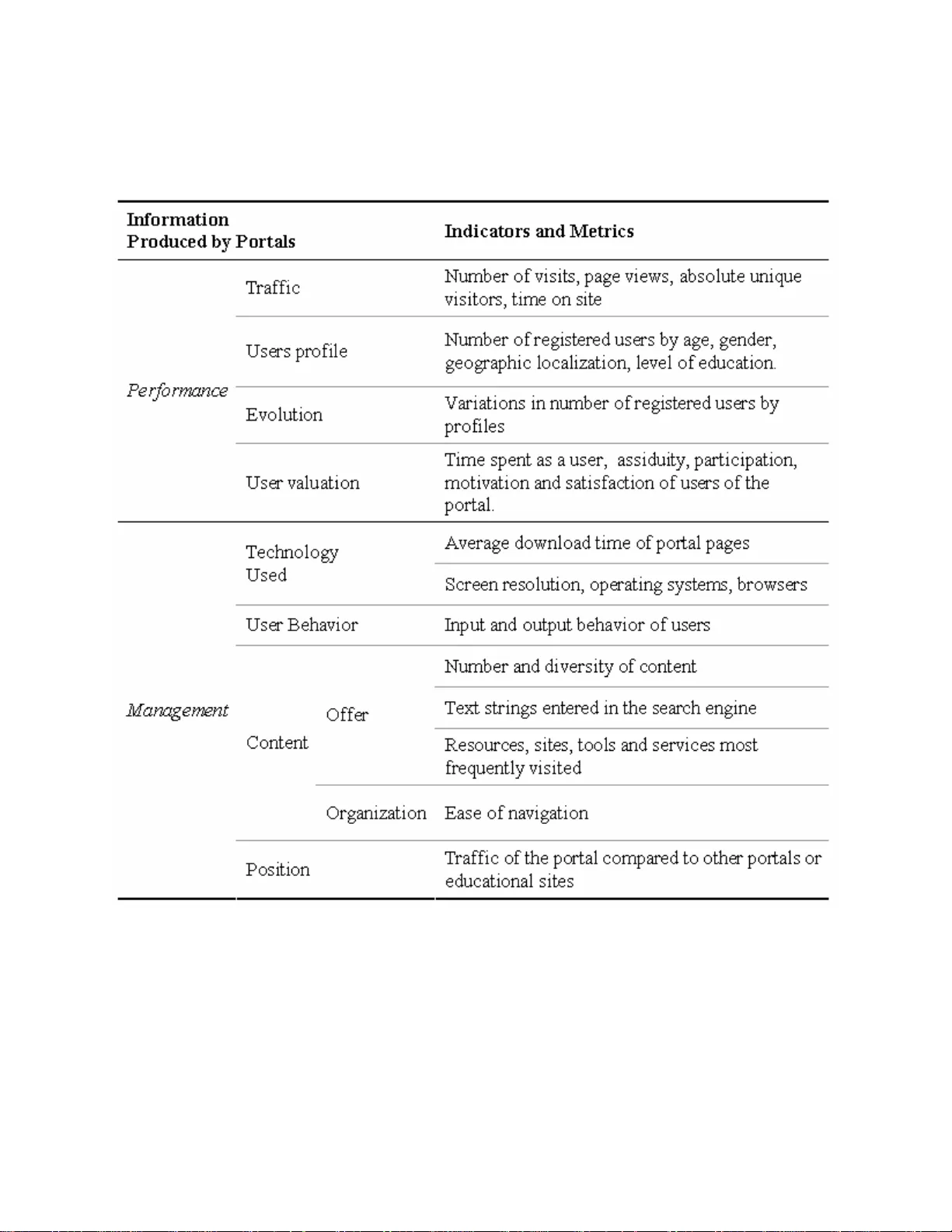
Knowledge sharing and educational portals network Enhancing Knowledge Sharing between Educational Portals Maria Teresa Noguera Fundación Evolución, Argentina Corresponding author : Maria T. Noguera, Fundación Evolución, San Martín 977 4º G, C1004AAS, Ciudad Autónoma de Buenos Aires, Argentina. Email: noguera@fundacionevolucion.org.ar Knowledge sharing and educational portals network Abstract Information and knowledge in exchange in public ne tworks is a crucial ch allenge that needs to be overcome in order to consolidate the benefits associated with such structures. We study the impact of the nature o f the information exch anged over the possibilitie s of success of this process, basing ourselves on the analysis of the information produced by the members of the network of national educational por tals RELPE. One of the main challenges that RELPE f aces consists in finding effective ways of sharing information that can pr omote knowledge transfer between members of the network. We argue that a ke y facto r that prevents information sharing is the use of performance metrics by portal responsibl es to evaluate the resu lts of their decisions. These metrics are highly sensitive, context- dependent, and produced through non-standardized methods, all of which reduce the willingness of knowledge sharing. We present a different approach: based on the RELPE case, we propose creating a comprehensive inform ation system aimed at providing reliable and timely informati on in a systematic fashion. W e believe that adopting standardized procedures and indicators of less se nsitive nature, we can produce information for all pa rtners without the shortcom ings of the usual practices. Keywords Educational portals, informati on sharing, transnational networ ks, public administration and metrics. Knowledge sharing and educational portals network Enhancing Knowledge Sharing between Educational Portals Introduction and Problem Motivation The exchange of knowledge in the field of public networks is a cr ucial challenge they need to overcome in order to consolidate the benefits asso ciated with such struct ures (Dawes, Cresswell, & Pardo, 2009; Weber & Khademian, 2008). It has been shown that knowledge sharing through social networks helps agencies in the public se ctor in achieving effectiv e solutions to many of their problems (Dawes, 1996), managing shared re sources, creating learning opportunities, and generating innovation (Powell, K oput, & Smith-Doerr, 1996). The process of knowledge sharing is complex and involves cultural an d organizational dim ensions and aspects related to the nature of the content actually being exchanged (Pardo, Cresswell, Dawes, & Burke, 2004). The nature of the information or knowledge to be exchange d determines the possibilities of success of this process. In order to consolidate partnership in th e context of a transnatio nal network of agencies, information sharing requires being of a nature th at allows the perception of its value (Zhang, Faerman, & Cresswell, 2006). In this paper we fo cus on this issue by analyzing the information produced by national educational portals that make up a transnati onal network of public agencies. The work presented in this pape r is part of the proposal of cr eating a comprehensive inform ation system for the network of national educational porta ls RELPE (Red Latinoamericana de Portales Educativos) [1], aimed at providing reliable a nd timely inform ation in a systematic fashion, through the adoption of standardi zed procedures. The RELPE network serves as a framework for the discussion that follows, and as a case study that motivates our proposal. Knowledge sharing and educational portals network The remainder of this paper is organized as follows. W e begi n introducing our case study, the RELPE, and the problem that led to its form a tion as a transnational knowledge network (TKN) (Gharawi & Dawes, 2010). We describe the in formation produced by the network m embers in their daily practice, and analyze a nd discuss its nature and the barr iers that such na ture imposes to information exchange. Based on the conclu sions of this discussion, we then propose a methodology aimed at prom oting knowledge exchange in educational portal s within a TKN. Our proposal is supported by two gr oups of metrics, those that produce information about portal management, and metrics that we denote “segment ation m etrics”, which that allow us to group together the portals acco rding with their activit y and relative size. We conclude with a summary of our contribution and an analysis of open research directions in the field . We rem ark that in this paper we do not address the ope rational and technical issues re lated to the production of the metrics proposed [2]. We rather intend to promote a conceptual discussion about the contribution of these metrics as a resource of information that contribute s to encourage knowledge sharing between network members. The Information Produced by Educational Portals The availability of quality digital educatio nal content, together with the provision of telecommunication equipment and in frastructure, are crucial to co mplete the scheme of public investment in educational technology (Gértrudix Barrio, Carm en Gálvez de la Cuesta, Álvarez García, & del Valle, 2007; Pandian, 2008). The limited development in the production and supply of these contents is a common and we ll-known problem for many countries (RELPE, 2007b) . To address this problem, the network of national educational portals RELPE was created, becoming a community for sharing, stori ng and free distribution of digital educational Knowledge sharing and educational portals network content (RELPE, 2010b). The creation of RELPE ra ised the need to establish a system for gathering information, and producing knowledge to support the development of its members [3]. The RELPE network is characterized by horizonta l links between national government agencies involving ministerial levels as well as senior experts in lo wer-level positions. The Board, President and RELPE Secretariats are held by the ministries of education of each member country, while the implementation of the directives is the responsib ility of senior m anagers and technicians of the member portals (RELPE, 201 0b). The network is aime d at solving, by means of collaborative work, a large scale problem as the production of high quality digital ed ucational content (a problem difficult to address in an isolated manner). This requires the resources developed by some member to be available for all the other network partners, an issue that was technically solved through the definition of standards for cat aloguing, and a self-developed content management system (CMS) which allows access to the different portals in the network (RELPE, 2010a). It has been reported that horiz ontal networking depends on th e exchange of information and knowledge. This exchange can be described as a process that unf olds over time. As agencies begin to work their purposes ex tend to additional issues (Ghara wi & Dawes, 2010). That m eans, the initial commitment assumed by m embers of the network opens them the opportunity of sharing other resources, such as informa tion, knowledge and lessons learned during their development. One of the main rem aining challe nges that managers of transnational network agencies face nowadays, consists in finding eff ective ways of sharing information, encouraging and promoting knowledge transfer betw een the members in the network. Being aware of the problem introduced above, in 2007, we launched a survey and contacted both, managers and technical staff, to determine the practices of production of information about the portal. They were asked about the goals of these practices, the aspects that were measured, Knowledge sharing and educational portals network the tools and procedures used, and the use of the information produced. This survey involved nine portals, out of the eighteen that com posed the network at that time [4]. The analysis of the pract ices identified allows us to group the information produced in two broad categories. On the one hand, th ere are those practices that allow obtaining performance information; on the other hand, we have thos e that produce inform ation related to portal management. We next describe the metrics and i ndicators in both groups, frequently used by portal responsabiles. Portal Performance Information: Information related to perform ance was obtained mainly by applying Web Usage Mining techniques (Cooley, 2000) for the analysis of visits, or sequences of page views (click-stream) made by the users [5]. This analysis included aspects such as (a) Activity or traffic; (b) The profiles of registered users; and (c) User valuation of the portal. Among the a ctivity or traffic m etrics are, for example, the number of pages visited, number of pages views, number of visitors and average v isit time. All of these metrics were analyzed for different time pe riods (e.g. by day of the month, by hour) in order to identify peaks and lows. In the case of sites that had the tech nology to register their us ers, metrics were also aimed at knowing the profiles of registered users , e.g. age, gender, geographic location, level of education. The portal evolution wa s studied by means of changes in the num ber of registered users according to their profile: students, teachers, administ rato rs and researchers. The user valuation of the portal was assessed measuring the tim e spent as a user, frequency of visits, and whenever possible, the participation level indic at ed by the participation in events promoted by the portal. We remark that it is a well-known fact that traffi c measures have technical limitations, such as the impossibility of knowing the actual number of users visiting the portal: unless a user is Knowledge sharing and educational portals network registered, visits are counted based on access to the site by the sam e team and from the same machine. Therefore, the variables ab ove are only approximations to m easuri ng to what extent an educational portal accomplishes one of its goals, which is, reaching as m any people as possible. Portal Management Information: Although less widespread than performance m etrics, management metrics allow obtaining informati on about (a) Technology; (b) Entering and exiting behavior of users; (c) Th e portal's offer of educational topics ; (d) Conten t organization; (e) Positioning of the portal relativ e to other ones in the network . Technology was estimated measuring the average download time of the p ort al pages, allowing asse ssing the efficiency of the operation of the portal. Al so, usage data was used, whenev er possible, to identif y the technology of the equi pment with which users acces sed the portal (eg: screen resolution , operating system, browser), in order to adapt the portal design to such technology. Entering user behavior was analyzed by identifyin g the pages in the portal that were used to enter it (usually called " landing pages "), and the external sites fr om where the portal was accessed. E xiting user behavior was also studied, and refers to the pages from where th e users exit the portal (usu ally called " exiting pages "), and the external pages to where the users go af ter exiting the portal. Regarding content, the offer of resources was measured as the number of educational and editorial content per month, per type of user, and per area of curricular knowledge. In general, user preferences was identified analyzing the resour ces, sites, tools, and services most frequently visited, as well as the text strings e ntered in the search eng ine of the po rtal. In a few cases, the content organization (i.e. the organization of the resources offered) was studied, through an indicator of ease of navigation. Finally, the positioning of the portal with respect to other ones (inside or outside the n etwork), was assessed m eas uring the traffic of the site compared to other portals or educational s ites [6]. Knowledge sharing and educational portals network Table 1 Aspects and Metrics of Inform ation Produced by Portals Note that all the measures presented above are associated with practice s and site management activities rather than with performance resu lts. Th at is, operation and orga nization are related to the management of portal technology; the offe r of resources is related to decision about development and/or acquisition of educational content. Finall y, com parative information is Knowledge sharing and educational portals network linked to efforts of positioning, policies and stra tegies, developed to position the portal on the Web. Characterizing the Nature of the Inform ation Produced by Educational Portals The nature of the information and knowledge to be shared on a network is a factor of crucial importance for the effectiveness of the process (Zhang et al., 2006). Some of the aspects about this nature, identified in rela ted literature and th at will be d iscussed below are: its sensitiv ity, its contextualized character, and the lack of standards. The results of the surv ey described in the previ ous section revealed that information regarding the performance of the portal gives a rough idea of the capab ility to attract audience and also of the way in which the products offered by the portal are consumed. Th erefore, perform ance information is used to assess the value of the portals, and to justif y the amounts of public resources invested on them. This usage turns performance information into an asset, and, as a consequence, the perception is that it must be considered conf idential. That is, sharing this type of information requires high levels of trust. The perceived risks of sharing performance information are rela ted to the loss of control of strategic resources, the po ssibility of use against the interests of the organizati on, and the risk of not being corresponded by the sharing partners (Pardo, Gil-Garcia, & Burke, 2006). In summ ary, taking into account the highly sensitive nature of performance information, sharing opportunities ar e limited, at least at an early stage of the process. Trust in social networks requires a high level of social capital to coordinate actions and create common norms and regulations (Coleman, 1988). As in any social network, information sharing does not occur naturally and requires an effort that invol ves investing in strategies to institutionalize group relati onships (Portes, 1998). Knowledge sharing and educational portals network On the other hand, although it is well-known that performance information produced by the W eb sites is useful for their own ad ministration, its usefulness for shar ing in a transnational network of portals is not so clear, as a consequence of its highly contextualized nature . Traffic measures only allow knowing the position of a portal with respect to a "competitor" if the target population is located within the same national contex t. Tra ffic metrics such as num b er of visits or the number of users are affected by local factors such as popul ation size, proportion of the population with access to computers and connec tivity, and the level of adoption of these technologies (e.g. percentage of popu lation connected to the Internet ). This reduces the perceived value of information for the other portal s because each faces d ifferent situations. Opposite to information rela ted to perform ance, portal management inform ation is less sensitive and possibly more valuable for all the network partners due to the fac t that it is embedded in the practices of the portal responsibles. The less sensitive nature of inform ation regarding management practices is because it is under the c ontrol of the portal reponsibles, help ing them in the decision-making process. The knowledge derived from this information would constitute a resource that would increase the repertoire of tools to improve the perform ance of the portal. Unfortunately this information is produced only fo r some cases and with procedures that are not systematic, widespread and automated. Moreover , it is produced using techniques that do not allow comparison. Literature on th e topic shows that the lack of standard pr ocedures goes against knowledge sharing between agencies (Dawes, 1996). It has been shown that agreed procedures allows solving discrep ancies between organizations, increasi ng partner trust by m eans of ensuring an even contribution of all network members (Pardo et al., 2004). The aspects of the information produced by the e ducational portals m entioned above can become barriers that limit exchanges acr oss the network. These barriers could be overcome if portal managers can perceive that what is proposed to be shar ed is a contribution th at can benefit them Knowledge sharing and educational portals network in achieving their goals (Dawes et al., 2009). To th is end, we argue that it is necessary to rethink the kind of information to be ex changed. In this sense, in the next section we propose a system of metrics oriented to analyze the con ditions that lead to the portals to a chieve certai n results. We will see that these metrics should b e applied in the contex t of a methodology that requires a global vision in which each portal collaborates in the understanding of the conditions that lead to an improvement of the way in which it can achie ve its mission. W e believe that the process of knowledge exchange involves a nego tiation between the actors in or der to coordinate what is going to be shared. Thus, our proposal has been de signed as a tool that must be able to adapt itself to the needs that may arise from the analys is. Further, the proposal has been conceived as a tool that can be operationalized but must be adapted to the needs which may arise of the analysis and reflective processes that may arise. It is definitely a dynamic tool that m ust be consolidated together with the consolidation of sharing practi ces over the network. This proposal is consistent with the vision stating that what people know in an organization and what they can share are deeply embedded in their usual practice (Carlile, 2002). A Proposal for Exchangeable Information in th e Network of National Educational Portals Following the criteria explained in the previous section, we now pr esent a system of metrics that focuses in the production of info rmation concerning portal manageme nt, due to its less sensitive nature embedded in the practices of the actors involved. Sh aring this knowledge, decisions rationale, experiences, etc, woul d have a synergic effect in all the network members. This proposal is based on th e grounds that the process of bui lding knowledge am ong organizations involves recursive successive stages which seek to render explicit the tacit knowledge embedded in usual practices, transforming them into know ledge valuable for all the partners (Nonaka, 1994). Knowledge sharing and educational portals network As we stated above, in order that this informa tion could be exchanged a nd its value perceived by others, it has to be produced through standard and systematic procedures. Taking this into account, we identified measures and methodologies aimed at obtaining info rmation for the portal management areas identified in the analyis of uual prac tices discussed in the previous section . For that, we reviewed the literature on We b Mining (i.e., W eb Us age Mining, Web Content Mining, and Link Mining) and, based of this corpus of work, we propose a set of metrics which we denote Portal Management Metrics that could be applied systema tically and in a standardized way, in order to identify good management practic es and the context in which they are carried out. Further, we propose to interpret these metric s with respect to anot her group of indicators, which we denote Segmentation Metrics , that we use to ch aracterize and segment the portals. Both sets of metrics, taken together, allow studying each por tal as a case, extracting its experience for exchange and reflec tion. W e next provide a detailed description of both groups of metrics. Table 2 Knowledge sharing and educational portals network Proposal for an Information System for Netw ork of National Educational Portals RELPE Knowledge sharing and educational portals network Portal Management Metrics This group of metrics deals with issues rela ted to three a spects: provision of content, organization of this content with in the portal, and positioning and ro le of the portal in a country's educational Web. Provision of Content: This first aspect includes m etrics that allow assessing the porta l's resource offer in terms of provision, and dynamics . We remark that we con sider digital educational content the data -in general m ultimedia data (text, im ages, etc.)- stored in W eb sites that are available to users (Poblete, 2004), not including services such as e-mail or forum s. As an example, the portals members of RELPE apply cata loguing standards agreed in advance, to their digital content, based on metada ta standards [ 7]. Each content unit is identif ied by the metadata "type of educational resource" that describes the resource in the educational context for which it was designed (eg activities, teaching guides, pres entations, etc.). Given these data, the provision of digital content can be described using two relate d standard measures [8]: (a) Dive rsity , which indicates the distributio n of content among the different topics that can be found in the portal collection; and (b) Richness which indicates the proportion of topics defined by RELPE that are actually present in the content of the portal being studied. Diversity inform ation can be enriched with metrics related to the diversity of the resources accessed by users. Since viewing of a resource may be a m easure of demand, the temporal variation in the number of unique visitors by content type would describe the audience, identifying and describing seasonal trends. Moreover, information about the diversity of content offered and the diversity of content demanded allow portal m anagers to identify the need for adjustments of their con tent offer. Also, this w ould allow them to identify whether other network members face similar situations and who could share knowledge on the strategies developed to address them. For instance, the top ics identifie d as having high demand but low offer in a portal Knowledge sharing and educational portals network can be populated with content developed by othe r portals for which these portals may have abundant offer and high demand. Content managed by a portal can be characterized also from the point of view of its dynamics using a measure such as the "averag e age". An an alysis across tim e of this metric may give an idea of the speed at which c ontent is being renewed, thus providing a rough measure of the production efforts of each portal and the degree of up-to-dateness of the re sources that the portal contributes to the network. The study of the dynamics of replacemen t of the contents complements the diversity analysis, allowing id entifying the topics or items to which a portal devotes greater efforts. For example, con ten t with high average ag e and low demand could require replacement; or content with high averag e age and high demand m ay indicate that such content is of high quality and it is steadily con s idered useful. Therefore this content could be analyzed in order to gu ide in the production process of new c ontent. This is a clear example of information that can be valuable for other memb ers of the network, wit hout affecting sensitive areas. Content Organization: This aspect refers to the order established between the portal pages, based on the URLs and the links that conn ect them. On this basis, an educational portal can be analyzed as a network that has a certain internal structure with distin ctive characteristics (Srivastava, Cooley, Deshpande, & Tan, 2000). Th is has been studied by the data mining community, and referred as Web Structure Mining, which is aim ed at characterizing the organization of the Web content (Botafogo, Ri vlin, & Shneiderman, 1992). Studies of the internal structure of the sites have demonstrated the im pact of this structure over the user's probability of effectively finding content within a site, and over the usability of a site (Adhikari & Lemone, 2007; Díaz, 2003; Miller & Remington, 2004) . The site structure also inf luences its Knowledge sharing and educational portals network possibility of being located and visible to users, and of being i ndexed by search engines (Baeza Yates, 2004). To measure and characterize the internal stru cture of a site we propose four metrics: depth, density, navigability and linearity . The depth of the portal is defined as the average number of links to follow in order to reach a page from the hom epage. The density of a portal is the number of links on the pages of the port al network, normalized by the to tal possible links of the site ( the result is a value between 0 a nd 1) (Bordignon & Tolosa, 2006). Th e shorter the distance between the pages (i.e., the more cohesive a site), the hi gher the number of links, and therefore the higher the density of the site (Petricek, Escher, Cox, & Margetts, 2006). A value close to 1 means high cohesion of the portal. Navigability means that each node of the portal can be easily accessed from other nodes (Pahl, 2001). Unlike cohesion, th is m easure takes into account the direction of the relationships and the distances from one point to another. Finally, the linearity of the portal reveals how well organized it is, and how many choices a user has to take while browsing it (Pahl, 2001). A low value of linearit y indicates that the number of choices a user faces is very high, and that the site is unstructured. On the other hand, sites with high linearity could be tedious to navigate. Therefore, medium linearity values are highly desirable. The combination of these four metrics describes the way in which a portal organizes its content, motivating to study the principles that lead to an effective organization. For example, it is possible to use the counterpart of the last two metrics (navigability an d linearity) as measures that indicate the complexity and nonlinearity of user navigation . Both seek to describ e the behavior of users as a result of the organiza tion of the portal. Both measures have been associated with the understanding that users develop in their interaction with hypermedia resources (McEneaney, 2000). Studies have shown th at subjects who are successful in the search processes and in comprehension tests, show hi gh values of complexity and low values of Knowledge sharing and educational portals network linearity. A high proportion of user s with erratic search behavior could indicate the need of adjusting the organization of content. In summary, organizational metrics would provide evidence of aspects that may need adjustment. Position Management: Refers to the managem ent of the hyperlinks and the role that the site accomplishes as a social actor within the educational Web [9]. An educational Web site shares its content with other educational ones in a country through the link structure that connects them. This structure is ex ternal to the portal, and it is composed of both, the links incoming to the portal (in-links), and the li nks outgoing from the portal (out-links). Links incoming to an educationa l portal (in-links) are an indica tion of the value given to the portal contents, and a measure of how the users benefit from such content. Through the link structure, the digital co ntent on the portals becomes a public asset in the scope o f a national educational Web, which is an external aspect of the use of educational portals. The number of links outgoing from an educational portal is an indication of the ag enda of the por tal, i.e., an indication of what is considered important by the portal management staff (Chakrabarti et al., 1999). A portal can play the ro le of a actor capable of building bridges between Web communities, while influencing the trust, pr estige, authority and credibility of oth er Web sites (Kleinberg, 1998; Park, 2003). Based on the above, we propose three measures that can be calculated for a collection of educational Web sites in the country to which the portal belongs. The first m easure is the level of authoritativeness , popularity and prestige of the portal, de fined as the incoming degree (Id) or number of incoming links from the other si tes being considered. The second measure, hubness , measures the capability of a portal to guide and lead their audience to other sites (Chakrabarti et al., 1999). It is measured by the num ber of outgoing links, and denoted outgoing degree (Od). Knowledge sharing and educational portals network The third measure proposed, bridging , is a combination of the degree (i.e., the sum of the number of incoming and outgoing links), and th e number of communities adja cent to the portal, and allows to determine the role of the portal w ith respect to the educational W eb of reference (Scripps, Tan & Esfahanian, 2007). A portal w ith low degree and high num ber of adjacent communities is what in the literature of social network analysis (SNA) is called a "bridge" (Burt, 2000, 2001). A metric that can de scribe to what extent a site is an authority in an edu cational Web, is a m ore reliable indicator of the value of the portal than a m etric that relies on Web traffic data. It is an indicator of the judgment and recognition to the content provided, produced by the “expert” actors who work in the same context and are pr obably seeking to satisfy the sam e target populations. To what extent a portal is a Hub depends on the policy that is carried out to manage it. This implies an action plan that consider s ex plicitly establishing links with o ther actors, and indicates a concern for knowing what the othe r ones have to offer to the educational communities. Different to the previous two characteristics, the role of bridge that an actor plays is an structural property of a social network, by which a node in a network serves as a "broker", building bridges that link different blocks of players wi th each other, increasing the probability of non- redundant access to information (Burt, 2000). Th e m ore heterogeneous are the bu ilding blocks being linked, the greater the possi bility of distributing resources th a t can enrich the network (Lin, 1999). Thus, the educational portal , through its external links, can play an important role in disseminating new ideas and conten t within the country's educa tional Web. This role, through which the portal exerts influence over other ones, allows to dissem inate ideas that can be relevant an innovative for the different groups (Burt, 2004), and that constitute a more appropriate measure of the value added by the port al, than m easures based on the com petition for Knowledge sharing and educational portals network attracting users. At the same time, they provide an alternative view of th e portal that goes beyond its primary role as a repository and provider of quality educational con tent, thus becoming an instrument for linking and disseminating ideas. Segmentation Metrics The metrics described in the previous secti on, although valuable, would produce even more interesting information if they were analyzed in light of the particular cha racteristics of the educational portals. Therefore we propose anot her group of indicators that account for such characteristics. We denote this group as segmentation metrics . These indicators m easure the dynamics of activity of a portal and the relative size with respect to the s ize of the portals in th e network. The dynamics of activity of a portal is given by the variations in a given period of time of the level of gross demand (that is, without user iden tification). This is evaluated by means of three metrics: overall level of demand , the recency of users, and the level of user activity . The overall level of demand is measured as the number of visits, or sequences of views, received by the portal in a certain period of time, without considering the visi ts from automated agents (crawlers and spiders). The recency is defined as the average time between visits by the same visitor in a certain period of time (again, visits from automatic agents are discarded). Finally, the level of user activity is measured as the av erage number of pa ge views per visit cal culated as the total sum of page views with respec t to the total num ber of visits in a certain period of tim e. The second aspect that we propose to use to account for the di versity of the portals is the relative size or relative abundance of a portal content, computed as the amount of content (without duplication) in the portal, rela tive to the total amount of ne twork content. In the RELPE cataloging standard, a "content" of a site is uniquely identified by the m eta-name [DC: Knowledge sharing and educational portals network identifier]. To compute the amount of content we need to sum the number of different unique identifiers. The combination of the two aspects, dynamics of activity an d relative size on the portal , allows establishing an a priori typology, with at least four possibl e groups: (a) Growing portals with large relative size; (b) Growing portals with low relative size; (c) Stable portal s with large relative size; (d) Stable p ortals with sm all relativ e size. These categories can serv e as a reference to give context and segment the analysis of managem ent measur es outlined above. To illustrate the jo int use of metrics in the two groups, let us consider the following exam ple. Two portals A and B in the RELPE network are of similar characteristics (g rowing and large according to the segmentation metrics above), although they orga nize their content in different ways, resulting in different indicators for content organization , which favor portal A. This may trigger an in-depth analysis aimed at finding out whether or not the causes of such differences were known by the responsibles of portal B. During this analysis, the responsibles for Portal B could work together with thei r colleagues of portal A, and i nvestigate effective organization strategies that have been implemented by the latter. This knowledge could be used by portal B to improve its content organizati on. Analogously, portal B m ay have better indicators in other topics (for example, a more divers e content o ffer), whose analysis may improve the operation of portal A. Note that this joint work would be m ore difficult (o r even impossi ble) to carry out with indicators of more sensitive nature. Both groups of metrics, portal managem ent a nd segmentation metrics, com pose a system of metrics oriented to ana lyze the conditions that l ead to certain resu lts, an d which m ust be applied with a global vision in mind, in which each portal collaborates in the understanding of the conditions that lead to their improvement. Knowledge sharing and educational portals network Conclusion In this paper we have analyzed the nature of inform ation actua lly produced by the members of an educational portal network. This information, ma inly based on W eb site traffic metrics, is commonly used by the portals to su pport their usual opera tion. However, we have shown that it is highly sensitive, and more than often, context-dependa nt. On the other hand, information about portal management is rarely produce d, and obtained without following standard methodologies. All of these aspects lim it the possi bilities and willingnes s of information sharing among network partners. With the purpose of overcoming the barriers that prevent k nowledge sharing, we proposed a system of metrics to generate inform ation a bout the management of educational portals (e.g. content offer and organization), a nd analyzing the results obtained in a context in w hich results of portals of similar characteris tics (e.g. size) could be compared. W e argue that this information, yet valuable for m anagement, is much less sens itiv e than traffic data, and m ore likely to be shared. In summary, we claim that portals have valuable, non-sensitive information that is being lost due to the lack of a methodology that encourages kn owledge sharing. Therefore, portal responsibles must be convinced that their knowledge contribu tion to the network will also benefit them in achieving their goals. We expect that this propo sal and the collection of m etrics presented can contribute to solve the problem of reliab ly reflecting the effectiv eness of the portal m anagement practices that are being carried out. Knowledge sharing and educational portals network Footnotes [1] http://www.relpe.org/ [2] These issues have been deve loped in other work (Noguera, 2007). [3] Full members : “educ.ar,” Argentina; “educabolivia”, Bolivia; “Portal do Professor”, Brazil; “educarchile”, Chile; “Colombia aprende”, Colombia; “educatico”, Costa Rica; “Educarecuador”, Ecuador; “Mi Portal”, El Salvador; “Mineduc”, Guatemala; “Nicaragua Educa”, Nicaragua; “Educa Panamá”, Panam á; “Arandú Rape,” Paraguay; “PerúEduca”, Peru; “Educando,” Dominican Republic; “Uruguay Educa”, Uruguay; “Sepiensa”, México. Contributing members : “CubaEduca”, Cuba; “Ministerio de Educación,” Guatemala; “hondurasaprende”, Honduras; “Portal Educativo Nacional”, Venezuela. Member of honor : “ITE” of Spain. Associate members (unofficial public po rtals): “CEDUCAR”, Central Am erica and Dominican Republic; “ATEI”, Latin Amer ica; “Indágala”, Latin America. [4] “educabolivia”, “educarchile”, “Colom bia ap rende”, “Mi Portal”, “Mineduc”, “Sepiensa”, “Nicaragua Educa”, “Arandú Rape” and “PerúEduca”. [5] Analysis Tools more frequently used were Web-Trends and Webalizer. In som e cases these were supplemented with Google Analytics or sim ilar. W eb-Trends and We balizer, are based on parsing, cleaning and analysis of the hits recorded on the Web serv er log of the portal. On the other hand, in Google Analytics and other similar t ools, the data collectio n technique is based on client-oriented data. Th ey work incorporatin g executable code in to Web pages that allow transfering data to an external data base for fu rther analysis. In spite of the current discussion about the limitations implicit in each m ethod of data collection, both can produce essentially the same kinds of metrics. Knowledge sharing and educational portals network [6] An example of this is the in form ation provided by Alexa.com. [7] See standards for cataloging content on the network agreement (RELPE, 2007a). [8] These are based on the Shannon Index (C. E. Shannon, 1948). [9] For example, the survey conducted in the framewo rk of the project that originated this work, allowed identifying a s et of educational W eb site s valued by the community of educational users of one of the portals of RELPE network. References Adhikari, V. K., & Lemone, K. (2007). Hypertext Structural Analys is of Nepali Educational Institution Web-sites . Paper presented at the 16th Annua l World Wide Web Conference Baeza Yates, R. (2004). Excavando la Web. El Profesional de la Información,, 13 (1), 4-10. Bordignon, F., & Tolosa, G. (2006). Caracter ización de Espacios Webs Educativos Sudamericanos. Enlace Informático, 5 (1). Botafogo, R. A., Rivlin, E., & Shneiderman, B. (1992). Structural Analysis of Hypertexts: Identifying Hierarchies and Useful Metrics. ACM TransactIons on Information Systems, 10 (2), 142-180. Burt, R. S. (2000). The network Structure of Social Capital. In B. M. Staw & R. L. Sutton (Eds.), Research in Organizational Behavior (Vol. 22). Amsterdam: Elsevier Science. Burt, R. S. (2001). Structural Hole s versus Network Closure as Soci al Capital. In N. Lin, K. S. Cook & R. S. Burt (Eds.), Social Capital: Theory and Research . Burt, R. S. (2004). Structural Holes and Good Ideas. The American Journal of Sociology, 110 (2), 349-399. C. E. Shannon. (1948). A Mathema tical Theory of Communication. The Bell System Technical Journal, 27 , 379-423. Carlile, P. R. (2002). A Pragmatic View of Knowledge and Boundaries : Boundary Objects in New Product Development. Organization Science, 13 (4), 442-455. Coleman, J. S. (1988). Social Capital in the Creation of Human Capital. The American Journal of Sociology, 94 Supplement , S95-S120. Cooley, R. (2000). The Importance of Understa nding Web Site Structure and Content when Performing Web Usage Mining. Available at: http://citeseerx.ist.psu.e du/viewdoc/summary?doi=10.1.1.6.7061 Chakrabarti, S., Dom, B., Davi d Gibson, Jon Kleinberg, Ravi Kumar, Prabha kar Raghavan, et al. (1999). Mining the Link Structur e of the World Wide Web. Dawes, S. S. (1996). Interagency information sh aring: Expected benefits, manageable risks. Journal of Policy Analysis and Management, 15 (3), 377-394. Dawes, S. S., Cresswell, A. M., & Pardo, T. A. (2009). From “Need to Know” to “Need to Share”: Tangled Problems, Information Bounda ries, and the Building of Public Sector Knowledge Networks. Public Administration Review, 69 (3), 392-402. Díaz, P. (2003). Usability of H ypermedia Educational e-Books. D-Lib Magazine, 9 (3). Gértrudix Barrio, M., Carmen Gálvez de la Cuesta , M. d., Á lvarez García, S., & del Valle, A. G. (2007). Design and Development of Di gital Educational Content. In Computers and Education (pp. 67-76): Springer Netherlands. Gharawi, M. A., & Dawes, S. S. (2010). Conceptualizing Knowledge and Information Sharing in Transnational Governmental Networks . Albany, NY: Center for Technology in Government. Kleinberg, J. (1998). Authoritative sources in a hyperlinked environment. Paper presented at the Proceedings of The Ninth Annual ACM-SIAM Symposium on Discrete Algorithm s, San Francisco, California. Lin, N. (1999). Building a Network Theory of Social Capital. Connections, 22 (1), 28-51. McEneaney, J. E. (2000). Navigational Correlates of Comprehension in Hypertext. Paper presented at the Hypertext 2000, San Antonio, TX. Miller, C. S., & Remington, R. W. (2004). Modeli ng Inform ation Navigation : Implications for Information Architecture. Human-Computer Interaction, 19 (3 ). Noguera, M. T. (2007, June). Propuesta Metodól ogica para el Com ponente Automático del Observatorio RELPE. Informe Técnico Nº4 Retrieved December, 2010, from http://fundacionevolucion.org.a r/investigacion/uploads/ groups/0012_group/doc/Informe %20Tecnico%20Componente%20Autom atico.pdf Nonaka, I. (1994). A Dynamic Theory of Organizational Knowledge Creation. Organization Science, 5 (1), 14-37. Pahl, C. (2001). The Evaluation of Educational Service Integration in Integrated Virtual Courses . Paper presented at the Proceedings of the 2001 Symposium on Applications and the Internet-Workshops Pandian, M. P. (2008). Digi tal Knowledge Resources. Policy Futures in Education, 6 (1), 22-38. Pardo, T. A., Cresswell, A. M., Dawe s, S. S., & Burke, G. B. (2004). Modeling the Social and Technical Processes of Interorgani zational Information Integration. Paper presented at the 37th Annual Hawaii Intern ational Conference on System Sciences (HICSS'04) - Track 5, Big Island, Hawaii. Pardo, T. A., Gil-Garcia, J. R., & Burke, G. B. (2006). Building Response Capacity through Cross-boundary Information Sharing: The Critical Role of Trust. In P. Cunningham & M. Cunningham (Eds.), Exploiting the Knowledge Economy: Issues, Applications, Case Studies . Amsterdam: IOS Press. Park, H. W. (2003). Hyperlink Network Anal ysis: A New Method for the Study of Social Structure on the Web. Connections, 25 (1), 49-61. Petricek, V., Escher, T., Cox, I. J., & Margetts, H. (2006). The Web Structure of E-Government - Developing a Methodology for Quantitative Evalua tion . Paper presented at the International World Wide W e b Conference Committee (IW 3C2). Poblete, B. (2004). Herramienta de Minería de Consultas para el Diseño del Contenido y la Estructura de un Sitio Web. Universidad Nacional de Chile, Santiago de Chile. Portes, A. (1998). Social Cap ital: Its Origins and Appli cations in Modern Sociology. Annual Review of Sociology, 24 , 1-24. Powell, W. W., Koput, K. W., & Sm ith-Doerr, L. (1996). Interorganizati onal Collaboration and the Locus of Innovation: Networks of Learning in Biotechnology. Administrative Science Quarterly, 41 (1), 116-145. RELPE. (2007a). Normas para la Ca talogación de Contenidos Educativos. Documento Técnico Nº1 Retrieved November, 2010, from http://www.relpe.org/documentos- tecnicos/documento-tecnico-1 / RELPE. (2007b). Stategic Plan. Consolidating and Integrating the Education Portals Network and Latin America Schoolnets Retrieved November, 2010, from http://www.idrc.ca/en/ev-123164-201-1-DO_TOPIC.html RELPE. (2010a). RELPE: Experiencias Exitos as de Trabajo Colaborativo : Red Latinamericana de Portales Educativos. RELPE. (2010b). RELPE: Red Latinoamericana de Portales Educativos [E lectronic Version]. Serie Portales Educativos Latinoam ericanos y El Trabajo Colaborativo , Retriev ed November 2010 from http://www.relpe.org/wp- content/uploads/2010/11/Publicaci %C3%B3n-RELPE-1_FINAL.pdf. Srivastava, J., Cooley, R., Deshpande, M., & Ta n, P. (2000). Web Usage Mining: Discovery and Applications of Usage Patterns from Web Data. SIGKDD Explorations, 1 (2), 12-23. Weber, E. P., & Khademian, A. M. (2008). Wicked Problems, Knowledge Challenges, and Collaborative Capacity Builders in Network Settings. Public Administration Review, 68 (2), 334-349. Zhang, J., Faerman, S. R., & Cresswell, A. M. (2006, January 4-7). The Effect of Organizational/ Technological Factors and the Nature of Knowledge on Knowledge Sharing. Paper presented at the Thirty-Ninth Annual Ha waii International Conference on System Sciences, Kauai, Hawaii.
Original Paper
Loading high-quality paper...
Comments & Academic Discussion
Loading comments...
Leave a Comment