On the characterization of expansion maps for self-affine tilings
We consider self-affine tilings in $\R^n$ with expansion matrix $\phi$ and address the question which matrices $\phi$ can arise this way. In one dimension, $\lambda$ is an expansion factor of a self-affine tiling if and only if $|\lambda|$ is a Perro…
Authors: Richard Kenyon, Boris Solomyak
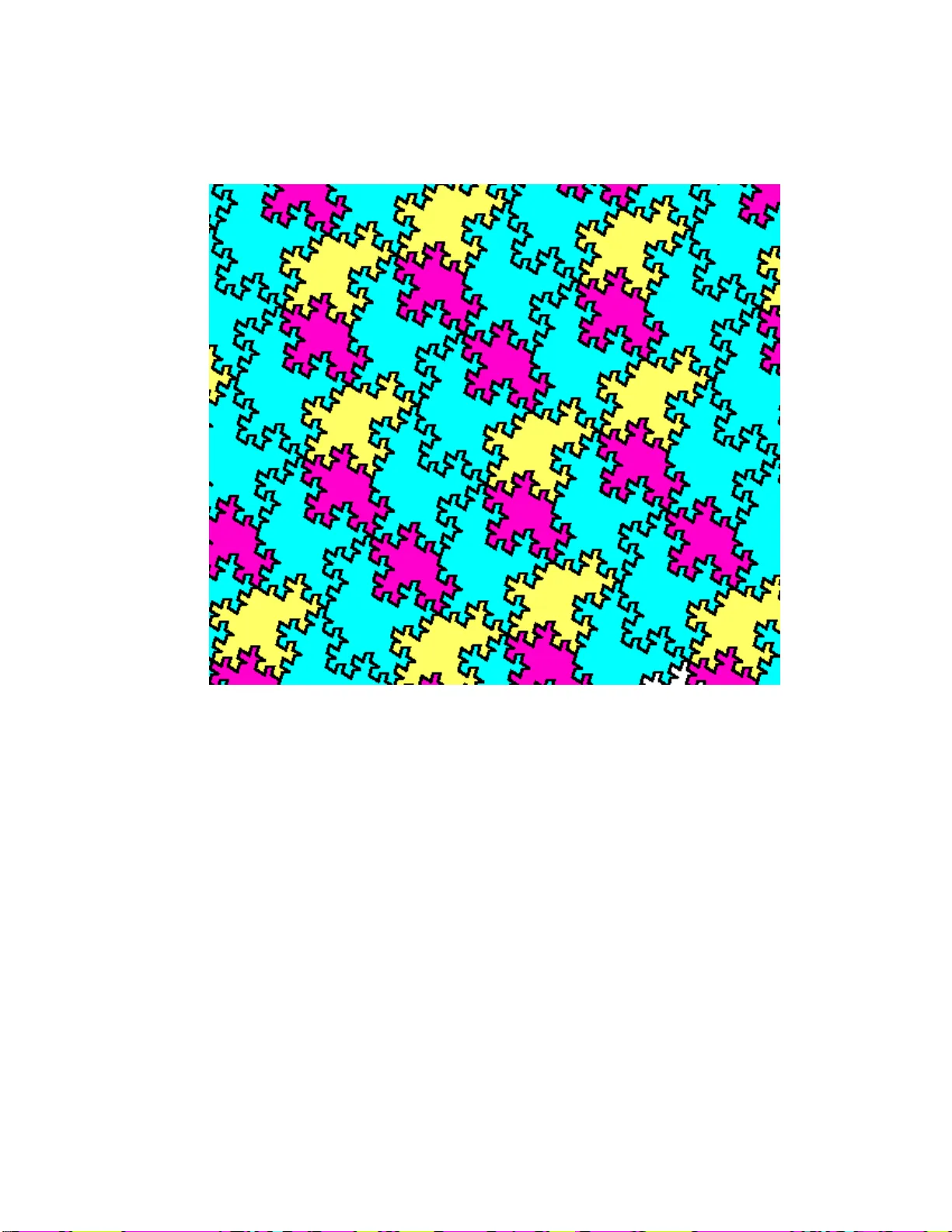
ON THE CHARACTERIZA TION OF EXP ANSION MAPS F OR SELF-AFFIN E TILINGS RICHARD KENYON AND BORIS SOLOMY AK Abstra ct. W e consider self-affine t ilings in R n with exp ansion matrix φ and address the q uestion whic h matrices φ can arise this w a y . In one dimension, λ is an expansion factor of a s elf-affine tiling if and only if | λ | is a P erron num ber, by a result of Lind. In tw o dimensions, when φ is a similarit y , we can sp eak of a complex exp ansion factor, and there is an analogous necessary condition, due to Thurston: if a complex λ is an ex pansion factor of a self-similar tiling, t h en it is a complex Perron n umber. W e establish a necessary cond ition for φ to b e an expansion matrix for an y n , assuming only that φ is diagonaliza ble ov er C . W e conjecture that th is condition on φ is also su ffi cient for the existence of a self-affine tiling. 1. Introduction Self-affine tilings arise in many different con texts, notably in dyn amics (Mark ov partitions for h yp erb olic maps [21, 11, 16]), logic (ap erio dic tilings [15 ]), num b er theory (radix repr esen tations [19, 13]), ph ysics (quasicrystals [3]), ergo dic the- ory [22], and h yp erb olic groups [4 ]. See [2, 2 0] for recen t su rv eys with a large bibliograph y . A self-affine tiling (SA T) T = { T i } i ∈ I of R n is a co v erin g of R n with sets (tiles) T i satisfying th e follo wing prop erties: (1) E ac h tile T i is the closure of its in terior. (2) I n teriors of tiles do not o v erlap. (3) T here are a finite num b er of tile t yp es up to translation. (4) T he tiling is re p etitive and has finitely man y local configurations (see the next section for definitions). Date : Nove mber 1, 2021. The researc h of R. K. w as supp orted in part by NSERC. The researc h of B. S. was supp orted in p art by NSF . 2 RICHARD KENYON AND BORIS SOLOM Y AK (5) T here is an expanding linear map φ : R n → R n mapping tiles o v er tiles: the image of a tile T i is a union of tiles of T , and t w o tiles of the same t yp e ha v e images which are translation-equiv alent patc hes of tiles. The simplest example is the p erio dic tiling with unit cu b es and expan s ion mapping φ ( x ) = 2 x . Ho w ev er typica lly SA Ts are nonp erio dic and hav e tiles w ith fractal b oundaries. See Figures 1 and 2 for examp les in R 2 . Lind [14] (using different language) gives a characte rization of expans ion factors of self-affine tilings in one dimension: λ is the expansion of an SA T of R if and only if | λ | is a P erron num b e r , that is, a real algebraic int eger which is strictly larger in mo dulu s than all of its Galois conjugates. A self-affine tiling is self-similar if φ is a similarit y (a homothet y f ollo w ed by a rotation). Thurston [24] sho w ed that the expansion f actor λ ∈ C of a self-similar tiling of R 2 is a complex P erron num ber , that is, an algebraic in teger w hic h is strictly larger in mo dulus th an its Galois conjugates except for its complex conjugate. In [9], a construction of a self-similar tiling for ev ery complex Pe rron n umber is given; unfortun ately , the pr o of as wr itten in sub s ection 4.5 of [9] is incomplete. A version of th e constru ction do es yield a tiling with expansion λ k for k sufficien tly large, and we h op e that it can b e mo dified to get a tiling with expansion λ , completing the c haracteriza tion. This gap do es not affect the construction in section 6 of [9] whic h us es free group endomorphism s; ho w ev er, the latter do es not co ver all the complex P erron num b ers. See also [5] for a related construction. In the current pap er w e study SA T s of R n with expansion matrix φ whic h is diagonaliza ble ov er C . W e show that if φ is the expansion m atrix f or an SA T then eigen v alues of φ are algebraic inte gers, and for ev ery eigen v alue γ , all Galois conjugates of γ whic h h a v e mo d ulus ≥ | γ | ha v e m ultiplicit y (among eigen v alues of φ ) at least as large as that of γ , see Theorem 3.1 b elo w. An alternativ e description of this criterion is that there is an intege r matrix M acting on R N for some N ≥ n , wh ic h h as an in v ariant real s u bspace W of dimen- sion n , on whic h it has strictly larger gro wth (that is, strictly larger determinan t, in absolute v alue) than for any other n -dimensional inv arian t subspace, and M restricted to W is linearly conjugate to φ . EXP ANSION M APS FOR SELF-AFFINE TILI NGS 3 Figure 1. A self-affine tiling in the plane with expansion φ ( z ) = λz wh ere λ is the complex ro ot of x 3 + x + 1 = 0. Here there are three tile t yp es, all similar. The smallest scales to th e medium whic h scales to th e large; the large su b d ivides into a small and a large. One can constru ct this tiling using the metho d of [9, Sec.6], as follo w s. T o a reduced word in the free group on three letters F ( a, b, c ) asso ciate a p olygonal path in C b y s en ding a ± 1 to ± 1, b ± 1 to ± λ , c ± 1 to ± λ 2 . Let ψ b e th e endomorphism of F ( a, b, c ) defin ed by ψ ( a ) = b, ψ ( b ) = c, ψ ( c ) = a − 1 b − 1 . Con- sider the three comm utato rs [ a, b ] = aba − 1 b − 1 , [ b, c ] , and [ a, c ]; they rep resen t thr ee closed p aths. Then lim n →∞ λ − n ψ n ([ a, c ]) is the b oundary of the smallest tile; the other tiles b ound aries are lim n →∞ λ − n ψ n ([ a, b ]) an d lim n →∞ λ − n ψ n ([ b, c ]) . Th e sub division rule comes from th e identit ies ψ ([ a, c ]) = a − 1 [ a, b ] a, ψ [ a, b ] = [ b, c ] and ψ [ b, c ] = [ c, a − 1 b − 1 ] = ( a − 1 [ a, c ] a )( a − 1 b − 1 [ b, c ] ba ) . 4 RICHARD KENYON AND BORIS SOLOM Y AK Figure 2. A s elf-affine tiling in the plane with diagonal expansion matrix Diag[ x 1 , x 2 ] w here x 1 ≈ 2 . 19 869 , x 2 ≈ − 1 . 91223 are r o ots of x 3 − x 2 − 4 x + 3 = 0. The con v erse to our r esult is op en: does there exist, for every linear map φ satisfying the ab ov e conditions, an SA T with expansion φ ? W e conjecture that the answer is yes. In Figure 2 we show an example of a self-affine (non-self-similar) SA T in the plane. The sub d ivision rule is indicated in Figure 3. Our m etho ds do not at p r esen t extend to the non-diagonalizable case. Ho we v er, w e conjecture that the second description ab o v e holds in general, that is, without the constraint of diagonaliz abilit y , φ is the expansion of an SA T if and only if there is an in teger matrix M acting on R N for some N ≥ n , whic h has an inv arian t real subspace W of dimension n , on whic h it has strictly larger growth (d eterminan t) than for any other n -dimensional inv arian t subsp ace, and M restricted to W is linearly conjugate to φ . F or example, we conjecture that there is no S A T in R 3 EXP ANSION M APS FOR SELF-AFFINE TILI NGS 5 Figure 3. Sub division ru le: 1 → { 3 , 2 } , 2 → { 3 , 2 , 2 , 2 , 2 } , 3 → { 1 , 1 , 1 } . The construction is sim ilar to the previous example b ut with a, b, c corresp onding to v ectors (1 , 1) , ( x 1 − 1 , x 2 − 1) , ( x 2 1 − x 1 , x 2 2 − x 2 ) in R 2 , endomorp hsm ψ ( a ) = ab, ψ ( b ) = c, ψ ( c ) = ab 4 and tiles [ b, a ] , [ b, c ] , [ a, c ] . with expans ion 3 + √ 2 1 0 0 3 + √ 2 0 0 0 3 − √ 2 although it is easy to constr u ct one with expansion 3 + √ 2 0 0 0 3 + √ 2 0 0 0 3 − √ 2 2. Preliminaries W e say that a tiling T = { T i } i ∈ I has a finite num b er of tile t yp es up to translation, if there is an equiv alence relation ∼ on the tiles T i with a finite n umber of equiv alence classes an d T i ∼ T j implies that T j is a translate of T i . W e denote [ T i ] th e equiv alence class of tile T i , and sa y T i is a tile of t yp e [ T i ]. A patc h in a tiling is a finite set of its tiles. Tw o patc hes are said to b e equiv alen t if one is a translate of the other, that is, there is a single translation whic h tak es ev ery tile in one patc h to an equiv alent tile in the other p atch. The radius of a patch is the radius of the smallest ball con taining the patc h. 6 RICHARD KENYON AND BORIS SOLOM Y AK A tiling is said to ha v e a finite num b er of lo cal configurations , or FLC for short, if there are a finite num b er of equiv alence classes of patc hes, up to translation, of an y give n radiu s . An FLC tiling is re p etitive if for all r > 0 there is an R > 0 su c h th at ev ery patc h of radiu s r can b e found, up to translation, in an y ball of radius R in the tiling. Th is is equiv ale nt to minimalit y of the orbit closure of the tiling, s ee e.g. [18], and w as called quasip erio dicit y in [24, 10]. In an SA T, the φ -image of eac h tile t yp e is a w ell-defined collectio n of translates of tile t yp es. If T i is a tile we can write φT i = ∪ j ( T i j + d i j ) , which is a fin ite in terior-disjoin t union. This s ub d ivision only dep en d s on the type of tile T i , in the sense th at equiv alen t tiles hav e equiv ale nt sub divisions. In particular we let m ij b e the num b er of tiles of t yp e j in the su b division of a tile of t yp e i . The matrix m = ( m ij ) is the sub division matrix , it is a n onegativ e in teger matrix whic h is primitiv e : some p o w er is strictly p ositiv e (by rep etitivit y of the tiling). The leading eigen v alue of m is the vol ume expansion of the SA T, wh ic h therefore m ust b e a real Pe rron num b er. Giv en an SA T, one can select in eac h of the tile t yp es a p oint, called a con trol p oin t , in s u c h a w a y that the set C of the con trol p oints of tiles in a tiling is forw ard inv arian t u nder φ : φ C ⊂ C . This can b e accomplished as follo ws [24] (see also [16, Pr op . 1.3]): for eac h tile typ e [ T i ], select one tile in its image under expansion and sub d ivision. L et the pr eimage of th is tile b e A [ T i ] ⊂ [ T i ]. Th en the sequence [ T i ] , A [ T i ] , A ( A [ T i ]) , . . . nests do wn to a single p oint in [ T i ], denoted b y c ( T i ), whic h w e define to b e th e con trol p oint of T i . F or a tile T = T i + x w e let c ( T ) = c ( T i ) + x . 3. Theorem The follo wing theorem is stated in [10 ]. Theorem 3.1. L e t φ b e a diagonal izable (over C ) exp anding line ar map on R n , and let T b e a self-affine tiling of R n with exp ansion φ . Then (i) every eigenvalue of φ is an algebr aic inte ger; (ii) if λ is an eigenvalue of φ of multiplicity k and γ is an algebr aic c onjugate of λ , then either | γ | < | λ | , or γ is also an eigenvalue of φ of multiplicity gr e ater than or e qual to k . EXP ANSION M APS FOR SELF-AFFINE TILI NGS 7 The pro of is based on the arguments of T h urston [24] and Keny on [10], but w e fill sev eral gaps in those argumen ts and provide a great d eal more detail. In particular, Lemmas 3.7 and 3.8 ha v e n o analogs in [24, 10]. It should b e p oint ed out that the corresp onding parts of [24] and [10] ha v e n ever app eared in refereed publications, but h a v e b een widely cited and used in the literature on tilings and tiling dyn amical systems. By appropr iate c hoice of a b asis, we can assume that the linear map φ has the real canonical form, see [7, Th. 6.4.2]. Since φ is d iagonaliz able o v er C , this means that w e h a v e a direct s u m decomp osition (1) R n = p M i =1 E i in to inv arian t subspaces asso ciated with eigen v alues λ i of φ , wher e we count eigen v alues, ha ving non-n egativ e imaginary part, with multipliciti es. F or a real eigen v alue λ i , the subspace E i is one-dimensional, and φ | E i acts as multiplicat ion b y λ i . F or a non-r eal eigen v alue λ i , the subspace E i is tw o-dimens ional. Iden- tifying it with a complex plane, w e get that φ | E i acts as multiplica tion by the complex n um b er λ i , in other w ords, as a comp osition of a dilation and a rotation. W e can d efine a norm on k · k on R n suc h that (2) k x k = max i k x i k for x = p X i =1 x i , x i ∈ E i , k φx i k = | λ i |k x i k (here k x i k is just the Euclidean norm on E i in our basis). Be ginning of the pr o of. Let C = C ( T ) b e a set of con trol p oin ts of the tiling T . Recall that φ ( C ) ⊂ C by construction. Consider J = hC i , th e free Ab elian group generated by C . It is easy to see that J is finitely generated. Indeed, let (3) Ψ := { c ( T ′ ) − c ( T ) : T , T ′ ∈ T , T 6 = T ′ , T ∩ T ′ 6 = ∅} . The set Ψ is finite b y FLC, and J is generated by Ψ and an arbitrary cont rol p oint (w e can get from it to an y control p oint by moving “from neigh b or to n eigh b or”). Let us fi x free generators v 1 , . . . , v N of J . These are v ectors in R n ; of course, th ey need not b e in C . They sp an R n , sin ce C is relativ ely dense. Note that the c hoice of the generators is non-uniqu e; in fact, w e will need to choose th em in a sp ecific w a y at the end of the pro of. Ho w ev er, for now an y generators will do. Let V b e 8 RICHARD KENYON AND BORIS SOLOM Y AK the matrix V = [ v 1 . . . v N ]. T his is a n × N matrix of r ank n . By the definition of free generators, for ev ery ξ ∈ J there exists a unique a ( ξ ) ∈ Z N suc h that (4) ξ = V a ( ξ ) . W e call ξ 7→ a ( ξ ) the “addr ess map.” Observe that (5) Span R { a ( ξ ) : ξ ∈ C } = R N . Indeed, J is generated b y C , hence eve ry v j is an inte gral linear com bination of con trol p oin ts, and a ( v j ) is the j th un it v ector in R N . Lemma 3.2. The addr ess map is u ni f ormly Lipschitz on C : ther e exists L 1 > 0 such that (6) k a ( ξ ) − a ( ξ ′ ) k ≤ L 1 k ξ − ξ ′ k for al l ξ , ξ ′ ∈ C . This lemma is a sp ecial case of the implication (i) ⇒ (v) in [12, Th. 2.2]. Note that the address map is us u ally not ev en con tin uous on J , since J is n ot discrete in R n unless we ha v e a “latt ice tiling,” whereas the range of the address map is a subs et of the in teger lattice in R N . Observe that φ C ⊂ C implies φJ ⊂ J , h ence there exists an intege r N × N matrix M suc h that (7) φV = V M . In other words, w e h a v e the comm utativ e diagram (wher e i indicates the natural inclusion) Z N i − − − − → R N M − − − − → R N i ← − − − − Z N x a V y y V x a J i − − − − → R n φ − − − − → R n i ← − − − − J F or ev ery (complex) eigen v alue λ of φ we can find a (complex) left eigen v ecto r e λ of φ corresp onding to λ . Th en e λ V is a left eigen v ect or for M corresp onding to λ (note th at e λ V 6 = 0 sin ce V has maximal p ossib le rank n ). T his pro v es (i): ev ery eigen v alue of φ is also an eigen v alue of M , hen ce an algebraic inte ger. Note also that (7) implies (8) a ( φξ ) = M a ( ξ ) , ∀ ξ ∈ J. Lemma 3.3. The matrix M is diagonal izable over C . EXP ANSION M APS FOR SELF-AFFINE TILI NGS 9 Pr o of. Recall that J is a free Z -mo du le, on wh ic h φ acts as an endomorph ism, and M is th e matrix if th is end omorp hism in the basis V := { v 1 , . . . , v N } . Note that Q · J is a v ector space ov er Q , and V is also a basis of this vec tor space. Then φ induces a linear transformation of Q · J , whose matrix in the b asis V is also M . Consider the decomp osition (1) of R n in to r eal eigenspaces E i corresp ondin g to the eigen v alues λ i of φ . D ecomp osing the ve ctors v j (the generators of J ) in terms of E i yields J ⊂ J ′ := p M i =1 J i e i , where e i ∈ E i and J i is a finitely-generated Z [ λ i ]-mo dule. (Here we id en tify t w o-dimensional subsp aces E i with a complex plane on which φ acts as multi- plication by λ i .) Th en Q · J i is a vect or space ov er Q and ov er Q ( λ i ) (a field). Let { y ( i ) 1 , . . . , y ( i ) r i } b e a basis of Q · J i o v er Q ( λ i ). Let n i b e the degree of the algebraic int eger λ i . Then { λ s i y ( i ) k : 0 ≤ s ≤ n i − 1 , 1 ≤ k ≤ r i , i ≤ p } is a basis for the vect or space Q · J ′ o v er Q . In this basis, the linear transformation induced by φ has a b lo c k matrix, whose ev ery b lo c k is a companion matrix of the minimal p olynomial of one of the λ i ’s. T his matrix is d iagonaliza ble o v er C , since the minimal p olynomial has no rep eated ro ots. Finally , we note that the linear transformation ind uced b y φ on Q · J is a restriction of th e one which is indu ced on Q · J ′ , hence its matrix, M , is diagonalizable as wel l. No w supp ose that γ is a conjugate of λ , γ 6 = λ, λ , and | γ | > 1. Then γ is an eigen v alue of M . Let U γ b e the (real) eigenspace for M corresp on d ing to γ . By Lemm a 3.3, there is a pro jection π γ from R N to U γ comm uting with M . By definition, the only eigen v alues of M | U γ are γ and γ (if γ is n onreal). Th us, we can fix a norm on U γ satisfying (9) k M y k = | γ | k y k , y ∈ U γ . Consider the mapping f γ : C → U γ giv en by (10) f γ ( ξ ) = π γ a ( ξ ) , ξ ∈ C . W e w ould like to extend f γ to the en tire space R n . W e let (11) f γ ( φ − k ξ ) = M − k f γ ( ξ ) , ξ ∈ C . 10 RICHARD KENYON AND BORIS SOLOM Y AK This is well-defined s ince M is inv ertible on U γ , and unam biguous b y (8), since π γ M = M π γ . This w a y we ha v e f γ defined on a d ense set C ∞ := ∞ [ k =0 φ − k C . Our goal is to sho w that f γ is uniformly con tin uous on C ∞ , hence can b e extended to all of R n . I n fact, it is H¨ older-con tin uous. Let λ max b e the eigen v alue of φ of maximal mo dulus . W e use the norm (2) on R n . Denote B r ( x ) = { y ∈ R n : k y − x k < r } an d let B r := B r (0). Lemma 3.4. The map f γ is H¨ older-c ontinuous on C ∞ : ther e e xi sts r > 0 and L 2 > 0 such that for any ξ 1 , ξ 2 ∈ C ∞ , with | ξ 1 − ξ 2 | < r we have (12) k f γ ( ξ 1 ) − f γ ( ξ 2 ) k ≤ L 2 k ξ 1 − ξ 2 k α , for α = log | γ | log | λ max | . Pr o of. Let r > 0 b e suc h that for ev ery x ∈ R n the b all B r ( x ) is cov ered b y a tile con taining x and its immed iate neigh b ors; this is p ossible b y FLC. Assume that δ = k ξ 1 − ξ 2 k < r and ξ i = φ − k c i for some c i ∈ C and k ∈ N . Define ℓ to b e the smallest p ositive in teger s uc h that φ k B δ ( φ − k c 1 ) ⊂ φ ℓ B r ( φ − ℓ c 1 ) . Since ℓ ≤ k , th e last inclusion is equiv alen t to | λ max | k − l δ ≤ r , so w e hav e (13) | λ max | − 1 ( r /δ ) ≤ | λ max | k − ℓ ≤ r /δ. Observe that c 2 ∈ φ k B δ ( φ − k c 1 ) ⊂ φ ℓ B r ( φ − ℓ c 1 ) , so φ − ℓ c 1 and φ − ℓ c 2 are in the same or in the neigh b oring tiles of T by th e choice of r . W e claim that there exists a finite set W ⊂ J , indep endent of c 1 , c 2 , suc h that (14) c 2 − c 1 = ℓ X i =0 φ i w i for some w i ∈ W (of course, w i , as well as ℓ , dep end on c 1 , c 2 ). This is standard, but we pro vide a pro of for completeness. Let T i ∈ T b e suc h that c i = c ( T i ), i = 1 , 2. By the definition of SA T, there is a (uniqu e) tile T (1) i ∈ T such that φT (1) i ⊃ T (0) i := T i . Iterating this, w e obtain a sequence of T -tiles T ( j ) i , f or j ≥ 0, suc h that φT ( j ) i ⊃ T ( j − 1) i , for j ≥ 1 and EXP ANSION M APS FOR SELF-AFFINE TILI NGS 11 i = 1 , 2. Note that T ( ℓ ) i ⊃ φ − ℓ T (0) i ∋ φ − ℓ c i , hence T ( ℓ ) 1 and T ( ℓ ) 2 either coincide or are adjacen t. W e ha v e c 2 − c 1 = ℓ − 1 X j =0 h φ j c ( T ( j ) 2 ) − φ j +1 c ( T ( j +1) 2 ) − φ j c ( T ( j ) 1 ) − φ j +1 c ( T ( j +1) 2 ) i + φ ℓ c ( T ( ℓ ) 2 ) − φ ℓ c ( T ( ℓ ) 1 ) . This implies (14), s in ce the set { c ( T ′ ) − φc ( T ′′ ) : T ′ , T ′′ ∈ T , T ′ ⊂ φT ′′ } is fin ite b y FLC, as w ell as the set Ψ from (3), to wh ic h w ℓ b elongs. No w we can write, u s ing (3), th e add itivit y of the address map on J , and (8), f γ ( c 1 ) − f γ ( c 2 ) = π γ a ( c 2 − c 1 ) = π γ a ℓ X i =0 φ i w i ! = ℓ X i =0 M i π γ a ( w i ) . Th us, in view of (11) and (9), k f γ ( φ − k c 2 ) − f γ ( φ − k c 1 ) k = k M − k ( f γ ( c 1 ) − f γ ( c 2 )) k = | γ | − k k f γ ( c 1 ) − f γ ( c 2 ) k = | γ | − k ℓ X i =0 M i π γ a ( w i ) ≤ | γ | − k ℓ X i =0 | γ | i k π γ a ( w i ) k ≤ L ′ | γ | ℓ − k , where L ′ = | γ | | γ | − 1 max w ∈ W k a ( w ) k . In view of (13), | γ | ℓ − k = ( | λ max | ℓ − k ) α ≤ ( | λ max | δ /r ) α = const · k ξ 1 − ξ 2 k α , so we obtain the desired in equalit y . No w we extend f γ b y con tin uit y and obtain a f unction f γ : R n → U γ . Observe that (15) f γ ◦ φ = M ◦ f γ , since this holds on the d ense set C ∞ . W e also ha v e the follo wing prop erty . 12 RICHARD KENYON AND BORIS SOLOM Y AK Lemma 3.5. L et E θ b e the r e al i nvariant subsp ac e of φ c orr e sp onding to an eigenvalue θ and supp ose that | γ | ≥ | θ | . Then f γ | E θ + x is Lipschitz for any x ∈ R n , with a uniform c onstant 2 L 1 (wher e L 1 is the c onstant in L emma 3.2). If | γ | > | θ | , then f γ | E θ + x is c onstant for any x ∈ R n . Pr o of. Let ξ 1 , ξ 2 ∈ R n b e suc h that ξ 2 − ξ 1 ∈ E θ . By (15), w e hav e for k ∈ N , k f γ ( ξ 1 ) − f γ ( ξ 2 ) k = k M − k ( f γ ( φ k ξ 1 ) − f γ ( φ k ξ 2 )) k = | γ | − k k f γ ( φ k ξ 1 ) − f γ ( φ k ξ 2 ) k . Let c i b e a nearest con trol p oint to φ k ξ i ; its distance to φ k ξ i is at most d max = max { diam( T ) : T ∈ T } . I f k is so large th at k φ k ξ 1 − φ k ξ 2 k > 2 d max , then k c 1 − c 2 k < 2 k φ k ξ 1 − φ k ξ 2 k , and we ha v e by uniform con tin uit y of f γ , Lemma 3.2, and (2), with a uniform constant C 3 : k f γ ( φ k ξ 1 ) − f γ ( φ k ξ 2 ) k ≤ C 3 + k f ( c 1 ) − f ( c 2 ) k ≤ C 3 + L 1 k c 1 − c 2 k ≤ C 3 + 2 L 1 k φ k ξ 1 − φ k ξ 2 k = C 3 + 2 L 1 | θ | k k ξ 1 − ξ 2 k . Th us, k f γ ( ξ 1 ) − f γ ( ξ 2 ) k ≤ C 3 | γ | − k + 2 L 1 ( | θ | / | γ | ) k k ξ 1 − ξ 2 k . The lemma follo ws b y letting k → ∞ . (Recal l that | γ | ≥ | θ | > 1.) Lemma 3.6. The function f γ dep ends only on the tile typ e in T up to an additive c onstant: if T , T + x ∈ T and ξ ∈ T , then (16) f γ ( ξ + x ) = f γ ( ξ ) + π γ a ( x ) . Observe that x ∈ C − C , so a ( x ) is defined, but we cannot w rite π γ a ( x ) = f γ ( x ), since we do not necessarily h a v e x ∈ C . EXP ANSION M APS FOR SELF-AFFINE TILI NGS 13 Pr o of. It is enough to c hec k (16) on a dense set. Sup p ose ξ = φ − k c ( S ) ∈ T for some S ∈ T . Then S ⊂ φ k T and S + φ k x ⊂ φ k ( T + x ) so S + φ k x ∈ T . Th us, f γ ( ξ + x ) = f γ ( φ − k c ( S ) + x ) = f γ ( φ − k c ( S + φ k x )) = M − k f γ ( c ( S + φ k x )) = M − k f γ ( c ( S )) + M − k π γ a ( φ k x ) = f γ ( ξ ) + π γ a ( x ) , as desired. Here we used th e definition of f γ on C and (8). Lemma 3.7. If | γ | ≥ | λ | then f γ | E λ + x is a c onstan t function for any x ∈ R n . Pr o of. By Lemma 3.5, this holds if | γ | > | λ | , so it remains to consider the case | γ | = | λ | . W e kn o w that for all x ∈ R n , the restriction f γ | E λ + x is Lipschitz , hence a.e. differentia ble by R ad emacher’s T heorem. It follo ws that D ( x ) u := lim t → 0 f γ ( x + tu ) − f γ ( x ) t exists for a.e. x ∈ R n for all u ∈ E λ , and is a linear transf ormation in u (from E λ to U γ ). Moreo v er, D ( x ) is measurable in x , since it is a limit of contin u ous functions. S ince D ( x ) is the total d eriv ativ e, w e ha v e (17) lim k →∞ sup u ∈ E λ , 0 < k u k < 1 /k k f γ ( x + u ) − f γ ( x ) − D ( x ) u k k u k ! = 0 for a.e. x ∈ R n . The fu n ctions in p aren theses are measurable and con v erge a.e., h ence by Egoro v’s Theorem they con v erge uniform ly on a set of p ositiv e measure. Uniform conv er - gence means that there exists a sequence of p ositiv e integ ers N k ↑ ∞ suc h that Ω := { ξ ∈ R n : k f γ ( ξ + u ) − f γ ( ξ ) − D ( ξ ) u k ≤ k u k /k ∀ u ∈ B 1 / N k ∩ E λ , for all k } has p ositiv e Leb esgue measure. W e claim that Ω h as full Leb esgue m easur e. Observe that if T , T + x ∈ T and ξ ∈ T ◦ , then (18) ξ ∈ Ω ⇒ ξ + x ∈ Ω 14 RICHARD KENYON AND BORIS SOLOM Y AK b y Lemma 3.6. F urthermore, b y (15) we h a v e D ( φξ ) = M D ( ξ ) φ − 1 and, denoting v = φu , for all v ∈ B | λ | / N k ∩ E λ , k f γ ( φξ + v ) − f γ ( φξ ) − D ( φξ ) v k = k M ( f γ ( ξ + u ) − f γ ( ξ )) − D ( ξ ) u ) k = | γ | · k f γ ( ξ + u ) − f γ ( ξ ) − D ( ξ ) u k ≤ | γ | · k u k /k = | λ | · k u k /k = k v k /k , where w e used that φ | E λ expands the norm by a factor of | λ | . This sho ws that φ (Ω) ⊂ Ω. W e w ill need a v ersion of Leb esgue-Vitali Densit y Th eorem where the differ- en tiation b asis is n ot the set of balls b ut rather the collec tion of sets of the form φ − k B 1 , k ≥ 0, and their translates. It is a wel l-kno wn fact in Harmonic An alysis that suc h sets form a density b asis, for any exp anding linear map φ (ev en non- diagonaliza ble), see [23, pp. 8-13] or [17, pp. 11-14]. Let y b e a densit y p oin t of Ω, i.e., denoting the Leb esgue measure by m , m (Ω ∩ φ − k B 1 ( φ k y )) ≥ (1 − ε k ) m ( φ − k B 1 ) for some ε k → 0 . Denote by [ B 1 ( x )] T the patc h consisting of those tiles wh ic h inte rsect B 1 ( x ). By rep etitivit y , there exists R > 0 su c h that B R con tains a translate of [ B 1 ( x )] T for ev ery x ∈ R n . Let y k ∈ B R b e su ch that [ B 1 ( y k )] T is a translate of [ B 1 ( φ k y )] T . Then m (Ω ∩ B 1 ( y k )) = m (Ω ∩ B 1 ( φ k y )) ≥ m ( φ k Ω ∩ B 1 ( φ k y )) = | det φ | k m (Ω ∩ φ − k B 1 ( φ k y )) ≥ | det φ | k (1 − ε k ) m ( φ − k B 1 ) = (1 − ε k ) m ( B 1 ) . W e u s ed (18) and φ k Ω ⊂ Ω in the fir st tw o d ispla y ed lines ab ov e. Let y ′ b e a limit p oin t of y k . T hen we ha v e m (Ω ∩ B 1 ( y ′ )) = m ( B 1 ). Thus, Ω is a set of full measure in B 1 ( y ′ ), and b y expansion and translation we conclude that Ω has full measure in R n , completing the pr o of of the claim. No w choose ℓ k so that | λ | ℓ k > N k . W e h a v e ζ ∈ φ ℓ k Ω ⇒ k f γ ( ζ + v ) − f γ ( ζ ) − D ( ζ ) v k ≤ k v k /k for all v ∈ φ ℓ k ( B 1 / N k ∩ E λ ) ⊃ B 1 ∩ E λ . EXP ANSION M APS FOR SELF-AFFINE TILI NGS 15 W e kno w that Ω ′ = T k ≥ 1 φ ℓ k Ω has f ull measure, hence it is dens e. F or an y ξ ∈ R n c ho ose a sequence ξ k → ξ su c h that D ( ξ k ) con v erges (this is p ossible since k D ( ξ ) k ≤ 2 L 1 b y Lemma 3.5). P assing to th e limit, w e obtain that f γ ( ξ + v ) = f γ ( ξ ) + D ( ξ ) v , for all v ∈ B 1 ∩ E λ . This shows that f is affine linear on ev ery E λ slice: f γ ( ξ + v ) = f γ ( ξ ) + D ( ξ ) v , for all v ∈ E λ , and D ( ξ ) = D ( ξ ′ ) whenever ξ ′ − ξ ∈ E λ . T aking ξ = 0 w e see that f γ | E λ is linear. It intert w ines φ | E λ and M | U γ . But { γ , γ } ∩ { λ, λ } = ∅ whic h are the eigen v alues of φ | E λ and M | U γ resp ectiv ely , hence the only p ossibilit y is f γ | E λ ≡ 0. Since f γ is uniformly contin u ous on R n and f γ | x + E λ is affin e linear, we obtain that f γ | x + E λ ≡ const( x ). T o motiv ate the conclusion of the pr o of, w e start w ith a h euristic discussion. Assume that | γ | ≥ | λ | for the rest of the pro of. S o far, we hav e prov ed th at f γ is affine linear on the slices x + E λ . Supp ose we could sho w th at f γ is linear on R n . Then we could conclude as follo ws: f γ ◦ φ = M ◦ f γ and f γ ( R n ) = U γ (the latter f ollo w s from (5) and the defin ition of f γ ) would imp ly that φ restricted to a linear subspace and M | U γ are linearly conjugate: U γ ⊂ R N M − − − − → U γ ⊂ R N f γ x f γ x R n φ − − − − → R n and hence γ is an eigen v alue of φ of multiplicit y at least d im U γ ≥ dim E λ , as desired. This sc heme do es work, b u t with some mod ifications. W e are able to sh o w that f γ is affin e linear in some, but p ossibly not all, d irections complemen tary to E λ . It is linear in d irections for which the differences b et w een con trol p oints for tiles of the same t yp e p ro ject densely . Let Ξ = Ξ( T ) denote the set of translation v ectors b et w een tiles of the same t yp e and let P λ b e the pro jection from R n to E λ comm uting with φ (note that the pro jection π γ acts in another s p ace, R N ). 16 RICHARD KENYON AND BORIS SOLOM Y AK Consider the set ( I − P λ )Ξ, that is, the pro j ection of Ξ onto the other eigenspaces of φ . This pro j ection may lo ok lik e a lattice in some directions and fail to b e dis- crete in other directions. W e consider the directions in which this set is not d is- crete; more precisely , th ose directions in whic h there are arbitrarily small n onzero v ectors in ( I − P λ )Ξ, and denote th e span of th ese d irections E ′ . What we will pro v e is that f γ is affine linear on all E ′ slices, and hence all E ′ ⊕ E λ slices. W e will th en sho w that the subspace E := E ′ ⊕ E λ is φ -in v arian t and is sp an n ed by the vect ors of Ξ con tained in it. T h is will allo w u s to essen tially restrict th e entire construction to φ | E and conclude as in d icated ab o v e, u sing that f γ | E is linear. No w let us b e more formal and for eac h ε > 0 define E ε ⊂ R n to b e the subspace E ε = Span R ( B ε ∩ ( I − P λ )Ξ) ⊂ E ⊥ λ ⊂ R n , where E ⊥ λ is the φ -in v ariant sub space complemen tary to E λ . F urther, consid er E ′ := \ ε> 0 E ε . W e ha v e φ Ξ ⊂ Ξ and P λ φ = φP λ , h ence φ (( I − P λ )Ξ) ⊂ ( I − P λ )Ξ . Note th at E ε are d ecreasing linear sub spaces of E ⊥ λ ⊂ R n , h ence E ′ = E ε for some ε > 0, and so E ′ = E ε ′ for all 0 < ε ′ ≤ ε . S in ce φE ε ′ ⊂ E cε ′ for c = k φ k we see that E ′ is φ -in v arian t. W e then defi ne E := E ′ + E λ . Lemma 3.8. f γ | E + x is affine line ar for every x ∈ R n . Pr o of. Ch o ose ε so that E ′ = E ε . Let ε ′ < ε and d efi ne E ′′ := S pan( B ε ′ ∩ ( I − P λ )( C 1 − C 1 )) where C 1 is the set of control p oin ts of tiles of t yp e 1 (of cours e, we could equally w ell choose another tile t yp e). First we claim that (19) E ′ = E ′′ . Indeed, C 1 − C 1 ⊂ Ξ hence E ′′ ⊂ E ′ . C ho ose ℓ so large that φ ℓ Ξ ⊂ C 1 − C 1 ; such an ℓ exists by primitivit y of the tile substitution (the ℓ -th p o w er of the sub s titution of any tile cont ains tiles of all t yp es). W e then hav e E ′ = φ ℓ E ′ = φ ℓ E ε ′ / k φ k ℓ ⊂ Span( B ε ′ ∩ ( I − P λ ) φ ℓ Ξ) ⊂ E ′′ . EXP ANSION M APS FOR SELF-AFFINE TILI NGS 17 The claim is pr o v ed. No w supp ose x ∈ C 1 − C 1 , so there exists T ∈ T of t yp e 1 su c h that T + x ∈ T . By Lemma 3.6, ξ ∈ T ⇒ f γ ( ξ + x ) = f γ ( ξ ) + π γ a ( x ) . But Lemma 3.7 implies that f γ ( ξ + x ) = f γ ( ξ + x − P λ x ), so (20) f γ ( ξ + ( I − P λ ) x ) = f γ ( ξ ) + π γ a ( x ) f or ξ ∈ T . W e wan t to sho w that f γ is affine linear on all E -slices. Since f γ is constan t on all E λ -slices b y Lemma 3.7, it is enough to v erify that f γ is affin e linear on all E ′ -slices (recall that E = E ′ + E λ ). Fix a small ε ′ as in (19) and select a basis of E ′ of the form y i = ( I − P λ ) x i ∈ B ε ′ , with x i ∈ C 1 − C 1 , for i = 1 , . . . , dim E ′ . No w for an y ξ in the interior of T , such that B r ( ξ ) ⊂ T , w e obtain from (20): f γ ξ + X i b i y i = f γ ( ξ ) + X i b i π γ a ( x i ) , for all b i ∈ Z suc h that P i b i y i ∈ B r . (Here we should note that, in view of Lemma 3.6 , equalit y (20) transfers to all tiles equ iv alen t to T . S ince all the x i are translates b et we en t w o copies of T , we can apply the equalit y for any x i in an y of the translates.) T his shows that f γ is affine linear on a large c hunk of the lattice in E ′ generated by small v ectors y i , translated in suc h a wa y that ξ b ecomes the origin. It is an easy exercise to pass to the limit as ε ′ → 0 and conclude that f γ is affine linear in the E ′ -direction on B r ( ξ ) ∩ ( E ′ + ξ ). T o b e a bit more precise, w e can v erify th at (21) f γ ζ 1 + ζ 2 2 = f γ ( ζ 1 ) + f γ ( ζ 2 ) 2 for all ζ 1 , ζ 2 ∈ B r ( ξ ) ∩ ( E ′ + ξ ) . Since f γ is con tin u ous, this implies that (22) f γ ( ζ ) = A ξ ζ + b ξ for all ζ ∈ B r ( ξ ) ∩ ( E ′ + ξ ) , see e.g., [1, 2.1.4 ], where it is called the “Jensen fu nctional equation”. The details are straigh tforw ard. Since (22) h olds on all slices of T , b y “expanding an d translating” w ith the help of (15) and Lemma 3.6, w e obtain the claim of the lemma. Lemma 3.9. E = Span R (( C − C ) ∩ E ) . 18 RICHARD KENYON AND BORIS SOLOM Y AK Pr o of. Denote W := Sp an R (( C − C ) ∩ E ) . First w e show that E λ ⊂ W . Let w ∈ E λ . The set C 1 (con trol p oin ts of t yp e-1 tiles) is relativ ely dense in R n ; let R > 0 b e su c h that ev ery op en ball of radius R hits C 1 . Let ξ j ∈ C 1 b e suc h that k ξ j − j w k < R for all j ≥ 0. Then k ( I − P λ ) ξ j k = k ( I − P λ )( ξ j − j w ) k ≤ (1 + k P λ k ) R, j ≥ 0 . It f ollo w s that there exists a sequence of p airs ( i k , j k ), with i k − j k → + ∞ , suc h that k ( I − P λ )( ξ i k − ξ j k ) k → 0 , as k → ∞ . Therefore, ( I − P λ )( ξ i k − ξ j k ) ∈ E ′ for k sufficiently large, and h ence ξ i k − ξ j k ∈ E for k ≥ k 0 . Now, k ( ξ i k − ξ j k ) − w ( i k − j k ) k ≤ 2 R, hence ζ k := ( ξ i k − ξ j k ) / ( i k − j k ) → w . But ζ k ∈ W , for k ≥ k 0 , hen ce w ∈ W , since W is closed, b eing a linear su b space of R n . No w recall that E ′ is spann ed by certain vect ors of the form ξ − P λ ξ , with ξ ∈ Ξ ⊂ C − C . Since P λ ξ ∈ E λ ⊂ E , we h a v e that these v ectors ξ are in E , and hence E ′ ⊂ W . This pr o v es that E = E ′ + E λ ⊂ W , as desired. Conclusion of the pr o of of The or em 3.1. As mentioned earlier, w e w ould lik e to run the ent ire construction essential ly restricting ourselves to the sub s pace E , which is φ -inv arian t, contai ns E λ , and is span n ed by th e vecto rs of C − C in it. W e do not literally do this, b ecause it is not clear what the int ersection of the tiling with E lo oks lik e; rather, we mak e sure that the construction on R n is compatible with this sub space structure. Recall that at th e b eginning of the pro of w e considered the free Ab elian group J = hC i and its free generators v 1 , . . . , v N . W e will n o w use a more sp ecific c hoice of the generators. Namely , let e J := h ( C − C ) ∩ E i = Sp an Z (( C − C ) ∩ E ) . Clearly , e J is an Ab elian sub grou p of J , and Span R e J = E b y Lemma 3.9. Is it p ossib le to choose the free generato rs for J as an extension of a set of free generators for e J ? Ma yb e not, but we can c ho ose v 1 , . . . , v N , the fr ee generators of J , s o th at d 1 v 1 , . . . , d s v s are free generators of e J for some p ositiv e int egers d j and s ≤ N (see e.g. [8, Th eorem I I .1.6]). EXP ANSION M APS FOR SELF-AFFINE TILI NGS 19 Recall that φ acts on J , and on the generators v j this action is given b y an in teger matrix M . S ince φ also acts on e J , we claim that M = f M ∗ 0 ∗ ! , where f M is an s × s matrix. Indeed, φ ( v i ), i ≤ N , is a uniqu e in tegral linear com bination of { v j } j ≤ N , with the co efficien ts coming from the i -th column of M . On the other hand, φ ( d i v i ), i ≤ s , is an integral linear combination of { d j v j } j ≤ s , since th e latter are free generators of e J . This im p lies th at φ ( v i ), i ≤ s , is an in tegral lin ear com bination of { d j v j } j ≤ s , th at is, (23) φ [ v 1 . . . v s ] = [ v 1 . . . v s ] f M , where f M is an integ ral s × s matrix. Thus, the matrix M is blo ck upp er-triangular, with the upp er left corner f M , as claimed ab o v e. Note th at (24) Sp an R ( { v j } j ≤ s ) = Span R ( { d j v j } j ≤ s ) = S p an R (( C − C ) ∩ E ) = E b y constru ction. By (23) and (24), there is an f M -in v arian t sub space of R s , on whic h f M acts isomorphically (linearly conjugate) to φ | E . S ince E ⊃ E λ , we obtain that λ is an eig en v alue of f M , with the multiplicit y greater or equal to dim E λ . Because γ is an algebraic conju gate of λ and f M is an integ er matrix, we ha v e that γ is also an eigen v alue of f M , with the m ultiplicit y ≥ dim E λ . Let e U γ b e the real inv arian t s u bspace of f M corresp onding to γ . Abusing notation a bit, we will iden tify R s with the sub space of R N generated b y the first s co ordinates. Then e U γ ⊂ U γ . Let a : J → Z N b e the address m ap, as in (4). Then a ( e J ) ⊂ Z s (using a similar abuse of n otation, so that Z s ⊂ Z N ). By construction, Span Z { a ( ξ − ξ ′ ) : ξ , ξ ′ ∈ C , ξ − ξ ′ ∈ E } = s M j =1 d j Z ⊂ Z s , hence Span R { a ( ξ − ξ ′ ) : ξ , ξ ′ ∈ C , ξ − ξ ′ ∈ E } = R s . It follo ws that (25) Span R { π γ ( a ( ξ ) − a ( ξ ′ )) : ξ , ξ ′ ∈ C , ξ − ξ ′ ∈ E } = π γ ( R s ) = e U γ . Recall that f γ : R n → R N , defi n ed originally b y f γ ( ξ ) = π γ ( a ( ξ )) on con trol p oints, is unif orm ly cont inuous, f γ ◦ φ = M ◦ f γ , and f γ | E + x is affine lin ear for all x b y Lemma 3.8. Not e that f γ | E is linear, since f γ (0) = 0. 20 RICHARD KENYON AND BORIS SOLOM Y AK W e claim that f γ ( E ) ⊃ e U γ . Indeed, eve ry f γ ( E + x ) is a translate of a linear subspace, wh ic h must b e a translate of f γ ( E ), b y the uniform cont inuit y of f γ . I t follo ws that for ξ , ξ ′ ∈ C , ξ − ξ ′ ∈ E , π γ ( a ( ξ ) − a ( ξ ′ )) = f γ ( ξ ) − f γ ( ξ ′ ) ∈ f γ ( E ) , whence e U γ ⊂ f γ ( E ) by (25). The claim is verified. Since f γ ( E ) conta ins e U γ , there exists a φ -inv arian t su b space e E ⊂ E ⊂ R n , suc h that f γ maps e E isomorphically on to e U γ : e U γ ⊂ R s f M − − − − → e U γ ⊂ R s f γ x f γ x e E ⊂ E φ − − − − → e E ⊂ E Th us, the linear map f γ | e E conjugates φ | e E to f M | e U γ = M | e U γ , h ence γ is an eigen- v alue of φ of multiplicit y ≥ dim E λ , as desired. Ac kno w ledgmen t. W e are grateful to Misha Lyubich for a su ggestion whic h help ed p ro v e Lemma 3.7. Referen ces [1] J. Acz´ el, L e ctur es on F unctional Equations and Their Appli c ations . Mathematics in Science and Engineering, V ol. 19, Academic Press, New Y ork-London 1966. [2] G. Barat, V. Berth´ e, P . Liardet, J. Thusw aldner, Dynamical directions in numeration. Num´ eration, pav ages, substitutions, Ann. I nst. F ourier (Gr enoble) 56 (2006), no. 7, 1987–20 92. [3] E. Bom bieri and J. E. T aylor, Quasicrystals, tilings and algebraic number theory: some preliminary connections, Contemp. Math. 64 (1987), 241–264. [4] D. Epstein, J. Cannon, D. Holt, S. Levy , M. P aterson, W. Thurston, Wor d pr o c essing in gr oups. Jones and Bartlett Publishers, Boston, MA, 1992. [5] M. F uruk ado, S. Ito, E. A. Robinson, Jr., Tilings associated with non- Pisot matrices, Ann . Inst. F ourier (Gr enoble) 56 (2006), n o. 7, 2391–2435. [6] M. De Guzman, Differ entiat ion of I nte gr als in R n , Lecture N otes in Math. vol. 541. Springer, Berlin, 1976. [7] M. Hirsc h, S. Smale, Differ ential Equations, D ynami c al Systems, and Line ar A lgebr a , Academic Press, 1974. [8] T. W. Hun gerford, Algebr a . Graduate T exts in Mathematics, 73. Sp rin ger-V erlag, New Y ork-Berlin, 1980. [9] R. Kenyon, The construction of self-similar tilings, Ge om. F unct. Anal. 6 (1996), no. 3, 471–488 . EXP ANSION M APS FOR SELF-AFFINE TILI NGS 21 [10] R. Kenyo n, Ph.D. Thesis, Princeton Universit y , 1990. [11] R. K enyon, A. V ershik, Arithmetic construction of sofic partitions of hyperb olic toral automorphisms, Er go dic The ory Dynam. Systems 18 (1998), no. 2, 357–372. [12] J. Lagarias, Geometric mo dels for q uasicrystals, I. Delone sets of finite type, Discr ete and Computational Ge ometry 21 (1999), 161–191. [13] J. C. Lagarias, Y. W ang, Self-affine tiles in R n , A dv. Math. 121 (1996), no. 1, 21–49. [14] D. Lind, The entropies of top ological Marko v shifts an d a related class of algebraic integ ers, Er go dic The ory Dynam. Systems 4 (1984), no. 2, 283–300. [15] R. Penrose, Pen taplexity: a class of nonp erio dic tilings of the plane, Math. Intel li- genc er 2 (1979/8 0), n o. 1, 32–37. [16] B. Praggastis, N umeration systems and Mark o v partitions from self similar tilings, T r ans. Amer. Math. So c. 351 (1999), no. 8, 3315– 3349. [17] C. Pugh and M. S hub, Stable ergo dicity and julienne qu asi-conformalit y , J. Eur. Math. So c. 2 (2000), no. 1, 1–52. [18] C. Radin, M. W olff, Space tilings and lo cal isomorphism, Ge om. De di c ata 42 (1992), no. 3, 355–36 0. [19] G. Rauzy , Nombres alg ´ ebriques et substitutions. Bul l. So c. m ath. F r anc e 110 (1982), 147-178. [20] E. A. Robinson, Jr., Symbolic dynamics and tilings of R d , in Symb olic dynamics and its applic ations , Proc. Symp os. Appl. Math., V ol. 60, A mer. Math. So c., Providence, RI, 2004, pp. 81–119. [21] Y. Sinai, Mark o v partitions and U -diffeomorphisms, F unkcional. Anal. i Prilo ˇ zen 2 (1968) no. 1, 64–89 . [22] B. Solomy ak, Dynamics of self-simi lar tilings, Er go dic The ory Dynam. Systems 17 (1997), no. 3, 695–7 38. [23] E. M. Stein, Harmonic Analysis , Princeton Univers ity Press, 1993. [24] W. Thurston, AMS lecture notes, 1989. Richard Ke nyon, Dep a r tment of Ma thema tics, B ro wn Univ ersity, Pr o vidence , RI 02912 Boris Solomy ak, Box 354350, Dep ar tment of Ma thema ti cs, University of W ash- ington, Sea ttle W A 98195 E-mail addr ess : solomyak@m ath.washingt on.edu
Original Paper
Loading high-quality paper...
Comments & Academic Discussion
Loading comments...
Leave a Comment