An Ontology-driven Framework for Supporting Complex Decision Process
The study proposes a framework of ONTOlogy-based Group Decision Support System (ONTOGDSS) for decision process which exhibits the complex structure of decision-problem and decision-group. It is capable of reducing the complexity of problem structure …
Authors: Junyi Chai, James N.K. Liu
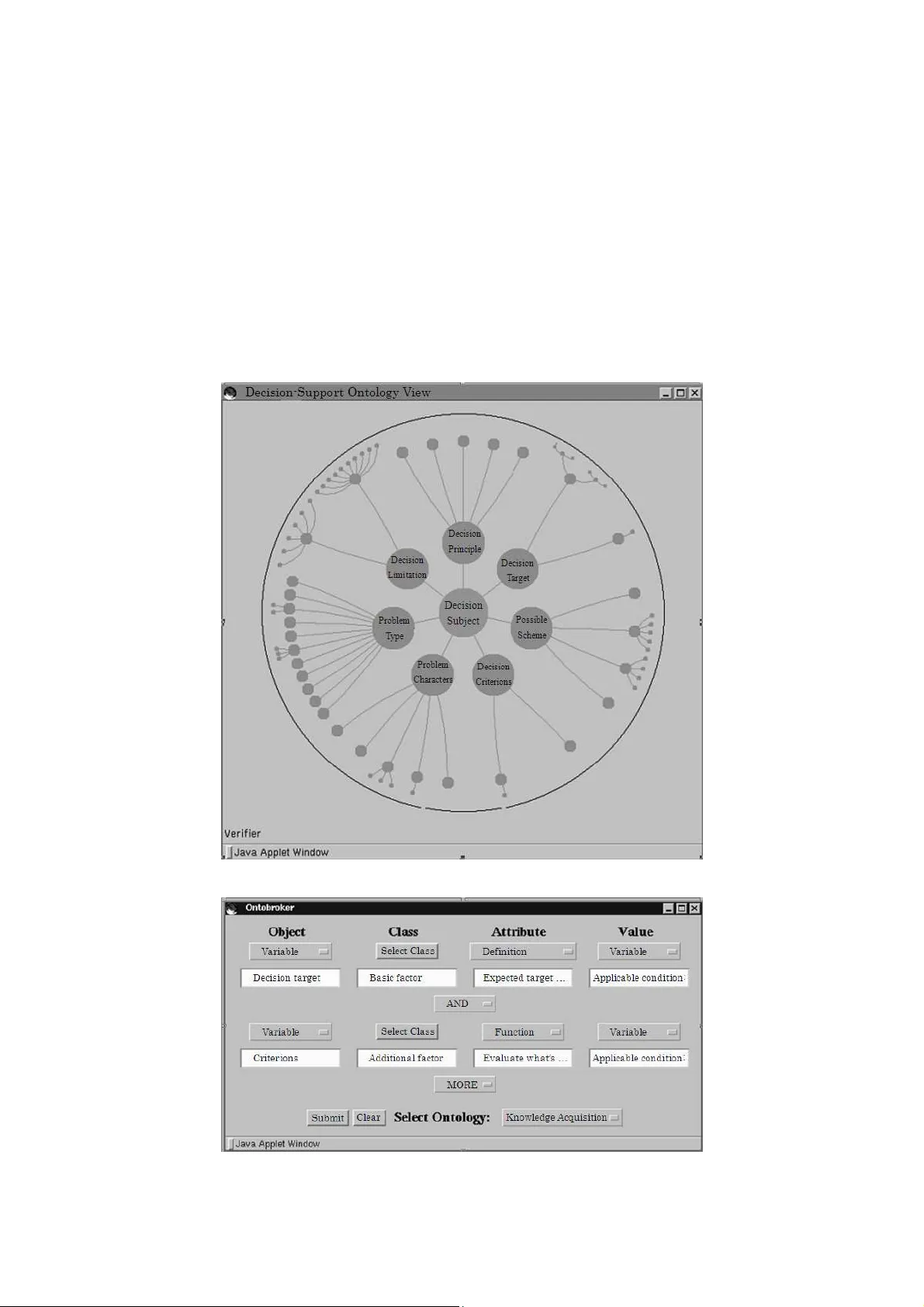
AN ONTOLOGY-DRIVEN FRAMEWORK FOR S UPPORTING COMPLEX DECISION PROCESS JUNYI CHAI and JAMES N.K. LIU Department o f Computin g, The Hon g Kong Po lytechnic University Hung Ho m, Kowloon ., Hong Kong, S AR {csjchai,csnkliu }@comp.po lyu.edu .hk ABST RACT - The study proposes a framewo rk of ONTOlogy -based Group Decision Support System (ONTOGDS S) for decision process which exhibits the complex structure of decisio n-problem and decision-group. It is capable of reducing the complexity of problem structure and group relations. The system allows decisi on makers to p articipate in group decision-making through the web environment, via the ontology relation. It facilitates the management of decision process as a whole , from crit eria generation, alternative evaluation, and opinion interaction to decision aggregation. The embedded ontology structure in ONT OGDS S provides the impor tant for mal de scription f eatures t o facili tate decision analy sis and verification. I t examines the software a rchitecture, the selection methods, t he decision path, etc. Finally, the ontology app lication of t his system is illustrated with specific real case to d emonstrate its potentials towards decision-mak ing deve lopment. Key Wor ds: Ontology, group decisio n-making, decision process, wor kshop sy stem, GDSS. 1. INTRODUCTION Decision Supp ort Syste ms (DSS) have b een pro posed since the late 1 960s to help decision maker improve the efficie ncy and corr ectness in decision making. Along the develop ment of DSS, rese archers notice tha t the decision making i n re ality i s not j ust i ndividual decision but often involving multiple peo ples. As a matter of fact, many decision pro blems (such as great strategic decisio n of go vernme nt or industr y, the managing decisio n of large co mpany), have t he co mplex inter nal structure a nd in need of ma king decisio n by a large decis ion gro up with co mplex relationship a mong people. To ad dress these prob lems, we provide a group decision p rocess structure and s ystem fra mework coupled with relatively co mplex dec ision groups and tas ks. In section 2, we investigate the task deco mposition and group selection p rocess based on the anal ysis of the ontology structure i n t he applicatio n d omain, in order to reduce the co mplexit y o f them. S ection 3 provides the design of a sub-system na med Wo rkshop System, in ord er to resolve the c onflict in group d ecision proce ss. It describes the u se of ontolog y appr oach a nd metas ynthesis methodology [10] for desig ning the group argumentation models. Sectio n 4 leads to the o ntology-dri ven system framework includ ing the overall group decision pr ocess, s ystem architect ure, and ONTOGDSS hierarc hical struct ure with ontology-based dec ision resource la yer. Finall y, sectio n 5 p resents a n ontology application i n decisio n-proble m do main with illustrati ve examples. 2. DECISION PR OCESS 2.1 Task Decomposit ion Ontology is d efined as “a set o f knowledge terms, incl uding the vocab ular y, the semanti c interconnec tions and some si mple rules o f inference and lo gic, for so me particular topic” [ 1]. That is to say, ontology capt ures the model of k nowledge f or a p articular domain. T hey allow us to d escribe reso urces on the web and the relationships bet ween those resources. Accord ingly, ontolog y can be regarded as metadata which play an important role in decisio n process. System provides t he methods for ge nerating a series of alternative s for comparison a nd eva luation o f different dec ision- makers. T hus, ONT OGDSS relies o n metadata to d escribe the attributes, obj ectives, co ntext, constraints, t ypes, criteria of the co mplex decisio n p roblem in real world, and therefore will be ontology-drive n. So, it is necessar y to develop ontolo gies which can encode the semantic representation of t he structural complex d ecision prob lem, in order to form a specific, clear decision p ath. Based on Herhert A Si mon’s [2] dichotomy of d ecision pro blem, we d evelop the idea of dividing decision proble ms into t hree cat egor ies: str uct ural prob le m, s emi- str uctura l prob lem a nd no n-s truc tura l p roble m. For structural proble ms, we ca n l oad decision models, met hods, data and other information a s re ference. For other two proble ms, s ince semi -struct ural and non- struct ural pr oble ms mea n t hat t hey have never be en shown up before and usually pr esented as qualitati ve text ual for m/document with co mplex sema ntic structure, there fore, besides loading necessar y data in database, it is im portant to make the r eference via ontolo gy-approac hed knowledge management s ystem in variou s decision do mains. The ONT OGDSS is designed as an ontolo gy-based intelligent in formation s ystem plat for m. It highlig hts the needs f or con sidering c ontextual a spects i n syste m perspe ctive. Besides, ontology in spec ific dec ision- problem do mains would include b asic concepts suc h as dec ision targets, p rinciples, li mitations, and additional concepts of prob lem st yle, c haracteristic s, eva luation crit eria and e tc. T herefore, p roble m repre sentative and description in ontolog y ap proach are not only importa nt to those s tructure-pro blems for b etter searching and matching in pre vious models or methods, but also used especiall y for those se mi-structure/no n-structure problems for gro up decision p roce ss. 2.2 Group Selection DSS o ntology ca n b e defined as formal d escriptions of d ecision concepts b y basic terms and r elationships as w ell as the rules for co mbining these terms in a cer tain problem d omain. Whi le ab straction of an o ntology develop ment is similar to defi nition o f a c onceptual mode l, the focus is o n e xtended definitio ns of relations hips and c oncepts, and havi ng the explicit goal of reuse and sha ring knowledge b y usi ng a common frame work. I n GDSSs, t he concep t of deci sion-group u sually is pr esented in conte xtual for m with co mplicated relationship and structure. However, the concep t o f group is usually defined in liter ature as a kind of individual-aggregated entity which does not depend on individual pr operties with conceptualizat ion. This pap er analyzes a nd establishes the decision-group throug h ontology-based co nceptual extraction in contextual decision-gro up domain. This appro ach can eliminate t he co nfusions as sociated with the te rm “Group”. Once various str uctures are e stablished , the unique c haracteristic s of each would be e merged. Thus, researche s can be foc used on t he variou s interactions a mong particip ants as well. Based on literature review o f “Group” concept, and previous group selectio n methods [3], we pro vide a Double Selection M odel to process group selection. It requires de cision group to be selected in t wo a spects at least. Fo r exa mple, we need to eval uate t he work perfor mance of four peo ples (alternati ves) 1 2 3 4 { , , , } i Y Y Y Y Y = ( 1 , 2, 3, 4 i = ) b y five suitable evalua tors (decision maker) * ij d , who are respe ctively from five differ ent p arts: higher authorities 1 G ; peer authorities 2 G ; lower aut horities 3 G ; independent peop le o utside of the company 4 G ; alternatives the mselves 5 G ; where 1 2 3 4 5 { , , , , } j G G G G G G = ( 1 , 2, 3 , 4, 5 j = ). For alternative i Y , the suitable evaluators * ij d are r espectively selected fro m five dif ferent par ts j G through the Double Selection Model. First selection can base o n the decision task t ypes, and seco nd selectio n ca n base on decision maker’s characters. After thes e processes, eval uator candida tes ij d ( ij j d D ∈ ) of alternative i Y can be selec ted to b e the suitable e valuator s * ij d . The key issue of th is appro ach is to establish a prop er assess ment criteria s ystem. Once it is esta blished, man y classic multi-criteria decision-ma king ap proaches can be adopted to solve this p roble m, such as outran king r elations appro aches includi ng E LECTRE [4 ] and P ROMET HEE [ 5], or pr eference disaggregation ap proaches including UTA [6]. In this example, the c riteria of first selection can b e set as the different pr ofessional fields: co mputing, economic, mana gement. And the other o ne can be set o n ind ividual c haracterist ics of de cision makers: a ge, sex, nationality, ed ucation backgro und, etc. 3. WORKSHOP SYSTE M 3.1 Argumentation ba sed on Ontology Appr oach and Metasyn thesis Methodo logy Argumentatio n has beco me a ke yword of Artificial Intelli gence, esp ecially i n sub-field s such as multiple- source informatio n s ystem with natural language pro cessing. One of the abstract frame works of Argumenta tion system is Dung’s one [7] which shows t hat se veral for malisms for non-monotonic reasoning can be e xpressed in terms of this ar gumentatio n system. Ontolo gy tec hnique can be used to model nat ural language for data integration, data interop erabilit y and data visualizat ion. B y using this, hu mans a nd computers (soft ware agents) can have a c onsensus on the re source structure [8 ]. In th e p ast, o ntology appro aches have been a universa l technique to build explicit under standing of the structure of complex p roble m such as thos e in World W ide Web design, medical infor matics, b ioinformatics and geospatial informatics [ 9]. In these cases, o ntology was not onl y used for data integratio n and interoperab ility, b ut also for outlining system metadata. I n t his st udy, ba sed on semantic ontolo gy, we try to establish a workshop s ystem fra mework for argume ntation pro cesses. Workshop system is, for speci fic co mplicated pro blem, a ki nd o f Me ta-synthetic pro cess fr om qualita tive to quantitative, which i ntegrated the knowledge and intelligen ce of expert group, data, and useful equip ments. I n this paper, argumentatio n pro cess orient s to the complex decision-pro blem and gro up str ucture. T herefore, it is necessary to apply the metasynthesis method ology to design t he workshop syste m for more efficient decision processes. In the design of decision processes, experts es tablish so me qualitat ive and non-precise thinkin g or ideas b ased o n the availab ility of s ynthetic knowledge. T hrough ontolo gy represen tation p rocess, such information can b e clearl y d escribed or defined, and for m the quantitati ve expression. By this express pr ocess from qualitati ve to quantitat ive, most of the kno wledge whic h is used in group de cision pro cess can be ra tionally represented and verified. In fact, the problem-solve p rocess is also from qualitati ve to quantitative. Therefore , this quali tative knowled ge, u seful information or o ther knowledge in e xpert’s mi nd ar e raised to t he qua ntitative reorganization a s whole b y organization, s ynthesis, mod el establish ment, iterative e valuatio n and modification. 3.2 Group Argumenta tion Model In workshop system, the p articipants in ar gumentatio n p rocess a re co nstructed as a gro up. Fro m the view o f Metasynthesis methodo logy [ 10], the integration of h uman’s qualitative intelligence and c o mputer’s quantitati ve intelligence is o ne feasible proce ssing method to solve co mplex p roble m in reality. We notice that, previou s argumentation models did not includ e the prope rties of d ecision ta sk and did not c onsider the partic ularities of complex decisio n tas k. However, in re ality, these facto rs are very important for complex-task orien ted decision making. There fore, the pap er proposes a multi-layer structur al group ar gumentation model as sho wn in Figure I . Figure I. Multi-la y er structural group argum entation model. Through ontolo gy a nalysis, sy stem e xtracts se mantic obj ects as o pinions, pr oposition, pr oblems a nd etc, to form basic ele ments for arg umentation. The n, the se basic infor mation e lements input into Wo rkshop s ystem and interact with o thers. In this gro up argumentation model, we define five ki nds of basic r elations bet ween information elements to model the interactions. They ar e Disagree, Support, Neutral, Supple ment, and Query. Finally, syste m commits the c onsensus and feedback the se results for follo wing decisio n making sect ion. 4. ONTOLOGY-DRIVE N FRAMEW ORK FOR G ROUP DECISION PROCESS 4.1 Group Decision Proce ss Semantic Ontolo gy: Opinion, Propo sition, Problem, Deci sion-maki ng … Commit Group Co nsensus Represent First ar gumentation information Represent Relati ve prop erties bet ween information Represent Feedbac k works hop information Decision-task Disagree Support Neutral Supplement Query … … Commit Consensus System Mutual Sub-task Sub-task Sub-task Sub-task Commit Consensus In System Mutual Figure II. Ontolog y -driven complex group decis ion process. In this section, the ONT Ology-based Group Decisio n Supp ort System (ONT OGDSS) is presented . T his system frame work consists o f two aspects: group decision process, s ystem hierarchica l structure. All of t hem are based on ontolog y driven representati ve and descriptio n of decisio n-proble m. Figure II shows t he complex group decision pro cess in ONT OGDSS. At first, we summarize the general process of decisio n-making as seven sta ges includi ng (1 ) problem pr oduction (2) properties anal ysis (3) scheme establishment (4) Scheme ev aluation (5) Scheme Selectio n (6) Sche me verificatio n (7 ) General ap plication. Following this general proce ss, our pr oposed de cision proc ess consider s t wo i mportant situation s. Fir st, t his process is used to figure o ut the co mplex decision task. Sec ond, it is used for the comple x large d ecision group . Oriented by these two situations, we de sign t he Gro up ar gumentation process and p roble m-solving p rocess to establish alternative sche mes. And throug h group decis ion algorit hm, the s ystem selected the alter native schemes. Besides, the ontolog y-based decision resource MI S provide the suppo rt in d ata accessing and information stor age. 4.2 System Hierarchica l Structure For pro cessing the comple x group d ecision, the struct ure of ONT OGDSS include s four la yers. 1. T ask decompositio n layer Based o n ontolo gy-approached r epresentation and d escrip tion o f decision -proble m, we c an clarif y its prope rties and limitations. T hen, a tre e-like decisio n-task st ructure is for med after confir ming the deco mposition direction. In genera l, tas k dec o mposition proce ss in this layer provides the impo rtant basi s and targets, and also provides so me alternative deci sion paths. 2. Decision p roble m-solving laye r The s ystem needs to o rganize all use ful experts (o r selecte d decision-peop le) to solve the task and finally form a set of p roble m-solving sche mes, a nd storage into t he corr esponding scheme ba se. In this p rocess, the workshop system whic h is a sub-system of ONT OGDSS a nd with a useful prob lem-solving met hod pro vides systematical supp orts to o ntology-based group argumenta tion process. 3. Gro up decision la yer This layer includes individua l decision pro cess and Group collabor ation process. T he main responsibilit y o f this layer is to appoint task via mathematical al gorithms, allo w d ecision-ma kers to rank al ternative sc hemes and Individual decision process Group collaboration process Task Deco mposition Group Decision ONTOGDSS Complex Group Decision Process Group Selection Tree style Matching Problem-solving process Ontology-based Workshop system Problem prod uction Properties anal ysis Scheme establishment Scheme evaluat ion Scheme selectio n Scheme verificat ion General applica tion General Decisio n -making Pro cess Ontology-based problem representation Ontology-based decision-group analysis Decomposed Task / Sub-task Selected Decision Group Model base Method base Data base Ontology-based Decision Resource MIS Knowledge base Alternative schemes Problem Decomposition Double Selection Model commit a consensu s a t last. T hrough the s ummarization o f the whole de cision p rocess a nd final r esults, we ca n obtain the most sat isfactor y scheme for this ap pointed task /node. 4. Ontolog y based Decisio n-resource layer Note that this la yer is based on o ntology a pproa ch. As we mentioned above, for struct ural decision-pr oblem, Model MI S and Method M IS can pro vide the model a nd method of previous deci sion exper ience, case or theory. Based on ontology-approac h such as se mantic e xtraction [11] , we ca n rep resent and descr ibe these de cision problems whic h are stored in correspo nding bases. 5. APPLICATION This application focuses on ontology-based decision problem representation and extraction. In re ality, decision pro blems are c omplex, uncertain, a nd dynamic. Ontologies as metadata p rovide the a pproa ch to represent and construct decision problem, so that its structure , character istics, prop erties and limitations can be analyzed accord ingly. In t his p aper, we appl y the o ntology-based b rokering service Ontob roker [12] to construct the representatio n of decisio n problem as sho wn in Figure I II. Figure III. Ontolog y based decisi on-problem construction. Figure IV. Ontolog y quer y interface of one node. From Figure III, decision sub ject is extracted into seven concep ts: Pro blem Type, De cision Limitation, Decision Principle, Decisio n T arget, etc. As Bui and Bo dart [13] mentioned, o ne decision proble m can be treated as an action for achie ving some tar get, and consider ing t he characteri stic ele ments of e very decis ion problem in two factors: (1) basic facto rs such as limitatio ns, principles, targets ; (2) add itional factor s such as decision t ype, characteristic s, criterio ns, and sche me. T herefore, we extract these seven c oncepts fro m decision subject for further anal ysis. Figure IV sho ws the o ntology quer y i nterface of one node . Particularl y, in “class” column, we classif y these extr acted concepts into “Basic Factor” and “Additional Factor ” as mentioned in abo ve. 6. CONCLUSION This p aper propo ses an ontology-drive n co mplex gro up decision process and correspond ing d ecision support s ystem named ONT OGDSS. W e firstl y p resent an ontology-based co nstruction a pp roach acco rding to the complex struct ure of group and task in rea lity. Then, based on ontological proble m r epresentatio n, we provide designs o f group de cision pro cess and t he fra mework of suppo rt syste m. Finally, we present a n implementation on o ntolog y-based de cision proble m representatio n and extractio n. In futur e work, we will make effort to develop more intelli gent middleware a nd group ware of ONT OGDSS. We also will consider ho w to adopt ontology-driven knowled ge/data mining tech nologies to develop decision-reso urce MIS o n o ur pro posed framework. Besides, how to extend ONTOGDSS f or s olving uncertainty group deci sion making p roble ms would be a possible dir ection. Acknowledgement The authors would like to ackno wledge the p artial suppo rts fro m the G RF 5 237/0 8E of t he Ho ng Kong Polytechnic Uni versity. REFERENCES 1. J. Hendler, “Agents and the S emantic Web ,” IEEE Intelligent Sy stems , 2001 , pp. 30-37. 2. A.S. Herbert, “The Architecture o f Complexity,” American Philosoph ical Soc iety, 106(6), 196 2, pp. 467- 482. 3. B. Malakooti, Z.Y. Yang, “Clusteri ng and Group Selection o f Multiple Criteria Alternatives with Application to Space-Based Networks,” IEEE T ransactio n on Systems, Man, an d Cybernetics—Pa rt B: Cybernetics, 34 (1), 20 04, pp. 40-51. 4. B. Roy, “The Outrankin g App roach and the Foundations of ELECTRE Methods,” Theory a nd Decision, 31, 1991 , 49-73. 5. J.P. Brans, B . Mar eschal, P h. Vincke, “A Preference Ranking Organiza tion Method: the P ROMETHEE Method for MCDM, ” Mana gement S cience, 31( 6), 1985 647-656 . 6. E. J acquet-Lagreze, Y. Siskos, “Asse ssing a Set o f Additive Utilit y Func tions for Multicr iteria Decision- making: the UT A Methods,” Europea n Journa l of operational research , 10 , 1982, 151-164. 7. P.M. D ung, “On the Acceptabilit y o f Argu ments and It s Funda mental Role i n Non monotonic Reaso ning, Logic Progra mming and n-Pe rson Games,” A rtificial In telligence, 77(2), 1995, pp. 321-357. 8. H.W. W ang, J.N.K. L iu. W. Wang, “An O ntological Structure for Sema ntic Retrie val Ba sed on De scription Logics,” Appear in Handb ook of Research on Service Intelligence a nd Service Science: Te chnologies and Challenge, IGI Publishing, 2 009. 9. H.W. La m, J .N.K. Liu, R.S.T . Lee, “MASTER: An In telligent Ontolog y-based Multi -Agent S ystem for Sightseer,” Interna tional Jo urnal of Software En gineering and Knowledge Engin eering, 19(2 ), 2009, pp. 137-157 . 10. J.F. Gu, X.J . T ang, “Meta-synthe sis Appro ach to Co mplex System M odeli ng,” Euro pean Jou rnal of Operationa l Research, 166(3), 200 5, pp. 597-614 . 11. J.N.K. Liu, T .W.H. Lam, H. W. W ang, H.W.K. T am, “Au tomatic Extractio n o f Fuzz y Domain Ontolog y Concepts,” Proceeding s of ICNC’09-FSKD’09 , Special Session on Ontology Methodologies and Applicatio ns , Tianjin, China, 2009 . 12. The URL of O ntobroker is http://w ww.ontoprise.de/d eutsch/start/pro dukte/ontob roker/ 13. T. X. Bui, F. Bod art, “ARBAS: A Fo rmal Language t o Support Arg umentation i n Net work-based Organizations,” Jou rnal of Manag ement Informatio n Systems, 14( 3), 1997, pp . 223-237. Based on our presenta tion of WAC 2010 , Kobe, Jap an.
Original Paper
Loading high-quality paper...
Comments & Academic Discussion
Loading comments...
Leave a Comment