Drawing cubic graphs with the four basic slopes
We show that every cubic graph can be drawn in the plane with straight-line edges using only the four basic slopes $\{0,\pi/4,\pi/2,3\pi/4\}$. We also prove that four slopes have this property if and only if we can draw $K_4$ with them.
Authors: ** Padmini Mukkamala (Rutgers University) Dömötör Pálvölgyi (Eötvös University, Budapest) **
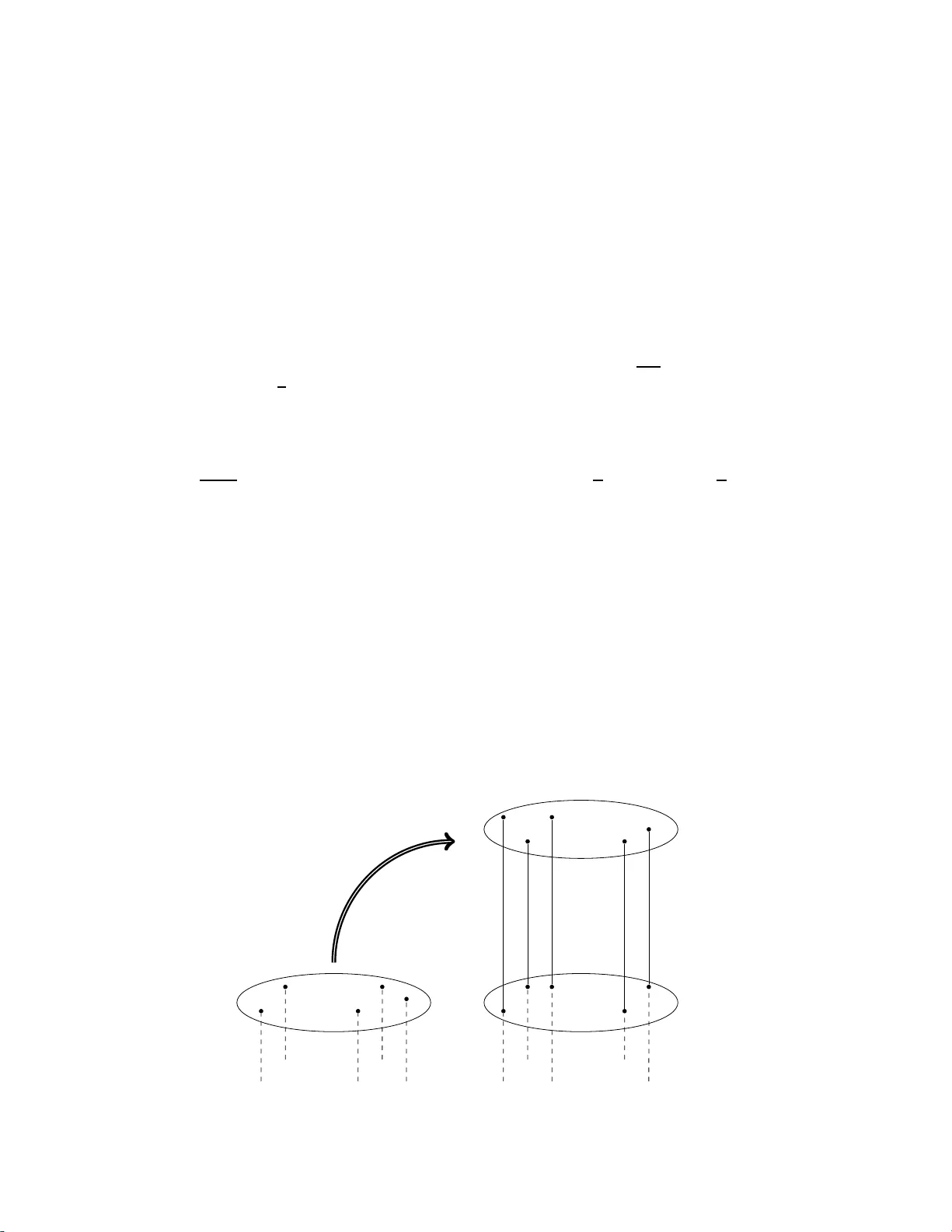
Dra wing cubic graphs w ith the four basic s l op es P admini Mukkamala and D ¨ om ¨ ot ¨ or P ´ al v ¨ olgyi ∗ Rutgers, the Sta te Univ ersit y of New Jersey E¨ otv¨ os Unive rsity , Budap est Abstract W e show th at ev ery cubic graph can be dra wn in the plane with straigh t- line edges using only the fo u r basic slopes { 0 , π / 4 , π / 2 , 3 π / 4 } . W e also pro ve th at four slop es hav e this prop erty if and only if we can draw K 4 with them. 1 In tro duc tion A dr awing of a graph is said to b e a str aight-line dr awing if the vertices of G are represented by distinct points in the plane a nd ev ery edge is represented by a straight-line s e gment connecting the co r resp onding pair of v ertices and no t passing through any other vertex of G . If it leads to no confusion, in no ta tion and terminology w e make no distinction b etw een a vertex and the corres p o nding p oint, and betw een an edge and the corresp onding segment. The slop e of an edge in a stra ight-line drawing is the slope of the co r resp onding segment. W ade and Chu [27] defined the slop e numb er , sl ( G ), of a graph G as the smalles t num b er s with the property tha t G has a straight-line drawing with edges of at most s distinct slop es. Obviously , if G has a vertex of de g ree d , then its s lo p e num b er is at lea st ⌈ d/ 2 ⌉ . Dujmo vi´ c et al. [12] asked if the slop e num b e r of a gra ph with b ounded ma ximum degree d could be arbitrar ily large. Pac h and P´ alv¨ olgyi [26] a nd Ba r´ a t, Matou ˇ sek, W o o d [7 ] (indep endently) show ed with a counting arg ument that the answ er is no for d ≥ 5. In [21], it was sho wn that cubic (3-r egular) graphs could be drawn with five slop es. The ma jor res ult from which this was concluded was that sub cubic graphs 1 can b e dr awn with the four basic slo pes , the slop es { 0 , π / 4 , π / 2 , 3 π / 4 } , corres po nding to the v ertica l, hor izontal and the t wo diago nal directio ns. This w a s impro ved in [24] t o show that connected cubic graphs can b e drawn wit h four slop es 2 while disconnected cubic gra phs required fiv e slopes. It was shown by Max Enge lstein [15] that 3-co nnected cubic graphs with a Hamiltonian c y cle can be drawn with the four basic slopes. W e improv e all these results b y the following Theorem 1.1 Every cubic gr aph has a str aight-line dr awing with only the four b asic s lop es. This is the first result ab out cubic graphs that uses a nice, fixed set of slopes instead of an unpredictable set, p ossibly co nt aining slo p es that are not ra tional multiples of π . Also, since K 4 ∗ The second author was supp orted b y the European Union and co-financed b y the Europ ean Social F und (gran t agreemen t no. T AMOP 4.2.1/B-09/1/KMR-2010-0003). Part of this wo rk w as done i n Lausanne and the authors gratefull y ackno wledge supp ort from the Bernoulli Center at EPFL and from the Swiss National Science F oundation, Grant No. 200021-125287/1. 1 A graph is sub cubic if it is a p r oper subgraph of a cubic graph, i.e. the de gree of ev ery vertex i s a t most three and it is not cubic (not 3-r egular). 2 But not the four basic s lopes. 1 (a) Petersen graph (b) K 3 , 3 Figure 1 : The Petersen gra ph and K 3 , 3 with the four basic slopes. requires at leas t 4 slo p e s, this settles the question o f deter mining the minim um num b er of slo pe s required for cubic graphs. In the last s e ction w e a lso pro ve Theorem 1.2 Cal l a set of slop es go o d if every cubic gr aph has a str aight-line dr awing with them. Then the fol lowing statements ar e e quivalent for a set S of four slop es. 1. S is go o d. 2. S is an affine image of the four b asic slop es. 3. We c an dr aw K 4 with S . The problem whether the slop e n umber of gra phs with max imum degree four is un b ounded or not remains an in teresting open problem. There are man y o ther related gra ph para meters. The thickness of a gr aph G is defined as the smallest n umber of planar subg raphs it ca n be dec omp o sed in to [25]. It is one of the several widely known g raph parameter s tha t measures how far G is fro m b e ing planar. The ge ometric thi ckness of G , defined as the smallest num b er of cr ossing-fr e e subgra phs of a straight- line drawing of G who s e union is G , is another simila r notion [1 9]. It follows directly from the definitions th a t the thickness of any g raph is at most as large a s its geometric thickness, which, in turn, cannot exceed its slop e num b er. F or man y in teresting r esults ab out these parameter s, consult [10, 14, 12, 13, 1 6, 17]. A v ar ia tion of the pro blem arises if (a) tw o vertices in a drawing have an edge b etw een them if and only if the s lop e b etw een them b elongs to a certain set S and, (b) collinea rity of points is allow ed. This vio lates the conditio n sta ted befor e that a n edge cannot pass thro ugh v ertices other than its end p oints. F or instance, K n can be drawn with one slope. The smallest n umber of slop es that can b e used to repres ent a gra ph in such a wa y is called the slop e p ar ameter of the graph. Under these set of conditions, [4] prov es that the slop e parameter of sub c ubic outer planar graphs is a t most 3. It was shown in [22] that the s lo pe par ameter of every cubic graph is a t most seven. If only the fo ur basic slop es ar e used, then the graphs drawn with the ab ov e conditions are called q ueens gr aphs and [3] characterizes certain g raphs as queens gr aphs. Graph theor etic prop erties of so me spe cific queens gr aphs ca n be found in [8]. Another v ar ia tion fo r pla nar graphs is to demand a plana r drawing. The planar slop e numb er of a plana r graph is t he smallest num ber of distinct slop es with the prop erty that the g raph has a straight-line drawing with non-cro ssing edg es us ing o nly these slop e s . Dujmovi´ c, Eppstein, Suderman, and W o o d [11] rais ed the question whether there exists a function f with the prop erty that the planar slope n umber o f every plana r graph with ma x im um de g ree d can be b ounded from a bove by f ( d ). Jelinek e t a l. [18] hav e shown that the a nswer is yes for outerplanar g raphs, that is, for planar gra phs that ca n be drawn so that all of their v ertices lie o n the outer face . Even tually the question was a nswered in [20] where it was prov ed that a ny bounded deg ree planar graph has a bounded planar slope n umber. 2 Finally we would mention a slig ht ly related problem. Didimo et al. [9] studied drawings of graphs wher e edges c a n only cr oss each o ther in a r ight angle. Suc h a dr awing is called an RA C (right angle cro ssing) drawing. They s how ed that every g r aph ha s an RAC drawing if every edge is a p olyg onal line with at most three be nds (i.e. it consists of at most four seg ment s). They also gav e up p er b ounds for the maxim um n umber of edges if le s s bends are allow ed. Later Arikushi et al. [6] showed that such gra phs ca n hav e a t most O ( n ) edges. Angelini e t al. [5] prov ed that every cubic graph admits an RA C drawing with at mos t one b end. It remained an open problem whether ev ery cubic gr aph has an RAC drawing w ith straight-line seg ment s. If b esides orthogo nal crossing s , we also allow tw o edges to cro s s at 4 5 ◦ , then it is a straig h tfor w a rd corolla ry of Theorem 1.1 that ev ery cubic g r aph admits such a drawing with straight-line segments. In section 2 we give the pro of of the Theo rem 1.1 while in section 3 w e prov e Theorem 1.2 and discuss o pe n problems. Figure 2: The Hea woo d graph drawn with the four basic slop es. 2 Pro of of Theorem 1.1 W e start with s ome definit io ns we will use throughout the section. 2.1 Definitions and Sub cubic Theorem Throughout the pap er log alwa ys deno tes lo g 2 , the lo g arithm in base 2. W e recall that the girth of a graph is the length of its shortest cycle. Definition 2.1 Define a sup er cycle as a c onne cte d gr aph wher e every de gr e e is at le ast two and not al l ar e two. N ote that a minimal su p er cycle wil l lo ok like a “ θ ” or like a “dumbb el l”. W e rec all that a cut is a par tition of the vertices into t wo sets. W e sa y that an edge is in the cut if its ends are in different subs ets o f the par tition. W e also call the edges in th e cut the cut-e dges . The size of a cut is the n umber of cut-edges in it. Definition 2.2 We say that a cut is an M -cut if the cut -e dges form a matching, i n other wo r ds, if their ends ar e p airwise differ ent vertic es. We also say t hat an M -cut is suitable if after deleting the cut-e dges, the gr aph has t wo c omp onent s , b oth of which ar e sup er cycles. F o r any tw o p oints p 1 = ( x 1 , y 1 ) and p 2 = ( x 2 , y 2 ), w e say that p 2 is to the N orth of p 1 if x 2 = x 1 and y 2 > y 1 . Analogous ly , w e say that p 2 is to the Northwest o f p 1 if x 2 + y 2 = x 1 + y 1 and y 2 > y 1 . W e will giv e the e x act statement of the theorem o f [21] ab out sub cubic graphs here a s it will be used in this pro of. 3 Theorem 2.3 ([21]) L et G b e a c onne cte d gr aph that is not a cycle and whose every vertex ha s de gr e e at most thr e e. Supp ose that G has at le ast one vertex of de gr e e at most two and denote by v 1 , . . . , v m the vertic es of de gr e e at most t wo ( m ≥ 1 ) . Then, for any se qu enc e x 1 , . . . , x m of r e al numb ers, line arly indep endent over t he r ationals, G has a s t r aight-line dr awing with the fol lowing pr op erties: (1) V ertex v i is mapp e d into a p oint with x -c o or dinate x ( v i ) = x i (1 ≤ i ≤ m ) (2) The slop e of every e dge is 0 , π / 2 , π / 4 , or − π / 4 (3) No vertex is to the North of any vertex of de gr e e two. (4) No vertex is to the North or to the N orthwest of any vertex of de gr e e one. It seems that the proof of the theorem ab out subc ubic g raphs in [21] w as slightly inco r rect. It used induction but during the pro o f the statemen t was also used for disco nnected graphs . This can be a problem, as when drawing tw o comp onents, it migh t happe n that a degre e three vertex of one c ompo nent has to b e a bove a degree tw o vertex of the other comp onent. How ever, the pro of ca n b e easily fix e d to hold f o r disconnected gr aphs a s well. F or this, one can make the statement strong er, by saying that a lso for every gr aph o ne can select a ny sequence x m +1 , . . . , x n of r eal num b ers that satisfy that x 1 , . . . , x m , x m +1 , . . . , x n are linea rly independent o ver the rationals, s uch that the x -co ordinates o f all the vertices are a linear combination with rationa l co efficients of x 1 , . . . , x n . This w ay we can ensure that diff er en t compo nen ts do not interfere. Note that Theorem 2.3 pr ov es the result o f Theor em 1.1 for subcubic gra phs. Another minor observ ation is that we may a ssume that the gra ph is connec ted. Since w e use the basic four slop es, if w e can draw the comp o nents of a disconnected g r aph, then we just place them far apart in the plane so that no tw o dr awings intersect. So we will a ssume fo r the r est of the section that the graph is cubic and connected. 2.2 Preliminaries The results in this subsection ar e a lso in teres ting indep endent of the current pro blem we deal with. Lemma 2.4 Every c onne cte d cubic gr aph on n vertic es c ontains a cycle of length at most 2 ⌈ log( n 3 + 1) ⌉ . v Figure 3: Finding a cycle in the BFS tree using that the left child o f v already occurr ed. Pro of. Start at an y v ertex of G and conduct a breadth first se a rch (BFS) of G until a vertex rep eats in the BFS tree. W e note here that by iteratio ns w e will (for the rest o f the subsection) mean the num b er of levels of the BFS tree. Since G is cubic, after k iterations, the num b er of vertices v isited will be 1 + 3 + 6 + 12 + . . . + 3 · 2 k − 2 = 1 + 3(2 k − 1 − 1 ). And since G has n 4 vertices, some vertex must repeat after k = ⌈ log ( n 3 + 1) ⌉ + 1 iteratio ns . T r a cing bac k along th e t wo paths obtained for the v ertex that reoccurs , we find a cycle of length at most 2 ⌈ lo g( n 3 + 1) ⌉ . Lemma 2.5 Every c onne cte d cubic gr aph on n vertic es with girth g c ontains a sup er cycle with at most 2 ⌈ log ( n − 1 g ) ⌉ + g − 1 vertic es. Pro of. Contract the vertices of a length g cycle, obtaining a multigraph G ′ with n − g + 1 vertices, that is almost 3-regular, except for o ne vertex o f deg ree g , from which we start a BFS. It is easy to see that the num b e r of vertices visited after k iterations is at most 1 + g + 2 g + 4 g + . . . + g · 2 k − 2 = g (2 k − 1 − 1) + 1. And since G ′ has n − g + 1 vertices, some v er tex must repeat after k = ⌈ log( n − g +1 g + 1) ⌉ + 1 = ⌈ lo g( n +1 g ) ⌉ + 1 iter ations. T racing ba ck along the tw o pa ths obtained for the vertex that reo ccurs, w e find a cycle (or tw o vertices connected by t wo edges) of length at most 2 ⌈ lo g( n − 1 g ) ⌉ in G ′ . This implies that in G we ha ve a sup e rcycle with at most 2 ⌈ log( n − 1 g ) ⌉ + g − 1 v ertices. Lemma 2.6 Every c onne cte d cubic gra ph on n > 2 s − 2 vertic es with a s u p er cycle with s vertic es c ont ains a suitable M -cut of size at most s − 2 . Pro of. The sup ercycle with s vertices, A , has at least t wo vertices of degree 3. The size o f the ( A, G − A ) cut is th us at most s − 2. This cut ne e d not b e an M -cut because the edges may hav e a common neig hbor in G − A . T o r epair this, w e will no w add, iteratively , the common neighbors o f edges in the cut t o A , until no edges ha ve a common neig h b or in G − A . Note that in an y iteration, if a v ertex, v , adjacen t to exactly tw o cut-edges was c hosen, then the size of A increases by 1 and the s iz e o f the cut decreases by 1 (since, these t wo cut-edges will get added to A along wit h v , but since the graph is cubic, the third edge from v will b ecome a par t o f the cut-edges). If a v ertex adjacen t to three cut-edges was chosen, then the s ize o f A increases b y 1 while the num b er of cut-edges decreases by 3. F rom this we can see that the ma ximu m n umber of vertices that could have been added to A during this pr o cess is s − 3. Now there are three conditions to check. The first condition is that this pro cess returns a non-empt y second comp onent. This would o ccur if ( n − s ) − ( s − 3 ) > 0 or, n > 2 s − 3 . The second condition is that the seco nd comp onent should not b e a collection of disjoint cycles. F or this we note that it is enough to check that at ev ery stage, the num b er of cut-e dges is strictly sma ller than the num b er of vertices in G − A . But since in the ab ov e iterations, the nu mber o f cut-edges decreases b y a num be r gr eater than or equal to the decrease in the size of G − A , it is enough to chec k that b efore the iterations, the num b er o f cut-edges is strictly smaller than the num b er of v ertices in G − A . This is the condition n − s > s − 2 or, n > 2 s − 2 . Note t hat if this ine q uality holds then the non-emptiness condition will als o hold. Finally , w e need to check that both comp onents ar e connected. A is connected but G − A need not b e. But this last step is the ea s iest. W e pick a comp onent in G − A that has mor e 5 vertices than the num be r of cut-edges adjacent to it. Since the num b er of cut-edg e s is strictly smaller t ha n n umber of vertices in G − A , there m us t b e one such comp onent, say B , in G − A . W e add every other comp onent o f G − A to A . Note that the size o f the cut only decre a ses with this step. Since B is connected a nd has more vertices than the n umber of cut-edges, B c a nnot be a cycle. Corollary 2.7 Every c onne cte d cubic gr aph on n ≥ 18 vertic es c ontains a su itable M -cut. Pro of. Using the first tw o lemma s , we hav e a sup ercycle with s ≤ 2 ⌈ log ( n +1 g ) ⌉ + g − 1 vertices where 3 ≤ g ≤ 2 ⌈ log( n 3 + 1) ⌉ . Then using the la st lemma, we hav e a n M -cut with b oth par titions being a sup ercycle if n > 2 s − 2. So a ll we need to chec k is tha t n is indeed big enough. Note that s ≤ 2 log( n + 1 g )+ g + 1 = 2 log( n +1 )+ g − 2 log g ≤ 2 log( n + 1)+ 2 log( n 3 +1) − 2 log(2 log( n 3 +1)) +1 where the last inequality follows fr o m the fact tha t x − 2 log e x is increasing for x ≥ 2 / lo g 2 ≈ 2 . 88. So we can bound the righ t hand s ide from abov e b y 4 log( n + 1) + 1. Now we need that n > 2(4 log( n + 1) + 1) − 2 = 8 log( n + 1 ) which holds if n ≥ 44. The s ta temen t can be chec ked for 18 ≤ n ≤ 42 with a co de that can b e found in the App endix. It outputs for a given v a lue of n , the g fo r whic h 2 s − 2 is maximum and this maximum v alue. Based on the output w e can s ee tha t for n ≥ 18 , this v alue is sma lle r. 2.3 Pro of Lemma 2.8 L et G b e a c onne cte d cubic gr aph with a suitable M -cut. Then, G c an b e dr awn with the four b asic s lop es. x 1 x 2 x 3 x m − 1 x m − x m − x m − 1 − x 3 − x 2 − x 1 Rotated and tra nslated Figure 4 : The x -co o rdinates of the degree 2 vertices is s uitably chosen and one co mpo nen t is rotated and trans lated t o make the M -cut v ertical. 6 Pro of. The pro of follows rather straightforwardly from 2.3. Note that the tw o comp onents a re sub c ubic graphs and we can c ho ose the x -co ordinates of the v ertices of the M -cut (since they are the vertices with degree t wo in the comp onents). If we pic ked co o rdinates x 1 , x 2 , . . . , x m in one comp onent, then for the neig hbors of these v ertices in the other comp onent w e pick the x -co ordinates − x 1 , − x 2 , . . . , − x m . W e now rotate the seco nd comp onent by π and place it very high above the other compone nt so that the drawings of the components do no t intersect a nd align them so that the edg e s of the M -cut will b e vertical (slop e π/ 2). Also , s ince Theorem 2.3 guarantees that degree t wo vertices hav e no other vertices on the vertical line ab ov e them, hence the dra wing w e obtain abov e is a v alid representation of G with the basic s lop es. F r om combinin g Lemma 2.7 a nd Lemma 2.8, w e can see that Theorem 1.1 is true for a ll cubic g raphs w ith n ≥ 18. F or smaller gr aphs, w e give below some lemmas which help reduce the n umber of graphs we hav e to chec k. The lemmas b elow als o o ccur in differen t pap ers a nd we give refere nc e s where required. Lemma 2.9 A c onne cte d cubic gr aph with a cut vertex c an b e dr awn with the four b asic slop es. Pro of. W e observe that if the cubic graph ha s a cut vertex then it m ust also hav e a bridge. This bridge would b e the s uitable M -cut for using the previous Lemma 2.8, since neither of the comp onents can be disconnected or cycles . Lemma 2.10 A c onne cte d cubic gr aph with a t wo vertex disc onne cting set c an b e dr awn with the four b asic slop es. Pro of. If a cubic gr aph ha s a tw o vertex disconnecting set, then it m ust hav e a cut of siz e t wo with no n-adjacent edge s. Again the tw o comp onents we obtain must b e connected (or the gra ph has a bridg e) and cannot b e cycle s . Thus w e can apply Lemma 2.8 again to get the required drawing. The fo llowing theorem w as pro ved by Max Engelstein [15]. Lemma 2.11 Every 3 -c onne cte d cubic gr aph with a Hamiltonian cycle c an b e dr awn in the plane with the four b asic s lop es. Note t hat combining the last three lemma s , we e ven get Corollary 2.12 Every c u bic gr aph with a Hamiltonian cycle c an b e dr awn in the pl ane with the four b asic slop es. The g raphs whic h no w need to be chec ked satisfy the follo wing conditions: 1. the n umber of vertices is at most 16 2. the graph is 3-connected 3. the graph does not have a Hamiltonian cycle. Note that if the n umber of vertices is at most 16, then it follows from Lemma 2.4 that the girth is at mo st 6. Luckily there are several lists a v ailable o f cubic graphs with a given num b er of v ertices , n a nd a given girth, g . If g = 6, then there a re only t wo g raphs with a t most 1 6 vertices (see [1, 23]), bo th containing a Hamiltonian cy cle. If g = 5 and n = 16, then Lemma 2.5 gives a s uper cycle with at most 8 vertices, so using Lemma 2.6 we ar e d o ne. 7 Figure 5: The Tietze’s graph drawn with the four basic slop es. If g = 5 and n = 14, then there a r e o nly nine gr aphs (see [1, 2 3]), a ll containing a Hamiltonian cycle. If g ≤ 4 and n = 16, then Lemma 2.5 gives a s uper cycle with at most 8 vertices, so using Lemma 2.6 we ar e d o ne. If g ≤ 4 and n = 14, then Lemma 2.5 gives a s uper cycle with at most 7 vertices, so using Lemma 2.6 we ar e d o ne. Finally , a ll gra phs with at most 12 vertices are either not 3-connected or con tain a Hamilto- nian cycle, except f or the Petersen graph a nd Tietze’s Graph (see [2]). F or the drawing of these t wo graphs, see the r esp ective Figures. 3 Whic h four slop es? and other concluding questions After es ta blishing Theorem 1.1 the questio n a r ises whether we could ha ve used a ny other four slop es. Call a set of slopes go o d if ev er y cubic graph has a straight-line dra wing with them. In this section we prov e Theor em 1.2 that claims that the following s tatement s a re equiv alent for a set S o f four slop es. 1. S is goo d. 2. S is an affine image of the four basic slopes. 3. W e can dr aw K 4 with S . Pro of. Since affine transformatio n keeps incidences, any set that is the affine image of the four basic slopes is goo d. On the other hand, if a set S = { s 1 , s 2 , s 3 , s 4 } is go o d, then K 4 has a straig ht -line dr awing with S . Since we do not a llow a vertex to b e in the in terior o f a n edge, the four vertices must b e in gener a l po sition. This implies that tw o incident edges cannot have the s ame slop e. Therefore there are t wo slop es, without loss of genera lit y s 1 and s 2 , such that we hav e t wo-tw o edges of each slop e. These four edges m ust for m a cycle of length four, which means that the vertices are the v ertices of a parallelog ram. But in this case there is a n affine tr ansformatio n that takes the parallelog ram to a sq ua re. This transformation also takes S into the four basic slop es. Note that a simila r re a soning shows that no matter how many slop es w e take, their set need not b e go o d, b ecause we cannot even draw K 4 with them unles s they s atisfy some corr elation. As in the pr o ofs it is used only a few times that our slop es are the four bas ic slop es (for ro tation inv a riance and to start induction), we mak e the following conjectur e . 8 Conjecture 3.1 Ther e is a (not ne c essarily c onn e cte d, finite) gr aph such that a set of slop es is go o d if and only if t his gr aph has a str aight-line dr awing with them. This finite graph would b e the disjoint union of K 4 , maybe the Petersen graph and other small graphs. W e could not ev en rule out the p os sibilit y that K 4 (or ma yb e a nother, co nnected graph) is alone sufficie nt. Note tha t we can define a pa rtial or der on the graphs this wa y . Let G < H if any set of slop es that ca n b e used to draw H ca n also b e used to draw G . This way of course G ⊂ H ⇒ G < H but what e ls e c an w e sa y about this poset? Is it p ossible to use this new method to pr ov e that the slop e parameter of c ubic g raphs is also four? The main question rema ins to prov e or disprov e whether the slop e n umber of gr aphs with maximum degree four is unbounded. References [1] htt p:// www.mathe2.uni-bayreuth.de/markus/ reggr aphs.h tml . [2] htt p:// en.wikip edia.org / wiki/T able of simple cubic graphs. [3] G. Am brus a nd J´ anos Bar´ at. A con tribution to queens graphs: A substitution metho d. Discr ete Mathematics , 306(12):11 0 5–11 1 4, 20 06. [4] G. Ambrus, J´ ano s Bar´ a t, a nd P . Ha jnal. The slo pe parameter of gr aphs. A cta Sci. Math. (Sze ge d) , 72 :875–8 89, 2006. [5] Patrizio Angelini, Luca Cittadini, Giuseppe Di Ba ttista, W alter Didimo, F abriz io F rati, Michael Kaufmann, and An tonios Symv o nis . On the p ersp ectives ope ne d b y rig h t angle crossing dra wing s. In 1 7th Symp os. Gr aph Dr awing (GD’09) , v olume 5849 of LNCS , pages 21–32 , 2010. [6] Karin Arikushi, Rados lav F ulek, Bal´ azs Keszegh, F ilip Moric, and Csaba D. T´ oth. Graphs that a dmit right ang le cr ossing drawings. In Dimitrios M. Thilikos, editor, WG , volume 6410 o f L e ctur e Notes in Computer S cienc e , pages 135–14 6, 2 010. [7] J´ a nos Bar´ a t, Jir ´ ı Matousek, and David R. W o o d. Bounded-degr e e gra phs ha ve arbitrarily large geometric thickness. Ele ctr. J. Comb. , 13(1), 2006. [8] J. B e ll and B. Stevens. A survey o f k nown r esults a nd r esearch areas for n -queens. Discr ete Mathematics , 309:1–31, 200 9. [9] W a lter D idimo, Peter E ades, a nd Giusepp e Liotta. Drawing graphs with righ t a ng le cross- ings. In Pr o c. 11th W ADS , volume 5664 of LNCS , pages 20 6–217 . Spring e r, 2009. [10] Michael B. Dillencour t, David Eppstein, and D a niel S. Hirsch ber g. Geometric thic kness of complete graphs. J. Gr aph Algo rithms Appl. , 4(3):5–17, 20 00. [11] Vida Dujmo vic, David Epps tein, Matthew Suderma n, and Da vid R. W o o d. Drawings of planar graphs with few slopes and segmen ts. Comput. Ge om. , 38(3):19 4–212 , 2007 . [12] Vida Duj movic, Matthew Suderman, and David R. W o o d. Really stra ight g raph dr awings. In J´ anos Pac h, editor, Gr aph Dr awing , volume 33 83 of L e ctur e Notes i n Computer Scienc e , pages 122–132. Springer, 2004. [13] Vida Dujmovic a nd David R. W o o d. Graph treewidth and geo metric thickness parameter s. Discr ete & Computational Ge ometry , 37(4):641– 670, 2007 . 9 [14] Christian A. D unca n, David Eppstein, and Stephen G. Ko bo urov. The g eometric thickness of low degree graphs. In Jack Sno eyink and Jea n-Daniel Boissonna t, editors, Symp osium on Computational Ge ometry , pages 3 40–34 6. ACM, 200 4. [15] M. E ng elstein. Drawing gr aphs with few slo p es. Intel Comp etition for hi gh scho ol stu dents , 2005. [16] David Eppstein. Sepa rating thickness from geometric thickness. In Stephen G. Kob ourov and Michael T. Goo dr ich, edit o r s, Gr aph Dr awing , volume 2528 of L e ctur e Notes in Com- puter Scienc e , pages 1 5 0–16 1 . Spring er, 2002. [17] Joa n P . Hutc hinso n, Thomas C. Shermer , and Andrew Vince. On repr esentations of some thic knes s-tw o g raphs. Comput. Ge om. , 13(3):161– 171, 1999 . [18] V ´ ıt Jel ´ ınek, Ev a Jel ´ ınko v´ a, Jan Kra to ch v ´ ıl, Bernard Lidic k ´ y, Marek T esa r, and T om´ as Vyskocil. The planar slop e n umber of plana r partial 3-trees of bounded degree. In Da vid Eppstein and Emden R. Gansner, editors , Gr aph Dr awing , volume 584 9 of L e ctur e Not es in Computer Scienc e , pages 304 –315 . Spr inger, 2 009. [19] P . C. Kainen. Thickness and coars e ne s s of graphs. Abh. Math. Sem. Un iv. Hambur g , 39 :88– 95, 1 973. [20] Bal´ azs Kesze g h, J ´ anos Pac h, and D¨ om¨ ot¨ or P´ alv¨ olgy i. Drawing planar graphs of b ounded degree with few s lop es. In Ulrik B randes and Sabine Co rnelsen, editor s, Gr aph Dr awing , volume 6502 of L e ctur e Notes in Computer Scienc e , pages 293–304 . Spring er, 2010. [21] Bal´ azs Keszegh, J´ anos Pac h, D¨ om¨ ot¨ or P´ alv¨ o lg yi, a nd G´ eza T´ oth. Drawing cubic graphs with at most five slop es. Comput. Ge om. , 40(2):138 –147, 200 8. [22] Bal´ azs Keszegh, J´ anos Pac h, D¨ om¨ ot¨ or P´ a lv¨ olg yi, and G´ eza T´ oth. Cubic gra phs hav e bo unded slope parameter. J. Gr aph Algorithms Appl. , 14(1):5–17, 2 0 10. [23] Markus Meringer . F ast generatio n o f re g ular g raphs and construction of cage s . J. Gr aph The ory , 30:13 7–146 , F ebruary 1999. [24] Padmini Mukk a mala and Mario Szegedy . Geometric representation of cubic g raphs with four directions. Comput. Ge om. , 42(9):842–8 51, 2009. [25] Petra Mutzel, Thoma s Odenthal, and Mark Scharbro dt. The thickness o f gr aphs: A survey . Gr aphs Combin , 14:59–73, 1 998. [26] J´ anos Pac h a nd D¨ om¨ ot¨ or P´ alv¨ olg yi. Bounded-de g ree gr aphs can hav e arbitrar ily la rge slop e nu mber s . Ele ct r. J. Comb. , 13(1), 2006. [27] Greg A. W a de and Jiang- Hsing Chu. Draw a bilit y o f c omplete graphs using a minimal slop e set. Comput. J . , 37(2):139–14 2, 199 4. A Program c o de The follo wing code is in Maple. #For acces sing log, ceil funct ions. with(M TM); #fmax is a procedu re that comput es the girth for which a graph on N #verti ces will have the larges t super cyle. 10 #Here, mg denot es the maxim um possible girth , max and g will have the #value s of the maxim um size of the super cycle and the girth at which #it occurs respect ively . The proc edure returns 2s-2, if this value is #less than N, we can apply Lemma 2.6 and 2.8 to draw the graphs on N #verti ces. fmax := proc (N) local g, mg, max, i, exp; #Initi aliza tions max := -1; g := 0; mg := 2*ce il(eva lf(log2((1/3)*N+1))); if mg < 3 then RETUR N([N, 2*max- 2, mg, g]) fi; #Main sear ch cycle. for i from 3 while i <= mg do exp := 2*ceil (eval f(log2((N+1)/i)))+i-1; if max < exp then max := exp; g := i fi end do; RETURN ([N, 2*max-2 , mg, g]) end proc; seq(fm ax(i) , i = 6 .. 42, 2); [6,10, 4,3], [8,12, 4,4], [10,14 ,6,5], [12,1 6,6,6] , [14,1 6,6,6] , [16,16 ,6,4] , [18 ,16,6, 4], [20 ,18,6, 5], [22,20,8 ,8], [2 4,20,8 ,6], [26,20 ,8,6] , [28 ,22,8, 7], [30 ,22,8, 7], [32,24,8 ,8], [3 4,24,8 ,8], [36,24 ,8,8] , [38 ,24,8, 8], [40 ,24,8, 8], [42,24,8 ,8] 11
Original Paper
Loading high-quality paper...
Comments & Academic Discussion
Loading comments...
Leave a Comment