Multistage Hypothesis Tests for the Mean of a Normal Distribution
In this paper, we have developed new multistage tests which guarantee prescribed level of power and are more efficient than previous tests in terms of average sampling number and the number of sampling operations. Without truncation, the maximum samp…
Authors: Xinjia Chen
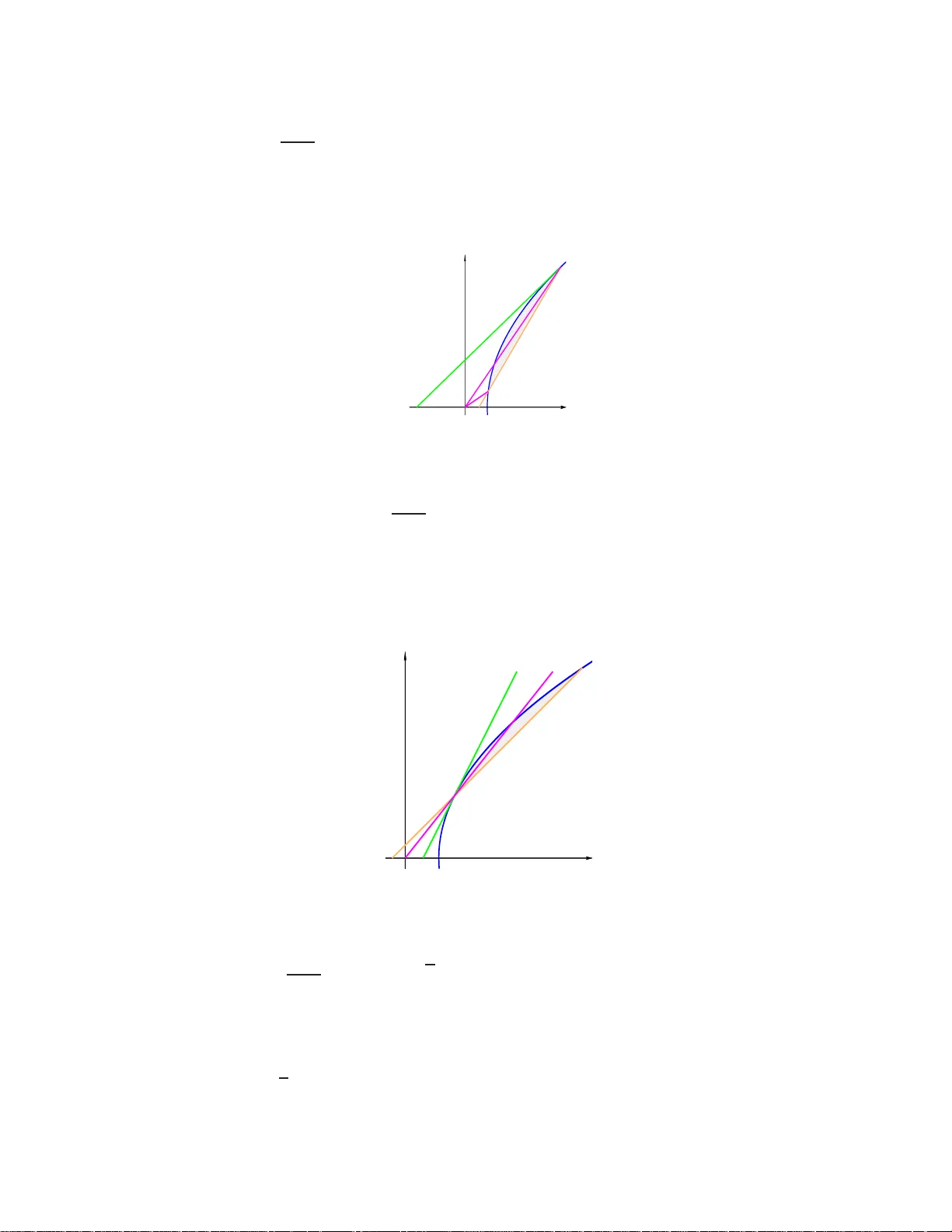
Multistage Hyp othesi s T ests for the Mean o f a Normal Dis tribution ∗ Xinjia Chen Octob er 2008 Abstract In this pap er, we ha ve developed new multistage tests which g uaran tee pr escribed level of power and are more efficient than prev io us tests in ter ms of a verage sampling n umber and the num b er of sampling op erations. Without trunca tion, the maximum sampling nu mbers of our testing pla ns ar e absolutely b ounded. Based on geometrical arguments, w e have derived extremely tigh t bo unds for the operating characteristic function. T o reduce the computatio na l complexity for the relev an t integrals, we prop ose adaptive scanning algorithms which are no t only useful for present hypothesis testing problem but also for o ther pro blem area s. 1 In tro duction Consider a Gaussian random v ariable X with mean µ and v ariance σ 2 . In many applications, it is an imp ortan t problem to d e termine wh e ther the mean µ is less or greater than a pr e scrib ed v alue γ based on i.i.d. rand om samples X 1 , X 2 , · · · of X . Su c h problem can b e put in to the setting of testing hyp othesis H 0 : µ ≤ µ 0 v ersus H 1 : µ > µ 1 with µ 0 = γ − εσ and µ 1 = γ + εσ , where ε is a p ositiv e num b er sp ecifying th e wid th of the indifference zone ( µ 0 , µ 1 ). It is usually required that the size of the Type I error is no greater than α ∈ (0 , 1) and the size of the Typ e I I err o r is no greater than β ∈ (0 , 1). That is, Pr { Reject H 0 | µ } ≤ α, ∀ µ ∈ ( −∞ , µ 0 ] (1) Pr { Accept H 0 | µ } ≤ β , ∀ µ ∈ [ µ 1 , ∞ ) . (2) The h yp othesis testing pr o blem describ ed ab o v e has b een extensiv ely s tu died in th e framewo rk of sequen tial probabilit y r a tio test (SPR T), which was established by W al d [4] during the p erio d of second world w ar of last cen tury . The SPR T suffers fr o m several drawbac ks. First, th e sampling ∗ The author had b een previously working with Louisiana State U niv ersit y at Baton Rouge, LA 70803 , USA, and is n o w with Department of Electrical Engineering, Southern Un i versit y and A &M College, Baton Rouge, LA 70813, U SA; Email: c henxinjia@gmail.com 1 n umb e r of S PR T is a random num b er which is n o t b ounded. Ho wev er, to b e useful, the maxim um sampling n umb e r of an y testing plan should b e b ounded by a deterministic n um b er. Although this can be fixed b y forced termination (see, e.g., [3] and the references therein), the prescrib ed lev el of p o w er ma y not b e ensured as a result of tr uncati on. Second, the num b er of sampling op eratio ns of SPR T is as large as the n umber of samples. In practice, it is us uall y muc h more economical to tak e a batc h of samples at a time instead o f one b y one. Thir d , the efficie ncy of SPR T is optimal only for the endp oin ts of the indifference zone. F or other parametric v alues, the SPR T can b e extremely inefficien t. Needless to sa y , a truncated version of SPR T ma y suffer fr o m the same problem due to the partial use of the b oundary of SPR T. Third, wh e n the v ariance σ 2 is not av ailable, a w eigh ting function needs to b e constructed so that the testing pr o blem can b e fit in to th e framew ork of SPR T. The construction of s u c h w eigh ting fun c tion is a d i fficult task and sev erely limit the efficiency of the resultan t test plan. In this pap er, to ov ercome the limitations of existing tests for the mean of a normal distribu - tion, w e ha ve established a new class testing plans ha ving the follo wing feat ur e s: i) Th e testing has a fin it e n umb e r of s tages an d thus the cost of sampling op erat ions is reduced as compared to SPR T. ii) The sampling n umber is absolutely b ounded without truncation. iii) T he pr escrib ed lev el of p o w er is rigorously guaran teed. iv) The testing is not only efficient for th e end points of indifference zone, but also efficien t for other parametric v alues. v) Ev en the v ariance σ 2 is unknown, our test plans do not require any w eigh ting function. In general, our testing plans consist of s stages. F or ℓ = 1 , · · · , s , the sample size of the ℓ -th stage is n ℓ . F or the ℓ -th stage , a decision v ariable D ℓ is defined b y using samples X 1 , · · · , X n ℓ suc h that D ℓ assumes only three p ossible v alues 0 , 1 and 2 with the f o llo wing notion: (i) Samplin g is contin ued until D ℓ 6 = 0 for s o me ℓ ∈ { 1 , · · · , s } . Since th e sampling m ust b e terminated at or b efore the s - th stage, it is required th a t D s 6 = 0. F or simplicit y of notations, w e also define D 0 = 0. (ii) Th e null hyp othesis H 0 is accepted at the ℓ -th stage if D ℓ = 1 and D i = 0 f or 1 ≤ i < ℓ . (iii) Th e null h yp othesis H 0 is rejected at the ℓ -th stage if D ℓ = 2 and D i = 0 f or 1 ≤ i < ℓ . As will b e seen in the our sp ecific te sting plans, the sample sizes n 1 < n 2 < · · · , n s and decision v aria bles D 1 , · · · , D s dep end on the paramet ers α, β , µ 0 , µ 1 and other parameters s uc h as th e risk tuning p ar ameter ζ and the samp le size incr emental factor ρ . The requiremen ts of p o wer can b e satisfied by determinin g an app ropriate v alue of ζ via b isec tion searc h. F or this p u rp o se, w e ha v e derived, by a geometrica l approac h, readily computable b ounds for the ev aluation of th e op erating c haracteristic (OC ) function. The remaind e r of th e pap er is organized as follo ws. I n Section 2, we presen t our app roac h for testing the mean of a normal d istribution in the con text of kno wing the v ariance σ 2 . In Section 3, w e describ e our metho d for for testing the mean of a normal distribution for situations that the v aria nce σ 2 is n o t a v ailable. Section 4 discusses the ev aluati on of OC functions. In Sectio n, we prop ose adaptive scanning algorithms for inte gration, summation, zero findin g and optimization. These new metho ds are u seful for our curr en t p roblem and other problem areas. S ec tion 6 is the 2 conclusion. All p r oofs of theorems are giv en in App endices. Throughout this pap er, we shall u se the follo wing notations. The ceiling f unction is denoted b y ⌈ . ⌉ (i.e ., ⌈ x ⌉ represents th e smallest intege r no less than x ). The gamma fu ncti on is denoted b y Γ( . ). Th e inv erse cosine function taking v alues o n [0 , π ] is den o ted by arccos( . ). The inv erse tangen t function taking v alues on − π 2 , π 2 is denoted b y arctan( . ). W e use the notation Pr { . | θ } to indicate that the asso ciate d rand om samples X 1 , X 2 , · · · are parameterized by θ . The parameter θ in Pr { . | θ } ma y b e dropp ed w h enev er this ca n b e d o ne without introdu c ing confusion. Th e other notations w ill b e made clear as we pro ceed. 2 T esting the Mean of a Normal Distribution with Kno wn V ari- ance F or δ ∈ (0 , 1), let Z δ > 0 b e the critical v alue of a n o rmal distribu ti on with zero mea n and u nit v aria nce, i.e., Φ( Z δ ) = 1 √ 2 π R ∞ Z δ e − x 2 2 dx = δ . In situations that the v ariance σ 2 is kno wn, our testing plan, dev elop ed in [2], is d e scrib ed as follo ws. Theorem 1 L et ζ > 0 and ρ > 0 . L et n 1 < n 2 < · · · < n s b e the asc ending ar r angement of al l distinct elements of nl ( Z ζ α + Z ζ β ) 2 4 ε 2 (1 + ρ ) i − τ m : i = 1 , · · · , τ o , wher e τ is a p ositive inte ge r. D efine a ℓ = ε √ n ℓ − Z ζ β , b ℓ = Z ζ α − ε √ n ℓ for ℓ = 1 , · · · , s − 1 , and a s = b s = Z ζ α −Z ζ β 2 . Define X n ℓ = P n ℓ i =1 X i n ℓ , T ℓ = √ n ℓ ( X n ℓ − γ ) σ , D ℓ = 1 for T ℓ ≤ a ℓ , 2 for T ℓ > b ℓ , 0 else for ℓ = 1 , · · · , s . Then, b oth (1) and (2) ar e guar ante e d pr ovide d that 0 < ζ ≤ 1 τ . Mor e over, the OC function Pr { A c c ept H 0 | µ } is monotonic al ly de cr e asing with r esp e ct to µ ∈ ( −∞ , µ 0 ) ∪ ( µ 1 , ∞ ) . T o compute tight b ound s for the OC function, we h a ve the follo wing result. Theorem 2 L et U and V b e i nd ep endent Gaussian r ando m variables with zer o me an and varianc e unity. Define ϕ ( θ, ζ , α, β ) = Φ ( √ n 1 θ − b 1 ) + s X ℓ =2 Pr b ℓ − √ n ℓ θ ≤ U ≤ k ℓ V − √ n ℓ θ + r n ℓ n ℓ − 1 b ℓ − 1 − s X ℓ =2 Pr b ℓ − √ n ℓ θ ≤ U ≤ k ℓ V − √ n ℓ θ + r n ℓ n ℓ − 1 a ℓ − 1 with k ℓ = q n ℓ n ℓ − 1 − 1 , ℓ = 2 , · · · , s . Then, Pr { A c c ept H 0 | µ = θ σ + γ } > 1 − ϕ ( θ , ζ , α, β ) for any θ ∈ ( −∞ , − ε ] and Pr { A c c ept H 0 | µ = θ σ + γ } < ϕ ( − θ , ζ , β , α ) for any θ ∈ [ ε, ∞ ) . 3 See App endix A for a pro of. As can b e seen f r o m the pro of of Theorem 2, w e ha ve P s ℓ =1 Pr { D ℓ − 1 = 0 , D ℓ = 2 | µ 0 } = ϕ ( µ 0 − γ σ , ζ , α, β ) and P s ℓ =1 Pr { D ℓ − 1 = 0 , D ℓ = 1 | µ 1 } = ϕ ( γ − µ 1 σ , ζ , β , α ) . By making use of such results and a b isec tion searc h method, w e can determine an app ropriate v alue of ζ so that b oth (1) and (2) are guaran teed. With regard to the distribu ti on of s amp le num b er n , w e hav e, for ℓ = 1 , · · · , s − 1, Pr { n > n ℓ } ≤ Pr { a ℓ < T ℓ ≤ b ℓ } = Pr { T ℓ ≤ b ℓ } − Pr { T ℓ ≤ a ℓ } = Pr { U + θ √ n ℓ ≤ b ℓ } − Pr { U + θ √ n ℓ ≤ a ℓ } = Φ ( b ℓ − √ n ℓ θ ) − Φ ( a ℓ − √ n ℓ θ ) , where U is a Gaussian rand o m v ariable with zero mean and un it v ariance. 3 T esting the Mean of a Normal Distribution with Unkn o wn V ariance F or δ ∈ (0 , 1), let t n,δ b e the critical v alue of Stud en t’s t -distribu tio n with n degrees of freedom. Namely , t n,δ is a n umber satisfying Z ∞ t n,δ Γ( n +1 2 ) √ nπ Γ( n 2 ) 1 + x 2 n − n +1 2 = δ. In situations that the v a riance σ 2 is unknown, our testing plan, develo p ed in [2], is describ ed as follo ws. Theorem 3 L et ζ > 0 a nd ρ > 0 . L et n ∗ b e the minimum inte ger n such that t n − 1 ,ζ α + t n − 1 ,ζ β ≤ 2 ε √ n − 1 . L et n 1 < n 2 < · · · < n s b e the asc ending arr angement of al l distinct e lements of {⌈ n ∗ (1 + ρ ) i − τ ⌉ : i = 1 , · · · , τ } , wher e τ is a p ositive inte ger. Define a ℓ = ε √ n ℓ − 1 − t n ℓ − 1 ,ζ β , b ℓ = t n ℓ − 1 ,ζ α − ε √ n ℓ − 1 for ℓ = 1 , · · · , s − 1 , a nd a s = b s = t n s − 1 ,ζ α − t n s − 1 ,ζ β 2 . Define X n ℓ = P n ℓ i =1 X i n ℓ , b σ n ℓ = s P n ℓ i =1 ( X i − X n ℓ ) 2 n ℓ − 1 , b T ℓ = √ n ℓ ( X n ℓ − γ ) b σ n ℓ , D ℓ = 1 for b T ℓ ≤ a ℓ , 2 for b T ℓ > b ℓ , 0 else for ℓ = 1 , · · · , s . Then, b oth (1) a nd (2) ar e guar a nte e d if ζ > 0 is sufficiently smal l. Mor e over, the OC function Pr { A c c ept H 0 | µ } is monotonic al ly de cr e asing with r esp e ct to µ ∈ ( −∞ , µ 0 ) ∪ ( µ 1 , ∞ ) . T o obtain tight b ounds f or the OC fun ct ion, the follo wing r e sult is useful. Theorem 4 L et U, V and Y ℓ , Z ℓ , ℓ = 2 , · · · , s b e indep endent r ando m variables such that U, V p ossess i dentic al normal distributions with zer o me an and unit varianc e and that Y ℓ , Z ℓ p ossess chi-squar e distributions of n ℓ − 1 − 1 and n ℓ − n ℓ − 1 − 1 de gr e es of fr e e dom r esp e ctively. Define 4 k ℓ = q n ℓ n ℓ − 1 − 1 , c ℓ = a ℓ √ n ℓ − 1 and d ℓ = b ℓ √ n ℓ − 1 for ℓ = 1 , · · · , s . De fine P ( θ , ζ , α, β ) = P s ℓ =1 P ℓ wher e P 1 = Pr n b T 1 > b 1 o and P ℓ = Pr n d ℓ √ V 2 + Y ℓ + Z ℓ < U + √ n ℓ θ ≤ k ℓ V + d ℓ − 1 q n ℓ Y ℓ n ℓ − 1 o − Pr n d ℓ √ V 2 + Y ℓ + Z ℓ < U + √ n ℓ θ ≤ k ℓ V + c ℓ − 1 q n ℓ Y ℓ n ℓ − 1 o for d ℓ ≥ 0 , Pr n a ℓ − 1 < b T ℓ − 1 ≤ b ℓ − 1 o + Pr n | d ℓ | √ V 2 + Y ℓ + Z ℓ ≤ U − √ n ℓ θ < k ℓ V − d ℓ − 1 q n ℓ Y ℓ n ℓ − 1 o − Pr n | d ℓ | √ V 2 + Y ℓ + Z ℓ ≤ U − √ n ℓ θ < k ℓ V − c ℓ − 1 q n ℓ Y ℓ n ℓ − 1 o for d ℓ < 0 for ℓ = 2 , · · · , s . Then, Pr { A c c e pt H 0 | µ = θ σ + γ } ≥ 1 − P ( θ , ζ , α, β ) for any θ ∈ ( −∞ , − ε ] and Pr { A c c ept H 0 | µ = θ σ + γ } ≤ P ( − θ , ζ , β , α ) for any θ ∈ [ ε, ∞ ) . See App endix B for a p roof. As can b e seen fr o m the p roof of Th e orem 4, we ha v e P s ℓ =1 Pr { D ℓ − 1 = 0 , D ℓ = 2 | µ 0 } = P ( µ 0 − γ σ , ζ , α, β ) and P s ℓ =1 Pr { D ℓ − 1 = 0 , D ℓ = 1 | µ 1 } = P ( γ − µ 1 σ , ζ , β , α ). By making use of such r esu lt s and a b isection searc h metho d, we can determine an appropriate v alue of ζ so that b oth (1) and (2) are guaran teed. With regard to the d ist rib u tio n of the sample num b er n , we ha v e Pr { n > n ℓ } < Pr { a ℓ < b T ℓ ≤ b ℓ } for ℓ = 1 , · · · , s − 1, wher e the p robabilit y can b e expressed in terms of th e well-kno wn non -central t -distribution. 4 Ev aluation of OC F unctions In this secti on, we shall d e monstrate that the ev aluatio n of OC functions of tests describ ed in preceding discussion can b e reduced to the compu t ation of the probabilit y of a certain domain including t wo indep endent standard Gaussian v ariables. In this regard, our first general resu lt is as follo ws. Theorem 5 L et U and V b e two indep endent Gaussian r andom variables with zer o me an and unit varianc e. L et D b e a two-dimensional c onvex domain which c ontains the origin (0 , 0) . Supp ose the set of b ounda ry p oints of D c an b e expr esse d as B = { ( r, φ ) : r = B ( φ ) , φ ∈ A } i n p ola r c o or dinates, wher e B ( φ ) is a Riemann inte gr able function on set A . Then, Pr { ( U, V ) ∈ D } = 1 − 1 2 π Z A exp − B 2 ( φ ) 2 dφ. See App endix C for a pro of. F or situations that the domain do es not con tain the origin (0 , 0), w e need to in tro duce the concept of visibility for bou n dary p oin ts of a tw o-dimensional domain D . The in tuitive notion of such concept is that a b oundary p oin t of D is visible if it can b e seen b y an observ er at the origin. Th e precise definition is as f o llo ws. Definition 1 A b ounda ry p oint, ( u, v ) , of do main D is said to b e visible if { ( q u, q v ) : 0 < q < 1 } ∩ D is empty . Otherwise, such a b oundary p oint is said to b e invisible. 5 Based on the concept of visib i lit y , w e h a ve derived the follo wing general result. Theorem 6 L et U and V b e two indep e nd ent Gaussian r andom variables with zer o me an and unit varianc e. L et D b e a two-dimensional c onvex domain which do es not c ontain the origin (0 , 0) . Supp ose the set of v i sible b oundary p oints of D c an b e expr esse d a s B v = { ( r , φ ) : r = B v ( φ ) , φ ∈ A v } in p olar c o or dinates, wher e B v ( φ ) is a Riema nn inte g r able function o n set A v . Supp ose the set of invisible b oundary p o ints of D c an b e expr esse d as B i = { ( r , φ ) : r = B i ( φ ) , φ ∈ A i } in p olar c o or dinates, wher e B i ( φ ) is a Riemann inte gr able function on set A i . Then, Pr { ( U, V ) ∈ D } = 1 2 π Z A v exp − B 2 v ( φ ) 2 dφ − Z A i exp − B 2 i ( φ ) 2 dφ . See App endix D f o r a pro of. As can b e seen fr o m Theorem 2, the ev al uation of OC functions of test plans d esig ned for the case that the v ariance σ 2 is known can b e red u ce d to the computation of pr o babilities of the form Pr { h ≤ U ≤ k V + g } . F or fast compu t ation of such probabilities, we ha v e deriv ed, b a sed on Theorems 5 and 6, the follo wing result. Theorem 7 L et k > 0 . L et U and V b e indep endent Gaussian r andom variables with zer o me a n and unit varianc e. Define Ψ h ( φ ) = 1 2 π exp − h 2 2 cos 2 φ , Ψ g,k ( φ ) = 1 2 π exp − g 2 2(1+ k 2 ) cos 2 φ , φ k = arctan ( k ) and φ R = ar ctan h − g kh . Then, Pr { h ≤ U ≤ k V + g } = R π + φ k + φ R π / 2 Ψ g ,k ( φ ) dφ − R π + φ R π / 2 Ψ h ( φ ) dφ for max( g , h ) < 0 , 1 − R π + φ R π / 2 Ψ h ( φ ) dφ − R 3 π / 2 φ k + φ R Ψ g ,k ( φ ) dφ for h ≤ 0 ≤ g , R π / 2 φ R Ψ h ( φ ) dφ − R π / 2 φ k + φ R Ψ g ,k ( φ ) dφ else . See App endix E for a pro of. As can b e seen from T heo rem 4, the ev aluation of OC functions of test plans d esig ned for the case that the v ariance σ 2 is unknown can b e reduced to the compu ta tion of pr o babilities of th e typ e P r n λ √ V 2 + Y + Z ≤ U − ϑ < k V + √ Y o with λ > 0, where Y and Z are c hi-square random v ariables indep endent with U and V . The ev aluat ion of su c h probab ilities is describ ed as follo ws. Define multiv ariate f unctions P ( y , z ) and P ( y , z ) so that P ( y , z ) = Pr n λ q V 2 + y + z ≤ U − ϑ ≤ k V + √ y o if ≥ 0 , Pr n λ q V 2 + y + z ≤ U − ϑ ≤ k V + √ y o if < 0 P ( y , z ) = Pr n λ p V 2 + y + z ≤ U − ϑ ≤ k V + √ y o if ≥ 0 , Pr n λ p V 2 + y + z ≤ U − ϑ ≤ k V + √ y o if < 0 for 0 < y ≤ y , 0 < z ≤ z . Then, Pr { λ √ V 2 + Y + Z ≤ U − ϑ ≤ k V + √ Y , Y ∈ [ y , y ] , Z ∈ [ z , z ] } is smaller than Pr Y ∈ [ y , y ] × Pr { Z ∈ [ z , z ] } × P ( y , z ) and is greater than Pr Y ∈ [ y , y ] × Pr { Z ∈ [ z , z ] } × P ( y , z ). F or an y ǫ ∈ (0 , 1), w e can determine, via bisection searc h, p ositiv e 6 n umb e rs y min < y max and z min < z max suc h that Pr { Y < y min } < ǫ 4 , Pr { Y > y max } < ǫ 4 , Pr { Z < z min } < ǫ 4 and Pr { Z > z max } < ǫ 4 . By p artitioning the set { ( y , z ) : y ∈ [ y min , y max ] , z ∈ [ z min , z max ] } as sub-d omains { ( y , z ) : y ∈ [ y i , y i ] , z ∈ [ z i , z i ] } , i = 1 , · · · , m and ev aluating P i = Pr { Y ∈ [ y i , y i ] } × Pr { Z ∈ [ z i , z i ] } × P ( y i , z i ) and P i = Pr { y i ≤ Y ≤ y i } × P r { Z ∈ [ z i , z i ] } × P ( y i , z i ) for i = 1 , · · · , m , we h a v e X i P i < Pr n λ p V 2 + Y + Z ≤ U − ϑ ≤ k V + √ Y o < ǫ + X i P i . The b ounds can b e refined by further partitio ning the sub-do m ains. F or efficiency , we can split the sub- domain with the large s t gap b et ween the upp er b ound P i and low er b ound P i in every additional partition. It can b e seen that the proba bilities like P ( y i , z i ) and P ( y i , z i ) ar e of the s ame type as Pr { ( U, V ) ∈ D } , where D = { ( u, v ) : √ λv 2 + h ≤ u − ϑ ≤ k v + g } with k > 0 , λ > 0 , h ≥ 0 and k 2 6 = λ . F or fas t computation of s uc h probabilities, we have derived, ba sed on Theorems 5 a nd 6, the following res ult s. Theorem 8 Define ∆ = h ( k 2 − λ ) + λg 2 , u A = λg − k √ ∆ λ − k 2 + ϑ, u B = λg + k √ ∆ λ − k 2 + ϑ, v A = gk − √ ∆ λ − k 2 , v B = gk + √ ∆ λ − k 2 , φ A = arccos u A √ u 2 A + v 2 A , φ B = arccos u B √ u 2 B + v 2 B , φ m = ar ctan q h λ | ϑ 2 − h | , φ λ = arctan 1 √ λ , φ k = ar ctan ( k ) , Ψ ϑ,g, k ( φ ) = 1 2 π exp − ( ϑ + g ) 2 2(1+ k 2 ) cos 2 φ and Υ ϑ,λ,h ( φ ) = 1 2 π exp − ( ϑ 2 − h ) 2 2 h ϑ co s φ + p ( h + λh − λϑ 2 ) co s 2 φ + λ ( ϑ 2 − h ) i 2 . Then, Pr { ( U, V ) ∈ D } = I np for k 2 < λ, g > √ h, ∆ ≥ 0 , I pp for k 2 < λ, 0 < g ≤ √ h, ∆ ≥ 0 , I n for k 2 > λ, g k > √ ∆, I p for k 2 > λ, g k ≤ √ ∆, 0 else wher e I np = I np , 1 for ϑ + h u B − ϑ ≥ 0 , I np , 2 for ϑ + h u B − ϑ < 0 ≤ ϑ + h u A − ϑ , I np , 3 for ϑ + h u A − ϑ < 0 ≤ ϑ + √ h, I np , 4 for ϑ + √ h < 0 ≤ ϑ + g , I np , 5 for ϑ + g < 0 I n = I n , 1 for ϑ ≥ 0 , I n , 2 for ϑ < 0 ≤ ϑ + h u A − ϑ , I n , 3 for ϑ + h u A − ϑ < 0 ≤ ϑ + √ h, I n , 4 for ϑ + √ h < 0 ≤ ϑ + g , I n , 5 for ϑ + g < 0 I pp = I pp , 1 for ϑ + h u B − ϑ ≥ 0 , I pp , 2 for ϑ + h u B − ϑ < 0 ≤ ϑ + h u A − ϑ , I pp , 3 for ϑ + h u A − ϑ < 0 I p = I p , 1 for ϑ ≥ 0 , I p , 2 for ϑ < 0 ≤ ϑ + h u A − ϑ , I p , 3 for ϑ + h u A − ϑ < 0 7 with I np , 1 = Z π + φ B π − φ A Υ( φ ) dφ − Z φ k + φ B φ k − φ A Ψ( φ ) dφ, I np , 2 = Z π + φ m π − φ A Υ( φ ) dφ − Z φ m φ B Υ( φ ) dφ − Z φ k + φ B φ k − φ A Ψ( φ ) dφ, I np , 3 = Z π + φ m π − φ m Υ( φ ) dφ − Z φ m φ B Υ( φ ) dφ − Z φ m φ A Υ( φ ) dφ − Z φ k + φ B φ k − φ A Ψ( φ ) dφ, I np , 4 = 1 − Z φ k + φ B φ k − φ A Ψ( φ ) dφ − Z 2 π − φ A φ B Υ( φ ) dφ, I np , 5 = Z φ k − φ A +2 π φ k + φ B Ψ( φ ) dφ − Z 2 π − φ A φ B Υ( φ ) dφ, I n , 1 = Z π + φ λ π − φ A Υ( φ ) dφ − Z π 2 φ k − φ A Ψ( φ ) dφ, I n , 2 = Z π + φ m π − φ A Υ( φ ) dφ − Z φ m φ λ Υ( φ ) dφ − Z π 2 φ k − φ A Ψ( φ ) dφ, I n , 3 = Z π + φ m π − φ m Υ( φ ) dφ − Z φ m φ λ Υ( φ ) dφ − Z φ m φ A Υ( φ ) dφ − Z π 2 φ k − φ A Ψ( φ ) dφ, I n , 4 = 1 − Z π 2 φ k − φ A Ψ( φ ) dφ − Z 2 π − φ A φ λ Υ( φ ) dφ, I n , 5 = Z φ k − φ A +2 π π 2 Ψ( φ ) dφ − Z 2 π − φ A φ λ Υ( φ ) dφ, I pp , 1 = Z π + φ B π + φ A Υ( φ ) dφ − Z φ k + φ B φ k + φ A Ψ( φ ) dφ, I pp , 2 = Z π + φ m π + φ A Υ( φ ) dφ − Z φ m φ B Υ( φ ) dφ − Z φ k + φ B φ k + φ A Ψ( φ ) dφ, I pp , 3 = Z φ k + φ A φ k + φ B Ψ( φ ) dφ − Z φ A φ B Υ( φ ) dφ, I p , 1 = Z φ k + φ A π 2 Ψ( φ ) dφ + Z π + φ λ π + φ A Υ( φ ) dφ, I p , 2 = Z φ k + φ A π 2 Ψ( φ ) dφ + Z π + φ m π + φ A Υ( φ ) dφ − Z φ m φ λ Υ( φ ) dφ, I p , 3 = Z φ k + φ A π 2 Ψ( φ ) dφ − Z φ A φ λ Υ( φ ) dφ. See App endix F for a pro of. In T he o rem 8, for simplicity of nota t ions, we have abbrevia ted Ψ ϑ,g, k ( φ ) and Υ ϑ,λ,h ( φ ) as Ψ ( φ ) a nd Υ( φ ) resp ectiv ely . 5 Adaptiv e Scanning Algorithms As ca n b e seen from last section, we need to frequently ev aluate integrals inv olving functions like Υ( . ) and Ψ( . ). Clea r ly , there are no c losed-form solutio ns for this type of in tegr als. Although existing num erica l 8 int egr ation metho d can be applied to o bt ain approximations for such in tegra ls, the a ccuracy of integration is not clear ly known. Since our c oncern is the risk o f making wro ng decisio ns in hypothesis testing, the quantification of in tegra t ion is crucial. Motiv ated b y this co nsideration, we have developed an adaptive scanning metho d for fast integration. Moreover, we have extended the metho d to summation, zero finding and optimization. 5.1 In tegration of Con tin uous F unctions The integrals in volv ed in h yp othesis testing can b e a ddressed in the general framework of computing I ( a, b ) = R b a f ( x ) dx by a numerical metho d. Exis t ing metho ds are quadr ature rules. A q uadrature r ule is an approximation of the definite int egr al o f a function, usually stated as a weight ed sum o f a function v alues a t sp ecified p oin ts within the domain o f in tegra tions. More for ma lly , a q uadrature rule pro ceeds as follows: (i) Partition the interv a l [ a, b ] by gr id p oin ts a = x 0 < x 1 < · · · < x n = b . (ii) E v aluate f ( x i ) , i = 0 , 1 , · · · , n . (iii) Co nstruct an estimate b I ( a, b ) for I ( a, b ) a s a weighted sum o f f ( x i ) , i = 0 , 1 , · · · , n . W ell known q ua drature r ules ar e r ectangle rule, trapez ium rule, Simpson’s rule, Romberg’s metho d, Gaussian q uadrature rule, Clenshaw-Curtis quadratur e rule, Newton-Cote formula, Richardson extr apola- tion, etc. One of the most frequently used method is the comp osite Simpson’s r ule. Suppo se that the interv al [ a, b ] is split up in n subin terv als, with n an even num ber . Then, the co mposite Simpson’s rule is given by Z b a f ( x ) dx ≈ h 3 f ( x 0 ) + 2 n 2 − 1 X j =1 f ( x 2 j ) + 4 n 2 X j =1 f ( x 2 j − 1 ) + f ( x n ) , where x j = a + j h, j = 0 , 1 , · · · , n − 1 , n and h = b − a n ; in pa rticular, x 0 = a and x n = b . It is widely r e c ognized that an ass essmen t of the ac c uracy is a n essential pa rt o f any numerical metho d. Spec ific a lly , given ε > 0, a crucia l question is how to ens ure | b I ( a, b ) − I ( a, b ) | ≤ ε ? The err or c o mmit ted b y the comp osite Simpso n’s rule is b ounded (in absolute v alue) by h 4 180 ( b − a ) max ζ ∈ [ a,b ] f 4 ( ζ ) . In Simpson’s rule, it is not clear how to c ho ose the step length. If the step length is too small, the computation is to o slow. O n the other hand, a lar ge step length may cause intolerable error of the computation. Although the err or b ound ca n be e xpressed in ter ms of the fo urth deriv ative, to guara ntee the accura cy , we need to b ound the fourth deriv ative ov er the who le integration r ange [ a, b ]. The b ounding is not ea sy and ca n b e extremely conser v ative. It is not hard to se e that other qua drature rules suffer similar drawbacks as the Simpso n’s r ule . T o ov ercome such drawbacks, we prop ose a new approa c h so that the a c c uracy requir emen t can b e rig orously guaranteed under mild conditions. A salient feature of our approach is that, ins tea d of partition the int erv al [ a , b ], we sequentially and a daptiv ely p erform integration over subinterv als of the overall interv al. F or e a c h subinterv a l, making use of deriv ative informatio n, we for ce the integration to meet a certain accuracy r equiremen t. Sta rting fr om the left endp oin t of interv al [ a, b ], we determine an initial [ u 1 , v 1 ] with 9 u 1 = a such that the difference b et w een I ( u 1 , v 1 ) = R v 1 u 1 f ( x ) dx a nd its estimate b I ( u 1 , v 1 ) is no grea ter than ε b − a ( v 1 − u 2 ). Then, we determine next subin terv al [ u 2 , v 2 ] as the form u 2 = v 1 , v 2 = min { b, v 1 + ( v 1 − u 1 )2 ℓ } , with ℓ tak en as th e lar gest integer no gr eater than 1 to ensure tha t the difference betw een I ( u 2 , v 2 ) = R v 2 u 2 f ( x ) dx and its estimate b I ( u 2 , v 2 ) is no gre a ter than ε b − a ( v 2 − u 2 ). F or i > 1, given interv al [ u i , v i ], we determine next subinterv al [ u i +1 , v i +1 ] as the for m u i +1 = v i , v i +1 = min { b, v i + ( v i − u i )2 ℓ } , with ℓ taken as the larg est integer no gr eater than 1 to ensure that the difference b et ween I ( u i +1 , v i +1 ) = R v i +1 u i +1 f ( x ) dx and its estimate b I ( u i +1 , v i +1 ) is no greater than ε b − a ( v i +1 − u i +1 ). W e repea t this pr ocess un til v i = b for some i . Finally , the ov erall estimate b I ( a, b ) for I ( a, b ) is given by b I ( a, b ) = X i b I ( u i , v i ) , which ensur es that | b I ( a, b ) − I ( a, b ) | ≤ X i b I ( u i , v i ) − I ( u i , v i ) ≤ X i ε b − a ( v i − u i ) = ε. Since the ab ov e pro cess of in tegra tion is like sca nning the interv al of integration, we call the metho d a s Adaptive Scanning Algorithm (ASA). The adaptive na tur e of the algorithm can b e see n from the dyna m ic choice of the length of subin terv al [ u i , v i ]. T o fo rmally des cribe our ASA, let I ( u, v ) = R v u f ( x ) dx and b I ( u, v ) b e an estimate of I ( u , v ) for a ≤ u ≤ v ≤ b . Assume that | b I ( u, v ) − I ( u, v ) | → 0 a s | u − v | → 0. Let η = ε b − a . Assume that we have a metho d for testing the truth of | b I ( u, v ) − I ( u, v ) | ≤ η ( v − u ) without knowing I ( u, v ). Our ASA pro ceeds as follows. ⋄ Cho ose initial step length ∆ as a pos itive num ber less than b − a 2 . ⋄ Let b I ( a, b ) ← 0 , η ← ε b − a and u ← a . ⋄ While u + ∆ < b , do the following: ⋆ Let st ← 0 and ℓ ← 2 ; ⋆ While st = 0, do the following: ∗ Let ℓ ← ℓ − 1 and ∆ ← 2 ℓ ∆ . ∗ If u + ∆ < b , let v ← u + ∆ . Otherwise, let v ← b . ∗ Ev aluate b I ( u, v ). ∗ T est the tr ut h of | b I ( u, v ) − I ( u , v ) | ≤ η ( v − u ) without knowledge of I ( u, v ). ∗ If | b I ( u, v ) − I ( u , v ) | ≤ η ( v − u ) is true, let b I ( a, b ) ← b I ( a, b ) + b I ( u, v ) a nd st ← 1 , u ← v . ⋄ Return b I ( a, b ) a s an estimate for I ( a, b ). Under the assumption that | b I ( u, v ) − I ( u, v ) | → 0 as | u − v | → 0, it can b e readily shown that | b I ( a, b ) − I ( a, b ) | ≤ ε is guar an teed after execution o f the algor ithm. This is b ecause | b I ( a, b ) − I ( a, b ) | is no greater than the summation of | b I ( u, v ) − I ( u , v ) | over all subinterv als ( u , v ) g enerated to cov er [ a, b ]. As can b e seen from the descr ipt ion of ASA, a critica l issue is to co nstruct b I ( u, v ) and test the truth of | b I ( u, v ) − I ( u , v ) | ≤ η ( v − u ) without any k no wledge of I ( u, v ). Our g eneral metho d for a ddressing this 10 issue is as follows. Let I ( u , v ) a nd I ( u, v ) b e lo wer and upp er bounds of I ( u, v ) respectively . Namely , I ( u, v ) ≤ I ( u, v ) = R v u f ( x ) dx ≤ I ( u, v ). Assume that I ( u, v ) − I ( u, v ) → 0 as | u − v | → 0. In many cases, the low er and upper b ounds ca n b e obtained from T aylor series ex pansion formu la. T o test the truth of | b I ( u, v ) − I ( u , v ) | ≤ η ( v − u ), we prop ose to make use of the following relatio nship I ( u, v ) − η ( v − u ) ≤ b I ( u, v ) ≤ I ( u, v ) + η ( v − u ) = ⇒ | b I ( u, v ) − I ( u, v ) | ≤ η ( v − u ) . (3) T o construc t es t imate b I ( u, v ) for I ( u, v ), we recommend to take b I ( u, v ) = 1 2 [ I ( u, v ) + I ( u, v )] or b I ( u, v ) = v − u 6 f ( u ) + 4 f ( u + v 2 ) + f ( v ) based on Simpson’s approximation rule. Assuming that the firs t deriv ative f ′ ( x ) of f ( x ) exists for all x ∈ [ a , b ], making use of (3), T aylor’s ser ies expansion fo rm ula, a nd Simpso n’s approximation r ule, we hav e der ived the following metho ds in Theorem 9 for co nstructing b I ( u, v ) and testing the truth o f | b I ( u, v ) − I ( u, v ) | ≤ η ( v − u ) without a n y k nowledge of I ( u, v ). Theorem 9 L et u, v and w b e t h r e e r e al num b ers su ch t h at w − u = v − w = h > 0 . L et I ( u, v ) = R v u f ( x ) dx and b I ( u, v ) = h 3 [ f ( u ) + 4 f ( w ) + f ( v )] . Then, the fol lowing statements hold tru e. (I) | b I ( u, v ) − I ( u, v ) | ≤ η ( v − u ) pr ovid e d that 3 κ − 6 η h ≤ f ( u ) + f ( v ) − 2 f ( w ) h ≤ 3 κ + 6 η h , wher e κ = 1 2 [min x ∈ [ u,w ] f ′ ( x ) + min x ∈ [ w ,v ] f ′ ( x )] and κ = 1 2 [max x ∈ [ u,w ] f ′ ( x ) + max x ∈ [ w ,v ] f ′ ( x )] . (II) | b I ( u, v ) − I ( u, v ) | ≤ η ( v − u ) pr ovid e d that f ( x ) is a c onc av e function of x ∈ [ u , v ] and that − 12 η h ≤ f ( u ) + f ( v ) − 2 f ( w ) h ≤ 3 4 [ f ′ ( v ) − f ′ ( u )] + 12 η h . (III) | b I ( u, v ) − I ( u , v ) | ≤ η ( v − u ) pr ovi de d t hat f ( x ) is a c onvex function of x ∈ [ u, v ] and that 3 4 [ f ′ ( v ) − f ′ ( u )] − 12 η h ≤ f ( u ) + f ( v ) − 2 f ( w ) h ≤ 12 η h . In the cas e that the co n v exity or co nca vity of f ( x ) are hard to deter mine, one may compute the b ounds of the firs t deriv ative of f ( x ) and apply s ta temen t (I) of Theorem 9 to ASA. F or e xample, the deriv atives of elliptical functions ca n b e easily b ounded, and th us one ca n use statement (I) for the purp ose o f integration. The applicatio ns o f statemen ts (I) a nd (I I) of The o rem 9 depend on the conv exity or concavit y of f ( x ). T o determine the c o n vexit y or concavit y of f ( x ), we can find the inflexion p oin ts from the equation f ′′ ( x ) = 0, which can frequent ly b e reduced to a quadr atic equatio n of x . Spe c ially , this is true for normal distribution, Gamma distribution, Beta distributio n, Studen t’s t -distr ibutio n, and F -distribution, etc. Once the inflexio n p oint s are obtained, the interv al o f integration can be decomp osed as subin terv als so that f ( x ) is completely convex or concave in each subinterv al. 5.2 Summation of Discrete F unctions In parallel to the problem of computing I ( a, b ) = R b a f ( x ) dx , a similar pr oblem is the computatio n of the discrete summation S ( a, b ) = P b k = a f ( k ), where a, b, k are in teger s. Let S ( u, v ) a nd S ( u, v ) b e the low er 11 and upp er b ounds of S ( u, v ) = P v k = u f ( k ) r espectively . W e can easily mo dif y the ASA of in tegra tion for computing S ( a, b ) a s follows. ⋄ Cho ose initial step length ∆ as a pos itive integer les s than b − a 2 . ⋄ Let b S ( a, b ) ← 0 , η ← ε b − a +1 and u ← a . ⋄ While u + ∆ < b , do the following: ⋆ Let st ← 0 and ℓ ← 2 ; ⋆ While st = 0, do the following: ∗ Let ℓ ← ℓ − 1 and ∆ ← ⌈ 2 ℓ ∆ ⌉ . ∗ If u + ∆ < b , let v ← u + ∆ . Otherwise, let v ← b . ∗ If u + 1 < v , ev aluate S ( u, v ) and S ( u, v ). ∗ If u + 1 < v a nd S ( u, v ) − S ( u, v ) ≤ 2 η ( v − u + 1), let b S ( a, b ) ← b S ( a, b ) + 1 2 [ S ( u, v ) − S ( u, v )] and st ← 1. ∗ If u + 1 = v , let b S ( a, b ) ← b S ( a, b ) + f ( u ) + f ( v ) and st ← 1. ∗ If st = 1, let u ← v + 1 . ⋄ Return b S ( a, b ) as an estima te for S ( a, b ). Clearly , | b S ( a, b ) − S ( a, b ) | ≤ ε is guaranteed after the execution o f the ab o ve algor ithm. A key ro utine is to ca lculate the low er and upper b ounds of S ( u, v ) = P v k = u f ( k ). F o r this purp ose, we hav e esta blished in [1] the following re s ult s. Theorem 1 0 L et u < v b e t wo inte gers. Define r u = f ( u +1) f ( u ) , r v = f ( v − 1) f ( v ) , r u,v = f ( u ) f ( v ) and j = u + v − u − (1 − r u,v )(1 − r v ) − 1 1+ r u,v (1 − r u )(1 − r v ) − 1 . Defin e α ( i ) = ( i + 1 − u ) h 1 + ( i − u )( r u − 1) 2 i and β ( i ) = ( v − i ) h 1 + ( v − i − 1)( r v − 1) 2 i . The fol lowing statements hold tru e: (I): If f ( k + 1) − f ( k ) ≤ f ( k ) − f ( k − 1) for u < k < v , then ( v − u + 1)[ f ( u ) + f ( v )] 2 ≤ v X k = u f ( k ) ≤ α ( i ) f ( u ) + β ( i ) f ( v ) (4) for u < i < v . The minimum gap b etwe en the lower and upp er b ounds is achieve d at i such that ⌊ j ⌋ ≤ i ≤ ⌈ j ⌉ . (II): If f ( k + 1) − f ( k ) ≥ f ( k ) − f ( k − 1) for u < k < v , t h en ( v − u + 1)[ f ( u ) + f ( v )] 2 ≥ v X k = u f ( k ) ≥ α ( i ) f ( u ) + β ( i ) f ( v ) for u < i < v . The minimum gap b etwe en the lower and upp er b ounds is achieve d at i such that ⌊ j ⌋ ≤ i ≤ ⌈ j ⌉ . T o inv estigate conditions like f ( k + 1 ) − f ( k ) ≤ f ( k ) − f ( k − 1) o r f ( k + 1) − f ( k ) ≥ f ( k ) − f ( k − 1), we ca n find the inflexion p oints fr om equatio n f ( k + 1) − f ( k ) = f ( k ) − f ( k − 1), which in many cases ca n be reduced to a quadra tic equation of k . Specially , this is tr ue for binomial distribution, negative binomial distribution, P ois s on distribution and hyper-ge o metrical distr ibutio n, etc. Onc e the inflexion p oint s are obtained, we can decomp ose the r ange of summa tio n as subsets so that f ( k ) is completely co n v ex or concave in each subset. 12 5.3 Zero Finding T o determine the co n v exity or co nca vity of f ( x ), we need to find zero s of the s econd deriv ative f ′′ ( x ). F or a function lik e Υ ( . ), there exits no analytic solution. Motiv ated by s uc h situation, w e pro pose a ge neral metho d for finding the zeros of f ( x ) for x ∈ [ a, b ]. Sine the zeros can b e obtained co nsecutiv ely , this problem can b e reduced to the following generic problem: Suppo se that f ( a ) < 0 and f ( x ) is contin uous for x ∈ [ a , b ]. Determine whether f ( x ) ha s at lea st o ne ro ot in [ a, b ]. In the case that f ( x ) has at least one ro ot in [ a, b ], find the smallest ro ot x ∈ [ a, b ] such that f ( x ) = 0 . Assume that, for a ny interv a l [ u , v ] ⊆ [ a, b ], it is p ossible to compute an upper b ound g ( u, v ) such that f ( x ) ≤ g ( u, v ) for any x ∈ [ u, v ] and tha t the upper bo und c o n verges to f ( x ) as the interv al width v − u tends to 0. Le t η > 0 be an extremely small n um b er, i.e. η = 10 − 15 . Our algorithm for zero finding pro ceeds a s follows: ⋄ Cho ose initial step length ∆ as a n umber b et ween η and b − a 2 . ⋄ Let F ← 0 , T ← 0 and a ← u . ⋄ While F = T = 0, do the following: ⋆ Let st ← 0 and ℓ ← 2 ; ⋆ While st = 0, do the following: ∗ Let ℓ ← ℓ − 1 and ∆ ← ∆ 2 ℓ . ∗ If u + ∆ < b , let v ← u + ∆ and T ← 0. Otherwis e, let v ← b and T ← 1. ∗ If g ( u, v ) < 0 , le t s t ← 1 and u ← v . ∗ If ∆ < η , let st ← 1 a nd F ← 1. ⋄ If F = 1, re tur n x = u + v 2 as the sma llest r oot in [ a, b ] such that f ( x ) = 0. Otherwise if F = 0 , declar e that f ( x ) ha s no ro ot on [ a , b ]. The ab o ve algorithm declares x = u + v 2 as an estimate of the smallest ro ot bas e d on the observ ation that f ( x ) < 0 for all x ∈ [ a, u ] a nd that g ( u, v ) ≥ 0. Since v − u < η ≈ 0 and g ( u, v ) → f ( u + v 2 ) as v − u → 0, it is reaso nable to b elieve that the smallest ro ot is close to u + v 2 . In the c a se that f ( x ) has mor e than one ro ots in [ a , b ], the above algor ith m can b e rep eatedly used to find all the zero s. It should be no ted that this algor ithm is actually adapted from our A da ptive Maximum Che cking Algo rithm (AMCA) established in [1 ]. 5.4 Finding Maxim um Clearly , finding the zeros of function f ( x ) is closely related to the problem of finding the minim um or maximum of f ( x ). Our AMCA ca n b e adapted for finding the maximum of f ( x ) for x ∈ [ a, b ]. F rom our previous pap er [1], it can be seen that our AMCA is a computationa l metho d to determine whether a function f ( x ) is smaller than a pre s cribed num b er for e very v alue o f x in in terv al [ a, b ]. Suppos e that we have a low er bo und L and an uppe r b ound U for max x ∈ [ a,b ] f ( x ). Then, we can apply our AMCA and a bis e ction sear c h method to deter m ine the exact v alue o f max x ∈ [ a,b ] f ( x ). O ne wa y to find a low er bo und L is to compute n v alues of f ( x ) and take the maximum a s L . Once a low er b ound L is obtained, one can find a n upp er b ound U as the form U = L 2 k , where the p ositiv e num b er k can b e determined as the minimu m integer by our AMCA s uc h that L 2 k > max x ∈ [ a,b ] f ( x ). Of course, there are so me other metho ds for finding L a nd U . 13 6 Conclusion In this pap er, we have develop ed new multistage s ampling schemes for testing the mean of a normal distribution. Our sa mpling schemes hav e absolutely bounded n umber of samples. Our test plans are significantly more efficient than previous tests, while rig orously guara n teeing prescr ibed level o f p o wer. In contrast to existing tests , o ur test plans inv olve no pr obabilit y r atio a nd weighting function. The ev aluation of op erating characteristic functions of our tests ca n b e readily a ccomplished by using tight b ounds derived from a geo metrical appro ac h. W e hav e es tablished ada pt ive sca nnin g metho ds for integration, summation, zero finding and optimization, which are useful for our current problem and other fields. A Pro of of Theorem 2 T o show Theorem 2, the following lemma is us ef ul. Lemma 1 L et m < n b e two p ositive int e gers. L et X 1 , X 2 , · · · , X n b e i.i.d. normal ra ndom variables with c ommon me an µ and varianc e σ 2 . L et X k = P k i =1 X i k for k = 1 , · · · , n . L et X m,n = P n i = m +1 X i n − m . Define U = √ n ( X n − µ ) σ , V = r m ( n − m ) n X m − X m,n σ , Y = 1 σ 2 m X i =1 X i − X m 2 , Z = 1 σ 2 n X i = m +1 X i − X m,n 2 . Then, U, V , Y , Z ar e indep endent r andom variables such that b oth U and V ar e normal ly distribut e d with zer o me an and varianc e 1 , Y p ossesses a chi -squar e distribution of de gr e e m − 1 , and Z p ossesses a chi- squar e distribution of de gr e e n − m − 1 . Mor e over, P n i =1 ( X i − X n ) 2 = σ 2 ( Y + Z + V 2 ) . Pro o f . Observ ing that R 1 = √ m ( X m − µ ) σ and R 2 = √ n − m ( X m,n − µ ) σ are indep enden t Gaussian random v ariables with z e r o mea n a nd unit v ariance and that U , V can be o bt ained fro m R 1 , R 2 by an orthogo nal transformatio n " U V # = p m n q n − m n q n − m n − p m n " R 1 R 2 # , we hav e that U and V are also indep enden t Gaussian ra ndo m v ariables with zer o mea n and unit v ariance. Since R 1 , R 2 , Y , Z ar e indep enden t, we hav e that U, V , Y , Z ar e indep enden t. F or simplicity of notations , let S n = P n i =1 ( X i − X n ) 2 and S m,n = P n i = m ( X i − X m,n ) 2 . Using identit y S n = P n i =1 X 2 i − nX 2 n , we have P m i =1 X 2 i = S m + mX 2 m , P n i = m +1 X 2 i = S m,n + ( n − m ) X 2 m,n and S n = n X i =1 X 2 i − n X 2 n = m X i =1 X 2 i + n X i = m +1 X 2 i − n m X m + ( n − m ) X m,n n 2 = S m + m X 2 m + S m,n + ( n − m ) X 2 m,n − n m X m + ( n − m ) X m,n n 2 = S m + S m,n + m ( n − m ) n ( X m − X m,n ) 2 = m X i =1 ( X i − X m ) 2 + n X i = m +1 ( X i − X m,n ) 2 + m ( n − m ) n ( X m − X m,n ) 2 = σ 2 Y + Z + V 2 . ✷ 14 Now we a re in a po sition to prov e the theorem. By Lemma 1 and some algebr aic o perations, we hav e U + r n − m m V = √ n ( X m − µ ) σ , ( X m − µ ) σ = 1 √ n U + r n − m m V ! , √ m ( X m − γ ) σ = r m n U + √ nθ + r n − m m V ! , √ n ( X n − γ ) σ = U + √ nθ . F or ℓ = 1, we have Pr { Re ject H 0 , n = n 1 | µ = θ σ + γ } = Pr { D ℓ = 2 | µ = θ σ + γ } ≤ Pr { T 1 > b 1 } = Pr U + √ n 1 θ > b 1 = Φ( √ n 1 θ − b 1 ) for any θ ∈ ( −∞ , − ε ]. F or 1 < ℓ ≤ s , since a ℓ − 1 ≤ b ℓ − 1 , we have Pr { Reject H 0 , n = n ℓ | µ = θ σ + γ } < Pr { D ℓ − 1 = 0 , D ℓ = 2 | µ = θ σ + γ } = Pr { a ℓ − 1 < T ℓ − 1 ≤ b ℓ − 1 , T ℓ > b ℓ } = Pr { T ℓ − 1 ≤ b ℓ − 1 , T ℓ > b ℓ } − Pr { T ℓ − 1 ≤ a ℓ − 1 , T ℓ > b ℓ } = Pr r n ℓ − 1 n ℓ ( U + √ n ℓ θ + k ℓ V ) ≤ b ℓ − 1 , U + √ n ℓ θ > b ℓ − Pr r n ℓ − 1 n ℓ ( U + √ n ℓ θ + k ℓ V ) ≤ a ℓ − 1 , U + √ n ℓ θ > b ℓ = Pr b ℓ − √ n ℓ θ ≤ U ≤ k ℓ V − √ n ℓ θ + r n ℓ n ℓ − 1 b ℓ − 1 − Pr b ℓ − √ n ℓ θ ≤ U ≤ k ℓ V − √ n ℓ θ + r n ℓ n ℓ − 1 a ℓ − 1 for any θ ∈ ( −∞ , − ε ]. It follows that Pr { Accept H 0 , n = n ℓ | µ = θ σ + γ } = 1 − P s ℓ =1 Pr { Reject H 0 , n = n ℓ | µ = θ σ + γ } > 1 − ϕ ( θ , ζ , α, β ) for any θ ∈ ( −∞ , − ε ]. By sy mm etry , we have Pr { Accept H 0 , n = n ℓ | µ = θ σ + γ } < ϕ ( − θ , ζ , β , α ) fo r any θ ∈ [ ε , ∞ ). This completes the pro of of the theorem. B Pro of of Theorem 4 By Lemma 1 , we have b T ℓ − 1 √ n ℓ − 1 − 1 = r n ℓ − 1 n ℓ U + √ n ℓ θ + k ℓ V √ Y ℓ , b T ℓ √ n ℓ − 1 = U + √ n ℓ θ √ V 2 + Y ℓ + Z ℓ for 1 < ℓ ≤ s . W e shall fo cus on the ca s e of µ ≤ γ − εσ , s ince the case of µ ≤ γ + εσ ca n b e dealt with symmetrically . F or ℓ = 1 , we have Pr { Reject H 0 , n = n 1 } ≤ P 1 for a n y θ ∈ ( −∞ , − ε ]. F o r 1 < ℓ ≤ s , we hav e Pr { Reject H 0 , n = n ℓ | µ = θ σ + γ } < Pr { D ℓ − 1 = 0 , D ℓ = 2 | µ = θ σ + γ } = Pr ( a ℓ − 1 < b T ℓ − 1 ≤ b ℓ − 1 , b T ℓ √ n ℓ − 1 > d ℓ ) = Pr a ℓ − 1 < b T ℓ − 1 ≤ b ℓ − 1 , U + √ n ℓ θ √ V 2 + Y ℓ + Z ℓ > d ℓ for any θ ∈ ( −∞ , − ε ]. In the case of d ℓ ≥ 0, sinc e c ℓ − 1 ≤ d ℓ − 1 , it is eviden t that Pr a ℓ − 1 < b T ℓ − 1 ≤ b ℓ − 1 , U + √ n ℓ θ √ V 2 + Y ℓ + Z ℓ > d ℓ = Pr ( c ℓ − 1 s n ℓ Y ℓ n ℓ − 1 < U + √ n ℓ θ + k ℓ V ≤ d ℓ − 1 s n ℓ Y ℓ n ℓ − 1 , U + √ n ℓ θ √ V 2 + Y ℓ + Z ℓ > d ℓ ) = P ℓ 15 for any θ ∈ ( −∞ , − ε ]. In the case of d ℓ < 0, we hav e Pr a ℓ − 1 < b T ℓ − 1 ≤ b ℓ − 1 , U + √ n ℓ θ √ V 2 + Y ℓ + Z ℓ > d ℓ = Pr n a ℓ − 1 < b T ℓ − 1 ≤ b ℓ − 1 o − Pr a ℓ − 1 < b T ℓ − 1 ≤ b ℓ − 1 , U + √ n ℓ θ √ V 2 + Y ℓ + Z ℓ ≤ d ℓ = Pr n a ℓ − 1 < b T ℓ − 1 ≤ b ℓ − 1 o − Pr ( − d ℓ − 1 s n ℓ Y ℓ n ℓ − 1 < U − √ n ℓ θ + k ℓ V ≤ − c ℓ − 1 s n ℓ Y ℓ n ℓ − 1 , U − √ n ℓ θ √ V 2 + Y ℓ + Z ℓ ≥ − d ℓ ) = P ℓ for any θ ∈ ( −∞ , − ε ]. It follows that Pr { Accept H 0 , n = n ℓ | µ = θ σ + γ } = 1 − P s ℓ =1 Pr { Reject H 0 , n = n ℓ | µ = θ σ + γ } > 1 − P ( θ , ζ , α, β ) for any θ ∈ ( −∞ , − ε ]. By symmetry , we have Pr { Accept H 0 , n = n ℓ | µ = θ σ + γ } < P ( − θ , ζ , β , α ) for any θ ∈ [ ε, ∞ ). This completes the pro of of the theorem. C Pro of of Theorem 5 Without loss of a ny gener alit y , we ca n assume that A ⊆ [0 , 2 π ] for any conv ex do ma in D which contains the origin (0 , 0). Let A ∗ = [0 , 2 π ] \ A . Since Pr { ( U, V ) ∈ D } = 1 2 π R R ( u,v ) ∈ D exp − u 2 + v 2 2 dudv , using po lar co ordinates, we have 2 π Pr { ( r, φ ) ∈ D } = Z A " Z B ( φ ) r =0 exp − r 2 2 rdr # dφ + Z A ∗ Z ∞ r =0 exp − r 2 2 rdr dφ = Z A 1 − exp − B 2 ( φ ) 2 dφ + Z A ∗ dφ = Z A ∪ A ∗ dφ − Z A exp − B 2 ( φ ) 2 dφ = 2 π − Z A exp − B 2 ( φ ) 2 dφ, from which the theorem immediately follows. D Pro of of Theorem 6 Without loss o f any g e ne r alit y , w e can a ssume that A i ⊆ A v for any conv ex domain D which do es not contain the orig in (0 , 0). Hence, we ca n write D = D ′ ∪ D ′′ with D ′ = { ( r, φ ) : B v ( φ ) ≤ r ≤ B i ( φ ) , φ ∈ A i } and D ′′ = { ( r, φ ) : r ≥ B v ( φ ) , φ ∈ A v \ A i } , where ( r, φ ) r epresen ts po lar co ordinates. 16 Since Pr { ( U, V ) ∈ D } = 1 2 π R R ( u,v ) ∈ D exp − u 2 + v 2 2 dudv , using p olar co ordinates, we hav e 2 π Pr { ( r, φ ) ∈ D } = Z Z ( r,φ ) ∈ D exp − r 2 2 rdr dφ = Z Z ( r,φ ) ∈ D ′ exp − r 2 2 rdr dφ + Z Z ( r,φ ) ∈ D ′′ exp − r 2 2 rdr dφ = Z A i " Z B i ( φ ) r = B v ( φ ) exp − r 2 2 rdr # dφ + Z A v \ A i " Z ∞ r = B v ( φ ) exp − r 2 2 rdr # dφ = Z A i exp − B 2 v ( φ ) 2 − exp − B 2 i ( φ ) 2 dφ + Z A v \ A i exp − B 2 v ( φ ) 2 dφ = Z A v exp − B 2 v ( φ ) 2 dφ − Z A i exp − B 2 i ( φ ) 2 dφ, from which the theorem immediately follows. E Pro of of Theorem 7 W e use a geometrical a pproac h fo r proving the theorem. Le t the horizon tal axis b e the u -axis a nd the vertical ax is be the v -axis. Note that line u = k v + g in tercepts line u = h at p oin t R = h, h − g k . Line u = h in tercepts the u -axis a t P = ( h, 0). Line u = k v + g intercepts the u - axis at Q = ( g , 0). The theorem can b e shown by considering 6 cases : (i) h ≤ g < 0; (ii) h ≤ 0 ≤ g ; (iii) 0 < h ≤ g ; (iv) 0 < g < h ; (v) g ≤ 0 ≤ h ; (vi) g < h < 0. In the ca se of h ≤ g < 0 , R is b elo w the u -axis , P is on the left side of Q , and O is o n the right side of Q . As can b e seen from Figure 1, the visible a nd invisible parts o f the b oundary can be express ed, re s pectively , as B v = n g √ 1+ k 2 cos( φ + φ k ) , φ : π 2 − φ k < φ ≤ π + φ R o and B i = n h cos φ , φ : π 2 < φ < π + φ R o . By Theorem 6 and making use o f a change of v ariable in the integration, we ha ve P r { h ≤ U ≤ k V + g } = R π + φ k + φ R π / 2 Ψ g,k ( φ ) dφ − R π + φ R π / 2 Ψ h ( φ ) dφ . 0.9 1 1.1 1.2 1.3 1.4 1.5 1.6 1.7 −0.3 −0.2 −0.1 0 0.1 0.2 0.3 0.4 0.5 R P Q O Figure 1: Confi guratio n of h ≤ g < 0 In the case of h ≤ 0 ≤ g , R is b elo w the u -a xis, P is on the left side of Q , and O is lo cated in b et ween 17 P and Q . As can b e seen from Figure 2, the b o undary c a n b e expressed as B = h cos φ , φ : π 2 < φ ≤ π + φ R [ g √ 1 + k 2 cos( φ + φ k ) , φ : π + φ R ≤ φ < 2 π + π 2 − φ k . By T he o rem 5 and making use of a change of v ariable in the in tegr ation, we hav e Pr { h ≤ U ≤ k V + g } = 1 − R π + φ R π / 2 Ψ h ( φ ) dφ − R 3 π / 2 φ k + φ R Ψ g,k ( φ ) dφ . 0.9 1 1.1 1.2 1.3 1.4 1.5 1.6 1.7 −0.3 −0.2 −0.1 0 0.1 0.2 0.3 0.4 0.5 R P Q O Figure 2: Confi guratio n of h ≤ 0 ≤ g In the case o f 0 < h ≤ g , O is on the left side of P , P is on the left s ide of Q , and R is b elo w the u -axis. As can be seen fro m Figure 3 , the visible and in visible par ts o f the b oundary can be expressed as B v = n h cos φ , φ : φ R ≤ φ < π 2 o and B i = n g √ 1+ k 2 cos( φ + φ k ) , φ : φ R < φ < π 2 − φ k o resp ectiv ely . B y Theorem 6 and making use o f a change of v ariable in the integration, we ha ve P r { h ≤ U ≤ k V + g } = R π / 2 φ R Ψ h ( φ ) dφ − R π / 2 φ k + φ R Ψ g,k ( φ ) dφ . 0.6 0.8 1 1.2 1.4 1.6 −0.3 −0.2 −0.1 0 0.1 0.2 0.3 0.4 0.5 R P Q O Figure 3: Confi guratio n of 0 < h ≤ g In the ca se o f 0 < g < h , R is ab o ve the u -a xis, Q is on the left side o f P , and O is on the left side of Q . As can b e seen from Fig ure 4, the vis ible and in visible parts of the b oundary can b e express ed as B v = n h cos φ , φ : φ R ≤ φ < π 2 o and B i = n g √ 1+ k 2 cos( φ + φ k ) , φ : φ R < φ < π 2 − φ k o resp ectiv ely . By Theorem 6 and making use o f a change of v ariable in the integration, we ha ve P r { h ≤ U ≤ k V + g } = R π / 2 φ R Ψ h ( φ ) dφ − R π / 2 φ k + φ R Ψ g,k ( φ ) dφ . 18 0.8 0.9 1 1.1 1.2 1.3 −0.05 0 0.05 0.1 0.15 0.2 0.25 0.3 0.35 R P Q O Figure 4: Confi guratio n of 0 < g < h In the case of g ≤ 0 ≤ h , R is ab o ve the u -a xis, Q is on the left side of P , and O is lo cated in b et ween Q and P . As can be seen from Figur e 5, the bo unda ry is completely visible a nd can b e expressed as B v = n h cos φ , φ : φ R ≤ φ < π 2 o S n g √ 1+ k 2 cos( φ + φ k ) , φ : π 2 − φ k < φ < φ R o . By Theo r em 6 and making use o f a change of v ariable in the integration, we have Pr { h ≤ U ≤ k V + g } = R π / 2 φ R Ψ h ( φ ) dφ − R π / 2 φ k + φ R Ψ g,k ( φ ) dφ . 0.8 0.9 1 1.1 1.2 1.3 −0.05 0 0.05 0.1 0.15 0.2 0.25 0.3 0.35 R P Q O Figure 5: Confi guratio n of g ≤ 0 ≤ h In the c ase of g < h < 0, R is ab ov e the u -axis, Q is on the left s ide of P , and P is on the left side of O . A s can be seen from Figure 6, the visible and invisible pa rts of the b oundary c an b e expr essed, resp ectively , as B v = n g √ 1+ k 2 cos( φ + φ k ) , φ : π 2 − φ k < φ ≤ π + φ R o and B i = n h cos φ , φ : π 2 < φ < π + φ R o . By Theorem 6 and making use o f a change of v ariable in the integration, we ha ve P r { h ≤ U ≤ k V + g } = R π + φ k + φ R π / 2 Ψ g,k ( φ ) dφ − R π + φ R π / 2 Ψ h ( φ ) dφ . This concludes the pro of of the theor em. F Pro of of Theorem 8 W e sha ll take a g eometrical a pproac h to pr o ve Theorem 8. Befo re pr oceeding to the details of pro of, we shall introduce some notations. F o r tw o p oin ts P 1 , P 2 on the u -axis, when P 1 is on the left side o f P 2 , we write P 1 < P 2 . Similarly , when P 1 is o n the right side of P 2 , we write P 1 > P 2 . W e use [ P 1 P 2 to denote the hyperb olic ar c with end p oin ts P 1 and P 2 . W e define so me sp ecial p oin ts O = (0 , 0 ) , A = ( u A , v A ) , B = 19 0.85 0.9 0.95 1 1.05 1.1 1.15 1.2 1.25 1.3 −0.05 0 0.05 0.1 0.15 0.2 0.25 0.3 0.35 R P Q O Figure 6: Confi guratio n of g < h < 0 ( u B , v B ) , C = ( ϑ + √ h, 0 ) , D = ( ϑ − √ h, 0 ) a nd M = ( ϑ, 0) that will b e frequently referr ed in the pro of. The domain D is shade d for all configura tio ns. The pro of of Theo rem 8 can b e accomplished by showing Lemmas 2 to 9 in the sequel. Lemma 2 F o r Pr { ( U, V ) ∈ D } t o b e non-zer o, ϑ, λ, g , h, k must satisfy one of t h e fol lowing four c onditio ns: (i) k 2 < λ, g > √ h, ∆ ≥ 0 ; (ii) k 2 < λ, 0 < g ≤ √ h, ∆ ≥ 0 ; (iii) k 2 > λ, g k > √ ∆ ; (iv) k 2 > λ, g k ≤ √ ∆ . Pro o f . Clearly , for Pr { ( U, V ) ∈ D } to b e non-zero , a necessary condition is that there exists a t leas t one tuple ( u, v ) satisfying equa tions √ λv 2 + h = u − ϑ = k v + g . By letting z = u − ϑ , w e can write the equations as z − k v = g and ( k 2 − λ ) z 2 + 2 λg z − λg 2 − k 2 h = 0 with z ≥ 0, wher e the discriminant for the quadratic equa tion of z is 4 k 2 ∆ . Therefore, the necess ary condition for P r { ( U, V ) ∈ D } to b e non-zer o can b e divided as tw o conditio ns : (I) ∆ ≥ 0 , g ≥ 0 , k 2 < λ ; (I I) k 2 > λ . If co ndit ion (I) holds, then the quadra t ic equa t ion of z hav e tw o no n-negativ e ro ots: z A = λg − k √ ∆ λ − k 2 , z B = λg + k √ ∆ λ − k 2 . Accordingly , there are tw o tuples ( u A , v A ) and ( u B , v B ) satisfying equations √ λv 2 + h = u − ϑ = k v + g with u A = z A + ϑ, v A = z A − g k , u B = z B + ϑ, v B = z B − g k . Noting that v A , v B are the ro ots for equation ( k 2 − λ ) v 2 + 2 kg v + g 2 − h = 0 with resp ect to v , conditio n (I) can b e divided into conditions (i) and (ii) of the lemma suc h that (i) implies √ h + ϑ < u A < u B , v A < 0 < v b and tha t (ii) implies √ h + ϑ < u A < u B , 0 ≤ v A < v B . If c ondition (I I) holds, then the qua dratic eq uation of z hav e tw o ro ots z A and z B of opp osite sig ns. Observing that z A > z B , we hav e z A = λg − k √ ∆ λ − k 2 > 0 > z B . Since v A = z A − g k = gk − √ ∆ λ − k 2 ≥ 0 if and only if g k ≤ √ ∆ , condition (II) can b e divided into conditions (iii) and (iv) of the lemma such that (iii) implies √ h + ϑ < u A , v A < 0 and that (iv) implies √ h + ϑ < u A , v A ≥ 0. This completes the pro of of the lemma. ✷ Now w e attempt to e xpress the right branch h yp erbo la, H R = { ( u, v ) : √ λv 2 + h ≤ u − ϑ } in p olar co ordinates ( r , φ ), which is related to the Ca rtesian c o ordinates by u = r cos φ, v = r sin φ . Note that the po lar co ordinates, ( r, φ ), of any p oin t of H R m ust s a tisfy the equation ( r cos φ − ϑ ) 2 − λ ( r sin φ ) 2 = h with resp ect to r ≥ 0, which can be written as (cos 2 φ − λ sin 2 φ ) r 2 − 2 ϑ cos φ r + η = 0 with η = ϑ 2 − h . F or φ such that ( h − λη ) cos 2 φ + λη ≥ 0, we have tw o rea l r oots r ⋄ ( φ ) = η ϑ co s φ + p ( h − λη ) cos 2 φ + λη , r ⋆ ( φ ) = η ϑ co s φ − p ( h − λη ) cos 2 φ + λη = − r ⋄ ( φ + π ) . 20 These are p o ssible expres sions for the relationship of p olar co ordinates r a nd φ of the rig h t branch hyperb ola H R . How ever, it is not clear which express ion should b e taken. The sp ecific express io n and the visibility of H R are to b e determined in the sequel. Lemma 3 If O ≤ M , t h en the right hyp erb ola H R is visible and c an b e expr esse d as B v = { ( r ⋆ , φ ) : | φ | < φ λ } . Pro o f . T o show the lemma, we first need to show that r ⋆ > 0 > r ⋄ for 1 − λ tan 2 φ > 0 and D < O ≤ M . F or D < O ≤ M , w e hav e ϑ − √ h < 0 ≤ ϑ ⇒ η = ϑ 2 − h < 0. Thus, r ⋄ < 0 as a result of 1 − λ tan 2 φ > 0 ⇐ ⇒ | φ | < φ λ < π 2 . On the other hand, r ⋆ = − η − ϑ cos φ + √ ( h − λη ) c os 2 φ + λη . Obser v ing that ( ϑ co s φ ) 2 − ( h − λη ) cos 2 φ + λη = η cos 2 φ (1 − λ tan 2 φ ) < 0 as a consequence of η < 0 and 1 − λ tan 2 φ > 0, we hav e r ⋆ > 0. Next, we nee d to show that r ⋆ > r ⋄ ≥ 0 for 1 − λ ta n 2 φ > 0 and O ≤ D . F or O ≤ D , we have ϑ − √ h ≥ 0 ⇒ η = ϑ 2 − h ≥ 0 . Thus, r ⋄ ≥ 0. On the other hand, obs erving that ( ϑ cos φ ) 2 − ( h − λη ) cos 2 φ + λη = η c o s 2 φ (1 − λ tan 2 φ ) ≥ 0 as a consequence of η ≥ 0 and 1 − λ tan 2 φ > 0, we hav e r ⋆ ≥ 0. Since the denominator of r ⋆ is s m aller than that of r ⋄ , we hav e r ⋆ > r ⋄ ≥ 0. This completes the pro of o f the lemma. ✷ Lemma 4 If M < O ≤ C , then B v = { ( r ⋆ , φ ) : | φ | ≤ φ m } and B i = { ( r ⋄ , φ ) : φ λ < | φ | < φ m } . Pro o f . Since M < O ≤ C , we have ϑ < 0 ≤ ϑ + √ h ⇒ η = ϑ 2 − h ≤ 0. Hence, ( h − λη ) cos 2 φ + λη = h c o s 2 φ + λη s in 2 φ = − λη cos 2 φ − h λη − tan 2 φ , whic h implies that ( h − λη ) cos 2 φ + λη is nonneg ativ e for | φ | ≤ φ m and nega tiv e for φ m < | φ | < π 2 . T o show the lemma, w e first need to show that r ⋆ ≥ 0 ≥ r ⋄ if 1 − λ tan 2 φ > 0 . Since η ≤ 0 and ϑ < 0, w e hav e r ⋆ = − η − ϑ cos φ + √ ( h − λη ) c os 2 φ + λη ≥ 0 in view o f 1 − λ tan 2 φ > 0 ⇐ ⇒ | φ | < φ λ < π 2 . On the other hand, observing that r ⋄ = − η − ϑ cos φ − √ ( h − λη ) c os 2 φ + λη and ( ϑ cos φ ) 2 − ( h − λη ) cos 2 φ + λη = η c o s 2 φ (1 − λ tan 2 φ ) < 0 as a consequence of η ≤ 0 a nd 1 − λ tan 2 φ > 0, w e have r ⋄ ≤ 0. Next, w e need to show that 0 ≤ r ⋆ ≤ r ⋄ if φ λ < | φ | < φ m . By the same argument as ab o ve, we hav e r ⋆ ≥ 0 b ecause | φ | < π 2 . It r emains to show r ⋆ < r ⋄ . Note that ( ϑ cos φ ) 2 − ( h − λη ) cos 2 φ + λη = η c o s 2 φ (1 − λ tan 2 φ ) is p ositiv e a s a r esult of η ≤ 0 and φ λ < | φ | < φ m ⇒ 1 − λ tan 2 φ < 0. Since ϑ cos φ < 0 as a cons e q uence of ϑ < 0 a nd φ λ < | φ | < φ m , it follows tha t − ϑ cos φ − p ( h − λη ) cos 2 φ + λη > 0 and thus r ⋄ ≥ 0. Since the numerators o f r ⋆ and r ⋄ are equal to the same non-negative num b er and the denominator of r ⋄ is a p ositiv e num be r smaller than that o f r ⋆ , we have r ⋄ ≥ r ⋆ ≥ 0. This completes the pro of of the lemma. ✷ As can b e seen from the pro of of Lemma 4, the b oundary is divided into visible part B v and invisible part B i by the upp er cr itical point η ϑ cos φ m , φ m and the lower critica l p oin t η ϑ cos φ m , − φ m . The visible part is o n the left side o f the critical line, which is referred to as the v ertica l line connecting the low er and upper critical p oint s. The invisible part is on the right side of the c ritical line. Lemma 5 If O > C , then the right hyp erb ola H R c an b e r epr esente d as { ( r ⋄ , φ ) : φ λ < φ < 2 π − φ λ } . 21 Pro o f . T o show the lemma, w e first need to show that r ⋆ < 0 < r ⋄ for φ λ < φ < π − φ λ and π + φ λ < φ < 2 φ − φ λ . Since O > C , we hav e ϑ < − √ h a nd thus η = ϑ 2 − h > 0. Since 1 − λ tan 2 φ < 0 for φ λ < φ < π − φ λ and π + φ λ < φ < 2 π − φ λ , w e hav e | ϑ cos φ | − p ( h − λη ) cos 2 φ + λη < 0, lea din g to r ⋆ < 0. On the other hand, ϑ cos φ + p ( h − λη ) cos 2 φ + λη > −| ϑ cos φ | + p ( h − λη ) cos 2 φ + λη > 0, leading to r ⋄ > 0. Next, we need to s ho w that r ⋆ > r ⋄ > 0 for π − φ λ < φ < π + φ λ . F or π − φ λ < φ < π + φ λ , we have 1 − λ ta n 2 φ > 0. Since η > 0 and ϑ < 0, it must be true that ϑ cos φ > 0 and r ⋄ > 0. As a consequence of ϑ cos φ > 0 and 1 − λ tan 2 φ > 0, w e hav e that the denominator of r ⋆ is p ositiv e. Reca lling that the nu mera t or of r ⋆ is a p ositiv e num b er η , we hav e r ⋆ > 0. Since the num era tors of r ⋆ and r ⋄ are eq ual to the same po sitiv e n umber η and the denominato r of r ⋆ is a p ositiv e n umber smaller than that of r ⋄ , we hav e r ⋆ > r ⋄ > 0. This completes the pr oof of the lemma . ✷ Lemma 6 If k 2 < λ, g > √ h and ∆ ≥ 0 , then Pr { ( U, V ) ∈ D } = I np . Pro o f . As consequence of k 2 < λ, g > √ h and ∆ ≥ 0, we have √ h + ϑ < u A < u B , v A < 0 < v B . The tangent line at A in tercepts the u -axis at P = ( u P , 0 ) with u P satisfying √ ( u A − ϑ ) 2 − h √ λ ( u A − u P ) = u A − ϑ √ λ √ ( u A − ϑ ) 2 − h , from which we obtain u P = ϑ + h u A − ϑ > ϑ . Similarly , the tangen t line at B intercepts the u -axis at Q = ( u Q , 0 ) with u Q = ϑ + h u B − ϑ < u P < u C . Line AB int erce pt s the u -axis at R = ( u R , 0 ) with u R = g + ϑ . Clea rly , D < M < Q < P < C . The lemma can be sho wn by investigating five ca ses as follows. In the case of ϑ + h u B − ϑ ≥ 0, we hav e O ≤ Q . The situa tio n is s ho wn in Figure 7. If O ≤ M , then, b y Lemma 2, the right branc h h yp erbola H R is completely visible. Accordingly , the visible and invisible parts of the b oundary o f D can b e expr essed, res pectively , as B v = { ( r ⋆ , φ ) : − φ A ≤ φ ≤ φ B } and B i = { ( r l , φ ) : − φ A < φ < φ B } , where r l ( φ ) = g + ϑ √ 1+ k 2 cos( φ + φ k ) . Now consider the situatio n that M < O ≤ Q . Since the domain, H = { ( u, v ) : √ λv 2 + h ≤ u − ϑ } , corr e s ponding to the region included by the rig ht branch hyperb ola H R , is a c o n vex set, we have that H is divided by line O A into tw o sub- do mains of which one is below line OA and ab o ve the tang en t line P A , and the o ther is ab o ve both line O A and the tangent line P A . As can b e s e e n from Figure 7, the lower critical p oint η ϑ cos φ m , − φ m m ust b e b elo w line OA . It fo llo ws from Lemma 3 tha t arc d AC is visible. B y a simila r argument, we hav e that arc d C B is visible. There fo re, b y Lemma 3, the visible and invisible par ts o f the b oundary of D can b e express e d, resp ectiv ely , as B v and B i like the ca se of O ≤ M . Applying Theorem 6 yields Pr { ( U, V ) ∈ D } = I np , 1 . In the case of ϑ + h u B − ϑ < 0 ≤ ϑ + h u A − ϑ , w e have Q < O ≤ P . The situation is shown in Figure 8. Recall that arc d AC is visible as in the preceding case of O ≤ Q . Since the doma in H is a convex set, we have that H is divided by line OB in to t wo sub-domains o f which one is abov e line O B and b elo w the tangent line QB , and the other is below b oth line O B and the ta ng en t line Q B . As can b e se e n fr om Figure 8, the upp er critical p oint η ϑ c os φ m , φ m m ust b e ab o ve line OB . Hence, applying Lemma 3, the visible and invisible pa rts of the b oundary of D ca n be expr essed, resp ectiv ely , as B v = { ( r ⋆ , φ ) : − φ A ≤ φ ≤ φ m } and B i = { ( r l , φ ) : − φ A < φ < φ B } ∪ { ( r ⋄ , φ ) : φ B ≤ φ < φ m } . Applying Theorem 6 yields Pr { ( U, V ) ∈ D } = I np , 2 . In the case of ϑ + h u A − ϑ < 0 ≤ ϑ + √ h , w e have P < O ≤ C . The s it uation is shown in Figure 9. By a similar metho d a s that of the case of Q < O ≤ P , we hav e that the upp er cr itical point must be ab o ve line OB and in ar c d C B and that the low er critical p oin t m ust b e be low line OA and in ar c d AC . 22 −0.2 −0.1 0 0.1 0.2 0.3 0.4 0.5 0.6 0.7 −0.03 −0.02 −0.01 0 0.01 0.02 0.03 0.04 0.05 0.06 A B C P Q R O Figure 7: Confi guratio n of O ≤ Q 0.2 0.3 0.4 0.5 0.6 −0.02 −0.01 0 0.01 0.02 0.03 0.04 0.05 0.06 A B C P Q R O Figure 8: Confi guratio n of Q < O ≤ P 23 Hence, b y Lemma 3 , the vis ible and invisible parts of the bo undary of D can b e expressed, resp ectiv ely , as B v = { ( r ⋆ , φ ) : − φ m ≤ φ ≤ φ m } and B i = { ( r l , φ ) : − φ A ≤ φ ≤ φ B } ∪ { ( r ⋄ , φ ) : − φ m < φ < − φ A } ∪ { ( r ⋄ , φ ) : φ B < φ < φ m } . By vir tue of Theor em 6, we hav e Pr { ( U, V ) ∈ D } = I np , 3 . 0.2 0.3 0.4 0.5 0.6 −0.04 −0.03 −0.02 −0.01 0 0.01 0.02 0.03 0.04 0.05 A B C P Q R O Figure 9: Confi guratio n of P < O ≤ C In the ca se of ϑ + √ h < 0 ≤ g + ϑ , we hav e C < O ≤ R . The situation is shown in Figure 10. By Lemma 4, the b oundary of D can b e express ed as B = { ( r l , φ ) : − φ A ≤ φ ≤ φ B } ∪ { ( r ⋄ , φ ) : φ B < φ < 2 π − φ A } . By virtue of Theorem 5, we hav e Pr { ( U, V ) ∈ D } = I np , 4 . 0.3 0.35 0.4 0.45 0.5 0.55 0.6 0.65 −0.04 −0.03 −0.02 −0.01 0 0.01 0.02 0.03 0.04 0.05 0.06 A B C R O Figure 10: Confi gu r a tion of C < O ≤ R In the case of g + ϑ < 0, we hav e O > R . The situation is shown in Figure 11. By L e m ma 4, the visible and invisible parts of the b oundary of D can be ex pressed, resp ectiv ely , a s B v = { ( r l , φ ) : φ B ≤ φ ≤ 2 π − φ A } and B i = { ( r ⋄ , φ ) : φ B < φ < 2 π − φ A } . By virtue of Theo rem 6, we hav e Pr { ( U, V ) ∈ D } = I np , 5 . ✷ Lemma 7 If k 2 < λ, 0 ≤ g ≤ √ h , then Pr { ( U, V ) ∈ D } = I pp . Pro o f . As a cons e q uence of k 2 < λ, 0 ≤ g ≤ √ h and ∆ ≥ 0, we have √ h + ϑ < u A < u B , 0 ≤ v A < v B . Clearly , D < M < Q < R < P < C . The le m ma ca n b e shown by inv estigating several ca ses as follows. In the case of ϑ + h u B − ϑ ≥ 0, we have O ≤ Q . The situation is shown in Figure 1 2 . By Lemmas 2 and 3 , and a similar argument as that of the first ca se o f Lemma 6, the visible and invisible pa rts of the b oundary of D can b e deter mined, r espectively , as B v = { ( r ⋆ , φ ) : φ A ≤ φ ≤ φ B } and B i = { ( r l , φ ) : φ A < φ < φ B } . By virtue of Theorem 6, we hav e Pr { ( U, V ) ∈ D } = I pp , 1 . 24 0.3 0.35 0.4 0.45 0.5 0.55 0.6 0.65 −0.04 −0.03 −0.02 −0.01 0 0.01 0.02 0.03 0.04 0.05 0.06 A B C R O Figure 11: Configuration of O > R −0.2 0 0.2 0.4 0.6 0.8 1 −0.01 0 0.01 0.02 0.03 0.04 0.05 0.06 0.07 0.08 0.09 A B C Q O Figure 12: Confi gu r a tion of O ≤ Q 25 In the case of ϑ + h u B − ϑ < 0 ≤ g + ϑ , we ha ve Q < O ≤ R . The situation is shown in Figure 13. By Lemma 3 and a similar ar g umen t as that o f the second cas e o f Lemma 6, the visible and in visible pa rts of the b o undary of D ca n b e determined, r espectively , as B v = { ( r ⋆ , φ ) : φ A ≤ φ ≤ φ m } and B i = { ( r l , φ ) : φ A < φ ≤ φ B } ∪ { ( r ⋄ , φ ) : φ B < φ < φ m } . By virtue of Theorem 6, we hav e Pr { ( U, V ) ∈ D } = I pp , 2 . 1.66 1.68 1.7 1.72 1.74 1.76 1.78 1.8 0 0.05 0.1 0.15 0.2 0.25 0.3 0.35 0.4 O A B Q R Figure 13: Confi gu r a tion of Q < O ≤ R In the case o f g + ϑ < 0 ≤ ϑ + h u A − ϑ , we hav e R < O ≤ P . The situatio n is shown in Figure 14. Obser ving that the upp er c r itical p o in t must b e above OA and thus must b e in arc c AS , by Lemma 3, we ha ve that the visible and in visible parts of the boundary of D can b e e x pressed, respe ctiv ely , as B v = { ( r ⋆ , φ ) : φ A ≤ φ ≤ φ m } ∪ { ( r l , φ ) : φ B ≤ φ < φ A } and B i = { ( r ⋄ , φ ) : φ B < φ < φ m } . By virtue of Theorem 6, we hav e Pr { ( U, V ) ∈ D } = I pp , 2 . 1.72 1.74 1.76 1.78 1.8 0 0.05 0.1 0.15 0.2 0.25 0.3 0.35 O A B P R S Figure 14: Confi gu r a tion of R < O ≤ P In the cas e of ϑ + h u A − ϑ < 0 ≤ ϑ + √ h , w e hav e P < O ≤ C . The situa tio n is s hown in Figure 15. Observ ing that the upper critical p oin t must be in the part of ar c d C A that is ab o ve O A , by Lemma 3, we have that the visible and invisible par ts of the b o undary o f D can b e determined, respectively , as B v = { ( r l , φ ) : φ B ≤ φ ≤ φ A } and B i = { ( r ⋄ , φ ) : φ B < φ < φ A } . By virtue o f Theorem 6, we have Pr { ( U, V ) ∈ D } = I pp , 3 . In the case of ϑ + √ h < 0, we hav e O > C . The s itua t ion is shown in Figure 16. By Lemma 4, the visible and invisible parts o f the b oundary of D can b e determined, resp ectiv ely , a s B v = { ( r l , φ ) : φ B ≤ φ ≤ φ A } 26 1.73 1.74 1.75 1.76 1.77 0 0.05 0.1 0.15 0.2 0.25 0.3 O A B C P Figure 15: Configuration of P < O ≤ C and B i = { ( r ⋄ , φ ) : φ B < φ < φ A } . By virtue of Theorem 6, we hav e Pr { ( U, V ) ∈ D } = I pp , 3 . 1.73 1.735 1.74 1.745 1.75 1.755 1.76 1.765 1.77 1.775 0 0.05 0.1 0.15 0.2 0.25 0.3 O A B C Figure 16: Configuration of O > C ✷ Lemma 8 If k 2 > λ and g k ≤ √ ∆ , then Pr { ( U, V ) ∈ D } = I p . Pro o f . Since k 2 > λ and g k ≤ √ ∆ , we hav e v A ≥ 0. Consider straight line AB describ ed b y equa tio n u − ϑ = k v + g , passing thro ugh A = ( u A , v A ). Supp ose that the tangent line at A int erce pts the u -a xis at P . Draw a line, denoted b y AF , fr om A with angle φ λ . Extend F A to int erce pt the u -ax is a t G . Then, u A − u G = √ λv A , leading to u G = u A − √ λ v A . The lemma can b e shown by considering several cases as follows. In the case of ϑ ≥ 0 a nd v A u A ≥ 1 k , we have that O ≤ M and AB is b elow OA . The situation is shown in Figure 17. Since O ≤ M , b y Lemma 2, the boundar y of D is completely visible and ca n b e expressed as B v = { ( r ⋆ , φ ) : φ A ≤ φ < φ λ } ∪ ( r l , φ ) : π 2 − φ k < φ < φ A . By virtue o f Theor em 6, we hav e P r { ( U, V ) ∈ D } = I p , 1 . In the case of ϑ ≥ 0 a nd v A u A < 1 k , we have that O ≤ M and AB is a bov e OA . The situation is shown in Figure 18. By Lemma 2 , the visible and invisible par ts of the bo undary of D can b e determined, resp ectiv ely , as B v = { ( r ⋆ , φ ) : φ A ≤ φ < φ λ } and B i = ( r l , φ ) : φ A < φ < π 2 − φ k . By virtue of Theorem 6, we hav e Pr { ( U, V ) ∈ D } = I p , 1 . 27 −0.2 0 0.2 0.4 0.6 0.8 1 −0.01 0 0.01 0.02 0.03 0.04 0.05 0.06 0.07 0.08 0.09 A B C M O Figure 17: Confi gu r a tion for O ≤ M and AB b elo w O A −0.2 0 0.2 0.4 0.6 0.8 1 −0.01 0 0.01 0.02 0.03 0.04 0.05 0.06 0.07 0.08 0.09 A B C M O Figure 18: Confi gu r a tion for O ≤ M and AB ab o v e O A 28 In the case of ϑ < 0 ≤ u A − √ λ v A and v A u A ≥ 1 k , we hav e that M < O ≤ G and AB is be low OA . The situation is shown in Figur e 1 9 . Ma king use o f Lemma 3 and the obser v ation that the upp er c r itical p oin t m ust b e ab o ve O A , the vis ible and invisible parts of the b oundary of D can be determined, res pectively , as B v = { ( r ⋆ , φ ) : φ A ≤ φ ≤ φ m } ∪ ( r l , φ ) : π 2 − φ k < φ < φ A and B i = { ( r ⋄ , φ ) : φ λ < φ < φ m } . By virtue of Theo rem 6, we hav e Pr { ( U, V ) ∈ D } = I p , 2 . 0 0.1 0.2 0.3 0.4 0.5 0.6 0.7 0.8 −0.01 0 0.01 0.02 0.03 0.04 0.05 0.06 0.07 A B C M O F G Figure 19: Configuration for M < O ≤ G and AB belo w O A In the case of ϑ < 0 ≤ u A − √ λ v A and v A u A < 1 k , we hav e that M < O ≤ G and AB is ab o ve O A . The situation is shown in Figur e 20. Since the upp er cr it ical po in t must b e ab o ve OA , by Lemma 3, the visible and invisible parts o f the b o undary of D can be determined, resp ectively , as B v = { ( r ⋆ , φ ) : φ A ≤ φ ≤ φ m } and B i = { ( r ⋄ , φ ) : φ λ < φ < φ m } ∪ ( r l , φ ) : φ A < φ < π 2 − φ k . By virtue of Theorem 6, we have Pr { ( U, V ) ∈ D } = I p , 2 . 0 0.1 0.2 0.3 0.4 0.5 0.6 0.7 0.8 0 0.01 0.02 0.03 0.04 0.05 0.06 0.07 A B C M O F G Figure 20: Configuration for M < O ≤ G and AB a b o v e O A In the case of u A − √ λ v A < 0 ≤ ϑ + h u A − ϑ , we have that G < O ≤ P . The s itu ation is shown in Figur e 21. Since k 2 > λ , the slo pe of line AB is s maller than that of line AF . As a consequence of G < O , the slop e of line AF must b e smaller than that of line OA . Hence, the s lo pe of line AB m ust b e smaller than that of line O A . Making use o f this observ ation and noting that the upp er critical p oint must be ab ov e OA , we c a n apply Lemma 3 to determine the v is ible and invisible pa r ts o f the bo undary of D , res pectively , as B v = { ( r ⋆ , φ ) : φ A ≤ φ ≤ φ m } ∪ ( r l , φ ) : π 2 − φ k < φ < φ A and B i = { ( r ⋄ , φ ) : φ λ < φ < φ m } . By virtue of Theo rem 6, we hav e Pr { ( U, V ) ∈ D } = I p , 2 . In the cas e of ϑ + h u A − ϑ < 0 ≤ ϑ + √ h , w e hav e P < O ≤ C . The situa tio n is s hown in Figure 22. Observing that the upper critical p oin t must be in the part of ar c d C A tha t is ab o ve line O A , by 29 0.2 0.25 0.3 0.35 0.4 0.45 0.5 0.55 0.6 0 0.01 0.02 0.03 0.04 0.05 A B C P O F G S Figure 21: Configuration of G < O ≤ P Lemma 3, the visible and invisible pa rts of the bo un dar y of D can b e determined, resp ectiv ely , as B v = ( r l , φ ) : π 2 − φ k < φ ≤ φ A and B i = { ( r ⋄ , φ ) : φ λ < φ < φ A } . By virtue o f Theorem 6, we hav e Pr { ( U, V ) ∈ D } = I p , 3 . 0.25 0.3 0.35 0.4 0.45 0.5 0.55 0.6 0 0.01 0.02 0.03 0.04 0.05 A B C P O Figure 22: Configuration of P < O ≤ C In the case of ϑ + √ h < 0, we hav e C < O . The situation is shown in Fig ure 2 3 . By Lemma 4, the visible and invisible parts of the b oundary of D can b e expr e s sed, resp ectiv ely , a s B v = ( r l , φ ) : π 2 − φ k < φ ≤ φ A and B i = { ( r ⋄ , φ ) : φ λ < φ < φ A } . By vir tue of Theorem 6, we have Pr { ( U, V ) ∈ D } = I p , 3 . ✷ Lemma 9 If k 2 > λ and g k > √ ∆ , then Pr { ( U, V ) ∈ D } = I n . Pro o f . F or k 2 > λ and g k > √ ∆ . Then, v A < 0. The lemma c an b e shown by inv estigating five cas es as follows. In the case of ϑ ≥ 0, w e have O ≤ M . The situation is sho wn in Figure 24. Since O ≤ M , by Lemma 2, the rig h t branch hyperb ola H R is completely visible. There f or e , the visible and invisible parts of the bounda ry o f D can b e determined, r espectively , as B v = { ( r ⋆ , φ ) : − φ A ≤ φ < φ λ } and B i = ( r l , φ ) : − φ A < φ < π 2 − φ k . By vir tue o f Theo r em 6, we hav e P r { ( U, V ) ∈ D } = I n , 1 . In the ca se of ϑ < 0 ≤ ϑ + h u A − ϑ , we hav e M < O ≤ P . The situation is shown in Figure 25. Observing that the low er critical p oin t must be b elo w line O A , by L e m ma 3 , w e have that a rc d AC must be visible and that the visible and invisible pa rts o f the b oundary of D can b e determined, resp ectiv ely , as 30 0.3 0.35 0.4 0.45 0.5 0.55 0.6 0 0.01 0.02 0.03 0.04 0.05 A B C O Figure 23: Configuration of C < O −0.2 0 0.2 0.4 0.6 0.8 1 −0.05 0 0.05 0.1 A B C M O Figure 24: Confi gu r a tion of O ≤ M 31 B v = { ( r ⋆ , φ ) : − φ A ≤ φ ≤ φ m } a nd B i = ( r l , φ ) : − φ A < φ < π 2 − φ k ∪ { ( r ⋄ , φ ) : φ λ < φ < φ m } . By virtue of Theo rem 6, we hav e Pr { ( U, V ) ∈ D } = I n , 2 . 0 0.1 0.2 0.3 0.4 0.5 0.6 −0.05 −0.04 −0.03 −0.02 −0.01 0 0.01 0.02 0.03 0.04 0.05 A B C M P O Figure 25: Confi gu r a tion of M < O ≤ P In the case of ϑ + h u A − ϑ < 0 ≤ ϑ + √ h , we have P < O ≤ C . The situation is shown in Figure 2 6. Observing that the low er critical p oin t must b e in the par t of ar c d AC that is b elo w line O A , by Lemma 3, we have that the visible and invisible pa rts of the b oundary o f D can b e deter min ed, resp ectiv ely , as B v = { ( r ⋆ , φ ) : − φ m ≤ φ ≤ φ m } and B i = ( r l , φ ) : − φ A < φ < π 2 − φ k ∪ { ( r ⋄ , φ ) : φ λ < φ < φ m } ∪ { ( r ⋄ , φ ) : − φ m < φ ≤ − φ A } . By vir tue of Theorem 6, we have Pr { ( U, V ) ∈ D } = I n , 3 . 0.2 0.25 0.3 0.35 0.4 0.45 0.5 0.55 −0.05 −0.04 −0.03 −0.02 −0.01 0 0.01 0.02 0.03 0.04 0.05 A B C P O Figure 26: Confi gu r a tion of P < O ≤ C In the ca se of ϑ + √ h < 0 ≤ ϑ + g , we hav e C < O ≤ R . The situation is shown in Figure 27. By Lemma 4, the b oundary of D can b e expressed as B = ( r l , φ ) : − φ A ≤ φ ≤ π 2 − φ k ∪ { ( r ⋄ , φ ) : φ λ < φ < 2 π − φ A } . By virtue of Theorem 5, we hav e Pr { ( U, V ) ∈ D } = I n , 4 . In the case of ϑ + g < 0, we hav e R < O . The s it uation is shown in Figur e 2 8 . By L e m ma 4, the visible and invisible par ts of the b oundary o f D can b e determined, resp ectiv ely , as B v = { ( r l , φ ) : π 2 − φ k < φ ≤ 2 π − φ A } and B i = { ( r ⋄ , φ ) : φ λ < φ < 2 π − φ A } . By vir t ue o f Theorem 6, we hav e Pr { ( U, V ) ∈ D } = I n , 5 . This completes the pro of o f the theor em. ✷ 32 0.3 0.35 0.4 0.45 −0.02 −0.01 0 0.01 0.02 0.03 A B C O Figure 27: Confi gu r a tion of C < O ≤ R 0.3 0.35 0.4 0.45 0.5 0.55 −0.01 −0.005 0 0.005 0.01 0.015 0.02 0.025 0.03 0.035 0.04 A B C O R Figure 28: Configuration of R < O 33 References [1] X. Chen, “ A new framework of multistage estimation,” a rXiv:0809.124 1 [ma th .ST], Septem b er 2008 . [2] X. Chen, “A new framework of m ultistage hypothes is tests,” arXiv:080 9.3170 [math.ST], Septem b er 2008. [3] B. K. Gho sh a nd P . K. Sen (eds.), Handb o ok of S e quent ial Analysis , Dekker, New Y ork, 19 91. [4] A. W a ld, Se quential Analysis , Wiley , New Y ork, 1 9 47. 34
Original Paper
Loading high-quality paper...
Comments & Academic Discussion
Loading comments...
Leave a Comment