Long-Term Proportional Fair QoS Profile Follower Sub-carrier Allocation Algorithm in Dynamic OFDMA Systems
In this paper, Long-Term Proportional Fair (LTPF) resource allocation algorithm in dynamic OFDMA system is presented, which provides long-term QoS guarantee (mainly throughput requirement satisfaction) to individual user and follows every user's QoS …
Authors: Arijit Ukil, Jaydip Sen, Debasish Bera
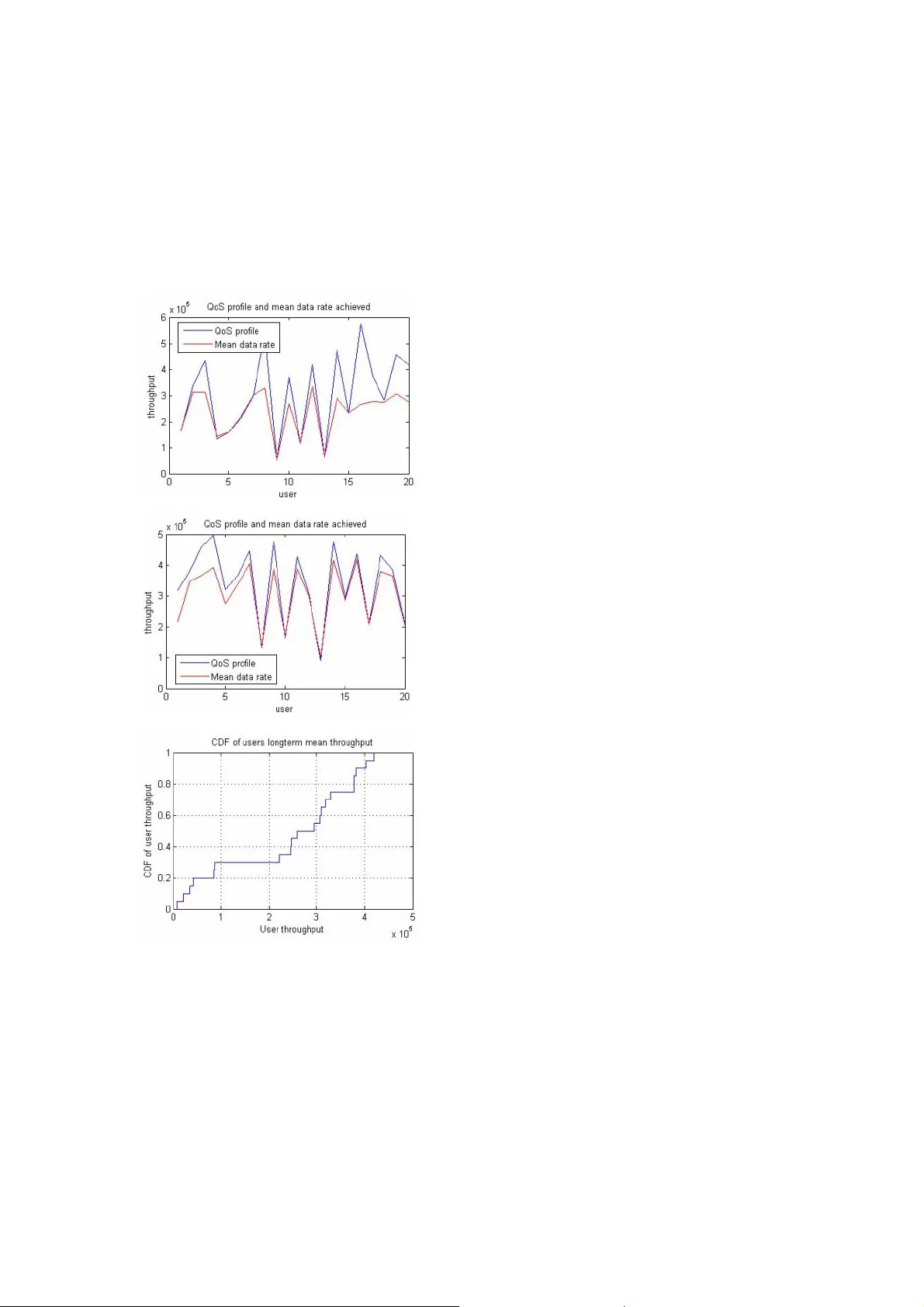
1 Abstract -- In this paper, Long-Term Proportional Fair (LTPF) resource allocation algorithm in dynamic OFDMA system is presented, which provides long-term QoS guarantee (m 1 ainly throughput requirement satisfaction) to individual user and follows every user’s QoS profile at long-term by incremental optimization of proportional fairness and overall system rate maximization. The LTPF algorithm dynamically allocates the OFDMA su b-carriers to the users in such a way that in long-term the individual QoS requirement is achieved as well as fairness among the users is maintained even in a heterogeneous traffic condition. Here more than maintaining individual user’s instantaneous QoS; emphasis is given to follow mean QoS profile of all the users in long-term to retai n the objectives of both proportional fairness and multi-user raw rate maximization. Compared to the algori thms, which provide proportional fair optimization and raw-rate maximization independently, this algorithm attempts to provide both kinds of optimizations simultaneously and reach an optimum point when computed in long-term by e xploiting the time diversity gain of mobile wireless environment. Index terms — Dynamic OFDMA, sub-carrier allocation, proportional fairness, time diversity, QoS I. INTRODUCTION Next generation broa dband wireless application s require high data rate, low latency, minimum delay; in short highly demanding QoS. The capacity o f a communication system is limited by its available resources like bandwidth and power and for a fixed bandwidth and power; the system capacity also becomes fixed. In a multi-user scenario, system performance optimization can not be guaranteed by optimizing only the individual link performance. Dynamic Resource Allocation is a kind of cross layer optimization mainly involving Physical (PHY) and Media Access Control (MAC) manages the system resources, like bandwidth, transmit power by exploiting the freq uency and temporal dimension of the resource space adaptively to achieve the system performance objective. Orthogonal Frequency Division Multiple Access (OFDMA) is the de facto standard multiple access scheme for next generation wireless standards like WiMAX, LTE, IMT-A. OFDMA, also referred to as Multi-user OFDM is normally characterized by a 13 th International OFDM Workshop, 2008, Hamburg fixed number of orthogonal sub-carriers to be allocated to the available users [1, 2]. Sub-carrier allocation algorithms intelligently assign mutually disjoint sub-carriers to the users from apriori knowledge of the channel condition by taking the advantage of Multi User Diversity [3, 4, 5]. The optimization objective of the system is either to attain maximum aggregate capacity or to provide fairness among the users or to have a trade-off between the t wo optimization schemes. Raw-rate maximization algorithm maximizes the total system throughput but does not concern about starving users. In [6], the problem of dynamic subcarrier and power allocation with the objective of maximizing the minimum of the users’ data rates subject to a total transmission power constraint is investigated. The fairness issue is emphasized in [7] by the concept of opportunistic scheduling. Tradeoff between capacity and fairness can be efficiently realized by efficient proportional fair (PF) OFDMA subcarrier and power allocation algorithms with QoS provisioning in [8]. From [6-8], it can be observed that the objectives of fair optimization and overall system throughput maximization are opposite in nature.It is also v ery much difficult and computationally expensive to satisfy each user’s instantaneous data rate requirement. User satisfaction and service provider objective both can be preserved if individual user’s QoS is maintained. As most of the current and next generation wireless applicati ons do not degrade much if mean QoS guarantee is provided, where the mean is computed over few frame durations. From this perspective Long Term Proportional Fair (LTPF) algorithm is proposed which instead of achieving instant aneous fairnes s or capacity maximization, attempts to allocate the OFDMA subcarriers to the users to achieve its minimum mean data-rate requirement within a few frame duration or at least to follow the overall QoS profile by exploitin g the time diversity gain. It produces better result in most cases than traditional PF optimization. QoS guarantee to the user is the most priority objective for next generation wireless broadband system. So LTPF algorithm is very much suitable and practical. Simulation results also Long-Term Proportional Fair QoS Profile Follower Sub- carrier Allocation Algorithm in Dynamic OFDMA Systems Wireless and Sensor Technology Innovation Lab, Tat a Consultancy Services BIPL, Sector-5, Saltlake, Kolkata- 700091, India arijit.ukil@tcs.com Arijit Ukil, Jaydip Sen, Debasish Bera 2 justify the claim and show how QoS profile is closely followed in long term by the mean d ata rate achieved by LTPF algorithm. The paper is organized as follows. The next section describes the system model. In section III instantaneous proportional fair optimization problem is discussed. LTPF optimization and algorithm are presented in detail in section IV. Simulation results and analysis of the LTPF algorithm are presented in the next section. Section VI provides the summary and conclusion. II. S YSTEM M ODEL Multiuser OFDMA system architecture with sub-carrier allocation module is shown in Fig. 1. Single cell wireless cellular network with one base station (BS) serving total K users is considered. The interference from adjacent cells is treated as background noise. The sub-carrier bandwidth is chosen to be sufficiently smaller than the coherence bandwidth of the channel in order to overcome frequency selective fading. Sub-carrier allocation is performed with in the frame duration, which is assumed to be less than the channel coherence time. Perfect channel characteristic is assumed in the form of channel state information (CSI). LTPF algorithm is simplified by equally distributing the total available transmitted power as performance can hardly be deteriorated by equal power allocation to each subcarrier [5]. LTPF optimization is performed in long term duration, which is n amed as allocation duration. The mutually disjoint sub- carriers are denoted as: Ω 1 , Ω 2 , …. Ω N , where Ω n = B/N and Ω n ≤ Bc , where Bc is the coherence Bandwidth of the channel and B is the to tal available bandwidth. P T is the total available transmit power and kn P is the transmit power for n th subcarrier when transmitted to k th user, where kn P = P T /N . Total noise power density including background noise and AWGN noise is taken as t N . Channel Gain for subcarrier n for user k at t th allocation instant is taken as knt h . Minimum individual rate requirement for all the K users as per individual QoS is [ K γ γ γ ,.... , 2 1 ]. Long-term allocation duration ad ∆ consists of a number of allocation epochs (=frame-duration) and ad ∆ = f T M × , M = 1, 2 …, where f T is the frame- duration, which is taken as the unit allocation duration. f T ≤ c Γ , where c Γ is the coherence time of the channel and ad ∆ should be (much) greater than c Γ , in order to take the advantage of time diversity gain. Let kt ω be the achievable rate for k th user at t th instant, then kt ω is a function of the channel condition or knt h . More specifically, kt ω also depends on the sub-carrier allocation scheme considered and can be expressed as: ∑ = × × Ω = N n knt knt n kt h f 1 ) ( ρ ω (1) where f( knt h ) can be expressed as per (2) and knt ρ is the sub-carrier assignment matrix, which is equal to 1 if n th subcarrier ass igned to k th user at t th time instant, else equal to 0 and ∑ = K k knt 1 ρ = 1 . × Ω × × + = n t kn knt knt N P h h f 2 2 1 log ) ( SNR_gap (2) SNR_gap is the imperfection of theoretical value of achievable data rate to the actual data rate and can be expressed as [10]: 6 . 1 ) 5 ln( BER × − . Proportional Fairness Index (PFI) is a kind of optimized measure of user fairness. PFI at t th allocation instant for k th user is expressed as t k kt kt pfi ω ω = . Total achievable data rate for k th user at the end of allocation duration ad ∆ is equal to k ω , which is equal to ∑ ∆ = ad t kt 0 ω . III. I NSTANTANEOUS P ROPORTIONAL F AIR O PTIMIZATION P ROBLEM PF in OFDMA system maximizes the sum of logarithmic mean user rates [8, 11]. t pfi = max ∑ ∑ = = N 1 n 1 kt ln K k ω (3) Equation (3) can be more generalized when PF is defined as follows [9]: t pfi = ∏ ∑ ∈ ∈ 1) − ∆ + K k kt N n knt ω τ ω ( 1 (4) where t pfi is the proportional fairness index at t th instant, τ ∆ is average window size and kt ω is the average data rate achieved b y the user k at the preceding allocation instant. Equation (4) is the optimal PF subcarrier allocation, c an not be implemented in real systems due to its high 3 computational complexity. The suboptimal form described in [11], where subcarrier n is allocated to k* user when: Fig. 1 Multiuser OFDMA System with Sub-carrier Allocation M odule k* = kt kt k ω ω max arg (5) kt ω = ) 1 ( ) 1 ( 1 ) 1 1 ( − − ∆ + ∆ − t k t k ω τ ω τ (6) System constraint to provide QoS is: k kt γ ω ≥ , k ∀ (7) The optimization and sub-optimization schemes (3-7) discussed so far deals with maintaining instantaneous QoS guarantee, which accordi ng to the proposed LTPF optimization does no t offer the best system or user level performance gain in wireless mobile environment. IV. L ONG T ERM P ROPORTIONAL FAIR OPTIMIZATION AND A LGORITHM According to equation (3-7) PF metric is calculated from instantaneous achievable rate and sub-carrier allocation decision taken at every allocation epoch ( f T ) depends on the instantaneous channel condition h knt | t=Tf and the fairness is maintained according to the law of d imishing return (3). The channel dynamics of mobile wireless broadband system is very high. So insta ntaneous decision making may not be the best way for an optimization scheme. Instead LTPF algorithm proposes l ong ter m maximization of user’s me an achievable data rate subject to minimum data rate constraint. LTPF incurs the advantage of time diversity (TD) gain, when QoS parameter computation time ( ad ∆ ) is more than the channel coherence time. But TD technique is restricted to delay-tolerant applications in mobile wireless environment. Let Pro bability of error of detecting x is given by: ( ) xSNR Q x P e 2 ) ( = where Q(.) is complementary cumulative distribution functio n of a ) , 0 ( T N N random variable and e P be the average probability of error of received signal, it can be proved that [13]: ( ) M e SNR M M P 4 1 1 2 × − ≈ (8) where M is the diversity branch or in this case, the number o f unit allocation instants taken in PFI computation. Equation (8) shows that substantial performance gain can be achieved by tak ing advantage of time diversity gain. LTPF optimization utilizes t his performance gain for its attempt to converge to k γ by computing PFI over ad ∆ as well as relaxing the QoS c onstraint of minimum data rate as a mean value. Basically, instead of instantaneous optimization, LTPF allocates OFDMA sub-carriers to optimize the performance over few allocations and assures QoS guarantee in an average basis within that pre-defined allocation duration. The idea is formulated below: ∑ ∑ ∑ ∆ = = = ∆ = ad ad t N n K k t k knt 0 1 1 0 max ω ω (9) ∑ ∑ ∆ = = × × Ω = ad t N n knt knt n k h f 0 1 ) ( ρ ω (10) ∑ ∑ ∑ ∆ = = = × = ad t N n K k knt M N 0 1 1 ρ (11 ) subject to: k k γ ω ≥ , k ∀ (12) Equations (9-12) describes LTPF optimization scheme. It can be noticed that more the value of M, the more ergodic the optimization scheme becomes; at M=1, the optimization is purely proportional fair. It can also be noted from (8) that more time diversity gain would b e achieved with the increasing value of M, i.e. 1 ) ( = → ∞ → ∆ k k P Lim ad γ ω (13) Equation (13) is an important result of L TPF, which states that with more allocation instants considered, more is the probability of mean achievable data rate to converge to the QoS requirement. This is due to the fact that in wireless mobile environment over long duration, time diversity gain becomes high and the mean channel Sub- carrier allocation IFFT f P/S CSI Sub- carrier to user mapping FFT S/P Remove Cyclic prefix Sub-carrier Allocation Module User1 QoS1 QoSK Transmitter Wireless Channel Add Cyclic prefi x User 1 UserK UserK 4 condition ( kn h ) follows similar distribution according to the Bernoulli’s Law of Large Numbers, which justifies the intuitive in terpretation that the expected value of a random variable is basically long-term average when sampled repeatedly. As kn h is commonly considered a s idenpendepent and identically distributed (i.i.d) random variable with mean k µ , then theoretically, k TDgain Lim ad µ = ∞ → ∆ (14) There exists some limitations o r constraints for (13) to be true. Let the long term average data rate of k th user equals to ) ( k k f Lim ad µ ω ∞ → ∆ = , then the following condition (15) should hold true for (13) to be valid. ε ω γ ≤ − k k (15) where ε is a very small number. In practical systems, QoS guarantee has to be made within few frame durations. This limits the value of ad ∆ , consequently the probability of convergence towards k γ . The converging rate towards k γ increases at large ad ∆ as well as in highly mobile environment. So the value of ad ∆ should be chosen as large as practically possible. Based on the LTPF optimization as per (9-12) the proposed LTPF algorithm is described as below: 1. Initialize 0 = t k ω = ψ , 0 0 = = t knt pfi , 0 = kt ω , k ∀ , where ψ is a random number . 2. Assign initial subcarriers to the users from proportional fairness index, at t = 0. while ({ Ω n } Φ ≠ ) do for k= 1: K calculate knt ω f T t k knt knt pfi 0 = = ω ω end for k* = ) ( max arg knt k pfi t k nt k t k * * * ω ω ω + = kt T t k f ω ω = = 0 end while 3. Incorporate long term notion and time diversity gain for t = f T : ad ∆ while ({ Ω n } Φ ≠ ) do for k= 1: K if ( k k γ ω < ) calculate knt ω t T t k knt knt f pfi = = ω ω else −∞ = knt pfi end for k* = ) ( max arg knt k pfi t k nt k t k * * * ω ω ω + = end while calculate f f T t k t k t T t k 0 = = − = ω ω ω end for V. S IMULATION R ESULT AND A NALYSIS In this s ection we present simulation results of the proposed LTPF algorithm under the system parameters and simulation scenario given in Table 1. The system parameters are roughly based on Mobile WiMAX Scalable OFDMA-PHY. Achievable data rate of individual user is calculated according to (2). Frequency reuse factor = 1 is taken, so that all the available sub-carriers can be allocated to the users. TABLE I Simulation and System Parameters Available Bandwidth 1.25 MHz Total Transmitted Power 20 dBm Number of users 20 Number of sub-carriers 72 BER 10 -3 Frame duration 5 msec Allocation instant (Tf) Frame duration ad ∆ f T M × Channel model Rayleigh Modulation 16QAM Channel sampling frequency 1.5 MHz Maximum Doppler 100Hz Figure 2: QoS profile and mean data rate achieved when M= 1 5 The simulation results depict the performance of the algorithm and also show how user data rat e follows the overall QoS profile at long term. By overall QoS profile, we mean the plot of every user’s fixed average data-rate requirement within the long te rm duration ( ad ∆ ). Heterogeneous traffic model with variable QoS demand by the user is considered, as in a broadband wireless scenario it is very much practical to assume large differences in QoS requirement. Figure 3: QoS profile and mean data rate achieved when M =4 Figure 4: QoS profile and mean data rate achieved when M =10 Figure 5: CDF plot of the user mean data rate at M =10 Fig. 2 depicts the plot comparing QoS profile of users’ achieved mean data-rate when ad ∆ equals to one unit. Here it is clear that the achieved mean data-rate profile deviates from the QoS profile considerably and also the individual data-rate achieved is substantially low, as in this case, LTPF algorithm becomes purely proportional fair. Fig. 3- 4 show the res ult when LTPF optimization is incorporated in sub-carrier allocation. Fig. 3 and 4 clearly show that the mean achieve d data-rate is considerably improved and attempts to follow the QoS profile. Fig. 4 establishes the fact that achievable mean data rate is converging towar ds k γ , when ad ∆ is of large magnitude. Fig. 5 is the corresponding CDF (Cumulative Distribution Function) plot. VI. S UMMARY AND C ONCLUSION The LTPF algorithm has shown the characteristics of long term QoS profile follower by taking the advantage of time diversity gain. This algorithm particularly performs better optimization in mobile environment and delay-tolerant applications. Simulation results depict the performance of the algorithm. The distinguished quality of LTPF as QoS profile follower is of very much practical importance and can well be implemented for next generation broadband wireless systems like LTE, WiMAX, IMT-A for acheiving the target performance . VII. R EFERENCES [1] Ahmad R. S. Bahai, Burton R. Saltzberg, Mustafa Ergen. “Multi- Carrier Digital Communications Theory and Applications of OFDM”. 2 nd ed. Springer. [2] Z. Shen, J. Andrews, and B. Evans, “Adaptive resource allocation in multiuser OFDM systems with proportional rate constraints,” IEEE Trans. Wireless Communication, vol. 4, no. 6, Nov. 2005, Page: 2726–2737. [3] Patrick Svedman, Sarah Kate Wil son, and Björn Ottersten. "A QoS-aware Proportional Fair Scheduler for Opportunistic OFDM". IEEE VTC, 2004, vol.1, Page: 558-562 [4] D. Kivanc, G. Li, and H. Liu, “Computationally efficient bandwidth allocation and power control for OFDMA,” IEEE Trans. Wireless Communication, vol. 2, no. 6 , Nov. 2003, Page 1150–1158. [5] Wei Xu, Chunming Zhao, Peng Zhou, a nd Yijin Yang ."Efficient Adaptive Resource Allocation for Multiuser OFDM Systems with Minimum Rate Constraints".,ICC, 2007. Page 5126-513 1. [6] W. Rhee and J. M. Cioffi. “Increase in capacity of multiuser OFDM system using dynamic subchannel allocation”. Proc., IEEE VTC 2000, Page: 1085–89. [7] Zhi Zhang, Ying He, Edwin K. P. Chong,"Opportunistic Scheduling for OFDM Systems with Fairness Constraints", EURASIP Journal onWireless Communications and Networ king Volume 2008. [8] Hoon Kim, Youngnam Han. “A Proportional Fair Scheduling for Multi-carries Transmission Systems”. IEEE Communications Letters, vol.9, no.3, March 2005, Page: 210-212. [9] Tien-Dzung Nguyen and Youngnam Han."A Proportional Fairness A lgorithm with QoS Provision in Downlink OFDMA Systems". IEEE Communication Letters. Vol-2, No.-11, Nov 2006. [10] Abolfazl Falahati, Majid R. Ardestani. "An Improved Low- Complexity Resource Allocation Algorithm for OFDMA Systems with Proportional Data Rate Constraint". 9th ICACT 2007, Page: 606-611. [11] Kaneko, Popvski, Dahl. “Proportional fairness in multicarrier system: upper bound and approximation algorithms”, IEEE Commn. Letters,vol 10, June 2006, Page: 462-464. [12] Christian Wengerter, Jan Ohlhorst, Alexander Golitschek Edler von Elbwart. "Fairness and Throughput Analysis for Generalized Proportional Fair Frequency Scheduling in OFDMA". IEEE VTC, 2005,Vol.3, Page:.1903-1907. [13] David Tse, Pramod Viswanath. “Fundamentals of Wireless Communication”, Cambridge University Press, 2005.
Original Paper
Loading high-quality paper...
Comments & Academic Discussion
Loading comments...
Leave a Comment