ATTac-2000: An Adaptive Autonomous Bidding Agent
The First Trading Agent Competition (TAC) was held from June 22nd to July 8th, 2000. TAC was designed to create a benchmark problem in the complex domain of e-marketplaces and to motivate researchers to apply unique approaches to a common task. This …
Authors: M. Kearns, M. L. Littman, S. Singh
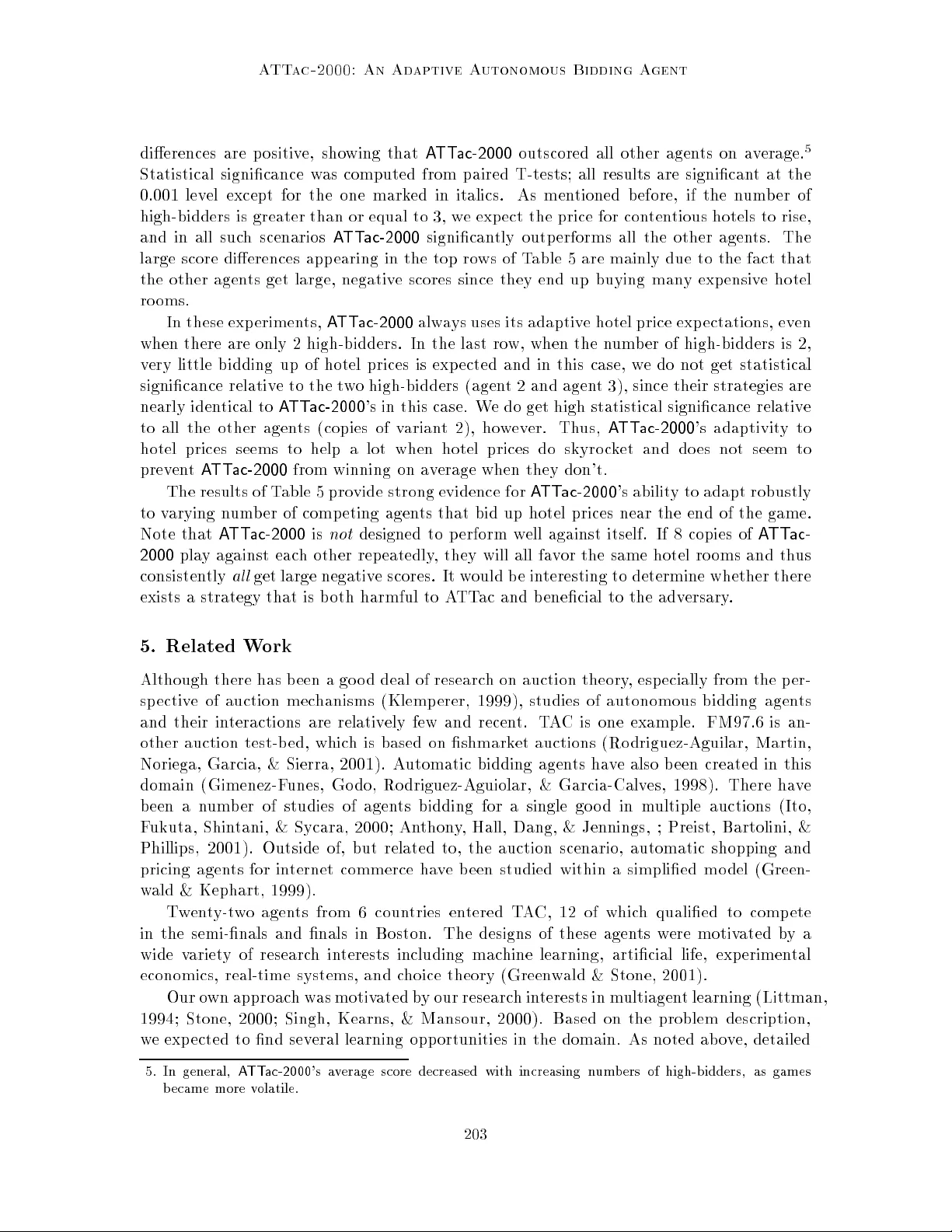
Journal of Articial In telligence Researc h 15 (2001) 189-206 Submitted 2/01; published 9/01 A TT ac-2000: An Adaptiv e Autonomous Bidding Agen t P eter Stone pstone@resear ch.a tt.com Mic hael L. Littman mlittman@resear ch.a tt.com A T&T L abs R ese ar ch, 180 Park A venue Florham Park, NJ 07932 USA Satinder Singh sa tinder.ba veja@syntekcapit al.com Mic hael Kearns michael.kearns@syntekcapit al.com Syntek Capital, 423 West 55th Str e et New Y ork, NY 10019 USA Abstract The First T rading Agen t Comp etition (T A C) w as held from June 22nd to July 8th, 2000. T A C w as designed to create a b enc hmark problem in the complex domain of e- mark etplaces and to motiv ate researc hers to apply unique approac hes to a common task. This article describ es A TT ac-2000 , the rst-place nisher in T A C. A TT ac-2000 uses a princi- pled bidding strategy that includes sev eral elemen ts of adaptivity . In addition to the success at the comp etition, isolated empirical results are presen ted indicating the robustness and eectiv eness of A TT ac-2000 's adaptiv e strategy . 1. In tro duction The rst T rading Agen t Comp etition (T A C) w as held from June 22nd to July 8th, 2000, or- ganized b y a group of researc hers and dev elop ers led b y Mic hael W ellman of the Univ ersit y of Mic higan and P eter W urman of North Carolina State Univ ersit y (W ellman, W urman, O'Malley , Bangera, Lin, Reev es, & W alsh, 2001). Their goals included pro viding a b enc h- mark problem in the complex and rapidly adv ancing domain of e-mark etplaces (Eisen b erg, 2000) and motiv ating researc hers to apply unique approac hes to a common task. A k ey feature of T A C is that it required autonomous bidding agents to buy and sell multiple inter acting go o ds in auctions of dieren t t yp es. Another k ey feature of T A C w as that participating agen ts comp eted against eac h other in a preliminary round and man y practice games leading up to the nals. Th us, dev elop ers c hanged strategies in resp onse to eac h others' agen ts in a sort of escalating arms race. Leading in to the comp etition da y , a wide v ariet y of scenarios w ere p ossible. A successful agen t needed to b e able to p erform w ell in an y of these p ossible circumstances. This article describ es A TT ac-2000 , the rst-place nisher in T A C. A TT ac-2000 uses a principled bidding strategy , whic h includes sev eral elemen ts of adaptivity . In addition to the success at the comp etition, isolated empirical results are presen ted indicating the robustness and eectiv eness of A TT ac-2000 's adaptiv e strategy . The remainder of the article is organized as follo ws. Section 2 presen ts the details of the T A C domain. Section 3 in tro duces A TT ac-2000 , including the mec hanisms b ehind its adaptivit y . Section 4 describ es the comp etition results and the results of con trolled exp erimen ts testing A TT ac-2000 's adaptiv e comp onen ts. Section 5 compares A TT ac-2000 c 2001 AI Access F oundation and Morgan Kaufmann Publishers. All righ ts reserv ed. Stone, Littman, Singh, & Kearns with some of the other T A C participan ts. Section 6 presen ts p ossible directions for future researc h and concludes. 2. T A C A T A C game instance pits 8 autonomous bidding agen ts against one another. Eac h T A C agen t is a sim ulated tra v el agen t with 8 clien ts, eac h of whom w ould lik e to tra v el from T A C- to wn to Boston and bac k again during a common 5-da y p erio d. Eac h clien t is c haracterized b y a random set of preferences for the p ossible arriv al and departure dates; hotel ro oms (The Grand Hotel and Le Fleabag Inn); and en tertainmen t tic k ets (symphon y , theater, and baseball). T o obtain utilit y for a clien t, an agen t m ust construct a tra v el pac k age for that clien t b y purc hasing airline tic k ets to and from T A Cto wn and securing hotel reserv ations; it is p ossible to obtain additional utilit y b y pro viding en tertainmen t tic k ets as w ell. A T A C agen t's score in a game instance is the dierence b et w een the sum of its clien ts' utilities for the pac k ages they receiv e and the agen t's total exp enditure. T A C agen ts buy igh ts, hotel ro oms and en tertainmen t tic k ets in dieren t t yp es of auctions . The T A C serv er, running at the Univ ersit y of Mic higan, main tains the mark ets and sends price quotes to the agen ts. The agen ts connect o v er the In ternet and send bids to the serv er that up date the mark ets accordingly and execute transactions. Eac h game instance lasts 15 min utes and includes a total of 28 auctions of 3 dieren t t yp es. Fligh ts (8 auctions): There is a separate auction for eac h t yp e of airline tic k et: igh ts to Boston ( inights ) on da ys 1{4 and igh ts from Boston ( outights ) on da ys 2{5. There is an unlimite d supply of airline tic k ets, and their ask pric e p erio dically increases or decreases randomly b y from $0 to $10. In all cases, tic k ets are priced b et w een $150 and $600. When the serv er receiv es a bid at or ab o v e the ask price, the transaction is cle ar e d imme diately at the ask price. No r esale of airline tic k ets is allo w ed. Hotel Ro oms (8): There are t w o dieren t t yp es of hotel ro oms|the Boston Grand Hotel (BGH) and Le Fleabag Inn (LFI)|eac h of whic h has 16 ro oms a v ailable on da ys 1{4. The ro oms are sold in a 16th-price asc ending (English) auction, meaning that for eac h of the 8 t yp es of hotel ro oms, the 16 highest bidders get the ro oms at the 16th highest price. F or example, if there are 15 bids for BGH on da y 2 at $300, 2 bids at $150, and an y n um b er of lo w er bids, the ro oms are sold for $150 to the 15 high bidders plus one of the $150 bidders (earliest receiv ed bid). The ask price is the curren t 16th-highest bid. Th us, agen ts ha v e no kno wledge of, for example, the curren t highest bid. New bids m ust b e higher than the curren t ask price. No bid withdr awal and no r esale is allo w ed. T ransactions only cle ar when the auction closes . T o prev en t agen ts from all w aiting un til the end of the game to bid on hotel ro oms, hotel auctions can close after an unsp ecied p erio d (roughly one min ute) of inactivit y (no new bids receiv ed). En tertainmen t Tic k ets (12): Baseball, symphon y , and theater tic k ets are eac h sold for da ys 1{4 in c ontinuous double auctions . Here, agen ts can buy and sel l tic k ets, with transactions cle aring imme diately when one agen t places a buy bid at a price at least as high as another agen t's sell price. Unlik e the other auction t yp es in whic h the 190 A TT a c-2000: An Ad aptive A utonomous Bidding A gent go o ds are sold from a cen tralized sto c k, eac h agen t starts with a random endo wmen t of en tertainmen t tic k ets. The prices sen t to agen ts are the bid-ask spr e ads , i.e., the highest curren t bid price and the lo w est curren t ask price (due to immediate clears, ask price is alw a ys greater than bid price). When a bid that b eats the curren t bid (ask) price arriv es, the sale price is the standing bid (ask) price, as opp osed to the arriving ask (bid) price. In this case, bid withdr awal and ticket r esale are b oth p ermitted. In addition to unpredictable mark et prices, other sources of v ariabilit y from game in- stance to game instance are the clien t proles assigned to the agen ts and the random initial allotmen t of en tertainmen t tic k ets. Eac h T A C agen t has 8 clien ts with randomly assigned tra v el preferences. Clien ts ha v e parameters for ideal arriv al da y , IAD (1{4); ideal depar- ture da y , IDD (2{5); grand hotel v alue, GHV ($50{$150); and en tertainmen t v alues, EV ($0{$200) for eac h t yp e of en tertainmen t tic k et. The utilit y obtained b y a clien t is determined b y the tra v el pac k age that it is giv en in com bination with its preferences. T o obtain a non-zero utilit y , the clien t m ust b e assigned a fe asible tra v el pac k age consisting of an arriv al da y AD with the corresp onding inigh t, departure da y DD with the corresp onding outigh t, and hotel ro oms of the same typ e (BGH or LFI) for eac h da y d suc h that AD d < D D . A t most one en tertainmen t tic k et can b e assigned for eac h da y AD d < D D , and no clien t can b e giv en more than one of the same en tertainmen t tic k et t yp e. Giv en a feasible pac k age, the clien t's utilit y is dened as 1000 tr avelPenalty + hotelBonus + funBonus where tr avelPenalty = 100( j AD IAD j + j D D IDD j ) hotelBonus = GHV if the clien t is in the GBH, 0 otherwise. funBonus = sum of relev an t EV 's for eac h en tertainmen t tic k et t yp e assigned to the clien t. A T A C agen t's nal score is simply the sum of its clien ts' utilities min us the agen t's exp enditures. Throughout the game instance, it m ust decide what bids to place in eac h of the 28 auctions. A t the end of the game, it m ust submit a nal allo cation of purc hased go o ds to its clien ts. The clien t preferences, allo cations, and resulting utilities from one particular game from the T A C nals (Game 3070 on the T A C serv er) are sho wn in T ables 1 and 2. F or full details on the design and mec hanisms of the T A C serv er, see W ellman et al. (2001). 3. A TT ac-2000 A TT ac-2000 nished rst in the T rading Agen t Comp etition using a principled bidding strategy , whic h included sev eral elemen ts of adaptivity . This adaptivit y ga v e A TT ac-2000 the exibilit y to cop e with a wide v ariet y of p ossible scenarios at the comp etition. In this section, w e describ e A TT ac-2000 's bidding strategy , its metho d for determining the b est allo cation of go o ds to clien ts, and its three forms of adaptivit y . A TT ac-2000 's high-lev el strategy is summarized in T able 3. 191 Stone, Littman, Singh, & Kearns Clien t IAD IDD GHV BEV SEV TEV 1 Da y 2 Da y 5 73 175 34 24 2 Da y 1 Da y 3 125 113 124 57 3 Da y 4 Da y 5 73 157 12 177 4 Da y 1 Da y 2 102 50 67 49 5 Da y 1 Da y 3 75 12 135 110 6 Da y 2 Da y 4 86 197 8 59 7 Da y 1 Da y 5 90 56 197 162 8 Da y 1 Da y 3 50 79 92 136 T able 1: A TT ac-2000 's clien t preferences from game 3070. BEV , SEV , and TEV are EV s for baseball, symphon y , and theater resp ectiv ely . Clien t AD DD Hotel En t'men t Utilit y 1 Da y 2 Da y 5 LFI B4 1175 2 Da y 1 Da y 2 BGH B1 1138 3 Da y 3 Da y 5 LFI T3, B4 1234 4 Da y 1 Da y 2 BGH None 1102 5 Da y 1 Da y 2 BGH S1 1110 6 Da y 2 Da y 3 BGH B2 1183 7 Da y 1 Da y 5 LFI S2, B3, T4 1415 8 Da y 1 Da y 2 BGH T1 1086 T able 2: A TT ac-2000 's clien t allo cations and utilities from game 3070. Clien t 1's \B4" under \En t'men t" indicates baseball on da y 4. 3.1 Bidding Strategy T A C w as dened so as to b e simple enough to ha v e a lo w barrier to en try , y et complex enough to prev en t tractable solution via direct game-theoretic analysis. Giv en that an optimal solution is not attainable, w e use a principled approac h that tak es adv an tage of details of the T A C scenario. In general, A TT ac-2000 aims to b e robust to the parameter space dened b y T A C as w ell as to conceiv able opp onen t strategies. A t ev ery bidding opp ortunit y , A TT ac-2000 b egins b y computing the most protable allo cation of go o ds to clien ts (whic h w e shall denote G ), giv en the go o ds that are curren tly o wned and the curren t prices of hotels and igh ts. (See Section 3.3 for a ca v eat.) F or the purp oses of this computation, A TT ac-2000 allo cates, but do es not consider buying or selling, en tertainmen t tic k ets. In most cases, G is computed using in teger linear programming, as describ ed in Section 3.2. A TT ac-2000 's high-lev el bidding strategy is based on the follo wing t w o observ ations: 192 A TT a c-2000: An Ad aptive A utonomous Bidding A gent 1. While the auctions are op en: Obtain up dated mark et prices. Compute G : the most protable allo cation of go o ds giv en curren t holdings and prices. Bid in 1 of 2 dieren t mo des P assiv e: bid to k eep options op en Activ e: at end, bid aggressiv ely on pac k ages 2. Allo cate: Compute G with closed auctions and allo cate purc hased go o ds to clien ts. T able 3: An o v erview of A TT ac-2000 's high-lev el strategy . 1. Since airline prices p erio dicall y increase or decrease with equal probabilit y , the ex- p e cte d c hange in price for eac h airline auction is $0. Indeed, it can b e sho wn that if the airline auction is considered in isolation, w aiting un til the v ery end of the game to purc hase tic k ets is an optimal strategy (except in the rare case that the price reac hes the lo w est allo w ed v alue). 2. Since hotel prices are monotonically increasing, as the game pro ceeds, the hotel prices approac h the ev en tual closing prices. Therefore, A TT ac-2000 aims to dela y most of its purc hases, and particularly its airline purc hases, un til late in the game. A TT ac-2000 's high-lev el bidding strategy is based on the premise that it is b est to dela y \committing" to the curren t G for as long as p ossible. Although it con tin ually reev aluates G , and is therefore nev er tec hnically committed to an ything, the mark ets are suc h that it is rarely adv an tageous to c hange a clien t's tra v el pac k age if it w ould mean w asting an airline tic k et or an exp ensiv e hotel ro om (th us requiring additional ones to b e purc hased). A TT ac-2000 accomplishes this dela y of commitmen t b y bidding in t w o dieren t mo des: p assive and active . The p assive mo de, whic h lasts most of the game, is designed to k eep as man y options op en as p ossible. During the passiv e mo de, A TT ac-2000 computes the a v erage time it tak es for it to compute and place its bids, T b ( T b is the a v erage time it tak es to go through one iteration of the lo op in step 1 of T able 3). W e found that T b ranged from 10 seconds to w ell o v er a min ute, and w as primarily dep enden t up on the serv er's load. Call the time left in the game T l . When T l 2 T b , A TT ac-2000 switc hes to its active mo de, during whic h it buys the airline tic k ets required b y the curren t G and places high bids for the required hotel ro oms. Note that A TT ac-2000 exp ects to run at most 2 bidding iterations in activ e mo de. In fact, only 1 suc h iteration is necessary , but there is a h uge cost to failing to complete the iteration b efore the end of the game. Planning for 2 activ e iterations lea v es ro om for some error. Based on the curren t G , its curren t mo de, and T l , A TT ac-2000 bids for igh ts, hotel ro oms, and en tertainmen t tic k ets. 193 Stone, Littman, Singh, & Kearns 3.1.1 Flights While in the passiv e mo de, A TT ac-2000 do es not bid in the airline auctions. In activ e mo de, A TT ac-2000 buys all curren tly uno wned airline tic k ets needed for the curren t G . In most cases, that means that it only bids for airline tic k ets during its rst bidding opp ortunit y in the activ e mo de. Ho w ev er, in the face of drastically c hanging (hotel and en tertainmen t tic k et) prices, G could c hange sucien tly to necessitate purc hasing additional igh ts, in- stead of simply using the ones that ha v e already b een purc hased. 3.1.2 Hotels When in the passiv e mo de, A TT ac-2000 bids in the hotel auctions either to try to win hotels c heaply should the auction close early , or to try to prev en t the hotel auctions from closing early . It migh t b e adv an tageous to prev en t a hotel auction from closing if no ro oms are curren tly desired in order to k eep op en the option of switc hing to that hotel should future mark et prices w arran t it. F or eac h hotel ro om of t yp e i (suc h as \Grand Hotel, nigh t 3"), let H i b e the n um b er of ro oms of t yp e i needed for G . Based on the curren t price of i , P i , A TT ac-2000 tries to acquire n ro oms where n = 8 > > > < > > > : 8 if P i = 0 (only true at the outset of the game) max( H i ; 4) if P i 10 max( H i ; 2) if P i 20 max( H i ; 1) if P i 50 : If A TT ac-2000 's outstanding bids w ould already win n ro oms should the auction close at the curren t price, then A TT ac-2000 do es nothing: should the auction close prematurely , A TT ac-2000 wins the n ro oms c heaply , and comp etitors lose the opp ortunit y to get an y ro oms of t yp e i later in the game. Otherwise, A TT ac-2000 bids for n ro oms at $1 ab o v e the curren t ask price. The form ula for computing n w as selected so as to risk w asting up to $40{$50 p er ro om t yp e for the b enet of main taining exibilit y later in the game. The exact parameters here w ere c hosen in an ad-ho c fashion without detailed exp erimen tation. Our in tuition is that A TT ac-2000 's p erformance is not v ery sensitiv e to their exact v alues. In the activ e mo de, A TT ac-2000 bids on hotel ro oms based on their marginal v alue within allo cation G . Let V ( G ) b e the v alue of G (the income from all clien ts, min us the cost of the y et-to-b e-acquired go o ds). Let G 0 c b e the optimal allo cation should clien t c fail to get its hotel ro oms. Note that G 0 c migh t dier from G in the distribution of en tertainmen t tic k ets as w ell as in the igh ts and hotels of clien t c . A TT ac-2000 bids for the hotel ro oms assigned to clien t c in G at a price of V ( G ) V ( G 0 c ). Since at this p oin t igh ts are a sunk cost, this price tends to b e more than $1000. Notice that A TT ac-2000 bids the full marginal utilit y for eac h hotel ro om required b y the clien t's tra v el pac k age. An alternativ e w ould ha v e b een to divide the marginal utilit y o v er the n um b er of ro oms in the pac k age, whic h w ould ha v e eliminated the risk of sp ending more on hotels than the itinerary is w orth. On the other hand, failing to win a single hotel ro om is enough to in v alidate the en tire itinerary . A TT ac-2000 bids the full marginal utilit y to maximize the c hance that v alid itineraries are obtained for all clien ts. In a com binatorial 194 A TT a c-2000: An Ad aptive A utonomous Bidding A gent auction, the bidder w ould b e able to b e place a bid for the conjunction of the desired ro oms and w ould therefore not need to c ho ose b et w een these t w o alternativ es. 3.1.3 Enter t ainment Tickets A TT ac-2000 's bidding strategy for the en tertainmen t tic k ets h yp othesizes that for eac h tic k et, the opp onen t buy (sell) price remains constan t o v er the course of a single game (but ma y v ary from game to game). So as to a v oid underbidding (o v erbidding) for that price, A TT ac-2000 gradually decreases (increases) its bid o v er the course of the game. The initial bids are alw a ys as optimistic as p ossible, but b y the end of the game, A TT ac-2000 is willing to settle for deals that are minimally protable. In addition, this strategy serv es to hedge against A TT ac-2000 's early uncertain t y in its nal allo cation of go o ds to clien ts. On ev ery bidding iteration, A TT ac-2000 places a buy bid for eac h t yp e of en tertainmen t tic k et, and a sell bid for eac h t yp e of en tertainmen t tic k et that it curren tly o wns. In all cases, the prices dep end on the amoun t of time left in the game ( T l ), b ecoming less aggressiv e as time go es on (see Figure 1). Buy value 5 10 0 Game Time (min.) 200 100 Bid Price ($) 15 $30 } } $50 $20 Owned, unallocated sell value Owned,allocated sell value Figure 1: A TT ac-2000 's bidding strategy for en tertainmen t tic k ets. The blac k circles indi- cate the calculated v alues of the tic k ets to A TT ac-2000 . The lines indicate the bid prices corresp onding to those v alues. F or example, the solid line (whic h increases o v er time) corresp onds to the buy price relativ e to the buy v alue. Corresp on- dence b et w een the text and the lines is indicated b y similar line t yp es and b o xes surrounding the text. F or eac h o wned en tertainmen t tic k et E , if E is assigned in G , let V ( E ) b e the v alue of E to the clien t to whom it is assigned in G (\o wned, allo cated sell v alue" in Figure 1). A TT ac-2000 oers to sell E for min (200 ; V ( E ) + ) where decreases linearly from 100 to 20 based on T l . 1 If there is a curren t bid price greater than the resulting sell price, then A TT ac-2000 raises its sell price to 1 cen t lo w er than the curren t bid price in order to get as high a price as p ossible. If E is o wned but not assigned in G (b ecause all clien ts are either una v ailable that nigh t or already sc heduled for that t yp e of en tertainmen t in G ), let V ( E ) b e the maxim um v alue 1. Recall that $200 is the maxim um p ossible v alue of E to an y clien t under the T A C parameters. 195 Stone, Littman, Singh, & Kearns for E o v er all clien ts, i.e. the greatest p ossible v alue of E giv en the clien t proles (\o wned, unallo cated sell v alue" in Figure 1). A TT ac-2000 oers to sell E for max(50 ; V ( E ) ) where increases linearly from 0 to 50 based on T l . Once again, A TT ac-2000 raises its price to meet an existing bid price that is greater than its target price. This strategy reects the increasing lik eliho o d as the game progresses that G will b e close to the nal clien t allo cation, and th us that an y curren tly un used tic k ets will not b e needed in the end. When in activ e mo de, A TT ac-2000 assumes that G is nal and oers to sell an y unneeded tic k ets for $30 in order to obtain at least some v alue for them (represen ted b y the discrete p oin t at the b ottom righ t in Figure 1). Belo w $30, A TT ac-2000 w ould rather w aste the tic k et than allo w a comp etitor to mak e a large prot. Finally , A TT ac-2000 bids to buy eac h t yp e of en tertainmen t tic k et E (including those that it is also oering to sell) based on the increased v alue that w ould b e deriv ed b y o wning E . Let G 0 E b e the optimal allo cation that w ould result w ere E o wned (\buy v alue" in Figure 1). Note that G 0 E could ha v e dieren t igh t and hotel assignmen ts than G so as to mak e most eectiv e use of E . Then, A TT ac-2000 oers to buy E for V ( G 0 E ) V ( G ) , where decreases linearly from 100 to 20 based on T l . All of the parameters describ ed in this section w ere c hosen arbitrarily without detailed exp erimen tation. Again our in tuition is that, unless opp onen ts kno w and explicitly exploit these v alues, A TT ac-2000 's p erformance is not v ery sensitiv e to them. 3.2 Allo cation Strategy As is eviden t from Section 3.1, A TT ac-2000 relies hea vily on computing the curren t most protable allo cation of go o ds to clien ts, G . Since G c hanges as prices c hange, A TT ac-2000 needs to recompute it at ev ery bidding opp ortunit y . By using an in teger linear programming approac h, A TT ac-2000 w as able to compute optimal nal allo cations in ev ery game instance during the tournamen t nals|one of only 2 en tran ts to do so. 2 Most T A C participan ts used some form of greedy strategy for allo cation (Green w ald & Stone, 2001). It is computationally feasible to quic kly determine the maxim um utilit y ac hiev able b y clien t 1 giv en a set of purc hased go o ds, mo v e on to clien t 2 with the remaining go o ds, etc. Ho w ev er, the greedy strategy can lead to sub optimal solutions. F or example, consider 2 clien ts A and B with iden tical tra v el da ys IAD and IDD as w ell as iden tical en tertainmen t v alues E V , but with A 's GH V = $50 and B 's GH V = $150. If the agen t has exactly one of eac h t yp e of hotel ro om for eac h da y , the optimal assignmen t is clearly to assign the BGH to clien t B . Ho w ev er, if clien t A 's utilit y is optimized rst, it will b e assigned the BGH, lea ving B to sta y in LFI. The agen t's resulting score w ould b e 100 less than it could ha v e b een. As an impro v emen t o v er the basic greedy strategy , w e implemen ted a heuristic approac h that implemen ts the greedy strategy o v er 100 random clien t orderings and c ho oses the most protable resulting allo cation. Empirically , the resulting allo cation is often optimal, and nev er far from optimal. In addition, it is alw a ys v ery quic k to compute. In a set of sev en games from just b efore the tournamen t, the greedy allo cator w as run appro ximately 600 times and pro duced allo cations that a v eraged 99.5% of the optimal v alue. 2. As computed b y Shou-de Lin of the T A C organizing team. 196 A TT a c-2000: An Ad aptive A utonomous Bidding A gent As the comp etition drew near, ho w ev er, it b ecame clear that ev ery p oin t w ould coun t. W e therefore implemen ted an allo cation strategy that is guaran teed to nd the optimal allo cation of go o ds. 3 The in teger linear programming approac h used b y A TT ac-2000 w orks b y dening a set of v ariables, constrain ts on these v ariables, and an ob jectiv e function. An assignmen t to the v ariables represen ts an allo cation to the clien ts and the constrain ts ensure that the allo cation is legal. The ob jectiv e function enco des the fact that w e seek the allo cation with maxim um v alue (utilit y min us cost). The follo wing notation is needed to describ e the in teger linear program. The formal no- tation is included for completeness; an equiv alen t English description follo ws eac h equation. The sym b ol c is a clien t (1 through 8). The sym b ol f is a feasible tra v el pac k age, whic h consists of: the arriv al da y AD ( f ) (1 through 4); the departure da y D D ( f ) (2 through 5), and the c hoice of hotel H ( f ) (BGH or LFI). There are 20 suc h tra v el pac k ages. Sym b ol e is an en tertainmen t tic k et, whic h consists of: the da y of the ev en t D ( e ) (1 through 4), and the t yp e of the ev en t T ( e ) (baseball b , symphon y s , or theater t ). There are 12 dieren t en tertainmen t tic k ets. Sym b ol r is a resource ( AD , D D , BGH, or LFI). Using this notation, the 272 v ariables are: P ( c; f ), whic h indicates whether clien t c will b e allo cated feasible tra v el pac k age f (160 v ariables); E ( c; e ), whic h indicates whether clien t c will b e allo cated en tertainmen t tic k et e (96 v ariables); and, B r ( d ) is the n um b er of copies of resource r w e w ould lik e to buy for da y d (16 v ariables). There are also sev eral constan ts that dene the problem: o r ( d ) is the n um b er of tic k ets of resource r curren tly o wned for da y d , p r ( d ) is the curren t price for resource r on da y d , u P ( c; f ) is utilit y to customer c for tra v el pac k age f , and u E ( c; e ) is the utilit y to customer c for en tertainmen t tic k et e . Giv en this notation, the ob jectiv e is to maximize utilit y min us cost X c;f u P ( c; f ) P ( c; f ) + X c;e u E ( c; e ) E ( c ; e ) X d 2f 2 ; 3 ; 4 ; 5 g p D D ( d ) B D D ( d ) X d 2f 1 ; 2 ; 3 ; 4 g ;r 2f BGH ; LFI ;AD g p r ( d ) B r ( d ) sub ject to the follo wing 188 constrain ts: F or all c , P f P ( c; f ) 1: No clien t gets more than one tra v el pac k age (8 constrain ts). F or all d 2 f 1 ; 2 ; 3 ; 4 g , X c X f j AD ( f )= d P ( c; f ) o AD ( d ) + B AD ( d ) ; F or all d 2 f 1 ; 2 ; 3 ; 4 g and h 2 f BGH ; LFI g , X c X f j H ( f )= h & AD ( f ) d
Original Paper
Loading high-quality paper...
Comments & Academic Discussion
Loading comments...
Leave a Comment