On fractionality of the path packing problem
In this paper, we study fractional multiflows in undirected graphs. A fractional multiflow in a graph G with a node subset T, called terminals, is a collection of weighted paths with ends in T such that the total weights of paths traversing each edge…
Authors: N. Vanetik
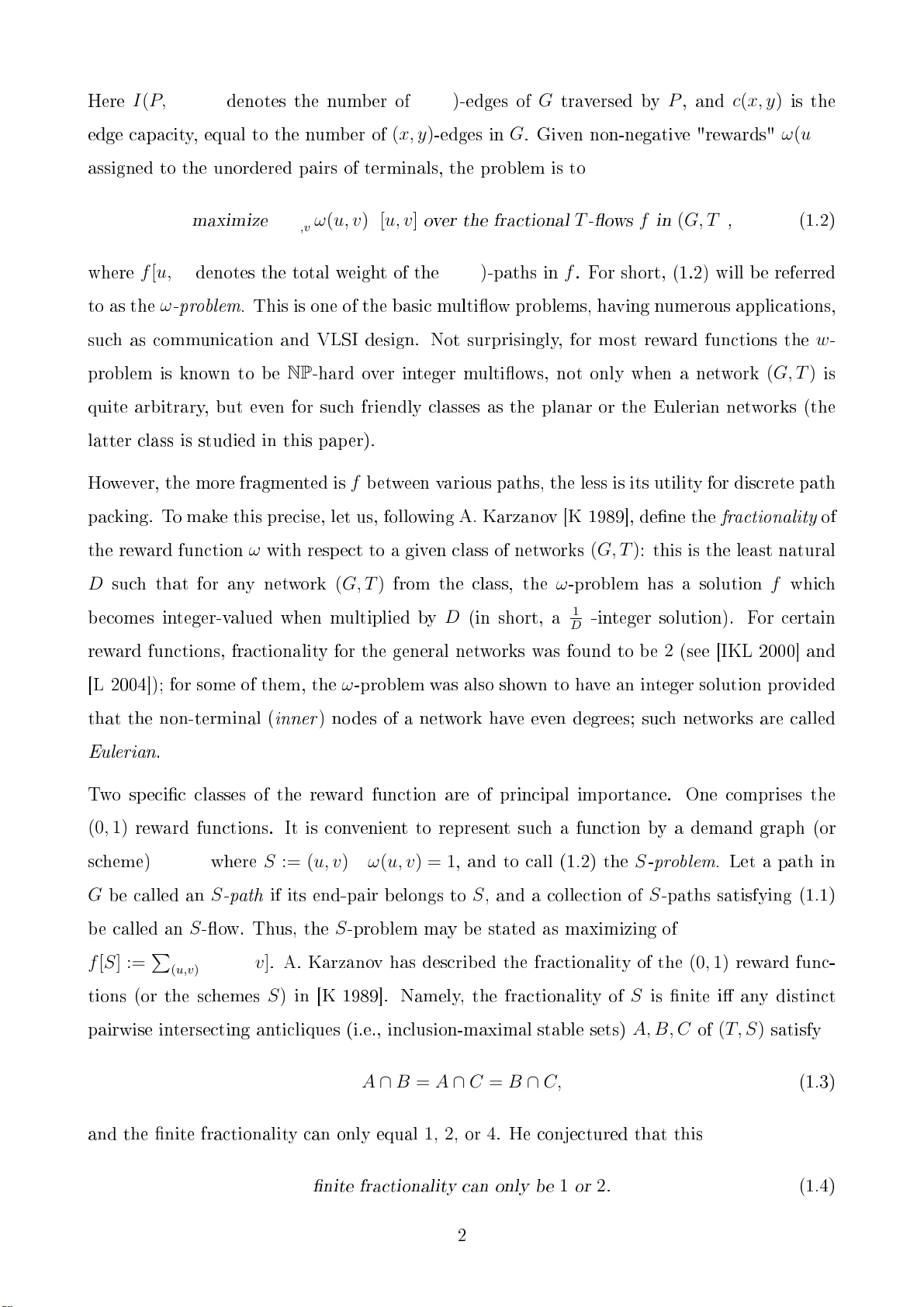
On frationalit y of the path pa king problem Natalia V anetik ∗ Abstrat In an undireted graph G with no de set N and a subset T ⊆ N , a fr ational multiow pr oblem is dened as nding max f P ( u,v ) ω ( u, v ) f [ u, v ] o v er all olletions f of w eigh ted paths with ends in T (the ω -pr oblem ). f [ u, v ] denotes the total w eigh t of paths with the end-pair ( u, v ) in f . The paths of f m ust satisfy the edge apait y onstrain t: total w eigh t of the paths tra v ersing a single edge do es not exeed 1 . W e study a frational m ultio w problem with the rew ard funtion ω ha ving v alues (0 , 1) (a fr ational p ath p aking pr oblem ), and an auxiliary we ak pr oblem where ω is a metri. A. Karzano v in [ K 1989℄ dened the fr ationality of ω with resp et to a giv en lass of net w orks ( G, T ) as the least natural D su h that for an y net w ork ( G, T ) from the lass, the ω -problem has a solution whi h b eomes in teger-v alued when m ultiplied b y D . He pro v ed that a frational path pa king problem has innite frationalit y outside a v ery sp ei lass of net w orks, and onjetured that within this lass, the frationalit y do es not exeed 4 ( 2 for Eulerian net w orks). In this pap er w e pro v e Karzano v's onjeture b y sho wing that the frationalit y of b oth frational path pa king and w eak problems is 1 or 2 for ev ery Eulerian net w ork in this lass. 1 In tro dution In this pap er w e study olletions of edge-disjoin t paths in a net w ork, also alled p aths p akings or multiows , addressing an optimization problem of the follo wing form. Let G = ( N , E ) b e a m ultigraph with no de-set N and edge-set E , and let T ⊆ N b e a set of no des distinguished as terminals . By a T -p ath w e mean an unlosed path with the ends in T, and b y an inte ger T -ow , or an in teger m ultio w, w e mean a olletion of pairwise edge-disjoin t T -paths in G . Let us dene a fr ational T -ow as a non-negativ e w eigh t funtion f ( P ) on the set of all T -paths in ( G, T ) , satisfying the e dge ap aity onstrain ts: P P f ( P ) I ( P , ( x, y )) ≤ c ( x, y ) for ea h adjaen t pair ( x, y ) of no des in N (1.1) ∗ Departmen t of Computer Siene, Ben-Gurion Univ ersit y , Israel, orlovns.b gu.a.il 1 Here I ( P , ( x, y )) denotes the n um b er of ( x, y ) -edges of G tra v ersed b y P , and c ( x, y ) is the edge apait y , equal to the n um b er of ( x, y ) -edges in G . Giv en non-negativ e "rew ards" ω ( u, v ) assigned to the unordered pairs of terminals, the problem is to maximize P u,v ω ( u, v ) f [ u, v ] o v er the frational T -o ws f in ( G, T ) , (1.2) where f [ u , v ] denotes the total w eigh t of the ( u, v ) -paths in f . F or short, (1.2) will b e referred to as the ω -pr oblem . This is one of the basi m ultio w problems, ha ving n umerous appliations, su h as omm uniation and VLSI design. Not surprisingly , for most rew ard funtions the w - problem is kno wn to b e NP -hard o v er in teger m ultio ws, not only when a net w ork ( G, T ) is quite arbitrary , but ev en for su h friendly lasses as the planar or the Eulerian net w orks (the latter lass is studied in this pap er). Ho w ev er, the more fragmen ted is f b et w een v arious paths, the less is its utilit y for disrete path pa king. T o mak e this preise, let us, follo wing A. Karzano v [K 1989 ℄, dene the fr ationality of the rew ard funtion ω with resp et to a giv en lass of net w orks ( G, T ) : this is the least natural D su h that for an y net w ork ( G, T ) from the lass, the ω -problem has a solution f whi h b eomes in teger-v alued when m ultiplied b y D (in short, a 1 D -in teger solution). F or ertain rew ard funtions, frationalit y for the general net w orks w as found to b e 2 (see [ IKL 2000 ℄ and [L 2004 ℄); for some of them, the ω -problem w as also sho wn to ha v e an in teger solution pro vided that the non-terminal ( inner ) no des of a net w ork ha v e ev en degrees; su h net w orks are alled Eulerian . T w o sp ei lasses of the rew ard funtion are of prinipal imp ortane. One omprises the (0 , 1) rew ard funtions. It is on v enien t to represen t su h a funtion b y a demand graph (or s heme) ( T , S ) where S := ( u, v ) : ω ( u, v ) = 1 , and to all (1.2) the S -pr oblem . Let a path in G b e alled an S -p ath if its end-pair b elongs to S , and a olletion of S -paths satisfying (1.1 ) b e alled an S -o w. Th us, the S -problem ma y b e stated as maximizing of f [ S ] := P ( u,v ) ∈ S f [ u , v ] . A. Karzano v has desrib ed the frationalit y of the (0 , 1) rew ard fun- tions (or the s hemes S ) in [ K 1989 ℄. Namely , the frationalit y of S is nite i an y distint pairwise in terseting an tiliques (i.e., inlusion-maximal stable sets) A, B , C of ( T , S ) satisfy A ∩ B = A ∩ C = B ∩ C , (1.3) and the nite frationalit y an only equal 1 , 2 , or 4 . He onjetured that this nite frationalit y an only b e 1 or 2 . (1.4) 2 s s s t t t 1 2 3 1 2 3 s s s t t t 1 2 3 1 2 3 P Q h P P P Integer solution Half-integer solution Q Q 1 1 2 Q 2 f R an inner node a terminal a path an edge 3 3 Figure 1: The frationalit y of S -problem and W -problem an b e 2 . Not long ago, H. Ilani and E. Barsky observ ed that the problem of disrete path pa king is NP -hard, ev en for Eulerian net w orks, for ea h demand graph violating (1.3 ). So, in v estigating the S -problem has fo used on the s hemes satisfying (1.3 ). In this pap er w e onsider the S - problem for S satisfying ( 1.3 ) together with an auxiliary w eak problem, denoted a W -pr oblem : an ω -problem where ω is a metri dened b y ω ( u, v ) = 1 for ( u, v ) ∈ S , 1 2 for ( u, v ) o v ered b y exatly one an tilique of ( T , S ) , and 0 for the others (i. e., those o v ered b y at least t w o an tiliques). An an tilique lutter of ( T , S ) satisfying (1.3) is alled a K-lutter , and an Eulerian net w ork ( G, T , K ) with an an tilique K-lutter K of ( T , S ) is alled a K-network . The maxima of S - and W -problems are denoted b y η and θ resp etiv ely . In this pap er, w e pro v e onjeture (1.4). A dditionally , w e sho w that the W -problem in a K- net w ork also admits a solution of frationalit y at most 2 . W e use the follo wing ruial fat: ev ery S -problem and W -problem in a net w ork satisfying ( 1.3 ) ha v e a ommon solution (Theorem 1 of [V a 2007 ℄). The b ound on frationalit y is tigh t in b oth ases, as an example in Figure 1 demonstrates. There w e ha v e K = {{ s i , t j }} , i, j ∈ { 1 , 2 , 3 } , and ev ery in teger m ultio w in this net w ork has no more than 2 S -paths, for example, paths P and Q in Figure 1(a). The maxim um of the W -problem among in teger m ultio ws is 2 1 2 . Ho w ev er, in this net w ork there exists a half-in teger m ultio w h = { P 1 , P 2 , P 3 , Q 1 , Q 2 , Q 3 } with w eigh t of ev ery path 1 2 b eing (see Figure 1(b)). The v alue of P u,v ω ( u, v ) h [ u, v ] for b oth S -problem and W -problem is 3 . Th us, an in teger solution to the S -problem or the W -problem do es not alw a ys exist. T able 1 summarizes notation used in this pap er. 3 Notation Denition ( G, T , K ) a net w ork ( G, ( T , S )) and the an tilique lutter K of ( T , S ) S -path a path whose end-pair is in S W -path a path whose end-pair is o v ered b y exatly one mem b er of K zero path a path whose end-pair is o v ered b y t w o mem b ers of K d ( X ) , X ⊂ N the n um b er of ( X, X ) -edges in G λ ( A ) , A ⊆ T min { d ( X ) : X ⊂ N , X ∩ T = A } β ( A ) , A ⊆ T 1 2 ( P t ∈ A λ ( t ) − λ ( A )) ; is an in teger in Eulerian net w orks A c , A ⊆ T T \ A A , A ⊆ N N \ A an ( A, B ) -path (an A -path), A, B ⊆ N a path ends in A and B (in A ) f [ A, B ] the n um b er of ( A, B ) -paths in f ( f [ A ] when A = B ) w ( P ) the w eigh t of path P xP y an ( x, y ) -segmen t of a path P , where x and y are no des | f | the size of a m ultio w f : the total w eigh t of its paths a maxim um m ultio w a m ultio w of maxim um size the frationalit y of a m ultio w the largest denominator among its paths' w eigh ts s ∼ t , s, t ∈ T ( s, t ) is a zero pair an atom a set of terminals not separated b y a mem b er of K K is simple ev ery atom in K has size 1 T able 1: Notation 2 Outline of the pro of W e observ e K-net w orks that are oun terexamples to the frationalit y onjeture for either W - or S -problem. First, w e pro v e the frationalit y onjeture for the W -problem b y sho wing that a half-in teger simple m ultio w of the smallest size solving the W -problem exists. Seond, w e observ e a minimal K-net w ork that fails to satisfy the S -problem frationalit y onjeture and sho w that it admits a half-in teger solution. 3 Op erations on paths and lo king A pair of paths with disjoin t end-pairs and a ommon no de forms a r oss . A path is omp ound if it tra v erses a terminal dieren t from its ends, and simple otherwise. A m ultio w is alled 4 simple if it on tains only simple paths. Let paths P and Q of a m ultio w f tra v erse an inner no de x , so that P = P ′ xP ′′ and Q = Q ′ xQ ′′ . Swithing P and Q in x transforms them in to K = P ′ xQ ′ and L = P ′′ xQ ′′ and f in to the m ultio w f \ { P , Q } ∪ { K , L } . A split of an inner no de x is a graph transformation onsisting of remo v al of x and linking its neigh b ors b y d ( x ) 2 edges so as to preserv e their degrees. Giv en a m ultio w h in a net w ork, an h -split of an inner no de is a split preserving the paths of h . A maxim um m ultio w f lo ks a set A ⊆ T if it on tains a maxim um ( A, A c ) -o w, that is, if f [ A, A c ] = λ ( A ) . Otherwise, f unlo ks A . In other w ords, f lo ks A if it on tains the smallest p ossible n um b er of A -paths. A. Karzano v and M. Lomonoso v ha v e in tro dued in [KL 1978 ℄ the follo wing appliation of the F ord-F ulk erson augmen ting path pro edure, assuming that a m ultio w tra v erses ea h edge. A maxim um m ultio w unlo ks A ∈ K if and only if it on tains an augmenting se quen e P 1 , x 1 , ..., x i − 1 P i x i , ...., P n of paths P 1 (an A -path), P 2 , ..., P n − 1 ( ( A, A c ) - paths) P n (an A c -path) and inner no des x 1 , ..., x n − 1 so that x i ∈ P i , P i +1 for i ∈ 1 , ..., n − 1 and x i is lo ated on P i b et w een x i − 1 and the A -end of P i . In the pap er, w e use the fat that unlo king a mem b er of K and existene of the alternating sequene are equiv alen t. When K is a K-lutter, there exists a series of swit hes of P 1 , ..., P n in x 1 , ..., x n − 1 that reates a maxim um m ultio w f ′ on taining a ross and ha ving Θ( f ′ ) ≥ Θ( f ) . If f solv es the W -problem and unlo ks A ∈ K , swit hing P 1 , ..., P n − 1 in x 1 , ..., x n − 2 reates a m ultio w f ′ with A -path P ′ 0 and A c -path P ′ 1 ha ving a ommon no de x n − 1 , so that ev ery swit h of P ′ 0 and P ′ 1 in x n − 1 preserv es Θ( f ′ ) = θ . Let P and Q b e an A - and A c -paths of a m ultio w h with a ommon inner no de so that w ( P ) = w ( Q ) and no swit h of P and Q hanges Θ( h ) . Let us denote the ends of P and Q b y p 1 , p 2 and q 1 , q 2 resp etiv ely . Let w.l.o.g. ( p 1 , p 2 ) , ( p 1 , q 1 ) , ( p 1 , q 2 ) ∈ W , ( p 2 , q 1 ) , ( p 2 , q 2 ) , ( q 1 , q 2 ) , ∈ S . A m ultio w transformation that replaes P and Q with three ( p 2 , q 2 ) -, ( p 2 , q 2 ) - and ( q 1 , q 2 ) -paths of w eigh t w ( P ) 2 (see Figure 2 ), is alled a 3 2 -op er ation . It preserv es Θ( h ) and inreases h [ S ] b y w ( P ) 2 . 4 F rationalit y of the W -problem T o pro v e the frationalit y onjeture for the W -problem, w e sho w the follo wing: Theorem 4.1 In ev ery K-net w ork ( G, T , K ) there exists a simple W -problem solution of the 5 p p 1 1 2 2 q q 1 q q 2 2 1 p p Figure 2: The 3 2 -op eration. smallest size that is half-in teger. W e later use this Theorem to pro v e the frationalit y onjeture for the S -problem. Let us observ e a K-net w ork ( G, T , K ) whi h is a minimal oun terexample to Theorem 4.1. W e assume that ( G, T , K ) has inner no de degree 4 , b y the kno wn redution (see, e.g. [F 1990 ℄), is simple (sine atom ompression preserv es all W -problem solutions) and is minimal rst in frationalit y k of the smallest size W -problem solution, and then in E as a set. Then k = 4 , for otherwise w e an dupliate ea h edge in E and obtain a net w ork with W -problem frationalit y ⌈ k 2 ⌉ . In this setion, f denotes a quarter-inte ger simple multiow of the smal lest size solving the W -pr oblem in ( G, T , K ) . F or simpliit y , w e assume that the paths of f ha v e w eigh t 1 4 . Let us denote ˆ η :=maxim um of the S -problem among simple m ultio ws in ( G, T , K ) . (4.5) In the App endix w e pro v e the max-min theorem for the W -problem in Theorem 7.1, whi h implies that for ev ery K-net w ork ( G, T , K ) , 2 θ ( G, T , K ) ∈ N and 2 ˆ η ∈ N . W e use these fats in the pro of. 4.1 General o w prop erties Here, w e study the b eha vior of W -problem solutions inside the mem b ers of K . The series of prop erties b elo w diretly follo ws diretly from the results of Lo v ãsz, Cherk assky and Lomonoso v desrib ed in Setion 3. Claim 4.2 Let ( G, T , K ) b e a simple K-net w ork, and let h b e a simple m ultio w of frationalit y k in it su h that h [ A ] < β ( A ) for some A ∈ K . Then there exists a simple m ultio w h ′ of frationalit y k ha ving Θ( h ′ ) ≥ Θ( h ) + 1 2 ( β ( A ) − h [ A ]) . 6 Pro of. Sine h [ A, A c ] ≤ λ ( A ) b y denition, and h [ A ] = 1 2 ( X t ∈ A h [ t, t c ] − h [ A, A c ]) < 1 2 ( X t ∈ A λ ( t ) − λ ( A )) = β ( A ) , P t ∈ A h [ t, t c ] < P t ∈ A λ ( t ) . W e mo dify h b y adding paths starting in t ∈ A un til h [ t, t c ] = λ ( t ) for all t ∈ A . Sine w e use edges not saturated b y h , w e obtain a simple m ultio w of frationalit y k , denoted h ′ . If W - or S -paths of total w eigh t no less than β ( A ) − h [ A ] w ere added, h ′ is the required m ultio w. Otherwise, some of these paths are yles that tra v erse one terminal from A ea h. Let us mo dify h ′ in to a m ultio w without yli paths tra v ersing terminals from A using Cherk assky pro edure, and denote the resulting m ultio w b y h ′′ . If Θ( h ′′ ) ≥ Θ( h ) + 1 2 ( β ( A ) − h [ A ]) , w e are done. Otherwise, w e ha v e P t ∈ A h ′′ [ t, t c ] = P t ∈ A λ ( t ) and h ′′ [ A ] < β ( A ) , th us h ′′ [ A, A c ] > λ ( A ) - a on tradition. Corollary 4.3 Let ( G, T , K ) b e a simple K-net w ork, and let h b e a simple m ultio w of the smallest size solving the W -problem in ( G, T , K ) . Then h lo ks K . Pro of. By Claim 4.2 , h [ A ] ≥ β ( A ) for all A ∈ K . If h unlo ks some A ∈ K , i.e. has h [ A ] > β ( A ) , h on tains an augmen ting sequene for A . Swit hing paths of this sequene reates a simple m ultio w h ′ that has the same size as h , solv es the W -problem and allo ws us to p erform a 3 2 -op eration, whi h preserv es Θ( h ′ ) but dereases the size of h ′ - a on tradition. 4.2 Pro of of the w eak frationalit y theorem Let us denote b y ( G ′ , T ′ , K ′ ) a net w ork obtained from ( G, T , K ) b y split-os in one or more inner no des. W e denote the W -problem maxim um in ( G ′ , T ′ , K ′ ) b y θ ′ , and let A ′ and t ′ denote a lutter mem b er and a terminal orresp onding to some A ∈ K and t ∈ T . W e let g denote a simple half-in teger W -problem solution of the smallest size in ( G ′ , T ′ , K ′ ) . g exists b eause ( G, T , K ) is minimal in E . Let us denote the v alue of ( 4.5) in ( G ′ , T ′ , K ′ ) b y ˆ η ′ . Note that ˆ η ′ ≤ ˆ η , (4.6) b eause b y Theorem 1 from [V a 2007 ℄ f solv es the S -problem in a net w ork obtained from ( G, T , K ) b y splitting ev ery terminal t in to d ( t ) equiv alen t terminals of degree 1 . F or this t yp e of net w orks w e pro v e the follo wing series of laims. Claim 4.4 Let θ ′ = θ − 1 2 and ˆ η − ˆ η ′ ≤ 1 . Then P A ′ ∈K ′ β ( A ′ ) ≤ P A ∈K β ( A ) . 7 Pro of. Let us assume that P A ′ ∈K ′ β ( A ′ ) > P A ∈K β ( A ) . As all β ( A ) and β ( A ′ ) are in tegers b y denition, w e ha v e θ − θ ′ = 1 2 = ˆ η − ˆ η ′ + ( X A ∈K β ( A ) − X A ′ ∈K ′ β ( A ′ )) , th us 1 ≥ ˆ η − ˆ η ′ = 1 2 + X A ′ ∈K ′ β ( A ′ ) − X A ∈K β ( A ) > 1 , a on tradition. Corollary 4.5 Let θ ′ = θ − 1 2 and ˆ η − ˆ η ′ ≤ 1 . Then for all A ∈ K , β ( A ′ ) ≥ β ( A ) . Pro of. Let β ( A ′ ) < β ( A ) . Then b y Claim 4.2, g an b e ompleted to a half-in teger simple o w g ′ in ( G, T , K ) with Θ( g ′ ) = θ . Sine | g | = ˆ η ′ + P A ′ ∈K ′ β ( A ′ ) < | f | b y Claim 4.4 and (4.6 ), w e ha v e | g ′ | ≤ | f | - a on tradition. Corollary 4.6 Let θ ′ = θ − 1 2 and ˆ η − ˆ η ′ ≤ 1 . Then for all A ∈ K , β ( A ′ ) = β ( A ) and ˆ η − ˆ η ′ = 1 2 . Pro of. F ollo ws from Claim 4.4 and Corollary 4.5. Claim 4.7 θ ′ 6 = θ . Pro of. Let us assume the on trary . Then for all A ∈ K , β ( A ′ ) ≥ β ( A ) , for otherwise b y Claim 4.2, in ( G, T , K ) g an b e mo died in to a m ultio w g ′ with Θ( g ′ ) > θ - a on tradition. If P A ′ ∈K ′ β ( A ′ ) > P A ∈K β ( A ) , w e ha v e θ − θ ′ = 0 = ˆ η − ˆ η ′ + ( X A ′ ∈K ′ β ( A ′ ) − X A ∈K β ( A )) > 1 , a on tradition b eause ˆ η > ˆ η ′ (otherwise, g is the solution w e seek). Then g [ W ] = f [ W ] = P A ∈K β ( A ) and Θ( g ) = Θ( f ) , resulting in | g | = | f | - a on tradition. Let us all t w o paths tra v ersing the same inner no de x opp osite in x if they do not tra v erse the same edge iniden t to x . Claim 4.8 Let x ∈ N \ T . Then there exists a split of x that dereases θ b y no more than 1 2 . Pro of. Let us assume the on trary . Let the n um b er of paths of f destro y ed b y a split of x b e n . Then the split dereases Θ( f ) b y at least 1 b y Corollary 7.4, th us 8 ≥ n ≥ 4 . Clearly , 8 (c) (b) (a) (d) Legend: a split an optional path an existing path Figure 3: P ossible swit hes of f in an inner no de. n 6 = 7 , 8 for otherwise x admits an f -split (see Figure 3 (a)). Lik ewise, if n ∈ { 5 , 6 } , then the swit h opp osite to the hosen one destro ys no more than t w o paths of f (see Figure 3(b)) - a on tradition. Therefore, n = 4 , and the paths destro y ed b y a split on tribute no more than 1 to Θ( f ) . By our assumption, the split dereases Θ( f ) b y 1 , and these paths are S -paths of f with t w o ommon ends. By our assumption, t w o of these paths annot b e swit hed so as to omply with the remaining paths tra v ersing x . If these t w o paths are opp osite, w e swit h one pair so as to omply with the other, and there are t w o options to do so (see Figure 3()). The opp osite swit h aets the other 4 paths of f tra v ersing x and, lik e ab o v e, those paths an tra v erse x in t w o dieren t w a ys. W e then selet a ommon swit h and obtain a new m ultio w f ′ that is a ommon solution in ( G, T , K ) and admits an f ′ -split in x - a on tradition. If the paths in question are not opp osite (see Figure 3(d)), all the paths of f tra v ersing x end in t w o terminals. Then there exists a swit h of paths of f in x allo wing an f -split - a on tradition. W e an no w nish the pro of of the frationalit y theorem for the W -problem. Theorem 4.1 Let ( G, T , K ) b e a K-net w ork. Then in ( G, T , K ) there exists a simple half-in teger W -problem solution of the smallest size. Pro of. Let ( G ′ , T ′ , K ′ ) b e the net w ork with θ ′ = θ − 1 2 and ˆ η − ˆ η ′ ≤ 1 , obtained from ( G, T , K ) b y the maxim um n um b er of split-os in inner no des. A t least one su h net w ork exists b eause of Claim 4.8 . By Claim 4.7 and Corollary 4.6, β ( A ′ ) = β ( A ) for all A ∈ K . Then ˆ η − ˆ η ′ = 1 2 . Let g denote a simple W -problem solution of the smallest size in ( G, T , K ) . Sine | g | = | f | − 1 2 , 9 t x P Q Legend an inner node a terminal a path a split Figure 4: θ -preserving split of an inner no de. g is not maxim um and w e an add a half-in teger zero path P to g with an end in t ∈ A . W e selet g so that P is the longest w.r.t. n um b er of edges. Let P tra v erse edge ( t, x ) . Then a path Q ∈ g opp osite to P in x has no end in t (otherwise, swit hing P and Q prolongs P ). Swit hing of P and Q in x annot inrease g [ S ] for then the resulting half-in teger o w g ′ has Θ( g ′ ) = θ and | g ′ | ≤ | f | . Lik ewise, swit hing P and Q so as to allo w a g -split in x annot inrease Θ( g ) , for otherwise w e obtain a net w ork ( G ′′ , T ′′ , K ′′ ) with θ ′′ ≥ θ − 1 4 - a on tradition to Claim 4.7. Therefore, Q is a t c -path and an S -path. Swit hing P and Q in x so as to allo w a g -split of x pro dues t w o W -paths (see Figure 4). W e swit h P and Q in this w a y , obtain a new m ultio w g ′′ and a net w ork denoted ( G ′′ , T ′′ , K ′′ ) . Then θ ′′ = θ − 1 2 and ˆ η ′′ ≥ ˆ η ′ − 1 2 = ˆ η − 1 while ( G ′′ , T ′′ , K ′′ ) on tains less inner no des than ( G ′ , T ′ , K ′ ) , on trary to our hoie. 5 F rationalit y of the S -problem W e use Theorem 4.1 to sho w that the frationalit y onjeture for the S -problem holds. Let us selet a K-net w ork ( G, T , K ) whi h is a oun terexample to the onjeture, minimal in frationalit y k and α := P t ∈ T | N ( t ) | | T | . Lik e in Setion 4, w e an assume that k = 4 . Claim 5.1 α = 1 Pro of. Let us assume the on trary and selet t ∈ T with | N ( t ) | ≥ 2 . Let g b e a quarter-in teger ommon solution to the W - and S -problems in ( G, T , K ) . Let us supp ose rst that no path of g has an end in t . W e turn t in to an inner no de, adding a new terminal t ′ ∼ t and an edge 10 ( t, t ′ ) if d ( t ) is o dd. In the resulting net w ork ( G ′ , T ′ , K ′ ) , η ′ := η ( G ′ , T ′ , K ′ ) = η b eause the rev erse op eration do es not derease η ′ . Let us supp ose no w that g on tains paths with an end in t . Let w g ( t ) denote the total w eigh t of g 's paths b eginning in t . Then w g ( t ) ≤ 3 4 d ( t ) , for otherwise there exists an edge ( t, x ) tra v ersed b y four paths of w eigh t 1 4 with an end in t . W e replae ( t, x ) with a new edge ( t ′ , x ) , where t ′ ∼ t is a new terminal, and turn t in to an inner no de. W e also add enough ( t, t ′ ) -edges to allo w the paths of g with an end in t to end in t ′ instead and the degree of t to b e ev en. In the resulting net w ork ( G ′ , T ′ , K ′ ) , α ′ < α and η ′ = η b eause the rev erse op eration do es not derease η ′ . Theorem 5.2 Ev ery K-net w ork ( G, T , K ) admits a half-in teger least-size W -problem solution f that also solv es the S -problem. Pro of. Let ( G, T , K ) b e a K-net w ork ( G, T , K ) . By Claim 5.1, w e an transform ( G, T , K ) in to a K-net w ork ( G ′ , T ′ , K ′ ) with α = 1 , η ′ = η and θ ′ = θ . Moreo v er, ev ery S -problem or W -problem solution in ( G ′ , T ′ , K ′ ) remains su h in ( G, T , K ) after the rev erse transformation. By Theorem 4.1, ( G ′ , T ′ , K ′ ) admits a simple half-in teger W -problem solution of the smallest size, denoted f ′ . By Theorem 1 of [V a 2007 ℄, f ′ solv es the S -problem in ( G ′ , T ′ , K ′ ) . Then the m ultio w f in ( G, T , K ) , obtained from f ′ , solv es b oth W - and S -problems. Corollary 5.3 In a general, not neessarily Eulerian, net w ork ( G, T ) where the an tilique lutter of ( T , S ) is a K-lutter, b oth W -problem and S -problem ha v e frationalit y 4 . 6 A kno wledgmen ts The author expresses her deep est gratitude to Prof. Ey al S. Shimon y for the help with this man usript and the Lynn and William F raenk el Cen ter for Computer Siene for partially supp orting this w ork. 7 App endix: om binatorial max-min for the W -problem Let E = { α , β , ... } b e a partition of T su h that for ea h α ∈ E an y t ′ , t ′′ ∈ α are equiv alen t (an e qui-p artition ). W e all X = ( X α : α ∈ E ) is an exp ansion if X α ∩ T = α , α ∈ E . T aking mem b ers of X as terminals and an indued lutter, w e obtain a new net w ork with a 11 graph G X , terminals X and a lutter K X on X ( K X is a K-lutter if K is a K-lutter). F or X α , X β ∈ X , w e all ( X α , X β ) str ong or we ak if for ev ery s ∈ α and t ∈ β , ( s, t ) ∈ S or ( s, t ) ∈ W resp etiv ely . Lik ewise, X α ∼ X β if for ev ery pair of terminals s ∈ α and t ∈ β , s ∼ t . An X -p ath in G is an ( x, y ) -path with x, y lying in distint mem b ers of X . An X -ow is a o w in the net w ork ( G X , X , K X ) onsisting of X -paths. The S -problem and the W -problem in ( G X , X , K X ) are dened in the same w a y as for ( G, T , K ) , and their maxima are denoted b y η X and θ X resp etiv ely . W e dene a p artial or der on expansions as follo ws. Let E and F b e equi-partitions of T and let X = ( X α : α ∈ E ) and Y = ( Y α : α ∈ F ) b e expansions. Then X Y if for ev ery X ∈ X there exists Y ∈ Y so that X ⊂ Y . Note that for ev ery X Y , ev ery X -o w is also a Y -o w (but the on v erse ma y b e not true). Sine for X Y an y X -o w is also a Y -o w, θ Y ≥ θ X . Sine T -o w is also an X -o w, θ X ≥ θ . X is alled riti al if θ Y > θ X for ev ery Y ≻ X . A ritial X with θ X = θ is alled a dual solution . The triangle theorem ([L 1985 ℄) ensures that: there exists a maxim um X -o w h su h that Θ X ( h ) = θ X . (7.7) W e limit ourselv es to net w orks ( G, T , K ) with simple K . The results of this setion that hold for simple lutters hold for general net w orks as w ell, b eause ompressing a non-trivial atom in to one terminal do es not hange θ b y triangle theorem from [L 1985 ℄ and metri prop erties of a K-lutter. F or a K-net w ork with simple K , ev ery subset in an expansion X on tains exatly one terminal; X t denotes a mem b er of X on taining t ∈ T . Then ( 7.7) implies that for a maxim um X -o w h (ev en when X = T ): Θ X ( h ) = | h | − 1 2 h [ W ] . (7.8) W e aim to pro v e the follo wing max-min theorem for the frational W -problem. Theorem 7.1 In a K-net w ork ( G, T , K ) : max f Θ( f ) = min X ( 1 2 P t ∈ T d ( X t ) − 1 2 P A ∈K X β ( A )) . (7.9) The maxim um is tak en o v er the frational m ultio ws in ( G, T , K ) , and the minim um is tak en o v er all expansions in ( G, T , K ) . Moreo v er, (7.9) holds as equalit y for ev ery dual solution X . T o pro v e this theorem, w e state the follo wing inequalit y for an expansion X and a T -o w f : Θ( f ) ( a ) ≤ θ ( b ) ≤ Θ X ( h ) ( c ) ≤ 1 2 X t ∈ T d ( X t ) − 1 2 X A ∈K X β ( A ) (7.10) 12 W e aim to sho w that (7.10 ) holds as inequalit y for ev ery expansion and as equalit y for ev ery ritial expansion. (7.10 )(a) follo ws diretly from the denition of θ . (7.10 )(b) holds b eause f is also an X -o w. (7.10 )() holds b eause there exists a maxim um X -o w h that solv es the W -problem in X . F or su h h the minim um of P A ∈K X h [ A ] is a hiev ed when all A ∈ K X are lo k ed b y h , i.e. P A ∈K X h [ A ] ≤ P A ∈K X β ( A ) and | h | = 1 2 P t ∈ T λ ( X t ) b y the Lo v ãsz-Cherk assky theorem ([Lo 1976 , Ch 1977 ℄). W e need the follo wing t w o laims to sho w that (7.10)() is an equalit y . Claim 7.2 Let ( G, T , K ) b e a simple K-net w ork, and let X b e a dual solution in it. A maxim um frational X -o w h that satises Θ X ( h ) = θ X (that is, solv es the W -problem in ( G X , X , K X ) ) lo ks X t for all t ∈ T . Pro of. First, let us sho w that h saturates ev ery ( X t , X t ) -edge. Let e b e an ( x, y ) -edge with x ∈ X t and y ∈ X t . Let Y ≻ X b e an expansion where Y s = X s for terminal s 6 = t and Y t = X t ∪ { y } . Sine X is ritial, θ Y > θ X and there exists a Y -o w g su h that Θ Y ( g ) > θ X . Let us denote the un used apait y of e b y ε and let δ = g [ y , ∪ s 6 = t X s ] . Clearly , ε < δ . W e turn g in to an X -o w b y prolonging all its paths starting in y to x instead through the edge e . Let g ′ b e the funtions on X -paths th us obtained; g ′ do es not satisfy the apait y onstrain t on ( x, y ) . Then there exists 0 < α < 1 su h that h ′ = (1 − α ) h + αg ′ is an X -o w. h ′ satises all apait y onstrain ts and has Θ X ( h ′ ) ≥ (1 − α )Θ X ( h ) + α Θ Y ( g ) > θ X , on traditing the denition of X . Let us assume no w that a ( p, q ) -path P of h , p ∈ X t , on tains t w o ( X t , X t ) -edges, e 1 = ( x 1 , y 1 ) and e = ( x 2 , y 2 ) where x 1 , x 2 ∈ X t , y 1 , y 2 ∈ X t and y 1 , x 1 , x 2 , y 2 app ear on P in this order. Then b y replaing P with x 2 P q w e obtain an X -o w g for whi h Θ X ( g ) = θ X and the edge ( x 1 , y 1 ) is not saturated b y g , a on tradition. Claim 7.3 Let ( G, T , K ) b e a simple K-net w ork, and let X b e a dual solution. A maxim um frational X -o w h w ould then satisfy Θ X ( h ) = θ X i ev ery A ∈ K X is lo k ed b y h . Pro of. The if diretion is trivial. Let h b e a maxim um X -o w with Θ X ( h ) = θ X that lo ks ev ery mem b er of K X . Beause of Claim 7.2 and the simpliit y of K X , w e get Θ( h ) = 1 2 P X ∈X d ( X ) − 1 2 P A ∈K X β A and th us Θ( h ) ≥ θ X b y (7.10 )(). F or the only if diretion, assume that h is a maxim um X -o w that has Θ X ( h ) = θ X and unlo ks A ∈ K X . Let A c in the on text of K X denote the mem b ers of X that do not lie in A . Then h on tains an augmen ting sequene P 0 , x 0 , ..., x m − 1 , P m , where P 0 is an A -path, P m is 13 X X X X s t q r s’ t’ r’ q’ x 0 α−ε β−ε/2 ε/2 ε/2 Figure 5: The frational 3 2 -op eration. an A c -path, and ea h one of P 1 , ..., P m − 1 is an ( A, A c ) -path. W e an ho ose h so that m = 1 . Let P 0 and P 1 b e ( s ′ , t ′ ) - and ( q ′ , r ′ ) -paths with w eigh ts α and β resp etiv ely where s ′ ∈ X s , t ′ ∈ X t , q ′ ∈ X q and r ′ ∈ X r . Sine a swit h of P 0 and P 1 in x 0 annot inrease Θ( h ) , w e an assume that w.l.o.g. ( X q , X r ) , ( X t , X r ) and ( X t , X q ) are S -pairs while ( X s , X q ) and ( X s , X r ) are W -pairs b y the simpliit y of K X . W e onstrut a new o w f from h b y replaing P 0 and P 1 with ( t ′ , r ′ ) , ( t ′ , q ′ ) , ( q ′ , r ′ ) and ( s ′ , t ′ ) -paths of w eigh ts ε 2 , ε 2 , β − ε 2 and α − ε resp etiv ely (this is the 3 2 -op er ation , see Figure 5). It follo ws that | f | = | h | − ε 2 and f [ W ] = h [ W ] − ε sine ( X q , X t ) , ( X q , X r ) , ( X r , X t ) ∈ S and Θ X ( f ) = Θ X ( h ) . The subpath s ′ P 0 x 0 do es not ha v e ommon no des with an y other X -path Q whose ends do not lie in X s ∪ X t . If it w ere so, then the ab o v e 3 2 -op eration ould b e applied to b oth P 0 , P 1 and P 0 , Q and a o w f ′ with | f ′ | = | h | − ε 2 and f ′ [ W ] = h [ W ] − 2 ε ould b e reated, whi h on tradits the maximalit y of Θ X ( h ) . Therefore, there exists an edge ( s ′ , x ) of s ′ Lv whi h is not saturated b y f - a on tradition to Claim 7.2. Theorem 7.1 follo ws from Claims 7.2 and 7.3. Corollary 7.4 2 θ ( G, T , K ) ∈ N . Pro of. Let X b e an expansion that a hiev es equalit y in Theorem 7.1 for ( G, T , K ) . Then θ ( G, T , K ) = 1 2 P X ∈X d ( X ) − 1 2 P A ∈K X β ( A ) , while P X ∈X d ( X ) is alw a ys ev en in an Eulerian net w ork and ev ery β ( A ) is an in teger b y denition. Th us, a split of an inner no de in ( G, T , K ) dereases θ b y k 2 , k ∈ N ∪ { 0 } . Corollary 7.5 Let ( G, T , K ) b e a simple K-net w ork and let h b e a simple W -problem solution in ( G, T , K ) with P A ∈K h [ A ] = P A ∈K β ( A ) . Then 2 h [ S ] ∈ N . Pro of. 2 h [ S ] is an in teger b eause θ = h [ S ] + 1 2 h [ W ] = h [ S ] + 1 2 P A ∈K β ( A ) and θ is half-in teger 14 b y Corollary 7.4 . Referenes [Ch 1977℄ B. V. Cherk assky , Solution of a problem on m ultiommo dit y o ws in a net w ork, Ek on. Mat. Meto dy (Russian), v ol. 13, pp. 143-151, 1977. [F 1990℄ A. F rank, P a king P aths, Ciruits and Cuts - a Surv ey , in: B. K orte, L. Lo v ãsz, H. J. Prömel, A. S hrijv er (Eds.): P aths, Flo ws, and VLSI-La y out, Springer, Berlin, 1990. [IKL 2000℄ H. Ilani, E. K ora h, M. Lomonoso v, On extremal m ultio ws, J. Com b. Theory Ser. B v ol. 79, pp. 183-210, 2000. [K 1989℄ A. Karzano v, P olyhedra related to undireted m ultiommo dit y o ws, Linear Algebra and its Appliations, v ol. 114-115 pp. 293-328, 1989. [KL 1978℄ A. Karzano v and M. Lomonoso v, Systems of o ws in undireted net w orks, Math. Programming. Problems of So ial and Eonomial Systems. Op erations Resear h Mo dels. W ork olletion. Issue 1 (Russian), Moso w, pp. 59-66, 1978. [L 1985℄ M. Lomonoso v, Com binatorial approa hes to m ultio w problems, Appl. Disrete Math. 11, No. 1, pp. 1-93, 1985. [L 2004℄ M. Lomonoso v, On return path pa king, Europ ean Journal of Com binatoris, V ol. 25, No. 1, pp. 35-53, 2004. [Lo 1976℄ L. Lo v ãsz, On some onnetivit y prop erties of Eulerian graphs, A ta Math. Ak ad. Si. Hungariae, v ol. 28, pp. 129-138, 1976. [V a 2007℄ N. V anetik, P ath pa king and a related optimization problem, to app ear in Journal of Com binatorial Optimization, 2007. 15 Keyw ords P ath pa king, m ultio w, frationalit y 16 Con tat author Natalia V anetik Departmen t of Computer Siene, Ben-Gurion Univ ersit y , Israel. E-mail address : orlovns.b gu.a.il F ax : +972-8-6477650 Phone : +972-8-6477866 A ddress : N. V anetik Departmen t of Computer Siene Ben Gurion Univ ersit y of the Negev P .O.B 653 Be'er Shev a 84105 Israel 17 F o otnotes Author aliation: N. V anetik, Departmen t of Computer Siene, Ben-Gurion Univ ersit y , Israel, orlovns.b gu.a.il 18
Original Paper
Loading high-quality paper...
Comments & Academic Discussion
Loading comments...
Leave a Comment