Nonautonomous discrete rogue waves and interaction in the generalized Ablowitz-Ladik-Hirota lattice with variable coefficients
We analytically investigate the nonautonomous discrete rogue wave solutions and their interaction in the generalized Ablowitz-Ladik-Hirota lattice with variable coefficients, which possess complicated wave propagations in time and are beyond the usua…
Authors: Zhenya Yan, Dongmei Jiang, W. M. Liu
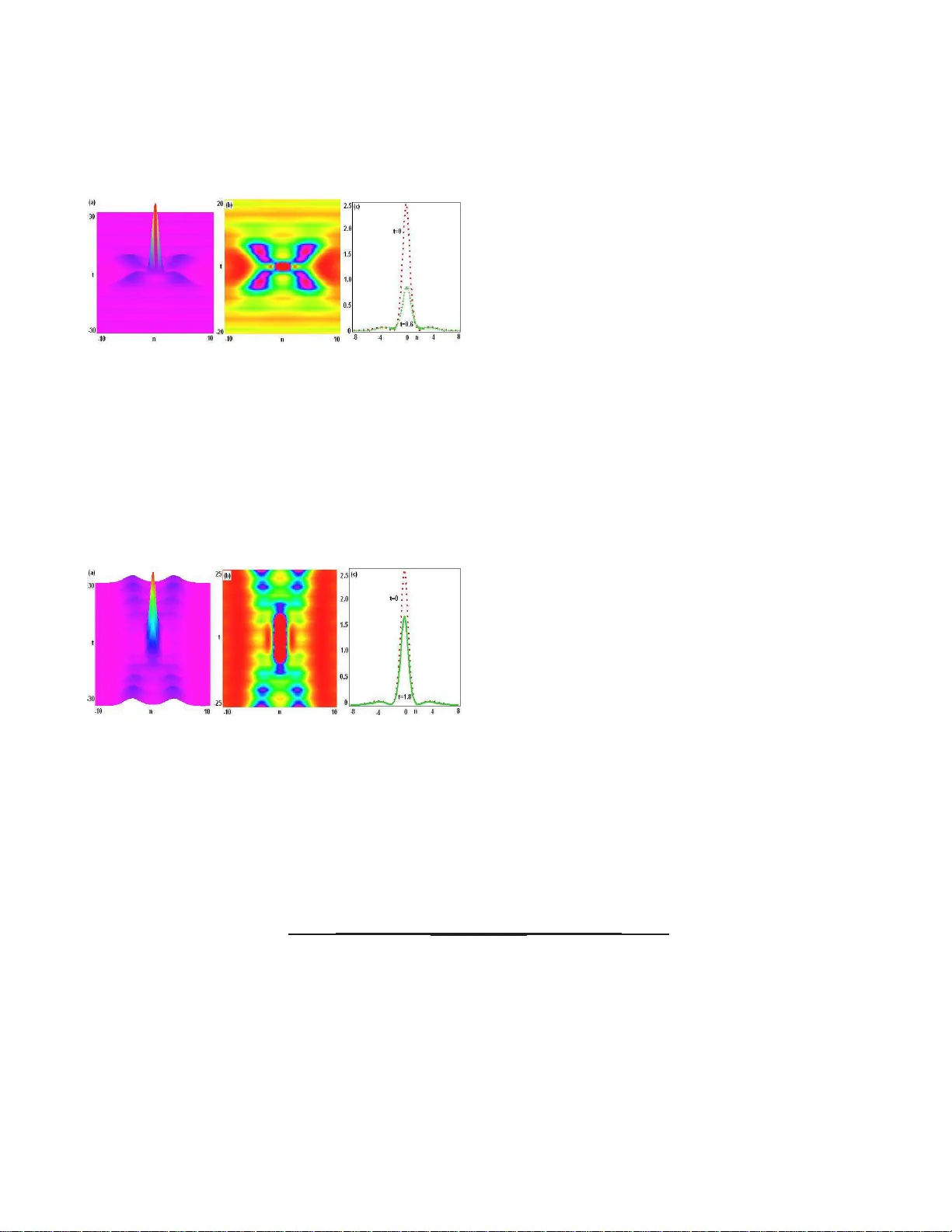
Nonautonomous discrete rogue w a v es and in teraction in the generalized Ablo witz-Ladik-Hirota lattice with v ariable co efficien ts Zheny a Y an 1 , Dongmei Jiang 1 , 2 , and W. M. Liu 3 1 Key L ab or atory of Mathematics Me chanization, Institut e of Systems Scienc e, AMSS, Chinese A c ademy of Scienc es, Beij ing 100190, China 2 Dep artment of Mathematics, Qingdao University of T e chnolo gy, Qingdao 266033, China 3 Beijing National L ab or atory for Condense d Matter Physics, Institute of Physics, Chinese A c ademy of Sci enc es, Beiji ng 100190, China W e analytically inv estigate the nonautonomous discrete rogue w av e solutions and their interaction in the generalized Ab lo witz-Ladik-Hirota lattice with v ariable co efficien ts, which p ossess complicated w av e propagations in time and are b ey ond the usual discrete rogue wa ves. When the amplitud e of the tunnel coupling co efficien t b etw een sites decreases, these nonautonomous discrete rogue wa ve solutions become lo calized in time after t hey propagate ov er some certain large critical va lues. Moreo ver, we find that the interactio n b etw een nonautonomous discrete rogue w av es is elastic. In particular, these results can reduce to the usual discrete rogue wa ve solutions when t h e gain or loss term is ignored. P ACS num b ers: 0 5.45.Yv, 42.65.Tg, 42.65.Wi I. INTRO DUCT ION Rogue wav es (alias as fr e ak waves, monster waves, kil ler waves, giant waves or extr eme waves ), as an im- po rtant physical phenomenon, a re lo calized b oth in space and time and depict a uniq ue even t that ‘app ears fro m nowhere and disa ppear s without a trace’ [1 ]. Rogue wa ves (R Ws) are also known as ‘ro gons’ if they reap- pea r virtually unaffected in size or shap e shortly after their in tera ctions [2]. The study o f R Ws has b ecome a significant sub ject in many fields since they can signal catastrophic phenomena such as thun der storms, earth- quakes, and h urr icanes. R Ws hav e b een found in the o cean [3, 4], nonlinear o ptics [5 – 7], Bose- E instein conden- sates [8], the atmosphere [9], and even the finance [1 0]. Moreov er , some ex perimental obser v ations hav e shown that optical R Ws do exist a nd play a pos itiv e role in non- linear optica l fibres [5 – 7]. Such optical R Ws differ fro m o ceanic R Ws that play a neg a tiv e role and lea d to many accounts of such wav es hitting pa ssenger s hips, co n tainer ships, oil ta nk ers, fishing b oats, and o ffshore and coasta l structures, so metimes with ca tastrophic conseque nc e s [4]. In particular, the analytic al R Ws hav e b een obta ined for the no nlinear Schr¨ odinger (NLS) equation [1, 11, 12], as well as some of their extensions w ith the v arying coef- ficient s [2], the higher orders [13], or the higher dimen- sions [14]. The discrete NLS equation [15] and the Ablowitz-Ladik (AL) la ttice [16, 17], as tw o pro to t ypical disc retizations of the contin uum NLS equation, ha ve b een studied ex- tensively in the field of nonlinear scie nce. The former is nonintegrable, but ha s so me interesting applications of physics [18 – 22]. The latter is integrable and p os- sesses a n infinite num b er of co nserv atio n laws [16, 17], as well as ha s b een depicted as an effectiv e lattice to study prop erties of the in trinsic lo caliz e d mo des [23]. More- ov er the nonintegrable discrete NLS equation c a n also be regarded a s a per turbation o f the integrable AL lat- tice [24]. In addition, the Salerno mo del (SM) has also bee n presented, interp olating be t ween the nonintegrable discrete NLS equation ( µ = 0 ) and the intregable AL lattice ( ǫ = 0 ) in the form [25 – 30] iψ n,t + ( ψ n + 1 + ψ n − 1 )(1 + µ | ψ n | 2 ) + ǫ | ψ n | 2 ψ n + v ψ n = 0 , (1) which c a n be der iv ed o n the ba s is of a v ariationa l pr in- ciple δ L SM /δ ψ ∗ n = 0 fro m the La grangian density L SM = X n i ( ψ ∗ n ψ n,t − ψ n ψ ∗ n,t ) + 4 Re ( ψ ∗ n ψ n +1 ) + µ ( ψ n + 1 + ψ n − 1 ) ψ ∗ n | ψ n | 2 + ǫ | ψ n | 4 + 2 v | ψ n | 2 , ( 2) where ψ n ≡ ψ n ( t ) stands for the complex field a mpli- tude at the n th site of the lattice, the parameter µ is the intersite nonlinea rit y and corre s ponds to the no nlin- ear coupling b etw een nearest neighbor s, ǫ measur es the int rins ic onsite nonlinearity , and v describ es the inhomo- geneous freq ue ncy shift. The SM has b een applied in bi- ology [25], and Bose -Einstein condensates [30]. Recently , the discr e te R Ws hav e also drawn m uch attention. The discrete NLS equation (i.e., for the case µ = 0 , ǫ = 1, and v = − 2 in E q. (1)) has numerically b een verified to suppo rt discrete R Ws [31]. The SM has also b een found to a dmit disc r ete R Ws fro m the viewp oint of statistica l analysis [32]. More r ecen tly , it has a lso b een shown that exact discrete R Ws [33, 3 4] can exist in the AL lattice (i.e., for the c ase µ = 1 , ǫ = 0, and v = − 2 in Eq. (1)) on the basis of the limit cases of their multi-soliton so- lutions [35]. How ever, there is no rep orts to date ab out nonautonomous discrete R Ws except for the AL lattice and the discre te Hir ota eq uation [3 3, 3 4]. In the presen t pap er, we will ex plore ex a ct no na u- tonomous discr ete R W so lutio ns and interaction of the generalized Ablowitz-Ladik-Hiro ta (ALH) lattice with v ar iable co efficients given by Eq. (3 ), i.e., the genera lized 2 case of Eq. (1) without the intrinsic onsite nonlinea r- it y , where the tunnel coupling c oefficients and the inter- site nonlinearity are the time-modulated, complex- v alued and real-v alued functions, respectively , the inhomog e - neous frequency shift are space- and time-mo dulated, real-v alued functions, and the time-dep enden t gain or loss term is added. T o do so, we will make us e of the differential-difference symmetry ana lysis that ca n con- nect this equation with v ar iable co efficients with the sim- pler ones. W e show that, for the attra ctiv e intersite non- linearity , the generalized ALH lattice w ith v aria ble co- efficients can supp ort nonautonomous dis crete R Ws in terms of the r ogue w ave so lutio ns of the discrete Hirota equation. Moreov er, we also ex hibit wa ve pro pa gations of no na utonomous discrete R W so lutions and their inter- action for so me chosen parameters and functions. The rest of this pap er is or ganized as follows. I n Sec. II, w e introduce the genera liz e d ALH lattice with v ariable co efficien ts, which contains so me sp ecial lattice mo dels, such a s the AL lattice, the disc rete Hirota e q uation, and the g eneralized AL lattice. In Sec. I I I, b y analyzing the phase of the co mplex field amplitude, we systematica lly present a similarity transfor mation reducing the genera l- ized ALH lattice with v ar ia ble co efficien ts to the discr ete Hirota equation. In Sec. IV, we deter mine the self-similar v ar iables and constra in ts satisfied b y the co efficient s in Eq. (3). Moreov er, we analy ze the r elations a mong these functions such that we find that the intersite nonlinear- it y (the inhomog eneous frequency shift) is related to the gain or loss term (the tunnel coupling co efficien t). Sec. V mainly discusses nonautonomous disc rete R W solutions and their interaction of Eq. (3 ) for some chosen par a m- eters and functions. F or the g iven p erio dic g ain o r loss term, when the amplitude of the tunnel coupling co effi- cient betw een sites decrea ses, these nonautonomo us dis- crete r ogue wa ve solutions are lo calized in space a nd keep the localiz a tion longer in time, which differ from the usual discrete rogue wa ves. Fina lly , w e give some conclusio ns in Sec. VI. II. THE GENERALIZED ABLOWI TZ-LADIK-HIROT A LA TT ICE WITH V ARIABLE C OEFFICIENTS W e her e address the g eneralized Ablowitz-Ladik- Hirota (ALH) la ttice with v aria ble co efficients mo deled by the following lattice i Ψ n,t + Λ( t )Ψ n +1 + Λ ∗ ( t )Ψ n − 1 1 + g ( t ) | Ψ n | 2 − 2 v n ( t )Ψ n + i γ ( t )Ψ n = 0 , (3) which c a n be der iv ed in terms of a v ariationa l principle δ L ALH /δ Ψ ∗ n = 0 fro m the following L agrangian dens it y L ALH = P n i (Ψ ∗ n Ψ n,t − Ψ n Ψ ∗ n,t ) + 4 Re [Λ( t )Ψ ∗ n Ψ n +1 ] + g ( t )[Λ( t )Ψ n +1 + Λ ∗ ( t )Ψ n − 1 ]Ψ ∗ n | Ψ n | 2 − 2[2 v n ( t ) − iγ ( t )] | Ψ n | 2 , (4) where Ψ n ≡ Ψ n ( t ) stands for the co mplex field amplitude at the n th site of the lattice, the complex-v a lued func- tion Λ( t ) is the co efficient of tunnel coupling b et ween sites and ca n b e rewritten as Λ ( t ) = α ( t ) + iβ ( t ) with α ( t ) and β ( t ) b eing differentiable, r eal-v alued functions, g ( t ) stands for the time-mo dulated intersite nonlinearity , v n ( t ) is the space- and time-mo dulated inho mogeneous frequency shift, and γ ( t ) denotes the time-mo dulated ef- fective gain or loss term. In fact, this nonlinea r la ttice mo del (3 ) contains many sp ecial lattice mo dels, suc h as the AL lattice for the case α ( t ) = co nst ., β ( t ) = v n ( t ) = γ ( t ) = 0, a nd g ( t ) = co nst . [16, 17], the AL equation with addi- tional term a c counding for dissaption for the ca se α ( t ) = const ., β ( t ) = v n ( t ) = 0 , γ ( t ) = const . , and g ( t ) = const . [26], the discrete Hirota equation for the case α ( t ) = const ., β ( t ) = const ., v n ( t ) = γ ( t ) = 0, and g ( t ) = const . [35], the genera liz ed AL lattice given b y Eq. (1) for the ca se α ( t ) = cons t ., β ( t ) = γ ( t ) = 0 , and g ( t ) = cons t . [3 6], and the dis c rete mo dified KdV equa- tion for the case α ( t ) = v n ( t ) = γ ( t ) = 0 , β ( t ) = co nst . , and g ( t ) = co nst . [37]. II I. DIFFERENTIAL-DIFFERENCE SIMILARITY REDUCTIONS AND CONSTRAINT EQUA TIONS W e consider the spatially lo calized solutions o f Eq. (3), i.e., lim | n |→∞ | Ψ n ( t ) | = 0 . T o this a im, we sear c h for a prop er similarity transfo r mation connecting solutions of Eq. (3) with those of the following discre te Hir ota e q ua- tion with co nstan t co efficien ts [35], namely i Φ n,τ + λ Φ n +1 + λ ∗ Φ n − 1 1 + | Φ n | 2 − 2Re ( λ )Φ n = 0 , (5) which c a n be der iv ed in terms o f a v ar iational principle δ L H /δ Ψ ∗ n = 0 from the following Lagr a ngian density L H = P n i (Φ ∗ n Φ n,τ − Φ n Φ ∗ n,τ ) + 4 Re ( λ Φ ∗ n Φ n +1 ) +( λ Φ n +1 + λ ∗ Φ n − 1 )Φ ∗ n | Φ n | 2 − 4 Re ( λ ) | Φ n | 2 , (6) where Φ n ≡ Φ n ( τ ) is a complex dynamical v ariable at the n th s ite o f the lattice, τ ≡ τ ( t ) is a real- v alued func- tion of time to b e determined, and the complex -v alued parameter λ ca n b e rewritten a s λ = a + ib with a and b being real- v alued pa rameters. The discre te Hir ota mo del (5) con tains some spec ia l physical models, such as the AL lattice for the ca se a = 1 and b = 0 [16, 17] and the discrete mKdV equation for the case a = 0 and b = 1 [37]. It ha s been shown in Ref. [38] tha t the discrete Hirota equation (5) is in fa c t an integrable dis c r etization of the three-or der NLS equation (also known as the Hi- rota equation) [3 9] iq t + a ( q xx + | q | 2 q ) − ib ( q xxx + 6 | q | 2 q x ) = 0 , (7) which plays an imp ortant r ole in nonlinear optics [40, 41]. T o show the ab ov e-mentioned aim, we here apply the similarity transforma tion in the form Ψ n ( t ) = ρ ( t ) e iϕ n ( t ) Φ n [ τ ( t )] (8) 3 to E q. (3), where the function ρ ( t ) and pha s e ϕ n ( t ) are bo th rea l- v alued functions of indicated v aria bles to b e determined. T o convenien tly substitute ans atz (8) in to Eq. (3) and to further ba lance the pha ses in every term in Eq . (3), i.e., Ψ n +1 ( t ), Ψ n ( t ), and Ψ n − 1 ( t ), we should firstly k now the explicit expr ession of the phase ϕ n ( t ) in transformatio n (8) in space. Here we consider the case that the phase is expres sed as a quadratic p olynomial in space with co efficients b eing functions of time in the form ϕ n ( t ) = p 2 ( t ) n 2 + p 1 ( t ) n + p 0 ( t ) with p 0 , 1 , 2 ( t ) b eing functions of time, which is sim- ilar to the phases in the co n tinuous NLS (or GP) equa- tions with v ar ia ble co efficients [42]. Based o n the sym- metry analy sis, we balance the c o efficients of these terms Ψ n +1 ( t ), Ψ n ( t ), and Ψ n − 1 ( t ) such that we find tha t the phase in transfor mation (8) sho uld b e a first degree p oly- nomial in space w ith co efficients b eing functions o f time, namely ϕ n ( t ) = p 1 ( t ) n + p 0 ( t ) , (9) where p 0 , 1 ( t ) are functions of time to be determined. Eq. (8) with the condition (9) allows us to reduce Eq. (3) to E q. (5), v ar iables in this reduction can b e de- termined fro m the requir e men t for the new co mplex field amplitude Φ n ( τ ( t )) to satis fy Eq. (5). Th us, we substi- tute transfor mation (8) into E q. (3 ) along with Eq. (9) and after relatively simple algebra obtain the following system of o r dinary differential equations ˙ ρ ( t ) + γ ( t ) ρ ( t ) = 0 , (10a) a ˙ τ ( t ) − α ( t ) cos p 1 ( t ) + β ( t ) sin p 1 ( t ) = 0 , (10b) [ bβ ( t ) + aα ( t )] sin p 1 ( t ) + [ aβ ( t ) − bα ( t )] × co s p 1 ( t ) = 0 , (10c) 2 v n ( t ) + ˙ p 1 ( t ) n + ˙ p 0 ( t ) + 2[ β ( t ) sin p 1 ( t ) − α ( t ) cos p 1 ( t )] = 0 , (10d) g ( t ) ρ 2 ( t ) = 1 , (10e) where the dot denotes the deriv ative with respec t to time. Therefore, if system (10) is consistent, then w e have constructed an algor ithm ge ne r ating nonautonomous so - lutions of E q. (3) based on tra nsformation (8) and solu- tions of E q . (5): Firstly , we solve Eqs. (10a)-(10c) to obta in the func- tions ρ ( t ) , τ ( t ), and p 1 ( t ) in tra nsformation (8). And then we co nsider Eqs. (10d) and (10 e) to deter - mine the inhomogeneous frequency shift v n ( t ) and the int er s ite nonlinearity g ( t ) in Eq. (3) in terms of a bov e- obtained functions ρ ( t ) , τ ( t ), and p 1 ( t ). Thu s, we hav e established a similarit y transforma - tion (8) connecting solutions of Eq. (5) and thos e of Eq. (3). In pa rticular, we here exhibit our a pproach in terms o f t wo low est- o rder discrete rogue wav e s olutions of Eq. (5) as seeding solutions to find no nautonomous discrete rog ue wa ve solutions of Eq. (3). IV. DETERMINING THE SIMILARITY TRANSFORMA TION AND COEFFICIENTS It follows fro m Eqs. (10 a )-(10 c) that we ca n obtain the v ar iables ρ ( t ) , p 1 ( t ) and τ ( t ) in transfo rmation (8) in the form ρ ( t ) = ρ 0 exp − Z t 0 γ ( s ) ds , (11a) p 1 ( t ) = tan − 1 bα ( t ) − aβ ( t ) aα ( t ) + bβ ( t ) , (11b) τ ( t ) = ( a 2 + b 2 ) − 1 / 2 Z t 0 [ α 2 ( s ) + β 2 ( s )] 1 / 2 ds, (1 1c) where ρ 0 is an integration constant. No w it follows fro m Eqs. (10d) and (1 0e) along with Eqs. (11 a ) and (11b) that we further find the inhomogeneous fr equency shift v n ( t ) and intersite nonlinearity g ( t ) in the form g ( t ) = ρ − 2 0 exp 2 Z t 0 γ ( s ) ds , (12a) v n ( t ) = v 1 ( t ) n + v 0 ( t ) , (12b) where we hav e in tro duced tw o functions in the inhomo - geneous frequency shift v n ( t ) in the form v 1 ( t ) = α ( t ) ˙ β ( t ) − ˙ α ( t ) β ( t ) 2[ α 2 ( t ) + β 2 ( t )] , (13a) v 0 ( t ) = a α 2 ( t ) + β 2 ( t ) a 2 + b 2 1 / 2 − ˙ p 0 ( t ) 2 , (13b) where p 0 ( t ) is a n arbitrar y differen tiable function of time. It fo llo ws from E qs. (12a)-(13b) that, in these co effi- cients of Eq. (3), the intersite nonlinea rit y g ( t ) (the inho - mogeneous frequency shift v n ( t )) is related to the gain or loss term γ ( t ) (the tunnel co upling Λ( t ) = α ( t ) + i β ( t )). This means that only tw o v arying co efficien ts (e.g., γ ( t ) and Λ( t ) = α ( t ) + iβ ( t )) a re left free. Moreover, it follows from E q. (12a) that the intersite nonlinearity g ( t ) is al- wa ys p ositive (i.e., the attractive in tersite nonlinea rit y). In addition, it follo ws from E q. (11a) that the gain or loss term γ ( t ) can also control the function ρ ( t ), which is used to mo dulate the amplitude of the co mplex field Ψ n ( t ). F or the inhomogeneous frequency shift v n ( t ) given by Eq. (12b), when α ( t ) 6 = cβ ( t ) with c being a constant, the inhomog e neous frequency shift v n ( t ) is a linea r func- tion of space n with co efficient s b e ing functions of time. In the a bsence of the discrete space n in the inhomo- geneous frequency shift, i.e., v n ( t ) ≡ v ( t ), which mea ns that ˙ p 1 ( t ) = 0 on the basis of E q. (10d), there exist t wo cases to b e discuss ed: i) If p 1 ( t ) 6 = 0 in which we hav e p 1 ( t ) = p 1 = const 6 = 0, then this means that ϕ n ( t ) is still a linear function of the discrete space n , i.e., ϕ n ( t ) = p 1 n + p 0 ( t ). In this case, the v ar iable function τ ( t ) a nd the inhomogeneo us frequency 4 FIG. 1. (color online). Profiles of th e co efficien ts of the generalized ALH lattice with v ariable co efficien ts given by Eq. (3) vs time for th e parameters given by Eq. (17) with parameters γ 0 = c 1 = c 2 = 1. (a) the coefficient v 1 ( t ) giv en by Eq. (13a) of the first degree term of the inhomogeneous frequency shift v n ( t ) given by Eq. (12b), (b) nonlinearity g ( t ) given by Eq. (12a) , and (c) the gain or loss term γ ( t ). shift v n ( t ) are g iv en by τ ( t ) = R t 0 α ( s ) ds a cos( p 1 ) + b sin ( p 1 ) , v n ( t ) = aα ( t ) a cos( p 1 ) + b sin( p 1 ) − ˙ p 0 ( t ) 2 , and ρ ( t ) , g ( t ) a r e sa me as Eqs. (11a) a nd (1 2 a); ii) If p 1 ( t ) = 0, i.e., tan − 1 { [ bα ( t ) − aβ ( t )] / [ a α ( t ) + bβ ( t )] } = 0, which means that the relation for the co effi- cients in Eq. (3 ), α ( t ) = ( a/b ) β ( t ), is r equired and ϕ n ( t ) is only a functions of time, i.e., ϕ n ( t ) ≡ p 0 ( t ), then the v ar iable function τ ( t ) and the inhomo geneous frequency shift v n ( t ) are g iv en by the form τ ( t ) = 1 a Z t 0 α ( s ) ds, v n ( t ) = α ( t ) − ˙ p 0 ( t ) 2 , and ρ ( t ) , g ( t ) a re same as Eq s. (11 a) and (12 a), where γ ( t ) , α ( t ) a nd p 0 ( t ) are free functions of time, and a, b, ρ 0 are all free pa rameters. V. NONA UTONOMOUS DISCRETE RO GON SOLUTIONS AND INTERACTION In general, we hav e a large degree o f freedom in choos- ing the co efficients of similarity transfor mation (8) and Eq. (3). As a consequence, we can obtain an infinitely large family of exact solutions of the genera lized ALH lat- tice with v aria ble co efficients given by Eq. (3) in terms of ex a ct solutions of the discrete Hirota equation (5) and transformatio n (8). In particular, if we consider disc r ete rogon solutions of Eq. (5) as seeding solutio ns , then w e can obtain many types o f nonauto nomous (including ar- bitrary time-de p endent functions) discr ete rogo n (rogue wa ve) so lutions of Eq. (3). As t wo repr esen tative ex am- ples, we consider the low est-or der discrete rogon so lutions of Eq . (5) as tw o examples [33] to study the dyna mics of nonautonomous discrete r ogon so lutions o f Eq. (3 ). A. Nonautonomous discrete one-rogon solution Firstly , based on the similarity transfo rmation (8) and one-rog on s olution of the discr ete Hirota equa tion (5), we present the nonauto nomous discr e te one-r ogon s olution (also known as the first-order r a tional solution) of Eq. (3) in the for m Ψ (1) n ( t ) = ρ 0 √ µ exp − Z t 0 γ ( s ) ds + i [ ϕ n ( t ) + ˆ ϕ n ( τ )] × " 1 − 4(1 + µ ) 1 + 4 iµ √ a 2 + b 2 τ ( t ) 1 + 4 µn 2 + 1 6 µ 2 (1 + µ )( a 2 + b 2 ) τ 2 ( t ) # , (15) where the par t phase ˆ ϕ n ( τ ) is defined by ˆ ϕ n ( τ ) = 2 τ ( t ) h (1 + µ ) p a 2 + b 2 − a i − n tan − 1 ( b/a ) , (1 6) µ is a p ositive para meter, the v ariable τ ( t ) is given b y Eq. (1 1 c), and the phase ϕ n ( t ) = p 1 ( t ) n + p 0 ( t ) with p 1 ( t ) g iven by Eq. (11b) and p 0 ( t ) b eing an a rbitrary differentiable function of time. T o illustrate the wav e pro pagations of the obtained nonautonomous discrete o ne-rogon solution (15), we ca n choose these free parameters in the form α ( t ) = c 1 sin(2 t ) , β ( t ) = c 2 cos( t ) , γ ( t ) = γ 0 sin( t ) cos 2 ( t ) , a = b = µ = ρ 0 = 1 , (17) where γ 0 , c 1 , 2 are consta n ts. Figure 1 depicts the pr o files of the co efficient v 1 ( t ) = [ α ( t ) ˙ β ( t ) − ˙ α ( t ) β ( t )] / { 2[ α 2 ( t ) + β 2 ( t )] } o f the first deg ree term of the inho mo geneous fr equency shift v n ( t ) given by Eq. (13a), the a ttractiv e intersite nonlinear it y g ( t ) given b y E q. (12a), a nd the g ain or lo ss term γ ( t ) vs time for the parameters given by E q . (17). The evolu- tion of the in tensity distribution for the o ne-rogon so- lution given b y Eq. (15) is illustr ated in Fig. 2 for pa- rameters γ 0 = c 1 = c 2 = 1. The discrete rogue w ave 5 FIG. 2. (color online). Profiles of nonautonomous discrete one-rogon solution (15 ) of the generalized ALH lattice with v ariable coefficients given by Eq. (3) for the parameters give n by Eq . (17 ) with γ 0 = c 1 = c 2 = 1. (a) th e in tensity distribution | Ψ (1) n ( t ) | 2 with max ( n,t ) | Ψ (1) n ( t ) | 2 ∼ = 4 . 7, ( b ) the density distribution | Ψ (1) n ( t ) | 2 , (c) the intensit y distributions | Ψ (1) n ( t ) | 2 for t = 0 , 0 . 2, which means th at the amplitude de- creases as time increases, and th e peak falls t he lo we r p osition after time exceeds ab out 1. FIG. 3. (color online). Profiles of nonautonomous discrete one-rogon solution (15 ) of the generalized ALH lattice with v ariable coefficients given by Eq. (3) for the parameters give n by Eq. (17) with γ 0 = 1 , c 1 = 0 . 01, and c 2 = 0 . 02. (a) the intensit y distribution | Ψ (1) n ( t ) | 2 with max ( n,t ) | Ψ (1) n ( t ) | 2 ∼ = 43 . 2, (b) the d ensit y distribution | Ψ (1) n ( t ) | 2 , (c) the intensity distributions | Ψ (1) n ( t ) | 2 for t = 0 , 3, which means that the amplitude decreases as time increases, and the p eak falls the lo wer p osition after time exceeds ab out 70. solution is lo calized bo th in space and in time, th us re- vealing the usua l discr e te ‘rog ue wav e’ features . How ever if we fix the co efficient γ 0 = 1 of the gain or loss term and adjust the co efficients c 1 = 0 . 01 , c 2 = 0 . 02 of the tun- nel couplings α ( t ) and β ( t ) g iv en by E q. (17), then the evolution of the intensit y distribution for the o ne-rogon solution is changed (see Fig . 3), and it follows fro m Fig. 3 that the discrete one-r ogon solution in this c a se is lo cal- ized in spa ce and keep the lo calization lo nger in time than usual rogue wav es (see [33]). Mor eov er, it follows from Fig s . 2(c) and 3(c) that the a mplitude of the dis- crete one-r ogon solution decreases as time increas es, and the amplitude in Fig. 2(c) is de c reased faster than one in Fig. 3(c) as time increases . B. The int e raction b etw een nonautonomous discrete rogon solutions Here we co ns ider the in teraction b et ween nonau- tonomous discr ete rog on so lutions. T o do so, we ap- ply a second-or der ratio nal solution of the disc rete Hi- rota equation (5) to the similarity transfor mation (8) such that we can o btain the nonautonomous discrete t wo- rogon solution o f Eq. (3) in the for m Ψ (2) n ( t ) = ρ 0 √ µ exp − Z t 0 γ ( s ) ds + i [ ϕ n ( t ) + ˆ ϕ n ( τ )] × 1 − 12(1 + µ ) P (2) n ( τ ) + i q T ( τ ) 1+ µ Q (2) n ( τ ) H (2) n ( τ ) , (18) which displays the int er action betw een nona utonomous discrete ro gon so lutio ns, where µ is a po sitiv e pa rameter, the functions P (2) n ( τ ) , Q (2) n ( τ ) and H (2) n ( τ ) are all p oly- nomials of space a nd time given by P (2) n ( τ ) = 5 T 2 + 6 ( N + 2 µ + 3) T + N 2 +(6 − 4 µ ) N − 3(4 µ + 1) , Q (2) n ( τ ) = T 2 + 2 ( N + 1) T + N 2 − (16 µ + 6) N − 3(8 µ + 5) , H (2) n ( τ ) = T 3 + 3( N + 8 µ + 9) T 2 + 3( N 2 − 6 N − 16 µ N + 48 µ 2 + 72 µ + 33) T + N 3 + (3 − 8 µ ) N 2 + (27 + 24 µ + 16 µ 2 ) N + 9 , where we hav e int r o duced N = 4 µn 2 and T = 1 6 µ 2 (1 + µ )( a 2 + b 2 ) τ 2 , τ ≡ τ ( t ) is given by Eq. (11 c), the part phase ϕ n ( t ) = p 1 ( t ) n + p 0 ( t ) with p 1 ( t ) given by Eq . (11 b) and p 0 ( t ) b eing a n arbitrary differentiable function of time, and the pa rt phas e ˆ ϕ n ( τ ) is given by Eq. (1 6). Similarly , we can choose these free parameters given by Eq. (17) for the nonautonomous discrete t wo-rogon solution given b y E q. (18) except for µ = 1 / 16. Fig- ures 4 and 5 depict the evolution o f in tensity distribu- tion for the interaction b et ween no na utonomous dis crete rogon so lutions (discrete t wo-rogon so lution) given b y Eq. (18) for different pa rameters γ 0 , c 1 , and c 2 , res p ec- tively . Moreover, we find that the interaction b etw een nonautonomous discrete r ogue wa ves is elastic. Figure 4 shows that the nona utonomous discrete t wo-rogo n solu- tion is lo calized bo th in s pa ce a nd in time, thus revealing the usual discrete ‘rogue wa ve’ features for the chosen parameters γ 0 = 1 , c 1 = 2 , c 2 = 1, but if we fix the co- efficient γ 0 = 1 of the gain or los s ter m and a djust the co efficien ts c 1 = 0 . 2 , c 2 = 0 . 1 of the tunnel couplings α ( t ) and β ( t ) given by Eq . (17), then the evolution o f the in- tensity distribution for the discre te tw o - rogon solution is changed (see Fig. 5), and it follows fro m Fig. 5 that the nonautonomous discr ete t wo-rogon solution is lo calized in space and keep the loca liz ation longe r in time than 6 usual rog ue w aves. Moreover, it follows from Figs . 4(c) and 5(c) that the amplitude of the dis crete tw o-rog on so- lution decreas e s as time incr eases, and the a mplitude in Fig. 4(c) decreases faster tha n one in Fig. 5(c) as time increases. FIG. 4. (color online). Profiles of the intera ction b etw een nonautonomous discrete rogon solution given by Eq. (18) of the generalized ALH lattice with va riable co efficien ts given by Eq. (3) for the parameters given by Eq. (17) with γ 0 = 1 , c 1 = 2, and c 2 = 1. (a) the intensit y d istribution | Ψ (2) n ( t ) | 2 with max ( n,t ) | Ψ (2) n ( t ) | 2 ∼ = 1 . 65, (b) the density dis- tribution | Ψ (2) n ( t ) | 2 , (c) the intensit y d istributions | Ψ (2) n ( t ) | 2 for t = 0 , 0 . 6, which means that the amplitude decreases as time increases, and the p eak falls the low er p osition after time exceeds ab out 3. FIG. 5. (color online). Profiles of the intera ction b etw een nonautonomous discrete rogon solution given by Eq. (18) of the generalized ALH lattice with va riable co efficien ts given by Eq. (3) for the parameters given by Eq. (17) with γ 0 = 1 , c 1 = 0 . 2, and c 2 = 0 . 1. (a) the intensit y distribut ion | Ψ (2) n ( t ) | 2 with max ( n,t ) | Ψ (2) n ( t ) | 2 ∼ = 2 . 25, (b) the density dis- tribution | Ψ (2) n ( t ) | 2 , (c) the intensit y d istributions | Ψ (2) n ( t ) | 2 for t = 0 , 1 . 8, which means that the amplitude decreases as time increases, and the p eak falls the low er p osition after time exceeds ab out 65. VI. CONCLUSIONS In conclusion, w e hav e studied nonauto nomous dis- crete rogo n solutions and their in tera ction in the gener al- ized Ablowitz-Ladik-Hirota lattice with the v arying tun- nel coupling, intersite nonlinearity , inhomogeneous fre- quency s hift, and gain or loss term given by Eq. (3) on the basis o f the differential-difference similar it y reductio n (8). W e found its some nonautonomo us discrete r ogon solutions when the intersite nonlinearity g ( t ) (the inho- mogeneous frequency shift v n ( t )) is related to the gain or loss term γ ( t ) (the tunnel coupling Λ ( t ) = α ( t ) + i β ( t )) (see Eqs. (12a) and (12b)). This denotes that only tw o co efficien ts (i.e., γ ( t ) a nd Λ( t ) = α ( t ) + iβ ( t )) are left free. In particula r, we hav e studied wav e propagations of nonautonomous dis c rete r o gon solutio ns and in ter a ction for s ome chosen para meters, which exhibit co mplicated rogue wa ve construes . F or the given p erio dic gain or loss term, when the a mplitude of the tunnel coupling co efficien t b etw een sites decreas es, these nonautono mous discrete ro gon so lutio ns a r e lo calized in space and k eep the localiz a tion longer in time, which differ from the usual discrete r ogue wav es of no nlinea r discrete equations (e.g., the AL la ttice a nd the discrete Hiro ta eq ua tion) [33]. Moreov er , nonautonomous discr ete rog on s o lutions and in terac tio n may provide more do cuments to fur- ther understand the physical mechanism of discrete rogue wa ve pheno mena. The approa c h may also b e extended to other discr ete nonlinear la ttices with v ariable co efficien ts for studying their discr ete ro gue wa ve solutions and wa ve propaga tions. ACKNO WLEDGMENT S This work w as supp orted by the NSF C under Grant Nos. 60821 002F02, 11 071242, 1 0874235 , 10934 010, 6097 8 019, the NKBRSF C under Grants Nos. 2009CB 930701, 20 10CB922 9 04 and 20 1 1CB9215 0 0. [1] N. A k hmediev, A . Ank iewi cz, and M. T aki, Phys. Lett. A 373 , 675 (2009); N. Akhmediev, A . A nkiewicz, and J. M. Soto-Cresp o, Phys. Rev. E 80 , 026601 (2009); A. Ankiewicz, J. M. Soto-Cresp o, and N. Akhmed iev , Phys. Rev. E 81 , 046602 (2010); A. Ankiewicz, P . A. Clarkson, and N. A khmediev, J. Phys. A 43 , 122002 (2010). [2] Z. Y. Y an, Phys. Lett. A 374 , 672 (2010). [3] C. K harif and E. P elinovsky , Euro. J. Mec h. B/Fluids 22 , 603 (2003). [4] K. Dysthe, H. E. Krogstad, and P . M ¨ uller, A nn u. Rev. Fluid Mech. 40 , 287 (2008). [5] D. R. Solli, C. Rop ers, P . Koonath, and B. Jalali, Nature (London) 450 , 1054 (2007). [6] D. R. Solli, C. R opers, and B. Jalal i, Phys. Rev . Lett. 101 , 233902 (2008). [7] B. Kibler, J. F atome, C. Finot, G. Millot, F. Dias, G. Gent y , N. Akhmediev, and J. M. D udley , Nature Phys. 6 , 1 (2010). 7 [8] Y. V. Blud ov, V. V . Konotop, and N. Akh mediev, Ph ys. Rev. A 80 , 033610 (2009). [9] L. Sten flo and M. Marklun d, J. Plasma Phys. 76 , 293 (2010). [10] Z. Y. Y an, Comm un. Theor. Phys. 54 , 947 (2010) [e- print, [11] Y . C. Ma, Stud . Ap pl. Math. 60 , 43 (1979). [12] D . H. P eregrine, J. Au st. Math. So c. Ser. B, Ap pl. Math. 25 , 16 (1983). [13] A . Ankiewicz, N. D evine, and N. Akh mediev, Phys. Lett . A 373 , 3997 (2009). [14] Z. Y. Y an, V. V. Konotop, and N . Akhmediev , Phys. Rev. E 82 , 036610 (2010); Z. Y. Y an, J. Math. An al. Appl. 380 , 689 (2011). [15] J. C. Eilbeck, P . S . Lomdahl, and A. C. Scott, Physica D 16 , 318 (1985). [16] M. J. Ab lo witz and J. F. Ladik, Stud. Appl. Math. 55 , 213 (1976). [17] M. J. Ab lowitz and J. F. Ladik, J. Math. Phys. 17 , 1011 (1976). [18] D . Henn ig and G. P . Tsironis, Phys. Rep. 307 , 333 (1999). [19] Y . V. K artasho v, B. A. Malomed, and L. T orner, Rev. Mod. Phys. 83 , 247 (2011). [20] M. J. Ablowitz, B. Prinari, and A. D. T rubatch, Discr ete and c ontinuous nonline ar Schr¨ odinger systems (Cam- bridge Universit y Press, Cambridge, 2004). [21] P . G. K evrekidis, The Discr ete Nonline ar Schr¨ odinger Equation: Mathematic al Analysis, Numeric al Computa- tions and Physic al Persp e ctives (S pringer, Berlin, 2009). [22] F. Led erer, G. I. Stegeman, D. N. Christo doulides, G. Assanto , M. Segev, and Y. Silb erb erg, Ph ys. R ep. 463 , 1 (2008). [23] S . T akeno and K. Hori, J. Ph ys. So c. Jpn. 59 , 3037 (1990). [24] Y . S. Kivshar and D. K. Campb ell, Phys. Rev . E 48 , 3077 (1993). [25] M. Salerno, Phys. Rev. A 46 , 6856 (1992). [26] D . Cai, A. R . Bishop, N. Grønbech-Jensen, and B. A. Malomed, Phys. R ev. E 50 , R694 (1994); D . Cai, A. R. Bishop, and N. Gronbech-Jensen, Phys. Rev. Lett. 72 , 591 (1994). [27] Y . Kivshar and M. Salerno, Phys. Rev. E 49 , 3543 (1994). [28] V. V. Konotop and M. Salerno, Phys. R ev. E 55 , 4706 (1996). [29] Z. W. Xie, Z. X. Cao, E. I. Kats, and W. M. Liu, Phys. Rev. A 71 , 025601 (2005). [30] A. T rombettoni and A. Smerzi, Phys. Rev. Lett. 86 , 2353 (2001); J. Gomez-Garden˜ es, B. A. Malomed, L. M. Flor ´ ıa, and A. R . Bishop, Phys. Rev. E 73 , 036608 (2006); i bid , 74 , 036607 (2006). [31] Y. V . Bludov, V. V. Konotop, and N. Ak hmediev, O pt. Lett. 34 , 3015 (2009). [32] A. Maluc ko v, Lj. Had˘ zievski, N. Lazarides, and G. P . Tsironis, Phys. Rev. E 79 , 025601R (2009). [33] A. Ankiewicz, N. Akhmediev, and J. M. Soto-Crespo, Phys. R ev. E 82 , 026602 ( 2010 ). [34] N. Akhmediev and A. A n kiewicz, Ph ys. Rev. E 83 , 046603 (2011). [35] K. Narita, J. Ph y s. So c. Jpn. 59 , 3528 (1990); ibid , 60 , 1497 (1991). [36] B. Miec k and R. Graham, J. Phys. A 38 , L139 (2005). [37] M. J. Ablowi tz and J. F. Lad ik , S tud. A ppl. Math. 57 , 1 (1977). [38] M. Daniel and K. Maniv annan, J. Math. Phys. 40 , 2560 (1999). [39] R. Hirota, J. Math. Phys. 14 , 805 (1973). [40] Y. S. Kivshar and G. P . Agraw al, Optic al solitons: f r om fib ers to photonic crystals (Academic Press, New Y ork, 2003); B. A. Malomed, D. Mihalache, F. Wise, and L. T orner, J. Opt. B: Quantum Semiclassical Opt. 7 , 53R (2005). [41] G. P . Agraw al, N onl ine ar Fib er O ptics (4th. Ed ., Aca- demic Press, San Diego, 2007); A. Hasega wa and Y. Ko- dama, Solitons i n Optic al Communic ations (Clarendon Press, Oxford, 1995). [42] S. A. Ponoma renko and G. P . Agra wal, Phys. Rev. Lett . 97 , 013901 (2006); V. N. Serkin, A . Hasegaw a, and T. L. Bely aev a, ibid . 98 , 074102 ( 2007 ); J. Belmonte-Beitia, V. M. Perez-Garcia, V. V ekslerchik, and P . J. T orres, ibi d . 98 , 064102 ( 2007 ); Z. Y. Y an, Phys. Lett. A 361 , 223 (2007); Z. Y. Y an, Phys. Scr. 75 , 320 (2007). Z. Y. Y an and V . V . Konotop, Phys. Rev. E 80 , 036607 (2009); Z. Y. Y an and C. H ang, Phys. Rev. A 80 , 063626 (2009).
Original Paper
Loading high-quality paper...
Comments & Academic Discussion
Loading comments...
Leave a Comment