Illumination problems on translation surfaces with planar infinities
In the current article we discuss an illumination problem proposed by Urrutia and Zaks. The focus is on configurations of finitely many two-sided mirrors in the plane together with a source of light placed at an arbitrary point. In this setting, we s…
Authors: Nikolay Dimitrov
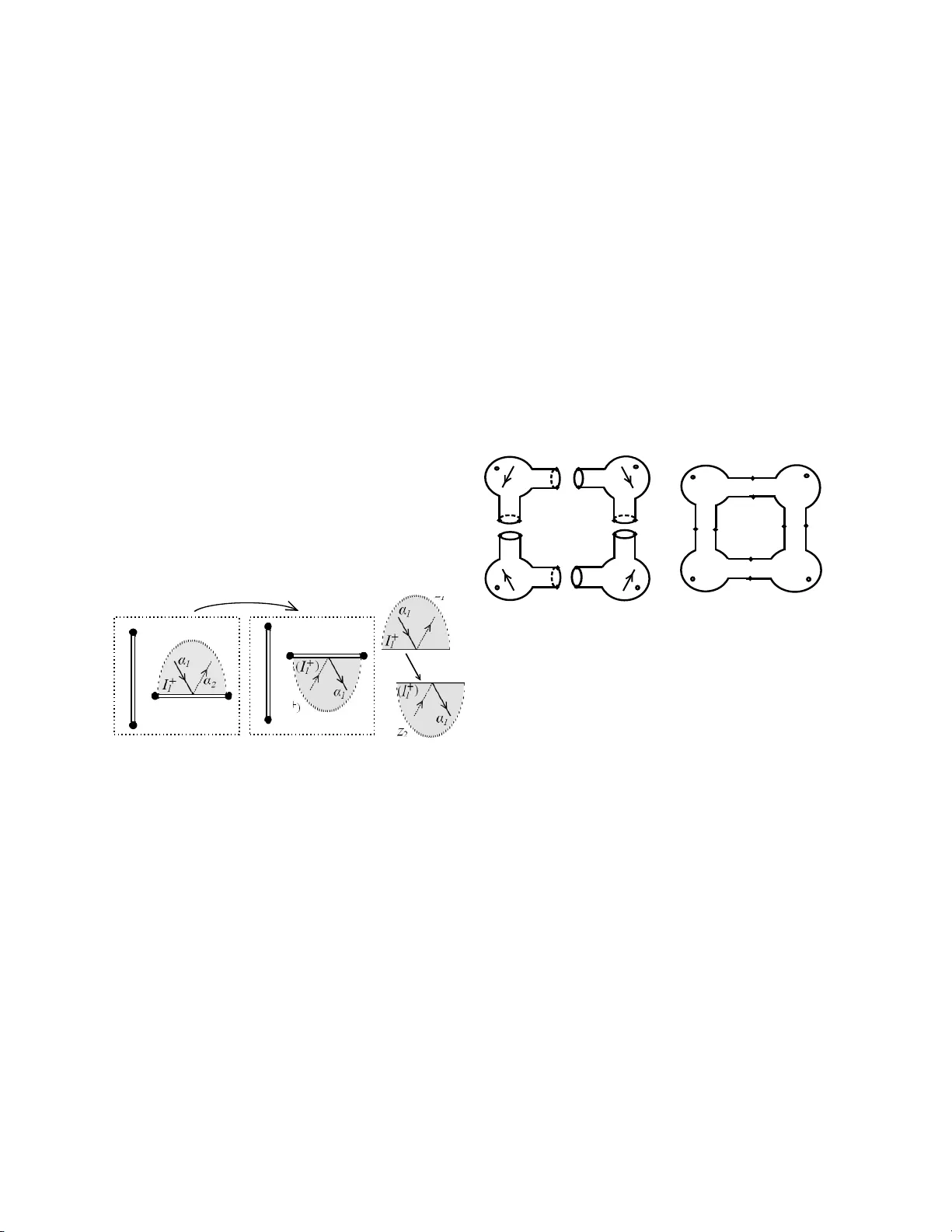
Illumination problems on translation surfaces with planar infinities Nik ola y Dimitrov ∗ Abstract In the curre nt article we discus s an illumination pro b- lem prop osed by Urrutia and Zaks. The fo cus is on configuratio ns of finitely many t wo-sided mirr ors in the plane together with a source of light placed at an arbitrar y p oint. In this setting, w e study the r egions unilluminated b y the source. In the c ase of rational- π angles betw een the mir rors, a planar configuration gives rise to a s urface with a translation struc tur e and a num b er of planar infinities. W e show that on a sur face of t his t yp e with at lea st tw o infinit ies, one can find plent y of unilluminated re gions isometric to un b ounded plana r sector s . In addition, we establish that the non-bijectivit y of a certain circle map implies the existence o f un b ounded dark sector s for rational planar mirror configurations illuminated b y a ligh t- source. 1 In tro duc tion Consider a planar do main with a ligh t reflecting bo undary . Place a source of light a t a po int inside the domain. Assume that the source emits rays in all dir ections. Each ray follows a stra ight line a nd whenever it reaches the b oundar y it is reflected ac- cording to the rule that the angle of incidence equals the angle of reflection. A point from the domain is considered illu minate d by the sourc e whenever there is a ray that rea ches the p oint e ither directly or a fter a series o f reflections. In this s etting, o ne can a sk the following ques tions, also known as il lumination pr oblems . Question 1. If we plac e the sourc e of light at any ∗ Departmen t of Mathemat ics and Statistics, McGill Uni- v ersity , dimitrov@math.m cgill.ca p oint in the domain, wil l al l of the domai n b e il lu- minate d? If not, what c ould b e s aid ab out the non- il luminate d r e gions? Question 2. Is ther e a p oint fr om which the light sour c e c an il lum inate the ent ir e domain? These problems a re often attributed to E. Straus who p ose d them so metime in the ea r ly fifties and first published b y V. Klee in 1969 [5]. Some famo us ex- amples and interesting results are Penrose’s ro om [1], T ok a rsky’s e xample [5 ] as well as the ar ticle [3] b y Huber t, Schm oll and T roub etzkoy on illumination on V eec h surfaces. In 1991, J. Urrita and J. Zaks pro po sed the follow- ing problem [6]. Assume we ar e given a finite num b er of disjoin t compa ct line segmen ts in the plane eac h representing a mirror that reflects light on bo th sides (a tw o- sided mirro r). Let p 0 be an y po int on the S S a) b) P Figure 1: plane not incide nt to an y o f the segmen ts. Then, the complement of the set of mir rors is an unbounded do - main with light-reflecting b o undary and if w e place a so urce of light S a t p 0 we can p ose questions 1 and 2. Figure 1a depicts an exa mple of a tw o-sided mir- ror configuration with a light emitting source S . The 1 conv ex h ull of the mirrors is a polygon. If S is in the conv ex hull, one can construct a triangle P unillu- minated by S , lik e the shaded o ne on fig ure 1 b. T o do that, it is sufficient f or a m irr or seg ment to be an edge of t he conv ex h ull. In this pap er we are interested in finite t wo-sided mirror configura tions with the following prop er ty: any pair of lines determined by the mirror seg ments are either parallel o r intersect at a n angle which is a rational m ultiple of π . W e will call suc h a configura- tion a r ational mirr or c onfigur ation and the doma in obtained as a complement o f the mirro rs will b e called r ational mirr or domain . F or those, we will find condi- tions that will g uarantee the existence of unbounded unilluminated sectors in the plane (see definition 2). A ra tional mirr or doma in can b e ” unfolded” in to a surface that car ries a flat structur e with conical sin- gularities a nd trivial ho lonomy g roup [2], [4]. This means that the surface has a sp ecia l atlas with the prop erty that aw ay from the cone p oints, the transi- tion maps betw een tw o charts from the atlas are Eu- clidean translations. In the litera ture, such an o b ject is calle d a tr anslation surfac e . As a r esult, the piece- wise linear tra jectory of a light r ay in the o r iginal domain becomes a smoo th geo desic on the flat sur- face. Thus, one can think of a ligh t source placed at a no nsingular po int on the surfac e , emitting geo desic rays in all directio ns. Any other p oint on the surface is considered il luminate d if there is a smo oth g eo desic connecting the s ource to the p oint. In this way , one can ask questions 1 and 2 f or the translation sur face. Notice that there ar e regions on it isometric to com- plement s of compa ct sets in the plane. W e will call a surface with such geometry a tr anslation surfac e with planar infinities . A tra nslation surface with pla nar infinities gives rise to a pair ( X , ω ) where X is a closed surface with a co mplex structure and ω is a meromo rphic differ- ent ial on X with only double p oles and z e ro residues. The zeroes of ω are t he cone points o f the flat struc- ture [2],[4], and a round each pole the surface lo o ks like the complemen t of a compact set in the plane. The converse is also true . A pair ( X, ω ) of a closed Riemann surface and a meromorphic differe ntial with only double p o les and zer o residues induces a trans- lation structure o n X with pla nar infin ities. Definition 1. The p air ( X , ω ) is c al le d a tr anslation surfac e with pla nar infinities whenever t he fol lowing c onditions hold: (1) X is a close d surfac e with a c omplex stru ctur e; (2) ω is a mer omorphic differ ential on X ; (3) Every p ole of ω is of or der exactly 2 and the r esidue a t that p ole is zer o. We will r efer t o t he p oles of ω as planar infinities. In this study we will b e interested in a sp ecial t yp e of domains b oth on a tr anslation surface wit h planar infinities and in the plane. Definition 2. a) L et l 1 and l 2 b e two half -lines in the plane b oth st arting form a p oint p 0 and going t o infinity. L et θ b e the angle b etwe en l 1 and l 2 at the vertex p 0 , m e asur e d c ounter clo ckwise fr om l 1 to l 2 . Then, the op en r e gion C b ounde d by l 1 and l 2 , whose internal angle at p 0 is θ , is c al le d an infinite se ctor of angle θ (se e figur e 2a). b) An op en sub domain C of a t r anslation surfac e with planar infinities ( X , ω ) is c al le d an infinite se ctor of angle θ whenever t her e ex ists a chart fr om the tr ans- lation atlas of ( X , ω ) that maps C isometric al ly to a planar infinite se ctor of angle θ like the one define d in p oint a. p 0 l 2 l 1 θ C a) b) p 0 q l l q p 0 α α (α) (α) = l q (0) l p 0 (0) Figure 2: On any translation s ur face ( X , ω ) one can alw ays find an orien table foliation F ω with singularities, whose leaves are geo desics. Indeed, let us foliate the E uclidean plane into horizo nt al straig ht lines, or i- ent ed as usual from left to right. Since ea ch transi- tion map b etw een tw o charts is a Euclidean transla - tion, it sends horizontal lines to horizontal lines (line 2 orientation pr e served). Th us, pulling bac k on to the surface the plana r horizo nt al foliation from a ll trans- lation charts defines globa lly the desired folia tion F ω . Moreov er, the singularities of F ω are the cone p oints of the sur face ( X , ω ), i.e. the zero es of the differential ω . W e ca ll F ω the horizontal foliation of the surface and its le av es - the horizontal ge o desics of the sur - face. A t each non-singula r p oint p 0 of ( X , ω ) the oriented horizontal geo desic l p 0 (0) f ro m F ω defines a p ositive horizontal dir e ction a t p 0 . The c o unterclock- wise angle α b etw een l p 0 (0) and a n ar bitrary o riented geo desic l p 0 ( α ) through p 0 is called the di r e ction o f l p 0 ( α ) at p 0 (see figure 2b). F rom now on, l p 0 ( α ) de- notes the ge o desic ray on ( X , ω ) star ting from p 0 ∈ X and going in the direction of ang le α . It is important to emphasize that, sinc e we a re working with a trans- lation surface, the in tersection of t he geo desic l p 0 ( α ) with a ny other horizo ntal geo desic l q (0) will alwa ys form the same angle α, a s shown lo cally on figur e 2b. In other words, just like in the plane, a ge o desic o n ( X, ω ) do es not changes its angle with resp ect to the horizontal direction. Since a dir e c tion at any non- singular p oint p ∈ X is defined as an angle α ∈ R mo d 2 π , we can iden tify the set of all direc tio ns at p with the unit cir cle S 1 = { z ∈ C : | z | = 1 } . The po int 1 ∈ S 1 gives the horizontal direction α = 0. 2 Results It is natural to ask questio ns abo ut the behavior of the geo des ics on a s urface. The first question we will address is the following. On a tr anslation surfac e with planar infinities, wher e do most ge o desics emanating fr om a n ons ingu lar p oint go? As it tur ns out, almos t all of them fall on to the p oles of the surface. Same is true for an y rational mirror config uration in the plane. Theorem 1. The fol lowing two statements ar e true: (1) L et ( X , ω ) b e a tr anslation surfac e with planar infinities and let p 0 ∈ X b e non-singular. Then the set of al l dir e ctions α ∈ S 1 for which t he ge o desic p assing thr ou gh p 0 in dir e ction of α go es to one of the p oles of ω is op en and dense in the cir cle S 1 ; (2) Assu me we ar e given a r ational mirr or c onfigu- r ation in the plane and let p 0 b e a p oint not lying on any of t he mirr ors. Then the s et of al l dir e ctions α ∈ S 1 for which the pie c e-wise line ar r efle cte d tr a- je ct ory starting fr om p 0 in t he dir e ction of α go es to infinity is op en and dense in the cir cle S 1 . The next r esult e s tablishes the existence of infinite unilluminated sec tors and large unbounded regions on translation surfa c es with mor e than one pla nar infinit y . Theorem 2. L et ( X , ω ) b e a tr anslation surfac e with at le ast two planar infin ities. Then, for any p oint p 0 on X \ ( z er oes ( ω ) ∪ p oles ( ω )) ther e exists an infinite se ctor C on ( X , ω ) unil luminate d by p 0 , i.e. for any p oint p ∈ C ther e is no smo oth ge o desic on ( X , ω ) that c onne ct s p 0 to p . Mor e over, ther e ex ists a re gion on ( X, ω ) c onsisting of unil luminate d, non-overlapping infinite se ctors of total angle 2 π ( k − 1 ) , wher e k is the numb er of p oles of ω . The main idea s used in the proo f of theorem 2 c a n be adjusted to the s tudy of illuminatio n pro blems for rational mirror configura tions in the plane. F or instance, an interesting question put in an every day language, is the following. How big of an obje ct c an b e hidden fr om a stationary observer in a r ational mirr or domain? Can we hi de a c ar? A whole p arking lot of c ars? Precis e ly s p ea king, we would like to find a bas ic co nditio n that will ensure the existence of an infinite unilluminated s e ctor for a light sour ce placed at a p o int inside a rational mir ror domain. Let D be a rationa l mirror domain and let p 0 ∈ D . Draw a large e no ugh cir cle K , so that its interior con- tains the mirror s from the configur ation and the light source at the p oint p 0 . Denote by U p 0 the op en dense set of all directions whic h go to infinit y , provided by theorem 1. F or an angle α ∈ U p 0 ⊂ S 1 follow the straight line l p 0 ( α ) starting form p 0 in direction of α . Whenev er t he line r eaches a mirror it is reflected, changing its direction. In this w ay , a piecewise lin- ear tra jector y is formed, which at some po int lea ves the disc b ounded by K never to come back to it. Denote b y f p 0 ( α ) the angle betw een the horizo nt al direction of C and the po rtion of the tra jector y that is outside the circle K . As a result, w e obtain a map f p 0 : U p 0 − → S 1 . F or a picture of the construction o f f p 0 see figure 3. 3 α horizontal direction p 0 S 1 D K α f p 0 α f p 0 α S 1 f p 0 Figure 3: The map f p 0 is defined almost everywhere on the unit circle. In fa c t, its domain U p 0 is op en and dense in S 1 . Moreover, f p 0 is a rotation when r estricted to any co nnected comp onent of U p 0 . Our hope is that finding ways to study the combinatorial prop erties o f f p 0 may facilitate the sear ch for un b ounded unillumi- nated sectors in ra tional mir ror domains. Theorem 3. Assume we ar e given a r ational mirr or c onfigur ation. F or an arbitr ary p oint p 0 , not lo c ate d on any of the mirr ors, c onstruct t he cir cle map f p 0 as explain in the pr evious two p ar agr aphs (se e also figur e 3). If f p 0 is n ot inje ctive, then ther e exist s an infinite se ctor in t he plane u nil lu minate d by p 0 . 3 T ranslation surfaces. In the curren t section we discuss tr anslation sur faces and show how to construct one from a rationa l mirror configuratio n. T o illustr ate the idea better, we apply the proce dure to an example. V ar ious des criptions. A translation surfac e is a closed s urface X with a finite set of po ints Σ ⊂ X , called sing ula rities, and a cover of X \ Σ by op en charts { ( W a , ϕ a ) | W a ⊆ X \ Σ , ϕ a : W a → C } having the prop erty that whenever W a ∩ W b 6 = ∅ the transitio n map b etw een the tw o charts ( W a , ϕ a ) and ( W b , ϕ b ) is a Euclidean tr a nslation, i.e. z b = ϕ − 1 b ◦ ϕ a ( z a ) = z a + c . In our study , Σ par titions into t wo subsets Σ 0 and Σ ∞ . Each point from Σ 0 has a co ne angle of 2 π N , where N is a p o s itive integer. Each p oint p ∞ form Σ ∞ has a n op en neighbo rho o d W ′ ⊂ X with a map ϕ ∞ : W ′ \ { p ∞ } → C such that ( W ′ \ { p ∞ } , ϕ ∞ ) is a trans lation chart from the atlas. Also, the set C \ ϕ ∞ ( W ′ \ { p ∞ } ) is compact. Thus, the colle c tion Σ ∞ contains all planar infinities o n the surface. Since all trans la tions are holomorphic maps, the translation atlas induces a co mplex structure on X (for de ta ils s ee [2] and [4]). Moreov er, the differential dz a in each ϕ ( W a ) ⊂ C ca n be pulled back as a holo- morphic differential ω a = ϕ ∗ a dz a in the corr esp onding W a . But if z b = ϕ − 1 b ◦ ϕ a ( z a ) = z a + c then dz b = dz a . Hence, ω a = ω b in a ny intersection W a ∩ W b 6 = ∅ which gives rise to a g lobal holomorphic differential ω o n X \ Σ. Moreov er, ω extends to the singular set Σ so that Σ 0 bec omes the set o f zero es of ω and Σ ∞ bec omes the s et of all p oles of ω . The la tter are all double and with residue 0. So we se e that a tra nslation surface with planar infinities induces a pair ( X, ω ) of a co mpa ct Riemann surface without bo undary together with an appropr iate mer o morphic differential. T o r e cov er the transla tion atlas fro m a pair ( X , ω ), one ca n cover X \ (zero es( ω )) with top ologica l discs W a . On ea ch of them define the chart ϕ a ( p ) = R p p a ω , where p a ∈ W a is fixed and p v a ries in W a . As ω is either holomo rphic or meromorphic with a double po le a nd residue 0 inside the top ologic al disc W a , the path of integration in W a \ p oles ( ω ) is ar bitrary . If W a ∩ W b 6 = ∅ then z b = Z p p b ω = Z p p a ω + Z p a p b ω = z a + c for p ∈ W a ∩ W b . Thus, we hav e obtained the desir ed translation atlas. As w e can see, the description of a tra nslation surfa c e with planar infinities which w e gav e in the b eginning of the curren t se ction is equiv- alent to definition 1. The hor iz ontal foliation F ω on X , mentioned in the int ro duction, is defined as follows. L e t F C be the fo- liation of horizontal lines { z ∈ C | I m( z ) = s } , s ∈ R 4 in C o riented from left to right (see figur e 2b ). De- fine the pulled-back loca l foliation F a = ϕ ∗ a F C in each W a . Observe that F C is inv ariant with resp ec t to any translation, i.e. the tra nslations map a ny horizon tal line to a horizontal line. Hence, F a = F b on ea ch W a ∩ W b 6 = ∅ . Thus, a ll lo cal foliations fit together in a global foliation F ω on X with geo desic leav es and sing ularities Σ. The or iented leav es o f F ω deter- mine g lobally a horizontal direction on ( X , ω ). Since translations are Euclidea n isometr ies, the Euclide a n metric on C induces a E uclidean metric on X \ Σ. In this metric geo desics that do not go thr ough singula r - ities are isometric to straight lines in C . The notio n of a direction at a non-sing ular po int p ∈ X is as defined in the intro duction. It is the counterclo ckwise angle betw een the horizontal leaf and an o riented geo des ic bo th passing thro ugh p . Finally , an oriented geo des ic alwa ys for ms the same ang le with an y horizontal leaf it intersects, s o it never self- intersects, except p oss i- bly to clo se up. z 1 z 2 I 2 D 1 * z 1 z 2 z 1 = + c I 2 + - I 1 - σ 1 reflect with in a horizontal line glue σ 1 + σ 1 D 2 * σ 1 ( ) I 1 - σ 1 ( ) I 2 + σ 1 ( ) Figure 4: Construction. Assume we hav e a configuration o f disjoint co mpact line segmen ts I 1 , ..., I m in the plane C , which we regard as tw o-sided mirror s. The a ngle betw een a ny tw o of them is a rational-multiple of π . Observe that if one of the mir rors fo rms a rational- π angle with the rest of the mirrors, then immediately follows that any pa ir of mir rors forms a rational- π angle. This is a consequence of the fact that in an Euclidean triangle the a ng les at the vertices sum up to π. T o understand be tter the construction that follo ws, one could hav e a simple toy-example in mind. Let us hav e tw o p erp endicular mirrors I 1 and I 2 in the plane C lik e the ones depicted on figure 4 . Begin by slicing C a long the segments I 1 , ..., I n to obtain a closed s litted domain D ∗ in which ev- ery mirro r s e gment I k is doubled in order to obtain t wo parallel co pies I + k and I − k that form the b ound- ary comp o nent of the surface D ∗ around the slit I k . F or an intuitiv e geometric picture of D ∗ in the case of the toy-example, lo ok a t figure 4. Then D ∗ is homeomorphic to a once-punctured s pher e with n disjoint op en discs remov ed, as sho wn on figure 5 for the case o f tw o ortho g onal mirro rs. In par ticula r, ∂ D ∗ = ⊔ n k =1 ( I + k ∪ I − k ). α 1 2 α α α 3 4 ∞ 1 ∞ ∞ ∞ 2 3 4 Figure 5: F or eac h segment I k , fix the line l k ⊂ C thr o ugh 0 ∈ C parallel to I k . Denote by σ k the refle c tion o f C in l k . The gro up G generated by all σ k , k = 1 , .., n is a finite group. If α 1 is a g eneric direction in C , then G ( α 1 ) = { g ( α 1 ) | g ∈ G } = { α 1 , ..., α m } is a n or bit of maximal length m ≤ n . In our example G ∼ = Z 4 and a generic o rbit has 4 element s. P ick m copies D ∗ j of D ∗ each with a c hoice o f a direction α j in it. I f you prefer more formally , let D ∗ j = ( D ∗ , α j ). On figure 5, in the c a se of the toy-example, we can see a topo logical mo del of these four slitted planes with a choice of direction on each of them. W e glue D ∗ i to D ∗ j if and only if there is a segmen t I k ⊂ C whose corres po nding reflection σ k satisfies σ k ( α i ) = α j . The gluing is done in the follo wing wa y . T ake D ∗ i and σ k ( D ∗ j ). Glue th e edge I + k ⊂ D ∗ i to the edge σ k ( I + k ) ⊂ σ k ( D ∗ j ) and the edge I − k ⊂ D ∗ i to the edge of σ k ( I − k ) ⊂ σ k ( D ∗ j ). O n figure 4 of the toy-example, we hav e chosen i = 1 a nd j = 2. The upp er edge I + 1 ⊂ D 1 of the cut I 1 is glued to the lo wer edge σ 1 ( I + 1 ) ⊂ σ 1 ( D ∗ 2 ) of the cut σ 1 ( I 1 ). Analogously , the lower edge I − 1 from D ∗ 1 is glued to 5 ∞ j ∞ j ω (X, ) ω (X, ) ~ ~ φ φ 1 - W Figure 6: upper edg e σ ( I − 1 ) from σ 1 ( D ∗ 2 ). Both D ∗ i and σ k ( D ∗ j ) ar e naturally tr a nslation sur- faces with piecewise ge o desic b o undaries, global co or- dinates z i and z j , a nd differentials dz i and dz j resp ec- tively . Segments I k and σ k ( I k ) are e qual and parallel, hence the gluing map is a trans lation z j = z i + c (see the gluing o f the shaded piec e s on figure 4). Therefor e the res ulting s ur face made out of D ∗ i and σ k ( D ∗ j ) has a transla tion structure. Moreover, dz j = dz i along the gluing locus, so there is a well-defined holo mo r- phic differential on the new surface which extends meromorphica lly to bo th of its infinity p oints. Now, follo w the describ ed g luing pro cedure for all cuts on the piece s D ∗ j , whe r e j = 1 , .., m . The final result is a closed Riemann surface X and a mero mor- phic differen tial ω with only double p oles and ze ro residues, as w ell as simple zero es with cone ang le 4 π . F or the example of the tw o orthogo nal mirror s, figure 5 illustr ates ho w the four pieces D ∗ 1 , ..., D ∗ 4 fit to gether to form a co mpact torus X with a complex s tr ucture and a meromor phic differen tial ω on X . Ther e are eight simple zero es of ω and four double p ole s . The zero es ar e obtained fro m identifying pairs of black vertices on the s e gments I k form figur e 4. The cone angle at ea ch zer o is 4 π and the r esidue at each p ole is 0 a s desired. 4 Pro ofs Pro of of theorem 1. F rom now on ( X , ω ) is an a r- bitrary transla tio n surface with planar infinities and p 0 ∈ X \ (zero es( ω ) ∪ p oles ( ω ) a ny fixed po int . The idea is to cut out a rectangle around ea ch p ole ∞ j ∈ po les( ω ) a nd replace it by a one-handle. Indeed, choose a small to p o logical disc W aro und ∞ j and map it to C by ϕ ( p ) = R p q 0 ω where p v aries in W and q 0 ∈ W is fixed. Notice, ϕ is well defined as the residue at ∞ j is 0, so the path of integration is irrelev ant. T he image ϕ ( W ) ⊂ C is the complement of a compact set (the total sha ded reg ion o n figur e 6 stretching to infinity). Draw a rectang le Q ⊂ ϕ ( W ) as shown on figure 6 a nd remov e its exterior (the darker r egion). On the surface, w e r emov e the darker rectangular domain containing ∞ j . Then glue to- gether the low er horizontal edge of Q to the upp er and the left to the r ight, like gluing a torus. The gluing maps a r e clea rly a vertical and a horiz o ntal tra nsla- tion resp ectively . Therefore w e obtain a handle with a transla tion structure co mpatible with the structure on the rest of the surface (see figur e 6). By doing this for each ∞ j , we obta in a compac t translation surface ( ˜ X , ˜ ω ) of genus( ˜ X ) = genus( X ) + ♯ (po les( ω )), where ˜ ω is no w holomo rphic (has no po les). A lot is known ab out the behavior of the geo desics on suc h surfaces [2], [4], [7], so we us e this knowledge in our adv ant ag e. Let ˜ Λ p 0 be the set of all directions θ ∈ S 1 for which the g eo desic ˜ l p 0 ( θ ) on ˜ X is closed or hits a zero of ˜ ω . Also, let ˜ Ξ b e the set of all dire ctions θ ∈ S 1 for which the geo des ic flo w of ( ˜ X , ˜ ω ) in direc tion of θ is minimal [4] (e.g. an er go dic flow is minim al [2],[4]). Then ˜ Λ p 0 is countable but dense in S 1 (see [7]) a nd ˜ Ξ is dense and of full measure in S 1 (see [4], [2]). As a res ult, the set ˜ Θ p 0 = ˜ Ξ \ ˜ Λ p 0 consists of all θ ∈ S 1 for which the geode s ic ra y ˜ l p 0 ( θ ) is dense in ˜ X . Moreover, ˜ Θ p 0 is dense and of full meas ure in S 1 . There fo re, for any θ ∈ ˜ Θ p 0 the corresp onding geo desic ray l p 0 ( θ ) on the original surface ( X, ω ) hits a p ole of ω . Let U p 0 ⊂ S 1 be the s et of all directions θ ∈ S 1 with the prop erty that the geo desic ray l p 0 ( θ ) o n ( X, ω ) in the direction of θ reac hes a p o le of ω . Since the geo desic flo w on ( X, ω ) dep ends contin uously on the initial p oint and direction, the condition that a geo desic ray reaches a planar infinit y is o p en. There- fore, for each θ ∈ U p 0 there exists an ope n circular int erv al ( α, β ) ⊂ U p 0 that contains θ and for a ny θ ′ ∈ ( α, β ) the ray l p 0 ( θ ′ ) also reaches the same infin- it y . Hence, U p 0 is op en in S 1 . Moreov er, the dense set of full measure ˜ Θ p 0 is contained in U p 0 . Therefore, U p 0 is open and dense s et of full measure in S 1 . The se c o nd part of theor em 1 fo llows from the first one. If we are given a rationa l mirror config uration, 6 unfold it into a trans lation surface with pla nar infini- ties ( X, ω ) as describ ed earlier . Then, the infinit y of the mirror do main lifts to the set of poles of ω on X and w e apply the first part of the theorem. Pro of of theorem 2. As an o pen dense s ubset of S 1 , the co nstructed U p 0 is a countable disjoint union of op en circular interv als ( α j , β j ) ⊂ S 1 , i.e. U p 0 = ⊔ ∞ j =1 ( α j , β j ). By construction, the geodesic rays l p 0 ( θ ) emitted from p 0 in all directions θ ∈ ( α j , β j ) go to the same pole of ω . Fix some j and take a subinterv a l ( α ∗ , β ∗ ) ⊆ ( α j , β j ) (it may even be conv enient to choo se ( α ∗ , β ∗ ) = ( α j , β j )). Ch o o se ( α ∗ , β ∗ ) so that its meas ure is les s than π . No- tice, that fo r every θ ∈ ( α ∗ , β ∗ ), each ray l p 0 ( θ ) on X g o es to the same ∞ ∗ ∈ p oles( ω ). I n partic- ular, ∞ ∗ = ∞ 3 on figure 7. As ♯ (p oles( ω )) ≥ 2, take another ∞ ∈ p ole s( ω ) \ {∞ ∗ } and call it ∞ 1 just like o n our picture b elow. Choose a ”small” top ologica l disc W around ∞ 1 with the pro p e rty W ∩ (zero es( ω ) ∪ po les( ω )) = {∞ 1 } . Define the trans- lation c hart ϕ ( p ) = R p q 0 ω , wher e p v aries in W and q 0 ∈ W is fixed. The zero residue at ∞ 1 guaranties independenc e of the in tegral on the path betw een q 0 and p in W . On figure 7 we ha ve a lso provided an analogo us c har t ψ around p 0 . F rom now on, we use the same notations in W as the o nes in ϕ ( W ). Thus, we iden tify W with ϕ ( W ). In C the domain W look s like the complement of a c ompact set (the shade d re- gion on figure 7). Let K ⊂ W be a E uclidean cir cle in C centered at O and con taining C \ W in its interior. Abusing nota tio n, let α ∗ and β ∗ be the t w o points on the circle K suc h that the coun ter-clo c kwise a ngles betw een the p ositive hor izontal line through O in C and the ra dii Oα ∗ and O β ∗ are resp ectively α ∗ and β ∗ . Let p oints T 1 and T 2 on K be such that co unter- clo ckwise ∡ α ∗ OT 1 = ∡ T 2 Oβ ∗ = π 2 . Draw the lines t 1 and t 2 tangent to circle K at T 1 and T 2 resp ectively . Then they b o und an infinite sector C , depicted on figure 7 a s a darker shaded reg io n. W e claim that that C ⊂ X is not illuminated by p 0 . Assume that for some po int p ∈ C there exists θ ∈ S 1 such that the geo desic l p 0 ( θ ) ⊂ X star ing from p 0 in the direction of θ passes thro ugh p . Then, clearly l p 0 ( θ ) g o es to ∞ 1 . As already commented in ∞ 1 ∞ 2 ∞ 3 ∞ 4 p 0 W φ ψ β * θ l p 0 ( ) β * l p 0 ( ) α * Figure 7: the introduction, an y smo oth geo des ic on a transla- tion sur face forms the s ame angle with the horizontal direction at every p oint it passes through. In par - ticular, the angle betw een l p 0 ( θ ) and the horizontal direction in the c hart W as well as near the point p 0 is alwa ys θ . By lo ok ing at the picture of the chart W on figure 7, w e see that θ ∈ ( α ∗ , β ∗ ) in W . Hence θ ∈ ( α ∗ , β ∗ ) ⊂ S 1 at the point p 0 as well. By the choice o f the c ir cular in terv al ( α ∗ , β ∗ ), the geo desic ray l p 0 ( θ ) sho uld go to ∞ ∗ 6 = ∞ 1 . But a geo desic r ay can o nly rea ch one po le of ω , s o we get to a contra- diction. Therefor e , the infinite sector C on ( X , ω ) is not illuminated b y p 0 ∈ X . T o conclude the pro of, notice that for each circula r int erv al ( α ∗ , β ∗ ) ⊂ U p 0 the unilluminated se ctor C near ∞ 1 can b e also constructed around an y o ther po le ∞ 6 = ∞ ∗ of ω , i.e. there are k − 1 unillumi- nated copies of C . Partition U p 0 int o disjo int s ubin- terv als for which we can apply the constructio n of unilluminated infinite sectors from the preceding tw o paragr aphs. Th us, the the total sum of the angle s of all unilluminated sectors constructed on ( X , ω ) is k − 1 times the tota l measur e of U p 0 ⊂ S 1 which is 2 π . Hence, the to tal angle is 2 π ( k − 1 ). Pro of of theorem 3. Le t D ⊂ C b e a rational mir- ror domain a nd p 0 ∈ D (see figure 1 o r 3). Recall the finite gr oup G gener ated by all reflections in the lines through 0 ∈ C parallel to the mirrors. It a cts o n S 1 by rotations. Let f p 0 : U p 0 → S 1 be the ma p describ ed at the end of subsection ” Main results” (see also fig - ure 3) and assume it is not injective. Then, there are 7 θ 1 6 = θ 2 from U p 0 such that f p 0 ( θ 1 ) = f p 0 ( θ 2 ). T ake the finite orbit G ( θ 1 ) = { g ( θ ) ∈ S 1 | g ∈ G } . Then θ ∈ G ( θ 1 ) if and only if f p 0 ( θ ) ∈ G ( θ 1 ) so θ 2 ∈ G ( θ 1 ). Hence, the r estriction f | G ( θ 1 ) : G ( θ 1 ) → G ( θ 1 ) is not bijectiv e a nd there is θ ∗ ∈ G ( θ 1 ) suc h that θ ∗ ∈ U p 0 \ f p 0 ( U p 0 ). S ince f p 0 is a restriction of a rotation o n e ach connected comp onent of U p 0 , there is ( α ∗ , β ∗ ) ∋ θ ∗ such that ( α ∗ , β ∗ ) ⊂ U p 0 \ f p 0 ( U p 0 ). Remem b er the circle K from figure 3 that encom- passes the mirrors a nd p 0 . Using the circ ula r interv al ( α ∗ , β ∗ ), w e ca n carry out a bsolutely the same c o n- struction as the one in the chart W describ ed in the pro of of theorem 2. F or a picture of this construction lo ok at the rightmost larg e shaded area W on figure 7. Observe that the nota tions of the current pro of match the picture’s notations so that we can use it directly , thinking that the set of mirrors is in the lit- tle white elliptic region co ntaining the center O . W e claim that the infinite sector C (the darker shaded area) is not illuminated by the source p 0 ∈ D . In- deed, assume there is a light ray emitt ed by p 0 that reaches s ome p ∈ C . Then, fro m the picture, the direction of this ray is θ ∈ ( α ∗ , β ∗ ). But the light ray started from p 0 in so me direction θ 0 ∈ S 1 , so θ = f p 0 ( θ 0 ) whic h is a contradiction. References [1] Cro ft, H. T.; F alconer, K. J.; and Guy , R. K., “Unsolved Pro ble ms in Geometry”, New Y o rk, Springer-V erla g, 199 1 [2] Hub ert, P .; Schmidt, T. A., A n intr o duction to V e e ch surfac es , Handbo ok of dynamical systems. V ol. 1B, Els e vier B. V., Amsterdam, 2006, pp. 501-5 26 [3] Hub ert, P .; Schmoll, M.; T roubetzkoy , S., Mo d- ular fib ers and il lumination pr oblems , Int. Math. Res. Not. IMRN 20 0 8, no. 8, Art. ID r nn011, 42 pp. [4] Masur , H., Er go dic the ory of tr anslation surfac es , Handbo ok o f dy na mical sy stems. V ol. 1B, E lse- vier B. V., Amsterdam, 2006, pp. 5 27-5 4 7 [5] T ok arsk y , G. W., Polygonal r o oms not il luminable fr om every p oint , Amer. Math. Monthly 102 , 1995, pp . 867– 879. [6] Urrutia, J., Op en pr oblems on mirr ors , p ersona l webpage, URL: http://w ww.ma tem.unam.mx / ∼ urr utia/o penprob/Mirrors/ [7] V orob ets, Y., Planar structur es and bil liar ds in r ational p olygons: the V e e ch alternative , Russ. Math. Surv. 5 1 , 1996, no. 5, pp. 7 79-81 7 , 8
Original Paper
Loading high-quality paper...
Comments & Academic Discussion
Loading comments...
Leave a Comment