Identities among relations for higher-dimensional rewriting systems
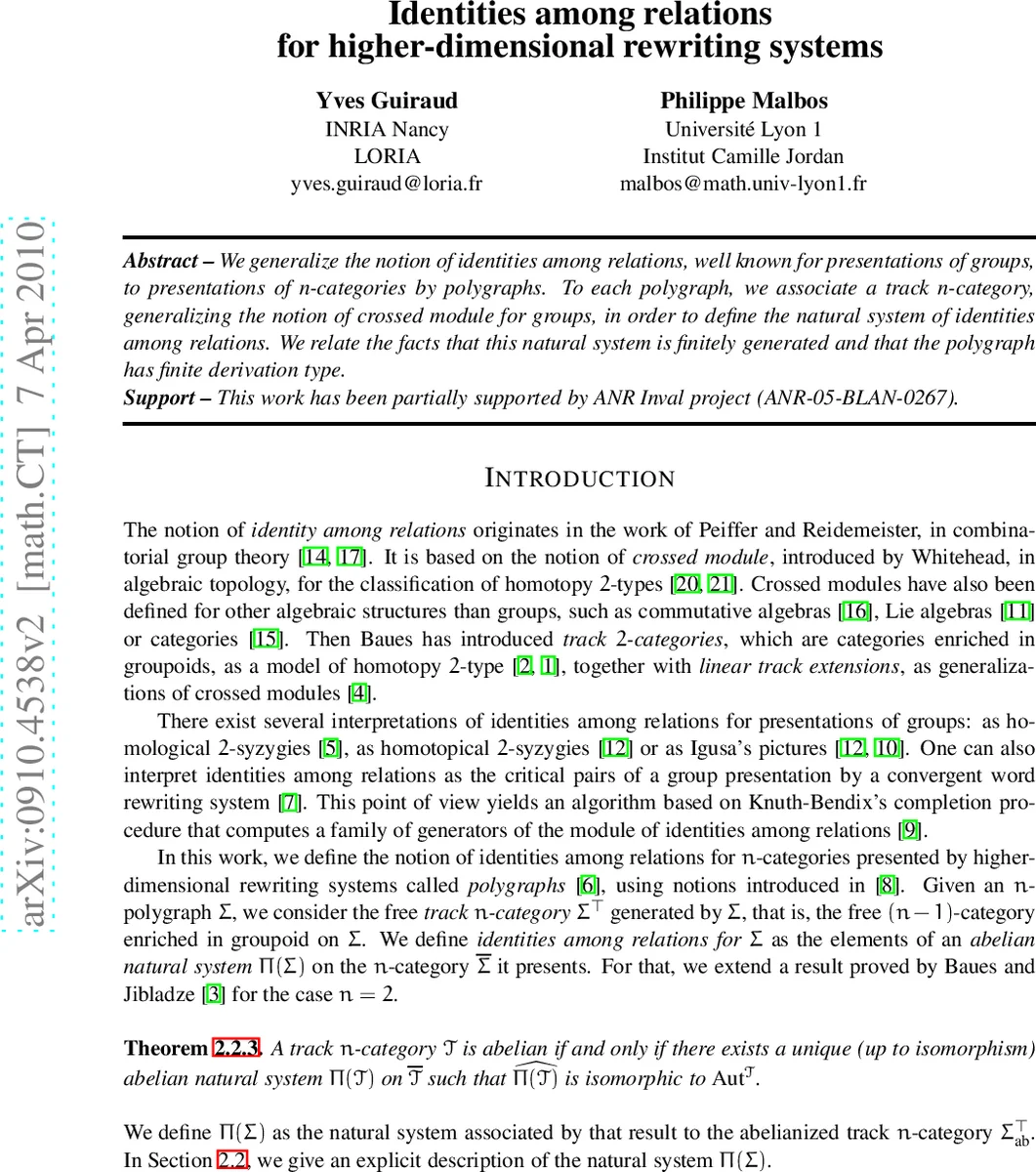
We generalize the notion of identities among relations, well known for presentations of groups, to presentations of n-categories by polygraphs. To each polygraph, we associate a track n-category, generalizing the notion of crossed module for groups, in order to define the natural system of identities among relations. We relate the facts that this natural system is finitely generated and that the polygraph has finite derivation type.
💡 Research Summary
This paper presents a significant generalization of the classical notion of “identities among relations” from combinatorial group theory to the context of higher-dimensional categories using the framework of polygraphs, which are higher-dimensional rewriting systems.
The core objective is to define and analyze the algebraic structure that captures the syzygies or coherence conditions among the rewriting rules (relations) in a presentation of an n-category. To achieve this, the authors first establish the necessary preliminaries. They review the definitions of n-categories and their finite presentations by (n+1)-polygraphs. Key rewriting properties like termination, (local) confluence, and convergence are defined for polygraphs. The critical concept of a “generating confluence” for a critical branching is introduced, which resolves local ambiguities in rewriting.
A central tool is the “track n-category” Σ⊤ freely generated from a polygraph Σ. This structure, an (n-1)-category enriched in groupoids, generalizes the notion of a crossed module for groups. A “homotopy basis” for such a category is a set of (n+1)-cells that makes the presented n-category aspherical. Squier’s Fundamental Confluence Lemma (Lemma 1.3.3) is highlighted, stating that for a convergent polygraph, its set of generating confluences forms a homotopy basis for Σ⊤. A polygraph has “finite derivation type” (FDT) if Σ⊤ admits a finite homotopy basis.
The main construction begins in Section 2. The authors define an “abelian track n-category” and prove a theorem (Theorem 2.2.3) generalizing a result by Baues and Jibladze: for such a category T, there exists a unique (up to isomorphism) abelian natural system Π(T) whose associated group is isomorphic to the automorphism group of T. Applying this to the abelianization of the track category Σ⊤ yields the desired natural system Π(Σ), defined as the system of identities among relations for the polygraph Σ.
The pivotal result of the paper is Theorem 2.4.1: If an n-polygraph Σ has finite derivation type, then the natural system Π(Σ) is finitely generated. The proof leverages the connection between homotopy bases and the natural system. Having FDT means Σ⊤ has a finite homotopy basis. If Σ is convergent, Squier’s lemma implies this basis consists of generating confluences. The paper then demonstrates that these generating confluences also serve as a generating set for the abelian natural system Π(Σ). This creates a powerful link: the computational, syntactic property of a rewriting system (having a finite set of critical pair resolutions) implies a deep algebraic property of the presented category (the finite generation of its higher syzygies).
In summary, this work successfully bridges several domains. It extends a key idea from group theory into higher-dimensional algebra, reformulates homotopical properties (homotopy bases, FDT) in terms of rewriting (confluence), and shows how the concrete, checkable property of convergence in a polygraph ensures the finite generation of the abstract invariant Π(Σ). The framework has implications for understanding coherence theorems (like Mac Lane’s pentagon) in higher categories through the lens of rewriting.
Comments & Academic Discussion
Loading comments...
Leave a Comment