Incrementally Maintaining Classification using an RDBMS
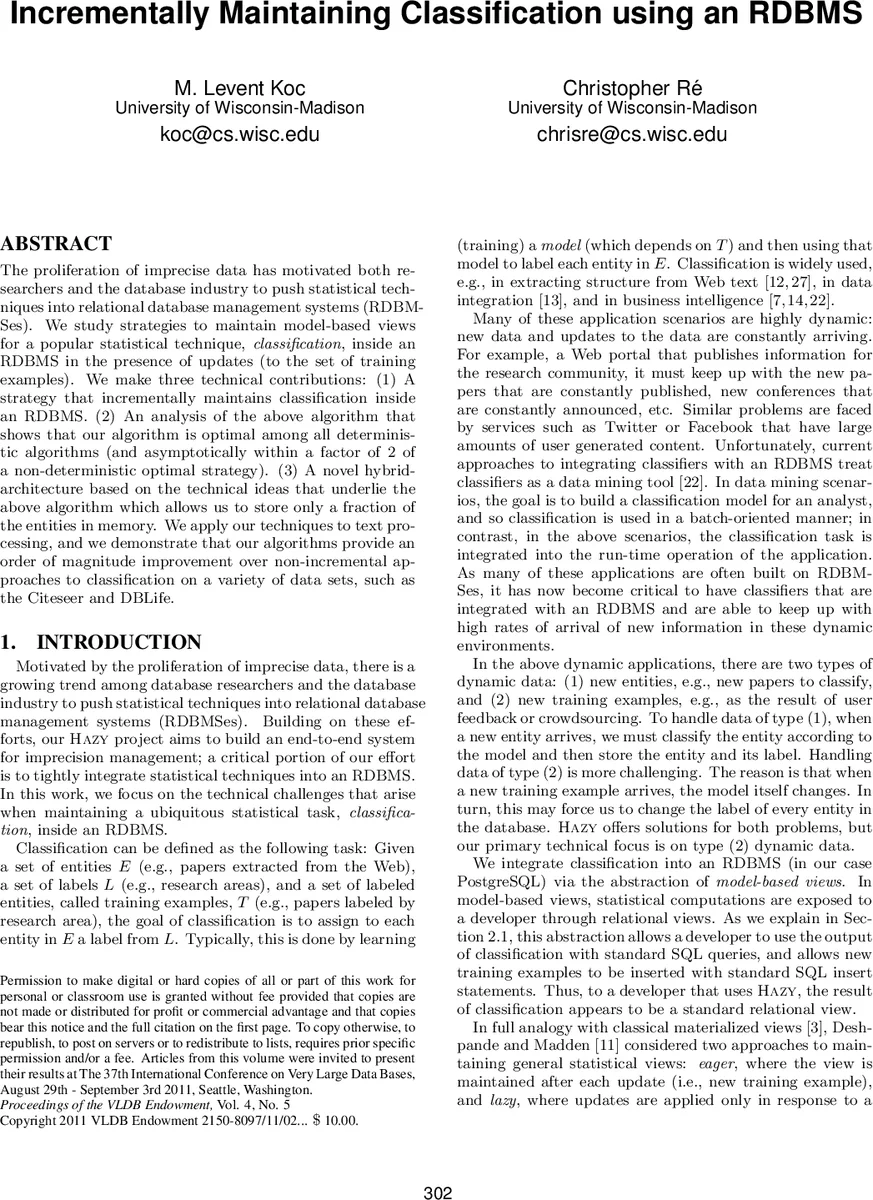
The proliferation of imprecise data has motivated both researchers and the database industry to push statistical techniques into relational database management systems (RDBMSs). We study algorithms to maintain model-based views for a popular statistical technique, classification, inside an RDBMS in the presence of updates to the training examples. We make three technical contributions: (1) An algorithm that incrementally maintains classification inside an RDBMS. (2) An analysis of the above algorithm that shows that our algorithm is optimal among all deterministic algorithms (and asymptotically within a factor of 2 of a nondeterministic optimal). (3) An index structure based on the technical ideas that underlie the above algorithm which allows us to store only a fraction of the entities in memory. We apply our techniques to text processing, and we demonstrate that our algorithms provide several orders of magnitude improvement over non-incremental approaches to classification on a variety of data sets: such as the Cora, UCI Machine Learning Repository data sets, Citeseer, and DBLife.
💡 Research Summary
The paper addresses the problem of maintaining classification results inside a relational database management system (RDBMS) when the underlying training data continuously evolves. Traditional approaches treat a classifier as a batch‑oriented data‑mining tool: the model is trained once, and the resulting labels are stored in a table. When new training examples arrive, the model must be retrained and, in the worst case, every entity’s label must be recomputed. This is prohibitively expensive for dynamic applications such as web portals, social media feeds, or any system that receives a steady stream of user feedback.
The authors propose Hazy, a framework built on PostgreSQL that introduces the notion of a classification view. Developers declare a view using a SQL‑like CREATE CLASSIFICATION VIEW statement, specifying (i) the entity table, (ii) the label domain, (iii) the training‑example table, and (iv) a user‑defined feature function (e.g., TF‑Bag‑of‑Words). Hazy automatically materializes the view, monitors inserts/deletes on the training‑example table via triggers, and updates the view whenever the model changes. The view appears to the application as an ordinary relational table, allowing any standard SQL query to retrieve labels.
The core technical contribution is an incremental maintenance algorithm that avoids full re‑classification after each update. The algorithm proceeds in three steps:
-
Incremental model update – Using online learning techniques (e.g., incremental SVM, stochastic gradient descent), the model parameters (weight vector w and bias b) are updated in O(d) time, where d is the feature dimension. The change Δw, Δb is computed directly from the new example.
-
Change‑propagation estimation – For each entity, the classification decision is sign(w·f – b). The algorithm estimates how much this decision could change given Δw, Δb by computing an approximate “label‑change score” |Δ(w·f – Δb)|. Entities are clustered on disk according to this score; those with high scores are likely to flip their label.
-
Selective re‑classification – Only the clusters with high scores are read from disk and re‑evaluated. Low‑score clusters are left untouched, saving I/O and CPU.
A crucial part of the design is deciding when to reorganize the clustering. Re‑organization (i.e., re‑sorting entities according to updated scores) incurs a cost proportional to the size of the data, but it can dramatically reduce future update costs. The authors formulate a cost‑benefit analysis: if the expected future savings exceed the re‑organization cost, the system triggers a re‑organization.
The paper provides a theoretical optimality proof. It shows that among all deterministic strategies for this problem, the proposed cost‑benefit policy achieves the lowest possible asymptotic runtime. Moreover, it is a 2‑approximation of the optimal nondeterministic strategy, meaning that no nondeterministic algorithm can be more than twice as fast in the worst case. This result is formalized in Theorem 3.3.
To handle memory‑constrained environments, the authors introduce a hybrid in‑memory/on‑disk index. The algorithm identifies the fraction of entities most likely to change labels (often less than 1 % of the total) and keeps those in main memory, while the rest remain on disk. The in‑memory portion is organized as a fast index (e.g., a B‑tree or LSM‑tree), enabling rapid updates and reads. The on‑disk portion is accessed only when a query involves low‑probability entities, which is rare. This hybrid design allows Hazy to scale to datasets that would otherwise exceed RAM capacity, such as millions of sparse document vectors that occupy tens of gigabytes.
Experimental evaluation spans several real‑world text‑classification benchmarks: Cora, multiple UCI Machine Learning Repository datasets, Citeseer, and DBLife. The authors compare three baselines: (a) naïve full re‑training and re‑labeling after each update, (b) eager materialization without selective re‑classification, and (c) lazy view evaluation that recomputes on every read. Results show that Hazy’s incremental strategy reduces update latency by one to two orders of magnitude compared to the naïve baseline, and by an order of magnitude compared to eager/lazy baselines. The hybrid index further reduces memory usage to ≤ 1 % of the dataset size while preserving > 95 % of read/write operations in memory, delivering near‑optimal performance even on commodity hardware. Classification accuracy remains comparable to batch training, confirming that the incremental updates do not degrade model quality.
In summary, the paper makes three major contributions:
- An incremental algorithm for maintaining classification views that selectively re‑classifies only the entities whose labels are likely to change.
- A rigorous optimality analysis proving that the algorithm is asymptotically optimal among deterministic strategies and within a factor of two of the nondeterministic optimum.
- A hybrid memory‑disk indexing scheme that enables the system to operate on datasets far larger than available RAM while still achieving dramatic speedups.
These contributions advance the integration of statistical learning into relational databases, providing a practical path for developers to embed real‑time, model‑driven functionality directly into SQL‑centric applications without resorting to external batch pipelines. Future work may extend the approach to non‑linear kernels, ensemble models, and distributed RDBMS architectures, further broadening the applicability of model‑based view maintenance.
Comments & Academic Discussion
Loading comments...
Leave a Comment