Scale invariance versus translation variance in Nash bargaining problem
Nash's solution in his celebrated article on the bargaining problem calling for maximization of product of marginal utilities is revisited; a different line of argument supporting such a solution is suggested by straightforward or more direct reasoni…
Authors: Alex Ely Kossovsky
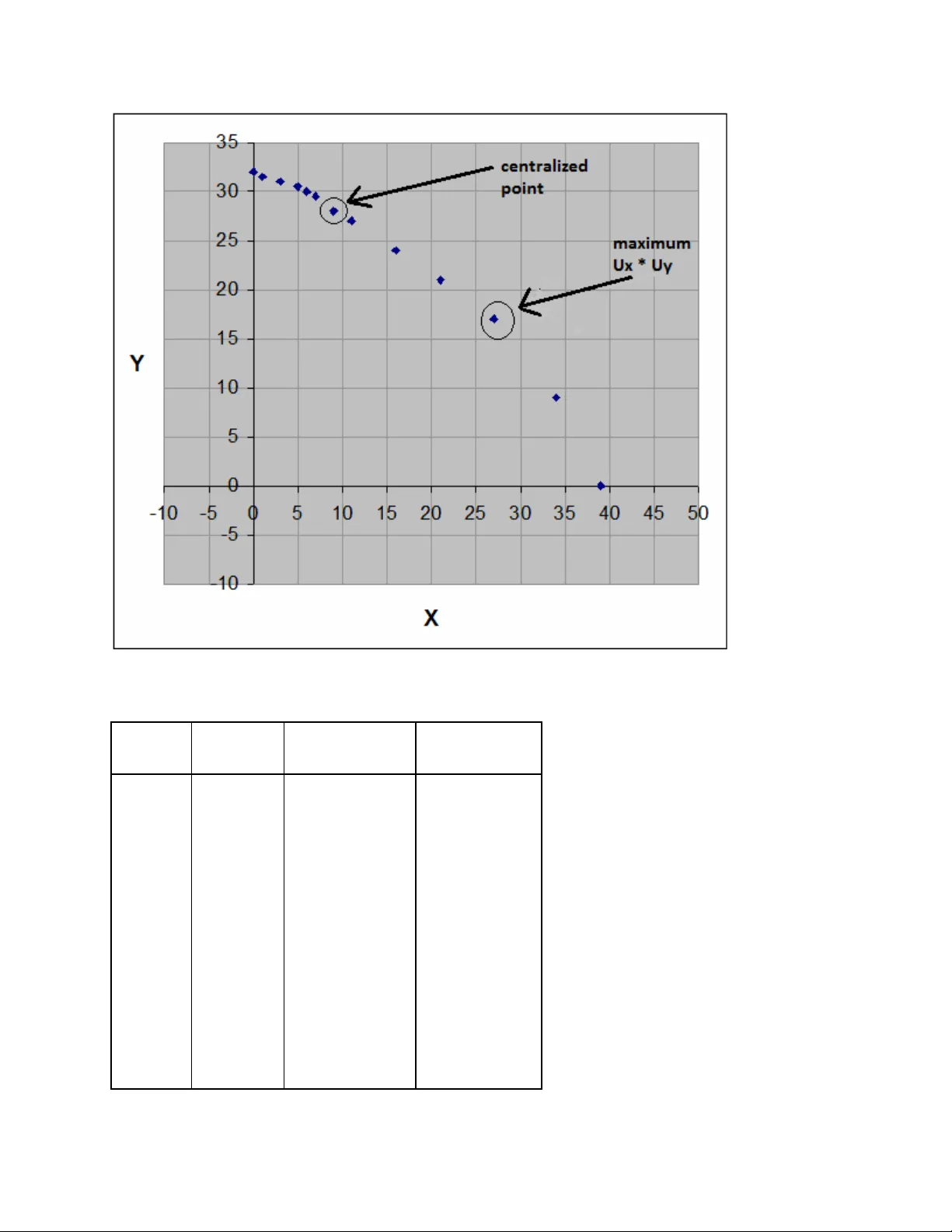
Scale invariance versus translation variance in Nash bargaining problem Abstract Nash’s solution in h is celebrate d article on the barga ining problem calling for maximization of product of m arginal utilities is revisite d; a different line of argument support ing such a solution i s suggested by straightforward or m ore direct reasoning, and a co njecture is raised w hich purports u niqueness of algorit hm, namely his solution. Other alter native inferior algorithm s are also suggested. It is argued in this ar ticle that the scale invariance princi ple for utility funct ions should and could be appli ed here, nam ely that utility resca ling u’=a*u is allowed, w hile translations, addi ng a constant to utility functions u’=u+b c ould not be ap plied here, since it is not invariant and lea ds to contrad ictory behavior. Finally , special situations of owners hip and utilities, wh ere trading is pre dicted not to take place at all because none is profitable are e xamined, and then shown to be consiste nt with the scale invaria nce principle. ------------------------------------------------------------------------------------------------------------------ [1] Two-person Bargaining Problem John Nash’s artic le “The Bargain ing Problem” relates t o the classical ec onomic problem of two parties freely bargaining with each other. I n this situation, su bsets of two original se ts of items belongi ng to two indivi duals are possibly exchanged voluntarily if the s um of utilities is i ncreased for both players. The two opponent s or players are each in possession of item s that have utili ties to both, and who enga ge in direct barter ing without the use of money. E ach wishes to convince the other to give away as many and most valuab le item s as possible in exchange for the few est and leas t valuable item s. A proposal of exc hange involves a specific offer as w ell as a specif ic demand, where ‘ offer’ and ‘ dem and’ refer to the details of the pr oposal. For exam ple: “ I offer the set R and I dem and in exchange the set K”. We shall use the f ollowing notatio n for the utility functions of X an d Y: the-person-possess ing-the item ITEM th e-person-for-whom-uti lity-is-considere d . For exam ple: x A y would m ean the utility to Y of an item named A which X possesses origina lly. Each possible exc hange, whether rea sonable or no t, can be draw n on the U x vs. U y plane, where U x and U y refer to the margin al utilities of X a nd Y respectively , that is, the sum of uti lities after an exchan ge is made m inus the original s um of utilities of the items they owned, or equivale ntly, the sum of utili ties of new item s gotten (gained) m inus the sum of utilities of items given out (lost). It is very clear that only points in the first quadrant on the boundary /periphery (and not on the axes) are c andidates for a sol ution, because any points inside (wher e there is room to go upward and/or to the right) are worse off f or both play ers as compared with the b oundary/perip hery. For exam ple, (3, 6) would not b e considered at all if ( 5, 7) is also available w ith a different e xchange, since t he latter point offers m ore for X as well as m ore for Y. The existence of (3, 7) wou ld also preclude the infer ior point (3, 6) even th ough it’s only worse off for Y. Moreover, Nash introduces the possibility of X and Y tossing a var iable bias coi n, with probability p on (0, 1) to decide be tween any two points on the periphery , hence creating a conti nuous line there. N ote that this line i ncludes linear co nnections between all points, a nd not only between adjacent ones on the periphery , thus resulting in an o verall curve that is not the same as sim ply connecting adjacent points on the per iphery, but rather a c urve that encloses m ore area. T he only question that rem ains then is “ where exactly on that bo undary?” and Nash’ s answer is that we look for an algorithm that m aximizes U x* U y . Without any loss of generality, in this article, we would de emphasize or downplay the contin uous line approach taken by Nash and instea d focus only on those discrete point s of actual deterministic e xchanges. One severe co nsequence or lim itation though of t he discrete approach is that there are cas es where m aximum U x* U y is not unique, whereas the cont inuous approac h always guarantee s uniqueness; hence a n essential part of Nash’s edifice was the joining of the points wi th this crooked yet continuous line. E xam ples o f m ultiple maximum U x* U y with the discrete ap proach abound. [2] Scale Invariance Principle It is noted that Na sh’s solution point is sca le invariant. The a lgorithm of maximizing U x * U y would always point t o the sam e transformed point (and the same item s being exchanged – the sam e deal) regar dless of scale. This is so because the m aximum of a set of real num bers is scale-invariant in the sense that the same point (or iginal/transform ed) alway s serves as the maxim um. IF Max{X 1 , X 2 , X 3 , … , Xn} = X i (for some unique i in the index to n ) THEN Max{Q*X 1 , Q* X 2 , Q*X 3 , … , Q*Xn} = Q *Xi (sam e i as above!!) (where Q is any rea l positive num ber). For exam ple: IF Max{4, 7, 20, 3, 6, 10} = 20 ( and it’s the 3 rd elem ent) THEN Max 2 *{ 4, 7, 20, 3, 6, 10} = Ma x{8, 14, 40, 6, 1 2, 20} = 40 (and it’s also the 3 rd elem ent) Moreover, any exc hange where b oth X and Y are hap py under original utili ty functions would c ontinue to be rendered profitable to both af ter any transform ation of scales ! To illustrate this, a ssume Y originally agrees to give X { A, B, C, D , … (M items)} and X agrees to give Y {P, Q , R, S, … (N items)} in exc hange. To express the original agreem ent and satisfaction f or both sides regard ing this exc hange, and taking first the p oint of view of X, we t hen must have: X extra satisfact ion in obtain ing {A, B, C, D , … M items} > > X losses in not possessing {P, Q, R, S, … (N items)} or : yAx+y Bx+yCx +… M item s > xPx+xQx+… N item s Now under scale tran sformation of the u tility function of X by b (when b > 0), that is u’---> b*u we have to com pare the two quant ities [ b*(yAx)+b*(yB x)+b*(yCx)+ … M i tems ] and [ b*(xPx)+b*(xQx)+… N it ems ] or, by pulling o ut the comm on factor b : [ b*(yAx+y Bx+yCx+ … M items) ] and [ b*(xPx+xQx+ … N items)] for which the previ ous inequality above guarantees that the l eft side is bigger than the right side, regar dless of the value of b. Sam e argument would apply to Y of course, and which c om pletes the proof. T he exact sam e line of argum ent above can be used to show that f or any exchange ref used by either X or Y or both under original utility function would also be resisted under any rescaling where b>0. To do that we sim ply flip the direction of the inequality above from > to < and all else follow just the same. Hence any d ecision to trade f or this two-person bargaining problem case is unaffected b y any scale tran sform ation, and therefore scale-in variant. The scale-invarianc e property of Nash’s solution is not incide ntal. Solution (a s well as every thing else here) should not change if we re- scale utilities of X or Y or both. This is so beca use utility function itself is defi ned only up t o scale. Hence if u is a utility function of X, than a*u i s also a valid utility function. This expresses the fact that utility function is nothin g but an expression of c omparisons of preferences in owning one thi ng as oppose to anot her. For exam ple, u(bike)=8 and u(boo k)=2 mean that the pers on derives four t imes as m uch satisfaction from a bike as compared with a b ook. Yet there is n othing intrinsic or im portant about the values 8 and 2. If we resca le everything by say 5, now u(bike)=40 an d u(book)=10, we would still have t he same ratio of satisfac tion, namely four-fold, and it’s this rat io that constitutes the re al measure of prefere nces of utility , expressing the co nsistent fact that for that pe rson four books sat isfy him or her ju st as much as o nly one bike would, regardless of scale. Hence scale-i nvariance com es very naturally here. It is in this sense perha ps that utility values are thought of as usin g some arbitrary “satisfaction scale” or ”happiness unit s” , just as the kilo s, grams, and po unds are used for weights, es pecially or con veniently so when the least-valued item could be given the arbitrary value of 1. [3] Translations are not invariant! Difficulties arise though when tra nslations are considere d. The other ax iom of utility functions i s that translated ut ilities are all equiva lent expressions of satisfaction. In other words, that for a ny utility funct ion u, u+b is also a va lid utility function. But tra nslations are harder to interpret. Say u(bike)=8 and u(book)= 2, and now u is translate d by +5, hence u(bi ke)=13 and u(book)=7, a nd so origina l ratios of satisfaction are t otally upset! More over, if translation is perf ormed usi ng a value much larger tha n the largest value of the original utility function then in the limit each item is assigned equal value – clearly a false re presentation of prefere nces and satisfaction order! F or example, in t he case above where u(bike)=8 and u( book)=2, and where b is 10 00 say, translated utilities are u(bi ke)=1008 and u(b ook)=1002, and are of alm ost identical value s. Moreover, here tr ades are NOT even translation-in variant! In other words, a given exchange acce ptable to both X a nd Y under original utility funct ion would be rendered as totally unaccept able under a certa in utility translati on! To illustrate this, a ssume Y originally agrees to give X { A, B, C, D , … (M items)} and X agrees to give Y {P, Q , R, S, … (N items)} in exc hange. To express the original agreem ent and satisfaction f or both sides regard ing this exc hange, and taking first the p oint of view of X, we t hen must have: X extra satisfact ion in obtain ing {A, B, C, D , … (M items)} > > X losses in n ot possessing {P, Q, R, S, … (N item s)} or : yA x+yBx+yCx +… M item s > xPx+xQx+… N item s Now under transla tion of utility function of X by b, that is u ----> u+b we have to compare the two q uantities [(yAx+b)+(y Bx+b)+(y Cx+b)+… M items ] and [ (xPx+ b)+(xQx+b)+… N items ] or : [(yAx+yBx+y Cx +… M items) +M*b ] and [ (xPx+xQ x + … N item s) + N*b ] for which the previ ous inequality above does not by any means guarantee a s imilar inequality here, unless b is relative ly very small. If M=N or if M>N then the inequality still holds true, but whe never M Y 0 or visa ve rsa. This is so becau se with a simple r escaling we could easily reverse the situation a nd obtain X 0 < Y 0 and then perhaps X would complain now, etc. O n the contrary ! The correct pers pective or view here runs much deeper! Nei ther would com plain about fairness a t all, as neither of them is concerned about how the other person is fairing, nor com paring his or her overall utility to that of t he other. Rather, al l Y is try ing to do is to obtain a point a s high as possible on the U x and U y plane, while X is striving to o btain a point as m uch to the right as possib le. The only solution point that c ould consiste ntly be considered unfair to say Y is (X 0 , 0), namely on the X axis, in whic h case no rescaling c ould ever reverse the fav orable situation t hat X enjoys here. [4] Naturalness of Maximum Marginal Utilities Deemphasize the c ontinuous line ap proach taken by Nash and focusing sole ly on those discrete poin ts, it is rather in tuitive or natural t hat we’ll loo k for or find the solution at m aximum U x * U y rather than anything else. W e are in need of an algorithm that is (1) fair to both, (2) b eneficial to both, ( 3) unique, and (4) sca le invariant. First, it is clear tha t both U x and U y must be somehow involved or present in any expression or alg orithm, otherwise one would be con sidered as bein g discriminated against the other. O f the four basic ari thmetic operation s, only addition an d multiplication can be used intercha ngeably without any preference rega rding operands, while subtraction U x - U y and division U x / U y are intrinsical ly preferential opera tions, treating U x and U y in different way s, hence should be excluded here a ll together. Express ions such as (U x 5 * U y 2 ) or (U x ) Uy would also not be acceptable a s it discriminates a gainst Y and favor s X or visa versa. Secondly, w hat is needed here i s a decisive algorithm , operation, or proce dure that points to a unique point, not m ultiple ones. Let us now t hen compare m aximizing U x +U y (addition) with m axi mizing U x * U y (multiplication). Evidently multiplication is superior here because product is one operation that is m axim ized only when both U x and U y are not small (and especia lly not close to zero), and so in that sense, by maxim izing the product of the two m arginal utilities we co nsider the interests of both X and Y equally and fairly. On the other hand, maxim ization of U x + U y can be done (if we w ish) totally at the e xpense of one of them. W e might even find cases w here the sum is being maxim ized while one quantity say U x is zero , a situation or a solution whic h does not reflect our case given that trad ing is voluntary for both players and that they are of equal knowle dge of utilitie s and of equal bargaining power. Another str ong consideratio n against maxim izing U x + U y is that it’s not scale invariance. For exam ple, if we rescale utility of (only ) X by a huge factor, thin gs would swing m uch in X favor as m aximization of U x + U y will now end up focusi ng much m ore on X than on Y. Anot her drawback of m aximum U x + U y is that it could y ield multiple solutions w henever boundary points farthest from the origin (i.e. t he best points) fall o n the equidista nce line U x + U y = C. And what other m ethods would X and Y w ould agree upon? Ma ximizing (1/U x )*(1/U y )? Minimizing U x * U y ? Certainly not, as it would h urt both. Finding the point closest t o the meaningle ss line X=Y w hich vary with scale? s urely not! Both X and Y woul d like to m aximize quantities here, n ot to m ini mize, nor t o set quantities equa l to anything when scales ar e totally m eaningless. There seem s to be no other rea sonable algorithm we can come up with besides m aximizing the product U x * U y ! Consider the case of 2-object grav itational force, F = G *M 1* M 2 /R 2 . Say we have a fixed amount of m atter, 10 kilogram s, where mass is flex ible so that we ca n draw from one box of m atter and into another a s much as we wi sh, in the sam e vein as zero-sum or constant-sum situations. D istance is fixed a t 10 meters say . The question then arise s, under what arrangem ent of m atter do we get m aximum gravitational force ? Here is the ta ble: M 1 M 2 M 1* M 2 F 0 10 0 0 1 9 9 6.00 E-12 2 8 16 1.06 E-11 3 7 21 1.40 E-11 4 6 24 1.60 E-11 5 5 25 1.66 E-11 6 4 24 1.60 E-11 7 3 21 1.40 E-11 8 2 16 1.06 E-11 9 1 9 6.00 E-12 10 0 0 0 Hence, by keepin g the two weig hts as even as possible, t hat is by dividing them equally, w e obtain maximum product, wh ile extrem e inequality y ielded zero. Hence, in general it can be said t hat maxim izing product of consta nt-sum variables entails the m ost equal division po ssible! Yet this concl usion can not be se parated from the fact that r escaling here say only M 1 leaving M 2 in tact is forbi dden. Only simultaneous an d equal rescaling i s allowed here to uphol d any meaning to the restriction M 1 + M 2 = 10, and that re scaling should be a pplied to the num ber 10 as well, com paring apples to apples n ot to bananas. In our context, thi s would point to a “ fair” solution at (C/ 2, C/2) for all the discrete points on the line of U x + U y = C. Surely, almost all typical curves i n bargaining games are convex a s opposed to straight lines, and one- sided rescaling i s surely allowed, y et some principle of “ fairness” in m aximizing products is dem onstrated by this physical ex ample. An intriguing and totally different line of thought is tha t mathem atically speaking there may not exist any other algorithm arriving at a uniq ue point except maximization of U x *U y - if we wish to be fair to both, to benef it both as m uch as possible, and f or the algorithm to be scale invariant. In other words, there is simply no other algorithm that could differentiate between the various points a vailable on the per iphery and point to a unique one except maximizing U x *U y ! If so, then say Y is unhappy about the end r esult of maximizing U x *U y , and so Y tries hard t o convince X to choose another point (X 0 , Y 0 ). In that case Y wouldn’t be a ble to back up this p oint by appeali ng to any algorithm. Y would simply have to arbitrarily insist or a sk X to m ove to that point without being able to say anything in support of his su ggestion! [5] Other Algorithms The only other scale-invariant algorit hm perhaps that c ould be proposed her e, uniquely pointin g to a special point on the periphery in a way which is (at first glance) fair to both X and Y is the f ollowing: Algorithm A) Count all those di screte points on the peri phery (excludin g points on the axes) and cho ose the middle one if they are odd, or the m idpoint (tossing a biased coin) betwee n the two m ost-centralized point s if they are even, in the sam e spirit as in the def inition of the m edian. This algorithm is scale invariant! This algorithm could work well for our discrete-points a pproach in this a rticle. But with the inclusion o f lines generated by tossing a decidin g coin, - the conti nuous approach suggested by Nash - there w ould be nothing special about th is (supposed) most-centralize d point! Nor could w e choose som e midpoint, by w ay of measuring the distance, alo ng the zigzagged line for the contin uous approach, as it is scale- dependent, and henc e m eaningless. Furtherm ore, the apparent fairness in t his approach is m isleading and the disadvantage is re vealed in cases where t he points on the periphery crowd out unevenly close to one axis and are s parse and spread o ut next to the other ax is, for example: Ux Uy product Ux*Uy comm ents 0 32.0 0.0 excluded 1 31.5 31.5 3 31.0 93.0 5 30.5 152.5 6 30.0 180.0 7 29.5 206.5 9 28.0 252.0 centralized 11 27.0 297.0 16 24.0 384.0 21 21.0 441.0 27 17.0 459.0 max Ux*Uy 34 9.0 306.0 39 0.0 0.0 excluded In this case, the cen tral point (9, 28) is not quite acceptab le to X w ho would very much prefer the p oint (27, 17) where U x *U y is maximized. Note that this dislike of X here regardin g choosing the m ost centralized point is independent of scale. Should X rescale h is utility function by a factor much bigger than 1 or by a tiny fraction of 1 (close to 0) his or her d islike of such a solu tion would rem ain in tact and X would alway s seek to convince Y to agree on m aximum U x *U y - a proposition Y wou ld not view negat ively nor as unreasona ble. A very different ap proach combinin g the concern for the two issues at hand here - fairness and scale invariance, is to f orce one final ‘ fair’ rescaling bef ore performing any algorithm or calculations. This done, any subsequent alg orithm can now be m ade fairly disregarding scale altogether, a nd perm itting procedures that are scale-dependen t. This is done by equating (via r escaling) the X and Y distances of the two extrem e points regard ing all 4 quadrants. An alternative way would be to equate X and Y distances of the cur ve considerin g only the first quadran t for the purpose, hence resca ling both X and Y s uch that (r, 0) and ( 0, s) [or their close st points if none of the points falls on the a xes] would be of the same length after transformation, tha t is (k, 0) and (0, k). W e shall call this “ equitable rescal ing ”. Algorithm B) Perform equitable rescal ing, then choose the point which maximizes X+Y . The difficulty here i s that there m ay be no unique so lution here, even though the zi gzagged line connect ing the points is c oncave. Algorithm C) Perform equitable res caling, then ch oose the point closes t to the 45 degrees line X=Y . Algorithm D) Perform equitable res caling, then m easure the total distanc e on the zigzagged line to c hoose the point half wa y through on t hat curve. We could either do it by creatin g the zigzagged li ne considering strictly only adjacent p oints, or the more encom passing approach given by Nash. [6] Cases Having no Profitable Trades The force drivin g the exchange i s the different va luations placed by X and Y for some of the item s, implying that eac h possible exchan ge could in principle represent a total ly different pair of sum s of utilities. T here would have been no incentive whats oever to trade had utilities were the sam e for both play ers for each item, that is if xZ x = xZy and yZy = yZx for any item Z. In such a case, al l the points on the Ux an d Uy plane appea r along the line Y = -X going throu gh the origin, since in any exchange here the gain for X (net of som e utilities gained and some lost) is exac tly the loss for Y . For exam ple, say X gives out three items with total utilities 3 0 (valued equally ), and gets from Y two items with total utili ties 34 (valued equally ), resulting in Ux = +4 a nd Uy = -4. Should we rescale here, say utilities of X are to be m ultiplied by a fact or of 2; this would only m ean that the X axis was stretched to doub le its original size, res ulting in a line through the origin with a slope of -0.5 instead. I t was proven earl ier in this article, in absol ute generality, that all trade decisions are i ndependent of sca le. Another situatio n where no trade co uld ever be m ade possible is depicted a s follow: for each item X possesses the sa tisfaction derived fr om it for X is grea ter than that for Y, AND ALSO visa versa. In other words, for any item Z possessed by either X or Y w e have iZi>iZj (indexes i and j representing X or Y). This precludes any possibility of trading. For e xample: X possesses radio Laptop Book watch Pen utility to X: 11 8 5 6 4 utility to Y: 4 3 1 1 3 Y possesses bike TV Cell chair utility to Y: 7 3 11 6 utility to X: 4 2 10 5 Let’s see why any possibility of one-to-one trade is prec luded. Repeated use of the transitive rule for i nequality will be m ade here, nam ely that if A>B and B>C then A>C. Say X possesses item A, and Y p ossesses item C, among some other items, and our particular s ituation is depicted a s xAx>xAy and yCy>yCx, hence a trade of item A for item C in which X is benefit ing from the excha nge gives yCx>xAx (gaining from C more than losing on A ) and this implies that yCx>xAy (because of xAx>xAy). Now, from y Cy>yCx we see that yCy >xAy, meaning that the loss of C for Y is greater t han Y’s gain in ac quiring A, and therefore Y co uld not be benefiting from such a trade! Similar argum ent can be m ade in general for ANY numbers of item s traded, say Y gives X {A, B, C, D, … (M item s)} and X gives Y {P, Q, R, S, … (N items)}, keeping in m ind that in here the conditi on im plies that for a ny item Z we have iZi>iZj - nam ely that the original owner obtains m ore satisfaction than the other person for any item possessed. Assume X would benefit and agree to such a trade as above, this would im ply that (gains>losses): [yAx+yBx+y Cx +… M items] > [xPx+xQx+… N item s] and em ploying rule iZi>iZj to the ri ght side of the ine quality we get: [yAx+yBx+y Cx +… M items] > [xPy+xQy+… N items] Now com paring the left side of t his inequality to [yAy+y By+yCy +… M items], we note that the lat ter quantity is superior (again becau se of iZi>iZj ), and so we finally get: [yAy+yBy +yCy +… M items] > [xPy+xQy+… N items] Hence clearly the loss of Y from not owning {A, B, C, etc.} i s greater than Y’ s gain from newly acquired item s {P, Q, R, etc.}, and therefor e Y would refuse to trade as such! The scale invaria nce principle applie s. Doubling util ities of X would m ake the gap with Y wider for items X possesse s but narrow it or eve n reverse the sit uation for items Y possesses. If X or Y refuses any trade under som e given utility function s, then they should co ntinue to res ist such an exchange u nder any rescaling of utilities as was proven earl ier. A third exam ple of a situation where no trade could ever be made possible i s when the SUM of utility values for (say ) X regarding ALL the items possessed by Y is LESS than the val ue X places on ANY of his own item s (or equivalen tly: LESS than the MIN va lue X has for his own ite m s.) In this case no am ount of satisfaction from item s belonging to Y can ever be awa rded to X to com pensate for the loss of even one single item he possesses, e ven the one leas t valued. For e xample: X possesses: Radio Laptop book watch Pen utility to X: 14 12 13 12 1 3 utility to Y: 10 16 7 17 5 Y possesses: Bike TV cell chair utility to Y: 2 8 13 2 utility to X: 3 1 4 3 = 11 Any rescaling of uti lity values of X w ould involve the sam e multiplicative f actor G say, for the transform ation for item s possessed by X as well as for item s possessed by Y, hence transformed utility sum of all the item s Y possesses is still for X less than the transform ed value for any of his own item s. This is consistent with the general scale invar iance principle pr oven earlier. It is noted that in this last exam ple, a one-way inequality is a sufficient c ondition to preclude trading, as oppose to the ea rlier exam ple where mutual inequali ty was a necessary conditio n, namely iZi>iZj as well as jZj>j Zi . [7] General Considerations To facilitate num erical analysis N ash makes the a ssumption that ‘ ultimate’ or ‘ideal’ utility for each player, his or her overal l goal, is simply the sum of the utilities of the in dividual item s he or she possesses. In rea lity this is certainly not true. The first l oaf of bread has m uch higher overall utility than the 1 0th loaf. One house and a loaf of bread have a m uch higher overa ll utility than either two loafs (full belly but stay ing outside in the c old) or two houses ( spacious livi ng space but with a hungry stomach). Nonetheless, a n analysis based on the m ore realistic assumption of the c om binatorial effect on overall utility would follow the sam e line of reasoning a s outlined in Nash’ s article given the m ore detailed ‘ ultimate utility function’ w hich yields unique values for each and e very com bination of items, leading t o a more realistic se t of points on the U x and U y plane for determinations of m ax U x *U y . It is interesting to note that the u niqueness of solu tion referred to in Nash’ s article is not about the e xpected details of the exchange (w hat item s exactly are being exchanged) but ra ther about the e xpected overall uti lities for the two play ers after a deal is struck, value s which at tim es could be achieved in more tha n one way of exchange and in wh ich case exact de tails of exchange co uldn’t be predicte d at all. To demonstrate th is, imagine t he case where play er X possesses two item s, A and B, and derives eq ual satisfaction from either one, and w here Y also derive s equal satisfaction here, t hat is, xAx = xBx and xAy = xBy, while solution inv olves X giving out to Y one of these two item s. There is no way to predict which item exactly X w ill give up, so solution is n ot unique in that se nse. Implicitly, N ash offers the use of the brute force m ethod, namely, to check t he entire list of all p ossible exchanges an d sort out maxim um Ux*Uy. Even with the elimination of ne gative and zero m arginal utilities this leaves the com puter performing com binatorial num ber of operations whic h increases expone ntially as the num ber of items possessed becom es large. One intrigu ing question is whether or not there exis ts a way to cut direct ly to the solution, in the same vein as when the gradient see ks out the maxim um and minim um of multivariable func tions by cutting right throu gh to it, avoiding t he brute force tedi ous way. Attem pts to devise an algorithm consisting of numerous l ittle logical or very “reasonable” excha nges leading to the f inal solution are doom to failure. A seque nce of one-for-one exchanges of item s that increase s ums of utilities to bo th players will n ot do. This is so because such a n algorithm couldn’t capture the be nefits presented by simultaneous m ulti exchanges. It is hard to im agine how two ratio nal players during Adam Sm ith ’s era living without the benefi t of computers could c alculate and arrive at t he optimal soluti on when number of al l possible trades is really huge as in the case w hen items to be exchanged are q uite num erous. If X possesses P item s and Y possesses Q items, then there are 2 (P+Q) possible exchan ges, including t he case of the nul l exchange - where nobody gives anything out nor ta kes anything, that is, keeping the original situation of owner ship in tact. Many of those 2 (P+Q) possib le exchanges thoug h converge onto ide ntical points on t he U x and U y plane whenever resultant U x and U y are equivalent, hence total num ber of points typically is m uch less than that a nd often folds into som ething like a two-t hirds, a half, or ev en around a t hird of the maximum potential of 2 (P+Q) points. References John Nash J.F. (19 50), The Bargaining Pr oblem, E conometrica 18, 155-162. Alex Ely Kossov sky akossov s@yahoo.co m
Original Paper
Loading high-quality paper...
Comments & Academic Discussion
Loading comments...
Leave a Comment