Cobweb posets - Recent Results
Cobweb posets uniquely represented by directed acyclic graphs are such a generalization of the Fibonacci tree that allows joint combinatorial interpretation for all of them under admissibility condition. This interpretation was derived in the source …
Authors: A. Krzysztof Kwasniewski, M. Dziemianczuk
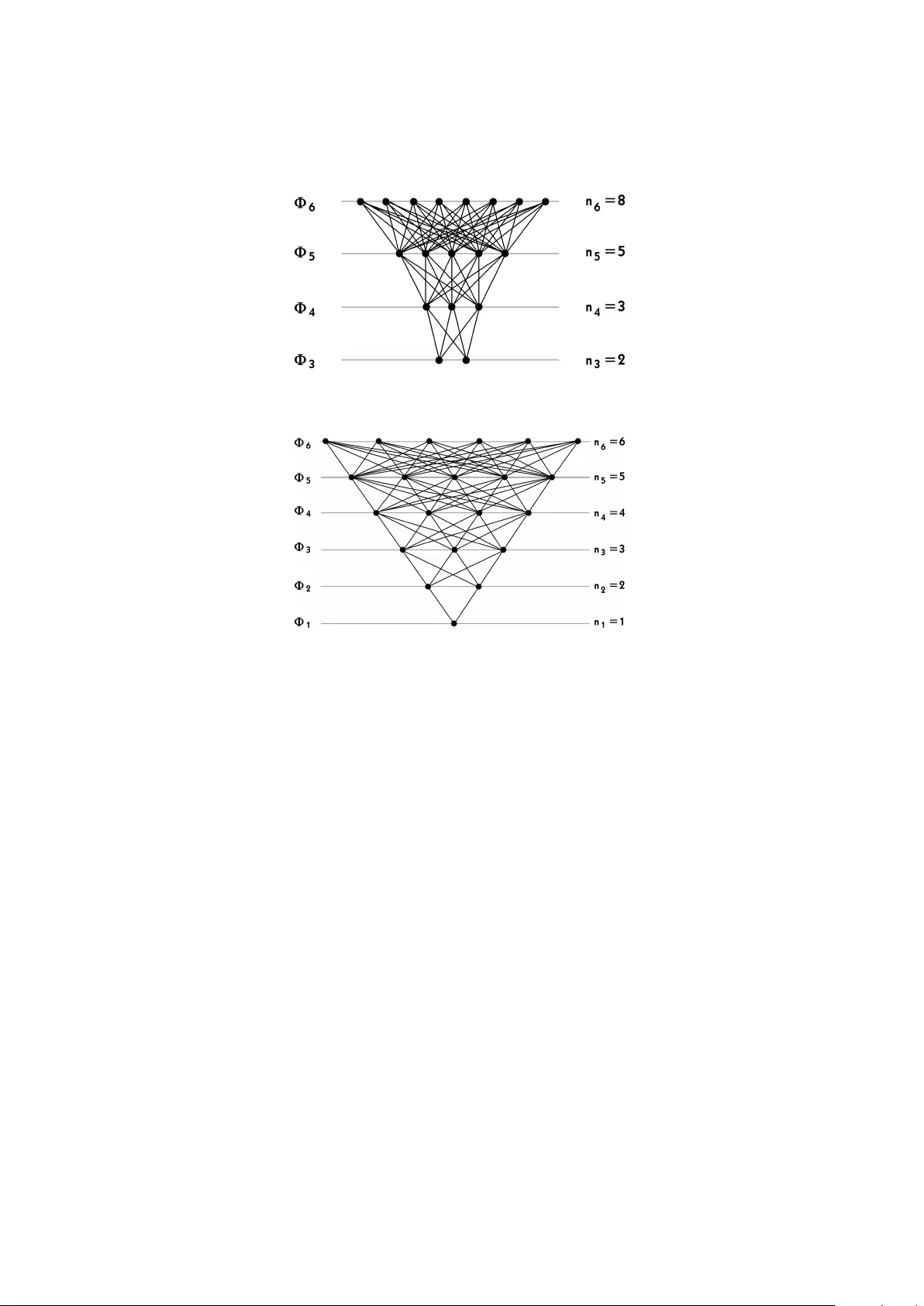
Cob w eb p osets - Recen t Results A. Krzysztof Kw a ´ sniewski (*) ,M. Dziemia ´ nczuk (**) (*) the Dissident - relegated by Bia lystok Universit y authorities from the Institute of Informatics to F aculty of Physics ul. Lipow a 41, 15 424 Bia lystok, Poland e-mail: kw andr@gmail.com (**) F ormer Student in the Institute of Computer Science, Bia lystok Universit y; then mo ved to: Institute of Informatics, Universit y of Gda ´ nsk, Poland; e-mail: mdziemianczuk@gmail.com SUMMAR Y Cob web p osets uniquely represen ted by directed acyclic graphs are such a generaliza- tion of the Fib onacci tree that allows join t combinatorial in terpretation for all of them under admissibilit y condition. This in terpretation was derived in the source papers ([6,7] and references therein to the first author).[7,6,8] include natural enquires to b e rep orted on here. The purp ose of this presentation is to rep ort on the progress in solving computational problems whic h are quite easily form ulated for the new class of directed acyclic graphs interpreted as Hasse diagrams. The problems posed there and not y et all solved completely are of crucial imp ortance for the v ast class of new partially ordered sets with join t combinatorial interpretation. These so called cobw eb p osets - are relativ es of Fibonacci tree and are lab eled by sp ecific num ber sequences - natural num bers sequence and Fib onacci sequence included. One presents here also a join combinatorial in terpretation of those posets‘ F -nomial coefficients which are computed with the so called cobw eb admissible sequences. Cobw eb p osets and their natural subp osets are graded p osets. They are vertex partitioned in to such an tichains Φ n (where n is a nonnegative in teger) that for eac h Φ n , all of the elements co vering x are in Φ n +1 and all the elemen ts co v ered by x are in Φ n . W e shall call the Φ n the n − th - level. The cob w eb p osets might be identified with a c hain of di-bicliques i.e. b y definition - a chain of complete bipartite one direction digraphs [6]. An y c hain of relations is therefore obtainable from the cobw eb p oset chain of complete relations via deleting arcs in di-bicliques of the complete relations c hain. In particular we resp onse to one of those problems [1]. This is a tiling problem. Our information on tiling prob- lem refers on pro ofs of tiling’s existence for some cobw eb-admissible sequences as in [1]. There the second author shows that not all cobw ebs admit tiling as defined b elow and pro vides examples of cob webs admitting tiling. Key W ords: acyclic digraphs, tilings, sp ecial n umber sequences, binomial-like co efficien ts. AMS Classification Num b ers: 06A07 ,05C70,05C75, 11B39. Presen ted at Gian-Carlo Polish Seminar: http://ii.uwb.e du.pl/akk/sem/sem r ota.htm published: Adv. Stud. Con temp. Math. v ol. 16 (2) April ( 2008 ):197-218. 1 In tro duction [6] A directed acyclic graph, also called D A G, is a directed graph with no directed cycles. D A Gs considered as a generalization of trees ha v e a lot of applications in computer science, bioinformatics, physics and man y natural activities of h u- manit y and nature. Here w e introduce specific DA Gs as generalization of trees b eing inspired by algorithm of the Fib onacci tree gro wth. F or an y giv en nat- ural n umbers v alued sequence the graded (la y ered) cob web p osets‘ DA Gs are equiv alently representations of a chain of binary relations. Ev ery relation of the cob web p oset c hain is biunivocally represen ted by the uniquely designated complete bipartite digraph-a digraph whic h is a di-biclique designated b y the v ery given sequence. The cobw eb p oset is then to be iden tified with a c hain of di-bicliques i.e. by definition - a chain of complete bipartite one direction digraphs. Any c hain of relations is therefore obtainable from the cob w eb p oset c hain of complete relations via deleting arcs (arrows) in di-bicliques. Let us underline it again : any chain of r elations is obtainable fr om the c obweb p oset chain of c omplete r elations via deleting ar cs in di-bicliques of the c om- plete r elations chain. F or that to see note that an y relation R k as a subset of A k × A k +1 is represented by a one-direction bipartite digraph D k . A ”complete relation” C k b y definition is identified with its one direction di-biclique graph d − B k An y R k is a subset of C k . Correspondingly one direction digraph D k is a subgraph of an one direction digraph of d − B k . The one direction digraph of d − B k is called since now on the di-biclique i.e. b y definition - a complete bipartite one direction digraph. Another w ords: cob web poset defining di-bicliques are links of a complete relations’ chain [6]. Because of that the cob w eb p osets in the family of all c hains of relations una void- ably is of principle importance being the most ov erwhelming case of relations’ infinite c hains or their finite parts (i.e. vide - subp osets). The in tuitively transparent names used abov e (a c hain of di-cliques etc.) are to b e the names of defined ob jects in what follows. These are natural correspon- den ts to their undirected graphs relativ es as we can view a directed graph as an undirected graph with arro wheads added. The purp ose of this rep ort is to inform several questions intriguing on their o wn apart from b eing fundamen tal for a new class of DA Gs introduced below. Sp ecifically this concerns problems which arise naturally in connection with a new join com binatorial in terpretation of all classical F − binomial co efficien ts - Newton binomial, Gaussian q -binomial and Fib onomial co efficien ts included. This report is based on [6-7] from which definitions and description of these new DA G’s are quoted for the sake of self consistency and last results are tak en from [1]. Applications of new cob w eb p osets‘ originated Whitney num b ers from [8] such as extended Stirling or Bell num bers are exp ected to b e of at least suc h a significance in applications to linear algebra of formal series as Stirling n umbers, Bell num b ers or their q -extended corresp ondent already are in the so called coheren t states physics [9,10] (see [13] for abundant references on this sub ject and other applications such as in [11,12]). The problem to b e the next. As cob w eb subp osets P n are v ertex partitioned in to antic hains Φ r for r = 0 , 1 , ..., n whic h w e call levels - a question of canonical imp ortance arises. Let { P n } n ≥ 0 b e the sequence of finite cobw eb subposets (see- b elo w). What is the form and prop erties of { P n } n ≥ 0 ’s characteristic p olynomials 2 { ρ n ( λ ) } n ≥ 0 [15,17]? F or example - are these related to umbra p olynomials? What are recurrence relations defining the { ρ n ( λ ) } n ≥ 0 family ? This is b eing no w under inv estigation with a progress to b e announced so on by Ew a Krot- Sienia wsk a [4,5] - the mem b er of our Rota P olish Seminar Group. The recent pap ers on DA Gs related to this article and its clue references [6,7,8] apart from [1] are [4] and [14]. Computation and Characterizing Problems . In the next section we define cob w eb posets. Their examples are giv en [6-8,1]. A join combinatorial in terpretation of cobw eb p osets‘ c haracteristic binomial- lik e coefficients is provided to o following the source papers of the first author. This sim ultaneously means that we hav e join combinatorial interpretation of fib onomial coefficients and all incidence co efficients of reduced incidence algebras of full binomial t yp e [16]. In [6,7] the first author had formulated three problems: characterization and/or computation of cobw eb admissible sequences Problem 1 , cob w eb lay ers parti- tion characterization and/or computation Problem 2 and the GCD-morphic sequences c haracterizations and/or computation Problem 3 all three in terest- ing on their own. Here w e report more on one of those problems [1]. This is a tiling problem. Our information on tiling problem refers to pro ofs of tiling’s ex- istence for some cob w eb-admissible sequences as in [1]. There the second author sho ws that not all cobw ebs admit tiling as defined b elow and provides examples with pro ofs of families of cob w eb p osets which admit tiling. 2 Cob w eb p osets as complete bipartite digraph sequences and com binatorial in terpretation [6] Cob w eb p osets as complete bipartite digraph sequences. Cob web posets and their natural subposets P n are graded p osets. They are ver- tex partitioned in to an tichains Φ k for k = 0 , 1 , ..., r, ... (where r is a nonnegativ e in teger) suc h that for eac h Φ r , all of the elemen ts co v ering x are in Φ r +1 and all the elemen ts co vered by x are in Φ r . W e shall call the Φ n the n − th -lev el. P n is then ( n + 1) lev el rank ed p oset. W e are now in a position to observ e that the cobw eb posets ma y b e identified with a chain of di-bicliques i.e. b y defini- tion - a c hain of complete bipartite one direction digraphs. This is outstanding prop ert y as then an y chain of relations is obtainable from the corresp onding cob web p oset chain of complete relations just by deleting arcs in di-bicliques of this complete relations c hain. Indeed. F or any given natural num bers v alued sequence the graded (lay ered) cobw eb p osets‘ D AGs are equiv alen tly represen- tations of a c hain of binary relations. Every relation of the cob web poset chain is bi-univ o cally represen ted by the uniquely designated complete bipartite di- graph - a digraph whic h is a di-biclique designated b y the v ery giv en sequence. The cob w eb p oset ma y b e therefore iden tified with a c hain of di-bicliques i.e. b y definition - a chain of complete bipartite one direction digraphs. Sa y it again, an y chain of relations is obtainable from the cob w eb p oset c hain of complete relations via deleting arcs (arro ws) in chains‘ di-bicliques elemen ts. The ab o ve intuitiv ely transparen t names (a chain of di-cliques etc.) are the names of the b elow defined ob jects. These ob jects are natural correspondents 3 of their undirected graphs relativ es as w e can view a directed graph as an undi- rected graph with arrowheads added. Let us start with primary notions remem- b ering that an y cob web subposet P k is a D AG of course. A bipartite digraph is a digraph whose v ertices can b e divided into tw o disjoint sets V 1 and V 2 suc h that ev ery arc connects a v ertex in V 1 and a v ertex in V 2 . Note that there is no arc b etw een tw o v ertices in the same independent set V 1 or V 2 . No t w o no des of the same partition set are adjacent. A one direction bipartite digraph is a bipartite digraph such that every arc originates at a no de in V 1 and terminates at a no de in V 2 . The extension of ”b eing one direction” to k -partite digraphs is automatic. Note that there is no arc betw een t w o v ertices in the same set. Intuitiv ely - one ma y color the nodes of a bipartite digraph black and blue such that no arc exists b etw een like colors. A k -partite not necessarily one direction digraph D is obtained from a k -partite undirected k -partite graph G by replacing every edge xy of G with the arc h xy i , arc h y x i or b oth h xy i and h y x i . The partite sets of D are the partite sets of G . Definition 1 . A simple dir e cte d gr aph G = ( V , E ) is c al le d bip artite if ther e exists a p artition V = V 1 + V 2 of the vertex set V so that every e dge (ar c) in E is incident with v 1 and v 2 for some v 1 in V 1 and v 2 in V 2 . It is c omplete if any no de fr om V 1 is adjac ent to al l no des of V 2 . W e shall denote our special case biparte one direction digraphs as follows G = ( V 1 + V 2 , E ) ≡ L F k ,F k +1 to inform that the partition has parts V 1 and V 2 where | V 1 | = F k and | V 2 | = F k +1 . Notation. The special k - partite ≡ k - lev el one direction digraphs considered here shall b e denoted by the corresponding symbol L p,q ,...,r . The complete k -partite ≡ k -lev el one direction complete digraph is co ded K p,q ,...,r as in the non directed case (with no place for confusion b ecause only one direction digraphs are to b e considered in what follows). L F k ,F k +1 ,...,F n ≡ h Φ k → Φ n i denotes ( n − k + 1) - partite one direction digraph ≡ ( n − k + 1) - level one direction digraph n ≥ k whose partition has ( antic hains from Π) the parts Φ k , Φ k +1 , ..., Φ n , | Φ k | = F k , | Φ k +1 | = F k +1 , , | Φ n | = F n . An y cob web one-la y er h Φ k → Φ k +1 i , k < n, k , n ∈ N ∪ { 0 } ≡ Z ≥ is a complete bipartite one direction digraph L F i ,F i +1 = K F i ,F i +1 i.e. by definition it is the di-biclique . The cob web one-lay er v ertices constitute bipartite set V ( h Φ k → Φ k +1 i ) = Φ k + Φ k +1 while edges are all those arcs incident with the tw o antic hains no des in the p oset Π graph represen tation. An y cobw eb subp oset P n ≡ h Φ 0 → Φ n i ≡ L F 0 ,F 1 ,...,F n , n ≥ 0 is a ( n + 1)-partite = ( n + 1)-level one direction digraph. W e shall keep on calling a complete bipartite one direction digraph a di-biclique b ecause it is a sp ecial kind of bipartite one direction digraph, whose ev ery v ertex of the first set is connected by an arc originated in this v ery no de to every v ertex of the second set of the giv en bi-partition. Any cob web la yer h Φ k → Φ n i , k ≤ n, k , n ∈ N ∪ { 0 } ≡ Z ≥ is a one direction the ( n − k + 1)-partite ≡ ( n − k + 1)-lev el one direction D AG L F k ,F k +1 ,...,F n with an additional defining property: it is a chain of di-bicliques for k < n . Since no w on we shall id entify both: h Φ k → Φ n i = L F k ,F k +1 ,...,F n . Note: P n ≡ h Φ 0 → Φ n i = L F 0 ,F k +1 ,...,F n , n ≥ 0 and h Φ k → Φ n i¬ = K F k ,F k +1 ,...,F n for n > k + 1 . 4 Observ ation 1 (6) | E ( h Φ k → Φ k + m i ) | = X m − 1 i =0 F k + i F k + i +1 , wher e E ( G ) denotes the set of e dges of a gr aph G (ar cs of a digr aph G ). The follo wing prop ert y ( ∗ ) ( ∗ ) h Φ k → Φ k +1 i ≡ L F k ,F k +1 = K F k ,F k +1 , k = 0 , 1 , 2 , ... i.e. L F k ,F k +1 is a di-biclique for k = 0 , 1 , 2 , ... , might be considered the definition of F 0 ro oted F -cobw eb graph Π or in short P if F -sequence has been established. The cobw eb p oset Π is being thus iden tified with a chain of di-bicliques . The usual con ven tion is to choose F 0 = 1 . One ma y relax this constrain, of course. Th us an y cobw eb one-lay er h Φ k → Φ k +1 i is a complete one direction bipartite digraph i.e. a di-biclique. This is how the definition of the F -cob w eb graph Π( F ) or in short P - has emerged. F or infinite cob w eb p oset Π with the set of v ertices P = V (Π) one has an ob vious δ ( G ) = 2 domatic vertex partition of this F -cobw eb poset. Definition 2 . A subset D of the vertex set V ( G ) of a digr aph G is c al le d dominating in G , if e ach vertex of G either is in D , or is adjac ent to a vertex of D . A djac ent me ans that ther e exists an originating or terminating ar c in b etwe en the two- any no de fr om G outside D and a no de fr om D . Definition 3 . A domatic p artition of V is a p artition of V into dominating sets, and the numb er of these dominating sets is c al le d the size of such a p arti- tion. The domatic numb er δ ( G ) is the maximum size of a domatic p artition. An infinite cobw eb poset Π with the set of v ertices P = V (Π) has the δ (Π) = 2 domatic v ertex partition, namely a mod 2 - partition. V = V 0 ∪ V 1 where V 0 = S k =2 s +1 Φ k , s = 0 , 1 , 2 , ... - (”black levels”); and V 1 = S k =2 s Φ k , s = 0 , 1 , 2 , ... - (”blue lev els”). Note: Natural mod n partitions of the cob w eb poset‘s set of vertices V (Π) = P ( n colours), P = V 0 ∪ V 1 ∪ V 2 ∪ ... ∪ V n − 1 , V i = S k =2 s + i , s = 0 , 1 , 2 , ..., i ∈ Z n = 0 , 1 , ..., n − 1 for n > 2 are not domatic . Cob web one-la yer or more than one-lay er subp osets h Φ k → Φ k + m i ≡ L F k ,F k +1 = K F k ,F k +1 , k = 0 , 1 , 2 , ... hav e also corresp onden t, obvious the δ ( G ) = 2 domatic partitions for m > 0 . Com binatorial in terpretation [7,19,24,25] . 2.1. F − binomial co efficien ts . The source papers are [9-13] from whic h in- disp ensable definitions and notation are taken for gran ted including Kw a ´ sniewski [9,10] upside - do wn notation n F ≡ F n b eing used for dipp er than mnemonic reasons - as it the case with widespread: a] Gaussian num b ers n q in finite ge- ometries and the so called ”quan tum groups” ([8,9]) or b] their p, q cognates n p,q = P n − 1 j =0 p n − j − 1 q j , n q = n 1 ,q . Giv en any sequence { F n } n ≥ 0 of nonzero reals ( F 0 = 0 b eing sometimes accept- able as 0! = F 0 ! = 1 . ) one defines its corresp onding binomial-like F − nomial co efficien ts as in W ard‘s Calculus of sequences [18] as follows. 5 Definition 4 . ( n F ≡ F n 6 = 0 , n > 0) n k F = F n ! F k ! F n − k ! ≡ n k F k F ! , n F ! ≡ n F ( n − 1) F ( n − 2) F ( n − 3) F . . . 2 F 1 F ; 0 F ! = 1; n k F = n F ( n − 1) F . . . ( n − k + 1) F . W e ha v e made ab ov e an analogy driven iden tifications in the spirit of W ard‘s Calculus of sequences [18]]. Identification n F ≡ F n is the notation used in extended Fib onomial Calculus case [9-13,4] b eing also there inspiring as n F mimics n q established notation for Gaussian integers exploited in muc h elab- orated family of v arious applications including quantum ph ysics (see [9,10,13] and references therein). The crucial and elementary observ ation now is that an ev en tual cob w eb poset or an y com binatorial in terpretation of F -binomial co efficients mak es sense not for arbitr ary F sequences as F − binomial coefficients should b e nonnegative in tegers (hybrid sets are not considered here). Definition 5 .[7,6,19,24,25] A natur al numb ers‘ value d se quenc e F = { n F } n ≥ 0 , F 0 = 1 is c al le d c obweb-admissible iff n k F ∈ N 0 f or k , n ∈ N 0 . F 0 = 0 b eing sometimes acceptable as 0 F ! ≡ F 0 ! = 1 . Incidence co efficients of an y reduced incidence algebra of full binomial type [16] immensely imp ortant for computer science are computed exactly with their corresp onden t cobw eb-admissible sequences. These include binomial (Newton) or q - binomial (Gauss) coefficients. F or other F -binomial coefficients - computed with cob web admissible sequences - see in what follo ws after Observ ation 3. Problem 1 . Find effe ctive char acterizations and/or an algorithm to pr o duc e the c obweb admissible se quenc es i.e. find al l examples. [6,7,19] V ery recen tly the second author ha ve prov ed (a note in preparation) that the follo wing is true. Theorem 1 (Dziemia ´ nczuk) A ny c obweb-admissible se quenc e F is at the p oint pr o duct [1] of primary c obweb-admissible se quenc es P ( p ) . Righ t from the definition of P via its Hasse diagram pictures in [6-8] the im- p ortan t observ ations follow which lead to a sp ecific, new joint combinatorial in terpretation of cobw eb p oset‘s characteristic binomial-lik e coefficients [6-8]. Observ ation 2 (6,7,19,24,25) The numb er of maximal chains starting fr om The R o ot (level 0 F ) to r e ach any p oint at the n − th level with n F vertic es is e qual to n F ! . Observ ation 3 , ( k > 0) [6,7,19,24,25] The numb er of al l maximal chains in- b etwe en ( k + 1) − th level Φ k +1 and the n − th level Φ n with n F vertic es is e qual to n m F , wher e m + k = n. 6 Indeed. Denote the num ber of wa ys to get along maximal chains from any fixe d p oint (the leftist for example) in Φ k to any vertex in Φ n , n > k with the sym bol [Φ k → Φ n ] then ob viously we ha ve ( [Φ n → Φ n ] ≡ 1): [Φ 0 → Φ n ] = n F ! and [Φ 0 → Φ k ] × [Φ k → Φ n ] = [Φ 0 → Φ n ] . F or the purpose of a new join t combinatorial in terpretation of F − sequence − nomial co efficients ( F-nomial - in short) let us consider all finite ”max-disjoint” sub-p osets ro oted at the k − th level at any fixed vertex h r , k i , 1 ≤ r ≤ k F and ending at corresp onding num ber of vertices at the n − th lev el ( n = k + m ) where the max-disjoint sub-p osets are defined b elow. Definition 6 . [6,7,19,24,25] Two p osets ar e said to b e max-disjoint if c on- sider e d as sets of maximal chains they ar e disjoint i.e. they have no maximal chain in c ommon. An e quip otent c opy of P m [‘ e quip-c opy ’] is define d as such a maximal chains family e quinumer ous with P m set of maximal chains that the it c onstitutes a sub-p oset with one minimal element. W e shall pro ceed with deliberate notation coincidence an ticipating coming ob- serv ation. Definition 7 . L et us denote the numb er of al l mutual ly max-disjoint e quip- c opies of P m r o ote d at any fixe d vertex h j, k i , 1 ≤ j ≤ k F of k − th level with the symb ol n k F . One uses here the customary con ven tion: 0 0 F = 1 and n n F = 1 . Compare the ab o v e with the Definition 4 and the Definition 10. The num b er of wa ys to reach an upp er level from a low er one along any of maximal chains i.e. the num b er of all maximal chains from the lev el Φ k +1 to the lev el Φ n , k > n is equal to [Φ k → Φ n ] = n m F . Therefore w e hav e n k F × [Φ 0 → Φ m ] = [Φ k → Φ n ] = n m F (1) where [Φ 0 → Φ m ] = m F ! coun ts the num b er of maximal chains in an y equip- cop y of P m . With this in mind w e see that the following holds [6,7,19,24,25]. 7 Observ ation 4 L et n, k ≥ 0 . L et n = k + m . L et F b e any c obweb admissible se quenc e. Then the numb er of mutual ly max-disjoint e quip-c opies i.e. sub-p osets e quip otent to P m , r o ote d at the same fixe d vertex of k − th level and ending at the n-th level is e qual to n m F m F ! = n m F = n k F = n k F k F ! . The immediate natural question no w is n η κ o const =? i.e. the n um b er of partitions with blo c k sizes all equal to const = ? where here const = λ = m F ! and η = n m F , κ = n k F The c onst indicates that this is the num b er of set partitions with blo c k sizes all equal to c onst and we use Kn uth notation n η κ o for Stirling n um b ers of the second kind. F rom the formula (59) in [2] one infers the P ascal-like matrix answer to the question ab o v e. n η κ o λ = δ η ,κλ η ! κ ! λ ! κ . This giv es us the rough upp er bound for the num b er of tilings (see [6] for P ascal- lik e triangles) as we arriv e now to the follo wing in trinsically related problem. The partition or tiling Problem 2. Suppose no w that F is a cobw eb ad- missible sequence. Let us in tro duce σ P m = C m [ F ; σ < F 1 , F 2 , ..., F m > ] the equip otent sub-p oset obtained from P m with help of a p ermutation σ of the sequence < F 1 , F 2 , ..., F m > enco ding m lay ers of P m th us obtaining the equin umerous sub-p oset σ P m with the sequence σ < F 1 , F 2 , ..., F m > enco ding no w m la yers of σ P m . Then P m = C m [ F ; < F 1 , F 2 , ..., F m > ] . Consider the la yer h Φ k → Φ n i , k < n, k , n ∈ N partition into the equal size blo c ks whic h are here max-disjoin t equi-copies of P m , m = n − k + 1. The question then arises whether and under which conditions the lay er may b e partitioned with help of max-disjoin t blo cks of the form σ P m . And how to visualize this phenomenon? It seems to b e the question of computer art, too. At first - we already know that an answer to the main question of such tilings existence - for some sequences F -is in affirmative. Whether is it so for all cobw eb admissible sequences -w e do not kno w b y no w. Some computer experiments done by studen t Maciej Dziemia ´ nczuk [1] are encouraging. More than that. The second author in [1] pro v es tiling’s existence for some cobw eb-admissible sequences including 8 natural and Fib onacci num b ers sequences. He sho ws also that not all F - designated cob w eb p osets do admit tiling as defined abov e. How ev er problems: ”ho w man y?” is op ened. Let us recapitulate and report on results obtained in [1]. 3 Cob w eb p osets tiling problem Let us recall that cob w eb p oset in its original form [6,7] is defined as a partially ordered graded infinite poset Π = h P, ≤i , designated uniquely by an y sequence of nonnegativ e in tegers F = { n F } n ≥ 0 and it is represen ted as a directed acyclic graph (D A G) in the graphical display of its Hasse diagram. P in h P , ≤i stays for set of vertices while ≤ denotes partially ordered relation. See Fig. 1 and note (quotation from [7,6]): One refers to Φ s as to the set of v ertices at the s -th level. The pop- ulation of the k -th level (” gener ation ”) counts k F differen t mem b er v ertices for k > 0 and one for k = 0. Here do wn (Fig. 1) a dis- p osal of v ertices on Φ k lev els is visualized for the case of Fibonacci sequence. F 0 = 0 corresp onds to the empt y ro ot {∅} . Figure 1: The s -th lev el in N × N ∪ { 0 } In Kwa ´ sniewski’s cob web p osets’ tiling problem one considers finite cobw eb sub-p osets for which w e ha ve finite num b er of lev els in la yer h Φ k → Φ n i , where k ≤ n , k , n ∈ N ∪ { 0 } with exactly k j v ertices on Φ j lev el k ≤ j ≤ n . F or k = 0 the sub-posets h Φ 0 → Φ n i are named prime c obweb p osets and these are those to b e used - up to p erm utation of levels equiv alence - as a blo ck to partition finite cob web sub-poset. F or the sake of combinatorial in terpretation a natural n umbers’ v alued se- quence F whic h determines its’ cobw eb p oset has to b e c obweb-admissible . F 0 = 0 b eing acceptable as 0 F ! ≡ F 0 ! = 1. W e adopt then the con ven tion to call the ro ot {∅} the ”empt y ro ot”. One of the problems p osed in [6-8] is the one, whic h is the sub ject of [1]. 9 Figure 2: Displa y of four levels of Fibonacci num b ers’ finite Cobw eb sub-poset Figure 3: Displa y of Natural num b ers’ finite prime Cobw eb poset The tiling problem Supp ose now that F is a cob w eb admissible sequence. Under which conditions an y la y er h Φ n → Φ k i ma y b e partitioned with help of max-disjoint blo c ks of established type σ P m ? Find effectiv e c haracterizations and/or find an algorithm to pro duce these partitions. The ab ov e Kwa ´ sniewski [7,6] tiling problem is first of all the problem of existence of a partition of la yer h Φ k → Φ n i with max-disjoint blocks of the form σ P m defined as follo ws: σ P m = C m [ F , σ h F 1 , F 2 , . . . , F m i ] It means that the partition ma y con tain only primary cob web sub-p osets or these obtained from primary cob web p oset P m via p ermuting its levels as illustrated b elo w (Fig. 4). The second author presen ts in [1] an algorithm to create a partition of any la yer h Φ k → Φ n i , k ≤ n , k , n ∈ N ∪ { 0 } of finite cobw eb sub-poset specified b y such F -sequences as Natural n um b ers and Fib onacci num bers. In [1] the follo wing Theorem 1 and Theorem 2 are prov ed. Theorem 2 (Natural n um b ers) Consider any layer h Φ k +1 → Φ n i with m levels wher e m = n − k , k ≤ n and k, n ∈ N ∪ { 0 } in a finite c obweb sub-p oset, define d by the se quenc e of natur al numb ers i.e. F ≡ { n F } n ≥ 0 , n F = n, 10 n ∈ N ∪ { 0 } . Then ther e exists at le ast one way to p artition this layer with help of max-disjoint blo cks of the form σ P m . Max-disjoin t means that the tw o blo cks ha v e no maximal c hain in common. Before pro ving let us notice that for any m, k ∈ N such that m + k = n : n F = m F + k F (2) where 1 F = 1. P R OOF (cprta1) algorithm Steep 1 . There are n F = m F + k F v ertices on the Φ n lev el. Let us separate them b y cutting in to t w o disjoin t subsets as illustrated b y the Fig.5 and cop e at first with m F v ertices (Steep 2). Then w e shall cope with those k F v ertices left (Steep 3). Steep 2 . T emporarily w e ha ve m F fixed vertices on Φ n lev el to consider. Let us co ver them b y m -th lev el of blo ck P m , whic h has exactly m F v ertices-leafs. What w as left is the lay er h Φ k +1 → Φ n − 1 i and we migh t even tually partition it with smaller max-disjoin t blo cks σ P m − 1 , but w e need not to do that. See the next step. Steep 3 . Consider no w the se cond complemen tary situation, where w e ha ve k F v ertices on Φ n lev el b eing fixed. Observe that if w e move this level lo w er than Φ k +1 lev el, w e obtain exactly h Φ k → Φ n − 1 i la y er to b e partitioned with max- disjoin t blo c ks of the form σ P m . This ” move ” op eration is just p ermutation of lev els’ order. The lay er h Φ k +1 → Φ n i may b e partitioned with σP m blo c ks if h Φ k +1 → Φ n − 1 i ma y be partitioned with σ P m − 1 blo c ks and h Φ k → Φ n − 1 i b y σ P m again. Con- tin uing these steeps b y induction, we are left to prov e that h Φ k → Φ k i ma y b e partitioned b y σ P 1 blo c ks and h Φ 1 → Φ m i b y σ P m blo c ks whic h is obvious Observ ation 5 W e already know from [7,6] that the num ber of max-disjoint equip-copies of σ P m , ro oted at the same fixed v ertex of k -th lev el and ending at the n -th level is equal to n k F = n m F If we cut-separate family of leafs of the lay er h Φ k +1 → Φ n i , as in the pro of of the Theorem 1 then the num b er of max-disjoint equip copies of P m − 1 from the Steep 2 is equal to n − 1 k F Ho wev er the num b er of max-disjoin t equip copies of P m from the Steep 3 is equal to n − 1 k − 1 F 11 It results in form ula of Newton’s symbol recurrence: n k F = n − 1 k F + n − 1 k − 1 F in accordance with what w as expected for the case F = N thus illustrating the com binatorial interpretation from [7,6] in this particular case. In the next we adapt Knuth notation for ” F -Stirling num b ers” of the sec- ond kind n n k o F as in [6] and also in conformity with Kw a ´ sniewski notation for F -nomial co efficients [9-13,4]. The num ber of those partitions which are ob- tained via (cprta1) algorithm shall b e denoted b y the symbol n n k o 1 F . Observ ation 6 Let F b e a sequence matching (2). Then the num b er n n k o 1 F of different parti- tions of the la yer h Φ k → Φ n i where n, k ∈ N , n, k ≥ 1 is equal to: n k 1 F = n F m F · n − 1 k 1 F · n − 1 k − 1 1 F ( S N ) where n n n o 1 F = n n n o F = 1, n n 1 o 1 F = n n 1 o F = 1, m = n − k + 1. P R OOF According to the Steep 1 of the proof of Theorem 1 we ma y choose on Φ n lev el m F v ertices out of n F ones in n F m F w ays. Next recurrent steps of the proof of Theorem 1 result in form ula ( S N ) via pro duct rule of coun ting. Note. n n k o 1 F is not the n umber of all differen t partitions of the la yer h Φ k → Φ n i i.e. n n k o F ≥ n n k o 1 F as computer experiments [6] show. There are muc h more other tilings with blo c ks σ P m . This is to be compared with Kwa ´ sniewski cobw eb triangle [6] (Fig. 9) for the infinite triangle matrix elemen ts n η κ o λ = δ η ,κλ η ! κ ! λ ! κ coun ting the num b er of partitions with blo ck sizes all equal to λ . Here const = λ = m F ! , m = n − k + 1 and η = n m F , κ = n k − 1 F The num b ers appearing ab ov e in n -th ro w, n > 3 are GIANT n um b ers as seen from Fig.9. The inequality n n k o 1 F ≤ n η κ o λ giv es us the rough upp er b ound for the num ber of tilings with blo c ks of established t yp e σ P m . 12 Theorem 3 (Fib onacci n um b ers) Consider any layer h Φ k +1 → Φ n i with m levels wher e m = n − k , k ≤ n and k, n ∈ N ∪ { 0 } in a finite c obweb sub-p oset, define d by the se quenc e of Fib onac ci numb ers i.e. F ≡ { n F } n ≥ 0 , n F ∈ N ∪ { 0 } . Then ther e exists at le ast one way to p artition this layer with help of max-disjoint blo cks of the form σ P m . The proof of the Theorem 2 for the Fib onacci sequence F is similar to the pro of of Theorem 1. W e only need to notice that for any m, k ∈ N , m > 1, m + k = n the following iden tit y tak es place: n F = ( m + k ) F = ( k + 1) F · m F + ( m − 1) F · k F (3) where 1 F = 2 F = 1. P R OOF The n um b er of leafs on the Φ n la yer is the sum of t wo summands κ · m F and µ · k F , where κ = ( k + 1) F , µ = ( m − 1) F , (Fig. 10) therefore as in the pro of of the Theorem 1 we consider t wo parts. At first we hav e to partition κ la y ers h Φ k +1 → Φ n − 1 i with blo c ks σ P m − 1 and µ lay ers h Φ k → Φ n − 1 i with σ P m . The rest of the pro of goes similar as in the case of the Theorem 1 Theorem 2 is a generalization of Theorem 1 corresp onding to const = κ, µ = 1 case. Observ ation 7 The num b er of max-disjoint equip copies of P m − 1 whic h partition κ lay ers h Φ k +1 → Φ n − 1 i is equal to κ n − 1 k F = ( k + 1) F n − 1 k F Ho wev er this n um b er of max-disjoint equip copies of P m whic h partition µ la yers h Φ k → Φ n − 1 i is equal to µ n − 1 k − 1 F = ( m − 1) F n − 1 k − 1 F Therefore the sum corresp onding to the Step 2 and to the Step 3 is the well kno wn recurrence relation for Fib onomial co efficien ts [11,7,6,4] n k F = ( k + 1) F n − 1 k F + ( m − 1) F n − 1 k − 1 F in accordance with what was exp ected for the case F b eing now Fib onacci sequence thus illustrating the combinatorial in terpretation from [6,7] in this particular case. Observ ation 8 Let F b e a sequence matching (3). Then the num b er n n k o 1 F of different parti- tions of the la yer h Φ k → Φ n i where n, k ∈ N , n, k ≥ 1 is equal to: 13 n k 1 F = F n ! ( F m !) κ · ( F k − 1 !) µ · n − 1 k 1 F · n − 1 k − 1 1 F ( S F ) where n n n o 1 F = n n n o F = 1, n n n − 1 o 1 F = n n n − 1 o F = 1, n n 1 o 1 F = n n 1 o F = 1, κ = k F , µ = ( m − 1) F , m = n − k + 1, F n ! = 1 · 2 · . . . · ( n F − 1) · n F . P R OOF According to the Steep 1 of the pro of of Theorem 2 we may choose on n -th lev el m F v ertices κ times and next ( k − 1) F v ertices µ times out of n F ones in F n ! ( F m !) κ · ( F k − 1 !) µ w ays. Next recurren t steps of the proof of Theorem 2 result in form ula ( S F ) via pro duct rule of coun ting Observ ation 4 b ecomes Observ ation 2 once w e put const = κ, µ = 1. Easy example F or cobw eb-admissible sequences F such that 1 F = 2 F = 1, n n n − 1 o 1 F = n n n − 1 o F = 1 as obviously we deal with the p erfect matching of the bipartite graph which is v ery exceptional case (Fig. 11). Note. As in the case of Natural n um bers for F -Fibonacci num b ers n n 1 o 1 F is not the num b er of all different partitions of the la yer h Φ k → Φ n i i.e. n n k o F ≥ n n k o 1 F as computer exp erimen ts [6] show. There are muc h more other tilings with blo c ks σ P m . This is to b e compared with Kwa ´ sniewski [6] cob w eb triangle for the infinite triangle matrix elemen ts (Fig. 13) 4 Other tiling sequences Definition 8 The c obweb admissible se quenc es that designate c obweb p osets with tiling ar e c al le d c obweb tiling se quenc es. 4.1 Easy examples The abov e method applied to pro v e tiling existence for Natural and Fib onacci n umbers relies on the assumptions (2) or (3). Ob viously these are not the only sequences that do satisfy recurrences (2) or (3). There exist also other cobw eb tiling sequences b ey ond the ab o v e ones with different initial v alues. There exist also cob web admissible sequences determining cob w eb poset with no tiling of the type considered in this pap er. Example 1 n F = ( m + k ) F = m F + k F , n ≥ 1 ( 0 F = corresp onds to one ” empty r o ot ” {∅} ) This migh t b e considered a sample example illustrating the metho d. F or example if w e choose 1 F = c ∈ N , we obtain the class of sequences n F = c · n 14 for n ≥ 1. Naturally lay ers of suc h cobw eb posets designated b y the sequence satisfying (2) for n ≥ 1 may also be partitioned according to (cprta1). Example 1.5 1 F = 1 , n F = c · n, n > 1 (0 F = corresp onds to one ” empty r o ot ” {∅} ) This might b e considered another sample example now illustrating the ” shifte d ” method named (cpta2). F or example if w e c ho ose 2 F = c ∈ N , while 1 F = 1, we obtain the class of sequences 1 F = 1 and n F = c · n for n > 1. La y ers of suc h cobw eb p osets designated by these sequences ma y also be partitioned. Observ ation 9 Algorithm (cpta2) Given any (including c obweb-admissible) se quenc e A ≡ { n A } n ≥ 0 , s ∈ N ∪ { 0 } let us define shift unary op er ation ⊕ s as fol lows: ⊕ s A = B , n B = 1 n < s ( n − s ) A n ≥ s wher e B ≡ { n B } n ≥ 0 . Natur al ly ⊕ 0 = identity. Then the fol lowing is true. If a se quenc e A is c obweb-tiling se quenc e then B is also c obweb-tiling se quenc e. F or example this is the case for A = 1 , 2 , 3 , 4 , . . . , ⊕ 3 A = 1 , 1 , 1 , 1 , 2 , 3 , 4 , . . . . Example 2 n F = m F · k F If we choose 1 F = c ∈ N , w e obtain the class of sequences n F = c n , n ≥ 0. W e can also consider more general case n F = α · m F · k F , where α ∈ N which gives us the next class of tiling sequences n F = α n − 1 · c n , n ≥ 1 , 0 F = 1 and lay ers of suc h cob web p osets can b e partitioned by (cprta1) algorithm. F or example: 1 F = 1 , α = 2 → F = 1 , 1 , 2 , 4 , 8 , 16 , 32 , . . . or 1 F = 2 → F = 1 , 2 , 4 α, 8 α 2 , 16 α 3 , . . . Example 3 n F = ( m + k ) F = ( k + 1) F · m F + ( m − 1) F · k F Here also we hav e infinite num b er of cobw eb tiling sequences dep ending on the initial v alues chosen for the recurrence ( k + 2) F = 2 F ( k + 1) F + k F , k ≥ 0. F or example: 1 F = 1 and 2 F = 2 → F = 1 , 2 , 5 , 12 , 29 , 70 , 169 , 408 , 985 , . . . Note that this is not shifted Fib onacci sequence as we use recurrence (2) whic h dep ends on initial conditions adopted. Next 1 F = 1 and 2 F = 3 → F = 1 , 3 , 10 , 33 , 109 , 360 , 1189 , . . . Note that this is not remarcable Lucas sequence [7]. Neither of sequences: shifted Fib onacci nor Lucas sequence satisfy (2) nei- ther these (as w ell as the Catalan, Motzkin, Bell or Euler n umbers sequences) are cobw eb admissible sequences. This indicates the further exceptionality of Fib onacci sequence along with natural n um b ers. The pro of of tiling existence leads to many easy kno wn formulas for se- quences, where w e use multiplications of terms m F and/or k F , like n F = α · k F , n F = α · m F k F , n F = α · ( m ± β ) F k F , where α, β ∈ N , n = m + k and so on. This are due to the fact that in the course of partition’s existence proving with (cprta1) partition of lay er h Φ k +1 → Φ n i existence relies on partition’s existence of smaller la yers h Φ k +1 → Φ n − 1 i and/or h Φ k → Φ n − 1 i . In what follows we shall use an at the point product of t w o cobw eb-admissible sequences giving as a result a new cob w eb admissible sequence - cobw eb tiling sequences included to whic h the ab o ve described treatment (cprta1) applies. 15 4.2 Beginnings of the cob w eb-admissible sequences pro duction Definition 9 Given any two c obweb-admissible se quenc es A ≡ { n A } n ≥ 0 and B ≡ { n B } n ≥ 0 , their at the p oint pr o duct C is given by A · B = C C ≡ { n C } n ≥ 0 , n C = n A · n B It is ob vious that A · B = C is also cobw eb admissible and n k A · B = n k A k A ! · n k B k B ! = n k A · n k B ∈ N ∪ { 0 } Example 4 A lmost c onstant se quenc es C t C t = { n C } n ≥ 0 where const = n C = t ∈ N for n > 0 , 0 F = 1 . as for example C 5 = 1 , 5 , 5 , 5 , 5 , . . . are trivially cob w eb-admissible and cob w eb tiling sequences - see next example. In the follo wing I denotes unit sequence I ≡ { 1 } n ≥ 0 ; I · A = A . Example 5 Not diminishing se quenc e A c,M If we multiply i -th term (where i ≥ M ≥ 1 , M ∈ N ) of sequence I by an y constan t c ∈ N , then the pro duct cobw eb admissible sequence is A c,M . A c,M ≡ { n A } n ≥ 0 where n A = 1 1 ≤ n < M c n ≥ M as for example A 5 , 10 = 1 , 1 , . . . , 1 | {z } 10 , 5 , 5 , 5 , . . . or more general example A 3 , 2 , 10 = 1 , 3 , . . . , 3 | {z } 10 , 6 , 6 , 6 , . . . Clearly sequences of this t yp e are cob w eb admis- sible and cob web tiling sequences. Indeed. Eac h of level of lay er h Φ k → Φ n i has the same or more vertices than eac h of levels of the blo c k σ P m . If not the same then the n umber of vertices from the block σ P m divides the n um b er of v ertices at corresponding la yer’s level. This is ho w (cprta2) applies. Note. The sequence A 3 , 2 , 10 is a pro duct of tw o sequences from Example 4, A = 1 , 3 , 3 , 3 , 3 , 3 , 3 , . . . and B 0 = ⊕ 10 B = 1 , . . . , 1 , 2 , 2 , 2 , . . . where B = 1 , 2 , 2 , 2 , 2 , 2 , 2 , . . . , then A · B 0 = A 3 , 2 , 10 = 1 , 3 , . . . , 3 | {z } 10 , 6 , 6 , 6 , . . . Example 6 Perio dic se quenc e B c,M A more general example is supplied b y B c,M ≡ { n B } n ≥ 0 where n B = 1 M - n ∨ n = 0 c M | n 16 where c, M ∈ N . Sequences of ab o ve form are cobw eb tiling, as for example B 2 , 3 = 1 , 1 , 2 | {z } 3 , 1 , 1 , 2 , . . . , B 7 , 4 = 1 , 1 , 1 , 7 | {z } 4 , 1 , 1 , 1 , 7 , . . . Indeed. P R OOF Consider any la yer h Φ k → Φ n i , k ≤ n , k , n ∈ N ∪ { 0 } , with m lev els: F or m < M , the blo ck P m has one v ertex on each of lev els. The tiling is trivial. F or m ≥ K , the sequence B c,M has a perio d equal to M , therefore an y la y er of m levels has the same or larger num b er of levels with c vertices than the block σ P m , if la yer’s lev el has more vertices than corresp onding level of blo ck σ P m then the quotient of this n umbers is a natural num b er i.e. 1 | c , th us the lay er can b e partitioned b y one blo c k P m or b y c blo c ks σ P m Observ ation 10 The at the point pro duct of the abov e sequences giv es us occasionally a method to pro duce Natural n um b ers as w ell as exp ectedly other cob web-admissible se- quences with help of the follo wing algorithm. Algorithm for natural n um b ers’ generation (cta3) N ( s ) denotes a sequence which first s members is next Natural num b ers i.e. N ( s ) ≡ { n N } n ≥ 0 , where n N = n , for n = 1 , 2 , . . . , s , p, p n - prime n umbers. 1. N (1) = I = 1 , 1 , 1 , . . . 2. N (2) = N (1) · B 2 , 2 = 1 , 2 , 1 , 2 , 1 , 2 , . . . 3. N (3) = N (2) · B 3 , 3 = 1 , 2 , 3 , 2 , 1 , 6 , . . . n. N ( n ) = N ( n − 1) · X Consider n : 1. let n be prime, then ¬∃ 1 6 = i ∈ [ n − 1] i | n ⇒ n N = 1 ⇒ X = B n,n 2. let n = p m , 1 < m ∈ N , then n N = p m − 1 ⇒ X = B p,n 3. let n = Q u s =1 p m s s , where p i 6 = p j for i 6 = j , m i ≥ 1, i = 1 , 2 , . . . , u , u > 1 ∀ i ∈ [ u ] p m i i < n ⇒ n N = LCD ( { p m i i : i = 1 , 2 , . . . , u } ) ∧ ∀ i 6 = j GCD( p m i i , p m j j ) = 1 ⇒ n N = Q u s =1 p m s s ⇒ X = I where low est common denominator or least common denominator (LCD) and greatest common divisor (GCD) abbreviations w ere used. Concluding N ( n ) = N ( n − 1) · B h n ,n n →∞ − → N h n = p n = p m , N 3 m ≥ 1 1 n = Q u> 1 s =1 p m s s , N 3 m s ≥ 1 17 while { h n } n ≥ 1 = 1 , 2 , 3 , 2 , 5 , 1 , 7 , 2 , 3 , 1 , 11 , 1 , 13 , 1 , 1 , 2 , 17 , . . . As for the Fib onacci sequence w e exp ect the same statement to b e true for n → ∞ b earing in mind those prop erties of Fib onacci num bers which mak e them an effectiv e to ol in Zeck endorf representation of natural n um b ers. F or the Fib onacci n um bers the would b e sequence { h n } n ≥ 1 is given by { h n } n ≥ 1 = 1 , 1 , 2 , 3 , 5 , 4 , 13 , 7 , 17 , 11 , 89 , 6 , . . . W e end up with general observ ation - rather obvious but imp ortan t to b e noted. Theorem 4 Not al l c obweb-admissible se quenc es ar e c obweb tiling se quenc es. P R OOF It is enough to giv e an appropriate example. Consider then a cobw eb-admissible sequence F = A · B = 1 , 2 , 3 , 2 , 1 , 6 , 1 , 2 , 3 , . . . , where A = 1 , 2 , 1 , 2 , 1 , 2 . . . and B = 1 , 1 , 3 , 1 , 1 , 3 , . . . are b oth cob web admissible and cobw eb tiling. Then the la yer h Φ 5 → Φ 7 i can not be partitioned with blocks σP 3 as the lev el Φ 5 has one v ertex, level Φ 5 has six while Φ 5 has one v ertex again (Fig 15). Corollary The at the p oint pr o duct of two tiling se quenc es do es not ne e d to b e a tiling se quenc e. Ho wev er for A = 1 , 2 , 1 , 2 , . . . and B = 1 , 1 , 3 , 1 , 1 , 3 , . . . cobw eb tiling se- quences their pro duct F = A · B = 1 , 2 , 3 , 2 , 1 , 6 , 1 , . . . is not a cobw eb tiling sequence. A natural question - is it still ahead [6,7]? . Find the effectiv e c har- acterizations and or algorithms for a cob web admissible sequence to b e a cob web tiling sequence. The second author has enco ded the problem of an algorithm b eing looked for with help of his inv ention called by him ”‘Primary cobw eb ad- missible binary tree”’ and this is a sub ject of a separate note to be presented so on. 5 GCD-morphism Problem. Problem I I I. Coming o v er to the last problem announced abov e following [6-8] let us note that the Observ ation 4. provides us with the new combinatorial interpre- tation of the immense class of all classical F − nomial co efficients including binomial or Gauss q - binomial ones or Konv alina generalized binomial co ef- ficien ts of the first and of the second kind [3] - which include Stirling num- b ers of b oth kinds too. All these F -nomial co efficients naturally are computed with their corresp ondent cobw eb-admissible sequences. More than that - the v ast ‘um bral’ family of F -sequences [9-13,4] includes also those whic h are called ”GCD-morphic” sequences. This means that GC D [ F n , F m ] = F GC D [ n,m ] where GC D sta ys for Greatest Common Divisor. Definition 10 . The se quenc e of inte gers F = { n F } n ≥ 0 is c al le d the GCD- morphic se quenc e if GC D [ F n , F m ] = F GC D [ n,m ] wher e GC D stays for Gr e atest Common Divisor op er ator. The Fib onacci sequence is a m uc h nontrivial [11,12,6] guiding example of GCD- morphic sequence. Of course not al l incidence co efficients of reduced incidence 18 algebra of full binomial t yp e are computed with GCD-morphic sequences how- ev er these or that - if computed with the cobw eb correspondent admissible se- quences all are giv en the new, join t cob web p oset com binatorial interpretation via Observ ation 3. More than that - in [8] a prefab-like com binatorial descrip- tion of cobw eb posets is being serv ed with corresp onding generalization of the fundamen tal exp onen tial formula. Question: which of these ab ov e men tioned sequences are GCD-morphic se- quences? GCD-morphism Problem. Problem I I I. Find effe ctive char acterizations and/or an algorithm to pr o duc e the GCD-morphic se quenc es i.e. find al l exam- ples. The second author has ”‘almost solved”’ the GCD-morphism Problem - again with help of his inv en tion called by him ”‘Primary cob web admissible binary tree”’ and this is a sub ject of a separate note to be presented soon.(See [27]). 6 Ap endix A.1. Cob w eb posets and KoDA Gs’ p onderables of Kw a ´ sniewski rele- v an t recent productions. [19-25,7,6] Definition 11 L et n ∈ N ∪ { 0 } ∪ {∞} . L et r , s ∈ N ∪ { 0 } . L et Π n b e the gr ade d p artial or der e d set (p oset) i.e. Π n = (Φ n , ≤ ) = ( S n k =0 Φ k , ≤ ) and h Φ k i n k =0 c onstitutes or der e d p artition of Π n . A gr ade d p oset Π n with finite set of minimal elements is c al le d c obweb p oset iff ∀ x, y ∈ Φ i.e. x ∈ Φ r and y ∈ Φ s r 6 = s ⇒ x ≤ y or y ≤ x, Π ∞ ≡ Π . Note . By definition of Π b eing graded its lev els Φ r ∈ { Φ k } ∞ k are indep endence sets and of course partial order ≤ up there in Definition 6.1. might be replaced b y < . The Definition 11 is the reason for calling Hasse digraph D = h Φ , ≤ ·i of the p oset (Φ , ≤ )) a Ko D AG as in Professor K azimierz K urato wski native language one w ord Ko mplet means complete ensemble - see more in [19-25]. Definition 12 L et F = h k F i n k =0 b e an arbitr ary natur al numb ers value d se- quenc e, wher e n ∈ N ∪ { 0 } ∪ {∞} . We say that the c obweb p oset Π = (Φ , ≤ ) is denominate d (enc o de d=lab el le d) by F iff | Φ k | = k F for k = 0 , 1 , ..., n. A.2. See also m uc h relev ant [26,2011] A.3. Cob w eb p osets and combinatorial interpretation in discrete h yp er-b o xes language. [19],[29] Theorem . [19] F or F -c obweb admissible se quenc es F -binomial c o efficient n k F is the c ar dinality of the family of equip otent to V 0 ,m mutual ly disjoint discr ete hyp er-b oxes, al l to gether p artitioning the discr ete hyp er-b ox V k +1 ,n ≡ the layer h Φ k +1 → Φ n i , wher e m = n − k . 19 The cob w eb tiling problem in the language of discrete h yp er-b o xes . Commen t General ”fractal-reminiscen t” comment. The discrete m -dimensional F -box ( m = n − k ) with edges’ sizes designated b y natural n um b ers’ v alued se- quence F where in ven ted in [26] as a resp onse to the so called c obweb tiling pr oblem p osed in [6,2007] and then rep eated in [7,2009]. This tiling problem w as considered by Maciej Dziemia ´ nczuk in [1,2008] where it w as sho wn that not all admissible F -sequences p ermit tiling as defined in [6,2007]. Then - after [26,2009 ArXiv] this tiling problem w as considered b y Maciej Dziemia´ nczuk in discrete h yp er-b o xes language [28, 2009]. Recall the fact ([6,2007], [7,2009]): L et F b e an admissible se quenc e . T ake any natur al numb ers n, m such that n ≥ m , then the value of F - binomial c o efficient n k F s e qual to the numb er of sub-boxes that c onstitute a κ - p artition of m - dimensional F - b ox V m,n wher e κ = | V m | . Definition 13 L et V m,n b e a m -dimensional F -b ox. Then any κ -p artition into sub-b oxes of the form V m is c al le d tiling of V m,n . Hence only these partitions of m -dimensional box V m,n are admitted for whic h all sub-b o xes are of the form V m i.e. w e ha ve a kind of ( self-similarit y ). It was shown in [13, 2008] b y Maciej Dziemia´ nczuk that the only admissibility condition is not sufficien t for the existence a tiling for any giv en m -dimensional b o x V k,n . Kw a ´ sniewski in [6,2007] and [7,2009] posed the question called Cobweb Tiling Pr oblem which w e rep eat here. Tiling problem Supp ose that F is an admissible sequence. Under whic h conditions an y F -b ox V m,n designated by sequence F has a tiling? Find effectiv e characterizations and/or find an algorithm to pro duce these tilings. In [28, 2009] b y Maciej Dziemia ´ nczuk one pro ves the existence of suc h tiling for certain sub-family of admissible sequences F . These include among others F = Natural n umbers, Fib onacci n umbers, or F = h n q i n ≥ 0 Gaussian sequence. Original extension of the ab o ve tiling problem on to the general case multi F - m ultinomial coefficients is prop osed in [28, 2009] , too. Moreov er - a reformu- lation of the present cob web tiling problem into a clique problem of a graph sp ecially in v ented for that purpose - is inv ented. References [1] Maciej Dziemia´ nczuk, On Cobweb p osets tiling pr oblem , Adv. Stud. Con- temp. Math. v olume 16 (2), ( 2008 ): 219-233. arXiv:0709.4263v2, Thu, 4 Oct 2007 14:13:44 GMT [2] Charles Jordan On Stirling Numb ers Thoku Math. J. 37 ( 1933 ),254-278. [3] John Kon v alina , A Unifie d Interpr etation of the Binomial Co efficients, the Stirling Numb ers and the Gaussian Co efficients The American Mathemat- ical Mon thly 107 (2000), 901-910. [4] Ew a Krot, An Intr o duction to Finite Fib onomial Calculus , CEJM 2(5) (2005) 754-766. 20 [5] Ew a Krot, The first asc ent into the Fib onac ci Cob-web Poset , Adv. Stud. Con temp. Math. 11 (2) ( 2007 ) 179-184. [6] A. Krzysztof Kwa ´ sniewski, Cobweb p osets as nonc ommutative pr efabs , Adv. Stud. Contemp. Math. v ol.14 (1) (2007): 37 - 47. arXiv:math/0503286v4 [v4] Sun, 25 Sep 2005 23:40:37 GMT [7] A. Krzysztof Kwa ´ sniewski, On c obweb p osets and their c ombinatorial ly admissible se quenc es , Adv anced Studies in Con temporary Mathematics, 18 no. 1, ( 2009 ): 17-32. arXiv:math/0512578v5, [v5] Mon, 19 Jan 2009 21:47:32 GMT [8] A. Krzysztof Kwa ´ sniewski, First observations on Pr efab p osets’ Whitney numb ers , Adv ances in Applied Clifford Algebras V olume 18, Number 1 / F ebruary , 2008, 57-73, Xiv:0802.1696v1, [v1] T ue, 12 F eb 2008 19:47:18 GMT [9] A. Krzysztof Kwa ´ sniewski, On extende d finite op er ator c alculus of R ota and quantum gr oups In tegral T ransforms and Sp ecial F unctions, 2 (4) (2001) 333-340. [10] A. Krzysztof Kwa ´ sniewski, Main the or ems of extende d finite op er ator c al- culus In tegral T ransforms and Sp ecial F unctions, 14 (6) ( 2003 ) 499-516. [11] A. Krzysztof Kw a ´ sniewski, The L o garithmic Fib-Binomial F ormula , Adv. Stud. Contemp. Math. v.9 No.1 ( 2004 ): 19 -26. arXiv:math/0406258v1 [v1] Sun, 13 Jun 2004 17:24:54 GMT [12] A. Krzysztof Kw a ´ sniewski, Fib onomial cumulative c onne ction c onstants , Bulletin of the ICA 44 ( 2005 ) 81- 92. Upgrade: arXiv:math/0406006v6, [v6] F ri, 20 F eb 2009 02:26:21 [13] A. Krzysztof Kwa ´ sniewski, On umbr al extensions of Stirling numb ers and Dobinski-like formulas , Adv anced Stud. Contemp. Math. 12 ( 2006 ) no. 1, pp.73-100. arXiv:math/0411002v5, [v5] Th u, 20 Oct 2005 02:12:47 GMT [14] Anatoly D. Plotniko v, A b out pr esentation of a digr aph by dim 2 p oset , Adv. Stud. Con temp. Math. 12 (1) (2006) 55-60 [15] Bruce E. Sagan Mobius F unctions of Posets (Lisbon lectures)IV: Why the Char acteristic Polynomial factors June 28 2007 h ttp://www.math.msu.edu/ [16] E. Spiegel, Ch. J. O‘Donnell Incidenc e algebr as Marcel De kk er, Inc., Basel, 1997. [17] Ric hard P . Stanley , Hyp erplane A rr angements , Proc. Nat. Acad. Sci. 93 (1996), 2620-2625. An Intr o duction to Hyp erplane A rr angements www.math.umn.edu/ ezra/PCMI2004/stanley .p df [18] Morgan W ard: A c alculus of se quenc es , Amer.J.Math. 58 (1936) 255-266. [19] A. Krzysztof Kwa ´ sniewski Natur al join c onstruction of gr ade d p osets versus or dinal sum and discr ete hyp er b oxes , arXiv:0907.2595v2 [v2] Th u, 30 Jul 2009 22:46:39 GMT [20] A. Krzysztof Kwasniewski On natur al join of p osets pr op erties and first applic ations arXiv:0908.1375v2 [v2] Sat, 22 Aug 2009 10:42:44 GMT 21 [21] A. Krzysztof Kw a ´ sniewski Gr ade d p osets inverse zeta matrix formula , Bull. So c. Sci. Lett. Lo dz , v ol. 60, no.3 (2010) in prin t. arXiv:0903.2575v3 [v3] Mon, 24 Aug 2009 05:38:45 GMT [22] A. Krzysztof Kwa ´ sniewski Gr ade d p osets zeta matrix formula , Bull. So c. Sci. Lett. Lo dz , vol. 60, no. 3 (2010), in print . arXiv:0901.0155v2 Th u, Mon, 16 Mar 2009 15:43:08 GMT [23] A.K. Kwa ´ sniewski , Some Cobweb Posets Digr aphs’ Elementary Pr op erties and Questions , Bull. So c. Sci. Lett. Lo dz , vol. 60, no. 2 (2010) in print. arXiv:0812.4319v1 [v1] T ue, 23 Dec 2008 00:40:41 GMT [24] A. Krzysztof Kwa ´ sniewski , Cobweb Posets and KoD A G Digr aphs ar e R ep- r esenting Natur al Join of R elations, their di-Bigr aphs and the Corr esp ond- ing A djac ency Matric es , Bull. So c. Sci. Lett. Lodz , vol. 60, no. 1 (2010) in prin t. arXiv:0812.4066v3,[v3] Sat, 15 Aug 2009 05:12:22 GMT [25] A. Krzysztof Kw a ´ sniewski, How the work of Gian Carlo R ota had influenc e d my gr oup r ese ar ch and life , arXiv:0901.2571v4 T ue, 10 F eb 2009 03:42:43 GMT [26] A. Krzysztof Kwa ´ sniewski, Maciej Dziemia´ nczuk , On c obweb p osets’ most r elevant c o dings , to app ear in Bull. So c. Sci. Lett. Lo dz , v ol. 61 (2011), arXiv:0804.1728v2 [v2] F ri, 27 F eb 2009 18:05:33 GMT [27] Maciej Dziemia ´ nczuk, Wies la w, Wladys law Ba jguz, On GCD- morphic se quenc es , IeJNAR T: V olume ( 3 ), Septem b er ( 2009 ): 33-37. arXiv:0802.1303v1, [v1] Sun, 10 F eb 2008 05:03:40 GMT [28] Maciej Dziemianczuk, On c obweb p osets and discr ete F-b oxes tilings , arXiv:0802.3473v2 v2, Th u, 2 Apr 2009 .11:05:55 GMT [29] A. Krzysztof Kw a ´ sniewski, Note on War d-Hor adam H(x) - binomials’ r e- curr enc es and r elate d interpr etations, II , to app ear; (sc heduled to b e an- nounced at Mon, 10 Jan 2011). 22 Figure 4: Displa y of blo c k σ P m obtained from P m and p erm utation σ Figure 5: Picture of m lev els of Cobw eb p oset’ Hasse diagram 23 Figure 6: Picture of Steep 2 Figure 7: Picture of Steep 3 Figure 8: Natural n um b ers’ Cobw eb p oset tiling triangle of n n k o 1 F Figure 9: Kw a ´ sniewski Natural num bers’ cob w eb poset tiling triangle of n η κ o λ 24 Figure 10: Picture of m lev els’ lay er of Fib onacci Cobw eb graph Figure 11: Easy example picture Figure 12: Fibonacci n umbers’ cobw eb poset tiling triangle of n n k o 1 F Figure 13: Kw a ´ sniewski Fib onacci num b ers’ cobw eb tiling triangle of n η κ o λ 25 Figure 14: Displa y of eight steeps of algorithm (cta3) Figure 15: Picture pro of of Theorem 3 26
Original Paper
Loading high-quality paper...
Comments & Academic Discussion
Loading comments...
Leave a Comment