Numerical Study of breakup in generalized Korteweg-de Vries and Kawahara equations
This article is concerned with a conjecture by one of the authors on the formation of dispersive shocks in a class of Hamiltonian dispersive regularizations of the quasilinear transport equation. The regularizations are characterized by two arbitrary…
Authors: B. Dubrovin, T. Grava, C. Klein
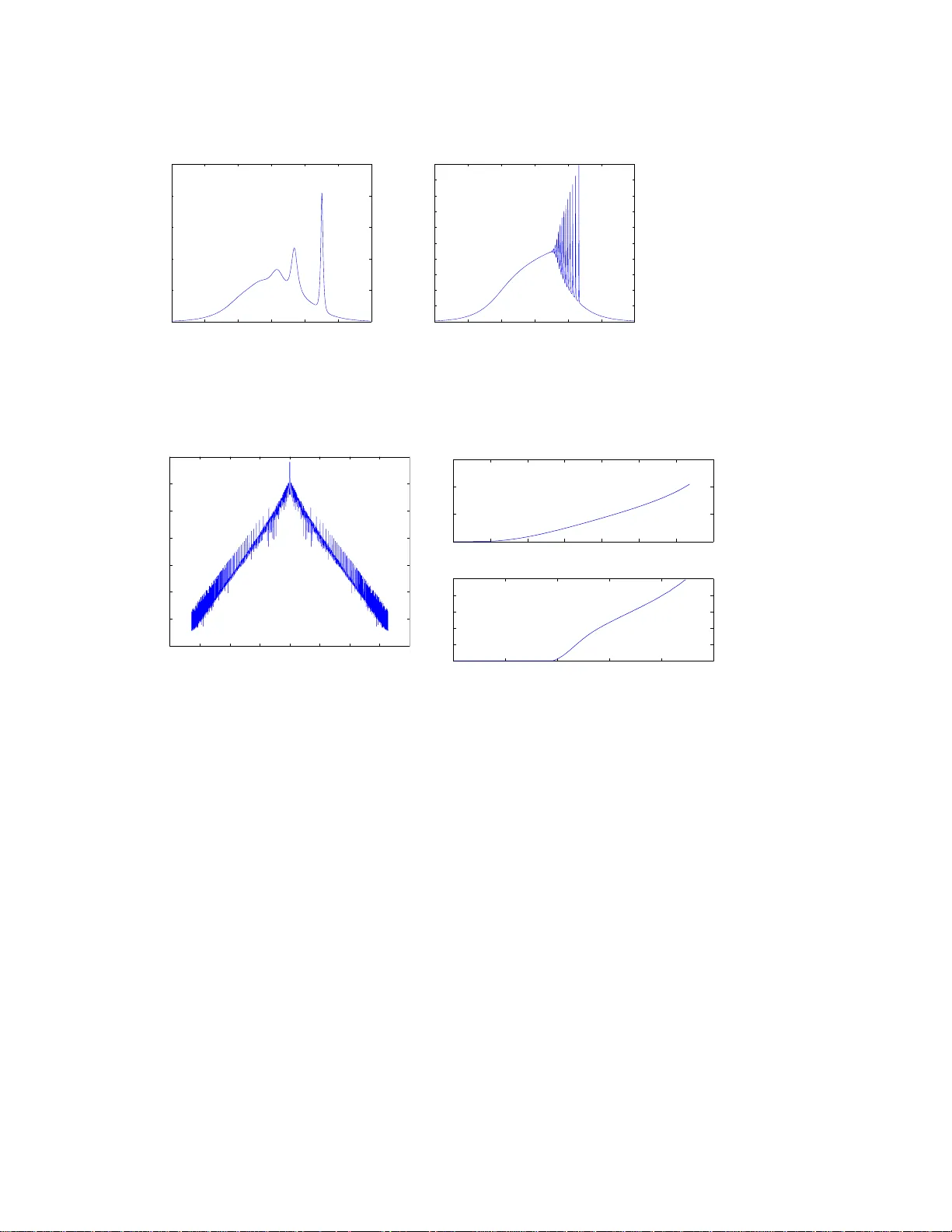
NUMERICAL STUD Y OF BREAKUP IN GENERALIZED K OR TEWEG-DE VRIES AND KA W AHARA EQUA T IONS B. DUBRO VIN ∗ , T. GRA V A † , AND C. KLEIN ‡ Abstract. This article is concerned with a conjecture in [8] on the formation of dispersi v e shocks in a c l ass of Hamiltonian dispersi v e regularizations of the quasilinear transport equation. The regularizations are c haracterized b y tw o a r bitrary functions of one v ariable, where the condition of int egrabili t y implies that one of these functions m ust not v anish. It is sho wn numerically for a l arge cl ass of equations that the lo cal b eha viour of their solution near the p oint of gradien t catastrophe for the transp ort equation is described lo cally by a sp ecial solution of a Painlev ´ e-t yp e equation. This lo cal description holds also for sol utions to equations where blow up can o ccur in finite time. F urthermore, it is shown that a solution of the dispersive equations aw a y from the p oint of gradien t catastrophe is approximated by a s olution of the transport equation with the same ini tial data, mo dulo terms of order ǫ 2 where ǫ 2 is the small disp ersion parameter. Corrections up to order ǫ 4 are obtained and tested n umerically . Key words. Generalized Kortew eg-de V ries equat ions, Kaw ahara equations, disp ersive shocks, multi-scales analysis AMS sub ject cla ssi fications. Primary , 65M70; Secondary , 65L05, 65M20 1. In tro duction. Many wa ve phenomena in dispersive media with neglig ible dissipation, in hydro dynamics, nonlinear optics, and plasma physics a re described by nonlinear disp ers ive pa r tial differential equations (PDE). These equations are also mathematically c halle ng ing since the solutio ns ca n have highly oscillatory regions and blowup even for smo oth initial da ta. This article is concerned with a conjecture in [8] on the for mation of disp ersive sho cks [16], [23],[26] in a cla ss of Hamiltonia n re g ularizatio ns o f the quas ilinear trans- po rt equa tion u t + a ( u ) u x = 0 , a ′ ( u ) 6 = 0 , u, x ∈ R . (1.1) In the present pap er we will consider general Hamiltonian p erturbations o f (1.1) up to fourth order in a small disp ersion par ameter 0 < ǫ ≪ 1. They c an b e wr itten in the fo rm of a cons e rv a tion law u t + a ( u ) u x + ǫ 2 ∂ x b 1 ( u ) u xx + b 2 ( u ) u 2 x + ǫ b 3 ( u ) u xxx + b 4 ( u ) u xx u x + b 5 ( u ) u 3 x + ǫ 2 b 6 ( u ) u xxxx + b 7 ( u ) u xxx u x + b 8 ( u ) u 2 xx + b 9 ( u ) u xx u 2 x + b 10 ( u ) u 4 x = 0 , (1.2) where the co efficients b 1 ( u ), . . . , b 10 ( u ) a re smo oth functions satisfying ce r tain con- straints following fro m the existence o f a Hamiltonian repr esentation u t + ∂ x δ H δ u ( x ) = 0 , (see Corolla ry 2.2 b elow). Here and b elow we use the notation ∂ x = ∂ ∂ x . ∗ SISSA, Via Bonomea 265, I-34136 T rieste, Italy , dubrovin@ sissa.it and Laboratory of Geomet- ric Methods in M athematical Ph ysi cs, Moscow State Univ ersi t y ‘M .V.Lomonosov’, † SISSA, Via Bonomea 265, I-34136 T rieste, Italy , grava@s issa.it ‡ Institut de Math ´ ematiques de Bourgogne, Unive r sit´ e de Bourgogne, 9 av enue Alain Sa v ary , 21078 Dijon Cedex, F rance, christi an.klein@u-bourgogne.fr 1 This class of equa tions contains impor ta nt equa tions as the Kor teweg-de V ries (KdV) equation u t + 6 uu x + ǫ 2 u xxx = 0 and its generaliza tions, the Kaw a hara eq ua tion and the C a massa-Ho lm equation in an a s ymptotic sens e (see [8]). Up to certain eq uiv alencie s the Hamiltonian re gularizatio ns of (1.1) ar e charac- terized by t wo free functions c ( u ) and p ( u ): u t + a ( u ) u x + ǫ 2 ∂ x c a ′ u xx + 1 2 ( c a ′ ) ′ u 2 x + ǫ 4 ∂ x 2 p a ′ + 3 5 c 2 a ′′ u xxxx + . . . = 0 . (1.3) Two equations of the for m (1.3) with the same inv ariants c ( u ) and p ( u ) commute, up to or der O ( ǫ 6 ) ( u t ) ˜ t − ( u ˜ t ) t = O ǫ 6 where, fo r a n a rbitrar y function ˜ a = ˜ a ( u ) u ˜ t + ˜ a ( u ) u x + ǫ 2 ∂ x c ˜ a ′ u xx + 1 2 ( c ˜ a ′ ) ′ u 2 x + ǫ 4 ∂ x 2 p ˜ a ′ + 3 5 c 2 ˜ a ′′ u xxxx + . . . = 0 . In this pap er the analysis o f [8] up to order ǫ 4 is extended to higher orders of ǫ . It is shown that the only obstr uc tio n to the functions c ( u ) and p ( u ) by the condition of integrabilit y is the condition that c ( u ) must not v anish. W e then pr o ceed to the study of the critic al b ehaviour of solutions to (1.2). Namely , let ( x c , t c , u c ) be a p oint o f gr adient c atastr ophe of a s o lution u 0 ( x, t ) to (1.1) sp ecified by an initial v alue u 0 ( x, 0) = φ ( x ). This means that the so lutio n is a smo oth function o f ( x, t ) fo r sufficiently small | x − x c | and t − t c < 0. Moreover ther e exists the limit lim x → x c , t → t c − 0 u 0 ( x, t ) = u c , but the deriv atives u 0 x ( x, t ), u 0 t ( x, t ) blo w up at the point. The Un iversality Conje ctur e of [8] says that, up to shifts, Galilea n tra ns formations a nd rescaling s, the b ehavior at the p oint o f gra dient catastro phe of a so lution to (1.2) with the same ǫ -indep endent initial data φ ( x ) es sentially dep ends neither o n the choice of the gene r ic so lution nor on the choice of the generic equa tion. Moreover, the generic s o lution near this p oint ( x c , t c , u c ) is given by u ( x, t, ǫ ) ≃ u c + α ǫ 2 / 7 U x − x c − a 0 ( t − t c ) β ǫ 6 / 7 ; t − t c γ ǫ 4 / 7 + O ǫ 4 / 7 , (1.4) where a 0 = a ( u c ) and the constants α , β , γ dep end on the c hoice of the ge neric equation and the so lution α = 12 b 0 1 a ′ 0 k 2 1 / 7 , β = 12 3 k ( b 0 1 ) 3 a ′ 0 3 ! 1 / 7 , (1.5) γ = 12 2 k 3 ( b 0 1 ) 2 a ′ 0 9 ! 1 / 7 . 2 Here a ′ 0 = a ′ ( u c ), b 0 1 = b 1 ( u c ); it is assumed tha t b 0 1 6 = 0. The consta nt k in these formula is inv erse pr op ortiona l to the “s trength” of the breakup o f the dis per sionless solution u 0 ( x, t ) k = − 6 lim x → x c x − x c ( u 0 ( x, t c ) − u c ) 3 (1.6) where we as s ume that k 6 = 0 (another genericity hypothesis) and a ′ 0 k > 0. The function U = U ( X ; T ), ( X, T ) ∈ R 2 , is defined as the unique rea l smo oth solution to the fourth o r der ODE [1],[19] X = T U − 1 6 U 3 + 1 24 U 2 X + 1 12 U U X X + 1 240 U X X X X , (1.7) which is the second member o f the Painlev´ e I hiera rch y . W e will call this equation PI2. The relev ant so lution is characterized by the asymptotic b ehavior U ( X , T ) = − (6 X ) 1 3 − 2 2 / 3 T (3 X ) 1 3 + O ( X − 5 3 ) , X → ±∞ , (1.8) for each fixed T ∈ R . The existence of a smoo th solution o f (1.7) for all r eal X , T satisfying (1.8) ha s b een proved by Clae ys and V anlessen [5]. Observe that the principa l term of the asymptotics (1.4) dep ends only on the or de r ǫ 2 regular iz ation. In the present pap er we will n umer ically analyze, in pa rticular, the influence of the higher order corr ections 1 on the lo ca l b ehaviour o f solutions to (1.2 ) near the po int of ca ta strophe. First n umerical tests of the P I2 as ymptotic descriptio n of the critical point for the class of PDE in [8] hav e b e en presented in [15] for the KdV and the Camassa- Holm equation. In [4] a rig o urous pro of o f the as ymptotic b ehaviour (1.4) has b een o btained for the K dV eq uation. In this pap er we genera lize the numerical inv estigatio n of [15] to a large r cla ss of equations which include the gener alized KdV equation, the K aw ahara equations with a disp er sion o f fifth or der and the seco nd equatio n in the KdV hierarch y . W e comment on the for mation of blow up and on the r ole of integrability in the formation o f oscillato ry regions . In particular we s how the differences in the formation of dispe r sive sho ck w av es betw een integrable and non-in tegr a ble ca ses. The KdV equation has b een ex tensively studied nu mer ically in [14]. Then we show numerically that the solutio n of the disp er s ive equation (1 .2) con- verges to the solution of the disper sionless equation (1.1) a way from the point of gradient cata strophe at a rate o f order ǫ 2 . Finally we show that the so lution of the disp e rsive equation (1.2) is well a pproximated a s a serie s in even p ower of ǫ in terms of the solution of the disp ersio nle s s eq uation (1.1) up to order ǫ 4 by the so ca lled 1 One should also tak e into accou nt [8] that the actual small parameter of the expansion (1.4) is 12 b 0 1 ǫ 2 1 / 7 . In other w ords the asymptotic expansion (1.4) makes sense only under the assumption b 0 1 ǫ 2 ≪ 1 12 in agreemen t with [2]. 3 quasi-trivia lity transfor mation [8 ] aw ay from the po int of gr adient catas trophe. Such an appr oximation has alr eady b een obtained for conser v atio n laws with p o s itive vis- cosity [1 3]. F urthermore the existence of a n expansion in ev en powers of ǫ has alr eady app eared and b een pr ov ed in the co ntext of la r ge N expansions in Hermitian matr ix mo dels [3],[12]. The pap er is org anized as follows. In sec t. 2 we briefly review the res ults of [8]. In sect. 3 we discuss higher or der in ǫ regula r izations of (1.1) a nd obs tr uctions o n the function c ( u ) by the condition of integrability . A numerical s tudy of the applicability of the conjecture to generalized KdV equations is given in sect. 4. W e also comment on the po ssibility of blowup. In se c t. 5 the co njecture is tested numerically for equations with high or der disp ersion as the K aw ahar a equation. D iffere nce s in the fo r mation of r apid o scillations in the solutions to integrable and non-integrable equatio ns are studied. Details a b o ut the us ed numerical metho ds a re given in the app endix. 2. Hamiltonian PDEs and their in v arian ts. In this pa pe r we study scala r Hamiltonian PDEs of the or der at most fiv e. They are written in the for m of a conserv ation law u t + ∂ x ϕ ( u, ǫ u x , ǫ 2 u xx , ǫ 3 u xxx , ǫ 4 u xxxx ) = 0 , (2.1) where ϕ = δ H δ u ( x ) , (2.2) H = Z h ( u, ǫ u x , ǫ 2 u xx ) dx. Recall that the E uler–Lag range der iv a tive is defined by δ H δ u ( x ) = ∂ h ∂ u − ∂ x ∂ h ∂ u x + ∂ 2 x ∂ h ∂ u xx − . . . . (2.3) Here and in the sequel the integral of a differential po lynomial is understo o d, in the s pirit of formal c alculus of variations , a s the equiv a lence clas s of the p olyno mial mo dulo the imag e of the op er ator o f total x -deriv ative ∂ x h = u x ∂ h ∂ u + u xx ∂ h ∂ u x + . . . . (2.4) It is worthwhile to recall that a differential p olyno mia l p ( u ; u x , . . . , u ( m ) ) b elongs to Im ∂ x iff δ P δ u ( x ) = 0 , P = Z p ( u ; u x , . . . , u ( m ) ) dx. (2.5) The Poisson brack et of t wo lo cal functiona ls H , F asso ciated with (2.1), (2.2), is a lo cal functiona l of the for m { H , F } = Z δ H δ u ( x ) d dx δ F δ u ( x ) dx (2.6) 4 Lemma 2.1. Equation (2.1) c an b e writt en in t he Hamiltonian form (2.2) iff t he function ϕ satisfies t he fol l owing two c onstr aints ∂ ϕ ∂ u x = ∂ x ∂ ϕ ∂ u xx − 1 2 ∂ x ∂ ϕ ∂ u xxx (2.7) ∂ ϕ ∂ u xxx = 2 ∂ x ∂ ϕ ∂ u xxxx . Pr o of According to the class ic al Helmholtz cr iter ion (see in [7]) the function ϕ ( u, u x , u xx , . . . ) can b e locally repres ent ed as the v a riational deriv ative of some functional H = R h ( u, u x , . . . ) dx iff it s atisfies the fo llowing system of constr aints ∂ ϕ ∂ u ( i ) = ( − 1) i X m ≥ 0 ( m + i )! i ! m ! ( − ∂ x ) m ∂ ϕ ∂ u ( i + m ) , i = 0 , 1 , . . . . (2.8) F or the par ticular case under consider ation the equations (2.8) r educe to (2.7). Applying the Lemma to a PDE (2 .1 ) written in the form of the weak disp ersion expansion one arrives a t Corollar y 2.2. The e quation u t + a ( u ) u x + ∂ x ǫ b 0 ( u ) u x + ǫ 2 b 1 ( u ) u xx + b 2 ( u ) u 2 x + ǫ 3 b 3 ( u ) u xxx + b 4 ( u ) u xx u x + b 5 ( u ) u 3 x + ǫ 4 b 6 ( u ) u xxxx + b 7 ( u ) u xxx u x + b 8 ( u ) u 2 xx + b 9 ( u ) u xx u 2 x + b 10 ( u ) u 4 x = 0 (2.9) is H amiltonian iff the c o efficients b 0 , . . . , b 10 satisfy b 0 = 0 , b 2 = 1 2 b ′ 1 , b 3 = 0 , b 5 = 1 3 b ′ 4 , b 7 = 2 b ′ 6 , b 8 = 3 2 b ′ 6 , b 10 = 1 4 b ′ 9 . The Hamiltonia n equations (2.1) ar e considered mo dulo canonica l transformations written in the form o f a time- ǫ shift u ( x ) 7→ ˜ u ( x ) = u ( x ) + ǫ { u ( x ) , K } + ǫ 2 2! {{ u ( x ) , K } , K } + . . . (2.10) generated by a Hamiltonia n K = Z k ( u, ǫ u x , . . . ) dx. (2.11) The trans formations (2.10) pr e s erve the canonical form of the Poisson bra cket (2.6 ). Two Hamiltonia n equations are called e quivalent if they are related by a canonical 5 transformatio n of the form (2.10), (2.11). F or example, the degree 3 terms in a Hamiltonian PDE of the form (2.9) can b e eliminated by a transforma tio n (2 .10) if a ′ ( u ) 6 = 0. Indeed, it suffices to choose the g enerating Hamiltonian in the form K = Z ǫ 2 b 4 ( u ) 6 a ′ ( u ) u 2 x dx. The following Lemma describ es a normal form of Hamiltonians of order 4 (cf. [8]) with r esp ect to tr ansformations (2.10). Lemma 2. 3. Any Hamiltonian e qu ation of t he form (2.9) with a ′ ( u ) 6 = 0 is e qu ivalent to u t + a ( u ) u x + ǫ 2 ∂ x b 1 u xx + 1 2 b ′ 1 u 2 x + ǫ 2 b 6 u xxxx + 2 b ′ 6 u xxx u x + 3 2 b ′ 6 u 2 xx (2.12) + b 9 u xx u 2 x + 1 4 b ′ 9 u 4 x = 0 . The H amiltonian PDEs (2.12) and u t + ˜ a ( u ) u x + ǫ 2 ∂ x ˜ b 1 u xx + 1 2 ˜ b ′ 1 u 2 x + ǫ 2 ˜ b 6 u xxxx + 2 ˜ b ′ 6 u xxx u x + 3 2 ˜ b ′ 6 u 2 xx (2.13) + ˜ b 9 u xx u 2 x + 1 4 b ′ 9 u 4 x = 0 . ar e e quivalent iff ˜ a = a, ˜ b 1 = b 1 , ˜ b 6 = b 6 . (2.14) Pr o of W e hav e alr eady prov ed that the coefficients of degree 3 in ǫ can be elimi- nated by a ca nonical transforma tio n of the form (2.10). One can eas ily see that the co efficients a , b 1 and b 6 are inv aria nt with respec t to these transformations. Tw o Hamiltonians of the form H = Z f − ǫ 2 2 b 1 u 2 x + ǫ 4 2 b 6 u 2 xx − ǫ 4 12 b 9 u 4 x dx and ˜ H = Z f − ǫ 2 2 b 1 u 2 x + ǫ 4 2 b 6 u 2 xx − ǫ 4 12 ˜ b 9 u 4 x dx generating the flows (2.12) a nd (2.13) with the same co efficients ˜ a = a , ˜ b 1 = b 1 , ˜ b 6 = b 6 but with differen t ˜ b 9 6 = b 9 are related by a cano nica l transformatio n (2.10) with K = ǫ 3 24 Z ˜ b 9 − b 9 a ′ u 3 x dx. 6 Thu s the co efficients a , b 1 , b 6 are invariants of the Hamiltonia n PDE (2.12). As it was discov ered in [8], any Hamiltonian PDE of the form (2.12) is integrable at the order ǫ 4 approximation. Mo re precisely , assuming a ′ 6 = 0 le t us r eplace the inv a riants b 1 = b 1 ( u ) and b 6 = b 6 ( u ) with c = b 1 a ′ , p = b 6 2 a ′ − 3 10 b 2 1 a ′′ a ′ 3 . (2.15) Then the equation (2.12) is equiv alent to the PDE u t + a ( u ) u x + ǫ 2 ∂ x c a ′ u xx + 1 2 ( c a ′ ) ′ u 2 x + ǫ 4 ∂ x 2 p a ′ + 3 5 c 2 a ′′ u xxxx + . . . = 0 (2.16) with the Hamilto nian H f = Z f − ǫ 2 2 c f ′′′ u 2 x + ǫ 4 p f ′′′ + 3 10 c 2 f (4) u 2 xx (2.17) − 1 6 3 c c ′′ f (4) + 3 c c ′ f (5) + c 2 f (6) 4 + p ′ f (4) + p f (5) u 4 x dx where, a s a bove, f ′′ ( u ) = a ( u ) . The appr oximate in tegra bility means that, fixing the functional par ameters c = c ( u ), p = p ( u ) o ne obta ins a family of Hamiltonia ns sa tis fying { H f , H g } = O ǫ 6 (2.18) for an arbitrar y pair of smo o th functions f = f ( u ), g = g ( u ). In pa rticular cho osing f ( u ) = 1 6 u 3 one o btains the Hamiltonia n H = Z u 3 6 − ǫ 2 c ( u ) 2 u 2 x + ǫ 4 p ( u ) u 2 xx dx (2.19) of a g eneral or der 4 disp ersive reg ularization of the Hopf equation u t + u u x + ǫ 2 ∂ x c u xx + 1 2 c ′ u 2 x + ǫ 4 ∂ x 2 p u xxxx + 4 p ′ u xxx u x + 3 p ′ u 2 xx + 2 p ′′ u xx u 2 x = 0 (2.20) int r o duced in [8] 2 . More generally , we call a p erturbatio n H = H 0 + ǫ H 1 + ǫ 2 H 2 + . . . of the Hopf Hamiltonian H 0 = Z u 3 6 dx 2 In the presen t pap er we use a differen t normalization c ( u ) 7→ 12 c ( u ). 7 N -inte gr able if, for any smo oth function f = f ( u ) there exists a p er turb ed Hamilto- nian H f = H 0 f + X k ≥ 1 ǫ k H k f such that fo r f = u 3 6 the Hamiltonia n H f coincides with H and, mor eov er, for a n y pair of functions f , g the Ha milto nia ns H f , H g satisfy { H f , H g } = O ǫ N +1 . F or ex ample, the p er tur be d Hamiltonian (2.1 9) is 5-in tegra ble. The commuting Hamiltonians have the form (2.1 7). In the nex t sec tion we will discuss the pr oblem of constructing hig her integrable p erturbations o f (2.1 9). 3. On obs tacles to integrabilit y . W e will now study the p oss ibility to extend the c o mmut ing Hamiltonians (2.17) to the next order of the p erturbative expansio n. Theorem 3.1. 1) Any or der 6 p ertu rb ation of the cu bic Hamiltonian H 0 = R u 3 6 dx c an b e r epr esent e d in the form H = Z u 3 6 − ǫ 2 2 c ( u ) u 2 x + ǫ 4 p ( u ) u 2 xx − ǫ 6 α ( u ) u 2 xxx + β ( u ) u 3 xx dx (3.1) Such a p ert u rb ation is 7-inte gr able for arbitr ary fun ctional p ar ameters c = c ( u ) , p = p ( u ) , α = α ( u ) , β = β ( u ) . 2) The p erturb ation (3.1) c an b e extende d t o a 9-inte gr able one iff c ( u ) 6 = 0 and α = 1 28 80 p 2 c − 67 p c ′ + 33 c p ′ + 12 c c ′ 2 − 9 c 2 c ′′ . (3.2) Pr o of A g eneral order 6 p erturbation of the cubic Hamiltonian H 0 m ust hav e the form H = Z u 3 6 − ǫ 2 2 c ( u ) u 2 x + ǫ 4 p ( u ) u 2 xx − ǫ 6 α ( u ) u 2 xxx + β ( u ) u 3 xx + γ ( u ) u 2 xx u 2 x + δ ( u ) u 6 x dx. The last tw o terms can b e eliminated by a canonica l transforma tio n H 7→ H − ǫ { H , F } + . . . with F = Z ǫ 5 1 6 γ ( u ) u 2 xx u x + 1 4 δ ( u ) u 5 x dx. F or an arbitr ary function f = f ( u ) the density of a Hamiltonian H f = Z h f dx commuting with (3.1 ) mo du lo O ǫ 6 m ust have the form h f = f − ǫ 2 2 c f ′′′ u 2 x + ǫ 4 p f ′′′ + 3 10 c 2 f (4) u 2 xx − 1 6 p ′ f (4) + 3 4 c c ′′ f (4) + p f (5) (3.3) + 3 4 c c ′ f (5) + 1 4 c 2 f (6) u 4 x − ǫ 6 α f ( u ) u 2 xxx + β f ( u ) u 3 xx + γ f ( u ) u 2 xx u 2 x + δ f ( u ) u 6 x 8 with so me smo o th functions α f = α f ( u ), β f = β f ( u ), γ f = γ f ( u ), δ f = δ f ( u ) depe nding on f . F rom the commutativit y { H , H f } = O ǫ 7 one uniquely determines these co efficients α f = α f ′′′ + 8 7 c p + 3 70 c 2 c ′ f (4) + 9 70 c 3 f (5) β f = β f ′′′ − 3 2 α + 253 p c ′ + 169 c p ′ 168 + c c ′ 2 35 + 5 56 c 2 c ′′ ! f (4) − 29 21 c p + 31 70 c 2 c ′ f (5) − c 3 f (6) 7 γ f = 3 7 β − 6 7 α ′ + 3 35 ( c ′ 3 − c 2 c ′′′ − 3 c c ′ c ′′ ) + c ′ p ′ − 47 14 p c ′′ − c p ′′ f (4) − 2 α + 37 14 p c ′ + 3 35 ( c c ′ 2 + 11 c 2 c ′′ ) + 8 7 c p ′ f (5) − 1 14 23 c p + 9 c 2 c ′ f (6) − 3 20 c 3 f (7) δ f = 1 10 p ′ c ′′′ + 10 c c ′′ c ′′′ + 7 c c ′ c (4) + c 2 c (5) 40 + 2 15 p c (4) + 1 60 c p (4) f (4) + 1 15 α ′′ + 1 5 p ′ c ′′ + 3 40 c c ′′ 2 + 3 10 p c ′′′ + c c ′ c ′′′ 10 + 1 15 c p ′′′ + c 2 c (4) 15 f (5) + 2 15 α ′ + 2 15 c ′ p ′ + 1 3 p c ′′ + 7 c c ′ c ′′ + 3 c 2 c ′′′ 40 + 1 10 c p ′′ f (6) + 1 15 α + 1 6 p c ′ + c c ′ 2 16 + 1 10 c p ′ + 3 40 c 2 c ′′ ! f (7) + 1 20 c p + 3 80 c 2 c ′ f (8) + c 3 240 f (9) Thu s the resulting Hamiltonian H f satisfies { H , H f } = O ǫ 8 . It is not difficult to als o verify the commutativit y { H f , H g } = O ǫ 8 for a n ar bitrary pa ir o f functions f = f ( u ), g = g ( u ). Let us now analyze the p os s ibilit y of extension to a commutativ e fa mily of order 8. W e add to (3 .1 ) terms o f the fo r m H 7→ ˜ H = H + Z ǫ 8 A 1 u 8 x + A 2 u 4 x u 2 xx + A 3 u 2 x u 3 xx + A 4 u 4 xx + A 5 u 2 x u 2 xxx + A 6 u xx u 2 xxx + A 7 u 2 xxxx dx and to (3 .3) a similar expres sion H f 7→ ˜ H f = H f + Z ǫ 8 B 1 u 8 x + B 2 u 4 x u 2 xx + B 3 u 2 x u 3 xx + B 4 u 4 xx + B 5 u 2 x u 2 xxx + B 6 u xx u 2 xxx + B 7 u 2 xxxx dx. 9 Here A 1 , . . . , A 7 , B 1 , . . . , B 7 are some functions of u . The g oal is to meet the condition { ˜ H , ˜ H f } = O ǫ 9 . (3.4) The order 8 ter ms in the bra ck et (3.4) ar e r epresented by a differential po lynomial of degree 9. F rom the v anis hing of the co e fficient of u (8) u x it fo llows tha t B 7 = A 7 f ′′′ + 10 9 α c + 10 9 p 2 + 10 63 c c ′ p − 1 210 c 2 c ′ 2 + 1 21 c 2 p ′ + 1 70 c 3 c ′′ f (4) + 5 7 c 2 p + 3 70 c 3 c ′ f (5) + 3 70 c 4 f (6) . Next, fr om the v anishing of the co efficient of u (6) u xxx we ge t (3.2). F urther calcula tions a llow one to determine B 6 from the co efficient of u (6) u xx u x , B 5 from the co efficient of u (6) u 3 x , B 4 from the co efficient of u (4) u 2 xx u x , B 3 from the co efficient of u (4) u xx u 3 x , B 2 from the co efficie nt of u (4) u 5 x , and, finally , B 1 from the co efficient of u xx u 7 x . All these co efficients are repr esented by line a r differential op er- ators of order at most 12 acting on the arbitra r y function f = f ( u ). The co efficients of these o p er ators dep end linearly on A 1 , . . . , A 7 and their u -deriv atives and also on c ( u ) and p ( u ) and their deriv atives. The explicit fo r mulae a re r ather long; they will not b e given here. As ab ov e one can verify v alidity of the identit y n ˜ H f , ˜ H g o = O ǫ 10 for a ny pair o f functions f ( u ), g ( u ). Corollar y 3.2. L et p ( u ) b e an arbitr ary n on-vanishing function. Then the Hamiltonian H = Z u 3 6 + ǫ 4 p ( u ) u 2 xx dx (3.5) c ann ot b e include d into a 9-inte gr able family. 4. Quastriviality transformations and p ert urbative s olutions. In this section we will develop a pe rturbative technique for constructing monotone so lutions to the equations of the form (2.2 0) for sufficien tly small time t . This technique is based on the so-called quasitriviality t r ansformation [8 ] expr essing solutions to the per turb ed equation (2.20) in terms of so lutions to the unp er tur be d e q uation. T o explain the basic idea let us consider the equation u t + u u x + ǫ 2 ∂ x c u xx + 1 2 c ′ u 2 x + · · · = u t + ∂ x δ H δ u ( x ) = 0 (4.1) H = Z 1 2 u 3 − ǫ 2 2 c u 2 x + . . . dx. The quasitrivia lit y tr ansformatio n for this e q uation v → u = v + ǫ 2 c 2 v xxx v x − v 2 xx v 2 x + c ′ v xx + 1 2 c ′′ v 2 x + O ( ǫ 4 ) (4.2) 10 is ge ner ated by the Hamiltonian K = − ǫ 2 Z c v x log v x dx + O ( ǫ 3 ) , (4.3) u = v + ǫ { v ( x ) , K } + ǫ 2 2! {{ v ( x ) , K } , K } + . . . . Substituting in to eq. (4.1) o ne obtains a function u ( x, t ; ǫ ) satisfying (4.1) up to terms of order ǫ 4 . Indeed, one can easily derive the following expressio n for the discrepancy ǫ − 4 u u x + ǫ 2 ∂ x c u xx + 1 2 c ′ u 2 x − u t = = c 2 23 v xx 5 2 v x 5 − 115 v xx 3 v xxx 4 v x 4 + 39 v xx 2 v xxxx 4 v x 3 + 57 v xx v xxx 2 4 v x 3 − 5 v xx v xxxxx 2 v x 2 − 19 v xxx v xxxx 4 v x 2 + v xxxxxx 2 v x + c c ′ − 35 v xx 4 4 v x 3 + 19 v xx 2 v xxx v x 2 − 7 v xx v xxxx v x − 23 v xxx 2 4 v x + 7 v xxxxx 2 + c c ′′ 3 v xx 3 2 v x + 13 v x v xxxx 2 + 3 v xx v xxx + c c ′′′ 15 v x 2 v xxx 2 + 8 v x v xx 2 + 11 2 c c (4) v 3 x v xx + 1 2 c c (5) v 5 x + c ′ 2 3 v xx 3 2 v x + 4 v x v xxxx + v xx v xxx 2 + c ′ c ′′ 21 v x 2 v xxx 2 + 10 v x v xx 2 + 9 c ′ c ′′′ v 3 x v xx + c ′ c (4) v 5 x +5 c ′′ 2 v 3 x v xx + 5 4 c ′′ c ′′′ v 5 x Note that the same quasitriviality transfor ma tion works for solutions v = v ( x , t ) to the no nlinear transp ort e q uation v t + a ( v ) v x = 0 transforming it to solutions, mo dulo O ( ǫ 4 ), to the p erturb ed equa tion (1.1) . Denote by φ ( x ) = v ( x , 0) the initial data for the Hopf equation. The initial v alue of solution u ( x, t ; ǫ ) given by the for mula (4 .2) differs fr o m φ ( x ): u ( x, 0; ǫ ) = φ + ǫ 2 c 2 φ xxx φ x − φ 2 xx φ 2 x + c ′ φ xx + 1 2 c ′′ φ 2 x + O ( ǫ 4 ) . (4.4) In or der to solve the C a uch y problem for (4.1) with the same initial data one ca n use the following trick. Let us consider the so lution ˜ v = ˜ v ( x, t ; ǫ ) to the Hopf equa tion with the ǫ -dep endent initial data ˜ v ( x , 0; ǫ ) = φ − ǫ 2 c 2 φ xxx φ x − φ 2 xx φ 2 x + c ′ φ xx + 1 2 c ′′ φ 2 x . (4.5) Such a so lution ca n b e repr e sented in the form ˜ v ( x , t ; ǫ ) = v ( x, t ) + ǫ 2 w ( x, t ) + O ( ǫ 4 ) (4.6) where the function w ( x, t ) has to b e determined from the equation Φ ′ ( w ) − w t = c ( v ) 2 2Φ ′′ 2 ( v ) − Φ ′ ( v )Φ ′′′ ( v ) Φ ′ 3 ( v ) − c ′ ( v ) Φ ′′ ( v ) Φ ′ 2 ( v ) + c ′′ ( v ) 2Φ ′ ( v ) . (4.7) 11 Here Φ( v ) is the function inv ers e to φ ( x ). Applying the quas itriviality tr a nsformation to the so lutio n ˜ v ( x, t ; ǫ ) one o btains a function u ( x, t ; ǫ ) = v + ǫ 2 w + ǫ 2 c 2 v xxx v x − v 2 xx v 2 x + c ′ v xx + 1 2 c ′′ v 2 x (4.8) satisfying equation (4.1) mo d ulo terms o f o rder ǫ 4 with the initial data u ( x, 0; ǫ ) = φ ( x ) + O ( ǫ 4 ) . (4.9) 5. Generalized KdV equations. In this sectio n we will fir st study the role of the function a ( u ) in (1.1) on the v alidity o f the conjecture. This is done for the generalized KdV equations having the for m u t + a ( u ) u x + ǫ 2 u xxx = 0 . (5.1) W e will assume that a ( u ) is monoto nic in an op en neigh b or ho o d of each critica l p oint. The functional pa r ameters c ( u ) a nd p ( u ) in (2.1 7) ar e given by c ( u ) = 1 a ′ ( u ) , p ( u ) = − 3 10 a ′′ ( u ) a ′ ( u ) 3 . (5.2) The basic idea o f the PI2 a pproach to the brea kup b ehavior is that the equation behaves in this case approximately a s the KdV equation. W e will test this assumption first for a ( u ) o f the for m a ( u ) = 6 u n , n ∈ N . 5.1. Breakup. T o b egin we will study the solutio ns to gener a lized KdV equa - tions close to the br eakup of the corr e sp o nding dispers ionless equation. A generic critical po int ( x c , t c , u c ) is given by a ( u c ) t c + Φ( u c ) = x c , a ′ ( u c ) t c + Φ ′ ( u c ) = 0 , (5.3) a ′′ ( u c ) t c + Φ ′′ ( u c ) = 0 , where Φ( u ) is the in verse of the initial da ta φ ( x ) (which migh t consist of several branches). W e will a lwa ys study the initial data φ ( x ) = sech 2 x , which imply Φ( u ) = ln((1 ± √ 1 − u ) / √ u ). F or the critical v alues we obtain u c = 2 n 2 n + 1 , t c = (1 + 2 n ) n +1 / 2 6(2 n ) n +1 , (5.4) x c = √ 2 n + 1 2 n + ln √ 2 n + 1 + 1 √ 2 n , k = − 1 6 ( a ′′′ ( u c ) t c + Φ ′′′ ( u c )) = (2 n + 1 ) 9 / 2 96 n 2 . W e study firs t the difference betw ee n the numerical s o lution to the genera lized KdV equation and the solutio n to the dis per sionless equatio n, a generalized Hopf equa tion, on the whole computational do ma in. F or v alues of ǫ = 1 0 − 1 , 10 − 1 . 25 , . . . , 10 − 3 we find that this difference scales for n = 1 (KdV) ro ughly as ǫ α with α = 0 . 29 9 (corr elation 12 co efficient r = 0 . 99997 in linear regressio n, standar d deviation σ α = 0 . 00 18), for n = 3 we have α = 0 . 31 7 ( r = 0 . 9998 , σ α = 0 . 004 6), for n = 4 we have α = 0 . 3 24 ( r = 0 . 9 998, σ α = 0 . 005), and for n = 5 we hav e α = 0 . 325 ( r = 0 . 999 8, σ α = 0 . 0053 ). The predicted v a lue is 2 / 7 = 0 . 28 57. It can be s een that the ab ov e v alues are all higher, and that the sca ling for the gener alized KdV equations is close to ǫ 1 / 3 . Th us the decreas e is at lea s t o f the predicted o rder. It is not surpising that higher v alues for the exp onent ar e found since we consider co nsiderably large v alue s of ǫ for which the c o ntributions of higher or der in the difference still play a consider able role . As discussed in the pr evious section it is conjectured that the b ehavior of the solutions to the genera lized KdV equatio n in the vicinity o f the critica l p oint is given in terms o f the s pe c ial solution to the P I2 equation. E x panding a ( u ) for u ∼ u c as in [8], one finds the b ehavior shown in Fig . 5 .1 for different v a lue s of n . It ca n b e seen that the asymptotic description is m uch better f o r KdV due the fact that the PI2 transcendent gives an exact solution to KdV. F o r o ther v alues o f n this transcendent gives the conjectured descr iption in the vicinity of the cr itical p oint. The q ua lity of 1.45 1.5 1.55 1.6 0.4 0.6 0.8 1 x u n=1 0.75 0.8 0.85 0.9 0.6 0.7 0.8 0.9 1 x u n=3 0.65 0.7 0.75 0.8 0.7 0.8 0.9 1 x u n=4 0.55 0.6 0.65 0.7 0.7 0.8 0.9 1 x u n=5 Fig. 5.1 . The blue line is the solution of the gener alize d KdV e quation u t + 6 u n u x + ǫ 2 u xxx = 0 for differ ent values of n for the init ial data φ ( x ) = 1 / cosh 2 x and ǫ = 10 − 3 at the time t c and ne ar the p oint of gr adient ca t astr ophe x c of the Hopf solution (c enter of the figur e). The gr e en line is the multisc ale appr oximation in terms of the PI2 solution. the asymptotic descr iption shows the exp ected scaling for smaller v a lues of ǫ a s can be seen on the left in Fig. 5.2. The qua lit y of this P I2 appr oximation is not limited to functions a ( u ) in (5.1) which are p o lynomial in u . If we co nsider the case a ( u ) = 6 sinh u , we obtain the right figure in Fig. 5.2. It ca n b e seen that the PI2 asympto tics gives the sa me excellent 13 0.634 0.636 0.638 0.64 0.642 0.644 0.646 0.648 0.65 0.652 0.82 0.84 0.86 0.88 0.9 0.92 0.94 0.96 0.98 x u 1.3 1.32 1.34 1.36 1.38 1.4 1.42 1.44 1.46 1.48 0.4 0.5 0.6 0.7 0.8 0.9 1 1.1 x u Fig. 5.2 . The b lue line is the solution of u t + a ( u ) u x + ǫ 2 u xxx = 0 with a ( u ) = 6 u 5 on t he left and a ( u ) = 6 sinh u on the ri ght, for the initial data φ ( x ) = 1 / cosh 2 x and ǫ = 10 − 4 at the time t c ne ar the p oint of gr adient c atastr ophe x c of the Hopf solution (c ente r of ea ch figur e). The gr een line is the multisc ale appr oximation in t erms of the PI2 solution. description as for K dV. 5.2. Oscillatory regimes and bl o wup. It is known that so lutio ns to initial v alue problems with sufficiently smo oth initial data for the gene r alized KdV eq uation with n < 4 ar e globa lly regula r in time. This is not the cas e for for n ≥ 4 where blowup can o ccur at finite time with n = 4 b eing the critical ca s e. F or this case a theorem by Martel and Merle [24] states that so lutions on the r eal line, with negative energy , blow up in finite or infinite time. F or the gener a l case n > 4 and p e rio dic settings co nsidered here, the q uestion is still op en. Since the energ y has the form E = Z R ǫ 2 2 u 2 x − 6 u n +2 ( n + 1)( n + 2) dx it will b e a lwa ys nega tive for sufficiently small ǫ and p ositive u . Here w e a ddress numerically the question whether the formation of disp ersive sho cks, i.e., of a reg ion of rapid mo dulated oscillatio ns, prec edes a p otential blowup. W e exp ect that the br eakup of the solution to the disp ers ionless equa tion is regula rized by the disp ers ion in the form o f oscillations which then develop into blowup if the latter exis ts. This is exa ctly what we see in the following. Notice that the breakup time is given by the dispe r sionless equa tio n and is thus indep endent of ǫ . W e first study the cas e n = 4. F or ǫ = 1, the energ y is p ositive and no indication of blowup is observed. F or ǫ = 0 . 1 we o btain for the initial data φ ( x ) = sech 2 x the left figur e in Fig. 5.3. F or smaller ǫ ( ǫ = 0 . 0 1) the b ehavior is similar, but there ar e as ex pe c ted more o scillations, a nd the size of the oscilla tions reaches higher v alue s ear lier as ca n be seen in Fig. 5 .3. F or obvious rea sons it is numerically difficult to decide whether the disp ersive sho ck will lead to a blowup. In practice we run out of r esolution b efore the code brea ks do wn beca use of a blowup. This is due to oscillatio ns in F ourier space as can b e seen in Fig. 5.4. Though there is in pr incipal enough res olution to approach u ( x, t ), the oscilla tio ns o f the F o urier co efficients ma ke an accurate approximation via a F ourier tra ns form imp ossible. The rea son fo r this b ehavior is as dis c ussed in [27] that singularities of the form ( z − z j ) µ j in the complex plane le ad asymptotica lly to F ourier co efficients with mo dulus of the form C k − ( µ j +1) exp( − δ k ) , δ > 0 . If there ar e several such singularities , there will b e oscillations in the F ourier co efficients. In the present case there are at leas t 14 −3 −2 −1 0 1 2 3 0 0.5 1 1.5 2 2.5 x u −3 −2 −1 0 1 2 3 0 0.2 0.4 0.6 0.8 1 1.2 1.4 1.6 1.8 2 x u Fig. 5.3 . Solution of the gene r alize d KdV e quation with n = 4 for the initial data φ ( x ) = 1 / cosh 2 x and ǫ = 10 − 1 at t he time t = 0 . 3180 ≫ t c on the left, and for ǫ = 10 − 2 at the t ime t = 0 . 2235 ≫ t c on t he right. −8000 −6000 −4000 −2000 0 2000 4000 6000 80 00 −10 −8 −6 −4 −2 0 2 4 k v Fig. 5.4 . L o garithm with b ase 10 of the mo dulus of the F ourier c o effic ent s of the func- tion shown in Fig. 5.3 on the right. 0 0.05 0.1 0.15 0.2 0.25 0.3 0.35 1 1.5 2 2.5 ε =10 −1 t ||u|| ∞ 0 0.05 0.1 0.15 0.2 0.25 1 1.2 1.4 1.6 1.8 2 t ||u|| ∞ ε =10 −2 Fig. 5 .5 . L ∞ norm of the solutions in Fig. 5.3. t wo such singular ities, the bre akup which is strictly sp e aking only s ingular for ǫ = 0 , but has an effect already for finite ǫ , and the blowup, which leads to the b ehavior seen in (5.4 ). In Fig. 5 .5 we give the L ∞ -norm of the solutions in Fig. 5 .3. It cannot be decided on the base of these numerical data whether ther e is finite time blowup in this case. If it exists it is clear ly preceded by a disp ersive s ho ck. In the sup e rcritical case n = 5 we obta in a simila r pictur e. In Fig . 5.6 we see the solution in the ca se ǫ = 0 . 1 . Again it app ears as if the rightmost p eak evolves into a singularity . F or s maller ǫ ( ǫ = 0 . 01) ther e ar e again mor e oscillatio ns , which stresses the imp ortance of disp ersive regula r ization b efore a p otential blowup. Studying the L ∞ -norm of the solutions in Fig. 5.6, we can see tha t the cas e ǫ = 0 . 1 indeed seems to appro ach an L ∞ blowup in finite time. Because of resolutio n pr oblems we could not reach a similar p oint for ǫ = 0 . 01. 6. Ka w ahara equations . The Kawahara e quations [20] which app ear in gener al disp e rsive media where the e ffects o f the third or der der iv a tive is weak as in certain 15 −2 −1.5 −1 −0.5 0 0.5 1 1.5 2 0 0.2 0.4 0.6 0.8 1 1.2 1.4 1.6 1.8 2 x u 0.4 0.5 0.6 0.7 0.8 0.9 1 1.1 0.2 0.4 0.6 0.8 1 1.2 1.4 1.6 1.8 x u Fig. 5.6 . Solution of the gene r alize d KdV e quation with n = 5 for the initial data φ ( x ) = 1 / cosh 2 x and ǫ = 10 − 1 at the time t = 0 . 2362 ≫ t c on the left and for ǫ = 10 − 2 at t he time t = 0 . 2235 ≫ t c on t he right. 0 0.05 0.1 0.15 0.2 0.25 1 1.5 2 2.5 3 t ||u|| ∞ ε =10 −1 0 0.02 0.04 0.06 0.08 0.1 0.12 0.14 0.16 0.8 1 1.2 1.4 1.6 1.8 t ||u|| ∞ ε =10 −2 Fig. 5.7 . L ∞ norm of the solutions in Fig. 5.6. hydrodynamic o r ma gneto-hydro dynamic s ettings can be written in the form u t + 1 2 ∂ x f ( u, ǫ u x , ǫ 2 u xx ) + β ǫ 4 u xxxxx = 0 . (6.1) Here we will mainly study the case f ( u, ǫ u x , ǫ 2 u xx ) = 6 u 2 + 2 α ǫ 2 u xx (6.2) with α = 1 and β = ± 1. The global well p osedness of solutions of (6.1) in a suitable Sob olev space has b een pr ov ed in [25]. The functional pa r ameters c ( u ), p ( u ) in (2.17) ar e cons ta nt s c ( u ) = 1 6 α, p ( u ) = 1 12 β . (6.3) A t the cr itical p o int we obtain for β = − 1 that the breakup b ehavior is w ell describ ed by PI2 in lowest or der as can b e seen in Fig . 6.1. 16 1.44 1.46 1.48 1.5 1.52 1.54 1.56 1.58 1.6 1.62 0.3 0.4 0.5 0.6 0.7 0.8 0.9 1 x u 1.44 1.46 1.48 1.5 1.52 1.54 1.56 1.58 1.6 1.62 0.3 0.4 0.5 0.6 0.7 0.8 0.9 1 x u Fig. 6.1 . The blue line is the solution of t he Kawahar a e quation ( β = − 1 ) f or t he initial data φ ( x ) = 1 / cosh 2 x and ǫ = 10 − 2 on the left figur e and ǫ = 10 − 3 on the right figur e. The plot is t aken at the time t c ne ar the p oint of gr adient ca t astro phe x c of the Hopf solution (c enter of the figur e). Her e x c ≃ 1 . 524 , t c ≃ 0 . 216 . The r e d line i s t he co rr esp onding Hopf solution, the gr een line the multisc ale appr oximation in terms of the PI2 solution. It ca n be seen that the PI2 solutio n g ives close to the brea kup p oint a muc h b etter description of the Kawahara so lution than the corre sp o nding Hopf solution. The oscillation closes t to the breakup p oint is to o far awa y fro m the latter to b e corre c tly repro duced, but the PI2 solution catches qua lita tively the oscilla to ry be havior o f the Kaw ahar a solution nea r the critical point. With s maller ǫ , the agreement gets as exp ected b etter, see the r ight fig ure in Fig . 6.1. 1.44 1.46 1.48 1.5 1.52 1.54 1.56 1.58 1.6 1.62 0.3 0.4 0.5 0.6 0.7 0.8 0.9 1 x u 1.44 1.46 1.48 1.5 1.52 1.54 1.56 1.58 1.6 1.62 0.3 0.4 0.5 0.6 0.7 0.8 0.9 1 x u Fig. 6.2 . The blue line is the solution of the Kawahar a e quation ( β = 1 ) f or the init ial data φ ( x ) = 1 / cosh 2 x and ǫ = 10 − 2 on the left figur e and ǫ = 10 − 3 on the right figur e. The plot is t aken at the time t c ne ar the p oint of gr adient ca t astro phe x c of the Hopf solution (c enter of the figur e). Her e x c ≃ 1 . 524 , t c ≃ 0 . 216 . The r e d line is the c orr esp onding Hopf solution, the gr e en line is the multisc ale appr oximation in terms of the PI2 solution. F or β = 1, the break up be havior o f solutions to the K awahara changes as can b e seen from Fig. 6.2. In this ca se the oscillations in the Kaw ahar a s olution app ear on the other s ide of the critical p oint a nd aro und it with small amplitude. This behaviour cannot b e captured b y the PI2 solution, but it is a higher order effect. Clo se to the critical p oint, the mult is c ale solution g ives as b efore a muc h b etter desc r iption o f the Kaw ahar a solution than the Hopf solution. 17 F or smaller v alues of ǫ , b oth asymptotic s olutions b ecome more s atisfactory a s can b e seen from the rig ht figure in Fig. 6.2. It is in teresting to notice that with 1.6 1.8 2 2.2 2.4 2.6 −0.5 0 0.5 1 1.5 x u ε =10 −2 1.6 1.8 2 2.2 2.4 2.6 −0.5 0 0.5 1 1.5 x u ε =10 −3 Fig. 6.3 . Oscil l atory zone of the solutions to the Kawahar a equa tion ( β = 1 ) for the initial data φ ( x ) = 1 / cosh 2 x and two values of ǫ at time t = 0 . 25 > t c . decreasing ǫ , the oscilla tions b ecome smaller in amplitude in this case, but app ear closer to the critical p oint. It can also be seen that the solution ha s the tendency to form one osc illa tion o n the other side of the cr itical p oint close to the cor resp onding PI2 o scillation. T racing the solution for lar ger times, it can b e reco gnized that this will b e the only o s cillation to the left of the c r itical p oint, wher eas a zo ne o f high- frequent oscillations which app ears to b e ess ent ia lly unbounded (see [18]) develops to the right, see Fig. 6.3. The oscillatio ns app ear to b e as in the KdV case more a nd mor e confined to a zone similar to the Whitham zone, though no a symptotic des cription of the o scillations ex ists since the eq uation is not integrable. It seems also that this one oscilla tion to the left is re ally due to the third or de r deriv a tive in the Kaw ahar a equation as can b e seen in Fig. 6.4 wher e one ha s to the left the Kaw ahar a s olution fro m Fig . 6.2 a nd to the right the analog o us solution for α = 0 , i.e., Kawahara witho ut third order deriv ative. The o scillations to the r ight of the critical p oint b eing due to the fifth order der iv ative ar e pr e sent in b oth ca ses and hav e only slig ht ly different form. 6.1. PDE with nonlinear dis p ersio n. T o sho w that the brea kup b ehavior discussed in the previous sections is typical, we will now consider equations of the form (2 .1 6) with nonlinear disp ersion, i.e., with functions c ( u ) a nd p ( u ) not constant. The Ca ma ssa-Holm equatio n (CH) falls in this class if the nonlo c al ter m is expanded in a von Neumann se ries, see [8], for functions c ( u ) ∼ u and p ( u ) ∼ u . The a pplicability of the PI2 a symptotics to CH was studied n umerically in [15]. F or simplicit y we restrict our ana lysis to the cas e c ( u ) and p ( u ) b oth pro p ortional to u 2 with the Hopf equation as the disp ersionless eq uation and initia l data o f the for m φ ( x ) = sech 2 x . More complicated functions c and p ca n be cons ide r ed, but the results are qualitatively the s ame. In Fig. 6.5 the b ehavior a t the critical time can b e seen for c ( u ) = u 2 and p ( u ) = 0 . 18 1.45 1.5 1.55 1.6 0.3 0.4 0.5 0.6 0.7 0.8 0.9 x u 1.45 1.5 1.55 1.6 0.3 0.4 0.5 0.6 0.7 0.8 0.9 x u Fig. 6.4 . Solutions of the Kawahar a e quation 6.1 with β = 1 α = 1 to the left and α = 0 to the right. The solution is giv e n for the initial data φ ( x ) = 1 / cosh 2 x and ǫ = 10 − 3 at the time t c ne ar the p oint of gr adient c atastr ophe x c of t he Hopf solution. The situation is obviously a s in the KdV case. 1.35 1.4 1.45 1.5 1.55 1.6 1.65 1.7 0.2 0.3 0.4 0.5 0.6 0.7 0.8 0.9 1 1.1 x u Fig. 6.5 . Solution to the e quation (2.16) for a ( u ) = u , c ( u ) = u 2 and p ( u ) = 0 and ini- tial data φ ( x ) = sech 2 x at the critic al time, and the c orr esp onding multisc ale solution in terms of the PI2 tr ansc endent. 1.35 1.4 1.45 1.5 1.55 1.6 1.65 1.7 0.2 0.3 0.4 0.5 0.6 0.7 0.8 0.9 1 1.1 x u Fig. 6.6 . Solution to the e quation (2.16) for a ( u ) = u , c ( u ) = − p ( u ) = u 2 and i ni - tial data φ ( x ) = se ch 2 x at the critica l time, and the c orr esp onding multisc ale solution in terms of the PI2 tr ansc endent. As for the Kawahara equatio n the relative sign b etw een the third and the fifth deriv a tive is impor tant for the form of the o scillations. The situa tion with the o pp o s ite sign of c and p can be seen in Fig. 6.6. It is qualita tively the same as in the KdV case. New feature s a ppea r as in the case of the Kaw aha r a equation for the same sign in front of the third and fifth deriv ative. As ca n b e seen in Fig. 6.7, o scillations of s mall amplitude app ear a s in the Kaw a hara equation on the other s ide of the critical p oint. Thu s non constant functions c ( u ) and p ( u ) as exp ected do not change the picture from the c ase of co nstant functions as long as they do not v anish at the cr itical p oint. 6.2. Quasi-trivial transformation. In this s ubsection w e study numerically the v a lidit y of the ex pansion given in sect. 4. F o r times t ≪ t c the b ehavior of 19 1.35 1.4 1.45 1.5 1.55 1.6 1.65 1.7 0.2 0.3 0.4 0.5 0.6 0.7 0.8 0.9 1 1.1 x u Fig. 6.7 . Solution to the e quation (2.16) for a ( u ) = u , c ( u ) = p ( u ) = u 2 and i ni tial data φ ( x ) = se ch 2 x at the crit i c al p oint, and the c orr esp onding multisc ale solution in terms of the PI2 tr ansc e ndent. the solution of (4.1) should b e describ ed to o rder ǫ 2 by the solution of the Ho pf equation u t + uu x = 0 with the same initial da ta. In fact we find that the differ ence betw ee n the Hopf solution a nd the solution to Kaw a hara equa tion (6.1) with β = 1, α = 1 for the initial data φ ( x ) = sech 2 x at t = t c / 2 scales as ǫ γ with γ = 1 . 94 (v alues of ǫ = 10 − 1 , 10 − 1 . 125 , . . . , 10 − 3 , corr elation co efficient r = 0 . 9 997 in linear regres s ion, standa r d deviation σ α = 0 . 027). F or the sa me setting in the interv a l x ∈ [0 . 8 , 2], the difference b etw een the quas itr iviality solution a s desc r ib ed in sect. 4 and the Kaw ahara so lution scales a s ǫ γ with γ = 3 . 77 (cor relation co efficient r = 0 . 9 99 in linear reg ression, standard deviation σ α = 0 . 088). This confirms the theor etical exp ectations. In Fig. 6.8 the difference b etw een the K aw ahara a nd the Ho pf so lution and the quas itriviality transfor m in order ǫ 2 can be seen for this case. A similar scaling is o bserved for α = − 1 and α = 0 (KdV). The difference b etw een the solution of generalized KdV equatio n u t + u 5 u x + ǫ 2 u xxx = 0 and the s o lution o f the co rresp onding conse rv a tion law scales, a t t = t c / 2 as ǫ γ with γ = 1 . 9 890 (v a lues of ǫ = 10 − 1 , 10 − 1 . 125 , . . . , 10 − 3 , corr elation co efficien t r = 0 . 99 9 98 in linear regr ession, standard deviation σ α = 0 . 0068). 6.3. Second equation in the KdV hierarc h y . In this subsectio n w e study the formation of disp ersive sho ck wav es fo r a family of equatio ns that includes int eg rable and non- in teg rable PDEs . Interestingly the family of equations u t + 30 u 2 u x + 10 αǫ 2 ( uu xxx + 2 u x u xx ) + ǫ 4 u xxxxx = 0 (6.4) having the inv ariants c ( u ) = 1 6 α, p ( u ) = 1 − α 2 120 u is completely in tegr a ble for α = ± 1 and coincides with the second eq uation in the KdV hierarch y (KdVII). V arying this factor o ne can study the transition to the Kawahara 20 0.8 1 1.2 1.4 1.6 1.8 2 −0.15 −0.1 −0.05 0 0.05 u−u h ε = 0.1 x 0.8 1 1.2 1.4 1.6 1.8 2 −15 −10 −5 0 5 x 10 −4 ε = 0.01 u−u h x Fig. 6.8 . Solution to t he Kawahar a e quation with α = 1 for the initial data φ ( x ) = 1 / cosh 2 x at the time t = t c / 2 f or t wo values of ǫ ; in blue the differ enc e b etwe en the Kawaha r a and the c orr e sp onding Hopf solution, in gr e en the or der ǫ 2 term of the quasitriviality tr ansformation. equation. As exp ected KdVI I shows similar oscillations as K dV [1 4], as can b e seen Fig. 6.9. F or la rger v alues of α one can r ecognize in Fig. 6.9 also a formation of oscillatio ns on the other side of the inflection p oint a s in the K aw ahara equa tion. Thes e effects bec ome sma ller for la rger v alues of α ( α > 1 . 2), but it shows that the phenomenon of int eg rability w ith the app eara nce of KdV-type oscillations is r ather subtle. Thus it seems that the decisive factor for the a ppea rence and the size of these oscilla tions is the relative sign a nd size of the factors in fr ont of the third and the fifth der iv ative in the equation. Notice that eq uation (6 .4 ) is for smaller α closer to the non-integrable (in hig her o rders in ǫ ) eq uation u t + 30 u 2 u x + ǫ 4 u xxxxx = 0 (see Section 3 a bove). It would b e interesting to elab or a te this observ ation in o rder to develop numerical tests of (approximate) integrability based on the s tudy of the phase tr ansition from r egular to oscillator y b ehaviour. Ac kno wle dgment s . This work ha s b een s upp or ted by the pro ject F r oM-PDE funded by the Euro p e an Research Council thr ough the Adv anced Inv estig ator Grant Scheme. CK thanks for financial supp o r t b y the Conseil R´ egional de Bourg o gne via a F ABER gr ant and the ANR via the progr am ANR-09 -BLAN-0117 -01. App endix A. Numerical Metho ds. In this appendix w e will briefly rev iew the used methods in the n umeric a l study of the PDE in the small disper sion limit and of the PI2 so lutio n and give references in which details can b e found. Since critical phenomena a re generally b elieved to be indep endent on sp ecific bo undary conditions, we r estrict o ur a nalysis to essentially p erio dic functions. Typi- cally we consider Sch warzian functions on a domain on w hich the functions are at the bo undaries s maller than machine precision (10 − 16 in double precision). Suc h func- tions can be per io dically contin ued and are smo oth with numerical precis ion. This 21 0.5 1 1.5 2 2.5 0 1 α = 1.0 u 0.5 1 1.5 2 2.5 0 1 α = 1.1 u 0.5 1 1.5 2 2.5 0 1 α = 1.2 u 0.5 1 1.5 2 2.5 0 1 α = 0.9 u 0.5 1 1.5 2 2.5 0 1 α = 0.5 u x 0.5 1 1.5 2 2.5 0 1 α = 0.1 u x Fig. 6.9 . O scil latory p art of the solution to the KdVII e quation for t he initial data φ ( x ) = 1 / cosh 2 x and ǫ = 10 − 2 at a t ime t = 0 . 04 > t c = 0 . 029 for severa l values of α . allows a F ourier disc r etization of the s patial v ariable s a nd an appr oximation of the solutions v ia truncated F o urier s eries. The use o f F ourier sp ectral metho ds is esp e- cially efficient for the studied disp ersive PDE b ecaus e of the exce lle n t a pproximation of smo o th functions and the only minimal introductio n of numerical dissipation. The latter is esp ecially impo rtant if o ne is interested in the study of disp ersive effects. After discretizatio n of the spatial co o rdinates, the PDE is equiv alent to a typically large system o f o rdinary differential equations (ODE) in the time v ar iable. B e cause of the high o rder of the s patial deriv atives a nd beca use of the s trong gradients we wan t to study , these systems will b e typically s tiff. If the stiff par t is linear as is the case for the ge ne r alized KdV equations and for the Kawahara equations, the system of ODE ha s the for m Lv + N [ v ] = 0 , where v is the discrete F ourier trans form of the so lution, where L is the stiff linear op erator , and wher e the nonlinear term N [ v ] contains only deriv a tives of low er order . F or such systems, efficient int eg ration schemes exis t. W e us e a fourth order exp onen- tial time differ encing s cheme [6], see [2 1] for a comparis on of four th order sc hemes for KdV. The numerical accuracy is co n tr o lled by sufficient spatial resolution, i.e., F our ier co e fficient s decreas ing to at least 10 − 8 , and by numerically chec king energ y conserv ation. Since all equations studied her e ar e Hamiltonia n, energy is a conser ved 22 quantit y . Due to unav oida ble nu mer ical erro rs, it will b e weakly time dep endent in nu mer ical time integrations. As discussed in [2 1], conser v a tion of the numerically computed energ y typically ov eres tima tes the accuracy of a solution by tw o o rders of magnitude. W e alwa ys co mpute with an error in energy conserv ation sma ller than 10 − 6 which implies that the er ror is well b elow plotting accura c y . The situation is different for the equa tions with nonlinear dis per sion in sect. 6.2. F or these PDE we use a n implicit fo urth order Runge-Kutta metho d (Hammer a nd Hollingsworth method). These equations a re numerically muc h more demanding. Therefore we co mpute with lo wer s patial resolution and an ener g y conserv a tion o f the order o f 1 0 − 4 . The sp ecia l so lution of the PI2 equation is generated with the co de bvp 4 dis- tributed with Matlab. F or details see [1 5]. The Hopf solutio n is obta ined from the implicit form u ( x, t ) = φ ( ξ ), x = tφ ( ξ ) + ξ with a fixed point itera tio n to mac hine precision. The deriv atives of the Hopf solution are obtained by ev aluating the the analytic expressio ns following fro m the characteristic metho d. REFERENCES [1] ´ E.Br´ ezin, E. Marinari, G.Parisi, A nonp erturbativ e amb iguity free sol ution of a string m o del. Phys. L ett. B 242 (1990 ) 35–38. [2] Y u.A. Berezin, V.I. Karpman, On nonlinear ev olution of p erturbations in plasma and other disp ersive media, Sov. Phys. JETP 22 (1966) 361. [3] P . Bleher, A. Its, Asymptotics of the partition function of a r andom matri x mo del. Ann. Inst. F ourier (Gr enoble) , 5 5 , (200 5), no. 6, 1943-2000. [4] T. Cl aeys, T. Grav a, Universality of the break-up profile for the KdV equation in the small dis- pers i on lim i t using the Riemann–Hilb ert approac h, arXiv:0801.2326, Comm. Math. Phys. 286 (2009) 979–1009. [5] T. Claeys, M . V anlessen, The existence of a real pole-fr ee solution of the fourth order analogu e of the Pa inl ev ´ e I equation. Nonline arity 20 (2007), no. 5, 1163–1184. [6] S. Cox and P . Matthews, Exp onen tial time differencing for s tiff systems, J. Comp. Phys. 1 76 (2002), pp. 430-455. [7] P . Dedeck er and W.M. T ulczyjev, Spectral sequences and the inv erse problem of the calculus of v ariations, Lecture Notes in Math. 836 (1980) 498-503. [8] B. Dubrovin, On Hamiltonian p erturbations of h yp erb olic systems of conserv ation laws, II: univ ers al it y of critical behaviour, Comm. Math. Phys. 26 7 (2006) 117 - 139. [9] B. Dubrovin, O n universality of critical behaviour in Hami ltonian PDEs, Am er. Math. So c. T r ansl. 22 4 (20 08) 59-109. [10] B. Dubro vin, Hamiltonian perturbations of h yp erb olic PDEs: from classification r esults to the properties of sol utions, In: New T r ends in Mathematic al Physics. Sele cted c ontributions of the XVth International Congr ess on Mathematic al Physics , ed. V.Sidoravicius, Springer Netherlands, 2009., pp. 231-276. [11] B. Dubrovin, S.P . Novik ov, Hydro dynamics of we akly deformed soliton lattices. Different i al geometry and Hamiltonian theory . Russian Math. Surv. 44:6 (1989), 29-98. [12] N.Ercolani, K. M cLaughlin, Asymptotics of the par tition f unction f or random matri ces vi a Riemann-Hilb ert tec hniques and applications to graphical en umeration. Int. M ath. R es. Not. , 14 , (2003) 755-820. [13] J. Go o dman, Zhou Pi ng Xin, Viscous li mits for piecewise smo oth solutions to systems of con- serv ation laws. Ar ch. R ational Me ch. Ana l. 121 (1992), no. 3, 235-265. [14] T. Grav a, C.Klein, Numerical solution of the small disp erion lim it of the KdV equation and Whitham equations, Comm. Pur e Appl. Math. 60 (2007) 1623-1664. [15] T. Grav a and C. Kl ein, Num er ical study of a multiscale expansion of KdV and Camassa-Hol m equation, in Int egrable Systems and Random Matrices, ed. by J. B ai k, T. Kri ec herbauer, L.-C. Li, K.D.T- R. McLaughlin and C. T omei, Contemp. Math. 458 (2008) 81-99. [16] A. Gurevic h, L. Pitaevski, Nonstationary structure of a coll isionless sho ck wa ve, Sov. Phys. JETP L ett. 38 (1974) 291–297. [17] T.Y. H ou, P .D. Lax, Disp ersive approximations in fluid dynamics. Comm. Pur e Appl. Math. 44 (1991) 1–40. 23 [18] J.Hunter, J. Sch eurle, Existence of p erturb ed solitary wa ve solutions to a mo del equation for wa ter wa ve s. Phys. D , 32 (1988), no. 2, 253-268. [19] A.A. Kapaev, W eakly nonlinear solutions of the equation P 2 1 , Zap. Nauchn. Sem. Leningrad. Otdel. Mat. Inst. Steklo v. (LOMI) 187 (1991), Differ entsialnaya Ge om. Gruppy Li i Mek h. 12 , 88–109, 172–173, 175; translation in J. Math. Sci . 73 (1995) , no. 4, 468–481. [20] T. Kaw ahara, Oscil latory solitary wa ves in disp ersi v e media, J. Phys. So c. Jap an , 33 (1972), 260-264. [21] C. Klein, F ourth order time-stepping for l ow dispersion Kortew eg-de V ries and nonlinear Sc hr¨ odinger equation, ETNA 29 , (2008) 116-135. [22] Y. Kodama, A. Mikhailov, Obstacles to asymptotic integrabilit y , Algebraic aspects of i nt egrable systems, 173–204, Progr. Nonlinear D i fferen tial Equations Appl., 26 , Birkh¨ auser, Boston, MA, 1997. [23] V. Kudashev, B. Suleimano v, A soft mechanism f or the generation of dis sipationless sho ck wa ves, Phys. L ett. A 2 21 (1996) 204–20 8. [24] Y. Martel and F. M erle, Stabilit y of Blow-Up Pr ofile and Lo wer Bounds f or Blow-Up Rate for the Critical Generalized KdV Equation, Ann . Math. , 155 , (2002), 235-280. [25] G. Ponce, Lax pairs and higher order models for water wa ves, J. Di ff er ential Equations , 102 (1993), 360-381. [26] B. Sule ˘ ımano v, Onset of nondissipativ e sho ck w av es and the “nonp erturbativ e” quan tum theory of gravitation. J. Exp eriment. The or et. Phys. 7 8 (1994), 583–587; translated from Zh. ` Eksp er. T e or et . Fiz. 10 5 (1994) , no. 5, 1089–1097. [27] C. Sulem, P .-L. Sulem and H. F risch, T racing Complex Singulari ties with Sp ectral Methods, J. Comp. Phys. 50 , (1983) 138-161. [28] N.Zabusky , M.Krusk al, In teraction of “solitons” in a collisionless plasma and the recurrence of initial states, Phys. R ev. L ett. 15 (1965) 2403. 24 1.45 1.5 1.55 1.6 0.4 0.6 0.8 1 x u n=1 0.75 0.8 0.85 0.9 0.5 0.6 0.7 0.8 0.9 1 x u n=3 0.65 0.7 0.75 0.8 0.6 0.7 0.8 0.9 1 x u n=4 0.55 0.6 0.65 0.7 0.6 0.7 0.8 0.9 1 x u n=5 0.634 0.636 0.638 0.64 0.642 0.644 0.646 0.648 0.65 0.652 0.82 0.84 0.86 0.88 0.9 0.92 0.94 0.96 x u
Original Paper
Loading high-quality paper...
Comments & Academic Discussion
Loading comments...
Leave a Comment