Cutwidth and degeneracy of graphs
We prove an inequality involving the degeneracy, the cutwidth and the sparsity of graphs. It implies a quadratic lower bound on the cutwidth in terms of the degeneracy for all graphs and an improvement of it for clique-free graphs.
Authors: Benoit Kloeckner (IF)
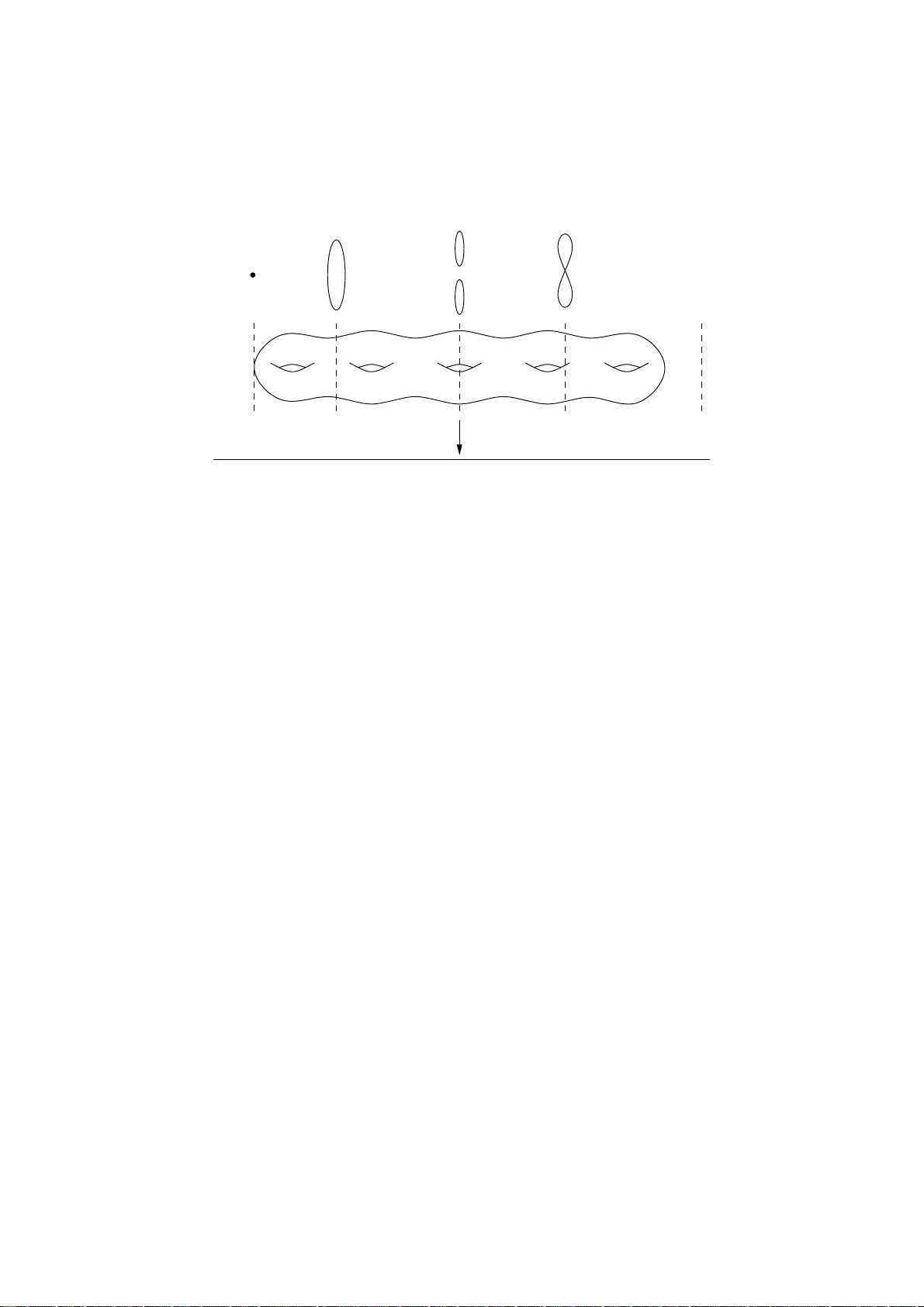
CUTWIDTH AND DEGENERA CY OF GRAPHS by Benoît Klo ec kner Abs tr act . — W e prov e an inequality in volving the dege neracy , the cut width and the sparsity of graphs. It implies a quadratic lo wer b ound on the cut width in terms o f the degeneracy for all graphs a nd an im- prov ement of it for clique-free gr aphs. 1. In tro duction The starting p oin t of the author’s inte rest in cut width is a lecture b y Misha Gromov at the “Glimpses of Geometry” conference held in Ly on in Ma y 2008. During this lecture, Gromo v in tro duced a concept similar to cut width in the realm of top ology of manifolds. Although this pap er will stic k to comb inatorics of graphs, let us giv e an idea of this imp ortan t motiv at io n to this w or k. Gromo v’s question w as the f ollo wing: giv en a manifold X and a con- tin uous map F : X → R , ho w can one relate the top ological complexit y of X to the maxim um top ological complexit y of the lev el sets of F ? It turns out that the a nswe r dep ends hea vily on the dimension of X . If X is an orien table surface of arbitrarily high gen us, it is alw ays p ossible to design F so that its leve ls a r e a p oin t, a circle, a couple of circles, a figure eigh t or empt y (see figure 1). The complexit y of X is therefore not b ounded by the complexit y of lev el sets o f F . The picture gets differen t in some higher dimens ions but it is not our purp ose to detail this here. This question also make s sense for p olyhedron, a nd in [ 5 ] Gromov pro ves sev eral results in this setting. That pap er raises many questions that could b e of great interes t to com binatoricians in terested in cut width. 2 BENOîT KLOECKNER Figure 1. A map from a surface of arbitrarily high gen us to the line, with level sets of b ounded compl exit y . 1.1. Cutwidth. — The complexit y o f a lev el set make s sense in graphs: if a simple graph G is iden tified with its top ological realization, one can consider the infim um, ov er all contin uous maps f : G → R , of the maximal m ultiplicit y (that is, n umber of inv erse images) of p oin ts of R . This turns out to b e exactly the cutwidth of G , usually defined as follo ws. Giv en a linear ordering O = ( x 1 < · · · < x n ) of the v ertices, one defines the cutwid th of the ordering as cw( G, O ) = max 1 6 i 6 n # { ( uv ) ∈ E | u 6 x i < v } Then, the cut width o f G is defined as cw( G ) = min O cw( G, O ) where O runs ov er all linear orderings of V . No w, give n an ordering O of V that is optimal with resp ect to cut width, an optimal con tinuous map is obtained b y mapping eac h vertex to the in teger corresp onding to its r a nk , a nd mapping edges monotonically be- t wee n their endp o in ts. Its maximal m ultiplicit y is then the cut width of the ordering. Con ve rsely , it can b e sho wn that any contin uous map G → R can b e mo dified into a map that is o ne -to-one o n V a nd mono- tonic o n edges without raising its maximal m ultiplicit y . T o sho w the relev ance of this p oin t of view, let us giv e a v ery short pro of of the main result of [ 3 ] (this is indep enden t of the rest of the article). One defines the cir cular cutwidth of a graph in the same w a y than its cut width, but replacing the line by a circle (the com binatorial definition CUTWIDTH AND D EG ENERACY OF GRAPHS 3 is in terms of a cyclic ordering o f the v ertices, plus data determinin g for eac h edge wheth er it is draw n clo c kwise o r coun terclo c kwise). The or em 1.1 . — The cir cular cutwidth of a tr e e is e qual to its cutwidth. Pr o of . — F irs t, since the line top ologically em b eds in the plane, it is clear that the circular cut width of an y graph cannot exceed its cut width. Consider an optimal con tin uous map f : T → S 1 where T is (the top ological realization of ) a tree. Let e : R → S 1 b e the univ ersal co v ering map. The path lifting prop ert y sho ws, since T has no cycle, that there is a contin uous map ˜ f : T → R suc h that e ◦ ˜ f = f . The in vers e image b y ˜ f of a p oin t x is contained in the in v erse image b y f of e ( x ) , so that the cutwid th of T cannot exceed its circular cut width. 1.2. Degeneracy. — What we need next is to define the complexit y of a graph. There a re many in v ariants that can pla y this r ô le ; here w e use the de gener acy , a mon tonic v ersion of the minimal degree, defined as follo ws. Giv en an in teger k , the k -core G k of G is the subgraph obtained b y recursiv ely pruning the vertic es of degree strictly less than k . The de- generacy δ ( G ) of the graph is the larg es t k suc h that G k is not empt y . A graph with big degeneracy is in some sense thic k. One o f the features of degeneracy is that it is an upper b ound fo r the c hromatic and list-c hromatic n umbers: χ ( G ) 6 χ ℓ ( G ) 6 δ ( G ) + 1 . The pro of o f this is classical, see for example the chapter on fiv e-coloring of planar graphs in [ 1 ]. 1.3. Sparsity. — In o rde r to get a more in teresting inequalit y , we need to in v olv e another inv arian t of graphs. W e shall use a uniform v arian t of sparsit y , whic h can b e controlled for clique-free graphs, a nd will enable us to deduce some kind of expanding prop ert y for G . A graph G on n v ertices is said to b e λ - sp arse (where λ > 1 ) if it has at most n ( n − 1) / (2 λ ) edges. W e shall sa y that G is ( ρ, λ ) -uniformly sp arse if a ll subgraphs of G that con tain a t least ρn v ertices are λ -sparse. Note that w e cannot ask for sparsit y of all subgraphs of G , since a subgraph consisting of t w o adjacent v ertices is not λ - sp arse for an y λ > 1 . 4 BENOîT KLOECKNER 2. A quadratic inequalit y 2.1. The main result. — W e start by a general low er b ound on the cut width of a graph in terms of its degeneracy and uniform sparsit y . The or em 2.1 . — F or al l ( ρ, λ ) -uniformly sp arse gr aph G on n vertic es we have (1) cw( G ) > ⌈ ρn ⌉ δ ( G ) − ⌈ ρn ⌉ − 1 λ . Mor e over if 2 nρ 6 δ ( G ) λ − 1 then (2) cw( G ) > ( δ ( G ) λ + 1) 2 4 λ − 1 λ . It may seem strange that in (2) the cut width is b ounded from b elo w b y an incr e asing function of the sparsit y; this simply tra ns lates the fact that when (uniform) sparsit y increases, the degeneracy decrease s more than the cut width do es. Note t hat in some classes of g r a phs , the p ossibilit y of ch o osing ρ en- ables one to get a b ound that is quadratic in δ from (1 ) to o. As a matter of fact, (2) is simply an optimization of (1) when ρ can b e tak en small enough. Since it can b e difficult to pro v e ( ρ, λ ) -sparsit y with go o d con- stan ts, it is not ob vious that there is a need for suc h a general statemen t. It is mainly motiv ated b y corollaries 2 .3 and 2 .4 on cliqu e-free graphs. Pr o of . — W e consider a simple gra ph G o n n v ertices that is assumed to b e ( ρ, λ ) -uniformly sparse. Let G ′ b e the δ ( G ) - core o f G : its minimal degree is δ ( G ) and since it is a subgraph of G , cw ( G ) > cw( G ′ ) . Let O = ( x 1 < · · · < x n ′ ) b e a linear ordering of the vertic es of G ′ that minimizes cw( G ′ , O ) . F or all i let n i = # { ( uv ) ∈ E ′ | u 6 x i < v } and denote b y G ( i ) the subgraph o f G ′ induced on the v ertices { x 1 , . . . , x i } . By assumption, for all i > ρn , the graph G ( i ) has at most i ( i − 1) / (2 λ ) edges. The total sum of the degrees in G ′ of the vertice s of G ( i ) is at least iδ ( G ) , so tha t n i > iδ ( G ) − i 2 − i λ . If 2 nρ 6 δ ( G ) λ − 1 , w e can ev aluate this inequalit y at the optimal p oin t i = ⌊ ( δ ( G ) λ + 1) / 2 ⌋ sinc e it satisfies i > ρn . Letting ε = ( δ ( G ) λ + 1) / 2 − CUTWIDTH AND D EG ENERACY OF GRAPHS 5 ⌊ ( δ ( G ) λ + 1) / 2 ⌋ we then get cw ( G ) > δ ( G ) λ + 1 2 − ε δ ( G ) − δ ( G ) λ +1 2 − ε − 1 λ > δ ( G ) λ + 1 − 2 ε 2 δ ( G ) λ + 2 ε + 1 2 λ = ( δ ( G ) λ + 1) 2 4 λ − ε 2 λ whic h giv es the desired inequalit y since ε < 1 . In any case, w e can conside r the p oin t i = ⌈ ρn ⌉ and get (1). 2.2. A pp lication t o general graphs. — If w e let down a ny informa- tion on G , we get the following. Cor ol l a ry 2.2 . — F or al l simple gr aphs, we have (3) cw ( G ) > 1 4 δ ( G ) 2 + 1 2 δ ( G ) . Pr o of . — Since ev ery graph is (0 , 1) -uniformly sparse, fro m (2) we deduce that cw( G ) > ( δ ( G ) + 1) 2 / 4 − 1 . If δ ( G ) is o dd, then it follows that cw( G ) > ( δ ( G ) + 1) 2 / 4 but otherwise, writting δ ( G ) = 2 k w e see that cw( G ) > k 2 + k − 3 / 4 so that cw( G ) > k 2 + k . This is a p ositiv e answ er to our ve rsion of Gromov ’s question: all con tinuous maps from a high-complexit y graph to the line ha v e high m ultiplicit y . Of course, in man y cases this estimate is rat her p o or: f o r example trees hav e degeneracy 1 and un b ounded cutwid th (so that there is no low er b ound of δ ( G ) in terms of cw ( G ) ) and h yp erc ub es hav e expo- nen tial cutw idth but linear degene racy . How ev er it is sharp for complete graphs, and a b etter b ound w ould ha ve to in volv e more information on the g r a ph. As p oin ted out to me by professors Raspaud and Grav ier, the conse- quence in terms of chromatic n um b er is in fa ct easy to prov e directly: consider an optimal coloring a s a morphism G → K χ ( G ) (whic h m ust b e on to the edge set), and use that cw( K n ) = ⌊ n 2 / 4 ⌋ . How ev er Corol- lary 2.2 is stronger in the sens e that it applies to the degeneracy , a nd in particular implie s a b ound on the list c hromatic n um b er. 6 BENOîT KLOECKNER 2.3. The case of clique-free graphs. — W e shall deduce the follo w- ing from Theorem 2.1 . Cor ol l a ry 2.3 . — F or al l simple gr aph G without triangle, o ne h as (4) cw( G ) > 1 2 δ ( G ) 2 . Pr o of . — The main point is to show that triangle-free graphs are some- what sparse; but T urán’s Theorem [ 6 ] (see also [ 2 ]) in particular gives that any graph without triangle on n v ertices is 2 n − 1 n -sparse. No w, when all subgraphs of G are triangle-free, we get that G is ( ρ, 2( ρn − 1) / ( ρn )) -uniformly sparse for all ρ suc h that ρn is an inte- ger. Applying the second part of the main theorem, w e g et that cw( G ) > ρn δ ( G ) − ρn − 1 2 ρn − 1 ρn ! > ρn δ ( G ) − 1 2 ρn and taking ρ = δ ( G ) /n , the desired inequalit y fo llo ws. With the same argumen t, one can deduce the followi ng from T urán’s Theorem. Cor ol l a ry 2.4 . — F or al l simple gr aph G without sub g r aph isomorphic to K k +1 , one has (5) cw( G ) > k k − 1 δ ( G ) 2 4 − k − 1 k . Let us sho w that t his giv es an asymptotically sharp result for T urán’s graph T ur ( n, k ) , defined as the most balanced complete k -partite graph on n v ertices. On t he one hand Corollary 2.4 giv es (6) cw(T ur( n, k )) > k − 1 k n 2 4 − n 2 − 3 k 4( k − 1) but on the other hand, one can giv e an explicit ordering of ve rtices of T ur( n, k ) with cut width of the same order of magnitude. Indeed, t he graph whose v ertices are the in tegers { 1 , 2 , . . . , n } and where tw o v ertices a, b are connected by an edge if and only if a 6≡ b mo d k is isomorphic to T ur( n, k ) and endo wed with a natural ordering. The n um b er o f edges CUTWIDTH AND D EG ENERACY OF GRAPHS 7 that cross the vertex i and are issued from an y fixed ve rtex j < i is at most n − i − n − i k 6 k − 1 k ( n − i ) + 1 so that the total n um b er of edges crossing i is at most c ( i ) = i ( n − i ) k − 1 k + 1 . No w the function c takes its maximal v alue at x = ( n + k / ( k − 1)) / 2 so that we get (7) cw(T ur( n, k )) 6 k − 1 k n 2 4 + n 2 + k 4( k − 1) . This approach also applies to all solv ed forbidden subgraph extremal problems, for example to T ur( r t, r ) -free g raphs [ 4 ], see also [ 2 , Theorem VI.3.1]. References [1] M. Aigner & G. M . Ziegler – Pr o ofs fr om The Bo ok , third ed., Springer- V erlag, Berlin, 2004, Including illustration s by Karl H. Hofmann. [2] B. Bollobás – Extr emal gr aph the ory , London Mathematical So ciet y Monographs, vol. 11, A cademic Press I nc . [Harcourt Brace Jo v ano vic h Pub- lishers], Lond on, 1978. [3] J. D. Cha vez & R. Trapp – “The cyclic cutwid th of trees” , Discr ete Appl. Math. 87 (1998), no. 1-3, p. 25–32. [4] P. Erdös & A. H. Stone – “On the s tructure of linear graphs” , Bul l. Ame r. Math. So c. 52 (1946), p. 1087–1 091. [5] M. Gr omo v – “Singular ities, expanders and top ology of maps. Part 2: from com binatorics to top ology via algebraic isop erimetry” , Ge om . F unct. Anal. 20 (2010), no. 2, p. 416–526. [6] P. Turán – “Eine Extremalaufgabe aus der Graphen theorie” , Mat. F iz. L ap ok 4 8 (1941), p. 436–452 . Benoît Kloeckner
Original Paper
Loading high-quality paper...
Comments & Academic Discussion
Loading comments...
Leave a Comment