Distributed Agile Software Development: A Review
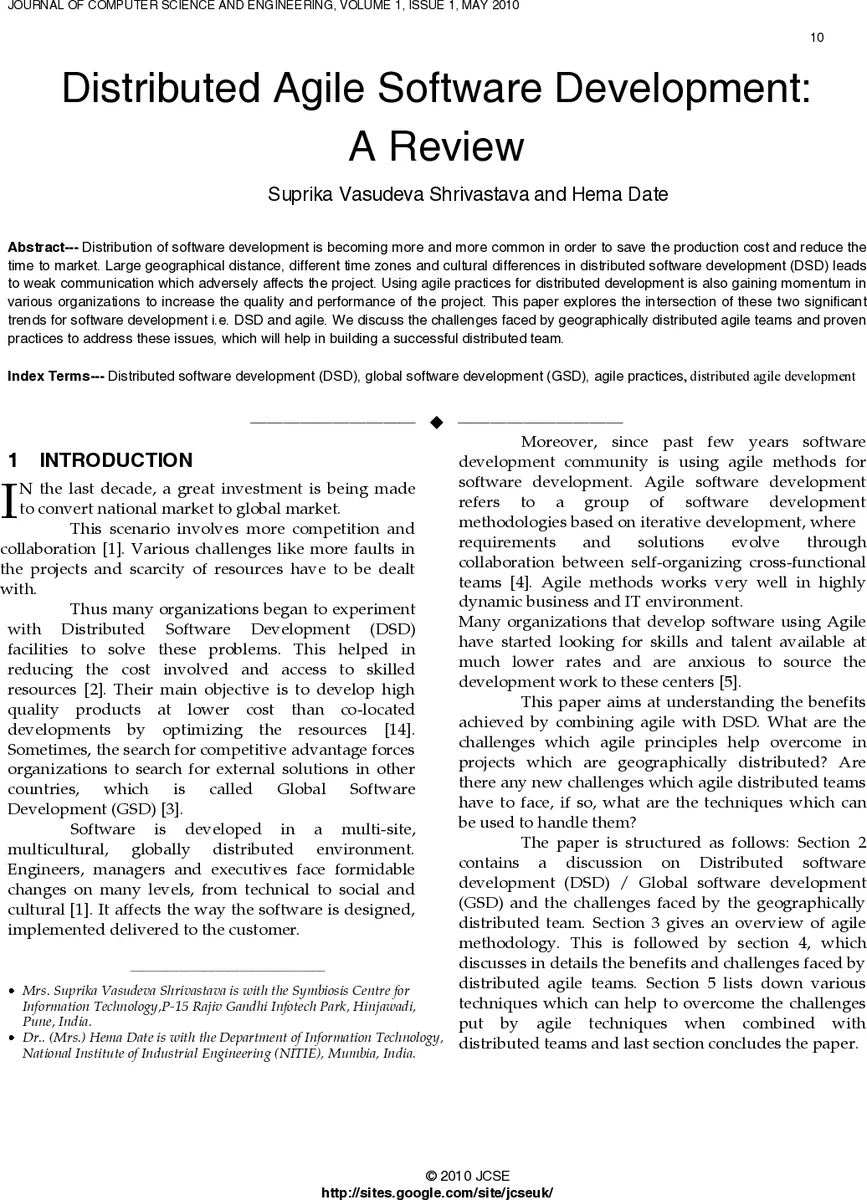
Distribution of software development is becoming more and more common in order to save the production cost and reduce the time to market. Large geographical distance, different time zones and cultural differences in distributed software development (DSD) leads to weak communication which adversely affects the project. Using agile practices for distributed development is also gaining momentum in various organizations to increase the quality and performance of the project. This paper explores the intersection of these two significant trends for software development i.e. DSD and agile. We discuss the challenges faced by geographically distributed agile teams and proven practices to address these issues, which will help in building a successful distributed team.
💡 Research Summary
The paper “Distributed Agile Software Development: A Review” (2010) offers a comprehensive overview of the convergence between Distributed Software Development (DSD), also referred to as Global Software Development (GSD), and Agile methodologies. It begins by contextualising the rise of DSD as a strategic response to market globalization, cost reduction, and the need for round‑the‑clock development. The authors categorize DSD by geographic distribution (on‑shore vs. off‑shore) and by control structure (outsourcing vs. insourcing), and they identify seven principal challenge domains: strategic decision‑making, cultural differences, communication breakdown, knowledge management, project and process management, technical infrastructure, and risk management. Each domain is described with illustrative bullet points, emphasizing how distance, time‑zone disparity, and cultural diversity erode visibility, increase defect rates, and complicate coordination.
The second part of the paper summarises Agile principles—customer satisfaction through continuous delivery, embracing change, close collaboration, and test‑driven development—and highlights Scrum and Extreme Programming (XP) as the most widely adopted frameworks. The authors argue that Agile’s short, iterative cycles, frequent demos, and continuous integration can mitigate several DSD pain points: early detection of problems, improved transparency, and more frequent communication. They cite a 2008 VersionOne survey indicating that 57 % of respondents worked in distributed teams and 41 % combined Agile with outsourced development, underscoring the practical relevance of the topic.
The core contribution lies in the “compatibility issues” section, where the authors enumerate both the benefits and the new challenges that arise when Agile is applied in a distributed context. Benefits include enhanced visibility of project status, reduced configuration‑management overhead due to continuous integration, and stronger trust across cultures through regular delivery. Empirical support is limited to a study by Pasiavara, Durasiewicz, and Lassenius, which reported higher software quality, more frequent communication, and increased motivation when Scrum was used in a distributed setting.
Conversely, the paper identifies several friction points:
- Documentation Gap – Offshore teams often rely on detailed specifications, whereas Agile de‑emphasises documentation, risking loss of critical information.
- Pair Programming – The co‑location prerequisite of pair programming is infeasible across continents, necessitating remote pairing tools or alternative practices.
- Time‑Zone Misalignment – Overlapping working hours are scarce, making synchronous activities (e.g., daily stand‑ups) difficult.
- Training on Agile Practices – New team members need hands‑on Agile training, which is harder to deliver remotely, especially when cultural differences affect learning styles.
- Work Distribution – The authors warn against allocating work purely by geographic location, as this can lead to architecture that mirrors team boundaries (Conway’s Law). Instead, they advocate for story‑centric distribution and loosely coupled module design, avoiding functional siloing.
The final section lists tools and techniques intended to bridge communication gaps: video conferencing, instant messaging, issue‑tracking systems, continuous‑integration servers, and code‑review platforms. However, the discussion remains high‑level; specific tool evaluations, integration strategies, or case studies are absent. Moreover, the paper does not address newer collaboration ecosystems (e.g., Slack, Microsoft Teams) or DevOps practices that have become integral to modern distributed Agile teams.
In summary, the paper succeeds in mapping the conceptual overlap between DSD and Agile, providing a useful taxonomy of challenges and a set of high‑level mitigation strategies. Its limitations lie in the lack of empirical validation, outdated references (the field has evolved considerably since 2010), and insufficient treatment of contemporary tooling and practices such as micro‑services, containerisation, and automated testing pipelines. Future research should focus on longitudinal case studies, quantitative measurement of Agile’s impact on distributed project metrics, and integration of modern DevOps pipelines to fully realise the promise of Distributed Agile Software Development.
Comments & Academic Discussion
Loading comments...
Leave a Comment