Locally Compact Objects in Exact Categories
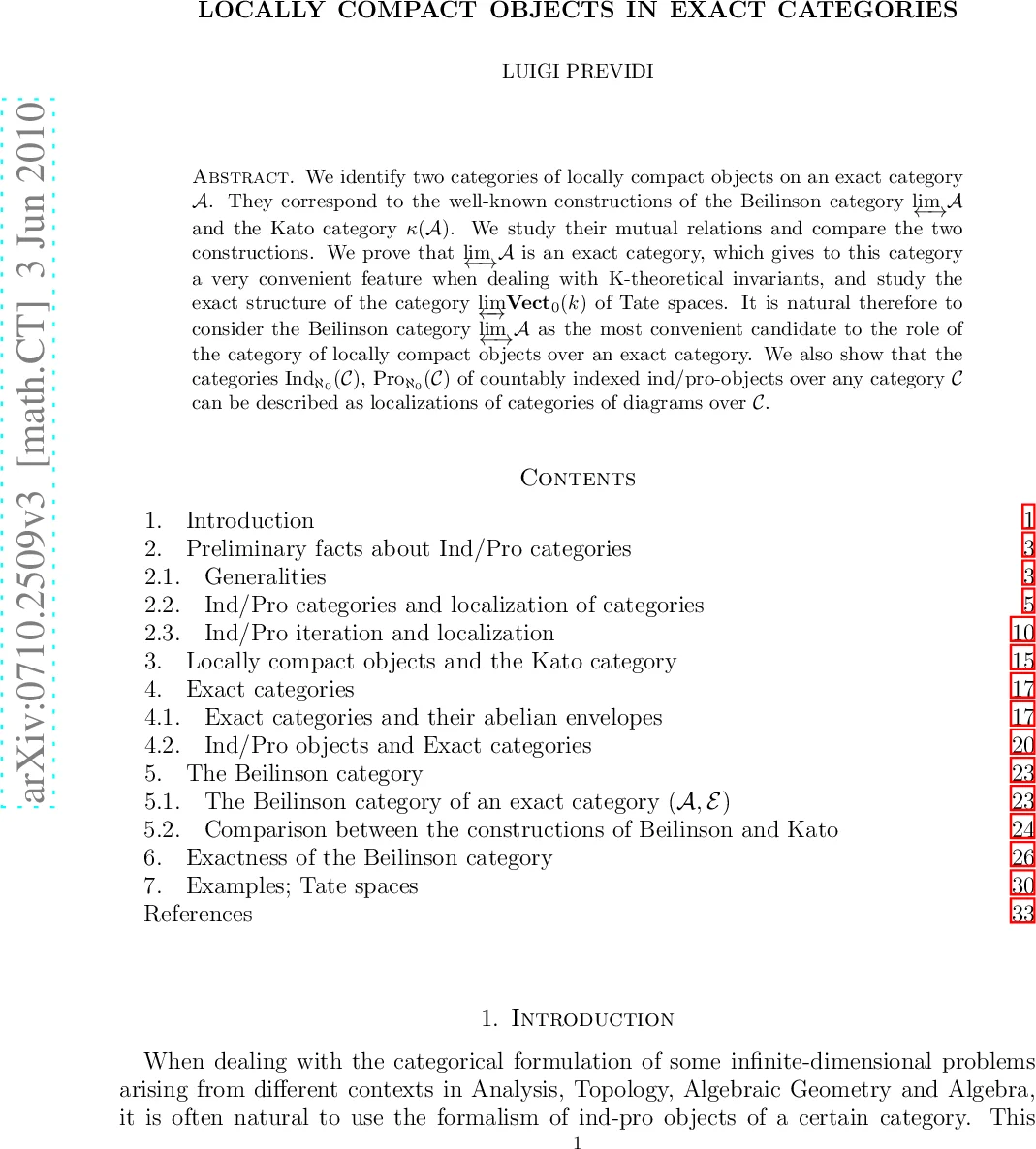
We identify two categories of locally compact objects on an exact category A. They correspond to the well-known constructions of the Beilinson category lim A and the Kato category k(A). We study their mutual relations and compare the two constructions. We prove that lim A is an exact category, which gives to this category a very convenient feature when dealing with K-theoretical invariants. It is natural therefore to consider the Beilinson category lim A as the most convenient candidate to the role of the category of locally compact objects over an exact category. We also show that the categories Ind_{aleph_0}(C), Pro_{aleph_0}(C) of countably indexed ind/pro-objects over any category C can be described as localizations of categories of diagrams over C.
💡 Research Summary
The paper investigates two categorical constructions that model “locally compact objects” over an exact category A. The first construction, due to Beilinson, is the category denoted lim←→ A, consisting of objects that are simultaneously ind‑limits and pro‑limits of objects in A. The second, introduced by Kato, is the Kato category κ(A), which is built from iterated ind‑pro systems without requiring the simultaneous limit condition. The author’s goal is to compare these two approaches, establish precise relationships between them, and determine which is more suitable for applications such as algebraic K‑theory.
The paper begins with a concise review of the theory of ind‑objects and pro‑objects. It recalls the standard definition of Ind(C) as the category of formal filtered colimits of objects of C, and Pro(C) as the opposite of Ind(Cᵒᵖ). The notion of “strict” ind‑ or pro‑objects (those whose transition maps are monomorphisms or epimorphisms respectively) is introduced, because strictness is essential for preserving exact structures. The author then defines the countable versions Indℵ₀(C) and Proℵ₀(C) and shows that they can be realized as localizations of the diagram category Fun(ℕ, C). The localization is performed with respect to a system S of morphisms that become isomorphisms after passing to a cofinal subsequence; morphisms are identified when they agree eventually. This result (Theorem 2.15) provides a clean, diagram‑theoretic description of countable ind/pro objects that works for any base category C.
Next, the Kato category κ(A) is described. An object of κ(A) is a diagram obtained by alternating ind‑ and pro‑constructions (e.g. ind‑pro‑ind …) over A. The morphisms are defined via compatible families of maps at each stage, respecting the transition maps. The construction works for arbitrary categories, but when A is exact the resulting objects inherit additional structure.
The core of the paper is the analysis of the Beilinson category lim←→ A. An object in this category is a pair consisting of an ind‑system and a pro‑system that are mutually compatible, i.e. the ind‑limit of the pro‑system coincides with the pro‑limit of the ind‑system. The author proves that lim←→ A is itself an exact category (Theorem 6.1). The proof proceeds in several steps:
-
Exactness of Ind(A) and Pro(A). Using the definition of admissible monomorphisms and epimorphisms in an exact category, the author shows that filtered colimits and limits of admissible sequences remain admissible. Hence Ind(A) and Pro(A) inherit exact structures.
-
Embedding into Ind Pro(A). The author constructs a fully faithful, exact embedding of lim←→ A into the iterated category Ind Pro(A). Objects of lim←→ A appear as strict objects in Ind Pro(A) that satisfy a closure condition under the admissible morphisms.
-
Closedness under extensions. By checking that extensions of objects in lim←→ A remain inside the subcategory, the author verifies that the subcategory is extension‑closed, a key requirement for an exact structure.
-
Admissible morphisms. The admissible monomorphisms and epimorphisms in lim←→ A are precisely those induced from admissible morphisms in Ind Pro(A). Consequently, the exact structure on lim←→ A is inherited from the ambient exact category.
Having established exactness, the paper argues that lim←→ A is the most convenient candidate for a “category of locally compact objects” over an exact category, especially when one wishes to apply algebraic K‑theory. Exactness guarantees that K‑theoretic constructions (e.g., Quillen’s Q‑construction, Waldhausen’s S•‑construction) can be carried out directly in lim←→ A, without leaving the realm of exact categories.
The author also provides concrete examples. The most prominent is the category of Tate vector spaces, realized as lim←→ Vect₀(k) where Vect₀(k) denotes finite‑dimensional vector spaces over a field k. In this setting, the exact structure reproduces the familiar exact sequences of Tate spaces and allows one to compute K‑theoretic invariants such as K₀ and K₁ of the Tate category. The paper mentions connections to Drinfeld’s notion of Tate R‑modules and to recent work on n‑Tate spaces.
Finally, the paper discusses the relationship between the two constructions. Theorem 5.12 gives an explicit description of lim←→ A in terms of κ(A): essentially, lim←→ A is the full subcategory of κ(A) consisting of objects whose ind‑ and pro‑components are strict and satisfy a compatibility condition. While κ(A) is more flexible (it works for any category), it lacks the built‑in exactness that makes lim←→ A particularly suitable for homological and K‑theoretic applications.
In summary, the paper achieves three major contributions:
- It provides a rigorous comparison between Beilinson’s and Kato’s approaches to locally compact objects in the setting of exact categories.
- It proves that the Beilinson category lim←→ A is itself an exact category, thereby opening the door to direct K‑theoretic analysis.
- It offers a new perspective on countable ind/pro objects as localizations of diagram categories, a result that is of independent categorical interest.
These results clarify the landscape of locally compact categorical objects, identify the most robust framework for future work in K‑theory and higher categorical analysis, and lay groundwork for further exploration of Tate‑type structures in algebraic geometry and representation theory.
Comments & Academic Discussion
Loading comments...
Leave a Comment