Which Digraphs with Ring Structure are Essentially Cyclic?
We say that a digraph is essentially cyclic if its Laplacian spectrum is not completely real. The essential cyclicity implies the presence of directed cycles, but not vice versa. The problem of characterizing essential cyclicity in terms of graph top…
Authors: Rafig Agaev, Pavel Chebotarev
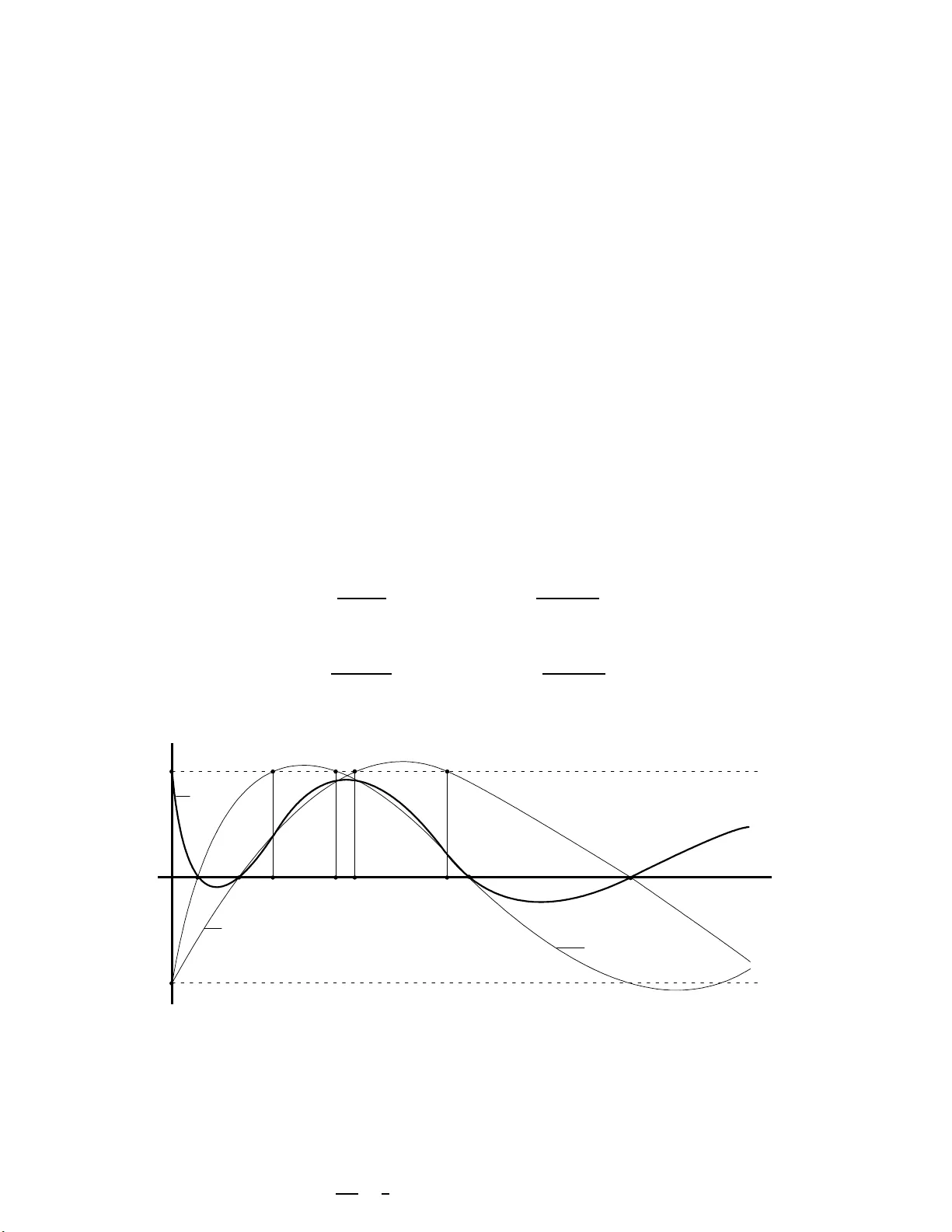
Whic h Digraphs with Ring Structure are Essen ti ally Cyclic? Rafig Agaev 1 and P a v el Chebo tarev 2 Institute of Control Sciences of the Russian Academ y of Sciences 65 Profsoyuznay a Street, Moscow 11 7997 , Russia Abstract W e sa y that a digraph is essen tially cyclic if its Laplacian sp ectrum is not completely real. The essen tial cy clicit y implies the presence of directed cycles, b ut not vice ve rsa. The problem of characteri zing ess ential cyclicit y in terms of graph top ology is difficult and yet unsolved. It s solution is important for some applications of graph t heory , including that in decentralized contro l. In the present pap er, this problem is solved with resp ect to th e class of digraphs with ring structure, which mod els some typical comm unication net wor k s. It is shown that th e digraphs in this class are essen tially cy clic, except for certain sp ecified digraphs. The main technical to ol we employ is th e Cheb yshev p olynomials of the second k ind. A by-pro duct of this study is a theorem on the zeros of p olynomials that differ by one from the p rodu cts of Chebyshev p olynomials of th e second kind. W e also consider the p roblem of essen tial cy clicit y for weigh ted d igraphs and enumerate the spannin g trees in some digraphs with ring structure. Keywor ds : Laplacian matrix; Laplacia n sp ectrum; Essential cyclicity; Chebyshev polynomial; Spanning tree; Directed graph; W eigh ted digraph 1. In tro duc tion As distinct from the Laplacian eigenv alues of ordina ry gra phs, those of digr aphs need not b e re a l. The problem of characterizing all digraphs that have completely re al La placian sp ectra is difficult a nd yet unsolved. Obviously , tw o class es of s uch digraphs are: the acyclic digraphs, whos e Laplacian matrices hav e a tria ng ular form, and symmetr ic digraphs, whose Laplac ian matrices a re symmetric and p ositive semidefinite. It can also b e obser ved that the sp ectrum of a Laplacian matrix L is completely r eal whenever for so me ε > 0, I − εL is the trans ition matrix of a reversible Mar ko v chain. The prev io us results [3] suggest that non-real eig env alues with noticeable imaginary pa rts characterize digraphs that hav e directed c y cles not “extinguished” by counter-directional cycles. On the other hand, there are digraphs that hav e “undamped” cycles and completely r e al sp ectra . In general, it is not an easy problem to distinguish, in terms of graph top olog y , dig raphs with rea l Laplacian sp e ctra fro m those having some non-rea l Laplacia n eigenv alues. The digraphs of the second type are guar anteed to hav e cycles, and we call them essential ly cyclic. Some pr e liminary results on essentially cyclic w eig hted digra phs were presented in [7, 9]. The afor ementioned pr oblem of distinguishing, in terms of graph top olog y , digr aphs w ith rea l and partially no n-real sp ectra is impo rtant for applications. In par ticular, in the decen tralized c o ntrol of m ulti-a g ent systems [10, 19, 21, 23], the abse nce of non-rea l Lapla cian e igenv alues o f the communication digraph implies that the simplest cons e ns us algorithms are dev oid of os cillations. 1 E-mail: ar p o@ipu.r u 2 Corresp onding auth or. E-m ail: ch v@member.ams.org, upi@ipu.ru; phone : +7-495-334-8869; fax: +7-495-420-2016 . 2 A ratio nal appro a ch to attacking the difficult problem of characterizing esse ntially cyclic directed graphs is studying v ario us classes of cyclic digraphs. In this pa per , we inv estigate the digr aphs with ring structure . By such a digraph we mean a digraph whose ar c set only co nt ains a collection of a rcs forming a Ha miltonian cyc le and an arbitra ry num b er o f arcs tha t b elong to the inverse Hamiltonian cycle. Digraphs of this type mo del a class of typical asymmetr ic co mmunication netw orks. W e obtain a necessary and s ufficien t condition of es sential c y clicity for the digraphs with ring structure. According to this condition, such digraphs are essentially cyclic, except for the digraphs whose inverse Hamiltonian cycle lacks tw o mos t dis tant ar cs o r one arc or no arc. This study in volves the Chebyshev p olyno mia ls of the second kind. As a by-pro duct w e o bta in a theorem on the zero s of p o lynomials that differ by one from the pro ducts of Chebyshev p oly nomials of the second kind. W e also consider weighted digra phs and find that in this case, some conditions o f essential c yclicity inv o lve the tria ngle inequality for the square ro o ts of weigh t differences. Finally , we e n umera te the conv erging trees in some digraphs with ring structure. The pap er is o rganized as follows. After the necessar y nota tion and pr eliminary results (Section 2), in Section 3 we present three auxiliary lemmas needed to pr ov e the main results. In Sectio n 4, we obtain a necessa ry and sufficien t conditio n of essential cyclicit y for the dig raphs with r ing structure, i. e., for the digraphs consisting of t wo oppo site Hamiltonian cycles from one of which some arcs ca n b e removed. In Section 5, w e in vestigate the essent ia l cyclicit y of the simplest weigh ted digr aphs. Finally , in Section 6 , we present explicit formulas for the num b er o f conv erging trees (in-ar bo rescences) in certain digraphs with ring structure and a dir ect computation, by means of Chebyshev polynomials , of the Laplacia n sp ectrum of the undirected cycle, which is usually prov ed rather than derived. 2. Notation and basic results The Laplacian matrix o f a digra ph Γ with v ertex set V (Γ) = { 1 , . . . , n } and a rc s et E (Γ) is the ma trix L = ( ℓ ij ) ∈ I R n × n in which, for j 6 = i , ℓ ij = − 1 whenev er ( i, j ) ∈ E (Γ), otherwise ℓ ij = 0; ℓ ii = − P j 6 = i ℓ ij , i, j ∈ V (Γ). If a digraph Γ is w eighted, i. e., each ar c ( i, j ) ∈ E (Γ) has a strictly positive weigh t w ij , then in the Lapla cian ma trix L = L (Γ) = ( ℓ ij ), for j 6 = i , ℓ ij = − w ij whenever ( i, j ) ∈ E (Γ), other wise ℓ ij = 0 ; ℓ ii = − P j 6 = i ℓ ij , i , j ∈ V (Γ). Among the pa p er s concerned with the Laplacian ma trices of digraphs, we men tion [1–3, 6, 8, 1 1 , 12 , 16, 24] and [1 3], whe r e the Laplacia n matr ix is defined differen tly . W e say that a (weigh ted) digra ph Γ is essential ly cyclic if its Laplacian sp ectrum contains non-r eal eigenv alues. Evidently , ev er y essentially cyclic digraph has at least o ne dir ected cycle. Indeed, otherwise there exists a n umbering of vertices such that the L a placian matrix has a tr iangular form, so the Laplacia n sp ectrum consists of the real diag onal en tries of this form. The Chebyshev p olynomial of t he se c ond kind , P n ( x ) , sc ale d on ] − 2 , 2 [ is the po lynomial of degree n defined by P n ( x ) = sin(( n + 1) arccos x 2 ) q 1 − x 2 4 , where x ∈ ] − 2 , 2[ . (1) Using the auxiliary v aria ble ϕ ∈ ]0 , π [ s uch that x = 2 cos ϕ (i. e., ϕ = arccos x 2 ) one can rewrite (1) in the form P n ( x ) = sin(( n + 1) ϕ ) sin ϕ . (2) The explicit form of the p olynomials P n ( x ) is (see, e.g., Theorem 1.1 2 in [20]) 3 P n ( x ) = [ n/ 2] X i =0 ( − 1) i n − i i x n − 2 i (3) and they satisfy the recurr ence P n ( x ) = xP n − 1 ( x ) − P n − 2 ( x ) (4) with the initial conditions P 0 ( x ) ≡ 1 and P 1 ( x ) ≡ x . By (2), the ro o ts o f P n ( x ) are: x k = 2 cos π k n + 1 , k = 1 , . . . , n . (5) In particular, if n = 2 m − 1 a nd m > 0 is integer, then P n ( x ) = 2 m − 1 Y k =1 x − 2 cos π k 2 m = x m − 1 Y k =1 x − 2 cos π k 2 m x + 2 cos π k 2 m = x m − 1 Y k =1 x 2 − 4 c o s 2 π k 2 m . (6) Consider the tridiagonal matrix M n ∈ I R n × n : M n = 2 − 1 0 − 1 2 − 1 . . . . . . . . . . . . . . . . . . − 1 2 − 1 0 − 1 1 . (7) In par ticular, M 1 = 1 . Let Z n ( x ) b e the characteristic po lynomial of M n : Z n ( x ) = det( xI − M n ). The expansion along the first row of xI − M n for every n ≥ 2 pr ovides Z n ( x ) = ( x − 2) Z n − 1 ( x ) − Z n − 2 ( x ) , (8) with the initia l conditions Z 0 ( x ) ≡ 1 a nd Z 1 ( x ) ≡ x − 1. The p olynomials Z n ( x ) play a ce n tra l ro le in the subsequent cons ider ations. 3. Auxiliary lemmas It will b e shown in Sectio n 4 that the Laplacian characteristic p oly nomials of the digra phs with ring structure differ by o ne from the pro ducts of the p olynomials Z n ( x ). In this section, we prove three lemmas. Le mma 1 connec ts Z n ( x ) with the Chebyshev polynomia ls P n ( x ) of the second kind, Lemma 2 provides the explicit for m of Z n ( x ), and Lemma 3 spe c ifie s the ro ots of the p olynomials Z n ( x ) ± 1. Lemma 1. F or n = 0 , 1 , 2 , . . . , Z n ( x 2 ) ≡ P 2 n ( x ) . Pro of. The pro of pro ceeds by inductio n. F or n = 0, b y definition, Z 0 ( x 2 ) ≡ P 0 ( x ) ≡ 1 holds. F or n = 1 we hav e Z 1 ( x 2 ) = x 2 − 1 = P 2 ( x ). Assume that the requir ed statement holds for n = m − 1 a nd n = m and show that it is true for n = m + 1. Indeed, b y (4) and (8), Z m +1 ( x 2 ) = ( x 2 − 2) Z m ( x 2 ) − Z m − 1 ( x 2 ) = ( x 2 − 2) P 2 m ( x ) − P 2 m − 2 ( x ) = x ( xP 2 m ( x ) − P 2 m − 1 ( x )) + ( xP 2 m − 1 ( x ) − P 2 m − 2 ( x )) − 2 P 2 m ( x ) = xP 2 m +1 ( x ) + P 2 m ( x ) − 2 P 2 m ( x ) = P 2 m +2 ( x ). ⊓ ⊔ Lemma 2. 1 . The explicit form of the p olynomial Z n ( x ) is 4 Z n ( x ) = n X i =0 ( − 1) i 2 n − i i x n − i . (9) 2 . The s et of r o ots of Z n ( x ) is n 4 co s 2 π k 2 n +1 k = 1 , . . . , n o and t hey al l b elong to [0 , 4[ . Pro of. Due to Lemma 1, to verify item 1, it suffices to compa r e (9) with (3); item 2 follo ws from (5). ⊓ ⊔ Since for x ≥ 0 P 2 n ( √ x ) = Z n ( x ), (1) provides the following trigono metric r epresentation of Z n ( x ): Z n ( x ) = sin((2 n + 1) ϕ ) sin ϕ , where x = 4 cos 2 ϕ, ϕ ∈ 0 , π 2 , x ∈ [0 , 4[ . (10) Lemma 3. The set of the r o ots of the e quation Z n ( x ) + ( − 1) p = 0 , p ∈ { 0 , 1 } (11) is n 4 co s 2 π k 2 n +1+( − 1) k + p k = 1 , . . . , n o and t hey al l b elong to [0 , 4 [ . Pro of. By (10) the ro o ts x i of Eq. (11) are connected with the ro o ts ϕ i of the equation sin((2 n + 1) ϕ ) sin ϕ + ( − 1) p = 0 (12) by x i = 4 cos 2 ϕ i . W e first solve Eq. (1 2) and then return to (11). O bserve that if (2 n + 1) ϕ = πk − ( − 1) k + p ϕ, (13) where k is integer, then the equality sin((2 n + 1) ϕ ) = ( − 1) p +1 sin ϕ to which Eq. (12) reduces w hen ϕ ∈ 0 , π 2 is satisfied. By (13), ϕ = π k 2 n + 1 + ( − 1) k + p . (14) T aking (14) with k = 1 , . . . , n provides n distinct roo ts of Eq. (12); all o f them belo ng to ]0 , π 2 ]. Due to (10), the set of the corresp onding distinct roots of Eq. (1 1 ) in [0 , 4[ is { 4 cos 2 π k 2 n +1+( − 1) k + p k = 1 , . . . , n } . Since the degree of (11 ) is n , this equation has no other ro o ts. ⊓ ⊔ 4. Essen tially cyclic digraphs with ring structure By a digraph with r ing structure we mean a dig raph tha t contains a Hamiltonia n cycle and whose remaining arcs b elong to the inv ers e Hamiltonian cycle. More s pec ifically , let Γ 1 n = ( V n , E 1 n ) a nd Γ 2 n = ( V n , E 2 n ) b e the digraphs with V n = { 1 , . . . , n } , E 1 n = { (1 , n ) , ( n, n − 1 ) , . . . , (2 , 1) } , and E 2 n = E 1 n ∪ { (1 , 2) , (2 , 3) , . . . , ( n − 1 , n ) , ( n, 1) } . W e say that Γ n = ( V n , E ) is a di gr aph with ring stru ctur e if it is isomorphic to some e Γ n = ( V n , e E ) with E 1 n ⊆ e E ⊆ E 2 n . Digraphs Γ 1 n and Γ 2 n are shown in Fig. 1 (a ) and 1(b), resp ectively . In this sec tion, w e answ er the question in the title of the pap er and find the Laplacia n sp ectra of some digraphs with ring structure. Certain weighte d digr aphs with ring structure are considered in Section 5 . 4.1. The digraphs Γ 1 n with n arcs and Γ 2 n with 2 n arcs Theorem 1. 1. Γ 1 n is ess en tial ly cyclic ; its La placian sp e ct r u m is n 2 sin 2 π k n + i sin 2 π k n k = 1 , . . . , n o . 2. Γ 2 n is n ot essential ly cyclic ; its L aplacian sp e ctru m is n 4 sin 2 π k 2 n k = 1 , . . . , n o . 5 ❄ (a) q ❥ ❥ ❨ ❨ ❨ ☛ ✕ 1 2 3 4 5 n n − 1 ✛ ✛ ✻ ✛ (b) ✲ ✲ ✲ q ❥ ❥ ❨ ❨ ❨ ☛ ✕ 1 2 3 4 5 n n − 1 ✛ ✛ ✻ ✛ (c) ✲ ✲ ✲ q ❥ ❥ ❨ ❨ ❨ ☛ ✕ 1 2 3 4 5 n n − 1 Figure 1. The digraphs: ( a) Γ 1 n ; (b) Γ 2 n ; (c) Γ ′ n . Pro of. 1. The La placian matrix of Γ 1 n is L 1 n = I − Q , where Q = ( q ij ) ∈ I R n × n is the circulant per mut atio n matrix with the entries q ij = 1 whenever i − j ∈ { 1 , 1 − n } and q ij = 0 other wise. The characteristic poly nomial o f Q is ∆ Q ( λ ) = λ n − 1 and its sp ectrum is e − 2 π k i /n k = 1 , . . . , n . Therefore the eigenv alues of L 1 n = I − Q are λ k = 1 − e − 2 π k i /n = 1 − cos 2 π k n + i sin 2 π k n = 2 sin 2 π k n + i sin 2 π k n , k = 1 , . . . , n (cf. § 2.1 in [1 4 ], Section 4.8.3 in [18], and Section 4 in [3]). 2. The Laplacian matrix of Γ 2 n is sy mmetr ic and co incides with that o f the undirected n - cycle. The sp ectrum of this matrix w as found in [15] and [4] and coincides with the expression given in Theorem 1. On the deriv a tion of this expressio n, see Section 6 . ⊓ ⊔ The following repr esentation of the sp ectrum of Γ 1 n is a consequence of Theorem 1. Corollary of Theorem 1. The La placian sp e ctrum of Γ 1 n is n 2 sin π k n e π i ( 1 2 − k n ) k = 1 , . . . , n o . 4.2. The digraphs Γ ′ n with 2 n − 1 arcs Consider the digraph that differ s from Γ 2 n by one arc. L e t Γ ′ n = ( V n , E ′ n ), where E ′ n = E 2 n r { ( n, 1) } , see Fig. 1(c). The La placian matrix of Γ ′ n , L ′ n = 2 − 1 0 · · · 0 − 1 − 1 2 − 1 0 . . . . . . . . . . . . . . . . . . . . . 0 − 1 2 − 1 0 − 1 1 , differs from the tridia gonal matrix M n (see (7)) by the non-zero (1 , n ) entry . Theo rem 2 b elow states that the Lapla cian characteristic p olynomia l of Γ ′ n can b e express ed via the polyno mial Z n int ro duced in Section 1 and that Γ ′ n , as well as Γ 2 n , is not essentially cyclic. Theorem 2 . L et L ′ n b e t he L aplacian matrix of digr aph Γ ′ n whose ar cs c onst itu te the Hamiltonian cycle (1 , n ) , ( n, n − 1) , . . . , (2 , 1) and the p ath (1 , 2) , (2 , 3 ) , . . . , ( n − 1 , n ) , and ther e ar e no other ar cs. Then : 1. The char acteristic p olynomial of L ′ n is ∆ L ′ n ( λ ) = Z n ( λ ) − ( − 1) n . 2. Γ ′ n is n ot essential ly cyclic and its L aplacian sp e ctrum is { 4 co s 2 π k 2 n +1 − ( − 1) k + n , k = 1 , . . . , n } . Pro of. 1. Expanding det( λI − L ′ n ) along the first row and making use of (8) provide ∆ L ′ n ( λ ) = det( λI − L ′ n ) = ( λ − 2 ) Z n − 1 ( λ ) − Z n − 2 ( λ ) − ( − 1 ) n = Z n ( λ ) − ( − 1 ) n . 2. By Lemma 3, the ro ots of ∆ L ′ n ( λ ) a r e 4 cos 2 π k 2 n +1 − ( − 1) k + n , k = 1 , . . . , n , s o Γ ′ n is no t essentially cyclic. ⊓ ⊔ 6 4.3. The digraphs Γ ′′ n with 2 n − 2 arcs Now cons ider the dig raphs with ring structure c onsisting of a Hamiltonian cycle supplemented b y the inv e rse Hamiltonian cycle in w hich two ar bitrary arcs are lacking. A digraph Γ ′′ n of this kind r esults from Γ ′ n by removing some ( i, i + 1) arc, 1 ≤ i < n . Therefore the Laplacia n matrix L ′′ n of Γ ′′ n is o btained from L ′ n by changing t wo ele men ts in the i th r ow: L ′′ n = 2 − 1 0 · · · · · · · · · · · · 0 − 1 − 1 2 − 1 0 . . . . . . . . . . . . . . . . . . . . . . . . − 1 1 0 . . . . . . . . . . . . . . . . . . . . . . . . 0 − 1 2 − 1 0 − 1 1 1 2 . . . . . . i . . . . . . n − 1 n (15) It turns out tha t a nswering the question of whether Γ ′′ n is essentially cyclic reduces to studying the pro ducts of Chebyshev p oly nomials of the second kind. T o do this, we need the following notation. Let x ( m ) 1 = 4 cos 2 π m 2 m + 1 and x ( m ) 2 = 4 cos 2 π ( m − 1 ) 2 m + 1 (provided that m > 1) (16) be the smallest and the seco nd smallest ro ots of Z m ( x ), resp ectively (see Le mma 2); u ( m ) 1 = 4 cos 2 π m 2( m + 1) and u ( m ) 2 = 4 cos 2 π ( m − 1 ) 2 m (provided that m > 1) (17) are the smallest and the second smallest ro o ts of Z m ( x ) + ( − 1 ) m , resp ectively (see Lemma 3). ✲ ✻ 1 − 1 x ( j ) 1 x ( j ) 2 x ( i ) 1 x ( i ) 2 u ( j ) 1 u ( j ) 2 u ( i ) 1 u ( i ) 2 Z i Z j Z i Z j Figure 2. The shapes of th e p olynomials Z i ( x ), Z j ( x ), and Z i ( x ) Z j ( x ) when i and j are o dd and 0 < i < j − 1. The following lemma es ta blishes s everal inequa lities in volving the roo ts (16)–(17) o f Z m ( x ) and Z m ( x ) + ( − 1 ) m as well as the p olynomials that have the pro duct fo rm Z i ( x ) Z j ( x ). The shap es o f Z i ( x ), Z j ( x ), and Z i ( x ) Z j ( x ) when i and j are o dd are exemplified in Fig. 2. Lemma 4. L et 0 < i < j − 1 . 1. If u ( i ) 1 < x ( j ) 2 , then i j − 1 > 2 3 . 7 2. u ( i ) 1 > u ( j ) 2 . 3. The ine quality | Z i ( x ) Z j ( x ) | < 1 (18) holds for al l x ∈ ]0 , ma x( x ( i ) 1 , u ( j ) 2 )] . 4. If u ( i ) 1 < x ( j ) 2 , then (1 8 ) is satisfie d for al l x ∈ [ u ( i ) 1 , x ( j ) 2 ] . Lemma 4 is the main technical tool employ ed in the pro o fs of the subsequent theor ems of this section. Pro of. 1 . Since c os 2 t strictly decreases on [0 , π 2 ], u ( i ) 1 < x ( j ) 2 implies that i 2( i +1) > j − 1 2 j +1 . As a consequence, one has item 1 of Lemma 4. Item 2 follows from the definitions of u ( i ) 1 and u ( j ) 2 and the inequality 0 < i < j − 1. 3. Let x ( i ) 1 ≥ u ( j ) 2 . Let us show that (18) holds for all x ∈ ]0 , x ( i ) 1 ]. If x ∈ ]0 , x ( i ) 1 [, then ϕ ∈ ] π i 2 i +1 , π 2 [, where ϕ = arc c os x 2 . Let ϕ = π ( i + δ ) 2 i +1 for 0 < δ < 1 / 2. W e get | Z i ( x ) Z j ( x ) | ≤ sin(2 i + 1) ϕ sin 2 ϕ = sin π δ sin 2 π ( i + δ ) 2 i +1 . (19) Consider the deriv ative of sin δ π sin 2 π ( i + δ ) 2 i +1 : sin π δ sin 2 π ( i + δ ) 2 i +1 ! ′ δ = π cos( π δ ) sin π ( i + δ ) 2 i +1 − 2 π 2 i +1 sin( π δ ) c o s π ( i + δ ) 2 i +1 sin 3 π ( i + δ ) 2 i +1 = π (2 i − 1) 2 i +1 + 2 π 2 i +1 cos( δ π ) sin π ( i + δ ) 2 i +1 − 2 π 2 i +1 sin( δ π ) c o s π ( i + δ ) 2 i +1 sin 3 π ( i + δ ) 2 i +1 = π (2 i − 1) 2 i +1 cos( π δ ) sin π ( i + δ ) 2 i +1 + 2 π 2 i +1 sin π i (1 − 2 δ ) 2 i +1 sin 3 π ( i + δ ) 2 i +1 . (20) Since for 0 ≤ δ < 1 / 2 the trig o nometric functions in (20) ar e pos itive, so is the le ft-ha nd side, therefore sin π δ sin 2 π ( i + δ ) 2 i +1 increases in δ . F or δ = 0 and δ = 1 / 2, sin π δ sin 2 π ( i + δ ) 2 i +1 equals 0 and 1 , res pec tively . Hence sin π δ sin 2 π ( i + δ ) 2 i +1 < 1 holds for all δ ∈ [0 , 1 2 [ and, b y (19), | Z i ( x ) Z j ( x ) | < 1 is sa tisfied for all x ∈ ]0 , x ( i ) 1 ]. Let us s how that u ( j ) 2 > x ( i ) 1 implies | Z i ( x ) Z j ( x ) | < 1 as w ell. Cons ider the para metrization ϕ = ϕ ( δ ) = π 2 j − δ j , from which x = x ( δ ) = 4 co s 2 π 2 j − δ j . Then w e obtain x (0) = 0 , x j j +1 = u ( j ) 1 , and x (1) = u ( j ) 2 . F or x ∈ ]0 , u ( j ) 2 ] (i. e., for δ ∈ ]0 , 1]) w e hav e Z i ( x ) Z j ( x ) = sin π 2 (2 i + 1) j − δ j sin π 2 (2 j + 1) j − δ j sin 2 π 2 j − δ j , consequently , | Z i ( x ) Z j ( x ) | ≤ sin π 2 (2 i + 1) 1 − δ j sin 2 π 2 1 − δ j = cos δπ 2 2 i +1 j cos 2 δπ 2 1 j . If cos δπ 2 2 i +1 j > 0 , then δπ 2 2 i +1 j < π 2 , so | Z i ( x ) Z j ( x ) | ≤ cos δπ 2 2 i +1 j cos 2 δπ 2 1 j < cos δπ 2 2 i j cos 2 δπ 2 1 j = cos 2 δπ 2 i j − sin 2 δπ 2 i j cos 2 δπ 2 1 j < 1 . If cos δπ 2 2 i +1 j ≤ 0 , then π 2 ≤ δπ 2 2 i +1 j < π , a nd since i + 1 < j , we hav e π 2 ≤ π 2 2 i +1 j < π . Therefore 8 cos δπ 2 2 i +1 j cos 2 δπ 2 1 j ≤ cos π 2 2 i +1 j cos 2 π 2 1 j = cos π − π 2 2 i +1 j cos 2 π 2 1 j = cos π 2 2( j − i ) − 1 j cos 2 π 2 1 j ≤ cos π 2 2 j cos 2 π 2 1 j = cos 2 π 2 1 j − sin 2 π 2 1 j cos 2 π 2 1 j < 1 . 4. By item 1 of Lemma 4, if u ( i ) 1 < x ( j ) 2 , then i > 2 j − 2 3 . On the other hand, i + 1 < j , and due to these tw o inequalities, i + j ≥ 8 (21) holds. The seg ment π ( j − 1) 2 j +1 , π i 2( i +1) on the ϕ -a x is corr e s po nds to x ∈ [ u ( i ) 1 , x ( j ) 2 ]. Let ϕ ( ξ ) = π ( j − 1+ ξ ) 2 j +1 , where 0 ≤ ξ ≤ 3 i − 2 j + 2 2 i +2 . Then ϕ (0) = π ( j − 1) 2 j +1 and ϕ 3 i − 2 j + 2 2 i +2 = π i 2( i +1) . F or all x ∈ [ u ( i ) 1 , x ( j ) 2 ], the following inequality holds: | Z i ( x ) Z j ( x ) | ≤ | sin((2 j + 1) ϕ ( ξ )) | sin 2 ϕ ( ξ ) = sin (2 j + 1) π ( j − 1+ ξ ) 2 j +1 sin 2 π ( j − 1+ ξ ) 2 j +1 = | sin( π ( j − 1 + ξ )) | sin 2 π 2 − π ( 3 2 − ξ ) 2 j +1 = | sin( π ξ ) | cos 2 π ( 3 2 − ξ ) 2 j +1 . (22) Since i < j − 1 , w e get ξ ≤ 3 i − 2 j + 2 2 i +2 = 1 2 5 i +5 − 2( i + j ) − 3 2 i +2 = 1 2 5 − 2( i + j ) +3 i +1 ≤ 1 2 5 − 2( i + j ) +3 i + j 2 = i + j − 6 2( i + j ) < 1 2 and (22) results in | Z i ( x ) Z j ( x ) | ≤ | sin( π ξ ) | cos 2 π ( 3 2 − ξ ) 2 j +1 ≤ sin π i + j − 6 2( i + j ) cos 2 3 2 π i + j < cos 3 π i + j cos 2 3 π 2( i + j ) = cos 2 3 π 2( i + j ) − sin 2 3 π 2( i + j ) cos 2 3 π 2( i + j ) < 1 . The last inequality follows from (21). The lemma is proved. ⊓ ⊔ In all subsequent sta temen ts, the copies of mult iple ro ots of a p olynomia l are considered as distinct ro ots so that each p olynomia l of degree n has n distinct ro ots. Lemma 5. L et 0 < i < j − 1 . L et x 1 , x 2 , and x 3 b e t he thr e e sm al lest ro ots of t he p olynomial f ( x ) = Z i ( x ) Z j ( x ) and x 1 < x 2 ≤ x 3 . Then | f ( x ) | < 1 for al l x ∈ ]0 , x 3 ] . Pro of. Consider four cases. (a) x ( i ) 1 < u ( j ) 2 and u ( i ) 1 < x ( j ) 2 . This ca se is illustrated by Fig. 2. By item 3 of Lemma 4, | f ( x ) | < 1 holds for all x ∈ ]0 , u ( j ) 2 ]; by item 4, this inequality is also true on [ u ( i ) 1 , x ( j ) 2 ]. By item 2, u ( j ) 2 < u ( i ) 1 . On ] u ( j ) 2 , u ( i ) 1 [, we a ls o have | f ( x ) | < 1 , b ecause on this interv al | Z i ( x ) | < 1 and | Z j ( x ) | < 1. Th us, | f ( x ) | < 1 on ]0 , x ( j ) 2 ]. Since x ( j ) 2 = x 3 , the desired statement follows. (b) x ( i ) 1 < u ( j ) 2 and u ( i ) 1 ≥ x ( j ) 2 . In this ca s e, using item 3 of Lemma 4, we similarly obtain | f ( x ) | < 1 on ]0 , u ( i ) 1 ]. Since 0 < x 3 = x ( j ) 2 ≤ u ( i ) 1 , | f ( x ) | < 1 is true on ]0 , x 3 ] . (c) x ( i ) 1 ≥ u ( j ) 2 and u ( i ) 1 < x ( j ) 2 . By items 3 and 4 of Lemma 4, | f ( x ) | < 1 holds on ]0 , x ( i ) 1 ] and [ u ( i ) 1 , x ( j ) 2 ]. In addition, | f ( x ) | < 1 on ] x ( i ) 1 , u ( i ) 1 [, b ecause on this int er v al, | Z i ( x ) | < 1 and | Z j ( x ) | < 1 . Hence | f ( x ) | < 1 on ]0 , x ( j ) 2 ], where x ( j ) 2 = x 3 . (d) x ( i ) 1 ≥ u ( j ) 2 and u ( i ) 1 ≥ x ( j ) 2 . In this ca se, | f ( x ) | < 1 is g uaranteed on ]0 , x ( i ) 1 ]. If x ( i ) 1 ≥ x ( j ) 2 , then x 3 = x ( i ) 1 and the desired s tatement fo llows. In the opp osite case, x 3 = x ( j ) 2 and | f ( x ) | < 1 holds o n ] x ( i ) 1 , x ( j ) 2 ], beca use on this in terv a l | Z i ( x ) | < 1 and | Z j ( x ) | < 1. Therefore | f ( x ) | < 1 on ]0 , x 3 ], as needed. ⊓ ⊔ The next lemma provides a means of us ing Lemma 5 in the s ubs e quent pro ofs. Lemma 6. Supp ose that g ( x ) is a p olynomial with r e al c o efficients and x 1 ≤ x 2 ≤ x 3 ar e some of its distinct r e al r o ots. Supp ose that | g ( x ) | < 1 for al l x such that x 1 ≤ x ≤ x 3 . Then e ach of the p olynomials g ( x ) − 1 and g ( x ) + 1 has at le ast a p air of non-r e al r o ots. 9 Pro of. Under the assumptions o f Lemma 6, neither g ( x ) + 1 nor g ( x ) − 1 has an y real ro ot x ′ such that x 1 ≤ x ′ ≤ x 3 . On the other hand, the segment (po ssibly , degenerating int o a p oint) [ x 1 , x 3 ] contains at least tw o ro ots o f the deriv ative g ′ ( x ). Consequently , each o f the p olynomia ls g ( x ) + 1 and g ( x ) − 1 has no ro ot non-strictly b etw een t wo ro o ts of its deriv ative. Hence it has at least tw o non-real ro o ts. ⊓ ⊔ The following theorem determines which digra phs of type Γ ′′ n are ess ent ia lly cyclic. Its pro o f is based on Lemmas 5 and 6 and the subsequent L e mma 7. Theorem 3. L et L ′′ n b e t he L aplacian matrix of the digr aph Γ ′′ n whose ar cs form the H amiltonian cycle (1 , n ) , ( n, n − 1) , . . . , (2 , 1) , the p ath (1 , 2) , (2 , 3) , . . . , ( i − 1 , i ) , and the p ath ( i + 1 , i + 2) , . . . , ( n − 1 , n ) , wher e 1 ≤ i < n . Then : 1 . The char acteristic p olynomial of L ′′ n is ∆ L ′′ n ( λ ) = Z i ( λ ) Z n − i ( λ ) − ( − 1) n . 2 . If n is even , then Γ ′′ n is essen t ial ly cyclic for al l i ∈ { 1 , . . . , n − 1 } ex c ept for i = n 2 ; in the latter c ase the eigenvalues of L ′′ n ar e 4 cos 2 π k n and 4 cos 2 π k n +2 , k = 1 , . . . , n 2 . 3 . If n is o dd , then Γ ′′ n is ess en tial ly cyclic for al l i ∈ { 1 , . . . , n − 1 } exc ept for i = n − 1 2 and i = n +1 2 ; in the latter c ases t he eigenvalues of L ′′ n ar e 4 cos 2 π k n +1 , k = 1 , . . . , n. The only digraphs of type Γ ′′ n that ar e not e s sentially cyclic hav e their tw o vertices of indegree 1 (as well a s the tw o vertices of outdegree 1) at a maxim um p ossible distance. In other words, they ca n be obtained from Γ 2 n by the remov a l of tw o most distant a r cs fr om the same Hamiltonian cycle. These digraphs a re shown in Fig. 3. In Fig . 3(b), exactly one of the t wo dotted vectors must be an arc; the tw o resulting digraphs are obviously is omorphic. ✲ ✛ ✛ ✛ (a) ✲ q ❥ ② ❨ ❨ ☛ ✕ 1 2 n 2 n + 2 2 n n − 1 ✲ ✲ ✛ ✛ ✛ (b) ✲ q ❥ ❥ ❥ ② ❨ ❨ . . . . . . . . . . . ✒ . . . . . . . . . . . ■ ✕ 1 2 n − 1 2 n + 3 2 n n − 1 ✲ ❫ ✮ n + 1 2 Figure 3. Digraphs Γ ′′ n that are not essen tially cyclic: (a) n is even; i = n/ 2; (b) n is o dd; either i = ( n − 1) / 2 or i = ( n + 1) / 2, i. e., exactly on e of the t wo dotted vectors is an arc. Fig. 4 shows the shap e of the p oly nomials Z 2 i ( λ ) a nd Z i ( λ ) Z i +1 ( λ ), which differ by 1 from the characteristic p oly nomials ∆ L ′′ n ( λ ) of the digraphs Γ ′′ n that are not essentially cyclic due to Theorem 3. ✲ ✻ ✲ ✻ 1 1 − 1 − 1 0 0 (b) (a) Z i ( λ ) Z i +1 ( λ ) Z 2 i ( λ ) λ λ Figure 4. (a) The shap e of Z 2 i ( λ ); (b) t he shap e of Z i ( λ ) Z i +1 ( λ ). Pro of of Theorem 3. 1 . Expanding ∆ L ′′ n ( λ ) = det( λI − L ′′ n ) along the first row and using identit y (8 ) and the fact that for any sq uare matrices P and S , det P 0 R S ! = det P det S , one obtains 10 ∆ L ′′ n ( λ ) = ( λ − 2) Z i − 1 ( λ ) Z n − i ( λ ) − Z i − 2 ( λ ) Z n − i ( λ ) − ( − 1) n = Z i ( λ ) Z n − i ( λ ) − ( − 1 ) n , which proves item 1 of Theorem 3. T o prove items 2 and 3, w e need the following lemma. Lemma 7. 1. If i + j is even , then the e quation Z i ( x ) Z j ( x ) − 1 = 0 has only r e al r o ots if and only if i = j . In t he latter c ase , the r o ots ar e 4 cos 2 π k 2 j , 4 co s 2 π k 2 j +2 , k = 1 , . . . , j . 2. If i + j is o dd and i < j, then the e qu ation Z i ( x ) Z j ( x ) + 1 = 0 has only r e al r o ots if and only if i = j − 1 . In the latter c ase , Z i ( x ) Z j ( x ) + 1 = P 2 i + j √ x for al l x ≥ 0 (23) holds and t he r o ots ar e 4 co s 2 π k 2 j , k = 1 , . . . , i + j. Pro of of Lemma 7. W e fir s t prov e that under the requirements of Lemma 7, all the ro o ts are real. After that we show that otherwise there are at least tw o non-real ro ots. 1. If i = j , then Z i ( x ) Z j ( x ) − 1 = ( Z i ( x ) − 1 )( Z i ( x ) + 1 ), thus, Lemma 3 implies that all the ro ots are real, b elong to [0 , 4[, and ca n b e expressed as 4 cos 2 π k 2 j , 4 cos 2 π k 2 j +2 , k = 1 , . . . , j . This can a lso be obtained using Lemma 1, Eq. (5), and Catalan’s identit y for Chebyshev polyno mials (see [22, Eq . (1 . 1 ′ )]) ( P n ( x ) − 1)( P n ( x ) + 1) = P n − 1 ( x ) P n +1 ( x ). 2. Let j = i + 1. Then for x ∈ [0 , 4[ and ϕ = a rccos √ x 2 , using (10), (2), and (6), w e have Z i ( x ) Z j ( x ) + 1 = sin((2 i + 1) ϕ ) s in((2 i + 3) ϕ ) sin 2 ϕ + 1 = cos(2 ϕ ) − cos((4 i + 4) ϕ ) 2 sin 2 ϕ + 1 = sin 2 ((2 i + 2) ϕ ) sin 2 ϕ = P 2 i + j √ x = x j − 1 Y k =1 x − 4 cos 2 π k 2 j 2 = i + j Y k =1 x − 4 cos 2 π k 2 j . This can also b e o btained using the identit y mentioned in the pro of of item 1. Thus, the ro ots of Z i ( x ) Z j ( x ) + 1 ar e 4 cos 2 π k 2 j , k = 1 , . . . , i + j ; they a re real and be long to [0 , 4[. Let us prov e that in the remaining cases, each of the equa tions under consideration has at least a pair of non-rea l ro ots. Let 0 < i < j − 1. By Lemma 5 , | Z i ( x ) Z j ( x ) | < 1 for all x ∈ ]0 , x 3 ], where x 1 , x 2 , a nd x 3 ( x 1 < x 2 ≤ x 3 ) are the three smallest r o ots of Z i ( x ) Z j ( x ). Hence by Lemma 6 each of the polyno mials Z i ( x ) Z j ( x ) + 1 and Z i ( x ) Z j ( x ) − 1 has at least a pair of non-real ro ots . The lemma is prov ed. ⊓ ⊔ In view of item 1 of Theo rem 3, items 2 and 3 follo w fr o m items 1 and 2 of Lemma 7, resp ectively . ⊓ ⊔ 4.4. The digraphs Γ n with m ( n < m < 2 n − 2) arcs Let us summarize the ab ov e results. Accor ding to Theorems 1 to 3: Γ 1 n is es sentially cyclic; the digraphs Γ ′′ n are ess ent ia lly cy c lic except for the cases sp ecified in Theorem 3; Γ ′ n and Γ 2 n are not esse n tially cyclic . The following theor em answers the question of essential cyclicit y for the remaining digraphs with r ing structure, in which the Hamiltonian coun ter- cycle la cks mor e than t wo ar cs. According to this theorem, all such digr aphs are essentially cyclic. Theorem 4. L et Γ n b e a digr aph on n > 3 vertic es c onstitut e d by the Hamiltonian cycle { (1 , n ) , ( n, n − 1) , . . . , (2 , 1) } and the opp osite cycle { (1 , 2) , (2 , 3) , . . . , ( n − 1 , n ) , ( n, 1) } in which i (2 < i < n ) arbitr ary ar cs ar e missing. Then : 1. The char acteristic p olynomial of the L aplacia n matrix L n of Γ n is 11 ∆ L n ( λ ) = K Y k =1 Z i k ( λ ) − ( − 1) n , (24) wher e i 1 , . . . , i K ar e the p ath lengths in the de c omp osition of the cycle { (1 , n ) , ( n, n − 1) , . . . , (2 , 1) } into the p aths linking t he c onse cutive vert ic es of inde gr e e 1 in Γ n . 2. Γ n is ess en tial ly cyclic. Pro of. 1. The pro o f is quite similar to that of item 1 of Theorem 3. 2. W e need the following lemma, which extends Lemma 5. Lemma 8. L et f ( x ) = Q K k =1 Z i k ( x ) , wher e K > 2 and i k > 0 , k = 1 , . . . , K . 1 . L et x 1 , x 2 , and x 3 b e t he smal lest 3 r o ots of f ( x ) and x 1 ≤ x 2 ≤ x 3 . Then | f ( x ) | < 1 for al l x ∈ ]0 , x 3 ] . 2 . Each of the p olynomials f ( x ) − 1 and f ( x ) + 1 has at le ast a p air of non-r e al r o ots. Pro of of Lemma 8. 1 . The pr o of pro ceeds b y induction o n K . W e first conside r the step of inductio n and then come bac k to its base. Assume that the requir ed statemen t is true for all K < K 0 . Let us prov e that it is a lso true for K = K 0 . Consider any pro duct o f the form f ( x ) = Q K 0 k =1 Z i k ( x ) . Without loss of generality , assume that i K 0 = min ( i 1 , . . . , i K 0 ) . (25) Then f ( x ) = Z i K 0 ( x ) f 0 ( x ) , (26) where f 0 ( x ) = Q K 0 − 1 k =1 Z i k ( x ). Let x 0 1 , x 0 2 , and x 0 3 be the three s mallest ro o ts of f 0 ( x ) and x 0 1 ≤ x 0 2 ≤ x 0 3 . By the assumption, 4 | f 0 ( x ) | ≤ 1 on ]0 , x 0 3 ] . (27) By (16), the s mallest r o ot of Z i ( x ) decreases w ith the increase of i . Therefore (25) implies tha t x 1 = x 0 1 , x 2 = x 0 2 , and x 3 = min( x 0 3 , x ( K 0 ) ), where x ( K 0 ) is the smallest r o ot of Z i K 0 ( x ). Having in mind (27) and that | Z i K 0 ( x ) | < 1 on ]0 , x ( K 0 ) ] (which follows from Lemma 1 and (2)), we hav e that | f 0 ( x ) | ≤ 1 and | Z i K 0 ( x ) | < 1 on ]0 , x 3 ]. Hence, by (26), | f ( x ) | < 1 on ]0 , x 3 ], thus, the inductio n step is complete. W e now tur n to the base of induction. Let K = 3 and f ( x ) = Q 3 k =1 Z i k ( x ) . Without los s of generality , assume that i 3 ≤ i 2 ≤ i 1 . Then f ( x ) = Z i 3 ( x ) f 0 ( x ) , wher e f 0 ( x ) = Z i 2 ( x ) Z i 1 ( x ). Let x 0 1 , x 0 2 , and x 0 3 be the three smallest ro o ts o f f 0 ( x ) ordered as follows: x 0 1 ≤ x 0 2 ≤ x 0 3 . Conside r three ca ses. (a) i 2 < i 1 − 1. Then, by Lemma 5, | f 0 ( x ) | < 1 for all x ∈ ]0 , x 0 3 ]. Now, applying the ab ove induction step, one has | f ( x ) | < 1 for all x ∈ ]0 , x 3 ], as needed. (b) i 2 = i 1 − 1. In this case, by (2 3), f 0 ( x ) = Z i 2 ( x ) Z i 1 ( x ) = P 2 i 2 + i 1 √ x − 1 (see also Fig . 4(b)) and we only hav e | f 0 ( x ) | ≤ 1 on ]0 , x 0 3 ]. How ever, the ca se of the weak inequality | f 0 ( x ) | ≤ 1 is covered by the ab ov e induction step (see (27)), thereby , this step provides | f ( x ) | < 1 on ]0 , x 3 ]. (c) i 2 = i 1 . In this case, b y Lemma 1, f 0 ( x ) = Z 2 i 2 ( x ) = P 2 2 i 2 ( √ x ), and | f 0 ( x ) | > 1 is p ossible for so me x ∈ ]0 , x 0 3 ] (cf. Fig. 4(a )). Let x ( i 3 ) be the smallest ro ot o f Z i 3 ( x ). Then by (1) for every integer k > 0 and x ∈ ]0 , 1] we have P 2 2 k ( √ x ) = sin 2 (2 k + 1) a rccos √ x 2 1 − x 4 ≤ 1 1 − x 4 = 1 + x 4 − x ≤ 1 + x 3 . (28) Moreov er , since x ( i 3 ) ≤ 1, 3 Here, as earl ier, w e distinguish the copies of ev ery multiple ro ot of a polynomial. 4 The inequalit y | f 0 ( x ) | < 1 i s giv en here in a w eakene d form for the subsequen t use of the induction step in the case where the strict inequality is not satisfied. 12 | Z i 3 ( x ) | ≤ | Z 1 ( x ) | = 1 − x for all x ∈ ]0 , x ( i 3 ) ] . (29) Indeed, | Z i 3 (0) | = | Z 1 (0) | = 1; by (9), | Z i 3 ( x ) | ′ x =0 = − n ( n +1) 2 ≤ − 1 = | Z 1 ( x ) | ′ x =0 . Now the assumption that | Z i 3 ( x ) | > | Z 1 ( x ) | at some x ∈ ]0 , x ( i 3 ) ] implies that | Z i 3 ( x ) | has an inflection on ]0 , x ( i 3 ) [, which is impo ssible b ecause Z i 3 ( x ) has i 3 real ro ots and x ( i 3 ) is the smallest one. Using (28) and (29 ) for every x ∈ ]0 , x ( i 3 ) ] we hav e | f ( x ) | = | Z i 3 ( x ) P 2 2 i 2 ( √ x ) | < (1 − x )(1 + x ) < 1 . Finally , i 3 ≤ i 2 = i 1 implies that x 3 = x ( i 3 ) , thereb y | f ( x ) | < 1 for a ll x ∈ ]0 , x 3 ]. 2. Item 2 follows from item 1 a nd Lemma 6. Le mma 8 is prov ed. ⊓ ⊔ Now item 2 of Theorem 4 follows fr om (24) and item 2 of Lemma 8. ⊓ ⊔ Corollary of Theorem 4. If for t wo digr aphs of the t yp e describ e d in The or em 4 , the p ath lengths i 1 , . . . , i K in t he de c omp osition of { (1 , n ) , ( n, n − 1) , . . . , (2 , 1) } into the p aths linking the c onse cutive vertic es of inde gr e e 1 differ only by the or der of the c orr esp onding p aths in the de c omp osition , then these digr aphs have t he same L aplacian sp e ctrum. Thu s, the answer to the question in the title of this pa per is as follows. The digraphs Γ n with r ing structure, which co nsist of t wo o ppo site Hamiltonian cycles fr o m one of whic h some arcs can be removed, are essentially cyclic, except for (up to isomorphis m) thr ee digraphs: • Γ 2 n , where no arcs are remov ed (Fig. 1(b)); • Γ ′ n , where one arc is remov ed (Fig. 1(c)); • Γ ′′ n with t wo most distant 5 arcs removed (Fig. 3). A by-product of this work is the following theorem on the Cheb yshev p olynomia ls of the second kind. Theorem 5 . L et h ( x ) = Q K k =1 P 2 i k ( x ) + ( − 1) p , wher e p ∈ { 0 , 1 } , P 2 i k ( x ) ar e the Chebyshev p olynomials of the se c ond kind s c ale d on ] − 2 , 2[ ( se e (1)) , K ≥ 1 , and i k > 0 , k = 1 , . . . , K . Then h ( x ) has only r e al r o ots if and only if (a) K = 1; t he r o ots ar e ± 2 c o s π k 2 j +1+( − 1) k + p k = 1 , . . . , j , wher e j = i 1 or (b) K = 2 , i 1 = i 2 , and p = 1; the r o ots ar e ± 2 c o s π k 2 j ; ± 2 cos π k 2 j +2 k = 1 , . . . , j , wher e j = i 1 or (c) K = 2 , | i 1 − i 2 | = 1 , and p = 0; the r o ots ar e 6 ± 2 c o s π k 2 j k = 1 , . . . , 2 j − 1 , whe r e j = max( i 1 , i 2 ) . Pro of. By Lemma 1, h ( x ) = Q K k =1 Z i k ( x 2 ) + ( − 1 ) p . In the case (a), h ( x ) ha s o nly rea l ro ots by virtue of Lemma 3. Suppo se that K = 2. If | i 1 − i 2 | > 1, then Lemmas 5 and 6 imply that h ( x ) has at least a pair of non-real ro o ts. If i 1 = i 2 and p = 1 (the case (b)), then by item 1 of Lemma 7, h ( x ) has only real ro ots. If i 1 = i 2 and p = 0, then h ( x ) = Z 2 i 1 ( x 2 ) + 1 has no rea l ro o ts. If | i 1 − i 2 | = 1 and p = 0 (the ca se (c)), then b y item 2 of Lemma 7, h ( x ) has only real ro o ts. If | i 1 − i 2 | = 1 and p = 1, then using the notatio n i = min( i 1 , i 2 ), by item 2 of Lemma 7 we hav e h ( x ) = Z i ( x 2 ) Z i +1 ( x 2 ) − 1 = P 2 2 i +1 ( x ) − 2 . Since P 2 2 i +1 ( x ) has a maximum on ]0 , 1[ and on this interv al, 5 F or the exact meaning of “most dis tan t,” see Theorem 3. 6 In this expression, each element app ears t wice, which corresp onds to multiplicit y 2 of every ro ot of h ( x ) in the case (c) . 13 P 2 2 i +1 ( x ) = sin 2 (2 i + 2) ar ccos x 2 1 − x 2 4 < 1 1 − 1 4 = 4 3 , h ( x ) has a negative maximum, consequently , it has at least a pair of non-real ro ots. Finally , if K > 2, then b y item 2 of Lemma 8, h ( x ) has a t least t wo non-real ro ots. The express ion for the ro o ts in the ca s e (a) is pr ovided by Lemma 3; in the cases (b) and (c) they are easily obtained using the identit y P n − 1 ( x ) P n +1 ( x ) + 1 = P 2 n ( x ) (see [22, Eq. (1 . 1 ′ )]) or Lemma 7. ⊓ ⊔ 5. On the essen tial cyc licit y of w eigh ted digraphs In this section, we study the essential cyclic ity of s imple weigh ted digraphs with ring structure. Recall that the Laplacian matrix of a w eig h ted digraph Γ with strictly po sitive arc weigh ts is the matrix L = L (Γ) = ( ℓ ij ) in which, for j 6 = i , ℓ ij equals minus the weigh t of ar c ( i, j ) in Γ and ℓ ij = 0 if Γ has no ( i, j ) arc, the diagonal en tries of L (Γ) b eing such that the row sums are zero. Some sp ectra l prop erties of the Laplacian matrices of weigh ted digra phs were studied in [1–3, 6 , 8 ], paper s cited therein, and, with a different definition of the Laplacian matrix, in [13]. First, consider a n arbitra ry w eighted directed cycle C 3 on three vertices, se e Fig. 5(a). Recall that by Theorem 1 the unweighte d directed cycle is ess e ntially cyclic. ✐ ❯ ✕ ✐ ❯ ✕ ⑦ ❂ ✻ 1 1 2 2 3 3 a a b b c c α γ β ( a ) ( b ) Figure 5. W eighted digraphs on three vertices: (a) a w eighted cycle C 3 ; (b) a complete digraph K 3 . Prop ositio n 1. The weighte d 3 -cycle C 3 is essential ly cyclic if and only if the squar e r o ots √ a, √ b, and √ c of its ar c weights satisfy the strict triangle ine quality , namely : √ a < √ b + √ c, √ b < √ a + √ c, and √ c < √ a + √ b. Prop ositio n 1 follows fro m Theo r em 6 b elow. It can b e in terpre ted as follows: in an es sentially cyclic digraph C 3 , the weigh t of a ny arc is not large eno ugh to “ ov erp ow er” the remaining par t of the cycle. Or, in more precise terms, C 3 is essentially cyclic whenever the squa re r o ots of its a r c w eights ar e the lengths of the sides of a non-deg e ne r ate triangle. Now consider the complete weight ed digra ph (without lo ops) on three vertices, K 3 (Fig. 5(b)). The Laplacian characteristic equatio n of this digraph, det λ − b − γ b γ α λ − c − α c a β λ − a − β = 0 , reduces to 14 λ ( λ 2 − ( a + b + c + α + β + γ ) λ + ( ab + bc + ca + αβ + β γ + γ α + aα + bβ + cγ )) = 0 . The digraph is essentially cyclic if and only if D < 0 , where D = ( a + b + c + α + β + γ ) 2 − 4( ab + b c + ca + αβ + β γ + γ α + aα + b β + cγ ) . Equiv a lent ly , D = ( a − α ) 2 − 2( a − α )( b + c − β − γ ) + ( b − c − β + γ ) 2 . This quadratic trinomial in a − α is negative iff its ro ots ar e r e a l and a − α lies strictly b etw een them. The ro ots ( a − α ) 1 , 2 = ( b + c − β − γ ) ± p ( b + c − β − γ ) 2 − ( b − c − β + γ ) 2 = ( b − β ) + ( c − γ ) ± 2 p ( b − β )( c − γ ) (30) are real and unequal iff ( b − β )( c − γ ) > 0 . (31) Assuming that (31) is satis fie d, first consider the ca se of b > β and c > γ . In this case, (3 0) re duces to the en tirely r e al expression ( a − α ) 1 , 2 = ( p b − β ± √ c − γ ) 2 . Then the inequality D < 0, i. e. the ess e n tial cyclicity of K 3 , amounts to p b − β − √ c − γ < √ a − α < p b − β + √ c − γ , which is the stric t triang le inequality for √ a − α , √ b − β , and √ c − γ . The case of b < β and c < γ is consider ed s imila rly; as a result we o btain the following theorem. Theorem 6. L et the matrix of ar c weights of a weighte d digr aph Γ b e W = 0 b γ α 0 c a β 0 . Then Γ is essential ly cyclic if and only if either (i) √ a − α, √ b − β , and √ c − γ ar e r e al and satisfy the strict triangle ine quality or (ii) √ α − a, √ β − b, and √ γ − c ar e r e al and satisfy t he st rict triangle ine quality. This criterion corr esp onds to a cer tain in tuitive sense of essen tial cyclicity . According to Theorem 6, for a complete weighted digra ph on thre e vertices, K 3 , to b e ess ent ially cyclic, it is ne c e ssary that it o bey s the strict triang le inequality applied to certain v alues rather a ttached to the vertices than to the pairs o f them. Indee d, suc h a v alue is the squa re ro o t of the weight difference for the tw o a rcs con verging to the same vertex. The pro blem of c har acterizing the essentially cyclic weight ed digr aphs b ecomes m uch mor e difficult with the increase of the num b er of vertices. How ever, some of the corr e sp o nding conditions inv olve the triangle inequality fo r the r o ots of the arc weigh ts as w ell. Consider the fir st w eighted dig r aph in Fig. 6. Note that the cor resp onding unw eighted dig raph is essentially cy clic b y Theorem 4. The Laplacian characteristic e q uation for the weigh ted digraph, det λ − p − 1 1 0 p 0 λ − y y 0 0 0 λ − 1 1 1 0 0 λ − 1 = 0 , as well as that for the seco nd w eighted dig raph shown in Fig. 6, reduce s to the for m 15 ❄ ✻ ✻ ❄ 1 1 1 1 p y 2 3 4 1 y 1 p 1 1 2 3 4 ✲ ❄ ✛ ✲ ❄ ✛ Figure 6. Tw o cospectral w eighted digraphs with ring stru ct ure on four vertices. λ ( λ 3 − ( y + q ) λ 2 + ( q y + q ) λ − ( q y + 1 )) = 0 , where q = p + 3 . The digraph is essentially cyclic whenever D < 0 , where D = 4( b 2 − 3 c ) 3 − (2 b 3 − 9 bc + 2 7 d ) 27 , (32) b = − ( y + q ) , c = q y + q , and d = − ( q y + 1 ) . Substituting these express ions for b , c , and d in (32) we obtain D = q ( q − 4) y 4 − (2 q 3 − 8 q 2 + 4) y 3 + q ( q 3 − 2 q 2 − 8 q + 6) y 2 − 2 q ( q + 2 )( q − 3) 2 y + ( q + 1)( q − 3) 3 . (3 3) T o solve the inequality D < 0 w.r .t. y , one can find the real ro o ts of the p oly nomial (3 3) trea ting q as a parameter. How ever, the expressions of these ro o ts as functions in q a re ra ther cumber some, as well as the inv erse representations of q via y . F or exa mple, when p = 3, the ro ots of the equation D = 0 are: y 1 , 2 = 37 − Q ± p 290 − 36 z − 5 04 /z + 34 54 /Q / 12 , where Q = p 36 z + 1 45 + 504 /z, z = 0 . 5 3 q 671 + 65 √ 65 . Therefore it do es not seem to be ea sy to formulate a simple criterion (suc h as Theorem 6) of essential cyclicity for the digraphs of this kind. Solving the pr oblem n umerica lly , we obtain that for p = 3, the digraph is essentially cyclic, i. e. D < 0, when 0 . 266 < y < 2 . 441 (approximately). So the essential cyclicity can b e suppres sed b y either incr ease or decrease of the arc weigh t y . Finally , consider a weighted cycle on four vertices w ith t wo v ariable weight s (Fig. 7). ❄ ✻ ✲ ✛ 4 9 a x 1 2 3 4 Figure 7. A cycle on four vertices with tw o va riable arc w eights, a and x . The corresp onding Laplacian characteristic p o ly nomial is f ( λ ) = λ ( λ 3 − (13 + x + a ) λ 2 + (36 + 1 3 x + 1 3 a + ax ) λ − 3 6 x − 36 a − 13 ax ) . The b oundary of the domain on the ( a, x ) plane cor resp onding to the ess e n tially cyclic digr aphs is sp ecified by the equa tio n 16 − a 2 x 2 ( x − a ) 2 + 26( x + a ) ax ( x − a ) 2 + 25( x 2 + a 2 ) + 58 ax + 900 + 870 a 2 x 2 − 241( x 2 + a 2 )(2 ax + 25 ) − 25( x 4 + a 4 ) − 39 34 ax − 3 2 400 = 0 . The polyno mial on the left-hand side is not the pr o duct o f po lynomials with ratio na l co efficients a nd Figure 8. F or the weigh ted d igraph sh o wn in Fig. 7, the domain where the sq uare roots of the three smaller arc w eights satisfy th e t riangle inequ alit y is filled in d ark grey; the domain corresp onding to the essen tially cyclic digraphs is the union of the ab ove “tria ngle inequalit y domain” and the four fringing d omains filled in ligh t grey . smaller degrees . The solutions ( a, x ) of the ab ov e equation in the non- negative quadrant are plotted in Fig. 8 with the “ro o ted” s cales √ a and √ x . The domain cor resp onding to the essentially cyc lic digr aphs is filled. The sub domain filled in dark grey is the lo cus o f p oints ( √ a, √ x ) for which the sq uare ro ots of the three sma llest ar c weights satisfy the tria ng le inequality . The lo cus of p oints ( √ a, √ x ) that corresp ond to the essentially cyclic digr aphs is wider: it also cont ains the four sub doma ins filled in light grey . Thu s, for this cyclic digraph, the tria ngle inequality for the square r o ots of the three smaller arc weigh ts is a sufficient, but not nece s sary co ndition of e s sential cyclicity . In other words, the r equired criterion of essential cyclicity is a kind of re laxe d triangle ineq uality . This relaxed inequality turns into the triangle ine q uality as the fourth (larg est) ar c weigh t tends to infinity o r the smalles t weigh t tends to zero; the relaxation is maxima l when the la rgest weigh t b eco mes equal to the second la rgest weigh t. It can b e c o njectured that the triang le inequality for the sq uare ro ots of the three smallest ar c weighs is a sufficient co nditio n of essential cyclicity for the whole class of weigh ted 4-cycles. As one can see, even for the w eig h ted digraphs on four vertices, the problem of characterizing essential cyclicity in terms of g raph topolo gy is non-trivial. 17 6. Concluding remarks W e conc lude with tw o side re marks. 1. Acco rding to the matrix tree theorem (see , e.g., Theorem 16.9 in [17 ]), for e very digraph Γ, the cofactor of each ent r y in the i th row of the Lapla cian matr ix is eq ua l to the num b er of spanning conv er ging trees (also called in-arb ore s cences) ro o ted at vertex i . The total num b er of in-arb or escences is equal to the sum of the cofactors in any c olumn of L . Thu s, the matrix tree theor em provides a general approa ch to computing the num b er of in- arb ores c e nces in a digraph and the num b er of spanning tr ees in a graph. F or certain cla sses of graphs , this approach lea ds to explicit for mulas which can be obtained using the Chebyshev p olynomials of the second kind. In [5], this metho d w as applied to the wheels, fans, M¨ obius ladders, etc. In [25 ], the Chebyshev po lynomials were used for finding the num b e r o f spanning trees for certain classes of graphs including circulant graphs with fixed and non-fixed jumps. The re s ults of the prese n t pap er can be us ed to o btain representations for the n umber of co nv erging tr ees in the digraphs with ring structure. Suppo se that t n i is the n umber of spanning con verging tr e e s in the digraph who se Laplacia n matrix is L ′′ n (Eq. (15)). Then summing up the cofactors of the la st column o f L ′′ n and having in mind that (i) det M n = ( − 1) n Z n (0) = ( − 1) n P 2 n (0) = 1, (ii) P n ( x ) = det( xI − C n ), where C n = 0 1 0 1 0 1 . . . . . . . . . . . . . . . . . . 1 0 1 0 1 0 (see, e. g., [2 0, Theor e m 1.11]), a nd (iii) P k (2) = k + 1 (whic h equals the limit from the left at x = 2 of the expressio n (2)) we obtain the following repres ent a tio n for t n i : t n i = i − 1 X k =0 P k (2) + n − i − 1 X k =0 P k (2) = 1 2 i 2 + n + ( n − i ) 2 . (34) Since t n i is the pro duct of the eig env a lues of L ′′ n , ex cept for a zero eigenv alue , for the non-tr ivial digraphs with ring s tr ucture that hav e completely real sp ectra, Eq . (34) and Theor em 3 pro vide the following expr essions fo r t n i and simultaneously trig onometric iden tities: t n n/ 2 = n/ 2 − 1 Y k =1 2 co s π k n n/ 2 Y k =1 2 co s π k n + 2 2 = n ( n + 2) 4 , if n is even ; t n ( n − 1) / 2 = t n n +1 / 2 = ( n − 1) / 2 Y k =1 2 co s π k n + 1 4 = ( n + 1) 2 4 , if n is o dd . 2. Let L c n be the Laplacian matrix of the undirected cy cle on n vertices. By suitable index ing of the vertices, L c n can be presented as a matrix different from M n (7) in the (1 , 1) entry , which in L c n is 1. Expanding det ( λI − L c n ) a long the first row and using (8), Lemma 1, and (6), for all λ ∈ ]0 , 4] one has: ∆ L c n ( λ ) = ( λ − 1) Z n − 1 ( λ ) Z n − 2 ( λ ) = Z n ( λ ) + Z n − 1 ( λ ) = P 2 n ( √ λ ) + P 2( n − 1) ( √ λ ) = √ λ P 2 n − 1 ( √ λ ) = λ n − 1 Y k =1 λ − 4 cos 2 π k 2 n = n Y k =1 λ − 4 cos 2 π k 2 n . 18 Thu s, the ro ots of ∆ L c n are (4 cos 2 π k 2 n , k = 1 , . . . , n ). O bviously , (4 sin 2 π k 2 n , k = 0 , . . . , n − 1) is a different representation of the same sp ectr um. The latter representation was taken as “r eady-made” and then prov ed in [15] and [4]. The a bove r eduction to Cheb yshev p o lynomials provides a deriv ation of this r esult. Another deriv a tion can b e obtained using item 1 of Theorem 1 and the representation C = ~ C ∪ ~ C n − 1 , where ~ C is the dir ected cycle and ~ C n − 1 its ( n − 1)st p ow er. On connections of the adjacency characteristic p olyno mia ls with Cheb ys hev p olyno mials, see [14, § 2.6 ]. Ac kno wledgemen ts This work was partially supp orted b y RFBR Grant 09-07- 00371 and the RAS P rogr am “Dev elopment of Net work and Logical Control in Conflict and Co op er a tive Environmen ts.” References [1] R.P . Agaev, P .Y u. Cheb otarev, The matrix of maximum ou t fo rests of a digraph an d its applicatio ns, Autom. Remote Control 61 ( 2000) 1424–1450. [2] R.P . Agaev, P .Y u. Cheb otarev, Spanning forests of a digraph and th eir applications, A utom. Remote Contro l 62 (2001) 443– 466. [3] R. A gaev, P . Cheb otarev, On the sp ectra of nonsymmetric Laplacian matrices, Lin ear Algebra Appl. 399 (2005) 157–168. [4] W.N. Anderson, T.D. Morl ey , Eigenv alues of the Laplacian of a graph, Linear Multilinear Algebra 18 (198 5) 141–145 . [5] F.T. Bo esch, H. Pro dinger, Spanning tree form ulas and Chebyshev p olynomials, Graphs Com bin . 2 ( 1986) 191–200 . [6] J.S. Caughman, J.J .P . V eerman, Kernels of directed graph Laplacians, Electron. J. Combin. 13 (2006) No. 1– R39. [7] P . Cheb otarev, Laplacian matrices and essential ly cyclic w eighted digraphs, Abstracts of the 13th Conference of the Internatio nal Linear Algebra S ociety , F ree Universit y of Amsterdam, 2006. P . 60–61 . [8] P . Cheb otarev, R . Agaev, F orest matrices around the Laplacian matrix, Linear Algebra Appl. 356 (2002) 253–274 . [9] P . Cheb otarev, R. Agaev, When is th e Laplacian sp ectrum of a w eighted digraph real? International GAMM- SIAM Conference on Applied Linear Algebra, U n ivers ity of D ¨ usseldorf, 2006. P . 29. [10] P .Y u. Chebotarev, R.P . Agaev, Coordin ation in m ultiagent systems and Laplacian sp ectra of digraphs, Autom. Remote Con trol 70 (2009) 469–483. [11] P .Y u. Cheb otarev, E.V. Shamis, The matrix-forest theorem and measuring relatio ns in small so cial groups, Autom. Remote Con trol 58 (1997) 1505–1514. [12] P .Y u. Cheb otarev, E.V. Sh amis, On p ro ximity measures for graph vertices, Autom. Remote Control 59 (1998) 1443–14 59. [13] F. Chung, Laplacians and the Cheeger inequalit y for directed graphs, Ann. Com b. 9 (2005) 1–19. [14] D.M. Cvetk ovi ´ c, M. D oob, H. Sachs, Sp ectra of Graphs, Academic Press, New Y ork, 1980. [15] M. Fiedler, Bounds for eigenv alues of doub ly stochastic matrices, Linear Algebra A p pl. 5 (1972) 299–310 . [16] M. Fiedler, J. Sedl´ a ˇ cek, O W -bas ´ ıc h orien tov an´ ych graf ˚ u, ˇ Casopis Pˇ est. Mat. 83 (1958) 214–22 5. [17] F. Harary , Graph Theory , Add ison–W esley , Reading, MA, 1969. 19 [18] M. Marcus, H. Minc, A Survey of Matrix Theory and Matrix Inequalities, Allyn and Bacon, Boston, 1964. [19] R. Olfati-Sab er, J.A. F ax, R.M. Murray , Consensus and coop eration in netw orked multi-agen t systems, IEEE Proc. 95 (2007) 215–2 33. [20] S. P aszko wski, Zastosow ania n umery czne wielomian´ ow i szereg´ ow Czebyszew a, P a ´ nst wo w e Wydaw nictw o Nauko we , W arsaw, 1975. [21] W. R en, R.W. Beard, Distributed Consensus in Multi-V ehicle Coop erative Control, Springer-V erlag, London, 2008. [22] G. Udrea, Catalan’s iden tity and Cheb yshev p olynomials of the second k ind, Port. Math., 52 (1995) 391 –397. [23] J.J.P . V eerman, G. Lafferriere, J.S. Caughman, A. Wiiliams, Flo cks and formations, J. Stat. Phys. 121 (2005) 901–936 . [24] Ch.W. W u, A lgebraic connectivity of directed graphs, Linear Multilinear Algebra 53 (2005) 203–223. [25] Y. Zhang, X . Y ong, M. Golin, Chebyshev p olynomials and spanning tree formulas for circulant and related graphs, Discrete Math. 298 (2005) 334–364.
Original Paper
Loading high-quality paper...
Comments & Academic Discussion
Loading comments...
Leave a Comment