Elastic Time Reversal Mirror Experiment in a Mesoscopic Natural Medium at the Low Noise Underground Laboratory of Rustrel, France
A seismic time reversal experiment based on Time Reversal Mirror (TRM) technique was conducted in the mesoscopically scaled medium at the LSBB Laboratory, France. Two sets of 50 Hz geophones were distributed at one meter intervals in two horizontal and parallel galleries 100 m apart, buried 250 m below the surface. The shot source used was a 4 kg sledgehammer. Analysis shows that elastic seismic energy is refocused in space and time to the shot locations with good accuracy. The refocusing ability of seismic energy to the shot locations is roughly achieved for the direct field, and with excellent quality, for the early and later coda. Hyper-focussing is achieved at the shot points as a consequence of the fine scale randomly heterogeneous medium between the galleries. TRM experiment is sensitive to the roughness of the mirror used. Roughness induces a slight experimental discrepancy between recording and re-emitting directions degrading the quality of the reversal process.
💡 Research Summary
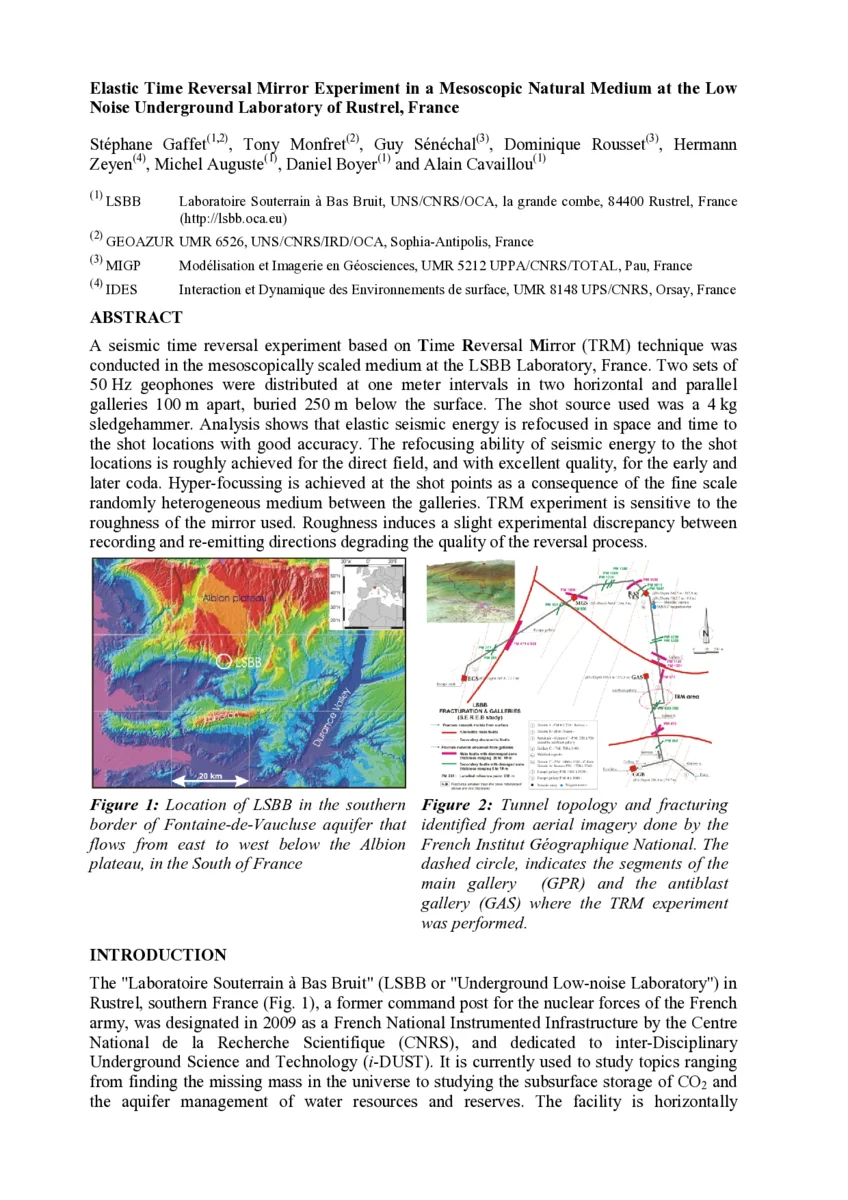
The paper reports a seismic time‑reversal mirror (TRM) experiment conducted in the Low‑Noise Underground Laboratory (LSBB) near Rustrel, France. Two parallel galleries, the “anti‑blast” (GAS) and the “main” (GPR) tunnels, are spaced 100 m apart at a depth of about 250 m. Along each wall, fifty 50‑Hz single‑component geophones are installed at 1‑m intervals, forming two linear arrays of 100 sensors in total.
The experiment follows three steps. In the forward step, a 4‑kg sledgehammer is struck at 50 successive positions in the GAS gallery; the resulting elastic wavefield is recorded by the GPR array. In the backward step the roles are reversed: the hammer is struck at the same positions in the GPR gallery and the signals are recorded in GAS. These two data sets are interpreted as empirical Green’s functions Gij(y, t; xo, to) and Gji(x, t; y, to+T). In the third step the recorded waveforms are time‑reversed and numerically re‑emitted from each sensor in the “mirror” array. The convolution of the time‑reversed forward Green’s function with the backward Green’s function yields a matched‑filter expression (Eq. 5) that focuses energy back onto the original source location.
Four temporal windows are analyzed: pre‑impact noise, direct arrivals, early coda, and later coda. Each window spans 0.064 s (512 samples) and is high‑pass filtered at 100 Hz. The reversal amplitude is evaluated at the theoretical focusing time T for every possible source position. In the noise window the energy distribution is random, confirming that a coherent source is required for successful reversal. In the direct‑field window a clear peak of about 3 m width appears at the true source location, indicating spatial focusing well below the theoretical diffraction limit (Δx ≈ λ L/a ≈ 45 m for a homogeneous medium). The early and later coda windows produce even sharper peaks and higher amplitudes, demonstrating the “hyper‑focusing” or super‑resolution effect that arises from multiple scattering in a heterogeneous medium.
The authors estimate an average wavelength λ ≈ 22.5 m (P‑wave velocity 4500 m s⁻¹, dominant frequency 200 Hz). The observed focal width δx ≈ 3 m implies an effective aperture a_eff = λ L/δx ≈ 750 m, far larger than the physical 50 m array length, confirming that medium heterogeneity dramatically enhances the aperture of the time‑reversal mirror.
A key experimental observation is the sensitivity of the reversal quality to the roughness of the mirror surface. The GPR gallery’s concrete wall is relatively smooth, allowing sensor axes to align well with the hammer impact direction, resulting in narrow, high‑amplitude focal peaks. In contrast, the GAS gallery’s natural, corrugated rock wall introduces misalignment between sensor orientation and source direction, violating the reciprocity assumption used in the derivation. Consequently, when GAS serves as the mirror, the focal peak broadens and secondary energy lobes appear, especially in the direct‑field and early‑coda windows.
The study concludes that (i) elastic energy can be robustly refocused on its original source in a natural, mesoscopic medium; (ii) the presence of a coherent source is essential, even when the wavefield has been heavily scattered; (iii) medium heterogeneity enhances focusing through multiple scattering, leading to hyper‑focusing; and (iv) the physical quality of the mirror (smoothness, sensor alignment) directly impacts the fidelity of the time‑reversal process. These findings have implications for underground imaging, seismic monitoring, and wave‑control technologies in complex geological settings.
Comments & Academic Discussion
Loading comments...
Leave a Comment