Optimal Tradeoff Between Exposed and Hidden Nodes in Large Wireless Networks
Wireless networks equipped with the CSMA protocol are subject to collisions due to interference. For a given interference range we investigate the tradeoff between collisions (hidden nodes) and unused capacity (exposed nodes). We show that the sensin…
Authors: ** P.M. van de Ven, A.J.E.M. Janssen, J.S.H. van Leeuwaarden **
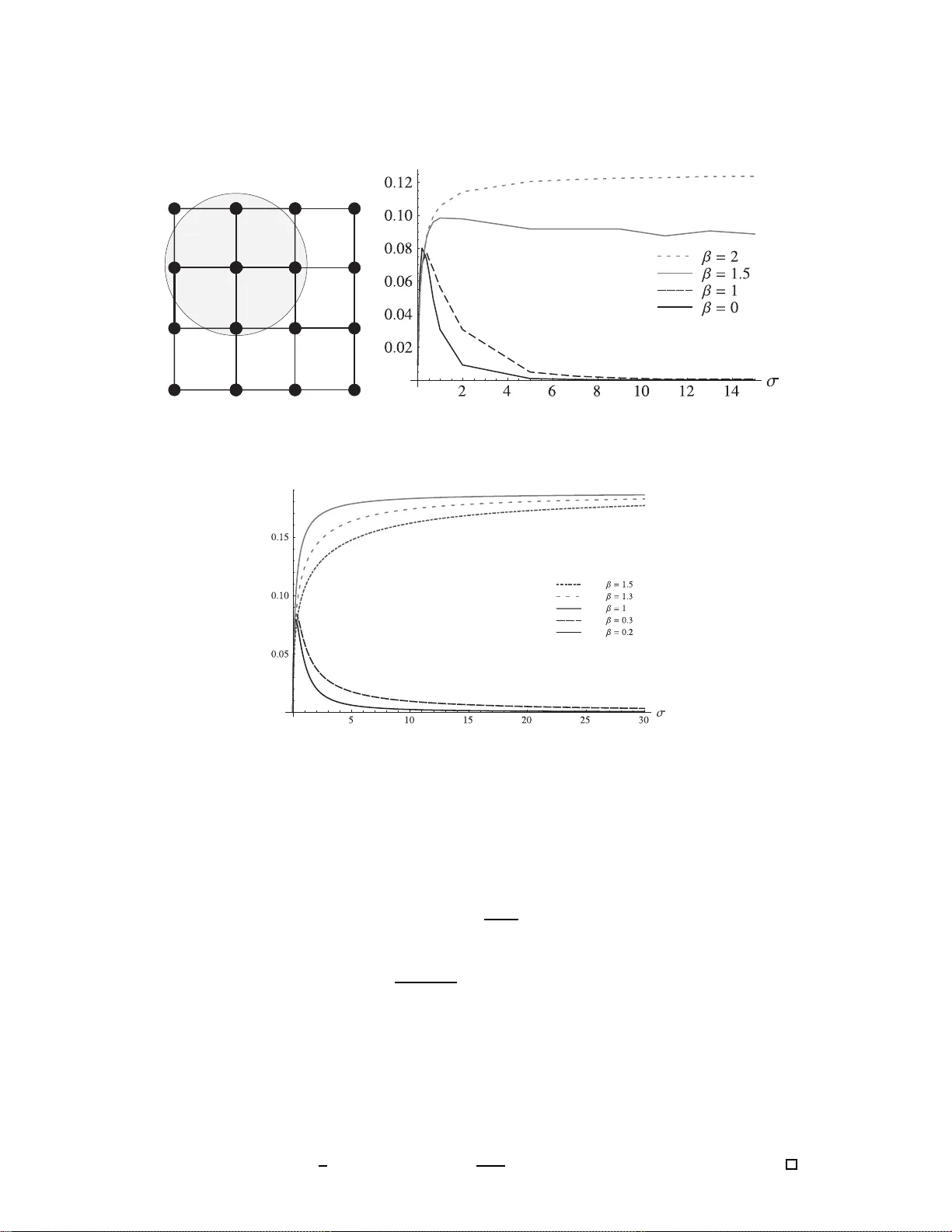
Optimal T radeoff b et w een Exp osed and Hidden No des in Large Wireless Net w orks P .M. v an de V en 1 , 2 A.J.E.M. Janssen 2 , 3 J.S.H. v an Lee uw aarden 1 , 2 Octob er 28, 2018 Abstract Wireless netw orks equip p ed with the CSMA proto col are sub ject to collisions due to interf erence. F o r a g iven in terference range w e in vestigate the tradeoff b et ween collisions (hidden nod es) and un u sed ca p acity (exp osed nod es). W e sho w that the sensing range that maximizes throughput critically dep end s on the activa tion rate of no d es. F o r infinite line netw orks, we pro ve the ex istence of a threshold: When the activ ation rate is below th is threshold the optimal sensing range is small (to maximize spatial reuse). Wh en the activ ation rate is ab ov e the threshold t h e optimal sensing range is just large enough to preclude all collisio n s. Simula tions s u ggest that t h is th reshold p olicy extends to more complex linear and non-linear top ologies. 1 In tro duction Carrier sense multiple-access (CSMA) type proto cols form a po pular class of medium acces s proto - cols for wireles s netw or k s. The firs t CSMA proto col was in tr oduced by Kleinro ck and T o bagi [1 0] in 1975 , and has s een many incar nations since, including the widely used 80 2.11 standard. In this pap er we provide an asy mptotic ana lysis o f larg e wireless ne tw o rks op erating under CSMA, in the presence of collis ions. CSMA is a r andomized proto col that allows no des to access the medium in a distributed man- ner. The a bsence of a centralized scheduler cr e ates mor e flexibility a nd a llo ws for the deploymen t of la r ger netw or ks. An ear ly exa mple of such a randomized pro cedure is the ALOHA pr otoc ol [1], which forces no des to wait for s ome ra ndom backoff perio d b efore starting a transmiss ion, in order to reduce the lik eliho o d of nearby no des transmitting simult a neously . The latter even t w ould cause the signals to interfere with each o ther, and may result in a co llision that r enders the transmissio ns useless. CSMA improv es upon ALOHA by letting no de s sens e their s urroundings to detect the presence o f other tr a nsmitting no des. If a no de detects at le a st one active (i.e. transmitting) no de within its sensing ra nge, its bac koff timer is frozen, def er ring the count down un til the channel is sensed c le a r. Using this mech a nism, co llisions can be further r educed. A key p erformance measur e in wireless netw orks is throughput, which we define as the av er age nu mber of success ful tr ansmissions p er unit of time. W e inv es tigate the rela tion b etw een the sensing rang e a nd the throug hput. The e ffect of the sensing r ange can b e u nder sto o d as follows. A small sensing range allows for more simultaneous tra nsmissions, but is les s effective in r educing collisions. On the o ther hand, a larg e sensing rang e admits fewer tra ns missions, but also mitig a tes int er ference. The main contribution o f this pap er is the examination o f this tradeo ff in r elation to its effect o n the throughput. The netw o rk is characterized by the sens ing ra nge and the interference range. A no de can only initiate a new transmission when all no des within its sensing r ange are inactive. This tra nsmission 1 Eindho ven University of T ec hnology , Departmen t of Mathematics and Computer Science, P .O. Box 513, 5600 MB Eindho ven, The Netherlands 2 Eurandom, P .O. Box 513, 5600 MB Eindhov en, The Netherlands 3 Eindho ven Uni v ersity of T echnology , Department of E lectrical Engineering, P .O. Box 513, 5600 MB Eindho ven, The Netherlands 1 is successful w he n all no des within the interference ra nge o f the destinatio n no de are ina ctiv e, and fails otherwis e . The netw ork p erformance suffers from tw o complementary iss ues: hidden no des and exp osed no des (see [15]). Hidden no des a re no des lo cated outside the sensing range of the transmitter and are there fo re not detected by the c arrier-s e nsing mechanism. Hidden no des caus e collisions as they ar e within the r e ceiv er ’s interference rang e. Expose d no des ar e no des lo cated outside the receiver’s interference ra nge but inside the sender’s sensing rang e. So despite b eing harmless to the tra ns mission, ex pose d no des are nevertheless blo ck ed. As the s e nsing range grows, the n umber of hidden node s decrea ses, and the n umber of exp osed no des increase s . In recent years the carrie r -sensing tra deoff b etw een hidden a nd exp osed no des has rec e iv ed m uch attention [11, 12, 18, 20]. Most of these analytic studies make the assumption that the activity of no des a nd their back o ff pro cesses ar e indep endent, which gre atly simplifies the a nalysis. The interaction b et ween no des, howev er, should b e taken into account, as it is t ypica l for the distributed co n tro l and has a larg e impact o n the pe r formance of the netw ork. W e do take into account this interaction, b y keeping tra c k of the activity o f no des over time. The clas sical mo del for such int er action in wire le s s net works is develop ed in Bo orstyn a nd Ke r shenb a um [4]. This mo del has bee n used in recent years to study throughput-o ptima lity [14] a nd fairness [7 , 8, 1 7, 16] in a setting witho ut collis io ns. The stability reg ion for larg e wireless netw or ks with co llis ions was inv estigated in [5]. In the s pirit of [4], we mo del the netw o rk as a contin uous- time Markov pro cess with interac- tion b etw een the no des, so that no des within a certain distance of an active no de ar e silence d, just a s in CSMA. Such interaction is re fer red to in statistical physics a s har d-c or e interaction. This pap er is par t of a la rger prog r am to study wireless netw orks via hard-cor e mo dels fr om statistical physics. Typical for such mo dels is the exis tence of a Gibbs mea sure that describ es the stationary distr ibutio n. This Gibbs measur e is no rmalized by the par tition function, which inv olves a computationally cumberso me summation ov er a ll p ossible co nfigurations. A substantial ingredient of this pap er is to characterize and approximate the partition function. W e shall con- sider the netw ork, and thus the partition function, in the asymptotic regime where the num b er of no des in the netw o rk tends to infinit y . F o r such infinite line net works we ar e able to o bta in structural results on the joint effect of hidden no des and exp osed no des.W e determine analy tically the thr o ughput-optimal sensing range that achiev es the best tradeo ff be tw ee n reducing hidden no des and prevent ing exp o sed no des. The remainder of this pap er is str uctured as follows. In Sec tion 2 we introduce the mo del, a nd derive so me auxiliar y results. Sectio n 3 discusses the main results on the carrie r -sensing tradeoff. In Section 4 we p erform a detailed study of the partition function. In Section 5 we v a lidate the analytical results fo r the line netw o rk by simulation, and we inv estigate netw orks with mor e general top o logies. In Section 6 we present the pro ofs of thos e r esults that a re not alre ady proved in earlier sec tions. 2 Mo del d escription W e consider a linea r arr a y o f 2 n + 1 no des, a nd we denote the set of all no des by N = {− n, . . . , n } . Whenever a no de activ ates, it tra nsmits a single pack et to a neighbo ring no de. With pr obability ψ , the pa c ket is intended for its rig ht neighbo r, and with probability 1 − ψ for its left neighbor. T o accommo date this, we in tro duce (pure destination) no de s n +1 and − ( n + 1), which receive pac kets, but do not transmit pack ets themselves. As will b e shown in P rop osition 2 , the thro ughput is insensitive to the par ameter ψ . W e a s sume that all no des a re sa turated, meaning that they hav e an infinite s upply of pack ets av a ila ble. After each transmission no des enter a back o ff p erio d, meaning that they will r emain inactive for so me time. The le ng th of the ba c koff p erio d is assumed to b e exp onen tia lly distributed with mean 1 /σ . W e assume a ll no des to have the sa me sensing rang e β , so tha t node v is prohibited from transmitting whenever a t leas t one no de w fo r which | v − w | ≤ β is active (i.e. tra ns mitting), in which case we say that no de v is blo cke d by no de w . So when a no de finishes its ba c koff p erio d and it finds at lea st one no de within distance β a ctiv e, it en ters a new ba c koff per iod. When a no de finds 2 all no des within distance β inactive up on finishing backoff, it star ts a tr ansmission. T ra nsmissions last for an exp onentially distributed dur ation with unit mean. Under these assumptions , the (2 n + 1 )-dimensional pr oces s that describ es the activity of no des is a c on tinuous-time Mar k ov pro cess. E ach state of the Mar k ov pro cess is describ ed by ω = ( ω − n , . . . , ω n ) ∈ { 0 , 1 } 2 n +1 , (1) where ω v = 1 when no de v is active, a nd ω v = 0 otherwise. Let Ω ⊆ { 0 , 1 } 2 n +1 be the s e t of all fe asible states. Here we call ω feasible if no tw o 1 ’s in ω a re β p ositions o r less apar t, i.e., ω v ω w = 0 if 1 ≤ | v − w | ≤ β . Let e v denote the vector with all zero s, except for a 1 a t p osition v . T he Marko v pro cess that describ es the a ctivit y of no des is then fully sp ecified by the state space Ω and the transitio n rates r ( ω , ω ′ ) = σ if ω ′ = ω + e v , 1 if ω ′ = ω − e v , 0 otherwise . (2) It is well known that this is a reversible Mar k ov pr oc e s s (see [4, 13]) with limiting distribution π ( ω ) = Z − 1 2 n +1 Q n v = − n σ ω v if ω is feasible, 0 otherwise, (3) with Z 2 n +1 the par tition function or norma lization constant of the pro babilit y distribution π . The partition function ca n b e defined recursively as (see [4, 13]) Z i = 1 + iσ i = 0 , 1 , . . . , β + 1 , Z i − 1 + σ Z i − β − 1 i ≥ β + 2 . (4) The sequence ( Z i ) ∞ i =0 is well studied. In fact, for a netw ork with i no des, Z i represents the partition function, defined as the summation of pr obability o ver all p ossible states. Straig h tforward calculations show that the the g enerating function G Z ( x ) of Z i can b e written as (see e.g . P inksy and Y emini [13]) G Z ( x ) = ∞ X i =0 Z i x i = x − 1 + σ x β +1 − σ x ( x − 1)(1 − x − σx β +1 ) . (5) Let λ 0 , . . . , λ β denote the β + 1 distinct (see Prop osition 8) ro ots of λ β +1 − λ β − σ = 0 . (6) W e denote by λ 0 the unique p ositive rea l r oo t for which λ 0 > | λ j | , j 6 = 0 (see [13]). Applying partial fraction expansion to (5) yields the fo llo wing result (prov ed in Section 6): Prop osition 1. The p artition fun ction Z i is given by Z i = β X j =0 c j λ i j , i = 0 , 1 , . . . , (7) wher e λ j ar e the r o ots of (6) , and c j = λ β +1 j ( β + 1 ) λ j − β . (8) T o mo del interference, we introduce a n interference ra nge η . A trans mission suc c eeds if and only if at the s tart of this transmissio n no no des within distance η o f the receiving no de are a lready active. This t y p e of interference is referred to in the literature as the p erfe ct c aptur e collision mo de l [4]. Note that neither (2) nor (3 ) dep ends on η , as co llisions hav e no impact on the dynamics o f the system. Using the sensing range β and interference range η we can define for mally hidden no des and exp osed no des. Co nsider a trans mission from no de v to no de w . Hidden no des are 3 then defined as no des that ar e outside the sensing r ange of v , but within the interference rang e of w . Such no des ar e not blo ck ed b y the activity of no de v , but their proximity to no de w makes the hidden no des harmful to the transmission from v to w . Conv erse ly , exp osed no des ar e thos e no des that are within the sensing ra nge of v , but o utside the interference r ange of w . Such no des are blo ck ed by an ongoing tr ansmission from v to w , despite the fact that they will not caus e this transmission to fail. Denote by H r ( H l ) the s e t of hidden no des of transmissions from no de 0 to no de 1 (no de -1): all no des outside the sensing range of 0 , but within the interference range of the receiving no de 1 (no de - 1). B y E r ( E l ) we deno te the set of no des to which this trans mission is ex p osed, so all no des within the sensing rang e of 0, but outside the in ter ference r a nge of the receiving no de. F or completeness we let B r ( B l ) denote the s et of all remaining no des that blo c k transmissions from no de 0 to no de 1 (node -1 ). This yields: H r = v ∈ N | v | ≥ β + 1 , | v − 1 | ≤ η , H l = v ∈ N | v | ≥ β + 1 , | v + 1 | ≤ η , E r = v ∈ N | v | ≤ β , | v − 1 | ≥ η + 1 , E l = v ∈ N | v | ≤ β , | v + 1 | ≥ η + 1 , B r = v ∈ N | v | ≤ β , | v − 1 | ≤ η , B l = v ∈ N | v | ≤ β , | v + 1 | ≤ η . So E r ∪ B r = E l ∪ B l = v ∈ N | v | ≤ β . An example is given in Figure 1(a). No de 3 is a hidden no de, as it interferes with the transmission fr om no de 0 to no de 1 ( η = 2 ) despite the car rier- sensing mechanism ( β = 1). In Figur e 1(b) no de 0 is an exp osed no de to the trans mission from no de 2 to no de 3 b ecause it would not in terfer e ( η = 2) with this transmissio n but is nevertheless silenced by the a c tivit y of no de 2 ( β = 2 ). -1 0 1 2 3 4 P S f r a g r e p la c e m e n t s β η σ σ m i n σ m a x β ∗ η − 1 η + 1 m (a) No de 3 is a h idden no de, and ma y interfere with the transmis- sion b etw een no des 0 and 1. -2 -1 0 1 2 3 P S f r a g r e p la c e m e n t s β η σ σ m i n σ m a x β ∗ η − 1 η + 1 m (b) No de 0 is an exp osed no de, unnec- essarily silenced by the transmission b e- tw een no des 2 and 3. Figure 1: Exa mples of hidden a nd exp osed no des. W e fo cus on no de 0 (the no de in the middle of the netw ork) and in pa rticular its throughput θ n ( β , η , σ ) defined as the average num b er of successful tr ansmissions p er unit of time. Prop osition 2. The thr oughput of no de 0 is given by θ n ( β , η , σ ) = σ Z n − max { β ,η − 1 } Z n − max { β ,η +1 } Z 2 n +1 . (9 ) Pr o of. Denote by θ r ( θ l ) the rate of successful transmissio n o f no de 0 to node 1 (no de -1), so θ n ( β , η , σ ) = θ r + θ l . The activ ation attempts to no de 1 (no de -1) o ccur according to a Poisson pro cess with r ate σ ψ (rate σ (1 − ψ )). W e first cons ide r activ a tion attempts to no de 1 . Whether an a c tiv ation attempt is succ essful dep ends on the s tate o f the system when this a ttempt o ccurs. Define A 1 = ω ∈ Ω ∃ v ∈ B r ∪ E r : ω v = 1 , A 2 = ω ∈ Ω ∀ v ∈ B r ∪ E r : ω v = 0 , ∃ v ∈ H r : ω v = 1 , A 3 = ω ∈ Ω ∀ v ∈ B r ∪ E r ∪ H r : ω v = 0 . 4 When the system is in sta te ω ∈ A 1 , the attempt is blo ck ed and no de 0 remains in its current state. When the system is in a state ω ∈ A 2 , no de 0 is not blo ck ed so it activ ates. How ever, a t least one hidden no de is active so the transmission fails and doe s no t co ntribute to the throughput. When the system is in state ω ∈ A 3 , the p erfect capture a ssumption guarantees a successful tra ns mission. It follows fro m the P AST A prop erty (cf. [2]) that the proba bilit y of an arbitrar y activ ation attempt resulting in a succ essful tr ansmission is equal to the limiting pro babilit y of the system b eing in a s tate ω ∈ A 3 . So the ra te of successful transmiss ions initialized (and thus the throug hput) is given by θ r = σ ψ X ω ∈ A 3 π ( ω ) . (10) F ro m the definitions of B r , E r and H r we se e that A 3 = ω ∈ Ω ∀ v ∈ ( D 1 ∪ D 2 ) c : ω v = 0 , (11) where D 1 = {− n , . . . , − max { β , η − 1 } − 1 } , D 2 = { max { β , η + 1 } + 1 , . . . , n } . (12) Let Z D denote the partitio n function for a subset o f no des D ⊆ N defined as Z D = P ω ∈ Ω , ∀ v ∈ D c : ω v =0 Q n v = − n σ ω v . T hen θ r = σ ψ Z D 1 ∪ D 2 Z N . (13) The mo del on the line ha s the prop erty that by conditioning o n the activity of one of the no des, its state spa ce can be deco mp osed, leading to t wo s maller ins tances of the same mo del on the line. In particular, we know that Z D 1 ∪ D 2 = Z D 1 Z D 2 (see [4, E quation (15 )]), so that θ r = σ ψ Z D 1 Z D 2 Z N = σ ψ Z n − max { β ,η − 1 } Z n − max { β ,η +1 } Z 2 n +1 , (14) where Z i denotes the par tition function of a ne tw o rk with i consecutive no des o n a line. Similarly , θ l = σ (1 − ψ ) Z n − max { β ,η − 1 } Z n − max { β ,η +1 } Z 2 n +1 . (15) and (9) follows by adding θ r and θ l . 3 Main results Our principal a im is to cho ose the sensing rang e β so that the thro ughput θ n ( β , η , σ ) is max imized for a given η and σ . Define β ∗ n = ar gmax β θ n ( β , η , σ ) . (16) Determining β ∗ n corres p onds to quantifying and optimizing the tradeo ff b et ween prevent ing col- lisions through interference (preven ting hidden no des by setting β larg e) and allowing har mless transmissions (preventing e x pos e d no des by setting β small). W e wan t to obtain structura l in- sights in how to choose β ∗ n , and for this purp ose the expr essions for Z i in (7) and θ n ( β , η , σ ) in (9 ) are to o cumberso me. Therefore, we inv estigate the throughput in the r egime wher e the net work bec omes large ( n → ∞ ), so that (9) s implifies co nsiderably , a llo wing for mo r e explicit a nalysis. The analytic r e sults that we obtain for the infinite netw ork pr ovide remar k ably s harp a ppr oxi- mations for the finite netw o rk; see Section 5.1. All pro ofs that are not given in this section are provided in Section 6. W e start by presenting the limiting expressio n for θ n ( β , η , σ ) a s the size of the netw ork b ecomes infinite: 5 Prop osition 3. L et λ 0 denote the unique p ositive r e al r o ot of (6) . Then θ ( β , η , σ ) = lim n →∞ θ n ( β , η , σ ) = σ λ β − f ( β ) 0 ( β + 1 ) λ 0 − β , (17) wher e f ( β ) = 2 η if 0 ≤ β ≤ η − 1 , η + β + 1 if η − 1 ≤ β ≤ η + 1 , 2 β if β ≥ η + 1 . (18) Pr o of. F rom Ro uc h´ e’s theorem (see De Bruijn [6]) it readily follows that λ 0 > | λ j | for j = 1 , . . . , β , and so from (7) w e g e t Z i = c 0 λ i 0 (1 + o (1)) , i → ∞ . (19) Hence lim n →∞ θ n ( β , η , σ ) = lim n →∞ σ c 0 λ n − max { β ,η − 1 } 0 c 0 λ n − max { β ,η +1 } 0 c 0 λ 2 n +1 0 = σ c 0 λ − m ax { β ,η − 1 }− max { β ,η +1 }− 1 0 , (20) which yields (18). Now tha t w e have the limiting express io n for the throug hput in (17 ) we opt for an asy mptotic analysis. That is, instea d of searching for β ∗ n , we sha ll sear c h for its asymptotic counterpart β ∗ = ar gmax β θ ( β , η , σ ) , (21) where we henceforth co nsider θ a s a contin uous function of the r eal v ar ia ble β ≥ 0. In Section 5.1 we show that the erro rs | θ n − θ | and | β ∗ n − β ∗ | b ecome s ma ll, alr eady for mo derate v alues of n . Because we consider fr om here onw a rds a n infinite line of no des, all no des have the sa me nu mber of no des within their sensing rang e. This r emo ves all bo undary effects, and all no des hav e the same thro ughput, which is wh y just inv estiga ting no de 0 is s ufficie nt to inv estiga te the ent ir e net work. Prop osition 4. β ∗ ∈ [ η − 1 , η + 1] . The result o f P r op o sition 4 can b e understo o d as follows. By increa sing β be y ond η + 1, no additional co llis ions a re pre v ented, but an increa s ing num b er of no des is silenced. On the other hand, the no des that b ecome unblock ed when decr easing β b elow η − 1 , ca use collis ions when they activ a te. Although this re sult may seem in tuitively clear , to the a uthors’ knowledge such a r esult has not b een prov ed rigouro usly (at least not in the present s e tting). Note that for all v alues β ∈ [ η − 1 , η + 1], w e can rewrite (17) as θ ( β , η , σ ) = g ( β ) · ( λ 0 ( β )) β − η − 1 β + 1 (22) with g ( β ) = λ 0 ( β ) − 1 λ 0 ( β ) − β β +1 → 1 , β → ∞ . (23) W e a re now in the po sition to pr esen t our ma in result. While we already know that the optimal sensing range is contained in the in terv al [ η − 1 , η + 1], the next re s ult is more sp e c ific. Theorem 1. Ther e exists a thr eshold interval [ σ min , σ max ] such that β ∗ = η − 1 if σ ≤ σ min , η + 1 if σ ≥ σ max , (24) and β ∗ incr e ases fr om η − 1 to η + 1 when σ incr e ases fr om σ min to σ max . 6 The pro of of Theorem 1, see Section 6, follows from a detailed study of θ ( β , η , σ ) which involv es implicit differ e n tiation with resp ect to β (since λ 0 ( β ) is defined implicitly). Theorem 1 can b e interpreted as follows (se e Fig ur e 2). When σ is larg e, no des activ ate very quickly after finishing their previous transmissions . In the langua ge of sta tis tica l physics, the system temper ature decrea ses, a nd the system t ypic a lly ge ts stuck in maximal indep e nden t sets of active no des (the configurations with the highest energy level). When the system is in a maximal independent set, and if collisions are not r uled out, a n activ ating no de suffers a collis ion almost surely . This explains why for σ larg e, the optimal sensing range is β = η + 1, pr ev enting collisions completely . On the other hand, whe n σ is small, collisions b ecome rare, as few no des ar e active simult a neously . In this cas e, the throughput is b est ser v ed by increas ing the spa tial reus e , that is, decreasing the se nsing ra nge (up to η − 1 ). This explains the result o f Theo rem 1 for σ sma ll. P S f r a g r e p la c e m e n t s β η σ σ min σ max β ∗ η − 1 η + 1 m Figure 2: The optimal sensing range β ∗ as a function of σ . Note that Theorem 1 does not give the exact v a lues of σ min and σ max . Ins tead, we g ive b elow an es tima te of the lo cation and width of the threshold in terv al. Theorem 2. L et κ = τ η +1 with τ = ( √ 5 − 1) / 2 . (i) The thr eshold interval is b ounde d as [ σ min , σ max ] ⊆ [ κ (1 + κ ) η − 1 , κ (1 + κ ) η +1 ] . (25) (ii) The width of t he thr eshold interval is asymptotic al ly given as σ max − σ min ∼ 2e τ 7 + 4 τ 1 η + 1 2 as η → ∞ . (26) Here we s ay that f ( η ) ∼ g ( η ) if f ( η ) / g ( η ) → 1 as η → ∞ . F rom T he o rem 2(ii) we see that the width of the thre shold interv al is O ( η − 2 ). Therefor e, the interv al width decr eases ra pidly as a function of η , and we can sp eak of an almost immediate transition from one re g ime ( β ∗ = η − 1 ) to the other ( β ∗ = η + 1). As a b y-pro duct of the pro of of Theo rem 2(ii) we obtain sha rp approximations fo r σ min and σ max , see (85 )-(86): ˆ σ min = ˆ µ − (1 + ˆ µ − ) η − 1 , ˆ σ max = ˆ µ + (1 + ˆ µ + ) η +1 , (27) with ˆ µ ± = τ / ( η + α ± ) a nd α ± given as α in (86) with γ = ± 1. 3.1 Throughput limiting b eha vior W e now conside r s ome limiting re gimes for which we can make more ex plicit statements a bout the throughput. F rom Theorem 2 we can alr eady see that the thresho ld interv a l mov es in the 7 direction of zero as η b ecomes larg e which implies that β ∗ = η + 1 for small v alues of σ . The next result s ho ws that in the reg ime where η b ecomes la r ge, the maximum throughput tends to z e r o. Prop osition 5. L et σ > 0 b e fixe d. As η → ∞ , max β θ ( β , η , σ ) = 1 η + 2 1 + O 1 ln( η + 1) . (28) F or β ≥ η + 1 our mode l reduces to a mo del without collisions that was studied extensively in [4, 1 3, 3, 19, 9, 16]. In particular , o ne immediately obtains from (17) the following r esult: Corollary 1. L et β ≥ η + 1 . Then θ ( β , η , σ ) = λ 0 − 1 ( β + 1) λ 0 − β . (29) This result was also derived in [13, 3, 19, 9]. F rom Prop osition 7 and the pro of o f Pr opo sition 5 it is seen that λ 0 → ∞ as σ → ∞ and β is fixed, and that β ( λ 0 − 1) → ∞ as β → ∞ a nd σ is fixed. Thus the throughput is approximately 1 β +1 when either σ or β is lar ge. This can b e understo o d a s follows. F or la rge σ , the hig h activity rate allows for configurations close to the maximal independent set: a configura tion in whic h one out of every β + 1 no des in active. F or β large, when a no de deactiv ates, a lar ge num b er of neig h b oring no des b ecome elig ible for activ a tion. The time until the first such no de activ ates go es to 0 when β increa ses. Corollary 2. L et β ≤ η . Then lim σ →∞ θ n ( β , η , σ ) = 0 . (30) Pr o of. F rom (41) it follows that λ 0 ( σ ) = σ 1 1+ β + O (1) , σ → ∞ . (31) Substituting (31) into (17), and using that f ( β ) > 2 β when β ≤ η , yields θ n ( β , η , σ ) = σ ( σ 1 1+ β + O (1)) β − f ( β ) ( β + 1 )( σ 1 1+ β + O (1)) − β → 0 , ( σ → ∞ ) , (32) which gives (3 0). Figure 3 shows the throughput plotted aga inst the activity rate σ for η = 7 and v arious v a lues of β . When β ≤ η , the thro ughput gr a dually drops to 0, wherea s for β ≥ η + 1, the throug hput will even tually conv er ge to the limit 1 / ( β + 1). This co nfirms Cor ollaries 1 and 2. P S f r a g r e p la c e m e n t s β η σ σ m i n σ m a x β ∗ η − 1 η + 1 m Figure 3: The throughput θ ( β , η , σ ) plotted aga inst σ fo r η = 7 and v a r ious v a lues of β . 8 4 P artition function ro ots In this section we study the ro ots λ 0 , . . . , λ β of (6) in more detail. In particula r, we der iv e exa ct infinite-series ex pressions for the ro o ts that are us ed in this pap er b oth for numerical purp oses (in Section 5) and to prove Co rollary 2. These ro ots a re esse ntial in Se c tio n 5.1, where the finite and infinite netw ork s ar e compared. Our main to ol will be the Lagr ange inv er s ion theorem (see [6]), and dep ending on the v alue of σ , this gives tw o different infinite-series e xpressions. Let ( x ) n = Γ( x + n ) / Γ( x ) denote the Pochhammer s ym b ol. Prop osition 6. F or smal l σ > 0 , λ 0 ( σ ) = 1 + ∞ X l =1 ( − 1) l − 1 ( β l ) l − 1 l ! σ l , (33) λ j ( σ ) = ∞ X l =1 ( l/ β ) l − 1 l ! w l j , j = 1 , 2 , . . . , β , (34) wher e w j = σ 1 /β e 2 π ı ( j − 1 / 2) /β and ı = √ − 1 . The series exp ansions in (33 ) and (34) c onver ge for 0 ≤ σ ≤ β β ( β + 1 ) β +1 =: ξ ( β ) , (35) and diver ge otherwise. Pr o of. W e first consider the ca s e j = 0 . Set µ 0 = λ 0 − 1, so µ 0 satisfies µ 0 (1 + µ 0 ) β = σ . Hence for s mall v alues of | σ | we have by Lagr a nge’s inversion theo rem µ 0 = ∞ X l =1 1 l ! d d µ l − 1 " µ µ (1 + µ ) β l # µ =0 σ l = ∞ X l =1 ( − 1) l − 1 ( β l ) l − 1 l ! σ l . (36) Next w e consider the case that j = 1 , . . . , β . W e now w r ite (6) as λ β (1 − λ ) = − σ, λ (1 − λ ) 1 /β = w j , (37) where w j = σ 1 /β e 2 π ı ( j − 1 / 2) /β . (38) Then w e get for | w j | sufficien tly small λ j = ∞ X l =1 1 l ! d d λ l − 1 " λ λ (1 − λ ) 1 /β l # λ =0 w l j = ∞ X l =1 ( l/ β ) l − 1 l ! w l j . (39) The r adii of convergence of the ser ies in (36) and (39) a re easily obtained fro m the a symptotics Γ( x + 1) = x x +1 / 2 e − x √ 2 π (1 + O ( x − 1 ) , x → ∞ , (40) of the Γ-function, used to examine the Pochhammer qua n tities ( x ) n = Γ( x + n ) / Γ( x ) and the factorials l ! = Γ( l + 1) that o ccur in b oth series. This yields the result that b oth series co n verge when | σ | ≤ ξ ( β ) a nd div er ge for | σ | > ξ ( β ). When | σ | = ξ ( β ) the terms in either ser ie s are O ( l − 3 / 2 ). Prop osition 7. F or lar ge σ > 0 , λ j ( σ ) = ∞ X l =1 − l β +1 l − 1 l ! v − l j ! − 1 , j = 0 , 1 , . . . , β , (41) wher e v j = σ 1 / ( β +1) e 2 π ıj / ( β +1) . The series exp ansion in (41) c onver ges for σ ≥ ξ ( β ) , (42) and diver ges otherwise, wher e ξ ( β ) is given in (35) . 9 Pr o of. W e can treat the case s j = 0 a nd j = 1 , . . . , β simultaneously now. W e wr ite (6) in the form 1 λ 1 − 1 λ − 1 β +1 = 1 σ 1 β +1 = v − 1 , (43) where we let v − 1 = v − 1 j = 1 σ 1 β +1 e − 2 π ı j β +1 , j = 0 , 1 , . . . , β (44) with σ − 1 β +1 > 0 in (44). W e g e t for sufficiently larg e σ fro m Lagra nge’s inv er sion theor em (with u = 1 / λ ) that 1 λ j = ∞ X l =1 1 l ! d d u l − 1 " u u (1 − u ) − 1 / ( β +1) l # u =0 v − l j = ∞ X l =1 − l β + 1 l − 1 v − l j l ! . (45) The Po c hha mmer quantit y ( − l β +1 ) l − 1 v anis he s if a nd only if l = 1 , 2 , . . . is a multiple of β + 1. The radius o f conv ergence of the series in (45 ) is again determined by the as y mptotics of the Γ-function in (40). Here it must a lso b e used tha t Γ( − J ) = − 1 Γ( J + 1) π sin π J , J > 0 . (46) It follows that the series in (45) is conv erg e n t when | σ | ≥ ξ ( β ) and divergent when | σ | < ξ ( β ). When | σ | = ξ ( β ) the terms in the series are O ( l − 3 / 2 ). Figure 4 shows the ro ots of (6) drawn in the complex λ -plane for β = 4. E ach heavy solid line corres p onds to a ro ot as a function of σ , and the dots repr esent the thres hold | σ | = ξ ( β ). The light solid str aight line a nd the da shed straight line illustra te the leading b ehavior of ea c h ro ot as σ ↓ 0 or σ → ∞ according to Prop ositions 6 a nd 7, re s pectively . The das hed curve encircling the origin 0 and the p oint 1 is the image of v ∈ C with | v | = σ 1 / ( β +1) , σ = ξ ( β ), under the mapping given by the recipr oc a l of the r igh t-ha nd s ide o f (41) with v j replaced b y v . 5 Discussion and outlo ok The distinguis hing feature of this pap er is the presence of no de interaction when making the tradeoff b et ween hidden no des and exp osed no des. In order to get a handle on the throughput function (a nd hence the partition function) we studied the wireles s netw o rk in the asymptotic regime of infinitely many no des. This resulted in a tractable limiting expressio n for the throughput of no de zero (and hence o f any other node ) that allowed us to pr ov e the following tw o results: (i) T o optimize the thro ug hput, o ne s hould always c ho ose a sens ing ra nge β that is close to the int er ference r ange η , and in fact the optimal sensing rang e is contained in the interv al [ η − 1 , η + 1] (see Prop osition 4). (ii) The sensing r ange β ∗ that optimizes the thro ughput equals η − 1 for less a ggressive no des (small σ ) and η + 1 for ag gressive no des (large σ ). In fa ct, we were able to show the exis tence of a threshold interv al for σ that distinguis he s these t wo r egimes (Theorem 1). This imp ortant result provides (partial) justificatio n for the frequently ma de a ssumption that no collisions o ccur. Indeed, one key take awa y is that if σ is large enough, r uling out a ll collisio ns by setting β = η + 1 is optimal. W e have further shown that the thresho ld interv al is in ma n y cas e s s ma ll, which implies that one can s p eak of a n almost immediate tra nsition from one regime ( β ∗ = η − 1) to the other ( β ∗ = η + 1). W e hav e arg ued that, when the ag gressiveness o f the no des is large enough, the system no lo nger gains from the p otential b enefits of mo re flexibility (small β ), and just settles for the situatio n with no collisions. W e sha ll now discuss tw o remaining issues. In Section 5 .1 we inv estigate to what extent the asymptotic res ults give a ccurate predictions for fin ite line netw orks. In Section 5.2 we inv estigate whether the notions of tw o reg imes and a critica l thresho ld carry over to more genera l top ologies. 10 - 1.5 - 1.0 - 0.5 0.5 1.0 1.5 - 1.5 - 1.0 - 0.5 0.5 1.0 1.5 P S f r a g r e p la c e m e n t s β η σ σ m i n σ m a x β ∗ η − 1 η + 1 m Figure 4: The ro ots of λ β +1 + λ β = σ as functions of σ in (33), (34) and (41), for β = 4. 5.1 Finite v ersus infinite line netw orks W e s hall no w lo ok at the a pproximation err or | θ n − θ | and the res ulting error in the optimal sensing range. T o in vestigate the err or we plot θ n and θ in Fig ure 5, r epresented by the dashed line and the solid line, r espe c tiv ely . All results for θ n were obtained by using (7) a nd (9) in c o m binatio n with the infinite-ser ies expr e s sions for the ro ots in Section 4. W e take n = 100 (2 0 1 no des), η = 4, and we let β incr ease from 1 to 100. In Figure 5(a) σ = 0 . 25, and in Fig ur e 5(b) σ = 5. F or β small the error | θ n ( β ) − θ ( β ) | is negligible, but the error increases as β incr e a ses. This ca n b e explained b y the o bserv a tion tha t for lar ger β , the nu mber of r oo ts of (6) increase s , as do es the n umber of r oo ts dis c a rded by the appr o xima tion. This phenomenon be c omes more pronounced for larger v alues o f σ . The no n-monotone b eha v io r of θ n is caused by the fact that for finite n , the sys tem is directed to maximal indep enden t se ts of a c tiv e no des, in particular for σ large, and these sets change dramatically with β . The mos t impo rtant observ ation is that the error | θ n − θ | is small for those v alues of β that lead to a la rge throughput. Fig ure 6 is similar to Figure 5, but instead of fixing n and v arying β , w e set β = 16 and v ar y n . In Figure 6(a) we take σ = 0 . 25 and in Figure 6(b) we take σ = 5. T he quality o f the approximation increases with n . Figure 7 s ho ws the optimal sensing ra nge plotted agains t σ , for η = 5 . E ach o f the Figures 7(a)- 7(d) shows the optimal range β ∗ n ( σ ) for finite n . W e take η = 5 for all figure s, a nd let σ incre ase from 0.1 5 to 0.19. The v er tical lines indicate the approximations of the thresho ld in terv al from (27), and we s e e that these ar e shar p. The optimal sens ing r ange β ∗ for n → ∞ b ehav es a s predic ted by Theorem 1, jumping from η − 1 b efore the thr e s hold interv a l, to η + 1 after this interv al, and β ∗ n shows a similar pattern. W e co nc lude that n = ∞ provides a go o d approximation for the b ehavior of finite-sized netw or ks, alrea dy for sma ll a nd mo derate v alues of n . 5.2 General top ologies T o inv estigate more ge ne r al top olog ies, we first need a more elab orate description of the mo del. In additio n to no des, we introduce directed links be t ween no des that r epresent the p ossibility of 11 20 40 60 80 100 Β 0.01 0.02 0.03 0.04 0.05 0.06 0.07 0.08 P S f r a g r e p la c e m e n t s β η σ σ m i n σ m a x β ∗ η − 1 η + 1 m (a) σ = 0 . 25. 20 40 60 80 100 Β 0.02 0.04 0.06 0.08 0.10 0.12 P S f r a g r e p la c e m e n t s β η σ σ m i n σ m a x β ∗ η − 1 η + 1 m (b) σ = 5. Figure 5: The throughput θ n (dashed) and θ (solid) plotted against β (with n = 100). 0 20 40 60 80 100 n 0.02 0.03 0.04 0.05 P S f r a g r e p la c e m e n t s β η σ σ m i n σ m a x β ∗ η − 1 η + 1 m (a) σ = 0 . 25. 0 20 40 60 80 100 n 0.02 0.04 0.06 0.08 0.10 P S f r a g r e p la c e m e n t s β η σ σ m i n σ m a x β ∗ η − 1 η + 1 m (b) σ = 5. Figure 6: The throughput θ n (dashed) and θ (solid) plotted against n (with β = 16). transmissions tak ing place b etw een these no des. F o r tw o no des to b e a ble to tr ansmit data, we require them to b e within (Euclidian) dis ta nce m of each other. W e assume links a re formed betw ee n a ll no des within distance m . Each no de has activ ation ra te σ , a nd the destination of a transmission is chosen uniformly fro m all links originating fr om the activ ating no de. T he se ns ing range β and interference r a nge η are also defined using the Euclidian distance. First we c onsider 16 no des placed on a 4 × 4 gr id at unit distance from each other. The grid is wrapp ed a r ound (top and b ottom no des o n a n y vertical line and left and r ight no des on any ho rizontal line a re connected) so that the netw ork is fully sy mmetric and all no des have the same environmen t (a nd the same throughput), elimina ting b oundary effects. W e set m = 1 and construct links b et ween neighbo r ing no des (see Fig ure 8 (a )). W e take η = 1 a nd β = 0 , 1 , 1 . 5 , 2. W e run a discrete ev ent simulation of the dyna mics de s cribe d ab ov e. Figure 8(b) shows the av era ge p er-no de thr o ughput plotted a g ainst σ . F or σ small we s ee that β = 0 (i.e. β = η − m ) is thr o ughput-optimal, and for σ large it tur ns out β = 2 ( β = η + m ) is optimal. Mo reov er, when β is such that co llisions ca n o ccur ( β < 2), we see that the throughput decreases when σ incre a ses, while for β = 2 the throughput appro ach es a non-zero limiting v a lue for la rge σ . W e next co nsider a ra ndomly genera ted netw or k with 16 no des. W e ass ume a transmiss ion range of m = 1 a nd interference range η = 1 . 6. Links are formed b etw een a ll no des within dis tance m and when a no de a ctiv ates, it uniformly choo ses a no de within distance m as the rec e iver. The simulation res ults a re shown in Figure 9. The av era g e p er-no de throughput is plotted against σ for β = 0 . 2 , 0 . 3 , 1 , 1 . 3 , 1 . 5. Figur e 9 shows resemblance with Figure 3 for the infinite line. F or β small the thro ug hput drops as σ incr eases, as a re s ult of collisions. F or la rge β collisions are precluded, and the av era g e throug hput stabilizes. Moreo ver, we see tha t the o ptimal sensing 12 0.15 0.16 0.17 0.18 0.19 Σ 3 4 5 6 7 P S f r a g r e p la c e m e n t s β η σ σ m i n σ m a x β ∗ η − 1 η + 1 m (a) n = 15. 0.15 0.16 0.17 0.18 0.19 Σ 3 4 5 6 7 P S f r a g r e p la c e m e n t s β η σ σ m i n σ m a x β ∗ η − 1 η + 1 m (b) n = 20. 0.15 0.16 0.17 0.18 0.19 Σ 3 4 5 6 7 P S f r a g r e p la c e m e n t s β η σ σ m i n σ m a x β ∗ η − 1 η + 1 m (c) n = 25. 0.15 0.16 0.17 0.18 0.19 Σ 3 4 5 6 7 P S f r a g r e p la c e m e n t s β η σ σ m i n σ m a x β ∗ η − 1 η + 1 m (d) n = 30. Figure 7: The optimal sensing ra nge β ∗ n (dashed) and β ∗ (solid) plotted against σ ar ound the threshold in terv al for v ar ious v alues of n and η = 5. range β ∗ again dep ends on σ . F or σ < 0 . 1 we have β ∗ = 0 . 3 (this is not visible in the picture), whereas for σ > 0 . 1 the optimal sensing range is β ∗ = 1. The tradeoff fo r individual no des in an ir r egular netw o rk is mor e c omplicated. Althoug h we see a similar threshold int er v al ( σ min , σ max ) that s eparates tw o sens ing regimes, the p osition of the threshold interv al and the optimal sensing range may differ b et ween no des. This dep ends o n the direct sur roundings of the no de, as well as on the entire netw or k structure. 5.3 F uture work Wireless netw or ks equipp ed with CSMA on complex top ologies form highly relev ant o b jects for further study . In par ticular, we have raised the question whether a threshold int er v al for the activity rate σ exists, whic h says that the optimal sensing ranges equa ls β L for σ b elow the int er v al, and β U for σ ab ov e the interv al. F o r the tw o examples in Section 5.2 there is indeed such a thre s hold interv al, but a mo re thoro ugh study is needed. Obtaining numerical results for co mplex to polo gies with many no des is challenging. F or o ne thing, the state space no longer decomp oses (as with the line netw o rk), so that the calculation of the partition function b ecomes mor e involv ed. In determining the sta tio nary dis tr ibution, and hence the throug hput o f no des, the brute-force metho d would b e to s um ov er all p ossible configur ations, but that will b ecome computationally cumberso me, already for mo dera te instances of the netw ork . Alternative a pproaches would be to use limit theo rems, for instance for hig hly dense netw or ks with many no des. W e conjecture that in such netw or ks w e would again find a thres hold int e r v al that distinguishes t wo reg imes for the optimal sens ing rang e. 13 P S f r a g r e p la c e m e n t s β η σ σ m i n σ m a x β ∗ η − 1 η + 1 m (a) 16 no des on a 4 × 4 gr id. P S f r a g r e p la c e m e n t s β η σ σ m i n σ m a x β ∗ η − 1 η + 1 m (b) The throughput θ of an arbitrar y no de i n a grid plotted against σ . Figure 8: A gr id netw ork and the corr espo nding p er-no de throughput. P S f r a g r e p la c e m e n t s β η σ σ m i n σ m a x β ∗ η − 1 η + 1 m Figure 9: The av er age p er-no de throughput plotted against σ . 6 Remaining pro ofs 6.1 Pro of of Prop osition 1 W e write the g enerating function fro m (5) as Z ( x, σ ) = P ( x ) S ( x ) , (47) where P ( x ) = 1 + σ x β +1 − x x − 1 , S ( x ) = 1 − x − σx β +1 . (48) It is shown in [1 3] that the e quation S ( x ) = 0 has β + 1 ro ots x j , j = 0 , 1 , . . . , β , and exactly o ne of them, x 0 is real and p ositive, while | x j | > x 0 , j = 1 , . . . , β . T o pr o ve Pro pos itio n 1 we first need to establis h that these ro ots are distinct. Prop osition 8. The r o ots of S ( x ) = 0 ar e distinct. Pr o of. When S ( x ) = S ′ ( x ) = 0, we hav e 1 − x − σ x β +1 = 0 = − 1 − σ ( β + 1) x β . (49) This implies that x = 1 + 1 β > 1 a nd so that σ = 1 − x x β +1 < 0. How ever, σ is non-negative. 14 Now we pro ceed with the pr oo f of Prop osition 1. Let λ j = 1 /x j so that λ = λ j satisfies (6). Using that all zer os of S are distinct, we hav e for Z ( x, σ ) the partial fraction expansion Z ( x, σ ) = β X j =0 P ( x j ) S ′ ( x j ) 1 x − x j . (5 0 ) Now P ( x j ) S ′ ( x j ) = 1 + σ x β +1 j − x j x j − 1 − 1 − ( β + 1) σ x β j = − x − β j 1 + ( β + 1) σ x β j = − x − β j 1 + ( β + 1) 1 − x j x j = − λ β j ( β + 1 ) λ j − β . (51) Here it has b een us ed that 1 1 − x j = − 1 σ x β +1 j , σ x β j = 1 − x j x j . (52) Then for | x | < x 0 we hav e Z ( x, σ ) = β X j =0 P ( x j ) S ′ ( x j ) ∞ X i =0 − x i x i +1 j = ∞ X i =0 x i β X j =0 λ β +1 j ( β + 1 ) λ j − β λ i j , (53) as r equired. 6.2 Pro of of Prop osition 4 As in tro duced earlier, µ 0 = λ 0 − 1 . (54) Then µ 0 depe nds o n β and σ , we have µ 0 > 0, and µ 0 (1 + µ 0 ) β = σ . (55) By implicit differ en tiation with resp ect to β , we get fro m (55) that ∂ µ 0 ∂ β = − µ 0 (1 + µ 0 ) ln(1 + µ 0 ) 1 + µ 0 + β µ 0 . (56) In particular, b oth µ 0 and λ 0 decrease a s a function of β > 0. Consider the case that 0 ≤ β ≤ η − 1. Using λ β 0 = σ λ 0 − 1 we g et θ ( β , η , σ ) = σ 2 λ − 2 η 0 ( λ 0 − 1)(( β + 1) λ 0 − β ) = σ 2 λ − 2 η 0 µ 0 (1 + µ 0 + β µ 0 ) . (57) Now λ − 2 η 0 increases as a function of β , a nd we shall show that µ 0 (1 + µ 0 + β µ 0 ) decr eases in β > 0. W e hav e fr o m (56) that ∂ ∂ β [ µ 0 (1 + µ 0 + β µ 0 )] = ∂ ∂ β [ β µ 2 0 + µ 0 + µ 2 0 ] = µ 2 0 − 1 + 2(1 + β ) µ 0 1 + µ 0 + β µ 0 µ 0 (1 + µ 0 ) ln(1 + µ 0 ) ≤ µ 0 ( µ 0 − (1 + µ 0 ) ln(1 + µ 0 )) < 0 , (58) where the last inequality follows fr om x ln x > x − 1 , x > 1. W e conclude that θ increas es as a function of β ∈ (0 , η − 1]. Next we co nsider the case that β ≥ η + 1. F ro m λ β 0 = σ λ 0 − 1 we get θ ( β , η , σ ) = σ λ β 0 ( β + 1 ) λ 0 − β = λ 0 − 1 ( β + 1 ) λ 0 − β = µ 0 1 + µ 0 + β µ 0 . Now ∂ ∂ β µ 0 1 + µ 0 + β µ 0 = ∂ µ 0 ∂ β − µ 2 0 (1 + µ 0 + β µ 0 ) 2 < 0 , (59) see (56), and s o θ decrea ses as a function of β ≥ η + 1. Since θ dep ends co ntin uo us ly on β > 0, the result follows. 15 6.3 Pro of of Theorem 1 The pro of o f the result as s ta ted in Theore m 1 requir es ex panding several other results. W e consider β ∈ [ η − 1 , η + 1] so tha t θ ( β , η , σ ) = σ λ − η − 1 0 ( β + 1 ) λ 0 − β = σ (1 + µ 0 ) η − 1 1 + µ 0 + β µ 0 . (60) F ro m (56) it follows fr o m a straightforw a rd but somewhat lengthy computation that ∂ ∂ β [ θ ( β , η , σ )] = − σ µ 0 (1 + µ 0 ) − η − 1 (1 + µ 0 + β µ 0 ) 2 × 1 − ( η + 2 + β 1 + µ 0 + β µ 0 ) ln(1 + µ 0 ) . (61) Let F ( β , σ ) = ( η + 2 + β 1 + µ 0 + β µ 0 ) ln(1 + µ 0 ) . (62) Then w e hav e for β ∈ [ η − 1 , η + 1] that F ( β , σ ) > 1 ⇒ θ incr eases strictly at β , (63) F ( β , σ ) < 1 ⇒ θ decr eases strictly a t β . (64) W e analyze F ( β , σ ) in some detail, e s pecia lly for v alues of β , σ such that F ( β , σ ) = 1 . W e r ecall here tha t µ 0 = µ 0 ( β , σ ) is a function of β and σ a s well. W e fix β > 0, and we co mpute ∂ ∂ β F ( β , σ ) = η + 1 µ 0 + 1 + 1 + β 1 + µ 0 + β µ 0 − β (1 + β ) ln(1 + µ 0 ) (1 + µ 0 + β µ 0 ) 2 ∂ µ 0 ∂ η . (65) W e get from (55) by implicit differentiation that ∂ µ 0 ∂ σ = µ 0 (1 + µ 0 ) σ (1 + µ 0 + β µ 0 ) > 0 . (66) F urthermo re, it is seen fr o m (55) that µ 0 ( β , σ ) → 0 a s σ ↓ 0 and tha t µ 0 ( β , σ ) → ∞ as σ → ∞ . Hence, µ 0 ( β , σ ) increases from 0 to ∞ as σ inc r eases from 0 to ∞ . Mor eov er, η + 1 µ 0 + 1 > 0 , 1 > β ln(1 + µ 0 ) 1 + µ 0 + β µ 0 . (67) It follows from (66) a nd (67) that ∂ ∂ σ F ( β , σ ) > 0 . Then, from (62) and from the fact that µ 0 increases from 0 to ∞ as σ increas es from 0 to ∞ , we hav e that F ( β , σ ) increases fro m 0 to ∞ as σ increases from 0 to ∞ . Therefore, for a n y β > 0, there is a unique σ = σ ( β ) such that F ( β , σ ) = F ( β , σ ( β )) = 1 . (68) W e shall next show that σ ( β ) increa ses in β ∈ [ η − 1 , η + 1 ]. B y implicit differentiation in (68), we have fo r β ∈ [ η − 1 , η + 1] 0 = d d β [ F ( β , σ ( β ))] = F β ( β , σ ( β )) + σ ′ ( β ) F σ ( β , σ ( β )) , (69) where F β and F σ denote the resp ectiv e partial der iv atives (and σ ′ ( η ± 1) is the left and right deriv a tiv e fo r + a nd − , resp ectively). W e already k no w that F σ > 0, and w e shall show now that F β ( β , σ ( β )) < 0. T o that end, w e co mpute, using definition (62) o f F and (56) tha t ∂ ∂ β [ F ( β , σ )] = − ln(1 + µ 0 ) h ( η + 2 + β 1 + µ 0 + β µ 0 ) µ 0 1 + µ 0 + β µ 0 − 1 + µ 0 − β (1 + β ) ∂ µ 0 ∂ β (1 + µ 0 + β µ 0 ) 2 i . (70) 16 Next, from (62) and (68) w e hav e that µ 0 ≥ ln(1 + µ 0 ) = 1 η + 2 + β 1+ µ 0 + β µ 0 , (71) and so ∂ F ∂ β ( β , σ ( β )) ≤ − ln(1 + µ 0 ) " 1 1 + µ 0 + β µ 0 − 1 + µ 0 − β (1 + β ) ∂ µ 0 ∂ β (1 + µ 0 + β µ 0 ) 2 # σ = σ ( β ) = − β ln(1 + µ 0 ) (1 + µ 0 + β µ 0 ) 2 µ 0 + (1 + β ) ∂ µ 0 ∂ β σ = σ ( β ) = − µ 0 β ln(1 + µ 0 ) (1 + µ 0 + β µ 0 ) 2 1 − (1 + β ) (1 + µ 0 ) ln(1 + µ 0 ) 1 + µ 0 + β µ 0 σ = σ ( β ) , (72) where (5 6) has b een used o nce more. Finally , fro m (62) and (68), (1 + β ) (1 + µ 0 ) ln(1 + µ 0 ) 1 + µ 0 + β µ 0 σ = σ ( β ) = (1 + β )(1 + µ 0 ) ( η + 2)(1 + µ 0 + β µ 0 ) + β σ = σ ( β ) < 1 , (73) since 0 < β ≤ η + 1 a nd µ 0 > 0. Hence, F β ( β , σ ( β )) < 0 as requir ed. It now follows from (69) and from F σ ( β , σ ( β )) > 0 that σ ′ ( β ) > 0 when β ∈ [ η − 1 , η + 1]. W e hav e now shown that σ ( β ) increases in β ∈ [ η − 1 , η + 1]. Next we let σ min := σ ( η − 1) < σ ( η + 1) =: σ max . (7 4) F or σ ∈ [ σ min , σ max ] there is defined the inv erse function β ( σ ) ∈ [ η − 1 , η + 1] that incr eases in σ . It fo llo ws then from F ( β ( σ ) , σ ) = 1 , F β ( β ( σ ) , σ ) < 0 (75) and (61 )-(64) that θ ( β , η , σ ) is maximal at β = β ( σ ) when σ ∈ [ σ min , σ max ]. W e shall now co mplete the proo f o f Theorem 1. Let β ∈ [ σ min , σ max ], and assume that σ ≤ σ min . Then σ < σ ( β ) a nd so F ( β , σ ) < F ( β , σ ( β )) = 1 since F increa ses in σ . Hence, θ strictly decre a ses at β . Similarly , θ s trictly increases a t β ∈ ( η − 1 , η + 1) when σ ≥ σ max . It follows that θ strictly decreases in β ∈ [ η − 1 , η + 1] when σ ≤ σ min and that θ strictly incr e a ses in β ∈ [ η − 1 , η + 1] when σ ≥ σ max . Fina lly , when σ ∈ ( σ min , σ max ), we have that F ( η − 1 , σ ) > F ( η − 1 , σ min ) = 1 = F ( η + 1 , σ max ) > F ( η + 1 , σ ) , (76) showing that θ str ictly increas es at β = η − 1 and strictly decreases at β = η + 1, and assumes its maximum a t β = β ( σ ). 6.4 Pro of of Theorem 2 W e shall show b e low that ( η + 2 + η − 1 1 + η κ ) ln(1 + κ ) < 1 < ( η + 2 + η + 1 1 + ( η + 2) κ ) ln(1 + κ ) (77) where κ = τ / ( η + 1). Assuming this, we r ecall that (for fixed β > 0) µ 0 strictly increases in σ a nd vice versa. When now σ − = κ (1 + κ ) η − 1 , (78) then κ = µ 0 ( β = η − 1 , σ − ) and we have that F ( η − 1 , σ − ) < 1. So σ − < σ min since F is incre a sing in σ . Similarly , when σ + = κ (1 + κ ) η +1 , (79) 17 we have that κ = µ 0 ( β = η + 1 , σ + ) and then fr om (77) that F ( η + 1 , σ + ) > 1 and so σ + > σ max . Therefore, σ max − σ min < σ + − σ − = κ (1 + κ ) η +1 ((1 + κ ) 2 − 1) = 2 1 + τ η + 1 η − 1 τ η + 1 1 + τ η + 1 ≤ 2e τ τ η + 1 2 (1 + τ η + 1 ) . (80) This proves Theo rem 2(i). It remains to show (77). As to the fir st inequa lit y in (77) we hav e 1 − ( η + 2 + η − 1 1 + η κ ) ln(1 + κ ) > 1 − ( η + 2 + η − 1 1 + η κ ) κ = 1 1 + η κ (1 − ( η + 1) κ − η ( η + 2) κ 2 ) > 1 1 + η κ (1 − ( η + 1) κ − (( η + 1) κ ) 2 ) = 0 (81) since 1 − τ − τ 2 = 0 and ( η + 1) κ = τ . As to the seco nd inequality of (77) we hav e 1 − ( η + 2 + η + 1 1 + ( η + 2) κ ) ln(1 + κ ) < 1 − ( η + 2 + η + 1 1 + ( η + 2) κ )( κ − 1 2 κ 2 ) = 1 1 + ( η + 2) κ 1 − ( η + 1) κ − (( η + 1) κ ) 2 − κ 2 ( η + 3 / 2 − 1 2 ( η + 2) 2 κ ) . (82) As befor e 1 − ( η + 1) κ − (( η + 1) κ ) 2 = 0 (83) and η + 3 2 − 1 2 ( η + 2) 2 κ = η + 3 2 − ( η + 2) 2 2( η + 1) τ > 0 , η ≥ 0 (84) since τ = 1 2 ( √ 5 − 1) < 3 4 (whic h is the minimum v alue of 2( η + 3 / 2)( η + 1)( η + 2) − 2 for η ≥ 0). This shows the second inequality in (77). W e next prov e Theor em 2(ii), and for this we need the following result: Prop osition 9. With β = η + γ wher e − 1 ≤ γ ≤ 1 , we have σ ( β ) = µ (1 + µ ) η + γ , (85) wher e µ = τ η + α + O ( η − 1 ) , α = (5 + 2 γ ) τ + 1 2(2 τ + 1) , (86) and the O holds uniformly in γ ∈ [ − 1 , 1] . Pr o of. W e hav e σ ( β ) = µ (1 + µ ) β where µ is the unique solution o f the equation ( η + 2 + β 1 + (1 + β ) µ ) ln(1 + µ ) = 1 . (87) W e know from the pro of o f Theorem 2(i) that µ = O ( η − 1 ). Multiplying (87) b y 1 + (1 + β ) µ and developing ln(1 + µ ) = µ − 1 2 µ 2 + O ( µ 3 ) , (88 ) we g et ( η β + 1 2 η + 3 2 β + 1) µ 2 + ( η + 1) µ − 1 = 1 2 ( η + 2)( β + 1) µ 3 + O ( η − 2 ) . (89) Next let α ∈ R b e indep endent o f η and use β = η + γ to write η β + 1 2 η + 3 2 β + 1 = ( η + α ) 2 + (2 + γ − 2 α ) η + 3 2 γ + 1 − α 2 . (90) 18 T og ether with η + 1 = η + α + 1 − α , we obtain ( η + α ) 2 µ 2 + ( η + α ) µ − 1 = 1 2 ( η + 2)( η + γ + 1 ) µ 3 − ((2 + γ − 2 α ) η + 3 2 γ + 1 − α 2 ) µ 2 − (1 − α ) µ + O ( η − 2 ) . (91) W e now take α such that the whole se cond member of (91) is O ( η − 2 ). Using tha t µ = τ η + O ( η − 2 ), this leads to 1 2 τ 3 − (2 + γ − 2 α ) τ 2 − (1 − α ) τ = 0 , (92) and this yields the α in (86). T he p olynomial x 2 + x − 1 = 0 has a zer o of first order at x = τ . Hence with α a s in (86) we see fro m ( η + α ) 2 µ 2 + ( η + α ) µ − 1 = O ( η − 2 ) that ( η + α ) µ = τ + O ( η − 2 ). This gives the result. Now we pro ceed to pr o ve Theorem 2(ii). W e use the result o f Prop osition 9. Thus σ ( η + γ ) = µ (1 + µ ) η + γ , (93) µ = τ η + α + O ( η − 1 ) = τ η + α (1 + O ( η − 2 )) . (94) By elementary considerations σ ( η + γ ) = τ η + α (1 + τ η + α ) η + γ (1 + O ( η − 2 )) = τ η + α exp[( η + γ )( τ η + α − τ 2 2( η + α ) )](1 + O ( η − 2 )) = τ e τ η + α (1 + ( γ − α ) τ − 1 2 τ 2 η )(1 + O ( η − 2 )) . (95) Then letting γ = ± 1 and α (1) = 7 τ + 1 2(2 τ + 1) , α ( − 1) = 3 τ + 1 2(2 τ + 1) (96) in accordance with P r opo sition 9 , it follows that σ ( η + 1) − σ ( η − 1) = τ e τ η 2 α ( − 1) − α (1) + (1 − α (1)) τ + (1 + α ( − 1 )) τ + O ( η − 3 ) = τ e τ η 2 2 τ 2 2 τ + 1 + O ( η − 3 ) . (97) Finally , it follows easily from τ 2 + τ = 1 that τ 3 (7 + 4 τ ) = 2 τ + 1. 6.5 Pro of of Prop osition 5 Since σ > 0 is fixed, it follows fr om (see the pro of o f Theorem 2) σ max < σ + = τ η + 1 1 + τ η + 1 η +1 < τ e τ η + 1 (98) that σ max < σ when η is larg e enough. Then by Theor em 1 max θ = θ ( η + 1) = λ 0 − 1 ( η + 2) λ 0 − η − 1 = µ 0 ( η + 2) µ 0 + 1 = 1 η + 2 1 1 + 1 ( η +2) µ 0 , (99) 19 where µ 0 is the unique p ositive real µ r o o t of µ (1 + µ ) η +1 = σ . W e shall show tha t ( η + 2) µ 0 ≥ ln σ, (100) ( η + 2) µ 0 = ln( η + 1) + O (ln ln( η + 1)) , η → ∞ , (101) uniformly in σ ∈ [ ǫ, M ], where ǫ > 0 and M > ǫ are fixed. T o s ho w (100), w e note from µ 0 (1 + µ 0 ) η +1 = σ that ( η + 1) µ 0 ≥ ( η + 1) ln(1 + µ 0 ) = ln σ − ln µ 0 . (102) Next σ = µ 0 (1 + µ 0 ) η +1 ≥ µ η +2 0 , and so ln µ 0 ≤ 1 η +2 ln σ . Therefore ( η + 1) µ 0 ≥ ln σ − 1 η + 2 ln σ = η + 1 η + 2 ln σ, (103) and (100) follows. As to (101), we firs t obser v e from (56 ) that µ 0 decreases in η when σ > 0 is fixed. Hence L = lim η →∞ µ 0 exists, and it follows from µ 0 (1 + µ 0 ) η +1 = σ that L = 0. Thus, µ 0 decreases to 0 as η → ∞ . Then, from (10 2) we get that ( η + 1) µ 0 increases to ∞ as η → ∞ . All this ho lds unifor mly in σ ∈ [ ǫ, M ]: since µ 0 increases in σ , the r igh t-ha nd side of (1 0 2) is bo unded b elow by ln ǫ − ln µ 0 ( σ = M ). Now take η 0 > 0 such that ( η + 1) µ 0 ≥ σ w he n η ≥ η 0 and ǫ ≤ σ ≤ M . Then from µ 0 (1 + µ 0 ) η +1 = σ we have ( η + 1) ln(1 + µ 0 ) = ln σ − ln µ 0 ≤ ln( η + 1) µ 0 − ln µ 0 ≤ ln( η + 1) (104) when η ≥ η 0 and ǫ ≤ σ ≤ M . Hence, when η ≥ η 0 , µ 0 ≤ exp ln( η + 1) η + 1 − 1 = ln( η + 1) η + 1 + O ln( η + 1) η + 1 2 ! , (105) where the O holds uniformly in σ ∈ [ ǫ, M ]. Then, by (10 2), ( η + 1) µ 0 ≥ ln σ − ln exp ln( η + 1) η + 1 − 1 = ln σ − ln( ln( η + 1 ) η + 1 1 + O ln( η + 1) η + 1 = ln( η + 1) − ln ln( η + 1 ) + ln σ + O ln( η + 1) η + 1 , (106) with O holding uniformly in σ ∈ [ ǫ, M ] and η ≥ η 0 . F ro m (105) and (106) we g et (10 0) uniformly in σ ∈ [ ǫ , M ]. References [1] N. Abramso n. The ALOHA system - another alternative for computer communications. In Pr o c. of AFIPS , pages 28 1–285, 1970 . [2] S. Asmussen. Applie d Pr ob ability and Queues . Spring er-V er lag, New Y o rk, second editio n, 2003. [3] Y. Ba ryshniko v, E.G. Coffman, J r., and P . Jelenko vi´ c. Space filling and depletion. Journal of Applie d Pr ob ability , 41 (3 ):691–70 2 , 2004 . [4] R.R. B o o r st yn and A. Kershenbaum. Throug hput analysis of multihop pa c ket radio. In Pr o c. of ICC , pages 1361– 1 366, 19 80. [5] C. Bordenav e, D. McDonald, and A. Prouti ` e r e. Performance of r andom medium access control, a n asymptotic approach. In Pr o c. of ACM Sigmetrics , pag es 1–12 , 2008. 20 [6] N.G. de Bruijn. Asymptotic metho ds in analysis . Dov er P ublications Inc., New Y o rk, third edition, 19 81. [7] D. Den teneer , S.C. B orst, P .M. v an de V en, a nd G. Hiertz. IEEE 802.11s and the philo s ophers’ problem. S tatistic a Ne erlandic a , 6 2(3):283–2 98, 2 008. [8] M. Durvy , O. Dousse, and P . Thir an. Modeling the 802.1 1 proto col under different capture and sens ing capabilities . In Pr o c. of INFOCOM , pages 2356–2 360, 20 07. [9] M. Durvy , O. Dous se, and P . Thiran. Self-orga nization pr oper ties of C SMA/ C A systems and their co nsequences o n fairness. IEEE T r ansactions on Information The ory , 55 (3 ), 2 009. [10] L. Kleinro ck and F.A. T obag i. Pack et switching in radio channels: part I - carr ier sense m ultiple-a ccess mo des a nd their t hr oughput-delay characteristics. IEEE T r ansactions o n Communic ations , 23 (12):1400– 1416, 1 975. [11] T.Y . Lin a nd J.C. Hou. Interpla y of spatial reuse and SINR-deter mined data rates in CSMA/CA-based, mult i- hop, multi-rate wireless netw or ks. In Pr o c. of INFOCOM , page s 803–8 11, 200 7. [12] H . Ma , R. Vijaykumar, S. Roy , and J. Z h u. Optimizing 8 02.11 wireless mesh netw ork s based on physical carr ie r sensing. IEEE/ACM T r ansactions on Networking , 17(5 ):1550–15 63, 2009. [13] E. P insky a nd Y. Y emini. The as ymptotic analy sis of so me pack et radio netw orks. IEEE Journal on Sele cte d Ar e as in Communic ations , 4 (6 ):938–94 5 , 1986. [14] S . Ra jagopala n, J. Shin, and D. Sha h. Netw ork adia b etic theo r em: An efficient ra ndomized proto col for conten tion r esolution. In Pr o c. of ACM Sigmetrics/Performanc e , pages 133– 144, 2009. [15] F .P . T obagi a nd L. Kle inr ock. Pack et switc hing in radio channels: part I I - the hidden terminal problem in carr ier sense multiple-access and the busy-tone solution. IEEE T r ansactions on Communic ations , 23 (12):1417– 1433, 1 975. [16] P .M. v an de V en, J.S.H. v an Leeuw aa r den, D. Denteneer, and A.J.E .M. Ja nssen. Spatial fairness in wireles s multi-access netw orks. In Pr o c. of V alueT o ols , pag es 51–1 / 7, 20 09. [17] X . W ang and K. Kar. Thro ughput mo delling and fair ness issues in CSMA/CA based ad-ho c net works. In Pr o c. of INFOCOM , pages 23– 3 4, 20 05. [18] X . Y ang and N.H. V aidya. On the physical carr ie r sense in wireless ad ho c netw o rks. In Pr o c. of INFOCOM , pag es 2525– 2535, 2 005. [19] M. Zafer and E. Mo diano. Blo cking pr o babilit y and channel assignment in wireless ne tw o rks. IEEE T r ansactions on Wir eless Communic ations , 5(4):869 –879, 2 006. [20] H . Zhai and Y. F ang. Physical carr ier sensing a nd spatial reus e in multirate and multihop wireless a d ho c net works. In Pr o c. of INFOCOM , pag es 1–12, 2006. 21
Original Paper
Loading high-quality paper...
Comments & Academic Discussion
Loading comments...
Leave a Comment