Stereotype bias: a simple formal model
Minimizing the relative inertia of a statistical group with respect to the inertia of the overall sample defines an unique point, the in-focus, which constitutes a context-dependent measure of typical group tendency, biased in comparison to the group…
Authors: Franc{c}ois Bavaud
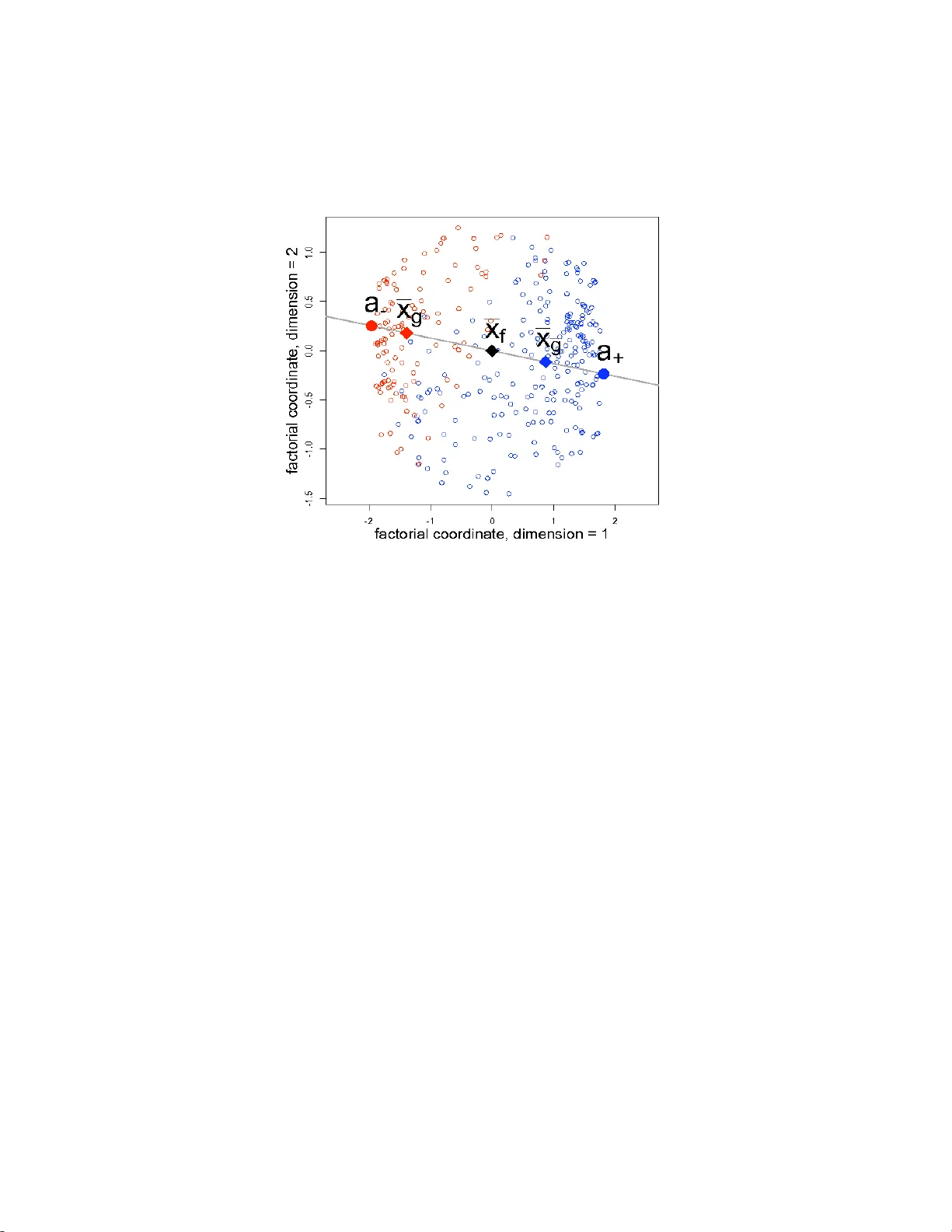
Stereot yp e bias: a simple formal mo del F ran¸ cois Ba v aud Departmen t of Computer Science and Mathematical Metho ds Departmen t of Geog r aph y Univ ersit y of Lausanne, Switzerland Abstract Minimizing the relative inertia of a s tatistical gr oup with resp ect to the inertia o f the ov erall sa mple defines an unique point, the in- fo cus, which constitutes a cont ext-dep endent measure o f typical g roup tendency , biased in comparison to the gr oup cen troid. Ma ximizing the relative inertia yields an unique out-fo cal p oint, p olariz ed in the reverse direction. This mechanism evokes the relative v a riability reduction of the o utgroup rep orted in Soc ial Psychology , and the stereotypic- like b ehavior of the in-fo cus, whose bias v anishes if the outgroup is constituted of a single individual. In this picture, the o ut- fo c us plays the role o f a n a nti-stereotypical p o s ition, iden tical to the in-fo cus of the complementary group. Keyw ords: an ti-stereot yp e, cen tral tendency , con text-dep endent p o- larizatio n , Huygens principles, metacon trast ratio, outgroup homogeneit y , relativ e disp ers ion, stereot yp e bias, v ariabilit y redu ction 1 In tro duc tion The expression “typic al fe a tur es of a gr oup” is am biguous: it migh t either refer to a multiv ariate ind icator of group cen tral tendency , that is to an u n- biased gr oup c entr oid , or to the distinctiv e, un iqu e charact eristic tend encies of the group, con trasting the features observed in the other groups or in the complete sample, in wh ic h case it constitutes a caricatural ster e ot yp e . A stereot yp e s ummarizes the features of a w h ole group in to a single profile (v ariabilit y reduction). Its profile is generally distinct from the group cen troid, pus hed aw a y from the o v erall cent roid of th e whole p opulation or con text under consid eration (bias or p olarization). 1 These t w o c haracteristics of stereot yp y ha v e b een largely r ep orted in So cial Psyc hology , in particular w ith r eference to the outgroup: 1) p eople tend to minimize the d ifferences b et wee n outgroup mem b ers, while b eing inclined to p erceiv e their own group as made of an het- erogeneous set of unique individu als ( outgr oup r elative homo geneity ): “They all look alik e but we d on’t”. See e.g. Quattrone and Jones (1980 ), T a ylor et al. (1978), Park and Hastie (1987), Mullen and Hu (1989 ), and references therein. 2) p eople tend to exaggerat e the t ypical traits of the outgoup, and to enhance the con trasts b etw een mem b ers of different group s ( ster e otyp e p o larization or bias effe ct ). See e.g. T ur ner (1975), Hopkin s and Cable (2001 ), Hogg et al. (2004), Realo et al. (2009), and references therein. This pap er presents a simple, formal, pr in cipled mec hanism linking the t w o aforement ioned asp ects of stereot yp y . Sp ecifically , w e sho w that min i- mizing the r elative gr oup disp ersion defines an uniqu e p oin t in the feature space, called the in-fo cus (Theorem 1), manifesting the exaggerati on or p o- larizatio n effect exp ected from a stereot yp e (Theorem 2). The p olarization can b e qualified as fair , in the sense it v anishes for a group formed of a single in dividual, which thus coincides with its own stereot yp e. Increasing the group disp er s ion in creases the p olarization effect, as sho wn b y (4 ) and (6). F urthermore, maximizing the relativ e group d isp ersion yields another unique p oint conjugate to th e in-fo cus, the out-f o cus , b earing the c haracter- istics of an anti -stereot yp e or antityp e . Th e group out-fo cus coincides with the in-fo cus of the c omplementa ry gr oup (Theorem 3), as illustrated on the U.S. Congressmen d ata (S ection 2.4). Section 3 attempts to ju stify the p osition of the in-fo cus in a decision- theoretical setup, and un derlines the connections with the meta-c ont r ast mo del and simulations of Salzarulo (2006), w h ose w ork initially triggered the present researc h. 2 The formal mo del 2.1 Definitions and notations: Huygens principle Consider a totalit y n ind ividuals, den oted i = 1 , . . . , n , c haracterize d by a m ultiv ariate pr ofi le of p features x ik with k = 1 , . . . , p . These features defi n e 2 a squared Euclidean distance b et wee n individu als D ij = p X k =1 ( x ik − x j k ) 2 i, j = 1 , . . . , n . (1) F or generalit y sak e, we assu me that individuals p ossess weights f i > 0, with P n i =1 f i = 1. The un iform weig hting obtains as f i = 1 /n . Also, consid er a profile a ∈ R p , which migh t or might not corresp ond to the features of an existing ind ivid ual. Huygens p rinciple consist of the identitie s ∆ a f = n X i =1 f i D ia = ∆ f + D f a ∆ f = 1 2 X ij f i f j D ij (2) where ∆ a f is the inertia r elativ e to the reference p oint a , D f a is the squared distance b et wee n the p oin t a and the cent roid ¯ x f = P i f i x i , and ∆ f = ∆ ¯ x f f is the inertia relativ e to the centroid. In particular, (2) sho ws that ∆ a f attains its min im um ∆ f for a = ¯ x f . No w consider a group g of individuals. A group is sp ecified by the individuals it conta ins, th at is, in full generalit y , by a d istribution g i ≥ 0 with P n i =1 g i = 1. In most situations, th e supp ort of g (that is the set of individuals for wh ic h g i > 0) is a str ict subset of the complete set of the n individuals, bu t this r estriction is n ot n ecessary . W e how ev er assume that the grou p centroi d ¯ x g = P i g i x i differs fr om the ov erall cen troid ¯ x f , th at is D f g > 0. As b efore, ∆ a g tak es on its minimum v alue ∆ g for a = ¯ x g . 2.2 The r elative disp ersion Definition 1 (Relative disp ersion) The relativ e disp ersion of gr oup g in c ontext f , r elatively to the r efer e nc e p oint a is δ ( a ) = δ ( a | g , f ) = ∆ a g ∆ a f = ∆ g + D g a ∆ f + D f a . (3) The relativ e disp ersion measures the disparit y or heterogeneit y in group g , in units determined b y the ov erall heterogeneit y , as assesse d fr o m some r efer enc e p oint of view a . V arying the p oint of view enables to tun e, w ith in some limits, the apparent, p erceiv ed relativ e heteroge neity of the group g . Remark ably enough, the relativ e disp ersion δ ( a ) is finite ev erywhere, and p ossesses an uniqu e m inim um a − as we ll as an unique maxim um a + : 3 Figure 1: Ab scissa: absolute co ordinates a and relativ e co ordinates ǫ , along the line (4) p assing thr ough the group cen troid ¯ x g (asso ciated to the b lac k ob jects) and th e ov erall centroid ¯ x f (asso ciated to the blac k and white ob- jects). O rdinate: the relativ e disp ersion δ ( a ) is minimum for the in-fo cu s p oints a − , m axim um for th e out-fo cus p oints a + , an d tends to un it y as ǫ → ±∞ . Theorem 1 (In- and out-fo cus p oin ts) Both the in-fo cus p oin t a − min- imizing δ ( a ) , and the out-fo cus p oin t a + maximizing δ ( a ) ar e unique, and given by a ± := a ( ǫ ± ) , with a ( ǫ ) := ¯ x f + ǫ ( ¯ x f − ¯ x g ) ǫ ± = 1 2 D f g ( b f g ± q b 2 f g + 4∆ f D f g ) (4) wher e b f g := ∆ f − ∆ g − D f g . By theorem 1, th e in- and out-fo cus p oint s lie on the line j oinin g centroi d s ¯ x f and ¯ x g . In-fo cus p olarizatio n o ccurs if a − lies “on ¯ x g side”, that is if ǫ − ≤ − 1, as in Figure 1. S imilarly , out-fo cu s p olarization o ccurs if a + lies “on ¯ x f side”, that is if ǫ + ≥ 0. Theorem 2 insures this to b e alw a ys the case. Theorem 2 (P olarization) In- and out-fo cus p oints a ± fal l outside the interval [ ¯ x g , ¯ x f ] , as in figur e 1. Sp e cific al ly, ǫ − ≤ − 1 0 < ǫ + ≤ ∆ f D f g (5) wher e b oth ine qualities ar e attaine d iff ∆ g = 0 , as in the c ase of a singleton, 4 disp ersion-fr e e g r oup . F or smal l ∆ g , ǫ − = − 1 − [ 1 ∆ f + D f g ] ∆ g + 0(∆ 2 g ) (6) ǫ + = ∆ f D f g − [ ∆ f D f g (∆ f + D f g ) ] ∆ g + 0(∆ 2 g ) (7) Pro ofs : let e := k ¯ x f − a k b e fi xed, and consider the angle α b et we en ¯ x g and a as measured fr om ¯ x f . By th e cosine theorem, ∆ g + D g a ∆ f + D f a = ∆ g + D f g + e 2 − 2 p D f g e cos α ∆ f + e 2 whic h is maxim u m for α = 180 ◦ and minim um for α = 0 ◦ . In b oth cases, the extrem um a lies on the line passing thr ough ¯ x g and ¯ x f , i.e. is of the form a ( ǫ ) in (4), with relativ e disp ersion (∆ g + D f g ( ǫ + 1) 2 ) / (∆ f + D f g ǫ 2 ). Setting to zero its deriv ative in ǫ y ields D f g ǫ 2 − b f g ǫ − ∆ f = 0, with solutions ǫ ± (with the correct sign) giv en by (4). F urthermore, it is easy to s h o w that, for D f g and ∆ f fixed, b oth expressions ǫ − and ǫ + are decreasing in ∆ g , and tak e on their maxim um v alue (5) f or ∆ g = 0. 2.3 Other expressions The follo wing features-based expression may b e computationally useful: a ± = X i α i ( ǫ ± ) x i α i ( ǫ ) := (1 + ǫ ) f i − ǫg i . (8) α ( ǫ ) is a signe d distrib u tion, that is n ormalized to u nit y bu t not necessarily non-negativ e. Also, twic e application of Huygens decomp osition (or d irect m anipula- tion of the features) d emonstrates the distance-based id en tities D f g = − 1 2 X ij ( f i − g i )( f j − g j ) D ij b f g = X ij f i ( f j − g j ) D ij . Finally , define the squar e d p olarization r atio as D a − a + D f g = ( ǫ + − ǫ − ) 2 = (1 + ∆ f + ∆ g D f g ) 2 − 4 ∆ f ∆ g D 2 f g ≥ 1 whic h sh o ws the p olarizatio n to increase with eac h of the inertias ∆ f and ∆ g . In particular, th e p olarizatio n ratio tak es on its minimum v alue u n it y iff ∆ g = ∆ f = 0, and a − = ¯ x g iff ∆ g = 0, as sho wn by (5). 5 2.4 Illustration: U.S. Congressmen In the legislature 1984, a num b er of p = 16 “k ey v otes” f rom n = 435 US Congressmen, comprisin g n R = 168 Republicans and n D = 267 Demo crats, ha v e b een co ded as 1 (“ye a”) or 0 (“na y”) 1 . Missing v alues ha ve b een replaced by the a verag e v alue inside the affiliated p olitical group. The o v erall, Repu blican and Demo crat distributions read resp ectiv ely as f i = 1 n g i = I ( i ∈ R ) n R ¯ g i = I ( i ∈ D ) n D . (9) where I ( A ) denotes the characte ristic function of ev en t A . After computa- tion of the squared Euclidean distances (1) from the C ongressmen v otes, a classical m ultidimensional scaling (MDS) has b een p erformed with uniform w eigh ting of the individ uals (see e.g. Mardia et al. 1979) to obtain th e fac- torial co ordinates expressing a maxim um amount of the o v erall disp ersion ∆ f (Figure 2). With D f g = 1 . 98, ∆ f = 3 . 67 and ∆ g = 1 . 89 , the p olarization ratio is | ǫ + − ǫ − | = 2 . 72. 2.5 Complemen tary group By constru ction (S ection 2.2), the in -fo cus a − is the p oin t of view un der whic h group g app ears, relativ ely to the gr ound or c ontext formed b y the complete set of individu als f , as homo gene ous as p o ssible , and tur ns out to constitute a credible candidate for rep resen ting a stereot ypical v alue. By con trast, the out-fo cus a + is the p oint of view maximally r esp ectful of the features div ersit y in g , and b eha ve s as an antityp e - in the sense of “an ti- stereot ypical”. In the example of Figur e 2, the out-fo cus a + of the Republicans s eems to b e equally qu alified to repr esen t the in-fo cus of the Demo crats (not dra wn on the Figure). As a matter of fact, the t wo p oints c oincide , as justified b y Definition 2 and Th eorem 3 b elo w. Definition 2 The gr oup complemen tary to gr oup g in c ontext f is define d by a norme d distribution ¯ g , which, mixe d with g , r epr o duc es f , in the sense ρg + (1 − ρ ) ¯ g = f , or e quivalently ¯ g i = f i − ρg i 1 − ρ for some ρ ∈ (0 , ρ max ] with ρ max := min i ( f i /g i ) . (10) 1 http://a rchive. ics.uci.edu/ml/mac hine- learning-databases/v oting-records/ 6 Figure 2: First MDS co ord inates obtained from the squared distances b e- t w een U.S. Congressmen (legislature 1984) , expressing 58% of the o v erall disp ers ion ∆ f . Red circles depict the p ositions of the Republicans, and blue circles th ose of the Demo crats. ¯ x f is th e o verall cen troid, ¯ x g is th e Repub - licans cen troid, ¯ x ¯ g is th e Demo crats cen troid. a − is th e in-fo cu s relativ e to the Repub licans, and a + the corresp on d ing out-fo cus; see also Section 2.5. The definition of ρ max insures the non-negativit y of ¯ g . F or ins tance, the Demo cr ats group ¯ g in (9) is complemen tary to the Rep u blicans group g since ρg + (1 − ρ ) ¯ g = f with ρ = n R /n = . 39, which tur ns out to b e equal to its maxim um v alue ρ max . Theorem 3 The out-fo cus p o int a g + for gr oup g is the in-f o cus p oint a ¯ g − of any gr oup ¯ g c omplementa ry to g . Pro of: substituting f = ρg + (1 − ρ ) ¯ g in (2) an d dev eloping the first iden tit y demonstrates ∆ a f = ρ (∆ g + D g a ) + (1 − ρ )(∆ ¯ g + D ¯ g a ), that is ρ δ ( a | g , f ) + (1 − ρ ) δ ( a | ¯ g , f ) = 1. Hence, ρ , f and g b eing fixed , maxi- mizing δ ( a | g , f ) amoun ts in minimizing δ ( a | ¯ g , f ). 7 Note the identit y δ ′ ( a ) = δ ( a | g , ¯ g ) = ∆ a g ∆ a ¯ g = 1 − ρ ∆ a f ∆ a g − ρ (11) whic h d emonstrates that extremalizing the r elativ e disp ersion δ ( a ) = δ ( a | g , f ) or its v arian t δ ′ ( a ) yields the same solutions. 3 F urther connections 3.1 Decision theory The follo wing argumen t constitutes a first attempt to w ards a deriv at ion of the in -fo cus in a decision-theoretica l framew ork. Consider the deci- sion rule “attribute individual i either to gr o up g with pr ob ability P ( g | i ) = exp( − β D ia ) or to the over al l set f with pr ob ability P ( f | i ) = 1 − P ( g | i ) ” , where β > 0 is a parameter cont rolling the d eca y of the exp onent ial and a a p oint to b e chose n wisely . The probabilit y of m isid en tifying an individual of g (miss) is P ( f | g ) = P i g i P ( f | i ), and the probabilit y of correctly identifying an ind ivid ual of f as suc h (correct rejection) is P ( f | f ) = P i f i P ( f | i ). In the limit of large sp read, the ratio of these quantitie s b ecomes lim β → 0 P (miss) P (co. re. ) = lim β → 0 P ( f | g ) P ( f | f ) = lim β → 0 β P i g i D ia + 0( β 2 ) β P i f i D ia + 0( β 2 ) = ∆ a g ∆ a f = δ ( a ) . In this cont ext, the p robabilit y of m iss is minimized by the group centroid ¯ x g , while the r atio of the probabilities “miss o ver correct rejection” is minimized b y the in-fo cus a − - a somewhat in triguing result to b e fu r ther inv estigat ed. 3.2 Subtractiv e com binations Instead of studying the relativ e disp ersion r atio (3), on e can consider the subtr active c ombinatio n of the form γ ( a ) = A ∆ a g − B ∆ a f A, B ∈ R . (12) If A + B 6 = 0, the tw o p arameters can b e n ormalized as A = 1 − λ and B = λ . F or λ 6 = 0 . 5, γ ( a ) p ossesses a unique b oun ded extremum at ǫ = ( λ − 1) / (1 − 2 λ ) (follo wing parameterizatio n (4)), wh ic h tur ns out to b e a minim um for λ < 0 . 5 an d a maxim um for λ > 0 . 5; no b oun ded extrem um exists for λ = 0 . 5. If A + B = 0, γ ( a ) p ossesses a un iqu e b ound ed extrem um 8 at the m id -p oint ǫ = − 0 . 5, wh ic h constitutes a minimum for A > 0 and a maxim um for A < 0. I n an y case, the p osition of the extrem um do es not dep end up on the disp ersions ∆ f and ∆ g . S im ilar r esults are obtained when replacing f b y ¯ g in (12). 3.3 Meta-con trast ratio and prototypicalit y function More in teresting, and considerably m ore inv olv ed is the stud y of th e follo w- ing fu nction, app earing in the framework of the self-c ate gorizatio n the ory (where groups are not giv en a p riori), prop osed by Salzarulo (2006), and referred to him (up to a sign) as the pr oto typic ality function : Γ( a ) = (1 − λ ) ∆ a g ( a ) − λ ∆ a ¯ g ( a ) λ ∈ [0 , 1] (13) Here g i ( a ) = exp( − β D ia ) / Z ( a ), where Z ( a ) is the norm alizati on constant: in this approac h, the v ery comp osition of group g d ep ends on the distance of its constituen ts to a . Also, ¯ g ( a ) is of the form (10) with ρ ( a ) = Z ( a ) /n < 1. The function (13) is prim arily mean t as an impro ved v arian t of the meta- c ontr ast r atio (Haslam and T urner 199 5; T urner et al. 1 987; Oake s et al. 1994) , measuring the relativ e differences b et ween individu als, and aimed at predicting to w hic h exten t a giv en individual will b e p erceiv ed as b elonging to the sub ject group . The h ighly non-linear p rop erties of of Γ( a ), w hose minima are int erpr eted as protot ypical p ositions, can b e bu ilt on to ru n dynamical numerical simula- tions exhibiting group s f ormation and destru ction, in the con text of opinion formation, for v arious v alues of λ and β . In particular, t wo agen ts initially catego rizing th emselv es as differen t can p erceiv e th emselv es as b elonging to the same grou p in p resence of a third agent distan t from them; also, fi t- ting exp erimental data is p ossible, as those of Haslam and T u rner (1995) , satisfactorily repro duced with λ = . 08 and β = 7 . 7, on a one-dimen s ional opinion space x ∈ [0 , 1] . See Salzarulo (2006) for more details. 4 Discussion and conclusion The mec hanism r elating the minimization of the relativ e disp ersion to the p olarization of th e in-fo cus is en tirely m athematical, and relev an t to the con- struction of statisticall y biased, con text-dep endent measures of cen tral (or “t ypical”) tendency . Ho wev er, the parallel with a few predominant themes of So cial Psy cholog y seems striking, and w e did not resist the temptation to in terpret the in-fo cus as a stereot yp e, and the statistical group g as an out- group. The exten t to wh ic h th e metaphor is legitimate is b e ju dged within 9 So cial Psyc hology . Among the p oint s p otenti ally stim ulating, let u s mentio n the question of the identific ation of the ingr oup , of wh ich b oth the cont ext f and the complemen tary ¯ g are legitimate candidates - with similar if not iden tical effects, in view of Th eorem 3 and (11 ). The form alism we ha ve used is b oth general, that is using w eigh ted groups allo wing fuzzy members h ips, and classical, that is using squared Eu - clidean distances as measures of dissimilarities. Eu clidean distances p ermit, in con trast to other dissimilarities, to extract the original features through MDS (up to a rotation in the features sp ace); they furth ermore add itiv ely decomp ose accordingly to Huygens principles, the use of whic h has b een crucial in the pr esen t pap er. Non-Euclidean dissimilarities, to wh ic h alternativ es measures of cen tral tendency are asso ciated, such as the trimmed mean or the median (e.g. Ham- p el et al. 1986 ), are p erfectly legitimate, and p ossibly b etter justified f orm robustness considerations. The resuting p olarization of the in-fo cus w ould certainly deserve prop er studies, whic h are ho wev er b oun d to b e tec hn ically more inv olv ed. References [1] Hamp el, F.R., Ronc hetti, E.M., R ou s seeu w, P .J., Stahel, W.A. (1986) Robust Statistics: The Appr oac h Based on Influ en ce F unctions, Wiley [2] Hasla m, S.A., T urner, J. C. (1995) Context-depend en t v ariation in so- cial stereot yping 3 : Extremism as a self-categ orical basis for p olarized judgement . Eur op ean Journal of So cial Psy cholog y 25, 341–371 [3] Hog g, M.A., Abrams, D., O tten, S., Hinkle, S. (2004) Th e So cial Id en tit y P ersp ectiv e: In tergroup Relations, Self-Conception, and Small Groups. Small Group Researc h 35, 246–27 6 [4] Hopkins, N., Cable, I. (2001) Group v ariabilit y judgments: In vesti gat- ing th e context -dep endence of stereot ypicalit y and disp ersal j udgment s. British Journal of So cial Psyc hology 40, 455–470 [5] Mardia, K.V., Kent, J .T ., Bibb y , J.M. (1979) Multiv ariate analysis. Aca- demic P ress [6] Mullen, B., Hu, L.-T. (1989) P erceptions of Ingroup and O utgroup V ari- abilit y: A Meta-Analytic In tegration. Basic and Applied So cial Psy chol- ogy 10, 233–2 32 10 [7] Oak es, P .J., Haslam, S.A., T ur ner, J.C. (1994) Stereot yping and so cial realit y . Blac kwe ll [8] P ark, B., Hastie, R. (198 7) P erception of v ariabilit y in catego ry devel- opmen t: Instance- versus abstraction-based stereot yp es. Journ al of Per- sonalit y and So cial Psyc h ology 53, 621–6 35 [9] Quattrone, G.A., Jones. E.E. (198 0) T h e Perce ption of V ariability Within In-Groups and Ou t-Groups: Implications for the La w of S mall Num b ers. J ou r nal of Personalit y and S o cial Psychol ogy 38, 141–1 52 [10] Realo, A., Allik, J ., L¨ onnqvist, J.-E., V erk asalo , M., K wiatk o wsk a, A., K¨ o ¨ ot, L., K ¨ utt, M., Bark auskiene, R., Laurinavic ius, A., Karp inski, K., Kolyshk o, A., S ebre, S., Renge, V. (2009) Mec hanisms of the national c haracter stereot yp e: How p eople in six neighbour ing countries of Rus- sia describ e themselves and th e t ypical Ru ssian. Europ ean J ournal of P ersonalit y 23, 229–24 9 [11] S alzarulo, L. (2006). A Contin uous Opinion Dynamics Mo d el Based on the Pr inciple of Meta-Con trast. Journal of Artificial So cieties and So cial Sim ulation 9(1)13 h ttp://jasss.so c.surrey .ac.uk/9/1/13 .html [12] T aylor, S .E., Fisk e, S.T., Etcoff, N.L., Ruderman, A.J. (1978) Categor- ical and Cont extual Bases of Person Memory and S tereot yping. Journ al of Personalit y and So cial Psyc hology 36, 778–7 93 [13] T u rner, J.C. (1975 ) So cial comparison and so cial identit y: Some prosp ects for group b eha vior. Europ ean Journal of So cial Ps yc hology 5, 5–34 [14] T u rner, J .C ., Hogg, M.A., Oak es, P .J., Reic her, S. D. W etherell, M.S. (Eds.) (1987) Redisco vering the so cial group : A self-catego rization the- ory . Blac kw ell. 11
Original Paper
Loading high-quality paper...
Comments & Academic Discussion
Loading comments...
Leave a Comment